


The existence of an ‘official opposition’, conventionally formed by the second-largest parliamentary party, is characteristic of Westminster systems (Helms Reference Helms2004; Kaiser Reference Kaiser2008; Michaud Reference Michaud2000; Russell and Serban Reference Russell and Serban2021: 752). Members of the opposition frontbench ‘shadow’ ministerial portfolios and constitute a formalised alternative government or ‘executive in waiting’ (Rhodes et al. Reference Rhodes, Wanna and Weller2009: 206). In the legislative arena, shadow ministers take the lead in questioning ministers and challenging their proposals (Bateman Reference Bateman2009; Fletcher Reference Fletcher2024; Punnett Reference Punnett1973).Footnote 1 In the electoral arena, they develop policies and try to persuade voters to give them the opportunity to govern (Jennings Reference Jennings1957: 171). If they succeed, it is a ‘convention’ (Berlinski et al. Reference Berlinski, Dewan and Dowding2012: 37) or informal ‘rule’ (Eggers and Spirling Reference Eggers and Spirling2018: 343) that the opposition frontbench forms the basis of the new executive.
This convention is part of a set of institutions and practices that underpin Westminster-style majoritarian democracy and the model of responsible party government associated with it (Lijphart Reference Lijphart2012; Mair Reference Mair2009; Powell Reference Powell2000; Ranney Reference Ranney1954; Rhodes et al. Reference Rhodes, Wanna and Weller2009). The expectation of ministerial office incentivises discipline among shadow ministers and fosters cohesive, ‘responsible’ parties capable of announcing and passing legislative programmes (Cox Reference Cox2024). It also promotes ‘identifiability’ in elections by designating who comprises the main alternative to the incumbent government (Powell Reference Powell2000: 71–6). It could even be argued – consistent with ideas about ‘promissory representation’ and ‘mandates’ (Mansbridge Reference Mansbridge2003; Powell Reference Powell2000: 7–13) – that winning an election obliges a prime minister to appoint ministers from among members of the party’s pre-election frontbench.
On a more practical level, frontbench continuity is thought to facilitate effective transitions from opposition to government (Dalton and Barr Reference Dalton and Barr2023; Norris et al. Reference Norris, Haddon, Worlidge, Owen and Paxton2024: 39; Punnett Reference Punnett1973: 383–384; Riddell and Haddon Reference Riddell and Haddon2009; Tiernan and Weller Reference Tiernan and Weller2010: 75; cf. Powell Reference Powell2010: 24). Other things being equal, new ministers who have shadowed their portfolio should have a clearer sense of what they want to achieve and be better placed to direct civil servants (Annesley et al. Reference Annesley, Beckwith and Franceschet2019: 125; Barber Reference Barber2007: 29; Hennessy Reference Hennessy1989: 291; Riddell Reference Riddell2019: 44).
Despite its recognised importance in Westminster systems, the topic of frontbench continuity when parties enter government has received limited scholarly attention. The expectation that the opposition forms the next executive if it wins power is highly generalised and primarily institutional. It is silent on individual continuity and how closely the new government should mirror the former opposition frontbench. Existing accounts suggest many shadow ministers are appointed to ministerial office if not always with the same policy responsibilities they held in opposition (Annesley et al. Reference Annesley, Beckwith and Franceschet2019: 125; Berlinski et al. Reference Berlinski, Dewan and Dowding2012: 37; Brazier Reference Brazier1997: 58; Dalton and Barr Reference Dalton and Barr2023; Punnett Reference Punnett1973: 369–378; Tiernan and Weller Reference Tiernan and Weller2010: 35). What is missing, however, is any systematic analysis across governments of when and why shadow ministers have become what one study called ‘realities’ (Turner Reference Turner1969: xvi).
We address this gap by investigating opposition-to-government frontbench continuity in the UK, the ‘classic’ Westminster model of opposition (Uhr Reference Uhr, Kane, Patapan and t’Hart2009). Our analysis is organised around three research questions. The first is descriptive: How many shadow ministers have been appointed to the position they had previously shadowed – which we term ‘portfolio continuity’ – or to any ministerial office – which we term ‘personal continuity’ – in newly formed governments? The second focuses on government-level continuity: Why do levels of continuity vary across new governments? The third research question focuses on continuity at the individual level: What factors shape the likelihood that a given shadow minister retains their portfolio or remains on the frontbench?
We consider government- and individual-level explanations of continuity separately for conceptual and methodological reasons. Continuity may reflect structural or contextual factors that shape multiple ministerial appointments simultaneously, or it may reflect personal factors that affect particular appointments. Assessing their respective importance requires distinct analytical strategies. We analyse government-level explanations using aggregate patterns across seven new governments, although our inferences are somewhat tentative given the small number of cases. We test individual-level explanations through several exploratory hypotheses using minister-specific data. This dual-level approach disentangles structural and personal drivers of continuity, providing a clearer understanding of when and why shadow ministers are retained or replaced.
We draw on an original dataset of 442 opposition frontbench MPs in post ahead of the 1964, 1970, February 1974, October 1974, 1979, 2010 and 2024 general elections. These seven elections cover all wholesale changes in the party of government in the UK since shadow portfolios started being formally assigned to named individuals in 1955. The dataset includes members of the shadow cabinet – the most senior frontbenchers – and shadow ministers outside it. While shadow cabinet members are typically more prominent, all shadow ministers form part of the ‘executive in waiting’ and may contribute to policy development (Heseltine Reference Heseltine2000: 181). Including all shadow ministers not only recognises the governmental importance of junior ministers – especially in the UK where they greatly outnumber cabinet ministers – but also enables us to examine whether party seniority increases the likelihood of retaining a portfolio or any frontbench position.
We find that over four-fifths of shadow ministers were appointed to incoming governments, but only around half were appointed to the portfolio they had been shadowing. At the government level, prime ministers’ idiosyncratic choices shaped overall frontbench continuity, but we identify several party and electoral factors that likely constrained and systematically shaped those choices. At the individual level, we find no evidence that prime ministers retained their supporters in greater numbers, but seniority, prior ministerial experience and time served in an opposition post were closely associated with portfolio continuity. Put simply, the longer a leader stuck with a shadow minister in opposition, the more likely they were to appoint them to the corresponding job in government. These findings provide new insights into UK government formation and serve as a reference point for future comparative research.
The opposition as alternative government
The ‘classic’ Westminster model of parliamentary opposition, in which the minority party in a two-party system forms the official opposition, originated in the UK (Johnson Reference Johnson1997; Uhr Reference Uhr, Kane, Patapan and t’Hart2009). While the majority party in the House of Commons forms the government and enacts its programme, the minority party challenges it and exists as an alternative ‘government in waiting’ (Harvey and Bather Reference Harvey and Bather1966: 152–153). When the government loses an election, the two parties swap places.
Since 1922, Labour and the Conservatives have dominated UK general elections and enjoyed an effective duopoly over both government and opposition (Bartle et al. Reference Bartle, Allen, Quinn, Poguntke and Hofmeister2024). In recent years, the party system’s fragmentation has spread the work of parliamentary opposition. Yet the smaller opposition parties do not enjoy the same rights in parliament or levels of financial support as the official opposition (Fletcher Reference Fletcher2024). Only very occasionally is a third party regarded as a credible alternative government.
The official opposition’s status as a government in waiting became institutionalised in the form of the ‘shadow cabinet’ during the nineteenth century (Cox Reference Cox2024; Eggers and Spirling Reference Eggers and Spirling2018; Johnson Reference Johnson1997; Turner Reference Turner1969). Its members were typically former ministers drawn from the outgoing cabinet who took the lead in parliament in opposing the new ministry. But early shadow cabinets were generally smaller and less clearly defined by current standards, nor was membership a full-time commitment. Rather, shadowing arrangements ‘were unofficial and largely unannounced, and were essentially informal and casual’ (Punnett Reference Punnett1973: 63).
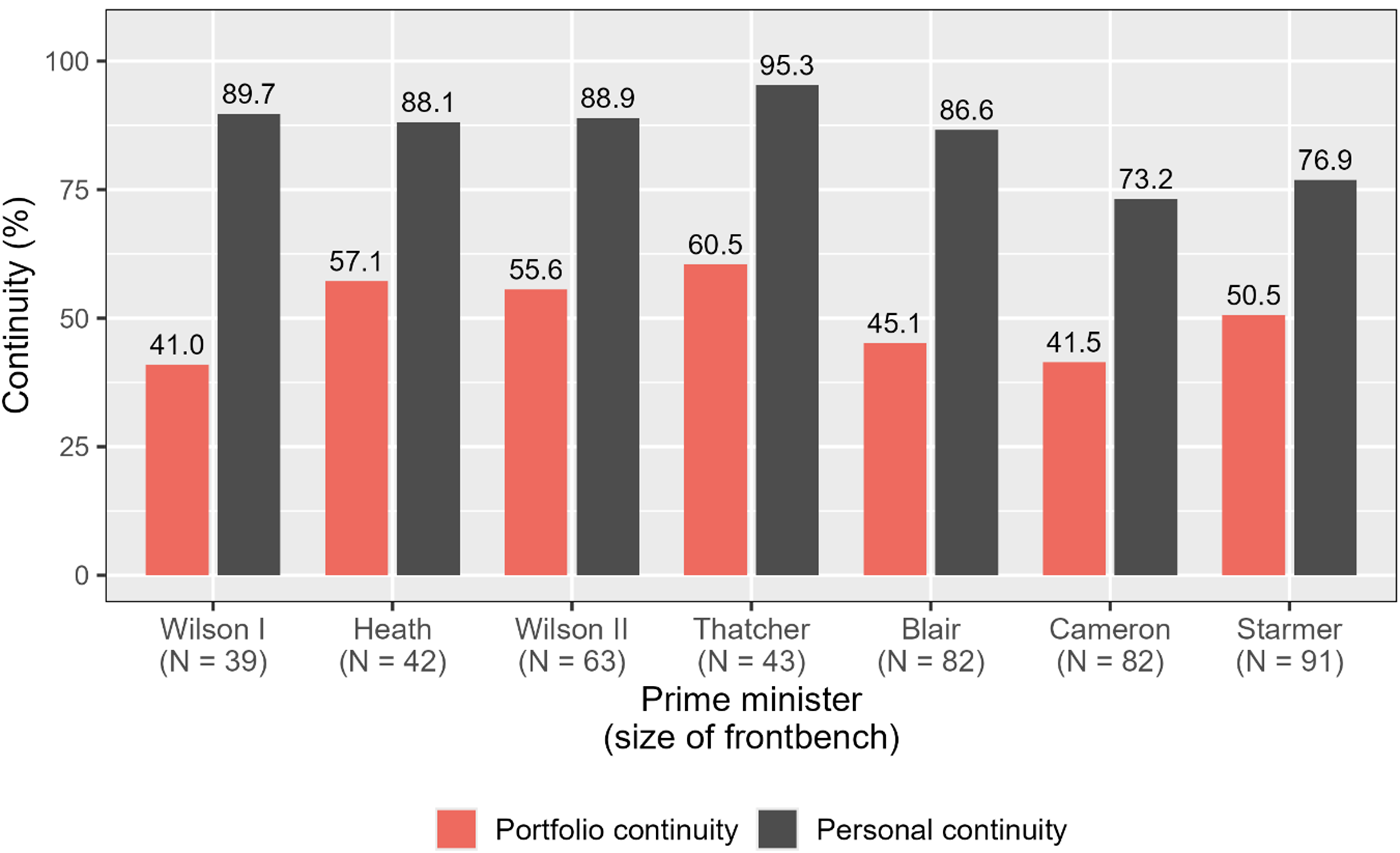
Parliamentary opposition became increasingly professionalised during the twentieth century. The Ministers of the Crown Act 1937 formally defined the position of ‘Leader of the Opposition’, and granted its holder an official salary. Nearly two decades later, in 1955, Clement Attlee, then leader of the opposition, started allocating specific portfolios to members of his shadow cabinet and appointing additional spokespersons to assist them (Punnett Reference Punnett1973: 59). Henceforth, named individuals were responsible for shadowing distinct areas of government activity – and there were more of them doing so (Punnett Reference Punnett1973: 318). This development not only strengthened the opposition’s ability to scrutinise the government; it also extended the reach of collective responsibility – the norm that frontbenchers must support party policy or quit their post – and made the frontbench a more obvious ‘team of potential ministers’ (Fletcher Reference Fletcher2024: 110). Subsequent leaders of the opposition have tended to appoint ever larger shadow teams. Ahead of the 2024 general election, Keir Starmer’s opposition frontbench included 91 MPs (see Figure 1), a fully staffed shadow government.
Portfolio and Personal Continuity (%) across the Frontbench

The question of who gets to serve on the opposition frontbench and in what capacity has varied by party and over time. Conservative leaders have long enjoyed the right to appoint and dismiss shadow ministers (Heffernan Reference Heffernan2014). Their only constraints – which can be significant – are political considerations and the availability of suitable MPs and peers. Labour leaders, by contrast, were once obliged to share their powers with other MPs. Until 2011, party rules stipulated annual elections to Labour’s shadow cabinet, officially the Parliamentary Committee, when the party was in opposition (Fletcher Reference Fletcher2024: 118–119). Leaders could still allocate portfolios and appoint other frontbenchers, but they had to work with those MPs elected to the Parliamentary Committee. That requirement has since been lifted. Labour leaders are now free to appoint almost the entire opposition frontbench.Footnote 2
The criteria that influence leaders’ decisions about potential shadow appointments broadly mirror those that influence ministerial appointments in government (Kam et al. Reference Kam, Bianco, Sened and Smyth2010; see Berlinski et al. Reference Berlinski, Dewan and Dowding2012: 37–42; King and Allen Reference King and Allen2010: 254–258). They include MPs’ standing in the party, their ability to perform in the House of Commons, on the campaign trail and in media interviews, their political value to the leader, and their compatibility with current party policy. As evidenced by their memoirs, leaders of the opposition are also mindful of MPs’ (anticipated) governmental competence and the frontbench’s overall gender, regional, factional, and/or ideological balance (Cameron Reference Cameron2019: 93, 110, 137–138; Thatcher Reference Thatcher1995: 282, 319–320, 418).
Most opposition leaders periodically reshuffle the membership of the frontbench and the allocation of portfolios. As in government, reshuffles reinforce party discipline by incentivising loyalty (Indriðason and Kam Reference Indriðason and Kam2008; Kam and Indriðason Reference Kam and Indriðason2005). They may also be reactive or proactive (see Helms and Vercesi Reference Helms and Vercesi2024). Leaders may need to plug gaps or remove underperforming colleagues. They may also wish to promote allies, sideline opponents, appoint talented younger colleagues, strengthen the frontbench’s effectiveness in parliament and/or broaden the party’s wider appeal. Leaders typically avoid extensive reshuffles immediately prior to a general election. If the opposition frontbench is to present itself as a credible alternative government, shadow ministers need time to establish themselves and gain relevant policy experience (Heath Reference Heath1998: 282).
Frontbench continuity into government
Despite being presented as a government in waiting, the opposition frontbench does not automatically become the new government en bloc when the party wins a general election. It is the prime minister who decides who to appoint and in what capacity. UK prime ministers face comparatively few constraints in this regard (King and Allen Reference King and Allen2010; Seldon Reference Seldon2021: 147–148; Weller Reference Weller2018). Other than the convention that ministers must sit in parliament and legal caps on the number of ministerial salaries, prime ministers are formally free to retain, move or discard frontbenchers as they see fit.Footnote 3
Our first research question asks: How many shadow ministers have been appointed to the position they had previously shadowed (portfolio continuity) or to any ministerial office (personal continuity) in newly formed governments? We focus on the period since 1955, when named frontbenchers were first allocated specific responsibilities. There have been seven wholesale changes in the party of government during this time. These changes include the formation of the 1964, 1974, 1997 and 2024 Labour governments; the 1970 and 1979 Conservative governments; and the 2010 Conservative-dominated coalition government. We include in our analysis all shadow ministers from the pre-election official opposition in the House of Commons.Footnote 4 We exclude whips, who perform an essentially parliamentary role, and the leader, who customarily becomes prime minister. We also exclude shadow ministers in the House of Lords. They have tended to hold multiple portfolios on a part-time basis.
We identified a total of 442 shadow ministers from contemporary newspaper reports, Stenton and Lees (Reference Stenton and Lees1981) Who’s Who of British Members of Parliament, and archived party websites. Opposition portfolios generally mirrored those in government, including a distinction between (shadow) cabinet-level heads of department and junior (shadow) ministers responsible for specific areas of policy. To measure continuity, we obtained details of ministerial appointments from Butler’s and Butler’s (Reference Butler and Butler2000) British Political Facts, contemporary newspaper reports and official lists of ministerial responsibilities. New ministers assigned broadly the same position and responsibilities they had shadowed in opposition were categorised as instances of portfolio continuity. We included in this category several cases where individuals retained their responsibilities but were given additional duties, or when shadow ministers with two or more distinct portfolios were allocated just one of them in government. Anneliese Dodds, who had been Labour Party chair and the shadow women and equalities secretary before the 2024 general election, was coded as a case of portfolio continuity because Keir Starmer appointed her as minister for women and equalities in his cabinet. Instances of personal continuity were easier to code. These occurred when the prime minister appointed a shadow minister to any government position.Footnote 5
Across all incoming governments since 1964, prime ministers appointed 49.3% of the 442 shadow ministers to the portfolio (or one of the portfolios) they had shadowed, and 83.7% to any government position. As Figure 1 shows, Margaret Thatcher’s government saw the highest portfolio (60.5%) and personal continuity (95.3%). The lowest portfolio continuity occurred in Harold Wilson’s first government (41.0%), whereas personal continuity was lowest in David Cameron’s (73.2%) government.
Levels of personal continuity are consistently higher because portfolio retention is a sufficient condition for staying on the frontbench, whereas the latter does not guarantee the former. Political and practical considerations almost certainly exacerbate the gap between the two measures. From a party-management perspective, sacking a frontbencher is always riskier than moving them. As prime ministers know, dismissals can lead to grievances on the backbenches and rebellious behaviour (Blair Reference Blair2010: 19; Cameron Reference Cameron2019: 136; see also Benedetto and Hix Reference Benedetto and Hix2007). More positively, personal continuity enables existing ‘relations of trust and loyalty’ between frontbenchers to be imported into government (Annesley et al. Reference Annesley, Beckwith and Franceschet2019: 135).
From a practical perspective, incoming governments can only draw on a limited supply of ‘ministrable’ MPs – those who are known to be administratively and politically competent and who possess an acceptable policy reputation (Laver and Shepsle Reference Laver and Shepsle2000: 114–115). For obvious reasons, most of a party’s ministrable MPs have likely been appointed to the frontbench when in opposition. Incoming prime ministers have little incentive to replace them in large numbers. The government’s newly elected MPs, by contrast, will be relatively unknown quantities. Prime ministers may still appoint them, but most new MPs will be willing to wait their turn for office, reducing the need to make space for them by omitting incumbent frontbenchers (Cowley Reference Cowley2005: 41–42).
Paradoxically, the limited supply of ministrable MPs likely suppresses portfolio continuity just as it incentivises personal continuity. If a prime minister needs or wishes to reallocate even a few portfolios, they are likely to reallocate many more. Moving one frontbencher usually requires moving another to replace them, and then another in turn. Even one change can trigger a wave of further changes within the existing frontbench.
Explaining variation at the government level
We now turn to our second research question: Why do levels of continuity vary across new governments? Answering this question is far from straightforward. One general difficulty is that we have only seven cases. This makes it extremely difficult to estimate the impact of potential causal factors. Another difficulty is the lack of reliable information about most ministerial appointments. Prime ministers’ memoirs and other first-person accounts are usually partial and possibly self-serving.
A third difficulty is that part of the variation in continuity across governments is likely to be random noise. Government formation is complex. Outcomes are dependent on the interaction of many idiosyncratic decisions made by prime ministers and others, often in haste. Mistakes or miscalculations are a possibility. Even long-planned decisions may contribute to non-systematic variation. Across the seven new governments in our data, two prime ministers immediately revised the machinery of government. Harold Wilson, when he took office in 1964, created several new Whitehall departments, including a Department of Economic Affairs (Wilson Reference Wilson1971: 3–9). One of Tony Blair’s first decisions in 1997 was to create a new ‘super’ Department for Environment, Transport and the Regions as a base for John Prescott, Labour's deputy leader (Prescott Reference Prescott2008: 212–213). In both cases, the new departments necessitated the reassignment of some existing frontbench responsibilities. Portfolio continuity was almost inevitably affected.
Specific circumstances, including internal party dynamics inherited from opposition, add to the non-systematic variation. So do prime ministers’ preferences. In 1970, Edward Heath appointed Reginald Maudling as home secretary, while Quintin Hogg, who had shadowed the role, instead became lord chancellor. When Wilson returned to office in 1974, he appointed Barbara Castle from the backbenches as secretary of state for health and social security, bypassing John Silkin, who had held the shadow portfolio. In 1979, Margaret Thatcher appointed Lord Carrington as foreign secretary instead of Francis Pym, the shadow foreign secretary, and made Peter Walker – a leading ‘wet’ on the Conservative backbenches – her agriculture minister. In 2010, David Cameron surprised many by appointing Iain Duncan Smith, a former party leader, as work and pensions secretary, and Theresa May – who had shadowed that role – as the home secretary. In 2024, Keir Starmer transplanted almost his entire shadow cabinet directly into government, but appointed Richard (Lord) Hermer, a lawyer from outside parliament, as attorney general in place of the incumbent shadow, Emily Thornberry.
None of these changes were inexplicable. Heath wanted Maudling to have a senior departmental role in his new government (Heath Reference Heath1998: 310). Wilson had a strong personal affection for Castle (Pimlott Reference Pimlott1992: 337). He wanted her in his cabinet. Thatcher respected Carrington and wanted to limit Pym’s status, and she included Walker to accommodate her party’s left wing (Moore Reference Moore2013: 429; Thatcher Reference Thatcher1993: 26–27). Cameron appointed Duncan Smith to accommodate his party’s right wing, and he wanted a woman in one of the top jobs for the sake of gender balance (Cameron Reference Cameron2019: 137–138; D’Ancona Reference D’Ancona2013: 25; Fall Reference Fall2020: 83). Starmer presumably valued Hermer’s legal skills. In each case, however, the new prime minister exercised power in idiosyncratic ways, resulting in a variable number of changes.
Shadow ministers’ preferences, too, have affected continuity. As the consistently high levels of personal continuity attest, most MPs are seemingly grateful for any ministerial job. In some cases, however, shadow ministers have declined lesser roles when offered them. After Thatcher offered John Peyton – who held the shadow agriculture portfolio – a non-cabinet post, ‘He turned her down in a matter of seconds, and went off into a business career’ (Cosgrave Reference Cosgrave2006). When Derek Foster, Blair’s shadow chancellor of the Duchy of Lancaster, was offered a more junior post, he initially accepted before resigning in indignation 3 days later (Abrams Reference Abrams1997).Footnote 6
Very occasionally, an insistent shadow minister may persuade a prime minister not to move them. In 1979, Thatcher asked Michael Heseltine, her shadow environment secretary, to be the new energy secretary. Ironically, Heseltine had accepted the environment portfolio in opposition on the condition he could have a different job in government (Heseltine Reference Heseltine2000: 177, 186). He now preferred the environment portfolio. Thatcher, wary of Heseltine's ambition, gave in (Moore Reference Moore2013: 429–430).
Party and electoral factors
Although some variation in frontbench continuity is contingent on individuals’ idiosyncratic choices, party and electoral factors also systematically structure the choice set – the pool of ministrable MPs – available to prime ministers when forming governments. We examine three party and three electoral factors drawing on first-hand accounts, secondary sources and our data. While we cannot estimate their effects with statistical precision, the evidence suggests that some factors promote continuity, whereas others constrain it. Beyond shedding light on the causes of government-level continuity in the UK, this approach can inform future research, as these factors may be generalisable to other national contexts.
Party factors influence continuity by shaping the choice set prior to elections. The first party factor relevant to our seven cases is the presence (or absence) of party rules that constrain prime ministerial discretion. In 1997, for example, a Labour party rule required Blair to offer cabinet jobs to all MPs previously elected to Labour’s Parliamentary Committee who remained in the Commons (Brazier Reference Brazier1997: 55; Powell Reference Powell2010: 24). Introduced in 1981, this rule strengthened the existing norm that Labour prime ministers ‘must have regard’ to members of the shadow cabinet when forming a government (Wilson Reference Wilson1979: 12). Blair largely complied when forming his government, although he appointed two members – Michael Meacher and Tom Clarke – to non-cabinet posts. Without the rule, it is plausible that Blair may have excluded more members of the Parliamentary Committee. In July 1998, as part of his first reshuffle, Blair sacked from his government four MPs who had previously been elected to the shadow cabinet.
A second party factor likely affecting continuity is the size of the pre-election opposition frontbench relative to the number of government posts to be filled (see note 3). Smaller frontbenches leave incoming prime ministers with more ‘unshadowed’ posts, allowing them to appoint MPs from outside the frontbench without displacing others or triggering sequences of further changes. The first four pre-election frontbench teams in our dataset (1964, 1970, 1974 and 1979) averaged 47 members, and the corresponding new governments were characterised by high average portfolio continuity (54.0%) and personal continuity (90.4%). By contrast, the three most recent frontbench teams (1997, 2010 and 2024) averaged 85 members and coincided with lower average portfolio continuity (45.9%) and personal continuity (78.8%) when going into government.
A third pre-election party factor is the number of shadow reshuffles conducted by the leader while in opposition. Reshuffles allow leaders to shape a frontbench team closer to their ideal prospective government. Leaders who have had fewer opportunities to make changes – usually because they had less time in post – are likely to have a team further from their ideal and may make more changes when forming a government. Wilson became Labour leader in February 1963, just 20 months before an election was due. This proximity may explain the low level of portfolio continuity (41.0%) in his 1964 government, as well as his plans to conduct an early cabinet reshuffle (Benn Reference Benn1987: 131). When Wilson became prime minister for a second time in 1974, having led the party for 11 years, Labour’s frontbench was largely his creation. He consciously made few changes when forming his new government (Wilson Reference Wilson1979, 12).
Our data suggest that previous shadow reshuffles are associated with higher portfolio continuity. Following Helms and Vercesi (Reference Helms and Vercesi2024), we define a ‘large-scale’ reshuffle as one affecting more than 15% of shadow cabinet positions, including any initial set of changes made by a new leader. Using this definition, Wilson conducted one large reshuffle during his first spell as leader of the opposition; Heath five; Wilson four during his second spell; Thatcher four; Blair three; Cameron three; and Starmer four. Among leaders who conducted four or more large-scale shadow reshuffles before becoming prime minister, portfolio continuity never fell below 50% in their newly formed government. By contrast, among those who conducted three or fewer large-scale shadow reshuffles, portfolio continuity never exceeded 45%.Footnote 7
If party factors shape the pool of ministrable MPs before elections, electoral outcomes can restructure it, creating new constraints and opportunities for incoming prime ministers. One of the most significant electoral factors affecting continuity across our seven governments was whether the election produced a single-party or coalition government. This effect is usually hidden. Single-party government is the norm in UK politics, and prime ministers rarely negotiate ministerial appointments with other parties. After the 2010 general election, however, the Conservatives fell 20 seats short of an overall majority. Cameron, the new prime minister, was obliged to form a coalition with the Liberal Democrats (Quinn et al. Reference Quinn, Bara and Bartle2011). Following negotiations, the Liberal Democrats received 5 cabinet jobs and a further 12 ministerial posts (10 in the Commons). Constrained by the number of paid ministerial jobs available (see note 3), Cameron made space for the Liberal Democrats by offering junior roles to several members of his shadow cabinet and by overlooking some spokespersons entirely (Fall Reference Fall2020: 82). The upshot was historically low portfolio continuity (41.5%) and personal continuity (73.2%) among Conservative frontbenchers.Footnote 8 As Cameron reflected, some MPs ‘took their lesser appointments with good grace … [but] in one or two cases it created simmering resentments’ (Cameron Reference Cameron2019: 138).
A second electoral factor likely shaping continuity is the post-election availability of additional ministrable MPs outside the pre-election frontbench. On the one hand, there have always been MPs who declined a frontbench role in opposition – often to pursue other career goals – but who were willing to accept ministerial office in government (Punnett Reference Punnett1973: 377). In recent years, chairing a select committee has become an alternative career path for opposition MPs, including ex-ministers (Fernandes et al. Reference Fernandes, Saalfeld and Schwemmer2022). Changes in continuity arising from ministrable MPs who suddenly make themselves available for frontbench duties in government properly fall in the ‘random noise’ category.
On the other hand, electoral victory brings an influx of new MPs. Prime ministers may wish to appoint some of them – particularly ‘retreads’, MPs who return to the Commons after a break – if they have prior ministerial experience. For example, Heath immediately appointed Peter Thomas – a former minister who re-entered the Commons at the 1970 general election – as Welsh secretary. Likewise, Starmer appointed Douglas Alexander – a former cabinet minister who returned to parliament in 2024 after a 9-year absence – as the minister for trade policy. With a larger sample of new governments, it would be possible to test the expectation that the return of former ministers tends to lower continuity. In the absence of more cases, this expectation must remain speculative.
A third electoral factor affecting continuity is the number of shadow ministers who lose their seats. Leaving the Commons usually renders a shadow minister ineligible for government office. In 1979, Thatcher’s shadow Scottish secretary, Teddy Taylor, lost his Glasgow Cathcart seat, and George Younger was appointed Scottish secretary in his place. More recently, Starmer’s shadow culture secretary, Thangam Debbonaire, and shadow paymaster general, Jonathan Ashworth, lost their seats in 2024, requiring replacements. Only very occasionally has an incoming prime minister overlooked a shadow minister’s departure from the Commons.Footnote 9 Patrick Gordon Walker, Wilson’s shadow foreign secretary before the 1964 general election, remains the most notable post-war example. Gordon Walker lost his Smethwick seat to the Conservatives, but Wilson still appointed him foreign secretary and then engineered a by-election to enable his return to the Commons (Wilson Reference Wilson1971: 4, 65–66). When Gordon Walker failed to win the by-election, Michael Stewart became foreign secretary. Gordon Walker later joined Wilson’s cabinet after returning to the Commons at the 1966 general election.
Frontbench continuity at the individual level
Having identified several party and electoral factors that likely shape government-level continuity, we now turn to the individual level and our third research question: What factors shape the likelihood that a given shadow minister retains their portfolio or remains on the frontbench? Focusing on individuals increases the number of cases available for comparative analysis and allows us to examine how personal characteristics influence continuity, as well as how systemic factors – including some identified in the previous section – manifest at this level.
Hypotheses and measures
A general challenge in explaining individual continuity is that prime ministers must balance multiple, sometimes conflicting, considerations when appointing ministers, not all of which can be readily measured. There are no direct indicators of shadow ministers’ abilities, political utility or ideological fit with the party programme (King and Allen Reference King and Allen2010: 254–258).Footnote 10 It is also practically impossible to distinguish reliably between shadow ministers who declined alternative portfolios and those offered no role in the new government. Given these constraints, we organise our analysis around several variables that more reliably align with two strategic considerations likely to shape ministerial appointments: a prime minister’s desire to reward loyalty and the need to form an effective government capable of hitting the ground running. For each variable, we develop an exploratory hypothesis with two variants: one concerning portfolio continuity and the other personal continuity.
The first variable is whether a shadow minister supported the prime minister at the time of their election as party leader. It allows us to examine whether prime ministers reward loyalty by being more likely to appoint their supporters. Our expectations here are necessarily speculative. To be sure, new prime ministers have often sought to broaden their cabinet’s base within the party by appointing figures from different wings, as illustrated by Margaret Thatcher’s appointment of Peter Walker in 1979 and David Cameron’s appointment of Iain Duncan Smith in 2010. Moreover, existing research finds little evidence that prime ministers systematically reward their old supporters over the long term (Heppell and Crines Reference Heppell and Crines2016). Nevertheless, party leaders in opposition have used reshuffles to promote allies and sideline opponents (Sherman Reference Sherman1995; Wright Reference Wright2023). It is also commonly asserted that winning an election enhances a prime minister’s authority and capacity to reshape their frontbench (Seldon Reference Seldon2021: 148; see Fleming Reference Fleming2023). The initial point of government formation thus provides an opportune moment to reward prior loyalty.
This possibility gives rise to two variants of our first hypothesis:
Hypothesis 1a: Shadow ministers who supported the prime minister at the time of their election as party leader are more likely to retain their portfolio in the new government.
Hypothesis 1b: They are more likely to hold any position in the new government.
The next variable is consecutive time served in the same opposition portfolio. It allows us to assess the weight an incoming prime minister places on appointing ministers who are ready to implement the party’s programme from the outset. We assume that prime ministers, like others, value relevant shadow experience as an indicator of prospective ministerial effectiveness (see Barber Reference Barber2007: 29; Cameron Reference Cameron2019: 138; Hennessy Reference Hennessy1989: 291; Johnson Reference Johnson1997: 495). Extended time in post familiarises shadow ministers with their policy area, develops expertise and provides experience of ‘the routines of collective decision-making and the disciplines of collective responsibility’ (Tiernan and Weller Reference Tiernan and Weller2010: 68–69). It also grants them access to crucial pre-election meetings with senior civil servants (Dalton and Barr Reference Dalton and Barr2023: 4; Hennessy Reference Hennessy1989: 284; Riddell Reference Riddell2019). Moreover, prime ministers are likely to have already moved or removed underperforming frontbenchers when in opposition. Consecutive time in post can therefore be interpreted as an indicator of a leader’s trust in a shadow minister’s ability to hold the same portfolio in government (Annesley et al. Reference Annesley, Beckwith and Franceschet2019: 135) and/or of anticipated general ministerial competence (see Berlinski et al. Reference Berlinski, Dewan and Dowding2007: 247).
These assumptions give rise to two variants of our second hypothesis:
Hypothesis 2a: MPs who have spent more consecutive time in their shadow post are more likely to retain their portfolio in the new government.
Hypothesis 2b: They are more likely to hold any position in the new government.
Our third and fourth variables are shadow cabinet membership and prior government experience. The rationale for their inclusion is straightforward. Shadow cabinet members usually head shadow departmental teams and bear overall responsibility for policy development. They also tend to enjoy greater influence and seniority within the party than junior frontbenchers. New prime ministers may therefore prioritise continuity among them for reasons of both policy leadership and party management. At the same time, frontbenchers with prior ministerial experience are already familiar with the routines and norms of government. They are better placed than those without such experience to lead a department and work effectively with civil servants. For these reasons, prime ministers may prioritise continuity among them.
These expectations give rise to two final sets of exploratory hypotheses:
Hypothesis 3a: Members of the shadow cabinet are more likely to retain their portfolio in the new government.
Hypothesis 3b: They are more likely to be appointed to any position in the new government.
Hypothesis 4a: Former ministers are more likely to retain their portfolio in the new government.
Hypothesis 4b: They are more likely to be appointed to any position in the new government.
We test all hypotheses using logistic regression models, with our binary measures of portfolio continuity (1 = the shadow minister was appointed to the same ministerial job, 0 otherwise) and personal continuity (1 = the shadow minister was appointed to any ministerial job, 0 otherwise) as the dependent variables. We measure prior support for the prime minister by whether a shadow minister had publicly nominated or voted for them in the most recent party leadership contest (1 = supported, 0 otherwise). Because reliable records of nominations or votes are only available for shadow ministers in 1997 (Waller and Criddle Reference Waller and Criddle1996: xxx–xxxvi), 2010 (Heppell and Hill Reference Heppell and Hill2009) and 2024 (Heppell et al. Reference Heppell, Roe-Crines and Jeffery2021), we focus our analysis on a subset of our data covering these shadow teams only (255 shadow ministers in total). Although we lose some cases, this approach enables us to focus on portfolio and personal continuity in an era of fully professionalised opposition politics. Blair’s, Cameron’s and Starmer’s frontbench teams were all larger and fully staffed shadow governments in ways that their predecessors’ teams were not. These three teams also endured extended periods in opposition and had relatively few members with prior ministerial experience.Footnote 11 We report descriptive statistics for all variables in Tables A1 and A2 in the Supplementary Material.
We measure consecutive time in a shadow post as the total number of years an MP served in that portfolio under the current leader. Accordingly, we treat all shadow appointments as beginning with each new leader, although we also control for when MPs were initially appointed by a previous leader and subsequently retained (1 = appointed by the previous leader, 0 otherwise). The advantage of this approach is that the resulting distribution is approximately symmetrical (Fisher–Pearson skewness = 0.38) and is not distorted by a small number of very long-serving shadow ministers.Footnote 12 We measure membership of the shadow cabinet (1 = a formal member, 0 otherwise) and prior government experience (1 = former minister, 0 otherwise) with dummy variables.
Our models control for several additional variables that might affect shadow ministers’ prospects. These include whether a shadow minister left the Commons at the election, their time in the Commons, age and gender, and the prestige of their portfolio. Leaving the Commons (1 = left the Commons, 0 otherwise) is included because, as noted above, doing so typically renders a minister ineligible for government office. We do not distinguish between voluntary retirement and electoral defeat, since the outcome is the same. We control for time in the Commons on the grounds that prime ministers might seek to bring in ‘new blood’ and dispense with shadow ministers who are nearing the end of their parliamentary careers. We measure this variable as the total number of years served as an MP on the day of the relevant general election.Footnote 13 We control for age and gender because of their potential impact on ministerial careers. Existing research has established that older politicians, especially those close to political retirement, are more likely to be sacked in reshuffles to make way for young MPs, while women are more likely to be moved (Berlinski et al. Reference Berlinski, Dewan and Dowding2012: 79–80). We include a simple dummy variable for retirement age (1 = 65 or over at the point of government formation, 0 otherwise) and a dummy variable for gender (1 = woman, 0 otherwise).Footnote 14
We control for the status and influence of shadow ministers’ portfolios using Mona Lena Krook and Diana O’Brien’s distinction between ‘high’, ‘medium’ and ‘low prestige’ roles, where the level of prestige reflects a portfolio’s policy control, political resources and public visibility (Krook and O’Brien Reference Krook and O’Brien2012: 842, 846). Consistent with previous research into cabinet reshuffles, prime ministers might want to move frontbenchers in high-prestige portfolios to minimise ‘ministerial drift’ (Indriðason and Kam Reference Indriðason and Kam2008). Following preliminary analysis, which showed that high and medium prestige behaved similarly relative to low prestige, we include only a dummy variable for the latter (1 = low prestige, 0 otherwise).
Lastly, we control for potentially relevant government-level factors, including the unique circumstances of the 2010 coalition agreement, with dummy variables for the Cameron government (1 = Cameron government, 0 otherwise) and the Starmer government (1 = Starmer government, 0 otherwise).
Results
Figure 2 presents the average marginal effects from our models of portfolio continuity and personal continuity (see Table A3 in the Supplementary Material for full results). These models include all explanatory and control variables. H1a and H1b are unsupported by the results. Prior support for the prime minister is not significant for either portfolio or personal continuity. When forming governments, prime ministers were seemingly more concerned to appoint a broad-based ministerial team than to reward their supporters. Nor was it the case that they had always packed their shadow frontbench with supporters. Some 63% of Labour MPs had voted for Blair in 1994 (Waller and Criddle Reference Waller and Criddle1996: xxx–xxxvi). They comprised 79% of the frontbench in 1997. In contrast, 45% of Conservative MPs had voted for Cameron in the final parliamentary ballot of the 2005 leadership contest (Heppell and Hill Reference Heppell and Hill2009). They comprised 37% of shadow ministers in 2010. Just 41% of Labour MPs had nominated Starmer in 2020 (Heppell et al. Reference Heppell, Roe-Crines and Jeffery2021). They comprised 49% of shadow ministers in 2024.
Portfolio and Personal Continuity (Average Marginal Effects)

Figure 2 Long description
Portfolio continuity (title at top of left plot). Personal continuity (title at top of right plot). Left plot: The x-axis is labeled Marginal effects, ranging from minus 1.0 to 0.5 with tick marks at minus 1.0, minus 0.5, 0.0 and 0.5. The y-axis lists: Supported leader; Years in post under leader; Shadow cabinet member; Prior government experience; Appointed by predecessor; Years as MP; Retirement age; Female; Left the Commons; Low prestige portfolio; Cameron government; Starmer government. Each row has a point estimate with a horizontal interval. Visible point labels include 0.02 (Supported leader), minus 0.10 (Years in post under leader), 0.23 (Shadow cabinet member), 0.38 (Prior government experience), minus 0.04 (Appointed by predecessor), 0.01 (Years as MP), minus 0.18 (Retirement age), 0.02 (Female), minus 0.48 (Left the Commons), 0.15 (Low prestige portfolio), minus 0.20 (Cameron government) and 0.08 (Starmer government). Right plot: The x-axis is labeled Marginal effects, ranging from minus 1.0 to 0.5 with tick marks at minus 1.0, minus 0.5, 0.0 and 0.5. The y-axis uses the same category list as the left plot. Each row has a point estimate with a horizontal interval. Visible point labels include 0.01 (Supported leader), minus 0.01 (Years in post under leader), 0.22 (Shadow cabinet member), 0.13 (Prior government experience), minus 0.02 (Appointed by predecessor), 0.01 (Years as MP), 0.02 (Retirement age), 0.02 (Female), minus 0.82 (Left the Commons), 0.08 (Low prestige portfolio), minus 0.15 (Cameron government) and minus 0.04 (Starmer government).
The results from the portfolio continuity model confirm H2a, H3a and H4a. Time spent in shadow post, shadow cabinet membership and prior government experience are significant and positively signed. Controlling for all other variables, a shadow minister has a 10 percentage-point greater probability of retaining the portfolio in government for every year spent shadowing the role. Meanwhile, shadow cabinet members and former ministers are 23 and 38 percentage points more likely, respectively, to retain their portfolios. The personal continuity model does not support H2b: the number of years in shadow post is not significant.Footnote 15 There is, however, support for H3b and H4b. Both shadow cabinet membership and prior experience increase the likelihood of remaining on the frontbench in any capacity by 22 and 13 percentage points, respectively.
Among our control variables, leaving the Commons is significant and negatively signed in both models, as one would expect. Low prestige is significant at the 5% level and positively signed in the portfolio continuity model, and there is clear evidence of a coalition effect on shadow ministers’ prospects in both models, as indicated by the significant, negative signs for the Cameron government.
Building on these findings, we explore whether shadow cabinet membership and government experience moderate the importance of time in the same portfolio. Shadow cabinet members’ experience and oversight of policy development in opposition might be relatively more important for a successful transition into government than that of junior frontbenchers. Conversely, prior ministerial experience might lessen the importance of time spent in the same shadow portfolio. The main value of relevant shadow experience is to equip incoming ministers with the ability to lead in government. If incoming ministers have already served in government, the value of being a shadow is diminished.
To explore these relationships, we re-estimated the models from Figure 2, including additional interaction terms. None of the interaction terms reached conventional levels of statistical significance (see Table A3 in the Supplementary Material). As shown in Figure 3, shadow cabinet members and MPs with prior government experience have higher initial probabilities of both portfolio and personal continuity than other frontbenchers and MPs without ministerial experience. The subsequent trajectories are broadly similar across groups: time in post increases the likelihood of retaining a portfolio but appears unrelated to the likelihood of securing any government position. MPs with prior government experience exhibit a somewhat shallower increase in the probability of portfolio continuity over time in post than those without such experience, suggesting that tenure in the relevant opposition role may matter more for portfolio continuity when an MP has not previously been a minister. However, given the lack of statistically significant interaction effects, this pattern should be interpreted as suggestive rather than conclusive.
Predicted Probability of Continuity by Years in Post × Shadow Cabinet Membership and Prior Government Experience

Figure 3 Long description
Four-panel line chart showing predicted probabilities of portfolio and personal continuity by years in post under a party leader, with separate estimates for shadow cabinet membership and prior government experience. The top panels compare MPs in and outside the shadow cabinet: portfolio continuity increases with years in post for both groups, while personal continuity remains high and changes little over time. The bottom panels compare MPs with and without prior government experience: portfolio continuity rises over time for both groups, with lower probabilities among those without prior experience; personal continuity remains consistently high, with slightly higher probabilities among those with prior experience. Shaded areas represent uncertainty intervals around the predicted probabilities.
Discussion and conclusion
This article has investigated the micro-level foundations of the ‘Westminster’ convention that the opposition frontbench becomes the new executive following a change in the party of government (Berlinski et al. Reference Berlinski, Dewan and Dowding2012: 37; Eggers and Spirling Reference Eggers and Spirling2018: 343). Focusing on individual opposition-to-government frontbench continuity in the UK, we found that just under half (49.3%) of MPs on the official opposition benches since 1964 retained their frontbench portfolio when their party went into government, and a much larger proportion (83.7%) were appointed to ministerial office in some capacity.
At the government level, continuity was affected by prime ministers’ and others’ idiosyncratic choices, but we also identified several party and electoral factors that likely constrained and shaped those choices, including party rules, the size of the opposition frontbench, leaders’ prior ability to reshuffle the frontbench, coalition negotiations and the post-election availability and unavailability of ministrable MPs. At the individual level, there was little evidence that prime ministers rewarded their supporters, but longer-serving shadow ministers, those with prior ministerial experience and those in the shadow cabinet were more likely to retain their portfolios in new governments.
There are obvious overlaps between some of our government- and individual-level findings. The relationship between the number of shadow reshuffles and portfolio continuity at the government level and the effects of time in post at the individual level both indicate that leaders actively develop their opposition frontbench as a government in waiting. The impact of the 2010 coalition government was manifested at both levels. The fact that our models do not explain all individual-level variation highlights, again, the impact of prime ministers’ idiosyncratic choices.
Insofar as frontbench continuity promotes the responsible party model, in which parties contest elections for the chance to enact their programmes (Mair 2009; Ranney Reference Ranney1954), our findings suggest that incoming prime ministers tend to appoint ministers who developed policy in opposition and/or have the experience and status to implement it. From the perspective of voters, prime ministers largely appoint the ‘alternative government’ that was presented to them ahead of the election, consistent with principles of promissory representation and mandates (Mansbridge Reference Mansbridge2003; Powell Reference Powell2000).
In addition to providing new insights into government formation in the UK, our findings prompt further questions. The first and most obvious is whether the patterns we identify in the UK can be generalised to other Westminster systems with formalised shadow cabinets. In this respect, our findings provide a reference point for future comparative analysis. The variables used in our individual-level models are easily replicated, while a larger number of government-level cases would permit more precise estimation of the party and electoral factors we identify. Extending the approach developed in this paper would enhance our understanding not only of what drives frontbench continuity but also of the official opposition’s systemic functions. It could well be that differences in frontbench opposition-to-government continuity are a further mark of diversity within the ‘Westminster model’ (Russell and Serban Reference Russell and Serban2021).
A second question is whether relevant shadow experience and frontbench continuity always improve government effectiveness. Their practical benefits may be exaggerated. Jonathan Powell, who served for a decade as Tony Blair’s chief of staff in Downing Street, suggests that ‘Whatever experience has been gained in Opposition is of little use in government’ (Powell Reference Powell2010: 24). Conversely, a former minister in Blair’s first government argues that ‘continuity in personnel’ enabled New Labour to hit the ground running in economic and education policy (cited in Dalton and Barr Reference Dalton and Barr2023: 6). While the prevailing view is that relevant shadow experience enhances new ministers’ individual and collective ability to implement their programmes (Barber Reference Barber2007: 29; Dalton and Barr Reference Dalton and Barr2023; Hennessy Reference Hennessy1989: 291; Norris et al. Reference Norris, Haddon, Worlidge, Owen and Paxton2024: 39; Punnett Reference Punnett1973: 383–384; Riddell and Haddon Reference Riddell and Haddon2009; Tiernan and Weller Reference Tiernan and Weller2010: 75), any such benefits are unlikely to be consistent across individuals or governments.
Further research is needed to explore when and how shadow experience and continuity benefit policy implementation, executive decision-making and party cohesion. At the government level, events sometimes frustrate an incoming prime minister’s best-laid plans. Iain Macleod, Edward Heath’s first chancellor of the exchequer, had shadowed the role for nearly 5 years but died suddenly after a month in office (Heath Reference Heath1998: 320). The benefits of continuity are also likely to depend on the portfolios involved. Continuity in the shadow chancellor/chancellor role – which has occurred in every new government since 1964 – is probably especially important given the position’s centrality to the party’s perceived economic competence and its strategic influence over most areas of domestic policy (Barber Reference Barber2016). The shadow chancellor’s retention may help a new government stick to its spending plans. By contrast, continuity in some portfolios may make it more difficult for an incoming government deliver on its full range of spending commitments (Indriðason and Kam Reference Indriðason and Kam2008). In some instances, continuity may even cause problems if it helps ministers implement policies developed in opposition that turn out to be politically damaging in government (Dalton and Barr Reference Dalton and Barr2023: 14–15).
At the individual level, continuity probably matters more for some ministers than others, and its value is likely to change over time. Politicians vary in their ability to master new briefs. Any benefits from relevant shadow experience will probably diminish as ministers gain experience in office. Moreover, the benefits may be limited by decisions from above. Most new prime ministers initiate ‘large-scale’ reshuffles within a year of taking office (Helms and Vercesi Reference Helms and Vercesi2024). Only Thatcher (20 months) and Cameron (28 months) waited longer before significantly reconstructing their governments.
A third question prompted by our findings concerns how frontbench continuity at the point of government formation compares to continuity at other points in the lifecycle of ‘parties in public office’. In a study of UK cabinet reshuffles, Allen (Reference Allen2023) finds that the average number of changes is greatest in ‘takeover’ reshuffles, when a new prime minister takes office midway through a parliament, followed by ‘post-election’ reshuffles held after a party secures re-election. The number of changes across all other reshuffles tends to be more variable and, on average, much smaller. Drawing on the data underpinning that study, average levels of portfolio and personal continuity among cabinet ministers were 61% and 82% respectively in the 10 post-election reshuffles conducted after 1964. These percentages are broadly comparable to average portfolio (61%) and personal (95%) continuity among shadow cabinet members in our dataset. By contrast, average portfolio (28%) and personal (56%) continuity were much lower in ‘takeover’ cabinet reshuffles during the same period.
Existing research on reshuffles in parliamentary systems has tended to focus on those occurring when parties are in government (see Fleming Reference Fleming2023; Helms and Vercesi Reference Helms and Vercesi2024; Indriðason and Kam Reference Indriðason and Kam2008; Kam and Indriðason Reference Kam and Indriðason2005). Yet frontbench reshuffles also occur when parties win power and enter government, when they lose power and enter opposition, and during spells in opposition. The latter are important because leaders can use them to affect their party’s direction and prospects. They are also important for their impact on future ministerial careers and the composition of new governments. As seen in the UK, a large part of government formation takes place in opposition. Incoming prime ministers are inevitably constrained by their shadow appointments and may require successive reshuffles in government to escape these constraints. Further research on frontbench reshuffles and continuity throughout the lifecycles of parties in public office may improve our understanding of such dynamics, as well as party performance in opposition and government.
Supplementary material
The supplementary material for this article can be found at https://doi.org/10.1017/gov.2026.10051.
Data availability
Replication data and the R script used to conduct the analyses, as well as a codebook describing the dataset, are available from the corresponding author upon request.
Acknowledgements
We would like to thank the three reviewers for their helpful and constructive feedback on an earlier version of this manuscript. We are also grateful to Chris Hanretty, Tim Heppell, David Jeffery and Andrew Roe-Crines for making their data freely available and to Chris Prosser for his guidance on using RStudio. For the purpose of open access, the authors have applied a Creative Commons Attribution (CC BY) licence to any Author Accepted Manuscript version arising from this submission.
Disclosure statement
The authors report that there are no competing interests to declare.


 Open access

