Introduction
Although there is continuing debate regarding diagnostic criteria and thresholds for Internet gaming disorder (IGD) and whether IGD should be considered a psychiatric disorder, it has been included as a potential psychiatric disorder in DSM-5. Although debated (Aarseth et al., Reference Aarseth, Bean, Boonen, Colder Carras, Coulson, Das and Van Rooij2017; King & Gaming Industry Response, Reference King2018; Rumpf et al., Reference Rumpf, Achab, Billieux, Bowden-Jones, Carragher, Demetrovics and Poznyak2018; Saunders et al., Reference Saunders, Hao, Long, King, Mann, Fauth-Buhler and Poznyak2017), the World Health Organization has recognized gaming disorder in the ICD-11 based on its clinical and public health impacts (http://www.who.int/features/qa/gaming-disorder/en/). IGD has been associated with multiple negative health measures and classified as an addictive behavior or behavioral addiction (Brand et al., Reference Brand, Wegmann, Stark, Muller, Wolfling, Robbins and Potenza2019; Dong & Potenza, Reference Dong and Potenza2016; Dowling, Reference Dowling2014; Petry, Rehbein, Ko, & O'Brien, Reference Petry, Rehbein, Ko and O'Brien2015; Wartberg, Kriston, Zieglmeier, Lincoln, & Kammerl, Reference Wartberg, Kriston, Zieglmeier, Lincoln and Kammerl2019). The negative consequences of IGD, including poor academic performance, excessive amounts of time spent gaming, and psychopathology like depression, have attracted widespread public concern, research, and clinical attention.
Impairments in executive control and reward processing have been suggested in recent IGD studies, implicating prefrontal and striatal regions. Neurocognitive research into IGD has identified differences in the function of the dorsolateral prefrontal cortex (DLPFC), anterior cingulate cortex (ACC), lentiform nucleus (as part of the basal ganglia), and other structures (Dong, Wang, Du, & Potenza, Reference Dong, Wang, Du and Potenza2017a; Weinstein, Livny, & Weizman, Reference Weinstein, Livny and Weizman2017; Yao et al., Reference Yao, Liu, Ma, Shi, Zhou, Zhang and Potenza2017; Zheng et al., Reference Zheng, Hu, Wang, Wang, Du and Dong2019). These regions are relevant to executive control, reward processing, decision-making, and other processes. The DLPFC and ACC, core components of executive control networks (Dong, Liu, Zheng, Du, & Potenza, Reference Dong, Liu, Zheng, Du and Potenza2019a; Kober et al., Reference Kober, Mende-Siedlecki, Kross, Weber, Mischel, Hart and Ochsner2010), show less activation in IGD relative to non-IGD (healthy control) subjects, suggesting that IGD subjects' executive control is impaired and they may not engage executive control effectively (Brand et al., Reference Brand, Wegmann, Stark, Muller, Wolfling, Robbins and Potenza2019; Weinstein et al., Reference Weinstein, Livny and Weizman2017; Yao et al., Reference Yao, Liu, Ma, Shi, Zhou, Zhang and Potenza2017). These findings suggest biological mechanisms for clinical features of IGD and thus may provide insight into potential treatment targets. On the other hand, brain regions such as the lentiform, insula, or thalamus typically show greater activity in IGD relative to non-IGD subjects when these individuals are exposed to gaming-related cues, consistent with cue-elicited-craving responses in substance addictions (Bostan & Strick, Reference Bostan and Strick2018; Dong, Wang, Wang, Du, & Potenza, Reference Dong, Wang, Wang, Du and Potenza2019b). Impaired executive control over strong motivational drives, especially in the setting of environmental gaming cues, may make it difficult for IGD subjects to cease gaming despite adverse consequences (Brand, Young, Laier, Wolfling, & Potenza, Reference Brand, Young, Laier, Wolfling and Potenza2016; Dong et al., Reference Dong, Liu, Zheng, Du and Potenza2019a).
Several studies have examined executive control over reward processing in IGD. For example, one study reported inverse relationships between functioning of executive control and reward networks in IGD, suggesting that impairments in executive control may lead to inefficient inhibition of enhanced cravings related to excessive online gaming (Dong, Lin, Hu, Xie, & Du, Reference Dong, Lin, Hu, Xie and Du2015; Ma et al., Reference Ma, Worhunsky, Xu, Yip, Zhou, Zhang and Fang2019). Studies of problematic internet use showed an association between executive control and reward processing that suggested an imbalance of self-regulation as a result of diminished function of both systems (Qi et al., Reference Qi, Yang, Dai, Gao, Du, Zhang and Zhang2016; Weinstein, Reference Weinstein2017). A study of individuals with recreational game use (RGU) as comparison subjects found that individuals with IGD showed lower prefrontal activation and higher cortico-striatal activation (Dong et al., Reference Dong, Wang, Liu, Liang, Du and Potenza2020; Dong, Wang, Wu, & Potenza, Reference Dong, Wang, Wu and Potenza2017b). Another study related the striatum to cognitive-control deficits in IGD (Cai et al., Reference Cai, Yuan, Yin, Feng, Bi, Li and Tian2016).
Several theoretical models describe reward and control systems and their interactions. The I-PACE (Interaction of Person-Affect-Cognition-Execution) model proposed that IGD may be the consequence of interactions between predisposing factors, including cognitive biases to gaming cues, affective and cognitive responses to situational triggers, and reduced executive functioning (Brand et al., Reference Brand, Young, Laier, Wolfling and Potenza2016, Reference Brand, Wegmann, Stark, Muller, Wolfling, Robbins and Potenza2019). Another prior model of IGD hypothesized that strong gaming motivations in conjunction with impaired executive control may lead to poor regulation of such desires, leading to addictive engagement (Dong & Potenza, Reference Dong and Potenza2014). Other models (e.g. Brand, Young, & Laier, Reference Brand, Young and Laier2014) have emphasized features of executive control and reward-seeking and their interaction in the etiology and maintenance of internet-use disorders like IGD.
Multiple studies have focused on regional brain activations that differ between IGD and control comparison subjects when performing specific tasks, placing findings of between-group regional activation differences into the context of the existing literature regarding purported functions of the brain areas. This type of approach, while valuable, does not reveal interactions among different brain regions or networks.
Analyses of functional connectivity (FC) permit exploration of interactions between different brain regions. FC may be assessed with respect to correlation, coherence, and spatial grouping based on temporal similarities (Fox & Raichle, Reference Fox and Raichle2007; Friston, Kahan, Razi, Stephan, & Sporns, Reference Friston, Kahan, Razi, Stephan and Sporns2014). FC analysis of resting-state data found weaker connectivity within executive-control regions in IGD v. control subjects that was associated with poorer cognitive control (Park et al., Reference Park, Lee, Choi, Kim, Chung, Park and Choi2019). Additionally, resting-state data suggested imbalanced functional links between executive-control and reward networks in IGD (Bae, Han, Jung, Nam, & Renshaw, Reference Bae, Han, Jung, Nam and Renshaw2017; Dong et al., Reference Dong, Lin, Hu, Xie and Du2015). However, while these studies suggest possible neurobiological mechanisms underlying IGD, they also have limitations. First, they only provide temporal correlations between activations in specific brain regions and do not examine directionality of interactions. Second, most studies use resting-state data. Thus, they do not provide insight into brain function during specific cognitive functions such as responses to gaming cues, a behaviorally and clinically relevant aspect of IGD.
Taken together, there exists a need for more sophisticated analytic approaches that allow for more concise mapping between brain activity and psychological states in IGD. Dynamic causal modeling (DCM) provides a principled means of characterizing roles of different brain regions by measuring their dynamic interactions/effective connectivity with other regions, inferring the strengths and directions of regional interactions (Daunizeau, David, & Stephan, Reference Daunizeau, David and Stephan2011; Friston, Moran, & Seth, Reference Friston, Moran and Seth2013). In addition, using Bayesian inferences during this process may provide a framework in which additional information (e.g. the directed influence one region may exert on another) may be extracted to provide insight into brain function (Harris, Rowe, Randeniya, & Garrido, Reference Harris, Rowe, Randeniya and Garrido2018; Rigoux, Stephan, Friston, & Daunizeau, Reference Rigoux, Stephan, Friston and Daunizeau2014).
An important feature of DCM is the capability of considering group-wise regions of interest (ROIs) in functional magnetic resonance imaging (fMRI) signals across a population of subjects and optimally determining change boundaries. DCM may thus delineate how dynamics in one brain region may influence dynamics in others, incorporating both a core set of interregional connections and modulations of those influences by experimental manipulations (Stephan et al., Reference Stephan, Penny, Moran, den Ouden, Daunizeau and Friston2010). Effective connectivities between brain regions (the directed influence one region may have on others) may be either positive or negative, such that an increase in activity in one region may generate increases or decreases, respectively, in the rate of change in others (Davey, Breakspear, Pujol, & Harrison, Reference Davey, Breakspear, Pujol and Harrison2017).
The aim of current study was to examine effective connectivities between executive-control-related brain regions and reward-related brain regions using DCM. As discussed above, interactions between these two systems may contribute importantly to the development and maintenance of IGD. Thus, we hypothesized that the modulatory regulation from executive-control-related brain regions [e.g. the prefrontal cortex (PFC)] to reward-seeking brain regions (e.g. the striatum) would be weaker in IGD relative to comparison subjects, which would provide additional evidence for how interactions between these two systems may operate in IGD.
Methods
Ethics
The experiment conforms to The Code of Ethics of the World Medical Association (Declaration of Helsinki). The study was approved by the Human Investigations Committee of Zhejiang Normal University. All participants were right-handed and provided written informed content before experiment.
Subjects
All participants were screened using Young's Internet addiction test (IAT) (Young, Reference Young2009), and the DSM-5 diagnostic criteria for IGD (Petry et al., Reference Petry, Rehbein, Gentile, Lemmens, Rumpf, Mossle and O'Brien2014). Subjects included in the IGD group needed to score more than 50 on Young's IAT and concurrently meet at least five DSM-5 inclusion criteria for IGD. We used relatively strict criteria for selecting IGD participants in order to focus on individuals experiencing more significant gaming problems given some current debates regarding severity of IGD (Aarseth et al., Reference Aarseth, Bean, Boonen, Colder Carras, Coulson, Das and Van Rooij2017; Billieux et al., Reference Billieux, King, Higuchi, Achab, Bowden-Jones, Hao and Poznyak2017; King & Gaming Industry Response, Reference King2018; Rumpf et al., Reference Rumpf, Achab, Billieux, Bowden-Jones, Carragher, Demetrovics and Poznyak2018; Saunders et al., Reference Saunders, Hao, Long, King, Mann, Fauth-Buhler and Poznyak2017).
Most people play video games; however, only a small percentage develops IGD. We selected individuals with RGU as a control group, which is to mitigate concerns regarding differences in gaming experience of control groups consisting of non-gaming individuals. The inclusion criteria for the RGU group were those used previously (Wang et al., Reference Wang, Wu, Wang, Zhang, Du and Dong2017) and described briefly as follows: (1) scored less than 50 on Young's IAT; (2) met fewer than five DSM-5 criteria; (3) played online games more than 5 days per week (a frequency to define regular usage); and (4) played online games for more than 14 h per week (>2 h per day, an amount to define regular usage). To control subjects' familiarity to gaming cues, all subjects were familiar with the game of League of Legends and played the game for more than 1 year.
Exclusion criteria for all participants included current psychiatric disorders (e.g. depression, anxiety, schizophrenia, and substance-use disorders) assessed by structured psychiatric interviews (MINI) (Lecrubier et al., Reference Lecrubier, Sheehan, Weiller, Amorim, Bonora, Sheehan and Dunbar1997) and previous or current gambling or use of illegal drugs (e.g. heroin and marijuana) or experiencing of any other types of addictions (e.g. to alcohol and tobacco). Participants were required not to take any medications or substances including tea and coffee on the day of scanning.
Table 1 shows the demographic information of the two groups.
Demographic information and group differences

IGD, Internet gaming disorder; RGU, recreational game use; IAT, Internet addiction test; DSM-5, Diagnostic and Statistical Manual of Mental Disorders-5.
There was no significant difference in age, education, and the gaming time between the IGD and RGU group. The IAT scores and DSM-5 scores of the IGD group were significantly higher than those of the RGU group, per the inclusion criteria.
Task and design
An event-related cue-reactivity task was used. The task includes two types of cue pictures: 30 gaming-related pictures and 30 typing-related pictures (neutral baseline). In each type, half of the 30 pictures contained a face and the other half contained a hand. As shown in Fig. 1a, gaming-related pictures showed a person playing the online game League of Legends on a computer, with half of the pictures showing faces and the other half showing hands. In typing-related pictures, the same person is typing an article on keyboard in front of a computer. During the task, participants were instructed to indicate via button press whether there was a face in the picture. Details of the task have been described previously (Dong, Wang, Du, & Potenza, Reference Dong, Wang, Du and Potenza2018).
The cue-craving task used in the current study. In this task, subjects were asked to react if there is a face in the stimuli. (a) The timeline of one trial in the current study. (b) The stimuli materials used in the current study.

Figure 1b shows the timeline of a sample trial in the task. First, a fixed 500 ms of a cross was presented, followed by a cue picture as stated above. All pictures were presented in a randomized order. Each picture was presented for up to 3000 ms, during which participants had to make a response. The screen turned to black after button pressing and lasted for 3000 − response time ms. Then, in the craving evaluation stage, participants were asked to evaluate the level of their craving for the corresponding stimuli on a 5-point scale ranging from 1 (no craving) to 5 (extremely high craving). This stage lasted for up to 3000 ms and was terminated by a button-press. Finally, a 1500–3500 ms blank screen was presented between each trial. The whole task contained 60 trials and lasted almost 9 min. The task was presented and behavioral data were collected using E-prime software (Psychology Software Tools, Inc.). Prior to fMRI, participants were asked to complete a 10-item gaming urge questionnaire based on a tobacco craving questionnaire using a 10-point response scale (Cox, Tiffany, & Christen, Reference Cox, Tiffany and Christen2001).
Image acquisition
Scanning was performed in the Shanghai Key Laboratory of Magnetic Resonance, East China Normal University. Structural images covering the whole brain were collected, using a T1-weighted three-dimensional spoiled gradient-recalled sequence [176 slices, TR = 1700 ms, echo time (TE) = 3.93 ms, slice thickness = 1.0 mm, skip = 0 mm, flip angle = 15°, inversion time = 1100 ms, field of view (FOV) = 240 × 240 mm, in-plane resolution = 256 × 256]. fMRI was performed on a 3T scanner (Siemens Trio) with a gradient-echo EPI T2 sensitive pulse sequence in 33 slices (interleaved sequence, 3 mm thickness, TR = 2000 ms, TE = 30 ms, flip angle = 90°, field of view = 220 × 220 mm2, matrix = 64 × 64). Stimuli were presented using an Invivo synchronous system (Invivo Company, http://www.invivocorp.com/) through a screen in the head coil, enabling participants to view the stimuli.
Image preprocessing
The functional data were analyzed using SPM12 and Neuroelf (http://neuroelf.net) as described previously (DeVito et al., Reference DeVito, Worhunsky, Carroll, Rounsaville, Kober and Potenza2012; Dong, Hu, Lin, & Lu, Reference Dong, Hu, Lin and Lu2013b; Krishnan-Sarin et al., Reference Krishnan-Sarin, Balodis, Kober, Worhunsky, Liss, Xu and Potenza2013). Images were slice-timed, corrected, reoriented (manually), and realigned to the first volume. T1-co-registered volumes were normalized to a MNI template and spatially smoothed with a 6 mm FWHM Gaussian kernel. A general linear model (GLM) was applied to identify blood oxygen level dependence activation in relation to event types. The six head-movement parameters derived from the realignment stage were included as covariates of no interest. All types of trials (gaming-related, typing-related, and missed) were included as conditions in the model to account for potential influences on the results. A GLM was independently applied to each voxel to identify voxels that were significantly activated for the different events of each condition.
Defining the nodes
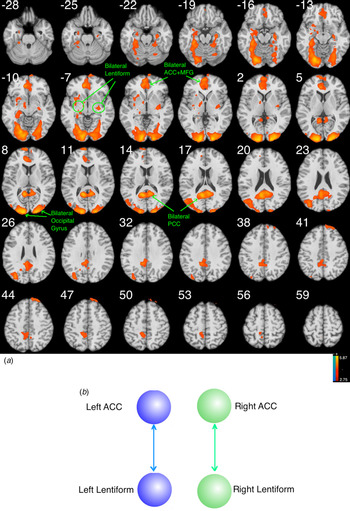
The nodes used in the current study were defined through the comparison between brain responses to gaming-related cues v. typing-related cues in all subjects (see Fig. 2a and Table 2). The results were family-wise correction-corrected at p < 0.01 and a voxel cluster threshold of 50. As the current study sought to examine interactions between executive-control and reward networks, identified regions within these networks were selected for use in DCM analyses. Specifically, a surviving cluster involving prefrontal brain regions [both the ACC and middle frontal gyrus (MFG) in one cluster] was selected given the ACC's and MFG's roles in executive control (Weinstein et al., Reference Weinstein, Livny and Weizman2017) and the lentiform nucleus was selected given its role in reward processing (Bamford, Wightman, & Sulzer, Reference Bamford, Wightman and Sulzer2018; Bostan & Strick, Reference Bostan and Strick2018; Brand et al., Reference Brand, Young, Laier, Wolfling and Potenza2016). Thus, we selected these brain regions as ROIs for further analysis in the current study (Fig. 2b).
The node selection in the current study. (a) Brain responses when comparing gaming-related cues to typing-related cues in all subjects. We can observe bilateral prefrontal brain regions (ACC + MFG), bilateral lentiform nucleus, bilateral PCC, bilateral occipital gyrus were activated during this process. (b) According to the main goal of the current study, we set to explore the interactions between executive control network and reward network, we selected ACC and lentiform as ROIs for further analysis.

Regions demonstrating differences in gaming v. typing cues

a Peak MNI coordinates.
b Number of voxels. Alphasim correction, p < 0.01, cluster size >50.
c The brain regions were referenced to software Xjview (http://www.alivelearn.net/xjview8) and verified through comparisons with a brain atlas.
In general, selecting ROIs in the current study met all of the following criteria: (1) showed significant activation in second-level analyses; (2) showed activation in previous addiction fMRI studies using cue-craving tasks, and; (3) were subordinate to executive-control or reward network. Consequently, surviving clusters involving prefrontal brain regions and the lentiform nucleus were selected as ROIs for the DCM analysis. Besides the prefrontal brain regions and lentiform, the bilateral posterior cingulate cortex (PCC) was identified in between-condition analyses. Given that the PCC has been implicated in addictions and cue responsivity (Jasinska, Stein, Kaiser, Naumer, & Yalachkov, Reference Jasinska, Stein, Kaiser, Naumer and Yalachkov2014; Potenza et al., Reference Potenza, Hong, Lacadie, Fulbright, Tuit and Sinha2012), we also conducted additional analyses involving the PCC (Fig. 3a, b).
When including the PCC in the model. (a) The location of the nodes we selected in the current study. (b) The model we set to explore in the current study. LAC: left anterior cingulate; LLN: left lentiform nucleus; LPC: left posterior cingulate; RAC, right anterior cingulate; RLN: right lentiform nucleus; RPC, right posterior cingulate. (The software only accepts name within three letters.)

Volumes of interest (VOIs) were obtained by significant activation clusters, which were determined by a second-level random effects univariate analysis. Within these regions, we took the coordinates of the peaks of the clusters (local maxima in the statistical map) as the VOI centers with 6 mm radii to extract the representative time series for the region and the search radii of local maxima were restricted to 15 mm concurrently using the F-contrast adjust time series, following the approach described previously (Hillebrandt et al., Reference Hillebrandt, Friston and Blakemore2014; https://en.wikibooks.org/wiki/SPM/Timeseries_extraction). The same VOIs were used across subjects.
Dynamic causal modeling
Interactions between prefrontal brain regions and the lentiform nucleus
We focused our analyses on interactions between executive control and reward regions. Thus, we focused on two pathways: prefrontal cortex [using the ACC/MFG cluster peak (in the ACC) as an ROI] to the lentiform nucleus; and, the lentiform nucleus to the ACC in each hemisphere, separately.
Including the PCC in the model
A three-region (six for bilateral hemispheres) stochastic dynamic causal model was specified for each subject. With bi-directional effective connections between the ACC, lentiform, and PCC, we specified a ‘full’ model where gaming-related cues could elicit coordinated activations in IGD and RGU subjects (Fig. 3a,b) and then inverted it for all subjects.
Stochastic DCM
The fMRI data were analyzed by the means of stochastic DCM in the current study. After extracting the principal eigenvariate of all ROIs, we assumed that all subjects used the same model and specified a ‘full’ model for each subject. Here, ‘full’ means that: (1) each ROI was assumed to be connected to all other ROIs (nine endogenous connections, including three self-connections); (2) it was assumed that the gaming cues acted as a driving input entering directly on all ROIs; and (3) it was assumed that the gaming cues modulated all endogenous connections. The full models were then inverted for all subjects (i.e. model estimation).
After that, we performed a DCM network discovery routine that automatically searches over all possible reduced models of a full model and uses post-hoc model selection to select the optimal one for each subject. The optimal sparse model was found at the group level, using Bayesian parameter averaging. Finally, we took the estimated connectivity parameters from the subject's optimization model and ran classical statistics such as independent sample t tests.
Correlations between clinically relevant measures and effective-connectivity values
We analyzed the correlations between the connectivity parameters and the clinical/behavioral measures of IGD subjects (IGD/IAT severity, self-reported craving to cues) to relate the neural results to clinically relevant measures.
Results
Behavioral performance
IGD subjects showed higher self-reported craving scores than RGU subjects before scanning (IGD, 51.22 ± 22.63; RGU, 39.71 ± 20.21; t = 6.142, p < 0.01) and during scanning (IGD, 2.42 ± 1.23; RGU, 1.33 ± 0.86; t = 5.251, p < 0.01). The findings suggest that manipulations in the current task were successful.
Fixed connectivity
In the entire sample, DCM estimates demonstrated significant positive endogenous influences between the ACC and the lentiform (Table 3). Group comparisons revealed significant interactions between these brain regions in the left and right hemispheres, separately.
Fixed and modulatory effects when exposed to gaming cues between the ACC and lentiform nucleus in the left and right hemispheres

LACC, left ACC; LLN, left lentiform nucleus; RACC, right ACC; RLN, right lentiform nucleus.
a Compared with random distribution.
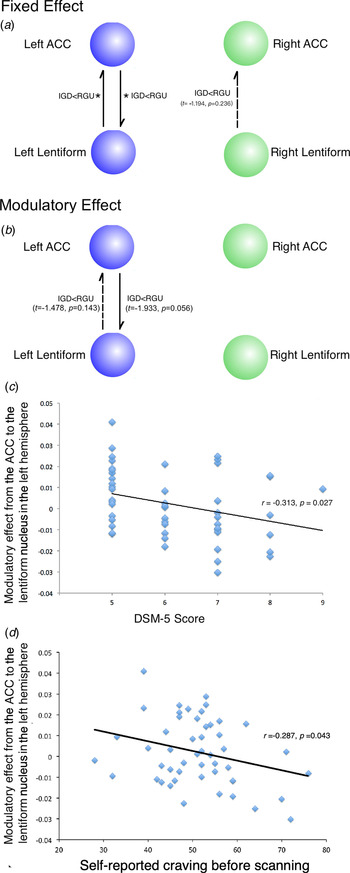
In the left hemisphere, group comparisons showed that RGU subjects showed higher positive effects than IGD subjects in both ACC-to-lentiform and lentiform-to-ACC pathways. In the right hemisphere, no group differences were observed in the lentiform-to-ACC pathway or the ACC-to-lentiform pathway (Table 3; Fig. 4a).
Fixed effect and modulatory effect between IGD and RGU. (a) In fixed effect, IGD subjects show lower ACC to lentiform and lentiform to ACC connectivity then RGU in the left hemisphere. A positive effect was observed in lentiform to ACC in the right hemisphere, although it does not reach statistical significance. (b) In modulatory effect, IGD subjects show lower ACC to lentiform connectivity in the left hemisphere. No interactions were found in the right hemisphere. (c) Negative correlation was found between DSM-5 score and the modulatory effect from ACC to lentiform in the left hemisphere. (d) Negative correlation was observed between self-reported cravings and modulatory effect from ACC to lentiform in the left hemisphere in IGD subjects.

Effects of gaming cues
The modulatory effects of gaming (gaming v. typing cues) showed that there was a positive effect on the left lentiform-to-ACC pathway in RGU but not in IGD subjects. Group comparisons showed that IGD subjects showed a trend toward lower scores compared with RGU subjects in the effect of the left ACC-to-lentiform pathway (p = 0.056), although modulatory effects were not significant in either subject group. In the right hemisphere, no group differences were found in these parameters (Table 3; Fig. 4b).
Correlation with clinically relevant factors
A negative correlation was found between the DSM-5 score and the modulatory effect from the ACC to the lentiform in the left hemisphere in IGD subjects (Fig. 4c). A significant correlation was observed in IGD subjects between self-reported cravings before scan and modulatory effect from ACC to lentiform in the left hemisphere (r = −0.287, p = 0.043) (Fig. 4d). A similar trend was observed in IGD subjects between self-reported cravings before scanning and modulatory effects from the ACC to lentiform in the left hemisphere (r = −0.233, p = 0.083).
Including the PCC in the model
Parameter estimates were calculated using the Bayesian model averaging over a model space partitioned according to whether gaming cues directly influenced activity in the PCC. Findings demonstrated significant fixed effects between the left PCC to lentiform, left PCC to left ACC, left lentiform to PCC, and left ACC to left PCC. Similar relationships were observed in the right hemisphere. In both hemispheres, IGD and RGU were not distinguished on these fixed effects.
With respect to modulatory effects of gaming cues, IGD subjects showed marginal effects (p = 0.051) with respect to left ACC to left PCC connectivity and significant (p = 0.023) effects on right ACC to right PCC connectivity (Table 4). Findings within the RGU group and between-group differences were not significant.
Fixed and modulatory effects among PCC, ACC, and lentiform nucleus in the left and right hemispheres and direct PCC effects

LACC, left ACC; LLN, left lentiform nucleus; RACC, right ACC; RLN, right lentiform nucleus; LPCC, left PCC; RPCC, right PCC.
a Compared with random distribution.
The p values in this table were not corrected for multiple comparisons.
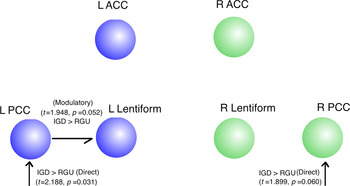
In the left hemisphere, data suggested that gaming cues drove PCC activity in the RGU but not IGD group (direct effects, Table 4). A group difference (p = 0.031) was found in the left PCC, in which the RGU group showed significantly lower scores than the IGD group. In addition, IGD subjects showed marginally higher (p = 0.052) PCC-to-lentiform connectivity than RGU subjects in modulatory effects (Table 4; Fig. 5). In the right hemisphere, no significant results were observed among these brain regions.
The role of PCC in the DCM model. Group differences on direct effect from the gaming cues were found in left and right PCC. IGD subjects show significant higher score than RGU subjects. Group difference on modulatory effect showed IGD subjects show higher PCC to lentiform connectivity than RGU in the left hemisphere.

Discussion
Behaviorally, IGD relative to RGU subjects showed higher craving scores to gaming cues before and after gaming. The imaging results provide further support for prefrontal–striatal interactions distinguishing groups with IGD and those with RGU. Our hypotheses were partially supported, as described below.
Interactions between prefrontal brain regions and the lentiform nucleus
Significant group differences were observed on some fixed effects. In fixed connectivity, IGD subjects show significant lower lentiform-to-ACC and ACC-to-lentiform connectivity than RGU in the left hemisphere. In modulatory effects, IGD subjects trended toward showing lower ACC-to-lentiform connectivity than RGU subjects in the left hemisphere, although the relationship was not significant in either group. However, the inverse relationship between the modulatory effects relating to ACC-to-lentiform connectivity in IGD subjects in the left hemisphere was inversely related to IGD severity, suggesting the clinical relevance of this relationship.
The ACC and MFG have been implicated in executive control (Engelmann et al., Reference Engelmann, Versace, Robinson, Minnix, Lam, Cui and Cinciripini2012; Goudriaan, Ruiter, Brink, Oosterlaan, & Veltman, Reference Goudriaan, Ruiter, Brink, Oosterlaan and Veltman2010; Ko et al., Reference Ko, Liu, Hsiao, Yen, Yang, Lin and Chen2009; Liu et al., Reference Liu, Yip, Zhang, Wang, Shen, Liu and Fang2017; Sun et al., Reference Sun, Ying, Seetohul, Xuemei, Ya, Qian and Ye2012), which refers to tendencies to successfully inhibit improper behaviors or thoughts in complex environments (Goldstein & Volkow, Reference Goldstein and Volkow2011). Neuroimaging and neuropsychological studies have suggested that executive functions contribute importantly to prevent the development and maintenance of internet-use disorders (Brand et al., Reference Brand, Young, Laier, Wolfling and Potenza2016; Dong & Potenza, Reference Dong and Potenza2014), in a manner similar to substance addictions (Bechara, Reference Bechara2005; Volkow et al., Reference Volkow, Fowler, Wang, Telang, Logan, Jayne and Swanson2010). Several models of IGD have proposed that impaired executive functioning and inhibitory control may be central to IGD (Brand et al., Reference Brand, Young, Laier, Wolfling and Potenza2016; Dong & Potenza, Reference Dong and Potenza2014), consistent with data linking to impaired response inhibition in individuals with IGD or substance addictions (Dong et al., Reference Dong, Wang, Wu and Potenza2017b).
As part of the basal ganglia, the lentiform is an important component of multiple processes including how people respond to rewards. As such, it has been implicated in the development and maintenance of addictions (Koopmann et al., Reference Koopmann, Bach, Schuster, Bumb, Vollstadt-Klein, Reinhard and Kiefer2019; Walker et al., Reference Walker, Cates, Loh, Purushothaman, Ramakrishnan, Cahill and Nestler2018). Enhanced brain responses in the lentiform nucleus may suggest reward sensitivity or relate to cravings in response to specific cues (Kearney-Ramos et al., Reference Kearney-Ramos, Dowdle, Lench, Mithoefer, Devries, George and Hanlon2018), consistent with findings in IGD groups and models of IGD (Brand et al., Reference Brand, Young, Laier, Wolfling and Potenza2016; Dong et al., Reference Dong, Wang, Du and Potenza2017a, Reference Dong, Liu, Zheng, Du and Potenza2019a, Reference Dong, Wang, Wang, Du and Potenza2019b).
In the current study, IGD subjects relative to RGU subjects showed lower ACC-to-lentiform and lentiform-to-ACC fixed effects with respect to connectivities in the left hemisphere. According to psychophysiological implications of the FC findings (Havlicek et al., Reference Havlicek, Roebroeck, Friston, Gardumi, Ivanov and Uludag2015; Stephan et al., Reference Stephan, Penny, Moran, den Ouden, Daunizeau and Friston2010), lower values in ACC-to-lentiform and lentiform-to-ACC in IGD subjects suggest the interactions among these two brain regions may be less efficient in IGD subjects than in RGU subjects. Blunted bi-directional interactions between these brain regions in IGD suggest that brain regions responsible for executive control may not be able to exert top-down control over cue-elicited brain responses and that bottom-up drive may be less linked to top-down control. The negative correlation between addiction severity, craving level (baseline out of the scanner and cue-elicited craving during scanning) and ACC-to-lentiform connectivity also provides support for this conclusion. The bi-directional effects suggest a disconnection in IGD that may perpetuate persistent gaming despite adverse consequences. The current results extend those of prior studies that have found enhanced basal ganglia responses to gaming cues in IGD (Dong, Huang, & Du, Reference Dong, Huang and Du2011; Yao et al., Reference Yao, Liu, Ma, Shi, Zhou, Zhang and Potenza2017) and studies suggesting impaired executive control in IGD (Dong et al., Reference Dong, Lin, Hu, Xie and Du2015, Reference Dong, Wang, Wang, Du and Potenza2019b).
When exposed to gaming cues, increased activation in the bilateral ACC (and MFG) and lentiform was observed in all subjects. With respect to modulatory effects, DCM analyses suggested in the left hemisphere the possibility of higher positive modulation of the effective connectivity from the ACC to lentiform nucleus in RGU subjects than in IGD subjects in between-group analyses (trend level of p = 0.056). In the right hemisphere, while the RGU group showed a modulatory effect in the effective connectivity from the lentiform nucleus to ACC that was significant and numerically larger than that in the IGD group, no between-group differences were observed. These findings suggest that if IGD subjects show reduced gaming-cue-related modulatory effects in interactions between the ACC and lentiform nucleus, they may not be particularly robust. Nonetheless, the findings suggest the possibility that when exposed to gaming cues, IGD subjects may show modestly blunted interactions between top-down and bottom-up processes, consistent with prior models and findings (Kuss & Griffiths, Reference Kuss and Griffiths2012; Kuss, Pontes, & Griffiths, Reference Kuss, Pontes and Griffiths2018; Petry et al., Reference Petry, Rehbein, Gentile, Lemmens, Rumpf, Mossle and O'Brien2014).
Taking the fixed connectivity and the modulatory effect findings together, data suggest prefrontal to lentiform connectivity impairments in IGD subjects that may be relatively independent of gaming cues. The results provide support for proposed IGD models (Brand et al., Reference Brand, Wegmann, Stark, Muller, Wolfling, Robbins and Potenza2019, Reference Brand, Young, Laier, Wolfling and Potenza2016; Dong & Potenza, Reference Dong and Potenza2014).
The role of the PCC in IGD
In addition to examining interactions between the ACC and lentiform nucleus, we investigated a possible role for the PCC in IGD in cue-elicited responses. The results suggest that the PCC is an important input source for gaming-related cues. Specifically, IGD subjects showed higher direct effects than RGU subjects in PCC activation in the left hemisphere with a similar trend on the right. No between-group differences were observed for fixed or modulatory effects, suggesting that direct effects may most strongly be implicated in IGD.
The PCC has been implicated in many addictions, especially in cue reactivity (Jasinska et al., Reference Jasinska, Stein, Kaiser, Naumer and Yalachkov2014; Potenza et al., Reference Potenza, Hong, Lacadie, Fulbright, Tuit and Sinha2012). In drug- or alcohol-use disorders, the PCC has been found to be activated by drug cues, particularly in individuals with long or intensive histories of use (Cousijn et al., Reference Cousijn, Goudriaan, Ridderinkhof, van den Brink, Veltman and Wiers2013; Filbey et al., Reference Filbey, Claus, Audette, Niculescu, Banich, Tanabe and Hutchison2008; Franklin et al., Reference Franklin, Wang, Suh, Hazan, Cruz, Li and Childress2011; Tapert et al., Reference Tapert, Cheung, Brown, Frank, Paulus, Schweinsburg and Brown2003; Yalachkov, Kaiser, & Naumer, Reference Yalachkov, Kaiser and Naumer2012). A relatively higher PCC response to cocaine-related cues also distinguished patients who relapsed to cocaine use from those who did not (Johnson, Chen, Schmitz, Bordnick, & Shafer, Reference Johnson, Chen, Schmitz, Bordnick and Shafer1998; Kosten et al., Reference Kosten, Scanley, Tucker, Oliveto, Prince, Sinha and Wexler2006). With respect to nicotine addiction, self-reported craving for a cigarette was found to positively correlate with cue-induced responses in the PCC (Kang et al., Reference Kang, Chang, Jahng, Kim, Kim, Kim and Lee2012; Owens et al., Reference Owens, Mackillop, Gray, Srh, Stein, Niaura and Sweet2017), and resisting craving was associated with increased activity in the PCC (Brody et al., Reference Brody, Mandelkern, Olmstead, Jou, Tiongson, Allen and Tiffany2007). The PCC was also implicated in responses to gaming cues in IGD subjects (Dong, DeVito, Huang, & Du, Reference Dong, DeVito, Huang and Du2012; Dong, Hu, & Lin, Reference Dong, Hu and Lin2013a; Dong et al., Reference Dong, Wang, Du and Potenza2017a).
Although the PCC has been widely implicated in cue responsivity in addictions, few studies have examined connectivity of the PCC in addictions. The PCC links to many brain structures (Zuo et al., Reference Zuo, Ehmke, Mennes, Imperati, Castellanos, Sporns and Milham2012). Greater PCC connectivity has been implicated in longer time to relapse in alcohol-use disorder (Zakiniaeiz, Scheinost, Seo, Sinha, & Constable, Reference Zakiniaeiz, Scheinost, Seo, Sinha and Constable2017). While PCC connectivity has been implicated in some studies of individuals with addictions or at elevated risk for addiction [e.g. in youth with prenatal cocaine exposure (Zakiniaeiz et al., Reference Zakiniaeiz, Yip, Balodis, Lacadie, Scheinost, Constable and Potenza2017b)], it has rarely been directly examined in IGD, although decreased insula-to-PCC cue-elicited activity has been reported following treatment of IGD (Zhang et al., Reference Zhang, Yao, Potenza, Xia, Lan, Liu and Fang2016). The current findings suggest that the PCC acts in a direct fashion with respect to gaming-cue responsivity in IGD, and that it may transmit information to relevant brain regions (e.g. the ACC or lentiform nucleus). These findings may differ from those in depression in which self-appraisal processes may drive PCC activity, with the PCC positively then influencing the medial prefrontal cortex, directly and indirectly (Davey et al., Reference Davey, Breakspear, Pujol and Harrison2017). More studies are needed to define more precise roles for the PCC and how it may interact with other brain structures in IGD.
Strengths and clinical implications
The current study has multiple strengths. First, it used DCM to investigate directional connectivity between executive-control and reward regions. Second, the study includes a sizable number of subjects and a well-controlled comparison group. Limitations include the cross-sectional nature of the study, the predominance of males and the limited geographic recruitment, restricted age range and certain gaming-related aspects. For example, the study focused on individuals familiar with League of Legends. Further, the RGU group on average met some criteria for IGD and thus may be considered at elevated risk for IGD. This may have led to relative blunting of between-group differences. In other words, sub-diagnostic levels of IGD in the RGU may have led to less robust between-group differences having been observed. However, some of these limitations may also represent strengths (e.g. by limiting sample variability), and the findings provide further insight into the neurobiological underpinnings of IGD.
The current results have clinical implications. First, the findings provide a foundation for possibly identifying treatment targets (e.g. with interventions that may alter cortical activity like transcranial direct current stimulation or repetitive transcranial magnetic stimulation). Second, training IGD subjects to control their cravings through behavioral techniques may involve cognitive mechanisms (e.g. cognitive behavioral therapy) or approaches that might target subcortical processes more directly (e.g. mindfulness-based approaches), and these warrant additional investigation in IGD.
Acknowledgements
This research was supported by Zhejiang Provincial Natural Science Foundation (LY20C090005).
Author contributions
Guangheng Dong designed the task and wrote the first draft of the manuscript; Min Wang and Ziliang Wang collected and analyzed the data and prepared the figures. Xiaoxia Du collected the data. Marc Potenza contributed in editing, interpretation, and revision processes. All authors contributed to and have approved the final manuscript.
Financial support
Dr Guangheng Dong was supported by the National Science foundation of China (31371023). Dr Potenza's involvement was supported by the National Center for Responsible Gaming, the Connecticut Mental Health Center, and the Connecticut Department of Mental Health and Addictive Services. The funding agencies did not contribute to the experimental design or conclusions, and the views presented in the manuscript are those of the authors and may not reflect those of the funding agencies.
Conflict of interest
Guangheng Dong, Min Wang, Ziliang Wang, Hui Zheng, Xiaoxia Du, and Marc Potenza reported no biomedical financial interests or other conflicts of interest with respect to the content of this manuscript. Dr Potenza has consulted for Ironwood, Lundbeck, Shire, INSYS, RiverMend Health, Lakelight Therapeutics/Opiant and Jazz Pharmaceuticals; has received research support to Yale from Mohegan Sun Casino, the National Center for Responsible Gaming, and Pfizer; and has consulted for legal and gambling entities on issues related to addictive disorders.