1 INTRODUCTION
Our study presents a variationist account of competing forms used to express future temporal reference in the spoken French of adolescents residing in the province of Ontario, Canada. Two variants are considered, namely the periphrastic future (e.g. elle va partir) and the inflected future (e.g. elle partira). The data used in our study come from Mougeon and Beniak's corpus of L1 French spoken in the Franco-Ontarian communities of Hawkesbury, Cornwall, North Bay and Pembroke.Footnote 1 The current analysis makes a unique contribution to the study of the future variable since, while in the past it has been the object of quantitative analysis (cf. Deshaies and Laforge, Reference Deshaies and Laforge1981; Emirkanian and D. Sankoff, Reference Emirkanian, Sankoff, Lemieux and Cedergren1985; Chevalier, Reference Chevalier, Boudreau and Dubois1996; Poplack and Turpin, Reference Poplack and Turpin1999; King and Nadasdi, Reference King and Nadasdi2003; Zimmer, Reference Zimmer1994), our research is the first to examine this case of variation on the basis of French language use restriction. In other words, we consider the extent to which an individual uses French in his or her daily activities.
The general trend that emerges in Ontario French is that the use of the periphrastic future (hereafter, PF) is higher than what has been reported for the French spoken in Québec, Acadia or France. The presentation of results includes a detailed discussion of linguistic and social factors that condition the two future forms under study. Although we coded for a variety of linguistic factors, only one, namely affirmative versus negative polarity, was selected as significant following multivariate analyses with GoldVarb. Previous research (notably Poplack and Turpin, Reference Poplack and Turpin1999) has documented the robust effect of this factor on the future variable. What is of particular interest in our own study is the interaction that exists between polarity and language use restriction. Cross-tabulation of locality and polarity reveal that the effect of this factor varies across the four communities (cf. Mougeon and Nadasdi, Reference Mougeon and Nadasdi1998). The effect of polarity is shown to be categorical in the French majority town of Hawkesbury, i.e. the inflected future (hereafter, IF) never occurs in affirmative utterances. Conversely, in the minority language community of Pembroke (where only 8% of the local population is francophone), affirmative/negative polarity has no significant effect on the choice of either variant.
2 THE VARIABLE
Examples of the periphrastic and inflected future taken from Mougeon and Beniak's Franco-Ontarian corpus are presented in 1a) and 1b):
1a) Periphrastic future (PF)
On dit qu'il va passer à la télévision bientôt. (H19)Footnote 2
‘They say it's going to be on television soon.’
1b) Inflected future (IF)
Peut-être j’irai à Ottawa puis essayer de trouver un bon emploi. (P06)
‘Maybe I'll go to Ottawa then try to find a good job.’
A third possible form also exists for expressing a future event, the so-called futurate present:
1c) Futurate present
Gilbert vient icitte demain. (P14)
‘Gilbert is coming tomorrow.’
Examples of the futurate present are indeed found in the corpus of Ontarian French, just as it is found in other Laurentian varieties of French (e.g. Poplack and Turpin, Reference Poplack and Turpin1999Footnote 3). However, due to the proportionately infrequent use of this form, these tokens were excluded as they were too rare to be submitted to quantitative analysis. (cf. Le Goffic, Reference Le Goffic2001 for an overview of the temporal functions as well as the conditioning contexts typically associated with the futurate present.)
We have also taken care to exclude a number of forms whose morphology resembles the two main variants under study but which are not functional equivalents. For example, in cases where the verb aller is used as a verb of motion, as illustrated in 1d), or when the future form – often expressed with the periphrastic construction – has a habitual rather than a true future reference, as in 1e):
1d) Aller as a verb of motion
Si j'ai pas trop de devoirs, j'vas aller jouer dehors. (H18)
‘If I don't have too much homework, I go and play outside.’
1e) Habitual ‘false’ future
Des fois elle va nous montrer des films. (C02)
‘Sometimes she will show us movies.’
Additional examples of discarded occurrences of the inflected and periphrastic forms include fixed expressions, which generally preclude variation (1f) and hypothetical statements (1g). Given that our primary goal was to identify actual occurrences of the future variants produced by the speakers themselves, we also chose to exclude instances of the variable which appeared in reported speech (1h):
1f) Invariable expression
Si je gagnais [à la loterie], on va dire 500 $. . . (C08)
‘If I won the lottery, we'll say $500. . .’
1g) Hypothetical statement
Disons que le joual pour ma part j'vas [le] parler pas couramment. (H09)
‘Let's say joual, me, I won't speak it fluently.’
1h) Indirect speech
Il dit: «Non, les poissons vont t'emmener drette dans l'eau pis tu vas t'noyer.» (P15)
‘He said, “No, the fish will pull you right into the water then you'll drown.”’
Once all invalid instances of the variable were discarded, as shown in the preceding examples, we retained for the final analyses a total of 1,232 tokens of verbs with a verifiable future temporal reference.
2.1 Function of the periphrastic and inflected future forms
To both future forms prescriptive grammars (e.g. Grevisse, Reference Grevisse1964: §655, §730–734) have ascribed a rather complex set of temporal functions which serve to identify the speaker's relationship with an event or the likelihood the latter will occur. Poplack and Turpin (Reference Poplack and Turpin1999) summarize the situations in which the periphrastic future ought to be selected, such as proximity to speech event, imminence, intentionality and certainty of outcome. King and Nadasdi (Reference King and Nadasdi2003) also include the speaker's desire to demonstrate greater interest or involvement with an event. As for the functions associated with the inflected future, Poplack and Turpin (Reference Poplack and Turpin1999) indicate that the IF signals neutrality, psychological separation from the event and an absence of proof the event will take place. In spite of the various temporal contexts that normative grammar proposes should influence the use of either the PF or the IF, few studies on the future variable in Canada conclude that the functions listed above motivate variant choice, including the present study.
2.2 Previous research
Both the inflected and periphrastic futures have a long history in French. While the synthetic form dates at least to the ninth century, attested in the Serments de Strasbourg (Fleischman, Reference Fleischman1982), the analytic construction aller + infinitive appeared much later in the language. The PF was first used as a transparent verb of motion, but by the 15th century it was used colloquially, especially in the first person singular, to indicate prediction as well as imminent future outcomes,Footnote 4 and came to be used this way in higher registers, including literary usage, during the 16th and 17th centuries (cf. Gougenheim, Reference Gougenheim1929; Fleischman, Reference Fleischman1982; Poplack and Turpin, Reference Poplack and Turpin1999). Both descriptive and quantitative studies of spoken French, from Bauche's (Reference Bauche1929) Le français populaire to more recent studies of European French (e.g. Söll, Reference Söll and Hausmann1983; Lorenz Reference Lorenz1989) and Québec French (e.g. Emirkanian and D. Sankoff, Reference Emirkanian, Sankoff, Lemieux and Cedergren1985; Zimmer, Reference Zimmer1994; Poplack and Turpin, Reference Poplack and Turpin1999), report higher incidences of the PF as well as increased usage of this form in contexts where traditional grammars would prescribe the IF. Such findings have lead researchers like Poplack and Turpin (Reference Poplack and Turpin1999) to suggest that the IF is disappearing in the same way that the passé simple has in most spoken varieties of Canadian French (with the exception of some Acadian varieties). However, it often remains the preferred future form in the written language (cf. Lesage and Gagnon, Reference Lesage, Gagnon, Crochetière, Boulanger and Ouellon1992).
A comparison of research from both sides of the Atlantic suggests that there is a clear difference between the French of France and Québec with respect to the distribution of the future variants. For example, Jeanjean (Reference Jeanjean, Blanche-Benveniste, Chervel and Gross1988) recorded a nearly even distribution of inflected and periphrastic future forms in her study of Metropolitan French data collected by researchers in Aix-en-Provence, while in Söll (Reference Söll and Hausmann1983) the IF represents 34% of all future occurrences. Variationist research on the variable shows that the IF is used considerably less in spoken Canadian French. For Montréal French, Emirkanian and D. Sankoff (Reference Emirkanian, Sankoff, Lemieux and Cedergren1985) recorded the average use of the IF at approximately 21% and Zimmer (Reference Zimmer1994) at 17%, whereas Poplack and Turpin's own study of Ottawa-Hull French, which served as the model for our research, found similar proportions (20%) as did Emirkanian and D. Sankoff. The variable has also been studied in Acadian French by King and Nadasdi (Reference King and Nadasdi2003) who report the highest rate for the IF at 53%.
3 THE DATA
The data we have used in this study come from Mougeon and Beniak's 1978 corpus of francophone adolescents living in southeast Ontario, specifically in the four communities of Hawkesbury, Cornwall, North Bay and Pembroke, situated near the Québec border. Within this region, the local francophone population varies substantially from 85% in Hawkesbury to 35% in Cornwall, 16% in North Bay and 8% in Pembroke (according to 1981 statistical data; see Mougeon and Beniak, Reference Mougeon and Beniak1991: 72). In total, 117 interviews were carried out for this corpus following a Labovian interview protocol during which each speaker discussed a variety of formal (e.g. politics, language) and informal (e.g. hobbies) topics for approximately one hour. The semi-informal sociolinguistic interviews were designed to ‘[tap] as natural and unreflecting a style of speech as could be obtained in the context of a semi-directed face-to-face interview on the school premises’ (ibid: 70).
The unique aspect of this corpus is that in addition to the traditional social factors considered in variationist research (sex, age, etc.), all speakers are categorized into one of three groups of French language use restriction (cf. Mougeon and Beniak, Reference Mougeon and Beniak1991). Note that all speakers from the four communities are francophone, in that at least one of his or her parents is also francophone, and attend French-medium schools. To assess a speaker's degree of language restriction, she or he indicated via a questionnaire which language is spoken in 11 different situations of communication (e.g. addressing a sibling outside of the home, parent addressing the respondent, addressing friends at home). For some, French is the regular language of communication both in and outside of the home (the unrestricted speakers), whereas others make limited use of French and use it almost exclusively in the school setting (the restricted speakers). The third group (the semi-restricted speakers) makes fairly equal use of French and English in the various situations of communication described above. A complete understanding of the distribution of a linguistic variable in a minority speech community requires that relative degree of language restriction be taken into account.
3.1 Linguistic factors
All 1,232 tokens of the future forms retained in this study were coded for a number of linguistic and social factors (see section 3.2). We identified and coded for a total of seven linguistic factors, having used as our model a combination of methodologies developed for other studies focusing on the future variable in Canadian French. These include affirmative vs negative polarity, grammatical person, temporal reference, adverbial specification, certainty of outcome, presence of quand and si. These linguistic factors are exemplified below in sections 3.1.1 to 3.1.7.
3.1.1 Polarity
The extant literature on the future variable for most varieties of spoken Canadian French have shown that sentential polarity has an exceptionally strong effect on the choice of future forms. Where affirmative environments favour the periphrastic future, the inflected future is much less likely to occur in this context; rather, it is largely conditioned by the presence of an adverb of negation (e.g. pas, plus, jamais). This distribution of the forms on the basis of polarity remains somewhat inexplicable, though researchers such as Deshaies and Laforge (Reference Deshaies and Laforge1981: 28) propose that negation and the inflected future are compatible due to the hypothetical value they both project (for further discussion, see also Poplack and Dion, Reference Poplack and Dion2009). In light of the importance of this factor, occurrences of the variable in Ontario were identified as either affirmative (2a) or negative (2b).
2a) Affirmative
J'veux continuer à parler français. Ça va m'aider dans les classes. (C07)
‘I want to continue speaking French. It is going to help me in class.’
2b) Negative
Ben on aura pas d'gaz d'après qu'est-ce qu'eux-autres i’ dit (disent). (N31)
‘Well, we won't have any gas according to what they say.’
3.1.2 Grammatical person
In keeping with the coding models designed in past research (e.g. Poplack and Turpin, Reference Poplack and Turpin1999; King and Nadasdi, Reference King and Nadasdi2003; Nadasdi et al. Reference Nadasdi, Mougeon and Rehner2003), we also considered grammatical person with a view to uncover any potential conditioning effect this factor may have on either future form. All grammatical persons were considered, including singular (3a) and plural (3b).
3a) 1st person singular
Jamais j'perdrai ma langue. (H01)
‘I'll never lose my language.’
3b) 3rd person plural
I’ vont devenir plus intelligents. (N30)
‘They are going to become more intelligent.’
3.1.3 Temporal reference
Various grammarians have attempted to assign a specific temporal function to both the IF and PF. For instance, Grevisse and Goosse (Reference Grevisse and Goose2008) and Parmentier (Reference Parmentier1993) note that the latter frequently marks a near future, while other future occurrences are generally linked to the IF. However, Grevisse and Goosse (Reference Grevisse and Goose2008: §887) also recognize that this distinction does not necessarily apply in spoken French, where the IF is regularly replaced by periphrastic constructions such as aller + infinitive. To capture any possible division between form and distance from speech time, we coded for a number of future references, including events deemed to occur in the proximate future, namely within the hour (4a) or the day; more distant futures, such as within the week or greater than one week (4b); and also indeterminate future references (4c). Following King and Nadasdi (Reference King and Nadasdi2003), a further category of futurity was also added to include continuous events or states which the speaker believes will persist now and into the future (4d).
4a) Within the hour
Y'en a qui sont bien, t'sais. J'vas pas dire des noms. (N18)
‘There are some who are good, you know. I'm not going to say any names.’
4b) Greater than one week
J'aurai la possibilité peut-être cet été, puis j'aimerais aller en Californie. (P17)
‘Maybe I'll have the chance this summer, then I'd like to go to California.’
4c) Indeterminate future reference
Peut-être i’ va penser que j'suis Franco-ontarien. (C04)
‘Maybe he is going to think I am Franco-Ontarian.’
4d) Continuous future
I’ va tout (le) temps n'avoir de l'essence. (C17)
‘There is always going to be gasoline.’
3.1.4 Adverbial specification
While the presence of an adverbial element is generally a prerequisite in order for the futurate present to specify the future realization of an event (cf. Poplack and Turpin, Reference Poplack and Turpin1999; Le Goffic, Reference Le Goffic2001), we nevertheless took its variable presence into consideration while coding our data (this is also the case in other research on the variable in L1 Canadian French, e.g. Emirkanian and D. Sankoff, Reference Emirkanian, Sankoff, Lemieux and Cedergren1985; King and Nadasdi, Reference King and Nadasdi2003; Blondeau, Reference Blondeau2006). The decision to include this factor was also motivated by Parmentier's (Reference Parmentier1993) treatment of both the futurate present and the periphrastic future, which, he states, “signal immediate outcomes with adverbs such as ‘immediately’ and ‘right away’” (175, our translation). To determine whether a relationship exists between the future variants in Ontario and temporally situated events via an adverb, we coded for adverbials that identified specific (5a) and non-specific (5b) time periods. Variants with no temporal specification were coded as such.
5a) Specific adverb
J'ai pas l'impression que ça va changer tant qu’ça dans l'an 2000. (N03)
‘I don't have the impression that things are going to change much in the year 2000.’
5b) Non-specific adverb
Bientôt i’ vont avoir beaucoup de Français dans Cornwall. (C38)
‘Soon there are going to be a lot of French people in Cornwall.’
3.1.5 Certainty
In the extant literature it has been proposed that the inflected future marks more hypothetical future events (e.g. Deshaies and Laforge, Reference Deshaies and Laforge1981) whereas those certain to occur are best expressed by the periphrastic future (e.g. Frontier Reference Frontier1997). Franckel (Reference Franckel1984: 66) speaks to the semantic distinction apparently dividing the future forms with respect to certainty, stating that the IF belongs to the domain of the unasserted/uncertain whereas the PF belongs to the realm of the certain, verifiable and factual. Using a combination of transparent syntactic ‘flags’ identifying degree of certainty (e.g. adjectives and adverbs) as well as, when necessary, the researchers’ intuitions, the future variants were coded as certain to occur (6a), uncertain (6b) or unverifiable.
6a) Certain
J'suis sûr que je vas savoir qu'est-ce qu'i’parle. (C07)
‘I'm sure I'm going to know what he's talking [about].’
6b) Uncertain
Peut-être que j'vas l'utiliser quand que j'ai un emploi. (P19)
‘Maybe I am going to use it when I have a job.’
3.1.6 Presence of ‘quand’
The relationship between quand and its potential role in conditioning one or the other future form has also garnered some attention in the previous studies we consulted (e.g. Deshaies and Laforge, Reference Deshaies and Laforge1981; Emirkanian and D. Sankoff, Reference Emirkanian, Sankoff, Lemieux and Cedergren1985; Chevalier, Reference Chevalier, Boudreau and Dubois1996; King and Nadasdi, Reference King and Nadasdi2003). In addition, this relationship is frequently cited in grammars, such as Parmentier (Reference Parmentier1993) and Sandhu (Reference Sandhu1995), whose examples show that, when used to express a future outcome, the conjunction quand accepts only the inflected future and never the periphrastic aller + infinitive. We considered two environments in which the dependent variable may occur with quand,Footnote 5 whether it appears adjacent to the conjunction or in a subordinate clause that follows. Both environments are exemplified in 7).
7) Variable introduced by ‘quand’
Quand j'serai dix-huit ans, j'prendrai un voyage ou quelque chose. (N02)
‘When I'm 18 years old, I'll take a trip or something.’
3.1.7 Presence of ‘si’
The last linguistic factor we coded for concerns the presence or absence of conditional si clauses. In the extant literature (e.g. Grevisse, Reference Grevisse1964), there is a strong tendency for the synthetic form to co-occur in si + present + future sequences. We considered such sequences, shown in 8), with a view to reveal the extent to which this ‘rule’ is observed in spoken Ontarian French.
8) Presence of ‘si’
Si le Québec (se) sépare, beaucoup de Québécois déménageront. (C10)
‘If Québec separates, a lot of Québécois will move.’
3.2 Social factors
For coding purposes, we considered in our analyses the same social factors that have been used in other variationist studies undertaken with the Mougeon and Beniak corpus. These factors include locality, sex, school year (grade 9/grade 12) socio-economic class (as defined by parents’ occupation) and language use restriction (unrestricted, semi-restricted, restricted).
4 RESULTS
Before presenting the overall results for the relevant linguistic and social factors, we will first provide information regarding the general distribution of the future forms in Ontario.
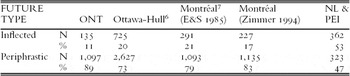
As stated above, the future variable has been the object of several quantitative studies in Laurentian as well as Acadian varieties of French spoken in Canada. This collection of research is reflective of data collected in both majority (Ottawa-Hull, Montréal, Québec) and minority settings (Newfoundland and Prince Edward Island). Table 1 provides the overall distribution of the variants, if available, from these studies. The results for our study are also included for cross-variety comparison.
Distribution of future variants in Laurentian varieties of Canadian French

Legend: ONT = Ontario, NL = Newfoundland, PEI = Prince Edward Island.
It can be seen in Table 1 that, in comparison with all other speakers of Canadian French, Franco-Ontarians are in the lead with respect to use of the PF. While in previous studies the use of the PF ranges from 47% (Newfoundland and Prince Edward Island) to between 73% and 83% (Ottawa-Hull and Montréal), this same variant represents fully 89% of all tokens in the Mougeon and Beniak Franco-Ontarian corpus. This, therefore, reserves a mere 11% for the IF, which traditionally represents between 17% and 53% of future occurrences in all other varieties of French in Canada. Thus, as compared to previous research in Canada (and France), Franco-Ontarians demonstrate the greatest use of the periphrastic future and consequently the lowest use of the inflected future.
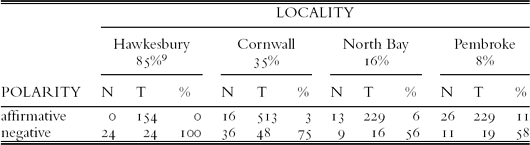
Of all seven linguistic factors retained for multivariate analyses using GoldVarb (cf. D. Sankoff, Tagliamonte and Smith, Reference Sankoff, Tagliamonte and Smith2005), only polarity produced statistically significant results in Franco-Ontarian French (The PF is favoured in affirmative contexts with a factor weight of 0.587, but strongly disfavoured in negative environments with a factor weight of 0.024.) This result is quite unusual in Canada. The bulk of the previous studies on the future, conducted with the help of large-scale corpora of varieties of both Canadian French and Acadian French, generated statistically significant results for a combination of linguistic factors other than or including polarity, however not polarity alone.Footnote 8 It should nevertheless be noted that it is not surprising that we found no effect for adverbial specification, since its role seems to be linked to the futurate present, which we have not examined in the current study. The robust effect of polarity is especially prevalent in the French majority community of Hawkesbury, where there is categorical use of the IF in negative utterances (N = 24) and of the PF in affirmative utterances (N = 154). The breakdown for each community is shown in Table 2.
Distribution of the inflected future (IF) according to polarity.
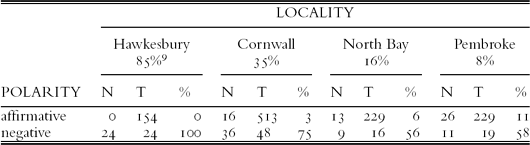
This striking find parallels in part the results of Emirkanian and D. Sankoff's 1985 study of spoken French in Montréal, where all affirmative future tokens were expressed only via the PF. Thus, our findings are in line with the general trend according to which the PF and IF variants are losing—or have lost—the temporal distinctions prescribed in contemporary prescriptive grammars (e.g. Grevisse and Goose, Reference Grevisse and Goose2008) and that they have adopted a strictly modal function in Hawkesbury. In other words, polarity itself predetermines the future variant to be selected rather than the temporal character of the utterance. If this modal division is indeed the future of the future in spoken French, we must conclude that, due to the absence of variation, linguistic change vis-à-vis the future in Hawkesbury is now complete. The effect of polarity on variant usage in the other three communities will be discussed below where we examine interactions with language use restriction. Note finally that the highly robust effect of polarity is likely the reason that no other linguistic factors were selected. In other words, polarity alone explains the linguistic variation. What is more, when the results for Hawkesbury are excluded from statistical analyses, we find that polarity continues to be the only significant linguistic factor in the remaining three communities.
4.1 Social factors
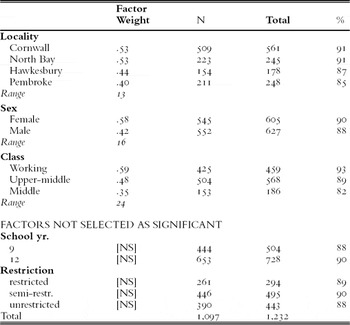
GoldVarb identified the following social factors as significant to variant choice, specifically locality, sex and socio-economic class. School year and language restriction were not selected as statistically significant. These results are presented in Table 3.
Social factors contributing to the selection of the periphrastic future (PF).

With respect to school year, it is no surprise that this factor was statistically insignificant in our study. Mougeon and Beniak (Reference Mougeon and Beniak1991) excluded from their studies the possible effect of school year, reporting the difference in age between grade 9 and grade 12 students to be too narrow. Despite the results of our initial analyses, and because language restriction plays such an important role in variant distribution in most studies of this particular variety of French, we believed a more refined analysis of the data would nevertheless produce telling results. This was indeed the case, as we will see later, especially with respect to the overall relationship between polarity, locality and language restriction.
Let us first consider the significant effect of sex and class. With respect to sex, we found that the ‘typical pattern’ where female subjects tend to produce more formal structures (cf. Labov, Reference Labov2001) does not obtain in our data. This finding stands out from prior research on Franco-Ontarian French, where, in comparison to their male counterparts, females regularly favour more prestigious forms in the spoken language, for instance alors as opposed to ça fait que and the first-person conjugation vais [vɛ] over informal vas [va] and m'as [ma] (cf. Mougeon and Beniak, Reference Mougeon and Beniak1991). As regards the future variable, we note instead a slightly higher preference for the more formal inflected form among male adolescents. This may be due to the disproportionate number of females (N = 14) to males (N = 24) in Cornwall, which outranks all other communities in the use of the PF. That said, the difference between the factor weights calculated in Table 3 for males and females in the four localities is minimal.
In terms of speaker class, there is a linear correlation between variant choice and class. In the middle class range, we see the lowest percentage of the PF and the highest percentage of the IF. Yet among the working-class speakers, there is greater use of the PF and much less of the IF. This result suggests that, while both variants are standard features in French, the IF is considered more formal in Ontario French. A similar pattern also holds in Montréal (Emirkanian and D. Sankoff, Reference Emirkanian, Sankoff, Lemieux and Cedergren1985), where tokens of the IF are more abundant in the speech of those belonging to the highest class.
4.2 Language use restriction
It is at first blush surprising that language use restriction does not correlate with variant choice. Previous research on Franco-Ontarian French has consistently reported significant results for this factor when examining grammatical variation (see Mougeon and Beniak, Reference Mougeon and Beniak1991; Nadasdi, Reference Nadasdi2000).
In the case at hand, there are indeed reasons to expect the variants to be correlated with language use restriction. On the one hand, we might anticipate greater use of the PF by restricted speakers since previous research has found that this group frequently displays a preference for structures that are morphologically less complex. For example, Mougeon and Beniak's (Reference Grevisse and Goose1991) study of irregular third-person-plural verbs (e.g. ils peuvent) found that restricted speakers frequently simplify these forms such that they resemble the dominant morphological pattern according to which there is no difference between third-person singular and plural morphology (e.g. ils peut). Similar results were obtained in Nadasdi's (Reference Nadasdi2000) analysis of clitic pronouns, since he reports a clear tendency for restricted speakers to use fewer clitics than their unrestricted counterparts. As such, one would expect greater use of the PF among restricted speakers, given the morphological complexity of the IF. However, studies that have examined the alternation between formal and informal variants have consistently found restricted speakers to use fewer informal variants (and consequently more formal variants) than unrestricted speakers of Ontario French. For instance, the restricted speakers have been shown to make less frequent use of schwa deletion (cf. Mougeon, Nadasdi, Rehner, and Uritescu, Reference Mougeon, Nadasdi, Rehner and Uritescu2002), /l/ deletion (cf. Tennant, Reference Tennant1995), ça fait que (cf. Mougeon and Beniak, Reference Mougeon and Beniak1991), rien que (cf. Rehner and Mougeon, Reference Rehner and Mougeon1998) and subject-doubling (cf. Nadasdi, Reference Nadasdi2000). It could therefore be expected that one would find greater use of the IF in the speech of the restricted speakers. Still, as we have seen, no significant difference was documented for the future variants according to language-use restriction.
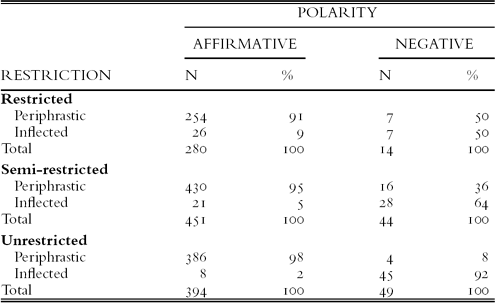
Before explaining this anomaly, we wish to remind the reader that the use of the periphrastic and inflected futures in spoken Canadian French, as witnessed in the speech communities of Ottawa-Hull, Montréal and Québec, is largely conditioned by syntactic polarity. While the PF is the dominant variant in affirmative utterances, the IF is almost always present when the polarity of a given sentence is negative. Still, this general pattern does not obtain for all speakers when we examine the effect of polarity according to language use restriction. In fact, as language restriction increases, the usage rate for the PF in negative utterances also increases – as much as 50% among the restricted speakers. Conversely, the lower the degree of language restriction, the less likely the PF will be used in negative utterances (see Table 4).
Variant distribution according to language use restriction and polarity.
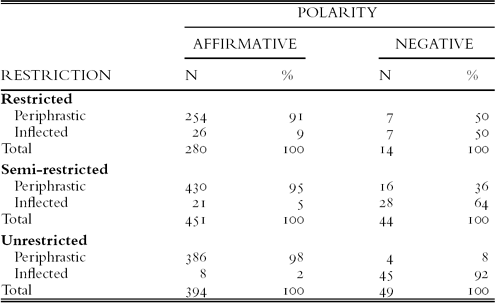
As this table reveals, the IF constitutes the dominant future form used among unrestricted speakers in negative utterances: 92%. This pattern largely imitates the marked preference for the IF in negative utterances in majority French-language speakers elsewhere in Canada. Among the semi-restricted speakers, we see that they produce intermediary results which follow the same general trend as the unrestricted speaker group, since they too show a marked preference for the IF in negative utterances. However, this constraint is ostensibly absent in the speech of the restricted speakers.
The quantitative distribution of our data indicates that a linear correlation also exists with respect to locality and the rate for the PF in negative sentences (see Table 2). As mentioned previously, the PF is at all times absent in negative utterances in the community of Hawkesbury, where the greatest number of unrestricted speakers live. However, in Pembroke, where we find the greatest concentration of restricted speakers, the percentage of tokens associated with the PF in negative utterances is at its highest.
5 CONCLUSION
In spite of external pressures to abandon the ancestral language in favour of English, the dominant language spoken in the province of Ontario, our research shows that it is nonetheless possible for minority speakers to maintain a morphologically complex form – in this case, the synthetic inflected future. This is especially true for the restricted speakers, who have largely lost French in daily communication outside the French education system. In fact, we submit that the school system itself is responsible for perpetuating the use of the IF among restricted speakers and that the standardizing effect of school has consequently prevented restricted speakers from learning the variable context in which polarity exerts such a strong influence. Simply put, the restricted speakers appear unaffected by the polarity constraint, which can only be acquired when a speaker has greater exposure to features of popular speech. In no other corpus of French in Canada is there equal representation of both future variants in negative contexts, as was found in the restricted speaker group. That said, we do recognize that the total token count for negative utterances in this group is limited, with a total of 14 occurrences.
We also note that the majority language speakers in Hawkesbury express the future in a way that resembles if not advances linguistic trends occurring in other majority French speech communities in Canada (with the exception of Acadian French). The categorical division between the PF and IF based on polarity not only demonstrates that language change is complete in Hawkesbury, but that access to the minority language in and out of the home helps to ensure that minority speakers retain greater stylistic flexibility in speech.
Our data reveal that the future tense in spoken Ontarian French demonstrates trends similar to and also different from other French-speaking communities in Canada. One significant finding concerns variant distribution. Compared to all francophone populations in Canada, we see that the IF is least frequent in Ontario. It accounts for only 11% of future tokens, and yet it constitutes no less than 17% of future tokens in other Laurentian varieties. This proportion translates into an obvious preference for the PF as the default future form irrespective of its purported temporal value.
Despite the reported differences between restricted and non-restricted speakers, it is nonetheless interesting to discover that the percentage distribution for the future variants among them is nearly the same. Token proportions in the restricted speaker group are 11% for the IF and 89% for the PF. With respect to the non-restricted speakers, these figures are 12% and 88% for the IF and the PF respectively (see Table 3). Though the exact token counts differ, it should not go unnoticed that when the future is being expressed throughout the minority communities, the degree to which it is used is constant.
The most significant finding we have to contribute to extant literature on the future variable in Canadian French, to the exclusion of Acadian varieties, is that polarity continues to maintain its known status as the most influential linguistic factor to condition variant choice. In Ontario, however, this ‘constraint’ is not operative in all three language use restriction groups. As identified in the previous studies we have consulted, the PF is the dominant choice in affirmative sentences and the IF is near categorical in negative sentences. Our data show that in Hawkesbury, where the largest concentration of non-restricted speakers reside, the polarity constraint is strongest in this community, the divide being effectively categorical. In other words, all negative future verbs are of the inflected form, whereas the periphrastic future is without exception present in affirmative sentences. This result leads us to believe that linguistic change for the polarity constraint in Hawkesbury is now complete.
Unlike the Hawkesbury speakers, the restricted speakers’ use of the variants patterns quite differently. We noted an equal distribution of the variants in negative sentences—an unprecedented observation in Canadian French. To this end, we assume that the polarity constraint is absent in this group of speakers. This is likely due to limited contact with spoken French on a daily basis outside the walls of the French-language school system. The general finding that restricted and unrestricted speakers use the same percentage of variants, but not in the same contexts, underscores the importance of conducting cross-tabulations for each language restriction group (cf. Mougeon and Nadasdi, Reference Mougeon and Nadasdi1998).
Finally, given the heterogeneous character of the trends we have described for the speakers in Hawkesbury and the restricted speakers elsewhere, we can safely assert that the future variable constitutes yet another evident case of linguistic discontinuity in minority French in Ontario.