

This is the second of four chapters that distinguishes between different levels, or sets, of security dynamics and related practices in the Arctic. Here, we look at the global, or systemic, level. These are dynamics and trends that are inherently determined beyond the borders of the Arctic region. Whether price levels for commodities, security interactions between NATO and Russia, or China and the USA, these issues and the political dynamics related to them are not to be confused with how the Arctic states interact in the Arctic region, as explored in Chapter 3.
Global Trends, Arctic Impact
At the start of the new millennium, certain developments and trends in international politics and global markets helped raise the Arctic on the international agenda. First and foremost, awareness of climate change and its marked effects in the Arctic spurred an environmental agenda concerning the region. The Arctic was promoted as the proverbial canary in the coal mine, showcasing the effects of human CO2-emitting activities. In tandem, global awareness of the impact on Arctic wildlife – such as imagery of drowning polar bears due to loss of ice habitat – spurred engagement in how to ‘Save the Arctic’ (Greenpeace Reference Østhagen2012). In contrast, or in addition, to a bottom-up approach to regional concerns as was showcased in Chapter 3, a renewed or increased interest in the Arctic – including from outside the region – emerged from around 2004–2005 onwards. This is reflected in the range of media attention, journalistic in-depth pieces, and scholarly work that looks at the Arctic in the early 2000s.Footnote 1
In addition to climate attention, another factor spurring global interest in the Arctic was high commodity prices. In July 2008, the price of crude oil peaked at USD 147. Coinciding with the high prices for resources, the Arctic region was thought to have a resource abundance and various numbers about the resource potential were flaunted. In 2008, the US Geological Survey estimated that the whole Arctic region held 13 per cent of the world’s undiscovered oil and 30 per cent of its undiscovered natural gas (USGS 2008). These reports have become the staple of any media article about the Arctic’s ‘riches’ and resource potential, despite their rather limited value to say anything about whether this potential is actually realisable. The reports only emphasise the probability of petroleum resources being located in various offshore parts of the Arctic. Crucially, the emphasis is on ‘undiscovered’.
This book is not about the oil and gas resource potential in the Arctic or the impediments to extraction;Footnote 2 hence, it will suffice to highlight that the extreme operating conditions in some of these areas, the subsequent fall in commodity prices, and the limited ability of the Arctic coastal states and companies to develop infrastructure connected to potential offshore fields are factors that have made these numbers around the resource potential less relevant. However, in the first decade of the second millennium, they helped spur attention and interest from large oil and gas companies (and their states) northward. And even today, the myth and allure concerning oil and gas in the Arctic is alive and well as internationally reputable media publish extensive features on the Arctic.Footnote 3
We also see that at the beginning of the 2020s, the general interest in oil and gas has, to some extent, been replaced with an interest in other natural resources. However, the dynamics are the same. The region’s resource abundance is coupled with global commodity prices and demand, prompting speculative statements about its future. Notions of a race to the Arctic, a scramble for resources, or an impending conflict continue to make headlines despite the situation being much more complex and nuanced in the Arctic.
This is not to say that the Arctic does not hold relevant resources, be it minerals or petroleum. Several parts of the Arctic are hubs for oil and gas extraction, which reaps profits for the relevant companies and regional/local governments. Fisheries, and their link to global markets for seafood, are similarly an international market-oriented product with enormous regional relevance in parts of Arctic waters. Moreover, other types of industry, for example, traditional metals industries that rely on parts of the Arctic that have cheap and stable electricity or new forms of industry-related battery plants or data centres, are relevant in some parts of the Arctic.
In addition, some Arctic countries have been particularly active in stoking interest from afar when it comes to the Arctic, working to highlight the region’s resource and economic potential. Thus, an argument that attention on the Arctic is only related to international or external factors disregards the agency of Arctic actors themselves. In turn, clearly distinguishing between the global, regional, and national drivers when it comes to economic prospects and resource development, or attention given to the region as part of a larger discussion on climate change remains difficult. Ultimately, the ‘Klondike’Footnote 4 that continues to lure one-liner descriptions never took place and will not come to fruition. The complexity of the region makes a pan-Arctic ‘gold rush’ impossible. However, global attention continues to set the frame for both the political and the economic discussions concerning the Arctic and driving attention northwards.
The Arctic’s Strategic Role for Russia, and Therefore NATO
The Arctic’s inherent cooperative spirit or ‘exceptionalism’ as explored in Chapter 3 has continued to clash against another global trend, or perhaps more accurately a certain effect of structures and developments in international politics. There are two dimensions to this: (1) the region’s role in security relations between Russia and ‘the West’ due to its strategic importance for Russian security policies; and (2) how the Arctic increasingly plays a role in the global competition between the USA and China.
The Cold War
It is worth taking a quick look at the Arctic’s importance during World War II, and since then, to understand why it has regained strategic importance for Russia (and the world). During World War II, the Barents Sea became a central part of Allied relief shipments to the USSR in the fight against Nazi Germany with convoys of ships traversing north of the occupied Norwegian Arctic. Nazi Germany occupied parts of the Kola Peninsula as part of the larger eastern offensive, whereas the Petsamo-Kirkenes offensive from the USSR became part of the Red Army’s liberation from Eastern North Norway.
Furthermore, Iceland held a strategically important geographical position, leading to its pre-emptive invasion by the UK in 1940 to avoid Nazi Germany occupying the island. By 1941, the USA had taken over the occupation of Iceland – then part of the Kingdom of Denmark. World War II also marked an incident in US history in which a hostile force invaded US soil in a northern or almost-Arctic context: the Japanese Empire attacked the Aleutian Islands of Unalaska, Attu, and Kiska, which were territories of the USA.
The Arctic played a prominent role in the political and military competition between the two superpowers during the Cold War. The region was not primarily important due to conflicts of interest within the Arctic itself however, but because of its strategic role in the systemic competition between the USA/NATO and the USSR (Åtland Reference Åtland2008; Huebert Reference Huebert2013a). Key to this was the nuclear arms race and, given the geographic proximity between the two states in the North, undersea and aerospace capabilities were prioritised in the Arctic, as the shortest route of missile attack between the two superpowers went over the North Pole.
Related to this, the Northern Fleet in the USSR eventually became the largest of the Soviet Fleets. The concentration of bases on the Kola Peninsula was, and is still today, largely a result of the fact that the southern Barents Sea is ice-free in winter, enabling year-round access to the Atlantic for Northern Fleet vessels. During the Cold War, Soviet naval strategy in this part of the Arctic revolved around a ‘bastion’ concept. This consisted of a maritime domain (a bastion) relatively close to Soviet territory, where ballistic missile submarines could linger while being protected by various conventional Soviet forces (Breemer Reference Breemer1989). Two bastions existed – one in the Barents Sea centred around the Northern Fleet and the other in the Sea of Okhotsk centred around the Pacific Fleet (Wezeman Reference Wezeman2016). After the fall of the USSR, the concept is thought to have survived, albeit in a reduced form. The focus also shifted away from the Pacific Fleet and to the Northern Fleet (J. Kjellén Reference Kjellén2022: 40).
Norway was one of only two NATO member states (the other being Turkey, which joined NATO in 1952) that shared a land border with the Soviet Union during the Cold War. As a consequence, the North Atlantic became NATO’s ‘northern flank’, crucial for monitoring and surveillance of Soviet military activity on the Kola Peninsula. Norway, with the help of the USA, built up its Armed Forces and force structure to be able to hold off a Soviet attack long enough for NATO allies to come to the rescue, albeit likely by ceding parts of its northern regions bordering the USSR. As is further explored in Chapter 5, Norway also imposed certain restrictions on itself regarding military activity and presence on its territory to ‘reassure’ the USSR that Norway posed no direct military threat (Skogrand and Tamnes Reference Skogrand and Tamnes2001).
One prominent geopolitical dimension was the possible role that the Norwegian archipelago of Svalbard might play in a large-scale conflict involving the Arctic (or parts of it). Since World War II, sensitivities concerning the use of the archipelago for military purposes have fluctuated in conjunction with East–West tensions. This possible military use of the islands was even discussed during World War II, albeit on a limited scale (Holtsmark Reference Holtsmark1993: 21–22; Dean and Lackenbauer Reference Dean and Lackenbauer2017). During the Cold War, the USSR was to some degree concerned about the possible military use of the archipelago, demanding adherence to the Svalbard Treaty’s ban on the use of the islands for warlike purposes or the construction of fortifications or naval bases (Svalbard Treaty Reference Treaty1920). When the archipelago was placed under NATO’s Atlantic Command in 1951 (Tamnes Reference Tamnes1987: 4:25; Baudu Reference Baudu2023), the USSR criticised this action as preparation for further Allied activity in the High North (Holtsmark Reference Holtsmark1995: 466–75; Skogrand and Tamnes Reference Skogrand and Tamnes2001: 81). Soviet leaders were concerned with Svalbard being utilised by NATO to hinder Russian access to the wider Atlantic via the Greenland-Iceland-UK (GIUK) and Norway gaps.
Norwegian analysts and policymakers thus thought, particularly in the late 1970s and onwards, that if war were to break out, control, and the possible use of Svalbard, would be the primary motivation for the Soviets – both to limit possible NATO command and to potentially use Svalbard as a forward operating area in order to protect the maritime domain of their strategic submarines with nuclear ballistic missiles (Tamnes Reference Tamnes, Dahl and Jensen2020: 155).Footnote 5 The Soviet interest in Svalbard expressed through, for example, the 1944 proposal to scrap the 1920 Svalbard Treaty (see more in Chapter 5) and also a debacle concerning the retrieval of the black box from a crashed Soviet reconnaissance aircraft in Hopen in 1978 probably contributed to the notion that Svalbard held an important position in strategic thinking in Moscow.Footnote 6
In the wider North Atlantic, the GIUK gap became an operational area where the emphasis was on the ability to monitor and deny the movements of Russian submarines with strategic nuclear capabilities (J. Smith, Hendrix, and Kaplan Reference Smith, Hendrix and Kaplan2017). Thus, the US presence increased markedly throughout the Cold War in both Iceland and Greenland, with US bases being established at Keflavik (Iceland) and Thule (Greenland). The USA never truly left Iceland after the occupation in 1941, and by 1949, Iceland became a founding member of NATO on the condition that they did not have to establish an army. Instead, the USA established the Icelandic Defence Force in 1951, which remained in place until 2006 (Ingimundarson Reference Ingimundarson and Kraska2011). The USA also took over the defence of Greenland in 1941, as Denmark was occupied by Nazi Germany in 1940. Military usage of the Thule airbase to the north-west of the island was expanded, which continued after the end of World War II. By the early 1950s, Thule Air Base was constructed, and it became a crucial component of the USA’s (and NATO’s) strategy to monitor and possibly intercept Soviet nuclear threats.
In Canada, the North – or the Arctic – was seen as a potential liability due to its extreme vastness and limited human population. The fear was that Russian bombers in particular could quickly reach North American cities by taking the shortcut across the North Pole. Given this vast, sparsely populated, and often inaccessible region, it perhaps comes as no surprise that Canada’s primary Arctic security and foreign policy concerns came to revolve around issues of sovereignty (Huebert Reference Huebert1995). In the words of Rob Huebert (Reference Huebert, Griffiths, Huebert and Whitney2011: 19–20): ‘The core issue of Canadian Arctic sovereignty is control; the core issue of Canadian Arctic security is about responding to threats.’
The USA and the USSR also started developing integrated, radar-based early warning systems, with the USA establishing the Strategic Air Command in 1946, installing the Ballistic Missile Early Warning and Distant Early Warning Systems and initiating bomber missions along the North American Arctic coast to deter the Soviet Union. Alaska was in close proximity to the north-east of the USSR – albeit separated by the Bering Strait. Thus, Alaska became the location for a range of strategic US forces – not only to control possible Russian incursions by air and sea but also in terms of ballistic missiles as part of nuclear deterrent structures during the Cold War.
Based on their decision to cooperate on mutual defence – the Ogdensburg Agreement from 1940 – in response to these new challenges, the USA and Canada bilaterally established the North American Aerospace Defence Command (NORAD) in 1957 to provide joint surveillance of potential air space threats in North America. Over time, NORAD became one of the foundations of defence collaboration between the USA and Canada, with the surveillance of the maritime domain added in 2006 (Jockel and Sokolsky Reference Jockel, Sokolsky and McDonough2012; Charron and Fergusson Reference Charron and Fergusson2022). However, these arrangements are what Jockel and Sokolsky deem ‘remarkably informal’ when framed in the broader context of North Atlantic security – namely in contrast to the formal structures of NATO (Jockel and Sokolsky Reference Jockel and Sokolsky2009: 316–18). An example of this collaboration is the joint surveillance infrastructure put in place during the Cold War in the Arctic, first and foremost the Distant Early Warning line: a 63-point line of radar stations across the northern parts of Canada and Alaska, which was replaced by the North Warning System when it became obsolete (Tukker Reference Tukker2022).
In all of these security considerations across the Arctic, from Norway to the GIUK gap to Canada and Alaska, the USSR was the primary concern. Thus, the Arctic played a significant role as a buffer space, a front line of defence in the case of outright conflict, and perhaps most importantly, as a domain for surveillance and monitoring of Soviet activity and possible air and seaborne threats.
When the Cold War ended, the Arctic moved from a region of geopolitical rivalry and investments in military infrastructure to one where Russia could be included in various cooperative arrangements with its former opponents. As discussed in Chapter 3, several regional organisations (such as the Arctic Council, the Barents Euro-Arctic Council, and others) appeared in the 1990s to deal with issues such as environmental matters, regional and local development, and cross-border cooperation (Young Reference Young2009). Although the interaction between Arctic states and Arctic peoples increased during this period, the region nevertheless disappeared from the geopolitical radar and lost its systemic or global significance. Eventually, the narrative of cooperation and stable Arctic relations came to dominate at least the foreign affairs statements from the Arctic states.
Russia’s Arctic Resurgence
The Arctic holds a particularly central position in Russian security policies for several reasons. First, from an economic perspective, the region is crucial in terms of resource extraction and exports. The Russian Arctic generates approximately 10 per cent of Russia’s GDP and 20 per cent of its exports (Almén and Hsiung Reference Hsiung2022: 30). Russia is boxed along all its western and central borders, with no direct access to the world seas in those domains. Russia is less restricted geographically in the Far East, although this is not where most of the population, economic activity, or political leadership are located. Writ large, the Arctic serves as a buffer zone for the world’s largest country, and it also provides unrestricted access to the North Atlantic and, to some extent, the North Pacific via the Northern Sea Route.
Since around 2005–2006 there was a marked resurgence of the emphasis placed on the strategic importance of the Arctic region for Russia. As in the Cold War, this was because Russia under the Putin regime has been committed to revamping its global militaristic and political security position, in part with an Arctic dimension (e.g., Hønneland Reference Hønneland2016). That in turn has led to increased attention northwards. Although this book is not about the underlying motivations of Russia in the Arctic or the various challenges it faces,Footnote 7 it is relevant to highlight the new security dynamics that have emerged consequently, of which there are at least two dimensions.
The first dimension is that in contrast to the situation during the 1990s, Russia has wanted to develop capacities in the Arctic itself to reap the benefits of resource extraction and increased Arctic shipping. The melting of the sea ice and the increased accessibility of the Russian Arctic undoubtedly pose a security problem, and Russian authorities have responded with a desire for more presence and control in their Arctic areas (Baev Reference Baev2018). In some ways, as highlighted by Lackenbauer (Reference Lackenbauer2010), this mirrors the debate in Canada, where Canadian forces and politicians have stressed the need to increase presence and capacity in the North due to the increased accessibility of the region.
In this duality between opportunity and challenges, Russia has responded by investing heavily in various aspects of its vast Arctic area. These investments have come in everything from research stations to search and rescue and military bases along the Northern Sea Route (i.e., with the small uptake in sailings along the Northern Sea Route) (Moe Reference Moe2014; Humpert Reference Humpert2014; Gunnarsson and Moe Reference Gunnarsson, Moe, Mineev, Bourmistrov and Mellemvik2022) to the vast hydrocarbon projects on the Yamal Peninsula (Sergunin Reference Sergunin2014). While other Arctic countries, in particular Canada, the USA, and the Kingdom of Denmark, have been slow or reluctant to push for large-scale Arctic projects, Russia has pursued these with a vigour that bears the mark of both symbolic and strategic rationales, in addition to economic (Hønneland Reference Hønneland2016). In other words, the Arctic has become an important area of investment in terms of military capacities.
As Russia placed the Arctic higher on the domestic or national agenda, followed by investments with a defence element, the other Arctic states as well as international media focused on the potential threats emanating from these investments. Despite the Arctic ‘cooperative spirit’, calls for other Arctic countries to respond to Russian investments were made from the 2010s onwards – often used in various domestic contexts to focus attention on Arctic issues in that specific setting. In particular, the ‘they-have-more-icebreakers-than-us’ argument referring to Russia (Byers Reference Byers2012; Humpert Reference Humpert2020) – without necessarily taking into account geography or icebreaker needs and where these are being used and what for – showcases the role of Russia in the other Arctic states’ domestic Arctic capacity and investment debates (Herrmann and Hussong Reference Herrmann, Hussong and Weber2021; Østhagen Reference Østhagen2020a, Reference Østhagen2023a).
Similarly, notions of Russia ‘militarising’ the Arctic appeared around 2007 in conjunction with the flag-planting stunt on the bottom of the North Pole seabed (Parfitt Reference Parfitt2007). However, the problem with some claims about Russian aggressive militarisation of the Arctic was that they seldom made a distinction between the different types of military capacities in which Russia was investing and the purpose and intent behind these investments (Borgerson Reference Borgerson2009; E. Buchanan Reference Buchanan2023b; Huebert Reference Huebert2013a). There was no doubt that Russia was increasing its military capability in the Arctic between 2006 and 2007 and 2022. Also, politically, the Russian leadership singled out the Arctic (Devyatkin Reference Devyatkin2023). First, in December 2014, a Joint Strategic Command was formed at the Northern Fleet headquarters. By presidential order in 2021, the Northern Fleet had the status of being one of the main military-administrative entities of the Armed Forces (Boulègue Reference Boulègue2022).
However, a few questions arose: Was this a capability that could be used to, for example, stage attacks on the Canadian or Norwegian Arctic areas? Or were the capabilities – often consisting of small units in reopened or newly constructed bases in remote locations along the Northern Sea Route – rather intended for Russia to project presence and have the ability to monitor activity and respond to emergencies along the Northern Sea Route? Naturally, both dimensions held true to varying degrees. Still, confusion or even obfuscation was arguably done to serve a purpose, namely raising awareness of Arctic issues and drawing attention to Arctic security issues in the domestic debate in other Arctic countries.Footnote 8
The point here is to try to further nuance the image of Russia doing only one thing in the Arctic. Pavel Baev, for example, showcases how Russia was actually doing different things along three rationales: realist/militaristic, institutional/cooperative, and diplomatic management (Baev Reference Baev2018). Others have explored similar multifaceted approaches to unpacking Russia’s Arctic actions (Konyshev and Sergunin Reference Konyshev and Sergunin2014; Sergunin and Konyshev Reference Sergunin and Konyshev2014; Hønneland Reference Hønneland2016; Zysk Reference Zysk2013; Boulègue Reference Boulègue2019; Sergunin and Konyshev Reference Sergunin2017). Looking at military activity and expenditure solely, it is also relevant to note a simple divide between assets in the Barents Sea, the central Arctic region of Russia, and those located close to the Bering Strait/North Pacific (J. Kjellén Reference Kjellén2022; Boulègue Reference Boulègue2022: 8).
In other words, if we unpack the idea of the ‘militarisation’ of the Arctic, at least three different strands of Russian Arctic military investments and capacity development seem to exist simultaneously:
To establish or re-establish capacities that primarily serve the purpose of sovereignty enforcement, emergency preparedness, and domain awareness. For example, including the bases in Russia’s Far East/Eastern Military District (see Figure 4.1).
Military defence of Arctic-located important military locations (i.e., Severomorsk, the location of the Northern Fleet) and Russian northern territory where it borders NATO countries (Norway and the USA, and from 2023, Finland). Here, the ‘bastion concept’ still holds relevance. For example, this includes the base structures established on Franz Josef Land (J. Kjellén Reference Kjellén2022: 41; Boulègue Reference Boulègue2019: 36).
Strategic competition and enhancing the Russian nuclear deterrent vis-à-vis NATO/the USA. For example, this includes the rearmament of the Northern Fleet and investments in submarine capabilities such as the new Borei-A class (Nilsen Reference Nilsen2021c).
Russia’s main base structures in the Arctic.
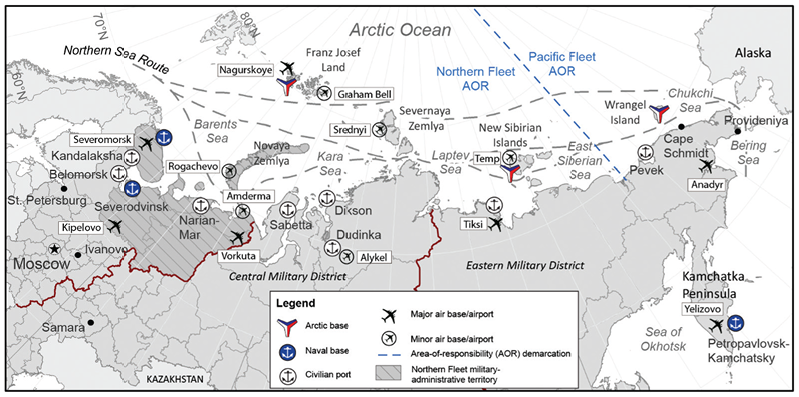
As such, the investments in Franz Josef Land stand out as perhaps the most obvious example of Russian militarisation of the Arctic, with a clear defence or security purpose in the Arctic. But the ‘aggressive’ nature of this can be questioned as its goal is primarily defensive – to assert control in that specific part of the Arctic. Still, these capabilities may undoubtedly be used aggressively, and they are part of a wider trend, namely increased military activity and installations in the Arctic, especially the Russian Arctic.
It is vital to distinguish between these Arctic-specific and Arctic-intended investments by Russia and the second dimension to the importance of the Arctic for Russian security policies, namely its strategic role. This is also what links this section on Russia to the overarching theme in this chapter, namely, the international level and the global security dynamics that have an Arctic impact or effect. As mentioned, the Arctic is not only, or even primarily, important for Russian security, but also – in the eyes of a Russian security strategist – critical to Russia’s nuclear deterrence strategy vis-à-vis NATO/the USA. As outlined in the Cold War section, this is a result of Russian geography and its reliance on the Russian Northern Fleet that houses the state’s strategic submarines.
The Russian Navy includes four fleets: the Northern Fleet, the Pacific Fleet, the Baltic Fleet, and the Black Sea Fleet. Its nuclear-powered strategic submarines, equipped with ballistic missiles, are deployed with the Northern Fleet and the Pacific Fleet, with the Northern Fleet being the most crucial for its strategic deterrence capabilities (J. Kjellén Reference Kjellén2022). The Pacific Fleet’s base in Vilyuchinsk on the eastern seaboard of the Kamchatka Peninsula is eastern Russia’s closest permanent naval base to Arctic waters. It is primarily home to nuclear-powered submarines, in addition to some surface ships.
Increasingly, naval operations in the Bering Strait and the Chukchi Sea by the Pacific Fleet are also becoming common, adding to Russia’s Arctic presence, although it is still the Northern Fleet and the Barents Sea that constitute the primary strategic role for Russia in the North. Russia’s strategic posture is weaker in the North Pacific than in the North Atlantic: neither Pacific Fleet assets nor Kamchatka installations are in particularly good condition (Boulègue Reference Boulègue2022: 23), while climate change is also impacting infrastructure there (Conley et al. Reference Conley, Newlin, Wall, Lohsen, Tsafos and Cahill2021). However, as we will return to in Chapter 7, there are developing security dynamics involving China that also make the Pacific Fleet a central component of Russia’s great power rivalry with the West.
Moreover, in addition to submarines, some of Russia’s long-distance bombers that can carry nuclear warheads are increasingly forward deployed at various bases in the Arctic as airbases and landing strips have been modernised. These play a role in showcasing Russian capabilities, reaching targets across the North Pole in North America, or in Western Europe – although some argue they pose only limited threat to North America (Lasserre and Têtu Reference Lasserre and Têtu2016).
In other words, this book distinguishes between intra-Arctic militarisation and Arctic-based militarisation, which is not intended for the Arctic. As argued by Jonas Kjellén, ‘although the Northern Fleet can be considered a latent Arctic force, in reality most of its vessels are rarely, or never, employed on Arctic missions’ (J. Kjellén Reference Kjellén2022: 43). Yet this is perhaps an artificial divide, as investments in one capability (the submarines) impact the other (conventional forces in the Arctic to protect the submarines). As Kjellén puts it, regarding Russian military investments in the Arctic before the 2022 war in Ukraine, ‘All these measures combined have certainly strengthened the defence of the Kola Peninsula and the provision for sustaining a Submersible Ship Ballistic Missile Nuclear “bastion” strategy and ensure that surface combatants can safely exit into the North Atlantic’ (J. Kjellén Reference Kjellén2022: 42).
Key here is again the bastion concept, as it was central during the Cold War (Olsen Reference Olsen2017). However, Ina Holst Pedersen Kvam argues that the current Russian force posture does not allow for a full-fledged ‘bastion defence’; instead, a rather limited version where new technology has enabled Russia to operate further behind its defensive lines (Kvam Reference Kvam2021). The bastion itself is probably a much smaller area than the wider bastion defence (see Figure 4.2), something that has become more apparent since Russia’s war in Ukraine from 2022. Kristian Åtland, Thomas Nilsen, and Torbjørn Pedersen, for example, find that after February 2022, Russian naval exercises in the North Atlantic/Barents Sea have shifted to concentrate on areas closer to the Russian Northern Fleet (Åtland, Nilsen, and Pedersen Reference Åtland2024). Nevertheless, the fundamental point here is that military investments and activity have increased. This is due to various rationales that we must unpack to understand so-called Arctic security practices.
Map of naval chokepoints in the North Atlantic and European Arctic, and typical Russian military activity in this space.
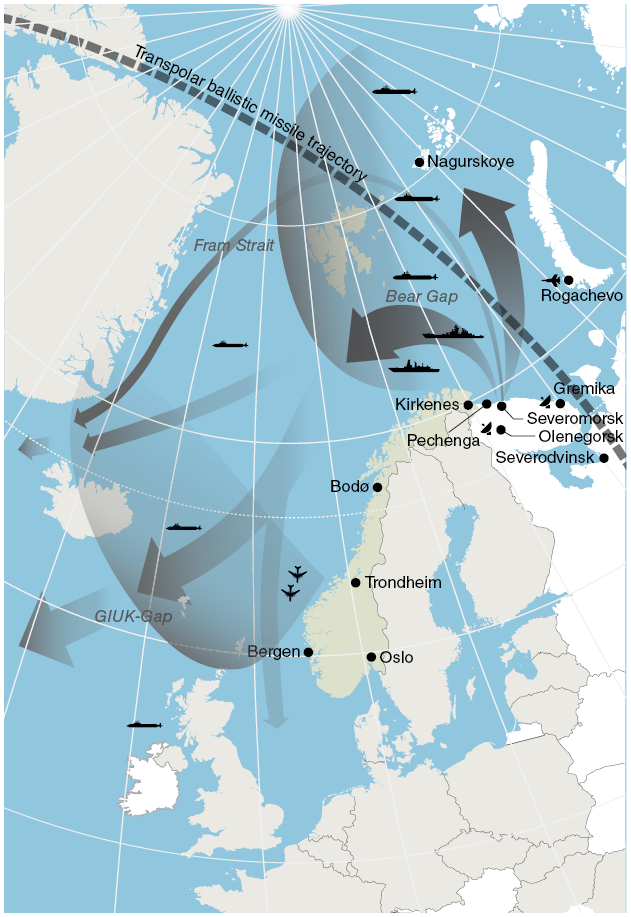
Moreover, these military investments have varying degrees of relevance in different parts of the Arctic. Chapter 5 discusses the effects of the bastion when looking at one country – Norway. Based on these security practices by Russia, it seems apparent that if we truly want to understand the complexities of Arctic security dynamics and the linkages to geography, it is by including a subregional (i.e., less-than-circumpolar) lens that we get a full picture of the geopolitical situation. In this instance, that concerns the Barents Sea/North Atlantic region and the Bering Sea/Strait region where we see the effects of this increased military attention given to the Arctic, whether for strategic (offensive) or defensive purposes.
NATO’s Response
It is clear that Russia’s increased military emphasis on the Arctic stems both from the changing Arctic geography, which leads to increased shipping and activity, and the importance of the Arctic to the Putin regime’s overall strategic plans and ambitions (Sergunin and Konyshev Reference Sergunin2017; Todorov Reference Todorov2020a; Hønneland Reference Hønneland2016). Retaining focus on the international level, or the effects of systemic competition and its Arctic-specific impact, in response to Russia, other states have looked to the North to counter the Russian presence there by increasing their military presence through exercises or maritime security operations in the Barents Sea.
Initially, the much-hyped 2007 flag planting led to concerns over Russian expansionist behaviour in the North. (Although, as already discussed, the planting of a seabed flag does not achieve anything per international law.) After the speech given by Russian President Vladmir Putin at the Munich Security Conference some months earlier that same year, where he attacked the West and US policies (Government of the Russian Federation 2007), coupled with the Russian invasion of Georgia in 2008, the fear of a revisionist Russia in the Arctic started to emerge. As examined further Chapter 5, Norway took a leading role in attempting to bring NATO attention to the Arctic, or more accurately, what it deems the ‘High North’.
However, at the same time, the notions of exceptionalism, cooperation, and the Arctic as a relatively peaceful domain were actively used by all Arctic countries (and academics (Käpylä and Mikkola Reference Käpylä, Mikkola, Finger and Heininen2019; Hoogensen Gjørv and Hodgson Reference Hoogensen Gjørv and Hodgson2019)) to counter ideas of an Arctic resource race or scramble. On a practical level, Norway, for example, continued to conduct an annual military naval exercise with Russia – named Pomor – up until 2014 (NATO-Russia Council 2013). This duality – on the one hand countering alarmist rhetoric concerning the conflict potential in the Arctic, while on the other hand increasingly worrying about Russian increased military investments and activity in the North – characterises much of the period from 2007 to 2014 (Łuszczuk Reference Łuszczuk and Heininen2016).
Although some NATO countries engaged in the Norwegian-led exercise Cold Response organised every second year since 2006, Allied engagement and interest in the Arctic – or more accurately the European parts of the Arctic/the High North – had been relatively limited. An exception to this became the NATO-led air policing mission in Iceland. In 2006, the United States Armed Forces announced that it would leave Iceland and dismantle the US Iceland Defence Force operating out of Keflavik Naval Air Station. The Defence Force, established after a joint NATO decision, had been present since 1951. The Icelandic government was vocal in highlighting its disappointment with the Americans’ decision (White Reference White2006). The USA still had a stated bilateral security responsibility for Iceland (Icelandic Ministry of Foreign Affairs 2006); nonetheless, Iceland was left with a security predicament as the country does not have armed forces of its own.Footnote 9
From 2007, Russia started showing more assertive military behaviour in the North Atlantic, particularly with regard to Cold War-style missions with Russian long-range bombers aimed at reasserting Russian long-range strike capabilities (Bases Reference Bases2008). This highlighted the strategic role of Iceland in the so-called GIUK gap and as gatekeeper (geographically) to the North Atlantic and North American East Coast. For this reason, it is also used as a ‘practice target’ by Russian strategic long-range bombers intent on showcasing Russian military capabilities. Since 2008, NATO has thus taken over the responsibility of Iceland’s defence and air policing. NATO’s efforts evolve around a rotary schedule of two to three joint air policing exercises annually, each for a period of three to four weeks. A range of NATO allies have contributed to this effort, such as France, Portugal, the USA, and Germany. The Nordic allies (Norway and Denmark) have also taken a considerable share of the burden.Footnote 10
With Russian resumption of Cold War-style military activity in the North Atlantic, combined with reinvestment in military bases and capabilities in the Arctic, the need to address NATO’s relative inattention took on a greater urgency (Depledge Reference Depledge2020: 296). The reduced ability of NATO to conduct anti-submarine operations in the North Atlantic and High North was central to these concerns, following years of declining training and exercise activity (Gade and Hilde Reference Gade, Hilde, Heier and Kjølberg2015). During the Cold War, this capability was seen as critical to protecting the Trans-Atlantic Sea Lines of Communication between Europe and North America (Olsen Reference Olsen2017). As explained by Duncan Depledge (Reference Depledge2020: 296):
Starting in 2012, NATO responded by reinvigorating its maritime exercise programme in the North Atlantic and High North. It did so by amalgamating what remained of national and small group training and exercises into a single NATO exercise involving undersea, surface and airborne assets: DYMON [Dynamic Mongoose]. The new NATO-led exercise allowed the Alliance to begin regenerating its joint anti-submarine warfare capabilities in the North Atlantic and High North … As such, DYMON marked the return of NATO to the North Atlantic and High North, although any link to changes unfolding in the Arctic could only be inferred by its proximity to the Greenland-Iceland-UK Gap and the focus on anti-submarine warfare.
Depledge’s points further underscore the importance of parts of the Arctic in wider security concerns, not necessarily linked to the ‘changes’ in the Arctic (i.e., resource extraction, climatic changes, etc.), but rather to the wider relations between NATO countries and Russia under Vladimir Putin’s leadership. Norwegian and Icelandic concerns over Russian resurgence are part of the explanation; the other part relates to Allied concern more generally over the lack of focus on the North Atlantic/High North part of the Arctic since the end of the Cold War. During Barack Obama’s presidency, for example, in 2011 the US 2nd Fleet out of Norfolk with responsibilities for the North Atlantic (i.e., Russia) was deactivated.
However, a point central to this book, these developments and NATO member states’ (slowly emerging) interests in High North security affairs were not in unison across the Arctic region. In Canada, for example, as an Arctic security interest came to the fore under the Conservative government from 2006, the focus was less on countering the Russian nuclear and naval threat, and more on domestic politics and developing adequate northern capacities. Prime Minister Harper made Arctic security an important component of his campaign and emphasised upholding Canada’s sovereignty (MacAskill Reference MacAskill2007). Throughout his years in office, the prime minister made Arctic security and Canada’s sovereignty central elements of his party’s brand: he made yearly visits during Operation Nanook, a ‘sovereignty operation exercise’ initiated in 2007 (National Defence 2024); he funded and heavily publicised efforts to find Sir John Franklin’s ill-fated Arctic expedition; and he ordered Canadian scientists to revise their submission to the Commission on the Limits of the Continental Shelf to include the North Pole (Byers Reference Byers2014b).
During Harper’s time in office, potential threats to Canada’s Arctic were highlighted. In particular, Russian bombers and fighter jets flying close to Canadian Arctic airspace were used as an example of an imminent threat to Canadian sovereignty in the North (CBC News Reference News2014; Lackenbauer Reference Lackenbauer2010; Wallin and Dallaire Reference Wallin and Dallaire2011). These flights had become infrequent following the Cold War but became more common after 2007. In response, the Conservative government increased the defence budget and initiated procurement projects, including stealth snowmobiles, Arctic drones, and Arctic offshore patrol vessels (Huebert Reference Huebert2013a, Reference Huebert, Griffiths, Huebert and Whitney2011). The subsequent drop in oil prices compounded the financial strain on the government, however, and several of the Arctic projects were put on hold or scaled back (Cox and Speer Reference Cox and Speer2016: 4). This back-pedalling on Arctic investment led some to label Harper’s approach as ‘all talk, no action’ (Byers Reference Byers2014a).
Others, however, debated the credibility of the threat posed by Russian aircraft flying close to Canadian Arctic airspace. A comparative study of Russian flight behaviour by Frédéric Lasserre and Pierre-Louis Têtu found that those aircraft flying near the North American Arctic did not violate Canadian airspace; that the number of interceptions in the North American Arctic was quite small relative to areas such as the Baltic Sea, the Sea of Japan, or the North Atlantic; and that the behaviour displayed by Russian planes was less aggressive in the Arctic (Lasserre and Têtu Reference Lasserre and Têtu2016, 320–21).
Many argued instead that a more pressing concern in the Canadian North was the persistent social and economic problems – ranging from food security to vulnerability to a changing climate – facing Canada’s northern communities (Perreault Reference Perreault2011; Furgal and Seguin Reference Furgal and Seguin2006; Power Reference Power2008). If anything, the soft security tasks, or safety-related concerns, were more apparent in the Canadian and wider North American Arctic despite Russia’s military resurgence from 2006. For example, investing in the Canadian Rangers or the Canadian Coast Guard was argued by some to be a more accurate response to Arctic security concerns (Lackenbauer Reference Lackenbauer2013a; Mitchell Reference Mitchell2013).
Even the concerns posed by the outstanding boundary dispute with the USA and the status of the Northwest Passage were relatively minor when considered in the context of the wider relationship between Canada and its neighbours (F. Griffiths Reference Griffiths and Kraska2011a: 10–11, Reference Griffiths, Griffiths, Huebert and Whitney2011b). From 2006 to 2015, the Conservative government’s strong rhetoric thus stood at odds with the lack of credible military security threats in the Canadian Arctic. Had the threats been more pressing, it is unlikely that the proposed investments in Arctic security would have been scaled back as significantly as they were, or that the government in Ottawa would have resisted a more pronounced role for NATO in the Arctic (Østhagen, Sharp, and Hilde Reference Østhagen, Sharp and Hilde2018). As Whitney Lackenbauer (Reference Lackenbauer, Griffiths, Huebert and Whitney2011a: 73) surmised it: ‘Anxiety about “using or losing” our Arctic inheritance is more revealing of the Canadian psyche … than of objective realities.’
These developments in the North American and Canadian Arctic stood, at the time, in sharp contrast with the European Arctic. The Russian annexation of Crimea in March 2014 and ensuing conflict in Eastern Ukraine showcased the willingness of the Russian regime to use force and its disregard for international law. These events had an Arctic impact. As Depledge highlights in his article ‘Train Where You Expect to Fight’, the number of military exercises in the Arctic and the number of NATO allies that partake in these exercises increased:
the intensity of exercises in and around the High North has increased since 2006: from one exercise every one-two years to two or three exercises each year, peaking with four in 2019. While this may not look dramatic, it implies an increased military presence and a higher tempo of activities involving non-Arctic states, which not only raises the costs for those involved, but also ties up capabilities that might be needed for military operations elsewhere in the world
A feature in this phase (2014–2022) of military response to Russian actions and activity was the NATO-led so-called high visibility exercise Trident Juncture in 2018. It became the pinnacle of Allied attention to the High North, although Norway worked actively to dampen antagonistic elements of the exercise, and most of it took part in the southern parts of Norway, namely below the Arctic Circle (Østhagen Reference Østhagen2023b). Russia in turn responded with an increasing amount of military exercises – both scheduled and so-called snap exercises intended to throw Norway/NATO members in the High North off balance (Nilsen Reference Nilsen2021b, Reference Nilsen2022; Danilov Reference Danilov2020).
In fact, in an analysis of where and when Russia issued notice to airmen (NOTAM) warnings in international waters and airspace in the High North in the period between 2015 and 2021, Åtland, Nilsen, and Pedersen (Reference Åtland, Nilsen and Pedersen2022) found that the number of NOTAMs steadily increased to a peak in 2019 and subsequently dropped in 2020 and 2021. This drop could be explained by the onset of the COVID-19 pandemic and its effects on military activity throughout the world. They also found a correlation between Russian NOTAMs and military exercises involving a NATO component in 2018, 2019, and 2021, suggesting that Russia most likely intended to disrupt these exercises.Footnote 11
With Russia’s full-scale invasion of Ukraine in February 2022, the security environment in the Arctic became even more tense, but these fundamental dynamics and practices did not change. In an updated study, Åtland, Nilsen, and Pedersen (Reference Åtland2024) found that ‘Russian NOTAM events in the High North now take place in the Barents Sea, rather than in the Norwegian Sea. The primary purpose of the activity now seems to be to bolster the Northern Fleet’s bastion defense, rather than to send political signals.’ Hopes of restarting security dialogue in the North to reduce the tension that emerged around 2019–2020 were dashed, and further sanctions on Russia were put in place.
Finland’s and Sweden’s subsequent decisions to join NATO in 2022 further solidified the divisions and spillover of tensions to the North. Moreover, not only has NATO’s role in the Arctic changed with seven member states in the North (see Figure 4.3); NORAD modernisation has also received fresh attention from Canadian and US decision-makers (Tukker Reference Tukker2022), with pledges of considerable spending over the next decades (Coates et al. Reference Coates, Heather Exner-Pirot, Johnston, Joyce, Lackenbauer and Spence2024: 21). These dynamics are further discussed in Chapter 7, where we examine the ongoing developments in the Arctic security subregions.
Map of naval chokepoints in the North Atlantic and European Arctic, and allied military activity in this space aimed at countering Russian activity.
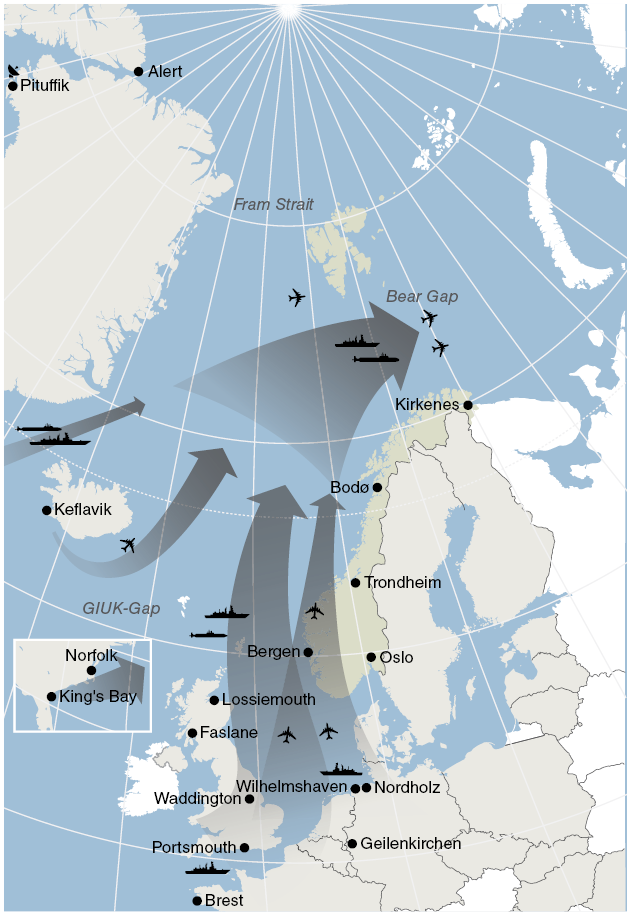
With all Arctic countries except Russia having joined the NATO alliance, there have also been increasing calls for a NATO Arctic command (Mottola Reference Mottola2023; Jonsson Reference Jonsson2023; Palmer and Gosnell Reference Palmer and Gosnell2024). However, this leads to a challenge since, in reality, the Northern European and North American parts of the Arctic are only marginally aligned in terms of defence concerns and threat perceptions. When Canada or the USA talks about ‘Arctic security’, the focus is on the Canadian North and Alaska respectively. What happens in Alaska has limited, if any, relevance to Finland, Norway, or Sweden. Whereas when Norway, for example, talks about the Arctic/High North it means the North Atlantic and Barents Sea areas.
Even security concerns related to Russia, as perceived by the seven Arctic NATO members, do not completely converge. Canada and Finland, for example, have varying threat perceptions and operate in different security geographies, even after 2022. Russia also does not treat the Arctic seven as one coherent block. Instead, Russia sees its vast Arctic coastline as segmented into different theatres of operation (J. Kjellén Reference Kjellén2022), the most prominent ones being the North Atlantic and the North Pacific.
Not only does the Arctic consist of different security spaces with limited, if any, overlapping security practices; the seven Arctic states that are part of NATO have diverging views of, and interests in, what NATO can do for national security. The Nordic countries, particularly the three Fennoscandian states that share a Northern European landmass with Russia, have viewed NATO as their main security guarantor, as they are unable to ensure adequate security on their own. This guarantee, however, does not come from policies set forth in Brussels by NATO HQ or because of NATO’s Allied Reaction Force – it comes in the shape of US commitment to upholding the territorial integrity of all NATO member states. NATO thus becomes the vehicle for US security engagement in the Nordics (Hilde Reference Hilde2019).
At the same time, we see that this Nordic engagement with the USA occurs, to a great degree, outside the NATO framework. The USA has, for example, signed bilateral agreements with Finland, Sweden, and Norway as a basis for enhanced defence cooperation. The USA actively conducts joint exercises with the Nordic states in the European Arctic, alongside other states such as the UK and France. This is in stark contrast to what happens in the North American Arctic – there, the USA and Canada manage their own security concerns. There are undoubtedly concerns over outdated technology and the need to modernise Cold-War infrastructure and policies (Charron and Fergusson Reference Charron and Fergusson2022). However, Canada and the USA do not need or want German, Swedish, or Turkish support to manage these issues. They have their own bilateral defence arrangement through NORAD, and NATO is not deemed necessary in their Arctic spaces.
In fact, the term High North has deliberately been used by NATO to underscore this divergence when it comes to the Arctic. Canada has been reluctant to use the ‘Arctic’ in NATO summit statements, whereas Norway has wanted NATO attention to go further north since 2008. The solution was NATO emphasis on deterring Russia in the High North, namely what Norway terms its Arctic areas (Østhagen, Sharp, and Hilde Reference Østhagen, Sharp and Hilde2018). Some argue that the Canadian position has shifted, partly showcased by former NATO Secretary General Jens Stoltenberg’s travel to the Canadian Arctic in 2022 (Brewster Reference Brewster2022). That does not discount the fact that within NATO the High North means something different to the Arctic. Whereas the former has been prioritised as an area that needs attention, the latter is often avoided in official statements or linked to wider concerns over climate change and general Russian military build-up.
Finally, there has also been a tendency to ascribe too much agency to NATO as an organisation in Arctic security debates. NATO HQ in Brussels has limited authority and cannot force its members to enact policy. NATO is the sum of its members, but its members’ actions cannot be equated with the whole defence alliance. However, in descriptions of Arctic security and geopolitics, NATO is often referred to as conducting independent activity in the North, or we hear statements about NATO militarising the Arctic (Little Reference Little2024). This is especially prevalent in the Russian narrative (Wilhelmsen and Hjermann Reference Wilhelmsen and Roth Hjermann2022), as a sign of how NATO is aggressive and expanding, whereas Russia is the victim – also in the Arctic.
Currently, the sole continuous NATO operation in the Arctic is the Air Policing mission conducted over Iceland, as that country lacks its own air force. The only NATO-led exercise regularly held in the Arctic is Dynamic Mongoose, an annual anti-submarine exercise in the North Atlantic. Other exercises are one-offs, such as the 2018 Trident Juncture – a high visibility exercise in response to requests from member states such as Norway for increased NATO attention and presence in the North. Numerous Western-state-led military exercises occur in the region.Footnote 12 However, these are not NATO-led initiatives. While they may involve a NATO component, such as support systems or specific NATO reaction forces, they are organised and conducted by individual countries in response to what they perceive is needed for their own security policies. Despite Russian claims to the contrary, these activities do not constitute NATO exercising in, operating in, or ‘militarising’ the Arctic. Rather, they reflect the preferences and activities of individual states that are also NATO members. These preferences may sometimes even diverge from those of other NATO members or involve only relevant regional coalitions.
However, there might be room for more sharing of knowledge, competence, and threat perceptions across the North Pole within the NATO alliance. This is also fundamentally the point made in many of the pieces calling for an Arctic Command, namely better situational awareness of what happens in the Arctic and better coordination amongst Arctic states. The solution to this might already partly be in place: in 2022, the Nordic Chiefs of Defence recommended that all Nordic states join the new Joint Force Command Norfolk to enhance their coordination (Gaasland Reference Gaasland2024), especially with the USA. Meanwhile, the USA and Canada maintain their joint NORAD command in Colorado Springs.
The point here is not to argue that the Arctic is not being militarised. It has been militarised during the Cold War and it started anew around 2007. The initial driver for this, both then and more recently, has always been Russia’s focus on developing its capacities on the Kola Peninsula due to its strategic importance – not because of ice melting or resources, but because it gives Russia a sheltered platform to operate its nuclear triad from, with relatively open access to Western Europe via the North Atlantic, and the North American continent writ large. Thus, for security analysts trying to understand Arctic developments, knowing where and what ‘Severomorsk’ is arguably matters more than knowing where Arctic shipping lanes might traverse or what resources the Arctic holds.
Still, it is not that intra-Arctic issues are irrelevant for Arctic security practices. However, global, or at least continental (i.e., European), security dynamics are the primary cause for the Russian military build-up in the European Arctic, which in turn has led to a response from initially Norway and eventually other NATO member states such as the USA, the UK, France, and also Finland and Sweden. This in turn has caused a security dilemma in the European Arctic (e.g., Åtland Reference Åtland2014; Sørensen Reference Sørensen2019; Knutsen and Pedersen Reference Knutsen and Nyquist Pedersen2024), where one actor’s security practices to increase security create a spiral of subsequent actions raising security concerns for all the actors involved. The Arctic, or, more accurately, the European parts of the Arctic, has thus undoubtedly been increasingly militarised over the last decades. This did not, however, start in 2014, or in 2022, but before that, in the early years of the Putin regime. Moreover, it is not NATO that has led the counter-reaction and the defence response since then, it is individual NATO member states in the Arctic.
The Arctic’s Role in Global Power Relations
When examining the international or systemic factors related to international affairs and security that have an impact on Arctic security practices, the role of global power rivalry is paramount. As outlined, this was central during the Cold War, due to the role of the Arctic as a buffer zone between the two superpowers. In contrast to during the Cold War, China has also emerged as a security actor in the Arctic – due to both concrete functional interests and the wider systemic rivalry between China and the USA (or the ‘West’).
China Emerges
From a systemic perspective, it is generally accepted that Russia is not the primary competitor vis-à-vis the West on a global level, due to Russia’s limited economy, declining population, and relative lack of innovation in society (Mearsheimer Reference Mearsheimer2010; Tunsjø Reference Tunsjø2018). Instead, China’s global rise in recent decades has prompted what is deemed a bipolar world order or, perhaps more accurately, if we also factor in India, Russia, the EU, and other emerging powers – a multipolar one. Of these non-Arctic actors, China is obviously the most central one due to its economic size and subsequent rise as a military power. When China asserts its influence on the world stage, the Arctic is one of many regions where its presence and interactions are components in its expansion of power through scientific research or investments in Russia’s fossil fuel industries (e.g., L. Guo and Wilson Reference Guo and Lloyd Wilson2020; Edstrøm, Stensdal, and Heggelund Reference Edstrøm, Stensdal and Heggelund2020; Koivurova and Kopra Reference Koivurova and Kopra2020; Brady Reference Brady2017).
Initially, as the Arctic was attracting attention due to economic opportunities and the effects of climate change, China’s interests were described primarily through an economic lens (Lim Reference Lim2018), with an emphasis on shipping along the Northern Sea Route (Jakobson Reference Jakobson2010). In the early stages of China’s Arctic interest, its link to polar research and the increasingly apparent effects of climate change along the Chinese coastal areas were furthermore highlighted as additional drivers for it (Stensdal Reference Stensdal2014). China also applied for an observer role in the Arctic Council, being accepted alongside Italy, Japan, India, South Korea, and Singapore at the Kiruna Ministerial Meeting in 2013. The deterioration in relations between the West and Russia after March 2014 further contributed to concerns over increased bilateral cooperation between Russia and China, and as a result, Russia seemed to allow China to play a larger part in the Arctic through those relations, from economic investments to science cooperation (Bertelsen and Gallucci Reference Bertelsen and Gallucci2016). Still, as many have highlighted, Russia has also been wary of giving China too much influence in this strategically and economically sensitive area (Røseth Reference Røseth2014; Moe Reference Moe2021; Stensdal and Heggelund Reference Stensdal and Heggelund2024).
China released its first and to date only Arctic policy in January 2018 (State Council of the People’s Republic of China 2018). In it, China describes itself as a ‘near-Arctic state’, which some have interpreted as having not only the right to get involved but also a duty to do so (Brady Reference Brady2017). The near-Arctic terminology was used for the first time in official Arctic documents not by China, but by the UK in 2013–2014.Footnote 13 The Chinese policy paper does not reveal anything noteworthy. As with most Arctic policy or strategy documents, it highlights the importance of the Arctic, the need for research, environmental and marine protection, and the legal frameworks governing the region:
China maintains that all activities to explore and utilize the Arctic should abide by treaties such as the UNCLOS and the Spitsbergen Treaty as well as general international law, respect the laws of the Arctic States, and proceed in a sustainable way on the condition of properly protecting the eco-environment of the Arctic and respecting the interests and concerns of the indigenous peoples in the region.
Perhaps one interesting thing – apart from China stating all the ‘correct’ things about Arctic climate, resource development, and governance – is how frequently the Spitsbergen Treaty (now usually known as the Svalbard Treaty) is mentioned. This book offers a deeper discussion of Svalbard and geopolitics in Chapter 5; however, it is noteworthy that the Treaty is mentioned with reference to the rights China has in the Arctic.Footnote 14 This must be, in part, read as a way to legitimise China’s Arctic interest and engagement, as an outsider to the region, and used as a starting point for Arctic engagement: ‘China has long been involved in Arctic affairs. In 1925, China joined the Spitsbergen Treaty and started to participate in addressing Arctic affairs’ (State Council of the People’s Republic of China 2018). In fact, China was amongst the first countries to ratify the Treaty – albeit it was not part of the negotiations in Versailles in 1919–1920.
An issue that has drawn particular attention to China’s interests in Svalbard has been Norwegian efforts through the Norwegian Polar Institute to better coordinate research in Ny-Ålesund (Norwegian Research Council 2019), which is a small research settlement on the island of Spitsbergen. In Ny-Ålesund, ten different national polar institutes have established their research presence, starting with the gradual establishment of the Norwegian presence in the 1960s as coal mining there was declining, and the most recent one being the Indian presence through the Indian National Centre for Antarctic & Ocean Research (Moe Reference Moe, Dahl and Jensen2020: 118).Footnote 15 Research access and activity is not explicitly tackled in the Svalbard Treaty from 1920,Footnote 16 but Norway’s policy up until the 1990s was one of treating this type of activity as on par with other types of activity covered by the Treaty, given that any national of the signatory states would have free access to the archipelago (Moe Reference Moe, Dahl and Jensen2020: 120).
Over the two past decades, Norwegian authorities have wanted better control over research activity and to counter the impression of third-party states that they have their own independent research stations based in Svalbard (as they have, for example, in Antarctica) (Hanger Reference Hanger2018; Moe Reference Moe, Dahl and Jensen2020: 124–25). At the same time, a goal has been to increase international collaboration in Ny-Ålesund to improve science quality, economies of scale, and environmental impact (Norwegian Research Council 2019). This came to the fore with a government White Paper on Svalbard in 2016 (Norwegian Ministry of Justice and Public Security 2016) and a new strategy for research and education on Svalbard in 2018 (Norwegian Government 2018). In the words of the director of the Norwegian Research Council, Norway wanted to ‘underscore that Svalbard is Norwegian’ (Hanger Reference Hanger2018).Footnote 17 Tiril Vold Hansen showcases how these efforts by the Norwegian government were indeed undertaken to support Norwegian sovereignty on Svalbard, but there were also idealistic and practical motivations and interests behind the policy changes (Vold Hansen Reference Vold Hansen2024).
The response from some research institutions, such as the British Natural Environment Research Council, was negative, indicating disappointment and fears that this coordination effort could undermine the British symbolic presence in the Arctic (Hanger Reference Hanger2018; Moe Reference Moe, Dahl and Jensen2020: 128). However, it was the Chinese response that attracted the most attention. Norwegian efforts to improve research coordination in 2018 led to Chinese research actors expressing concerns over whether Norway was extending its reach too far (N. Liu Reference Liu2021: 4; Hanger Reference Hanger2019). In an official note from the Chinese Arctic and Antarctic Administration, it was argued that these matters should have been decided through an international process and that they violate the principle of equal access and right to certain activities – despite acknowledging that research does not constitute any of those (Moe Reference Moe, Dahl and Jensen2020: 128–29).
As Arild Moe highlights (Moe Reference Moe, Dahl and Jensen2020: 129), Norwegian leniency since the start of the international research presence in Svalbard might have been to blame for these counter-reactions, as the idea of Svalbard research as an international ‘common good’ had taken root in public discourse. This mirrors Rolf Tamnes’s argument (Tamnes Reference Tamnes, Dahl and Jensen2020: 140, 147) about Norway’s passive role when it came to governance of Svalbard in the first decades after the Treaty came into force, which in turn might have left an impression amongst other states’ citizens that they have special privileges in Svalbard.Footnote 18
We return to Svalbard and security practices there in Chapter 5. Here it is used as an example of a concrete, or functional, Chinese interest in the Arctic, which the Chinese government apparently also places a certain degree of weight on in order to legitimise its Arctic engagement. Other examples range from Chinese investments in the Yamal LNG-project in Russia to research interests in Iceland or mining interests in Greenland. However, that general engagement and interest into the Arctic policy realm has elicited counter-reactions, especially in the USA.
Reactions to China in the Arctic
China’s Arctic interests have led, as per a systemic or global outlook, to the Arctic’s becoming relevant in the increasing global power competition between China and the USA. In 2019, US Secretary of State Mike Pompeo gave a speech in Rovaniemi, Finland, just before an Arctic Council Ministerial Meeting, where he lambasted both Russia and China for their ‘aggressive’ actions in the Arctic. China was obviously the main target in this speech: ‘Beijing claims to be a “Near-Arctic State,” yet the shortest distance between China and the Arctic is 900 miles. There are only Arctic states and non-Arctic states. No third category exists, and claiming otherwise entitles China to exactly nothing’ (US Department of State 2019).
The fact that the speech was held just in advance of the Arctic Council Ministerial meeting, where the main keywords were ‘cooperation’, ‘peaceful’, and ‘sustainable’, caused concern in the Arctic community over where the Arctic Council, and Arctic cooperation at large, was going (Koivurova Reference Koivurova2019). China also had, and still has, a seat around the table, being granted observer status to the Arctic Council in 2013. However, this speech was perhaps the final blow to the efforts made by all Arctic states – including the USA and Russia – to focus primarily on the region’s cooperative traits and downplay, or ignore, the parallel increase in military activity and build-up.Footnote 19
This was also quite in line with the Trump administration’s ‘America First’ foreign policy (Council on Foreign Relations 2024). The 2019 warning about Beijing’s Arctic interests highlighted how the USA saw the Arctic as yet another arena in which the new systemic competition between the two countries was sharpening (US Department of State 2019).Footnote 20 Arguably, this was linked to a lesser extent to Chinese actions in the Arctic; it was more about the United States wanting to stop China’s global growth in as many areas as possible (Østhagen Reference Østhagen2021b). However, questions about China–Russia cooperation in the Arctic and the effects this could have on regional tension are increasingly on the agenda after the sanctions placed on Russia in 2022.
With its harsh tone and the rather inaccurate comparisons to the South China Sea,Footnote 21 the 2019 speech also seems to have led to, or been part of, a resurgence of the ‘new-cold-war-conflict-is-imminent’-style articles from large media outlets. While the first wave of such stories in 2007–2010 focused on Russia, climate change, and resource conflicts (for an analysis, see Nilsson and Christensen Reference Nilsson and Christensen2019; Padrtova Reference Padrtova2019), this time, the main antagonist was not only Russia, but increasingly China.Footnote 22
We can question what China has done in the Arctic to warrant this focus. Some of the Chinese economic interest had already disappeared with the fall in commodity prices in 2014 (Koivurova and Kopra Reference Koivurova and Kopra2020: 26). By 2024, Yamal LNG represented the majority of Chinese maritime activity, in that there are Chinese ownership interests in fourteen of the fifteen ice-breaking LNG transport vessels delivered from South Korea (Moe and Stokke Reference Moe and Schram Stokke2019). Nevertheless, as Christopher Weidacher Hsiung (Reference Hsiung2016) as well as Oscar Almén and Hsiung (Reference Hsiung2022) point out, Chinese interest in economic projects in the Arctic is modest, and the engagement in both the Nordic countries and – to some extent – Russia is limited. Moreover, ‘[m]ajor obstacles to further development relate not only to the harsh physical environment that the Arctic represents, but also to the response and willingness of Arctic states to welcome a greater Chinese economic presence’ (Almén and Hsiung Reference Hsiung2022: 92). As Anders Edstrøm, Iselin Stensdal, and Gørild Heggelund also argue (Reference Edstrøm, Stensdal, Heggelund and Østhagen2023):
In particular, transport and energy are areas where China has expressed interest. Nevertheless, activity in both areas is relatively low. At present, we see few concrete Chinese Arctic projects, and we have also seen the side-lining of projects due to cost levels. Whether the number of projects is due to low interest, a poor commercial basis under current conditions, or other factors is difficult to conclude with certainty.
It seems clear that the role of China in the Arctic is far more complex than Pompeo’s 2019 speech made it out to be (Fravel, Lavelle, and Odgaard Reference Fravel2022). The effects of the Russian invasion of Ukraine in 2022 have also impacted Chinese–Russian cooperation in the Arctic (and in general) (Hsiung Reference Hsiung2022). This has a circumpolar/Arctic and a subregional/North Pacific effect, returned to in Chapters 6 and 7.
China’s interests do not necessarily align with those of Western Arctic states, although when it comes to specific economic projects in the Arctic, Chinese investments and capital might even be sought after (Gåsemyr and Sverdrup-Thygeson Reference Gåsemyr, Sverdrup-Thygeson, Seaman, Huotari and Otero-Iglesias2017). At the same time, China’s interest in Arctic-specific investments and activity have spurred Arctic states into blocking possible activity, or purchasing land, rights, or companies, in advance (Edstrøm et al. Reference Edstrøm and Guðbjörg Ríkey2025). Examples of this includes fears of Chinese mining activity in Greenland (Andersson, Zeuthen, and Kalvig Reference Andersson, Zeuthen and Kalvig2018; Jacobsen and Lyngholm Lindbjerg Reference Jacobsen, Lyngholm Lindbjerg, Jacobsen, Wæver and Gad2024) and fears of Chinese acquisition of land on Svalbard (Moe Reference Moe, Dahl and Jensen2020; Østhagen Reference Østhagen2024).
However, we must see China’s interests and expansion in the Arctic as part of the global expansion of the ‘new superpower’ (Edstrøm, Stensdal, and Heggelund Reference Edstrøm, Stensdal, Heggelund and Østhagen2023), with all the challenges that entails for not only the ‘old superpower’ – the USA – but also the various European countries. For example, NATO has been increasingly warning that China is a competitor and rival to the West, with an Arctic component. In early 2023, NATO Secretary General Jens Stoltenberg warned about becoming too dependent on China for economic purposes and of increasing Russia–China military cooperation (NATO 2023a). Chinese ‘spy balloons’ notwithstanding (Chotiner Reference Chotiner2023), concrete military expressions in the Arctic of China’s interests are few and far between (Lajeunesse and Choi Reference Lajeunesse and Choi2022).
The points made here regarding China and the USA showcase the core difference between a regional look at security relations, especially as showcased at the end of Chapter 3 when discussing security cooperation and dialogue with Russia, and the security impact of global affairs on Arctic security relations. In the Arctic, Russia is undoubtedly the dominant actor along a range of parameters (population, size of territory, military investments, or – as used by some – number of icebreakers).Footnote 23 However, globally, China is the competitor – or adversary – that the USA (and the West, although that varies) perceives as the more severe threat in the long term.
Reactions to China in the Arctic also showcase another thing, namely the difference between the strategic or systemic dimensions as already outlined when it comes to Russia’s military posturing and strategic positioning in the Arctic and China’s Arctic interests. Russia’s dependence on parts of the Arctic for its security strategies and nuclear deterrent triad results in military investments in the Arctic. However, China has an outside-in approach to the Arctic, increasingly displaying Arctic capabilities – such as its three polar class icebreakers (Humpert Reference Humpert2024b; Staalesen Reference Staalesen2024) – and highlighting Arctic investments but nevertheless remaining firmly on the outside of the region in terms of sovereign territory and sovereign rights (Lamazhapov Reference Lamazhapov2024).
Nevertheless, there is one part of the Arctic that is seeing increased Chinese activity beyond symbolic statements, namely the Bering Sea/North Pacific region. While examining Russian military activity in the Arctic and unpacking Chinese security interests and military activity, the circumpolar or ‘pan-Arctic’ labels are too loose to accurately fit. Instead, we must also examine the subregional level, focusing on – in the case of China – what is happening in the North Pacific. In comparison to the dynamics that take place in Barents Sea/North Atlantic, this will be discussed in Chapters 5 and 7.
Other Non-Arctic States: The Rise of India
There are more non-Arctic actors engaged in, or at least showing an interest in, Arctic affairs other than China. These include the EU, France, Germany, India, Italy, Japan, Poland, Singapore, South Korea, Turkey, the UAE, the UK, and others. Yet keeping an eye on security dynamics, few of them tend to have much impact on security dynamics (even loosely defined to include national interests, governance issues, and cooperative elements). Often, a different set of dynamics explain their engagement: (1) either with functional interests in the Arctic related to research presence (such as being part of the Norwegian-led research station in Ny-Ålesund in Svalbard) or economic investments (such as Chinese investments in Yamal-LNG); or (2) an interest in stating an Arctic interest for partly symbolic or immaterial interests, as engaging in Arctic discussions and Arctic governance is increasingly seen as a staple of global politics and a state’s global aspirations (Ayaydin Reference Ayaydin2022; Steinveg Reference Steinveg2017; Lamazhapov Reference Lamazhapov2024).
Although these strands have the potential to impact Arctic developments and related politics, they arguably have limited impact on specific security dynamics, unless the efforts involved are considerable. Increased intangible interests by non-Arctic actors might also spur Arctic states to intensify their rhetoric concerning current governance mechanisms, or initiate new efforts, as described in Chapter 3. For security-specific actions, however, is has been European non-Arctic states such as the UK and France that have engaged militarily the most in the region, although this tends to take place in a subregional context. Keeping a focus on the international or systemic dynamics emanating from outside of the Arctic, that might have long-term Arctic security implications, one other actor is increasingly relevant to consider, namely India.
India has been active in Arctic affairs with, for example, its research presence in Svalbard through the Himadri station since 2008, and in 2022 India released an Arctic Policy (Government of India 2022). However, only in recent years with the deterioration of security relations between Russia and the West, alongside China’s increased engagement in the Arctic through its cooperation with Russia, has India begun to show an interest in the region’s security and strategic dynamics (Sharma Reference Sharma2024).
Starting with the operational perspective, it is obviously difficult for India to mount much of a military or security presence in the different parts of the Arctic. India does not belong to the NATO alliance, nor does it figure in an outright security or defence alliance with Russia, meaning that it so far has not partaken in military exercises held by either actor above the Arctic Circle. Still, Uttam Sinha, for example, muses that increased military cooperation between Russia and India might have the ‘potential to grant India access to Russian naval port facilities in the Arctic and thereby add to its overall strategic reach’ (Rishikesh Reference Rishikesh2021). Italy, albeit located far away from the Arctic and having limited operational security interests there, still participates on a limited scale in northern NATO exercises from time to time (Pes Reference Pes2020). It is thus not unthinkable that countries located closer to the equator than the Arctic Circle might want to engage in some form of military exercise or operation, primarily led by an Arctic state, in order to both train in an extreme environment and to build diplomatic and military relations. An example of this was the US–Indian Yudh Abhyas exercise in Alaska in 2023 (Indian Ministry of Defence 2023).
Similarly, showcasing capacity, capability, and – to some extent – symbolic interest by sending a state vessel into Arctic waters is not uncommon for non-Arctic states such Italy, France, or China. Given India’s location, the North Pacific Arctic or subarctic domain is probably what is within closest reach, although still located at a considerable distance. Still, the North Atlantic is the easiest part of the Arctic to access due to milder temperatures and limited sea ice, as well as the most developed infrastructure. India–Norway relations in particular have grown exponentially in recent years, with a strong Arctic focus also linked to Indian aspirations in the maritime sector, as well as India’s foothold on the Norwegian Arctic archipelago of Svalbard (Singh and Østhagen Reference Singh and Østhagen2024).
India’s Arctic ambitions are also influenced by concerns over China’s growing presence in the region which India fears could divert the USA’s focus away from the Indo-Pacific (Suhag Reference Suhag2022). Indian strategists are equally worried that new Arctic sea routes could provide China with an alternative to the Malacca Strait, thus easing what is commonly known as the Malacca dilemma (Suhag Reference Suhag2022). Although this could arguably be questioned as any Arctic route would also be contingent on the sailing through the Bering Strait – another potential chokepoint.
This links to the second dimension of Indian security engagement in the Arctic, namely the symbolic and/or political aspirations that tie India to Arctic geopolitics. China’s acquisition of polar icebreakers primarily designed for research purposes arguably fulfils several goals at once: they perform research tasks, they enable Chinese learning and capacity-building for operating in polar environments, and they highlight Chinese global reach and interest spheres stretching even to the Poles (Lamazhapov Reference Lamazhapov2024; Tatlow Reference Tatlow2024a). An Indian polar class research vessel is thus rather likely as India’s global aspirations, as well as Arctic and Antarctic interests, become more concrete (Sharma Reference Sharma2021).
Although, as described, the Arctic is the polar opposite to Antarctica concerning aspects related to population, climate, land/ocean ratio, and state sovereignty, the importance of presence and an ability to operate in both domains undoubtedly links to perceptions of great power status and global influence. India today not only has a research presence through the Himadri research presence in the Ny-Ålesund research station in Svalbard in Norway, but also has two research stations in Antarctica, the Bharati and Maitri. Thus, Bipandeep Sharma (Reference Sharma2021) concludes that ‘icebreaking capabilities will be an important requirement for India not only in terms of scientific research but equally for economic and strategic interests in the Arctic’.
Coupling apparent interests in research, economic activity, and governance questions with a clear sense of what India wants to achieve politically can lead to the Arctic being utilised for both domestic and international purposes. Notwithstanding the benefits of the scientific data and research itself, up-playing, for example, India’s Svalbard presence with the first year-round occupancy at Himadri (Srivastava Reference Srivastava2023), showcases to a domestic audience the state’s competence and global aspirations. Similar actions (and showcasing of capacity) from Indian companies or other government entities operating in the Arctic are conceivable in the near future.
For a country increasingly throwing its weight around in global politics, expressions of its global engagements and interests – as with the rise of China over the last two decades – are also likely to have an Arctic component. However, how it utilises these interests and what issues India decides to address (and with what tools), remains to be seen. Generally, non-Arctic states have been wary of highlighting any strong divergence from the interests of the Arctic states. The perhaps most apparent example of outside interests wanting to challenge existing governance mechanisms and/or ongoing activity has been the EU’s environmental, economic, and governance statements on the Arctic especially at the start of its Arctic endeavour (Østhagen Reference Østhagen2013; Raspotnik Reference Raspotnik2018). Fears about China’s interests and role in Arctic governance have also been raised, although China seems to have taken a relatively muffled approach in the North to sensitive issues that might irk Arctic states (Ye Reference Ye2014; Edstrøm, Stensdal, and Heggelund Reference Edstrøm, Stensdal, Heggelund and Østhagen2023).
Finally, India’s ambition to be a global power broker – positioned somewhere in between the USA, Europe, and Russia, and with an ambivalent relationship with China – comes into play in the Arctic. As highlighted above, beyond Arctic-specific activity or actions that are either directly security-oriented (e.g., sailing a frigate through the Bering Strait) or linked to wider political interests and posturing (e.g., increasing scientific missions or launching an Arctic policy), the Arctic’s role in global politics as an arena for contestation and cooperation became increasingly apparent from 2018 onwards.
For the smaller Western Arctic states, there is a wait-and-see approach to what India’s geopolitical ambitions entail for the Arctic. Especially given the growing friendship of convenience emerging between Russia and China in an Arctic and North Pacific context, hopes are that India can play a balancing role vis-à-vis China, and possibly also Russia, as the latter state might eventually implode due to external and internal pressures. Terming itself ‘non-West but not anti-West’ (Mohan Reference Mohan2024, quoting India’s Foreign Minister Subrahmanyam Jaishankar), India could also have a central role to play in the Brazil, Russia, India, China and South Africa grouping and its possible Arctic endeavours – which Russia is increasingly seeking to utilise as a wider alternative to Western Arctic collaboration (Edvardsen Reference Edvardsen2023a).
In conclusion, the Arctic continues to be on the global political agenda both because of its importance for Russia’s strategic dependence on the region and increasing Chinese interest in the region, which in turn impact Chinese rivalry with the USA. Security tensions arising from issues in other parts of the world (i.e., Ukraine in 2014/2022) or global power struggles (i.e., China–USA, or – perhaps – China–India) have a spillover effect for the Arctic: on the rhetorical level in the form of bellicose statements and on the operational level in the form of increased military presence and exercises by some NATO member states and Russia, to some extent China, and – in the future – perhaps also other actors. In Chapter 7, how these dynamics might play out on a subregional level is further discussed. Yet there is one more level we must examine to get the full picture of what is occurring in the Arctic when it comes to security and geopolitics, namely the bottom-up perspective of specific Arctic states.
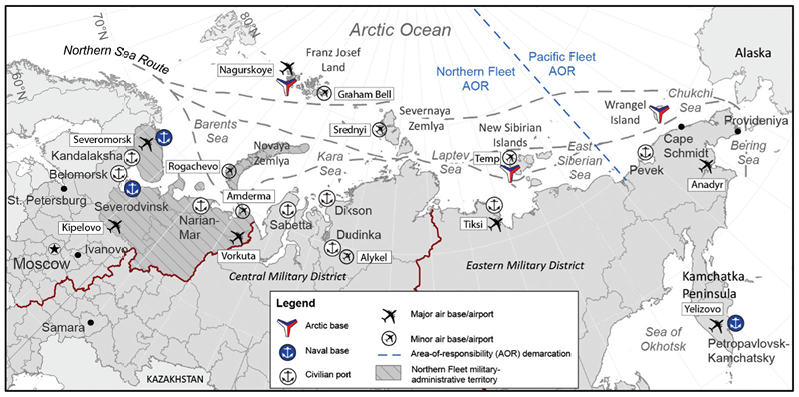
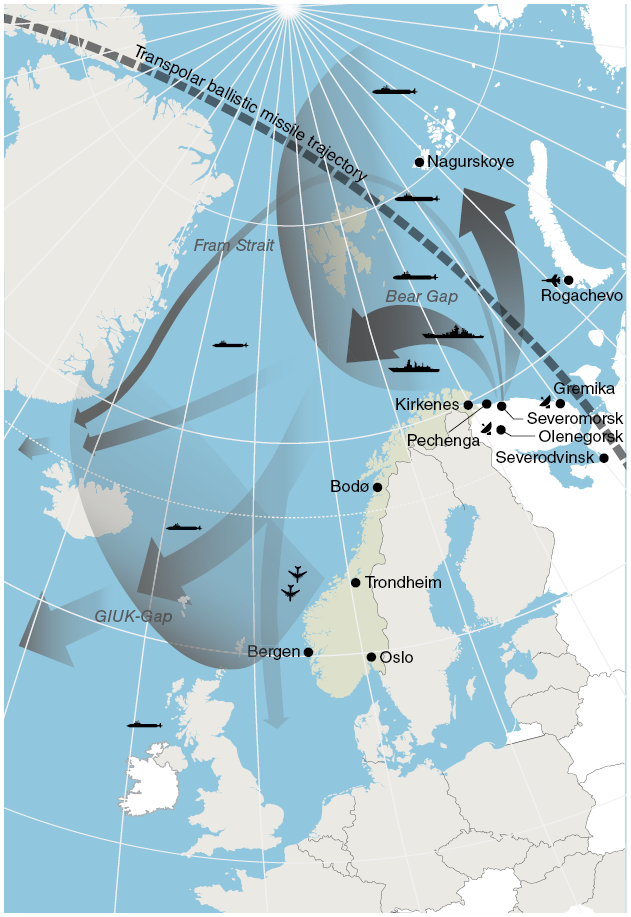
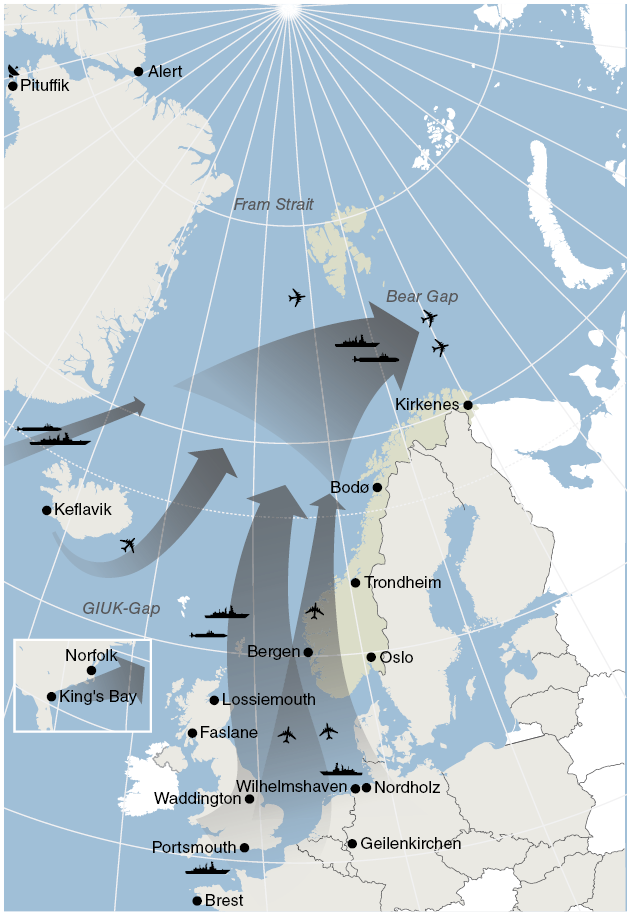

 Open access