1 INTRODUCTION
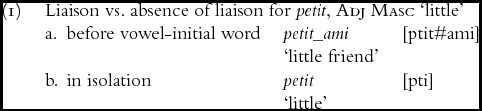
French liaison is a phrasal phonological phenomenon that consists in the pronunciation of a word-final consonant that is followed by a vowel-initial word, see (1a), where this consonant is otherwise not pronounced when the word is realised in isolation or before a pause,Footnote 1 (1b). Here and in all following examples, realization of a liaison consonant is indicated in the orthographic representation by an underscore (‘_’), and word boundaries are indicated in the phonetic transcription by a hash (‘#’).
(1)

The present study addresses the question of how liaison is used in informal speech, based on a small selection of texts drawn from the French part of the C-Oral-Rom corpus (Cresti & Moneglia, Reference Cresti and Moneglia2005), which contains spontaneously spoken language recorded in natural conversations. The database comprises a total of 1,219 possible liaison contexts. Linguistic factors that condition speakers’ use of variable liaison – such as syntactic context, word length, lexical or functional status of the target word, segmental identity of the liaison consonant – are investigated. It will be argued that the distinction between variable and invariable liaison can – at least to some degree – be accounted for by adopting Selkirk's (Reference Selkirk, Morgan and Demuth1996) distinction between internal and free clitics. We also deal with the influence of sociolinguistic variables like sex, age and education on speakers’ use of variable liaison.
Three questions have figured prominently in previous research on French liaison: first, how can we account for the contexts in which liaison applies invariably, variably or in which it must not apply? Second, what is the nature of the alternating liaison consonant, realized in prevocalic position but remaining unrealized in preconsonantal or prepausal position? Third, which grammatical or sociolinguistic factors influence the realization of liaison in contexts where it applies variably? These questions are briefly introduced in this section; in section 3.8 below, they will be discussed in more detail in the light of the results of the present study.
It is well known that application of liaison depends on the syntactic context in which the liaison word occurs (Morin & Kaye, Reference Morin and Kaye1982). Following the basic tenets of prosodic phonology (Nespor & Vogel, Reference Nespor and Vogel1986; Selkirk, Reference Selkirk1972, Reference Selkirk1984), some have proposed that French liaison is a prosodic rule applying within the phonological phrase (Schane, Reference Schane1968; Selkirk, Reference Selkirk1972; Reference Selkirk1974), but others have called into question this claim (de Jong, Reference De Jong1990; Post, Reference Post2000) and have even disputed that liaison is at all tied to a prosodic domain (Morin & Kaye, Reference Morin and Kaye1982). The variable and idiosyncratic behaviour of French liaison has been taken by some as evidence for an account based on grammatical constructions (Bybee, Reference Bybee, Bybee and Hopper2001a; Laks, Reference Laks2005). What is clear, in any case, is that the closer two words are connected syntactically or in terms of transition probabilities (Côté, Reference Côté2013), the higher the probability that the first word shows liaison. Below, we argue that the results of the present corpus study can be accounted for by the assumption that liaison applies invariably in sequences of an internal clitic and a following prosodic word and variably in sequences of a free clitic and a following prosodic word; cf. Selkirk (Reference Selkirk, Morgan and Demuth1996).
A word-final liaison consonant of a target word surfaces (variably) if the following word is vowel-initial;Footnote 2 in general, it does not surface if the following word starts with a consonant or when followed by a pause. When a liaison consonant is realized, it surfaces as an onset of the initial syllable of the following word (disregarding liaison without enchaînement; Encrevé, Reference Encrevé1988; Laks, Reference Laks, Baronian, Morin and Martineau2009). This particular distribution of liaison consonants thus raises a question as to how liaison consonants should be represented in the lexicon, and in particular, how they are to be distinguished from invariably realized consonants. A variety of analyses have been proposed in the literature which cannot be reviewed in detail here (but see Côté, Reference Côté2005, Reference Côté2010, Reference Côté, van Oostendorp, Ewen, Hume and Rice2011). What has emerged as an important insight from the discussion, to be carried over into the analysis sketched in section 3.8 below, is that not all cases of liaison should be analyzed in the same way. Let us consider the most important options for representation in turn. Under the straightforward assumption that the liaison consonant pertains to what is termed the target word in this study, four options have been proposed: the liaison consonant may be lexically present, but truncated where unrealized (Schane, Reference Schane1968; Selkirk, Reference Selkirk1974); it may be lexically absent, but inserted where realized (Klausenburger, Reference Klausenburger1974, Reference Klausenburger1978; Tranel, Reference Tranel1981); it may be lexically represented as a floating consonant, remaining unrealized unless anchored to an empty onset position of the following word (Booij, Reference Booij1983; Clements & Keyser, Reference Clements and Keyser1983; Hyman, Reference Hyman1985); see Tranel (Reference Tranel1995) for a discussion of different implementations; or the target word may be lexically represented in two shapes, one with and one without liaison consonant (Gaatone, Reference Gaatone1978; Tranel, Reference Tranel1990; Perlmutter, Reference Perlmutter, Lapointe, Brentari and Farrell1998; Steriade, Reference Steriade, Authier, Bullock and Reed1999; Plénat, Reference Plénat2008). Finally, a recent proposal which we will build on below assumes that the liaison consonant is lexically represented, but that its status with respect to the lexeme is that of an appendix, that is, it is not part of the invariant morphological shape of the lexeme (Bonami, Boyé, & Tseng, Reference Bonami, Boyé and Tseng2005; Eychenne, Reference Eychenne2011). Liaison with [z] and [t], where these two consonants are exponents of morphological features like ‘plural’ or ‘3rd person’, has sometimes been analyzed as an instance of realization or non-realization of a morphemic marker (Morin & Kaye, Reference Morin and Kaye1982; Morin, Reference Morin and Andersen1986). The observation that liaison applies more frequently in sequences with a high probability of co-occurrence (Côté, Reference Côté2013) has led some to analyze liaison consonants as part of larger lexicalized constructions (Bybee, Reference Bybee, Bybee and Hopper2001a, Reference Bybee2001b). Finally, some researchers have proposed that a liaison consonant should be lexically represented as pertaining to the following word rather than to the target word, given that a liaison consonant is realized as the onset of the word following the target word. Here, we shall not discuss the adequacy of different approaches on a general level; see Côté (Reference Côté2005) for a thorough discussion; however, we shall come back to the question of how to represent liaison consonants in a model of French morpho-phonology in section 3.8.
In the sociolinguistic perspective, speakers appear to produce more liaison in more formal registers and less liaison in more colloquial registers. This observation has been made numerous times, in prescriptive works (Fouché, Reference Fouché1959: 462) as well as in descriptive studies (Delattre, Reference Delattre1947; Reference Delattre1955; Lucci, Reference Lucci1983; de Jong, Reference De Jong and Lyche1994). Likewise, frequency of liaison has often been related to social class of the speaker, with the highest occurrence of liaison to be found in the ‘classe la plus cultivée’ (Delattre, Reference Delattre1955: 45, cf. also Ashby, Reference Ashby, Cressey and Napoli1981; de Jong, Reference De Jong and Lyche1994). On a very general level, it might thus be said that in contemporary French, liaison is felt to be a prestige feature (Encrevé, Reference Encrevé1988; Gadet, Reference Gadet1989; Armstrong Reference Armstrong2001), at least to some degree. Some researchers take it that variable liaison is losing productivity (Ågren, Reference Ågren1973; Ashby, Reference Ashby, Cressey and Napoli1981; Tranel, Reference Tranel1987: 169; Green & Hintze, Reference Green, Hintze and Green1990; Green & Hintze, Reference Green, Hintze, Hintze, Pooley and Judge2001), but not all share this view (Durand et al., Reference Durand, Laks, Calderone and Tchobanov2011; see Armstrong, Reference Armstrong2001: 206; Laks, Reference Laks, Baronian, Morin and Martineau2009 for a more differentiated view).
A relatively large number of corpus-based studies have attempted to gather solid empirical support for such observations. Less recent studies often have restricted their scope to specific groups of speakers, such as radio speakers (Ågren, Reference Ågren1973), politicians (Encrevé, Reference Encrevé1983; Reference Encrevé1988), adolescents (Armstrong, Reference Armstrong1993), or speakers pertaining to the middle class in general (Malécot, Reference Malécot1975; Green & Hintze, Reference Green, Hintze and Green1990; Reference Green, Hintze, Hintze, Pooley and Judge2001; Fougeron et al., Reference Fougeron, Goldman, Dart, Guélat and Jaeger2001). Others, looking at more diverse populations, explicitly address the effect of speaker characteristics and/or register on usage of liaison (Ashby, Reference Ashby, Cressey and Napoli1981; de Jong, Reference De Jong, Schouten and van Reenen1989a; de Jong, Reference De Jong and Lyche1994; Ranson, Reference Ranson2008). Recently, large-scale corpus studies on the usage of liaison have been conducted on the basis of the PFC corpus (Phonologie du Français Contemporain) (Durand et al., Reference Durand, Laks, Calderone and Tchobanov2011; Durand & Lyche, Reference Durand and Lyche2008; Eychenne, Reference Eychenne2011; Mallet, Reference Mallet2008). The present study likewise addresses the question of how liaison is used in informal speech. It is based on a limited selection of texts drawn from the C-Oral-Rom corpus (Cresti & Moneglia, Reference Cresti and Moneglia2005), which is described in more detail in the next section.
As shown below, the results contrast with those of previous studies in two respects: first, previous studies often do not find a significant difference in liaison rates for subjects drawn from different social classes or having more or less formal education (Durand et al., Reference Durand, Laks, Calderone and Tchobanov2011; Mallet, Reference Mallet2008), or they neglect this factor (Durand & Lyche, Reference Durand and Lyche2008; Green & Hintze, Reference Green, Hintze and Green1990, Reference Green, Hintze, Hintze, Pooley and Judge2001; Ranson, Reference Ranson2008). If they find such a difference, the result has in all cases been that higher social class or more formal education is tied to higher liaison rates (Ashby, Reference Ashby, Cressey and Napoli1981; Booij & De Jong, Reference Booij and De Jong1987; de Jong, Reference De Jong, Schouten and van Reenen1989a, Reference De Jong and Lyche1994). The present study, in contrast, finds significantly higher liaison rates for speakers with less formal education. Second, as to the factor age, it has often been shown that older speakers have higher liaison rates than younger speakers (Ashby, Reference Ashby, Cressey and Napoli1981; de Jong, Reference De Jong and Lyche1994; Durand et al., Reference Durand, Laks, Calderone and Tchobanov2011; Green & Hintze, Reference Green, Hintze, Hintze, Pooley and Judge2001; Malécot, Reference Malécot1975; Mallet, Reference Mallet2008; Ranson, Reference Ranson2008). Again, the results of the present study are unexpected in that, in the corpus studied here, younger speakers have higher liaison rates than older speakers. Furthermore, a significant interaction of the factors sex, age and education is observed.
The article is structured as follows. Section 2 describes the data and methods employed in the present study, and results will be presented in sections 3 and 4. Section 3 addresses the question of where liaison applies invariably and where it is variable, discussing various language-internal factors (syntactic context, segmental identity of liaison context, word length, functional vs. lexical status, lexical category and morphological specification) influencing variable liaison. The influence of language-external factors (communicative situation as well as speakers’ sex, age and level of education) is depicted in section 4. The results of the present study are summarised in section 5.
2 DATA AND METHODS
2.1 The corpus
The C-Oral-Rom corpus is a collection of samples of spontaneously spoken language in four Romance languages (Spanish, French, Portuguese and Italian), containing roughly 300,000 words for each language (Cresti & Moneglia, Reference Cresti and Moneglia2005). The French collection was begun in 1980 at the University of Aix-en-Provence. Most conversations selected for the present study were recorded between 1998 and 2003, with two conversations dating from 1994. Both the orthographic transcriptions and the original audio recordings aligned with them, utterance by utterance, are accessible to the researcher. One explicit aim in the design of the corpus was to record spontaneously spoken language in natural contexts. Some recordings consist of conversations by two or more speakers. Selection of the informants did not follow systematic criteria but was based on their availability. In many cases informants were friends or relatives of the interviewers. Recordings most often took place in natural settings, such as the informants’ homes. In some cases, the informants were not aware of being recorded and were asked only afterwards for consent to use the material in the corpus. Information about the recording setting has not been systematically coded in the corpus metadata, but it can sometimes be inferred from the interviews. At the time when the recordings were made, all informants were resident in the area of Aix-en-Provence. However, a number of informants come from other regions of France, as indicated in the corpus metadata. A detailed description of the French part of the C-Oral-Rom corpus may be found in Campione, Véronis and Deulofeu (Reference Campione, Véronis, Deulofeu, Cresti and Moneglia2005).
2.2 Choice of speakers
The C-Oral-Rom corpus has been transcribed orthographically. Since application or non-application of liaison is not represented by French orthography, liaison cannot be studied simply by inspecting the transcriptions. Rather, the corpus recordings must be listened to in order to detect whether liaison occurs or not in possible liaison contexts. To this aim, a strictly limited but representative sub-set of speakers had to be selected from the corpus. In choosing a sub-set of speakers, we aimed at exploiting as much of the speaker-related information coded in the corpus metadata as possible, while at the same time studying those factors that in previous studies have been found to be relevant. We decided to include the factors communicative situation, sex, age and level of education of speakers, as described in the following.
2.2.1 Style and communicative situation
As has often been noted, the frequency with which liaison applies depends on the speaking style, with more liaisons occurring in more formal styles. This study aims at describing the use of liaison in spontaneously spoken informal contemporary French. Therefore the analysis is restricted to the C-Oral-Rom sub-corpus containing informal speech. Within informal conversations the corpus further allows us to distinguish two types of discourse which we consider as potentially differing with regard to style: monologues and conversations among two or more speakers. In the monologues, it is often the case that one person tells an episode from his or her life to the field worker, who, as a respected listener, may well elicit a higher register than the speaker would employ in a dialogic situation. It is thus to be expected that monologues contain a more careful speaking style, and hence a higher percentage of liaison. We therefore chose to distinguish between monologic and dialogic speech in the analysis. In the following, the label ‘communicative situation’ will be used to refer to this distinction between monologues and dialogues.
2.2.2 Sex of speakers
Since previous studies have sometimes found that speakers of one or the other sex make more liaison, we have included this factor in the analysis, adopting the sex assignments indicated in the corpus metadata.
2.2.3 Age
Previous studies have in general found that older speakers use liaison more frequently than younger speakers. In the C-Oral-Rom corpus, speakers are classified according to four age-groups (A: aged 18–25; B: aged 26–40; C: aged 41–60; D: older than 60). In order to be able to select a representative, well-balanced sample of speakers, it turned out as necessary to collapse groups A and B and groups C and D. As a result, we compare speakers under 40 to speakers over 40.
2.2.4 Education
Previous studies have sometimes claimed that the social class of a speaker, often defined in terms of highest academic degree obtained (Ashby, Reference Ashby, Cressey and Napoli1981; de Jong, Reference De Jong and Lyche1994), influences his or her usage of liaison. It has likewise been assumed that the degree of literacy has an influence on the mastering of French liaison (Armstrong, Reference Armstrong2001). The corpus studied here contains information about the speakers’ professions and about their highest school or university degrees. With regard to level of education, speakers are assigned to one of three classes (1: no university qualifying certificate; 2: university qualifying certificate; 3: university degree). Class 3 also includes speakers who are currently university students. Since the corpus as a whole contains a far larger number of recordings from group 3, in particular as compared to group 1, we chose to collapse groups 1 and 2, in order to be able to select an equal number of speakers having undergone relatively little or much formal education. Hence, we compare speakers without university degree (pertaining to group 1 or 2) to speakers who have obtained a university degree or who are studying at university at the moment of the recording (group 3).
2.2.5 Summary
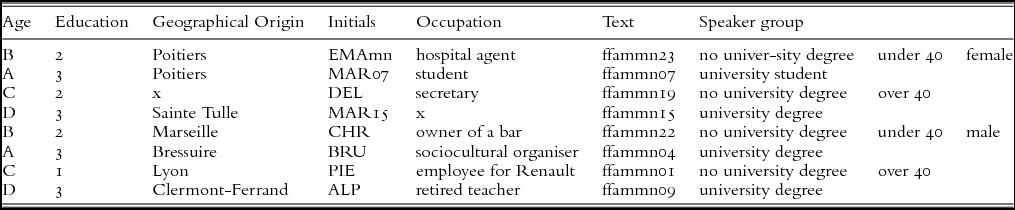
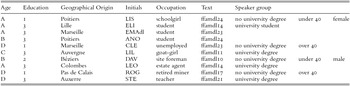
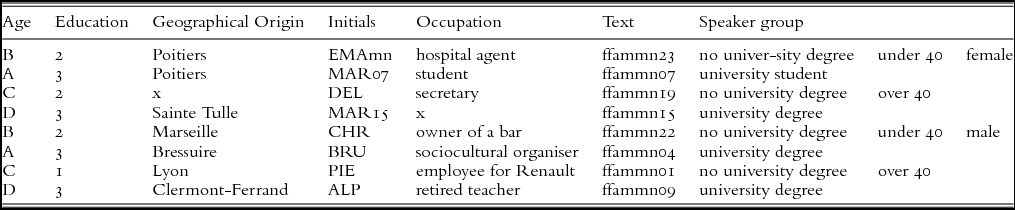
The combination of four independent variables (communicative situation, sex, age and education) having two values each thus yields 16 cells. Fifteen texts were chosen from the corpus so as to have at least one speaker per cell. The speaker sample under investigation here is thus comparable in size to a number of other studies (Ashby, Reference Ashby, Cressey and Napoli1981; Lucci, Reference Lucci1983; Green & Hintze, Reference Green, Hintze, Hintze, Pooley and Judge2001; Ranson, Reference Ranson2008), but much smaller than samples analyzed in studies based on data from the project Phonologie du Français Contemporain (Côté, Reference Côté2013; Durand et al., Reference Durand, Laks, Calderone and Tchobanov2011; Eychenne, Reference Eychenne2011; Mallet, Reference Mallet2008). Yet, as shown in section 4, even with such a restricted number of speakers statistically significant differences with respect to sociolinguistic factors like sex, age and education can be demonstrated. The composition of the sample is shown in Table 1 for monologues and in Table 2 for dialogues.
Sample of speakers in monologues
Sample of speakers in dialogues
Whenever one of the speakers is identified as interviewer in the corpus metadata, this speaker was not considered in the study, since the role of interviewer may have coerced less natural and spontaneous production. Otherwise, for each text chosen from the corpus, all interacting speakers were included in the sample, to the effect that one of the cells contains not only one, but three speakers; see Table 2.
In Tables 1 and 2, cells are marked with an ‘x’ if the corpus contains no information about the speaker's age, origin, or education, and so on. Where the relevant information is not given in the corpus metadata but may safely be inferred from the interview, this information has been added in Tables 1 and 2. Specifically, this was done for speakers ANO (ffamdl 24) and ROG (ffamdl 17).
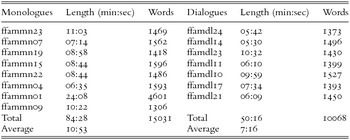
The speech samples under analysis here are of roughly the same length, with an average of seven to ten minutes per sample; see Table 3. The sub-corpus studied here contains 25,099 words; utterances made by the interviewers – not included in the study – have, however, not been subtracted from this figure.
Length of speech samples analysed

2.3 Data
On the basis of the orthographic transcription of the recording for each text, all possible liaison contexts were determined. We follow Selkirk (Reference Selkirk1974) and subsequent work in prosodic phonology in assuming that liaison is a phrasal rule that does not apply across boundaries of maximal projections that are sisters dominated by the same superordinate node. Occurrences of words that could potentially be subject to liaison, but that were followed by such a boundary, were not considered possible cases of liaison, for example, occurrences of a (plural) noun or (postnominal) adjective in a subject NP when followed by a verb. Cases where the transcription contains a pause between a potential liaison word and the following word were also not considered as possible liaison contexts (but see Tranel, Reference Tranel1990; Plénat, Reference Plénat2008).
It was then determined on the basis of the audio recording of each text whether the speaker realized the liaison consonant or did not realize it. Unintelligible cases were marked as such and later excluded from the analysis. Twenty cases of possible liaison contexts have been excluded from the analysis for this reason, stemming from nine different speakers in nine different texts. No cases of liaison without forward resyllabification and no cases of liaison with an unexpected consonant were observed in the corpus.Footnote 3
In total, the corpus contains 1,219 possible liaison contexts. For every case of possible liaison the data file contained the following information: application or non-application of liaison, speaker name, age of speaker (under 40 or over 40), education of speaker (with or without university degree), communicative situation (dialogue or monologue), text identification code.
2.3.1 Syntactic category
Since it is clear that application of liaison depends on the syntactic contexts in which a word occurs (e.g., Morin & Kaye, Reference Morin and Kaye1982; Selkirk, Reference Selkirk1972), each of the 1,219 possible liaison contexts contained in the data file was then coded for syntactic information: syntactic category of the word showing or not showing liaison, according to the inventory of labels given in (2), as well as syntactic category of the following word or constituent; see (3). Note that we chose to include tout ‘all’ as a pronoun neither among the clitic pronouns nor among the nouns/noun phrases, as its behaviour with regard to liaison differs from both.
(2) Inventory of syntactic categories of target words
a. Adjective (Adj), adverb (Adv), clitic pronoun (Cl), non-clitic pronoun (Pro), complementiser (Conj), negation element (Neg), noun (N), tout ‘all’ (used as a pronoun), verb (V)
b. Verb types differentiated
Lexical verb (V), aspectual verb (VAsp, e.g., commencer à ‘to begin’), auxiliary verb (VAux), causative verb (VCaus, e.g., faire ‘to make’), copula verb (VCop), modal verb (VMod)
(3) Inventory of syntactic categories of following word/constituent
a. Adjective (Adj), adverb (Adv), clitic pronoun (Cl), non-clitic pronoun (Pro), noun/noun phrase (NP), preposition/prepositional phrase (PP), sentence (S), verb (V)
b. Verb types differentiated
Finite (Fin), infinitive (Inf), participle (Part)
Words occurring prenominally within the NP were classified as determiner or as adjective. In general, forms that combine with a determiner relatively easily (e.g., trois ‘three’ in les trois élèves qui sont venus ‘the three pupils that came’) were classified as adjectives, while forms which resist combination with another determiner (e.g., certain ‘some’ in *mes certains élèves ‘some of my pupils’) were classified as determiners. More particularly, articles (e.g., definite les, indefinite un, partitive des), including prepositional articles (e.g., aux), demonstratives (e.g., ces), possessives (e.g., ses), indefinites (e.g., quelques ‘some’, certains ‘certain’) and quantifying determiners (e.g., plusieurs ‘several’, tout ‘all’) were classified as determiners. All other elements, in contrast, were classified as modifiers, that is, as adjectives. Numerals, such as deux ‘two’, were marked as adjectives.
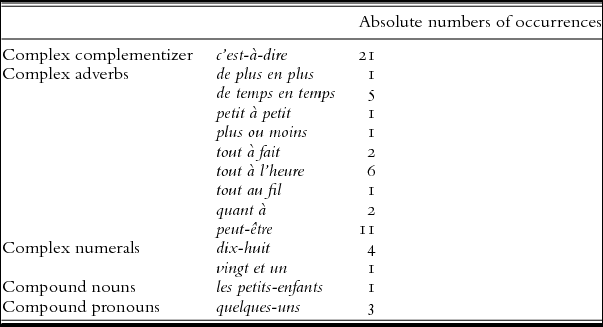
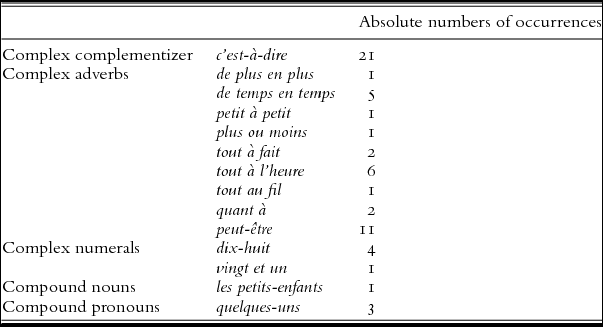
Lexicalized constructions, in which liaison is expected to apply invariably or at least with high frequency (Delattre, Reference Delattre1947), were coded as such. While most classificatory systems for liaison acknowledge the existence of this category, no clear defining criteria have been put forward (cf. also Durand & Lyche, Reference Durand and Lyche2008). A list of all lexicalized constructions found in the corpus and considered as such is given in Table 4.
Invariable liaison in lexicalized complex forms
For every combination of the syntactic categories given in (2) and (3), it was then determined whether liaison applied without exception (i.e., whether liaison is ‘invariable’ in this context) or whether variation was found in liaison application in that context (i.e., whether liaison was ‘variable’ in that context).
2.3.2 Other language-internal variables
For contexts in which liaison was found to be variable, data were additionally coded for (i) number of syllables of the target word, (ii) whether the target word was a lexical word or a function word, (iii) whether the immediately following word was a lexical word or a function word, and (iv) segmental identity of the liaison consonant ([t], [z], [n], [p], [ʁ]).
As to the distinction between lexical words and function words, we rely on the following criteria; see also Corver and van Riemsdijk (Reference Corver, Riemsdijk, Corver and van Riemsdijk2001) and references therein. Function words express grammatical features or relations (such as number, person, tense, spatial or temporal relations, coordination, identity, modality, etc.), while lexical words refer to entities, situations or properties. For a given language, the inventory of function words is relatively small and closed, that is, the function words can be exhaustively enumerated, whereas the inventory of lexical words is very large and it is open, that is, new lexical words can be created by word-formation or come into the language by borrowing. More concretely, the class of function words contains pronouns, determiners, prepositions, complementisers, closed-class adverbs (i.e., those not formed by adding a suffix), auxiliary verbs, modal verbs, copula verbs, while lexical words are mostly nouns, (lexical) verbs, adjectives, and derived adverbs (i.e., French adverbs derived by adding the suffix -ment).
3 LANGUAGE-INTERNAL FACTORS IN VARIABLE AND INVARIABLE LIAISON
The corpus contains a total of 1,219 possible liaison contexts, determined as described in section 2. The first step consisted in distinguishing between contexts (defined syntactically as described in section 2.3.1) in which liaison applied invariably and contexts in which it applied variably. Liaison was found to apply invariably in 642 cases and variably in 577 cases. Cases of invariable liaison are discussed in sections 3.1 and 3.2. The 577 cases of variable liaison are dealt with in sections 3.4 to 3.7 and in section 4. As to variable liaison, 156 out of 577 possible liaisons were realized, corresponding to a mean liaison rate of 27 percent.
3.1 Invariable liaison with determiners and clitic pronouns
Liaison was found to apply without exception between a prenominal determiner or modifier and a following noun (155 of 156 liaisons realized) or adjective (10/10), and between a preverbal clitic pronoun and a following verb (374/374) or clitic (13/13). It was likewise found to apply without exception in a few lexicalized complex forms, such as c’est-à-dire ‘that is’ or de temps en temps ‘from time to time’; see Table 4 for a listing. The results are thus in accordance with previous studies.
In one case liaison between a prenominal determiner and a following noun was not made; (4).
(4) No liaison on determiner followed by noun
dans certaines occupations realised as dans cer[tɛ.nɔ]cupations
‘in certain professions’
[dialogue, male speaker, ROG, ffamdl17]
This is in accordance with the observation that realization of a word final plural [z] in a context where liaison is otherwise invariable is sometimes omitted if the [z] is preceded by another consonant (Tranel, Reference Tranel1987: 177).
3.2 Liaison with prenominal adjectives
Liaison with prenominal adjectives does not occur frequently enough in the corpus to allow anything more than a tentative confirmation of previous research. In all sequences of a prenominal adjective followed by a noun, the liaison consonant is realized (n = 29). The lexemes found in the corpus are given in (5); more than half of the occurrences consist of a numeral, classified as adjectives, (5a). In six examples, liaison is realized with a plural Adj (that is not a numeral), see (5b). Two of the six examples are repetitions of the same AP; the six examples are produced by only three speakers. As to singular Adj, (5c), only three lexemes are attested: in five of the seven occurrences the prenominal adjective is bon ‘good’ (among these, in turn, are three occurrences of bon appetit); the two other adjectives occur in what may be termed collocations; (5c).
(5) Prenominal adjectival lexemes occurring in the corpus analyzed here
a. Numerals (n = 16)
Ordinal numerals: premier étage ‘first floor’
Cardinal numerals: deux, trois, vingt ‘two, three, twenty’
b. Plural adjectives (n = 6)
de nombreux_entraînements ‘numerous trainings’, des anciens_élèves ‘former pupils’ (n = 2), d’excellents_élèves ‘excellent pupils’, de longues_oreilles ‘long ears’ (n = 2)
c. Singular adjectives (n = 7)
bon ‘good’ (n = 5), bas ‘low’ in bas_âge ‘young age’, plein ‘full’ in en plein_hiver ‘in mid-winter’
At first sight a liaison rate of 100 percent for sequences of Adj and N might be surprising, given that it is generally taken that liaison with prenominal adjectives is systematic, but not invariable, with a general tendency towards non-realization of the liaison consonant (Post, Reference Post2000; Sampson, Reference Sampson2001; Durand & Lyche, Reference Durand and Lyche2008). Yet, on closer inspection, the present results fit well into the overall picture established by previous research. Liaison with plural adjectives is more likely to be realized than with singular adjectives (Morin & Kaye, Reference Morin and Kaye1982). In fact, the large majority of the sequences occurring here contain plural adjectives (if numerals are included, see [5a–b]). It should also be stressed that, as often noted, the class of adjectives that may ever occur in prenominal positions is highly restricted, comprising adjectives with very general, grammaticalized or idiosyncratic meaning. Again, the adjectives attested in the corpus belong to what may be considered the core of a limited set of semi-functional adjectives, such as numerals or relational adjectives with a temporal meaning like ancien ‘former’, bas ‘early’ and plein ‘mid-’.
As has often been noted, a subset of prenominally occurring adjectives exhibit an alternation in vowel quality between the preconsonantal and the liaison form, with respect to nasality or degree of openness. To give an example, the adjective bon alternates between a nasalised vowel in the pre-consonantally occurring Masc Sg form bon [b ] and a fully denasalised Masc Sg liaison form [bɔn], but other prenominal adjectives, such as commun ‘common’, surface with a nasalized vowel in both preconsonantal and liaison form (Sampson, Reference Sampson2001). Again, various of the adjectives attested in the corpus studied here exhibit such an alternation in the shape of the stem (bon, plein, ancien, premier). The fact that liaison with prenominal adjectives is limited to a small set of adjectives, many of which present stem alternations, has often been taken as evidence that liaison with these forms should not be considered a phonological, but rather an allomorphic alternation (Tranel, Reference Tranel1990; Steriade, Reference Steriade, Authier, Bullock and Reed1999; Plénat, Reference Plénat2008), an interpretation which is fully consistent with the data considered here.
3.3 Segmental identity of liaison consonant
Within all 1,219 possible liaison contexts, the coronal nasal [n] has by far the highest liaison rate (99% of 351 occurrences present liaison), followed by [z] (67% of 480 occurrences) and [t] (33% of 385 occurrences). The high liaison rate for [n] is mostly due to the fact that 90% of all occurrences of this liaison consonant are in contexts where liaison is invariable, while this proportion is much lower for [z] and [t] ([z]: 57%; [t]: 14 %). Of the 797 realised liaisons in the corpus, 44% are in [n], 40% in [z] and 16% in [t]. Restricting the perspective to contexts in which liaison was found to apply variably, [n] still has the highest rate (91% of only 34 occurrences), followed by [z] (24% of 208 occurrences) and [t] (23% of 333 occurrences). It is noteworthy, however, that in variable liaison [n] occurs as a potential target for liaison only in the two lexemes en ‘in’ and bien ‘well’, while both [z] and [t] are found in a much larger array of lexemes. The hierarchy of liaison rates [n] > [z] > [t] is in accordance with previous studies (Malécot, Reference Malécot1975; Mallet, Reference Mallet2008: 213; Ranson, Reference Ranson2008); yet other researchers have found that liaison rates are higher for [t] than for [z] (Ashby, Reference Ashby, Cressey and Napoli1981; Lucci, Reference Lucci1983: 257; Encrevé, Reference Encrevé1988: 68; de Jong, Reference De Jong, Schouten and van Reenen1989a). The corpus contains only one occurrence of [ʁ] as a liaison consonant (premier étage ‘first floor’), where liaison is realised, and two occurrences of [p] in the adverbs trop ‘too (much)’ and beaucoup ‘much’, where no liaison is made.
3.4 Number of syllables of liaison word
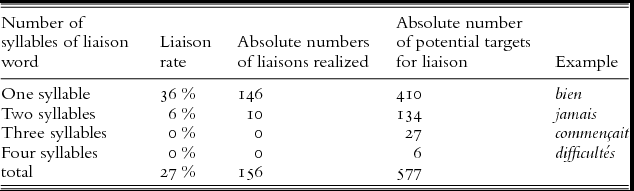
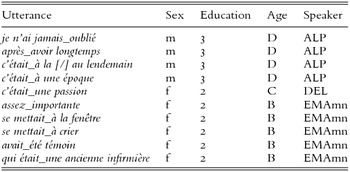
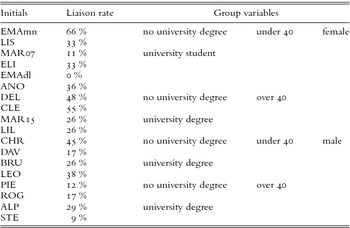
As shown in Table 5, in contexts where liaison is variable a final liaison consonant is never realized on words with more than two syllables (disregarding – arguably invariable – liaison with prenominal adjectives as well as with disyllabic determiners like certain ‘certain’, plusieurs ‘various’). The great majority of occurrences of variable liaison is on monosyllabic words. The ten occurrences of variable liaison with disyllabic words are made by only three speakers (out of 18), see Table 6, and of these, five are realized by the speaker with the highest overall liaison rate (EMAmn, 66%); see Table 7.
Liaison rates according to number of syllables of target word
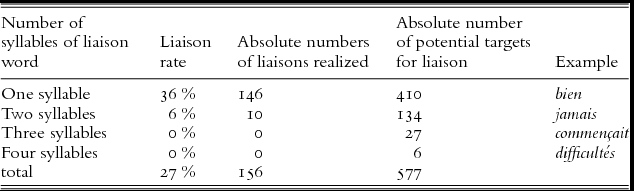
χ2 = 53,530, p < 0.001
Variable liaison after disyllabic words

Liaison rates for individual speakers

This finding is in accordance with previous studies, which have uniformly shown that, the shorter the liaison word, the higher the probability that it will undergo liaison (Delattre, Reference Delattre1947; Encrevé, Reference Encrevé1988; de Jong, Reference De Jong and Hall1989b; Fougeron, Goldman & Frauenfelder, Reference Fougeron, Goldman, Frauenfelder, Dalsgaard, Lindberg, Benner and Tan2001; Mallet, Reference Mallet2008; Laks, Reference Laks, Baronian, Morin and Martineau2009). In particular, recent studies show that the majority of speakers no longer realise liaison with polysyllabic words (Green & Hintze, Reference Green, Hintze, Hintze, Pooley and Judge2001; Durand & Lyche, Reference Durand and Lyche2008; Durand et al., Reference Durand, Laks, Calderone and Tchobanov2011), which is also the case for 15 out of the 18 speakers studied here.
3.5 Function words and lexical words
The overwhelming majority of occurrences of variable liaison appear on function words (cf. also Armstrong, Reference Armstrong2001; Fougeron, Goldman & Frauenfelder, Reference Fougeron, Goldman, Frauenfelder, Dalsgaard, Lindberg, Benner and Tan2001; Laks, Reference Laks, Baronian, Morin and Martineau2009). To be sure, the distinction between lexical and functional words corresponds to a continuum rather than to a dichotomy; for this reason, it is difficult to give an exact numerical count for occurrences of liaison on lexical words. A case in point is prenominal adjectives. Looking at the data given in (5) above, one might say that clear instances of lexical words are only bon ‘good’, excellent ‘excellent’ and long ‘long’. All other instances are numerals or have a temporal meaning (e.g., ancien ‘former’, bas in bas âge ‘young age’) and might thus be considered functional rather than lexical. Two more occurrences of liaison on lexical words can be added, see (6). Both were produced by the same speaker, who is also the speaker with the highest overall liaison rate (EMAmn, 66%). In both cases, the liaison consonant corresponds to a morphological exponent (of the features ‘3rd person Sg’ and ‘Pl’, respectively). The sequence soins intensifs ‘intensive care’ can also be regarded as a lexicalized compound, given that the denotation of the phrase can only partly be determined on the basis of the denotations of its parts.
(6)
a. elle se mettaitLex_à la fenêtre / se mettaitFnc_à crier [EMAmn]Footnote 4
‘she placed herself at the window, she started to shout’
b. qui est les soinsLex_intensifs en cardiologie [EMAmn]
‘which is the intensive care in cardiology’
While variable liaison on lexical words is not unattested, there is a clear tendency for liaison to be restricted to function words.
3.6 Liaison in invariable words
Individual words differ greatly in their probability of showing variable liaison. In this section, we consider liaison in invariable words (adverbs, prepositions, negative elements and complementisers); in the next section, we discuss liaison with morphological exponents (Pl as well as 3rd person). The differences in liaison rates reported in this and in the next section are statistically not significant, which is probably due to the small number of occurrences in each cell. Among the invariable words, prepositions present the highest liaison rateFootnote 5 (93%), followed by adverbs (73%), complementisers (47%) and negative elements (26%). As noted above, a potential liaison in [p] is never realied (target words are trop ‘too much’ and beaucoup ‘much’); the same holds for disyllabic words (with the exception of one liaison each on assez ‘enough’, jamais ‘never’, après ‘after’).
As to prepositions, liaison rates amount to 100% for en ‘in’ (realized in 23 of 23 occurrences) and chez ‘at’ (1 of 1) and are only slightly lower for dans ‘in’ (21 of 22) and sans ‘without’ (3 of 4). Liaison appears likewise to be categorical in adverbial tout ‘all’ (realized in 6 of 6 occurrences) and adverbial plus ‘more’ (1 of 1) and is highly frequent in très (9 of 10) and bien ‘well’ (8 of 11).
The only complementisers occurring in the corpus in liaison contexts are quand ‘when’ (realized in 23 of 26 occurrences) and mais ‘but’ (2 in 44), both presenting highly divergent liaison rates. Specifically, liaison is highly frequent with quand, but nearly absent with mais. Both liaisons in mais are realized by the same speaker (MAR07), who, surprisingly, presents an overall liaison rate which is far below the average for the corpus (11%, see table 7). Realization of liaison with mais may thus be a stylistic idiosyncrasy, particular to this individual speaker, who, at the same time, chooses to realize none of the 19 possible liaisons with the verb form est ‘is’ she produces, although this form is subject to liaison in the corpus (overall liaison rate for est is 23%).
(7) Liaison with mais. Speaker MAR07, file ffammn07
a. on court pour se faire plaisir / mais_aussi pour [/]
‘one runs to enjoy oneself, but also to . . .’
b. tout le monde rigole / mais_on ressent bien un peu le [/]
‘everyone is joking, but one feels a bit the . . .’
Finally, the negative element pas ‘not’ occurs far more often without than with liaison (liaison is realized in 5 out of 40 occurrences), while the liaison consonant is realized in 2 of 5 occurrences of plus ‘no more’. In sum, within the category of invariables liaison is lexically determined, with prepositions, the complementiser quand and adverbs presenting high liaison rates, while liaison rates for negative elements and the complementiser mais are relatively low.
3.7 Liaison with the morphological exponents [z] and [t]
The liaison consonant [z] occurs as a morphological exponent of the feature ‘Pl’ in nouns and adjectives,Footnote 6 as well as an exponent of the features ‘1st person’ and ‘2nd person’ in verbs. [t] occurs as an exponent of the feature ‘3rd person’ in verbs.
As to plural [z], liaison was said to apply invariably to prenominal adjectives; see section 3.2. In contrast, in the 11 occurrences of the sequence ‘plural noun followed by adjective’ liaison is realized only once; (6b) above. This example was produced by the speaker with the highest liaison rate and the sequence soins intensifs ‘intensive care’ may also be considered a lexicalized compound. Liaison with plural nouns is thus nearly absent in the corpus.
In the corpus [z] never surfaces (in a context where liaison is variable) as an exponent of ‘2nd person’ and it is realized only twice (out of 44 occurrences) as an exponent of ‘1st person Sg’. In the latter two cases, the verb is the auxiliary être ‘be’ (je suis allée ‘go Prs Perf 1st Sg’ and j’étais appelé ‘call Pass Imperf 1st Sg’).
Liaison rates for [t] are slightly higher. As an exponent of 3rd person, it is realized in 40 out of 291 verb forms; of these, 39 are function verbs rather than lexical verbs. The only example of liaison in a lexical verb is produced by the speaker with the highest liaison rate; the same holds for the only realized liaison with an aspectual verb; see (6) above, where the speaker uses the form mettait ‘put 3rd Sg Imperf’ twice in the same utterance. Across all contexts, [t] is realized slightly more often in Sg forms (36 of 254, 14% liaison rate) than in Pl forms (4 of 37, 11%).
Liaison in 3rd person [t] is realized more often in auxiliaries (16 out of 62) than in any other verb class. Of the 37 attested forms of être as an auxiliary in a liaison context, 13 (35%) surface with a liaison consonant (est ‘3rd Sg Pres’, était ‘3rd Sg Imperf’, sont ‘3rd Pl Pres’); of the 23 forms of avoir as an auxiliary, 3 (13%) present a realized liaison consonant (ont ‘3rd Sg Pres’, avait ‘3rd Sg Imperf’). Among the realized liaisons in auxiliaries, the majority are on the form est (10 out of 16). The liaison rate for est as an auxiliary is 42% (10 liaisons out of 24 occurrences). As a copula verb, est likewise often surfaces with liaison (in 16 out of 88 occurrences, liaison rate 18%). The liaison rate for copula verbs is 15% (liaison is realized in 21 of 141 occurrences). Of the 21 realized liaisons with copula verbs, 16 are on est. The sequence c’est ‘it is’ followed by a predicative word or phrase presents liaison in 12 out of 72 occurrences. Finally, in the 36 modal verb forms attested in the corpus, liaison is present in only three cases. All occur in the sequence {ça/ce} doit être ‘this may be’; two other occurrences of ça doit être are realized without liaison.
Let us finally note that est is also by far the most frequent verb form in the corpus (112 occurrences in liaison contexts, 26 liaisons), followed by était (33 occurrences, 4 liaisons), fait ‘do 3rd Sg Pres’ (16/0), ont (14/2), avait (14/1), followed by faut ‘must 3rd Sg Pres’ (10/0).
In sum, variable liaison on the morphological exponents [t] and [z] shows complex morpho-lexical conditioning. Disregarding the two liaisons on lexical words, see (6) above, variable liaison with the exponents [t] and [z] occurs only on function words. The more grammaticalized a verb form, that is, the less semantic content it carries, the higher the probability that a liaison is realized, as shown by the fact that liaison rates are highest with auxiliaries (26%), to which no individual meaning component can be attributed, followed by copula verbs (15%), arguably expressing the meaning component ‘identity’ and modal verbs (8%), expressing ‘necessity’ or ‘possibility’. Under the assumption that the 3rd person is morphologically unmarked, while 1st and 2nd person are marked as ‘referring to the speaker’ and ‘referring to the addressee’, respectively (Harley & Ritter, Reference Harley and Ritter2002; Bobaljik, Reference Bobaljik2008), it may be said that liaison is more likely in unmarked than in marked forms. Hence, liaison is far more frequent with 3rd person [t] than with 1st/2nd person [z]. Note that this cannot be due to some property of the consonantal segments, as overall liaison rates for [z] and [t] are similar in the corpus (23% and 24%, respectively). Likewise, this also explains why [t] is realized more often in Sg forms than in Pl forms. Finally, it is clear that frequency of liaison with the exponents [t] and [z] is not determined by these elements alone, but rather by the combination of stem and exponent. Both behave as a unit in that, for example, liaison with [t] is more likely in auxiliaries than in copula verbs, or that the liaison rate is higher for es-t than for étai-t.
3.8 Discussion
In the corpus studied here, liaison applies invariably in sequences of prenominal determiner and noun, of preverbal clitic and verb as well as of prenominal adjective and noun. In all other contexts, liaison applies variably. Individual speakers differ greatly in their liaison rates; see Table 7. Variable liaison is subject to phonological, morphological as well as to lexical conditioning. As to phonological restrictions, liaison applies only to coronal consonants [t], [z], [n] and nearly exclusively to monosyllabic words. From a morpho-lexical perspective, liaison rates appear higher for words with less semantic content and lower for words with more semantic content. This is evident in two respects: on the one hand, variable liaison applies nearly exclusively to function words. On the other hand, among function words, liaison rates are higher for fully grammaticalized function words, such as auxiliaries, and lower for function words with more complex semantic functions, such as modal verbs. Likewise, liaison applies more frequently to morphological exponents that are less marked than to more marked ones (3rd person as compared to 1st and 2nd person, and Sg as compared to Pl).
Individual words of the same category may differ greatly in liaison rates, which is most visible when comparing the conjunctions quand ‘when’ and mais ‘but’. Yet, given the limited size of the corpus, less pronounced differences between individual words, such as en ‘in’ and bien ‘well’, besides being statistically not significant, may not be representative and may require further consideration. The relatively low liaison rates attested for negative elements, as compared to far higher rates for non-negative adverbs, call for an explanation, which may possibly be related to the information structural function of negation and its consequences for phonological phrasing. Finally, it should be stressed that liaison with the morphological exponents [t] and [z] is conditioned not only by these exponents alone, but that stem and suffix together determine liaison rates. This clearly shows that, even in cases where liaison consonants are, as suffixes, detached from individual lexemes, they nevertheless belong to the lexeme they are attached to, not only in syntax, where features like Pl or 1st person are interpreted, but also on the prosodic level, where liaison applies or is blocked.
From a theoretical perspective, two aspects of these results are particularly interesting: first, the restriction to monosyllabic function words and the contrast in invariability with determiners and pronouns as opposed to variability with other function words; second, the observation that liaison appears to be invariable with prenominal adjectives. Let us look at these aspects in turn.
To begin with, we believe the observation that liaison is found nearly exclusively with function words is best represented by exploiting the long-held assumption that function words, but not lexical words, are ‘prosodically invisible’, that is, they are not parsed as prosodic words on the level of prosodic structure (Selkirk, Reference Selkirk1984, Reference Selkirk, Morgan and Demuth1996). We follow de Jong (Reference De Jong1990) in assuming that the prosodic domain of obligatory liaison is the prosodic word. In contrast to de Jong, and following Selkirk (Reference Selkirk, Morgan and Demuth1996), we assume that in prosodic structure not only determiners and clitic pronouns, but in fact all function words do not correspond to prosodic words. To account for the differential behaviour of liaison with pronouns and determiners on the one hand and other kinds of function words on the other, we propose to adopt from Selkirk (Reference Selkirk, Morgan and Demuth1996, p. 188) the two different prosodic configurations given in (8).
(8)
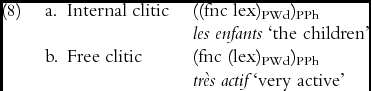
In the case of internal clitics, no prosodic boundary intervenes between clitic and host that could block liaison. Therefore, liaison applies invariably, as no counteracting force blocks it from applying. This is the representation we propose for sequences of determiner and noun and of preverbal pronoun and verb (following Bonami, Boyé, & Tseng (Reference Bonami, Boyé, Tseng and Jaeger2004); Miller & Sag (Reference Miller and Sag1997). In the case of free clitics, in contrast, a left boundary of a prosodic word hinders liaison but does not block it categorically from applying. When liaison does apply, a constraint requiring realization of the liaison consonant, conspiring with a constraint requiring syllables to have onsets, counters the constraint blocking resyllabification across the left edge of a prosodic word. This is the representation we assume for all other function words exhibiting variable liaison in the corpus, that is, prepositions, adverbs, negative elements and complementisers. To be sure, this account may only explain the fact that liaison is variable with free clitics, but invariable with internal clitics; why free clitics of the same category may vary greatly in their liaison rates remains to be explained.
As to the representation of the liaison consonant, the results of the present study are fully compatible with the assumption that it is lexically stored as an appendix to the invariant morphological shape of the lexeme, as proposed by Bonami et al. (Reference Bonami, Boyé and Tseng2005). As argued by Eychenne (Reference Eychenne2011), following previous research (Bonami et al., Reference Bonami, Boyé and Tseng2005; Steriade, Reference Steriade, Authier, Bullock and Reed1999), a constraint requiring invariance in the shape of morphemes militates against realization of the appendix; yet, if higher ranked constraints on syllabification require an onset, the liaison consonant will be realized. The results presented here are certainly not incompatible with other approaches mentioned in section 1, but they do not present positive evidence for alternative models discussed above.
The analysis has shown that for most speakers liaison is possible only with monosyllabic, but not with disyllabic function words. A reason for this may be that disyllabic, but not monosyllabic function words are parsed as a foot, and possibly even as a prosodic word (Monachesi, Reference Monachesi, Beals, Denton, Knippen, Melnar, Suzuki and Zeinfeld1994; Zec, Reference Zec2005). In (9b), but not in (9a), a right foot boundary thus intervenes between the target word and the following word, in addition to the left PWd boundary intervening in both configurations, thus further militating against liaison, that is, against resyllabification, across prosodic boundaries. For the majority of speakers studied here, a right boundary of a foot appears categorically to block resyllabification, and thus liaison, from applying; for some speakers, resyllabification is possible, but occurs infrequently.
(9)

A notorious problem for formal analyses of French liaison are prenominal adjectives (cf. the discussion in Côté, Reference Côté, van Oostendorp, Ewen, Hume and Rice2011), presenting invariable liaison, as in the corpus described here, or at least comparatively high liaison rates (Durand & Lyche, Reference Durand and Lyche2008; Post, Reference Post2000; Sampson, Reference Sampson2001). Yet, as has often been noted, the class of prenominally occurring adjectives is closed and many of its members are function words rather than lexical words. Given that in the corpus studied here, all prenominally occurring adjectives, with the exception of the Pl forms longue-s ‘long’ and excellent-s ‘excellent’, can in fact be granted functional or semi-functional status, we follow previous assumptions that adjectival liaison is based on selection rather than on alternation (Plénat, Reference Plénat2008; Steriade, Reference Steriade, Authier, Bullock and Reed1999; Tranel, Reference Tranel1990), that is, that prenominally occurring adjectives dispose of (at least) two lexically stored allomorphs, one vowel-final, the other ending in a consonant. They surface with a liaison consonant if the consonant-final allomorph is selected, but without a liaison consonant if the vowel-final allomorph is selected. Crucial arguments for analyzing liaison with prenominal adjectives as stemming from selection rather than from alternation are, first, that some prenominal adjectives in fact dispose of suppletive liaison forms (e.g., vieux – vieil ‘old’, beau – bel ‘beautiful’), and, second, that liaison is rather unproductive with infrequent adjectives or with neologisms (Sampson, Reference Sampson2001).
Under this conception, realization of the liaison consonant of prenominal adjectives has no cost, in contrast to realization of this segment in other lexical categories, which are subject to a constraint requiring lexical invariance, militating against realization of the appendix. Selection of the consonant-final or vowel-final allomorph of a prenominal adjective is left to constraints on syllable structure, requiring that syllables have onsets or that they must not have a coda. Their prosodic structure corresponds basically to that of a free clitic, (8b), with a left PWd boundary intervening, which variably blocks liaison. However, it may further be argued that prenominal elements may optionally be reanalyzed as internal clitics, (8a), in particular if they are semantically similar to determiners. Reanalysis as an internal clitic correlates with invariable liaison, in contrast to optional liaison with free clitics. Arguably, such a reanalysis as internal clitic may have occurred for numerals like deux ‘two’ or nombreux ‘numerous’.
4 SOCIOLINGUISTIC FACTORS IN VARIABLE LIAISON
4.1 Monologues and dialogues
Liaison rates in monologues and in dialogues do not differ (26,7% as opposed to 27,7%, n.s.); interactions with other factors under investigation are likewise non-significant. It may thus be that the stylistic difference between the monologues and the dialogues in the C-Oral-Rom corpus is not large enough to lead to the differences in liaison rates that have been observed for, for example, formal as opposed to informal speech (Delattre, Reference Delattre1947; Reference Delattre1955; Lucci, Reference Lucci1983; de Jong, Reference De Jong and Lyche1994). Recent studies on liaison in the PFC corpus have likewise found that liaison rates do not differ between guided and free conversation (Mallet, Reference Mallet2008: 190; Durand et al., Reference Durand, Laks, Calderone and Tchobanov2011).
4.2 Male and female speakers
Female speakers realize the liaison consonant significantly more often than male speakers (36% as opposed to 21%; χ2 = 17,447, p < 0.001). Some previous studies have found the same effect (Malécot, Reference Malécot1975; De Jong, Reference De Jong and Lyche1994; Ranson, Reference Ranson2008), others have found the opposite (Ashby, Reference Ashby, Cressey and Napoli1981; Green & Hintze, Reference Green, Hintze, Hintze, Pooley and Judge2001); studies based on the PFC corpus have found no difference (Mallet, Reference Mallet2008; Durand et al., Reference Durand, Laks, Calderone and Tchobanov2011).
4.3 Speakers with and without university degree
Speakers with less formal education realize the liaison consonant more often than speakers with a higher degree of formal education (30% as opposed to 23%). This difference is, however, not statistically significant (χ2 = 3,476, p < 0.062).
4.4 Speakers under 40 and speakers over 40
Younger speakers realize the liaison consonant significantly more often than older speakers (32% as opposed to 24%; χ2 = 3,943, p < 0.05). This is an unexpected result, given that most previous studies have found the opposite (Malécot, Reference Malécot1975; Ashby, Reference Ashby, Cressey and Napoli1981; de Jong, Reference De Jong and Lyche1994; Green & Hintze, Reference Green, Hintze, Hintze, Pooley and Judge2001; Mallet, Reference Mallet2008; Ranson, Reference Ranson2008; Durand et al., Reference Durand, Laks, Calderone and Tchobanov2011).
4.5 The interaction of the factors sex, education and age
Since the difference in liaison rates between female and male speakers is highly significant, cross-tables showing variation in liaison rates according to age and education have been computed for male and female speakers separately.
4.5.1 Speakers with and without university degree
Variation according to level of education is visible in female speakers, but not in male speakers. Liaison rates for female speakers without university degree are significantly higher than liaison rates for female speakers with university degree (53% as opposed to 21%, χ2 = 25,690, p < 0.001). This finding clearly contradicts the often made assumption that realization rates for variable liaison are positively correlated with socioeconomic status of the speakers (Delattre, Reference Delattre1955; Ashby, Reference Ashby, Cressey and Napoli1981; Encrevé, Reference Encrevé1983; Gadet, Reference Gadet1989; de Jong, Reference De Jong and Lyche1994). In contrast, no significant difference is found for male speakers with and without university degree (18% in speakers without university degree as opposed to 25% in speakers with university degree, χ2 = 2,145, n.s.).
4.5.2 Speakers under 40 and speakers over 40
Variation according to age is more pronounced in male speakers than in female speakers. Younger male speakers make significantly more liaison than older male speakers (31% as opposed to 14%; χ2 = 13,615, p < 0.001). As to female speakers, in contrast, the difference is not significant (32% for speakers under 40 as opposed to 40% for speakers over 40, χ2 = 1,422, n.s.).
4.6 Individual stylistic differences
Liaison rates for individual speakers vary greatly, as shown in Table 7. Speakers differ not only with respect to the frequency with which liaison is realised, but also with respect to the ‘grammar’ of liaison. To give an example, the few liaisons on disyllabic target words are due to only three speakers (out of 18), and the two realized liaisons on mais ‘but’ are produced by a single speaker.
4.7 Discussion
As to the influence of sociolinguistic factors on the frequency of occurrence of variable liaison, the results are rather complex. To begin with, liaison rates for speakers present considerable individual differences, even when considering speakers in the same cell; see Table 7. Yet liaison rates do vary significantly according to the factors sex, age and education. Not only do male and female speakers differ with regard to overall liaison rate (more liaison in female speakers), but a significant effect for level of education (more liaison in less educated speakers) is found only in female speakers, while a significant effect for age (more liaison in younger speakers) is found only in male speakers. Even though these differences emerge as statistically significant, it should be kept in mind that the size of the corpus under investigation here is limited and that individual speakers present a high degree of variation in their liaison rates. Let us discuss each of these results in the light of previous research.
Considering only the literature on variation in French liaison, previous research on sex differences has been inconclusive, with some studies finding more liaison in female speakers (Malécot, Reference Malécot1975; De Jong, Reference De Jong and Lyche1994; Ranson, Reference Ranson2008), while in others male speakers realize more variable liaisons than female speakers (Ashby, Reference Ashby, Cressey and Napoli1981; Green & Hintze, Reference Green, Hintze, Hintze, Pooley and Judge2001); the most recent studies find no difference at all (Mallet, Reference Mallet2008; Durand et al., Reference Durand, Laks, Calderone and Tchobanov2011). Under a more general sociolinguistic perspective, higher liaison rates for female speakers are not unexpected if one assumes that variable liaison continues to be a prestige feature prescribed by the linguistic norm (Delattre, Reference Delattre1947; Fouché, Reference Fouché1959). In fact, much sociolinguistic research has consistently found that women's language is closer to the standard variety and that women use a lower percentage of vernacular forms than men of the same social class category (Trudgill, Reference Trudgill1972; Macaulay, Reference Macaulay1976; Eisikovits, Reference Eisikovits1987; Milroy, Reference Milroy1980; Reference Milroy, Bolton and Kowk1992); an overview with respect to phonological variation in French is given in Pooley (Reference Pooley, Armstrong, Bauvois, Beeching, Bruyninckx and Gadet2001).
As to the influence of the factor age, with younger speakers realizing more liaison than older speakers, most previous studies on French liaison have found the opposite, that is, that older speakers use liaison more often than younger speakers (Malécot, Reference Malécot1975; Ashby, Reference Ashby, Cressey and Napoli1981; de Jong, Reference De Jong and Lyche1994; Green & Hintze, Reference Green, Hintze, Hintze, Pooley and Judge2001; Mallet, Reference Mallet2008; Ranson, Reference Ranson2008; Durand et al., Reference Durand, Laks, Calderone and Tchobanov2011). Higher liaison rates for older as compared to younger speakers have often been interpreted as evidence for a linguistic change in progress (Labov, Reference Labov1972), with liaison gradually losing productivity. Yet, different liaison rates for different age groups may also be an indication of age grading (Labov, Reference Labov1994: 83), as suggested by Malécot (Reference Malécot1975), who finds an overall increase of liaison rates as speakers’ age increases, but at the same time reports that speakers between the age of 20 and 29 have higher rates than expected, which he interprets as conservatism affected by the young in their desire to be acceptable to the ‘establishment’. That Malécot (Reference Malécot1975) may be right is supported by the result – reported here – that only male speakers, but not female speakers, show a significant effect of the factor age. In fact, the mean liaison rate in female speakers under 40 is slightly higher than the mean liaison rate in male speakers under 40 (32% as opposed to 31%), but it is still lower than that of female speakers over 40 (which is 40%), with no significant difference emerging between the two female groups. While we propose to interpret higher liaison rates for younger speakers as an effect of age grading, rooted in the younger speakers’ striving for prestige by adopting what they consider a prestigious pronunciation feature, it should be stressed that matters may actually be more complex and require further consideration. As shown by Laks’ (Reference Laks, Baronian, Morin and Martineau2009) study on liaison in the speech of French politicians throughout the twentieth century, liaison rates show considerable variation across time. The actual pattern of change in liaison rates may thus qualify as a case of ‘lifespan change’ in Sankoff's (Reference Sankoff and Trudgill2005) sense rather than as a case of age grading, as originally conceived of by Labov (Reference Labov1994).
If male and female speakers are considered separately, we see that female speakers with less formal education have higher liaison rates than female speakers with university degree, while male speakers show no significant effect for education. On the one hand, this result is not in accordance with the often made claim that speakers of higher social class use more liaison than speakers from lower social classes (Delattre, Reference Delattre1955; Ashby, Reference Ashby, Cressey and Napoli1981; Encrevé, Reference Encrevé1988; Gadet, Reference Gadet1989; de Jong, Reference De Jong and Lyche1994; Armstrong, Reference Armstrong2001). On the other hand, a similar finding is reported by Ashby (Reference Ashby, Cressey and Napoli1981), who notes that in his sample younger working class women have relatively high liaison rates, both in comparison to working class men as well as to upper class women. Likewise, in a study on the basis of the PFC corpus, Mallet (Reference Mallet2008) finds the highest liaison rates (54%) among speakers who have finished middle school, but have no high-school diploma, and the lowest rates among those with Bac+2 (38%). Her data show, however, no systematic overall difference between more and less educated speakers.
The results of the present study are thus compatible with the claim that French liaison is a linguistic feature with overt prestige for most speakers – with the exception of males with little education, who have the lowest rate. In contemporary informal French, the more prestigious liaison forms are used more frequently by speaker groups assumed to be striving for higher status (Labov, Reference Labov and Bright1966; Reference Labov1972), that is, by female speakers in general, by younger males as opposed to older males, and in particular by female speakers with little education. As Laks (Reference Laks, Baronian, Morin and Martineau2009: 243, note 9) puts it, ‘un fort taux de liaison facultative [. . .] est un signe [. . .] d’insécurité sociale propre à une bourgeoisie [. . .] dominée par la norme écrite et emportée par son insécurité scolaire’. While we cannot draw any firm conclusions on this matter from the limited corpus under investigation here, it has become clear that the social meaning of French liaison is more complex than often assumed and merits further attention.
5 CONCLUSION
Based on an analysis of informal spoken French as represented in a small sub-corpus of the C-Oral-Rom corpus, this study has shown that liaison applies nearly exclusively to monosyllabic function words. Only three speakers (out of 18) realize variable liaison with disyllabic words. Liaison was found to apply invariably in sequences of a prenominal determiner followed by a noun and of a preverbal pronoun followed by a verb. Furthermore, in the relatively small number of occurrences of prenominal adjectives followed by a noun, the liaison consonant was invariably realized. Liaison consonants were found to be realized variably in sequences of invariable words (prepositions, adverbs, negative elements, complementisers) followed by a complement. It was argued that the generalization that liaison occurs nearly exclusively on function words as well as the contrast between invariable and variable liaison can be accounted for by adopting two different representations for sequences of function word and lexical word (Selkirk, Reference Selkirk, Morgan and Demuth1996). With internal clitics, liaison is invariable, while it applies variably to free clitics. To be sure, the mechanism lying behind variable liaison rates found with free clitics remains to be implemented in a formal model of the interaction between lexical and prosodic conditioning of liaison. In addition, the liaison consonants [t] and [z] are variably realized where they correspond to morphological exponents of person or number features. Crucially, these two consonants present higher liaison rates when they function as exponents of unmarked features and lower rates when they function as exponents of marked features. As verbal inflections, [t] and [z] are realized nearly exclusively when affixed to a function word, such as an auxiliary or modal verb. Furthermore, they present higher liaison rates when their verbal host is more grammaticalized (e.g., with auxiliaries) and lower rates with less grammaticalized hosts (e.g., with modal verbs and copula verbs).
Individual speakers differ greatly in their liaison rates. As to the sociolinguistic factors constraining variable liaison, sex, age and level of education have nevertheless been found to a have a significant effect on liaison rates. First, female speakers have higher liaison rates than male speakers; second, and contrary to what has been observed in previous corpus studies, speakers with less formal education present higher rates than speakers with more formal education, but only in the group of female speakers; third, younger speakers realize more variable liaisons than older speakers, but only in the group of male speakers. Some common generalizations about socio-cultural influences, such as age, education, and speech situation, on liaison are thus put into question by this study, and may need revision. Yet, given the limited size of the corpus under study here, no firm conclusions should be drawn on the basis of these findings.