

Introduction
Since Koziel et al. (Reference Koziel, Belad and Brown1993) first reported that Bt maize could successfully express the Cry1Ab insecticidal protein, there have been more than 10 transgenic insect-resistant lines that, respectively, expressed the proteins of Cry1Ab, Cry1Ac, Cry9C and Cry1Fa2 and have been planted commercially in such nations as the United States, Canada and Spain. Although research into insect-resistant transgenic maize was initiated at a later stage in China, various methods have been used to transfer Bt genes into some inbred lines, and some resistant transgenic plants have been obtained; now a multitude of new insect-resistant hybrids are being applied for release in pilot tests in a variety of environments. Ding et al. (Reference Ding, Xie and Dai1993) and Wang et al. (Reference Wang, Du and Zhang1995) transferred Bt toxic protein genes into maize and obtained insect-resistant transformants, and the normally inherited plants were separated from their offspring (Wang et al., Reference Wang, Wang, Ding, Zhang, Xie and Dai1999). Liu et al. (Reference Liu, Tang and Li2003) reported that a transgenic inbred line was obtained by using sweet corn with the Bt gene of Li Baojian (unpublished) as the parental material, and the assessment of field insect resistance for the obtained inbred line indicated that the insect resistance level of the population was remarkably improved. Zhang et al. (Reference Zhang, Zhang, Zhang, Chen, Wang and Tan2004) transferred GFM Cry1A (Bt) into the parental inbred line 501 of the maize hybrid Jingyu No.7 via particle bombardment and obtained transgenic lines and hybrids with higher resistance to corn-borers. Zhu et al. (Reference Zhu, Wang and Liu2004) obtained backcross (BC) offspring by the hybridization and backcrossing of foreign donor parents with the Bt gene, and an appraisal of insect resistance showed that BC offspring and the foreign transgenic line all had a high level of resistance. The Institute of Plant Protection, Chinese Academy of Agricultural Sciences analysed the resistance effect of the Bt Cry1Ab insecticidal protein on corn-borers, using the hybrid NX4777 containing Bt11 transformed lines from Novartis Company as the test material, and indicated that Cry1Ab insecticidal protein provided very high resistance to Asian corn-borers, and put forward the identification methods and evaluation standards of corn-borers (He et al., Reference He, Wang, Zhou, Wen and Song2000). Although the Bt gene from Novartis Company provides very high resistance, its intellectual property does not belong to China, and so far there have been no reports on the results of resistance of hybrids to corn-borers using our independently developed and self-owned Bt gene. The GFM Cry1A gene cloned by Guo and co-workers (Ni et al., Reference Ni, Zhang and Guo1998) of the Chinese Academy of Agricultural Sciences has played an important role in the commercialization of GM cotton and showed excellent resistance.
In 2007, our laboratory transferred GFM Cry1A into the Northeast spring maize inbred line Tie7922 by using particle bombardment, cultivated a stable inbred line (Yuan et al., Reference Yuan, Li and Kong2007), and cultivated a batch of hybrids with this line. The assessment of the resistance of GFM Cry1A transformed maize to corn-borers is of great significance to the improvement of the resistance to corn-borers and the application of transgenic breeding. In this experiment, three hybrids, Simi 25Bt, Tongdan 24Bt and Jidan 209Bt have been cultivated by the hybridization of the stable line containing the GFM Cry1A gene with a common inbred line, and we also conducted an analysis of the stable line and the resistance of its hybrids to corn-borers and toxic protein expression, so as to define the resistance of GFM Cry1A to corn-borers and to improve its application in transgenic maize breeding.
Materials and methods
Materials
The hybrids Simi25Bt, Tongdan24Bt and Jidan209Bt were produced by respectively crossing six transgenic insect-resistant lines GPC5-2, GPC5-8, GPC12-1, GPC12-15, GPC23-9 and GPC23-11 (Yuan et al., Reference Yuan, Liu, Zheng, Chen and Wen2001) with other parents of 81162, 7884-7 and Ji853, which were obtained by transferring Bt (GFM Cry1A) into Tie 7922. The Chinese Academy of Agricultural Sciences supplied egg masses of corn-borers (Ostrinia furnacalis Guenee), which were used as the insect source for artificial inoculation during the black-head egg stage.
Methods
Evaluation of insect resistance of transgenic plants in the field
When the transgenic plants grew to the bell-mouth stage, each plant was inoculated with 20–30 black-head stage eggs and 10 plants in each plant line were inoculated. Three weeks later, the rate of damaged plants, the number of tunnels per 100 plants, the number of larvae surviving per 100 plants, and the weight of larvae of each plant line were surveyed and the plants classified into five resistance grades (Zhou and He, Reference Zhou and He1995). After the plants matured, we cut the stem to survey the number of tunnels in the stem, the length of tunnels and the proportion of plants with tunnels.
Laboratory bioassays of insect resistance of transgenic plants
Bioassay tests were performed at seedling stage and mid-growth stage. Neonates fed on the fresh leaves or fresh silks of transgenic and non-transgenic maize lines for 4–6 days at 25–27°C. At seedling stage, part of the newly expanded fresh leaves were taken and put into the glass culture dish, together with two same-size egg masses whose neonates had just emerged (about 20 larvae). At the mid-growth stage before silking, and after the ears were covered with parchment bags for 3–5 days, fresh silks were cut and placed in a culture dish with a double layer of wet filter paper; then five third- to fourth-instar larvae were put on the plate and the culture dish was sealed with breathable sealing membrane so as to prevent the larvae from escaping. The tests were repeated three times.
PCR assay of transgenic plant lines
Genomic DNA of the leaves of resistant plants and control plants was prepared using the method described by Wang and Fang (Reference Wang and Fang2002).
The primers (Bt) were:
P1: 5′-GGGCCCGCTGAATCCAACTGGAGAGGC-3′;
P2: 5′-CCATACAACTGCTTGAGTAACCCAGAAGTTG-3′.
They were synthesized by Sangon Biological Engineering Technology & Services Co. Ltd. (Shanghai, China). The reaction mixture (25 μl) for polymerase chain reaction (PCR) was composed of 10×buffer (200 mmol/l Tris–HCl, 100 mmol/l (NH4)2SO4, 100 mmol/l KCl, 1% Triton X–100, 20 mmol/l MgSO4, pH 8.8), 2.5 μl; dNTP (2.5 mmol/l), 2.5 μl; primers (40 pmol/l), 1.0 μl; template DNA, 3.0 μl and Taq DNA polymerase (2 U/μl), 0.5 μl. PCR conditions were 94°C for 5 min; 35 cycles at 94°C for 5 min, 55°C for 1 min and 72°C for 15 min; then 72°C for 5 min. Amplified products were separated by 1.6% agarose gel electrophoresis.
The detection of toxic protein of transgenic plants
For the enzyme-linked immunosorbent assay (ELISA) reaction 0.50 g of fresh leaf and 5.0 ml of extraction buffer (0.1 ml/l carbonate buffer, pH 9.5, with 0.05% Tween20) were used. The protein content was detected by Coomassie Brilliant Blue R250 Dye Binding; and purified Cry1A toxic protein with a molecular weight of 67 kDa was used as the antigen standard protein.
Results
The evaluation of insect resistance of transgenic lines in the field
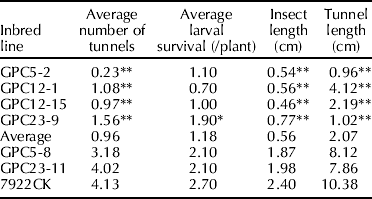
The degree of damage to the leaves during the booting stage indicated that there were obvious differences in resistance to corn-borers among several transgenic lines. It can be seen from Table 1 that the average number of tunnels in the four plant lines GPC5-2, GPC12-1, GPC12-15 and GPC23-9, which have stronger resistance to corn-borers, was 0.96, which is 23% of the control (7922CK), a reduction of 77%. The average tunnel length of the borer hole in these plant lines was 2.07 cm, which is 20% of the control, and a reduction of 80%; the live insect averaged 0.56 cm in length, which is 24% of the control, and a reduction of 76%. The obvious differences indicate that the four plant lines have a high resistance level. The plant lines GPC-8 and GPC23-11 showed no significant differences compared to the control (Table 1).
Identification of resistance to corn-borer of transgenic progeny
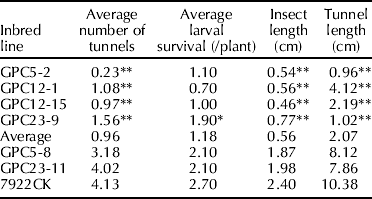
Significance levels: **, P=0.01; *, P=0.05.
Laboratory bioassays of insect resistance of transgenic plant lines
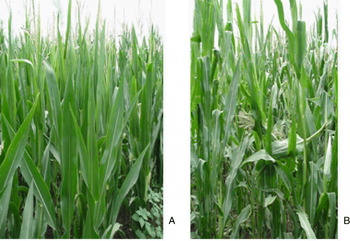
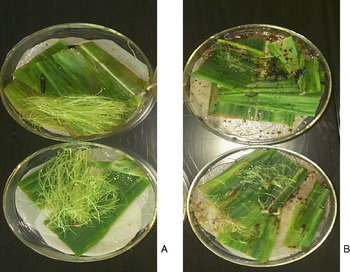
The results of bioassay tests of neonates fed on fresh leaves or silks from transgenic plants GPC5-2, GPC12-1 and GPC23-9 (experiments carried out in two consecutive years, 2003 and 2004) showed that the larvae were dead and the leaves of transgenic plants were hardly chewed; but the leaves of the control plants were damaged, and the larvae were fat and transparent (Fig. 1). The identification of larvae fed on the silks taken from transgenic plants showing field resistance during the earing stage indicated that the silks of transgenic plants had a certain degree of resistance to insects (Fig. 2).
Field representation of resistant and sensitive plants: (A) insecticidal line; (B) control plants. (See online for a colour version of this figure.)

Fresh silk fed on corn-borers indoors: (A) insecticidal line; (B) control plants. (See online for a colour version of this figure.)

Genetic stability of transgenic plant lines
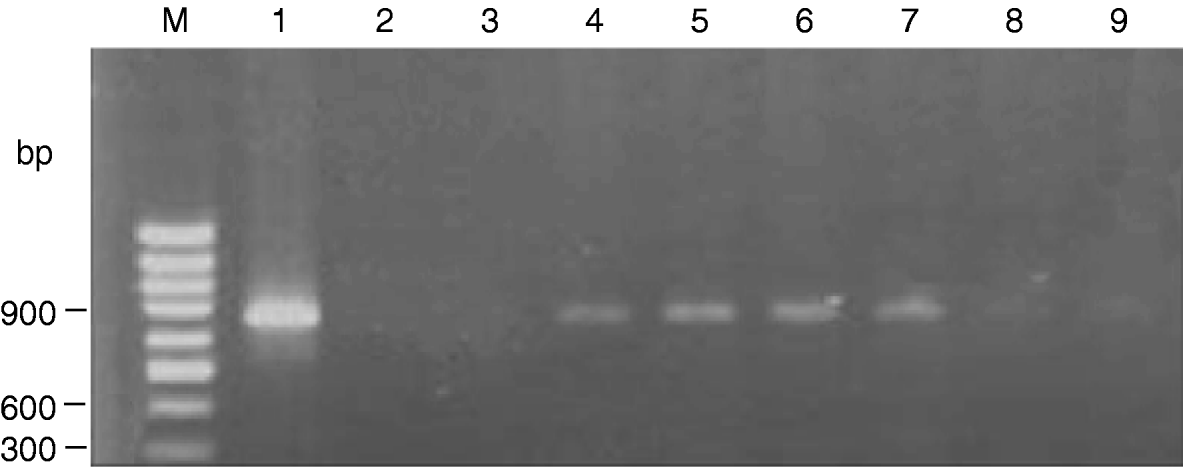
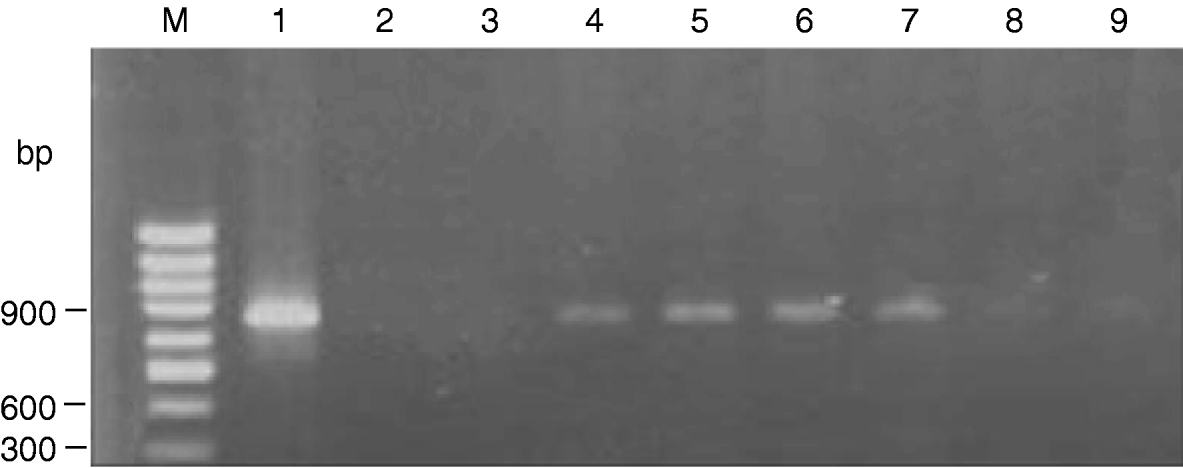
In order to verify whether foreign genes exist in the transgenic offspring and can be stably inherited, PCR analysis was performed on T5 generation transgenic plants; 900 bp sequence bands were amplified from the positive control and transformed plants, and these bands were absent from untransformed plants and negative control (water) (Fig. 3).
PCR assay of transgenic plants with Bt toxic protein gene. Lanes: M, λDNA/HindIII; 1, plasmid DNA; 2, non-transformed plant; 3, water; 4–9, transgenic plants.
Detection of toxic protein
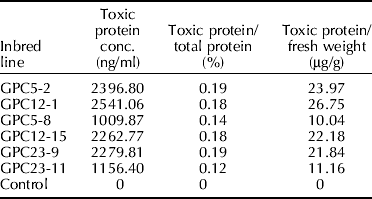
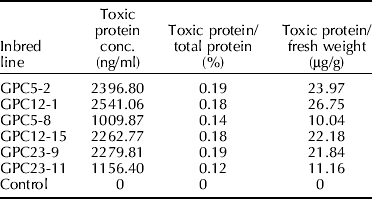
The ELISA assay was conducted on the transgenic lines and non-transgenic lines, and showed that the transgenic plant lines contained different amounts of Bt insecticidal protein. The maximum expression of toxic protein in the transgenic plant lines was 0.19% of the total protein (Table 2).
Analysis of Bt toxic protein of the transgenic plants
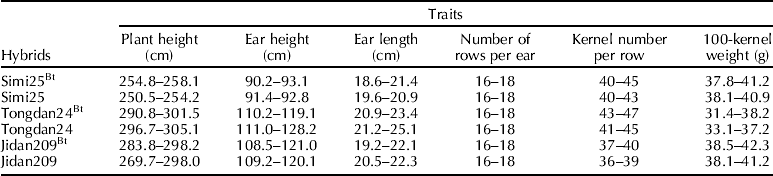
The agronomic characters of the transgenic hybrids
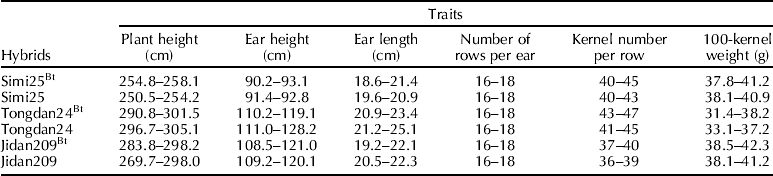
Six characteristics of transgenic plant lines have been surveyed (for 10 plants (single ears) of each line). The results (Table 3) indicate there were no obvious differences in plant height, ear length, row number per ear, kernel number per row and 100-seed weight between the transgenic lines and the control group, which provides strong evidence for the use of transgenic maize inbred lines with the Bt gene for breeding.
Field investigation and indoor study of hybrids
Identification of insect resistance of the transgenic hybrids
Under the conditions of natural and artificial inoculation, there were marked differences in insect resistance among the hybrids cultivated from the transgenic plant lines GPC5, GPC12, and 81162, 7884-7 and Ji853. There were many large insect holes on many leaves of the single hybrids using the transgenic plants GPC5-8, GPC23-11 and GPC12-1 as parents; while the hybrids using the transgenic plants GPC5-2, GPC12-15 and GPC23-9 as parents had few small insect holes on the leaves. We investigated the insect hole lengths by cutting the stems and the result showed that there were marked differences in insect resistance among the transgenic lines. There were differences in insect resistance between single plants of the same transgenic line and the three cultivated hybrids. Compared with the control groups, the insect resistance of the hybrids cultivated from the transgenic lines was obviously improved, and the differences were significant.
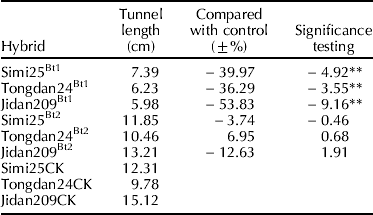
It can be seen from Table 4 that, compared with the control group (the hybrids of Simi 25, Tongdan 24 and Jidan 209), the average lengths of insect cavities of the hybrids Simi25Bt1, Tongdan24Bt1 and Jidan209Bt1, which were cultivated from the transgenic inbred lines GPC5-2, GPC12-15 and GPC23-9 manifesting good field insect resistance, were shortened by 39.97%, 36.2% and 53.83%, respectively, and reduced by 43.36% on average. Statistical analyses indicate that the differences reached significant or extremely significant levels. Compared with the control group, the differences in tunnel lengths in the groups of hybrids Simi25Bt2, Tongdan24Bt2 and Jidan209Bt2, which were cultivated from the transgenic inbred lines with relatively poorer resistance to corn-borers, were not obvious.
Identification of hybrid resistance to corn-borer
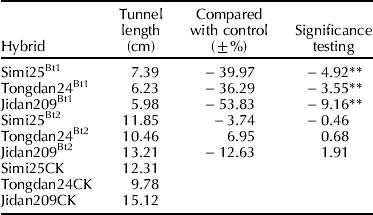
CK, control. Significance levels:
**, P=0.01; *, P=0.05.
Discussion
In this research, the differences in insect resistance of different transgenic plant lines are large, and there are also differences between the insect resistance of the same transgenic plant line and the three cultivated hybrids. However, generally speaking, the hybrids cultivated from transgenic plant lines showed better insect resistance, but, compared with the controls, the difference in the insect resistance of the hybrids cultivated from the transgenic plant lines with poor insect resistance was not obvious. This also indicates that the insect resistance in the transgenic plant lines can be inherited and expressed by the hybrids. Therefore, more screening work of plant lines must be done in the transgenic breeding of maize, and only when molecular identification and the identification of field insect resistance are closely combined can the plant lines with highly efficient expression be selected.
There have been some domestic reports on the identification of resistance to Asian corn-borer in maize transgenic genes and Bt maize, but most of them relate to the early generation of the transgenic plants. Liu et al. (Reference Liu, Tang and Li2003) identified resistance to corn-borers of hybrid lines that were produced from the Li Baojian transgenic Bt gene: the insect resistance of four transgenic groups was elevated. Compared with the control group, the average tunnel length was shortened by 49.70%. Zhang et al. (Reference Zhang, Zhang, Zhang, Chen, Wang and Tan2004) selected one highly resistant plant line T123 from 16 T3 GFM Cry1A transgenic lines and one hybrid that was cultivated from T123 and Jing 24. Identification was conducted on the leaf-eating grade of corn-borer during the tasselling stage and silking stage and the tunnel lengths during the maturity period, and the results showed that the leaf-eating grade was Grade 2 and no tunnel was seen.
The present research investigated the amount of plant damage, number of tunnels per stalk, larval survival per stalk, the weight of the larvae that survived, the length of tunnels, and the proportion of tunnelled plants. Compared with the control group, the insect resistance of the selected resistant lines was greatly improved: the average tunnel length was 10 cm, the average length of tunnels of the four transgenic lines was 2 cm, which was 20% shorter than that of the control group, and some plants had tunnels less than 1 cm in length. These results are similar to the findings of Zhang (Reference Zhang, Zhang, Zhang, Chen, Wang and Tan2004), which indicates that the transgenic technology of using the gene GFM Cry1A as the gene source to cultivate anti-corn-borer maize is effective, and could be applied to the molecular breeding of maize. This research also analysed the agronomic characteristics of the hybrids: there was no marked difference between hybrids and the control group. This also provides a basis for the insect-resistant transgenic maize inbred lines which can be used directly for the improvement of maize hybrids.
In addition, ELISA analysis of the insect-resistant lines with transformed Cry1A genes indicated that the quantity of Bt toxic protein expressed by insect-resistant plants was almost the same as that of American Bt maize. However, compared with the American Bt maize, it still did not have the effect of killing all the corn-borers. It needs to be explored whether this is due the GFM Cry1A gene itself or an expression problem of the gene in the transgenic maize.
Acknowledgements
The current research was supported financially by the National Center of Transgenic Plant Research and Commercialization Program (No. JY03-17-1). We would like to thank Dr Rick Rochester and his organization, International College of China Agricultural University, for proofreading the English manuscript of this paper.