


In the Middle East, fewer women work outside the home, and fewer hold positions in government, than in any other region of the world. According to most observers, this troubling anomaly is due to the region's Islamic traditions (e.g., Sharabi Reference Sharabi1988; World Bank 2004). Some even argue that the “clash of civilizations” between the Islamic world and the West has been caused, in part, by the poor treatment of Muslim women (Inglehart and Norris Reference Inglehart and Norris2003a; Landes and Landes Reference Landes and Landes2001).
This paper suggests that women in the Middle East are underrepresented in the workforce and in government because of oil—not Islam. Oil and mineral production can also explain the unusually low status of women in many countries outside the Middle East, including Azerbaijan, Botswana, Chile, Nigeria, and Russia.
Oil production affects gender relations by reducing the presence of women in the labor force. The failure of women to join the nonagricultural labor force has profound social consequences: it leads to higher fertility rates, less education for girls, and less female influence within the family. It also has far-reaching political consequences: when fewer women work outside the home, they are less likely to exchange information and overcome collective action problems; less likely to mobilize politically, and to lobby for expanded rights; and less likely to gain representation in government. This leaves oil-producing states with atypically strong patriarchal cultures and political institutions.Footnote 1
This argument challenges a common belief about economic development: that growth promotes gender equality (e.g., Inglehart and Norris Reference Inglehart and Norris2003b; Lerner Reference Lerner1958). Development institutions like the World Bank often echo this theme, and it is widely accepted among development experts (World Bank Reference Inglehart and Norris2001). This paper instead suggests that different types of economic growth have different consequences for gender relations: when growth encourages women to join the formal labor market, it ultimately brings about greater gender equality; when growth is based on oil and mineral extraction, it discourages women from entering the labor force and tends to exaggerate gender inequalities.
It also casts new light on the “resource curse.” Oil and mineral production has previously been tied to slow economic growth (Sachs and Warner Reference Sachs and Warner1995), authoritarian rule (Ross Reference Ross2001a), and civil war (Collier and Hoeffler Reference Collier and Hoeffler2004). This paper suggests that oil extraction has even broader consequences than previously recognized: it not only affects a country's government and economy but also its core social structures.
Finally, it has important policy implications. The United States and Europe consume most of the world's oil exports, and hence have strong effects on the economies of oil-exporting states. One of these effects is to reduce economic opportunities for women; another is to reduce their political influence. A third effect may be to foster Islamic fundamentalism: a recent study of 18 countries found that when Muslim women had fewer economic opportunities, they were more likely to support fundamentalist Islam (Blaydes and Linzer Reference Blaydes and Linzer2006). Changes in Western energy policies could strongly affect these outcomes.
THE CONSEQUENCES OF FEMALE LABOR FORCE PARTICIPATION
Social theorists have long claimed that women can achieve social and political emancipation by working outside the home (e.g., Engels Reference Engels and Tucker1978 (Reference Engels and Tucker1884)). Many recent studies support this claim. Female labor force participation helps raise female school enrollment and literacy: when families know that girls will be able to earn their own income—and contribute to household income—they tend to invest more in their health and education (Michael Reference Michael1985). Female labor force participation is also linked to lower fertility rates: when women earn their own incomes, they gain an incentive to delay the onset of parenthood, and hence bear fewer children over their lifetimes (Brewster and Rindfuss Reference Brewster and Rindfuss2000).
Female labor force participation also affects gender relations more broadly—particularly when women work in factory jobs that bring them into contact with each other, allow them to share information, and lower the barriers to collective action. Studies of female garment workers in Bangladesh—who typically come from poor rural areas, and are hired when they are young and single—have found that factory work helps them gain self-confidence, develop social networks, learn to negotiate with men, and learn about health and contraception (Amin et al. Reference Amin, Diamond, T Naved and Newby1998; Kabeer and Mahmud Reference Kabeer and Mahmud2004). Other studies show that when women have an independent source of income, they tend to gain more influence within the family (Beegle, Frankenberg, and Thomas Reference Beegle, Frankenberg and Thomas2001; Iverson and Rosenbluth Reference Iverson and Rosenbluth2006). They also develop more egalitarian beliefs about gender relations (Thornton, Alwin, and Camburn Reference Thornton, Alwin and Camburn1983).
Finally, the entry of women into the labor force tends to boost female political influence. There seem to be many reasons for this effect. According to studies in the United States, when women enter the workforce they become more likely to engage in conversations that promote an interest in politics, to join informal networks that facilitate collective action and help them develop their civic skills, and perversely, to experience gender discrimination in a manner that motivates them politically (Sapiro Reference Sapiro1983; Schlozman, Burns, and Verba Reference Schlozman, Burns and Verba1999).
Studies of female political participation in developing states are broadly consistent with these findings. Indian women are more likely to participate in politics and elect female representatives when they have established an identity outside the household, often through work (Chhibber Reference Chhibber and Inglehart2003). In many countries where women work in low-wage manufacturing—including Guatemala, Taiwan, Hong Kong, India, Indonesia, Tunisia and Morocco—they have formed organizations to protect their interests; often these organizations lobby for broader reforms in women's rights (Moghadam Reference Moghadam1999).
These and other studies imply that joining the labor force can boost female political influence through at least three channels: at an individual level, by affecting women's political views and identities; at a social level, by increasing the density of women in the labor force and hence the likelihood they will form politically salient networks; and at an economic level, by boosting their economic importance and hence forcing the government to take their interests into account.
THE CAUSES OF FEMALE LABOR FORCE PARTICIPATION
Women commonly face special barriers to entering the labor market. Labor markets are typically segregated by gender: men work in some occupations and women, in others, even when their qualifications are similar (Anker Reference Anker1997). Occupational segregation tends to reduce both the number of jobs available to women, and their wages (Horton Reference Horton1999).
In theory, women could gain greater access to labor markets by persuading governments to adopt and enforce laws that cause employers to end discrimination, to facilitate maternity leave, to allow women to own property, and to let them travel without the consent of a male relative. But in practice, when women are excluded from labor markets, they typically have little political influence—which leaves governments with little incentive to act on their behalf.
When labor markets are segregated by gender, and women have little political power, how can they enter the work force in large numbers? Since the early days of the industrial revolution, the answer has often come from the development of low-wage export-oriented industries, especially in textiles, garments, and processed agricultural goods. In 1890, women held over half of the jobs in the U.S. textiles industry (Smuts Reference Smuts1959). Today more than 80% of all textile and garment workers in the world are women (World Bank 2001).Footnote 2
There are several reasons why these industries are conduits for new female workers:
• they do not need workers with great physical strength: men have no natural advantage in these jobs;
• the jobs require little training and few specialized skills, which makes it easier for women to intermittently leave their jobs to care for their families;
• and making cloth and clothing is often perceived as traditional women's work.
Factories are even more likely to employ women when they export their products. Several studies show that even within a single industry, export-oriented firms employ women at a higher rate than do similar firms that produce goods for domestic markets (Başlevent and Onaran Reference Baslevent and Onaran2004; Ozler Reference Ozler2000). This seems to occur because:
• Export-oriented industries can grow quickly since they are selling into a global market. Hence they can produce large numbers of new jobs, which also means women can be hired without displacing men.
• Factories that produce goods for export are more likely to be owned or managed by foreign companies that—for legal or cultural reasons—are less prone to discriminate against women in hiring;
• Export-oriented firms produce goods for highly-competitive global markets, and wages constitute a large fraction of their production costs; this places them under exceptional pressure to seek out labor at the lowest cost. Since female wages are lower than male wages, export-oriented firms often target them for recruitment.
THE EFFECTS OF FEMALE LABOR FORCE PARTICIPATION IN SOUTH KOREA
To illustrate the ways that export-oriented manufacturing can draw women into the labor force, and boost their political influence, consider the case of South Korea. At the turn of the twentieth century, Korea had a highly patriarchal culture: females were not given their own names, girls were separated from boys beginning at age 6, and women were not allowed to enter the streets of Seoul during the daytime. In 1930, 90% of Korean women were illiterate (Park Reference Park1990).
When South Korea industrialized in the 1960s, women began to take jobs in factories that produced goods for export—including textiles, garments, plastics, electronic goods, shoes, and dishware. Their low wages—less than half of male wages—made them attractive to employers, and helped fuel Korea's economic boom: by 1975, female-dominated industries produced 70% of South Korea's export earnings (Park Reference Park1993). The growth of the export sector, in turn, boosted the female share of the labor force—which rose by 50% between 1960 and 1980 (World Bank 2005a).
Although there were women's organizations in Korea in the 1950s and 1960s, they were often government sponsored and focused on charity work, consumer protection, and offering classes for housewives and brides-to-be (Yoon Reference Yoon and Institute2003). Beginning in the 1970s, however, women working in export industries began to mobilize for both labor rights and gender equality. Labor unrest in the textiles sector was especially acute (Amsden Reference Amsden1989).
In 1987, female activists took advantage of South Korea's democratic opening to found the Korean Women's Associations United (KWAU); unlike earlier women's organizations, it worked for improved labor conditions and women's rights, and took a more confrontational stance towards the government (Moon Reference Moon2002). More traditional women's groups also began to focus on women's rights (Palley Reference Palley1990).
In the mid-1990s, women's organizations started to push for—and gain—greater female representation at all levels of government: the number of female representatives in the national assembly rose from 8 in 1992 to 1996 to 16 in 2000 to 2004; female membership on policy-setting government committees increased from 8.5% in 1996 to 17.6% in 2001; and the percentage of female judges rose from 3.9% in 1985 to 8.5% in 2001 (Yoon Reference Yoon and Institute2003).
The lobbying strength of the women's movement, and the growing number of women in government, has led to a series of landmark reforms. These included the Gender Equality Employment Act (1987), revisions to the family laws (1989), the Mother-Child Welfare Act (1989), the Framework Act on Women's Development (1995), and a bill stipulating that political parties must set aside for women at least 30% of their national constituency seats (2000) (Park Reference Park1993; Yoon Reference Yoon and Institute2003).
By drawing women into the work force, export-oriented manufacturing helped South Korean women gain a foothold in government and opened the door to the reform of patriarchal institutions.
HOW OIL PRODUCTION CAN AFFECT FEMALE LABOR FORCE PARTICIPATION
When countries discover oil, their new wealth tends to produce an economic condition called the “Dutch Disease”, which is characterized by a rise in the real exchange rate, and a transformation of the economy away from the “traded sector” (agriculture and manufacturing) and towards the “nontraded sector” (construction and services) (Corden and Neary Reference Corden and Neary1982). Classic models of the Dutch Disease, however, do not consider whether these changes might affect men and women differently (Frederiksen Reference Frederiksen2007). Once we extend the model to better capture the conditions that women face in most low-income countries, we can see how a boom in oil production will squeeze women out of the labor force.
In the classic Dutch Disease model, a boom in oil production will crowd out the production of other traded goods, via two mechanisms.Footnote 3 First, the influx of foreign currency—that is, the new wealth generated by oil sales—will raise the real exchange rate, making it cheaper for locals to import tradable goods from other countries than to buy them from domestic producers. Second, the new wealth will increase the demand for non-tradable goods—things that cannot be imported, like construction and retail services—drawing labor away from the tradable goods sector and hence raising its production costs. The net result is that an oil boom causes a decline in the traded goods sector (agriculture and manufacturing) but an expansion in the non-traded sector (construction and retail).
How does this affect women? According to standard models of female labor supply, two key factors influence the number of women in the labor market (Mammen and Paxson Reference Mammen and Paxson2000). One is the prevailing female wage: as it rises, women are more inclined to enter the market for wage labor and “substitute” work for leisure. The other is “female unearned income,” which means the income that accrues to a woman's household, but that she does not earn directly: as her family's income rises, she becomes less inclined to join the labor market and provide a second income. A women's “reservation wage” is the wage at which she finds it worthwhile to join the labor force. If her unearned income is high—for example, if her husband has a sizable income—then her reservation wage will also be high, and only a well-paying job will lure her into the work force. If her unearned income is low, her reservation wage will also be low, meaning she will be willing to join the labor force even if the prevailing female wage is low.
In a classic Dutch Disease model, the impact of an oil boom on female labor force participation is ambiguous: it will increase the prevailing wage (which is assumed to be the same for men and women), and this in turn will increase a women's incentive to join the work force. But there is also a countervailing force: higher wages will boost household income, which will raise a women's reservation wage and reduce her incentive to join the labor force. The classic model does not tell us which effect will prevail.
Now consider what happens if we modify the Dutch Disease model to reflect gender-based segregation in the labor force—that is, the fact that many kinds of jobs are closed to women. Dutch Disease models show that oil booms lead to a shift away from the traded sector to the nontraded sector. In many developing countries, women are largely employed in the traded sector, in low-wage jobs in export-oriented factories and agriculture; and they are excluded from many parts of the nontraded sector, such as construction and retail, since these jobs typically entail heavy labor, or contact with men outside the family (Anker Reference Anker1997). If we assume that women can only work in the traded sector, and men in the nontraded sector, how will an oil boom affect female labor force participation?Footnote 4
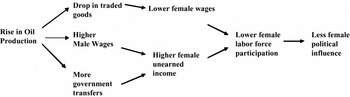
When there is gender segregation in the labor market, men and women have different wages. Since men in this model work in the non-traded sector, its expansion will boost the demand for male labor and cause male wages to rise; since women cannot enter the nontraded sector, male wages will rise even more than they would otherwise. Since women work in the traded sector, the sector's decline will reduce the demand for female labor, and hence, the prevailing female wage.
An oil boom should also reduce the supply of female labor by raising womens' unearned income, and hence, their reservation wage. This occurs through two mechanisms: through higher male wages (caused by the expansion of the non-traded sector, which employs only men), and through higher government transfers to households (caused by the effect of booming oil exports on government revenues).Footnote 5 The decline in the demand for female labor, plus the decline in the supply of female labor, will reduce the number of women in the workforce.
Now consider what occurs if we loosen some key assumptions. The model assumes an open economy. But sometimes oil-rich governments use tariffs and subsidies to protect their tradable sectors. Will this affect the results? Probably not: oil-rich governments tend to protect heavy industry, not light industry—and hence, male jobs instead of female jobs (Gelb and Associates, Reference Gelb1988). Even if an oil-rich government did protect light industries, once domestic firms received protection they would no longer have to compete with overseas firms—reducing their incentive to seek out low-wage labor, and hence, female workers.
The model also assumes that the number of working-age men and women is fixed. But many small, oil-rich countries import both male and female labor; how would this change the model? If we allow for immigrant male workers—in effect making the supply of male labor more elastic—then a boom in the nontraded sector might not raise male wages, eliminating one source of higher female unearned income. But a second source of female unearned income would remain: governments would still receive a boost in revenues, generating more transfers to households.
If we allow for female immigration, the prevailing female wage would drop. Since women withdraw from the labor market when the prevailing wage falls below their reservation wage, this would further discourage local women from entering the work force.
Both male and female immigration would also swell the overall size of the labor force. Hence even if there were no change in the number of working female citizens, the fraction of female citizens in the total labor force labor force would fall.
What if we partially ease the assumption of occupational segregation, by allowing both men and women to work in the traded sector? Again, there should be little change in the outcome: when the traded sector contracts, both men and women will lose their jobs. But although men can switch to jobs in the non-traded sector, women cannot because of occupational segregation. As a result, female wages will still fall, and unearned female income will still rise, since both male wages and government transfers will increase.
What if we further ease the assumption of occupational segregation and allow both men and women to work in the nontraded sector? Here there is a change in the results: the effects of an oil boom are now ambiguous. If more female jobs are lost in the traded sector than are gained in the nontraded sector, the demand for female workers will still drop; if more jobs are gained in the nontraded sector, the demand for female workers may increase.
If the demand for female workers rises enough, the increase in the prevailing female wage will exceed the increase in the reservation wage (which will still rise thanks to higher male wages and higher government transfers) and lead to a net increase in female labor force participation. This implies that oil may not harm the status of women if they are free to work in the nontraded sector. It may also explain why the booming oil markets of the 1970s reduced female labor force participation in countries with high levels of occupational segregation (like Algeria, Angola, Gabon, Nigeria, and Oman), but not in those with low levels of occupational segregation (like Colombia, Malaysia, Mexico, Norway, and Venezuela).
The main implication of the model is,
H 1: A rise in the value of oil production will reduce female participation in the labor force.
The earlier discussion suggests that female political influence is partly a function of female labor force participation: when the fraction of female citizens in the work force rises, it should enhance women's political influence through dynamics at an individual level (as their exposure to the work place affects their identities and perceptions), a social level (as their density in the labor force rises, so does the number of formal and informal female networks), and an economic level (as their growing role in the economy forces the government to take their interests into account). If an increase in oil production reduces the percentage of female citizens in the labor force, we can infer
H 2: A rise in the value of oil production will reduce female political influence.
How Oil Production May Reduce Female Political Influence

DATA AND METHODS
To explore these hypotheses, I analyze oil production and employment data for all countries from 1960 to 2002, and data on female political representation for 2002. The analysis can tell us if the key variables in the model—oil, female work patterns, and female political empowerment—are statistically correlated. It cannot tell us much about the causal mechanisms behind these correlations; hence I follow the statistical analysis with a case study, to better illustrate the causal mechanisms at work.
Below I carry out two sets of estimations: one uses a first-differences model with country fixed-effects, and employs pooled time-series cross-sectional data for all states between 1960 and 2002; the other uses a cross-national model with a between estimator and covers all states in the most recent 10-year period (1993–2002). The first-differences model with fixed effects examines variations over time within states, whereas the cross-national model measures variations across them. The dataset includes all 169 states that were sovereign in the year 2000, and that had populations over 200,000—and leaves out very small countries to make sure they do not drive my results.
The first-differences model with country fixed-effects can be written as

where i is the country, t is the year, x is a series of explanatory variables, and the right-hand side variables are lagged by 1 year.
The first-differences model with fixed effects has some useful properties. Standard ordinary least-squares models look at whether the levels of the explanatory variables are correlated with the level of the dependent variable; the first-differences model looks at whether changes in the explanatory variables are associated with changes in the dependent variable. Because it focuses on changes, not levels, the model helps control for country heterogeneity. It also helps correct for trending in the dependent variable: the steady rise of female labor force participation between 1960 and 2002, if not accounted for, could produce biased estimates of the explanatory variables. The model includes country fixed-effects to allow any trends in female labor force participation to vary from country to country (without fixed-effects, the results are unchanged). I use an AR1 process to control for any remaining autocorrelation, and lag the explanatory variables to reduce endogeneity.
The disadvantage of the first-differences model with fixed effects is that it does not tell us anything about the influence of factors that vary a lot from country to country, but change little within countries over time—like a country's religious traditions, or its presence in a larger region. I use cross-national tests to explore the role of these fixed and “sluggish” variables, and compare their effects to the effects of oil production. The cross-national estimations also allow me to use a measure of female political empowerment—described below—that is only available for one or two years for most countries.
The between estimator allows me to compare the mean values of the explanatory variables with the mean values of the dependent variable, over some period of time. It may be written as

where i is the country, x is a series of explanatory variables, and values are averaged over several years. Using the mean value of each variable over a 10-year period (1993–2002) also helps reduce measurement error.
Variables
My independent variable is Oil Rents Per Capita, which is a country's total rents from oil and gas divided by its midyear population. Like the other economic variables, it is measured in constant 2000 dollars. I calculate oil rents by taking the total value of each country's annual oil and natural gas production, and subtracting the country-specific extraction costs, including the cost of capital. Data sources are discussed in the Appendix.
Past studies of the ‘resource curse’ have measured a country's oil wealth as “oil exports divided by GDP” (e.g., Collier and Hoeffler Reference Collier and Hoeffler2004; Sachs and Warner Reference Sachs and Warner1995). Oil Rents Per Capita is a better variable than the Oil Exports Over GDP in two ways: it is a more precise measure of the value of oil production, since it subtracts production costs, leaves out oil that is imported and subsequently reexported, and includes the value of oil that is produced and consumed domestically; and it avoids endogeneity problems that come from measuring exports instead of production, and from using GDP to normalize oil wealth. These issues are discussed in greater detail in the Appendix.
The amount of petroleum that a country produces is not fully exogenous to the other variables: it reflects the investments made in oil exploration and production, which in turn may reflect a country's economic health and stability, and the quality of its government. But these links probably bias the Oil Production variable toward disconfirming the hypotheses, since countries with better conditions for women (i.e., wealthier and more westernized countries) are also likely to attract more investment, and hence, to produce more oil.
There are two dependent variables. One is Female Labor Force Participation, a variable that denotes the fraction of the formal labor force that is made up of female citizens. It is based on data collected by the International Labor Organization from national surveys and censuses, and released by the World Bank (2005a). The variable has three shortcomings: countries differ in the way they define and measure labor force participation; some countries count foreign workers as part of the labor force, which complicates my efforts to measure the citizen labor force; and the measure does not distinguish between work in the agricultural sector and the nonagricultural sector.
The first problem can be addressed by using the first-differences model with fixed-effects: as long as countries define “female labor force participation” consistently over time, country-to-country differences in measurement should not bias the estimations in any obvious way. Still, this issue causes problems for the cross-national tests and should give us caution when interpreting them.
The other two problems can be addressed by subtracting agricultural workers (World Bank 2005a), and foreign workers (World Bank 2004, 2005b), from Female Labor Force Participation. Since adjustments can only be done for recent years—there are little data on these measures before 1990—the corrected measures can only be used in the cross-national analysis, not in the first-differences tests.
The other dependent variable is female political influence, which I gauge with two variables: Female Seats, which measures the fraction of seats in each country's parliament (or in bicameral systems, the lower house) held by women in 2002, and Female Ministers, which is the fraction of ministerial positions held by women in 2002 (the most recent year for which the data are available). The data are collected by the Inter-Parliamentary Union (www.ipu.org/wmn-e/world-arc.htm).
Although they are crude measures of female political influence, there is evidence that when women hold high political office, it boosts the political knowledge, interest, and participation of other women (Burns, Schlozman, and Verba Reference Burns, Schlozman and Verba2001; Hansen Reference Hansen1997). There is also evidence that female legislators favor different policies than do their male counterparts (Chattopadhyay and Duflo Reference Chattopadhyay and Duflo2004). Other global studies of female political influence also use these measures (e.g., Inglehart and Norris Reference Inglehart and Norris2003a; Reynolds Reference Reynolds1999). Although the percentage of parliamentary seats held by women is influenced by gender quotas, this does not lessen the value of Female Seats as an indicator of female political influence, since the decision to enact gender quotas is usually itself a sign of female influence (Baldez Reference Baldez2004; Caul Reference Caul2001). Since these measures are only available for recent years, I can only use them for cross-national analyses.
The models include several control variables:
• Income, which is the log of GDP per capita, and is controlled for in all models;
• Income Squared, which is the log of income squared, and is added to the regressions for Female Labor Force Participation to capture the U-shaped relationship produced by the combined effects of rising income on female wages (which encourages female labor participation) and unearned household income (which discourages female labor participation; Mammen and Paxson Reference Mammen and Paxson2000);
• Middle East, which is a dummy variable for the 17 states of the Middle East and North Africa. I use the World Bank's definition of the region;
• Islam, a variable that measures the Muslim fraction of each country's population;
• Communist, which is a dummy variable for the 34 states that had communist legal systems at some point since 1960. It is included in some cross-national tests to capture the lasting influence of communist policies on female employment;
• Working Age, which is the fraction of the population between the ages of 15 and 64;
• Several measures of a state's political institutions: Proportional Representation, which is a dummy variable for states whose parliaments are chosen through proportional representation; Closed List, which is a dummy variable for electoral systems with closed lists; and Polity, which uses a 21-point scale to measure a state's democracy level, and is drawn from the Polity IV database. Earlier studies suggest that women are more likely to be elected to parliament in electoral systems with proportional representation and closed lists (Reynolds Reference Reynolds1999).
Robustness
I test the robustness of the models in three ways. To determine whether the estimations are sensitive to influential observations, I rerun them after dropping the two most influential countries from the dataset. To see if the results of the cross-national regressions on Female Labor Force Participation are specific to the period covered (1993–2002), I run the same model for the decades 1960–1969, 1970–1979, and 1980–1989.
Finally, to see whether the cross-national models are biased by the exclusion of important regional effects, I add a set of regional dummy variables to the models.
Results
All of the variables are standardized to make comparisons easier.
Female Labor Force Participation
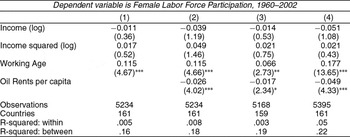
Oil Rents has a large, negative impact on Female Labor Force Participation. In the first-differences estimations (Table 1), increases in Oil Rents in a given year are consistently linked to decreases in Female Labor Force Participation the following year. Oil Rents is highly significant when tested with the full set of countries (column 2); it is significant at the .05 level after the two most influential states (Kuwait and Saudi Arabia) are dropped from the sample (column 3); and it remains highly significant when year dummies are used in place of the AR1 process to mitigate autocorrelation (column 4).
Pooled Time-Series Cross-national Regressions, with First Differences and Fixed Effects

Note: Absolute value of t statistics in parentheses. *Significant at 5%; **significant at 1%; ***significant at 0.1%. Country fixed-effects are used in each estimation. In column 3, the two most influential countries have been dropped from the sample. In column 4, year dummies were included in place of the AR1 process.
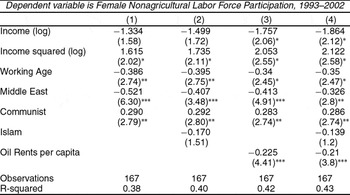
Oil Rents is also linked to lower Female Labor Force Participation in the cross-national estimations (Table 2). The Income, Middle East, Working Age and Communist variables are also correlated with Female Labor Force Participation in the expected directions. The Islam variable has no effect (columns 2, 4). The inclusion of Oil Rents reduces the Middle East coefficient by about one fourth.
Cross-national Regressions on Female Labor Force

Note: Robust t statistics in parentheses. All variables are standardized. *Significant at 5%; **significant at 1%; ***significant at 0.1%.
Like the first-differences results, the cross-national results are robust. If the two most influential countries (Qatar and Kuwait) are dropped from the estimations, Oil Rents remains highly significant. A dummy variable for sub-Saharan Africa is statistically significant but has little impact on the Oil Rents variable. I also estimated the model using data for 1960–69, 1970–79, and 1980–89. In every period, Oil Rents was strongly correlated with Female Labor Force Participation.
These results are consistent with H 1, which states that oil production will reduce female labor force participation.
Female Representation
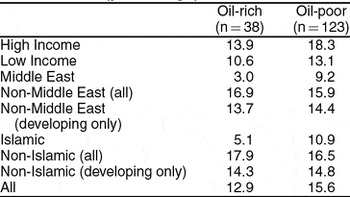
Before turning to the regression results, consider Table 3, which shows the fraction of parliamentary seats held by women in different categories of states. The table shows that women have better political representation in countries that have little or no oil, in five the seven categories of states: high and low income, Middle East, Islamic, and all states. This is striking since oil-rich countries have higher incomes than the oil-poor states within each category of stages, which would suggest higher, not lower, female representation.
Parliamentary Seats Held by Woman, 2002 (percentage)

Note: I define states as “oil-rich” if they gererate at least $100 per capita in oil rents, and “oil-poor” otherwise; as “high-income” if their incomes are above the sample mean ($1592), and low-income otherwise; as “Middle East” if they meet the World Bank's definition of the region, and “non-Middle East” otherwise; and as “Islamic” if more than fifty persent of their citizens are Muslim, and “Non-Islamic” otherwise. Developing countries are all countries excluding the states of Western Europe, the United States, Canada, and Japan.
In two categories—non-Middle East, and non-Islamic—the oil-rich states have more female representation than oil-poor states. But this only holds true when we include both developed and developing countries in the sample—and the theory suggests that oil will only harm female political influence in developing countries, where women are excluded from jobs in the nontraded sector. Once we limit the sample to developing countries, we again see that oil-rich countries have inferior records to oil-poor countries, even among non-Middle East, and non-Muslim countries.
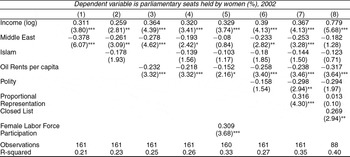
In cross-national regressions, Oil Rents is negatively correlated with all three measures of female political representation. Column one of Table 4 shows that Income is linked to higher levels and Middle East, to lower levels, of Female Seats. In column 2, Islam is also linked to reduced levels of Female Seats, although it is only significant at the .10 level. Column 3 shows that Oil Rents is strongly associated with lower levels of Female Seats, and its inclusion causes the Middle East coefficient to drop by a third; it also causes the Islam variable to lose statistical significance at the .10 level (column 4). The association between Oil Rents and Female Seats is robust: it is unaffected by the exclusion of the two most influential cases, and by the inclusion of the regional dummies. The results are unchanged if Female Seats is measured in 1995 (the earliest year available) instead of 2002.
Cross-national Regressions on Female Seats in Parliament

Note: Robust t statistics in parentheses. All variables are standardized. *Significant at 5%; **significant at 1%; ***significant at 0.1%.
Columns 6, 7, and 8 show that the Oil Rents variable is robust to the inclusion of controls for political institutions that may affect female political representation: Polity, Proportional Representation, and Closed Lists. A variable that measures district magnitude was not statistically significant; nor was a variable that measured migration, which conceivably might be affecting female representation.
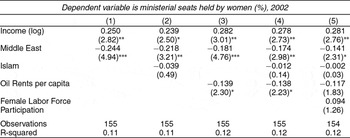
Oil Rents has a similar negative correlation with Female Ministers (Table 5). Islam has even less effect on Female Ministers than it does on Female Seats (columns 2 and 4). Once again, the correlation survives the exclusion of the two most influential states, although now the inclusion of a dummy variable for the OECD states causes Oil Rents to lose statistical significance.
Cross-national Regressions on Female Ministerial Positions 2002

Note: Robust t statistics in parentheses. All variables are standardized. *Significant at 5%; **significant at 1%; ***significant at 0.1%.
These results are consistent with H 2, which suggests that petroleum production will reduce female political influence.
There is also evidence that Female Labor Force Participation helps explain why Oil Rents is linked to less female representation. Female Labor Force Participation is strongly tied to Female Seats, and its inclusion produces a large drop in the Oil Rents coefficients (Table 3, column 5). Female Labor Force Participation is not significantly linked to Female Ministers, although its inclusion causes the Oil Rents variable to lose significance (Table 4, column 5).
These results are consistent with the claim that oil production reduces female political influence by reducing the number of women who work outside the home.
Discussion
After controlling for income, higher oil rents are linked to lower rates of female labor force participation, fewer female legislators, and fewer female cabinet members.
These correlations are not caused by the concentration of petroleum in the Middle East or in Islamic countries: they are robust to the inclusion of controls for both factors. In fact, Islam has no statistically significant effect on any of the dependent variables in the fully specified models. This implies that some measures of female status in the Middle East can be partly explained by the region's oil wealth, but not by its Islamic culture or traditions.
This is not true of all dimensions of female status: measures of female education—including adult literacy, primary school enrollment and the ratio between enrolled girls and boys—are negatively correlated with Islam, and seem to be unaffected by Oil Rents. But the negative links between female education and Islam all disappear once we account for the exceptionally low initial levels of female education in the Middle East. Indeed, after controlling for female literacy in 1970, Islam no longer affects any of the education measures, and the Middle East variable becomes significant and strongly positive. In other words, before 1970 the Middle East countries had unusually low rates of female education; since 1970 they have done an unusually good job of catching up. But on the oil-affected dimensions of gender—female participation in the economy and government—progress has been much slower.
How much does oil production affect female political influence? The answer is less straightforward than it might seem, since an oil boom will have two, contradictory effects: it will increase Oil Rents—which will reduce female representation—but it will also increase Income—which should increase female representation. The net impact of an oil boom will be the sum of these two effects.
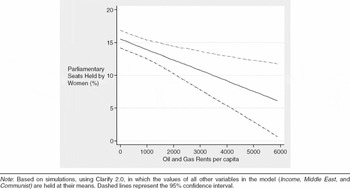
A rise in Oil Rents of one standard deviation—about $1,280 per capita, which is roughly equivalent to the difference in 2002 oil production between Algeria and Libya—is associated with a 2.15% drop in the fraction of parliamentary seats held by women (with a 95% confidence interval of .87% to 3.43%). But if a country gains $1,280 in new Oil Rents per Capita, it should also gain about $420 in income per capita.Footnote 6
For a country whose income was at the sample mean, a $420 rise in Income would produce a 0.16% rise in Female Seats. The net effect of a $1,280 rise in Oil Rents would hence be a drop of about 2% in the total percentage of parliamentary seats held by women (with a 95% confidence interval of −.62 to −3.36).
This effect is illustrated in Figure 2, which uses Clarify software to display the simulated impact of Oil Rents on Female Seats in a fictional country where values of the other variables in the model (Income, Middle East, and Communist) are set at the sample mean. The dashed lines show the 95% confidence intervals.
Simulated Effect of Oil Rents on Female Parliamentary Seats

The impact of oil production on female representation is substantial. For a country at the sample mean, just 12.5% of all legislative seats were occupied by women in 2002. A drop of 2% in Female Seats would produce a 16.6% loss in the total number of seats held by women. This implies that when oil revenues jump—due to the discovery of new fields, or a spike in prices—female representation in parliament will drop, other things being equal.
Of course, other things are never equal: in recent years there has been a trend toward greater female representation in government, which has lifted the number of female legislators in more than three-quarters of the world's countries—including some oil-rich countries. But the gains in the oil-rich states have been slower than the gains in oil-poor states: between 1995 and 2002, oil-poor states (<$100 per capita in oil rents) had a 5% increase in the number of female representatives, whereas oil-rich states (>$100 per capita in oil rents) had only a 2.9% increase. Even though the vast majority of states showed increases in female representation, oil-producing states like Algeria, Norway, Russia and Kazakhstan—all of which enjoyed a sharp rise in oil revenues—saw a fall in female representation.
OIL AND THE MIDDLE EAST
Do these figures confuse the effects of oil with the effects of Arab or Islamic culture? Consider the relationship between oil and female status within the Islamic Middle East—a setting that allows us to control for the influence of both religion and regional culture.
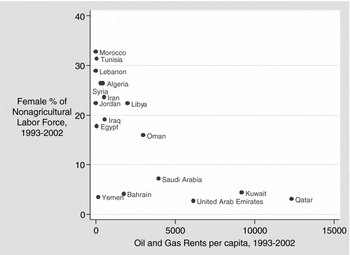
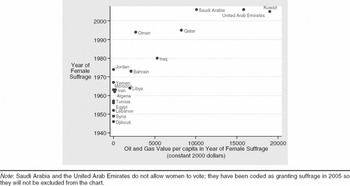
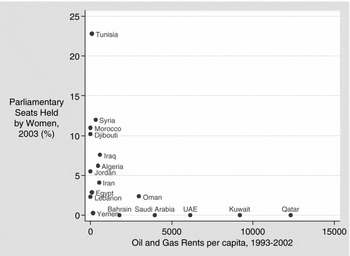
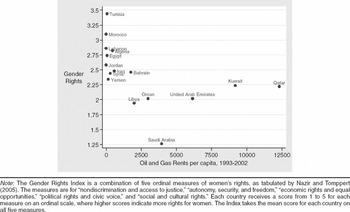
Figures 3 through 6 are scatterplots that show the relationship between oil rents per capita and four measures of female status for the Middle East states: female labor force participation, the year of female suffrage, the fraction of parliamentary seats held by women, and an ordinal measure of gender rights derived from Nazir and Tomppert (Reference Nazir and Tomppert2005). In general, the states that are richest in oil (Saudi Arabia, Qatar, United Arab Emirates, and Oman) have the fewest women in their nonagricultural workforce, have been the most reluctant to grant female suffrage, have the fewest women in their parliaments, and have the lowest scores on the gender rights index. States with little or no oil (Morocco, Tunisia, Lebanon, Syria, and Djibouti) were the first to grant female suffrage and tend to have more women in the workplace and parliament and higher gender rights scores.
Oil Rents and Female Labor Force Participation in the Middle East

Oil Rents and Female Suffrage in the Middle East

Oil Rents and Female Parliamentary Seats in the Middle East

Oil Rents and the Gender Rights Index in the Middle East

The region's oil wealth also helps explain some of the outliers. Even though Yemen, Egypt, and Jordan have little or no oil, they have fewer women in the labor force (Figure 3) and parliament (Figure 5) than we might expect. These anomalies may be partly the result of labor remittances: from the 1970s to the 1990s, these countries were the largest exporters of labor to the oil-rich countries of the Persian Gulf, and received enormous remittances from them in turn.Footnote 7
Labor remittances tend to have the same economic effects as oil: they constitute a large influx of foreign exchange, which raises the real exchange rate, hence making it harder for countries to develop low-wage, export-oriented manufacturing; and they increase household incomes, giving women less incentive to work outside the home. Yemen is farther below the trend lines for female labor and female representation than any other Mideast country; it has also received more remittances (as a fraction of GDP) than any other country.
CASE STUDY: ALGERIA, MOROCCO, AND TUNISIA
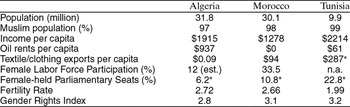
The regression analysis suggests that oil production is statistically correlated with female labor, and female representation, but it cannot tell us why. To explore the causal mechanisms that link oil to female status—while still controlling for Islam and regional culture—we can look more closely at a set of highly similar countries that have different petroleum endowments: Algeria, Morocco, and Tunisia. All three states were French colonies, all gained independence in the late 1950s or early 1960s, all granted suffrage to women soon after independence, and all are overwhelmingly Muslim (Table 6).
Comparison of Algeria, Morocco, and Tunisia

Note: Figures are for 2003, except where indicated. Income, oil rents, and textile and clothing exports per capita are in constant 2000 dollars.
*2002 figures.
Although they are otherwise similar, they have different levels of oil wealth: Algeria has been a major producer since the 1960s, whereas Morocco and Tunisia have relatively little. They also have different levels of female political representation: in oil-rich Algeria, women held 6.2% of the seats in parliament in 2002; in oil-poor Morocco and Tunisia, they held 10.8 and 22.8%, respectively. Differences in their oil wealth can help explain differences in the number of working women, which in turn helps account for differences in the number of women entering parliament.
With little or no oil, labor costs in Morocco and Tunisia are relatively low by international standards. Beginning around 1970, both countries took advantage of these low labor costs to develop export-oriented textile industries.
In both countries, these industries played a major role in drawing women into the work force. In Morocco, for example, the government began to promote textile and garment exports to Europe in 1969, hoping this would reduce the high unemployment rate for men. To the goverment's surprise, companies deliberately sought out and hired unmarried women, since they could be paid lower wages; by keeping their labor costs low, these firms were able to compete in the European market. By 1980, Morocco's textile work force was 75% female, even though men continued to outnumber women in textile factories that produced goods for the domestic market (Joekes Reference Joekes1982).
In the late 1970s, the Moroccan textile industry hit a slump when Europe closed its markets. But after the government carried structural reforms in the late 1980s and early 1990s, the industry once again grew quickly: by 2004, it was Morocco's main source of exports. It also accounted for three-quarters of the growth in female employment in the 1990s (Assaad Reference Assaad2004).
The Tunisian textile industry has followed a largely similar path—expanding since about 1970 through exports, relying on low-wage female labor, and weathering changes in European trade policies (Baud Reference Baud1977; White Reference White2001). Morocco and Tunisia now have the two highest rates of female labor force participation in the Middle East.
The high rates of female labor participation in Morocco and Tunisia have contributed to each country's unusually large and vigorous gender rights movements. Unlike other Middle East countries, Morocco and Tunisia have women's organizations that focus on female labor issues, including the right to maternity leave, raising the minimum work age, sexual harassment, and gaining rights for domestic workers (Moghadam Reference Moghadam1999).
In Tunisia, the women's movement began with an important advantage: shortly after independence, President Bourguiba adopted a national family law that gave women greater equality in marriage, and opened the door to major improvements in female education and employment. But Moroccan family laws were much more conservative, and women's groups had little success in reforming them in the 1960s, 1970s, and 1980s (Charrad 1990).
Although Morocco had a small number of women's organizations in the 1950s and 1960s, they were headed by men and focused on social and charitable work. Between 1970 and 1984, however, the number of women's organizations jumped from five to 32, and many began to focus on women's rights.
Between 1990 and 1992, a coalition of women's groups (including labor unions) gathered more than 1 million signatures on a petition calling for reform of the family laws to give women new rights in marriage, divorce, child custody, and inheritance. Conservative Islamists rallied their own supporters to block any new laws. Morocco's political parties—even secular opposition parties—declined to support the petition campaign. Still, the movement placed strong pressures on King Hassan II, and he eventually backed a more modest package of reforms (Brand Reference Brand1998; Wuerth Reference Wuerth2005).
In the late 1990s and early 2000s, the women's groups continued to face strong opposition, and even death threats. Yet their lobbying led to further reforms, including a new labor code that recognizes gender equality in the workplace and criminalizes sexual harassment; a more complete reform of the family laws; and an informal 20% female quota for political parties in parliament. These new measures, coupled with the grassroots strength of the women's movement, led to a tripling in the number of women running for local office from 1997 to 2002, and an increase in the fraction of parliamentary seats held by women from 0.6% in 1995 to 10.8% in 2003 (World Bank 2004).
In Tunisia, women's groups have been even more successful, raising the fraction of female-held parliamentary seats from 6.7% in 1995 to 22.8% in 2002—the highest in the Middle East, and higher than in Western countries like the United States, the United Kingdom, and Canada (Moghadam Reference Moghadam1999; World Bank 2004).
Oil-rich Algeria provides a telling contrast to oil-poor Morocco. A naïve observer might expect Algeria to have more women in the labor force and in parliament than Morocco: Algerian incomes are considerably higher; Algeria has had a series of socialist governments, while Morocco has been ruled by a monarchy with strong tribal roots; and Moroccans hold more conservative religious views than Algerians (Blaydes and Linzer Reference Blaydes and Linzer2006). Yet Algeria has fewer women in its nonagricultural labor force (about 12% vs. 33%), fewer women in its parliament (6.6% vs. 10.8%), and a higher fertility rate (2.72% vs. 2.66%) than Morocco.Footnote 8 According to the gender rights index, Algeria ranks lower than Morocco and Tunisia on “nondiscrimination and access to justice,” “autonomy, security, and freedom,” “economic rights and equal opportunities,” and “social and cultural rights.”
These differences in female status can be at least partly explained by Algeria's oil industry. The Algerian economy has long been based on the extraction of hydrocarbons: between 1970 and 2003, oil rents made up about 44% of its GDP. It has also long suffered from the Dutch Disease: since at least the early 1970s, its tradable sector (agriculture and manufacturing) has been unusually small, and its nontradable sector (construction and services) has been unusually large, for a country of Algeria's size and income. Despite reform efforts in the 1990s—pushed by the International Monetary Fund—Algeria failed to diversify its export sector, and its small manufacturing sector remained highly protected, capital-intensive, and oriented toward domestic needs (Auty Reference Auty2003). Consequently, Algeria's manufacturing sector had little need for low-wage labor, and little reason to hire woman.
If Morocco had a large oil sector like Algeria, it would not have become a major textiles exporter, since the Dutch Disease would have made its labor costs too high. Without a large, export-oriented manufacturing sector, Moroccan women would have been slower to enter the labor force, women's groups would have been smaller and less influential, and major reforms would have been less likely.
CONCLUSION
The extraction of oil and gas tends to reduce the role of women in the work force, and the likelihood they will accumulate political influence. Without large numbers of women participating in the economic and political life of a country, traditional patriarchal institutions will go unchallenged. In short, petroleum perpetuates patriarchy. This dynamic can help explain the surprisingly low influence of women in mineral-rich states in the Middle East (Saudi Arabia, Kuwait, Oman, Algeria, Libya), as well as in Latin America (Chile), Sub-Saharan Africa (Botswana, Gabon, Mauritania, Nigeria), and the former Soviet Union (Azerbaijan, Russia).
This dynamic has implications for our understanding of both the Middle East and Islam. Many observers claim the unusually low status of women in the Middle East is due to the patriarchal culture of Islam, the Arab states, or perhaps the Middle East region. Some suggest that the treatment of women is the central issue that divides the Islamic and Western worlds, and hence drives the “clash of civilizations.” Writing in Foreign Policy, Inglehart and Norris (Reference Inglehart and Norris2003b) argue,
the real fault line between the West and Islam . . . concerns gender equality and sexual liberalization. In other words, the values separating the two cultures have much more to do with eros than demos. As younger generations in the West have gradually become more liberal on these issues, Muslim nations have remained the most traditional societies in the world.
Some observers also argue that gender inequalities in the Middle East are at the core of the region's failure to democratize, and are linked to a more general lack of tolerance (Fish Reference Fish2002; Inglehart and Norris Reference Inglehart and Norris2003a).
These criticisms are at least partly misplaced. The persistence of patriarchy in the Middle East has relatively little to do with Islam, but much to do with the region's oil-based economy. Economic growth that is based on export-oriented manufacturing and agriculture tends to benefit women; economic growth based on oil exports diminishes their role in the work force and the political sphere, and hence allows patriarchal norms, laws, and institutions to endure.
The link between oil and patriarchy also has ramifications for the way we think about economic development. Many scholars argue that in low- and middle-income countries, economic growth leads to social modernization, including greater gender equality (e.g., Inkeles and Smith Reference Inkeles and Smith1974; Inglehart and Norris Reference Inglehart and Norris2003a). In his classic book The Passing of Traditional Society, Lerner (Reference Lerner1958, 45) wrote that
Whether from East or West, modernization poses the same basic challenge—the infusion of a ‘rationalist and positivist spirit’ against which, scholars seem agreed, “Islam is absolutely defenseless.”
This study suggests that different types of economic growth can have different effects on gender relations. When economic growth is the result of industrialization—particularly the type of export-oriented manufacturing that draws women into the labor force—it should also bring about the changes in gender relations that we associate with modernization. But income that comes from oil extraction often fails to produce industrialization—and can even discourage industrialization by causing the Dutch Disease.
Ironically, this suggests that scholars have underappreciated the socially transformative effects of industrialization, by conflating the “positive” impact of growth driven by industrialization with the “negative” impact of growth driven by resource extraction. This is apparent in the regressions: when Oil Rents is added to each of the models, the substantive and statistical significance of Income on female status grows substantially. In other words, once the confounding effects of oil-fueled growth are controlled for, industry-fueled growth has an even larger impact on the status of women.
This study also has implications for our understanding of the “resource curse,” a term that refers to the political and economic ailments of mineral-producing states. Earlier studies found that oil-producing states tend to have more frequent civil wars (Collier and Hoeffler Reference Collier and Hoeffler2004; Fearon and Laitin Reference Fearon and Laitin2003); less democracy (Ross Reference Ross2001a; Jensen and Wantchekon Reference Jensen and Wantchekon2004); and possibly, slower economic growth (Sachs and Warner Reference Sachs and Warner1995). This study suggests that the production of oil and gas—and potentially, other minerals—also influences a country's social structure, a topic that has received little attention.Footnote 9 Oil not only hinders democracy; it also hinders more equitable gender relations.
Of course, oil wealth does not necessarily harm the status of women. Seven countries have produced significant quantities of oil and gas, but still made faster progress on gender equality than we would expect based on their income: Norway, New Zealand, Australia, Uzbekistan, Turkmenistan, Syria, and Mexico. The first three countries are probably exceptions to the general pattern because of reasons implied by the model: since women already had a large presence in the nontraded sector (thanks to the size and diversification of these economies), rising oil exports did not crowd them out of the labor market. The two Central Asian states were strongly affected by many years of Soviet rule, which promoted the role of women through administrative fiat; this may have inoculated them against oil-induced patriarchy.
Perhaps the most interesting exceptions are Syria and Mexico: women in both states may have benefited from many years of rule by secular, left-of-center parties that showed an interest in women's rights. Mexico also gained from its proximity to the U.S. market, which allowed it develop a large, low-wage export-oriented manufacturing sector along the border—which pulled women into the labor market despite the flow of oil rents. These cases show that both good fortune, and a committed government, can sometimes counteract the perverse effects of oil on the status of women.
APPENDIX: MEASURING OIL WEALTH
Earlier studies of the ‘resource curse’ have measured a country's oil wealth as “oil exports divided by GDP” (e.g., Ross Reference Ross2001a; Sachs and Warner Reference Sachs and Warner1995). This measure has two problems. First, it is imprecise. Most theories about the resource curse suggest that mineral production is harmful because it generates rents in the economy or revenues for the government. The value of oil exports is not a good measure of either rents or revenues, since it does not include oil that is produced but consumed domestically, and it does not account for extraction costs, which vary widely from country to country.
The second problem is that the oil-exports-to-GDP measure contains a lot of hidden information about the rest of the economy that could bias any estimations. The ideal measure of a country's oil wealth should be uninfluenced by all other variables of interest. The oil-exports-to-GDP ratio contains biases in both its numerator and its denominator that tend to inflate its value in countries that are poorer, more corrupt, and more conflict ridden.
Even if two countries produce the same quantity of oil, the numerator—a country's oil exports—will typically be larger in poorer countries. Most oil-producing countries use a fraction of their oil domestically and export the surplus. Rich countries will consume more of their own oil, whereas poor countries will consume less of it, hence, exporting more. For example, on a percapita basis, the United States produces more oil than Angola or Nigeria, but Angola and Nigeria export more than the United States—because the United States is wealthier than Angola or Nigeria and consumes more of its oil domestically. When we measure oil exports, we are indirectly measuring the size of a country's economy.
A similar problem occurs in the denominator. Even if two countries export the same quantity of oil, the poorer country will have a smaller GDP, and hence, a higher oil-exports-to-GDP ratio. This opens the door to several endogeneity problems. For example, having a high oil exports-to-GDP ratio might cause slow economic growth (or corruption, or civil war), but it could also be a result of these ailments, since they tend to reduce a country's GDP.
To avoid these problems, I measure oil and gas production instead of oil and gas exports; use the total value of petroleum rents (i.e., the value of production minus the country-specific extraction costs, including the cost of capital) instead of the total value of production or exports; and use a country's population, not its total exports or GDP, to normalize the value of these rents.
The resulting measure, Oil Rents per capita, also has a more intuitive meaning than the oil exports-to-GDP ratio. If two countries with similar populations produce similar quantities of oil and gas at similar costs—for example, Angola and the Netherlands—they will have similar levels of Oil Rents per capita (in this case, about $380 per capita in 2003). If we measured them by their oil-exports-to-GDP ratios, however, Angola's measure (.789) would be much higher than the Netherlands' (.056), because Angola is too poor to consume much of its own oil (making the numerator larger), and because its GDP is much smaller (making the denominator smaller).
Data on oil and gas rents, extraction costs, and production volumes, come from the World Bank's Environmental Economics and Indicators web site (www.worldbank.org), using methods described in Bolt, Matete, and Clemens Reference Bolt, Matete and Clemens2002. I have corrected these data, and filled in missing observations, using figures from BP (2006), United States Geological Survey (various), Goldman Reference Goldman1980, and Stern Reference Stern1980. Data on oil and gas prices come from BP 2006, and data on GDP come from World Bank 2005a.



Comments
No Comments have been published for this article.