1. INTRODUCTION
Maling (Reference Maling1980) observed that in Icelandic clauses with a subject gap, such as relative clauses where the subject has been extracted, various non-subject elements could be fronted to the pre-verbal position. In (1), the participle farinn ‘gone’ can appear in its ordinary post-verbal position, or front to the position preceding the finite verb.Footnote 1
(1)


This phenomenon, known as ‘Stylistic Fronting’ (SF), has since been subject to a great deal of research in the syntax literature.Footnote 2 Although SF in many cases is reported to sound rather formal to native speakers (see Angantýsson Reference Angantýsson2011:211–212), it is usually taken to be optional and have no truth-conditional semantic effects; fronting negation, for example, is reported not to affect its scope (Jónsson Reference Jónsson1991:35; Holmberg Reference Holmberg, Everaert and van Riemsdijk2005:551). Given this, the question that arises is whether its use is completely optional, or whether it is constrained by other factors. The primary aim of this study is to use spoken corpora to study this kind of optional movement. A quantitative analysis is performed to tease apart various linguistic factors which favor or disfavor fronting, given that it is syntactically optional.
It is shown that SF is conditioned by both prosodic and syntactic factors. In the domain of prosody, the number of syllables in the frontable constituent makes a difference. Constituents with one syllable favor fronting, whereas those with two or more syllables disfavor fronting. In addition, the prosodic contour of the material surrounding the landing site has an effect. Fronting is disfavored if it breaks up an otherwise eurythmic set of trochees. The grammatical category of the frontable constituent is also a significant conditioning factor. Categories such as PPs, particles and verbal participles disfavor fronting, whereas adjectives and adverbials favor fronting.
2. THE PHENOMENON
Stylistic Fronting has been extensively studied since it was first discussed in Maling (Reference Maling1980). Similar phenomena have been identified in Italian (Cardinaletti Reference Cardinaletti, Delsing, Falk, Josefsson and Sigurðsson2003), Faroese (Barnes Reference Barnes1987), Old Catalan (Fischer & Alexiadou Reference Fischer and Alexiadou2001), Old Spanish (Fontana Reference Fontana1993), Old French (Mathieu Reference Mathieu2006), Old English (Kroch & Taylor Reference Kroch, Taylor, van Kemenade and Vincent1997), Middle English (Trips Reference Trips2003), Old Danish and Middle Danish (Hrafnbjargarson Reference Hrafnbjargarson2004), Old Swedish (Falk Reference Falk1993; Delsing Reference Delsing2001), and other languages. It has been studied in Icelandic more extensively than any other language.
Possibly the most salient and unusual property of SF is that it is only possible when there is some kind of subject gap (see Poole Reference Poole2007 for recent discussion). The subject gap constraint is illustrated with the following examples from Holmberg (Reference Holmberg, Everaert and van Riemsdijk2005) (glosses modified slightly).
(2)
In (2a), the subject has been extracted and the adjective can move to the pre-verbal position, whereas in (2b–c), the subject is not extracted and the adjective must stay post-verbal. Relative clauses with a subject gap are the primary object of study in this paper. Other ways of obtaining a subject gap involve impersonal clauses, where SF alternates with the expletive það ‘it/there’, indefinite NP post-posing, and embedded wh-subject extraction.
One of the more intriguing properties of the construction is the fact that a heterogeneous set of categories can undergo SF. Among the categories reported in Maling (Reference Maling1980), in addition to participles, as in (1), and adjectives, as in (2), are sentential adverbs such negation, as in (3a), locative adverbials, as in (3b), various other adverbials, as in (3c), and particles, as in (3d).Footnote 3
(3)
Two other categories that can undergo SF are Prepositional Phrases (PPs) and Determiner Phrases (DPs). An example with a DP from the Ístal corpus is given in (4a), and one with a PP from the Alþingi corpus is given in (4b).Footnote 4 (The corpora are described below.)
(4)
The conditions governing accepability of fronting DPs are extremely subtle, and not fully understood. Definiteness (Maling Reference Maling1980) and abstractness (Sigurðsson Reference Sigurðsson1997) have been suggested to have an effect. Since the conditions governing DP fronting are unclear, and optionality is crucial to the methodology used here, I did not include DPs in the present study.
While many grammatical categories seem to be subject to the same movement, Maling (Reference Maling1980) showed that they are subject to an ‘accessability hierarchy’. If a sentence adverb such as ekki ‘not’ or sennilega ‘probably’ is present, nothing else can be fronted. When a verbal participle and a particle are both present (and there is no sentence adverb), either may be fronted, but not both. An adjective can often only be fronted when none of the above are present (though see below). An example of blocking between a sentence adverb and a participle is shown in (5) (from Angantýsson Reference Angantýsson2011:148–9).
(5)
Though the participle dæmdur ‘convicted’ can normally be fronted, as in (5a), this is not possible when a negative adverb is present, as shown in (5b); rather, the negative adverb can be fronted, as in (5c). I will discuss adjectives further in Section 5.2.
The accessibility hierarchy is a descriptive generalization, and while it does capture certain aspects of the availability of SF, it is not without exceptions. For example, Holmberg (Reference Holmberg, Everaert and van Riemsdijk2005) discusses the possibility that optionality between a particle and a participle is probably a specific instance of a more general fact. Heads and their complements tend to be equally accessible for SF (as long as both are independently accessible). There are thus cases where either a participle or a PP can be fronted. A near-minimal pair illustrating this from the Alþingi corpus is presented in (6).Footnote 5
(6)
This has led Holmberg (Reference Holmberg2000) and others to propose that what is at issue is something like Rizzi's (Reference Rizzi1990) ‘Relativized Minimality’. The basic idea is that SF attracts the structurally closest frontable constituent. On this explanation, the reason that sentence adverbs such as negation block SF of everything else is that, when present, they are always the constituent closest to the landing site. Holmberg (Reference Holmberg2000) exploits a notion of structural distance where heads and their complements will always be equidistant to a c-commanding position; as long as the participle and PP (or particle) form a head–complement relation, either may be fronted.
However, there are some cases where there seems to be a three-way optionality between a participle, a particle, and a locative adverb such as hér ‘here’.
(7)
(8)
In sentences without a frontable adverbial, either the participle komið/farið ‘come/gone’ or the particle fram ‘forth’ could be fronted. Sentence (7), however, shows that the adverbial hér ‘here’ can also be fronted in such cases. Sentence (8) shows that hér ‘here’ occupies a base position which is at least linearly farther away from the landing site than either the participle or the particle.Footnote 6 The fact that fronting is possible in (7) leads to the conclusion either that hér ‘here’ is, or can be, structurally closer to the landing side than anything else, or that structural closeness is not necessarily a precondition for fronting.
The example in (7) does not, however, indicate that locative adverbs like hér ‘here’ are simply among the adverbs which outrank participles and particles on the accessibility hierarchy. There are a number of examples where hér ‘here’ is present but something else is fronted.
(9)
(10)
(11)
In (9)–(11), verbal participles are fronted and hér ‘here’ is not. While optionality between fronting a head and its complement is given a lot of attention in the syntax literature (e.g. Poole Reference Poole1997; Holmberg Reference Holmberg2000, Reference Holmberg, Everaert and van Riemsdijk2005; Hrafnbjargarson Reference Hrafnbjargarson2004; Burton-Roberts & Poole Reference Burton-Roberts and Poole2006, among many others), this kind of apparent optionality is rarely discussed, except perhaps in Hrafnbjargarson (Reference Hrafnbjargarson2004).Footnote 7 I return to this issue, as well as a discussion of the accessibility hierarchy, in Section 5.2. In the next section, I discuss the method used in this study and some preliminary quantitative results.
3. METHOD
3.1 The corpora used
The spoken corpora used for this study are available online, and include informal conversations (Ístal: 20 hours, 180,705 words) and unprepared parliament speeches (Alþingi: 20 hours, 169,315 words; both word counts from Thráinsson et al. Reference Thráinsson2007). Both are transcribed in Icelandic orthography.Footnote 8 The informal conversation corpus, known as Ístal, is comprised of 31 informal conversations with two to six participants in each (male and female). The recordings were made in natural settings in different parts of the country (Thráinsson et al. Reference Thráinsson, Svavarsdóttir, Eythórsson and Jónsson2005). The Alþingi corpus is transcribed from recorded discussions in the Icelandic parliament. It is extracted from 11 meetings in 2004 and 2005. Fifty-two members of parliament, with birth dates ranging from 1938 to 1979, participate in the discussions (Thráinsson et al. Reference Thráinsson, Svavarsdóttir, Eythórsson and Jónsson2005).
3.2 The dependent variable
The dependent variable in the present study is ‘+/− First-Position Filled’ in the context of relative clauses with a subject gap. For the most part, this is in practice very close to saying ‘+/− Stylistic Fronting has applied’, as most of the examples presented in this paper will show. For this reason, I refer to the dependent variable as SF throughout. However, to be clear, there are some cases considered here which may not strictly qualify as SF (such as (28) below). I include them because the main purpose here is to study the conditions on the optional presence of pre-verbal elements.
Thráinsson (Reference Thráinsson, Angantýsson, Svavarsdóttir, Eythórsson and Jónsson2007:368–390) points out that researchers often have different notions of what the defining characteristic of SF is which distinguishes it from topicalization. One position is to treat any movement to the pre-verbal position in the presence of a subject gap as SF. Another position is that SF should properly be conceived of as moving only ‘heads’, not phrases, to this position. In the present study, SF and topicalization are not strongly distinguished. Instead, I take it as a given that both XPs and heads, when they move to the preverbal position in a relative clause with a subject gap, exhibit SF. This may or may not be a misnomer; it depends on what one takes to be the crucial ‘distinguishing’ property. The issues involving the syntax of SF and topicalization are detailed and subtle (see especially Rögnvaldsson & Thráinsson Reference Rögnvaldsson, Thráinsson, Maling and Zaenen1990; Holmberg Reference Holmberg, Everaert and van Riemsdijk2005; and Thráinsson Reference Thráinsson, Angantýsson, Svavarsdóttir, Eythórsson and Jónsson2007: Ch. 7). But it is straightforward to see if fronting has occurred, and the conditions governing fronting are well-enough studied that it is usually possible to tell if fronting would be possible when it has not occurred.Footnote 9
The reason for selecting relative clauses was methodological; the relativizer sem ‘which’ makes token extraction straightforward. First, all occurrences of sem were extracted and irrelevant examples manually removed. Initially, 960 tokens were coded, approximately half in the Ístal corpus and half in the Alþingi corpus, where SF would in principle be possible. Some tokens were later removed, for reasons described below.
By and large, relative clauses where SF is possible were subject relatives, where the head of the relative clause is understood to be the subject internal to that clause. However, SF is possible in other relative clauses, and I saw no reason to exclude them. One example is an ‘impersonal’ relative clause, which has no logical subject. Sentence (12) is an example of this.
(12)
3.3 Factor groups and GoldVarb
After the dependent variable is decided and tokens are extracted, each token is coded for a number of other properties which might ‘condition’, that is, favor or disfavor, the application of SF. These properties are called factor groups.Footnote 10 A regression analysis is then performed on the tokens to determine which factors, if any, favor or disfavor application of SF. Drawing from the literature on SF, I included the following factor groups:
(13) Syntactic factors
a. Category of frontable constituent
b. +/− optional complementizer að ‘that’
c. XP vs. head
Phonological/prosodic factors
a. Syllable count in fronted constituent
b. Syllable count in finite verb/auxiliary
c. Syllable count in word preceding relativizer sem
Other factors
a. Number of intervening words
b. Corpus
The category of frontable constituent and the prosodic factors will be discussed in more detail below. +/− optional complementizer að ‘that’ refers to the fact that spoken Icelandic allows an optional complementizer, as shown in the examples in (14) (see Thráinsson Reference Thráinsson, Angantýsson, Svavarsdóttir, Eythórsson and Jónsson2007:449–450).
(14)
XP vs. Head refers to the fact that sometimes what is fronted is unambiguously an XP, as in (15a); tokens which could be analyzed as (remnant) XP movement or head movement, as in (15b), were coded as heads.
(15)
The number of intervening words refers to the number of words which appear between the finite verb/auxiliary and the base position of the frontable constituent; this is discussed further in the appendix, along with ‘corpus’. Not all of these factors turned out to be significant. The appendix includes the full results for the regression analyses.
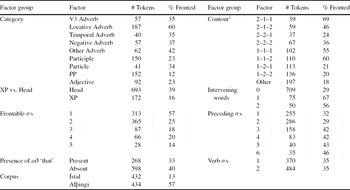
Table 1 shows the number of tokens in each factor and the percentage of fronting. For example, we see that 39% of all heads are fronted, whereas only 16% of XPs are. On the basis of such differences in raw frequency, we might be led to suspect that heads prefer fronting more than XPs. However, from raw frequency data alone, we actually do not know if this is the right way to characterize the effect of XPs on fronting. For illustration, consider the fact that only 14%–20% of tokens with between three and five syllables exhibit fronting. If all or most of the XPs in the data set happen to contain three or more syllables, it could be that XPs do not front very often simply because they often have too many syllables; the proper way of characterizing the situation, then, would be to say that constituents with between three and five syllables disfavor fronting.
Factor group frequencies.

†The Contour factors are presented as described in Section 4.2: Comp-σ-Frontable-σ-Verb-σ. Thus, 2–1–2 means is that there are two complementizer syllables, one frontable syllable, and two finite verb syllables.
This example illustrates the motivation for and intuition behind regression. A regression algorithm looks for which factors best explain the frequencies. GoldVarb X (Sankoff, Tagliamonte & Smith Reference Sankoff, Tagliamonte and Smith2005), a logistic regression program used primarily by variationist sociolinguists, does this using a ‘step-up, step-down’ algorithm. First, it adds factor groups one at a time, trying to predict what the frequencies would be in each model. It picks the model that best matches the actual frequencies. Then, it starts with a model that includes all factor groups, and starts removing them one at a time, again picking the model that best matches the actual frequencies. Ideally, both the step-up and the step-down algorithms pick the same model.
The statistically significant results are the ones that are included in the final model. It might seem that the sample size in this study is too small to have any statistically significant results (as suggested by a reviewer). However, statistical significance is based not on the raw number of tokens in a study, but rather on how much relevant variation those tokens exhibit. If there are too few tokens, it is possible that a regression analysis will not produce any statistically significant results. However, if, say, fronting or non-fronting can be explained (in part) by taking some factor into account, this can be statistically significant. Statistical significance means that the correlation between that factor and (non-)fronting is very unlikely to be an accident.Footnote 11
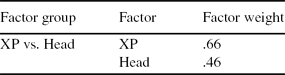
The results of a GoldVarb run are presented as probabilities. Each factor is given a ‘factor weight’ ranging from 0 to 1. A factor weight of .50 means that the factor has no effect one way or another on the variable. Higher than .50 means that the factor increasingly favors (in this case) fronting; lower than .50 means that the factor disfavors fronting. The further from .50 that the factor weight is, the stronger it is. For example, taking all the factors from Table 1 into account, XP vs. Head came out as statistically significant with the factor weights in Table 2.Footnote 12 We see that XPs favor SF, while heads (only weakly) disfavor it.
Factor weights for XP vs. head.
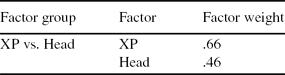
This result suggests an explanation along the lines outlined above. XPs have various characteristics which make them unlikely to front. Many have 3 or more syllables, for example. What the regression analysis says, then, is that 16% of 172 is actually higher than one would expect for XPs, given other properties that they happen to manifest in the corpus. The important point is this: raw percentages (such as in Table 1) have no obvious or direct translation into favoring/disfavoring factors (such as in Table 2). There are a number of possible reasons for percentages, and the goal of a regression analysis is to figure out what those reasons might be.
4. PROSODIC FACTORS
4.1 The relevence of prosodic factors
Some linguists have argued that SF is prosodically conditioned. Poole (Reference Poole1997), for example, has argued that SF is the result of a ‘prosodic flip’ of the auxiliary and fronted constituent. Burton-Roberts & Poole (Reference Burton-Roberts and Poole2006) have argued that SF exists to satisfy the verb-second constraint, which they argue to be a prosodic constraint. Bošković (Reference Bošković2001, Reference Bošković2003) has argued that SF is the product of phonological merger (or ‘PF’ merger). While there is no explication in these works of exactly what it is prosodically that conditions SF, they do express the intuition that prosody is relevant to the optionality of SF.
Trips (Reference Trips2003) studied SF in an Early Middle English document, the Ormulum. The Ormulum has a strict, non-rhyming iambic meter, with 15-syllable lines. She shows that ‘whenever there is a relative clause with a monosyllabic auxiliary followed by a two-syllable participle, SF is forced because inflectional endings of participles must not occur in the ictus of a foot’ (Trips Reference Trips2003:466).Footnote 13 This is shown in the following example, where accent marks indicate stress.
(16)
If the order were wáss timmbrédd ‘was built’, either the meter would be broken or the final syllable of the participle would have to be in the ictus of a foot, which is claimed to violate of the prosodic rules of Old English participles. Trips (Reference Trips2003:469) concludes that ‘the fronting operation is metrically driven’. It is possible, then, that the metrical organization of syllables is behind the intuition that SF has a metrical effect or motivation. To address this, the number of syllables in the finite verb, the frontable constituent, and word preceding the relative marker sem were coded for each token.
Jaeger (to appear) has studied the factors conditioning the use of the optional complementizer that in English. He found that that is exploited by speakers for ‘rhythmic optimization’. Specifically, speakers will avoid using that when the next syllable is unstressed; since that is usually unstressed, this would create a stress lapse and is thus disfavored. Similar interactions can be readily explored in Icelandic, where word and phrasal stress patterns are very regular, although phrasal stress can be affected by focus (Dehé Reference Dehé, Bruce and Horne2006). Icelandic has primary word stress on the first syllable of each word, and secondary stress on alternating syllables thereafter.Footnote 14 A complex but consistent set of factors conspire to avoid hiatus and stress clash in compounds (see Árnason Reference Árnason1985, Reference Árnason1987, Reference Árnason1996). In addition, some functional elements are unlikely to carry stress. Icelandic phrasal stress is generally head-final (Árnason Reference Árnason1998; Dehé Reference Dehé2009). Given the systematicity of Icelandic stress, a lot can be inferred about prosodic rhythm by knowing how many syllables are in a word.
There are at least two other domains of Icelandic grammar where an optional process reportedly interacts with metrical prosody. Dehé (Reference Dehé2008) has shown that eurhythmy has an effect on variable final-vowel deletion (FVD), a rule which deletes a word-final vowel when the following word begins with a vowel. In (17), boxes indicate the syllable which meets this description. In both cases, the final vowel u (IPA = [ʏ]) precedes the vowel e (IPA = [ɛ]).
(17)
The participants in Dehé's (Reference Dehé2008) experiment never deleted the vowel in (17b), but almost always did in (17a). Dehé argues that this is because deletion in (17a) results in a eurhythmic set of trochees, whereas deletion in (17b) would disturb the existing eurhythmic set of dactyls. There are a variety of similar contrasts, where the result preferred by subjects was always the one that preserved or created a more uniform set of trochees or dactyls.
The second case where prosody has an effect on an optional grammatical process, studied by Ingason (Reference Ingason2008a, Reference Ingasonb), is Dative Substitution, where the prescriptively correct accusative case on a subject is replaced by dative (see Jónsson & Eythórsson Reference Jónsson and Eythórsson2005). Some speakers give categorical judgments with respect to subject case. For the ones who varied, though, it was always in one direction: subjects preferred the dative variant only when the dative was a two-syllable word. No one accepted (19b) without also accepting (18b), whereas many accepted (18b) without accepting (19b).
(18)
(19)
Ingason (Reference Ingason2008b) explains this in terms of the constraint ‘Foot Binarity’ (FtBin), which prohibits prosodic feet of more or fewer than two syllables.Footnote 15 However, in these examples the dative/accusative arguments are surrounded by other trochees. To be sure that the prosodic effects on case selection are the result of Foot Binarity rather than eurhythmy as in Dehé (Reference Dehé2008), we would need sentences like (19b) except with Guðmundi surrounded by dactyls. If prosodic eurhythmy (or Foot Binarity) has an effect on variable syntactic and phonological phenomena, it might have an effect on SF as well.
4.2 Coding the prosodic factors
As mentioned above, each token was coded for the number of syllables in the finite verb, in the frontable constituent, and in the word preceding the relative marker sem. Each was also coded for the deletion/presence of an optional complementizer að ‘that’. Ingason (Reference Ingason2008b) argues that að ‘that’ is used in well-known Icelandic poetry to facilitate the appropriate prosodic rhythm.Footnote 16 The following line example from a Davíð Stefánsson poem illustrates this. After og ‘and’, the line is parsed into four consecutive trochees.
(20)
If SF is affected by prosody, the presence of að ‘that’ is likely to have an effect.
These four factors together should be sufficient to investigate the prosodic contour of the relative clause with respect to syllable count. This is illustrated with example (21), from the Ístal corpus, where SF has not applied. Had SF applied, the contour in this case would have been the same, as shown in (22).
(21)
(22)
However, in some cases, the prosodic contour would be different. If SF had not applied in (23), the prosodic contour would have been as in (24). In this case, (23) can easily be organized into two consecutive dactyls, since function words and auxiliaries are usually unstressed, whereas (24) cannot.
(23)
(24)
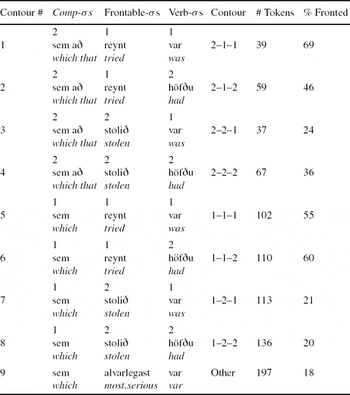
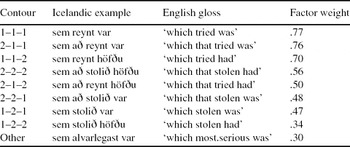
Syllable-count factor groups were coded in two ways, to reflect two distinct possibilities of how prosody might condition SF. First, it is reasonable to suppose that each of these factor groups interact with each other. Perhaps fronting of two-syllable constituents is preferred when the verb is two syllables but dispreferred when the verb is one syllable. Along these lines, each sentence was coded as fitting into one of nine prosodic contours. These describe what the contour is (or would be) when SF applies. The contour factors vary between one and two syllables for each of the complementizer(s), the frontable constituent, and the finite verb. Any token which had more than two syllables in either the finite verb or the frontable constituent was counted as ‘other’. In Table 3, I illustrate each of the contour groups used with hypothetical examples, along with the number of tokens exhibiting them and the percentage of fronting in each. (Though it is important to remember that these percentages do not translate directly into favoring/disfavoring fronting, since other factors affect these percentages as well.)
Prosodic contours.

For the remainder of the paper, contours are described using the notation 2–1–2, 1–1–1, etc. This lists the number of syllables in the complementizer, followed by the frontable constituent, followed by the finite verb. Thus, for example, ‘2–1–2’ means that there are two syllables in the complementizer, one frontable syllable, and two finite verb syllables.
Syllable-count factor groups were also coded individually, treating frontable syllables, verb syllables, and complementizer syllables as individual, non-interacting factors. This allows for the possibility that one or more factor groups have an effect on fronting independent of any interaction. It would not be possible, without significant problematic overlap, to run a regression with both ‘contour’ and the individual factor groups at the same time. Therefore, two analyses were performed: one with the above contour factor group, but no individual groups for frontable syllables, verb syllables or presence of að ‘that’, and another without the above contour factor groups, but with the individual groups instead.
4.3 Categorical results
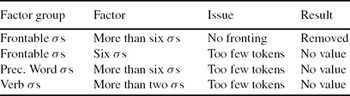
Initially, 940 tokens were coded. These data were then run through GoldVarb X (Sankoff et al. Reference Sankoff, Tagliamonte and Smith2005) to look for categorical effects. There were some factors which categorically exhibited or failed to exhibit fronting. Such effects are often linguistically revealing, but they are a problem for regression, since there is no variation for a categorical factor.
In the factor group ‘syllables in frontable constituent’, there were 36 tokens where a frontable constituent had seven or more syllables. None of these exhibited fronting. This was a categorical effect, so such tokens were excluded from the regression analysis. Note that in all cases, the relevant example was an XP, such as the following prepositional phrase (PP) in (25).
(25)
On the other hand, for tokens with exactly six syllables, there was variation, with some fronting and others not fronting; an example with fronting is shown in (26).Footnote 17
(26)
Six-syllable tokens, however, were too small a fraction of the entire token set to yield reliable results. Such a situation does not warrant exclusion, but these tokens were not given a value for the ‘frontable syllables’ factor group. Similar considerations go for preceding-word and verb syllables. There were too few tokens with more than six preceding-word syllables, and too few tokens with more than two verb-syllables. These tokens were included, but not given a value for these factor groups. What this means is that a token whose frontable constituent had six syllables would be left in the regression model; the model would take into consideration how many syllables were in the finite verb, whether the optional að ‘that’ was present, etc. That is, such tokens still have valuable information on conditioning factors for SF. But since there were so few tokens with one certain value for one particular factor group, that it ‘skips’ that factor group but looks at other properties of the token. This is summarized in Table 4.
Summary of (near) categorical effects for prosodic factors.

4.4 Regression results
As mentioned above, the prosodic categories were coded in two ways, and a seperate regression analysis was performed for each. First, the verb syllables, frontable syllables, and presence of að ‘that’ were combined into one factor group which I call ‘contour’. The results of a run that uses this combined factor group, which was statistically significant, are shown in Table 5. The number of syllables in the word preceding sem ‘which’ was not selected as a significant factor group by GoldVarb.
First run: Contours.

In Table 5, we see gradient spread of factor weights. Contours 2–1–1, 1–1–1, and 1–1–2 strongly favor SF. The only contour which has one frontable syllable and does not favor SF is 2–1–2, which is neutral. Contours 1–2–2 and other strongly disfavor, and Contours 2–2–1 and 2–2–2 weakly disfavor, SF. The only contour with two frontable syllables which favors SF is 2–2–2.
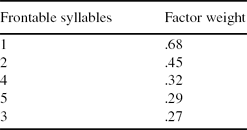
In the second run, all syllable-counting factor groups are included independently. The results of this are shown in Table 6. Of the syllable-counting factor groups, only ‘frontable syllables’ was independently significant; the number of syllables in the finite verb, the complementizer, and the word preceding sem were not selected as independently significant factors constraining the application of SF.
Second run: Frontable syllables.
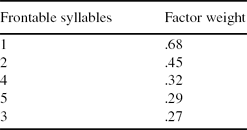
There is a robust effect of frontable syllables. Frontable constituents with 1 syllable highly favor fronting, those with 2 syllables weakly disfavor fronting, and those with 3–5 strongly disfavor fronting. This puts some quantitative support behind the intuition that phonological or perhaps syntactic weight has an effect on SF (see e.g. Ott Reference Ott2009:149, citing Gunnar Hrafn Hrafnbjargarson p.c.). However, no prosodic account of SF that I am aware of would predict this to be the case. In Bošković (Reference Bošković2001, Reference Bošković2003), the fronted constituent moves to the specifier of a silent functional head, and the functional head must ‘affix-hop’ to the finite verb. There is no reason that the functional head should care about the prosodic properties of the constituent in its specifier. In his discussion of Icelandic SF, Poole (Reference Poole1997) suggested that phonological deficiency of the finite verb forces it to move rightward to cliticize onto the ‘fronted’ element.Footnote 18 It is possible that a one-syllable host is somehow better for this, but this is certainly not predicted by his account. This result could be consistent with Trips (Reference Trips2003), who argues that SF is metrically driven, but more would have to be said about how fronting a one-syllable constituent satisfies metrical constraints better than other constituents. I must leave the explanation of the one-syllable effect for future work.
The presence of að ‘that’ was not independently significant, but it did show effects in the Contour factor group of the first run. Consider Contours 1–2–2 and 2–2–2 in Table 5. Both have two syllables in the frontable constituent and two syllables in the finite verb. When að ‘that’ is present, the factor weight is favoring (.56), and when it is absent, the factor weight is strongly disfavoring (.34). This is a large difference, and it is only the presence of að ‘that’ that makes this difference. A similarly drastic effect in Contours 1–1–2 and 2–1–2, which both have one syllable in the frontable constituent and two syllables in the finite verb. When að ‘that’ is present, the factor weight is neutral (.50), but when it is absent, the factor weight is strongly favoring (.70). Note that the effect of að ‘that’ is different in each case. In the first case, its presence drastically increases the factor weight. In the second case, its presence decreases the factor weight. This shows that að ‘that’ does not have a consistent favoring or disfavoring effect, though it does have an effect.
In the case where the presence of að ‘that’ decreases the factor weight, the result is a contour of 2–1–2. This is (i) the only situation where the there is no tendency to front a one-syllable word, and (ii) the only case where such fronting breaks up a sequence of two trochees. The powerful effect of having one frontable syllable is offset only when the resulting prosody is worse. In the opposite case, where að ‘that’ increases the factor weight, the result is a series of trochees 2–2–2. The general disfavoring effect of having two frontable syllables is only offset when the result is a completely eurhythmic set of trochees. These two results suggest that the presence of að ‘that’ has a strong prosodic effect, but only by interacting with surrounding material. On its own, it does not favor or disfavor fronting. But its presence can have a dramatic favoring or disfavoring effect depending on the number of syllables in the frontable constituent.
In summary, the results here show a powerful conditioning effect of having one syllable in the frontable constituent. More than one syllable disfavors fronting. Further, this effect interacts with its prosodic environment. The presence of an extra syllable in the complementizer can annul the favoring effect of one frontable syllable just in case the verb has two syllables. That same extra complementizer can also annul the disfavoring effect of two frontable syllables, again just in case the verb has two syllables. This shows that with respect to prosody, fronting is first and foremost sensitive to the number of syllables in the frontable constituent. In addition, the number of syllables in the complementizer and the finite verb interacts with the number of frontable syllables in a way that is sensitive to the overall prosodic contour. Specifically, there is a tendency toward preserving adjacent trochees. Further research is required to determine if this is an effect of something like FtBin (as in Ingason Reference Ingason2008b) or eurhythmy (as in Dehé Reference Dehé2008).
5. GRAMMATICAL CATEGORY
5.1 Coding for grammatical category
The factors in the grammatical category factor group are as follows: adverb, participle, particle, PP, and Adjective(P).Footnote 19 Adverbs were divided into the subcategories of V3 adverb (see below), negative adverb, locative adverb, temporal adverb, and other adverb.Footnote 20
There were roughly 16 tokens where a potentially frontable adjective had an adverbial modifier, but none of these fronted. This excludes other tokens which had already been removed for other reasons, such as having too many syllables. Some of these were prosodically quite small, such as mjög skýr ‘very clear’, so this effect is not likely to be due to general phonological weight. Since it did seem to be a categorical effect, however, these tokens were removed.
A ‘V3 adverb’, as discussed by Sigurðsson (Reference Sigurðsson, Dahl and Holmberg1986) and Thráinsson (Reference Thráinsson, Haider and Prinzhorn1986), is a kind of speaker-oriented adverb which can appear between the subject and the finite verb in main and subordinate clauses alike (see also Wiklund et al. Reference Wiklund, Bentzen, Hrafnbjargarson and Hróarsdóttir2009:1917, Fn.5).Footnote 21 These have become known as ‘verb third (V3)’ adverbs because they can be positioned between the subject and the verb, resulting in the verb being third, rather than second, in its clause.Footnote 22 Example (27) shows that bara ‘just’ can occur in several positions, including the position between the subject ég ‘I’ and the verb veit ‘know’; in this position, the verb is thus the third, rather than the second constituent in the clause.
(27)
When these adverbs appear in the preverbal position of subject relatives, they are in principle ambiguous between SF and ‘second-position’ uses. An example of this from Ístal is presented in (28).
(28)
Most researchers would probably not consider an example like (28) to exhibit SF, since these kinds of adverbs can independently occur in the pre-verbal position, unlike Stylistically Fronted elements. An anecdotal reason to suspect that they might not undergo SF is that SF tends to sound formal, whereas V3 adverbs often sound colloquial. However, since the same adverbs can occur post-verbally, SF cannot be ruled out as a grammatical mechanism in some cases, whatever the stylistic effects are. Since the main aim of the present study is to tease apart prosodic and syntactic aspects of overtly filling the ‘first position’ of relative clauses with a subject gap, adverbs of this kind were included and sentences like (28) were coded as exhibiting SF. But given the differences between these and other adverbs, and since it is not possible to know if a V3 adverb has undergone SF or not, they were coded as a distinct category.
Unlike V3 adverbs, negative adverbs like ekki ‘not’ cannot usually appear in the position preceding the finite verb in main clauses. The standard assumption is that the verb moves to a position higher than negation, as indicated in (29).
(29)
However, Wiklund et al. (Reference Wiklund, Hrafnbjargarson, Kristine and Hróarsdóttir2007) have argued that verb movement is sometimes optional in relative clauses (see also Sigurðsson Reference Sigurðsson, Dahl and Holmberg1986). Angantýsson (Reference Angantýsson2001, Reference Angantýsson2007, Reference Angantýsson2011) has argued that ekki ‘not’ (as well as some other sentential adverbs) can sometimes exceptionally adjoin to a higher position in the clause, namely TP.Footnote 23 Angantýsson (Reference Angantýsson2001, Reference Angantýsson2007, Reference Angantýsson2011) argues that the possibility of this word order varies depending on the kind of subordinate clause in question. Two examples of this from Ístal are given in (30)–(31).
(30)
(31)
There is an intuition that cases like this are different from SF of negation, as in sentences like (3a) above. Angantýsson (Reference Angantýsson2007: Fn.8) expresses this intuition: ‘[a] central pre-VP adverb [e.g. ekki ‘not’] can easily occur before the finite verb in [subject relative] clauses but that would be stylistic fronting in my view’. However, the possibility that sentences like (3a) are ambiguous between SF and ‘subordinate V3’ cannot in principle be ruled out (see the discussion of Faroese in Angantýsson Reference Angantýsson2011:171).Footnote 24 But since the syntax of ‘subordinate V3’ adverbs is different from V3 adverbs of the type illustrated in (27)–(28) above, they were coded as separate categories.
Locative adverbs and temporal adverbs were frequently fronted; examples of locative adverbs were seen in Section 2 above. The sentence in (32) is an example of temporal adverb fronting.
(32)
Locative and temporal adverbs were coded separately and, as we will see below, were distinguished in the regression analysis.
5.2 Regression results
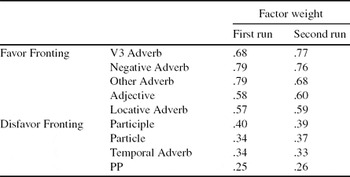
The syntactic category of the frontable constituent was significant. There is a sharp distinction between categories that favor fronting and those that disfavor it. This is unlike the situation with prosodic contour, where there was a much more gradient spread. There, some factors strongly favored fronting, others fell within a more or less neutral range (i.e. either weakly (dis)favoring or neutral), and still others strongly disfavored fronting. Here, participles, temporal adverbs, particles, and PPs disfavor SF, while adjectives and all the other adverb categories favor it. This is shown in Table 7. No factors are neutral; everything below locative adverb disfavors SF, and everything above participle favors it.Footnote 25
Factor weights for category.

I will first address adjectives, since, as pointed out by an anonymous reviewer, it may seem a bit surprising that they favor rather than disfavor fronting. This is because many adjectives are quite odd when they are stylistically fronted. A reviewer provides judgments such as the following.
(33)
There are a number of unresolved issues with respect to the fronting of adjectives, involving what kinds of adjectives can front and where they sit on the accessibility hierarchy. For example, Jónsson (Reference Jónsson1991:6–7, 36) reports the following contrast (glosses modified slightly):
(34)
(35)
While both (34) and (35) involve predicative adjectives, they differ as to when adjective fronting past the participial form of the copula is acceptable. Note that example (35b) seems to pattern with (11) above.
Like the example in (34a), the adjective hægt is quite frequently fronted in the spoken corpora. Some other predicative adjectives which are fronted are shown in (36).
(36)
In (36a), the adjective fróðlegt ‘instructive’ is fronted past the participle verið ‘been’, and like hægt ‘possible’, takes an infinitival complement. While there is no infinitive clause in (36b), the adjective eðlilegt ‘appropriate’ does seem to be associated with a proposition. There are other cases where the fronted adjectives are in comparative or superlative forms, which Halldór Sigurðsson (p.c.) tells me often improves otherwise marginal examples of adjective fronting.
(37)
What seems to be a strong tendency in the corpus is for adjectives which take (perhaps sometimes implicit) complements to front. It may be that unfronted adjectives in the spoken corpora which did not take complements had properties which independently disfavored SF. This suggests avenues for further research, but I must set them aside for now.Footnote 26
The primary question raised by the result in Table 7 is why there is a split between favoring and disfavoring categories. I would like to hypothesize that what separates the favoring and disfavoring categories is syntactic. All of the disfavoring categories, with the exception of temporal adverbs, are canonically involved in verbal argument structure, whereas none of the favoring categories are.Footnote 27 Prepositions generally assign case to their objects. Further, they very often interact directly with the lexical verb to do so. For example, in (38), the argument barnafólkið ‘the people with children’ can only be interpreted thematically with respect to the verbal participle haft ‘had’ along with the preposition af ‘from’ (similarly with examples (4b), (15a, b), and (39)).Footnote 28
(38)
(39)
Particles do not assign case, and according to some researchers (e.g. Harley & Noyer Reference Harley, Noyer, Tamanji and Kusumoto1998), this is the crucial difference between particles and prepositions (see also Thráinsson Reference Thráinsson1979:25f.; Svenonius Reference Svenonius, Reuland, Bhattacharya and Spathas2007:83–85). But they do interact intimately with verbal argument structure. Participles, of course, are themselves verb forms. What prepositions, particles, and participles have in common, then, is that they can all be directly involved in verbal argument structure; they can all be responsible for assigning verbal thematic roles.Footnote 29 The reason that the groups split up quantitatively, I suggest, is that we are looking at two different SF processes (see immediately below for a suggestion for how they differ). They appear similar because each clause has certain grammatical requirements that must be fulfilled, and there are various ways to do this.
Sigurðsson (Reference Sigurðsson2010) argues that what is traditionally referred to as the ‘EPP’, often understood as the requirement that SpecIP be filled, should be understood as involving at least four subcomponents, which I simplify and summarize here. First, IP must match grammatical ‘Person’ features of some element; this is what is behind obligatory movement of definite DPs to SpecIP. Further, various heads in the CP domain must match other features in the clause, positively or negatively. The relevant CP heads and their feature content are summarized in (40).
(40)
Different kinds of constituents are able to match different subsets of these features:
(41)
This matching obeys a kind of subset requirement; if X is available and can match two features, while Y, which is also available, can only match one of those two features, then X is chosen and Y is unable to do so, since X is a better overall match. Further, ‘positive’ matching, such as valuing FinP as [+speech local], takes precedence over ‘negative’ matching.
If the grammatical motivation for SF is a syntactic requirement to match FinP features, note that SF is not the only way to match FinP. Subject DPs and expletives can do so as well. Supposing that SF involves at least two syntactically different fronting processes, there is no reason that why could not in principle involve matching features of Fin. Blocking effects, rather than arising from structural locality, would derive from the featural makeup of the constituents involved. On this view, adverbs' blocking of participles is similar to overt subjects' blocking of SF of any kind (the subject gap requirement).Footnote 30 Adverbials would match FinP in some way that is distinct from everything else. FinP relates speech time and location to event time and location, and adverbials often say something specific about the event (either its place, time, manner, or the subject's or speaker's attitude toward it); the presence of the right kind of adverbial prevents movement of something less specific, like the verbal elements themselves.Footnote 31 The distinction between temporal and locative adverbs on this understanding might be that temporal features can be matched by the finite verb in a way that locative features cannot.Footnote 32
6. CONCLUSION
The results of this study reveal several hitherto unknown aspects of the interaction of an optional syntactic process with other domains. In the domain of prosody, we see clear effects of syllable counts and prosodic contour. The strongest effect is that one-syllable constituents favor fronting, two-syllable constituents weakly disfavor it, and anything higher strongly disfavors fronting. Further, fronting is especially favored in prosodic contexts which allow for a more eurhythmic syllable stress alternation. While two-syllable constituents tend to disfavor fronting, they favor it when the surrounding verb and complementizer(s) also have two-syllables. On the other hand, while one-syllable constituents strongly favor fronting, the effect is neutralized when fronting would break up two adjacent trochees.
In the domain of syntax, we see a quantitative split between fronting of elements involved in verbal argument structure (PPs, participles, particles) and non-verbal elements (adverbs and adjectives). I have suggested that this result is best understood if we see SF as a heterogenous process, a possibility that can be explored naturally in the framework pursued by Sigurðsson (Reference Sigurðsson2010). That is, I hypothesize that the fronting of adverbs and adjectives is syntactically distinct from the fronting of PPs, participles, and particles. Whether this is ultimately on the right track remains to be seen. The goal here has been to see what influences an optional syntactic operation, to provide a basis for forming new hypotheses. The next step is to find ways of testing these hypotheses, exploiting, where appropriate, quantitative, experimental, and theoretical paradigms.
ACKNOWLEDGEMENTS
I would like to express my gratitude to Maria Gouskova, Stephanie Harves, Alec Marantz, John Singler and the three anonymous reviewers for providing extensive comments on various drafts of this paper, and Halldór Ármann Sigurðsson for discussing the topic with me. I would like to thank John Singler in particular for helping me with a number of issues related to the quantitative analysis. I would also like to thank Anton Karl Ingason for directing me to the corpora I used for this study, discussing a number of issues with me in the early stages of this work, and providing me with versions of his work on Icelandic prosody and Dative Substitution. Finally, I would like to thank Theódóra A. Torfadóttir and Erla Skúladóttir for discussing a number of sentences in this corpus with me along with various possible alternations of them, among other data-related issues during the coding process. I accept responsibility for any mistakes in this article.
APPENDIX
Overall GoldVarb results
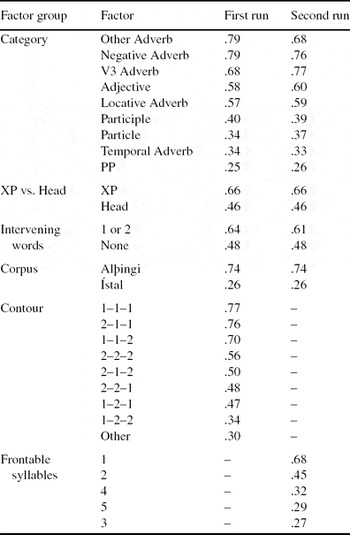
In this appendix, I briefly present the overall results of the GoldVarb analyses. Of the factor groups included (shown in (13) in the main text), the following did not come out as (independently) significant: presence of optional complementizer að ‘that’, number of syllables in finite verb, number of syllables in word preceding the relative marker sem (see Table A1).
Factor weights.

The other results in Table A1 which were not presented in the main text are (i) the effect of corpus, and (ii) the effect of intervening words. The Alþingi corpus highly favors, and the Ístal corpus highly disfavors, application of SF. Since SF tends to be considered a formal construction, this is expected. ‘Intervening words’ refers to the number of words intervening between the auxiliary and the base position of the frontable constituent. Tokens with one or two intervening words were combined. When taken separately, they exhibited an ordering where one intervening word had a factor weight higher than two, making the order 1 > 2 > 0; this ordering is surprising but not statistically significant (i.e. it was not picked out by GoldVarb presented in this way). When ‘1’ and ‘2’ are combined, the factor group comes out as significant, as seen above. This suggests that what is important is not how many intervening words there are, but rather whether words intervene at all. Having no intervening words is almost neutral with respect to SF, while having one or two favors it. There were 17 tokens with three words intervening, 15 of which exhibited fronting. These tokens were included but not given a value for this factor, since they made up only 2% of the total token set. Similarly, there were six tokens with four or six words intervening between the landing site and the frontable constituent, none of which exhibited fronting. They were not included, since this seemed to be a categorical effect.
These factor groups were included in the regression analyses to control for their effects; by including intervening words, for example, the independent effect of intervening words is factored out of the regression analysis making the the other results more reliable. However, as John Singler (p.c.) emphasizes, it need not be the case that all the significant factor groups are linguistically interesting, which is why not all factor groups are discussed in the main text of this article.