


The Dobbs decision, the #MeToo Movement, and the Affordable Care Act are just the most recent examples of high-profile conflicts over women’s place in society and the contours of the social safety net. Indeed, social welfare and women’s rights issues have long constituted a central fault line between the parties. Contestation over the size of the welfare state and women’s place in society increasingly fuels polarization in Congress. However, not all lawmakers choose to engage with these issues. Research on issue ownership indicates that voters trust particular parties to handle specific issues and the parties engage more actively in legislating on issues they own (Egan Reference Egan2013; Petrocik Reference Petrocik1996). In the arena of social welfare and women’s rights policies, voters favor Democrats (Pope and Woon Reference Pope and Woon2009; Winter Reference Winter2010). Among Democratic legislators, women are the most aggressive advocates for these issues, centering them in their policy agendas, exercising leadership within the party to move legislation forward, and aggressively attacking Republican policies as harming women (Dittmar, Sanbonmatsu, and Carroll Reference Dittmar, Sanbonmatsu and Carroll2018; Swers Reference Swers2002, Reference Swers2013).
By contrast, Republicans are less active on these issues than Democrats. When legislating, they prefer to shrink the size of government and social safety net programs (Continetti Reference Continetti2022; Mettler Reference Mettler2011; Noel Reference Noel2013). Focusing on traditional family values, opposition to abortion is the party’s most prominent women’s rights concern (Freeman Reference Freeman1986; Sanbonmatsu Reference Sanbonmatsu2002; Wolbrecht Reference Wolbrecht2000). Despite the highly gendered nature of these debates, we know comparatively little about the policy views of Republican women on these issues and the role they play in their party’s efforts to address social welfare and women’s rights policymaking.
Unlike Democratic women, Republican women are cross-pressured. Their gendered life experiences suggest they will bring a different perspective to policy issues and perhaps take more interest in social welfare and women’s rights policies (Mansbridge Reference Mansbridge1999; Reingold and Swers Reference Reingold and Swers2011). However, as Republicans, party issue ownership theory indicates they should be less engaged with these Democratic owned issues (Petrocik Reference Petrocik1996). Moreover, partisan polarization over women’s rights should lead Republican women to further deemphasize these issues, embracing only policies that align with conservative constituencies such as anti-abortion legislation (Sanbonmatsu Reference Sanbonmatsu2002; Wolbrecht Reference Wolbrecht2000). Yet, their status as conservatives and women makes Republican women strategic party actors who can push back on Democratic efforts to portray the party as anti-women, suggesting they might have a greater incentive to engage these issues than Republican men (Atkinson, Mousavi, and Windett Reference Atkinson, Mousavi and Windett2023; Roberti Reference Roberti2021; Swers Reference Swers, Shames and Och2018, Reference Swers2023; Wineinger Reference Wineinger2022; Wineinger and Nugent Reference Wineinger and Nugent2020).
We conduct the most comprehensive study of the legislative activity of Republicans from the 103rd–113th Congresses (1993–2014) to evaluate the ways gender does and does not shape their policy priorities and the level of influence women wield inside the party. Examining five different policy areas — tax policy, a subset of tax policies concerning social welfare issues, social welfare policies outside the tax code, women-focused issues, and abortion — we find that Republican women do have distinct policy agendas from their male colleagues. Moreover, their policy agendas are impacted by ideology in a way that is different from their male co-partisans.
Moderate and mainstream conservative women are more likely to pursue women-focused and social welfare policies than their male colleagues. However, women’s engagement through bill sponsorship and cosponsorship diminishes as they get more conservative. Meanwhile women’s activism on abortion increases as they become more conservative. By contrast, ideology has very little influence on Republican men’s decisions to pursue social welfare, women-focused, or abortion policy initiatives. Examining how far members’ proposals advance in the legislative process, we find that women are playing a strategic role in their party’s effort to combat Democratic narratives that Republican policies harm women. Republican women are only more likely to see action on their women-focused and abortion legislation, the two arenas that define the partisan divide over women’s role in society.
Why Study Republican Women?
Republican women occupy a unique place in contestation over public policy related to women. Research suggests that gendered socialization and women’s life experiences lead them to bring a distinct perspective to policymaking in which they are more cognizant of the impact of policy on women (Dovi Reference Dovi2002; Mansbridge Reference Mansbridge1999; Phillips Reference Phillips1995). As a result, women will utilize their recognized moral authority to advocate for policies that benefit women, children, and families (Barnes Reference Barnes2016; Dittmar, Sanbonmatsu, and Carroll Reference Dittmar, Sanbonmatsu and Carroll2018; Kittilson Reference Kittilson2008; Osborn Reference Osborn2012; Reingold, Haynie, and Widner Reference Reingold, Haynie and Widner2020; Swers Reference Swers2002, Reference Swers2013; Weeks Reference Weeks2022). Similarly, prior work on voter stereotypes demonstrates that voters perceive women as more compassionate and they favor women to address social welfare policies like health care and education, as well as women’s rights issues like paid family leave and sexual harassment (Huddy and Terkildsen Reference Huddy and Terkildsen1993; Winter Reference Winter2010).
While research on gender supports the expectation that Republican and Democratic women will champion public policy related to social welfare and women’s rights, party issue ownership research indicates that voters trust Democrats to legislate on these same issues that are perceived as women’s expertise (Holman, Merolla, and Zechmeister Reference Holman, Merolla and Zechmeister2016; Petrocik Reference Petrocik1996; Pope and Woon Reference Pope and Woon2009; Winter Reference Winter2010). Thus, in contrast to Democratic women, Republican women are cross-pressured since the gender-based and party-based expectations regarding their expertise conflict.
Party polarization exacerbates the challenges Republican women face in deciding how broadly to engage with social welfare and women’s rights issues. Contestation over the size of the welfare state is central to the partisan divide (Mettler Reference Mettler2011). While Democrats seek to expand the social safety net, since Ronald Reagan, Republicans aggressively champion cutting taxes and reducing spending on social welfare programs (Continetti Reference Continetti2022; Noel Reference Noel2013). The scope of women’s rights and the protection of traditional family values have become central fault lines of party competition as women’s organizations firmly aligned with the Democratic Party and social conservatives became a pivotal Republican constituency (Bawn et al. Reference Bawn, Cohen, Karol, Masket, Noel and Zaller2012; Grossmann and Hopkins Reference Grossmann and Hopkins2016; Sanbonmatsu Reference Sanbonmatsu2002; Wolbrecht Reference Wolbrecht2000).
As a result, when Democratic women advocate for social welfare and women’s rights policies, their efforts are rewarded by their voter and donor base (Crowder-Meyer and Cooperman Reference Crowder-Meyer and Cooperman2018; Thomsen and Swers Reference Thomsen and Swers2017). By contrast, Republican women face a more complicated decision calculus. Their advocacy of social welfare issues must align with the party’s preference for limited government and shrinking the welfare state (Deckman Reference Deckman2016; Sanbonmatsu Reference Sanbonmatsu2002; Wolbrecht Reference Wolbrecht2000). Similarly, promoting bills related to women’s rights can run afoul of social conservatives, if the proposals are perceived as undermining traditional family values. Reflecting these conflicting incentives, in interviews, Republican women often express discomfort with the concept of women’s issues but are more likely to embrace the idea that women bring a distinctive perspective to policy deliberations, one often grounded in motherhood (Dittmar, Sanbonmatsu, and Carroll Reference Dittmar, Sanbonmatsu and Carroll2018; Dodson Reference Dodson2006; Swers Reference Swers2002, Reference Swers2005, Reference Swers2013; Wineinger Reference Wineinger2022). Thus, the set of issues Republican women advocate may be more circumscribed and impacted by their ideology as their gendered life experiences interact with their policy views to shape their priorities.
Existing research on bill sponsorship suggests there are some differences in the policy priorities of Republican men and women, with Republican women more engaged with women’s issues than their male co-partisans (Dodson Reference Dodson2006; Swers Reference Swers2002, Reference Swers2005, Reference Swers2013). Looking at specific issues through 2009, Atkinson (Reference Atkinson2020) and Atkinson and Windett (Reference Atkinson and Windett2019) identify the broad categories of health care, law, crime, and family issues as areas where Republican women are most active. Focusing on state legislatures in 1999–2000, Osborn (Reference Osborn2012) found Republican women’s proposals on women’s health issues outside of abortion were more similar to Democratic women’s bills, while their initiatives regarding domestic violence and sex offenders were more aligned with proposals by Republican men. In a comprehensive study of abortion bills in the states, Reingold et al. (Reference Reingold, Kreitzer, Osborn and Swers2021) found conservative Republican women are more likely to introduce restrictions that are framed as protecting women, rather than bills that are focused on the life of the fetus.
The issue-focused research largely concentrates on social welfare and women’s rights issues that are more associated with the Democratic Party. Work on messaging through floor speeches indicates that Republican women speak in a distinctive voice that brings women’s perspectives to debates on issues outside of social welfare and women’s rights ranging from the importance of small businesses to national security (Atkinson, Mousavi, and Windett Reference Atkinson, Mousavi and Windett2023; Pearson and Dancey Reference Pearson and Dancey2011; Shogan Reference Shogan2002). However, studies of sponsorship and cosponsorship generally do not address whether Republican women bring a gendered perspective to party-owned issues by, for example, utilizing the tax code to pursue social welfare policies.Footnote 1
We also do not know whether their gendered perspective makes Republican women more willing to reach across the aisle and sponsor bipartisan bills on social welfare and women-focused issues. Volden, Wiseman, and Wittmer (Reference Volden, Wiseman and Wittmer2018) find that women’s issues are among the most gridlocked in Congress, suggesting a need for bipartisan outreach. Yet, despite research indicating women employ a more consensus-oriented leadership style (Rosenthal Reference Rosenthal1998), Lawless, Theriault, and Guthrie (Reference Lawless, Theriault and Guthrie2018) find no evidence women are more bipartisan than men in their analysis of CODELs, procedural votes, and cosponsorship activity. Similarly, in interviews, Republican and Democratic women serving in the 114th Congress (2015–16) maintain that polarization prevents bipartisan cooperation among women (Dittmar, Sanbonmatsu, and Carroll Reference Dittmar, Sanbonmatsu and Carroll2018).
Since the 1994 Republican Revolution, the Republican party has steadily ushered in more conservative women, making it imperative to understand how ideology interacts with gender to influence the policy activities of Republican women. However, all of the research on Republican women’s policy priorities examines snapshots in time or a limited set of issues in the period before the 2010 election and the rise of the Tea Party. By analyzing sponsorship and cosponsorship activity through 2014, we are able to broaden our understanding of the effect of ideological conservatism among Republicans, and women in particular, on their legislative activity and policy focus.
Finally, we need to understand how Republican women’s ideological leanings and the party’s need for women to counter Democratic accusations that Republican policies harm women impacts their ability to move their proposals through the legislative process. Current work on legislative effectiveness and productivity does not specifically delve into partisan differences. Volden, Wiseman, and Wittmer (Reference Volden, Wiseman and Wittmer2013) show women are only more effective in moving bills when they are in the minority party and attribute this success to their more consensus-oriented leadership style. They do not delve into whether party contestation over issues leads party leaders to elevate women’s proposals on particular policies when their identity as women can advance party goals or inoculate the party against criticism. Similarly, other work on productivity looks at the breadth of women’s policy agendas, finding that women sponsor more bills on a range of topics and deliver more money to their districts because they must combat gender stereotypes about their policy expertise and electoral viability (Anzia and Berry Reference Anzia and Berry2011; Atkinson and Windett Reference Atkinson and Windett2019; Kalaf-Hughes, MacDonald, and Santoro Reference Kalaf-Hughes, MacDonald and Santoro2022; Lazarus and Steigerwalt Reference Lazarus and Steigerwalt2018). This research does not address party differences or the possibility that women’s success is influenced by their ability to help the party in addition to their own policy interests and electoral concerns.
We take a deep dive into the sponsorship and cosponsorship records of Republicans across two decades (1993–2014) to evaluate how gender and ideology impact members’ willingness to bring a gendered perspective to a variety of policy issues. We consider the central Republican issue of tax policy, as well as their propensity to advocate social welfare and women-focused policy proposals, including pro-life initiatives. We also analyze whether moderate and conservative women are more inclined to reach across the aisle and sponsor legislation that attracts Democratic cosponsors. Finally, we examine whether Republican women are more likely to see their proposals on specific issues advance in the legislative process. We investigate how their ideology and their potential symbolic role as women countering Democratic attacks on the party influences their success on issues that underlie the partisan divide on women’s place in society.
Theory and Hypotheses
Republican women confront a complicated landscape when choosing whether to pursue social welfare and women-focused legislation. Research on gendered socialization suggests that their life experiences as women at home and in the workplace will encourage Republican women to act on behalf of women’s interests and lead them to bring a different perspective to issues (Gilligan Reference Gilligan1982; Phillips Reference Phillips1995). Any personal motivation to engage social welfare or women-focused policies will be reinforced by voter expectations that women have more expertise and moral authority to address these issues (Bauer Reference Bauer2020; Huddy and Terkildsen Reference Huddy and Terkildsen1993). Moreover, the media adds to perceptions of women’s moral authority by seeking out women legislators and scrutinizing their positions when these issues are debated (Swers Reference Swers2013; Wineinger Reference Wineinger2022). Perceptions of expertise and an ability to gain media attention facilitate efforts to advance legislation with colleagues, further encouraging Republican women to engage these issues.
Yet, social welfare issues like health care and education, and policies that are more narrowly focused on benefits for women and children, such as efforts to combat domestic violence and sexual harassment, or policies to address childcare and family leave, are more associated with the Democratic Party. Egan (Reference Egan2013) finds that when parties hold the majority, they are more likely to pursue issues that voters perceive them to own. As a result, Republican women face cross-pressures when deciding whether to engage these issues. Since voters prefer Democrats to handle social welfare and women’s rights policies, Democrats have a greater incentive to draft legislation on these issues (Holman, Merolla, and Zechmeister Reference Holman, Merolla and Zechmeister2016; Petrocik Reference Petrocik1996; Pope and Woon Reference Pope and Woon2009; Winter Reference Winter2010). Meanwhile, Republican women risk spending political capital on issues that are less valued by colleagues and Republican voters. Furthermore, pursuit of these policies can run afoul of important party constituencies. While many Republican proposals seek to reduce federal spending on social welfare programs, efforts to expand the social safety net, whether through tax credits or new programs, contradict the party’s preference for limited government and can alienate business interests that oppose mandates (Continetti Reference Continetti2022; Deckman Reference Deckman2016; Noel Reference Noel2013).
Moreover, social conservatives oppose women’s rights initiatives that they perceive as undermining traditional family values, especially policies related to reproductive rights that expand access to family planning services and abortion (Sanbonmatsu Reference Sanbonmatsu2002; Schreiber Reference Schreiber2008; Wolbrecht Reference Wolbrecht2000). At the same time, the growing importance of social conservatives within the party elevates the value of appeals to motherhood, Christian principles, and the traditional family (Deckman Reference Deckman2016; Schreiber Reference Schreiber2008). Championing social welfare and women-focused policies can also be a path to influence if their advocacy attracts swing voter groups like suburban women. Further complicating this decision calculus, Republican Party culture rejects the idea of identity politics and group rights. Republican voters and donors are not responsive to calls to elect more women and prefer to focus on general values of conservatism and individualism (Grossmann and Hopkins Reference Grossmann and Hopkins2016; Thomsen and Swers Reference Thomsen and Swers2017).
Epitomizing this discomfort with highlighting gender, Swers and Larson (Reference Swers, Larson, Thomas and Wilcox2005) found Republican women varied in their willingness to champion women’s issues. Some moderate women felt a responsibility to represent women’s interests, whereas other women denied the existence of women’s interests or did not incorporate them into their own agendas. Socially conservative women were strongly pro-life and pursued women’s issues from their perspective as wives and mothers. Wineinger (Reference Wineinger2022) also found that ideology impacts how women address issues on the House floor, with moderate and conservative women developing distinct gendered partisan identities. In sum, Republican women face a host of conflicting expectations based on their life experiences, voter stereotypes, party priorities, and their ideological beliefs that their male counterparts do not. As a result, ideology could impact women’s desire to pursue these policies in a way it does not for men.
Hypothesis 1: Republican women are more likely to advocate for social welfare and women-focused policies than their male counterparts, but gender differences diminish as women become more conservative; meanwhile ideology will not be an important factor in predicting men’s engagement.
Because social welfare policy and women-focused legislation overlap with Democratic interests, Republican legislative entrepreneurs may be incentivized to seek out bipartisan support (Harbridge Reference Harbridge2015). Comparative work shows that women are more likely to collaborate across party lines on policy development (Barnes Reference Barnes2016). Research on women’s legislative agendas suggests that women’s greater effectiveness when they are in the minority party stems from their propensity to build consensus (Volden, Wiseman, and Wittmer Reference Volden, Wiseman and Wittmer2013, 2018). Republican women may be particularly incentivized to take bipartisan action on these issues because there is a clear gender gap among Republicans on social welfare policy. Compared to Republican men, Republican women are more supportive of spending on childcare, education, and welfare programs. However, they remain less supportive of these programs than Democrats (Barnes, Beall, and Cassese Reference Barnes, Beall and Cassese2021; Barnes and Cassese Reference Barnes and Cassese2017).
Hypothesis 2: Republican women offer more bipartisan legislation on social welfare and women-focused policies than men, with moderate women the most likely to offer bipartisan bills.
Drawing on their unique life experiences as women, Republican women may bring a gendered perspective to policymaking on party-owned issues, particularly tax policy. Tax policy is one of the issues most strongly associated with the Republican Party. Presidents Reagan, G. W. Bush, and Trump all prioritized passing major tax cuts. One of the major impetuses of the Tea Party movement was opposition to the Affordable Care Act, based on the idea that Americans are “Taxed Enough Already” (TEA) (Skocpol and Williamson Reference Skocpol and Williamson2012). Republican reluctance to raise taxes has reshaped how social welfare policy is made, as new programs are often pursued through the tax code (Mettler Reference Mettler2011). While tax policy has long been central to the Republican partisan identity, research on voter stereotypes suggests voters perceive tax policy as a masculine issue (Bauer Reference Bauer2020).
However, Republican women may bring a gendered lens to tax policymaking and pursue social welfare policymaking through the tax code. Indeed, recent research demonstrates that democratic countries with more women in their legislatures have lower “pink taxes,” or smaller disparities in the import tax rates for similar goods marketed to men and women (Betz, Fortunato, and O’Brien Reference Betz, Fortunato and O’Brien2021). In an analysis of floor speeches in the 105th Congress (1996–97), Shogan (Reference Shogan2002) finds Republican women are more likely to talk about the impact of taxes and the economy on working women. Similarly, Pearson and Dancey (Reference Pearson and Dancey2011) show that Republican women are more likely to invoke gendered rhetoric on a range of issues.
Hypothesis 3: Republican women are less engaged than men on general tax policy but more likely to use the tax system to influence social welfare policy.
Meanwhile, party imperatives mix with legislators’ policy preferences to influence which members’ bills see action. Women are strategic party actors. Gender differences will be reinforced by Republican women’s ability to help their party on these issues (Atkinson, Mousavi, and Windett Reference Atkinson, Mousavi and Windett2023; Reingold et al. Reference Reingold, Kreitzer, Osborn and Swers2021; Roberti Reference Roberti2021; Swers Reference Swers, Shames and Och2018, Reference Swers2023; Wineinger Reference Wineinger2022; Wineinger and Nugent Reference Wineinger and Nugent2020). While voters perceive the parties as owning specific issues, parties must be responsive to the political context and the issue priorities of voters. Partisans will utilize issue framing to “trespass” on the other party’s issues by emphasizing aspects of an issue that align with voter perceptions of the party. For example, while Democrats might talk about expanding health benefits, Republicans gain traction with arguments about controlling health care costs (Sides Reference Sides2006; Atkinson, Mousavi, and Windett Reference Atkinson, Mousavi and Windett2023). The party’s need for a female spokesperson to help attract swing voter groups such as suburban voters further incentivizes the party to advance women’s proposals (Swers Reference Swers, Shames and Och2018; Wineinger Reference Wineinger2022; Wineinger and Nugent Reference Wineinger and Nugent2020).
The party’s imperative to elevate women will be most urgent on women-focused and abortion initiatives. Democrats frequently portray Republicans as anti-women in campaign messaging, and Republican leaders are eager to spotlight women members to counter this narrative (Swers Reference Swers2013, Reference Swers, Shames and Och2018; Wineinger Reference Wineinger2022). Similarly, the issue of abortion is a particular focus of Republicans because of its importance to social conservatives. To deflect Democratic criticism and to demonstrate that pro-life policies are supported by women, conservative women will be called on to advocate for these bills (Reingold et al. Reference Reingold, Kreitzer, Osborn and Swers2021; Roberti Reference Roberti2021; Rolfes-Haase and Swers Reference Rolfes-Haase and Swers2022; Swers Reference Swers2023). Republican women should have greater success on proposals that anchor the partisan divide on women’s rights. The party’s need to have a female spokesperson to combat Democratic criticism of the party as hostile to women will be most evident on these issues.
Hypothesis 4: Republican women are more likely than Republican men to see their bills on women-focused and anti-abortion issues advance in the legislative process.
Measuring Republican Policy Priorities
We analyze how gender and ideology impact the legislative priorities of Republican men and women by examining the sponsorship and cosponsorship activity of members from the 103rd–113th Congresses (1993–2014). Utilizing data from the Congressional Bills Project (Adler and Wilkerson Reference Adler and Wilkerson2022), we identify five categories of bills: tax bills, social welfare tax bills, social welfare policies outside of the tax code, women-focused policies, and anti-abortion policies. Social welfare policies outside of the tax code include issues concerning health care, education, welfare reform, and children’s issues such as adoption, foster care, and child support. Congress developed multiple important social welfare initiatives in this period. The Clinton years saw a failed effort at national health insurance reform, the creation of the SCHIP Program to provide health insurance for low-income children, and major welfare reform. During the Bush presidency, Congress passed the No Child Left Behind Act, a significant education reform bill, and created a prescription drug benefit in Medicare. The Obama presidency featured a renewed effort at education reform and Obama’s signature expansion of health insurance, the Affordable Care Act (Adler and Wilkerson Reference Adler and Wilkerson2013; Jacobs and Skocpol Reference Jacobs and Skocpol2015).
Women-focused policies incorporate issues that directly impact women and are often flashpoints in the party culture wars, including violence against women, women’s health, childcare, family leave, and employment discrimination.Footnote 2 Anti-abortion policies concern restrictions on abortion and family planning services. The Clinton administration saw the passage of the Family and Medical Leave Act and the Violence Against Women Act, which Congress reauthorized during the Bush and Obama administrations. Under Obama, Congress passed the Lily Ledbetter Fair Pay Act (Dittmar, Sanbonmatsu, and Carroll Reference Dittmar, Sanbonmatsu and Carroll2018; Dodson Reference Dodson2006; Swers Reference Swers2002, Reference Swers2013). During the Bush presidency, Congress passed a ban on late term abortions and legislation to increase criminal punishments if a fetus is harmed during the commission of a federal crime. Stem cell research was also a flashpoint in the Clinton and Bush years, and Republicans have utilized the Appropriations process to restrict the use of federal funds for abortion (Rolfes-Haase and Swers Reference Rolfes-Haase and Swers2022; Swers Reference Swers2023).
To address whether Republican women bring a gendered perspective to party-owned issues, we compare men’s and women’s activism on general tax policy and a set of tax issues focused on social welfare benefits. Across issues, tax policy is among the most strongly associated with the Republican Party (Petrocik Reference Petrocik1996; Pope and Woon Reference Pope and Woon2009). Major tax cuts were implemented during the George W. Bush administration and reauthorized in the Obama years (Crandall-Hollick Reference Crandall-Hollick2021). The general tax category includes a broad range of issues like the reduction of the capital gains tax, elimination of the estate tax, and various business tax incentives. Social welfare tax issues include proposals such as expanding the child tax credit, increasing deductions for health and education expenses, and creating an IRA for homemakers.
It is important to examine whether Republican women pursue social welfare goals through the tax code in light of recent work demonstrating that policymakers have increasingly shunned the direct disbursement of benefits and favored less visible subsidies (Mettler Reference Mettler2011). For example, Republicans proposed numerous health care tax deductions in response to Clinton’s effort to create national health insurance and Obama’s Affordable Care Act (Jacobs and Skocpol Reference Jacobs and Skocpol2015). The child tax credit, first created during the Clinton administration, was expanded as part of the Bush tax cuts and during the Obama administration. The child tax credit was also a key provision in the Trump tax cuts, and most recently as part of Biden’s pandemic stimulus (Crandall-Hollick Reference Crandall-Hollick2021).
The Congressional Bills Project contains information on all bills sponsored by members in each Congress, including the bill title, which provides a summary of the bill’s content. The bills also receive a major and a minor issue code such as major code “Macroeconomics” and minor code “Taxation, Tax Policy, and Tax Reform.” To identify bills in each issue category, we read each bill’s title and major and minor code, and then categorized the legislation by its subject and incorporated it into the relevant issue set. When more information was needed, we read the bill summary of the legislation on Congress.gov. This method allows us to conduct more fine-grained analyses of members’ issue agendas and provides an opportunity to assess unexplored questions, like which Republicans are utilizing the tax code to pursue a social welfare agenda.
To date, work that utilizes the Congressional Bills Project to analyze gender differences in legislators’ agendas uses only the major codes (Atkinson and Windett Reference Atkinson and Windett2019; Volden, Wiseman, and Wittmer Reference Volden, Wiseman and Wittmer2018). Some of the categories like “Health” and “Education” are clearly focused on issues associated with women, but many of the categories are quite broad, such as “Labor, Employment, and Immigration” or “Law, Crime, and Family Issues.” Atkinson (Reference Atkinson2020) conducted the only analysis of the more than 200 minor codes, but even these codes are not sufficiently targeted. For example, abortion is incorporated into a minor code for “Right to Privacy and Access to Government Information” that also includes police wiretapping, privacy of consumer and worker records, and drug and polygraph testing. Moreover, she analyzes gender but not gender-party differences across minor codes. Finally, social welfare tax policy cannot be studied using the major and minor codes because these proposals are included in multiple major and minor issue categories.Footnote 3
To assess whether Republican women are more likely to engage in bipartisan legislating, we coded whether 20% of the cosponsors on a member’s bill are Democrats.Footnote 4 Harbridge (Reference Harbridge2015) utilizes the 20% threshold in her comprehensive study of bipartisanship. She finds that while voting is strongly partisan, there remains a high level of bipartisanship in members’ sponsorship activity. Our final interest is whether Republican women are more or less likely to see action on their proposals. The Congressional Bills Project also includes information on which bills passed the committee, the House, the Senate, were vetoed, and became law. We added information on which bills received a hearing or passed a subcommittee and whether a bill was defeated on the House floor.
In addition to gender, ideology is a central focus of our analysis. We utilize first dimension NOMINATE scores to measure member ideology, with higher values corresponding to ideological conservatism (Lewis et al. Reference Lewis, Poole, Rosenthal, Boche, Rudkin and Sonnet2022). We interact gender and ideology to evaluate whether the relationship between ideology and legislative behavior differs for men and women. Specifically, we are testing whether women are cross-pressured and their willingness to advocate for social welfare and women’s rights issues diminishes as they become more conservative. However, ideology should not have a similar impact on the decision calculus of men.
Members’ policy agendas are also influenced by the needs and preferences of their constituency, and we account for the Democratic presidential vote share in the district. We incorporate measures of the district’s racial and ethnic composition, proportion of college educated voters, median household income, unemployment rate, percent urban, and whether the district is in the South.Footnote 5 Because prior work demonstrates that women legislators are more likely to be elected from more educated, racially diverse, and higher income districts (Palmer and Simon Reference Palmer and Simon2008), the inclusion of these variables also ensures that differences attributed to gender do not actually stem from the fact that women represent different kinds of districts.
Finally, a member’s position within the institution strongly influences their ability to influence the agenda (Hall Reference Hall1996; Volden and Wiseman Reference Volden and Wiseman2014). We include measures for seniority and whether the representative is in the majority or holds a leadership position.Footnote 6 We account for whether the member has a seat on a relevant committee, such as Ways and Means for tax issues, or serves as the chair or ranking member of that committee.Footnote 7 We also include the total number of bills members sponsor and cosponsor because more active members will be more likely to sponsor bills in particular areas and because women are more prolific legislators (Lazarus and Steigerwalt Reference Lazarus and Steigerwalt2018; Volden, Wiseman, and Wittmer Reference Volden, Wiseman and Wittmer2013).
Results
We present the results from a series of Poisson regression models to test our expectations about gender differences in Republican members’ policy priorities and influence.Footnote 8 For each type of legislative activity — sponsorship, sponsorship of bipartisan bills, cosponsorship, and sponsorship of bills that received action — we test whether gender and ideology influences members’ propensity to engage each of our five sets of issues.Footnote 9 We begin by examining gender differences in bill sponsorship to test our hypothesis that the cross-pressures Republican women face impact their policy agendas in ways that are different from men. Indeed, the models in Table 1 demonstrate that with the exception of general tax policy, gender matters for whether lawmakers are active on social welfare issues within and outside the tax code, women-focused policies, and anti-abortion initiatives. Furthermore, women’s ideological views influence their decisions about what bills to sponsor differently from their male counterparts. The results suggest that voter expectations, socialization, and ideology are impacting the decision calculus of Republican women concerning which issues to focus on in a way they are not for Republican men.
Bill sponsorship, by policy area
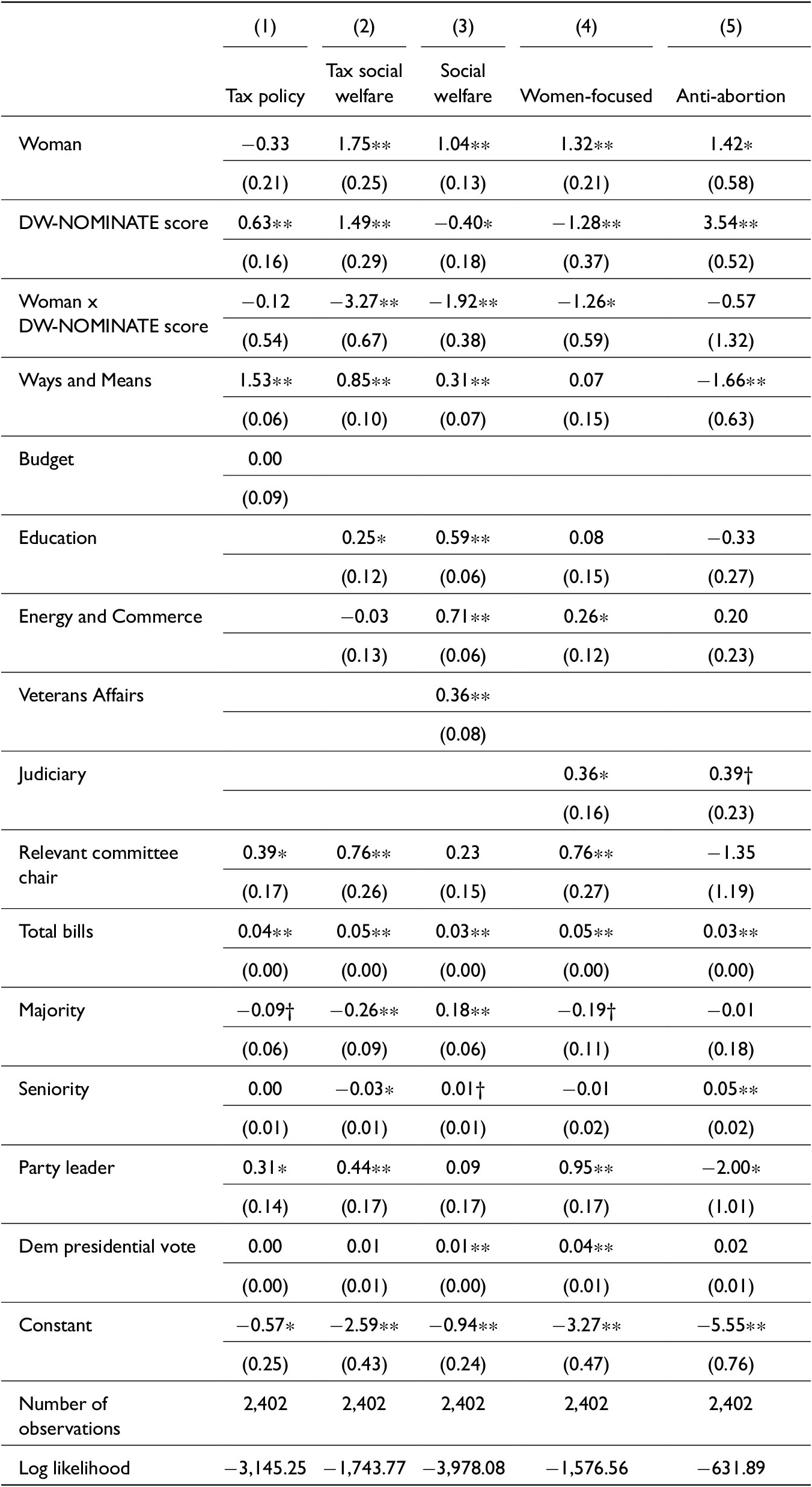
Notes: Results are from zero-inflated Poisson regressions (103rd–113th Congresses). Robust standard errors are in parentheses. The models also include the district’s racial and ethnic composition, proportion of college educated voters, median household income, unemployment rate, percent urban, and South.
† p < 0.10,
∗ p < 0.05,
∗∗ p < 0.01.
The graphs in Figure 1 illustrate the magnitude of these relationships by plotting predicted values by gender and ideology. For Republican men, ideology has a more muted impact on their decision to sponsor bills on social welfare, women-focused, and anti-abortion policies. The main exception is social welfare tax policy. When conservative men engage social welfare policy, they do it through the tax code. By contrast, women’s interest in these areas is strongly influenced by their ideology. Moderate women are the most active proponents of using the tax code to enhance social welfare benefits, but gender differences diminish as women become more conservative.Footnote 10 At the highest levels of conservatism, women are actually less likely than their male counterparts to pursue social welfare legislation through the tax code. Women who resemble Virginia Foxx (R-NC; NOMINATE score of 0.67 in the 113th Congress), for example, sponsor 0.2 bills, compared to 0.3 bills for ideologically similar Republican men. Meanwhile, moderate women like Ileana Ros-Lehtinen (R-FL; NOMINATE score of 0.25 in the 113th Congress) are predicted to sponsor 0.4 bills, and women like Kay Granger (R-TX; NOMINATE score of 0.43 in the 113th Congress) who are in the party mainstream sponsor 0.3 bills.Footnote 11
Bill sponsorship, by policy area.
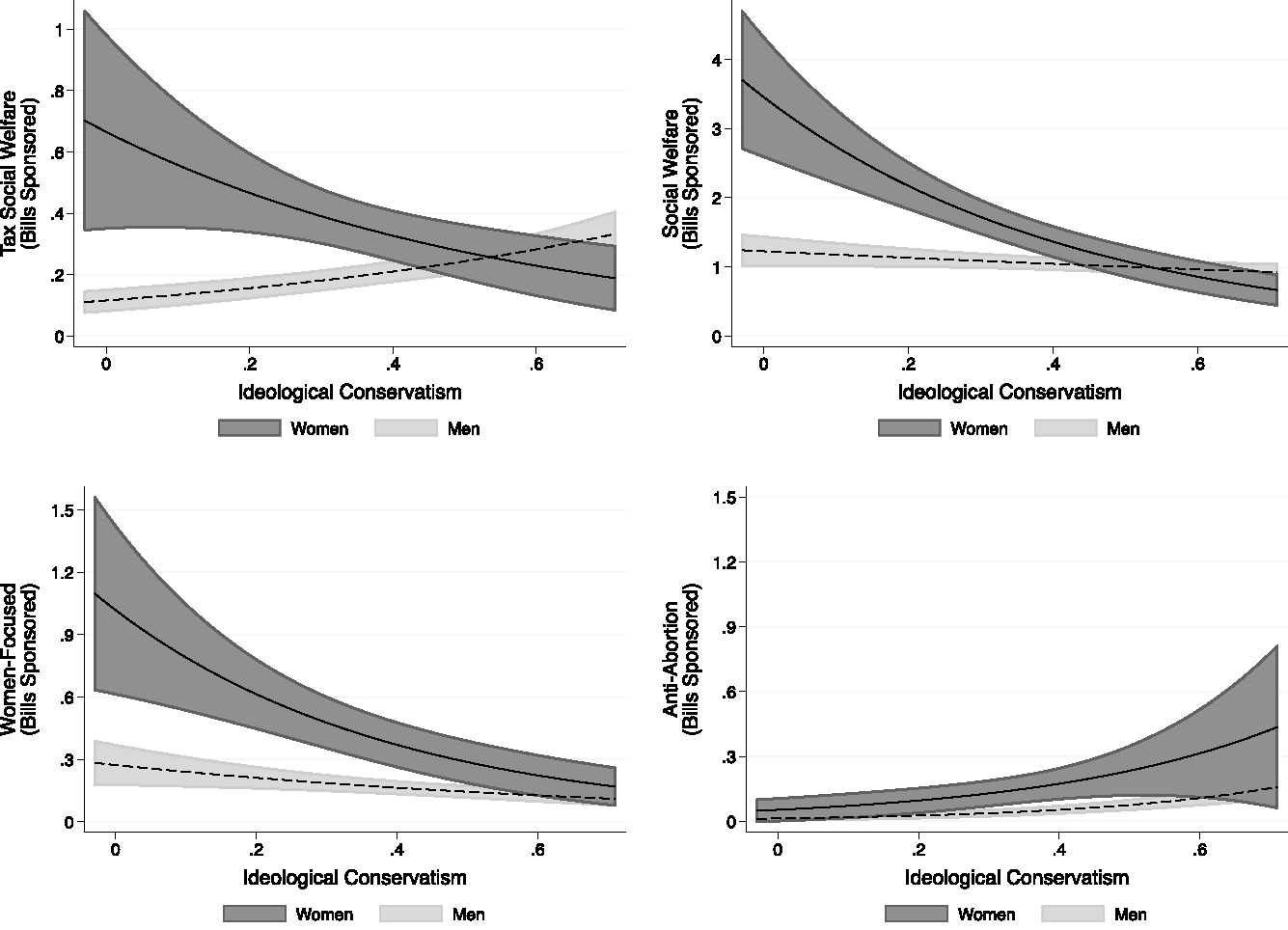
When we examine women’s activism on social welfare, women-focused, and anti-abortion bills, we continue to see Republican women structure their policy agendas differently across the ideological spectrum. On social welfare bills such as increasing funding for health research, reforming medical malpractice laws, creating school choice programs, and reforming welfare, moderate and mainstream conservative women are more active proponents of these polices, but the impact of gender declines as women become more conservative. The propensity of men and women to offer these bills converges at the highest levels of conservatism. Turning to women-focused bills, we see that while gender differences are smaller at higher levels of conservatism, these differences remain apparent at all levels of conservatism. Moreover, the most conservative women are predicted to sponsor as many women-focused bills as moderate and mainstream conservative men.
Abortion policy is the one area where conservatism increases women’s propensity to sponsor legislation. Conservative women sponsor more anti-abortion bills than men. We can see in the bottom right panel of Figure 1 that conservative Republican women like Foxx sponsor 0.4 anti-abortion bills, compared to 0.1 bills for conservative men. Reflecting the party’s desire to elevate women to counter Democratic attacks that Republican abortion initiatives harm women, moderate women like Ros-Lehtinen are predicted to sponsor the same number of anti-abortion bills (0.1) as conservative men. By contrast, moderate men are predicted to sponsor only 0.03 bills. Research at the state level similarly finds that conservative women are increasingly active advocates of pro-life policies, particularly policies that are framed as protecting women (Reingold et al. Reference Reingold, Kreitzer, Osborn and Swers2021; Roberti Reference Roberti2021).
In Table 2, we examine gender differences in the propensity to sponsor bipartisan bills. As one would expect, more moderate members are more likely to sponsor bipartisan bills that attract Democratic cosponsors. However, the graphs in Figure 2 illustrate that this pattern is largely driven by the sponsorship behavior of women members. For general tax policy, the issue area that is owned by Republicans but is not clearly connected to women’s life experiences, ideology is associated with bipartisan sponsorship patterns for men, but it does not impact which women offer general tax bills (top left panel).
Bipartisan bill sponsorship, by policy area
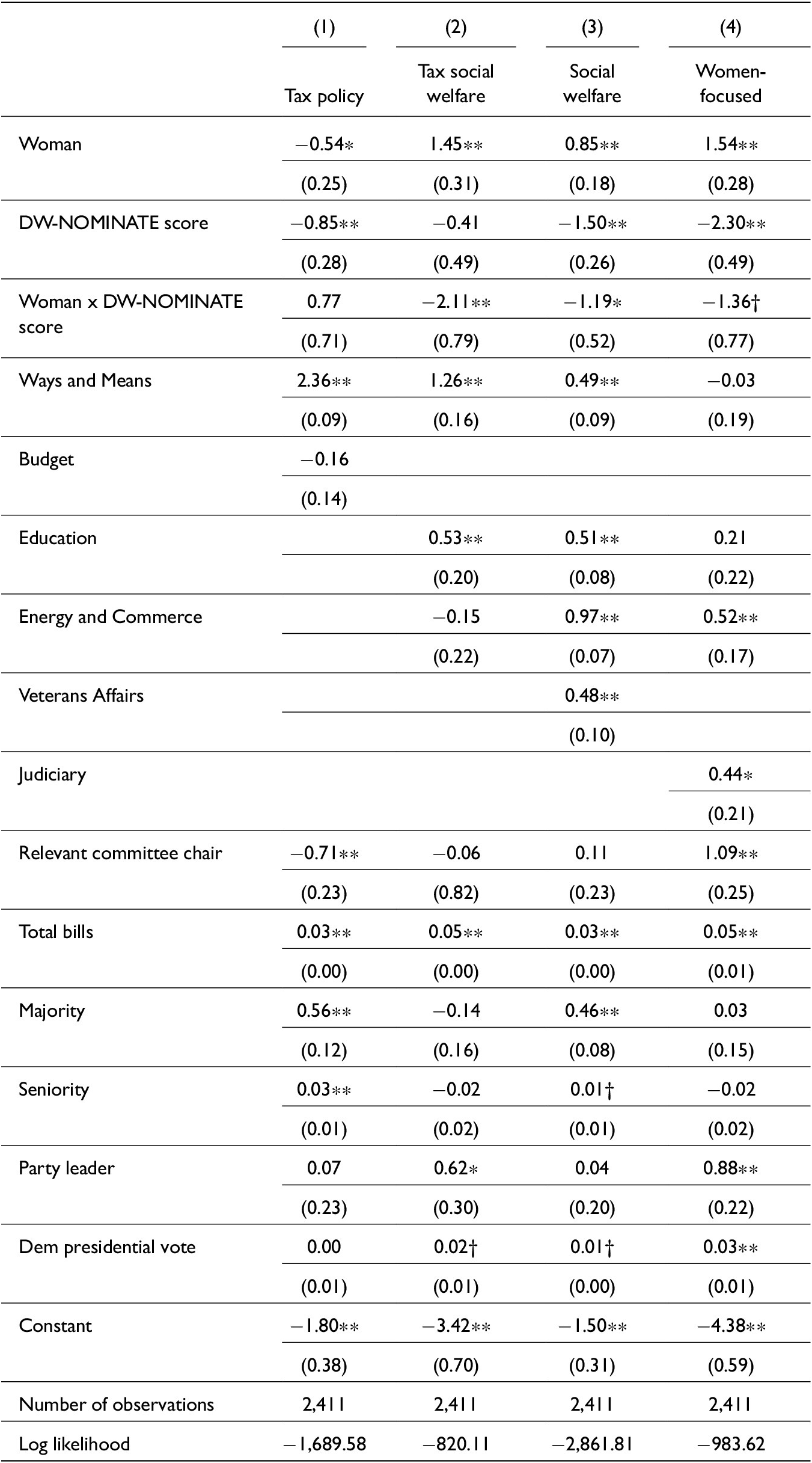
Notes: Results are from zero-inflated Poisson regressions (103rd–113th Congresses). Robust standard errors are in parentheses. The models also include the district’s racial and ethnic composition, proportion of college educated voters, median household income, unemployment rate, percent urban, and South.
† p < 0.10,
∗ p < 0.05,
∗∗ p < 0.01.
Bipartisan bill sponsorship, by policy area.
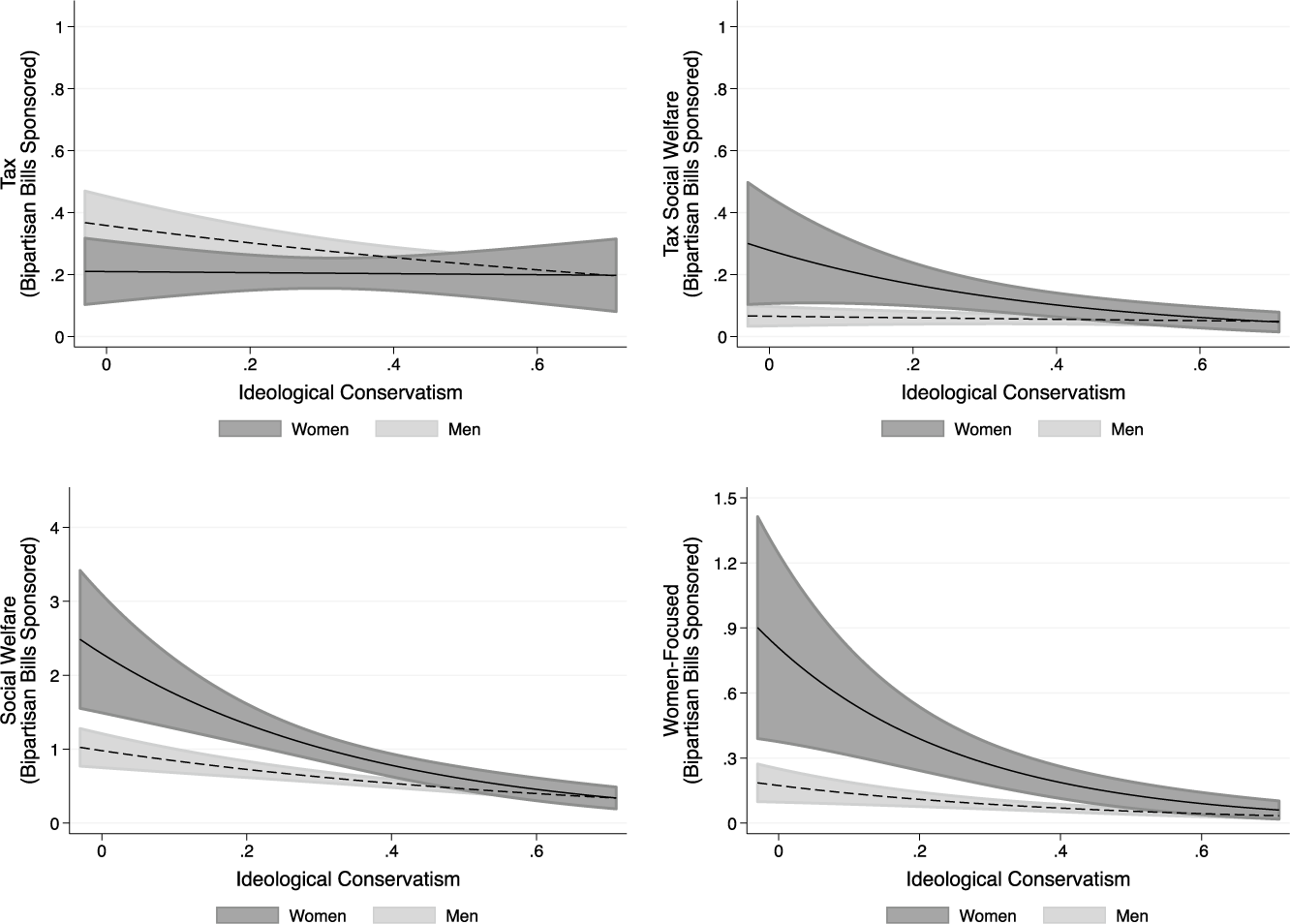
On the policies in which voters assume women have more expertise and women’s own life experiences might contribute to their policy decisions, women are more willing to reach across the aisle when crafting social welfare tax, social welfare, and women-focused bills. However, gender differences diminish as women become more conservative. Still gender differences are most persistent across the ideological spectrum on the women-focused bills that have the most direct consequences for women as a group. Indeed, moderate Republican women like Ros-Lehtinen are expected to sponsor 0.3 bipartisan bills, mainstream conservative women like Granger are expected to sponsor 0.2 bipartisan bills, and conservative women are predicted to sponsor 0.1 bipartisan bills, the same number of bipartisan bills as moderate men.Footnote 12 In sum, the bipartisan results indicate that gendered life experience leads Republican women to collaborate with Democrats on women-focused issues to a greater extent than one would expect based on their ideological leanings.
Turning to cosponsorship, research suggests that cosponsorship is an important avenue for position taking with voters and signaling to other legislators about the policy content of a proposal (Koger Reference Koger2003; Wilson and Young Reference Wilson and Young1997). The results in Table 3 support the idea that on the issues that have shaped the partisan divide since the New Deal, tax rates and the size of the social welfare state, ideology, not gender, drives legislators’ cosponsorship activity (Models 1–3).
Bill cosponsorship, by policy area
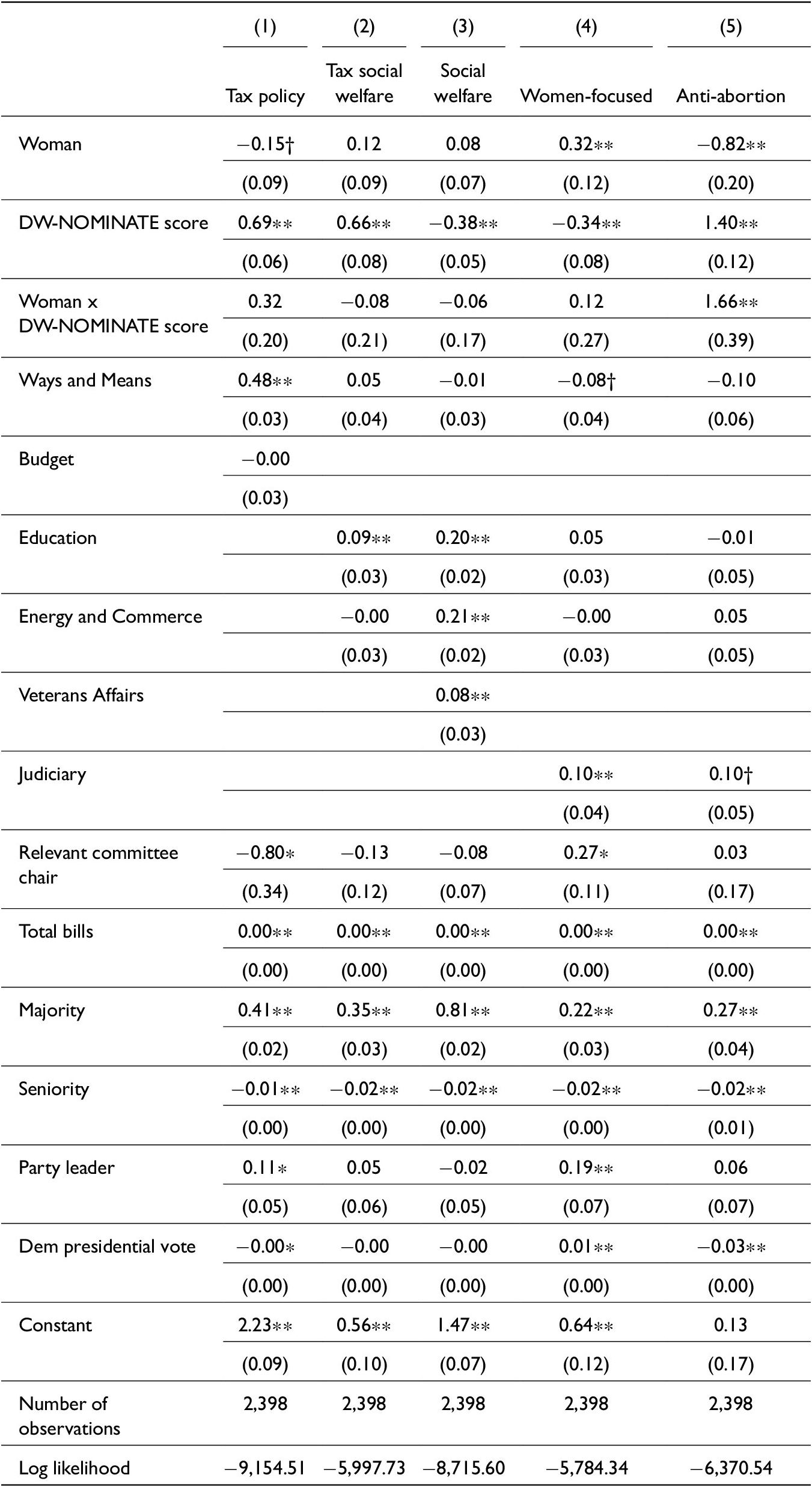
Notes: Results are from Poisson regressions (103rd–113th Congresses). Robust standard errors are in parentheses. The models also include the district’s racial and ethnic composition, proportion of college educated voters, median household income, unemployment rate, percent urban, and South.
† p < 0.10,
∗ p < 0.05,
∗∗ p < 0.01.
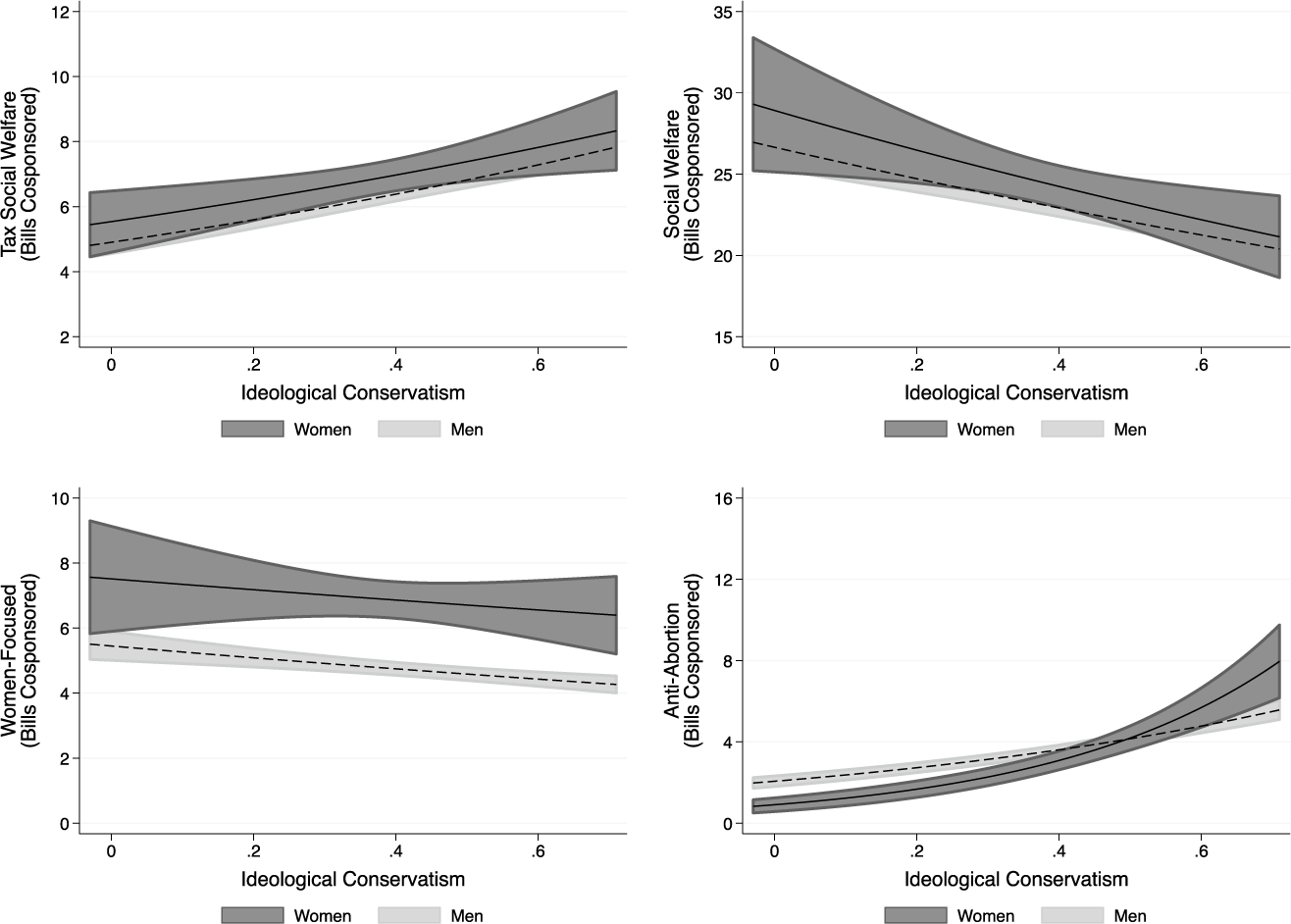
The predicted values in Figure 3 demonstrate that conservatives are more inclined to cosponsor bills that influence social welfare policy through the tax code, while more moderate members cosponsor traditional social welfare legislation. However, when deciding to cosponsor a women-focused bill, gender is an important factor. Republican women’s life experiences may increase their commitment to addressing these issues, and policy entrepreneurs likely want to harness women’s perceived authority to signal support to other legislators. The most conservative women are predicted to cosponsor more women-focused bills than both conservative and moderate men (bottom left panel). Furthermore, conservative women are the most committed to cosponsoring pro-life legislation. The gender patterns on abortion differ for sponsorship and cosponsorship. In the arena of bill sponsorship, party leaders want women to take the lead to demonstrate that not all women are pro-choice, but cosponsorship is less visible. Moderate women may be less interested in taking positions on these issues, while conservative women may want to signal their commitment to pro-life causes.
Bill cosponsorship, by policy area.
The importance of women as strategic party actors is further highlighted by the gender differences in which members’ bills move through the legislative process. Very few policies receive action in the chamber, so the size and significance of the results are weak. As we would expect, party leaders, committee members, and chairs are more likely to see action on their proposals. Still, we can see suggestive patterns in Table 4 and Figure 4.
Action on sponsored bills, by policy area
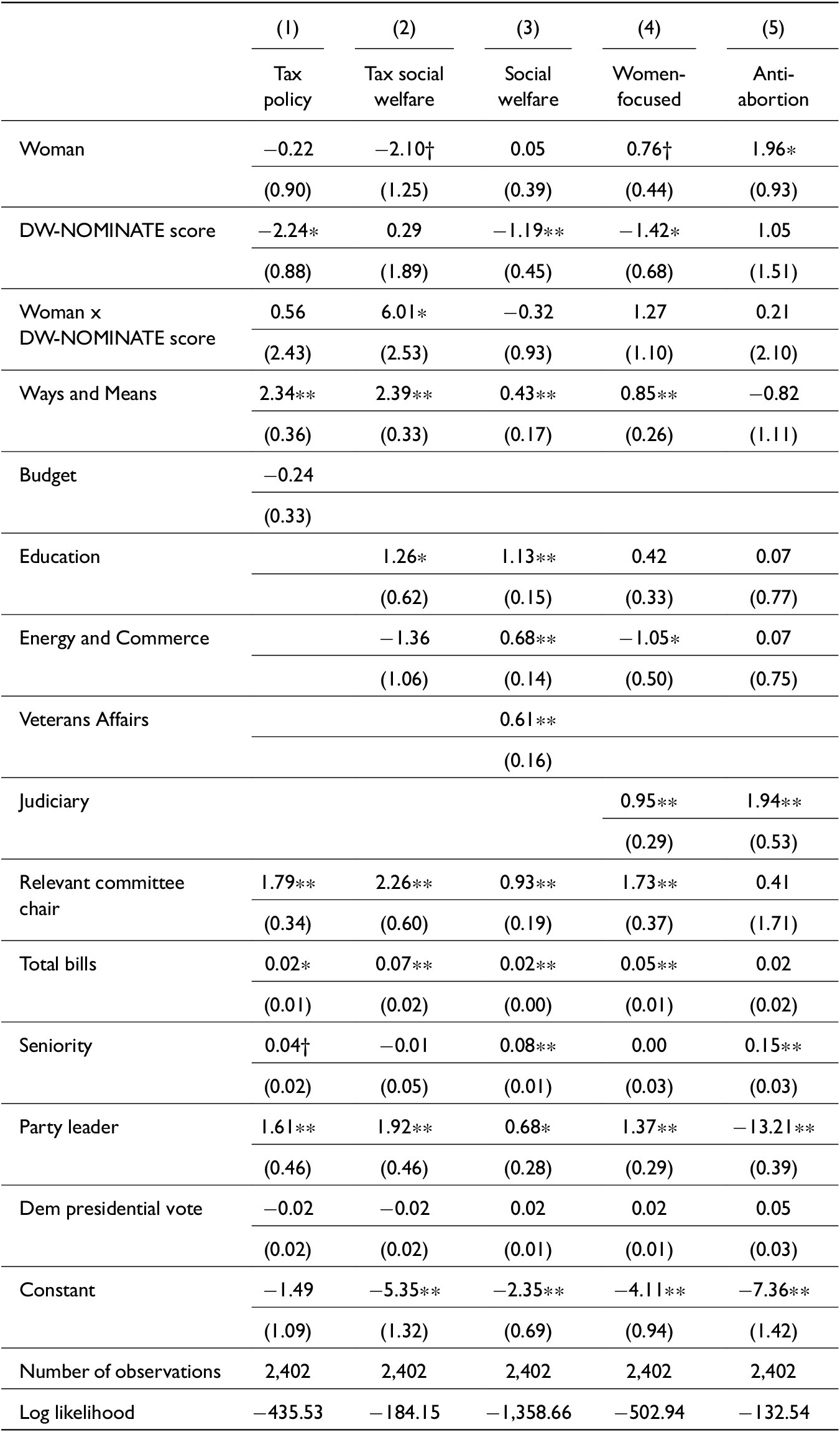
Notes: Results are from zero-inflated Poisson regressions (103rd–113th Congresses). Robust standard errors are in parentheses. The models also include the district’s racial and ethnic composition, proportion of college educated voters, median household income, unemployment rate, percent urban, and South.
† p < 0.10,
∗ p < 0.05,
∗∗ p < 0.01.
Action on sponsored bills, by policy area.
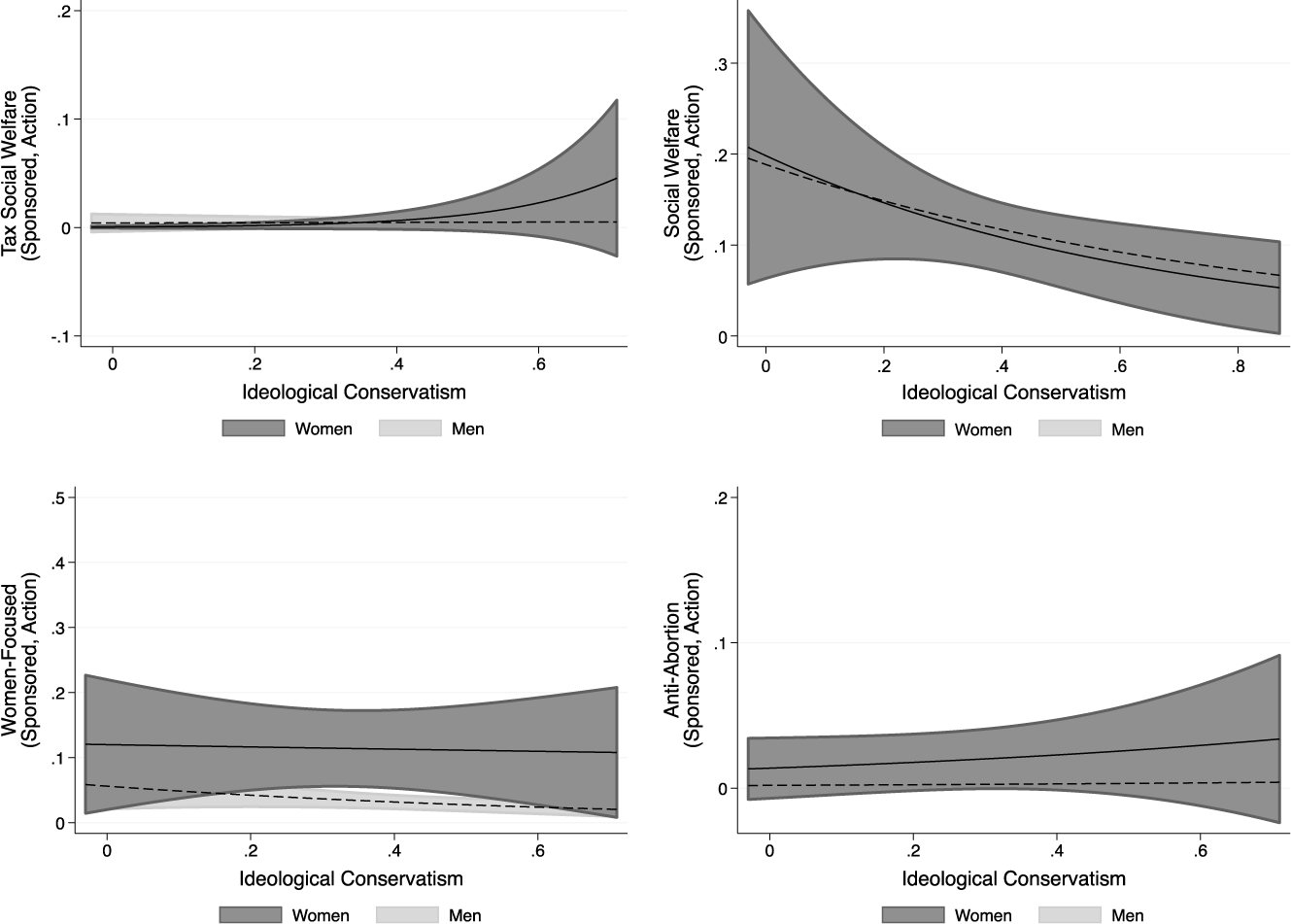
Gender is associated with legislative action on women-focused and anti-abortion policies. In these two issue areas, women’s life experiences, voters’ beliefs about women’s expertise, and media expectations may combine to increase women’s willingness to spend political capital and push bills through the legislative process; however, ideology plays a more limited role.Footnote 13 Any personal motivation women have to legislate on these issues is likely reinforced by the party’s desire to elevate women as spokespersons to counter Democratic criticisms that Republican policies harm women (Atkinson, Mousavi, and Windett Reference Atkinson, Mousavi and Windett2023; Roberti Reference Roberti2021; Swers Reference Swers, Shames and Och2018, Reference Swers2023; Wineinger Reference Wineinger2022; Wineinger and Nugent Reference Wineinger and Nugent2020).
Anti-abortion bills illustrate this dynamic. Abortion is a top priority for social conservatives. When Republicans control the majority, party leaders always put a bill on the floor to coincide with the March for Life to demonstrate their commitment to the issue. Pro-life groups such as the National Right to Life Committee and Susan B. Anthony List pressure the party to pass more initiatives restricting abortion and they routinely score members’ votes (Rolfes-Haase and Swers Reference Rolfes-Haase and Swers2022). Having a female face to advocate for these policies is so essential that in her memoir, Marjorie Dannenfelser noted that she founded Susan B. Anthony List in the early 1990s because she believed that Republicans needed “the voices of pro-life women legislators to counter the dozens of congresswomen who spoke with authority and vigor in defense of abortion” (Dannenfelser Reference Dannenfelser2020). Interviews with Republican staffers and Republican women members indicate that the party relies on women to act as spokespersons to counter Democratic efforts to portray the party as harming women’s interests (Dittmar, Sanbonmatsu, and Carroll Reference Dittmar, Sanbonmatsu and Carroll2018; Swers Reference Swers2002, Reference Swers2013; Wineinger and Nugent Reference Wineinger and Nugent2020). Thus, the party’s desire to both shape voter perceptions of the party’s commitment to women and respond to interest group demands to take action on abortion combines with women’s own policy preferences to provide strategic opportunities for Republican women to both help the party and achieve their own policy goals (Reingold et al. Reference Reingold, Kreitzer, Osborn and Swers2021; Roberti Reference Roberti2021; Swers Reference Swers, Shames and Och2018, Reference Swers2023; Wineinger Reference Wineinger2022)
Conclusion
Social welfare and women’s rights issues will continue to define the partisan divide. Given the centrality of these issues, women will play an important role in their party’s policymaking efforts. The nature of this role will be heavily influenced by their ideological profile. Our research demonstrates that Republican women are cross-pressured as they navigate an environment in which their party’s policy reputation conflicts with voter expectations about women’s policy expertise. They must be judicious when choosing to pursue policies based on their gendered life experiences. In response to this conflict, as women get more conservative, they are less likely to sponsor legislation on social welfare and women’s rights issues. Meanwhile Republican men face no conflict between gender expectations and the party’s reputation. As a result, their level of conservatism generally does not predict whether they sponsor or cosponsor social welfare or women-focused policies.
By contrast, gender considerations, whether stemming from socialization, voter and media expectations, or partisan imperatives, are impacting Republican women’s policy choices. Moderate and mainstream conservative Republican women sponsor more social welfare bills and women-focused bills than their male colleagues. The most conservative women offer more women-focused bills than conservative men, and they offer as many women-focused bills as moderate and mainstream Republican men. Similarly, comparative research suggests that right leaning women both reject the feminist worldview promoted by left parties and advocate for their own vision of women’s interests (Celis and Childs Reference Celis and Childs2018; Franceschet, Piscopo, and Thomas Reference Franceschet, Piscopo and Thomas2016). Our research provides additional support for these findings. Moreover, our analysis of bipartisanship demonstrates that bipartisan legislating is the purview of moderate members. Yet, mainstream conservative women, and to a lesser extent the most conservative women, are sponsoring as much bipartisan legislation on tax social welfare, social welfare, and women-focused bills as moderate men.
Furthermore, the fact that Republican women see more action on their proposals regarding women-focused and anti-abortion issues suggests that women are acting as strategic party actors (Swers Reference Swers2013, Reference Swers2023; Wineinger Reference Wineinger2022; Wineinger and Nugent Reference Wineinger and Nugent2020). On the issues most closely associated with women, Republican women’s interest in these policies is likely being elevated by party and committee leaders’ desire to reach women voters and counter Democratic criticisms of the party by highlighting women’s policy leadership.
Looking toward the future of policymaking, tax policy and abortion are the policy arenas most likely to rise to the top of the agenda in a Republican controlled Congress, particularly when there is a Republican president. Interestingly, tax social welfare policy is the one area where ideology matters for Republican men. If conservative men are going to engage social welfare policy, it will likely be through the tax code. Indeed, under the Trump administration, Republicans adopted an expansion of the child tax credit championed by Senators Marco Rubio (R-FL) and Mike Lee (R-UT) as part of their major tax bill (Stein Reference Stein2017).
Most recently, in anticipation of the need to reauthorize the Trump tax cuts, a deal was brokered between House Republicans led by Ways and Means chair Jason Smith (R-MO) and Senate Democrats led by Ron Wyden (D-OR) that included an expansion of the child tax credit. Despite high levels of gridlock and polarization, the Republican controlled House passed this bill (Reilly Reference Reilly2024). The child tax credit remains a central point of contention as President Trump and congressional Republicans work to renew the 2017 tax legislation and pass new tax cuts. While tax policy is tightly controlled by party leaders and the tax writing committees, Republican women could focus the party’s attention on women’s interests. During the crafting of the 2017 Trump tax cuts, Senator Deb Fischer (R-NE) secured a tax credit for businesses that offer paid leave (Sherlock Reference Sherlock2023).
Finally, when Republicans control Congress, they regularly advance policies to limit abortion. The Dobbs decision has complicated these efforts due to significant public backlash to the overturning of Roe v. Wade (Swers Reference Swers2023). In this atmosphere, the importance of women to efforts to restrict abortion will be even more significant. Republican women can influence the nature and scope of proposals as the party will be especially reliant on their efforts to speak as women in support of proposed restrictions. Reingold et al. (Reference Reingold, Kreitzer, Osborn and Swers2021) and Roberti (Reference Roberti2021) find that women are more likely to lead on abortion when the issue is framed as protecting women. With heightened media and public attention on abortion, Republicans will be even more reliant on women to advocate for funding restrictions in the Appropriations process and other bills limiting access to reproductive health services.
Acknowledgments
We are grateful to Tiffany Barnes, Tracy Osborn, participants at the 2022 Women in Legislative Studies conference at Rice University, and participants at the Women and Political Parties conference at the University of Iowa for helpful comments and feedback. We also thank Grant Farrington, Henry Watson, and the many undergraduate research assistants who coded sponsorship and cosponsorship activity.
Competing interest
The authors have no competing interests.


 Open access

