In recent years, archaeologists have turned to relational approaches and New Materialist theories of the human and non-human past (see Buchanan & Skousen Reference Buchanan and Skousen2015; Harrison-Buck & Hendon Reference Harrison-Buck and Hendon2018; C. Watts Reference Watts and Watts2013). The multitude of such archaeological studies highlights the importance of not masking Indigenous ontologies and non-Western states of existence (Alberti & Marshall Reference Alberti and Marshall2009; Smith Reference Smith1999). Many of these studies present archaeological analyses of communities with relational ontologies (e.g. Brück Reference Brück2004; Hill Reference Hill2011). Some scholars, however, have moved beyond attempting to reconstruct a past worldview to present analyses of archaeological material from the framework of relationality (e.g. Lazzari & Korstanje Reference Lazzari and Korstanje2013; Alt & Pauketat Reference Alt and Pauketat2019). These approaches move through and outside the confines of culturally defined ontologies to propose an all-encompassing state of matter. It is essential to highlight that many Indigenous ontologies have a grasp of matter's affect and necessary reciprocity that many Western ontologies have yet to fully recognize (Kimmerer Reference Kimmerer2013, 39–47; Viveiros de Castro Reference Viveiros de Castro1998); that affect (not a particular human ontology) is primary. In this discussion, water is not an object ‘produced through social relationships and imbued with meaning through cultural schemes’ (Krause & Strang Reference Krause and Strang2016, p.633). Water is innately a material co-constituent in the formation of relationships with, and meanings of, water.
Water is both mirror and window; it can be translucent, transparent, or a dark, foreboding unknown. Water makes up bodies and fuels minds; it is essential, a biological necessity. For millennia, water has driven human behaviour, as we must access fresh water, irrigate crops, and navigate flood zones. Water is not only constantly engaged in dialectics, but it is simultaneously integral to each thing in dialogue. My approach decentres humans and puts forth an ontology of matter, within which diverse human ontologies can unfold but to which we are all subject. I suggest that truly to understand the spaces with which we exist, we need not invite non-humans into our ontologies, but rather reincorporate ourselves into theirs. A closer look at water, specifically at the pre-Columbian pilgrimage Maya site of Cara Blanca, Belize, offers an example of how we as humans exist as only one part of many that participate in the formation of landscapes and shows how water's affect preempts cultural interpretations and relationships with water.
The repositioning of water as a primary force in my analysis situates it ‘as an active participant in a mutually constitutive relational process, thus enabling an “appreciation of the other” and highlighting the need to consider its interests’ (Strang Reference Strang2017, 13). An expanded notion of who or what warrants justice—ensuring equity in appreciation and consideration of rights (e.g. Strang Reference Strang2017)—allows for a less anthropocentric, more materially and biologicallly unbiased consideration of landscape formation. Ultimately, such an approach can offer legal precedent in movements for environmental justice. As Krause and Strang (Reference Krause and Strang2016, 633) contend, ‘if we study how social and hydrological relationships are interconnected and mutually constitutive, … significantly better management and policy can be designed.’
For the past 20 years, the Valley of Peace Archaeology project, under the leadership of Dr Lisa J. Lucero, has meticulously documented the Cara Blanca landscape and offered valuable insights into Maya relationships with the space (see Lucero Reference Lucero2018; Lucero & Kinkella Reference Lucero and Kinkella2015). In this paper, I approach the site from a slightly different though complementary perspective—that of the water. I argue that the inherent qualities of water are affective, and it is this affect that mediates and ultimately integrates the Cara Blanca landscape. Here, I introduce my adoption of the concept of kinesis, a territorializing force that allows for the possibility of non-humans to cause history (see Pauketat Reference Pauketat, Alt and Pauketat2019a). Thus, Cara Blanca is an exemplary site at which to examine how archaeology, a discipline generally centred upon what is human, can contribute to ecocentric perspectives of past landscapes. I follow water through the archaeological data, elucidating how water's kinesis created possibility in the Cara Blanca landscape.
Water's kinesis: decentring humans in a relational existence
Many scholars (e.g. Bird-David & Naveh Reference Bird-David and Naveh2008; Grauer Reference Grauer2020; Harrison-Buck Reference Harrison-Buck2012; Lucero Reference Lucero2018) have recently discussed the ways in which Indigenous perspectives challenge dualisms—in particular, nature/culture, mind/body and human/non-human (Smith Reference Smith1999; V. Watts Reference Watts2013). Indeed, a dichotomized Western ontology is not suitable for understanding many non-Western ontologies (see Latour Reference Latour1999; Viveiros de Castro Reference Viveiros de Castro1998; Reference Viveiros de Castro2004). Non-Western approaches often adhere to a New Materialist and post-human philosophy (see Barad Reference Barad2007; Bennett Reference Bennett2010; Deleuze & Guattari Reference Deleuze, Guattari and Massumi1987; Viveiros de Castro Reference Viveiros de Castro1998) and lead to perceptions of matter that are unified across disciplines: that matter, or mattering (Barad Reference Barad2007, 151–2), is dynamic and in process. The perpetual unfolding within New Materialist thought encourages one to focus on relationships—the give and take, the changing forms, the shifting meanings produced—between different humans, things, animals, atmospheres, and so on. Analysis does not centre on the material form of a thing itself, but rather on the processes within which it has, and continues to, become. It gives life to the arguments of relational ontology, ultimately challenging anthropocentrism (see Barad Reference Barad2003; Braidotti Reference Braidotti1994; DeLanda Reference DeLanda2006).
A relational ontology promotes the understanding that material worlds emerge through relations—that all matter is constantly in process (Barad Reference Barad2007; Bennett Reference Bennett2010; Harris Reference Harris2014; Ingold Reference Ingold2007). This approach helps to break down perspectives that the world exists in dichotomies and emphasizes that things—nature and culture, human and non-human, even this article as you read it and you, are not distinct or opposing entities, but rather are entangled—existing and emerging as they do, as we are, with and because of each other (Alberti & Marshall Reference Alberti and Marshall2009; Barad Reference Barad2007). What separates humans, plants, animals, landscapes and water is not deeply rooted internal ontological discrepancies, but rather external expressions (e.g. Neves Reference Neves2018). But such a perspective exists outside, and in fact allows for, ecocentric ontologies. In understanding that humans are not apart from or above, relational ontologies allow for decentring humans as the motivator of all of those essential relations and instead considers the ways in which materials, organisms and processes co-constitute landscapes, a position that ‘allow[s] for animate and agentic forces other than people to cause history’ (Pauketat Reference Pauketat, Alt and Pauketat2019a, 14). Importantly, this does not discount the violence inflicted by humans on spaces nor the continued damage to our climate at the hands of humans (see Larmon Reference Larmon2019, 9–11; Strang Reference Strang2020); rather, it acknowledges this violence and the power dynamic inflicted upon spaces as a result of dichotomized and anthropomorphic thinking. Within this consideration, one cannot ignore the hegemonic relationships that also oppress groups of humans (see Tsing et al. Reference Tsing, Mathews and Bubandt2019).
Let us delve a bit deeper into this breakdown between nature and culture. As Grauer (Reference Grauer2020, 76) eloquently explains, the dualism stems from a false conception that human minds and human bodies are separate entities and the ‘immaterial mind is superior to the material body’. Thus, the body interacts with nature (or uses nature), while the mind exists in a social, cultural space. Therefore, social humans are both apart from and above nature. Though ‘Indigenous’ and ‘Western’ are not static and confined categories, as V. Watts espouses, Western ontologies are often in opposition to Indigenous perspectives; in Western ontologies, ‘humans are assumed to be separate from the world they are in, in order to have a perception of it … It necessitates a separation of not only human and non-human, but a hierarchy of beings in terms of how beings are able to think as well’ (V. Watts Reference Watts2013, 24; see also Bird-David & Naveh Reference Bird-David and Naveh2008; Harrison-Buck Reference Harrison-Buck2012; Lucero Reference Lucero2018). Therefore, Western ontologies can force an understanding of space as only either non-human or cultural and assume that if humans are involved in a landscape, they are organizers of that space. If we understand the world as truly relational, this cannot be true. For a structurally sound home to be built, water mixes with limestone or shell to create cement, the home's foundation. Trees provide their wood for the bones and the siding of the home. Fine particles of clay and quartzite remain suspended in moving water until the water quiets and they are deposited—over generations they are compressed to form shale, which is the roof. The atmosphere gives sun, rain and wind to aid in the wetting and drying of each of these. Humans combine the elements. All sacrifice their time and their energy. All move forward, year after year, and are subject to the tides of change and aging deterioration. How can such a feat be deemed ‘cultural’ when non-humans make possible the context in which that house can be?
In the case of Cara Blanca, water is the primary disrupter of preconceived dualities and the orchestrator of the space. There is no doubt that water is an essential component of human sociality; the environment and water are well integrated into New Materialist studies (Krause & Strang Reference Krause and Strang2016; Linton & Budds Reference Linton and Budds2014; Pauketat & Alt Reference Pauketat, Alt, Harrison-Buck and Hendon2018; Strang Reference Strang2014. Wittfogel's (Reference Wittfogel1957) examination of hydraulic societies engendered a course of study focusing on the ways in which water is social—or at the very least those ways in which it engages with the social world (a clear affront to mind/body dualities). More recent explorations of the ‘hydrosocial’ (Linton & Budds Reference Linton and Budds2014) consider the dialectic of water and society, how ‘water and society make and remake each other’ (Linton & Budds Reference Linton and Budds2014, 179, emphasis original). The ‘immanence’ of water situates it as essential in discussions of and beyond biology, as noted by Pauketat (Reference Pauketat, Alt and Pauketat2019b). Water's prominence in considerations of ‘being’ comes from its necessity in all biological life. It cannot be ignored that ‘every cell in the human body is irrigated by water; the human body is about 67 [per cent] water; even our thoughts depend upon the electric charges enabled by water molecules’ (Strang Reference Strang2017, 11). So, is water social? Are humans natural? Or, perhaps, should we discount such distinctions: just as when a tree decomposes it becomes the earth, so do we.
It is important to consider how water has become such a forceful integrator of spaces. Of course, the biological necessity of water has fuelled power relationships through time (e.g. Lucero Reference Lucero2006). But as an entity, water complicates concepts of containment (evapo-transpiration, e.g. Pauketat Reference Pauketatin press), embodies material adaptation (taking the shape of its container and shifting between states), makes life possible (agriculture and hydration) and also puts it in jeopardy (droughts and floods). Consider the ways in which we experience water—the way cold water feels trickling down your throat into your stomach on a hot day, as if rehydrating a desiccated body; the way warm water can instantly give you and then relieve pins and needles in frozen limbs; the way a strong current can make you question your body's ability for contrary movement, as if it is exerting tons of force upon you; the way water makes you weightless. It turns the sky on its head, reflecting clouds, sun and moon; at the same time it appears endless, home to a dark world, fathoms of unknown. Regardless of what state water is in, ‘it remains relational to a less fluid environment which contains it’ (Strang Reference Strang2006, 2). These very tangible contradictions allow for water's affect. It exemplifies the power of non-humans both because of the distinction and affect of its various material articulations (Krause & Strang Reference Krause and Strang2016; Strang Reference Strang2006; Reference Strang2014), as well as its power of transformation—imagine how a warm breeze cools as it passes over a body of water. Such a power certainly ebbs and flows with massive shifts in the global state of water, as is caused by a changing climate. These qualities of water are innate and allow for cultural perceptions of water to unfold.
When we consider the rights of a ‘cultural’ landscape, human rights are primary. If a landscape cannot be just cultural, however, we need to resituate our conceptualization of ‘justice’ such that we can appreciate the rights of non-humans to equal consideration in movements of environmental justice and recognize their efforts in causing history (e.g. Strang Reference Strang2017). I use ‘kinesis’ (Larmon Reference Larmon2019, 3–9) to show how water creates possibility because it rids matter of concepts of personhood or agency, which can be anthropomorphizing and detract from the idea that non-humans can cause history. Kinesis can be traced back to Aristotle's musings on physics (see Hope Reference Hope1961, 41–57). For Aristotle, kinesis is movement, sometimes interpreted as change through movement. It is a continuous process—movement into presence (Webster Reference Webster2002); it is the mobilizing, energetic force originating in material emergence and potential. It is social, in that both ‘mobilization’ and ‘emergence’ imply an engagement—co-constitution. Aristotle noted that kinesis (movement) occurs in a way that entities both act and are acted upon. This sociality, its potentiality, and its catalyzing energy is kinesis—the actualization (mobilization) of a potential.
Anna Tsing uses ‘friction’ to describe interconnections across difference in a global, human, political context—the tensions, possibilities and creativity that relations within difference might allow (Tsing Reference Tsing2005, 4). Kinesis is the mobilization/possibility that such a tension of relations might allow; it stems from friction, but where friction is the meeting of two distinct things, kinesis is the result of a full realization of entanglement. Whereas previous archaeologists employing Aristotle's concept remained focused on the human body/perceptions of movement (Ingold Reference Ingold2013 and Tilley Reference Tilley2008)— Ingold references the kinetic qualities of gestures (Reference Ingold2013, 102) or of thinking (Reference Ingold2013, 98) and Tilley (Reference Tilley2008, 20, 33) refers to the kinaesthetics of bodily movement—my use of this concept does not require the engagement of humans. It does not rely upon biology and does not require an ‘external force’, as kinesis itself both penetrates and integrates matter. Kinesis mobilizes potential. As Aristotle discusses in Physics (Hope Reference Hope1961, 42), bronze has the potential to become a statue through kinesis, yet there are many different components of the process of sculpting that make the actualization of that sculpture possible. Kinesis creates through motivating the potential of a thing or multiple things.
The Classic Maya and Terminal Classic droughts
People have been occupying what is now Guatemala, Belize, southeastern Mexico and parts of El Salvador and Honduras for the last 12,500 years (Prufer et al. Reference Prufer, Meredith, Alsgaard, Dennehy and Kennett2017). Cara Blanca is in the southern Maya lowlands, which is comprised of northern Guatemala, southeastern Mexico and a large portion of Belize. It was not until c. 300 bc that those we now recognize as the Preclassic Maya emerged, living sustainably in small communities with small-scale agriculture and a less hierarchical social structure. The Classic period (c. ad 300–800) witnessed the growth of large urban centres intertwined with hinterland farms, over which kings ruled (Lucero Reference Lucero2006). During this period, population densities in the lowlands reached <100 per sq. km, with some urban centres home to over 100,000 people (Turner & Sabloff Reference Turner and Sabloff2012). Between c. ad 806 and 935, a series of prolonged droughts struck Mesoamerica (Kennett et al. Reference Kennett, Breitenbach and Aquino2012; Medina-Elizalde et al. Reference Medina-Elizalde, Burns and Lea2010). Probably driven by the Intertropical Convergence Zone (ITCZ) migration and changes in El Nin˜o frequency, northern Mexico received an abundance of rainfall while southern Central America, including Cara Blanca, received staggeringly less (Kennett et al. Reference Kennett, Breitenbach and Aquino2012). Belize, which is at a latitude of 16–18°N, generally has one seven-month rainy season and one five-month dry season each year. As the ITCZ movement was hindered, however, that seasonality shifted and the area received up to 40 per cent less annual rainfall (Medina-Elizalde & Rohling Reference Medina-Elizalde and Rohling2012).
As populations grew throughout the Classic Period, plentiful and predictable rain allowed for rainfall-dependent, agriculturally sustained Maya to thrive through varied means of subsistence, from the household level to the communal (Ford & Nigh Reference Ford and Nigh2009). Kings also played a role in Classic Maya subsistence, garnering their power by communicating with Ancestors and the rain deity Chahk and providing supplication in return for dependable rainfall (Lucero Reference Lucero2006). When the droughts struck, kings could no longer provide dependable rainfall and constructed water-management systems began to fail. Maya commoners lost faith in their rulers and moved out of the urban centres into the hinterlands, to new regions along the coast and major rivers where market towns and trade expanded (Lucero et al. Reference Lucero, Fletcher and Coningham2015). This massive shift in their social system included ritual shifts as well—in some cases, ritual supplication intensified in hinterland areas with portals to the underworld (caves, cenotes, etc.), where people could communicate more directly with the deities and Ancestors (e.g. Lucero & Kinkella Reference Lucero and Kinkella2015; Moyes et al. Reference Moyes, Awe, Brook and Webster2009).
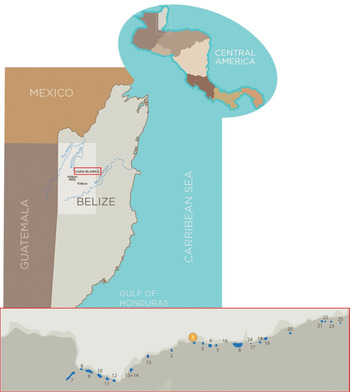
Cara Blanca, a system of 25 pools comprised of both shallow lakes and steep-sided karstic sinkholes fed by groundwater (cenotes), was one of these ritually intensified landscapes (Fig. 1). During the late Late and Terminal Classic periods (c. ad 700–900), the ancient Maya made pilgrimages to the cenotes, as is evidenced by rich ritual deposits and ceremonial architecture, particularly at the deepest of the cenotes, Pool 1 (Larmon & Carbaugh Reference Larmon and Carbaugh2018; Larmon et al. Reference Larmon, Cruz and Copper2019; Lucero & Kinkella Reference Lucero and Kinkella2015. It is evident, however, that the entire landscape was intimately engaged with the Maya (Larmon & Carbaugh Reference Larmon and Carbaugh2018; Lucero et al. Reference Lucero, Larmon and Carbaugh2017).
Cara Blanca. (Map generated by J. McMahon. Courtesy of VOPA.)

The Maya and water
The ancient Maya understood their space as uninhibited by perceived material boundaries—water was central to this integration (see Lucero Reference Lucero2018; Lucero & Kinkella Reference Lucero and Kinkella2015). Particularly in light of the role of drought in the tropics, numerous studies have been dedicated to understanding the role of water in the Maya decline (e.g. Kennett et al. Reference Kennett, Breitenbach and Aquino2012), as well as the role of water within the Maya ideology (Finamore & Houston Reference Finamore and Houston2010; Scarborough Reference Scarborough1998). But water does not have one singular determined role and such an idea is as contradictory as the material reality of water itself. The nature of water is that it is at once distinct and bounded, while also being indefinite and nebulous. The Cara Blanca pools, for instance, each have their own distinct cultural and ecological histories. On the surface, each pool appears separate from the others, demarcated by steep limestone sides. Subsurface, however, is a complex tangling of open and closed systems (Beddows Reference Beddows and Lucero2011). The pools are semi-perched, sealed off from the water table and bedrock, yet the porous limestone and fissures in the fault lines have allowed for the subsurface inundation of the entire, local landscape by Cara Blanca waters—water that is distinct from the water table, yet totally indefinite in that underground, web-like system of karstic tunnels and tectonic fractures. The pools are perfectly defined and yet completely indistinguishable.
This contradiction is the essence of the kinesis fuelled by water. This contradiction is also what drove the Maya relationship with water. To the Maya, the water was both portal, through which one could engage with Ancestors and deities, and the underworld (Christenson Reference Christenson2003, 12). In the sixteenth century K'iche’ Maya origin story, the Popol Vuh, the ‘earth is submerged in water’ (Christenson Reference Christenson2003, 39). While this story must be read with caution because it was recorded only after the highland K'iche’ culture had been influenced by Christianity, the prominence of water is noted throughout. Standing bodies of still water are the entrance to the underworld into which Maya proffer and within which deities, such as Chahk the rain god, reside. Yet all things, too, emerge from water (Christenson Reference Christenson2003, 53). Water came first; water existed before anything. The visible and invisible inundation of the Cara Blanca landscape, however, ensured that there was never a distinct boundary between the earth and the underworld. The tension of the waters was felt by the entirety of the Cara Blanca assemblage, as the soil, trees, and jaguars are both dehydrated and quenched by water's manifestation. The ubiquity of water in Maya ideology and its prevalence in Maya origin stories are not born from a Maya predisposition for water. The excess and dearth of rainwater and its role in forming Terminal Classic spaces should not be seen as originating from Maya perceptions of water, but rather from the innate necessity of water in feeding the material vibrancy of the space. This necessity includes Maya ideological positioning, not due to Maya beliefs about water, but due to water's ability to pull together material and immaterial spaces and animate and inanimate entities. This necessity encompasses the Maya worldview but also exists beyond it.
Previous archaeological investigations of Cara Blanca materials have focused on the role that they played within a Maya ontology (Lucero Reference Lucero2018; Lucero & Kinkella Reference Lucero and Kinkella2015)—all linking back to Maya relationships with water. These essential approaches move from Maya understandings of water to Cara Blanca. Here, however, I start from the Cara Blanca waters and move to Maya relationships with that space. How does water instigate? The potential of this space is stimulated by water's kinesis. Therefore, we have to understand how water's kinesis is materially embodied in stones, ceramics and architecture. We have to answer, why water? To do so, I address how water both is experienced and experiences. I acknowledge the qualities of water that are reflected in these other embodiments (stone, ceramic, architecture). If these relations are a novel, this is a transcription of the prologue. So as to lose little in translation, here I will allow the Cara Blanca waters to show me how they are affective. In ‘Water as elicitor’, blue-grey stones and iconography tell us how visuals associated with water (colours, shapes, beings) resonate. In ‘Water as creator’, water works to bring together distinct materials, distinct places and distinct atmospheres to form what we (humans) perceive and with which we create meaning. In “Water as mirror and window’, water's translucent and transparent state reflect us back on ourselves. In ‘Water as movement’, we follow the flow of water through time and space.
Before cities were abandoned, as the droughts unfolded, Maya people sought reprieve from the drought at Cara Blanca as some of the only resources for fresh water in the area. The formation of this space unfolds in a context of loss—the Maya region was undergoing loss of reliable and plentiful rains. The opposition of little in the regional landscape to plenty in the local landscape opens a narrative in which water is the director of a dynamic symphony.
Cara Blanca, Belize
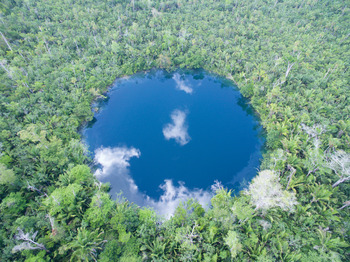
Cara Blanca is north of the Belize River Valley, where people had access to resources of the fertile river basin, allowing for small and medium-sized agricultural communities and centeres to line the floodplains of the Belize River to the south and Rio Bravo to the north. These communities grew and thrived through the waters and the material sustenance of the landscape. From the constant movement of merging ground- and rainwaters stretching from the highlands to the coast, the pilgrimage centre of Cara Blanca emerged. The 25 pools line the base of a stark white limestone cliff—a dramatic vision against the backdrop of green and blue. The pools are not materially distinct from their surroundings; by being bound in the earth—soil and limestone and prying roots—the context of these pools changes. While the rains and groundwater instigate as they flow through the landscape, these pools stand apart in the ways they motivate and engender our present understandings of the space. The soils surrounding the perennial cenotes were fertile, yet residential architecture was built only at the shallow lakes, which desiccated during the dry season. Maya built only ceremonial structures surrounding the deep cenotes. Their depths are home to flora and fauna that create a universe unto itself—towering submerged trees and swirls of cichlids—such vibrancy surely fed the Maya relationship to these pools (Fig. 2). The disintegration of cities in the late Late and Terminal Classic period (c. ad 700–900), as well as a loss of faith in rulers, would have shifted ritual practice and participation; Cara Blanca was likely to have been a space for everyone; the inclusivity of the space would have also extended beyond the human (Larmon Reference Larmon2019, 49–50).
Pool 20. (Courtesy of VOPA.)

Pool 1
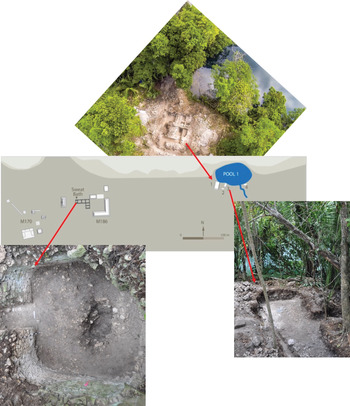
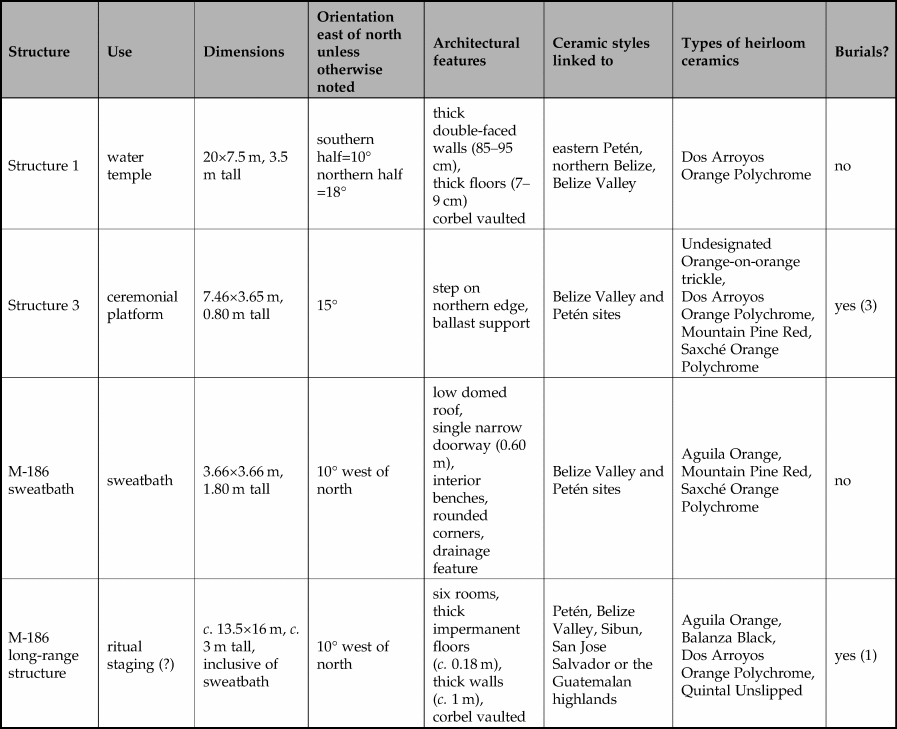
Based upon ceramic assemblages recovered from closed architectural contexts at Pool 1, the built landscape dates primarily to the late Late and Terminal Classic periods (Kosakowsky Reference Kosakowsky, Lucero, Larmon and Benson2017; Reference Kosakowsky and Lucero2019), when droughts were overtaking much of the area. Each structure on the landscape was unique, but they shared qualities that intimately tied them to Maya relationships with water (Fig. 3; Table 1). Structure 1, the water temple (Lucero & Kinkella Reference Lucero and Kinkella2015), teeters on the western edge of Pool 1. Excavations of the structure revealed a complex, asymmetrical temple that originally had six to eight rooms. The northeastern portion of the structure has eroded into Pool 1. The structure's complex orientation led Lucero (Reference Lucero and Lucero2014) to propose that it may have been intended to mirror the edge of the cenote. The structure was built with high-quality materials and required high labour investment; the effort employed in the construction of this space was not typical elsewhere in the lowlands (see Table 1) (Harrison Reference Harrison and Lucero2015). With only a single doorway and narrow hallway leading into the structure, the practices unfolding within its walls would have been hidden to those outside, known only to the practitioners and the water temple walls (Harrison Reference Harrison and Lucero2015).
The Pool 1 space with location of Structure 1, Structure 3 and M186. (Pool 1 map generated by J. McMahon. Structure 1 photograph: T. Rath. Courtesy of VOPA.)

Data for the archaeological spaces discussed in the text (Harrison Reference Harrison and Lucero2015; Kosakowsky Reference Kosakowsky, Lucero, Larmon and Benson2017; Reference Kosakowsky and Lucero2019; Larmon Reference Larmon2019).

Structure 1 sits over a plaza floor that stretches to the east, connecting it to the rest of the Pool 1 space, including Structure 3, which is located 22 m to the southwest of Structure 1 and sits on the south side of the pool. The platform does not match the orientation of the water temple, suggesting that both buildings may have been oriented in relation to the pool rather than to each other. A step sits on the north end of the platform, directly overlooking Pool 1. Upon excavation, it immediately became clear that the Maya understood this space on the landscape as particularly important (Larmon Reference Larmon and Lucero2015). Permanent, intensive acts of termination—including depositing thousands of ceramic sherds on top of the structure (n = 3519), burning the structure and finally covering it in limestone boulders— set this platform apart from Structure 1 (Larmon Reference Larmon and Lucero2015). Structure 3 is also unique in that the remains of three individuals were included in its construction (Carbaugh Reference Carbaugh, Lucero, Larmon and Benson2017). No non-perishable grave goods were left with the individuals and, thus, they are atypical burials for the Classic period and were more likely left as dedicatory offerings (Carbaugh Reference Carbaugh, Lucero, Larmon and Benson2017). The individuals were placed in ascending position from south to north, interred during the late Late Classic or Terminal Classic period, when the structure was built. The result of their provenience is a sort of map, with the interments guiding those walking on the platform to the water's edge (Fig. 4).
Sketch map showing the location of individuals buried in Structure 3. (Courtesy of VOPA.)

While the water temple and platform occupy unique positions within the landscape, they also share an intimacy with water through the materials used in their construction and left as offerings or termination deposits. Tufa, a calcium-carbonate precipitate that forms in the water (Pedley Reference Pedley1990), was used to terminate Structure 1 and in the fill of Structure 3 (Lucero & Kinkella Reference Lucero and Kinkella2015). Additionally, neither of the artifact assemblages is domestic, as there is an overall dearth of lithics and a relatively uniform ceramic assemblage (Lucero & Kinkella Reference Lucero and Kinkella2015; Lucero et al. Reference Lucero, Larmon and Carbaugh2017). The few lithics that are present are overwhelmingly blue chert nodules, with very few tools. The ceramic assemblages of both structures are comprised of a majority of water jars; at Structure 1 there are 72.1 per cent jars (Harrison Reference Harrison and Lucero2015) and at Structure 3 there are 56 per cent jars (Larmon et al. Reference Larmon, Cruz and Copper2019). These jars are primarily narrow-orificed and large-bodied, suggesting that they were used to hold liquid (Moyes et al. Reference Moyes, Awe, Brook and Webster2009). Jars are noted to have been included in rain-related rituals in caves, also considered to be portals to the underworld, throughout western Belize (Moyes et al. Reference Moyes, Awe, Brook and Webster2009) and their ties to water and water ritual solidify the importance of water in the space.
Ceramic styles from throughout the Maya region, as well as from earlier Maya periods, are represented in the massive ceramic assemblage from Pool 1 (Kosakowsky Reference Kosakowsky, Lucero, Larmon and Benson2017; Reference Kosakowsky and Lucero2019) (see Table 1). It appears that people, or at the very least ceramic styles, came from all over the Maya region to provide offerings at these pools. In the wake of dramatic social upheaval and environmental uncertainty, Cara Blanca offered a renewed hope in ritual supplication (Lucero & Kinkella Reference Lucero and Kinkella2015). The inclusion of earlier ceramics acted to disintegrate diachronic boundaries by tying Early Classic materials to Terminal Classic spaces. Similarly, the inclusion of ceramic styles from distant locales disintegrated geographic boundaries, tying each of those homelands to the power of these pools.
About 400 m to the west of Pool 1 is M186, a long-range structure with a sweatbath attached to its western extent (Kinkella Reference Kinkella2009; Larmon & Carbaugh Reference Larmon and Carbaugh2018). The sweatbath was first identified by Kinkella (Reference Kinkella2009) and subsequent analysis of the room showed that the M186 sweatbath fits well within the dimensions of other archaeological and modern sweatbaths throughout the Maya region (Larmon & Carbaugh Reference Larmon and Carbaugh2018). M186, again, appears to have been built in late Late and Terminal Classic periods (Kosakowsky Reference Kosakowsky and Lucero2019) and has a single individual interred in the long-range structure termination fill (Larmon et al. Reference Larmon, Cruz and Copper2019). Interestingly, the Maya left a number of Early Classic ceramic sherds in the terminating deposit atop the structure when it was abandoned sometime in the Terminal Classic period (Larmon et al. Reference Larmon, Cruz and Copper2019). Additionally, there were again styles from throughout the Maya region represented at the structure (Kosakowsky Reference Kosakowsky and Lucero2019) (e.g. polychrome jar with specular hematite temper that originates in El Salvador and the Guatemalan highlands). The ceramic assemblage further supports the hypothesis that people were bringing vessels from their homes to Cara Blanca (see also Lucero & Kinkella Reference Lucero and Kinkella2015).
Discussion
As Fash (Reference Fash, Andrews and Fash2005, 104) notes, ‘water served as a link between the sacred realm of Maya cosmology and the functional domain of technology and politics.’ What is ritual cannot be separated from what is adaptive, what is cultural cannot be separated from what is natural; water and its movement through the landscape is all of these things—it is simultaneously esoteric and pragmatic (Matheny Reference Matheny1987, 210). Movement through Cara Blanca is surely one of the features stimulating kinesis. From within the Maya ontology movement through the watery landscape is what animates and integrates the realms. When we look beyond cultural perceptions of the space, however, we can recognize that humans are an essential contributing entity, but it is from the potentiality stimulated by water's kinesis that this material articulation of the Maya world emerges. We have to recognize that water's draw preempts human, and in this case Maya, understandings of water. To do this, we turn to water—whose kinesis facilitates the integration and relations of the landscape. Apart from human perception, water's materiality is ‘the basis of causal relationships beyond things’ (Pauketat Reference Pauketat, Alt and Pauketat2019b, 250)—water's kinetic possibility is the basis for the formation of Cara Blanca.
Water as elicitor
The contradictions of water innately produce intrigue—how can something so daunting be so essential? Against the dark soil and vibrant foliage of the Maya jungle, water's blue-green-black hues precipitate hope and release floods of despair. The aesthetic of water, of a watery landscape, make an impact. At Cara Blanca, it is clear that the Maya, too, felt this impact. While very few lithics were included in the entire Pool 1 assemblage, those that were evoked the same fluid response. Deep blue chert nodules were included throughout the construction fills and scattered amongst ceramic deposits. Their colour is not quite the darkness of deep waters, nor the lightness of sky. Rather, they seem to echo the relationship unfolding between the two, as one peers into the pool and watches the day's sky turn to night.
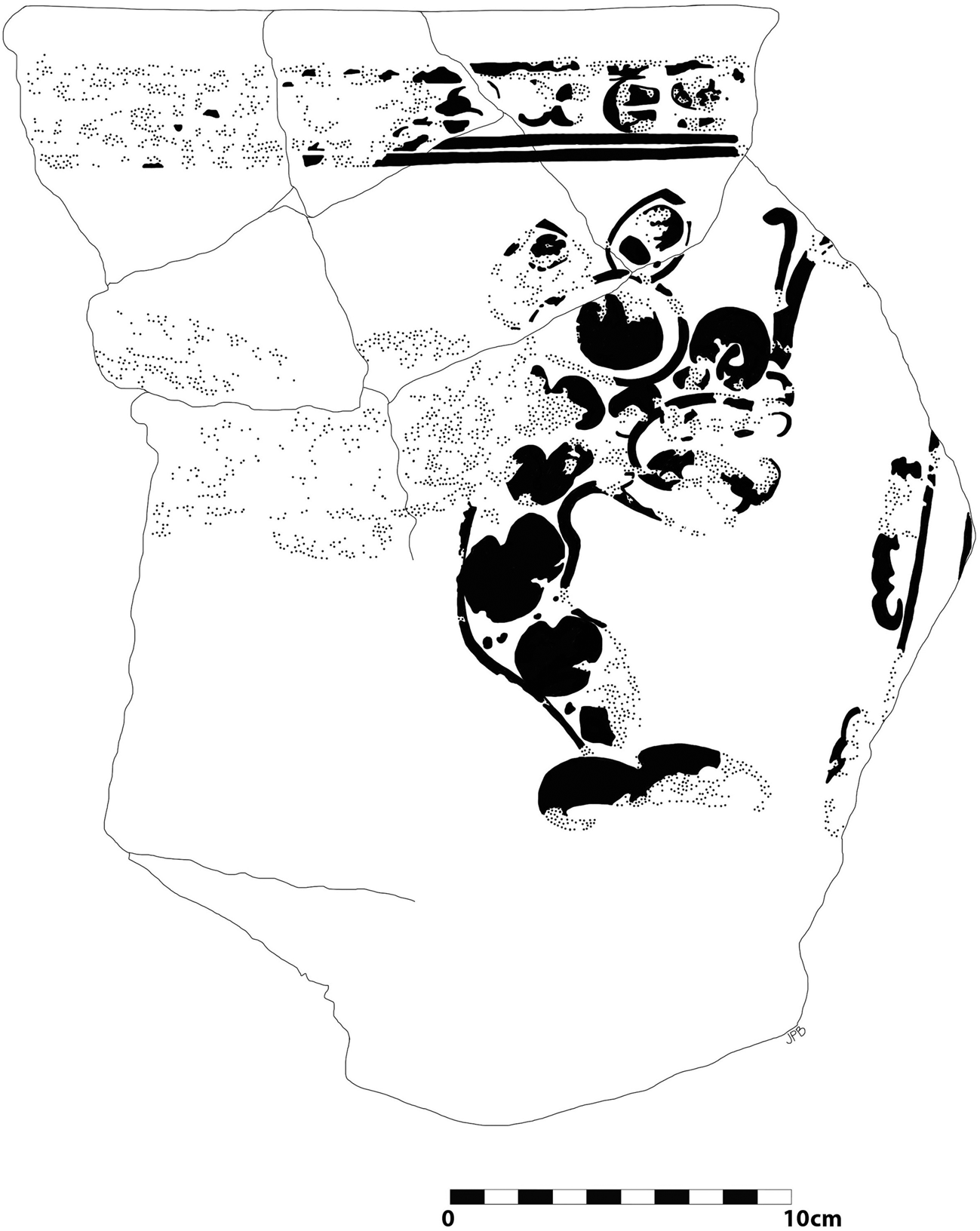
Renderings of water's contradictions, the intrigue it allows, make universal the potential dangers of too much or too little water. As just one example, a jaguar vessel placed in the northeastern corner of Structure 1 Room 2 hints at an awareness of this danger (Fig. 5). Jaguars are known for traversing the worlds (upper-middle-under) by lounging on tree branches over the water—the tree is the axis mundi that connects the middle and upper world to the watery underworld (Miller & Taube Reference Miller and Taube1993, 102). Valley of Peace Archaeology (VOPA) project epigrapher Joanne Baron identified opposing motifs on the vessel that are associated with darkness (ak'bal) and with yellow (k'an) (Lucero Reference Lucero and Lucero2014). In concert with these motifs are water signs—in this case, parallel lines with small dots or circles down the middle and spirals coming off. The opposition of the sun/daylight with darkness depicted on the jaguar vessel in association with water motifs during periods of drought and social upheaval suggests an acute awareness of the environmentally traumatic period. The deep turmoil caused by the shifting aqueous context shows its impact in the ambiguously blue cherts and the jaguar's limbs stretching along the branch, seemingly towards the reprieve of water.
Jaguar vessel. (Sketch: J. Baron. Courtesy of VOPA.)

Water as creator
But water does not just project or uproot meanings. It also facilitates connections, transforms materials and creates possibility. Remember the example of a sound home—myriad raw materials coming together in time and energy to create a house. At Cara Blanca, water creates that same integration. First, we look at ceramics. The prevalence of jars at Pool 1, which likely contained water, reaffirms the necessity of water in contributing to the maintenance of human and non-human relationships. Jars are most often used by Maya in ceremonies at portals because of their association with water and Chahk (Moyes et al. Reference Moyes, Awe, Brook and Webster2009). The percentage of jars at Structures 1 and 3 (72.11 per cent and 56.03 per cent, respectively) mirrors other ceremonial contexts associated with rain ritual (see Moyes Reference Moyes2001, 68–9). Yet even beyond water's ability to mould to the shape of these jars and be transported in them throughout the landscape, water allows for the jars’ creation. This highlights the continually unfolding dialogue between water and humans, and between water, fire, clay and temper. The negotiation occurs in two important ways: the creation of the vessels used in Cara Blanca rituals and their use at the pool. Maya ceramics were made with water, clay and some form of temper (sand, limestone, ash, etc.), and it is the integration of these distinct materials that, when treated with fire, transforms into the vessel that we see shattered on Structure 3 or left in supplication in Structure 1. It is only with the addition of water to fine particles of clay that these pots can be moulded into their narrow-orificed and large-bodied shape. Then it is only with the complete desiccation of the vessels through the firing process that the pots retain their shape. Their rounded bodies mirror the perfectly circular cenotes and the water that was probably transported within was that of the pools. Again, water is at once the thing being transformed and the necessary ingredient for transformation. These vessels were a material manifestation of the mutual engagement of water and people. The practices emerging from the Pool 1 space would have necessitated the continued relations of Pool 1 waters with human and non-human things and acted as a bridge between the aquatic and terrestrial realms of the landscape.
The Cara Blanca pools also worked to transform the built space. The use of materials that are formed in and by the water, such as tufa, integrated terrestrial and aquatic spaces. Through the tufa, water helped to build, define, and terminate the structure—an active participant in site formation. Water created the tufa the Maya used at Structure 1 and Structure 3. The still waters allowed for the calcium carbonate to precipitate on decomposing matter, which allowed for the creation of something from the loss of another—decomposition to creation, twig to detritus to tufa to construction fill. Water instigates and mediates this relationality through facilitation of tufa formation. Similarly, limestone—in the form of large boulders terminating Structure 3 and thick, finely formed plaster used throughout the space—shows a continued co-constitution of the space. Cara Blanca limestone formed over millennia primarily through the compression of skeletal materials from various marine specimens—coral, foraminifera and molluscs. The limestone is said to have ‘back-reef or lagoonal affinities’ (King et al. Reference King, Pope and Petruny2004, 297) and formed during the Cenozoic era. Thus, the limestone itself formed through Cenozoic waters. The calcium carbonate make-up of the limestone is easily eroded by acidic waters and in the 66 million years since the Cenozoic, the limestone bedrock has undergone transformation at the whim of the waters—tunnels have eroded into the bedrock forming the karst landscape that now underlies much of Belize. Weakness caused by those tunnels led to the collapse in bedrock that formed the Cara Blanca pools. The limestone that participated in the termination and construction of the space has a relationship with water that goes back millions of years—it is in fact the power of that Cenozoic era water that permitted construction in c. ad 700. Humans entered the dynamic relationship between water and limestone in order to create space for the water temple and Structure 3. Water allowed for the creation of this particular material articulation of the space. Today, water continues to orchestrate the space. As the water temple crumbles into the west side of the pool and consumes the pool's edges, the Cara Blanca assemblage continues to shift.
Water as mirror and window
The positioning of the structures surrounding Pool 1, the deepest of the pools, is not by chance. The water temple sits on the west side of Pool 1, facing the setting sun. Those participating in the space could have stood on the step on the northern edge of Structure 3 and been able to watch the moon overtake the sun. From the step, the Maya could have been in collusion with the watery reflection—the upperworld snuggled amongst the shifting skies. The Maya have often associated the moon, the largest participant of the night sky, with a water jar that holds, and periodically pours, rainwater (Moyes et al. Reference Moyes, Awe, Brook and Webster2009; Taube Reference Taube1992, 100). From moon to cenote to water jar, water worked to integrate the space. There is no doubt that the reflection of the water temple against a moonlit sky upon Pool 1's surface resonated within those feeling the weight of drought.
But the water was also a window into another space. Whether the water's surface was cloudy or clear, the step on the northern edge of Structure 3 offers insight into what is beneath. Mayan Tetra (Hyphessobrycon compressus), Northern Checkmark Cichlid (Chichlasoma intermedium) and Bay Snook (Pentenia splendida) are just some of the fish that explore the pool's depths (Larmon & Carbaugh Reference Larmon and Carbaugh2018). Trees emerge from the pool's floor with naked limbs stretching towards the surface. The pool is a window into submerged world. The position of the three human caches at Structure 3 shows how the Maya saw through the portal to the watery underworld. The Maya placed three human caches in an ascending line towards the southern edge of Pool 1. These individuals would have acted as a map to the underworld, guiding the way for those providing offerings into the cenote from the step on its northern edge. As visitors to the space traversed the platform from south to north, they approached the portal to meet these deities and their Ancestors at the pool's edge, pulling together and integrating ‘distinct’ worlds and peering through the window to the depths of the pool.
Water as movement
Movement of humans and otherwise was essential to the landscape's integration. Humans, ceramics, clay, soil—all moved through the landscape in watery processes of integration. Cara Blanca and its 25 pools probably comprised part of a ceremonial circuit, which was formalized and intensified in part as a response to rulers’ failures to secure rain during the Terminal Classic droughts (Larmon & Carbaugh Reference Larmon and Carbaugh2018; Lucero et al. Reference Lucero, Larmon and Carbaugh2017). The Maya travel along ceremonial circuits to connect significant places, in this case various pools; in so doing, they make explicit their relationship to that space (Vogt Reference Vogt1969, 89, 446). Because cenotes are considered portals to the underworld and a space in which Chahk resides, by reaffirming their relationship to this landscape the Maya were also strengthening their connection to and their ability to communicate with Chahk. The 25 pools of Cara Blanca are each active participants in this landscape. Each pool contributes to the vivacity of the landscape. Each pool is a life-giving force, quenching the thirst of those engaged in its web.
Perhaps one of the most potent movements of water at Cara Blanca was through steam. The Maya would probably have cleansed themselves in the M186 sweatbath before moving east to the Pool 1 space, as steam was believed to cleanse bodies for ritual. As participants sat in the sweatbath, the pool's water infiltrated their bodies, drenching their bodies’ hairs, seeping into their skin and coating their airways. The steam washed away their homeland's resins and allowed them to be resolutely there, with the Pool 1 waters. Water's changing of forms from rain, to pool water, to steam, to rain exemplifies the regeneration and fluorescence of the landscape—with or without humans. Within the Maya circuit, water moves from pool, to pot, to sweatbath, to body, to sky, disintegrating the boundary between bodies and merging each of them to one another.
Boundaries are further disintegrated at the pools with the presence of a plethora of foreign styles of pots (see Table 1), which might suggest that people brought vessels or sherds to Cara Blanca from distinct homelands. Connecting sacred spaces to various homelands was not uncommon (see Moyes Reference Moyes2001, 75). Pool 1 visitors no doubt brought connections to their home and community in the form of ceramic to connect the renewal at Pool 1 to distinct homelands. When Maya brought ceramics from different regions to Cara Blanca, the space transformed into one that incorporates or remembers different communities or households and, therefore, connects the ‘distinct’ locales. Concepts of chronological and spatial distance are interrogated as heirloom and foreign pieces are witnessed in the Cara Blanca space, tying it to distant places and times. The vessels were probably formed with materials from these various spaces (though sourcing analyses are needed to corroborate this), including waters. The waters formed the landscape by moving through the porous karst and eroding away seemingly material boundaries, eventually forming the landscape we see today. The movement of water-filled and -formed ceramics performed a similar task above ground. Non-local ceramic moved throughout the landscape, connecting one's local source of water to the rituals being performed at Cara Blanca—a kinetic tentacle extending through diverse geographies. Water fuelled these relations, which became trans-scalar (connecting local and regional) and trans-dimensional (connecting the aquatic, the terrestrial and the cosmic) (e.g. Pauketat Reference Pauketat, Alt and Pauketat2019b, 268).
Pool 1 was a potent place—but it is only one of 25 pools, many of which are likely to have involved a ceremonial circuit (Larmon & Carbaugh Reference Larmon and Carbaugh2018; Lucero et al. Reference Lucero, Larmon and Carbaugh2017). For the Maya, Cara Blanca was vibrant, animated, and impactful. Each of these portals offered sustenance at all levels to those visiting the pools—the eastern pools are surrounded by swamps and thick stands of red mangrove. During the rainy season, it is likely that there were fewer Maya visitors to this space as the Pool 1 waters have been overflowing the pool's edges and enveloping the base of the construction, leaving the impression that the temple itself is floating on the pool. Yet, even throughout the dry season, the easternmost pools are completely inundated (Larmon & Carbaugh Reference Larmon and Carbaugh2018). Maya ritual practices were often seasonal, many oriented around agricultural productivity and the rainy season (Scarborough Reference Scarborough1998; Vogt Reference Vogt and Benson1981, 136). As Maya relationships with water shifted throughout the year, so too would their experiences with Cara Blanca waters. The pools’ waters filter together, blanketing the landscape and weighing heavy on those who choose to traverse through. Kinesis, as any entity and assemblage, is not a stable force, but rather one that ebbs and flows within its context. To go back to the analogy of a symphony, musical pieces and those performing them are most affective when they are dynamic—sinking into calls for pianissimo and emerging from softness with swells of fortissimo.
Let us think only of the movement of matter and the possibility afforded by water. During the Terminal Classic droughts, the pools’ water fed the landscape and each entity within. These waters were the very substance that pulled that landscape together. In times of plenty, the land surrounding the pools flooded, radiating from the westernmost pool and materially integrating and territorializing the landscape. But even in periods of desiccation when flooding was minimal, small tributaries connected the flow between some pools; others are connected via underground flows where water travels through the porous limestone. Water's constant movement through this landscape keeps it alive. And it is not without import that this water sustains its depth in the driest of times, offering itself to surrounding beings. Steam, emerging from the water of Pool 1 in the sweatbath, cleansed bodies and rose to the sky, traversing the plains as it shifted between water's many forms—rain, vapour, sweat, condensation. The architecture is contingent upon water's position. Understanding Cara Blanca in this way—a landscape caused by water's kinesis—does not discount the ancient Maya ontological position: that they were engaged in these ceremonial processions sheds light on an essential understanding of the landscape and its cultural contingency. But it extends beyond a singular understanding and experience of the space. To see water as the mechanism allowing for the possibility of this ancient Maya materialization of the landscape to actualize permits us to consider water's rights to and in the landscape. Within that consideration, certainly human rights, particularly Maya rights, are included.
Concluding remarks
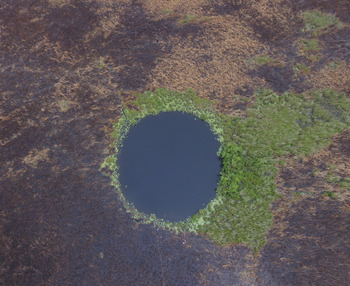
During the prolonged droughts of the Terminal Classic period, less rain made possible the context within which movement of beings throughout a landscape was integrative. Structure 1 was built by the Maya, but its origins can be attributed to the 62+ m deep pool upon whose edge it sits. The Maya understood the pool as a place of liminality and creation, a point preempted by New Materialist understandings of water. The Cara Blanca waters are indeed points of creation and life—the probable instigation for this Maya belief. In periods of desiccation and water-related turmoil, these waters fuelled the landscape, sustained its inhabitants and fostered growth. This point is perfectly exemplified by the role nearby Pool 25 played in fending off flames of a recent fire (Fig. 6)—notice that the pool fed the thirsty landscape and some patches of green were able to thrive amongst the charred remains. What we need to understand here, then, is not just the ways that human groups used a space, but the ways that the watery landscape orchestrated its own use.
Pool 25. (Photograph: courtesy of VOPA.)

How does such an understanding of water change our experience of the space? We now are forced to reconsider the space as inherently blurring the lines of natural and cultural—if water is the mediator, we cannot consider even the Pool 1 structures themselves as ‘cultural’ constructions. The Terminal Classic life history of Cara Blanca was not caused by the Maya or Maya understandings of water, but rather by the material implications of the water itself. Water was the orchestrator, the mediator, the facilitator of a space that held particular sacred implications for the Maya through the material rendering of their universe: architecture, artifacts, open space and movement. As the Maya visited this space from various regions, they became embedded in the landscape that was territorialized by the waters. The hydrological and social relations, human and not, were truly mutually constituted and the significance of the space is born from that kinetic energy.
Earlier, I mentioned that such a view has implications for environmental justice. In seeking that justice, the human and non-human must be integrated; failure to do so ‘leads down a path that is morally questionable, carries high risks, and is intellectually problematic’ (Strang Reference Strang2017, 259). This deprioritization frames my approach to environmental justice in forthcoming works. Just as water was both mirror and window for the ancient Maya, it can be for all of us, today. Water offers our reflection, showing us the ways in which we continuously put ourselves (humans) in focus. As a window, water allows us a vantage-point into an other-oriented ontology—one that, as we peer in, makes the boundaries surrounding the human less defined; our image becomes tangled in webs of sprawling vegetations, downed trees, schools of fish and unsettled particles. Let us consider those people whose world grew from the dark waters of the underworld into the expansive and creative lowland Maya of the Classic period. At Cara Blanca, the Maya material world—water temples and ceramic pots, ceremonial circuits, constructed spaces and the space in between—was born in the context of water's status as all-consuming and yet all too scarce. The landscape's cycles of inundation and desiccation fed the continued kinesis of the late Terminal Classic Cara Blanca and continue to do so today.
Acknowledgements
I would like to thank the anonymous reviewers for very thoughtful comments on the previous draft of this paper. Their comments surely made the paper better and gave me fodder for future publications. I would also like to thank Lisa Lucero, Tim Pauketat, Erin Benson, Aimée Carbaugh and Annie Larmon for their insightful comments on previous drafts of this paper. It surely would not be what it is today without such great minds. Finally, I would like to thank author Richard Powers, whose prose offers inspiration for ecocentric studies and whose work is a revelation.