


The translation of genetic information to proteins forms the basis for most metabolic processes in the body. When these molecules are required, genes are transcribed first to the corresponding messenger ribonucleic acids (mRNAs) and then translated to their protein counterparts. Additional protein diversity is introduced by subsequent processes of post-translational modification (e.g. phosphorylation, glycosylation), resulting in the biological phenotype. This process of transcription, translation and post-translational modification is variable, depending on genetic predispositions and environmental interactions. Thus, the previous notion that one gene results in one protein no longer holds true. Indeed it has been estimated that, if the human genome contains 30 000 expressed genes, there may be the potential to express as many as one million different proteins. Bearing this in mind, the prospect of identifying what is now termed the ‘proteome' (the protein complement of a genome (Reference Wasinger, Cordwell and Cerpa-PoljakWasinger et al, 1995)) is daunting. Fortunately, the birth of ‘proteomics', an umbrella term encompassing the many tools available to investigate proteins expressed within cells, fluids, tissues or organisms, has made this task more manageable. These proteomic methods have the power to display and quantify the functional expression of genes, enabling the measurement of disease-associated or phenotypic changes in proteins.
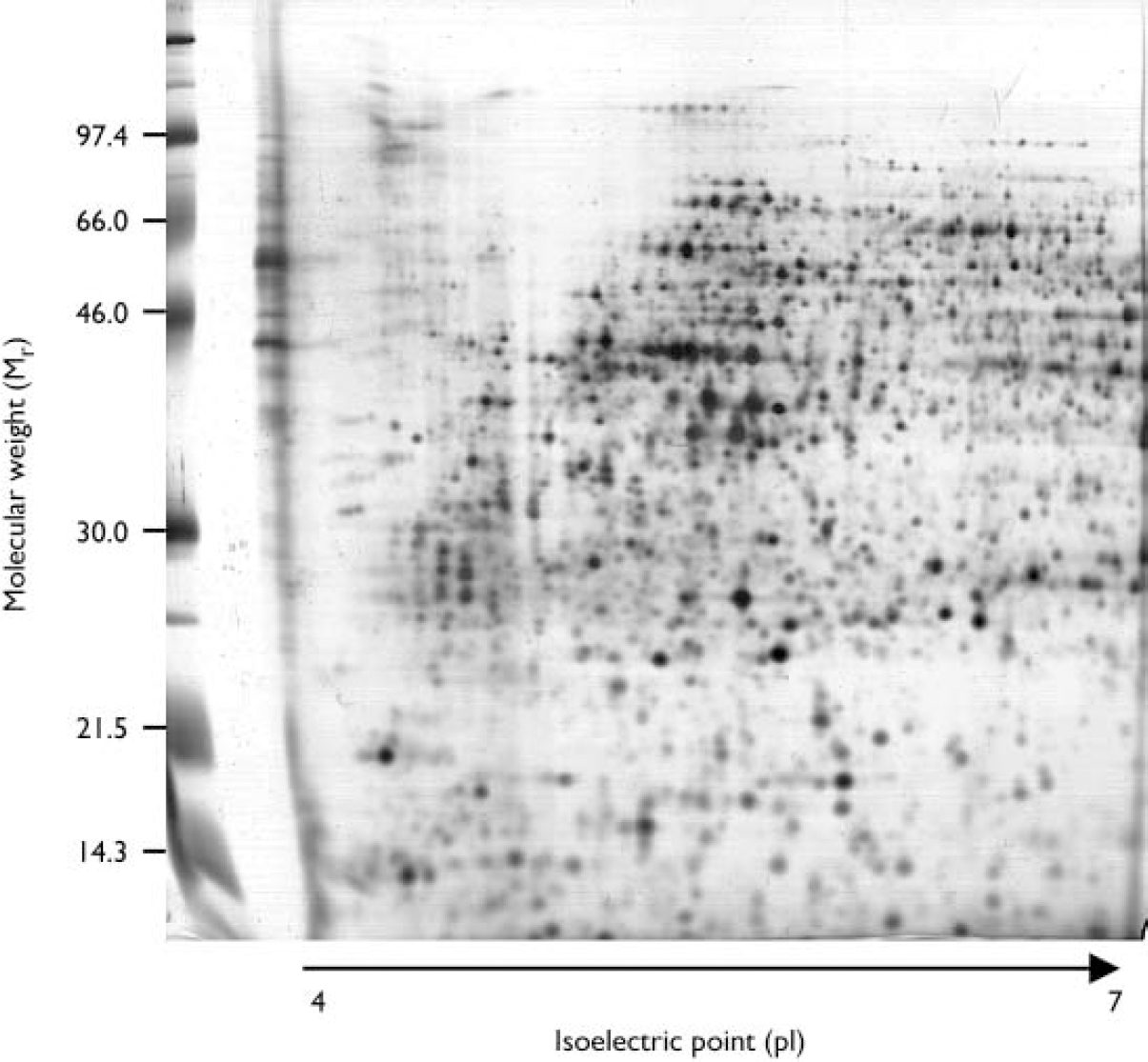
Two-dimensional gel (18 × 20 cm) of post-mortem brain tissue. Grey matter was removed from the dorsolateral prefrontal cortex (∼100 mg) and homogenised. Extracted proteins were subsequently separated by isoelectric point in the first dimension and molecular weight in the second dimension.
Proteomic studies thus have the potential to provide important insights into our understanding of psychiatric, neurodegenerative and neurological diseases. For example, by identifying alterations in protein expression in post-mortem brain they can provide new insights into the cellular mechanism underlying diseases such as schizophrenia. Likewise, by characterising disease-associated protein profiles in sera they may be able to identify and quantify proteins that serve as diagnostic or prognostic markers. Furthermore, proteomic investigation of the effects of pharmaceutical agents in vitro may help us to identify new therapeutic pathways. In this context, it is of interest to discuss how exactly these ‘proteomic' techniques might be relevant to a psychiatric disease, for example, schizophrenia. Schizophrenia, with its early developmental and later degenerative/atrophic components, is a particularly complex disorder. We know that multiple, largely unidentified genetic (Reference Weinberger, Egan and BertolinoWeinberger et al, 2001) and environmental (Reference Cannon, Kendell, Susser, Murray, Jones and SusserCannon et al, 2003) risk factors interact to lead to disease and disease progression (Reference Thompson, Vidal and GieddThompson et al, 2001). However, the underlying functional changes at the cellular level remain unknown. This is where the strength of a proteomics approach lies, allowing one to identify, quantify and compare the levels of thousands of proteins. The main methods encompassed within this term can be broadly described as those using two-dimensional gel electrophoresis and those using non-gel-based methods to separate and identify proteins in a complex mixture, such as a whole cell or tissue lysate.
GEL-BASED PROTEOMIC METHODS
Gel-based methods are the most commonly used and well-defined techniques in the proteomic world, having been around since the mid-1970s (Reference O'FarrellO'Farrell, 1975). Briefly, two-dimensional gel electrophoresis involves the separation of solubilised proteins in the first dimension according to their charge (isoelectric point, pI), followed by their separation in the second dimension by sodium dodecyl sulphate-polyacrylamide gel electrophoresis (SDS-PAGE), according to their relative molecular mass (Mr). The resulting protein ‘maps' can then be compared using image analysis software and subsequent statistical analysis to identify protein spots of interest (Fig. 1). In addition, a mass spectrometry approach, for example matrix-assisted laser desorption/ionisation mass spectrometry, which measures peptide masses based on their mass-to-charge ratio, generates spectra that can be used to search for correlating protein identities in sequence databases. These techniques and the newer two-dimensional fluorescence difference gel electrophoresis method, which allows two samples labelled with different fluors to be resolved on the same gel, have been used in post-mortem studies of human brain tissue in schizophrenia, bipolar disorder and major depression (Reference Edgar, Schonberger and DeanEdgar et al, 1999; Reference Johnston-Wilson, Sims and HofmannJohnston-Wilson et al, 2000; Reference Prabakaran, Swatton and RyanPrabakaran et al, 2004).
A recent study investigated schizophrenia using post-mortem brain tissue at the transcriptome, metabolome and proteome level (Reference Prabakaran, Swatton and RyanPrabakaran et al, 2004). This approach highlights the complementary role of proteomics in validating and providing additional information on post-translational processing to transcriptomic investigations. Two-dimensional fluorescence difference gel electrophoresis was used to compare protein expression in prefrontal cortical tissue taken from 10 controls and 10 individuals with schizophrenia. The combined findings strongly suggest a mitochondrial dysfunction within this area of the brain in schizophrenia. Proteomics was invaluable in leading to this conclusion, with almost 50% of the differentially expressed proteins being associated with mitochondrial function or oxidative stress. In support of this, our recent two-dimensional gel electrophoresis study of the anterior cingulate cortex in schizophrenia, bipolar disorder and major depression also revealed abnormal expression of many proteins with roles in metabolism and mitochondrial function (Reference Pennington, Beasley and DunnPennington et al, 2004).
NON-GEL-BASED PROTEOMIC METHODS
Gel-based methods have fundamental limitations due to their inability to represent the whole proteome. For example, although brain tissue is the most complex tissue in the body with regard to heterogeneity of protein content, the average two-dimensional gel can resolve only a few thousand proteins, and many of these represent different post-translationally modified forms of a much smaller number of gene products. Alternative approaches avoid the use of gels altogether by combining liquid chromatography and mass spectrometry. In these ‘shotgun' proteomics approaches, the sample is separated by one or more dimensions of liquid chromatography to reduce the complexity of peptide fractions. These are subsequently introduced into a tandem mass spectrometer for sequence-based identification. Such techniques can hypothetically cope better with complex samples than the gel-based methods, have a higher throughput and generate data faster. However, these approaches cannot distinguish between different forms of the same protein due to processes such as post-translational modification. In addition, stable isotope labelling methods must be combined if differential quantitative analysis of two populations of proteins is needed. The most widely used isotope-coded affinity tag method can distinguish between two protein populations, for example disease v. control, where there is a ‘light' reagent tag and a ‘heavy' reagent tag to label total tryptic peptides generated from the two samples. The combined sample then undergoes single or multi-dimensional chromatography, and resultant peptide mass peaks from mass spectrometry clearly show the two samples separated by the mass of the two tags, allowing relative quantitation. This method has been used to study changes in protein expression in a cortical neuron cell culture undergoing DNA damage-induced death, where 150 proteins were identified and quantitated (Reference Johnson, Yu and ConradsJohnson et al, 2004). Forty-five per cent of these had altered expression in the damaged neurons; validation was carried out for 14 of these, mostly cytoskeletal proteins and those involved in energy production and oxidative stress, using Western blots and immunohistochemistry.
In addition, there is much interest in the development of antibody and protein arrays for quantitative expression profiling, but considerable work remains to be carried out before this approach can be routinely used in proteomic investigations (Reference CutlerCutler, 2003). One chip-based method that has already had a major impact on the discovery of potential biomarkers, especially in cancer research, is surface-enhanced laser desorption ionisation (SELDI) coupled with time-of-flight mass spectrometry (Reference Petricoin, Ardekani and HittPetricoin et al, 2002). In this approach a small volume of a liquid sample, typically a body fluid such as serum, plasma or urine, is spotted onto a chemically modified surface of a special target. Using this approach it is possible to rapidly screen large numbers of samples to detect disease-associated proteins, but a major disadvantage is that it provides no direct information on the identities of these components. Nevertheless, this identification may not be required. For example, using bioinformatics, Petricoin et al (Reference Petricoin, Ardekani and Hitt2002) used SELDI mass spectral patterns to discriminate normal serum samples from samples taken from patients with early ovarian cancer. Identification of disease occurred in nearly 100% of cases. However, re-analysis of these data has led to a questioning of the validity of this technique (Reference CheckCheck, 2004) and has raised many methodological issues that need clarification before the technique can be applied to the investigation of neurological and psychiatric disorders.
CREATING A SUB-PROTEOME
It is of interest to fractionate samples at the cellular and sub-cellular level to increase proteomic coverage so that specific and less abundant subsets of the total proteome can be analysed. Laser-assisted micro-dissection allows the isolation of regions of interest that cannot be dissected by the naked eye, for example a sub-region of the hippocampus. This method has been successfully applied to the investigation of pancreatic cancer by Shekouh et al (Reference Shekouh, Thompson and Prime2003) who removed tumour cells from surrounding tissue and performed two-dimensional gel electrophoresis and mass spectrometry identifying a novel tumour-associated protein, S100A6.
The sub-fractionation of homogenised brain samples allows isolation of membrane, mitochondrial or nuclear proteins. In addition, proteins can be isolated that have undergone specific post-translational modifications, such as phosphorylated proteins. When combined, such techniques result in decreased sample heterogeneity and thus increase the likelihood of gaining information about proteins of potential interest.
WHICH SAMPLES CAN WE USE?
Most proteomic research into psychiatric disorders has focused on the comparative analysis of post-mortem brain tissue. This tissue has limitations in terms of differentiating primary and secondary pathology. Therefore, other tissues must also be investigated in order to obtain a fuller picture of disease-associated changes in protein profiles. Fortunately, proteomic techniques can be applied to whatever sample is of interest, for example animal models and drug action effects in vitro. Furthermore, with the advent of the fractionation techniques described previously, it will also be possible to study cerebrospinal fluid (CSF) or plasma and serum samples, fluids containing several high-abundance proteins of little interest, such as albumin. In addition to providing insights into the disease process, studying CSF using proteomic methods may allow researchers to gain further insights into drug action and effect. A two-dimensional gel study looking at the CSF of individuals with schizophrenia found an average 21% decrease in the number of proteins detected in those receiving haloperidol compared with CSF from the same individuals after withdrawal of treatment (Reference Johnson, Brane and van KammenJohnson et al, 1992).
The role of proteomics in psychiatric research is clear. It provides researchers with a set of tools to help validate and expand on both genetic and epigenetic studies in order to explore further the pathogenesis of disease. As this holistic approach is largely non-hypothesis based, it should reveal aspects of abnormal function previously inaccessible to researchers. In addition, from a clinical viewpoint, diagnostic biomarkers may be revealed through analysis of serum or CSF. These biomarkers will hopefully facilitate the identification of those at risk of psychosis, and treatment response may also be predicted. We look forward to the clinical improvements that should follow the application of proteomic methods to psychiatric and neurological disorders.
Acknowledgements
We thank the Stanley Foundation Brain Consortium, The Wellcome Trust, the National Alliance for Research (in Schizophrenia and Affective Disorder), and Science Foundation Ireland for funding.




eLetters
No eLetters have been published for this article.