1. Preliminaries
1.1 Soft sets
The usual set is merely a collection of objects. But, in some situations, we need that collection to be parameterized. The need for such a parameterized collection motivated Molodtsov to introduce soft set theory in Molodtsov (Reference Molodtsov1999). Soft set theory is considered a mathematical tool that deals with objects that are not defined in a definite way. Such objects can be found in complicated mathematical problems in economics and engineering applications when classical mathematical tools cannot be used due to the uncertainties associated with such problems. There are already existing mathematical tools for dealing with uncertainty in mathematical problems, such as the use of probability theory (Jaynes Reference Jaynes2003), fuzzy set theory (Zadeh Reference Zadeh1965) and interval mathematics (Gorzałczany Reference Gorzałczany1987). However, those three mathematical tools have their own shortcomings that the use of soft set theory overcomes as argued in Molodtsov (Reference Molodtsov1999).
Due to the unique properties of soft set theory that allow it to be more suitable in certain situations compared to the other mathematical tools mentioned above, it is often a major mathematical tool used in decision-making problems as in Maji et al. (Reference Maji, Roy and Biswas2002) and Feng et al. (Reference Feng, Li and Leoreanu-Fotea2010). Soft set theory, when combined with fuzzy set theory (Zadeh Reference Zadeh1965) can be used in decision-making as in Yang et al. (Reference Yang, Tan and Meng2013) and Peng et al. (Reference Peng, Yang, Song and Jiang2015), and also used in forecasting problems as in Xiao et al. (Reference Xiao, Gong and Zou2009). There are also some applications of soft set theory in algebraic structures as in Acar et al. (Reference Acar, Koyuncu and Tanay2010), Aktaş and Çağman (Reference Aktaş and Çağman2007), and Jun and Park (Reference Jun and Park2008). When soft set theory is combined with rough set theory Pawlak (Reference Pawlak1982), we get new approximation spaces with interesting properties (Shabir et al. Reference Shabir, Ali and Shaheen2013).
Topological spaces are introduced for soft sets (Shabir and Naz Reference Shabir and Naz2011), and some of the properties associated with soft topological spaces are explored in Nazmul and Samanta (Reference Nazmul and Samanta2013). Several soft separation axioms were defined and studied in El-Shafei et al. (Reference El-Shafei, Abo-Elhamayel and Al-Shami2018) and the further applications of those soft separation axioms are explored in El-Shafei and Al-Shami (Reference El-Shafei and Al-Shami2020) and Al-shami (Reference Al-shami2021). Soft separation axioms are of importance in soft topological spaces as shown in the existing literature, much like how classical separation axioms have played a key role in the classification and the understanding of classical topological spaces. In this paper, we will define and explore further soft separation axioms for soft topological spaces. We also define the computable versions of these soft separation axioms and investigate their properties in an effective setting. This paper is intended to investigate how computability interacts with soft topological spaces and soft separation axioms. Hence, we will compare the various principles that arise by considering computable separation axioms in the soft setting.
The paper is organized as follows. In Section 1.2, we recall some basic notions of soft sets and soft topological spaces as defined in the literature. In Section 1.3, we briefly recall some notation and definitions that we will require from computable analysis, including computable topological spaces and computable separation axioms that were studied in the literature. In Section 2, we define a new separation axiom for soft topological spaces, called u-soft separation, and give some of its basic properties. In Section 3, we define and study computable u-soft separation axioms for computable soft spaces, and in Section 4, we define and study various computable p-soft separation axioms. Finally in Section 5, we compare the various principles introduced in Sections 3 and 4.
1.2 Soft topological spaces
In this section, we recall some definitions and results of soft set theory and soft topological spaces. This section is meant to provide a self-contained introduction to the basics and background of soft set theory. The initiated reader may skip ahead to Section 1.3.
Note: We would like to mention that soft topological spaces
 $(\widetilde{X}, \tau, E)$
can be viewed as general topological spaces on
 $E \times X$
as Matejdes pointed out in Matejdes (Reference Matejdes2021). Matejdes mentioned that not all counterparts of soft concepts are studied in general topology. In this article, we prefer to stick to the setting in which soft topological spaces are defined as this setting is widely used in the literature regarding soft topological spaces and even the applications—look at those applications mentioned in the introduction—of soft topological spaces used the same setting.
1.2.1 Basics of soft sets
Definition 1.1. (Molodtsov Reference Molodtsov1999) A pair (G, E) (usually denoted as
 $G_E$
) is called a soft set over a universe X if G is a map from the nonempty parameter set E into
 $2^X$
. We usually identify
 $G_E = \{(e, G(e)): e \in E$
and
 $G(e)\subseteq X\}$
.
 $S(X_E)$
denotes the set of all soft sets over X with respect to the parameter set E. The relative complement of
 $G_E$
is denoted by
 $G_E^c$
, where
 $G^c: E \rightarrow 2^X$
is defined by
 $G^c(e) = X \setminus G(e)$
. Where the context is clear we do not refer to the universe X. A soft set
 $G_E$
is finite if, for every parameter e, the corresponding set is finite.
Definition 1.2. (Maji et al. Reference Maji, Roy and Biswas2002; Pei and Miao Reference Pei and Miao2005) Soft union and soft intersection are taken parameter-wise. For two soft sets
 $G_{E_1}, H_{E_2}$
over X, their soft union,
 $G_{E_1} \bigcup H_{E_2}$
, is the soft set
 $F_{ E_1 \cup E_2}$
where
 $F: E_1 \cup E_2 \rightarrow 2^X$
is defined as follows
 \[F(e) = \begin{cases} G(e), & \textrm{if } e \in E_1 - E_2, \\ H(e), & \textrm{if } e \in E_2 - E_1, \\ G(e) \cup H(e), & \textrm{if } e \in E_1 \cap E_2.\end{cases}\]
The soft intersection
 $G_{E_1} \bigcap H_{E_2}$
is the soft set
 $I_{E_1 \cap E_2}$
where
 $I(a) = G(a) \cap H(a)$
for every
 $a\in E_1 \cap E_2$
.
Given
 $x\in X$
and a soft set
 $G_E,$
there are four ways one can define membership or non-membership:
Definition 1.3. (El-Shafei et al. Reference El-Shafei, Abo-Elhamayel and Al-Shami2018;Molodtsov Reference Molodtsov1999) For a soft set
 $G_E \in S(X_E)$
and
 $x \in X$
, we say that
•
 $x \in G_E$
if
$x\in G(e)$
for each
$e\in E$
.
•
$x \notin G_E$
if
$x \notin G(e)$
for some
$e\in E$
.•
$x\Subset G_E$
if
$x\in G(e)$
for some
$e\in E$
.•
$x \not\Subset G_E$
if
$x\notin G(e)$
for each
$e\in E$
.


Hence,
 $\in$
and
 $\not\Subset$
are “strong” membership and non-membership, respectively. Depending on the version of membership that one uses, the usual set-theoretic operations might or might not be compatible:
Proposition 1.4. (El-Shafei et al. Reference El-Shafei, Abo-Elhamayel and Al-Shami2018) For two soft sets
 $G_E \textrm{ and } H_E$
in
 $S(X_E) \textrm{ and } x\in X$
, we have the following,
(1) If
$x \in G_E$
, then
$x \Subset G_E$
.(2)
$x \not \Subset G_E \textrm{ if and only if } x\in G_E^c$
.(3)
$x \Subset G_E \bigcup H_E \textrm{ if and only if } x \Subset G_E \textrm{ or } x \Subset H_E$
.(4) If
$x \Subset G_E \bigcap H_E \textrm{, then }x \Subset G_E \textrm{ and } x \Subset H_E$
.(5) If
$x \in G_E \textrm{ or } x \in H_E \textrm{, then } x \in G_E \bigcup H_E$
.(6)
$x \in G_E \bigcap H_E \textrm{ if and only if } x \in G_E \textrm{ and } x \in H_E$
.







Definition 1.5. (El-Shafei et al. Reference El-Shafei, Abo-Elhamayel and Al-Shami2018; Maji et al. Reference Maji, Roy and Biswas2002) A soft set
 $G_E$
over X is said to be:
• A null soft set if
$G(e) = \emptyset$
for each
$e\in E$
. It is denoted by
$\widetilde{\emptyset}$
.• An absolute soft set if
$G(e) = X$
for each
$e\in E$
. It is denoted by
$\widetilde{X}$
.• A stable soft set if for some
$M\subseteq X$
we have
$G(e) = M$
for each
$e \in E$
.


There are two different ways one can define a point, either as a soft singleton or as a soft point:
Definition 1.6. (Ali et al. Reference Ali, Feng, Liu, Min and Shabir2009; Shabir and Naz Reference Shabir and Naz2011) The soft set
 $x_E$
(called a soft singleton) is defined by
 $x(e) = \{x\}$
for each
 $e\in E$
. A soft point, denoted by
 $p_e^x$
, is the soft set
 $P_E$
where
 $P(e) = \{x\}$
and
 $P(k) = \emptyset$
for each
 $k\in E\setminus \{e\}$
.
Definition 1.7. (Pei and Miao Reference Pei and Miao2005) A soft set
 $G_{E_1}$
is a soft subset of a soft set
 $H_{E_2}$
, denoted by
 $G_{E_1} \subseteq H_{E_2}$
, if
•
$E_1 \subseteq E_2$
, and•
$\forall e\in E_1$
,
$G(e) \subseteq H(e)$
.


Two soft sets are soft equal if each one of them is a soft subset of the other.
Definition 1.8. (Peyghan Reference Peyghan2013) The Cartesian product of two soft sets
 $F_A \textrm{ and }I_B$
, denoted by
 $(F \times I)_{A \times B}$
over universes
 $X\textrm{ and } Y$
, respectively, is defined as
 $(F\times I)(a, b) = F(a) \times I(b)$
, for each
 $(a, b) \in A\times B$
.
1.2.2 Soft topological spaces
The study of soft topological spaces was initiated in Shabir and Naz (Reference Shabir and Naz2011). We quickly recall some of the definitions and results of soft topological spaces.
Definition 1.9. (Nazmul and Samanta Reference Nazmul and Samanta2013; Shabir andNaz Reference Shabir and Naz2011) A collection
 $\tau$
of soft sets over a universe X w.r.t. a parameter set E is said to be a soft topology on X if the following conditions are satisfied,
(1)
$\widetilde{X}, \widetilde{\emptyset}\in \tau.$
(2)
$\tau$
is closed under finite intersections.(3)
$\tau$
is closed under arbitrary unions.


The triple
 $(X, \tau, E)$
is called a soft topological space, or STS. Members of
 $\tau$
are called soft open sets. A soft set is soft closed if its complement is soft open. The closure of
 $H_E$
, denoted by
 $\overline{H_E,}$
is the intersection of all soft closed sets containing
 $H_E$
.
 $p_e^x$
is called a soft limit point of
 $G_E$
if
 $[F_E\setminus p_e^x] \bigcap G_E \neq \widetilde{\emptyset}$
, for each soft open set
 $F_E$
containing
 $p_e^x$
.
Let Y be a nonempty soft subset of an STS
 $(X, \tau, E)$
parameterized by E.
 $\tau_Y = \{\widetilde{Y} \bigcap G_E: G_E \in \tau\}$
is said to a soft relative topology on Y, and the triple
 $(Y, \tau_Y, E)$
is a soft subspace of
 $(X, \tau, E)$
.
Fact 1.10. (Shabir and Naz Reference Shabir and Naz2011
) Given an STS
 $(X, \tau, E)$
and
 $e\in E$
,
 $\tau_e = \{G(e): G_E \in \tau\}$
forms a topology on X (classically).
Theorem 1.11. (Peyghan Reference Peyghan2013) Let
 $(X, \tau, A)$
and
 $(Y, \theta, B)$
be two STSs. Let
 $\Omega = \{G_A \times F_B: G_A \in \tau \textrm{ and } F_B \in \theta \}$
. Then, the family of all arbitrary unions of elements of
 $\Omega$
is a soft topology on
 $X \times Y$
.
Note: In the previous theorem, if
 $\tau$
is seen as a topology on
 $A \times X$
and
 $\theta$
as a topology on
 $B \times Y$
, then the result is just the product topology on
 $A \times B \times X \times Y$
.
We now recall the partial soft separation axioms based on the partial membership
 $(\!\Subset\!)$
and strong non-membership
 $(\!\not \Subset\!)$
relations:
Definition 1.12. (El-Shafei et al. Reference El-Shafei, Abo-Elhamayel and Al-Shami2018) An STS
 $(X, \tau, E)$
is said to be:
• p-soft
$T_0$
if for every two distinct
$x, y \in X$
, there exists a soft open set
$G_E$
such that
$x\in G_E \textrm{ and } y \not \Subset G_E$
, or
$y\in G_E \textrm{ and } x \not \Subset G_E$
.• p-soft
$T_1$
if for every two distinct
$x, y \in X$
, there exist soft open sets
$G_E$
and
$F_E$
such that
$x\in G_E, y \not \Subset G_E, y \in F_E$
and
$ x \not \Subset F_E$
.• p-soft
$T_2$
if for every two distinct
$x, y \in X$
, there exist disjoint soft open sets
$G_E$
and
$F_E$
such that
$x \in G_E$
and
$y \in F_E$
.• p-soft regular if for every soft closed set
$H_E$
and
$x \in X$
such that
$x \not \Subset H_E$
, there exist disjoint soft open sets
$G_E$
and
$F_E$
such that
$H_E \subseteq G_E$
and
$x \in F_E$
.









Note that two soft sets are disjoint if their soft intersection is
 $\widetilde{\emptyset}$
.
The following well-known fact about
 $T_1$
spaces holds in the p-soft setting:
Theorem 1.13. An STS
 $(X, \tau, E)$
is a p-soft
 $T_1$
space if and only if
 $x_E$
is soft closed, for all
 $x \in X$
.
1.3 Basics of computable analysis
1.3.1 Type-2 theory of computability
Turing provided (Turing et al. Reference Turing1936) in his pioneering work in 1936 an abstract model of a Turing machine. This is a central notion in the study of computability theory. In classical computability theory, we deal with natural numbers and the domain and co-domain of computable functions are subsets of the natural numbers
 $\mathbb{N}$
. However, in the study of effective analysis, we are often concerned with potentially uncountable objects such as subsets of real numbers, sets of functions, etc. In order to apply the tools of classical computability, we will need to “encode” these objects by means of names. Through systems of notations and representations in which the objects of study are represented as finite or infinite sequences of natural numbers, we can make sense of the notion of a computation in which these names can be used as an input or the output of a computation.
Computable analysis has provided us with a formal framework in which we can conduct investigations of computability in the realm of analysis and topology. We introduce the notations that will be used throughout the paper. The reader is referred to Weihrauch (Reference Weihrauch2000, Reference Weihrauch2012) for more details and background. Let
 $\Sigma$
be a finite set of symbols that contains 0 and 1. The set of all finite words over
 $\Sigma$
is denoted by
 $\Sigma^*$
, and the set of all infinite sequences over
 $\Sigma$
is denoted by
 $\Sigma^{\omega}$
where
 $q \in \Sigma^{\omega}$
means that
 $q : \mathbb{N} \rightarrow \Sigma$
and we write
 $q = q(0)q(1) \cdots$
, and
 $|w|$
denotes the length of
 $w \in \Sigma^*$
.
 $q^{<i} \in \Sigma^*$
represents the initial segment of length i of
 $q \in \Sigma^{\omega}$
and
 $ w \sqsubseteq q$
means that w is a prefix of q.
We use the wrapping function
 $\iota : \Sigma^* \rightarrow \Sigma^*$
, where for example, for
 $a, b, c, d, e \in \Sigma$
,
 $\iota(abcde) = 110a0b0c0d0e011$
to encode the concatenation of finite strings of any length in a way which can be effectively decoded. For instance, we cannot recover
 $\sigma$
and
 $\tau$
from
 $\sigma\tau$
but we can do so from
 $\iota(\sigma)\iota(\tau)$
. We fix the pairing function on the set of natural numbers as
 $\langle i, j \rangle = \frac{(i + j)(i + j +1)}{2} + j$
. We also consider the standard tupling function on
 $\Sigma^*$
and
 $\Sigma^{\omega}$
where
 $\langle v_1, \cdots, v_n \rangle = \iota(v_1)\cdots \iota(v_n)$
,
 $\langle v, q \rangle = \iota(v)q$
,
 $\langle p, q \rangle = p(0)q(0)p(1)q(1) \cdots$
, and
 $\langle q_0, q_1,\cdots \rangle \left(\langle i, j \rangle\right) = q_i(j)$
for
 $v_1,\cdots , v_n, v \in \Sigma^*$
and
 $p, q \in \Sigma^{\omega}$
. For
 $r \in \Sigma^*$
let
 $r!$
be the longest subword
 $s \in 11\Sigma^*11$
of r and
 $u \ll r$
iff
 $\iota(u)$
is a subword of r. Then, for
 $u, r_1, r_2 \in \Sigma^*$
,
 $(u \ll r_1 \vee u \ll r_2) \Leftrightarrow u \ll r_{1}!r_{2}!$
.
For
 $X_1, X_2 \in \{\Sigma^*, \Sigma^{\omega}\}$
, a (partial) function
 $f: \subseteq X_1 \rightarrow X_2$
is computable if there is a type-2 machine M that computes f (see Weihrauch Reference Weihrauch2000, Reference Weihrauch2012 for more details if the reader is unfamiliar with the basics of effective type-2 theory). In TTE, we use representations or names to denote objects and type-2 machines can work with them via names. This is formalized through the notion of a represented space: a representation
 $\delta$
of a set S is simply a surjective (partial) function
 $\delta:\subseteq\Sigma^\omega\rightarrow S$
, while a notation
 $\nu$
of a countable set S is a surjective (partial) function
 $\nu:\subseteq\Sigma^*\rightarrow S$
. Examples include the canonical notations of the natural numbers and the rational numbers
 $\nu_{\mathbb{N}} : \Sigma^* \rightarrow \mathbb{N}$
,
 $\nu_{\mathbb{Q}} : \Sigma^* \rightarrow \mathbb{Q}$
, respectively.
For representations or notations
 $\gamma : \subseteq \Sigma^\omega\cup\Sigma^* \rightarrow M$
and
 ${\gamma}' : \subseteq \Sigma^\omega\cup\Sigma^* \rightarrow M'$
, a partial function
 $h : \subseteq \Sigma^\omega\cup\Sigma^* \rightarrow \Sigma^\omega\cup\Sigma^*$
realizes
 $f : \subseteq M \rightarrow M'$
if
 $f \circ \gamma(p) = {\gamma}' \circ h(p)$
for every
 $p\in dom(\gamma)$
. The function f is called
 $(\gamma, {\gamma}')$
-computable if it has a computable realization h. These definitions extend readily to multi-representations and multi-functions.
We say that
 $\gamma$
is reducible to
 ${\gamma}'$
 $(\textrm{denoted by}\, \gamma \leq {\gamma}')$
if
 $M \subseteq M'$
and the identity function
 $id : M \rightarrow M'$
is
 $(\gamma, {\gamma}')$
-computable, i.e. there is a computable function that translates
 $\gamma$
-names to
 ${\gamma}'$
-names. Two representations
 $\gamma$
and
 ${\gamma}'$
are equivalent iff
 $\gamma \leq {\gamma}'$
and
 ${\gamma}' \leq \gamma$
.
Given a notation
 $\alpha : \subseteq \Sigma^* \rightarrow M,$
we can extend it naturally to a notation
 $\alpha^{fs}$
for the set of finite subsets of M and a representation
 $\alpha^{cs}$
for the set of countable subsets of M in the natural way:
 \[\alpha^{fs}(w) = W \Leftrightarrow (\forall u \ll w) u \in dom(\alpha), W = \{\alpha(u): u \ll w\}; \]
 \[\alpha^{cs}(p) = W \Leftrightarrow (\forall u \ll p) u \in dom(\alpha), W = \{\alpha(u): u \ll p\}.\]
If
 $\mu : \subseteq\Sigma^{\omega} \rightarrow M'$
is a representation of M’, we can also define representations
 $\mu^{fs}$
and
 $\mu^{cs}$
for the set of finite and countable subsets of M’ accordingly:
 $\mu^{fs}(p) = W \Leftrightarrow (\exists n)(\exists q_1,...., q_n \in dom(\mu))\textrm{, } p = \langle 1^n, q_1,...., q_n \rangle, W = \{\mu(q_1),...,\mu(q_n)\},$
and
 $\mu^{cs}(\langle a_0q_0, a_1q_1,...\rangle) = W \Leftrightarrow (\forall i) (a_i = 0 \Rightarrow q_i \in dom(\mu)) $
and
 $ W = \{\mu(q_i): a_i = 0\}.$
Here,
 $w \in \Sigma^*$
,
 $p, q_0, q_1,....\in \Sigma^{\omega}$
and
 $a_0, a_1,... \textrm{are} \textrm{symbols of} \, \Sigma$
.
1.3.2 Computable topological spaces
In this section, we define computable topological spaces as introduced in Weihrauch (Reference Weihrauch2010), Weihrauch and Grubba (Reference Weihrauch and Grubba2009) and mention some of the useful results in the literature that are relevant to us.
Definition 1.14. (Weihrauch and Grubba Reference Weihrauch and Grubba2009). An effective topological space is defined to be a 4-tuple
 $ \textbf{X} = (X, \tau, \alpha, \mu)$
such that
 $(X, \tau)$
is a topological
 $T_0$
space and
 $\mu : \subseteq \Sigma^* \rightarrow \alpha$
is a notation of a countable base
 $\alpha$
of
 $\tau$
.
 $\textbf{X}$
is a computable topological space if dom(
 $\mu$
) is recursive and there is some c.e. set S such that for all
 $u,v\in dom(\mu)$
we have
 \[\mu(u) \cap \mu(v) = \bigcup \{\mu(w): (u, v, w) \in S\}.\]
In other words, the intersection of any two basic open sets is effectively open, uniformly in the notation for the basic open sets.
Definition 1.15. (Weihrauch Reference Weihrauch2010). Let
 $ \textbf{X} = (X, \tau, \alpha, \mu)$
be a computable topological space. We define the following representations.
(1)
$\delta : \subseteq \Sigma^{\omega} \rightarrow X$
is a representation of the set X, where
\[\delta(p)= x \Leftrightarrow (\forall w \in \Sigma^*)(w \ll p \Leftrightarrow x \in \mu(w)).\]
(2)
$\vartheta : \subseteq \Sigma^{\omega} \rightarrow \tau$
is a representation of the set of open sets where
\[\vartheta(p) = W \Leftrightarrow \forall w \in \Sigma^* (w \ll p \Rightarrow w \in dom(\mu)), \textrm{ and }W = \bigcup \{\mu(w): w \ll p\}.\]
(3)
$\psi : \subseteq \Sigma^{\omega} \rightarrow \mathcal{A}$
is a representation of the set of closed sets where
\[\psi(p) = A \Leftrightarrow \forall w \in \Sigma^*(w \ll p \Leftrightarrow A \cap \mu(w) \neq \emptyset).\]
(4)
$\overline{\delta} : \subseteq \Sigma^{\omega} \rightarrow X$
is a representation of the set X, where
\[\overline{\delta}(p) = x \Leftrightarrow \vartheta(p) = X\setminus \overline{\{x\}}.\]
(5)
$\overline{\vartheta} : \subseteq \Sigma^{\omega} \rightarrow \tau$
is a representation of the set of open sets, where
\[\overline{\vartheta}(p) = X\setminus \psi(p).\]
(6)
$\overline{\psi} : \subseteq \Sigma^{\omega} \rightarrow \mathcal{A}$
is a representation of the set of closed sets, where
\[\overline{\psi}(p) = X \setminus \vartheta(p).\]







We introduce some existing results that we will be using implicitly throughout the paper.
Lemma 1.16. (Weihrauch Reference Weihrauch2010). We have the following:
(1)
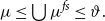
$\mu \leq \bigcup \mu^{fs} \leq \vartheta.$
(2)
$\delta(w\Sigma^{\omega}) = \bigcap \mu^{fs}(w)$
for all
$w \in dom(\mu^{fs}).$
(3) The space is
$SCT_2$
(see Definition 1.19) iff
$\delta \leq \overline{\delta}$
.



The following theorem illustrates how we can compute unions and intersections of open and closed sets computably.
Theorem 1.17. (Weihrauch Reference Weihrauch2010). We have the following:
(1) Finite intersection on open sets is
$(\mu^{fs}, \vartheta)$
-computable and
$(\vartheta^{fs}, \vartheta)$
-computable.
(2) Union on open sets is
$(\vartheta^{cs}, \vartheta)$
-computable.
(3) Finite union on closed sets is
$(\overline{\psi}^{fs}, \overline{\psi})$
-computable, and intersection on closed sets is
$(\overline{\psi}^{cs}, \overline{\psi})$
-computable.
(4) Finite union of compact sets is
$(\varkappa^{fs}, \varkappa)$
-computable.


Lemma 1.18. (Weihrauch and Grubba Reference Weihrauch and Grubba2009). Given a point x, an open set W, a closed set A and a compact set K, we have the following:
(1) “
$x\in W$
” is
$(\delta, \vartheta)$
-c.e.
(2) “
$K\subseteq W$
” is
$(\varkappa, \vartheta)$
-c.e.
(3) “
$A \cap W \neq \emptyset$
” is
$(\psi, \vartheta)$
-c.e.
(4) “
$K \cap A = \emptyset$
” is
$(\varkappa, \overline{\psi})$
-c.e.


In the above lemma, the relation is
 $(\gamma, \gamma^{'})$
-c.e. if there is a Turing machine that, on input (p, q) where p, q are
 $\gamma$
-,
 $\gamma^{'}$
-names, respectively, halts precisely if the two names satisfy the corresponding relation.
1.3.3 Computable separation axioms
Weihrauch (Reference Weihrauch2010) introduced effective versions of separation axioms in computable topological spaces and discovered several interesting properties that hold for the computable separation axioms but not for their classical counterparts. For instance, he proved that the computable versions of
 $T_2$
and
 $T_1$
are equivalent (Weihrauch Reference Weihrauch2010) although they are clearly not classically equivalent.
In this section, we recall some of the computable separation axioms defined in Weihrauch (Reference Weihrauch2010) and the relationships between them. The main goal of this paper is to further this line of investigation for soft topological spaces. In the subsequent sections, we define different types of computable separation axioms for soft topological spaces and establish the relationships between them. We also show that certain implications are proper.
Definition 1.19. (Weihrauch Reference Weihrauch2010). We define the following properties for a computable topological space
 $(X, \tau, \alpha, \mu)$
:
•
$CT_0$
: The multi-function
$t_0$
is
$(\delta, \delta, \mu)$
-computable, where
$t_0$
maps every pair of points
$(x, y) \in X^2$
such that
$x \neq y$
to some
$U \in \alpha$
such that
$x \in U$
and
$ y \notin U$
, or
$x \notin U$
and
$y \in U$
.•
$CT_1$
: The multi-function
$t_1$
is
$(\delta, \delta, \mu)$
-computable, where
$t_1$
maps every pair of points
$(x, y) \in X^2$
such that
$x \neq y$
to some
$U \in \alpha$
such that
$x \in U$
and
$ y \notin U$
.•
$CT_2$
: The multi-function
$t_2$
is
$(\delta, \delta, [\mu, \mu])$
-computable, where
$t_2$
maps every pair of points
$(x, y) \in X^2$
such that
$x \neq y$
to some
$(U, V) \in \alpha^2$
such that
$U \cap V = \emptyset$
,
$x \in U$
and
$y \in V$
.•
$SCT_2$
: There is a c.e. set
$H \subseteq \Sigma^* \times \Sigma^*$
such that (1)
$\forall x \neq y ~\exists (u, v) \in H ~(x \in \mu(u) \wedge y \in \mu(v)).$
(2)
$\forall (u, v) \in H~(\mu(u) \cap \mu(v) = \emptyset).$
•
$CT_2^{pc}$
: The multi-function
$t^{pc}$
is
$(\delta, \varkappa, [\mu, \bigcup \mu^{fs}])$
-computable, where
$t^{pc}$
maps every
$x \in X$
and every compact set K such that
$x \notin K$
to some pair (U, W) of disjoint open sets such that
$x \in U$
and
$K \subseteq W$
.•
$CT_2^{cc}$
: The multi-function
$t^{cc}$
is
$(\varkappa, \varkappa, [\bigcup \mu^{fs}, \bigcup \mu^{fs}])$
-computable, where
$t^{cc}$
maps every pair (K, L) of nonempty disjoint compact sets to some pair (V, W) of disjoint open sets such that
$K \subseteq V$
and
$L \subseteq W$
.•
$SCT_2^{pc}$
: There is a c.e. set
$H \subseteq \Sigma^* \times \Sigma^*$
such that (1)
$\forall x \in X~\forall \textrm{ compact } K \textrm{ such that } x \notin K~\exists (u, w) \in H~(x \in \mu(u) \wedge K \subseteq \bigcup \mu^{fs}(w)).$
(2)
$\forall (u, w) \in H~(\mu(u) \cap \bigcup \mu^{fs}(w) = \emptyset)$
.
•
$SCT_2^{cc}$
: There is a c.e. set
$H \subseteq \Sigma^* \times \Sigma^*$
such that (1)
$\forall \textrm{ compact sets }K, L \textrm{ such that } K \cap L = \emptyset~\exists (u, v) \in H~(K \subseteq \bigcup \mu^{fs}(u) $
and
$ L \subseteq \bigcup \mu^{fs}(v)).$
(2)
$\forall (u, v) \in H~\left(\bigcup \mu^{fs}(u) \cap \bigcup \mu^{fs}(v) = \emptyset\right)$
.



















We list some of the implications between the above computable separation axioms.
Theorem 1.20. (Weihrauch Reference Weihrauch2010). The following implications are proper or the notions are equivalent as indicated by the arrows:
(1)
$SCT_2 \Rightarrow CT_2 \Rightarrow CT_0.$
(2)
$CT_2 \Leftrightarrow CT_1.$
(3)
$SCT_2^{cc} \Leftrightarrow SCT_2^{pc} \Leftrightarrow SCT_2 \Rightarrow CT_2^{cc} \Rightarrow CT_2^{pc} \Rightarrow CT_2.$



Weihrauch in Weihrauch (Reference Weihrauch2010) wondered whether the implications in the third line of the above theorem are proper and in Elsayed (Reference Elsayed2022) The authors proved that those notions in the third line of the above theorem are all equivalent.
Convention. We would regard
 $\widetilde{X}$
as a set whose points are of the form
 $p_e^x$
and thus,
 $p_e^x \in \widetilde{X}$
means
 $p_e^x \subseteq \widetilde{X}.$
2. U-Soft Separation Axioms
In Section 1.2.2, we mentioned soft separation axioms for STS based on strong membership and strong non-membership.
In this section, we define u-soft separation axioms. This type of separation axioms is based on soft points which is the natural way to define separation axioms analogously to the classical separation axioms. We investigate the relations between the u-soft separation axioms and p-soft separation axioms defined in El-Shafei et al. (Reference El-Shafei, Abo-Elhamayel and Al-Shami2018). We will note that some implications between the two different notions of soft separation axioms hold when the set of parameters is finite; however, when the parameter set is infinite those implications do not hold as what will be seen then from the counterexamples. We also answer a question proposed in Al-shami (Reference Al-shami2020) about whether u-soft
 $T_2$
spaces imply p-soft
 $T_2$
spaces where we find out that the answer is yes and we give a counterexample to show that the reverse implication is not true in general.
Definition 2.1. An STS
 $(X, \tau, E)$
is called
• u-soft
$T_{0}$
iff
$\forall$
$p_{e}^x, p_{a}^y$
$\in$
$\widetilde{X}$
where
$p_{e}^x \neq p_{a}^y$
, there exists a soft open set
$G_E$
such that
$p_{e}^x \in G_E $
and
$p_{a}^y \notin G_E$
, or
$p_{e}^x \notin G_E $
and
$p_{a}^y \in G_E$
.• u-soft
$T_{1}$
iff
$\forall$
$p_{e}^x, p_{a}^y$
$\in$
$\widetilde{X}$
where
$p_{e}^x \neq p_{a}^y$
, there exist two soft open sets
$G_E$
and
$F_E$
such that
$p_{e}^x \in G_E $
and
$p_{a}^y \notin G_E$
, and
$p_{e}^x \notin F_E $
and
$p_{a}^y \in F_E$
.• u-soft
$T_{2}$
iff
$\forall$
$p_{e}^x, p_{a}^y$
$\in$
$\widetilde{X}$
where
$p_{e}^x \neq p_{a}^y$
, there exist two soft open sets
$G_E$
and
$F_E$
such that
$p_{e}^x \in G_E $
and
$p_{a}^y \in F_E$
and
$G_E \bigcap F_E = \widetilde{\emptyset}$
.


Immediate implications between u-soft separation axioms are given in the next proposition.
Proposition 2.2. Every u-soft
 $T_{i}$
space is u-soft
 $T_{i-1}$
space for
 $i = 2, 1$
.
Proof. Straightforward.
Now, we give counterexamples of the above implications.
Example 2.3. Let
 $X = \{x\}, E = \{e_1, e_2\}$
and
 $\tau = \{\widetilde{X}, \widetilde{\emptyset}, \{(e_1, \{x\}), (e_2, \widetilde{\emptyset})\}\}$
.
It can be easily seen that this space is u-soft
 $T_{0}$
but not u-soft
 $T_{1}$
.
Example 2.4. Let
 $E = \mathbb{N}, X$
be an infinite set,
 $ \tau = \{\widetilde{X}, \widetilde{\emptyset}, G_E: G_E^c \textrm{ is finite }\}$
.
Clearly, this space is u-soft
 $T_{1}$
but not u-soft
 $T_{2}$
.
Proposition 2.5. An STS is a u-soft
 $T_{1}$
space iff
 $\forall$
 $p_{e}^x$
 $\in$
 $\widetilde{X}$
,
 $\overline{p_{e}^x} = p_{e}^x$
.
Proof. Straightforward.
The following propositions illustrate the relation between u-soft
 $T_{i}$
and p-soft
 $T_{i}$
spaces for
 $i = 2, 1$
. Those implications are based on the finiteness of the parameter set and counterexamples are given to show that the implications are proper.
Proposition 2.6. Every u-soft
 $T_{2}$
space is p-soft
 $T_{2}$
space if E is finite.
Proof. Let
 $x \ne y$
and E has m parameters.
 $\forall$
 $p_{e_i}^x$
 $\forall$
 $p_{e_j}^y$
 $\in$
 $\widetilde{X} \setminus p_{e_i}^x$
, there exist two disjoint soft open sets
 $G_{E,i,j}$
and
 $F_{E,i,j}$
such that
 $p_{e_i}^x \in G_{E,i,j} $
and
 $p_{e_j}^y \in F_{E,i,j}$
.Then,
 $p_{e_i}^x \in \displaystyle \bigcap_{j = 1}^m G_{E,i,j} $
and
 $y \not\Subset G_{E,i,j}$
 $\forall i \leq m$
, also,
 $y \in \displaystyle \bigcup_{j = 1}^m F_{E,i,j}$
and
 $p_{e_i}^x \notin \displaystyle \bigcup_{j = 1}^m F_{E,i,j}$
. Thus,
 \[ x \in \bigcup_{i = 1}^m [\bigcap_{j = 1}^m G_{E,i,j}] \, {\rm and}\, y \in \bigcap_{i = 1}^m [\bigcup_{j = 1}^m F_{E,i,j}],\]
and
 \[ [\bigcup_{i = 1}^m [\bigcap_{j = 1}^m G_{E,i,j}]] \, \bigcap\, [\bigcap_{i = 1}^m [\bigcup_{j = 1}^m F_{E,i,j}]] = \widetilde{\emptyset}.\]
Therefore, the space is p-soft
 $T_{2}$
.
Proposition 2.7. Every u-soft
 $T_{1}$
space is p-soft
 $T_{1}$
space if E is finite.
Proof. Let
 $x \ne y$
and E has m parameters.
 $\forall$
 $p_{e_i}^x$
 $\forall$
 $p_{e_j}^y$
 $\in$
 $\widetilde{X} \setminus p_{e_i}^x$
, there exists an open set
 $G_{E,i,j}$
such that
 $p_{e_i}^x \in G_{E,i,j} $
and
 $p_{e_j}^y \notin G_{E,i,j}$
. Then,
 $p_{e_i}^x \in \displaystyle \bigcap_{j = 1}^m G_{E,i,j}$
,
 $\forall i \leq m$
. Therefore,
 \[x \in \bigcup_{i = 1}^m [\bigcap_{j = 1}^m G_{E,i,j}] \, {\rm and}\, y \not\Subset \bigcup_{i = 1}^m [\bigcap_{j = 1}^m G_{E,i,j}].\]
Similarly, if we switch y and x we will get soft open sets
 $G_{E,i,j}$
such that
 \[y \in \bigcup_{i = 1}^m [\bigcap_{j = 1}^m F_{E,i,j}] \, {\rm and}\, x \not\Subset \bigcup_{i = 1}^m [\bigcap_{j = 1}^m F_{E,i,j}].\]
Therefore, the space is p-soft
 $T_{1}$
.
The converse of the above propositions is not true in general as shown in the following example.
Example 2.8. Let
 $X = \{x, y\}, E = \{e_1, e_2\}$
and
 $\tau = \{\widetilde{X}, \widetilde{\emptyset}, \{(e_1, \{x\}), (e_2, \{x\})\}, \{(e_1, \{y\}), (e_2, \{y\})\}, \{(e_1, \emptyset), (e_2, \{x\})\},\\ \{(e_1, \{x\}), (e_2, \emptyset)\}, \{(e_1, \{y\}), (e_2, \emptyset)\}, \{(e_1, X), (e_2, \{x\})\}, \{(e_1, X), (e_2, \{y\})\},\\ \{(e_1, \{y\}), (e_2, X)\}, \{(e_1, X), (e_2, \emptyset)\}, \{(e_1, \{y\}), (e_2, \{x\})\}\}$
. This space is p-soft
 $T_{2}$
but not u-soft
 $T_{1}$
. If we view this space as a topology on
 $E \times X$
, it may look simpler.
When the parameter set is infinite, the above inclusions do not hold in general as shown in the following examples.
Example 2.9. Let
 $X = \{x, y\}$
,
 $E = \{e_1, e_2, \cdots\}$
. We define a STS
 $\tau$
on X with respect to E as follows,
 $\tau = \{\widetilde{X}, \widetilde{\emptyset}, G_k^{a_{i_1} a_{i_2} \cdots a_{i_k}}: G_k^{a_{i_1} a_{i_2} \cdots a_{i_k}} = \{(e_1, f(a_{i_1}), (e_2, f(a_{i_2}), \cdots, (e_k, f(a_{i_k}), (e_{k+1}, X), \cdots\}; i_1, \cdots, i_k \in \{0, 1, 2, 3\}; f(a_0) = \emptyset, f(a_1) = \{x\}, f(a_2) = \{y\}, f(a_3) = X\}$
. Clearly, this space is u-soft
 $T_1$
but it is not p-soft
 $T_1$
or even p-soft
 $T_0$
. You could view it as a topology on
 $E \times X$
as well.
Example 2.10. Let
 $X = \{a, b\}$
,
 $E = \{e_1, e_2, \cdots\}$
. We partition
 $\mathbb{N}$
into infinitely many infinite partitions
 $\mathbb{N} = F_1 \bigcup F_2 \bigcup \cdots .$
we define a STS on X with respect to E where its basic open sets are defined as follows, for each finite set
 $G \subseteq \mathbb{N}$
we have
 $\{p_{e_i}^a: i \in G\}$
and for each finite set
 $G \subseteq \mathbb{N}$
,
 $n \in \mathbb{N}$
we have
 $\{p_{e_n}^b\} \bigcup \{p_{e_i}^a: i \in F_n - G\}$
. Clearly, this space is u-soft
 $T_2$
but it is not p-soft
 $T_2$
.
The following two examples show that u-soft
 $T_{0}$
and p-soft
 $T_{0}$
spaces are incomparable.
Example 2.11. Let
 $X = \{x, y\}, E = \{e_1, e_2\}$
and
 $\tau = \{\widetilde{X}, \widetilde{\emptyset}, \{(e_1, \{y\}), (e_2, \{x\})\}, \{(e_1, \widetilde{\emptyset}), (e_2, \{y\})\}, \{(e_1, \{y\}), (e_2, X)\}, \{(e_1, \widetilde{\emptyset}), (e_2, \{x\})\}, \{(e_1, \widetilde{\emptyset}), (e_2, X)\}\}$
.
This space is u-soft
 $T_{0}$
but not p-soft
 $T_{0}$
.
Example 2.12. Let
 $X = \{x, y\}$
,
 $E = \{e_1, e_2\}$
and
 $\tau = \{\widetilde{X}, \widetilde{\emptyset}, \{(e_1, \{x\}), (e_2, \{x\})\}\}$
.
This space is p-soft
 $T_{0}$
but not u-soft
 $T_{0}$
.
3. Computable u-Soft Separation Axioms
In this section, we define the new notions of computable soft topological spaces and computable u-soft separation axioms that are based on soft points. We investigate some properties and implications of those newly defined computable u-soft separation axioms. We also introduce some counterexamples to prove that some implications are not true in general.
Definition 3.1. A computable STS is a tuple
 $(X, \tau, A, \beta, \nu)$
such that
(1)
$(X, \tau, A)$
is a u-soft
$T_0$
space,(2)
$\nu : \Sigma^* \rightarrow \beta$
is a notation of a base of
$\tau$
with respect to soft points (i.e. for a soft open set W,
$\forall$
soft points
$p_e^x \in W$
, there is some
$U \in \beta$
such that
$p_e^x \in U \subseteq W$
) with recursive domain,(3) There is a computable function
$h : \Sigma^* \times \Sigma^* \rightarrow \Sigma^{\omega}$
such that for all
$u, v \in dom(\nu)$
,
\[\nu(u) \bigcap \nu(v) = \cup \{\nu(w) : w \in dom(\nu) \,and\, \iota(w)\ll h(u, v)\}.\]
(4) In computable soft topological spaces when we encode soft points, we need to consider the parameter of the soft point so that it is encoded as well in the name. That is,
$\delta^u(p) = p_e^x$
where p is a list of all basic soft open sets containing
$p_e^x$
and the first bit of p encodes the parameter of the soft point, which is e in this case. When the parameter set E is infinite, we require it to be computable and countable and to be given of the form
$E = \{e_1, e_2, \cdots \}$
.






The following are the computable u-soft separation axioms which are based on separating soft points by basic soft open sets.
Definition 3.2. A computable STS
 $(X, \tau, A, \beta, \nu)$
is computable u-soft
 $T_0$
 $(CuT_0, \textrm{ for short })$
if
 $(X, \tau, A)$
is a u-soft
 $T_0$
and the multi-function
 $ut_0$
is
 $(\delta^u, \delta^u, \nu)$
-computable where
 $ut_0$
maps every
 $(p_{e}^x, p_{\alpha}^y) \in \widetilde{X} \times \widetilde{X}$
such that
 $p_{e}^x \neq p_{\alpha}^y$
to some
 $U_A \in \beta$
such that
 \[(p_{e}^x \in U_A\, \textrm{ and }\, p_{\alpha}^y \notin U_A)\, or\, (p_{e}^x \notin U_A\, \textrm{ and }\, p_{\alpha}^y \in U_A). \]
Definition 3.3. A computable STS
 $(X, \tau, A, \beta, \nu)$
is computable u-soft
 $T_1$
 $(CuT_1, \textrm{ for short })$
if
 $(X, \tau, A)$
is a u-soft
 $T_0$
and the multi-function
 $ut_1$
is
 $(\delta^u, \delta^u, \nu)$
-computable where
 $ut_1$
maps every
 $(p_{e}^x, p_{\alpha}^y) \in \widetilde{X} \times \widetilde{X}$
such that
 $p_{e}^x \neq p_{\alpha}^y$
to some
 $U_A \in \beta$
such that
 \[(p_{e}^x \in U_A\, \textrm{ and }\, p_{\alpha}^y \notin U_A). \]
Definition 3.4. A computable STS
 $(X, \tau, A, \beta, \nu)$
is computable u-soft
 $T_2$
 $(CuT_2, \textrm{ for short })$
if
 $(X, \tau, A)$
is a u-soft
 $T_0$
and the multi-function
 $ut_2$
is
 $(\delta^u, \delta^u, \nu)$
-computable where
 $ut_2$
maps every
 $(p_{e}^x, p_{\alpha}^y) \in \widetilde{X} \times \widetilde{X}$
such that
 $p_{e}^x \neq p_{\alpha}^y$
to some
 $U_A, V_A \in \beta$
such that
 \[(p_{e}^x \in U_A\, \textrm{ and }\, p_{\alpha}^y \in V_A\, \textrm{ and } \, U_A \bigcap V_A = \widetilde{\emptyset}). \]
The next lemma gives the obvious implications between the computable u-soft separation axioms that are defined so far. The proof is Straightforward by definition.
Lemma 3.5.
 $CuT_i \Rightarrow$
u-soft
 $T_i$
for
 $i \in \{0, 1, 2\}$
.
Proof. Straightforward.
Lemma 3.6.
 $CuT_i \Rightarrow CuT_{i-1}$
for
 $i \in \{1, 2\}$
.
Proof. Straightforward.
We give a counterexample that is
 $CuT_0$
but not
 $CuT_1$
.
Example 3.7. Let
 $X = \{x\}$
be the universe set,
 $E = \{e_1, e_2\}$
be a set of parameters and
 $\tau$
is a STS generated by the following base,
 \[\nu(01) = \{(e_1, \{x\}), (e_2, \emptyset)\}\, ,\nu(001) = \widetilde{X} \, ,{\rm where} \, \beta = range(\nu).\]
We define now some more computable u-soft separation axioms to help us establish the relation between
 $CuT_1$
and
 $CuT_2$
. At the end of this section, we will see that some of the following notions are equivalent.
Definition 3.8. A computable STS is:
 $WCuT_0$
: If there is a c.e. set
 $H \subseteq dom(\nu) \times dom(\nu)$
such that
(1)
$(\forall p_{e}^x \neq p_{\alpha}^y)(\exists (u, v) \in H)(p_{e}^x \in \nu(u)\, and\, p_{\alpha}^y \in \nu(v)),$
(2)
$(\forall (u, v) \in H)$
:
\[(\nu(u) \bigcap \nu(v) = \widetilde{\emptyset}),\]
\[\vee ((\exists p_{e}^x) \nu(u) = \{p_{e}^x\} \subseteq \nu(v)),\]
\[\vee ((\exists p_{\alpha}^y) \nu(v) = \{p_{\alpha}^y\} \subseteq \nu(u)).\]



 $SCuT_0$
: If he multi-function
 $ut_{0}^s$
is
 $(\delta^u, \delta^u, [\nu_N, \nu])$
-computable where
 $ut_{0}^s$
maps every
 $(p_{e}^x, p_{\alpha}^y) \in \widetilde{X} \times \widetilde{X}$
such that
 $(p_{e}^x \neq p_{\alpha}^y)$
to some
 $(k, U_E) \in \mathbb{N} \times \beta$
such that
 \[(k=1, p_{e}^x \in U_E\, \textrm{ and }\, p_{\alpha}^y \notin U_E) \vee (k=2, p_{e}^x \notin U_E \,\textrm{ and }\, p_{\alpha}^y \in U_E).\]
 ${CuT_0}^{\prime}$
: If there is a c.e. set
 $H \subseteq dom(\nu_N) \times dom(\nu) \times dom(\nu)$
such that
(1)
$(\forall p_{e}^x \neq p_{\alpha}^y)(\exists (w, u, v) \in H)(p_{e}^x \in \nu(u)\, and\, p_{\alpha}^y \in \nu(v)),$
(2)
$(\forall (w, u, v) \in H)$
:
\[(\nu(u) \bigcap \nu(v) = \widetilde{\emptyset}),\]
\[\vee (\nu_N(w) = 1 (\exists p_{e}^x) \nu(u) = \{p_{e}^x\} \subseteq \nu(v)),\]
\[\vee (\nu_N(w) = 2 (\exists p_{\alpha}^y) \nu(v) = \{p_{\alpha}^y\} \subseteq \nu(u)).\]




 ${CuT_1}^{\prime}$
: If there is a c.e. set
 $H \subseteq dom(\nu) \times dom(\nu)$
such that
(1)
$(\forall p_{e}^x \neq p_{\alpha}^y)(\exists (u, v) \in H)(p_{e}^x \in \nu(u)\, \textrm{ and }\, p_{\alpha}^y \in \nu(v)),$
(2)
$(\forall (u, v) \in H)$
:
\[(\nu(u) \bigcap \nu(v) = \widetilde{\emptyset}),\]
\[\vee ((\exists p_{e}^x) \nu(u) = \{p_{e}^x\} \subseteq \nu(v)).\]



 ${CuT_2}^{\prime}$
: If there is a c.e. set
 $H \subseteq dom(\nu) \times dom(\nu)$
such that
(1)
$(\forall p_{e}^x \neq p_{\alpha}^y)(\exists (u, v) \in H)(p_{e}^x \in \nu(u)\, \textrm{ and }\, p_{\alpha}^y \in \nu(v)),$
(2)
$(\forall (u, v) \in H)$
:
\[(\nu(u) \bigcap \nu(v) = \widetilde{\emptyset}),\]
\[\vee ((\exists p_{e}^x) \nu(u) = \{p_{e}^x\} = \nu(v)).\]



 $SCuT_2$
: If there is a c.e. set
 $H \subseteq dom(\nu) \times dom(\nu)$
such that
(1)
$(\forall p_{e}^x \neq p_{\alpha}^y)(\exists (u, v) \in H)(p_{e}^x \in \nu(u)\, \textrm{ and }\, p_{\alpha}^y \in \nu(v)),$
(2)
$(\forall (u, v) \in H)$
:
\[(\nu(u) \bigcap \nu(v) = \widetilde{\emptyset}).\]



Now we investigate the relations between those separation axioms.
Proposition 3.9.
 $CuT_0 \Leftrightarrow SCuT_0 \Leftrightarrow {CuT_0}^{\prime} $
.
Proof.
 $SCuT_0 \Rightarrow CuT_0$
: Straightforward.
 $CuT_0 \Rightarrow SCuT_0$
: There is a machine M on input
 $(p, q) \in dom(\delta^u) \times dom(\delta^u)$
, it first runs
 $ut_0$
on (p, q) that outputs u. Then, M outputs (1, u) if
 $u \ll p$
, and outputs (2, u) if
 $u \ll q$
.
 ${CuT_0}^{\prime} \Rightarrow SCuT_0$
: There is a machine M on input
 $(p, q) \in \Sigma^{\omega} \times \Sigma^{\omega}$
, it first searches for
 $(w, u, v) \in H$
such that
 $u \ll p$
and
 $v \ll q$
and then it outputs (w, u) if
 $\nu_N(w) = 1$
and
 $(w_2, v)$
for some
 $w_2$
such that
 $\nu_N(w_2) = 2$
, otherwise.
 $SCuT_0 \Rightarrow {CuT_0}^{\prime}$
: Let M be a machine that realizes
 ${ut_0}^s$
. There is another machine M’ that on input
 $(w, u, v) \in (\Sigma^*)^3$
halts iff we can find words
 $u' \in dom(\nu)$
,
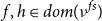 $f, h \in dom(\nu^{fs})$
and
 $t \leq \min(|f|, |h|)$
such that M on
 $(f1^{\omega}, h1^{\omega})$
halts in t steps outputting (w, u’) and
 \[u \ll g(f\iota(u')) \,{\rm and}\, v \ll g(h) \,if\, \nu_N(w) = 1,\]
 \[u \ll g(h) \,{\rm and}\, v \ll g(f\iota(u'))\, if\, \nu_N(w) = 2,\]
where g computes the union of a finite set of basic open sets. Now, let
 $H = dom(f_{M'})$
.
We need now to show the two conditions of H. For the first condition: Let
 $\delta^u(p) = p_{e}^x \neq p_{\alpha}^y = \delta^u$
. Then, M on (p, q) halts and outputs (w, u’) in t steps where
 $\nu_N(w) = 1, p_{e}^x \in \nu(u') \,{\rm and}\, p_{\alpha}^y \notin \nu(u')( \textrm{when} \, \nu_N(w) = 2, \textrm{same argument follows})$
. Then, M also halts on
 $(f1^{\omega}, h1^{\omega})$
outputting (w, u’) where
 $f = p^{<t} \,\textrm{and}\, h = q^{<t}$
. Thus,
 $p_{e}^x \in \bigcap \nu^{fs}(f\iota(u'))$
and
 $p_{\alpha}^y \in \bigcap \nu^{fs}(h)$
and hence there are u, v such that
 $u \ll \nu^{fs}(f\iota(u')), u \ll p$
and
 $v \ll \nu^{fs}(h), v \ll q$
. Therefore, there exists some
 $(w, u, v) \in H$
such that
 $p_{e}^x \in \nu(u)$
and
 $p_{\alpha}^y \in \nu(v)$
.
For the second condition of H: Let
 $(w, u, v) \in H$
,
 $\nu_N(w) = 1$
,
 $p_{e}^x \in \nu(u)$
,
 $p_{\alpha}^y \in \nu(u) \bigcap \nu(v)$
and
 $p_{e}^x \neq p_{\alpha}^y$
. Then, there are f, h, u’ and t such that
 $t \leq \min(|f|, |h|)$
and M halts on
 $(f1^{\omega}, h1^{\omega})$
in t steps outputting (w, u’) and
 $u \ll g(f\iota(u'))$
and
 $v \ll g(h)$
. Therefore,
 $p_{e}^x \in \nu(u) \subseteq \delta^u[f\Sigma^{\omega}] \bigcap \nu(u')$
and
 $p_{\alpha}^y \in \nu(v) \subseteq \delta^u[h\Sigma^{\omega}]$
. We know that
 $p_{e}^x \in \nu(u')$
and
 $p_{\alpha}^y \notin \nu(u')$
. But,
 $p_{\alpha}^y \in \nu(u) \subseteq \nu(u')$
, which a contradiction. Therefore, it must be the case that
 $p_{e}^x = p_{\alpha}^y$
, hence,
 \[((w, u, v) \in H, \nu_N(w) = 1 \,\textrm{and}\, \nu(u) \bigcap \nu(v) \neq \widetilde{\emptyset} ) \Rightarrow (\exists p_{e}^x) \nu(u) = \{p_{e}^x\} \subseteq \nu(v).\]
Same argument follows when
 $\nu_N(w) = 2$
.
Proposition 3.10.
 $SCuT_2 \Rightarrow CuT_2 \Rightarrow CuT_0 \Rightarrow WCuT_0$
.
Proof. Similar to the previous proof.
Proposition 3.11.
 $CuT_2 \Leftrightarrow {CuT_2}^{\prime} \Leftrightarrow CuT_1 \Leftrightarrow {CuT_1}^{\prime}$
.
Proof.
 $CuT_1 \Leftrightarrow {CuT_1}^{\prime}$
: Straightforward as it is a special case of
 $SCuT_0 \Leftrightarrow {CuT_0}^{\prime}$
.
 ${CuT_2}^{\prime} \Rightarrow {CuT_1}^{\prime}$
: Straightforward.
 ${CuT_1}^{\prime} \Rightarrow {CuT_2}^{\prime}$
: Let H be the c.e. set from
 ${CuT_1}^{\prime}$
. Now, let
 \[H' = \{(r, s) : r \ll g(u, v'), s \ll g(u', v) \,{\rm for}\, {\rm some}\, (u, v), (u', v') \in H\}.\]
We prove now the two conditions of H’ as the c.e. set of
 ${CuT_2}^{\prime}$
.
Suppose
 $p_{e}^x \neq p_{\alpha}^y$
. By the first condition of H, there are
 $(u, v), (u', v') \in H$
such that
 $p_{e}^x \in \nu(u), p_{\alpha}^y \in \nu(v), p_{\alpha}^y \in \nu(u'), {\rm and}\, p_{e}^x \in \nu(v')$
. Then,
 $p_{e}^x \in \nu(u) \bigcap \nu(v')$
and
 $p_{\alpha}^y \in \nu(u') \bigcap \nu(v)$
, and hence there is
 $(r, s) \in H'$
such that
 $p_{e}^x \in \nu(r)$
and
 $p_{\alpha}^y \in \nu(s)$
. Thus the first condition of H’ holds.
Now, we prove the second condition of H’. Suppose
 $(r, s) \in H'$
and
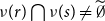 $\nu(r) \bigcap \nu(s) \neq \widetilde{\emptyset}$
. Thus, by definition of H’ there are
 $(u, v), (u', v') \in H$
such that
 $\nu(r) \subseteq \nu(u) \bigcap \nu(v')$
and
 $\nu(s) \subseteq \nu(u') \bigcap \nu(v)$
. Hence,
 $\nu(u) \bigcap \nu(v) \neq \widetilde{\emptyset}$
and
 $\nu(u') \bigcap \nu(v') \neq \widetilde{\emptyset}$
. Now, by the second condition of H,
 $\nu(u) = \{p_{e}^x\} \subseteq \nu(v)$
and
 $\nu(u') = \{p_{\alpha}^y\} \subseteq \nu(v')$
. Therefore,
 $\nu(r) = \{p_{e}^x\} = \nu(s)$
which shows that the second condition of H’ holds.
 ${CuT_2}^{\prime} \Rightarrow CuT_2$
: There is a machine M that on input (p, q) searches for
 $(u, v) \in H$
such that
 $u \ll p$
and
 $v \ll q$
and prints (u, v) if the search is successful and diverges, otherwise.
 $CuT_2 \Rightarrow {CuT_2}^{\prime}$
: By transitivity, which completes the proof.
Now, we give a counterexample of the above implications.
Proposition 3.12. There is a STS that is
 $WCuT_0$
but not
 $CuT_0$
.
Proof. Follows immediately from the next example.
Example 3.13. Let
 $X = \{x_i, y_i: i \in \mathbb{N}\}$
,
 $E = \{e\}$
be a set of parameters, and
 $\tau$
be the soft discrete topology defined on X w.r.t E. We will define
 $A,\, B,\, C,\, and\, D$
as a partition of
 $\mathbb{N}$
where A is a non-c.e. set. We define a notation
 $\nu$
of a basis of
 $\tau$
as follows:

We define now the intersection of soft basic open sets computably,
 $\nu(0^im) \bigcap \nu(0^in) = \nu(0^imn)$
for
 $m \neq n$
and we define the other intersections to be empty. Thus,
 $(X, \tau, E, \beta, \nu)$
is a computable STS. Let
 $ H = \{(0^im, 0^jn) : i, j \in \mathbb{N}; m, n \in \{1, 2\}; (i \neq j \,{\rm or}\, m \neq n)\}$
. Then H satisfies the two conditions of
 $WuCT_0$
. We show now that this space is not
 $SCuT_0$
. Let
 $r, s \in \Sigma^*$
such that
 $\nu_N(r) = 1$
and
 $\nu_N(s) = 2$
. W.L.O.G. assume that
 $\nu_N$
is injective. For
 $i \in \mathbb{N}$
let
 \[S_i = \{\langle r, 0^i1 \rangle, \langle s, 0^i3 \rangle, \langle r, 0^i12 \rangle, \langle s, 0^i23 \rangle \},\]
 \[T_i = \{\langle s, 0^i2 \rangle, \langle r, 0^i3 \rangle, \langle s, 0^i12 \rangle, \langle r, 0^i13 \rangle \}.\]
Suppose that
 $ut_{0}^s$
is realized by
 $f: \Sigma^{\omega} \times \Sigma^{\omega} \rightarrow \Sigma^*$
. If
 $\delta^u(p) = p_{e}^{x_i}$
and
 $\delta^u(q) = p_{e}^{y_i}$
, then
 \begin{equation} f(p, q) \in \begin{cases} S_i &\textrm{if}\ i \in B\\ T_i &\textrm{if}\ i \in C. \end{cases}\end{equation}
 $\forall i \in \mathbb{N}$
we define
 $p_i = \iota(0^i1)\iota(0^i1)...$
, and
 $q_i = \iota(0^i2)\iota(0^i2)...$
, where
 $p_i, q_i \in \Sigma^{\omega}$
. Let
 $F = \{f: f: \Sigma^{\omega} \times \Sigma^{\omega} \rightarrow \Sigma^* \textrm{such that}\, f \textrm{ is computable and } f(p_i, q_i) \,\textrm{exists for all} \,i \in A\}$
. Consider
 $f \in F$
. Then,
 $f' : i \rightarrow f(p_i, q_i)$
is computable such that
 $A \subseteq dom(f')$
and
 $dom(f') \setminus A$
is infinite as A is a non-c.e. set. Since F is countable, there is a bijective function
 $g: E \rightarrow F$
for some
 $E \subseteq \mathbb{N}$
such that
 $s \in dom(g'_s) \setminus A$
for all
 $s \in E$
where
 $g(s) = g_s$
and
 $g'_s : i \rightarrow g_s(p_i, q_i)$
for
 $i \in \mathbb{N}$
and
 $s \in E$
. Then,
 $A \bigcap E = \emptyset$
. We can see that
 $g_s(p_s, q_s)$
is defined for all
 $s \in E$
. Let
 \begin{equation} B = \{s \in E: g_s(p_s, q_s) \notin S_s\}, C = \{s \in E: g_s(p_s, q_s) \in S_s\},\end{equation}
and
 $D = \mathbb{N} \setminus (A \cup B \cup C)$
. Since
 $A \bigcap E = \emptyset$
,
 $E = B \cup C$
and
 $B \bigcap C = \emptyset$
,
 $\{A, B, C, D\}$
is a partition of
 $\mathbb{N}$
.
Suppose some computable function f realizes
 $ut_{0}^{s}$
. Since
 $\delta^u(p_i) = p_{e}^{x_i}$
and
 $\delta^u(q_i) = p_{e}^{y_i}$
for all
 $i \in A$
,
 $f(p_i, q_i)$
exists for all
 $i \in A$
, hence
 $f = g_s$
for some
 $s \in E$
. Since
 $g_s$
realizes
 $ut_{0}^{s}$
,
 $g_s(p_s, q_s) \in S_s \Leftrightarrow s \in B$
by
 $(3.1)$
. On the other hand,
 $g_s(p_s, q_s) \in S_s \Leftrightarrow s \notin B$
by
 $3.2$
. Thus, the space is not
 $CuT_0$
.
Example 3.14. Let
 $X = \{x\}$
,
 $E = \{e_1, e_2\}$
be a set of parameters, and
 $\tau$
be a STS defined on X w.r.t. E where
 $\tau = \{\widetilde{X}, \widetilde{\emptyset}, \{(e_1, \{x\}), (e_2, \emptyset)\}\}$
which is generated by the following basis:
 \[\nu(01) = \{(e_1, \{x\}), (e_2, \emptyset)\},\]
 \[\nu(001) = \widetilde{X},\]
where
 $\beta = range(\nu).$
Thus,
 $(X, \tau, E, \nu, \beta)$
is a computable STS and it is
 $CuT_0$
nut not
 $CuT_1$
.
Example 3.15. Let
 $A \subseteq \mathbb{N}$
be a c.e. set with non-c.e. complement. Define a notation
 $\nu$
by
 \[\nu(0^i1) = \{p_{e}^{x_i}\}, \nu(0^i2) = \{p_{e}^{x_i}\}\, \textrm{for}\, i \in A, \]
 \[\nu(0^i1) = \{p_{e}^{x_i}\}, \nu(0^i2) = \{p_{e}^{y_i}\}\, \textrm{for}\, i \notin A, \]
for all
 $i \in \mathbb{N}$
. Then,
 $\nu$
is a notation of a base
 $\beta$
of a STS on a subset
 $X \subseteq \mathbb{N}$
w.r.t. a parameter set
 $E = \{e\}$
such that
 $(X, \tau, E, \beta, \nu)$
is a computable STS.
This space is
 $CuT'_2$
and not
 $SCuT_2$
as we have a c.e. set
 $H = \{(0^im, 0^in): i, j \in \mathbb{N}, m,n \in \{1, 2\}\}$
that satisfies
 $CuT'_2$
and let H be the c.e. set for
 $SCuT_2$
. Thus, by the two conditions of
 $SCuT_2$
 \[i \notin A \Rightarrow (0^i1, 0^i2) \in H,\]
 \[i \in A \Rightarrow (0^i1, 0^i2) \notin H,\]
since H is c.e., the complement of A must be c.e., which is a contradiction.
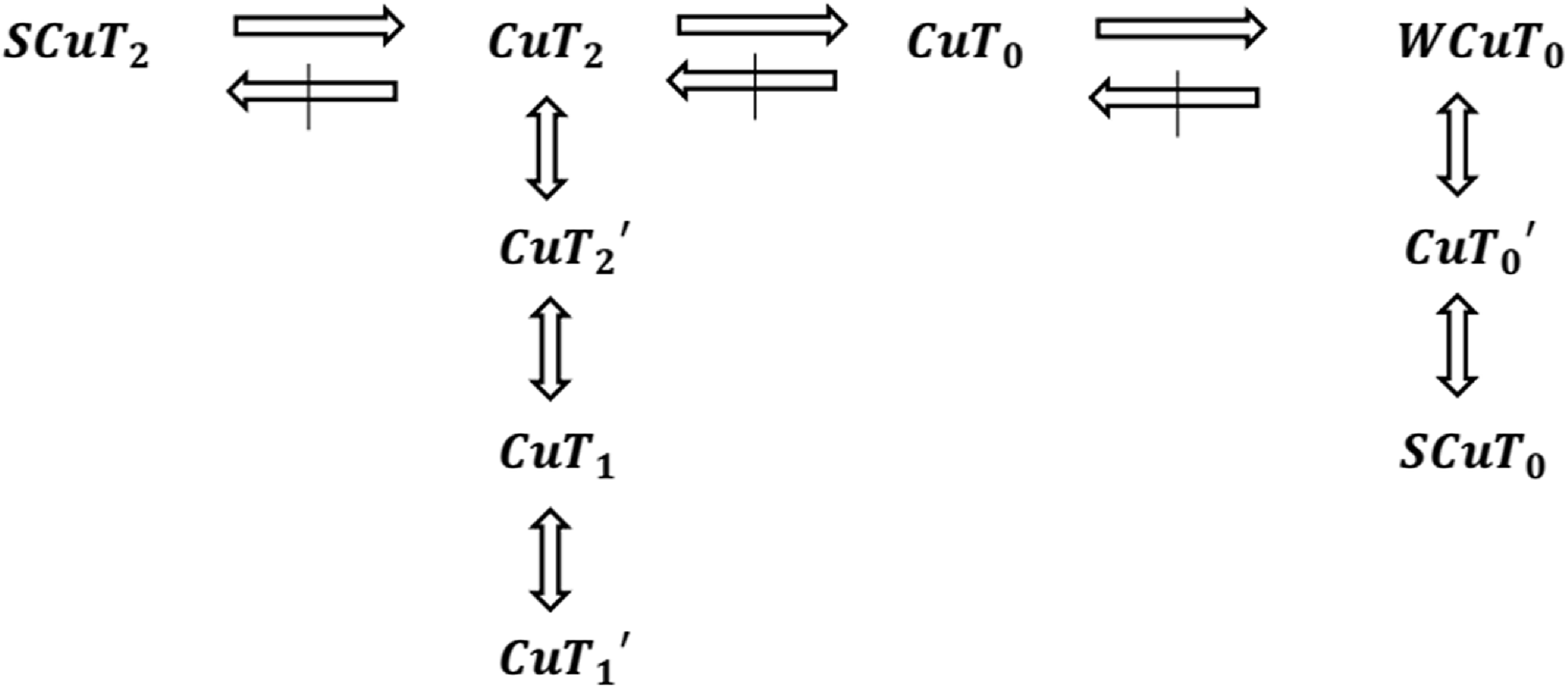
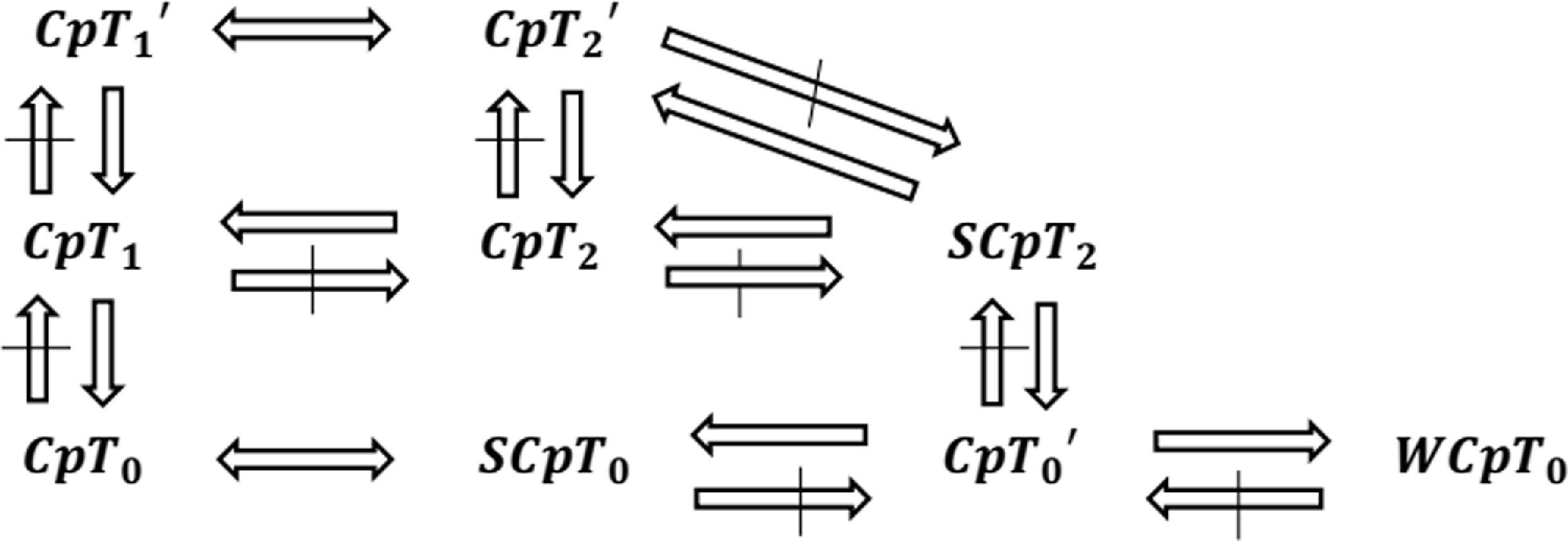
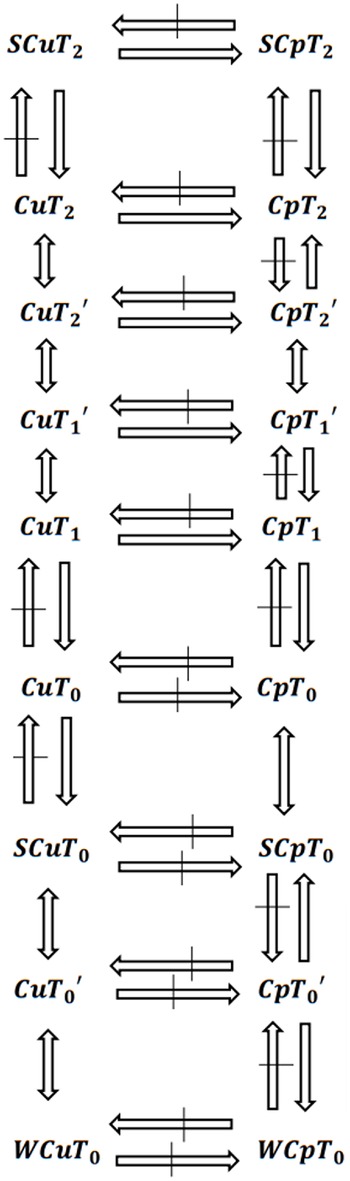
In the figure below, we summarize the implications of the computable u-soft separation axioms. Those implications are based on what we investigated above and the non-implications are based on the counterexamples introduced in this section above. These implications are actually the same as those of the classical computable separations axioms corresponding to the ones defined in the computable soft setting.
From the equivalences in Fig. 1, we can see that we have exactly four different notions of computable u-soft separation axioms.
Relations between computable u-soft separation axioms.

In the next section, we will define computable p-soft separation axioms as the computable versions of those defined in El-Shafei et al. (Reference El-Shafei, Abo-Elhamayel and Al-Shami2018). Then, we define more variations of computable p-soft separations axioms and investigate the relations between them.
4. Computable p-Soft Separation Axioms
In this section, we define the computable versions of partial soft separation axioms defined in El-Shafei et al. (Reference El-Shafei, Abo-Elhamayel and Al-Shami2018) and then introduce some of the notions corresponding to those defined for computable u-soft separation axioms.
We define first
 $\delta^p$
names for
 $x_E \subseteq \widetilde{X}$
in a computable STS
 $(X, \tau, E, \beta, \nu)$
, where a
 $\delta^p$
name of
 $x_E \subseteq \widetilde{X}$
contains all soft basic open sets intersecting
 $x_E$
where E is the parameter set associated with the given STS.
We will define also p-soft separation axioms based on
 $x_E \subseteq \widetilde{X}$
and then compare those separation axioms to the u-soft separation axioms defined in the previous section.
Definition 4.1. Let E be a finite set of parameters. Now,
 $\delta^p(p) = x_E$
where
 $p = s_i\iota(w_l)s_j\iota(w_m)s_k\iota(w_n).......$
, and
 $p_{e_i}^x \in \nu(w_l)$
,
 $p_{e_j}^x \in \nu(w_m)$
and
 $p_{e_k}^x \in \nu(w_n)$
. In other words, p is a list of all soft basic open sets intersecting
 $x_E$
, and
 $s_i \in \Sigma^*$
precedes the basic open sets containing
 $p_{e_i}^x$
.
Now, we define the p-soft separation axioms.
Definition 4.2. A computable STS
 $(X, \tau, E, \beta, \nu)$
is
• computable p-soft
$T_0$
$(CpT_0, \textrm{for short})$
if
$(X, \tau, E)$
is a u-soft
$T_0$
and the multi-function
$pt_0$
is
$(\delta^p, \delta^p, \theta)$
-computable where
$pt_0$
maps every
$x_E, y_E \subseteq \widetilde{X}$
such that
$x_E \neq y_E$
to some
$U_E \in \tau$
such that
\[(x \in U_E\, \textrm{ and }\, y \not\Subset U_E)\, or\, (x \not\Subset U_E\, \textrm{ and }\, y \in U_E). \]
• computable p-soft
$T_1$
$(CpT_1, \textrm{for short})$
if
$(X, \tau, E)$
is a u-soft
$T_0$
and the multi-function
$pt_1$
is
$(\delta^p, \delta^p, \theta)$
-computable where
$pt_1$
maps every
$x_E, y_E \subseteq \widetilde{X}$
such that
$x_E \neq y_E$
to some
$U_E \in \tau$
such that
\[(x \in U_E\, \textrm{ and }\, y \not\Subset U_E). \]
• computable p-soft
$T_2$
$(CpT_2, \textrm{for short})$
if
$(X, \tau, E)$
is a u-soft
$T_0$
and the multi-function
$pt_2$
is
$(\delta^p, \delta^p, \theta)$
-computable where
$pt_2$
maps every
$x_E, y_E \subseteq \widetilde{X}$
such that
$x_E \neq y_E$
to some
$U_E, V_E \in \tau$
such that
\[(x \in U_E\, \textrm{ and }\, y \in V_E, ,\textrm{ and }\, U_E \bigcap V_E = \widetilde{\emptyset}).\]










We can see that
 $CpT_i \Rightarrow CpT_{i-1}$
for
 $i \in \{1, 2\}$
.
Based on the above definitions, we can see that the following implications hold,
 \[CpT_2 \Rightarrow CpT_1 \Rightarrow CpT_0\]
The converses of the above implications are not true in general as shown from the following examples.
Example 4.3. Let
 $X = \{x, y\}$
,
 $E = \{e_1, e_2\}$
be a set of parameters and
 $\tau$
is a STS defined on X w.r.t. E generated by the following basis,
 \[\nu(01) = \{(e_1, \{x\}), (e_2, \emptyset)\}, \nu(001) = \{(e_1, \emptyset), (e_2, \{x\})\}, \nu(0001) = \widetilde{X},\]
and
 $\beta = range(\nu).$
Thus,
 $(X, \tau, E, \beta, \nu)$
is a computable STS and it is
 $CpT_0$
since there is a machine M that realizes
 $CpT_0$
where M on input
 $(p, q) \in \Sigma^{\omega} \times \Sigma^{\omega}$
, prints
 $\iota(01)\iota(001)$
. The space is not
 $CpT_1$
as it is not even
 $pT_1$
.
Example 4.4. Let
 $X = \{a_i: i \in \mathbb{N}\}$
,
 $E = \{e_1, e_2\}$
be a parameter set, and
 $\tau$
be a STS defined on X w.r.t. E generated by the following basis notation,
 \[\nu(o^i1^j) = \{(e_1, G_i), (e_2, F_j)\},\]
where i and j are the canonical indices of
 $G_{i}^c$
and
 $F_j$
, respectively. We define the intersection of finitely many basic open sets by
 $\nu(0^i1^j) \bigcap \nu(0^k1^l) = \nu(0^m1^n)$
, where m is the canonical index of
 $G_i \bigcup G_k$
and n is the canonical index of
 $F_j \bigcap F_l$
. Thus, the space is computable STS. The space is
 $CpT_1$
as there is a machine M that on input
 $(p, q) \in \Sigma^{\omega} \times \Sigma^{\omega}$
, searches for
 $s_2\iota(0^i1^j)$
and
 $s_2\iota(0^m1^n)$
in p and q, respectively, and j and n are canonical indices of singletons of X, and
 $i, m \in \mathbb{N}$
. If the search is successful, it prints
 $\langle 0^n1^j, 0^j1^n \rangle$
. Hence, machine M realizes
 $CpT_1$
. However, the space is not
 $CpT_2$
as it is not
 $pT_2$
.
Now, we give some more p-soft separation axioms and investigate the relations between them.
Definition 4.5. A computable STS
 $(X, \tau, E, \beta, \nu)$
is:
 $WCpT_0$
: if there is a c.e. set
 $H \subseteq dom(\nu^{fs}) \times dom(\nu^{fs})$
such that
(1)
$(\forall x_E \neq y_E)(\exists (u, v) \in H)(x \in \cup \nu^{fs}(u) \textrm{ and } y \in \cup \nu^{fs}(v)),$
(2)
$(\forall (u, v) \in H)$
:
\[(\cup \nu^{fs}(u) \bigcap \cup \nu^{fs}(v) = \widetilde{\emptyset}),\]
\[\vee ((\exists x_E) \cup \nu^{fs}(u) = x_E \subseteq \cup \nu^{fs}(v)),\]
\[\vee ((\exists y_E) \cup \nu^{fs}(v) = y_E \subseteq \cup \nu^{fs}(u)).\]



 $SCpT_0$
: if the multi-function
 $pt_{0}^s$
is
 $(\delta^p, \delta^p, [\nu_N, \theta])$
-computable where
 $pt_{0}^s$
maps every
 $x_E, y_E \subseteq \widetilde{X}$
such that
 $(x_E \neq y_E)$
to some
 $(k, U_E) \in \mathbb{N} \times \tau$
such that
 \[(k = 1, x \in U_E \textrm{ and } y \not\Subset U_E) \vee (k = 2, y \in U_E \textrm{ and } x \not\Subset U_E).\]
 $CpT'_0$
: if there is a c.e. set
 $H \subseteq dom(\nu_N) \times dom(\nu^{fs}) \times dom(\nu^{fs})$
such that
(1)
$(\forall x_E \neq y_E)(\exists (w, u, v) \in H)(x \in \cup \nu^{fs}(u) \textrm{ and } y \in \cup \nu^{fs}(v)),$
(2)
$(\forall (w, u, v) \in H)$
:
\[(\cup \nu^{fs}(u) \bigcap \cup \nu^{fs}(v) = \widetilde{\emptyset}),\]
\[\vee (\nu_N(w) = 1 (\exists x_E) \cup \nu^{fs}(u) = x_E \subseteq \cup \nu^{fs}(v)),\]
\[\vee (\nu_N(w) = 2 (\exists y_E) \cup \nu^{fs}(v) = y_E \subseteq \cup \nu^{fs}(u)).\]




 $CpT'_1$
: if there is a c.e. set
 $H \subseteq dom(\nu^{fs}) \times dom(\nu^{fs})$
such that
(1)
$(\forall x_E \neq y_E)(\exists (u, v) \in H)(x \in \cup \nu^{fs}(u) \textrm{ and } y \in \cup \nu^{fs}(v)),$
(2)
$(\forall (u, v) \in H)$
:
\[(\cup \nu^{fs}(u) \bigcap \cup \nu^{fs}(v) = \widetilde{\emptyset}),\]
\[\vee ((\exists x_E) \cup \nu^{fs}(u) = x_E \subseteq \cup \nu^{fs}(v)).\]



 $CpT'_2$
: if there is a c.e. set
 $H \subseteq dom(\nu^{fs}) \times dom(\nu^{fs})$
such that
(1)
$(\forall x_E \neq y_E)(\exists (u, v) \in H)(x \in \cup \nu^{fs}(u) \textrm{ and } y \in \cup \nu^{fs}(v)),$
(2)
$(\forall (u, v) \in H)$
:
\[(\cup \nu^{fs}(u) \bigcap \cup \nu^{fs}(v) = \widetilde{\emptyset}),\]
\[\vee ((\exists x_E) \cup \nu^{fs}(u) = x_E = \cup \nu^{fs}(v)).\]



 $SCpT_2$
: if there is a c.e. set
 $H \subseteq dom(\nu^{fs}) \times dom(\nu^{fs})$
such that
(1)
$(\forall x_E \neq y_E)(\exists (u, v) \in H)(x \in \cup \nu^{fs}(u) \textrm{ and } y \in \cup \nu^{fs}(v)),$
(2)
$(\forall (u, v) \in H)$
:
\[(\cup \nu^{fs}(u) \bigcap \cup \nu^{fs}(v) = \widetilde{\emptyset}).\]


Proposition 4.6. Let
 $\overline{CpT_i}$
and
 $\overline{SCpT_0}$
be the conditions obtained from
 $CpT_i$
and
 $SCpT_0$
, respectively, by replacing
 $\theta$
by
 $\cup \nu^{fs}$
. Then,
 $\overline{CpT_i} \Leftrightarrow CpT_i$
for
 $i \in \{0, 1, 2\}$
, and
 $\overline{SCpT_0} \Leftrightarrow SCpT_0$
, when the parameter set is finite.
Proof. Let E have n parameters.
 $\overline{CpT_i} \Rightarrow CpT_i$
: since
 $\cup \nu^{fs} \leq \theta$
.
 $CpT_i \Rightarrow \overline{CpT_i}$
: There is a machine M that on input
 $(p, q) \in dom(\delta^p) \times dom(\theta)$
where
 $\delta^p(p) \in \theta(q)$
searches for
 $u_1,...., u_n$
where
 $u_i \ll p_i$
and
 $u_i \ll q$
for all i where
 $p_i$
is a
 $\delta^u$
name obtained from p. Then, machine M prints u if the search is successful where
 $u = \iota(u_1)\iota(u_2).......$
and diverges, otherwise. Following the same argument, we can prove
 $\overline{SCpT_0} \Leftrightarrow SCpT_0$
, which completes the proof.
Lemma 4.7. In a computable STS, the predicate
 $x \in U$
is
 $(\delta^p, \theta)-c.e.$
.
Proof. Let n be the number of parameters of that space. There is a machine M that on input (p, r) where
 $p \in dom(\delta^p)$
,
 $r \in dom(\theta)$
halts iff there are
 $u_1, \cdots u_n \in dom(\nu)$
such that
 $u_i \ll r$
and
 $u_i \ll p_i$
for
 $i \in \{1, \cdots , n\}$
where
 $p_i$
is a
 $\delta^u$
-name obtained from p.
We now introduce some implications between the p-soft spaces defined above.
Proposition 4.8.
 $CpT_0 \Leftrightarrow SCpT_0 \Leftarrow CpT'_0 \Rightarrow WCpT_0$
.
Proof.
 $SCpT_0 \Rightarrow CpT_0$
: Obvious.
 $CpT_0 \Rightarrow SCpT_0$
: By Lemma 4.7 there is a machine M that on input
 $(p, q) \in dom(\delta^p) \times dom(\delta^p)$
, it tests in parallel whether
 $\delta^p(p) \in \theta(r)$
and
 $\delta^p(q) \in \theta(r)$
and outputs
 $\langle 1, r \rangle$
or
 $\langle 2, r \rangle$
, accordingly, where
 $pt_0(p,q) = r$
. We can see easily the M realizes
 $pt_{0}^s$
, which completes the proof.
 $CpT'_0 \Rightarrow SCpT_0$
: There is a machine M that on input
 $(p, q) \in dom(\delta^p) \times dom(\delta^p)$
searches for
 $(w, r, s) \in H$
-The c.e. set of
 $CpT'_0$
—such that
 $\delta^p(p) \in \theta(r)$
and
 $\delta^p(q) \in \theta(s)$
, which can be tested using Lemma 4.7. Then, machine M prints
 $\angle w, r \rangle $
if
 $\nu_N(w) = 1$
and
 $\langle w, s \rangle $
, otherwise. Thus, M realizes
 $pt_{0}^s$
, which completes the proof.
 $CpT'_0 \Rightarrow WCpT_0$
: Obvious.
We now show that the second and third implications are not reversed in general as shown from the next two examples.
Example 4.9. Let
 $X = \{a_i, b_i: i \in \mathbb{N}\}$
,
 $E = \{e_1, e_2\}$
be a parameter set, and
 $\tau$
be a STS defined on X w.r.t. E generated by the following basis where A is a non-c.e. set,

The finite intersections are all empty except for
 $\nu(0^i11) \bigcap \nu(0^i52) = \nu(0^i5211)$
. Thus, the space
 $(X, \tau, E, \beta, \nu)$
is computable STS. Let H be the c.e. set of
 $WCpT_0$
, then
 \[i \in A \Rightarrow (u, v) \in H \textrm{ where } 0^i11, 0^i12 \ll u \textrm{ and } 0^i51, 0^i52 \ll v, \]
 \[i \notin A \Rightarrow (u, v) \notin H \textrm{ where } 0^i11, 0^i12 \ll u \textrm{ and } 0^i51, 0^i52 \ll v.\]
Thus, A must be a c.e, set which is a contradiction. Hence, the space is not
 $WCpT_0$
and then not
 $CpT'_0$
, however, it is
 $CpT_0$
as there is a machine M that realizes
 $pt_0$
where M on (p,q) prints
 $\iota(0^i11)\iota(0^i12)$
.
Proposition 4.10. There is a computable STS that is
 $WCpT_0$
but not
 $CpT_0$
.
Proof. Follows immediately from the following example.
Example 4.11. Let
 $A \subseteq \mathbb{N}$
be some non-c.e. set. Let
 $X = \{x_i, y_i\}$
,
 $E = \{e_1, e_2\}$
be a parameter set and
 $\tau$
be a STS defined on X w.r.t. E generated by the following basis given in the table below.

We define
 $\{A, B, C, D\}$
to be a partition of
 $\mathbb{N}$
. We define the intersection of soft basic open sets as follows,
 $\nu(0^ikl) \bigcap \nu(0^imn) = \nu(0^iklmn)$
for
 $k \neq m \vee l \neq n$
. Therefore,
 $(X, \tau, E, \beta, \nu)$
is a computable STS. We can see that the space is
 $WCpT_0$
as we can have a c.e. set
 $H = \{(\iota(0^ir1)\iota(0^ir2, \iota(0^js1)\iota(0^js2 ): i, j \in \mathbb{N}; r, s \in \{1, 2\}; (i \neq j \vee r \neq s) \}$
that satisfies the two conditions of
 $WCpT_0$
. Now, we define B and C in a way that makes the space not
 $SCpT_0$
. Let
 $w_1, w_2 \in \Sigma^8$
such that
 $\nu_N(w_1) = 1$
and
 $\nu_N(w_2) = 2$
, and W.L.O.G. we assume that
 $\nu_N$
is injective. For
 $i \in \mathbb{N}$
let
 $S_i = \{\langle w_1, u_1 \rangle, \langle w_2, u_2 \rangle: u_1, u_2 \in dom(\nu^{fs}) \textrm{ and } u_1 \textrm{ is any combination of }\\ \{0^i11, 0^i12, 0^i1222, 0^i1121\} \textrm{ and } u_2 \textrm{ is any combination of } \{0^i31, 0^i32, 0^i2131,\\ 0^i2232\} \}$
,
 $T_i = \{\langle w_1, v_1 \rangle, \langle w_2, v_2 \rangle: v_1, v_2 \in dom(\nu^{fs}) \textrm{ and } v_1 \textrm{ is any combination of }\\ \{0^i31, 0^i32, 0^i1131, 0^i1232\} \textrm{ and } v_2 \textrm{ is any combination of } \{0^i21, 0^i22, 0^i1121,\\ 0^i1222\} \}$
,
Suppose the function
 $f: \subseteq \Sigma^{\omega} \times \Sigma^{\omega} \rightarrow \Sigma^*$
realizes
 $pt_{0}^s$
. If
 $\delta^p(p) = x_{E,i}$
and
 $\delta^p(q) = y_{E,i}$
, then
 \begin{equation} f(p, q) \in \begin{cases} S_i &\textrm{if}\ i \in B\\ T_i &\textrm{if}\ i \in C. \end{cases}\end{equation}
 $\forall i \in \mathbb{N}$
we define
 $p_i = \iota(0^i11)\iota(0^i12)\iota(0^i11)\iota(0^i12) \cdots $
,
and
 $q_i = \iota(0^i21)\iota(0^i22)\iota(0^i21)\iota(0^i22) \cdots $
, where
 $p_i, q_i \in \Sigma^{\omega}$
. Let
 $F = \{f: f: \Sigma^{\omega} \times \Sigma^{\omega} \rightarrow \Sigma^* \textrm{such that}\, \textit{f}\, \textrm{is computable and }\, f(p_i, q_i) \,\textrm{exists for all} \,i \in A\}$
. Consider
 $f \in F$
. Then,
 $f' : i \rightarrow f(p_i, q_i)$
is computable such that
 $A \subseteq dom(f')$
which means that
 $dom(f') \setminus A$
is infinite. Since F is countable, there is a bijective function
 $g: E \rightarrow F$
for some
 $E \subseteq \mathbb{N}$
where
 $g(s) = g_s$
and
 $g'_s: i \rightarrow g_s(p_i, q_i)$
for
 $i \in \mathbb{N}, s \in E$
such that
 $s \in dom(g'_s) \setminus A$
for all
 $s \in E$
. Then,
 $A \bigcap E = \emptyset$
. Note that
 $g_s(p_s, q_s)$
is defined for all
 $s \in E$
. Let
 \begin{equation} B = \{s \in E: g_s(p_s, q_s) \notin S_s\}, C = \{s \in E: g_s(p_s, q_s) \in S_s\},\end{equation}
and
 $D = \mathbb{N} \setminus (A \cup B \cup C)$
. Since
 $A \bigcap E = \emptyset$
,
 $E = B \cup C$
and
 $B \bigcap C = \emptyset$
,
 $\{A, B, C, D\}$
is a partition of
 $\mathbb{N}$
.
Suppose some computable function f realizes
 $pt_{0}^{s}$
. Since
 $\delta^p(p_i) = x_{E,i}$
and
 $\delta^p(q_i) = y_{E,i}$
for all
 $i \in A$
,
 $f(p_i, q_i)$
exists for all
 $i \in A$
, hence
 $f = g_s$
for some
 $s \in E$
. Since
 $g_s$
realizes
 $pt_{0}^{s}$
,
 $g_s(p_s, q_s) \in S_s \Leftrightarrow s \in B$
by
 $(3.3)$
. On the other hand,
 $g_s(p_s, q_s) \in S_s \Leftrightarrow s \notin B$
by
 $3.4$
. Thus, the space is not
 $CpT_0$
.
Proposition 4.12.
 $CpT'_2 \Leftarrow SCpT_2 \Rightarrow CpT_2 \Leftarrow CpT'_2 \Leftrightarrow CpT'_1 \Rightarrow CpT_1$
.
Proof.
 $SCpT_2 \Rightarrow CpT'_2$
: Straightforward.
 $SCpT_2 \Rightarrow CpT_2$
: There is a machine M that on input
 $(p, q) \in \Sigma^{\omega} \times \Sigma^{\omega}$
searches for
 $(r, s) \in H$
such that by Lemma 4.7,
 $\delta^p(p) \in \theta(r)$
and
 $\delta^p(q) \in \theta(s)$
. Machine M prints
 $\langle r, s \rangle$
if the search is successful and diverges, otherwise.
Thus, let
 $\delta^p(p) = x_E \neq y_E = \delta^p(q)$
. When we apply M on (p, q), the machine searches for
 $(r, s) \in H$
as described above and the search must be successful since by definition of H there must exist
 $(r, s) \in H$
such that
 $x \in \cup \nu^{fs}(r)$
and
 $y \in \cup \nu^{fs}(s)$
and
 $\cup \nu^{fs}(r) \bigcap \cup \nu^{fs}(s) = \widetilde{\emptyset}$
, and thus,
 $\forall i \in \{1, 2,.....,n\}$
there exists
 $u_i \ll r$
,
 $v_i \ll s$
such that
 $p_{e_i}^x \in \nu(u_i)$
and
 $p_{e_i}^y \in \nu(v_i)$
. Therefore, the space is
 $CpT_2$
.
 $CpT'_2 \Rightarrow CpT_2$
: There is a machine M on input
 $(p, q) \in \Sigma^{\omega} \times \Sigma^{\omega}$
searches for
 $(r, s) \in H$
such that by Lemma 4.7,
 $\delta^p(p) \in \theta(r)$
and
 $\delta^p(q) \in \theta(s)$
. The machine prints
 $\langle r, s\rangle $
if the search is successful and diverges, otherwise. Thus, machine M realizes
 $pt_2$
.
 $CpT'_2 \Rightarrow CpT'_1$
: Obvious.
 $CpT'_1 \Rightarrow CpT'_2$
: We define the c.e. set of
 $CpT'_2$
to be
 $H_2 = \{(\overline{r}, \overline{s}): u_i \ll \overline{r} \Rightarrow u_i \ll g(r, s'), v_i \ll \overline{s} \Rightarrow v_i \ll g(r', s) \, \textrm{for some}\, (r, s), (r', s') \in H\}$
where H is the c.e. set of
 $CpT'_1$
and g is a computable function that computes the intersection of two open sets.
We check now the two conditions of
 $H_2$
. Let
 $x_E \neq y_E$
. There are
 $(r, s), (r', s') \in H$
such that
 $x \in \cup \nu^{fs}(r) \bigcap \cup \nu^{fs}(s')$
,
 $y \in \cup \nu^{fs}(s) \bigcap \cup \nu^{fs}(r')$
. Then,
 $x \in \theta(r'') = \cup \nu^{fs}(r) \bigcap \cup \nu^{fs}(s')$
,
 $y \in \theta(s'') = \cup \nu^{fs}(s) \bigcap \cup \nu^{fs}(r')$
and hence
 $\forall i \in \{1, 2,.....,n\}$
there are
 $u_i \ll r''$
and
 $v_i \ll s''$
where
 $p_{e_i}^x \in \nu(u_i)$
and
 $p_{e_i}^y$
. Thus, there is
 $(\overline{r}, \overline{s})$
where
 $\overline{r} = \iota(u_1)....\iota(u_n)$
,
 $\overline{s} = \iota(v_1)....\iota(v_n)$
and
 $x \in \cup \nu^{fs}(\overline{r})$
,
 $y \in \cup \nu^{fs}(\overline{s})$
.
Now, we prove the second condition of
 $H_2$
. Suppose
 $(\overline{r}, \overline{s} ) \in H_2$
and
 $\cup \nu^{fs}(\overline{r}) \bigcap \cup \nu^{fs}(\overline{s}) \neq \widetilde{\emptyset}$
. Thus, there are
 $(r, s), (r', s') \in H$
such that
 $\cup \nu^{fs}(\overline{r}) \subseteq \cup \nu^{fs}(r) \bigcap \cup \nu^{fs}(s')$
, and
 $\cup \nu^{fs}(\overline{s}) \subseteq \cup \nu^{fs}(r') \bigcap \cup \nu^{fs}(s)$
, and then
 $\cup \nu^{fs}(r) \bigcap \cup \nu^{fs}(s) \neq \widetilde{\emptyset}$
, and
 $\cup \nu^{fs}(r') \bigcap \cup \nu^{fs}(s') \neq \widetilde{\emptyset}$
. Hence, there are
 $x_E$
and
 $y_E$
such that
 $\cup \nu^{fs}(r) = x_E \subseteq \cup \nu^{fs}(s)$
, and
 $\cup \nu^{fs}(r') = y_E \subseteq \cup \nu^{fs}(s')$
. Therefore,
 $\cup \nu^{fs}(\overline{r}) \subseteq x_E$
and
 $\cup \nu^{fs}(\overline{s}) \subseteq y_E$
, which means that
 $x_E = y_E$
. Now, we prove that
 $x_E \subseteq\cup \nu^{fs}(\overline{r})$
. If not, then there is some
 $p_{e_i}^x \notin \nu^{fs}(\overline{r}) \subseteq \cup \nu^{fs}(r) \bigcap \cup \nu^{fs}(s')$
for some parameter
 $e_i$
. Hence,
 $p_{e_i}^x \notin \cup \nu^{fs}(s')$
which is a contradiction as
 $x_E \subseteq \cup \nu^{fs}(s')$
. Thus, the second condition of
 $H_2$
is satisfied.
 $CpT'_1 \Rightarrow CpT_1$
: This is a special case of
 $CpT'_0 \Rightarrow SCpT_0$
, which completes the proof.
Remark 4.13.
 $CpT_{2}^{'} \Rightarrow CpT_{0}^{'}$
Proof. Straightforward.
We introduce now counterexamples to show that the implications of the previous proposition are not reversed in general.
The next example shows a space that is
 $CpT'_2$
but not
 $SCpT_2$
.
Example 4.14. Let
 $A \subseteq \mathbb{N}$
be a c.e. set with non-c.e. complement. We define a notation of a basis of a topology
 $\tau$
on a subset
 $X \subseteq \mathbb{N}$
as follows,

We extend names to finite intersections of basic open sets as follows:
 $\nu(0^imn) \cap \nu(0^irs) = \nu(0^imnrs)$
and for
 $i \neq j$
the intersections are empty. Thus,
 $(X, \tau, E, \beta, \nu)$
is a computable STS. The space is
 $CpT'_2$
as we have a c.e. set that satisfies the two conditions of it, namely,
 $H = \{(\iota(0^imn)\iota(0^ilk)), (\iota(0^jm'n')\iota(0^jl'k')): i, j \in \mathbb{N}; l, m, l', m' \in \{1, 2, 3\}; n, k, n', k' \in \{1, 2\}; ((l = m \textrm{ and } l' = m') \textrm{ and } (k \neq n \textrm{ and } k' \neq n'))\}$
.
Now, we show that the space is not
 $SCpT_2$
. Let H’ be the c.e. set of
 $SCpT_2$
. then by the first condition of H’,
 \[i \notin A \Rightarrow (u, v) \in H'\, {\rm where}\, 0^i11, 0^i12 \ll u \,{\rm and}\, 0^i21, 0^i22 \ll v,\]
and by the second condition of H’,
 \[i \in A \Rightarrow (u, v) \notin H'\,{\rm where}\, 0^i11, 0^i12 \ll u \,{\rm and}\, 0^i21, 0^i22 \ll v.\]
Since H’ is c.e., the complement of A must be c.e. which is a contradiction.
The next example shows that there is a space that is
 $CpT_2$
but not
 $CpT'_1$
.
Example 4.15. Let
 $A \subseteq \mathbb{N}$
be a non-c.e. set,
 $E = \{e_1, e_2\}$
be a parameter set and
 $X = \{x_i, y_i : i \in \mathbb{N}\}$
be a set on which a STS
 $\tau$
is defined where
 $\tau$
is generated by the following basis which is given by the following notation,

Thus,
 $(X, \tau, E, \beta, \nu)$
is a computable STS. The space is
 $CpT_2$
as there is a machine M that on input
 $(p, q) \in \Sigma^{\omega} \times \Sigma^{\omega}$
searches for
 $0^i13$
and
 $0^i14$
where on of the following cases hold:
(1)
$0^i13 \ll p$
and: a.
$0^i12 \ll q$
, the machine prints
$\langle 0^i11, 0^i12 \rangle,$
b.
$0^j12 \,\vee\, 0^j11 \ll q$
for some
$j \neq i$
, the machine prints
$\langle 0^j11, \iota(0^j11)\iota(0^j12) \rangle$
(2)
$0^i13 \ll q$
and: a.
$0^i12 \ll p$
, the machine prints
$\langle 0^i12, 0^i11\rangle,$
b.
$0^j12 \,\vee\, 0^j11 \ll p$
for some
$j \neq i$
, the machine prints
$\langle \iota(0^j11)\iota(0^j12), 0^j11)\rangle $
(3)
$0^i14 \ll p$
and: a.
$0^i1112 \ll q$
, the machine print
$\langle \iota(0^i14)\iota(0^i61), 0^i1112\rangle$
b.
$0^j12 \,\vee\, 0^j11 \ll q$
for
$j \neq i$
, the machine prints
$\langle \iota(0^i11)\iota(0^i12), \iota(0^j11)\iota(0^j12)\rangle $
(4)
$0^i14 \ll q$
and: a.
$0^i1112 \ll p$
, the machine print
$\langle 0^i1112, \iota(0^i14)\iota(0^i61)\rangle $
b.
$0^j12 \,\vee\, 0^j11 \ll p$
for
$j \neq i$
, the machine prints
$\langle \iota(0^j11)\iota(0^j12), \iota(0^i11)\iota(0^i12)\rangle $





















Hence, M realizes
 $CpT_2$
. Now, we prove that the space is not
 $CpT'_1$
. Let H be the c.e. set of
 $CpT'_1$
, then
 \[i \in A \Rightarrow (u, v) \in H\, {\rm where}\, 0^i11 \ll u, 0^i12 \ll v,\]
 \[i \notin A \Rightarrow (u, v) \notin H\, {\rm where}\, 0^i11 \ll u, 0^i12 \ll v.\]
Since H is a c.e. set, A must be a c.e. set which is a contradiction. Therefore, the space is not
 $CpT'_1$
.
In the following figure, we represent all implications between the computable p-soft separation axioms we defined so far. The implications are based on the results that we got in this section and the non-implications come from the counterexamples that we introduced above.
We can see from Fig. 2 that we have exactly seven different notions of p-soft separation axioms compared to four different notions of u-soft separation axioms.
Relations between computable p-soft separation axioms.

In the next section, we study the relation between computable u-soft separation axioms and computable p-soft separation axioms.
5. Relations Between u-Soft and p-Soft Separation Axioms
In this section, we investigate how computable u-soft separation axioms are related to their counterparts computable p-soft separation axioms. We just consider the case when the set of parameters is finite.
At the end of this section, we will be able to compare the four different notions of u-soft separation axioms to the seven different notions of the p-soft separation axioms.
Proposition 5.1. Computable u-soft
 $T_i \Rightarrow$
computable p-soft
 $T_i$
, for
 $i = 1, 2$
.
Proof. Case 1:
 $i = 1$
. Assume computable u-soft
 $T_1$
. Let
 $\delta^p(p) = x_E \neq y_E = \delta^p(q)$
. There are n machines
 $M_i$
such that machine
 $M_i$
translates p into a
 $\delta^u$
-name
 $p_i$
for
 $p_{e_i}^x$
. Similarly, there are n machines
 $N_i$
where
 $N_i$
translates q into a
 $\delta^u$
-name
 $q_i$
for
 $p_{e_i}^y$
. Now,
 $\forall i \forall j$
 $ut_1$
on input
 $(p_i, q_j)$
outputs
 $w_{i,j}$
where
 $\nu(w_{i,j}) = U_{E,i,j} \in \beta$
and
 $p_{e_i}^x \in U_{E,i,j}$
and
 $p_{e_j} \notin U_{E,i,j}$
.
 $\forall i$
, let
 $w_i = \iota(w_{i_1}).....\iota(w_{i_n})$
and since
 $\nu \leq \theta$
and the intersection of a finite set of open sets is
 $(\theta^{fs}, \theta)$
-computable, there is a computable function f such that
 $\bigcap \nu^{fs}(w_i) = = \theta \circ f(w_i)$
. Thus,
 $\forall i \forall j\, , p_{e_i} \in \theta(r_i)\, {\rm and}\, p_{e_j} \notin \theta(r_i)$
where
 $r_i = f(w_i)$
. Also, since the union of a finite set of open sets is open, there is a computable function g such that
 $\cup \theta^{fs}(\langle 1^n, r_1, ....., r_n\rangle) = \theta \circ g(\langle 1^n, r_1, ....., r_n\rangle )$
and hence
 $x \in \theta(r)\,\textrm{ and }\, y \not \Subset \theta(r)$
where
 $r = \langle 1^n, r_1, ....., r_n\rangle $
. Therefore, the space is p-soft
 $T_1$
.
Case 2:
 $i = 2$
. Assume u-soft
 $T_2$
. Let
 $\delta^p(p) = x_E \neq y_E = \delta^p(q)$
. There are n machines
 $M_i$
such that machine
 $M_i$
translates p into a
 $\delta^u$
-name
 $p_i$
for
 $p_{e_i}^x$
. Similarly, there are n machines
 $N_i$
where
 $N_i$
translates q into a
 $\delta^u$
-name for
 $p_{e_i}^y$
.
 $\forall i \forall j$
 $ut_2$
on input
 $(p_i, q_j)$
outputs
 $(u_{i,j}, v_{i,j})$
where
 $\nu(u_{i,j}) = G_{E,i,j} \in \beta$
and
 $\nu(v_{i,j}) = H_{E,i,j}\in \beta$
such that
 $p_{e_i}^x \in G_{E,i,j}$
and
 $p_{e_j}^y \in H_{E,i,j}$
and
 $G_{E,i,j} \bigcap H_{E,i,j} = \widetilde{\emptyset}$
.
 $\forall i$
, let
 $u_i = \iota(u_{i_1})....\iota(u_{i_n})$
and
 $v_i = \iota(v_{i_1})....\iota(v_{i_n})$
. By functions f and g from case 1,
 $\forall i$
we have
 $f(u_i) = r_i$
and
 $g(v_i) = s_i$
where
 $p_{e_i} \in \theta(r_i)$
and
 $y \in \theta(s_i)$
and
 $\theta(r_i) \bigcap \theta(s_i) = \widetilde{\emptyset}$
. Now, we use g and f again, where
 $g(\langle 1^n, r_1,...., r_n\rangle ) = r$
and
 $f(\langle 1^n, s_1,....., s_n\rangle ) = s$
. Thus,
 $x \in \theta(r)$
and
 $y \in \theta(s)$
and
 $\theta(r) \bigcap \theta(s) = \widetilde{\emptyset}$
. Therefore, the space is
 $p-soft\,T_2$
which completes the proof.
We give a counterexample that the converse of the above implications is not true in general.
Example 5.2. Let
 $X = \{x, y\}$
,
 $E = \{e_1, e_2\}$
be a parameter set, and
 $\tau$
be a STS defined on X w.r.t. E and generated by the following base
 $\nu(01) = \{(e_1, \{x\}), (e_2. \{x\})\}$
,
 $\nu(001) = \{(e_1, \{y\}), (e_2. \{y\})\}$
.
 $\nu(0001) = \{(e_1, \{x\}), (e_2. \{y\})\}$
. The space is computable STS and it is
 $CpT_1$
as we have a machine M on
 $(p, q) \in \Sigma^{\omega} \times \Sigma^{\omega}$
outputs
 $\iota(01)$
if
 $01 \ll p$
and outputs
 $\iota(001)$
if
 $01 \ll q$
. Thus, M realizes
 $pt_1$
but the space is not
 $CuT_1$
as it is not u-soft
 $T_1$
. We can see also that this space is
 $CpT_2$
but not
 $CuT_2$
.
In the next example, we show that the above result does not hold when the set of parameters is infinite.
Example 5.3. Let
 $X = \{a, b\}$
,
 $E = \{e_1, e_2, \cdots\}$
. We partition
 $\mathbb{N}$
into infinitely many infinite partitions
 $\mathbb{N} = F_1 \cup F_2 \cup \cdots ,$
and we assume that partition to be computable. We define a STS on X with respect to E where its basic open sets are defined as follows, for each finite set
 $G \subseteq \mathbb{N}$
we have
 $\{p_{e_i}^a: i \in G\}$
and for each finite set
 $G \subseteq \mathbb{N}$
,
 $n \in \mathbb{N}$
we have
 $\{p_{e_n}^b\} \cup \{p_{e_i}^a: i \in F_n - G\}$
. Clearly, this space is u-soft
 $T_2$
but it is not p-soft
 $T_2$
. We effectivize this space by introducing a notation
 $\nu$
for the set of basic open sets
 $\beta$
as follows,
 $\nu(0^k1) = G$
where k is the canonical index of G, and
 $\nu(0^m10^n1) = \{p_{e_m}^b\} \cup \{p_{e_i}^a: i \in F_m - G\}$
where m is the index of
 $F_m$
and n is the canonical index of G. We define the finite intersection of basic open sets as follows,
•
$\nu(0^k1) \bigcap \nu(0^l1) = \nu(0^r1)$
where r is the canonical index of the intersection of two sets, the canonical index of the first set is k while the canonical index of the other one is l.
•
$\nu(0^m10^n1) \bigcap \nu(0^r10^s1) = \widetilde{\emptyset}$
for
$m \neq r$
.•
$\nu(0^m10^n1) \bigcap \nu(0^r10^s1) = \nu(0^m10^t1)$
for
$m = r$
, where t is the canonical index of the set resulting from the union of two sets whose canonical indices are s and n.
•
$\nu(0^k1) \bigcap \nu(0^m10^n1) = \nu(0^s1)$
where s is the canonical index of H where
$H = G \bigcap F_m - I$
and k, n are the canonical indices of G, I, respectively, and m is the index of
$F_m$
.







Finite intersections can be obtained directly from the cases above. Thus, the space
 $(X, \tau, E, \nu, \beta)$
is a computable STS.
Now, we show that the space is
 $CuT_2$
. There is a machine M that on input
 $(p, q) \in \Sigma^{\omega} \times \Sigma^{\omega}$
does the following: in p, q, it looks for
 $0^r1, 0^s1$
, or
 $0^i10^j1, 0^m10^n1$
with
 $i \neq m$
, or
 $0^j1, 0^m10^j1$
where j is the index of a singleton, and outputs the pair that is found.
Thus, machine M realizes
 $ut_2$
, and hence the space is
 $CuT_2$
. However, the space is not even p-soft
 $T_1$
.
The following two examples show that
 $CuT_0$
and
 $CpT_0$
are incomparable.
Example 5.4. Let
 $X = \{x_i, y_i: i \in \mathbb{N}\}$
,
 $E = \{e_1, e_2\}$
be a parameter set, and
 $\tau$
be a STS defined on X w.r.t. E and generated by the following base notation where A is a non-c.e. set,

We extend names to the finite intersections as follows
 $\nu(0^imn) \bigcap \nu(0^ikl) = \nu(0^imnkl)$
and the intersection of more than two basic open sets is empty except for
 $\nu(0^i11) \bigcap \nu(0^i12) \bigcap \nu(0^i31) = \nu(0^i111231)$
. Thus, the space is computable STS. The space is
 $CpT_2^{\prime}$
, which implies
 $CpT_2$
—and hence
 $CpT_0$
—as we have the following c.e. set,
 \[H = \{(\iota(0^im1)\iota(0^im2), \iota(0^in1)\iota(0^in2)): m, n \in \{1, 2\}; i, j \in \mathbb{N}\}.\]
Assume now that the space is
 $WCuT_0$
. Thus, there is a c.e. set H’ that satisfies the two conditions of
 $WCuT_0$
which means the following,
 \[i \in A \Rightarrow (0^i11, 0^i12) \in H',\]
 \[i \notin A \Rightarrow (0^i11, 0^i12) \notin H'.\]
Hence, A must be a c.e. set which is a contradiction. Therefore the space is not
 $WCuT_0$
(Thus not
 $CuT_0$
as well).
Example 5.5. Let
 $X = \{x, y\}$
,
 $E = \{e_1, e_2\}$
be a parameter set, and
 $\tau$
be a STS defined on X w.r.t. E and generated by the following base notation,
 $\nu(01) = \{(e_1, \{x\}), (e_2, \emptyset)\},$
 $\nu(02) = \{(e_1, \{y\}), (e_2, \emptyset)\},$
 $\nu(03) = \{(e_1, \{x\}), (e_2, \{y\})\},$
 $\nu(04) = \{(e_1, \{y\}), (e_2, \{x\})\},$
We give names to the finite intersections of basic open sets as follows,
 $\nu(0m) \bigcap \nu(0n) = \nu(0mn)$
for
 $m, n \in \{1, ...., 4\},$
and the intersection of any three basic open sets is empty.
Now, we show that this space is
 $CuT_0$
. There is a machine M that on input
 $(p, q) \in \Sigma^{\omega} \times \Sigma^{\omega}$
, scans p and q and prints
 $\iota(u)$
whenever it scans first
 $u \ll p$
or
 $u \ll q$
such that
 $u \in \{01, 02\}$
at any point of the computation. If M scans first
 $0m \ll p$
or
 $0m \ll q$
for
 $m \in \{3, 4\}$
, then it prints the first word v of the other name if
 $v \neq 0m$
, otherwise, it prints
 $\iota(01)$
if
 $m = 3$
and prints
 $\iota(02)$
if
 $m = 4$
.
Therefore, machine M realizes
 $ut_0$
, and hence, the space is
 $CuT_0$
. However, it is not
 $CpT_0$
as it is not
 $pT_0$
.
Proposition 5.6.
 $SCuT_2 \Rightarrow SCpT_2.$
Proof. Let H be the c.e. set of
 $SCuT_2$
, and n be the number of parameters. Let
 $H' \subseteq \Sigma^* \times \Sigma^*$
be the set of all pairs (u, v) of words for which there are some n such that
 $u = \iota(u_1)....\iota(u_n)$
and
 $v \ll \theta \circ f(\iota(v_1)....\iota(v_n))$
, where f is the computable function that computes the finite intersection of soft open set and
 $u_1,.., u_2 \in dom(\nu)$
and
 $v_1,..., v_n \in dom(\nu^{fs})$
, and
 $\forall i(u_i \ll \bigcap \nu^{fs}(w_i)\,\textrm{where}\, \nu^{fs}(w_i) = Pr_1(N) \,\textrm{and}\, \nu^{fs}(v_i) = Pr_2(N)$
for some finite set
 $N \subseteq H$
, where
 $Pr_1(N) = \{l_i: (l_i, m_i) \in N\}$
and
 $Pr_2(N) = \{m_i: (l_i, m_i) \in N\}$
.
Let
 $x_E \neq y_E$
. Then,
 $\forall p_{e_i}^x \in x_E \forall p_{e_j}^y \in y_E$
there are pairs
 $(r_{i_1}, s_{i_1}),...., (r_{i_n}, s_{i_n}) \in H$
such that
 $p_{e_i}^x \in \nu(r_{i_j}) $
and
 $p_{e_j}^y \in \nu(s_{i_j})$
, and
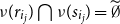 $\nu(r_{i_j}) \bigcap \nu(s_{i_j}) = \widetilde{\emptyset}$
. Then,
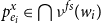 $p_{e_i}^x \in \bigcap \nu^{fs}(w_i)$
where
 $w_i = \iota(r_{i_1})...\iota(r_{i_n})$
and hence there is some
 $u_i \ll \nu^{fs}(w_i)$
where
 $p_{e_i}^x \in \nu(u_i)$
, and
 $y \in \cup \nu^{fs}(v_i)$
where
 $v_i = \iota(v_{i_1})...\iota(v_{i_n})$
. Thus, there are some
 $u \in \nu^{fs}$
and
 $v \in \nu^{fs}$
where
 $u = \iota(u_1....\iota(u_n))$
and
 $x \in \cup \nu^{fs}(u)$
, and
 $v \ll \theta \circ f(\iota(v_1)....\iota(v_n))$
where
 $y \in \cup \nu^{fs}(v)$
. It is obvious that
 $\cup \nu^{fs}(u) \bigcap \cup \nu_{fs}(v) = \widetilde{\emptyset}$
. Therefore, H’ is the c.e. set for
 $SCpT_2$
.
Example 5.7. Let
 $X = \{x_i, y_i: i \in \mathbb{N}\}$
,
 $E = \{e_1, e_2\}$
be a parameter set, and
 $\tau$
be a STS defined on X w.r.t. E and generated by the following base notation where A is a non-c.e. set,

We extend names to the finite intersections as follows
 $\nu(0^imn) \bigcap \nu(0^ikl) = \nu(0^imnkl)$
and the intersection of two basic open sets is empty except for
 $\nu(0^i21) \bigcap \nu(0^i22) = \nu(0^i2122)$
. Thus, the space is computable STS. This space is
 $SCpT_2$
as we have a c.e. set
 $H_1$
where
 $H_1 = \{(\iota(0^im1)\iota(0^im2), \iota(0^jn1)\iota(0^jn2)): i, j \in \mathbb{N}; m, n \in \{1, 2\}; m \neq n\}$
. Let
 $H_2$
be the c.e. set for
 $SCuT_2$
, then for
 \[i \in A \Rightarrow (0^i21, 0^i22) \in H_2,\]
 \[i \notin A \Rightarrow (0^i21, 0^i22) \notin H_2.\]
Thus, A must be a c.e. set which is a contradiction. Therefore, the space is not
 $SCuT_2$
.
We now give a counterexample for a space that is
 $CuT'_1$
but not
 $ CpT'_1$
.
Example 5.8. Let
 $X = \{x_i, y_i: i \in \mathbb{N}\}$
,
 $E = \{e_1, e_2\}$
be a parameter set, and
 $\tau$
be a STS defined on X w.r.t. E and generated by the following base notation where A is a non-c.e. set,

We define names to the finite intersections as follows
 $\nu(0^im) \bigcap \nu(0^in) = \nu(0^imn)$
and the intersection of more than two basic open sets is empty except for
 $\nu(0^i3) \bigcap \nu(0^i4) \bigcap \nu(0^i6) = \nu(0^i346)$
.
Thus, the space is computable STS. This space is
 $CuT'_1$
as we have the following c.e. set that satisfies the conditions of
 $CuT'_1$
,
 \[H = \{(0^im, 0^jn), (0^i46, 0^jm): i,j \in \mathbb{N}; m \in \{1, 2, 3, 5\}; n \in \{1, 2, 3, 4\}\}.\]
However, it is not
 $CpT'_1$
, as if it was, there would exist a c.e. set H’ that satisfies the conditions of
 $CpT'_1$
and hence for,
 \[i \in A \Rightarrow (r, s) \in H',\]
 \[i \notin A \Rightarrow (r, s) \notin H',\]
where
 \[\iota(0^i1), \iota(0^i2)\ll r \land \iota(0^i3), \iota(0^it) \ll s \,\textrm{for}\, t\in\{4, 6, 46\}.\]
Thus, A must be a c.e. set which is a contradiction. Therefore, the space is not
 $CpT'_1$
.
Remark 5.9.
 $SCuT_0$
and
 $SCpT_0$
are incomparable.
Proof. This follows directly from Propositions 3.9, 4.8 and Examples 5.3 and 5.4.
Remark 5.10.
 $CuT'_i$
and
 $CpT'_i$
are incomparable for
 $i \in \{0, 1, 2\}$
.
Proof. For
 $i = 0$
: Use Example 5.5 where in which the space is not
 $WCuT_0$
and Example 5.4, and Propositions 3.9, 3.10.
For
 $i = 1, 2$
: Use Examples 5.5, 5.7, and Propositions 3.11, 4.12.
Remark 5.11.
 $WCuT_0$
and
 $WCpT_0$
are incomparable.
Proof. Use Examples 5.5, 4.9 where in the latter example the space is
 $WCuT_0$
as we have the following c.e. set,
 \[H = \{(0^imk, 0^inl): i, j \in \mathbb{N}; m,n \in \{1, 5\}; k, l \in \{1, 2\}\}.\]
However, it is not
 $WCpT_0$
as shown earlier.
So far we have defined nine computable separation axioms based on soft points and another nine separation axioms based on soft singletons. We also investigated how the ones based on soft points are related and how the other ones based on soft singletons are related. Counterexamples have been provided to show the non-implications between them. Some of them turned out to be equivalent and others turned out to be incomparable. Equivalences between the ones that are based on soft points exist for instances:
 $CuT_2 \Leftrightarrow CuT'_2$
,
 $CuT_1 \Leftrightarrow CuT'_1$
, and
 $SCuT_0 \Leftrightarrow CuT'_0$
. However, these equivalences do not exist for their counterparts that are based on soft singletons.
In the following Fig. 3, all relations between computable u-soft and p-soft separation axioms are represented. As seen from the figure, there are some implications between some separation axioms and some other separation axioms turn out to be incomparable.
Relations between computable u-soft and computable p-soft separation axioms.

6. Conclusion
In this paper, we defined the effective versions of soft separation axioms. We introduced two sets of computable soft separation axioms, namely computable u-soft and computable p-soft separation axioms, and investigated many relations between them. Finally, We showed how the effective and classical versions of these soft separation axioms differ.
Statements and declarations
Data availability.
No datasets are used in this paper.
Author contributions.
All the work is done by the two authors where the first author proposed and initiated the idea of effectivizing some of the soft separation axioms and the second author reviewed and introduced the suitable techniques in computability theory that fit that effectivization. The paper is written by the first author and the final revision was done by the second author.
Funding.
The authors declare that no funds, grants, or other support were received during the preparation of this manuscript.
Competing interests.
The authors declare none.