Introduction
Fluorarrojadite-(BaNa), ideally BaNa4CaFe13Al(PO4)11(PO3OH)F2 is a new member of the arrojadite group. It was found at the dump of Elisabeth adit near Gemerská Poloma village, Rožňava Co., Košice Region, Slovak Republic.
The new mineral is named according to the nomenclature scheme of arrojadite-group minerals (Chopin et al., Reference Chopin, Oberti and Cámara2006), which was approved by the International Mineralogical Association Commission on New Minerals, Nomenclature and Classification (IMA-CNMNC) and it is based on the occupancy of M (root-name), A1 (first suffix), B1 (second suffix) and W (first prefix) sites. Three root-names are recognized for arrojadite-group minerals: arrojadite (Fe2+ dominant at M sites), dickinsonite (Mn2+ dominant at M sites) and carmoite (Mg dominant at the M sites; Cámara et al., Reference Cámara, Bittarello, Ciriotti, Nestola, Radica and Bracco2015). The general structural formula for arrojadite-group minerals is A2B2CaNa2+xM13Al(PO4)11(PO3OH1–x)W2 (for details see Chopin et al., Reference Chopin, Oberti and Cámara2006). In fluorarrojadite-(BaNa) Fe2+ is the dominant cation at the M site (so the root-name is arrojadite) and two suffixes are added to the root-name according to the dominant cation of the dominant valence state at the A1 (Ba2+) and B1 sites (Na+). The prefix fluor is added to the root-name as F– is dominant over (OH)– at the W site.
The new mineral and the name were approved by the CNMNC (IMA 2016-075; Števko et al., Reference Števko, Sejkora, Uher and Cámara2016). The description of fluorarrojadite-(BaNa) is based upon two holotype specimens (two parts of one large piece). One is deposited in the collections of the Department of Mineralogy and Petrology, National Museum in Prague, Cirkusová 1740, 19300 Praha 9, Czech Republic under the catalogue number P1P 13/2016. The second holotype specimen is deposited in the collections of the Department of Mineralogy and Petrology, Faculty of Natural Sciences, Comenius University, Ilkovičova 6, 84215 Bratislava IV, Slovak Republic under the catalogue number 7401.
Occurrence
Several specimens with fluorarrojadite-(BaNa) were found at the dumps of Elisabeth adit (which exploited the Gemerská Poloma talc deposit) situated near Gemerská Poloma village, Rožňava Co., Košice Region, Slovak Republic (48°45'04.06''N, 20°29'39.27''E). During the exploration of the talc-magnesite deposit the main crosscut of the Elisabeth adit intersected a large body of specialized S-type granite (also called Gemeric granite) with abundant hydrothermal quartz veins containing fluorarrojadite-(BaNa).
The granitic rocks of the Gemeric Unit represent a distinct type of specialized (Sn–W–F), highly evolved suite with S-type affinity, which differs from other granitoids occurring in the Veporic and Tatric Units of the Western Carpathian crystalline basement; they are enriched in phosphorus and rare lithophile elements, such as Li, Rb, Cs, B, Ga, Sn, W, Nb, Ta and U and depleted in rare-earth elements, Zr, Ti, Sr and Ba (e.g. Uher and Broska, Reference Uher and Broska1996; Petrík and Kohút, Reference Petrík, Kohút, Grecula, Hovorka and Putiš1997; Kubiš and Broska, Reference Kubiš and Broska2005, Reference Kubiš and Broska2010; Breiter et al., Reference Breiter, Broska and Uher2015). The Gemeric granitic rocks form several small plutons intruded into the intensively folded Lower Paleozoic (mainly Ordovician to Devonian) volcano-sedimentary complex of the Gelnica Group, metamorphosed in the greenschist metamorphic facies (Bajaník et al., Reference Bajaník, Ivanička, Mello, Pristaš, Reichwalder, Snopko, Vozár and Vozárová1984; Petrasová et al., Reference Petrasová, Faryad, Jeřábek and Žáčková2007). In the Gemerská Poloma area, the metamorphic rocks are composed mainly of phyllites, metapyroclastic rocks of rhyolitic to dacitic composition, locally with lenses of metadolomite, and strongly steatitized magnesite with a recently exploited talc deposit near Gemerská Poloma (Kilík, Reference Kilík1997). The age of the granite intrusion and related hydrothermal veins with fluorarrojadite-(BaNa) and other phosphates is Late Permian (~260 to 250 Ma), on the basis of zircon U–Pb radiometric age determination of the granites (Poller et al., Reference Poller, Uher, Broska, Plašienka and Janák2002) and Re–Os molybdenite dating of related Sn–W–Mo mineralization (Kohút and Stein, Reference Kohút and Stein2005).
Several types of the Gemeric granites were distinguished at the Gemerská Poloma area: (1) coarse-grained porphyritic granite to granite porphyry; (2) medium-grained Li-annite-topaz-tourmaline bearing granite; (3) P-enriched topaz-zinnwaldite leucogranite; and (4) albitite (Dianiška et al., Reference Dianiška, Breiter, Broska, Kubiš and Malachovský2002, Reference Dianiška, Uher, Hurai, Huraiová, Frank, Konečný, Kráľ and Hurai2007; Petrík et al., Reference Petrík, Čík, Miglierini, Vaculovič, Dianiška and Ozdín2014; Breiter et al., Reference Breiter, Broska and Uher2015). Except for albitites, all the other granite types were encountered recently in the Elisabeth adit (Števko et al., Reference Števko, Uher, Sejkora, Malíková, Škoda and Vaculovič2015).
The hydrothermal quartz veins with albite, muscovite, fluorite, siderite, calcite, dolomite, sulfides and sulfosalts were observed in all types of granite, but the occurrence of the quartz veins with fluorarrojadite-(BaNa) and other phosphates (fluorapatite, ‘fluordickinsonite-(BaNa)’, triplite and viitaniemiite) is limited only to the highly fractionated topaz–zinnwaldite leucogranite (Števko et al., Reference Števko, Uher, Sejkora, Malíková, Škoda and Vaculovič2015). The quartz veins with fluorarrojadite-(BaNa) are up to 8 cm thick and no more than 3 m long and except for other phosphates (common and macroscopic: fluorapatite and triplite; rare and microscopic: viitaniemiite; very rare and microscopic: ‘fluordickinsonite-(BaNa)’) they contain minor amounts of albite, orthoclase, muscovite, fluorite, Mn-rich siderite to rhodochrosite, arsenopyrite, pyrite, bismuthinite, kobellite, tintinaite, giessenite and native bismuth.
Physical and optical properties
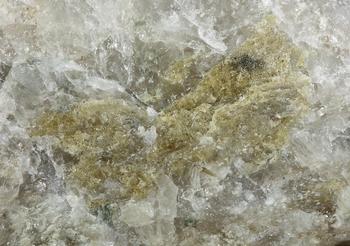
Fluorarrojadite-(BaNa) occurs as very fine grained irregular aggregates usually up to 1 cm x 1 cm in size, exceptionally up to 4 cm x 2 cm (Fig. 1), which consists of individual anhedral grains up to 0.01 mm. Individual crystals have not been observed. It has a yellowish-brown to greenish-yellow colour, very pale yellow streak, a vitreous to greasy lustre and is non-fluorescent in SW and LW ultraviolet light. The Mohs hardness is estimated at ~4½ to 5 based upon scratch tests and by analogy to other arrojadite-group minerals. The fracture is irregular and tenacity is brittle. No cleavage was observed as aggregates of fluorarrojadite-(BaNa) are fine grained. The measured density acquired by floating of the mineral fragments in a mixture of the Clerici solution (density 4.2 g cm–3) and distilled water is 3.61(2) g cm–3, whereas calculated density is 3.650 g cm–3 based on the empirical formula and unit-cell volume. Fluorarrojadite-(BaNa) is optically biaxial (+) without apparent pleochroism. Refractive indexes and other optical properties were not determined due to the very small grain size of single crystals. The calculated refractive index based on the empirical formula is 1.674.
Yellowish-brown fine grained aggregate of fluoarrojadite-(BaNa) associated with minor dark green grains of fluorapatite in quartz matrix. Field of view is 40 mm. Photo: Pavel Škácha.

Raman spectroscopy
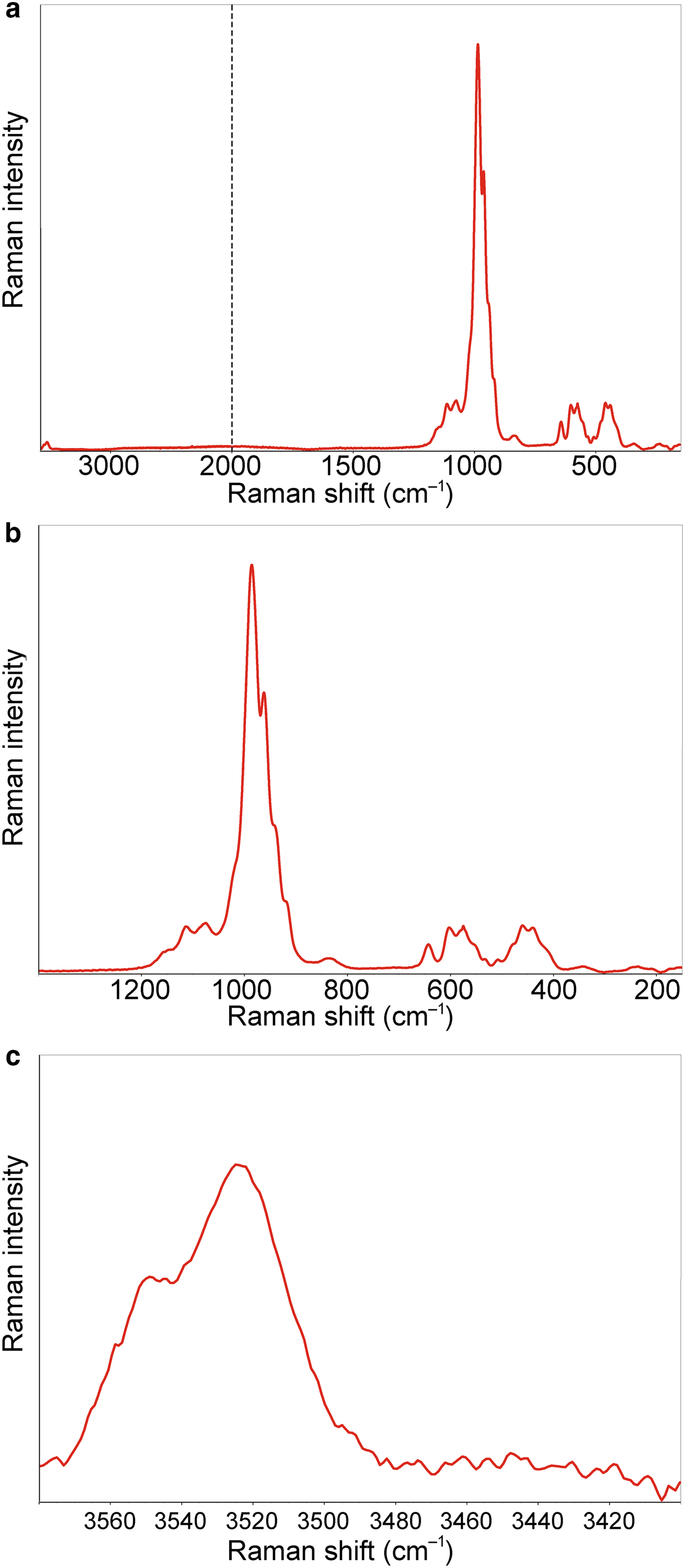
The Raman spectrum of fluorarrojadite-(BaNa) was collected in the range 3580–50 cm–1 using a DXR dispersive Raman Spectrometer (Thermo Scientific) mounted on confocal Olympus microscope at the Department of Mineralogy and Petrology, National Museum, Prague, Czech Republic. The Raman signal was excited by a green 532 nm diode-pumped solid-state laser and detected by a CCD detector. The experimental parameters were: 10x objective, 1 s exposure time, 1000 exposures, 900 lines/mm grating, 50 µm slit spectrograph aperture and 8 mW laser power level. The instrument was set up by a software-controlled calibration procedure using multiple neon emission lines (wavelength calibration), multiple polystyrene Raman bands (laser frequency calibration) and standardized white-light sources (intensity calibration). Spectral manipulations were performed using the Omnic 9 software (Thermo Scientific).
The Raman spectrum (Fig. 2) of fluorarrojadite-(BaNa) is similar to spectra published by Frost et al. (Reference Frost, Xi, Schol and Campos Horta2013) for arrojadite-(KFe) and those on the RRUFF database (www.rruff.info, Lafuente et al., Reference Lafuente, Downs, Yang, Stone, Armbruster and Danisi2015): arrojadite-(KNa) (R050107), arrojadite-(KFe) (R070319) and arrojadite-(NaFe) (R070298). The existence of several non-equivalent (PO4)3– groups, their strong distortion and the presence of the (PO3OH)2– group in the crystal structure of the proposed new mineral leads to a complex Raman spectrum with a lot of overlapping bands corresponding to stretching and bending vibrations of phosphate groups (Nakamoto, Reference Nakamoto1986). The most intensive bands in the region 1060–830 cm–1 (1020, 985, 959, 939, 916 and 839 cm–1) corresponds to the ν1 symmetric stretching vibration of (PO4)3– and (PO3OH)2– groups; those at 1151, 1113 and 1076 cm–1 to ν3 antisymmetric stretching vibration of (PO4)3– and (PO3OH)2– groups. The bending vibrations of (PO4)3– and (PO3OH)2– groups are represented by bands in the region with frequencies between 700 and 400 cm–1: 507, 481, 461, 439 and 414 cm–1 (ν2) and 643, 602, 580, 575, 551 and 532 cm–1 (ν4). The observed bands at 3551 and 3523 cm–1 are connected to stretching vibrations of OH groups. These compare well with stretching vibrations observed by Cámara et al. (Reference Cámara, Oberti, Chopin and Medenbach2006) in Nickel Plate mine arrojadite-(KFe) and Rapid Creek arrojadite-(KNa) and also with Fourier-transform infrared spectroscopy absorbance data by Della Ventura et al. (Reference Della Ventura, Bellatreccia, Radica, Chopin and Oberti2014) for Nickel Plate mine arrojadite-(KFe). Note, the absence of molecular water in the mineral phase studied is confirmed by a lack of observed bands in the region 1650–1550 cm–1.
(a) Raman spectrum of fluorarrojadite-(BaNa) from Gemerská Poloma, full range. (b) 150–1400 cm–1. (c) 3400–3580 cm–1.

Chemical composition
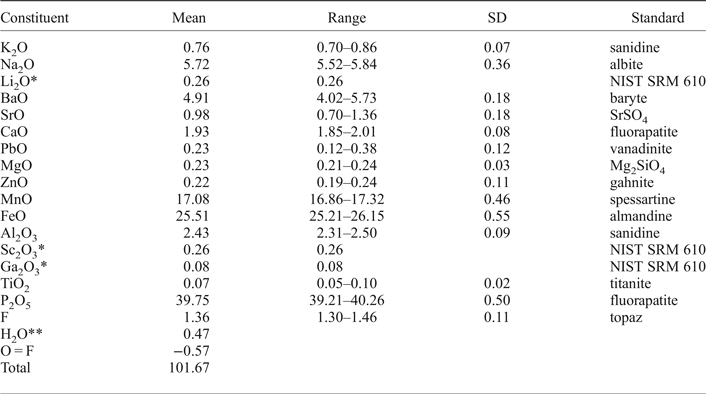
Quantitative chemical analyses (5 points) of fluorarrojadite-(BaNa) were performed at the Laboratory of Electron Microscopy and Microanalysis of the Masaryk University and Czech Geological Survey in Brno, Czech Republic on a Cameca SX100 electron microprobe equipped with five wavelength-dispersive spectrometers (WDS). Analytical conditions were: 15 kV accelerating voltage, 10 nA beam current, 10 µm beam diameter and WDS mode. Raw X-ray intensities were corrected for matrix effects with a φ(ρz) algorithm (Pouchou and Pichoir, Reference Pouchou, Pichoir, Heinrich and Newbury1991).
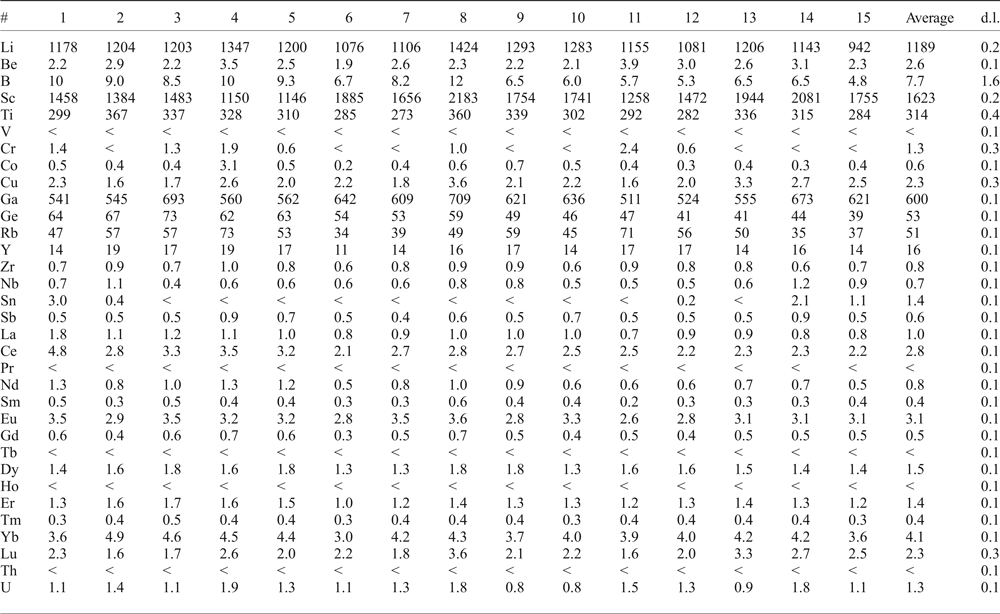
The contents of trace elements in fluorarrojadite-(BaNa) were determined by laser ablation inductively coupled plasma mass spectrometry (LA-ICP-MS) at the Department of Chemistry, Faculty of Science, Masaryk University, Brno, Czech Republic. The setup consists of laser ablation system UP213 (New Wave, USA) and quadrupole ICP-MS Agilent 7500ce (Agilent Technologies, Japan). The ablation system is equipped with Nd:YAG laser emitting radiation with a wavelength of 213 nm. Laser ablation was performed with a single hole drilling mode for the duration of 60 s for each spot of 100 µm diameter with a laser fluency of 12 J cm–2 and repetition rate of 10 Hz. The LA-ICP-MS measurements were normalized on average electron-microprobe measured concentration of phosphorus in fluorarrojadite-(BaNa) and the NIST SRM 610 glass reference material was used. Analytical data for fluorarrojadite-(BaNa) as well as standards used are given in Table 1 and the LA-ICP-MS analyses of selected trace elements in fluorarrojadite-(BaNa) are given in Table 2.
Chemical composition (in wt.%) of fluorarrojadite-(BaNa).

* Obtained by LA-ICP-MS; ** calculated as (F + OH + Na3) = 3 apfu; SD = standard deviation.
Trace element LA-ICP-MS analyses of fluorarrojadite-(BaNa) from Gemerská Poloma (in ppm).

d.l. = Detection limit; ‘<’ = not detected.
On the basis of 47 O OH + F = 2 + [21 – the sum of non-(P,Al) cations] atoms per formula unit (apfu) (Chopin et al., Reference Chopin, Oberti and Cámara2006) the average composition of fluorarrojadite-(BaNa) corresponds to the empirical formula: (Na3.96Ca0.74Ba0.69K0.35Sr0.20Pb0.02)Σ5.96 M(Fe7.62Mn5.17Li0.37Mg0.12Sc0.08Zn0.06Ti0.02Ga0.02)Σ13.46 Al1.02(P12.02O47)(F1.54OH1.00O0.46)Σ3.00. The elements have been grouped into four categories: large low-charge cations (alkali and alkaline earth metals plus lead) occupying high coordination number sites; small alkali and alkaline earth metals plus transition metals in four-, five- and six-fold coordinated sites; Al (Ga) in small octahedra and P in tetrahedral coordination. The sum of [Fe + Mn + Mg + Li+(Sc,Zn,Ti)] > 13 apfu, but it is < 13.5 therefore precluding dominance of Fe (or Mn) in the B1b,c sites described by Chopin et al. (Reference Chopin, Oberti and Cámara2006). In addition, the sum of alkali and alkali earths metals is close to 6 apfu. Of them 1.69 are divalent cations (essentially Ca and Ba), and this implies that the formula scheme has to be no. 3 in table 3 of Chopin et al. (Reference Chopin, Oberti and Cámara2006). Therefore, Ba must be dominant at the A1 site and Na at the B1 site. Furthermore, the analysed fluorine content is F > 1.5 apfu, distinguishing it from the composition reported by Vignola et al. (Reference Vignola, Hatert, Baijot, Dal Bo, Andò, Bersani, Risplendente and Vanini2015), and thus this mineral has to be classified as fluorarrojadite-(BaNa).
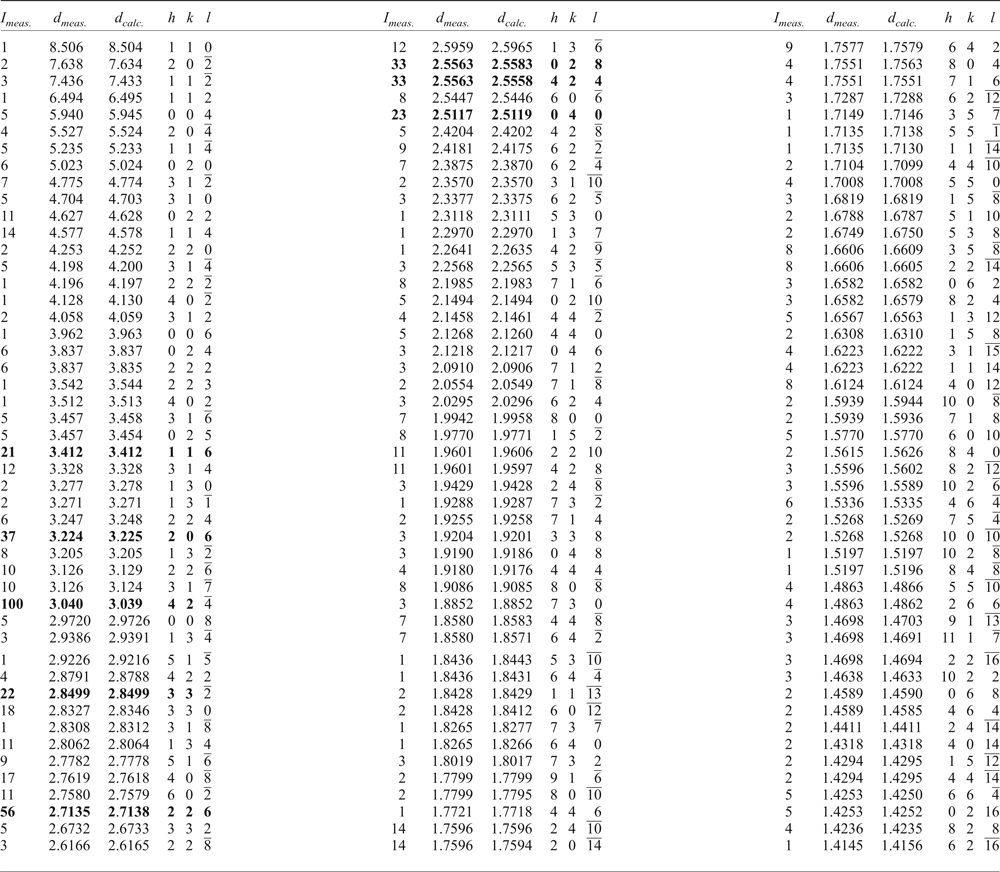
X-ray powder diffraction data of fluorarrojadite-(BaNa) from Gemerská Poloma; the strongest diffractions are reported in bold.

The eight strongest lines are given in bold.
In the absence of site partitioning that can be obtained only from crystal-structure refinement (see below), site assignment follows the cation ordering scheme proposed by Cámara et al. (Reference Cámara, Oberti, Chopin and Medenbach2006), allowing the ordering of the cations to be guessed in the different sites of the structure, thus leading to the following crystal-chemical formula: A1(Ba0.65K0.35)Σ1.00 A2Na0.35 B1(Na0.54Fe0.46)Σ1.00 B2Na0.54 Ca(Ca0.74Sr0.20Pb0.02Ba0.04)Σ1.00 Na2 Na3Na0.46 M(Fe7.16Mn5.17Li0.37Mg0.12Sc0.08Zn0.06Ga0.02Ti0.02)Σ13.00 Al1.02P11O44PO3.46(OH)0.54 W(F1.54OH0.46)Σ2.00. The presence of 0.46 apfu of Fe2+ at B1 sites implies that B2 can be at most occupied by 0.56 apfu of Na, the remaining Na partially occupying the Na3 site. This implies that in the calculation of total amount of (F + OH), the Na present at the Na3 site must be subtracted to 3 (F + OH), because the occupancy of the Na3 site is incompatible with a proton bonded to the O3x anion site at the PO4 group at the P1x site (see Cámara et al., Reference Cámara, Oberti, Chopin and Medenbach2006 for a discussion of local ordering). Although the Raman spectrum does not show a clear indication of a deprotonation of the PO4 group, there is other evidence from crystal data that supports this site assignment (see below). The ideal, fully ordered end-member formula of fluorarrojadite-(BaNa) is A1BaA2□B1NaB2NaCaCaNa1NaNa2NaNa3□MFe13Al(PO4)11(PO3OH)W(F)2, which can be simplified as BaNa4CaFe13Al(PO4)11(PO3OH)F2, and requires Na2O 5.63, BaO 6.97, CaO 2.55, FeO 42.44, Al2O3 2.32, P2O5 38.69 F 1.73, H2O 0.41 and O = F –0.73, total 100.00 wt.%. The holotype material studied was homogenous, but some of earlier collected samples from Gemerská Poloma studied by Števko et al. (Reference Števko, Uher, Sejkora, Malíková, Škoda and Vaculovič2015) suggest that a complete solid-solution exists between fluorarrojadite-(BaNa) and arrojadite-(BaNa), following a simple F– ↔ (OH)– substitution. Likewise, a solid solution exists between fluorarrojadite-(BaNa) and an as yet unapproved new member of the arrojadite group ‘fluordickinsonite-(BaNa)’.
X-ray diffraction data
Single-crystal X-ray studies of fluorarrojadite-(BaNa) were not carried out because of the absence of suitable single crystals: as the material studied is very fine grained (individual grains up to 0.01 mm) and several attempts to obtain a suitable single crystal from the fine-grained mass of fluorarrojadite-(BaNa) were unsuccessful.
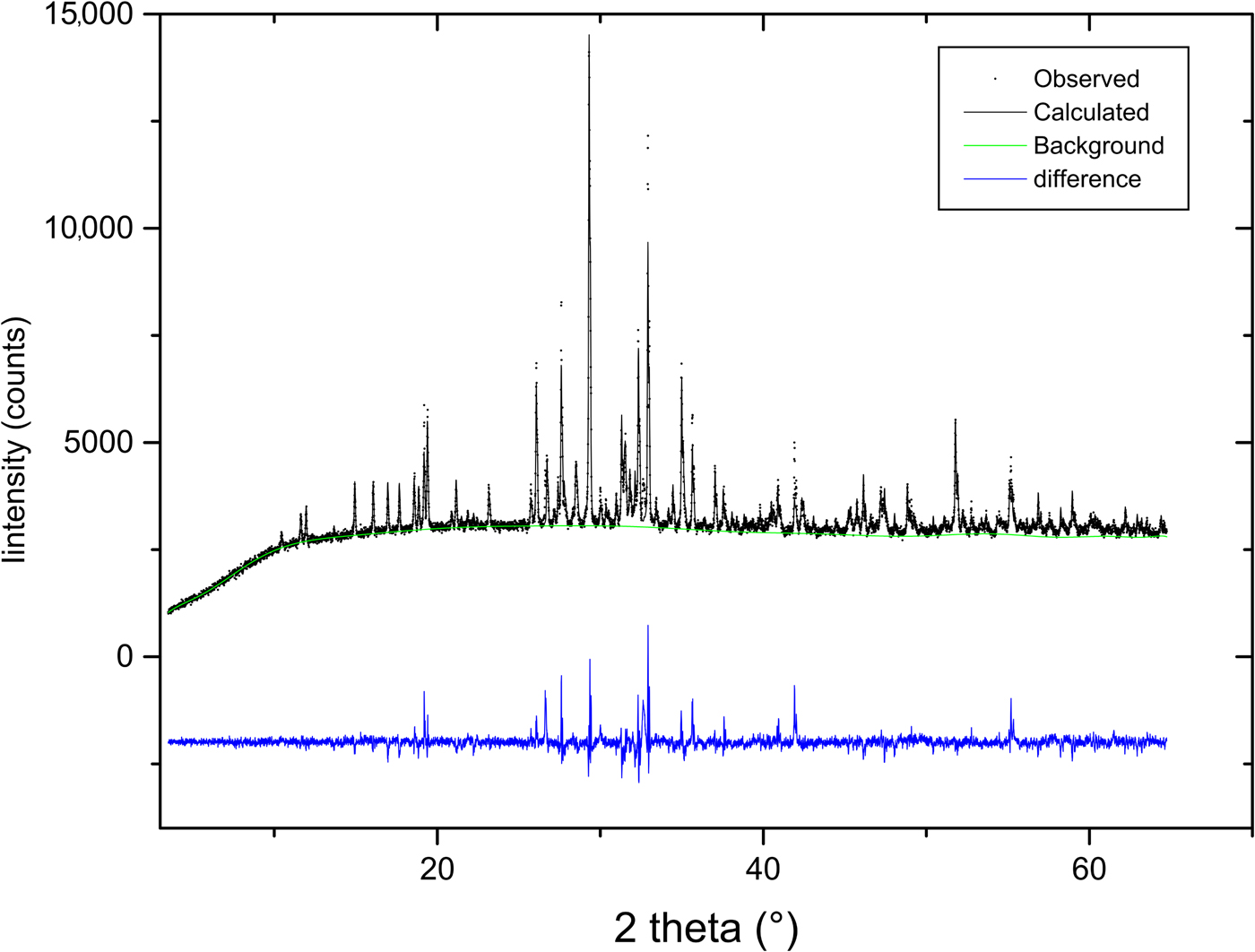
Powder X-ray diffraction data for fluorarrojadite-(BaNa) were recorded using a Bruker D8 Advance diffractometer equipped with solid-state LynxEye detector and secondary monochromator producing CuKα radiation housed at the Department of Mineralogy and Petrology, National Museum, Prague, Czech Republic. The instrument was operating at 40 kV and 40 mA. In order to minimize the background, the powdered sample was placed on the surface of a flat silicon wafer in ethanol suspension. The powder pattern was collected in the Bragg–Brentano geometry in the range 3–75°2θ, with 0.01° step size and a counting time of 30 s per step (total duration of the experiment was ~3 days). Positions and intensities of diffractions were found and refined using the Pearson VII profile-shape function of the ZDS program package (Ondruš, Reference Ondruš1993) and the unit-cell parameters were refined by the least-squares program of Burnham (Reference Burnham1962). The powder X-ray diffraction data of fluorarrojadite-(BaNa) are given in Table 3. Unit-cell parameters of fluorarrojadite-(BaNa) refined for the monoclinic space group Cc are: a = 16.563(1) Å, b = 10.0476(6) Å, c = 24.669(1) Å, β = 105.452(4)°, V = 3957.5(4) Å3 and Z = 4. The application of Rietveld refinement is highly questionable considering that the structure has >90 independent atom sites. However, we conducted a test using the collected data and the model published by Cámara et al. (Reference Cámara, Oberti, Chopin and Medenbach2006) for arrojadite-(SrFe), allowing for refinement of cation occupancies at A1, A2, B1, Na3 and Ca sites (Ba vs. K and Na; Na vs. Fe and Na; and Na and Ca vs. Sr, respectively). The chemistry at the M1 and M3 sites was allowed to vary, but was fixed in all the other M sites. The atom coordinates of every cation and anion sites in the structure were kept fixed. Refinement was performed with GSAS + EXPGUI software (Larson and Von Dreele, Reference Larson and Von Dreele1994; Toby, Reference Toby2001). The residuals improved sensibly (wR p = 0.0398, wR p after background subtraction 0.0911; R(F 2) = 0.1475) when chemistry was allowed to vary in the above reported sites. Obviously, the results should interpreted with caution. Nevertheless the trend agrees well with what was expected from the formula obtained on the basis of crystal-chemical criteria. Occupancy at M1 was determined to be 18.0(7) electrons per site (eps), as expected for fractionation of Li at this site already found in dickinsonite-(KMnNa) by Cámara et al. (Reference Cámara, Oberti, Chopin and Medenbach2006). Zn seems to order in the M3 site that is among the smaller octahedra but yielded 29.1(6) eps, evidently overestimated. The most interesting results are obtained for alkali sites: 48.5(4) vs. 43.1 eps from chemical formula in the A1 site; 2.5(8) vs. 3.9 eps from chemical formula in the A2 site; 25.7(5) vs. 26.3 eps from chemical formula in the Ca site; 22.8(6) vs. 17.9 eps from chemical formula in the B1 site; and 1.2(7) vs. 5.1 eps from chemical formula in the Na3 site. Therefore the worst agreements are found in the B1 and Na3 sites, which are usually split sites (see Cámara et al., Reference Cámara, Oberti, Chopin and Medenbach2006) thus seriously challenging any plausible satisfactory result. The observed and calculated pattern and the relative residuals are reported in Fig. 3. The results are a reasonable support of the proposed crystal-chemical formula.
Observed powder pattern of fluorarrojadite-(BaNa). The calculated intensities, substracted background and residuals obtained by Rietveld refinement (see text) are also reported.

Relationship to the known species and origin
As mentioned previously, fluorarrojadite-(BaNa) is a member of the arrojadite group (Cámara et al., Reference Cámara, Oberti, Chopin and Medenbach2006; Chopin et al., Reference Chopin, Oberti and Cámara2006). Its existence was noted in samples of fluoarrojadite-(BaFe) from the Sidi-bou-Kricha pegmatite in Morocco by Chopin et al. (Reference Chopin, Oberti and Cámara2006) and it was also described as a product of the hydrothermal alteration of triphylite from the Nanping No. 31 granitic pegmatite in Fujian Province, China by Rao et al. (Reference Rao, Wang, Hatert and Baijot2014). The sample studied has a rather high content of Mn2+, among the highest reported for arrojadites in the literature. Only the sample from Buranga (Rwanda) (von Knorring, Reference von Knorring1969) has a higher Mn-content and as such it is very close to be classified as a dickinsonite. It is not surprising that in the same locality (Gemerská Poloma) some minute crystals showed compositions classifiable as ‘fluordickinsonite-(BaNa)’ (Števko et al., Reference Števko, Uher, Sejkora, Malíková, Škoda and Vaculovič2015). The Mg content is fairly low (only 0.12 apfu), lower than in most of the analyses reported for arrojadites, and far from arrojadite-(PbFe) from Sapucaia (Moore and Ito, Reference Moore and Ito1979) which contains 3.49 apfu of Mg and arrojadite-(BaFe) from Spluga (Demartin et al., Reference Demartin, Gramaccioli, Pilati and Sciesa1996) which reaches 5.54 apfu of Mg, but still far from being classifiable as carmoite-(BaFe). Another interesting chemical feature is the presence of significant Li (0.37 apfu), not uncommon in arrojadite-group minerals, although far lower than the amount present in arrojadite-(PbFe) from Sapucaia (0.86 apfu, data from Cámara et al., Reference Cámara, Oberti, Chopin and Medenbach2006).
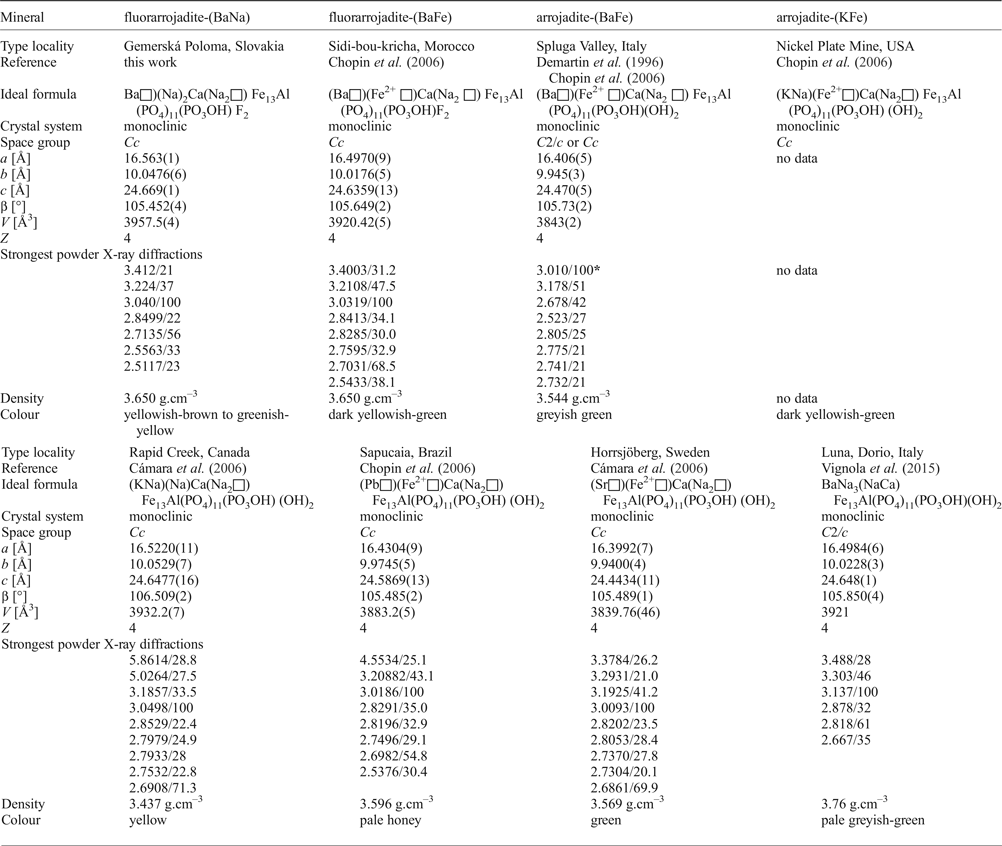
In the Strunz mineral classification system fluorarrojadite-(BaNa) fits in subdivision 8.BF: phosphates, arsenates, vanadates with additional anions, without H2O, with medium-sized and large cations and (OH, etc.): RO4 < 0.5:1 (Strunz and Nickel, Reference Strunz, Nickel and Verlagsbuchhandlung2001). The comparison of physical properties of the valid mineral species of the arrojadite subgroup are given in Table 4. The observed lattice parameters are among the largest of the arrojadite subgroup and this is due to the fairly low Mg content. In general, all the cell dimensions are correlated negatively with the Mg content. The value observed for the β angle deviates from the positive trend observed by Cámara et al. (Reference Cámara, Oberti, Chopin and Medenbach2006), which compares the value of the β angle with the (Na + K) content (see their Fig. 1), for samples with a vacant Na3 site. This indication is in support of the presence of Na at the Na3 site as suggested by the site assignment on the basis of crystal-chemical criteria and the weak evidence from Rietveld refinement of the presence of some occupation at this site.
Comparison of the physical properties for valid members of the arrojadite group (dickinsonite-group minerals and fluorcarmoite-(BaNa) are not included).

* data from Demartin et al. (Reference Demartin, Gramaccioli, Pilati and Sciesa1996) for space group C2/c.
Fluorarrojadite-(BaNa) and associated phosphates in quartz veins were formed from late-magmatic to early-hydrothermal P- and F-rich fluids, related to the adjacent granite. These relatively high-temperature fluids altered primary magmatic minerals of the granite (especially albite, K-feldspar, Li-rich micas and fluorapatite) and liberated elements (such as Na, K, Fe, Mn, Ca, Ba, Sr and P) necessary for precipitation of the phosphate minerals.
Acknowledgements
The helpful comments of Jakub Plášil, Peter Leverett and Christian Chopin are greatly appreciated. Pavel Škácha is acknowledged for photography. FC thanks Marco Merlini (Università di Milano, Italy) for help with GSAS-EXPGUI. This study was supported financially by the Ministry of Culture of the Czech Republic (DKRVO 2017/02; National Museum 00023272), by the Slovak Research and Development Agency under the APVV-14-0278 project, and by the Ministry of Education, Slovak Republic, the VEGA-1/0499/16 project.