Introduction
Attentional dysregulation may underlie many of the defining aspects of posttraumatic stress and related psychological symptoms. In particular, many symptoms of posttraumatic stress disorder (PTSD) can be described as failures of attentional control, such as the inability to inhibit intrusive, distracting, trauma-related thoughts and images, increased monitoring of salient changes in the environment (i.e., hypervigilance), and difficulty concentrating. Correspondingly, researchers have found PTSD-related alterations in several categories of attention including sustained attention (Jenkins, Langlais, Delis, & Cohen, Reference Jenkins, Langlais, Delis and Cohen2000; Vasterling, et al., Reference Vasterling, Duke, Brailey, Constans, Allain and Sutker2002; Veltmeyer, et al., Reference Veltmeyer, Clark, McFarlane, Felmingham, Bryant and Gordon2005) shifting attention (e.g., to trauma-related stimuli; Bryant & Harvey, Reference Bryant and Harvey1997), and in executive attention/inhibitory control (Leskin & White, Reference Leskin and White2007; Vasterling, Brailey, Constans, & Sutker, Reference Vasterling, Brailey, Constans and Sutker1998). Researchers have also described increased attention to negative stimuli and more general executive dysregulation in depression (Berman et al., Reference Berman, Nee, Casement, Kim, Deldin, Kross and Jonides2011; Mogg, Mathews, Bird, & Macgregor-Morris, Reference Mogg, Mathews, Bird and Macgregor-Morris1990), though these findings have been less consistently demonstrated than in PTSD. The current study investigated an aspect of attentional control that has yet to be fully explored in this population—the ability to attend to emotionally-neutral relevant information while resisting distraction from irrelevant, non-emotional distractors (i.e., selective attention). Specifically, this study uses attentional capture, or distractor-related interference in task performance, as a direct measure of failures of selective attention.
Most studies investigating selective attention in those suffering from posttraumatic psychological symptoms have used non-emotional targets (e.g., dot probes; Bryant & Harvey, Reference Bryant and Harvey1997) in the context of emotional distractors (e.g., trauma-related words). Using different experimental tasks, individuals with PTSD, and to a lesser extent those with depressive symptoms, show an attentional bias to threatening information that can interfere with task performance. For example, Pineles, Shipherd, Mostoufi, Abramovitz, and Yovel (Reference Pineles, Shipherd, Mostoufi, Abramovitz and Yovel2009) observed that individuals with greater PTSD symptom severity showed increased interference from trauma-related distractors during visual search. Collectively, these studies suggest that posttraumatic psychological symptoms are characterized by capture of attention toward threatening and/or trauma-related distractors that may overpower the goal-directed/volitional attentional system. An important question is whether the reduced ability to ignore threat-related distractors represents a special case of a more global attentional dysregulation in this population, which would be potentially more disruptive to day-to-day functioning (e.g., driving difficulties) than attentional limitations circumscribed to emotional contexts.
Recent reviews indicate that even on emotionally neutral tasks, PTSD in particular is associated with attention alterations, albeit these effects tend to be subtler than in emotional contexts (Aupperle, Melrose, Stein, & Paulus, Reference Aupperle, Melrose, Stein and Paulus2012; Vasterling & Verfaellie, Reference Vasterling and Verfaellie2009). Supporting a link between PTSD and general dysregulation in attentional selection, Vasterling et al. (Reference Vasterling, Brailey, Constans and Sutker1998) found that the tendency for cognitive intrusions, pooled across several tasks, was positively correlated with severity of re-experiencing symptoms of PTSD. Additionally, Kimble, Kaloupek, Kaufman, & Deldin (Reference Kimble, Kaloupek, Kaufman and Deldin2000) showed that veterans with PTSD had a heightened neural response to novel relative to repeated non-emotional auditory distractors as measured by the P3a, an ERP component thought to reflect attentional capture to unpredictable and salient distractors (Friedman, Cycowicz, & Gaeta, Reference Friedman, Cycowicz and Gaeta2001). Further indirect support comes from a study by Leskin and White (Reference Leskin and White2007) who showed that PTSD is associated with greater interference from non-emotional distractors that are either congruent or incongruent with targets. However, the task used by Leskin and White combines effects of attentional selection, response competition, and perceptual interference. Thus, it is difficult to know if these findings were driven by exaggerated capture of attention by distractors. In contrast, depression has been more consistently associated with disruptions in working memory and executive functioning (e.g., Berman et al., Reference Berman, Nee, Casement, Kim, Deldin, Kross and Jonides2011), although some evidence supports attentional alternations in depression, and that depression may exacerbate PTSD-related alterations (Johnsen, Kanagaratnam, & Asbjornsen, Reference Johnsen, Kanagaratnam and Asbjornsen2008). Understanding the specific underlying mechanism of attentional abnormalities caused by PTSD and related psychological symptoms is important to refining information processing and neurocognitive models of PTSD, shedding light on discrepant findings (e.g., PTSD-related impairments on some executive attention tasks and not others), and developing interventions (e.g., attentional retraining) based on such models.
In the current study, we used a visual search task that more purely measures selective attention, referred to as attentional capture, without the influence of response inhibition or target/distractor similarity (Theeuwes & Burger, Reference Theeuwes and Burger1998). Compared to previous reports, this allowed us to more thoroughly determine if PTSD and depression symptoms are associated with a generalized attentional bias toward non-threatening distractors. Based on previous evidence (Kimble et al., Reference Kimble, Kaloupek, Kaufman and Deldin2000; Leskin & White, Reference Leskin and White2007) and commonly self-reported attentional failures in this population, we hypothesized that individuals with more severe PTSD symptoms, as well as potentially more severe depression symptoms, would experience greater capture of attention by task irrelevant, but visually salient distraction.
Methods
Participants
Thirty-five Operation Enduring Freedom (OEF)/Operation Iraqi Freedom (OIF) veterans were recruited from the VA Boston Translational Research Center for TBI and Stress Disorders (TRACTS). Requirements for participation included OEF/OIF deployment, as well as at least one Criterion A trauma event; however, participation did not require a prior diagnosis of PTSD. From this remaining pool, subjects were randomly selected and approximately 70% of participants who were contacted participated. As part of the Center's exclusionary criteria, participants had no history of neurological conditions or physical impairments except some reported history of a mild traumatic brain injury (mTBI). We did not exclude mTBI due to the large number of veterans reporting at least one blast resulting in altered consciousness. Post hoc analyses were conducted to examine any additional effects of mTBI status. Additional psychiatric exclusionary criteria included psychotic disorders, bipolar disorder, and suicidal/homicidal ideation requiring intervention. Five of the 35 participants were excluded for poor task performance (see results section). This study was approved by the VA Boston Healthcare System IRB, and written consent was obtained from all participants.
PTSD and Depression Symptom Severity
At the time of the experimental session, participants completed the PTSD Checklist—Civilian version (PCL-C; Weathers, Huska, & Keane, Reference Weathers, Huska and Keane1991) to measure PTSD symptom severity. To assess depression symptoms, participants also completed the Beck Depression Inventory-II (Manual for the Beck Depression Inventory-II, San Antonio, TX: Psychological Corporation). In addition, as part of their participation in TRACTS, the presence and severity of PTSD was assessed using the Clinician-Administered PTSD Scale (CAPS, Blake et al., Reference Blake, Weathers, Nagy, Kaloupek, Klauminzer, Chamey and Keane1990), a semi-structured clinical interview evaluating the frequency and intensity of re-experiencing (Criterion B), avoidance (Criterion C), and hyperarousal symptoms (Criterion D). Note that all participants met Criterion A (exposure to a traumatic event). However, because the CAPS assessments were performed an average of 7 months before the experimental session (SD = 5 months), we focused our analyses on the PCL-C measure and report CAPS strictly as additional validation of the more recent PCL-C measure. Because our PCL-C scores were not bimodally distributed (see Figure 2), reflecting the continuous nature of the construct, and because PCL-C cutoffs only serve as rough guidelines for clinical diagnosis of PTSD (McDonald & Calhoun, 2010; Swick, Honzel, Larsen, Ashley, & Justus, Reference Swick, Honzel, Larsen, Ashley and Justus2012), we chose to treat the PCL-C as a continuous variable.
TBI Assessment
As part of participation in TRACTS, possible TBIs were evaluated through a structured interview, the Boston Assessement of TBI- Lifetime (BAT-L; Fortier et al., Reference Fortier, Amick, Grande, McGlynn, Kenna, Morra and McGlinchey2013), to document events with alteration of mental status, post-traumatic amnesia, and loss of consciousness. Injuries were then graded by severity (mild, moderate, severe; see Fortier et al., Reference Fortier, Amick, Grande, McGlynn, Kenna, Morra and McGlinchey2013). Participants were categorized as mTBI cases if they experienced either altered mental status and/or post-traumatic amnesia for less than 24 hr or any episode of loss of consciousness for less than 30 min. Seven participants reported history consistent with mTBI, and no participant reported history consistent with moderate or severe TBI.
Deployment Duration and Intensity of Combat Exposure
To examine the general effect of deployment itself as well as combat exposure on attentional capture, we considered the cumulative total of months deployed, as well as a modified version of the Deployment Risk and Resiliency Inventory-2 (DRRI-2) Combat Experiences scale. On the modified scale, each item is rated on a 6-point Likert (1 = Never; 6 = Daily or almost daily) to measure exposure to combat-related circumstances such as firing a weapon, being fired on, being attacked or witnessing an attack (e.g., encountering an explosive device), encountering friendly fire, and going on special missions and patrols that involve such experiences.
Attentional Capture Paradigm
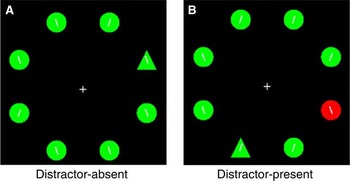
Participants performed a version of the irrelevant singleton visual search paradigm (Theeuwes & Burger, Reference Theeuwes and Burger1998; Figure 1). Each display consisted of an 8-item stimulus array with one unique shape (circles and triangles were randomly assigned to target or distractors). On 50% of trials, one of the non-unique shapes was colored red (distractor-present trial); for the other 50%, all items in the display were green (distractor-absent trials). Reaction times (RTs) and accuracy were measured for each trial. RT served as the primary dependent measure, as the displays are not data-limited, accuracy is emphasized in the instructions, and accuracy is typically at ceiling. In accordance with this, poor accuracy was used as an exclusionary criterion. Following 20 practice trials, participants performed 4 blocks of 75 trials. Participants were instructed to search for a unique shape, and press one of two buttons on the keyboard to indicate whether the line inside this target shape was tilted left (“\”) or tilted right (“/”). Participants were told to respond as quickly as possible without making errors and that they would receive feedback on their performance (after an error or no response after 2 s, subject heard a short beep). Reaction time (RT) outliers more than 3 standard deviations from the mean were removed, and RTs were analyzed from correct trials only. Attentional capture was measured as the difference in mean RT between distractor-present and distractor-absent trials.
Visual search task. Participants searched for a unique shape (triangle in the example), and indicated whether the white line inside this target shape was tilted left or tilted right (tilted left in panel A.; tiled right in panel B). A: On 50% of trials, all shapes were presented in green color (distractor-absent trials). B: On the other 50% of trials, one of the non-target shapes was colored red (distractor-present trials), while the other shapes were colored green. Attentional capture was measured as the difference in mean RT between distractor-present trials and distractor-absent trials.

Results
Subject Characteristics
Of the 30 included participants, 29 were male, and were on average 33.3 years old (SD = 8.81) and had an education of 14 years (SD = 2.22). In terms of self-reported PTSD and depression symptoms on the day of testing, participants had a mean score of 36.7 on the PCL-C (SD = 16.1) and 12.6 on the Beck Depression Inventory-II (BDI-II) (SD = 10.2). Participants had a mean CAPS score of 37.1 (SD = 30.3) during the prior TRACTS testing session. PCL-C scores correlated with previous CAPS scores (r = .77, p < .001), despite an average of 7-month delay. Based on these previous CAPS, 12 of the 30 participants had a previous diagnosis of PTSD. Of the seven participants who reported mTBI during deployment when administered the BAT-L, all reported altered mental status, but only two reported a loss of consciousness, suggesting that the TBIs reported were at the very mildest end of the severity continuum.
Attentional Capture: Overall Results
Using a similar exclusion criterion as previous studies (e.g., Moser, Becker, & Moran, Reference Moser, Becker and Moran2012), data from five participants were eliminated due to poor accuracy (<85%). While the subsequent pattern of results, as well as their statistical significance was maintained even with the inclusion of these participants, we chose this strict threshold to ensure participants were putting forth their best effort, and so we could assume no speed-accuracy tradeoff. These five participants had characteristics that were comparable with the included participants (e.g., mean PCL = 45; mean BDI = 19). The remaining 30 participants averaged 95% correct (SD = 3.5%). The attentional capture effect of interest (distractor-present RT minus distractor-absent RT) was robustly observed across the entire group, averaging 96 ms (SD = 55 ms; distractor-present M = 1105 ms; distractor-absent M = 1009 ms; t(29) = 9.51, p < .0001). Similarly, an attentional capture effect was also observed for accuracy (distractor-present M = 94%; distractor-absent M = 96%; t(29) = 4.30, p < .001). However, like previous studies, we did not use this measure in subsequent analyses.
Attentional Capture and PTSD Symptoms
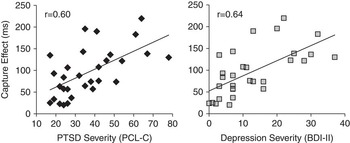
PCL-C scores were significantly and positively correlated with the capture effect (distractor present trials minus distractor absent trials; r = .60, p < .01; Figure 2A), confirming a link between increased symptom severity and greater attentional capture. This relationship held for each of the three DSM-IV defined PCL-C symptom clusters (re-experiencing: r = .50, p < .05; avoidance/numbing: r = .62, p < .01; hyperarousal: r = .46, p < .05). However, when the three symptom cluster scores were entered simultaneously into a multiple regression to account for shared variance, none individually explained significant unique variance. Mean RTs on distractor-present trials were non-significantly correlated with PCL-C scores (Distractor-present, r = .32, p < .09), whereas there was no significant relationship to distractor-absent trials (r = .05, p > .7). In addition, after controlling for variation in distractor-absent RTs using linear regression, the residualized distractor-present trial RTs correlated positively and significantly with PCL (r = .63, p < .01). Together, these analyses demonstrate that variance in search performance specific to distractor-present trials, rather than general visual search performance (as reflected by distractor-absent trials), is related to PTSD symptom severity. Because individual RT distributions were skewed, we performed the same analyses with median RTs for each subject, as well as with log-transformed RTs, methods commonly used to alleviate this concern (Ratcliff, Reference Ratcliff1993). In both cases, the PCL-capture relationship was maintained (medians: r = .50, p < .01; log transformation: r = .53, p < .01). Furthermore, a non-parametric analysis of the PCL-capture association (Spearman's rho) replicated these results (rho = .59, p < .01). Finally, although CAPS was administered too long before cognitive testing to be considered a valid index of current PTSD symptoms (performed an average of 7 months prior; see above), CAPS scores were positively correlated with the capture effect (r = .43, p < .05), and the capture effect was greater in individuals with a diagnosis of PTSD based on this previous CAPS administration (capture effect in PTSD- vs. PTSD+: 77 ms vs. 121 ms, t(29) = 2.10, p < .05).
Correlation of attentional capture with PTSD severity (PTSD Checklist—Civilian version, PCL-C) and depression severity (Beck Depression Inventory-II, BDI-II).

Attentional Capture and Depression Symptoms
As can be seen in Figure 2B, the capture effect also significantly correlated with BDI-II scores (r = .64, p < .001; Spearmann's rho = .67, p < .001). This was not surprising given the high correlation between PCL-C and BDI-II both in our sample (r = .91, p < .0001) and other studies of OEF/OIF veterans (Spearmann's rho = .90; Swick et al., Reference Swick, Honzel, Larsen, Ashley and Justus2012). Given such high correlations between measures, neither BDI nor PCL explained significant unique variance in the capture effect (multiple regression model with PCL and BDI predicting capture: r = .65).
Attentional Capture and mTBI
Exploratory analyses contrasting attentional capture in groups with (N = 7) and without (N = 23) mTBI indicated no significant differences (mTBI, M = 89 ms; no mTBI, M = 98 ms; t(28) = 0.4, p > .60).
Attentional Capture and Deployment
Deployment duration (M = 14.2 months; SD = 8.3) did not correlate significantly with attentional capture (r =− .30, p > .1), such that, if anything, longer deployment was associated with less capture. DRRI Combat Experiences severity also did not correlate significantly with attentional capture (r = .15, p > .4).
Discussion
We demonstrated that both PTSD and depression symptom severity are associated with capture of attention by visually salient and non-emotional distractors. These results suggest that enhanced attention to threat-related stimuli in those suffering from posttraumatic psychological symptoms may be an extreme example of a more generalized attention dysregulation characterized by an imbalance between the goal-directed and salience-based attentional systems. Our findings, combined with evidence from previous literature (Aupperle et al., Reference Aupperle, Melrose, Stein and Paulus2012; Kimble et al., Reference Kimble, Kaloupek, Kaufman and Deldin2000), suggest that this imbalance may cause excessive influence of task-irrelevant distraction across modalities (auditory and visual) and domains (perceptual and memory) and is potentially related to core posttraumatic symptoms, particularly associated with PTSD. For example, re-experiencing symptoms may result from the combination of traumatic memories automatically capturing attention and impaired attentional control over this process (Aupperle et al., Reference Aupperle, Melrose, Stein and Paulus2012; Vasterling et al., Reference Vasterling, Brailey, Constans and Sutker1998). Additionally, hypervigilance may be due to increased capture of attention to salient, task-irrelevant stimuli.
The imbalance between goal-directed and salience-based mechanisms in those suffering from posttraumatic psychological symptoms has typically been characterized as a failure to engage goal-directed attentional processes (Aupperle et al., Reference Aupperle, Melrose, Stein and Paulus2012) and concomitant lack of engagement of the neural mechanisms supporting these functions. For example, functional neuroimaging studies show that PTSD-related attention and inhibitory impairments with emotionally neutral stimuli are related to prefrontal hypoactivation, regions often associated with goal-directed attention (Falconer et al., Reference Falconer, Bryant, Felmingham, Kemp, Gordon, Peduto and Williams2008; Jovanovic et al., Reference Jovanovic, Ely, Fani, Glover, Gutman, Tone and Ressler2012). Consistent with this, the results of the current task could be interpreted as suggesting that failures of goal-directed attention are associated with PTSD symptom severity. However, evidence suggests that the current task predominantly assesses the function of the salience-based, or bottom-up system, as manipulations of task-set (i.e., one's task goals) only modestly influence attentional capture (Theeuwes, Reference Theeuwes2010). This leads to the novel interpretation that, rather than solely resulting from impaired goal-directed attention, the currently observed PTSD and depression-related distractibility may also result from enhanced attention to threatening or negative stimuli generalizing to enhanced attention to any salient stimuli. One possible mechanism for this enhanced attention to any salient stimuli could be from dysregulation of the ventral attention network (areas of right hemisphere temporal-parietal junction and ventral prefrontal cortex), which in healthy participants is recruited when attention is captured by behaviorally relevant stimuli but not by task-irrelevant distractors (Kincade, Abrams, Astafiev, Shulman, & Corbetta, Reference Kincade, Abrams, Astafiev, Shulman and Corbetta2005). Trauma may lead to a mode of processing in which all salient stimuli (emotional and non-emotional) are treated as potentially threatening and thus behaviorally relevant, leading to generalized increases in distractibility.
Future work will be necessary to tease apart the effects of posttraumatic psychological symptoms on both goal-directed attention and distractibility. One such approach with the current task would involve manipulating predictability of distractors with preceding cues (e.g., cue indicating 80% likelihood of upcoming distractor). This would help determine whether preparation for upcoming distractors could attenuate exaggerated attentional capture or rather if impaired goal-directed attention would prohibit the effects of preparation (Moher, Abrams, Egeth, Yantis, & Stuphorn, Reference Moher, Abrams, Egeth, Yantis and Stuphorn2011). In addition, varying the timing of distractor presentation could help disentangle whether attentional capture persists and thus reflects difficulty with disengagement. Finally, a further test of the over-generalization hypothesis could include direct comparisons between emotionally neutral and threat-related forms of distraction.
An important limitation of the current study is that we were unable to differentiate the unique effects of PTSD from depression. PTSD and depression are frequently comorbid, have overlapping symptoms, and may involve similar mechanisms (Breslau, Davis, Peterson, & Schultz, Reference Breslau, Davis, Peterson and Schultz2000). However, depression is more often associated with biases in working memory and is less consistently associated with attentional biases (e.g., Berman et al., Reference Berman, Nee, Casement, Kim, Deldin, Kross and Jonides2011; Mogg et al., Reference Mogg, Mathews, Bird and Macgregor-Morris1990). Furthermore, PTSD studies that have covaried the effects of depression find that PTSD-related attentional impairments are often preserved after adjusting for depression (e.g., Brandes et al., Reference Brandes, Ben-Schachar, Gilboa, Bonne, Freedman and Shalev2002). Nevertheless, it remains unclear whether the attentional impairments observed in the current study are specific to posttraumatic psychological symptoms, or instead share common mechanisms with other disorders of anxiety and depression (Moser et al., Reference Moser, Becker and Moran2012). A post-deployed depressed-only group would potentially represent an ideal control in future studies. These factors illustrate why disentangling the contribution of various comorbid factors contributing to cognitive impairments in trauma victims has been a longstanding challenge.
A further limitation in this population is that the extended combat and trauma environment may lead to an adaptive learned response to enhance attention to anything salient, which in combat, may have a high probability of being threatening. This likely differs from a single, acute trauma more typical in civilian cases of PTSD. However, counter to this hypothesis, both deployment length and combat intensity did not correlate with the capture effect, demonstrating that dysregulated attention is more specific to the psychological consequences of the combat and trauma environment, rather than to the prolonged trauma exposure itself. A related limitation is the use of the color red, which may be more subject to the overgeneralization of threat detection, as red may be be associated with threat in several environments, including in a military setting. Finally, because our population was almost exclusively male, it is unclear whether there are differential effects of gender.
In sum, using a sensitive measure of visual selective attention, we demonstrate that increased attentional capture by non-emotional, but visually salient distractors, is related to greater posttraumatic psychological symptom severity. These general (non-threat related) attention alterations may underlie and/or interact with abnormal processing of trauma-related stimuli, may explain attention failures reported in daily life, and open up new possibilities for future investigations.
Acknowledgments
We thank Jeff Moher for the use of his task, as well as Monica Rosenberg and Sarah Noonan for their fruitful discussions. The present work is supported by a VA Rehabilitation Research and Development Career Development Award (to J.D.) as well as by the Translational Research Center for TBI and Stress Disorders (TRACTS), a VA Rehabilitation Research and Development Traumatic Brain Injury Center of Excellence (B6796-C). Authors have no financial or other relationships that could be interpreted as a conflict of interest affecting this manuscript.