Introduction
Animal welfare has become one of the key issues in the EU during the last few decades. Consequently, legislation that aims to ensure animal welfare has been introduced. Decision makers usually justify such regulations by public/consumer pressure. Research conducted in 2007 shows that animal welfare is indeed of great importance for the EU citizens/consumers. While the average coefficient indicating the importance of animal welfare is 7.8 out of 10, the value of the coefficient for 34% of the respondents is 10 out of 10 (EC, 2005). Moreover, the vast majority of citizens (77%) believe that the welfare of domestic animals should be improved in the future. There are, of course, differences in attitude among EU Member States. More specifically, welfare is more important for the old member states (EU-15) compared to the new member states, and for the Northern/Scandinavian countries (Sweden, Finland and Denmark) compared to southern countries, for example Spain and Greece (EC, 2005; 2007).
At the same time, it is interesting that 85% of the respondents declared that they knew nothing or very little about the conditions in which animals are reared, including a large number of people who had never had the opportunity to visit a farm (31%) or had done so less than three times in their lives (a further 29% of the respondents; EC, 2005; EC, 2007). This is why some authors (Poza, 2007) point to more complex reasons for tightening welfare regulations. These reasons include, among other things, socially desirable (responsible) consumer behaviour, as well as the existence of certain lobbies which tend to influence the world trade flows.
As many as 40% of the surveyed respondents (consumers) in the EU see farmers as those responsible for ensuring the welfare of domestic animals (which can be interpreted, in a sense, as the transfer of responsibility to someone else), while producers do not welcome this regulation because it complicates production and increases production costs.
In this paper, the authors aim to analyse socio-economic problems involved in the implementation of the recently adopted Regulation on Conditions for Animal Welfare (in which animal welfare issues are defined in the same way as in EU Directive 1999/74/EC), in the Serbian egg sector.
Laying hen welfare in the EU
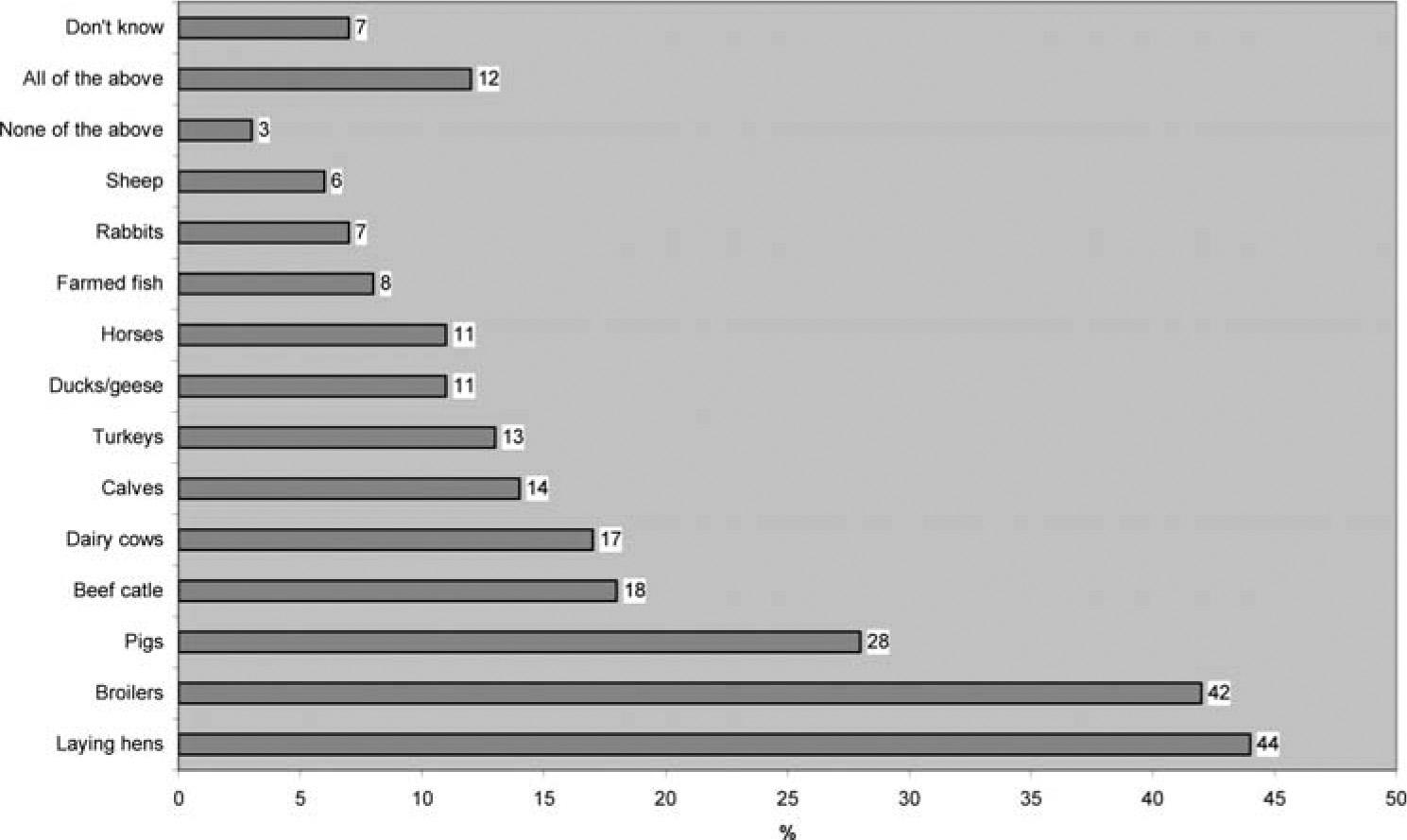
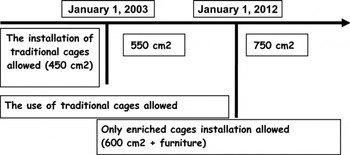
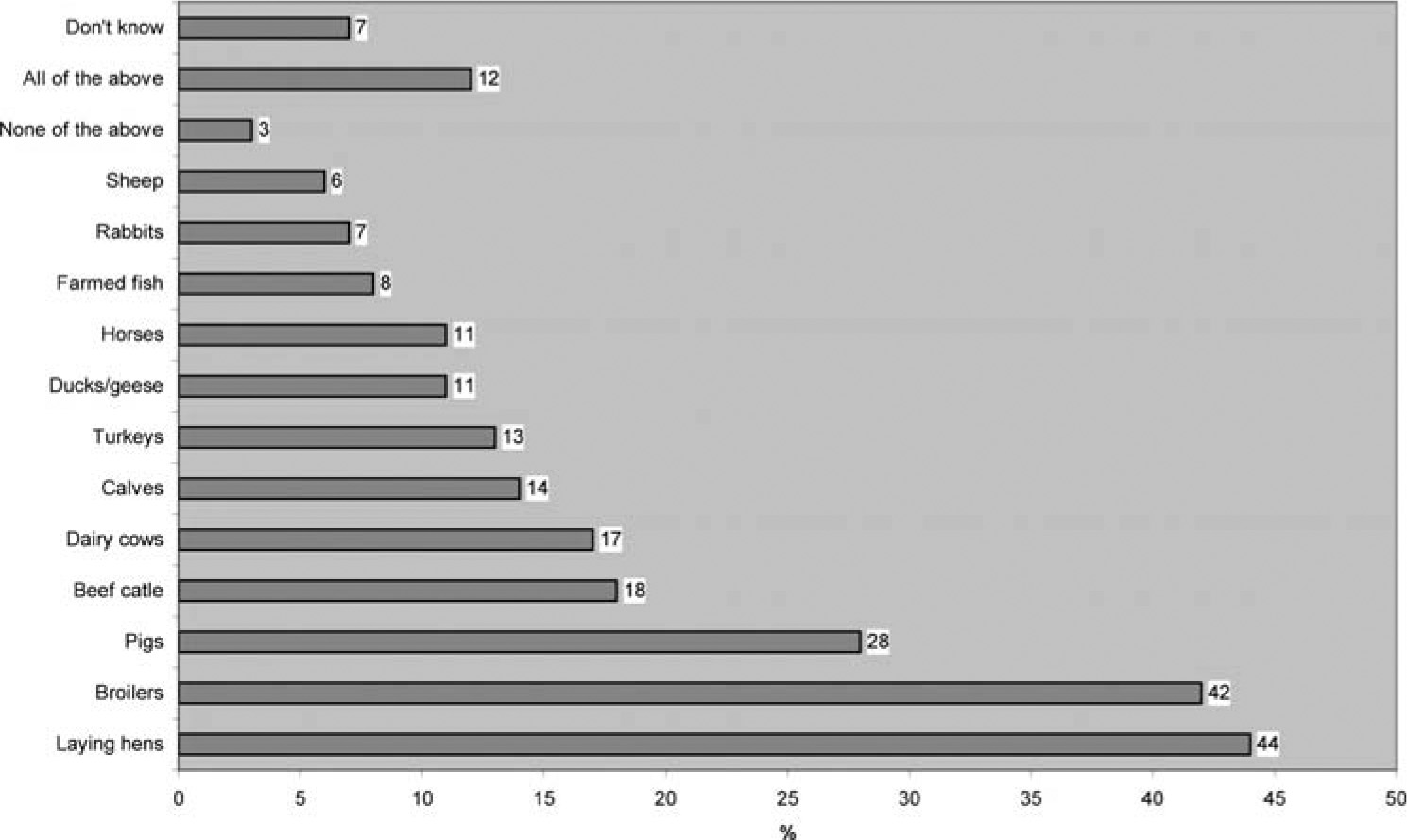
EU citizens consider laying hens to be the species for which improvements in terms of welfare and protection are needed most (Figure 1). This is a logical consequence of a very critical perception of the welfare of this animal among Europeans (EC, 2005; Lagerkvist et al., Reference LAGERKVIST, CARLSSON and VISKE2006). Thus, it is not surprising that the first regulations concerning laying hens welfare were introduced in the EU more than twenty years ago, when Directive 88/166/EEC set the minimum standards for protection of laying hens in traditional cages. Ten years later, in 1998, Directive 98/58/EC further defined the conditions for rearing farmed animals, emphasising again that the system of housing, feeding and care of a farmed animal must be in accordance with the physiological and ethological needs of animals. Finally, in 1999 Directive 1999/74/EC was adopted, which set a standard whereby egg producers were required to shift (gradually) to enriched cages or alternative (non-cage) systems – barn, avian system, free range or organic production (Figure 2).These efforts resulted in the development of new, or the revitalization of some old housing systems, which are all described in detail in literature, with all of their specific advantages and disadvantages (Laywel, Reference LAYWEL2004a; Reference LAYWEL2004b). However, an ‘ideal’ system has not been defined yet; i.e. the system that would fully satisfy two requirements: on the one hand, safe, cheap and efficient production, and on the other, the needs of laying hens in terms of their welfare. Thus, each of these systems must be viewed from both sides, and the system selected must represent a compromise to be optimal for specific conditions (Perić et al., Reference PERIĆ, MILOŠEVIĆ and STRUGAR2007a; Reference PERIĆ, MILOŠEVIĆ, TOLIMIR and ŽIKIĆ2007b; Reference PERIĆ, MILOŠEVIĆ and TOLIMIR2008).
Farmed animals for which improvement in welfare and protection is needed most according to EU citizens, in %.\Source: European Commission (2007): Attitudes of consumers towards the welfare of farmed animals, Wave 2, Special Eurobarometer 229 / Wave 64.4
The dynamics of implementing EU Directive 1999/74/EC.

As the introduction of alternative systems requires major changes in management, time for such adjustments is needed. This is why a twelve-year period is allowed in the EU for the producers to adapt. Some member states even insisted on implementing the regulation earlier in order to prepare the sector properly for 2012. For example, in 2004 Austria prohibited keeping laying hens in traditional cages as from 2009, and by 2019 even enriched cages will not be allowed. Germany banned the production of conventional cages as from 1999, as well as keeping hens in them as from 2009. From 2012, all cages in Germany will be prohibited. In France, which is Europe's largest producer of eggs, preparations for the implementation of Directive 1999/74 EC began in 2002. Today, owing to timely preparation, these countries have a higher percentage of hens in alternative systems as compared with the EU average.
It is well known (Van Horne, Reference VAN HORNE2003; Agra Cease Cons., 2004; Polet, Reference POLET2005;Van Horne, Reference VAN HORNE2007; Van Horne and Achterbosch, Reference VAN HORNE and ACHTERBOSCH2008; Rodić et al., Reference RODIĆ, PERIĆ, ĐUKIĆ-STOJČIĆ and MILOŠEVIĆ2008; Reference RODIĆ, PERIĆ and ĐUKIĆ STOJČIĆ2009) that the transition to alternative housing systems implies a significant increase in production costs, which seriously threatens the profitability of production and competitiveness of such eggs. This applies to eggs produced in alternative systems, which are exposed to the competition of eggs produced in traditional cages (in the EU and beyond) until 2012. On the other hand, it applies to eggs produced in the period thereafter, when EU producers, in the case of further market liberalisation on which the WTO insists, could be faced with fierce competition from countries where such strict welfare regulations are not in force. Thus, the EU will certainly aim, and probably find ways, to allow the import of eggs only from countries that have the same or similar standards (Grethe, Reference GRETHE2007).
The basic prerequisite for ensuring the competitiveness of eggs produced in non-cage systems is consumers’ willingness to pay a higher price for such eggs, thus compensating for higher costs and supporting improvement in layer welfare. Consumers in the EU are willing to pay a higher price (Bennett et al., Reference BENNETT, ANDERSON and LANEY2002; Goddard et al., Reference GODDARD, BOXALL, EMUNU, BOYD, ASSELIN and NEALL2007) and this is the main reason why alternative systems have been developed in all member states.
Nevertheless, the research which was carried out to assess the socio-economic implications of the implementation of Directive 1999/74/EC (Agra Cease Cons., 2004) estimated that 15% of the producers who are unwilling to face the problems that are, due to changes in rearing, expected after 2012, will completely leave the sector. Another 23% of producers will reduce production due to the unavailability of additional space. This percentage could be even higher because 20% of the producers had not yet made a final decision by the time when the survey was conducted.
Laying hens welfare issues in Serbia
Although there is no reliable statistics on egg producers in Serbia, it can be estimated (Škorić, Reference ŠKORIĆ2003; Rodić et al., Reference RODIĆ, PERIĆ, PAVLOVSKI and MILOŠEVIĆ2010a) that about 1/3 of the total production comes from large industrial farms. Nowadays, these producers do not have any alternative housing systems and all laying hens are still kept in traditional cages. Besides the large-scale, industrial egg producers, the sector is characterised by the presence of a large number of small producers who have a significant impact on the market. Some of the latter are market-oriented producers, with different production capacities. The production technology which they apply does not differ substantially from that used by large-scale industrial producers; this means that they have hybrid layers and keep hens in traditional cages, achieving 280 to 300 eggs per laying hen per year.
However, in addition to the market-oriented producers, there are a significant number of backyard producers whose production is highly seasonal. There use different breeds of chickens and extensive housing systems (free range). These layers produce a small number of eggs and only during the summer months. Moreover, the production is mainly aimed at meeting the needs of the household, with the possibility of placing any surplus on local markets.
In the market there are currently no differentiated prices for eggs from different housing systems. Thus, it is fully justified to say that the system of labelling and price differentiation is one of the first steps that should be regulated in this area in order to create preconditions for the development of different housing systems.
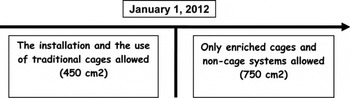
Until February 2010, there were no regulations (whether already in force or at the drafting stage) in Serbia whereby producers would be required to make any changes in the way of keeping laying hens. Consequently, all commercial egg production still takes place in traditional cages and commercial production in enriched cages or non-cage systems is totally undeveloped. In February 2010, however, the above mentioned Regulation on Conditions for Animal Welfare (Official Gazette 6/2010) was adopted. It lays down the same welfare conditions as EU Directive 1999/74/EC. Thus, Article 53 of this Ordinance states that ‘...laying hens (except the flocks of less than 350 laying hens and breeding flocks) could be kept in traditional cages until January 1, 2012’.
As far as the authors of this paper know, the Regulation was adopted without consultation with representatives of the sector, despite warnings that the hasty adoption of such regulations could be very dangerous for this highly sensitive sector. It is evident that the conditions provided in the EU (the time envisaged for adjustment to the new regulations combined with sufficient demand and the willingness of consumers to pay premium prices) are not fulfilled in Serbia and thus, it is not realistic to expect smooth implementation of the regulations (Figure 3).
The dynamics of implementing the Regulation on Conditions for Animal Welfare in Serbia (Official Gazette 6/2010).

Willingness of Serbian consumers to support improvements in laying hen welfare
A survey has been recently conducted (Rodić et al., Reference RODIĆ, PERIĆ, PAVLOVSKI and MILOŠEVIĆ2010b, Reference RODIĆ, PERIĆ, PAVLOVSKI and VLAHOVIĆ2010c) to assess the willingness of Serbian consumers to accept and pay a higher price for eggs produced in different housing systems and, thus, to support welfare improvements. The main aim was to provide egg producers with additional market information that may encourage a certain number of them to switch voluntarily to enriched cages or non-cage systems before 2012. On the one hand, it would enable some producers to satisfy the existing domestic demand; on the other hand, it would enable them to overcome initial difficulties, which regularly occur in the transition to new housing systems (Newton, Reference NEWTON2009) and to be better prepared for 2012, when the transition will no longer be a matter of choice.
Producers need such information in order to make business decisions and prepare themselves to break into the EU market, if possible. This is because a significant deficit of eggs could be expected in the EU after 2012. According to Windhorst (Windhorst, Reference WINDHORST2006; Reference WINDHORST2009), the egg deficit is likely to be compensated by imports from the neighbouring countries, predominantly those where the same or at least similar standards are applied in production. It can be assumed that this was exactly the reason behind the hasty adoption of the Serbian Regulation on Conditions for Animal Welfare, which left such a short period for adjustment. This assumption seems to be even more justified considering that the actual capacity of the poultry production sector in Serbia is far below its potential capacity and that the sector has already reached its full potential before (Škorić, Reference ŠKORIĆ2003; Rodić, Reference RODIĆ2009; Rodić et al., Reference RODIĆ, PERIĆ, PAVLOVSKI and MILOŠEVIĆ2010a).
The findings from the survey (with 720 consumers interviewed) showed that most respondents in Serbia (75.7%) had never heard of a ban on keeping hens in traditional cages after 2012, but they considered such a ban reasonable and 73% supported it. This is a clear indication that the concern about animal welfare is increasing in Serbia, exactly like in other developed countries (Magdelaine et al., Reference MAGDELAINE, SPIESS and VALCESCHINI2008; Magdelaine, 2009; Tacken, Reference TACKEN2009). Thus, they may be expected to show increasing willingness to choose this option and make a ‘sacrifice’ by paying higher prices for the products which are produced respecting animal welfare.
For a large percentage of respondents (63%), housing system is one of the criteria when buying eggs. However, it is the most important criterion for only 7.5% of them, while other criteria (primarily freshness, but also egg size and price) are more important for more than 80%.
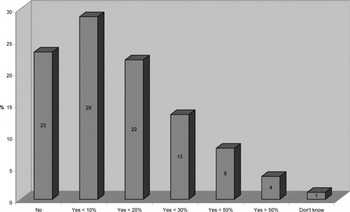
It is interesting that, despite the low living standards and the limited purchasing power of the Serbian population, over ¾ of the respondents are willing to pay a higher price for eggs produced in alternative systems. Most consumers (53%), however, are willing to pay more only if the price increase is up to 20% (Figure 4). The percentage of those who are willing to pay a higher price decreases with the increase in premium rates, which should not be surprising having in mind the comparatively low standard of living in Serbia.
The price increase (%) which respondents are willing to pay for eggs from non-cage housing systems. Source: The authors’ own calculation, 2010

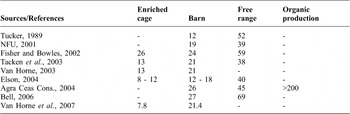
The experience of developed countries shows that the costs of producing eggs in enriched cages and alternative housing systems are higher than in the case of traditional cages. Estimated differences in production costs vary from one author to another (Table 1), but all authors agree that enriched cages produce eggs at the lowest costs among all allowable housing systems (Van Horne, Reference VAN HORNE2007).
Increase in costs of production in different housing systems as compared to traditional cages (%).

The selling price increase of 20% (which Serbian consumers are willing to accept) could cover the increased costs of production in enriched cages and possibly in barns. Van Horne et al. (Reference VAN HORNE, TACKEN, ELLEN, FIKS-VAN NIEKERK, IMMINK and BONDT2007) estimate that the difference in production cost between eggs produced in enriched cages and barn eggs will decrease in the future, however it certainly cannot cover the increased costs of production in the free range system and organic production. Those producers that would, eventually, move on to free range or organic production can count on the consumers who are willing to pay a price that is up to 50% or over 50% higher, and there are only 8% and 4% of such consumers, respectively.
Thus, if there is no guarantee for export and/or governmental support, the transition to non-cage systems could be a good business decision only for a limited number of producers, since there is a relatively small niche on the domestic market. For most producers, however, the transition to enriched cages is less risky. In this system, the producers cannot rely on a significant premium price, especially as, at the same time, the costs do not increase by more than around 10%.
At the moment, a good example would be the practice used in some EU countries, where producers replaced traditional cages with enriched ones, but without furniture and with higher density, trying to use them in this way for as long as possible. When such options are no longer available, they will buy furniture (required equipment) and reduce the layers to the allowable number. Some producers can certainly opt for a strategy of waiting in the hope that the implementation of these regulations will encounter problems in practice and the Regulation on Conditions for Animal Welfare, like many others, will be rescinded. Such a business decision, however, involves risks of which producers should be aware. A wait-and-see approach has been adopted by some producers in other EU member states as well, but a growing number of EU producers are now aware that there will be no changes in the regulations and thus they are ready to welcome 2012, and the percentage of eggs in the EU that come from enriched cages or non-cage systems is increasing each day.
Conclusions
In Serbia there is still no significant commercial production of eggs in enriched cages or alternative housing systems which would improve the welfare of laying hens. This is a consequence of the fact that production costs in these housing systems are higher than in traditional cages, and the previous lack of regulations in this area. In February 2010, however, the Regulation on Conditions for Animal Welfare was adopted, regulating laying hen welfare issues in the same way as the EU Directive 1999/74/EC.
Adopting such legislation in Serbia, with less than two years given for adjustment and transition, without any previous assessment of consumers’ willingness to pay a higher price for eggs from allowable housing systems (enriched cages or non-cage systems), places the burden of animal welfare solely on the producers. Given their rather difficult financial situation, a large number of egg producers will face serious problems, which could jeopardize this very sensitive sector.
At present, the system of control and labelling of eggs in Serbia is yet to be developed, and prices do not depend on housing systems. In order to encourage producers to shift to the allowable housing systems as soon as possible and prepare them for what is coming, it is necessary to solve this problem in a systematic way. This primarily includes differentiated egg prices (which depend, among other criteria, on the housing system). Government support in terms of subsidies for the transition to allowable housing systems is also very important. Otherwise, after 2012 (assuming full implementation of the regulations) the entire sector would face serious problems and the chance to break into the EU market will certainly be missed.
In the meantime, egg producers, should consider the advantages of production in enriched cages and alternative systems and seize the chance coming their way on the domestic and European markets, rather than complain, worrying about what is coming and expecting a delay of the Regulation. This approach would be much more reasonable given the fact that the egg sector in Serbia is dominated by small-scale producers for whom alternative systems are especially suitable.
Acknowledgements
This work has been funded by the Serbian Ministry of Science, as part of the Technological development project No TR 31033/2011. The authors also would like to thank anonymous reviewer(s) for valuable comments and Ms Ewa Kolanowska for the immaculate proofreading.