


In most of the world's advanced parliamentary democracies, government by coalition is the norm. In European political systems, for example, only 13% of postwar governments have been composed of a single party controlling a majority of legislative seats (Gallagher, Laver, and Mair, Reference Gallagher, Laver and Mair2005, 401). Given the preponderance of coalitions and the widespread view that governments are the key actors in policy making, it is not surprising that scholars believe that finding the answer to the question of which parties get into government, and why, is “when all is said and done, simply one of the most important substantive projects in political science” (Laver and Schofield, Reference Laver and Schofield1990, 89). This belief has helped give rise to a vast literature on coalition politics, which has generated several significant findings over the past five decades. One of the most striking is that incumbent governments, in the event of a new round of coalition bargaining, are able to return immediately to office an inordinate amount of the time. For example, Powell (Reference Powell2000, 49) noted that, in his sample of multiparty democracies, “incumbents were retained without change in 44 percent of the elections and completely replaced in only 17 percent.” Similarly, we found in a study of government formation (Martin and Stevenson, Reference Martin and Stevenson2001) that outgoing coalitions were able to immediately get back into government approximately 35% of the time. When one considers that there are sometimes hundreds (and even thousands) of “potential coalitions” that could form a government in a given bargaining opportunity, it is even more remarkable that the incumbent coalition manages to hang on to the reins of power so consistently.
Surprisingly, coalition scholars have devoted little attention to understanding why this “incumbency advantage” in government formation exists. Conducting such an investigation is important for at least two reasons. First, the fact that incumbency has a larger empirical impact on government formation than several of the conventional size and policy-related factors coalition theorists have emphasized throughout the years (see Martin and Stevenson, Reference Martin and Stevenson2001) represents a significant puzzle for existing research. Second, the existence and magnitude of the incumbency effect, and the reasons behind it, have interesting normative implications. If incumbency is so overwhelming a force in bargaining that it enables coalitions to get back into office under any circumstances—such as when their members demonstrate an incapacity to govern together or when they fare poorly at the ballot box—then this raises serious issues about the relationship between democratic performance and the practice of multiparty government.
In this study, we conduct a systematic examination of the role of incumbency in government formation. In the next section, we briefly review previous empirical studies of the impact of incumbency to establish more firmly that the incumbency advantage is indeed quite substantial. We then turn to the scant, and rather scattered, theoretical literature concerning the sources of the incumbency effect. This literature contains a number of speculations about the role of incumbency, but scholars have not yet integrated their conjectures into a coherent theoretical story. We classify existing ideas about the sources of the incumbency effect into two distinct sets of explanations: those emphasizing the reasons why incumbent coalition partners may prefer to re-form (even after accounting for such considerations as the coalition's size and ideological compatibility) and those emphasizing procedural advantages that may enhance the ability of an incumbent government to re-form, given the desire of coalition partners to do so. With this distinction in mind, we point out that not all incumbent governments should desire to re-form (irrespective of any procedural advantages they may possess), and we argue that whether they do want to re-form is almost certainly affected by the “historical context” in which coalition bargaining occurs. In particular, the preferences of incumbent parties to reenter government together should be conditional on the circumstances under which their most recent tenure in office came to an end (the “termination context” of bargaining) and the results of the most recent election for the incumbent parties (the “electoral context” of bargaining). We then discuss our empirical design for exploring the role of incumbency in government formation, where we develop several original measures that tap into the preferences of incumbent parties to re-form, including ones that characterize the termination and electoral contexts of bargaining. These variables not only enable us to test preference-based explanations of the incumbency effect, but also help us distinguish the effects of preferences from the effects of institutions. As theorists have often pointed out, preferences and institutions are key features in the “fundamental equation of politics” (Hinich and Munger Reference Hinich and Munger1997; Plott Reference Plott1991). And although it is not always easy to disentangle their effects on outcomes, we are able to do this, to a limited extent, in our analysis. Our findings reveal that both preferences and procedures have a role to play in explaining the incumbency effect and that the extent to which there is an “incumbency advantage” in coalition formation depends critically on the termination and electoral context of bargaining. Specifically, incumbent governments that collapse due to internal party conflict or that suffer significant electoral setbacks are much less likely to re-form than governments that end their tenure harmoniously or that do well at the polls.
INCUMBENCY IN EMPIRICAL MODELS OF GOVERNMENT FORMATION
The empirical impact of incumbency in existing models of government formation is surprisingly large, both in absolute terms and when compared to other variables. Indeed, the primacy of incumbency as a predictor of government formation represents something of a puzzle because the well-developed theoretical literature on coalition formation has largely ignored incumbency in favor of explanations emphasizing the importance of size and ideology. The empirical studies that best highlight this puzzle are those that have included indicators of incumbency alongside conventional size and ideology measures. Warwick (Reference Warwick1996), for example, found that a party's membership in the outgoing government, and its previous government experience in general, significantly increases its chances of being part of the next government; conversely, long periods of absence from government decreases its chances of future participation. More specifically, after accounting for party size and ideology, he showned that incumbent parties are more than twice as likely as nonincumbents to get into the next government (see his Table 3).Footnote 1 Similarly, Franklin and Mackie (Reference Franklin and Mackie1983), also accounting for size and ideology, found that governments consisting of parties that had worked together in the past are much more likely to form than those consisting of relative “strangers,” especially if these parties all took part in the most recent government.
In our previous work on government formation, we also showed that the incumbent coalition enjoys a substantial advantage, even after controlling for an extensive set of other relevant coalition attributes and institutional factors (Martin and Stevenson, Reference Martin and Stevenson2001). The impact of incumbency is, in fact, larger than the impact of any of the variables capturing size and ideology. An odds ratio transformation of the “implied” coefficient on the status quo indicator variable (from Model 7 of that study) reveals that the incumbent coalition is approximately six times more likely to form the next government than a nonincumbent coalition, all other things being equal.Footnote 2 In comparison, a minimal winning coalition is only about twice as likely to form as a surplus majority (or oversized) coalition. We find it remarkable that the effect a size-related factor such as a coalition's minimal winning status—which has been a primary focus of the coalition literature for more than fifty years (Riker Reference Riker1962; von Neumann and Morgenstern Reference von Neumann and Morgenstern1953)—is dwarfed by the effect of incumbency, which has received comparatively little theoretical and empirical attention.
In more recent work (using essentially our earlier empirical approach on updated data), Bäck and Dumont (Reference Bäck and Dumont2007, 476-78) focused explicitly on the large impact of the status quo indicator. They showed that the conventional set of size and ideology variables have a predictive efficiency rate (defined as the number of correctly predicted government coalitions as a proportion of the total number of predicted coalitions) of only 12% when the status quo indicator is excluded from the model. Once the status quo indicator is included, the predictive efficiency rate jumps to 32%. Incumbency, then, is clearly a very strong predictor of which coalition forms, and, importantly, its impact is disproportionately larger than the impact of variables that have been at the center of coalition research for decades. Consequently, we agree with Bäck and Dumont (Reference Bäck and Dumont2007) that coalition scholars need to focus on providing more thorough theoretical and empirical accounts of the sources of the incumbency effect.
EXISTING THEORIES ABOUT THE IMPACT OF INCUMBENCY ON GOVERNMENT FORMATION
Given the demonstrably large effect of incumbency on government formation, it is important to think about the causal mechanisms that may produce it. Scholars have articulated various explanations in previous research that are both compelling and comprehensive enough to provide a good basis for an empirical examination of the sources of the incumbency effect. However, the arguments are scattered throughout the literature and so have had little impact on current empirical work. Thus, one of our goals is to collect the various strands of arguments regarding the incumbency effect and impose on them a particular theoretical organization that will heighten their usefulness. To that end, we divide previous explanations of the impact of incumbency on coalition formation into two groups according to whether they address why incumbent governments would want to re-form, or whether they address why they are able to re-form, given the desire to do so. Coalition scholars have largely failed to appreciate this conceptual distinction, despite its critical importance to tracing the observable implications of different explanations of the incumbency effect.
The Preference to Re-Form. The first explanations of the impact of incumbency on government formation focused on the question of why parties might desire to re-form the current cabinet, even when other factors (e.g. size, ideology) that may have brought the cabinet to power in the first place are no longer as compelling. These explanations fall into two categories: those that emphasize the benefits of working with familiar cabinet partners and those that emphasize the costs of changing partners.
(a) Familiarity. Franklin and Mackie (Reference Franklin and Mackie1983) provided the most comprehensive and persuasive presentation of the argument that parties that have governed together in the past can reap significant benefits by doing so again. The idea is that parties care deeply about the ability of the coalition to work together (see Browne and Rice, Reference Browne and Rice1979) and thus prefer partners whom they trust and understand and who understand them. Franklin and Mackie suggested that shared governing experience is the principal way in which such trust and understanding is created and so label the concept familiarity.
When we probe the idea of familiarity, it is easy to come up with reasons why knowing one's partners well is valuable in day-to-day governance. A party leader must ask him- or herself a number of questions about the motivations and limitations of potential coalition partners: What kinds of policy compromises will my partner be able to make on policy? Will my partner understand my party's electoral circumstances and internal constraints so as not to push policies that would put me in an untenable position? How constrained are my partners by their party organization? Can they find ways to get their activists to go along with the coalition bargain? That is, can I believe them when they tell me, “I just can't sell that to the party”? Parties that have worked together in the past, particularly those that have spent extensive periods of time in government together, should have much greater knowledge about each other's constraints than parties that have not had significant experience in partnership with one another. As Saalfeld (Reference Saalfeld, Strøm, Müller and Bergman2008, 358–59) put it, a coalition that has worked together previously “has practically served as a screening device reducing information uncertainty and perceived commitment problems.” Of course, given that our concept of familiarity is about trust and information, and because such things can change over time (e.g., with changes in party leadership or organizational structure), we would also expect familiarity to be greater when parties have been in government together more recently.
(b) Bargaining Costs and Inertia. Several scholars have pointed to the idea that incumbent cabinets may desire to re-form because, all things being equal, it is simply easier to restrike a bargain that is working than to negotiate a new one. These explanations are distinct from those that invoke familiarity. For example, one can imagine situations in which the status quo cabinet is relatively unfamiliar (e.g., a new partnership that has lasted a short time), but nevertheless desires to re-form to minimize the costs associated with renegotiating the cabinet bargain. Warwick (Reference Warwick1996) referred to this concept as “bargaining costs,” and Franklin and Mackie (Reference Franklin and Mackie1983) seemed to have the same idea in mind for their concept of “inertia.” In both studies, the idea was that negotiating coalition bargains consumes time, energy, and political capital. New negotiations entail working out new compromises that often require new support coalitions both within and between the coalescing parties. Even if a coalition contending to replace the status quo cabinet is a familiar one, there are often new issues and priorities in every bargaining situation, and consequently, new compromises have to be hammered out (and sold to the party faithful).
One notable feature of the concept of bargaining costs is that although these costs may well be smallest when the exact incumbent coalition re-forms, the argument also applies (with decreasing force) to alternatives that, although not identical to the incumbent cabinet, are nevertheless similar. As Warwick (Reference Warwick1996, 474) pointed out, “if a coalition has fallen apart over a particular issue or because of the defection of a single party, for example, it may be much easier to resolve the dispute or replace the defecting party than it is to build a new coalition from scratch.” Thus, the bargaining costs associated with a truly new combination of forces should be much greater than those associated with small changes (e.g., dropping a minor party from the coalition or adding a new one).
The Ability to Re-Form. Even if a potential cabinet is seen as desirable by all its members, that is not enough for it to form. And even if such a coalition controls a majority of seats, there are often alternative coalitions in the same position that prospective partners may view as equally desirable. As students of coalition formation have long recognized, this fact suggests that the process by which cabinets form may have an important role to play in determining which cabinet among the set of viable alternatives actually makes it into office (see, e.g., Austen-Smith and Banks Reference Austen-Smith and Banks1988; Strøm; Budge and Laver Reference Strøm, Budge and Laver1994; Laver and Schofield Reference Laver and Schofield1990; Laver and Shepsle Reference Laver and Shepsle1996). The question at hand is, if members of an incumbent government want it to return to power, how might they be able to use the norms and procedures defining the process of government formation to improve its chances of doing so?
The formation process in most countries confers important procedural powers on particular parties that should, in theory, allow them to bias outcomes in their favor. Two types of bargaining rules, in particular, may advantage the incumbent government as a whole (another bargaining rule, as we discuss later primarily advantages the party of the incumbent prime minister). The first is the constitutional requirement, present in all parliamentary democracies, that a government must be in place at all times—even while bargaining over a new government is going on, and possibly well beyond that period if bargaining breaks down. As Laver and Shepsle (Reference Laver and Shepsle1996) pointed out:
Both de jure and de facto in a parliamentary democracy, there is always an incumbent government. Put very crudely, somebody has to remain in office to sign the checks—someone has to have a finger on the trigger (46).
When the government formation process is triggered for some reason, either the status quo government remains in power or it is replaced by some alternative that is preferred to this by a parliamentary majority (147).
Simply stated, the argument is that an incumbent government enjoys an advantage in the formation process because it represents the “reversion point” in the event bargaining over a new government breaks down (Strøm, Budge, and Laver, Reference Strøm, Budge and Laver1994, 311). We would note, however, that there are two significant caveats to the reversion point argument not often made in the literature. First, even though the incumbent government remains in office in the event of bargaining breakdown, it may be the case that it does so in a very diminished capacity (i.e., as a “caretaker” administration). In such situations, “it is a strong constitutional convention that no important decisions are taken until a new fully fledged cabinet has been invested in office” (Laver and Shepsle, Reference Laver and Shepsle1996, 47). Thus, a caretaker cabinet may not be equivalent to the status quo government in a substantive sense.Footnote 3 Second, the status quo government that emerges from a bargaining breakdown might not actually be the incumbent government, but rather, what is left of it. That is, if the previous government collapsed because one or more coalition partners withdrew from it, then the status quo government during the subsequent process of coalition bargaining will not be the same as the incumbent administration prior to its collapse. In short, the reversion point argument for an incumbency advantage only makes sense if the status quo government during bargaining is identical in party composition to the outgoing administration and if, in the event that bargaining does not result in an alternative to the status quo, the incumbent is able to continue in office as a “real” (i.e., policy-making) government.
In light of these qualifications, the more theoretically compelling institutions-based explanations for an incumbency advantage are those that focus on the importance of recognition rules—that is, the rules that determine which actors get to be the proposers in coalition bargaining, and in what order—rather than reversion points. A number of new institutionalist theories of government formation have taken into account this feature of the bargaining environment (e.g., Austen-Smith and Banks Reference Austen-Smith and Banks1988; Baron Reference Baron1991, Reference Baron1993; Baron and Ferejohn Reference Baron and Ferejohn1989; Morelli Reference Morelli1999), although most of these have focused on which single party (or individual) gets chosen as formateur (more on this later). However, as Diermeier and van Roozendaal (Reference Diermeier and van Roozendaal1998) described, in some systems, a set of parties—specifically, the parties in the incumbent government—are collectively given the right to make the first proposal for a new government. Scholars typically refer to this particular type of recognition rule as a continuation rule. Diermeier and van Roozendaal (620–21) pointed out that, where such a rule exists, an incumbent government can choose to remain in office following an election, without ever having to resign, thereby bypassing the process in which an external agent (e.g., the head of state) chooses a formateur to lead negotiations.Footnote 4
A related institutional explanation, referred to previously, focuses on which party is recognized as the formateur party and given (more or less) exclusive proposal powers during the period of its mandate. Prior research has consistently shown that the formateur party is able to guarantee its place in the cabinet and to pick cabinet partners that are ideologically compatible (Martin and Stevenson Reference Martin and Stevenson2001; Stevenson Reference Stevenson1997; Warwick Reference Warwick1996). As Strøm, Budge, and Laver (Reference Strøm, Budge and Laver1994, 312) pointed out, few constitutions have specific requirements for which party, if any, will be asked to lead the government formation process. Nevertheless, there do appear to be a number of well-established empirical regularities governing which parties gain this important procedural power, one of which is critical for our understanding of how incumbent cabinets that desire to re-form can do so. Bäck and Dumont (Reference Bäck and Dumont2008) undertook perhaps the most comprehensive study of this question and found that although the first party chosen to lead the cabinet is likely to be a large one, incumbency also has a substantial effect on this choice (see also Stevenson Reference Stevenson1997; Warwick Reference Warwick1996). Specifically, they found that (holding party size and ideological centrality constant) the party of the previous prime minister is more likely than other parties to be chosen as the first formateur in all situations they examine: those in which the formation process is highly structured (e.g., where the head of state formally chooses a formateur), those in which bargaining is relatively unstructured (or “freestyle”), those in which coalition bargaining immediately follows an election, and those in which it occurs without a preceding election. The conventional view is that conferring proposal powers on the party of the incumbent prime minister should make the status quo coalition as a whole more likely to form. This view, however, mixes in the idea that the formateur will want to re-form the incumbent cabinet. A cleaner expectation, although not emphasized in the previous literature, is that the procedurally advantaged prime minister will form some coalition in which his or her party is included, even if it is not the incumbent government.
In sum, scholars have highlighted three institutional rules that should help the incumbent government re-form. Two of these should advantage the entire incumbent government directly, and another should advantage the party of the incumbent prime minister. Given our distinction between the desire and ability to re-form, however, we qualify these arguments in a few significant respects.
First, when we think in terms of the incumbent government's desire and ability to re-form, we must recognize that the impact of procedural rules is necessarily conditional on preferences. That is, giving procedural advantages in bargaining to a cabinet that desires to re-form may well help it do so. But giving such advantages to a cabinet that does not want to remain intact should be irrelevant in determining whether it re-forms. Thus, a procedure such as the continuation rule should advantage an incumbent government in bargaining only if its members want to remain in office together.
Second, if a procedural advantage applies to only one party in the cabinet, then the impact of the procedure favors the re-formation of the incumbent government only if the institutionally advantaged party wants the incumbent government to re-form. If this party instead prefers to be part of an alternative coalition, then this should cause the incumbent cabinet to be less likely to re-form. Thus, if the previous prime minister has a disproportionate influence on the bargaining process (through his role as formateur, for example), then his or her party should be able to form the government he or she wants, regardless of whether it consists of all other parties from the previous administration. Of course, he or she may indeed want to re-form the incumbent cabinet, and factors such as familiarity and bargaining costs should intensify this preference, but if he or she has other plans, it is not at all clear that procedural powers in bargaining will help the status quo government to remain in office.
INCUMBENCY AND HISTORICAL CONTEXT IN GOVERNMENT FORMATION
To distinguish situations in which cabinets should prefer to form again from those in which they do not, we consider two features of the historical context characterizing coalition bargaining. By taking into account the past behavior of coalition partners, we can both enhance earlier preference-based arguments about why incumbent governments might want to re-form and provide a way for scholars to separate (in certain circumstances) the effects of procedural advantages from the effects of preferences.Footnote 5
The historical context characterizing any formation opportunity is, of course, unique. Thus, to usefully explore the systematic influence of history, we need to concentrate on those aspects of historical context that have some theoretical import for the question of interest. Because our present concern is uncovering the impact of incumbency on government formation, we concentrate on those contextual differences that tell us something about the preferences of incumbents to re-form the government or that would modify the influence of an incumbent's procedural advantages on its likelihood of re-formation. More specifically, we focus on (1) how the circumstances that ended the tenure of the previous cabinet, thereby creating a new bargaining situation, affect the chances that the incumbent cabinet re-forms, and (2) how the electoral performance of the incumbent government affects its tendency to re-form.
We make two important distinctions in the “termination context” of coalition bargaining. The first is whether the previous government ended due to a public conflict—that is, a conflict that was sufficiently severe to bring down the government and sufficiently public that observers have been able to record it. The kinds of public conflicts that can lead to government termination include conflicts between government parties, conflicts within government parties, and conflicts between the government and parliament. These conflicts may precipitate an election or may simply initiate a new bargaining situation without an election, but this is not the critical distinction—instead, it is the existence of a high level of public conflict resulting in the termination of the government. In contrast to these types of terminations are those that occur without significant public conflict. The clearest cases of nonconflictual terminations are those that occur to satisfy some technical or constitutional provision, or when the government reaches the end of its constitutionally mandated electoral term. Finally, some nonconflictual terminations occur because governments voluntarily call early elections, presumably to take advantage of favorable public opinion polls.
A second important distinction in the termination context of bargaining involves the nature and severity of public conflicts. The type of conflict that precipitated the fall of the government may provide valuable information about the preferences of incumbents for re-formation. The clearest case in which there will be disincentives for cabinet re-formation comes when cabinet terminations involve (at least as a contributing factor) public disagreements between cabinet parties. Such disagreements may produce a diminution of trust between party leaders, interpersonal “grudges” or—more likely for professional politicians—a fear of the electoral backlash and intraparty turmoil that could result from reentering office with a party with whom one has had severe, government-ending conflicts. It is less apparent that other cases in which cabinet termination involved public conflict (but not specifically conflict between partners) would have this same negative effect on re-formation, although this is probably a question of degree rather than kind. The cases least likely to evidence this same kind of effect are parliamentary defeats for minority cabinets in which no significant intracabinet or intraparty conflict occurs. Defeat in this manner may tell us nothing about the preferences of coalition partners to re-form. Less clear-cut is the case in which a government falls due to conflict within parties. Cabinet partners may have some negative utility for reentering government with a party that has brought down the cabinet due to its own internal conflicts. Likewise, the existence of intraparty conflict may be an indicator that the internal politics of a cabinet party have changed such that factions that do not prefer re-formation have gained influence. In any case, the negative impact of this kind of termination should be more limited than that of conflict between cabinet partners. Thus, in the empirical analysis, we focus on testing the hypothesis that incumbent governments will be less likely to re-form after terminations involving public conflict between coalition partners than after those that do not involve such conflict.Footnote 6
In addition to termination context, the “electoral context” of coalition bargaining should affect the odds of incumbent re-formation. Specifically, we expect the most recent electoral performance of the cabinet to influence its likelihood of returning to office. An important conceptual point here is that we are concerned with the impact of electoral performance on cabinet formation after we have taken into account the ways that elections may have changed the seat distribution in the legislature or the policy positions of the parties. That is, it is possible that electoral performance has a direct impact on formation independent of its impact on several other variables (such as the majority status of the coalition or whether it contains the median party) that already enter conventional models. First, parties may use information about previous electoral performance to forecast how the current cabinet will perform. They should be more willing to join (or re-form) a potential cabinet that has done well. Second, there may be a (hard to quantify) impact of legitimacy on coalition bargains. That is, parties may believe that an incumbent that has done well in the elections deserves to continue, quite apart from whether they could be prevented from doing so. Of course, there is no reason this preference for continuing a successful cabinet need be altruistic. If voters prefer such cabinets to continue and are willing to punish them (and those who prevent them) when they do not, then there would be a strong electoral incentive to take cabinet performance into consideration in coalition bargaining. Thus, in the empirical analysis, we test the hypothesis that incumbent cabinets will be more likely to re-form following elections in which they perform well than following elections in which they perform poorly.
EMPIRICAL DESIGN
For our empirical analysis, we employ the conditional logit model described in our previous work (Martin and Stevenson, Reference Martin and Stevenson2001) and used in several subsequent studies in the coalition literature (e.g., Bäck, Reference Bäck2003; Bäck and Dumont, Reference Bäck and Dumont2007; Druckman, Martin, and Thies, Reference Druckman, Martin and Thies2005; Indridason, Reference Indridason2008; Skjaeveland, Serritzlew, and Blom-Hansen, Reference Skjaeveland, Serritzlew and Blom-Hansen2007; Warwick, Reference Warwick2005, Reference Warwick2006). The unit of analysis is a coalition bargaining situation (or “formation opportunity”). Each formation opportunity consists of observations on the 2p−1 “potential governments” that could form in that formation opportunity (where p refers to the number of legislative parties). The dependent variable is a dichotomous indicator that takes a value of “1” for the potential government that forms and “0” for all other potential governments in that formation opportunity. We use the set of independent variables from Model 7 in the Martin and Stevenson (Reference Martin and Stevenson2001) study, which includes several size and ideology variables, an indicator variable for the incumbent coalition, an indicator variable for potential coalitions containing the party of the previous prime minister, and several other variables capturing “pre-formation” institutions.Footnote 7
We have significantly updated the Martin and Stevenson (Reference Martin and Stevenson2001) sample, using a new data set on government composition and seat distributions from the Comparative Parliamentary Democracy Archive (CPDA), as described in a recent volume by Strøm, Müller, and Bergman (Reference Strøm, Müller and Bergman2008), as well as a new set of manifestos data on party left–right positions and antisystem positions collected by the Comparative Manifestos Project (CMP). From the CPDA data, we constructed an initial sample of 412 formation opportunities covering the following countries and time periods (end years not inclusive): Austria (1945–99), Belgium (1946–95), Denmark (1945–2001), Finland (1945–99), France (1959–2002), Germany (1949–98), Greece (1977–96), Iceland (1944–99), Ireland (1944–97), Italy (1945–98), Luxembourg (1945–95), the Netherlands (1945–98), Norway (1945–97), Portugal (1976–99), Spain (1974–96), Sweden (1945–98), and the United Kingdom (1945–97). From this sample of formation opportunities, we excluded 39 of them either because the governments formed were nonpartisan administrations (e.g., in Finland and Italy on several occasions), caretaker administrations, or because of missing ideological data on government parties in the CMP data. We further dropped 66 formation opportunities in which a single party controlled a majority of legislative seats (e.g., most cases in the UK and Greece). Coalition theories do not apply to such cases, and it is therefore inappropriate to include them in an analysis of coalition formation. Finally, we excluded 51 formation opportunities in which either (a) the cabinet's resignation was only a formality and therefore did not result in a formation opportunity or (b) the cabinet terminated due to a voluntary enlargement. We cannot use the latter cases in a study of the impact of incumbency because the very existence of these kinds of (so-called) formation opportunities is defined by the fact that the status quo cabinet did not re-form, which is exactly what we are trying to explain. Our final data set thus consists of 256 theoretically relevant formation opportunities and 65,320 potential coalitions.Footnote 8
To test the preference-based expectations about the possible sources of the incumbency advantage, we add two new variables to the Martin and Stevenson (Reference Martin and Stevenson2001) model: an index of partner familiarity and an index that taps into the notion of bargaining costs. To test our hypotheses that the impact of incumbency should depend on the historical context of coalition bargaining, we also include a set of interactions reflecting the termination and electoral contexts. Including these interactions will also allow us to test some (but not all) of the previous explanations about the procedural advantages incumbent coalitions may possess in bargaining.
First, to examine the impact of familiarity on government formation, we develop a more direct measure of the concept than has previously been attempted in the coalition literature. To do so, we revisit a key point of the explanation discussed previously. If we look at the argument more closely, there is nothing about it that should limit the impact of familiarity to the incumbent cabinet itself. Rather, any potential cabinet in which the members have had substantial experience governing together should garner the benefits of familiarity and so be more likely to want to re-form. The fact that arguments about familiarity apply to all potential coalitions, and not just the incumbent, is useful empirically because it allows us to construct a measure of familiarity without having to worry about it being collinear with variables intended to tap into other aspects of incumbency—such as procedural powers—that are only relevant for the incumbent cabinet itself.
To construct our measure, we begin by characterizing the extent to which any pair of parties has experience governing together. For any two parties, M and K (where M is not equal to K), the familiarity between the two parties at any point in time is equal to the percentage of days (since the formation date of the first democratic cabinet after 1945) that the two parties have participated in the same cabinet up until that point. Familiarity between parties M and K is always equal to 100% if M = K. That is, a party is always assumed to be completely “familiar” with itself. We then weight this measure by the expected portfolio shares belonging to the pair of parties.Footnote 9 Specifically, the weight for any pair of parties, M and K (where M is not equal to K) is two times the product of their individual portfolio shares. Where M is equal to K (i.e., where the “pair” consists of a single party), the weight is simply the square of the party's portfolio share.Footnote 10 Once we have the portfolio-weighted familiarity scores for each pair of parties in a potential government, we then sum across all such pairs to create the potential government's aggregate familiarity score.
One drawback of this measure as it exists so far is that it treats recent spells of cabinet partnership the same as spells that may have occurred many years before the start of the current episode of coalition bargaining. Intuitively, however, we would expect that as more time has passed since a set of parties last governed together, the less relevant are the “lessons learned” during the earlier period of partnership for the current situation (e.g., those concerning a potential partner's preferences, internal constraints, etc.). We can address this problem quite easily by recalculating our pair-based measures of familiarity to discount past cabinet partnership relative to more current partnership, and then aggregating these measures across the relevant party pairs to create a discounted familiarity score for a potential government.Footnote 11
Of course, there are numerous discount rates that might appear reasonable. In making our choice about the appropriate one, we draw on our previously conceptual definition of familiarity. Recall that familiarity is valuable because parties who govern together have “insider information” about the preferences, constraints, and expectations of their partners. The “insider” quality of this information is critical to the concept because if one party could simply deduce these things from readily observable sources like party manifestos, the structure of party organizations, or the public statements of party leaders, then governing together would not be necessary for one party to know the other well. This definition gives us a clue as to when previous governing experience may become “stale” (i.e., no longer providing valuable insider information), and thus whether it should be heavily discounted. Specifically, this information should be least valuable when there has been significant change in the leadership of any of the parties involved. That is, when a potential partner is led by the same set of individuals that one governed with previously, the “insider information” gained during that experience should be significantly more relevant to the current situation than when the leadership of the parties involved has changed. Although data on change in party leadership for our full sample are not available, we do know from a recent study by Andrews and Jackman (Reference Andrews and Jackman2008) that the average tenure of party leaders in Western democracies is approximately eight years. Consequently, a pair of parties whose most recent cabinet partnership experience was more than eight years ago will have, on average, experienced leadership change in the interim. We have therefore chosen a discount rate that is sufficiently high to ensure that periods of cabinet partnership occurring more than approximately eight years before the current cabinet formation episode are almost completely discounted in the calculation of familiarity.
In addition to familiarity, previous explanations have highlighted the influence of bargaining costs, or inertia, on government formation. Recall that an important conceptual feature of bargaining costs is that although they may be smallest when the exact incumbent coalition re-forms, the argument also applies (with decreasing force) to alternatives that are similar (but not identical) to the incumbent. This means that we may be able to capture the impact of inertia and bargaining costs (as distinct from the impact of both familiarity and the incumbent's procedural powers) with a measure of the similarity of any potential cabinet to the incumbent, rather than simply with the status quo indicator variable.
Our measure of the similarity of a potential coalition to the incumbent government is

where N is the number of parties in the legislature; λi is the seat share of party i in the previous cabinet; g′i is an indicator variable that takes a value of “1” if party i is in the potential coalition, and “0” otherwise; and λ′i is the seat share of party i in the potential coalition. One big advantage of this measure, which will vary between 0 and 1, is that it brings in more than just the composition of the cabinet. It also takes into account the relative sizes of its members. This means that, following an election, the status quo coalition will not, in general, be perfectly similar to what it was before the election. Its members will typically bring different shares of seats to the cabinet and so have different weights (and if the change is big enough, different shares of cabinet portfolios). The bigger the electoral change, the more the situation supporting the cabinet will have changed and the more likely that new and substantively meaningful negotiations (leading to higher bargaining costs) will have to take place.
To test our hypotheses that the impact of incumbency should depend on termination and electoral contexts, we add a set of interactions to the model. First, to examine the possibility that the election results for an incumbent matter directly for its probability of re-formation (i.e., aside from the effects of elections on the distribution of seats, which maps into several variables already included in the model), we calculate the average seat change experienced by each potential cabinet between the most recent election and the election prior to that. To isolate the effect of the electoral performance of the incumbent cabinet, we have also constructed an interaction between this measure and the status quo indicator.Footnote 12 Furthermore, we make an additional distinction in the model that seems obviously relevant for this variable—whether the formation opportunity directly follows an election or occurs without an intervening election. That is, we expect the effects of electoral performance to be stronger in the immediate aftermath of an election. In sum, to test the hypothesis that electoral context matters, we introduce four new variables into the Martin and Stevenson (Reference Martin and Stevenson2001) model: the average change in seat share experienced by each potential government between the most recent election and the election prior to that; an interaction between this seat change variable and the status quo indicator; and, for each of these two variables, an interaction with a dichotomous indicator for whether the formation opportunity occurs immediately following an election.
Second, following from our argument about termination context, we identify formation opportunities occurring after those terminations that were a result of a public conflict between coalition partners. The contributors to the Müller and Strøm (Reference Müller and Strøm2000) and the Strøm, Müller, and Bergman (Reference Strøm, Müller and Bergman2008) volumes have detailed such conflicts and provide the source of information that we have used to identify them. The experts contributing to these volumes followed a “structured collaboration” approach whereby they applied a common set of rules for coding terminal events across governments and countries. In our sample of 256 governments, 78 (or 30%) are coded as having fallen because of partner conflict.Footnote 13 We distinguish these cases from the remaining 178 cases with a dichotomous indicator (which takes a value of “1” for bargaining situations following a termination due to conflict between coalition parties, and “0” otherwise), which we interact with our two incumbency variables: the status quo indicator and the previous prime minister party indicator.
If the termination context reveals something meaningful about the preferences of incumbent parties to reenter government together, then taking it into account also gives us leverage in testing some (but not all) of the institutions-based hypotheses from the previous literature. Recall that the impact of procedural powers held by incumbents in the formation process should be conditional on preferences. If incumbents collectively want to re-form, then having procedural advantages at their disposal should help them do so. Furthermore, if procedural rules primarily advantage one party in the incumbent government (e.g., the party of the prime minister), and if that party wants to form a government with new partners, then we would expect the incumbent administration as a whole to be disadvantaged vis-à-vis other coalition alternatives that include the procedurally advantaged incumbent party.
With that in mind, we now consider how we can test the various arguments that incumbent governments are more likely to re-form because of their procedural advantages. One possible approach to exploring the impact of procedural powers is simply to assume that, once we have controlled for familiarity, bargaining costs, and termination and electoral contexts (i.e., the factors that should affect the incumbent government's preference to re-form), any remaining positive effect of incumbency on the probability of formation is due to procedural advantages. This approach is obviously not ideal because it is predicated on the assumption that there are no factors unaccounted for by the model that contribute to the preference of incumbent cabinets to re-form. Unfortunately, to evaluate one of the institutional explanations for the incumbency advantage—the reversion point argument—we are forced to follow exactly this approach. Because the rule that an incumbent government gets to remain in office while bargaining is going on (and possibly beyond, in the event of a breakdown in bargaining) applies to all incumbent governments across all bargaining situations and countries, there is insufficient variation to test whether incumbents operating under such a rule are more likely to re-form than incumbents not operating under the rule. Thus, any evidence supporting this explanation must necessarily be indirect.
Fortunately, we can do much better than this in examining the impact of another institutional rule, the continuation rule. The expectation is that incumbent coalitions that have a desire to re-form should be more likely to do so if, following an election, they can simply continue in office without resigning and with no formal action having to be taken by an external agent (e.g., a head of state, or parliament) to install a new government. The continuation rule applies only to incumbent governments in Denmark, Norway, and Sweden (Diermeier and van Roozendaal, Reference Diermeier and van Roozendaal1998).Footnote 14 These three countries account for 58 of the 256 formation opportunities in our sample, and thus there should be enough variation in the data to allow for a meaningful test. To evaluate this hypothesis, we simply create a dichotomous indicator for the presence of a continuation rule and interact it with the status quo indicator in bargaining situations following an election where the incumbent government did not fall because of conflicts between its member parties (i.e., situations in which the termination context for the incumbent was favorable to its chances of re-formation).
Taking termination context into account also gives us (some) leverage on the question of whether procedural advantages for the party of the incumbent prime minister help it get back into government. Previous findings suggest that this party—holding other factors such as size and ideological centrality constant—is more likely than other parties to be the formateur in coalition bargaining. The expectation is that if the previous prime minister wants to re-form the incumbent coalition, then this coalition should be more likely to form (if, of course, the other members of the incumbent administration also want it to re-form). However, if the previous prime minister does not want to re-form the incumbent coalition, then he or she should be more likely to form an alternative coalition.
Unfortunately, as was the case with the reversion point argument (but for a different reason), it is not possible to test directly whether the previous PM party's formateur advantage has an effect on whether the incumbent coalition re-forms if all members prefer to re-form. This is the case because there is an implicit interaction (pointed out in footnote 2) between the status quo indicator and the previous PM party indicator. Recall that the previous PM party indicator always equals one when the status quo indicator equals one because the incumbent coalition necessarily includes the party of the previous prime minister. This means that the coefficient on the previous PM party indicator represents the impact on formation of including the previous PM party in any potential coalition other than the status quo coalition. In other words, the coefficient on the previous PM party variable does not say anything (by itself) about the chance the status quo cabinet will form. Thus, if the procedural advantage for the previous prime minister helps the incumbent government to re-form, then evidence of this effect will be, at best, indirect. As we pointed out previously, if there is a positive impact of incumbency after controlling for termination context and the other factors that should affect the incumbent government's preference to re-form, then it may be reasonable to assume that this impact is due to some sort of procedural advantage accruing to some, or all, of the incumbent members of the government. Again, however, such a conclusion is predicated on the assumption that we have controlled for all preference-related factors.Footnote 15
It is possible, however, to test whether the previous PM party's formateur advantage impacts government formation if we focus our attention on those bargaining situations where the members of the incumbent coalition prefer not to re-form (e.g., situations where the government terminated due to an intracoalition squabble). Because the coefficient on the previous PM party indicator represents the impact on the probability that this party forms an alternative to the incumbent government, we expect it to be positive following a termination context in which the government collapsed due to internal conflict. In other words, if the previous prime minister enjoys an advantage in coalition bargaining, then we should expect his or her party to use this advantage to get into a government with new partners when the old partners no longer want to govern together. The interaction between the previous PM party indicator and termination context will allow us to assess whether this is empirically the case.
Before we proceed to testing the various preference- and institutions-based explanations of the incumbency effect, we address a potential problem with current empirical models of government formation—particularly as it relates to the causal impact of incumbency. Namely, it is possible that the impact of the status quo indicator in current models is so large because the variable is actually substituting for a set of unmeasured factors that impact the distribution of formation probabilities over potential coalitions more generally. To understand why this could be the case, imagine a particular unmeasured factor that, when present for a particular potential coalition, increases the chances that this coalition will form. If this factor is persistent (i.e., if at formation opportunity t + 1 it affects the distribution of formation probabilities in the same direction that it did at formation opportunity t), then it will help the incumbent coalition to re-form in formation opportunity t + 1, even if there is no causal impact of incumbency. Indeed, if the impact of this unmeasured factor is strong enough, then it may keep a potential coalition in power at time t + 1, even if other variables change in ways that make the alternative less attractive. In such a situation, the inclusion of the status quo indicator variable is simply picking up on the continuing effect of the unmeasured factor, not necessarily telling us anything about a direct impact of incumbency.
When we look to the coalition literature to figure out what sorts of factors might be important in government formation, but not typically included in quantitative models, we find that most of these are associated with characteristics of individual parties. For example, in qualitative narratives of several specific episodes of government formation (e.g., Bogdanor, Reference Bogdanor1983; Luebbert, Reference Luebbert1986; Müller and Strøm, Reference Müller and Strøm1999), the primary explanations of coalition behavior focus on the personal qualities and incentives of party leaders, as well as internal party constraints that limit their ability to bargain effectively. Given this emphasis, we address the potential problem of “inflation” of the incumbency effect by including party-specific indicators in our model. These indicators take a value of “1” for each potential coalition in which a given party appears (across all formation opportunities) and “0” otherwise. Naturally, our strategy of including party-specific indicators to mitigate possible inflation in the effect of the status quo indicator is only useful to the extent that the unmeasured factors are associated with parties. However, one could make the case that party-specific indicators should be included in models of government formation, even if they do not significantly reduce the size of the coefficient on the status quo indicator. The party-specific intercepts will tell us that some parties are more or less likely to be in government even after factors such as coalition size and ideology are taken into account. Thus, these intercepts are potentially very meaningful in telling us which parties' coalition memberships are poorly explained by existing theories. For example, if we were to find that our models systemically underpredicted the cabinet participation of extremist parties, then we would conclude that a stronger focus on the role of extremist parties in coalition bargaining is warranted.Footnote 16
FINDINGS
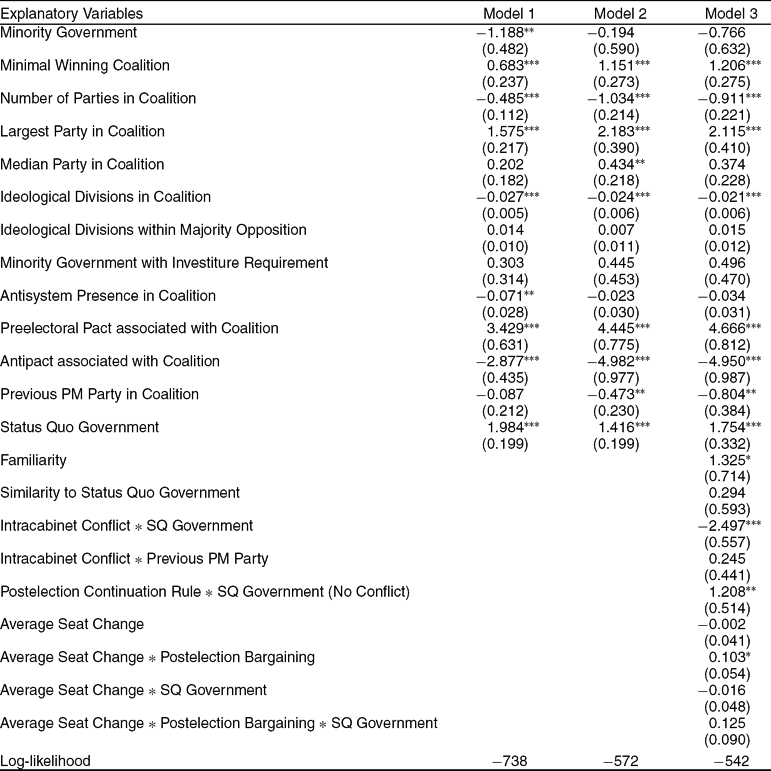
We begin our analysis by replicating the Martin and Stevenson (Reference Martin and Stevenson2001) model (specifically, Model 7) using our updated sample of bargaining situations. We present these findings in Table 1, Model 1.Footnote 17 By and large, the two sets of results do not diverge substantially, and most important, we find little difference in the “implied” coefficient on the status quo indicator (again, this is the sum of the coefficients on the status quo and previous PM party indicators) across the two studies.Footnote 18 In the Martin and Stevenson model, the implied coefficient was 1.76 (p < .001), whereas in the current model, it is slightly larger, at 1.90 (p < .001). Thus, we continue to see a strong, positive impact of incumbency on government formation.
Impact of Incumbency, Conditional on Termination and Electoral Context

Notes: Conditional logit coefficient estimates, with standard errors in parentheses. Model 1: Replication of Martin and Stevenson (Reference Martin and Stevenson2001). Model 2: Model 1 with party-specific indicators. Model 3: Model 2 with preference, institutional, and contextual factors.
N: 256 cases/65, 320 potential governments.
*p < .1, **p < .5, ***p < .01.
Based on our argument at the conclusion of the last section about potential inflation in the size of the incumbency effect, we next add party indicators to the model. The results of this analysis are shown in Model 2.Footnote 19 For our purposes, the most important point to note is that the implied coefficient on the status quo indicator is essentially cut in half once we take into account party-specific effects, dropping from 1.90 (p < .001) to 0.94 (p < .001). That is, the effect of incumbency on government formation is much smaller than previous studies have suggested, although it is still quite large in substantive terms: An incumbent government entering a new round of coalition bargaining is roughly 2.5 times more likely to form than an alternative coalition, all other things being equal.Footnote 20 Interestingly, this effect is now slightly less than the effect of some of the conventional size and ideology variables in the model (e.g., a minimal winning coalition is three times more likely to form than an oversized or minority coalition). These findings suggest that we are correct in our claim that the large impact of the status quo indicator found in previous research was partly due to unmeasured factors and that these factors are tied to attributes of the individual parties engaged in bargaining.
Of course, our central empirical task is to evaluate previous theoretical arguments for the sources of the incumbency effect, and to investigate whether the impact of incumbency is conditional on the termination and electoral contexts of bargaining. To do this, we add our measures of familiarity and bargaining costs to the model, and we introduce interactions between our two incumbency variables (the status quo government indicator and the previous PM party indicator) and the termination and electoral contexts. We present our findings in Model 3.
Beginning with the impact of partner familiarity, we find empirical support for the expectation that potential coalition partners that have worked together in the past (especially in the more recent past) prefer to govern together again. Familiarity has a clear, positive influence on the chances that a given cabinet will form. We can get a sense for its substantive importance by examining the odds ratio of its effect for different values of familiarity in the data. For example, if we define potential coalitions with “low” partner familiarity as those with familiarity scores at the 25th percentile in the data (0.375) and potential coalitions with “high” partner familiarity as those with scores at the 75th percentile (0.641), then we see that familiarity has quite a large impact on the odds of formation. Specifically, potential coalitions whose members are highly familiar with one another are approximately 40% more likely to form than coalitions whose members are relatively unfamiliar with one another. Notably, despite the significant impact of the familiarity variable, it does not come close to extinguishing the impact of the status quo indicator variable, as it should if the only thing driving the impact of incumbency on cabinet formation is the fact that incumbent partners get to know one another after a history of working together. Thus, there is clearly room for other influences to play a role in explaining the incumbency effect.
One of these potential influences, however, appears to have very little impact on government formation. Namely, coalitions that are “similar” in party composition to the incumbent government are not significantly more likely to form than coalitions that are dissimilar to the incumbent. The expectation from previous research was that a set of parties that spent the time, energy, and political capital to successfully negotiate a deal to enter government together in the most recent period of bargaining should find it relatively less difficult to strike a deal in the next period. Because potential coalitions are more similar to the incumbent coalition, in terms of their partisan composition and the relative bargaining strength of their members, the process of negotiating a new coalition deal should be significantly easier, thus making these coalitions more likely to form. The results provide little evidence that this is actually true. For example, a potential coalition that we would define as highly similar to the incumbent cabinet (with a similarity score at the 75th percentile, 0.638) is only 17% more likely to form than a coalition that is not very similar to the incumbent (with a similarity score at the 25th percentile, 0.100), a difference that is not statistically distinguishable from zero (p > .60).
We now evaluate whether the impact of incumbency on formation is conditional on (a) how the incumbent government left office and (b) how the incumbent government fared in the most recent parliamentary elections. The interpretation of the coefficients in Model 3 is complicated because of the several interaction terms with the contextual variables. To assess the impact of these variables, we must therefore consider them as a group—the implied interactions and other dependencies make it illegitimate to talk about changing one variable without also changing the others. Because the status quo indicator and the previous PM indicator are both interacted with termination and electoral context, and because the results for each variable are relevant to the interpretation of the others, we organize the discussion of our findings by context rather than by variable.
Beginning first with termination context, we divide our discussion into two parts, corresponding to the two types of termination discussed previously—one in which the incumbent government most recently terminated as a result of intracoalition conflict, and one in which it did not. For each type of termination, we examine the implied coefficients within that context for the status quo indicator variable and the previous PM indicator variable. The implied coefficients (as well as their standard errors) can be calculated easily from the coefficients in Model 3. These calculations include the obvious interactions and also the implied interaction between the previous prime minister indicator and the status quo indicator. And although interpreting coefficients in nonlinear models can often be treacherous, in this case, the direction of the coefficients does indicate the general direction of the effects on formation probabilities—a positive coefficient shifts probability toward coalitions that have the indicated characteristic and away from those that do not.
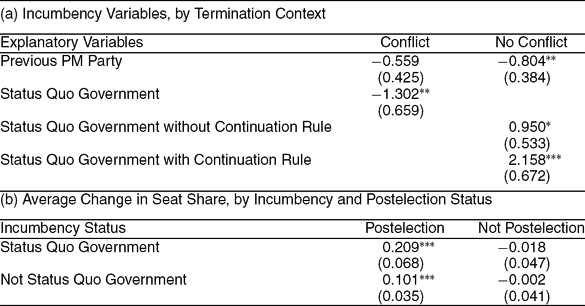
Table 2, panel (a), provides the implied coefficients on our two incumbency variables for the two types of termination contexts. We further distinguish the effects of the status quo indicator between those cases in which there was a continuation rule in place and those in which there was no continuation rule. We only make this distinction within the context in which the incumbent government ended without internal conflict because the continuation rule is only theoretically relevant in cases in which the government wants to re-form.
Implied Coefficients on Incumbency Variables, by Termination Context, and Implied Coefficients on the Average Change in Seat Share, by Incumbency and Postelection Status

Notes: All implied coefficient estimates are calculated from Table 1, Model 3. These account for the obvious interactions plus the implied interaction between the previous PM indicator and the status quo indicator. In panel (a), average seat change for the incumbent coalition is set to zero. In panel (b), the postelection continuation rule is set to zero. Numbers in parentheses are standard errors for the implied coefficients.
*p < .1, **p < .5, ***p < .01.
The first message to take away from these findings is that the impact of incumbency on the probability of government formation is decidedly negative in a bargaining situation that follows a conflictual cabinet termination, in line with our expectations. In substantive terms, our results show that a government that has collapsed due to internal conflict is only one-tenth as likely to immediately re-form as an incumbent that ended without internal conflict, and it is only about one-fourth as likely to form as an alternative coalition.Footnote 21 This constitutes the first empirical finding in the literature on government formation that incumbency is sometimes a disadvantage in coalition bargaining.
A second important message is that the presence of a continuation rule greatly improves the chances that an incumbent government that wants to re-form will be able to do so. As an odds ratio transformation of the implied coefficients from Table 2 shows, an incumbent coalition without a continuation rule, if it did not previously collapse due to conflict, is about 2.5 times more likely to form than an alternative coalition. But if a continuation rule is in place, the incumbent government is almost nine times more likely to form than an alternative coalition. In other words, an incumbent government that is not constitutionally bound to resign following an election, assuming it prefers to re-form, is almost 3.5 times more likely to remain in office than any other incumbent government that also wants to re-form.Footnote 22 This represents the first clear evidence for the claim that procedural rules give a big advantage to incumbent governments that want to remain in power.
The results also show that it is only the rule that advantages the government as a whole that matters in coalition bargaining. That is, we have no direct evidence that rules or norms that are believed to advantage the party of the incumbent prime minister make a difference in government formation. Recall that a positive coefficient on the previous PM indicator means that any potential coalition, other than the status quo cabinet, that includes the party of the previous PM is more likely to form. Recall also that our expectation is that, if the previous PM party's formateur status matters, then this coefficient should be positive following a termination context in which the government collapsed due to internal conflict. In other words, if the previous prime minister enjoys an advantage in bargaining, then we should expect his or her party to use this advantage to get into an alternative government when the members of the incumbent government no longer want to remain together. But if we look at the implied coefficient on the previous PM party in the context where the government terminated due to conflict, we see that the outgoing prime minister enjoys no discernible advantage in obtaining a place in the next cabinet (indeed, the coefficient is in the negative direction).
We also see that in situations where the previous government did not terminate due to conflict, the party of the previous PM is unlikely to be in any coalition other than the incumbent government. That is, the previous prime minister is likely to make it back into government in this situation, but only with his or her previous cabinet partners. Thus, the negative coefficient on the previous PM party indicator in this context says little about the impact of the PM's bargaining advantage (or lack thereof) because the PM would have no real incentives to form an alternative coalition to the incumbent government. Indeed, as we pointed out previously, a positive incumbency effect in cases where the incumbent government wants to re-form may be partly due to procedural advantages that some (or all) of its members possess, but it is difficult to tease out the impact of these procedures in this context because their influence would lead to the same observable outcome—re-formation of the incumbent government—as the influence of factors left out of the model that cause an incumbent government to want to re-form. Thus, to evaluate the role of the previous PM's formateur advantage, we focus on the cases in which the incumbent government does not want to re-form, and again, there is no evidence in such cases that the previous PM is able to get back into government.
The electoral context of bargaining also makes a difference in government formation. The focus of previous research has been exclusively on the indirect effects of elections on government formation via their effects on the seat distribution in the legislature. Thus, previous empirical models have accounted for the impact of elections only through the various party and coalition size indicators and other variables tied to seat shares (e.g., whether the coalition includes the median party). In contrast, our model accounts for whether there exists any direct influence of party electoral performance on coalition formation, after controlling for conventional size-related factors.
Our findings regarding electoral context are in Table 2, panel (b). The implied coefficients in this case indicate the effect of electoral performance on the probability of formation both for incumbent and nonincumbent coalitions, in bargaining situations that immediately follow elections and in those that do not.Footnote 23 These results make it plain that electoral performance has an important impact on coalition formation, even when we have controlled for the various ways that seat share matters in most coalition bargaining models. These results are interesting in several ways. First, they suggest that, in bargaining situations immediately following elections, performance matters for all potential governments, not just incumbents. If members of a potential coalition, on average, gain parliamentary seats in these situations, then they increase their chances of forming a government (and, conversely, if they lose seats on average, then they damage their chances of forming). For example, if a potential coalition other than the incumbent experiences a 1% gain in its average seat share, then it increases its odds of getting into government by approximately 10%.
However, the effect is even greater for the incumbent coalition, as evidenced by the fact that the implied coefficient for incumbents is approximately twice the size of that for nonincumbents. Thus, incumbent governments that have just received a positive verdict on their performance from voters are disproportionately advantaged in parlaying their electoral gains into government membership. An average seat increase of 1% for incumbent parties, for example, increases the chances they will remain in office together by almost 25%, even after we control for size-related considerations such as their majority status. Conversely, incumbent governments that have just performed poorly in elections are about 20% less likely to return immediately to office. This suggests that parliamentary elections have a bigger impact on which parties get into government than scholars have previously recognized. This impact is direct, and it affects the incumbent government more than any coalition alternative. This may suggest that election results convey information to incumbent parties about their previous performance that they use to forecast their future performance, thus affecting their preference to return to office together. It may also suggest that election results are seen by parties as a “verdict” by voters on the performance of the incumbent government that must be respected, regardless of whether the seat distribution in the legislature otherwise makes it more or less likely that the incumbent government can remain in office. In any event, our findings also make it clear that electoral results have a direct impact on government formation only if coalition bargaining occurs in the immediate aftermath of the election. If bargaining does not immediately follow an election, then previous electoral performance has no direct effect on government formation, regardless of whether the potential coalition is the incumbent.
CONCLUSION
In this study, we examine why incumbency matters in government formation. Previous scholarship has offered a variety of explanations for why incumbency should have an effect, but the explanations have been scattered and, consequently, have had little impact on empirical work in the field. We collected these ideas and integrated them into a coherent theoretical story. We classified existing theories into two broad sets of explanations for why an incumbent coalition might be likely to form again. The first focuses on the preferences of members of the incumbent coalition to re-form. These explanations suggest that incumbent cabinet partners, by virtue of their experience governing together, know and understand one another better than potential partners who have not had extensive experience together, and that incumbent cabinets may prefer to re-form because, in doing so, they avoid the costs associated with hammering out a new coalition bargain. The second focuses on the procedural advantages possessed by an incumbent government that should make it more likely to re-form, given a desire to do so. More specifically, these explanations emphasize the powers that are conferred on the cabinet as a whole, or the party of the sitting prime minister, that enhance incumbent influence in the formation process.
A central challenge confronting coalition research has been how to evaluate preference-based explanations versus institutions-based explanations empirically. Our success in making distinctions between them in this study comes from two sources. First, our measures of the different concepts highlighted by these explanations apply to different sets of potential governments. We argue that familiarity and bargaining costs apply to all potential coalitions, not just incumbents. In contrast, arguments about procedural powers apply only to the incumbent coalition specifically or to the set of potential cabinets that include the party of the previous prime minister. Second, we consider the termination and electoral context of coalition bargaining and argue that preferences and institutions interact in systematic ways.
Our empirical analysis, which uses a comprehensive new data set on episodes of coalition bargaining in Europe, produced several interesting results about the role of incumbency in government formation. Using a new measure of partner familiarity, we found that it has an important impact on the odds that a potential coalition will form. This effect is important for all coalitions, and it casts significant doubt on standard “one-off” models of coalition bargaining that ignore the importance of previous interactions between prospective government partners. We also found that certain institutional rules help an incumbent government to re-form, assuming that its members want to remain in office together. Specifically, we found compelling evidence that the presence of a continuation rule significantly enhances the incumbency advantage in coalition bargaining. However, we found no evidence that the advantages possessed by the party of the previous prime minister help it get back into office.
Perhaps most important, we found that the termination and electoral circumstances incumbent coalitions face in coalition bargaining have a strong impact on their chances of staying in office. One popular “knock” against multiparty government is that, because power sharing makes it difficult for voters to hold incumbents accountable and because of the closed-door nature of coalition negotiations, it is possible for incumbent governments to return to office, regardless of whether they were successful in managing their internal conflicts and irrespective of the verdict of the electorate (Gallagher, Laver, and Mair Reference Gallagher, Laver and Mair2005, 383–84; Powell Reference Powell2000, 11–12). Our main findings bear quite clearly on such concerns. Incumbent governments whose members have demonstrated a capacity to govern together without public conflict are likely to remain in office. A severe public conflict between coalition partners, however, is more than sufficient to convert a significant incumbency advantage into a sizable disadvantage. Moreover, incumbent governments that have made gains at the ballot box are more likely to return to power than those that have received a negative electoral verdict. Importantly, the effects of elections on government formation go beyond their impact on size-related attributes such as a coalition's majority status. Coalitions receiving a boost in seats receive an added “bonus” to their chances of forming the next government, especially if they are incumbents and if coalition bargaining follows in the immediate aftermath of the election. Naturally, other contexts may also condition the role of incumbency in government formation, such as the success of the government in managing the economy, the extent to which it fulfills the various campaign promises of its members, and its responsiveness in dealing with changing events over the course of its tenure, to name but a few. Our hope is that future research will benefit from the design and findings of this study and will continue to investigate the mitigating effects of such factors on the role of incumbency in coalition bargaining.




Comments
No Comments have been published for this article.