Suicide bombers have become an important weapon in the limited arsenal of occupied populations. The dominant perspective in proliferating scholarship as well as in policy circles views suicide terror as a rational act guided by strategic calculations. We aim to contribute to explanations of why terror is used in self-determination movements and offer a revamped strategic explanatory model of terror. The Palestinian conflict illustrates that occupying states and non-state groups alike employ terror by targeting non-combatants in pursuit of anticipated gains. Palestinian factions, we contend, adopted terror as the only available tactic that could generate the lethal, disruptive costs producing desired leverage over Israel. At the same time terror served as a means for integrating rival forces into an ostensibly effective confrontation bloc. We argue that when reconfigured occupation institutions generated a political opportunity structure promoting the use of terror, its deployment by Palestinians was governed by dual-arena strategic logic.
Suicide terrorFootnote 1, lethal attacks indiscriminately carried out against civilians via self-immolation, attained prominence in the Palestinian repertoire beginning in March 2001. From that point until the end of 2005, at which point they virtually ceased, 57 suicide bombings were carried out, causing 491 civilian deaths, 73% of the total civilians killed by Palestinian resistance organizations and 50% of all Israeli fatalities during this period. While not the modal coercive tactic, suicide terror was the most efficient in terms of lethality, our basic measure of its efficacy. In the conflict with the Israeli state, Hamas’s paramilitary wing, the Al-Qassam Brigades, championed suicide bombings during the second, or Al-Aqsa, Intifada, prompting rival actors of diverse ideological and religious convictions, including Fateh-affiliated Al-Aqsa Martyrs Brigades, to follow suit. This in turn provoked an escalation in Israeli reprisals and a suppression of the tactic by governing Palestinian Authority elites.
Though we are centrally concerned with terrorism, our analysis focuses on its suicide variant which, we claim, was adopted as the only feasible means for carrying out terror. In our view, the most relevant feature of terror is its chosen target rather than its modality [Goodwin Reference Goodwin2004; Moghadam Reference Moghadam2006: 710]. What compels us to investigate suicide bombings is the intent to cause non-combatant civilian casualties, that is, the willingness to target those who are conventionally off-limits in armed conflicts.
Most scholarship focuses on discreet levels of analysis to explain this form of political violence. One perspective concentrates on the meso-level of networks, for instance [Pedahzur and Perliger Reference Pehahzur and Perliger2006]. Another important vein of terrorism studies aims to identify individual characteristics of suicide bombers, some authors focusing on socio-economic status and educational attainment [Benmelech, Berrebi and Klor Reference Benmelech, Berrebi and Klor2012], others on occupational backgrounds [Gambetta and Hertog Reference Gambetta and Steffen2009], and still others on the cultural and religious commitments of bombers [Dale Reference Dale1988; Hafez Reference Hafez2006]. Broader studies of terror that analyze individual, organizational and national or societal motivations have been applied to the Palestinian conflict [Hafez Reference Hafez2006]. We follow the most ambitious scholarship on terrorism that aims to elucidate the links among micro-, meso-, and macro-level mechanisms behind political violence [Della Porta Reference Della Porta2013].
This paper is therefore less concerned with the single micro-level question of “what makes suicide bombers tick?” than with the meso- and macro- political opportunities that shape relative capacities and strategies and compel armed political groups to deploy pre-selected individuals to target civilians in anti-occupation conflicts. For the same reason, we distinguish our explanandum from both suicide attacks against discriminately chosen non-civilian targets and growing Jihadi terror against civilians in escalating sectarian conflicts.Footnote 2 Given that the strongest arguments about anti-occupation terrorism come from literature on the Palestinian-Israeli conflict, we reexamine comprehensive data on all fatalities during the second intifada to support our claims.
Suicide terror emerged as a key tactic only after a significant reconfiguration of occupation policies and domestic Palestinian politics generated a new opportunity structure. The new context was characterized by a marginalization of Palestinians from ruling Israeli institutions and a fragmentation of Palestinian political actors. Under the 1990s Oslo peace process framework, the Israeli state abandoned direct administrative control, shifting to a strategy of separation from and isolation of Palestinian territories. Negotiations also produced the Palestinian Authority (PA), which became a source of domestic disputes. The resulting context of fractured powerlessness shaped decisions to employ terror by determining valuations of their utility not only in the external sphere of conflict against the Israeli state, but also, and primarily at key junctures, in the internal field of competing organizations and strategies. Terror was not driven by individual motivations or cultural predispositions; instead, we argue, it was employed to advance internal political objectives embedded within the overarching ends of the external campaign against occupation. In general, we posit that in anti-occupation conflicts between institutionally separated populations and in which the occupying state enjoys overwhelming advantages without direct management, terror is used by rival factions to build effective capacity to impose otherwise unrealizable costs required to rebalance asymmetrical power relations.Footnote 3
In the Palestinian case, we contend that explaining suicide terror’s termination sheds significant light on the tactic’s adoption. Though dominant accounts of suicide bombings—theories of retaliatory terror, of terror to outbid domestic rivals, and of strategic terror for territorial liberation—offer valuable insights, we are puzzled by their common inability to explain a crucial fact of political violence in the Palestinian conflict: the cessation of suicide terror after 2005. Building on these theories and addressing their gaps, we show that Hamas was driven by mutually-conditioning calculations of the benefits and costs of suicide attacks on two levels. Externally, Hamas hoped to force Israel to bargain on equal grounds by exerting deadly leverage against its main adversary. It soon realized that suicide bombings compounded Israeli occupation and violence, resulting instead in intolerable costs for Palestinians. Notwithstanding external setbacks, Hamas temporarily maintained the terror strategy to bolster a united domestic pole which challenged PA elites deemed detrimental to national goals.
By 2005, as risks of internal strife and human loss escalated, the campaign’s overall costs overwhelmed any remaining benefits. Simultaneously, new opportunities opened for Hamas. First, the Israeli disengagement plan created the possibility for national dominance rooted in political control of Gaza. Second, changes in the US’s Middle East policy led to the promotion of elections [Craner Reference Craner2006]. As the electoral opportunities materialized, Hamas was able to compete for national leadership and pursue what it presented as “resistance by other means”, a non-conciliatory policy without the use of terror. In the end, while based on dual-level utilitarian assessments, Hamas’s strategic use of terror failed. In what follows, we review the leading theories of suicide terror, ending with Robert Pape’s rational strategic account [2005], which we find most instructive and upon which our model builds.
Theories of suicide terrorism
Retaliatory terror
Without rejecting rationality outright, retaliatory theories of suicide terror minimize the claim that attacks seek to pursue strategic goals, emphasizing instead individual and organizational desires for revenge. Robert Brym and Bader Araj [Reference Brym and Araj2006] contend that most Palestinian suicide bombings cannot be “construed as instrumentally rational means of achieving” strategic objectives [2006: 1981]. Terror operations are “reactive”, with even most organizational rationales “focused on avenging Israeli attacks” [2006: 1979]. Establishing a “balance of terror” [Araj Reference Araj2008] is narrowly conceived as a reflexive tactic for reciprocating the occupation forces’ violence against leaders, members and constituents.
This approach suffers from difficulties inherent in isolating the effects of occupying states’ assaults. Examining instances of revenge attacks results in selection bias. In fact, retaliatory impulses arise in all armed conflicts, yet very few conflagrations produce suicide terrorism. Though revenge motives may be necessary, other obstacles must be overcome for terror attacks to obtain.Footnote 4 In emphasizing desires to inflict lethal damage, revenge theories assume unhindered deployment capabilities, paying insufficient attention to harm from reprisals. Brym and Araj enjoin scholars to consider costs incurred by terror actions, but their account fails to relate reactive motivations to calculations of terror’s relative costs. At the very least, revenge theories must address the capacity of groups and constituents to absorb reprisals and renew the ability to sustain revenge attacks. “Balance of terror” models fail to address the required capacity to tolerate escalating costs.
Besides their conceptual issues, retaliatory accounts are not supported by key facts of the Palestinian conflict. During important junctures, revenge motivations failed to produce terror. In 2006, for instance, over 600 Palestinians were killed by Israeli security forces; a fifth of these were indiscriminate civilian casualties and scores were selective fatalities. Were vengefulness and the establishment of a non-strategic “balance of terror” sufficient causes of suicide attacks, these should have persisted beyond 2005.
Still, the work of Brym and Araj raises a central feature of suicide terror: the aim of transferring costs onto perceived aggressors. Having introduced this motivation, however, retaliatory theories falter in not addressing the relationship between the aims of terror and the domestic costs they elevate. In addition, such theories, while correctly relating terror to external adversaries, fail to connect the tactic to domestic rivalries common to conflicts involving foreign occupation.
Terror for domestic market share
Whereas retaliatory accounts point to intended external impacts, a prominent, competing theory of suicide terror privileges its internal utility. In “Palestinian Suicide Bombing: Public Support, Market Share, and Outbidding,” Mia Bloom [Reference Bloom2004] argues that terror is deployed to outbid rivals for political market share. Concretely, as public approval of terror against the occupying state grows, factions compete for support by maximizing attacks. Independent of its external efficacy, terror is carried out for internal gains.
“Outbidding” models correctly incorporate domestic calculations but lack a full account of how these are computed. Most importantly, they never establish the reasons constituents reward suicide attacks. Since national factions are embroiled in fierce competition over “market share”, and political violence elicits support, questions regarding the forms and targets of violence emerge. Why, in her account, is suicide terror against external civilians the most rewarded tactic? After all, prominent scholars of political violence have persuasively shown that under certain circumstances of escalating cycles of contention, competition for supporters leads insurgents to target rival groups [Della Porta and Tarrow Reference Della Porta and Tarrow1986: 612-613]. By severing domestic factional competition from the external anti-occupation sphere, Bloom fails to explain the link between terrorists’ target selection and perceived gains rewarded by constituents. Further, replicating the central gap of revenge theories, she fails to examine how this political payoff is impacted by assessments not only of external gains but of retaliatory blows provoked by targeting non-combatants. Downplaying domestic costs, Bloom assumes preference constancy, irrespective of fluctuations in external achievements and internal burdens [2004: 76].
Bryn and Araj [Reference Brym and Araj2008] usefully presented inconsistencies between Bloom’s outbidding hypotheses and the historical record. Observing an undeniable intensification of domestic competition during the conflict’s latter stages, Bloom predicted that “the number of attacks will increase because groups vying to lead Palestine will [… use terror] for recruitment and mobilization” [2004: 87]. Instead suicide attacks sharply subsided and soon ceased altogether. Simultaneously, as Hamas tempered its use of terror in 2004 and then abandoned it ahead of rival factions in 2005, its public support peaked, doubling to almost 40% by early 2006.Footnote 5 Given the asynchronous occurrence of terror, rivalry intensification and shifts in public support, domestic competition alone was not driving terror during the second Intifada.
Importantly, her theory nevertheless underscores the domestic terrain in which terror groups operate. Factional competition has an unquestionable effect on decisions to deploy terror. In not examining the relationships between support for terror, its target and its external efficacy, however, outbidding accounts fail to elucidate the mechanisms linking growing political market share and terror against the occupying state.
Strategic terror for territorial liberation
Strategic models of terrorism center precisely on the impact of suicide attacks on the occupying state. Suicide attacks, they contend, rather than a manifestation of domestic competition or a means of revenge, are terror-inducing tactics intended to exact concrete concessions from external adversaries. In Dying to Win Robert Pape [Reference Pape2005] asserts that suicide terror is used against foreign occupation because “it works” for coercing military withdrawal. Other groups learn and replicate a method allegedly enjoying comparatively high success rates. He reaffirms the efficacy thesis by pointing to Israel’s 2005 disengagement from the Gaza Strip [Pape and Felder Reference Pape and Feldman2010].
Pape addresses the choice of tactic and target. Agreeing with previous scholars, he argues that suicide terror is a strategic weapon [Crenshaw Reference Crenshaw1981], employed by weaker, non-state actors against foreign military occupations due to its effective “threat to inflict […] punishment on civilians” [Pape Reference Pape2003: 344]. Specifically, terrorism exacts territorial gains when the occupying state is democratic. Pape reasons that democracies are less likely to respond with devastating and indiscriminate reprisals, in part because they are restrained by contending electorates who compel leaders to make concessions. Our model builds upon, but departs in important ways from, Pape’s central argument.
Firstly, Pape overlooks the possibility, indeed the expectation, that like the occupying side, the polity under occupation may be divided with regards to national objectives and means for their attainment. As Bloom shows, we expect not only opposing positions, but, more importantly for our purposes, that opposing aims of rivals and demands of constituents will influence the external tactics of competing factions. Secondly, Pape’s model, in our view, misconceptualizes terror’s anti-occupation aims. Empirically, Pape strays from analysis of terror as an indiscriminate tactic against civilians, addressing numerous campaigns waged against state and military targets. We insist that attacks against non-combatants are precisely the aspect that demands explanation. Further, terror’s objectives are construed too narrowly; given extreme power asymmetries and domestic cleavages, groups may employ terror to attain intermediate ends that are no less strategic than territorial liberation. Suicide attacks may “work” in pursuit of other, non-maximalist anti-occupation goals. Finally, we propose that, though to a lesser degree, shifting regional politics should be integrated in our understanding of conditions that facilitate or obstruct the use of terror. In deploying terror, factions are not only influenced by the politics of the occupying state; appraisals of terror’s efficacy will also be shaped by the interests of competing regional powers.
Pape’s misspecification of targets and objectives has allowed scholars to dismiss convincingly his claims that suicide campaigns enjoy a 54% success rate [Moghadam Reference Moghadam2006]. Likewise, we question his criteria for ascertaining success—in the Palestinian context, for instance, we maintain that the Gaza disengagement, given the continuation of Israel’s total control over the strip’s borders, airspace and coast, amounts to a shift to a more effective occupation regime, or in the words of a scholar of the conflict, a more “advanced stage” in the separation policy [Li Reference Li2006], rather than territorial liberation. Unlike critics of Pape’s work, however, we preserve its basic insight that terror groups act in calculated pursuit of strategic ends. We note, however, that the choice of non-combatant targets is central to the desired emancipatory efficacy of terror attacks which, in turn, hinges on a domestic polity fractured by Bloom-like competition as well as on regional rivalries. We thus reformulate terror’s ends to address the lacuna in Pape’s model.
Summarizing, an alternative strategic explanation of suicide attacks must a) focus on explaining the indiscriminate targeting of non-combatants; b) expand the conceptualization of terror’s objectives beyond immediate territorial liberation; c) define the roles of retaliation and domestic competition in relation to wider objectives vis-à-vis the occupation; and d) offer a convincing treatment of the mutually conditioning cost/benefit calculations by groups that employ terror within both the domestic political sphere and the external sphere of the anti-occupation conflict.
Our alternative dual-arena model
Taking Pape’s work as our foundation, we offer a dual-arena account of terror that incorporates and connects features of outbidding and retaliatory models. We propose a theory of terror whereby the logic of suicide attacks in the domestic arena is nested in the overarching logic of terror in the external arena. To that end, we borrow from both dual-arena frameworks and scholarship that employs social movement theory to make sense of political violence.
Two-level theories linking decision-making in the international sphere to national constraints have been developed since Robert Putnam offered his influential diplomacy-domestic politics game model [Putman Reference Putnam1988]. More recently Wendy Pearlman adopted a dual-arena model to explain violence in Palestine [2011]. Unlike Pearlman, however, our findings show that terror pulled domestic players into a common strategy—enhancing efficacy in external relations. Our aim is to specify as rigorously as possible the mechanisms linking motivations behind terror in each sphere. To this end, we follow Della Porta’s work [2013] identifying the interconnections among multi-level mechanisms amid the changing opportunity structures of cycles of violence.
Suicide terror in the external arena
In the external arena, we accept Pape’s premise that terror is used owing to its perceived success in advancing objectives against occupation. However, we specify that terror is effective not in absolute terms, but in comparison to other available options and in pursuit of intermediate ends.
By external arena we mean the sphere of conflict pitting non-state national actors against the occupying state, along with its regional context. Generally, the conflict’s core sphere is characterized by extreme power asymmetries giving the occupying state overwhelming military and diplomatic superiority. Opposite the occupying state, key actors on the occupied side comprise resistance factions and proto-state, administrative elites. Factions aim to harm the external adversary while elites, who benefit from existing arrangements with the occupying state, prefer to preserve the status quo in external relations.
Anti-occupation groups must develop the capacity to impose costs onto their external adversary. Marginalization, however, dramatically curtails avenues for disruptive action available to occupied groups. Physical separation eliminates most avenues for disrupting occupying institutions. Further, extreme asymmetry in hard power resources makes it exceedingly difficult and risky for non-state factions to impose costs via conventional military means. As a result, whereas proto-state elites defend their governing prerogatives, armed factions resort to extra-institutional opportunities for imposing disruptive costs. Incapable of directly threatening the external state, anti-occupation factions attack civilians as the only available recourse for achieving concessions, amid otherwise overwhelming powerlessness. Suicide terror, we contend, is not merely a non-state weapon against occupation; more precisely it is the least ineffectual tactic of institutionally marginalized national forces. Accordingly, we argue that rather than pursuing territorial exactions, suicide attacks striking non-combatants are deadly disruptions aiming to improve the balance of forces within a circumscribed set of feasible achievements.Footnote 6
Our reconceptualization of suicide terror’s goals has serious implications for measuring its success and assessing the utility of its continued use. Against Pape’s argument that democratic cleavages facilitate concessions, we argue that suicide campaigns are not necessarily intended to further divide the adversary. We adopt Jeff Goodwin’s [Reference Goodwin2006] more compelling concept of “categorical terrorism” whereby civilians are targeted for their perceived complicity with occupying state elites. Circumscribed by marginalization, anti-occupation factions thus measure efficacy in terms of the civilian casualties produced. Accordingly, as long as resistance factions preserve a capacity for confrontation and constituents display a willingness and ability to countenance the costs of reprisals, terror factions can be expected to intensify bombings in a gambit to spread costs against the external adversary as widely and indistinctly as possible. The aim is for an allegedly monolithic occupying polity to tire of mounting fatalities before the occupied population. This pivotal mechanism is what we refer to as “out-suffering”.
Faced with the “out-suffering” gambit, we posit that the external adversary faces two choices, one defensive, the other offensive. First, the occupying state may choose to neutralize the terror tactic by preventing deadly disruptions against it. Alternatively, the occupying state can take up the challenge and seek to prevail by overwhelming the occupied population with disproportionately escalating costs. Extreme power asymmetries usually translate into gains for the occupying state when the conflict escalates. This built-in advantage, moreover, promotes consensus around decision-making on the occupying side. We therefore surmise that lethal escalation is the preferred strategy for the occupying state as it is widely supported and brings the most reliable results in the out-suffering contest.
Along with the occupying state’s overwhelming counter-offensive measures, regional politics often condition the out-suffering strategy. Typically, dependency on regional patrons tends to restrict already marginalized and subordinate anti-occupation factions to activities aligned with allied states’ interests. Reconfiguration of patron states’ interests thus either loosens or tightens the constraints operating on non-state actors.
In a context of reprisals by the occupying state and shifting interests of regional patrons, the ability of anti-occupation factions to alter the overarching power correlation hinges at its core on a relative cost threshold. Terror loses its efficacy if its pursuit of external gains raises domestic costs to unbearable levels before the adversary state shows a willingness to make concessions. The logic of suicide terror in the external arena is calibrated by imbedded cost-benefit appraisals in the internal arena. The “out-suffering” mechanism crucially connects the macro-level confrontation with the adversary state to the meso-arena of competing domestic factions [Della Porta Reference Della Porta2013: 24].
Suicide terror for the internal arena
We define the internal arena as the field of domestic contention that factions seek to influence via the execution of terror. Starting from the primacy Pape assigns to anti-occupation aims, we maintain that the domestic ends of terror are subordinated to overriding external objectives. This nested relationship is a natural extension of two core mechanisms behind the external use of terror: developing capacity for confrontation and out-suffering the adversary polity. Factions use terror to build domestic resources for confrontational capacity and to promote organizational and popular commitment to winning the out-suffering contest.
In the domestic sphere, competition arises primarily among anti-occupation factions and between these and administrative elites. Resistance factions limited to a narrow range of violent tactics must defend and expand coercive capacities. A major threat to the growth and preservation of confrontational capacity arises from domestic rivals pursuing non-belligerent strategies. Militant groups confront competitors who seek to undermine their ability to inflict lethal external blows by marginalizing them in the internal arena. The imperative to isolate them augments if competitors couple conciliatory tactics with elite resources to suppress violent resistance. In advancing their aims, all political groups must therefore also jockey for influence on the “street”, turning grassroots preferences into an important feature of the domestic sphere.
Effectively, terror is a tactic used to “outbid” domestic rivals. Contra Bloom, however, suicide attacks seeking internal influence are foremost intended to consolidate and stabilize anti-occupation belligerent capacities rather than winning market share. Competitive terror, we contend, is therefore integrative and is predicated on two interconnected mechanisms, one operating at the inter-organizational level, the other among grass-roots constituents. Firstly, factions exploit terror’s demonstration effects: its exemplary deployment is designed to win sympathetic rivals to the confrontation strategy. By demonstrating undeterred capabilities for inflicting lethal costs, terror attacks attract groups that might otherwise be drawn to conciliatory strategies and increase the costs to dominant rivals who suppress resistance. We contend that terror for integrative competition serves to cohere a shared confrontation strategy.
Secondly, suicide attacks are designed to shore up popular support for violent resistance. They gain public support primarily because they are perceived to be justified retaliations for assaults on civilians by occupying states, and because they are widely perceived to advance broadly embraced anti-occupation aims. Since popular backing is needed for out-suffering to succeed in the external arena, militants must display sensitivity to “street” calls for revenge against the occupying state. Relatively independent of their immediate results in the external arena, suicide attacks are carried out to preserve popular support.
The domestic utility of terror, nonetheless, runs up against unavoidable limits, as intensified competition and retaliatory escalation carry grave risks. After a point, pursuing the domestic advantages of terror threatens to generate excessive polarization among rival factions and unbearable suffering among constituents. Up to this threshold, competition and compliance with calls for revenge support the central aim of building confrontational capacity; beyond it, they undermine it by fracturing the resistance bloc and exhausting the sympathies of supporters.
Recapitulating, we argue that suicide terror is deployed in circumstances of institutional marginality primarily to alter the balance of forces vis-à-vis the external enemy. Moreover, we contend that attacks against external civilians are themselves a means to perpetuate capacities for improving the national power correlation via further confrontation. If carried too far, terror runs the risk of destroying confrontational capacities by transferring the conflict onto an irreversibly polarized domestic arena and by provoking unbearable reprisals that subvert the core out-suffering mechanism. The use of terror, in sum, is dynamic and relational, shifting in the course of interaction with opponents, rival and allied factions [Della Porta Reference Della Porta2013: 19], along with regional actors.
Definitions, methods and case
Having presented our alternative model, we now describe the methods and sources employed, defend our case selection, and present some of the more instructive questions it offers with respect to theorizing the logic of suicide bombings.
Contrasting with most studies of suicide terrorism that quantify terror campaigns, terror attacks, or individual terrorists, we measure the totality of deaths during the conflict. Consistent with the centrality ascribed to lethality by at least one prominent study [Asal and Rethemeyer Reference Asal and Rethemeyer2008] this choice of unit of analysis responds to our emphasis on effective costs. Given our claim that terror attacks aim to generate such costs via successful out-suffering, we examine the capacity to impose lethal costs by focusing on this measurable result of adopted repertoires, rather than debatable claims around territorial liberation, market share or vengeance.
Accordingly, to explain why Hamas employed terror in the early years of the Intifada and when and why the suicide campaign was terminated we examine all fatalities during the Al-Aqsa Intifada beginning in the Fall of 2000, extending our review through 2008. We rely on two sources. Firstly, we looked at the universe of Intifada deaths registered in the database of the human rights ngo B’Tselem [B’Tselem 2010].Footnote 7 To analyze the patterns of lethal violence during the conflict, we classified the 5,941 recorded fatalities—Israeli and Palestinian—into four broad categories: combatant death, indiscriminate non-combatant death, collateral non-combatant death, and targeted killings.Footnote 8 The indiscriminate attacks that are our analytical focus are suicide bombings “inside the Green Line,” that is, within the internationally recognized 1967 Israeli borders.
To ascertain with confidence the circumstances surrounding each death, we complemented the B'Tselem evidence with descriptions provided by weekly reports compiled by the Palestinian Committee on Human Rights (pchr). Well over 99% of Palestinian deaths registered in B’Tselem’s database were covered by pchr field researchers. Both human rights organizations are non-partisan groups officially recognized by the UN (and frequently rebuked by their respective national authorities).
In addition, we conducted a qualitative review of all statements by Hamas officials in the Arabic language press as well as on Hamas’s Palestinian Information Center (pic) website. These delineate public Hamas positions on terror and the general contours of its official decision-making around this tactic. We measured claims made by Hamas officials against the conflict’s patterns of violence, determining the extent to which their statements matched the conflict’s trends. Finally, we also examine the claims and actions of other actors including the Israeli state, PA leadership (dominated by Fateh party elites), Al-Aqsa Martyrs Brigades (Fateh-linked militia), Islamic Jihad militia, and the Popular Front for the Liberation of Palestine (pflp).
The Al-Aqsa Intifada was the selected case for reasons beyond the fact that many scholars have constructed theories of suicide terror based on its empirics. Firstly, the choice by Palestinian resistance groups to employ suicide bombings as a central yet not exclusive tactic allows for an examination of decisions to use terror over other operations. Secondly, the case is enlightening because of the Islamic character of the organization that spearheaded its use. This reality enables a juxtaposition between strategic ends and alleged cultural-religious motives. Finally, the Al-Aqsa Intifada is relevant for the conclusions it allows us to draw about the use of suicide terror in the context of anti-occupation conflicts.
Stated objectives of suicide terror
Official Hamas statements convey a strategic adaptation to the conflict’s changing circumstances. In this section we present a representative selection. Hamas claimed the Intifada’s eruption presented the opportunity to replace the Oslo framework with a more effective strategy of violent resistance. Through a “balance of terror” strategy, Hamas initially hoped to force Israel to bargain on more even grounds. Realizing the difficulties involved, they invoked the need to fortify a united armed bloc to build capacities for future confrontation. In the end Hamas abandoned the campaign when the terror strategy failed and when opportunities for different forms of political contention emerged.
In 2005, political bureau chief, Khalid Mishaal, articulated the group’s oft-stated principle that “without a [favorable] balance of power, you can’t make an honorable peace” [Al-Ahram weekly, April 7-13, 2005]. Throughout the conflict, Hamas’s public declarations insisted that it did not reject a negotiated settlement but instead repudiated the concessionary manner in which the PA conducted peace talks. More than as a spoiler, Hamas claimed it acted to overturn and replace the PA’s conciliatory negotiation strategy.Footnote 9 From Hamas’s perspective, leverage for negotiations required effective belligerent capacity. To again quote Mishaal: “[I]f war requires a balance of forces, then negotiations do as well; […] peace is not made between a weak and a strong party” [pic, July 21, 2010].
Hamas claimed to employ the only available weapon that could outperform the overwhelming Israeli force. In a December 2003 interview Mishaal explained that, within an asymmetrical context, suicide attacks were essential for establishing the required “balance of forces” [pic December 7, 2003]. Gaza spokesperson Al-Rantisi elaborated: “[h]alting suicide missions is dangerous for the overall future of the Palestinian question, because the enemy will be released from the biggest pressure and terrorizing power” [pic March 30, 2003, emphasis added]. For Hamas, pressure entailed terrorizing Israelis by raising fatalities to unbearable levels.
Hamas simultaneously claimed that deployment of this sole source of leverage neutralized domestic obstacles to achieving “terrorizing” capacity. In March 2001 Abrahim Goshi, official Hamas spokesperson, asserted that forceful resistance eroded security cooperation between the PA and Israel and promoted coordination between Islamic and national resistance forces, foremost Fateh. In the same interview, he specified that maintaining a shared violent strategy proved effective in preserving external capacity for obstructing an immediate territorial threat: an alleged cantonization scheme [pic March 14, 2001].
Despite initial optimism, Hamas officials later modified their claims. After two years of suicide attacks, they admitted shifts in the balance of forces favored Israel. Firstly, they acknowledged the crippling costs paid by Palestinians, with senior Gaza official Ismail Haniyeh, for example, discussing at length the need “to reduce [Palestinian] suffering […] by protecting children from the killing” [Aljazeera October 3, 2004]. Secondly, Hamas statements revealed the need to defer goals in the external arena and consolidate the resistance bloc that had emerged in the first period. Mishaal emphasized the “survival of resistance”, linking extended balance of power shifts to preservation of capacity: “[T]he philosophy of resistance… is not necessarily to inflict the largest number of deaths, but […] to exhaust the enemy in a long term struggle, so that in the end this enemy will not be able to bear this high burden of the occupation” [pic March 12, 2003, emphasis added]. Since targeting Israeli civilians could not exact territorial gains, aims shifted from generating immediate leverage to requirements for developing capacities for a prolonged conflict.
Simultaneously, Hamas’s internal leadership routinely expressed fears of domestic fracturing. On June 8, 2003, a West Bank leader explained that terror fanned polarization and risked “ignit[ing] civil war”, facilitating pro-Israeli “security demands for the PA [to] attack the resistance” [pic June 8, 2003]. Increasingly aware of PA elites’ ascendance and commitment to negotiation conditions that fomented civil conflict, Hamas nevertheless defended the coalitional effects of terror. Responding to rising distrust of terror’s strategic value, Mishaal explained that while PA officials suppressed the resistance, bombings held “Hamas, Fateh and Jihad […] in the same trench (khandak)” [pic August 25, 2003].Footnote 10 Pronouncements by Al-Aqsa Martyrs Brigades following joint military attacks are consistent with Hamas’ claims linking terror to consolidation of the resistance bloc. A Spring 2003 communiqué co-authored with Al-Qassam condemned Palestinian elites for disarming the resistance and asserted that unity under a common confrontation strategy would overturn such divisive “provocations” [pic March 30 and June 10, 2003].
Hamas officials also recognized that the final attacks were launched in response to public outrage at ceasefire violations. In an August 2003 interview conducted after the execution of Abu Shanab, the truce’s mastermind, Hamas founder Ahmed Yassin admitted a Jerusalem bombing was payback for Israel’s targeted assassinations. As calls for retaliation mounted, he defiantly promised retaliation for Palestinian deaths [pic August 28, 2003]. Within a year, however, Hamas began minimizing popular calls for revenge. Following the assassinations of Yassin and Al-Rantisi, Haniyeh stressed “we are a liberation project and do not work according to considerations of revenge” [pic April 20, 2004].
Calls for patiently building terror capacity subsequently gave way to pronouncements for participation in national elections. After Israel announced a planned withdrawal from Gaza, Hamas communicated two main concerns. First, Hamas expressed suspicion that Israel would parlay disengagement into tighter control over the West Bank. In February 2004 Mishaal took credit for expelling Israel from Gaza but cautioned that “Sharon wants to appear flexible in Gaza to push through and justify his rigidity in the West Bank, knowing that evacuating Gaza settlements […] does not represent a real concession […]; he gets rid of a burden rather than an advantage” [Alwatan Voice February 22, 2004]. Second, Hamas expressed fears that intra-Fateh discord would culminate in the installation of a conciliatory Arafat replacement pushing for unilateral PA control of the strip following disengagement. Reiterating Hamas leaders’ slogan “Partners in blood, partners in decision making,” Mishaal asserted that Hamas would accept nothing short of equal partnership in political decision-making [paldf, August 1, 2004]. Following Arafat’s November death, Mishaal called on Fateh to overcome infighting and consent to a united national leadership tasked with holding fair elections [pic November 20, 2004].
Officials insisted Hamas was adopting non-violent resistance tactics that conformed to the occupation’s changing features [pic February 23, 2005]. Hamas’s proclaimed “resistance by other means” endowed co-ruling Palestinian political institutions created by Oslo with two aims. First, Hamas sought to use the power-sharing arrangement to reach a non-capitulationist settlement with Israel based on common principals of national sovereignity. By 2005 Hamas had unambiguously accepted settlement terms based on the 1967 borders, refugees’ right of return, east Jerusalem as the capital of Palestine, and release of prisoners. Secondly, Hamas aimed to govern in ways that moved the resistance bloc into a hegemonic position. Significantly, Hamas reaffirmed the right to build military capacity to confront the ongoing occupation when necessary.
In the remaining sections of the paper, we first lay out changes in the political opportunity structures that facilitated the initiation of the terror campaign and later altered Hamas’s strategy. The subsequent empirical section of the paper verifies the validity of the dual-arena strategic model by examining consistency between Hamas’s stated motivations and patterns of suicide attacks and shifting fatality rates throughout the conflict.
Shifting political opportunity structures: the initiation and termination of the suicide campaign
We follow Tilly’s [Reference Tilly1978] basic insight that changes in power institutions influence the shape of violent protest. From the suicide campaign’s inception to its termination, shifts in the occupation’s ruling structures created opportunities for successive forms of contention. The First Intifada’s mass civil disobedience was facilitated when Israeli administrative and policing institutions in the Occupied Territories became vulnerable to widespread protest by ordinary Palestinians who had built up autonomous resources and local leadership [Alimi Reference Alimi2009]. In the lead up to the Second Intifada, the occupation’s reconfiguration, from direct management to separation, eliminated conventional avenues for disrupting Israeli institutions [Gordon Reference Gordon2008]. It also, via the concurrent opening of peace negotiations, established the Palestinian Authority institutions and administrative elites with interests in quelling disruptive tactics, particularly violent ones, against Israel. The resulting opportunity structure on the one hand restricted Palestinians to a few available channels for imposing costs onto Israel, while, on the other, compelled violent resistance actors to consolidate the sole coercive strategy deemed viable and defend it against domestic elite suppression. By 2005, though the “out-suffering” strategy failed to coerce Israel into negotiating on improved terms, the campaign had compelled Israel to adopt a disengagement approach to the Gaza Strip. This shift in occupation practices, which coincided with US regional “democracy promotion”, presented Hamas with the opportunity to end the campaign and compete in national politics.
The Al-Aqsa Intifada erupted among widespread disillusion with the Oslo negotiations and the Palestinian Authority. Contrasting with the optimism of the early to mid-1990s a decisive segment of Palestinians reached the conclusion that the peace-process itself and the PA leadership marshaling talks were obstacles to independence. By June 2000 over a third of Palestinians had lost confidence in the Oslo process.Footnote 11 A month later the failure of the Camp David talks between Arafat and prime minster Barak facilitated the eruption of pent up disaffection.
The Intifada’s first three months were characterized by massive, civil defiance. There is no evidence that Hamas’s Al-Qassam Brigades were preparing in advance for a terror escalation.Footnote 12 Israel’s devastating repression, however, soon discouraged protest and promoted the conflict's militarization.Footnote 13 Palestinians’ perception of an inordinately and indiscriminately deadly suppression of protest was critical in creating the climate that fuelled the terror campaign. Shortly before Hamas deployed the first suicide attack in March 2001, another round of failed peace talks at the Taba summit was followed by the February election of right-wing candidate, Ariel Sharon, as Israeli prime minister. By 2002 all rival Palestinian actors, including Al-Aqsa Brigades, Islamic Jihad and pflp, adopted the suicide terror policy. Many Fateh officials, and to some degree Arafat himself, defended the campaign.
In response to the suicide campaign, Israel launched a full-scale reoccupation, Operation Defensive Shield, in March 2002. As Zeev Moaz shows, the Israeli state applied “unlimited use of limited force” intended to impose “escalation dominance through excessive” and disproportionate lethal violence [2009: chapter 7]. Israel's military, the Israeli Defense Forces (idf) reoccupied major towns in areas that the Oslo framework had relinquished to semi-autonomous Palestinian administration. Though the idf pulled troops out of urban centers after two months, it maintained cordons around Palestinian towns from where it carried out regular raids and incursions. Despite Israel’s increased reliance on large-scale military action and resort to “collective punishment”, including “increased penetration into populated Palestinian areas,” “increased reliance on the air force and armored forces” and “a greater emphasis on targeted assassinations,” suicide bombings continued into 2004 [Moaz Reference Maoz2009: 265-256].
Israeli repression and reoccupation promoted one strand of violence over others. Whereas overwhelming force against mass civil disobedience fostered an armed response, opportunities to engage idf personnel were fleeting and extremely costly for Palestinian combatants. Reoccupation also intensified divisions and escalated competition among Palestinian factions. Fractures first appeared within Fateh, undergoing a power struggle between PA elites and lower-level combatants over strategies in the escalating conflict. Whereas militants advocated maintaining the terror campaign, PA elites were committed to conciliation via the new US-sponsored Road Map peace initiative. Only Yasser Arafat’s balancing-act prevented an all-out assault against Al-Aqsa Brigade militants who were nonetheless compelled to temper suicide attacks.Footnote 14 Fateh’s internal dispute paralleled increasingly sharp discord with Hamas [Pearlman Reference Pearlman2011: 152]. Amid intensifying domestic fissures and intimidated by threatening possibilities forecast by the US invasion of Iraq and its potential encouragement of more aggressive Israeli policies, Hamas succumbed to pressure by the PA and Arab powers. It agreed to a limited truce, or hudna, on June 29, 2003.Footnote 15 In exchange for an end to the assassination of Palestinian activists and withdrawal from Palestinian population centers, Hamas suspended operations inside the Green Line [Usher Reference Usher2005b and Amayreh 2003].
Throughout the Second Intifada Israel’s public and political class overwhelmingly supported IDF escalation.Footnote 16 Still, Israel began dedicating resources to preventing suicide attacks during 2003. That year, the IDF tempered its security operations and completed the first segment of the separation wall first announced in June 2002.Footnote 17 The truce collapsed, however, when Israel, following continued raids, extra-judicially assassinated Hamas leader, Ismael Abu Shanab [Pearlman Reference Pearlman2011: 176]. Subsequent Israeli incursions and targeted killings were met with popular calls for retaliation and a renewed cycle of attacks and reprisals.
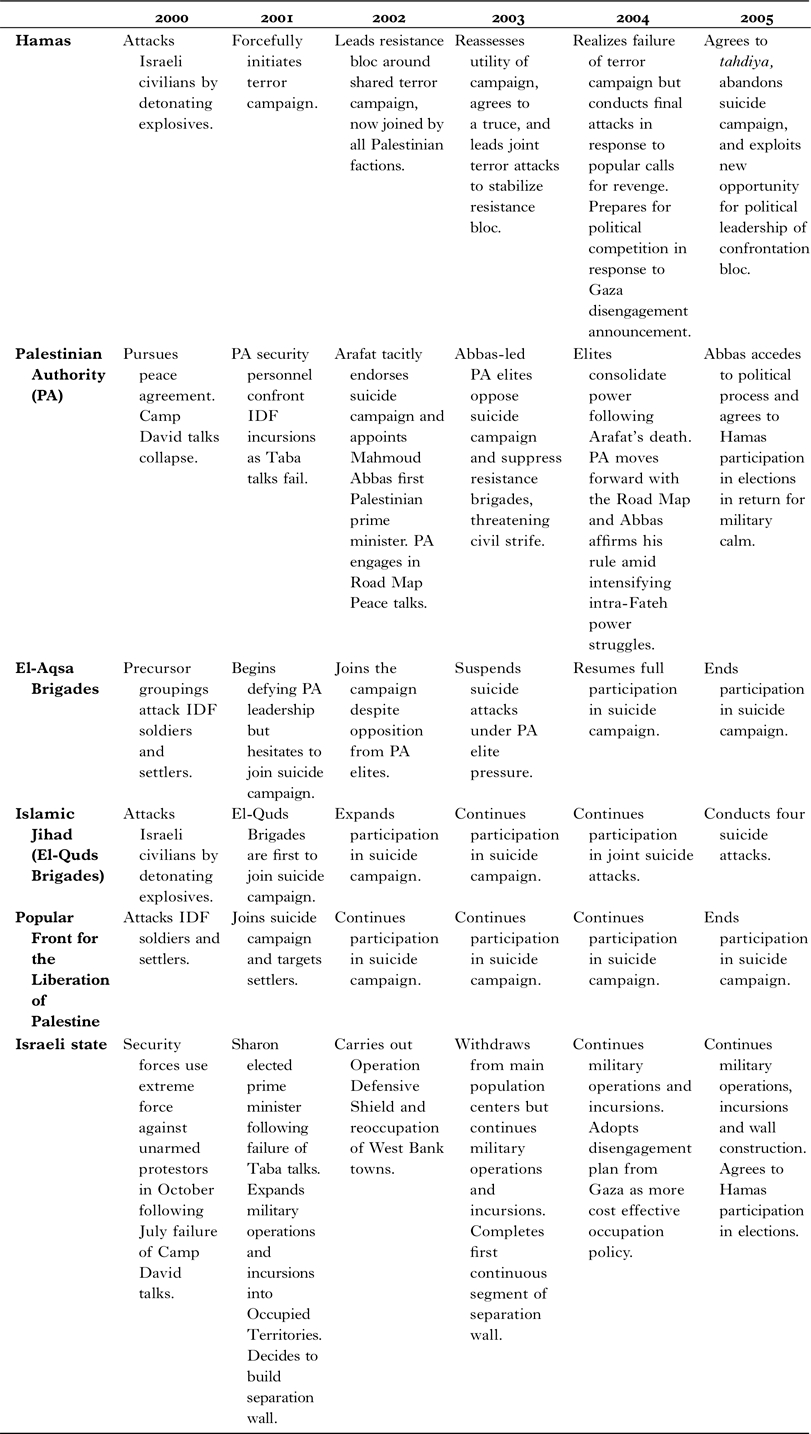
Meanwhile, despite the growing dominance of pro-Oslo PA elites, the intra-Fateh conflict over the legitimacy and function of confrontation remained unresolved and Al-Aqsa Brigades resumed suicide attacks. When Arafat’s November 2004 death cleared the way for conciliatory elites to take full control of the PA, they proceeded to suppress Al-Aqsa’s terror operations. In addition to domestic factors that discouraged the maintenance of terror, two major external changes altered the context under which Hamas operated. Israel’s disengagement from Gaza first raised the question of rule after evacuation. Though the early 2004 withdrawal announcement was followed by an intensification of deadly incursions and subsequent measures to tighten its grip on and surveillance of the strip from outside, Israeli withdrawal forced Hamas to adjust. Israel’s shift was aligned with the US’s promotion of Middle East elections [Craner Reference Craner2006]. After resisting the Bush administration’s new policy [Herzog Reference Herzog2006], Israel grudgingly acceded. Like Israel, factions within Fateh and Egypt objected to Hamas’s participation in elections. Prospects for securing domination after Arafat’s death, however, led top Fateh official and future president, Mahmoud Abbas, to sanction Hamas’s electoral participation [Usher Reference Usher2006]. In March 2005 Hamas signed the Cairo Declaration agreeing to a tahdiya (or “calming”) which portended its definitive abandonment of terror in preparation for legislative elections in 2006 [Usher Reference Usher2005a]. (See Table 1 for a summary of actors’ strategies and use of political violence from 2000-2005.)
Summary of actors’ strategies and use of political violence, 2000-2005

The initiation of the suicide campaign in the Second Intifada
In the opening period of the Al-Aqsa Intifada, Hamas’s decision to launch a terror campaign was driven primarily by anticipated gains in the conflict’s external arena. In this section, we offer an analytical description of the use of terror in the Second Intifada and begin to expose problems with current explanations. We resume our analysis further below when addressing the second phase of the conflict in order to defend our account over leading models.
Shifting fatality rates: balancing terror in the external arena
In what follows, we analyze absolute fatalities, fatality ratios, and rates of change in fatalities for all coded categories. Absolute fatalities are an indication of the overall costs imposed by chosen tactics. Fatality ratios reflect the evenness of fatalities across groups allowing for a comparison of the costs endured by each category. Finally, fatality change rates convey the year-to-year shifts in lethal cost facilitating evaluation of the efficacy of chosen tactics throughout the Intifada. We will show that all fatality measures during the first phase of the Second Intifada point to Hamas’s success at transferring costs onto Israel using suicide attacks. Assessing the results of the conflict’s opening, Hamas advanced a terror policy that by early 2002 was followed by allied and rival factions alike.
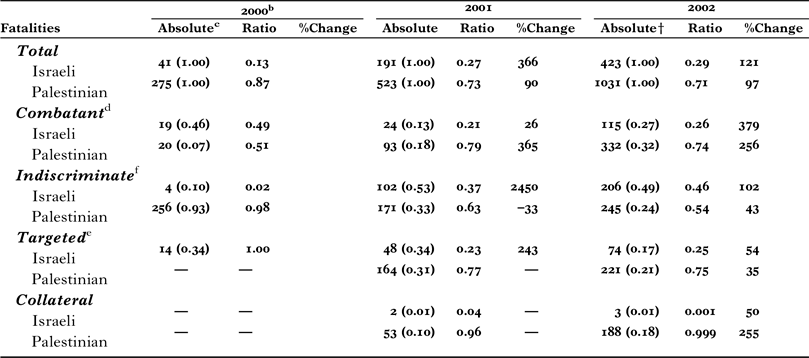
Overall, evidence from the 2000-2002 period reveals a general but uneven escalation in lethal violence characterized by fairly steady growth in Palestinian fatalities compared to geometrical increases in Israeli deaths. Whereas total Palestinian deaths roughly doubled each year, Israeli casualties grew by 366% from 41 in the first year of the conflict to 191 in the second. Though the rate of change in overall Israeli fatalities slowed in the third year, it nonetheless more than doubled to 423. In contrast, Palestinian deaths over the initial years grew by less than 100%. Whereas in 2000, Israelis accounted for 13% of total deaths, by 2002, almost one-third of all deaths were Israelis (see Table 2; unless otherwise indicated, all fatality figures alluded to in the remainder of this section are taken from this table). In sum, the conflict’s opening stage exhibits more rapidly expanding Israeli deaths and a general evening out of fatality ratios.
Israeli and Palestinian fatalities, categorical ratios and rates of change, 2000-2002a
Source: B’Tselem and Palestinian Center for Human Rights (pchr) reports.
a Totals exclude unclear cases and cases from residual cases.
b Year 2000 cases are coded according to descriptions provided by B’Tselem as pchr began issuing reports in 2001.
c Figure in parentheses refers to the share of yearly total per side.
d Includes only armed actors killed in combat.
e Includes targeted non-combatant civilians as well as political and armed actors targeted during non-combat situations.
f Excludes 7 indiscriminate Israeli fatalities caused by rocket attacks.
Despite an uptick in idf casualties, this relative evening out was not driven by combatant fatalities.Footnote 18 Although, by 2002, over one quarter of all Israeli fatalities were combatants, this figure is misleading. In fact, Israel dominated the conflict in this realm as evidenced by the greater expansion of Palestinian combatant deaths. Though idf retaliatory incursions enabled combat encounters, Palestinian combatant deaths grew by 365% from 2000 to 2001 (from 20 to 93 fatalities). Significantly, the relatively high number of Israeli combatant deaths in 2002—115, representing a 379% increase—does not reflect sustainable Palestinian military capabilities, but rather the extraordinary opportunities that opened up as the IDF reoccupied Palestinian West Bank towns. These opportunities would never again present themselves. In fact, Palestinian combatant fatalities skyrocketed in 2002 to an unsustainable 332 deaths.
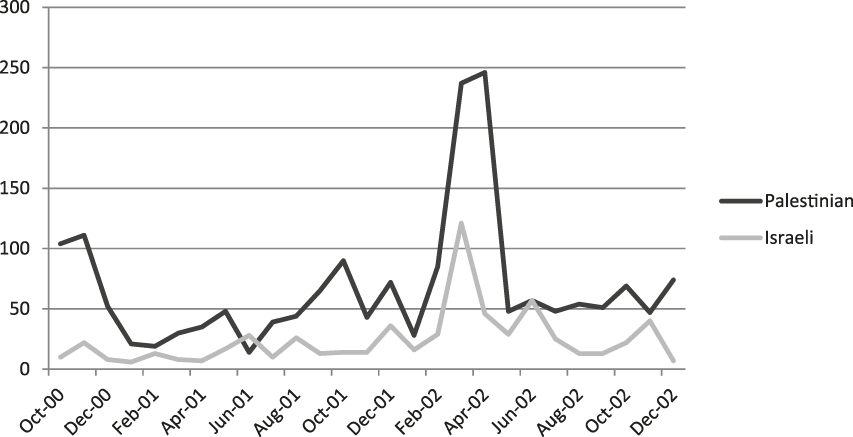
Significantly, the bulk of this cost transfer was accounted for by indiscriminate attacks against civilians. 2000 was characterized by grossly uneven terror fatality figures. While difficult to ascertain, analysts agree that the vast majority of 275 Palestinians killed in the last quarter of 2000 were civilians. Over 100 Palestinians were killed in October 2000 alone (see Graph 1).Footnote 19 Though B’Tselem’s data for 2000 is incomplete, only 20 or 7% of the Palestinian fatalities are listed as “killed in armed confrontations.” We can assume that most non-combatant civilian fatalities were victims of terror by Israeli soldiers firing on demonstrators without singling out acts warranting such lethal action [Hammami and Tamari Reference Hammami and Tamari2001: 12; Schatz Reference Shatz2011]. In general, 2000 was the conflict’s most lopsided year as the ratio of indiscriminate Palestinian fatalities to Israeli indiscriminate fatalities was roughly 98 to 2. The number of Israeli indiscriminate fatalities is just as revealing. Only 4 Israelis killed in the last quarter of 2000 were non-combatant victims of terror.Footnote 20
Total fatalities by month, 2000-2002
Source: B’Tselem and pchr (Palestinian Center for Human Rights) reports.
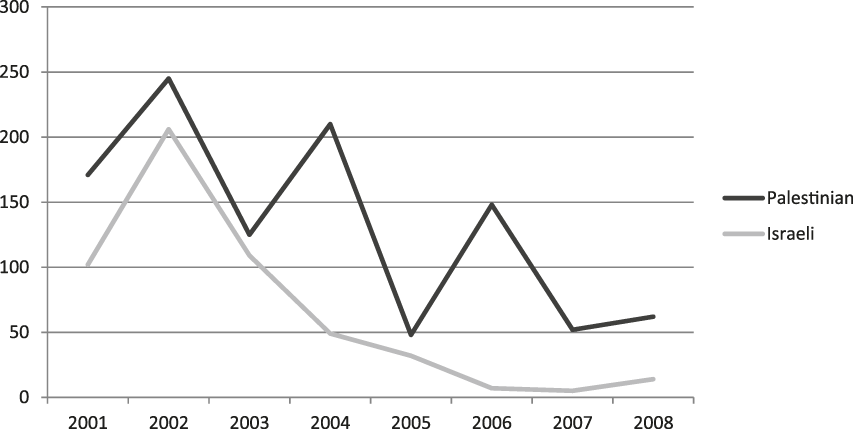
The key to the evening out of overall lethal costs during the first phase is the shift in year-to-year Israeli indiscriminate fatality rates as Hamas was consolidating the terror campaign. As shown in the third column for 2000, the number of Israeli indiscriminate fatalities grew by 2,450% 2000 to 2001 and then doubled to 206 the following year; meanwhile, Palestinian terror fatalities decreased by 33% from 2000 to 2001, and then increased by only 43% from (171 to 245), the following year. Thus, and most significantly for the suicide campaign’s logic, indiscriminate killings of Israelis exponentially outpaced indiscriminate Palestinian fatalities: deaths within this category were dramatically rebalanced, from 2000’s completely lopsided ratio (98 to 2) to near parity (54 to 46) by 2002.
Clearly, indiscriminate attacks on civilians presented the best option for balancing the costs of the conflict. As mentioned, the exceptional opportunities for causing combatant fatalities opened up by the reoccupation had severe limits: attacking soldiers only resulted in a slight evening out of fatality ratios after 2001. Further, the “encouraging” opportunity to balance overall lethal costs via terror remained unaltered even when factoring in the growing number of collateral deaths, predictably the most uneven category for fatalities. Whereas Palestinians had no avenues for provoking such deaths, Israel was able to impose enormous collateral costs that increased by 255% from 2001 to 2002, leading to 188 deaths. The spike in collateral Palestinian fatalities resulted primarily from the 2002 reoccupation of towns. Similarly, Palestinians endured high numbers of targeted deaths. During the intensifying incursions of 2001-2002 the IDF targeted growing numbers of both militants and civilians. Though factions succeeded in increasing Israeli targeted fatalities at a high rate (243% from 2000 to 2001), Palestinian targeted deaths grew by 35% and reached 221 in 2002. Overall, even amid extremely uneven collateral and targeted costs, Palestinian terrorism drove the most balanced overall fatality figures of the conflict.
In sum, these balanced figures portended a “successful” strategy in the external arena via the out-suffering mechanism. The decision to make suicide attacks a dominant tactic was based on Hamas’s perceived success at transferring real costs onto Israelis and the derived calculation that terror escalation was the most plausible means for leveling costs and improving the conflict’s balance of power.
Integrative competition and popular support: domestic reinforcement of terror
Hamas-led terror was not primarily driven by its domestic rewards. Nonetheless, considering the salience this motivation acquired in the second phase of the Intifada, it is worth discussing the relationship between the suicide campaign’s external efficacy and internal determinants. In short, domestic consensus in favor of the terror policy allowed Hamas to commit to the campaign and demonstrate its feasibility, which in turn encouraged other factions to join.
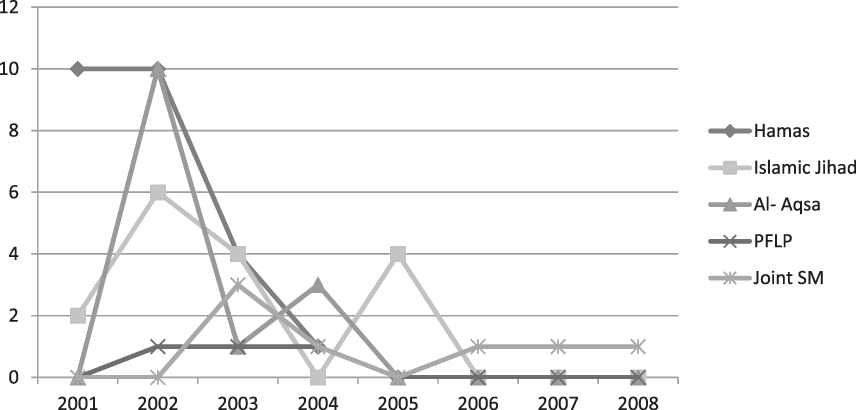
As fatality rates shifted, the number of suicide attacks doubled and their authorship diversified. Though the number of Hamas attacks did not vary during 2001-2002, the group’s share of bombings decreased notably; even Al-Aqsa, affiliated with rival Fateh, participated fully in the campaign (see Graph 2). Clearly, all major Palestinian factions, across the ideological spectrum, adopted a common strategy as Hamas publicly claimed. Factions were not merely imitating one another; they were compelled to action by a shared adherence to the out-suffering logic.
Number and authorship of suicide attacks, 2001-2008
Source: Israeli government reports, B’Tselem, Arabic, English and Hebrew Media outlets.
(Note: The three joint attacks in 2003 were between Al-Aqsa and the three other factions, Hamas, Islamic Jihad and PFLP, respectively. The 2004 joint attack was carried out by Hamas and Al-Aqsa Brigades.)
Even with factional consensus, however, Hamas could not have promoted terror without solid popular support. During the 6-month period between September 2001 and March 2002, the percentage of Palestinians expressing confidence that the Intifada would achieve its goals grew from 53% to a 65%, the highest level obtained throughout the conflict. Significantly, support for armed resistance and for targeting Israeli civilians doubled from March 1999 to a peak of 70% in June 2001.Footnote 21
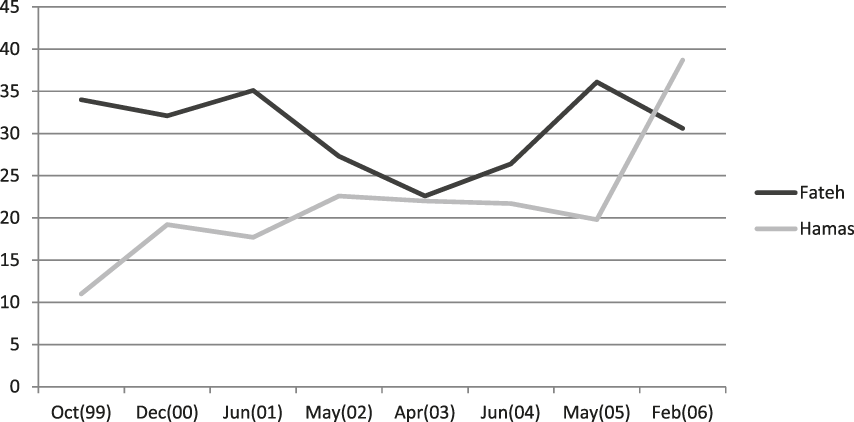
Tellingly, the increased support for violence against Israeli civilians that Hamas harnessed did not straightforwardly translate into sectarian support.Footnote 22 A year before the initiation of the Intifada, support for Fateh far exceeded its closest rival Hamas, by 34% to 11%. Three months into the campaign, Fateh’s support held at 32% despite an absence of suicide attacks. Meanwhile though Hamas’s popularity grew to 19% as it championed terror in 2001, it leveled off even as it continued to be the leading perpetrator of suicide attacks (see Graph 3). Moreover, popular trust in Islamic Jihad, the other faction to prominently adopt a terror strategy in this period never exceeded 5.7%. Most notably, as a national terror policy consolidated, the share of Palestinians disgruntled with all factions declined sharply, from 37.3% in June 2000 to a historic low of 22% in September 2001. Thus, the common strategy appears to have rekindled faith in national, not sectarian, political leadership (though factional rankings remained unchanged).
Support for Hamas and Fateh, October 1999-February 2006
Source: jmcc polls No. 40, 41, 44, 51, 55 and 57.
Total Palestinian and Israeli indiscriminate fatalities, 2001-2008
Source: B’Tselem and pchr (Palestinian Center for Human Rights) reports.
Summarizing, the adoption and escalation of terror attacks in the Intifada’s opening period defy the explanations offered by Bloom and Pape. Bombings proliferated despite their failure to reward perpetrators with a “winning” market share or in the liberation of territory. In our view, Hamas championed terror attacks during this stage in a reasoned effort to establish an apparently promising balance of terror. With broad support behind a shared “out-suffering” purpose, all major factions had by 2002 joined the campaign to exert leverage in the external arena. Surprisingly, however, Hamas continued to target Israeli civilians beyond 2002 even as evidence mounted that Palestinians were losing the “out-suffering” contest. In the following section we present a dual-arena explanation of Hamas’s maintenance of terror in the third and fourth years of the Intifada.
The puzzling years of the conflict: 2003-2004
Data showing expanding relative fatality tolls for Palestinians in this stage of the Intifada are uncontroversial. Further, the Israeli government’s recalcitrance grew, fortified by overwhelming popular support. 90% of Israeli Jews continued to favor Operation Defensive Shield and over 60% consistently backed targeted assassinations.Footnote 23 The terror campaign initiated in 2001 ultimately failed to impose on Israel the generalized, intolerable costs that the out-suffering mechanism required to improve the balance of national forces. Instead, Israelis displayed a commitment to escalating militarization while the idf adjusted its occupation strategy to effectively reduce the costs incurred in controlling reoccupied areas.
The paradox of maintaining a tactic incapable of producing external gains can be explained by turning to its internal impact. At this point, the terror campaign served to obstruct PA elites that moved forcefully against the armed strategy and to respond to popular calls for retribution. During 2003-2004, in brief, Hamas used suicide attacks to stabilize a threatened resistance bloc. Once the failure of terror in the external arena became indisputable, an inward-oriented approach assumed strategic primacy.
Shifting fatality rates: failure of terror in the external arena
The second period of the conflict exhibited a general de-escalation involving a reduction in all fatality measures for Palestinians and Israelis alike, along with a return to the lopsidedness of fatality ratios that characterized the conflict’s first year, albeit with two important exceptions. Though Palestinians maintained 2002’s relatively even distribution of indiscriminate deaths, they continued to pay inordinately high collateral costs. Further, breaking with the broader trend of the second period, 2004 was marked by a steep one-sided surge in most categories of Palestinian fatalities.
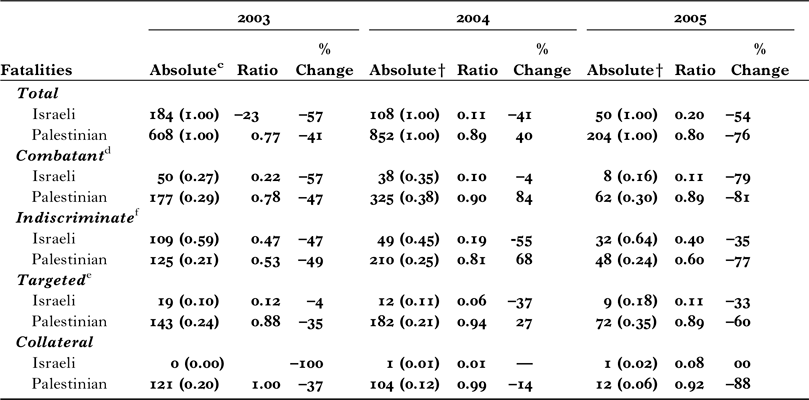
2003 appeared to offer relief from the first years’ lethality for both sides. Compared to the previous year, total Israeli and Palestinian fatalities dropped by 57% and 41%, respectively. This important overall bilateral decline, though partially an artifact of the conflict’s exorbitant overall 2002 tolls, abruptly diverged in 2004 when, as Israeli fatalities continued to drop by 41%, Palestinian deaths resurged by a similar rate to 852, the second highest yearly total of the conflict. Fatality ratios diverged sharply from 89 to 11, though they were halved the following year when fatality rates on both sides again subsided considerably (see Table 3; again, unless otherwise indicated, all fatality figures alluded to in the remainder of this section are taken from this table).
Consolidation of uneven global fatality rates was a consequence of the reestablishment of disparities across all categories. Although 2003 exhibited universal declines, 177 armed Palestinians were killed in combat, compared to only 50 idf personnel. This restored the expected disproportionate combatant fatality ratio. Though the idf evacuated the inner Palestinian cities and camps, regular incursions into densely populated areas facilitated direct military engagement; more conventional confrontation, however, maintained an unsustainable 78 to 22 ratio for combatant fatalities. By 2004, total combatant Palestinian deaths returned to 2002 levels, as the idf killed 325 militiamen, skewing the combatant fatality ratio from 90 to 10. Meanwhile, even with limited potential to engage militarily, Israeli soldier fatalities actually shrank by 24%. Such unevenness persisted into 2005, when combatant killings further contracted on both sides by nearly 80%.
The conflict’s second phase began with near identical declines in indiscriminate fatalities. Accordingly, the even ratio established in the opening period was carried over. While 125 Palestinians were killed indiscriminately, 109 Israeli fatalities resulted from 13 suicide bombings in 2003, accounting for more than half of all Israeli deaths. Seemingly reflecting unreserved, continued deployment of indiscriminate confrontational capacity, this ratio, in fact, masks the tentativeness of Palestinian terror. Though resistance factions continued to rely on terror, its use became more restricted. 2003’s 53 to 47 ratio of Palestinian to Israeli indiscriminate deaths jumped back to 81 to 19 the following year. Whereas indiscriminate Israeli civilian deaths continued declining by 55%, Palestinian terror fatalities grew by 68% in 2004, demonstrating the bankruptcy of the “out-suffering” strategy. The 210 indiscriminate Palestinian fatalities that year, compared to only 49 Israeli civilian victims, point to the rapidly diminishing advantages of Palestinian terror. The restoration of exorbitant Palestinian death rates, both general and indiscriminate, intimates resistance factions’ reluctance to maintain efforts at equalizing the conflict’s costs via suicide attacks.
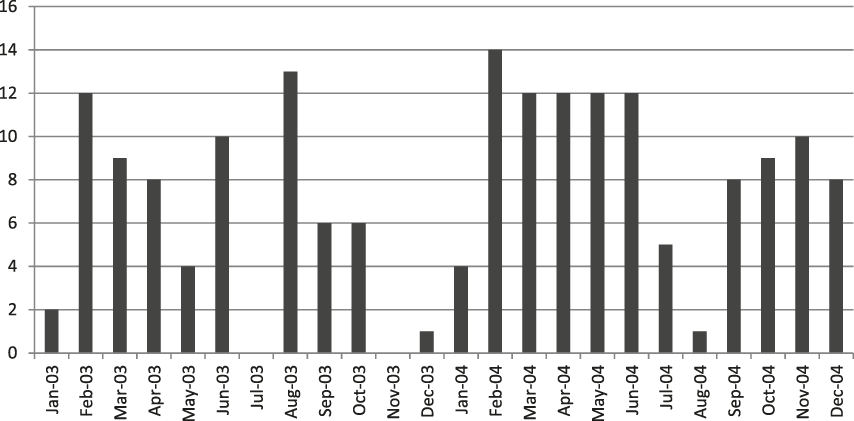
Significantly, the costs of targeted and collateral fatalities turned dramatically in favor of Israel during the conflict’s latter years. Collateral deaths continued to produce elevated costs: in 2003 and 2004, Israeli attacks produced 121 and 104 collateral fatalities, respectively, more than double the pre-2002 reoccupation total. Additionally, the IDF lethally targeted 325 Palestinians during 2003-2004. This toll became particularly pronounced among executions of militants and leaders, accounting for over half (178) of overall targeted deaths. Whereas only 2 extrajudicial Palestinian assassinations occurred in January 2003, such fatalities grew to an average of 5 per month by year’s end. In 2004, targeted assassinations rose more dramatically reaching 12 monthly executions in the first half of the year before abating slightly (see Graph 5). Israeli reprisals thus assumed a more selective dimension as targeted attacks decimated factions’ leadership and cadre. The most debilitating of these assassinations were carried out in Spring 2004 when Israel killed Hamas’s two top Gaza leaders. Though the continued suicide attacks into 2005 show that these blows failed to eliminate Palestinian factions’ capacities for terror, they nonetheless caused severe moral and political damage.
Targeted assassinations of Palestinian resistance members and political leaders 2003-04
Source: B’Tselem and pchr (Palestinian Center for Human Rights) reports.
In sum, fatality figures—totals, ratios, and yearly shifts—during the latter years of the Second Intifada clearly show that Palestinians came to face increasingly intolerable costs and thus to lose any advantage they might have established via the out-suffering contest. The failure to consolidate any gains from growing capacity to inflict indiscriminate Israeli civilian deaths was most apparent in 2004. Hamas faced the inescapable impossibility of preserving this strategy without provoking intolerable lethal costs, increasingly determined unilaterally by Israel, onto its supporters, militants and leaders.
Retaliation, integrative competition, and polarization: balancing domestic benefits
In contrast to its aggressive instigation of terror in the first period, in 2003 and 2004 Hamas reduced suicide attacks in a calibrated effort to preserve the resistance bloc against domestic threats. Most notably, it tempered its execution of solely-authored attacks and increased its military cooperation with other factions. Despite realization of the failure of terror’s “out-suffering” strategy, Hamas continued to use terror to consolidate the confrontational capacity developed during the conflict’s initial period.
Firstly, it carried out only 4 unilateral bombings in 2003, compared to 10 in the previous year.Footnote 24 This reduction, we contend, reflected Hamas’s more cautious promotion of the common terror strategy that emerged in the first period. Islamic Jihad and pflp, a secular faction, continued their bombings, signaling their continued cohesion. The behavior of the Al-Aqsa Brigades was of particular interest considering Hamas’s intensifying rivalry with Fateh. Al-Aqsa was the first group to use terror in January 2003, carrying out a joint bombing with Jihad’s Al-Quds Brigades, and continued its terror collaboration thereafter, perpetrating attacks with each of the remaining factions. Following a lull in Al-Aqsa’s terror activity in mid-2003, Hamas’s measured approach seemed to bear fruit as Al-Aqsa resumed suicide bombings with an August attack ostensibly in response to idf assassinations of Jihad cadre (see Graph 2).
Secondly, Hamas appeared to renounce unilateral terror attacks altogether by 2004. Of the two attacks it carried out that year, the first was jointly executed with Al-Aqsa, extending operational collaboration between secular and religious factions that emerged during these years. Where the co-authored bombings of 2003 indicate a positive effort to nurture the armed bloc, Hamas’s caution the following year suggests a defensive approach aimed at dampening domestic tension. Its final attack was the August 2004 Beer Shiva strike that killed 16 civilians in response to the back-to-back assassinations of Al-Rantisi and Yassin (see Graph 2). Having acknowledged the increasing domestic costs of terror, Hamas was compelled to act, yet no longer in pursuit of external advantages or to induce rivals to action. Terror was now calibrated to preserve popular backing and stabilize the confrontation bloc in a threatening context of growing polarization and expanding costs of idf assaults.
Poll data support the view that Hamas’s calculated use of terror during the period responded, at least partially, to popular preferences for suicide attacks. Beginning in June of 2002, support for suicide bombings, which stood at 68.1%, began a steady decline. By April 2003, it reached a low of 60% in the Occupied Territories, reflecting the heavy toll of idf reprisals.Footnote 25 By the June hudna, therefore, Hamas had reason to begin questioning the utility of suicide bombings for galvanizing public support.Footnote 26
Fluctuations in public opinion following Israel’s intensification of targeted assassinations prompted Hamas to reassess the suspension of attacks. Following the Spring 2004 assassinations, Palestinian support of suicide attacks inside the Green Line shot back up to 70.5% and those fearing damage to Palestinian interests sank to 22.5%. Public support again shifted, however, following Hamas’s limited response. Even as three-quarters of Palestinians viewed Hamas’s final attack favorably, 83% simultaneously reported support for a mutual ceasefire. Additionally, and perhaps most importantly, as terror drove polarization to the breaking point, distrust in all factions steadily remounted. We find it safe to argue that Palestinians demanded revenge against Israeli assassinations yet were not prepared to endure or reward a boundless tit-for-tat escalation in the absence of broader strategic prospects.Footnote 27
At this stage, we argue that, even as terror elevated the toll for Palestinians by provoking idf reprisals and exacerbating internal polarization, the opportunity costs of definitively suspending attacks still outweighed the acknowledged, growing costs of carrying on the campaign. The overriding cost of inaction in the face of rival counter-tactics and sustained popular sympathy for revenge attacks remained decisive. But when polarization reached a critical point and even a vengeful public was unprepared to countenance the growing costs of the “out-suffering” gambit, Hamas shut down suicide operations for good.
At the end of 2004, with Arafat gone, conciliatory PA forces took full control of Fateh, effectively marginalizing Al-Aqsa holdouts. With potential adherents from its rival faction decisively weakened, Hamas’s attempts at buoying the armed bloc via terror would have provoked uncontainable civil conflict. Taking credit for the Gaza evacuation, Hamas was poised to contend for the reigns of national institutions and pursue “resistance by other means.” Though Hamas countenanced the continued launching of rockets into Israel, their notorious imprecision and lethal inefficacy revealed an abandoned intent to produce indiscriminate civilian causalities. Instead, Hamas hoped to translate the prestige garnered as leader of the resistance into a significant share of votes. With the benefits of terror dwindling, it now strove to head an anti-Oslo governing bloc without incurring the overwhelming costs of terrorism.
Discussion
The dual-level strategic logic of terror is best illustrated during the second period of the Intifada. The mutually-conditioning interplay of external and internal motivations behind Hamas’s decision-making in 2003 and 2004 reveal the limitations of leading explanations. As discussed, revenge was not centrally behind terror attacks. Had retaliatory motivations impelled bombings, retribution for leaders of Yassin’s and Al-Rantisi’s stature would have been more swift and thorough. Moreover, even as Palestinian fatalities in all categories continued to mount, Hamas refrained from retaliating altogether. Undeniable desires for revenge impacted strategic decision-making in a manner nested in both arenas. With renewed upticks in support for suicide operations, Hamas could not afford inaction. Particularly in the context of the power struggle within Fateh, inertness would have undermined the bloc it sought to hold together. Yet, as exhaustion and skepticism grew among Palestinians, eroding the popular foundation for “out-suffering”, the costs of indiscriminate and targeted reprisals by the idf began weighing more prominently in the group’s decision-making.
Similarly, patterns of suicide attacks by Hamas during these years contradict Bloom’s outbidding model. The evidence shows that Palestinians did not linearly reward the factions responsible for executing the attacks. Instead, when popularly preferred, the execution of terror attacks tended to diminish overall dissatisfaction with national leadership. Factions could not, therefore, mechanically use terror to outbid rivals. Just as support for Hamas scarcely varied from 2001 to 2005, whether it was expanding, interrupting or resuming attacks, fluctuations in popular support for other factions never correlated with their wielding of terror. Public endorsement of attacks was rooted in assessments of their viability within a national liberation project. This helps explain the paradoxical, simultaneous backing of suicide bombings and support for the hudna during the period. For Hamas, attacks were aimed at compelling rivals to sustain a national confrontation policy. In 2003, it coldly used terror to promote integrative or “collaborative” competition; the following year, it cooled terror-induced competition to mitigate growing polarization.
Patterns of suicide bombings in the second phase of the conflict also clash with Pape’s theory. Under Pape’s premises, the reoccupation of Palestinian lands should have taught Hamas that terror did not work. Alternatively, if the aim of suicide bombings was steadily to widen a divide in Israel’s polity and generate concessions, then Pape’s model is similarly inadequate in its inability to explain Hamas’s interruption and later delayed and tempered resumption of attacks in 2003. The puzzling years of the conflict demonstrate that, while the deployment of terror was certainly strategic, it was governed by a more complex logic. Its utility in this stage of the conflict was derived mostly from its domestic effects on the beleaguered resistance bloc. Hamas employed suicide bombings to preserve the confrontational capacities built during the previous period.
In addition to the above domestic factors ignored by Bloom and Pape, Hamas’s decisions to employ and terminate suicide missions were also influenced by changes in occupation methods and regional politics. Contra Pape, however, Hamas did not halt bombings after succeeding in liberating lands. The evacuation of Gaza was influenced by costs imposed by terror tactics, but disengagement reinforced West Bank occupation and tightened the Gaza siege, as Hamas officials repeatedly warned. Hamas ended the campaign when, having contributed to delegitimizing conciliatory elites, perceived prospects for confronting Israel through governance emerged.
Other, heretofore unmentioned, competing explanations for the reduction in suicide attacks during these years merit serious attention. One perspective attributes the reduction in suicide missions to a shrinking supply of suicide bombers. This hypothesis, we argue, can easily be discarded as motivated Palestinians—i.e. potential recruits—continued to attempt terror acts on an individual basis.Footnote 28 A more compelling view holds that the advancing construction of a separation barrier impeded attacks [Byman Reference Byman2012]. Besides refutations of the wall’s efficacy by Israeli security actors themselves—analysts point to more effective military and intelligence operations, the hudna, and the shift to electoral tactics by Hamas—other grounds exist for disputing such claims. Most significantly, the rates of attacks varied across factions in the waning years and months of the conflict. Broadly, while Hamas dramatically curtailed attacks, ending unilateral bombings altogether, bombings by other factions oscillated significantly, with declines followed by spikes in terror activity. Such factional variation implies that the wall alone could not have definitively halted Hamas attacks. Further, the first continuous segment of the barrier, which was completed in July 2003, accounted for just 25% of the wall. By February 2005 only 29% was completed. It was not until 2012 that 60% of the wall was erected.Footnote 29 The wall might have represented a formidable obstacle, but its incompleteness and circumvention by others shows that, when motivated, factions could breach it. As experts on the subject maintain, suicide attacks were “undeterrable” [Moaz Reference Maoz2009: 261].
Lastly, a note on the deployment of rockets is in order. Between 2001 and 2008 Palestinians fired 11,458 rockets and mortars into Israel, over half of which were launched from Gaza since the strip’s 2007 takeover by Hamas.Footnote 30 When Hamas embraced electoral competition to promote “resistance by other means”, it did not renounce the task of building confrontational capacity. Though launchings did not constitute official Hamas policy, with most rockets deployed by other factions or unsanctioned low-level Hamas operatives, the group undeniably tolerated an inherently indiscriminate tactic. But the imprecision of the rockets—leaving a balance of 17 civilian deaths, or 674 missiles per fatality—strongly suggests their deployment was not an extension of the “out-suffering” strategy aimed at maximizing civilian fatalities. Instead, we surmise that rockets primarily satisfied the internal need to promote the resistance bloc by differentiating Hamas from its new electoral rivals, preventing militant defections, and mobilizing popular support. While not intended to impose indistinct lethal costs on Israel, these missiles have nonetheless played a role externally. Since 2005, we infer that rockets and mortars obeyed a logic consistent with the “resistance by other means” approach: besides upholding the non-conciliatory bloc, missiles signaled an uninterrupted ability to breach Israel’s security agenda and continually impose non-lethal indiscriminate costs in the hope to compel Israel to negotiate with new Palestinian authorities on more equal terms.Footnote 31
Instead of consolidating a common national approach around shared principles, domestic fractures widened and Israeli recalcitrance hardened. Antagonism with Fateh reached an impasse in 2007 leading to Hamas’s preemptive Gaza coup, which solidified Palestine’s political and administrative division and was followed by an intensification of the Israeli siege of the strip. The rupture, blockade and Cast Lead assault on Gaza the following year opened a new, more complex, and more lopsided phase of the conflict. Yet even in these circumstances, Hamas has been reluctant to use rockets to maximize civilian casualties. The results of Hamas’s actions in the flare-up during the summer of 2014, corroborate the view that indiscriminate rocket barrages were at most subordinate to the primary aim of conducting operations against military targets.
Conclusion
The failure of terror during the Second Palestinian Intifada to exact Israeli concessions appears consistent with claims that Hamas’s terrorism was guided by non-strategic impulses [Pedahzur, Perliger and Weinberg Reference Pedahzur, Perliger and Weinberg2003; Kimhi and Even Reference Kimhi and Even2004]. In “What Terrorists Really Want”, Max Abrahms rejects the basic premise that groups like Hamas employing suicide attacks pursue clearly defined political ends, offering evidence of persistent failure, the eschewing of available political alternatives, and fratricidal impulses [2008]. Measuring terror’s success exclusively in maximalist terms in the external arena of the conflict seems to validate non-strategic explanations of this tactic. Yet our analysis shows that the question of efficacy is not as straightforward as even strategic-rationalists like Pape maintain. Our work compels analysts to pay closer attention to domestic aims and illuminates the mechanisms linking these to intermediate and long-term external objectives.
With respect to the purported failure to adopt alternative tactics, we point to two considerations that improve scholars’ understanding of terror. Firstly, we suggest that the continued deployment of terror attacks that failed to weaken the occupation is paradoxical evidence of adaptation. When the “balance of terror” strategy was abandoned by Hamas’s leadership, the group was logically compelled to preserve, if haltingly, the terror tactic in response to domestic requirements of the conflict. Secondly, we show that failure to adopt comprehensive changes resulted from the absence of alternative routes rather than “reflexive, uncompromising” terrorist obduracy. When the institutional configuration of the occupation was reconfigured Hamas abandoned suicide terrorism fully and unwaveringly.
The most compelling objections from non-strategic explanations concern fratricidal conflict. Clashes between Hamas and PA security apparatuses did rise to levels suggesting the factions turned on one another over less than strategic ends. We have argued above that even fierce domestic competition does not preclude strategic decision-making in the external arena, and may indeed support external aims. Attending to the mechanisms connecting both arenas is a theoretical necessity. More to the point, our analysis shows that Hamas consistently assessed the dangers of domestic infighting, and that once fratricidal impulses threatened to undercut resistance, Hamas curbed aggravating bombings. Rising intra-Palestinian killings and open hostilities culminating in its 2007 Gaza takeover occurred subsequent to Hamas’s abandonment of terror.
Beyond the experience of the Second Intifada, our work suggests that terror is a recourse adopted by severely marginalized populations seeking sovereignty. In extreme cases of asymmetrical national relations, occupied populations suffer the absence of meaningful points of leverage along with the likelihood that elites, given restrictive prospects for advancing their interests, will seek accommodations with occupiers. As our model shows, both conditions promote terrorism.
One final question may remain for observers: can a return to suicide bombings be expected? After all, Hamas’s 2006 electoral success came with a heavy price and its adoption of “resistance by other means” was ineffective. Instead of galvanizing national consensus, it furthered antagonized PA elites, triggering the 2007 civil division and subsequent Israeli siege. Intermittent military confrontations and rocket barrages, moreover, rather than pushing Israel to negotiate on more equal terms, provoked even deadlier reprisals. Further, the Arab Spring’s promise that domestic upheavals and regional shifts would create openings for leverage in the campaign for national liberation has evaporated. Yet these serial aggravations of Palestinian marginalization and powerlessness have not prompted Hamas to resume terrorist activities. Simply stated, the current configuration of the occupation closes all opportunities for exerting leverage by out-suffering Israel. In conclusion, even as Hamas and a majority of Palestinians continue to demand liberation, vie for domestic influence, clamor for revenge, and be devout, we are unlikely to see the reemergence of suicide terror in Palestine, a tactic that, though based on strategic logic, proved a failure.
Acknowledgement
We would foremost like to thank Prof Jeff Goodwin for bringing us on board his larger project on terrorism, for providing research funds for data collection and coding, and for his generous time and feedback throughout. He provided unwavering support as we developed our own account of second intifada terror and turned this into an independent paper. We also thank Prof Vivek Chibber for his frank critiques of and valuable suggestions on earlier drafts. Others have also contributed. Our colleague Mike McCarthy helped collect and code portions of the data. Members of NYU's Economic and Political Sociology workshop provided useful feedback. Finally, we wish to thank Prof Bashir Abu-Manneh and Glen Pine for helping us work through early versions of our argument.