Implications
This study demonstrates that suboptimal incubation temperature affects the embryonic development and post-hatch behaviour of layer hens and tends to reduce their ability to cope with an infectious challenge. These results emphasize the importance of good incubation practice for the development, health and welfare of layer hens in production systems.
Introduction
In practice, layer hens encounter different environmental challenges, which may affect their health and welfare. In order to respond to these challenges with the appropriate behavioural, physiological and immunological adjustments, a well-developed adaptive capacity is necessary. In addition to genetic background, environmental conditions and experiences in early pre- and postnatal life are known to influence the development of adaptive capacity (Star, Reference Star2008; Walstra et al., Reference Walstra, Ten Napel, Kemp, Schipper and Van den Brand2010).
For layer hens, development starts in ovo where embryos can already be influenced by environmental conditions. Temperature is one of the most important environmental factors for the development of the chicken embryo. Previous studies in broilers and layers demonstrated that deviations from optimum incubation temperature (between 37°C and 38°C; Wilson, Reference Wilson1991) have negative effects on embryo development (Romanoff, Reference Romanoff1972; Shafey, Reference Shafey2004; Molenaar et al., Reference Molenaar, De Vries, Van den Anker, Meijerhof, Kemp and Van den Brand2010), hatchability (Deeming and Ferguson, Reference Deeming and Ferguson1991; Decuypere and Michels, Reference Decuypere and Michels1992), chick quality (Lourens et al., Reference Lourens, Van den Brand, Meijerhof and Kemp2005; Molenaar et al., Reference Molenaar, De Vries, Van den Anker, Meijerhof, Kemp and Van den Brand2010) and subsequent performance (Decuypere, Reference Decuypere1979; Lourens et al., Reference Lourens, Van den Brand, Meijerhof and Kemp2005). Walstra et al. (Reference Walstra, Ten Napel, Kemp, Schipper and Van den Brand2010) previously demonstrated that the combination of suboptimal incubation, hatch and rearing management reduces the capacity of layer hens to adapt to infectious challenges as compared with layers hatched and reared under more optimized conditions. However, in this previous study, incubation conditions were always combined with suboptimal or optimal hatch conditions, and therefore the effects of incubation temperature as a single early life condition could not be separately investigated. To our knowledge, effects of suboptimal incubation on the adaptive capacity in later life have also never been investigated in other studies. Because incubation temperature can easily be manipulated in practice, it could be a useful tool to create layers with a better adaptive capacity. Ultimately, this will benefit their production, health and welfare.
Therefore, the objective of this study was to investigate the effects of suboptimal v. optimal incubation temperature on the development and behaviour of layer hens post hatch, and on their adaptive capacity during infectious challenges. In order to challenge the adaptive capacity, we used an infection model of Eimeria acervulina under normal and following a presumed stressful period of heat exposure. On the basis of previous studies described above, we expected that suboptimal temperature would reduce (embryonic) development and hypothesized that reduced (embryonic) development due to suboptimal temperature will also result in a lower capacity to adapt to post-hatch challenges.
Material and methods
All experimental protocols were approved by the Animal Use and Care Committee of the Wageningen University, the Netherlands.
Incubation
Eggs (n = 800, Lohmann Brown; breeder flock age 42 weeks, Verbeek Hatchery, Lunteren, the Netherlands) were randomly divided over two eggshell temperature (EST) treatments during incubation. Eggs were incubated at a considered optimum EST of 37.8°C in the OI treatment (Lourens et al., Reference Lourens, Van den Brand, Meijerhof and Kemp2005; Molenaar et al., Reference Molenaar, De Vries, Van den Anker, Meijerhof, Kemp and Van den Brand2010). In the SI treatment, eggs were incubated at an EST of 36.7°C from embryonic days (EDs) 0 to 7, 37.8°C from EDs 8 to 14 and 38.9°C from EDs 15 to 21. The SI treatment was based on conditions that occur in practice, where a relatively constant air temperature (± 37.8°C) is often used as treatment applied to the eggs. However, due to the imbalance between embryonic heat production and heat transfer in early and late incubation, the embryo temperature during early incubation is lower than the incubator temperature. On the other hand, a higher embryo temperature compared with incubator temperature is observed at the end of incubation, when the embryo is producing heat itself (French, Reference French1997; Hulet et al., Reference Hulet, Gladys, Hill, Meijerhof and El-Shiekh2007). The aim of the SI treatment was to mimic embryo temperature during incubation in commercial hatcheries (especially multi-stage incubators) and was also based on a previous study of Walstra et al. (Reference Walstra, Ten Napel, Kemp, Schipper and Van den Brand2010).
Incubation occurred in climate respiration chambers (Verstegen et al., Reference Verstegen, Van der Hel, Brandsma, Henken and Bransen1987) where the EST was recorded continuously and chamber temperatures were adjusted to maintain the set EST for both treatments. Relative humidity (RH) was maintained at 55% in both EST treatments. At ED 19, all eggs were candled and infertile eggs or eggs containing dead embryos were removed and visually examined to determine the moment of embryonic mortality. The fertile eggs were placed in hatching baskets. The chamber temperature applied to obtain the EST of ED 19 was maintained at EDs 20 and 21. After the hatching process, unhatched eggs were visually examined to determine the moment of embryonic mortality.
Hatch
At EDs 20 and 21, eggs were checked every 3 h to examine the number of chickens that emerged from the eggshell and dry chickens were colour sexed. To investigate whether SI temperature created differences in embryonic development and quality of hatched chickens, several measurements were performed. Nine-hour-old female chickens were weighed, chick length (Hill, Reference Hill2001; Molenaar et al., Reference Molenaar, Reijrink, Meijerhof and Van den Brand2008) was measured and cloacal temperature (T b) was recorded with a digital thermometer (MT1831, Microlife®, Widnau, Switzerland). Navel condition was scored as 1 (closed and clean navel area), 2 (black button up to 2 mm or black string) or 3 (black button exceeding 2 mm or open navel area; Molenaar et al., Reference Molenaar, De Vries, Van den Anker, Meijerhof, Kemp and Van den Brand2010). After measurements, female chickens of both EST treatments were kept in the different hatching baskets in the same climate respiration chamber with access to feed (commercially available feed, ad libitum; 175 g/kg CP, 11.31 MJ ME/kg, 0.37% ileal digestible lysine), water and wood shavings until all eggs hatched.
Nine-hour-old male chickens (n = 20 per EST treatment) were weighed, chick length was measured and navel condition was scored. After the measurements, chickens were decapitated and blood was collected in heparinized tubes. Blood samples were centrifuged at 3000 r.p.m. for 15 min and plasma was stored at −20°C for further analysis of thyroxin (T 3) and triiodothyronine (T 4) levels by radioimmunoassay (Darras et al., Reference Darras, Visser, Berghman and Kuhn1992). T 3 and T 4 levels were measured to determine possible metabolic differences between SI and OI chickens at hatch. After blood sampling, yolk-free body mass (YFBM), residual yolk (RY) weight and heart weight were determined. The remaining male chickens were not used for measurements and were euthanized by CO2.
Housing conditions
After hatch, female chickens (n = 160 per EST treatment) were housed in separate floor pens (350 × 150 × 100 cm; one per treatment) with wood shavings in a temperature-controlled room from day 1 (defined as the day after 21 days of incubation) to day 7 of age. The ambient temperature (T a) was 33°C at day 1 and decreased linearly until 31°C at day 7. All chickens had unlimited access to the same feed as used before (commercially available feed, ad libitum; 175 g/kg crude protein, 11.31 MJ ME/kg, 0.37% ileal digestible lysine) and water.
At day 8 of age, chickens were transported to a new rearing environment, where they were divided over 32 floor pens (100 × 75 cm) containing wood shavings and a perch. Ten chickens per EST treatment were housed per floor pen and feed and water were provided ad libitum. The floor pens were located in two temperature-controlled rooms, with eight pens per incubation treatment (16 pens in total) per room. T a in the rooms was 31°C at day 8 and decreased linearly until 20°C at day 38. From days 38 to 61, the T a remained 20°C. The light–dark cycle (LD) was 24 : 0 from days 1 to 3; 18 : 6 LD from days 4 to 7; 16 : 8 LD from days 8 to 13; 14 : 10 LD from days 14 to 20; 12 : 12 LD from days 21 to 27; 11 : 13 LD from days 28 to 34; 10 : 14 LD from days 35 to 41and 9 : 15 LD from days 42 to 61. BW and feed intake (FI) were measured to determine growth differences between EST treatments. Chickens were weighed at days 1, 7, 11, 19, 26, 29, 36, 39, 40, 41, 42, 43, 49, 56 and 61. Feed trays were weighed empty and with feed before arrival of the chickens and subsequently at days 7, 11, 19, 26, 39, 41, 43, 49, 56 and 61 to determine FI.
Temperature preference of chickens
The temperature preference test was performed at days 1 and 7 of age to investigate whether periods of SI temperature act on the immature thermoregulatory system of the embryo. Temperature preference of the chickens was measured during a test, based on the method of Myhre et al. (Reference Myhre, Cabanac and Myhre1975). A wooden box (160 × 60 × 50 cm) with a plexiglas lid and wood shavings on the bottom, contained 24 temperature sensors divided over the floor area. Two infrared lights (250 W) were placed on one side of the box, creating a temperature gradient from 20°C to 50°C over the entire length of the box. T a in the box was recorded by all 24 sensors each minute and sent to a computer database. Video cameras were placed above the box to record every test. Three chickens from the same pen were randomly selected, placed in the middle of the box and observed for 30 min. The location of the chickens was written down at the end of each test and the T a of each location could be calculated with the temperature sensor data. T b was measured before and after the temperature preference test.
Tonic immobility (TI) test
At day 15 of age, two chickens per pen were subjected to a TI test (Jones et al., Reference Jones, Mills, Faure and Williams1994) to investigate whether periods of SI temperature result in differences in fearfulness behaviour. To induce TI, chickens were placed on their back and restrained with one hand over the sternum for 10 s. If TI could not be induced in the first restraint, the procedure was repeated until a maximum of four restraints. If TI could not be induced after four restraints, the score was 0 s. When induction was successful, the duration was recorded for a maximum of 300 s. The maximum time was based on the previous study by Walstra et al. (Reference Walstra, Ten Napel, Kemp, Schipper and Van den Brand2010), which showed that most chickens tested did not reach a TI duration of 300 s. The recording ended after the chicken righted itself, or when the time limit was reached. In the latter situation, the score given was 300 s. Chickens with a longer TI duration are considered to be more fearful (Jones et al., Reference Jones, Mills, Faure and Williams1994).
Manual restraint test
At day 25 of age, two chickens per pen, which were not used for the TI test, were subjected to a manual restraint to investigate whether periods of SI temperature act on the immature hypothalamic–pituitary–adrenocortical (HPA) axis and thereby result in differences in stress response behaviour and endocrinology. Immediately after the chicken was removed from the pen, a blood sample (1 ml) was taken from the wing vein and collected in a heparinized tube. Following this procedure, chickens were put on their side and restrained with one hand for 5 min. Latency time to vocalize and struggle, as well as number of vocalizations and struggles during the restraint were scored. Immediately after the 5 min restraint, a blood sample (1 ml) was taken from the other wing vein. Blood samples were centrifuged at 3000 r.p.m. for 15 min and plasma samples were stored at −20°C for further analysis of corticosterone levels as described by Lin et al. (Reference Lin, de Vos, Decuypere and Buyse2008).
Heat exposure
At the age of 33 days, the T a in one room was increased to 35°C (RH 55%) for 72 h, thereby exposing eight floor pens per EST treatment to a high T a until day 36 of age. The other eight floor pens per EST treatment remained at the normal (control) temperature (± 21°C). T b of two chickens per pen was measured with a digital thermometer before and after 36 h of heat exposure (MT1831, Microlife®). Approximately 1 h before and immediately after 72 h of heat exposure, blood samples were taken from the wing vein of two chickens per pen (different chickens than for TI and manual restraint test) and collected in heparinized tubes. Plasma was obtained by centrifugation at 3000 r.p.m. for 15 min and samples were stored at −20°C for further analysis of T 3, T 4 (Darras et al., Reference Darras, Visser, Berghman and Kuhn1992) and corticosterone (Lin et al., Reference Lin, de Vos, Decuypere and Buyse2008).
E. acervulina challenge
At day 36 of age, all chickens were inoculated in the crop with a 1 ml PBS solution containing 25 000 sporulated oocysts of E. acervulina (Animal Health Service, Deventer, the Netherlands). At days 3, 4 and 7 post infection (p.i.), one chick from each pen was dissected and the duodenum was visually scored for lesions. The severity of the lesions ranged from 0 to 4 in which score 0 = no lesions; score 1 = one to maximum five lesions per cm2; score 2 = more than five separate lesions per cm2; score 3 = some lesions are merged but separate lesions are still visible; score 4 = lesions are merged and hardly visible individually (Animal Health Service, Deventer, the Netherlands). A faecal sample (± 2.0 g) was also collected from the dissected chickens and the number of E. acervulina oocysts secreted per gram faeces was counted with the salt floatation method described by Long and Rowell (Reference Long and Rowell1975). Both lesions and oocyst production are a measure of the severity of an Eimeria infection.
Statistical analysis
For statistical analysis, we used SAS software (SAS Institute Inc., Cary, NC, USA). Differences in hatchability, navel condition, duodenal lesion score and number of TI inductions were analysed with the χ 2 test for the effect of EST treatment. Chick was the experimental unit. Incubation time, BW at hatch, chick length at hatch, T b at hatch, heart weight, YFBM, RY weight, TI duration, struggles and vocalizations during manual restraint, and temperature preference were analysed with a PROC GLM (SAS Institute Inc., Cary, NC, USA) for the effects of EST treatment and chick was the experimental unit. Differences in BW gain, FI and T b between heat-exposed and control chickens during the period of heat exposure, and BW gain and FI during Eimeria infection were analysed with a PROC GLM (SAS Institute Inc, Cary NC, USA.) for the effects of EST treatment, heat exposure and their interaction. Pen was the experimental unit for BW gain and FI and chick was the experimental unit for T b. Differences in the number of secreted oocysts per gram faeces during Eimeria infection were determined with a PROC GLM (SAS Institute Inc.) for the effects of EST treatment, heat exposure, day p.i. and their interactions, with chick as the experimental unit. A PROC MIXED (SAS Institute Inc.) for repeated measurements was used for overall BW and FI analysis during the experimental period to determine effects of EST treatment, heat exposure, age, room and their interactions, with pen as the experimental unit. The autoregression heterogenous structure was used to account for heterogeneous variance and was the best fit to this model (smallest Akaike information criterion). Room replication was taken into account for BW and FI, before heat exposure and was added to the model as class variable. Data are presented as least square means (LSmeans) ± s.e.m. in tables and figures, unless stated otherwise. If data were not normally distributed, a log transformation was performed before analysis. Non-significant interactions were excluded from analysis by stepwise deletion. Effects were considered significant at P ⩽ 0.05 and a trend at 0.05 < P < 0.10.
Results
Embryo development and chick quality
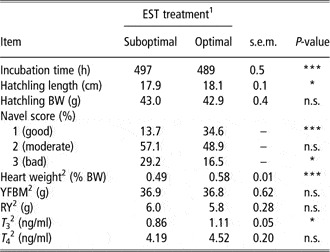
Incubation time in SI embryos was on average 8 h longer than in OI embryos (P < 0.001; Table 1). Hatch of fertile was 78.9% in the SI treatment and 81.9% in the OI treatment and not affected by incubation treatment.
Effect of suboptimal EST treatment on incubation time and layer hatchling characteristics (LSmeans ± s.e.m.)

EST = eggshell temperature; LSmeans = least square means; YFBM = yolk-free body mass; RY = residual yolk; EDs = embryonic days; T 3 = triiodothyronine; T 4 = thyroxin.
1Suboptimal = EST of 36.7°C from EDs 0 to 7, 37.8°C from EDs 8 to 14 and 38.9°C from EDs 15 to 21; optimal = EST of 37.8°C from EDs 0 to 21.
2Measured in 20 male chickens per EST treatment, equally divided over hatching times.
*P < 0.05; ***P < 0.001; n.s. = not significant.
Chick length of 9-hour-old chickens was on average 0.2 cm shorter in SI chickens compared with OI chickens (P = 0.01; Table 1). Navel condition was significantly worse in SI chickens than in OI chickens (P < 0.001). Dissection of the 20 male chickens per treatment demonstrated a reduced relative heart weight in SI chickens compared with OI chickens (Table 1; P < 0.001), but no differences were observed in YFBM and RY weight (Table 1). Plasma measurements demonstrated significantly lower T 3, but not T 4 levels in 9-hour-old SI chickens compared with OI chickens (P = 0.02; Table 1).
TI and manual restraint test
TI duration at 14 days of age did not differ between SI (88.9 ± 14.8 s.) and OI (89.0 ± 13.0 s) chickens, nor the number of attempts needed to induce TI (1.34 ± 0.15 in SI chickens v. 1.41 ± 0.15 in OI chickens).
The latency to vocalize and struggle during the manual restraint test, as well as the total number of vocalizations and struggles, was not affected by incubation treatment. Corticosterone levels did not differ between incubation treatments before the manual restraint; however, immediately after the 5 min restraint, corticosterone levels in OI chickens (44.2 ± 2.1 ng/ml) were higher than in SI chickens (36.6 ± 2.2 ng/ml; P = 0.017)
Temperature preference and heat exposure
Temperature preference of chickens was not affected by incubation treatment at day 1 (OI = 29.90 ± 0.22°C and SI = 30.02 ± 0.22°C; P = 0.62) and day 7 (OI = 27.37 ± 0.36°C and SI = 27.10 ± 0.36°C; P = 0.61), but the preferred T a decreased with increasing age of the chickens. No differences were found between incubation treatments in BW gain during the 72 h period of heat exposure, nor in FI (OI-heat = 42.08 ± 0.77 g/chick/day and SI-heat = 40.65 ± 0.77 g/chick/day; P = 0.20). Although heat exposure increased the T b of chickens significantly (41.8 ± 0.03°C) compared with non-exposed chickens (41.4 ± 0.04°C; P < 0.001), no effect of incubation treatment on T b during heat exposure was found. Moreover, incubation treatment also had no effect on plasma T 3, T 4 and corticosterone levels before heat exposure (t = 0 h), nor on levels after 72 h heat exposure (results not shown).
E. acervulina infection
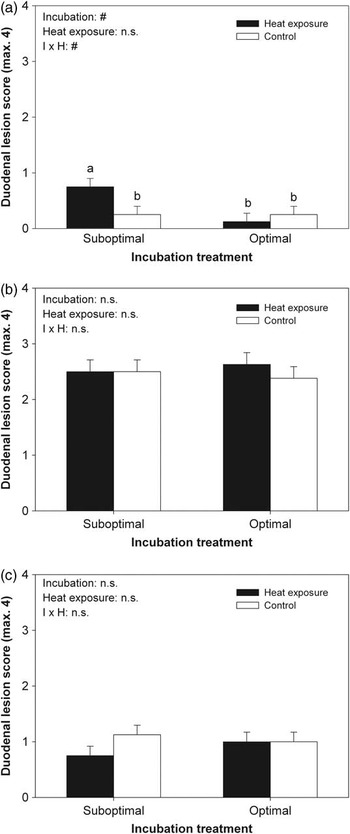
Dissection of the intestines at days 3, 4 and 7 p.i. demonstrated intestinal lesions in the duodenum due to E. acervulina. There was a significant day effect (P < 0.001), in which lesion severity increased from days 3 to 4 p.i. and declined thereafter (Figure 1). SI chickens tended to have more severe duodenal lesions at day 3 p.i. (P = 0.09). This effect could mainly be attributed to increased lesion severity in SI chickens that were exposed to heat before the infection (incubation treatment × heat interaction; P = 0.09). No significant differences in lesions between treatments were observed at days 4 and 7 p.i.
Duodenal lesion score at day 3 (a), day 4 (b) and day 7 (c) after Eimeria acervulina infection in 36-day-old layer chickens incubated at suboptimal or optimal eggshell temperatures, which were either exposed to heat (35°C) for 72 h or kept under normal conditions (21.°C) preceding the infection (least square means; LSmeans ± s.e.m.).abLSmeans followed by different letters are significantly different (P < 0.05); P < 0.10.

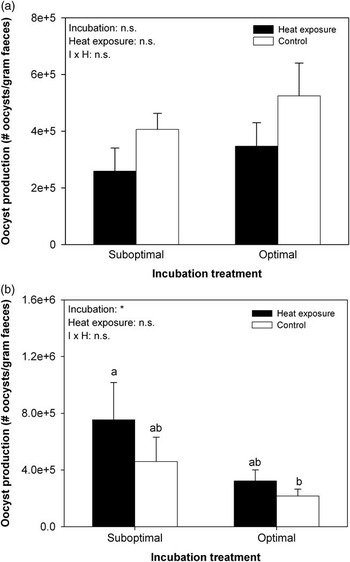
Microscopical examination of faecal samples from the dissected chickens demonstrated that there was no E. acervulina oocyst production at day 3 p.i. and that production started at day 4 p.i. (Figure 2). The amount of oocysts produced per gram faeces did not differ at day 4 p.i. (P > 0.05), but SI chickens produced significantly more oocysts per gram faeces than OI chickens at day 7 p.i. (P = 0.02).
Oocyst production at day 4 (a) and day 7 (b) after Eimeria acervulina infection (day 36 of age) in layer chickens incubated at suboptimal or optimal eggshell temperatures (EST), which were either exposed to heat (35°C) for 72 h or kept under normal conditions (21°C) preceding the infection (least square means; LSmeans ± s.e.m.). abLSmeans followed by different letters are significantly different (P < 0.05); *P < 0.05.

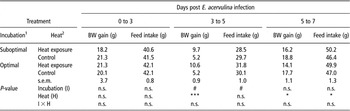
Daily BW gain and FI per chick after E. acervulina infection was divided into three periods, days 0 to 3 p.i., days 3 to 5 p.i. and days 5 to 7 p.i. (Table 2). The infection resulted in a reduced BW gain and FI from days 3 to 5 p.i. in all chickens compared with the BW gain and FI from days 0 to 3 p.i. (P < 0.001). However, chickens did not lose weight (Table 2). From days 5 to 7 p.i., BW gain and FI increased again.
Average BW gain and feed intake per chick per day from days 0 to 3, days 3 to 5 and days 5 to 7 after E. acervulina infection in 36-day-old layer chickens incubated at suboptimal or optimal eggshell temperatures that were either exposed to heat (35°C) for 72 h or kept under control conditions (21°C) preceding the infection (LSmeans ± s.e.m.)

E. acervulina = Eimeria acervulina; LSmeans = least square means; EST = eggshell temperature; EDs = embryonic days.
1Suboptimal = EST of 36.7°C from EDs 0 to 7, 37.8°C from EDs 8 to 14 and 38.9°C from EDs 15 to 21; optimal = EST of 37.8°C from EDs 0 to 21.
2Heat exposure was from days 33 to 36 of age, starting and ending at 0800 h.
0.05 < P < 0.10; *P < 0.05; ***P < 0.001.
From days 0 to 3 p.i., no interaction or differences were found between incubation and heat treatments in BW gain and FI. From days 3 to 5 p.i., there was no incubation × heat interaction but OI chickens tended to eat more (P = 0.07) and gain more BW (P = 0.08) than SI chickens. Moreover, heat-exposed chickens gained more weight than control chickens (P < 0.001), whereas FI between heat-exposed and control chickens did not differ. From days 5 to 7 p.i., no effect of incubation treatment was found on BW gain and FI. Heat exposure before infection resulted in a higher FI but lower BW gain from days 5 to 7 p.i. (P < 0.05).
BW and FI during the experiment
No differences in BW and FI between treatments were observed during the experiment (results not shown), apart from the above-described differences during the E. acervulina infection. At the end of the experiment (day 61 of age), heat-exposed OI chickens weighed 817.6 g ± 10.2 and heat-exposed SI chickens weighed 807.2 g ± 10.2. In addition, control OI chickens weighed 813.71 g ± 10.2, whereas control SI chickens weighed 810.5 g ± 10.2.
Discussion
This study aimed to investigate whether suboptimal incubation temperature during incubation of layer embryos affects their development and post-hatch adaptive capacity to a model infection with E. acervulina, under normal conditions and following a presumed stressful period of high T a.
Layer chickens exposed to suboptimal temperatures during incubation appeared to have a reduced ability to respond to E. acervulina at day 36 of age, regardless of whether they were exposed to heat before infection or kept under control temperatures. This was demonstrated by tendencies to lower FI and BW gain, more duodenal lesions and higher oocyst production after infection. At day 3 p.i., the percentage of chickens with lesions in the duodenum as a result of E. acervulina (Lillehoj and Trout, Reference Lillehoj and Trout1996) was lower in the OI (18.8%) than SI (50.0%) treatment. The higher percentage of chickens with lesions in the SI treatment was mainly due to SI chickens that were exposed to heat before infection. This indicates that the duodenum of SI chickens, and in particular of SI × heat chickens, was more affected by E. acervulina in the first phase of the infection. Intestinal lesions during Eimeria infections are caused by sporozoites, which are released after the Eimeria oocyst wall is cracked in the gizzard, and penetrate the intestinal epithelial cells where they undergo several reproductive phases in the tissue (Rose et al., Reference Rose1996). These reproductive phases lead to most damage to the intestinal tissue. The severity of the intestinal lesions is a measure for the infection severity and is often related to a downward trend in weight gain (Reid and Johnson Reference Reid and Johnson1970). This is in correspondence with results in our study, where higher lesion scores on day 3 p.i. were followed by a tendency to lower FI and BW gain from days 3 to 5 p.i. in SI chickens. Moreover, SI chickens had a significantly higher oocyst production at day 7 p.i. compared with OI chickens. Again, this effect was mainly due to higher oocyst production of SI × heat chickens. The output of oocysts in the faeces is a widely used method in disease diagnosis and also a measure for the infection severity (Chapman and Rayavarapu, Reference Chapman and Rayavarapu2007). Furthermore, it says something about the chickens’ resistance to Eimeria (Dalloul et al., Reference Dalloul, Lillehoj, Shellem and Doerr2003), the higher the oocyst production, the lower the resistance to Eimeria. These observations all indicate that SI chickens had a lower capacity to adapt during the E. acervulina infection than OI chickens. And in particular, based on the results of duodenal lesions and oocyst production, SI chickens exposed to heat before infection were most affected by E. acervulina in the first phase of infection.
We hypothesize that the reduced capacity of SI chickens, and in particular SI × heat chickens, to cope with E. acervulina might be due to several reasons. First, it may relate to developmental differences of the chickens. The effects of SI temperature on development in this study were determined based on other studies (Hill, Reference Hill2001; Molenaar et al., Reference Molenaar, Reijrink, Meijerhof and Van den Brand2008), by measuring heart weight, chick length, navel condition, BW, YFBM and RY weight. Our results demonstrated that SI temperature had a negative effect on embryonic growth and development. At hatch, relative and absolute heart weights were lower in SI chickens than in OI chickens. Furthermore, chick length and navel condition, which are indicators for chick quality (Wolanski et al., Reference Wolanski, Luiten, Meijerhof and Vereijken2004; Fasenko and O'Dea Reference Fasenko and O'Dea2008; Molenaar et al., Reference Molenaar, Reijrink, Meijerhof and Van den Brand2008), were reduced in SI chickens. It is possible that these differences in chick quality were the result of metabolic differences of the embryos, as T 3 levels at hatch were different between SI and OI chickens. Although there are several studies that demonstrated adverse effects of reduced chick quality on performance later on (Wolanski et al., Reference Wolanski, Luiten, Meijerhof and Vereijken2004; Fasenko and O'Dea, Reference Fasenko and O'Dea2008; Molenaar et al., Reference Molenaar, Reijrink, Meijerhof and Van den Brand2008), in this study we found no negative effects on BW development, FI and/or mortality in the post-hatch period, but we also did not look at organ development at a later age. Therefore, it is possible that differences between chickens are only apparent in times of infectious challenges in which organs are affected, such as during the intestinal E. acervulina infection.
Another challenging situation in which we observed differences between incubation treatments in this study was the manual restraint. Immediately after the manual restraint test, SI chickens had significant lower corticosterone levels than OI chickens, indicating a lower activity of the HPA-axis (Braastad, Reference Braastad1998). This result is probably more related to the effects of prenatal development of physiological control systems (Dorner, Reference Dorner1974). Corticosterone levels can be interpreted as an adaptive response to stressful events (Martins et al., Reference Martins, Roberts, Giblin, Huxham and Evans2007). For example, free-living birds respond to environmental stresses by upregulating corticosterone production (Martins et al., Reference Martins, Roberts, Giblin, Huxham and Evans2007). In our study, the lower corticosterone response of SI chickens after manual restraint might therefore be interpreted as a reduction in adaptive response to a stressor. This may consequently also affect their adaptive response to other stressors than the manual restraint, which would explain the reduced capacity to respond to Eimeria.
Second, differences between SI and OI chickens in coping with the E. acervulina infection might be more related to the availability of internal resources in order to respond to a challenge. In this context, the reduced ability of SI × heat chickens to cope with Eimeria might partly be due to differences in response to the heat exposure. Heat exposure, regardless of incubation treatment, resulted in a higher BW gain from days 3 to 5 p.i., but a lower BW gain (and higher FI) from days 5 to 7 p.i. Heat-exposed chickens also had lower plasma T 3 levels and higher T 4 levels just before infection compared with control chickens. In addition to the role of thyroid hormones in metabolism, they are also known to be involved in the functioning of the immune system, especially in regulating lymphocyte reactivity (Klecha et al., Reference Klecha, Genaro, Gorelik, Barreiro Arcos, Magalí Silberman, Schuman, Garcia, Pirola and Cremaschi2006). Immune responses to E. acervulina are mostly cell dependent (Dalloul and Lillehoj, Reference Dalloul and Lillehoj2005) and therefore immune modulation by changes in thyroid hormones might be a reason for the significant difference in BW gain in response to Eimeria between heat-exposed and control chickens. Although the heat exposure did not result in differences in performance and endocrine response between SI and OI chickens, it is possible that SI chickens had more difficulties than OI chickens to maintain their T b and metabolic rate at a normal level during the heat exposure. It is possible that when the heat stress was more extreme, with a higher temperature and/or longer duration, differences between SI and OI chicks in coping with the heat would be present, especially because differences in thyroid hormone levels between SI and OI chickens were already found at hatch. Therefore, the energy costs for maintenance during heat exposure could be higher in SI chickens, which might have resulted in a trade-off with immune function in the first phase of the E. acervulina infection (Moberg, Reference Moberg2000), also because inoculation of E. acervulina occurred immediately after heat exposure, which was probably still in the recovery phase for the chickens. Although this remains a speculation, it could explain why SI × heat chickens had more lesions and a higher oocyst production after infection than chickens of all other treatments.
In conclusion, exposure of layer embryos to a suboptimal temperature in weeks 1 and 3 of incubation reduced embryo development and post-hatch corticosterone levels during manual restraint. Furthermore, suboptimal incubation temperature tended to reduce the performance of chickens during E. acervulina and resulted in higher lesion scores and faecal oocyst numbers, especially when suboptimal incubation temperature was combined with heat exposure preceding the infection. This demonstrates that SI chickens are less able to cope with an intestinal pathogen post hatch, especially after already stressful conditions of heat exposure. This is a disadvantage because environmental challenges can also occur consecutively in production systems. This study therefore emphasizes the importance of incubation temperature for layer embryos in the development of their ability to cope with post-hatch (infectious) challenges.
Acknowledgements
The authors thank Marcel Heetkamp, Liesbeth Bolhuis, Ilona van den Anker, Ingrid de Jong, Henk Gunnink, Annemarie Rebel, Amina Mahmoud, Esther van Luttikhuizen and the animal caretakers in Wageningen and Lelystad for their assistance.
This project was funded by the Dutch Ministry of Agriculture, Nature and Food Quality, in the framework of the KB-8 program (Project number KB-08-002-007).