Introduction
Many long-term care systems in Europe and other more economically developed countries are reliant on unpaid or informal care provided by families and friends (OECD, 2006). However, in the context of population ageing, there are concerns about the future supply of informal care (United Nations, 2009). If the supply of informal care does not meet rising needs for care, then this is likely to mean an increase in demand for formal care and an increase in long-term care expenditure. Access to informal care is, therefore, of increasing policy importance, particularly in countries that are currently considering reform of their long-term care systems, as is the case in England, where the Dilnot Commission has recently published its recommendations (Commission on Funding of Care and Support, 2011a). One of the Commission's key criteria for the evaluation of long-term care funding options has been their future sustainability, including their ability to respond to demographic and societal changes. Receipt of informal care is a key socio-demographic factor that needs to be taken into account in the development of long-term care policy.
Informal care for older people primarily comes from adult children and spouses or partners (Pickard et al., Reference Pickard, Wittenberg, Comas-Herrera, King and Malley2007). Concerns about the future supply of family care do not affect all forms of care. In particular, care by spouses is likely to increase in future, primarily because projected improvements in male mortality are likely to lead to a fall in the number of widows (ONS, 2009). Indeed, concerns about the future supply of informal care primarily affect the availability of children (Clarke, Reference Clarke, Allen and Perkins1995). In particular, relatively high rates of childlessness in cohorts born in the 1960s in England may mean that they are less likely to be able to rely on family care in their retirement (Evandrou and Falkingham, Reference Evandrou and Falkingham2000). These trends are likely to affect older people in the long term (Murphy et al., Reference Murphy, Martikainen and Pennec2006). In the shorter term, over the next twenty years or so, the literature suggests that the proportion of older people with a surviving child is likely to increase, although these trends primarily relate to women in the oldest age-groups (Murphy and Grundy, Reference Murphy and Grundy2003; Murphy et al., Reference Murphy, Martikainen and Pennec2006).
Previous research by the present authors has examined receipt of informal care by older people with functional disabilities in England, distinguishing care by spouses and children, both now and in the future (Pickard et al., Reference Pickard, Wittenberg, Comas-Herrera, King and Malley2007). The research is based on a study by the Personal Social Services Research Unit (PSSRU), which makes macro-simulation projections of demand for long-term care services for older people aged sixty-five and over in England (Wittenberg et al., Reference Wittenberg, Pickard, Comas-Herrera, Davies and Darton2001). Previous informal care projections have incorporated a key aspect of informal care supply, taking into account the numbers of older people likely to have a spouse/partner in future (Pickard et al., Reference Pickard, Wittenberg, Comas-Herrera, King and Malley2007). However, these informal care projections did not take into account the availability of children to provide unpaid care.
The present article builds on this previous research and makes projections to 2032 of informal care that take into account not just the availability of spouses/partners to provide care, but also the availability of children. The research primarily uses projections of the availability of children in future produced by the Future Elderly Living Conditions In Europe (FELICIE) study, which made projections to 2030 in nine European countries, including England and Wales (Gaymu et al., Reference Gaymu, Ekamper and Beets2007, Reference Gaymu, Festy, Poulain and Beets2008). However, the present article also takes the European work further. The FELICIE project used living arrangements as a proxy for the availability of informal care, but such imprecise indicators are not a sufficient basis for determining informal care receipt (Jette et al., Reference Jette, Tennstedt and Crawford1995: S4). An innovative contribution of the present article is that it makes projections of informal care receipt, taking into account both demand for care (through disability) and potential supply (through the availability of both spouses/partners and children).
The first part of the article describes the methodology used to make projections of informal care receipt by older people with disabilities in England. The second part presents the results, looking at projections of numbers of older people with disabilities by availability of children and spouses/partners, in different household types and in receipt of informal care. The article ends with a discussion of the results and their policy implications.
Methods
PSSRU long-term care projections model
The projections of informal care receipt begin with the projected numbers of older people with functional disabilities in private households in England derived from the PSSRU long-term care projections model. The initial part of the model makes projections of estimated numbers of people aged sixty-five and over by age, gender, disability and marital status (Wittenberg et al., Reference Wittenberg, Pickard, Comas-Herrera, Davies and Darton2001, Reference Wittenberg, Comas-Herrera, King, Malley, Pickard and Darton2006).
Disability is defined in terms of an inability to perform one or more Instrumental Activities of Daily Living (shopping, cooking, handling personal/business affairs and practical activities, including housework) or difficulty with, or an inability to perform, one or more Activities of Daily Living (bathing/showering, getting in/out of bed, dressing, feeding and using the toilet). Marital status is defined in terms of de facto marital status, distinguishing single (never-married, widowed, divorced, separated and not cohabiting) and married or cohabiting. For the purposes of the projections of the availability of children (described below), the de facto single group are further divided by legal marital status.
The PSSRU model makes projections based on specific assumptions, which include the following. First, the projections are based on the Government Actuary's Department 2006-based population and marital status/cohabitation projections. Second, age/gender specific disability rates are assumed to remain unchanged, based on analysis of the 2001/2 General Household Survey (GHS).
Methodology for projections of availability of children
Projections of the percentages of older people aged seventy-five and over with and without children, by age, gender and marital status, are derived from published FELICIE data (Gaymu et al., Reference Gaymu, Festy, Poulain and Beets2008). These data take into account mortality in the younger generation and therefore relate to the proportions of older people who have a surviving child.
The FELICIE projections of childlessness in the population aged seventy-five and over are supplemented by the authors’ own projections for the population aged sixty-five to seventy-four. These projections were developed using a ‘pseudo-cohort’ approach (Evandrou and Falkingham, Reference Evandrou and Falkingham2000). The projections are based on data from the English Longitudinal Study of Ageing (ELSA) (Marmot et al., Reference Marmot, Banks, Blundell, Erens, Lessof, Nazroo and Huppert2011), which contains information on people aged fifty and over with and without a surviving child. Wave 1 data, with a (weighted) sample size of 11,392 respondents in 2002/3, are used to make projections of the availability of children for cohorts who will be aged sixty-five to seventy-four between 2007 and 2022. Wave 3 data are used to make projections for cohorts who will be aged sixty-five to seventy-four between 2022 and 2032, using sample data on 1,237 respondents aged fifty to fifty-four in 2006/7.Footnote 1 In order to allow for a major transition in marital status, those who are married/cohabiting are grouped with those who are widowed (see Murphy, Reference Murphy2009).Footnote 2
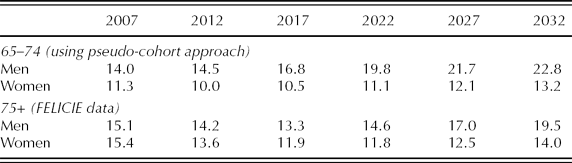
Table 1 shows that, based on the FELICIE data, the percentage of women aged seventy-five and over who are childless is projected to be lower in 2032 than today. However, the percentage of men aged seventy-five and over who are childless is projected to be higher in 2032 than today. Among those aged sixty-five to seventy-four, the percentages of both men and women who are childless are projected to be higher in 2032 than at present.
People aged sixty-five and over who are childless, by gender and age-band, England, 2007–32
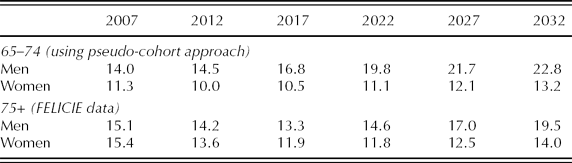
Notes: Childlessness is defined as absence of a surviving child. FELICIE data are for United Kingdom; 2005 FELICIE figures are used for 2007, 2010 for 2012 etc. All figures are percentages.
Sources: ELSA Waves 1 and 3 (2002/3 and 2006/7); Gaymu et al., Reference Gaymu, Festy, Poulain and Beets2008.
Methodology for projections of household type
The availability of kin is a major factor affecting household type and, in turn, household type is closely associated with informal care receipt (Pickard et al., Reference Pickard, Wittenberg, Comas-Herrera, Davies and Darton2000). The methodology used here for making projections of household type follows that previously utilised in the PSSRU model (Wittenberg et al., Reference Wittenberg, Comas-Herrera, King, Malley, Pickard and Darton2006), although the present article also allows for changes in the availability of children. The household type classification is based on de facto marital status. Couple households are divided into couples living with their spouse/partner only and couples living with their spouse/partner and others. To accommodate the availability of children, the de facto single group is divided into four household types: living alone, has no child; living alone, has a child; living with a child; and living with others.
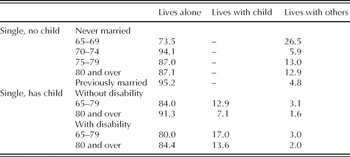
The household type projections take into account the factors previously incorporated into the PSSRU model, that is age, gender, marital status and disability, but now also take into account the availability of children. The distributions of older people into different household types by these factors are derived from Wave 1 ELSA data, with a (weighted) sample size of 5,513 people aged sixty-five and over. The household type distributions, by these factors, are kept constant in subsequent years. The introduction of the availability of children into the model primarily affects the household type of de facto single older people. Table 2 shows the distribution of single older people by household type, illustrating the key factors taken into account in the projections.
Household type of de facto single people aged sixty-five and over, by age, marital status, disability and availability of a child, England, 2002/3

Notes: Household type of single people does not vary significantly by gender and therefore results for men and women are combined. All figures are percentages.
Source: Wave 1 ELSA.
Methodology for projections of informal care receipt
Projections of informal care receipt are based on current receipt of informal care by older people, using Wave 1 ELSA data. Informal care is defined as help with personal care or domestic tasks from relatives or friends, provided because of the disability of the care recipient. The analysis of informal care relates only to older people with disabilities. The informal care definition used here is more rigorous than that used in previous projections by the same authors, in that respondents are only included as receiving informal help with a task if they have difficulty with or are unable to perform that task (see Pickard, Reference Pickard2008).
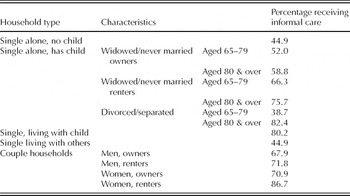
The factors incorporated into the projections of informal care receipt by older people with disabilities are age, gender, legal marital status (for de facto single people), housing tenure and household type (Table 3).Footnote 3 It is assumed that the proportions of older people receiving informal care remain constant over time. The analysis therefore implicitly assumes that, contingent on the availability of key kin, the supply of informal care rises in line with demand.Footnote 4
People with disabilities aged sixty-five and over receiving informal care by household type, age, gender, marital status and housing tenure, England, 2002/3

Source: Wave 1 ELSA.
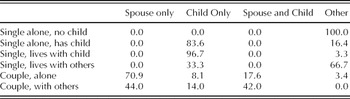
Finally, sources of informal care are distinguished, using Wave 1 ELSA data (Table 4). Three principal sources are identified: spouses, children and others. The projections assume that the propensity, within household types, to receive care from each source remains constant over time.
Sources of informal care for people with disabilities aged sixty-five and over by household type, England, 2002/3

Note: all figures are percentages.
Source: Wave 1 ELSA (authors’ analysis).
Results
Projections of sources of family support and household type
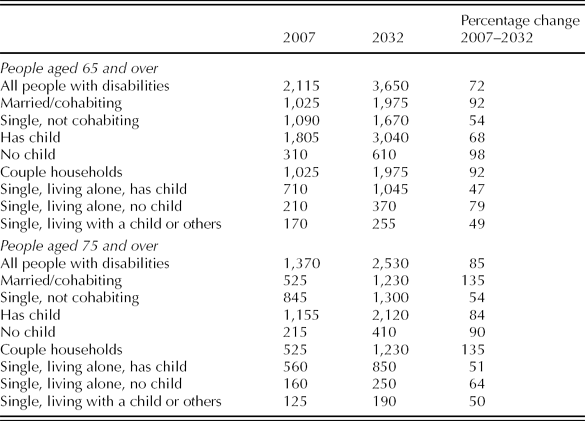
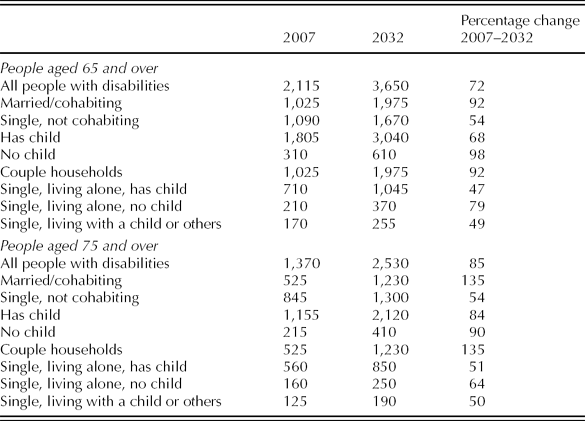
There are currently approximately 2.1 million people aged sixty-five and over with disabilities in private households in England and this number is projected to rise by 72 per cent by 2032 (Table 5). The number of people aged seventy-five and over with disabilities is projected to rise faster than this, increasing by 85 per cent in the same period. The increase in the population aged seventy-five and over is important because this is a critical threshold for the risks of widowhood and disability.
People with disabilities aged sixty-five and over and aged seventy-five and over in private households by marital status, availability of children and household type, England, 2007–2032 – projected numbers (thousands) and percentage change over time
Notes: Numbers rounded to nearest 5,000; numbers may not add exactly due to rounding; percentage change based on un-rounded figures.
Sources: 2006-based official population and marital status projections (ONS 2008, 2009); 2001/2 GHS; ELSA Waves 1 and 3; Gaymu et al., Reference Gaymu, Festy, Poulain and Beets2008; also see text.
The numbers of married/cohabiting older people with disabilities are projected to rise faster than the numbers of single people (Table 5). The numbers of married/cohabiting older people are projected to rise by 92 per cent between 2007 and 2032, whereas the numbers of single older people are projected to rise by 54 per cent (Table 5). At present, the majority of people with disabilities aged sixty-five and over are single, but by 2032, primarily due to a rise in male life expectancy, the majority will be married/cohabiting. The numbers of married/cohabiting people aged seventy-five and over will also increase much faster than the numbers of single people but, by 2032, there will still be more single than married/cohabiting people aged seventy-five and over.
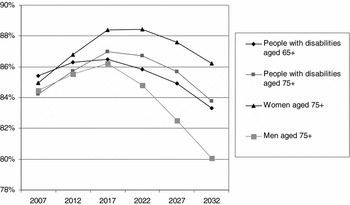
The numbers of older people with disabilities who are childless are projected to rise faster than the numbers with a child between 2007 and 2032 (Table 5). This suggests that the proportions with a child will fall over the next twenty-five years or so. Figure 1 shows that the percentages of people with disabilities aged sixty-five and over, and aged seventy-five and over, who have a child are projected to increase until 2017 and then begin to fall, so that, by 2032, they are projected to be lower than today. The proportion of people with disabilities aged sixty-five and over with a child is projected to fall from approximately 85 per cent in 2007 to 83 per cent in 2032.
People aged sixty-five and over in private households, with a child, by age and disability, England, 2007–2032 Sources: see Table 5.

Changes in the household type of older people over time primarily reflect the availability of kin. Between 2007 and 2032, the number of older people with disabilities in couple households is projected to increase by over 90 per cent, faster than the number in any other household type (Table 5). However, the number of older people with disabilities who live alone and have no child is also projected to increase rapidly, rising by nearly 80 per cent between 2007 and 2032. In contrast, the number of people with disabilities aged sixty-five and over living alone who have a child is projected to increase by only 47 per cent between 2007 and 2032.
Projections of receipt of informal care
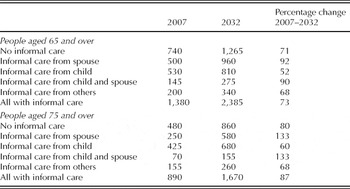
Approximately 65 per cent of older people with disabilities in England are estimated to receive informal care at present and this percentage is projected to remain relatively stable over the next twenty-five years or so (Table 6). The numbers of older people with disabilities in receipt and not in receipt of informal care are both projected to increase by just over 70 per cent between 2007 and 2032. Numbers of older people with disabilities in receipt of informal care are projected to increase from 1.4 to 2.4 million between 2007 and 2032, while those not in receipt of informal care are projected to increase from 740,000 to over 1.2 million in the same period.
People with disabilities aged sixty-five and over and aged seventy-five and over in private households by receipt of informal care, England, 2007–2032 – projected numbers (thousands) and percentage change over time

Sources: see Table 5.
Sources of informal care are projected to change over time in response to changes in the availability of kin. The greatest increase in informal care receipt is from spouses (Table 6). Numbers of people with disabilities aged sixty-five and over receiving care from a spouse/partner in England are projected to increase by over 90 per cent between 2007 and 2032 (Table 6). Moreover, informal care from ‘others’, including wider kin and friends, is projected to increase by nearly 70 per cent in the same period. In contrast, numbers of older people with disabilities who receive informal care from a child are projected to increase by only approximately 50 per cent between 2007 and 2032.
These trends in informal care receipt primarily reflect trends in the availability of spouses and children. The increase in ‘spouse care’ primarily reflects trends in marital status (Table 5). The increase in care by ‘others’ is primarily a reflection of the increase in numbers of childless single people living alone (Table 5) who, where they receive informal care, do so exclusively from wider kin and friends (Table 4).
The trends in informal care receipt will have an impact on the future composition of informal care. At present, the most important source of informal care for older people with disabilities is care by children (Table 6). Over half a million people with disabilities aged sixty-five and over currently receive informal care from a child. However, by 2032 the most important source of informal care for older people with disabilities is projected to be care by spouses/partners. Nearly a million older people with disabilities are projected to receive care from a spouse/partner in 2032.
Although the percentage increase in the numbers of older people with disabilities receiving care from a child is lower than the increase in any other source of informal care, children are still projected to be an important source of care for older people with disabilities, particularly people aged seventy-five and over. Care by children is still projected to be the most important source of informal care for people aged seventy-five and over in 2032 (Table 6). The underlying reason is that, at age seventy-five and over, the numbers of single older people with disabilities will still exceed the numbers in couples in 2032 (Table 5).
Conclusions
A key aim of this article has been to take into account the availability of children in projections of the receipt of informal care by older people with functional disabilities in England. The article has shown that the proportions of people with disabilities aged sixty-five and over with a child are projected to be lower in twenty-five years’ time than they are today.
The decline in the availability of children as a source of informal care for older people reported here is somewhat surprising in the context of the existing British literature, some of which has suggested that the supply of care by children will be greater than it is today until beyond the mid-2030s (Murphy et al., Reference Murphy, Martikainen and Pennec2006). The difference between the results presented here and those reported elsewhere is primarily that the present analysis includes both men and women, whereas previous research in this country has focused on women only (Murphy et al., Reference Murphy, Martikainen and Pennec2006). Data from the FELICIE study (Gaymu et al., Reference Gaymu, Festy, Poulain and Beets2008), utilised here, show that the proportions of men aged seventy-five and over in this country with a surviving child will fall after 2017. A similar decline occurs for women but not until later, with the gender difference primarily explained by men's higher age of paternity (Gaymu et al., Reference Gaymu, Ekamper and Beets2007). The FELICIE study primarily examines the implications of trends in childlessness for European countries generally, rather than for individual countries (Gaymu et al., Reference Gaymu, Ekamper and Beets2007; Tomassini et al., Reference Tomassini, Grundy, Kalogirou, Gaymu, Festy, Poulain and Beets2008). In England, the decline in the percentages of older men with a child is projected to more than offset the increase in the percentages of women with a child, with the result that the proportions of people with disabilities aged seventy-five and over, and aged sixty-five and over, with a child are projected to be lower in 2032 than today.
A key effect of the rise in childlessness is that the role of children caring for older people with disabilities in twenty-five or so years’ time is likely to be smaller than it is today. At the same time, a greater role is likely to be played by spouses and ‘others’, including wider kin and friends. However, there are reasons (explored below) to suggest that this may lead to a greater reliance on potentially fragile care relationships.
Thus, the results show that the numbers of older people with disabilities receiving care from spouses/partners in England are likely to increase substantially in future. However, much of this increase in receipt of spouse care is by people aged seventy-five and over. The projections of informal care from spouses/partners therefore implicitly assume that care will be provided by increasingly older people, who may be frail or even in need of care themselves (Colombo et al., Reference Colombo, Llena-Nozal, Mercier and Tjadens2011). It seems questionable whether the ‘older old’ will be able to provide care to this extent, or whether it is fair to expect this (Pickard et al., Reference Pickard, Wittenberg, Comas-Herrera, King and Malley2007).
Moreover, the results suggest that one of the fastest growing sources of informal care in future years in England is projected to be care by ‘others’, including friends and kin other than children, spouses or partners. However, it is not clear whether friends or more distant kin will be able to play an increasing role in the care of older people. The current evidence is inconclusive. On the one hand, there is evidence of a growing ‘fusion between kith and kin’ (Pahl and Spencer, Reference Pahl and Spencer2004, Reference Pahl and Spencer2010: 10) and that people are ‘substituting the ties of friendship for those of blood’ (Roseneil, Reference Roseneil2004: 413). On the other hand, it is argued that boundaries still exist between family and friends, and that family members are likely to be more involved than friends when the support needed by older people becomes more extensive or intimate (Allan, Reference Allan2008; Twigg, Reference Twigg2000). An increasingly important role for more distant relatives and friends in the care of older people with disabilities in future is, therefore, somewhat speculative.
As well as an increasing reliance on potentially fragile care relationships, the projections presented here also suggest that numbers without informal care are likely to increase substantially. The use of a more rigorous definition of informal care in the present research means that more older people with disabilities have been identified as being without informal care than previously. Previous projections have indicated that there would be approximately 485,000 older people with disabilities not in receipt of informal care by the early 2030s (Pickard et al., Reference Pickard, Wittenberg, Comas-Herrera, King and Malley2007). Although there are other differences in underlying assumptions, the projections now show that there will be over 1.2 million older people with disabilities not in receipt of informal care by 2032.
The changes in the sources and extent of informal care, identified here, are likely to have an impact on demand for formal care and on long-term care expenditure, and are therefore relevant to the debate over the funding of the long-term care system in England. The Commission on Funding of Care and Support published its recommendations in mid-2011 and the Government is planning a White Paper in 2012 (Commission on Funding of Care and Support, 2011a; Department of Health, 2011). The Commission on Funding of Care and Support did not look at the sensitivity of the projected costs of its recommendations to the supply of unpaid care (Commission on Funding of Care and Support, 2011b: 90). It is therefore important to consider the potential implications of the results reported here for the Commission's recommendations.
A key recommendation of the Commission on Funding of Care and Support is that there should be a cap on the lifetime contribution to adult social care costs that any individual needs to make, with the suggested cap being set at £35,000 (Commission on Funding of Care and Support, 2011a: 5). Where an individual's care costs exceed the cap, the Commission recommends that they should be eligible for full support from the state. However, the Commission's recommendations are likely to be sensitive to the changes in informal care described in this article in two key ways. First, if there are fewer people with informal care in future than previously estimated, then it is likely that there will be more people eligible for state support under the Commission's recommendations and public expenditure costs are likely to be higher than the Commission has estimated. Second, under the Commission's recommendations, those with the highest care costs, and therefore most likely to exceed the cap, are those in long-stay residential care. Yet the rise in childlessness, described in this article, is likely to lead to a rise in residential care use, because childless older people are much more likely to enter residential care than those with children (Grundy and Jitlal, Reference Grundy and Jitlal2007). Therefore, the costs of the Commission's recommendations may be particularly vulnerable to a rise in childlessness.
More fundamentally, the recommendations of the Commission on Funding of Care and Support are likely to be sensitive to changes in informal care supply because the Commission adopts the same approach to policy for carers as that currently adopted in England. The current approach is to take informal care into account in determining eligibility for publicly funded care (Department of Health, 2010). The Commission intends to continue this, stating that, ‘As now, we believe that any reformed system will need to continue to be ‘carer sighted’ (that is, the contribution of carers is taken into account when deciding on the appropriate pack of support)’ (Commission on Funding of Care and Support, 2011a: 52). Because they continue to rely heavily on carers the costs of the Commission's recommendations are likely to be sensitive to the availability of informal care.
This article has shown that over the next twenty-five years or so in England, there is likely to be an increase in childlessness among older people with disabilities, that the extent of informal care may be lower than previously estimated and that there is likely to be increasing reliance on potentially fragile care relationship, including care provided by ‘older old’ spouses aged seventy-five and over and by more distant kin and friends. In these circumstances, long-term care policy should perhaps consider reducing reliance on informal care. More universal systems of long-term care, which determine eligibility primarily on the basis of disability, are likely to be less reliant on informal care. A number of proposals for a more universal social care system care have been put forward over the last decade or so in England (Comas-Herrera et al., Reference Comas-Herrera, Wittenberg and Pickard2010, Reference Comas-Herrera, Wittenberg, Pickard, Courbage and Costa-Font2011). Ultimately, it is only with a ‘carer-blind’ system, in which eligibility criteria do not take account of informal care, that sensitivity to future changes in informal care is likely to be reduced, though such a system would potentially shift more costs onto public expenditure.
Acknowledgements
This article arises from work undertaken as part of the Modelling Ageing Populations to 2030 (MAP2030) project, funded under a grant from the new Dynamics of Ageing Programme, a cross-research council programme (RES-339-25-0002). Material from the General Household Survey and English Longitudinal Study of Ageing is crown copyright and has been made available via the UK Data Archive. Responsibility for any errors and all views in this article lies with the authors.