Larvae of most species of cerambycid beetles feed subcortically in woody plants, and many species are important pests in managed and natural forests worldwide (Solomon Reference Solomon1995). For some cerambycid species, performance by the larvae is strongly influenced by the physical dimensions of larval hosts (Hanks et al. Reference Hanks, Paine and Millar2005), as well as parasitism rate (Hanks et al. Reference Hanks, Millar, Paine, Wang and Paine2001). Here, we summarise research that assessed the relationship between the size of bolts cut from trees and the number and size of cerambycid beetles that emerge, and parasitism rates.
The study was conducted in a ∼0.08 ha tree plantation (United States of America: Illinois: Champaign Co.; 40°05′06.43″N, 88°12′49.88″W) with pin oaks, Quercus palustris Münchhausen (Fagaceae), and eastern white pines, Pinus strobus Linnaeus (Pinaceae) (oaks ∼40 years old, pines ∼50 years old; average diameter of trunk [±1 SD] at 1 m: 27 ± 7 and 23 ± 2 cm, respectively). During 6–19 July 2005, we felled six oaks and cut them into 81 bolts (63 from trunk, 18 from branches, mean diameter 0.17 ± 0.08 m, length 0.79 ± 0.16 m). Bolt diameter was strongly autocorrelated with bark thickness (adjusted r 2 = 0.56, P < 0.0001). We felled three pines and cut them into 72 bolts (42 from the trunk, 30 from branches, diameter 0.12 ± 0.07 m, length 0.8 ± 0.17 m). We confirmed that few adult insects emerged from the bolts during 2005 by enclosing a subset (two oak, three pine bolts) in aluminium screen (2 mm mesh) in early fall. Neither adult beetles nor parasitoids emerged from those bolts until the following spring. In April 2006, we enclosed the remaining bolts in screen, individually wrapping large bolts from trunk and larger branches (>0.1 m in diameter), but wrapping smaller bolts (<0.08 m) together in groups of 3–7 (n = 3 and six groups of the smaller bolts for oaks and pines, respectively). Wrapped bolts were checked for insects weekly through September 2006.
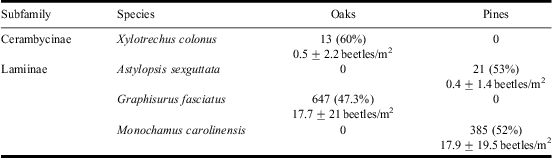
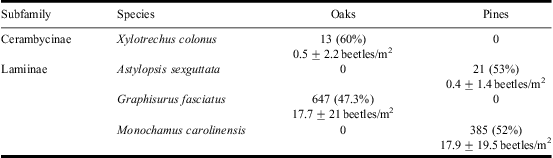
We reared from the bolts 1066 cerambycid beetles of four species (Table 1). Of the 81 oak bolts, 70 (86%) produced beetles, of which 98% were Graphisurus fasciatus (De Geer) and the remainder Xylotrechus colonus (Fabricius) (Table 1). Males and females did not differ in emergence period (t-test of mean ordinal dates of emergence, t = 0.13; df = 442; P > 0.1). It is notable that 11 of the 13 adult X. colonus emerged from three oak bolts that produced no G. fasciatus, suggesting that larvae of the two species compete aggressively. Cerambycid larvae can be opportunistic predators of other wood-boring insects (e.g., Dodds et al. Reference Dodds, Graber and Stephen2001).
Total number (% female) and mean density (per m2 bark surface of bolt, ±1 SD) of adult cerambycid beetles that emerged from bolts of pin oak and eastern white pine. Sex ratios of all species were not significantly different from 1:1 (G-test for goodness of fit, P > 0.05)
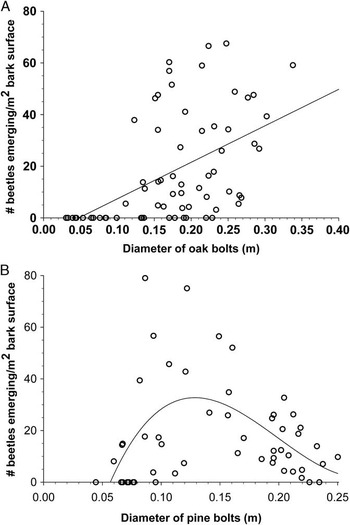
Density of adult G. fasciatus (number of beetles per unit bark area) was positively, though weakly, correlated with bolt diameter (Fig. 1A; regression analysis, adjusted r 2 = 0.24; F 1, 67 = 21.8; P < 0.0001), suggesting that adult females preferred to oviposit into larger bolts, and/or that survivorship of larvae was greater in such bolts. Other studies of cerambycids also have reported greater rates of oviposition and enhanced survivorship in larger bolts (e.g., Hanks et al. Reference Hanks, Paine and Millar2005). Larger bolts may accommodate greater numbers of larvae because they offer thicker phloem and cambial tissue for the larvae to feed (Hanks et al. Reference Hanks, Paine and Millar2005). Body size of G. fasciatus (length of right elytron) was positively, but weakly correlated with the diameter of their natal bolts (best fit regression equation: Y = 0.002X + 0.0077; adjusted r 2 = 0.012; F 1, 506 = 7.13; P = 0.0078).
Relationship between the number of adult cerambycid beetles that emerged (per unit of bolt surface area) and bolt diameter for (A) bolts of pin oak (best fit regression equation Y = 141X – 6.7) and (B) bolts of eastern white pine (relationship characterised by fitting equations to data and selecting that which maximised the coefficient of determination with all terms significant: Y = 22 400X 3 – 13 360X 2 + 2330X – 93) (Quinn and Keough Reference Quinn and Keough2002; SPSS 2006).

Of the 72 pine bolts, 44 (61%) yielded adult Monochamus carolinensis (Olivier) (95% of beetles), and Astylopsis sexguttata (Say) (Table 1). Of the latter species, 86% emerged from three different groups of smaller branches, however, densities were not significantly different between bolts cut from branches or from the trunk (means ± SE: 1.88 ± 1.1 and 0.22 ± 0.18 beetles/m2 of bark surface for branches and larger bolts, respectively; Kruskal–Wallis Q 1,60 = 2.5, P = 0.11).
Densities of M. carolinensis were greatest in logs of intermediate size, although the correlation was weak (Fig. 1B; regression analysis, adjusted r 2 = 0.21; F 3,51 = 5.49; P < 0.0025). A similar parabolic relationship has been reported for a different Monochamus Dejean species (Zhang et al. Reference Zhang, Byers and Zhang1993). Fewer beetles may have emerged from the largest logs because their thick bark hindered oviposition, as has been reported for M. carolinensis in an earlier publication (Walsh and Linit Reference Walsh and Linit1985). Consistent with G. fasciatus, body size of M. carolinensis was positively, but weakly correlated with diameter of pine bolts (best fit regression equation: Y = 0.007X + 0.014; adjusted r 2 = 0.09; F 1,190 = 20.8; P < 0.0001).
Very few adult parasitoids emerged from oak bolts, with an overall parasitism rate (i.e. number of parasitoids/total number of insects) of 0.88%. This finding was surprising, given the high densities of beetle larvae in many bolts, and the fact that they had been exposed to the parasitoid community for several months. From oak bolts we reared the braconids (Hymenoptera: Braconidae) Atanycolus Förster species (a species similar to Atanycolus charus (Riley) (two females) and Wroughtonia ferruginea (Brues) (one of each sex), and an ichneumonid (Hymenoptera: Ichneumonidae) in the genus Demopheles Förster (two females). Voucher specimens were deposited in the Insect Collection of the Illinois Natural History Survey, Champaign, Illinois, United States of America.
Parasitism rate for beetles that emerged from pine bolts averaged 5.3 ± 8.6%, including a braconid in the genus Digonogastra Viereck (one female), and the tachinid fly (Diptera: Tachinidae) Billaea monohammi (Townsend) (28 adults, approximately equal numbers of females and males). Billaea Robineau-Desvoidy species are known to parasitise larvae of a different Monochamus species (Allison et al. Reference Allison, McIntosh, Bordon and Humble2000).
Wood-boring insects can be shielded from parasitoids by the woody tissues of their hosts (e.g., Hanks et al. Reference Hanks, Millar, Paine, Wang and Paine2001). In our study, however, the parasitism rate of M. carolinensis was not correlated with the diameter of pine bolts (regression P > 0.05). Very low rates of parasitism also have been reported for other species of cerambycid beetles (e.g., Bashford Reference Bashford1994).
Acknowledgements
We thank E.E. Graham, R.F. Mitchell, A.M. Ray, M.L. Richardson, D.E. Philpott, M.C. Currier, and J.F. Hitchens for assistance in the field, and J.J. Rodriquez, A.A. Velario, J.B. Whitfield, and N.E. Woodley for help with taxonomy. We appreciate funding support from the Agricultural Research Service of USDA under agreement #58-1926-3-339, and the Alphawood Foundation. This research was in partial fulfilment of a Ph.D. degree for P.F.R. from the University of Illinois at Urbana-Champaign.