Introduction
A child's early language environment is predictive of their cognitive development, educational outcomes, and future economic opportunities (Hoff, Reference Hoff2013; Leffel & Suskind, Reference Leffel and Suskind2013), and the negative effects of a diminished language environment emerge early. The number of words a child hears by the age of 36 months is highly correlated with language development and later academic success (Hart & Risley,Reference Hart and Risley1995; Rowe, Reference Rowe2018). Moreover, differences in vocabulary and processing speed have been shown to emerge as early as 18 months (Fernald, Marchman, & Weisleder, Reference Fernald, Marchman and Weisleder2013). Children living in poverty are at increased risk for experiencing poorer language environments and, without intervention, this gap in language development continues to widen and is associated with smaller vocabularies and weaker reading skills in third grade (Hart & Risley, Reference Hart and Risley1995; Suskind et al., Reference Suskind, Leffel, Graf, Hernandez, Gunderson, Sapolich and Levine2016). This is critical, because children who have not achieved reading proficiency by third grade are more likely to experience academic difficulties and behavior problems, and are less likely to graduate high school and more likely to experience economic difficulties later in life (Fiester, Reference Fiester2010). Further compounding the risk associated with socioeconomic status (SES), when mothers of young children are experiencing depression they are more likely to engage in parenting behaviors that diminish the quality of the language environment (Lovejoy, Graczyk, O'Hare, & Newman, Reference Lovejoy, Graczyk, O'Hare and Neuman2000). Low-income children three years and under are at increased risk of having a mother with depressive symptoms, and over half of children living in low-income families have a mother who is experiencing depressive symptoms (Schmit, Golden, & Beardslee, Reference Schmit, Golden and Beardslee2014; Vericker, Macomber, & Golden, Reference Vericker, Macomber and Golden2010), compounding the risk for delayed language development. Despite the significant associations between SES and language environments, we know that variability exists, both across SES groups and within low SES groups (Golinkoff, Hoff, Rowe, Tamis-LeMonda, & Hirsh-Pasek, Reference Golinkoff, Hoff, Rowe, Tamis-LeMonda and Hirsh-Pasek2019). In response, the current study aims to examine relationships between positive parenting behaviors, maternal depression, and language environments within a sample of young low-income children to help identify potential points for intervention.
Quantitative and qualitative features of young children's language environments
Evidence supporting the important role of the qualitative features of the language environment on children's development comes from longitudinal research spanning a decade (Hirsh-Pasek et al., Reference Hirsh-Pasek, Adamson, Bakeman, Owen, Golinkoff, Pace and Suma2015; Pace, Luo, Hirsh-Pasek, & Golinkoff, Reference Pace, Luo, Hirsh-Pasek and Golinkoff2017). Researchers found that conversational turns, measured when children were one to three years old, predicted working memory and cognitive development ten years later (Gilkerson, Reference Gilkerson2017). Further, the magnitude of this effect size was large, and was not found for the number of words the child heard (Gilkerson, Reference Gilkerson2017). Perhaps the most recent evidence of the influence of the qualitative features on children's language development comes from a study examining the home language environments of young children using Language Environment Analysis System (LENA) recording devices and data from functional magnetic resonance imaging (fMRI). fMRI scans of children four to six years of age were conducted during a language processing task. Adult word count and conversational turns assessed using LENA in the home were negatively correlated with SES; however, only conversational turns predicted children's language processing over and above SES. Further, results from scans showed greater activation of the area of the brain associated with language processing – Broca's area – for children who experienced more conversational turns, even when controlling for SES, cognitive ability, adult word count, and child vocalizations. Taken together, activation of Broca's area and conversational turns accounted for 23% of the variance between SES and children's language ability (Romeo et al., Reference Romeo, Leonard, Robinson, West, Mackey, Rowe and Gabrieli2018). These results are the first to show neurobiological evidence of the significant role that the qualitative features of the language environment plays in young children's language development. In order to better understand how parents influence the language environments of young children, in the current study we examine positive parenting behaviors and maternal depression in relation to conversational turns, child and adult vocalizations, and child language productivity scores.
Parenting behaviors, maternal depression, and language development
Viewing language development through a social interactionist perspective illustrates how parent's input on young children's language environment is influenced by the interactions between the parent and child. The social interactionist framework posits that infants develop language during interactions with parents and caregivers that include vocal exchanges, and that these interactions are the foundation for language development (Golinkoff, Reference Golinkoff and Liben1983; Vygotsky, Reference Vygotsky, Gauvain and Cole1978). Empirical evidence supports this theory. For example, sensitive and responsive parenting interactions in infancy, which can be defined as responding promptly and appropriately to a child's needs, have been shown to positively impact child language outcomes (Landry, Smith, & Swank, Reference Landry, Smith and Swank2006; Leigh, Nievar, & Nathans, Reference Leigh, Nievar and Nathans2011). In contrast, negative intrusive interactions (i.e., interactions that are harsh, controlling, or punitive) are associated with reduced opportunities for conversation and poorer child language outcomes (Hart & Risley, Reference Hart and Risley1995; Pungello, Iruka, Dotterer, Mills-Koonce, & Reznick, Reference Pungello, Iruka, Dotterer, Mills-Koonce and Reznick2009). Moreover, mothers experiencing depressive symptoms are more likely to have difficulty responding to their child's needs, maintaining engagement, and displaying more negative emotionality (Feldman, Reference Feldman2009), irritability, and hostility, all of which can lead to fewer and disrupted caregiving interactions (Lovejoy et al., Reference Lovejoy, Graczyk, O'Hare and Neuman2000). Empirical evidence suggests that the relationship between maternal depression and young children's language outcomes is associated with caregiving quality. However, maternal depression did not independently predict children's language, suggesting that maternal depression plays a role in children's language acquisition through the quality of parent–child interactions. Further, this association was found to be particularly strong among low-income families (Stein et al., Reference Stein, Malmberg, Sylva, Barnes and Leach2008). Very young children may be even more susceptible to the effects of depression and negative interactions, as they are more reliant on their caregiver to initiate and maintain interactions (Kaplan et al., Reference Kaplan, Danko, Everhart, Diaz, Asherin, Vogeli and Fekri2014; Sohr-Preston & Scaramella, Reference Sohr-Preston and Scaramella2006).
Alternatively, some evidence suggests that language quality may be more influential than sensitive parenting, which can be defined as parenting interactions that are warm, responsive, and stimulating (Hirsh-Pasek et al., Reference Hirsh-Pasek, Adamson, Bakeman, Owen, Golinkoff, Pace and Suma2015). For example, within a sample of low-income families the quality of communication was a better predictor of children's expressive language development one year later than the quantity of words or sensitive parenting (Hirsh-Pasek et al., Reference Hirsh-Pasek, Adamson, Bakeman, Owen, Golinkoff, Pace and Suma2015). Focusing on global parenting constructs such as sensitive parenting, which has been operationalized in many ways, may obscure other aspects of parenting that uniquely affect the quality of the language environment (Hirsh-Pasek et al., Reference Hirsh-Pasek, Adamson, Bakeman, Owen, Golinkoff, Pace and Suma2015). In response, the current study examined four domains of positive parenting behavior – encouragement, responsiveness, affection, and teaching – using observational methods (see ‘Method’ section), and both quantitative and qualitative features of the language environment using LENA. While there may be many conceptualizations of positive parenting in the literature, we focused on four main categories (Roggman et al., Reference Roggman, Cook, Innocenti, Jump Norman and Christiansen2013); affection, responsiveness, encouragement, and teaching. Affectionate behavior that is characterized by warm, positive interactions is associated with positive child outcomes in many studies (Belsky, Bell, Bradley, Stallard, & Stewart-Brown, Reference Belsky, Bell, Bradley, Stallard and Stewart-Brown2007; Caspi et al., Reference Caspi, Moffitt, Morgan, Rutter, Taylor and Arseneault2004; Roggman et al., Reference Roggman, Cook, Innocenti, Jump Norman and Christiansen2013). Responsiveness can be observed when parents respond to their child's needs sensitively and positively (Roggman et al., Reference Roggman, Cook, Innocenti, Jump Norman and Christiansen2013). Encouragement consists of behaviors that support children's independence and choices as they play and explore their world (Deci & Ryan Reference Deci and Ryan1987; Landry et al., Reference Landry, Smith and Swank2006; Roggman et al., Reference Roggman, Cook, Innocenti, Jump Norman and Christiansen2013). Teaching behaviors can be characterized as those behaviors that are stimulating and provide opportunities for conversation and shared play (Fuligni & Brooks-Gunn Reference Fuligni and Brooks-Gunn2013; Roggman et al., Reference Roggman, Cook, Innocenti, Jump Norman and Christiansen2013).
It is important to note that cultural differences exist within each of these constructs, regardless of SES (Roggman et al., Reference Roggman, Cook, Innocenti, Jump Norman and Christiansen2013). For example, some cultures favor displays of affection that are non-verbal (Bornstein & Putnick, Reference Bornstein and Putnick2012; Roggman et al., Reference Roggman, Cook, Innocenti, Jump Norman and Christiansen2013). Nevertheless, responsive parenting behaviors are seen in diverse cultures, but, similar to affection, these behaviors may also be displayed in ways that are non-verbal. Related to encouragement, some families may be less likely to endorse behaviors that show independence and initiative (Becerra, Reference Becerra, Mindel, Havenstein and Wright1998) and teaching behaviors may look different across cultures. For example, some cultures may not engage in pretend play with their children (Roggman et al., Reference Roggman, Cook, Innocenti, Jump Norman and Christiansen2013). However, in the current study we used established norms and procedures to code parenting behaviors that have been used in numerous studies (Roggman et al., Reference Roggman, Cook, Innocenti, Jump Norman and Christiansen2013).
Current study
In the current study we examined four domains of positive parenting behavior – encouragement, responsiveness, affection, and teaching – using observational methods (see ‘Method’ section), and both quantitative and qualitative features of the language environment using LENA. Much of the research assessing the quality and quantity of language during parent–child interactions has been done in a lab setting during a relatively brief structured or semi-structured play task and may not accurately reflect the quality of language interactions in the home. In the current study, the quantity and quality of young children's language environments were assessed using full day recordings of the home language environment using LENA digital recording devices. In addition, the current study examined relationships between maternal depression, positive parenting behaviors (discussed above), and both the quantitative and qualitative features of the home language environments in a sample of low-income mothers and their young children living in an urban city in the Midwest, in the United States. Home language environment quantity was assessed through adult word counts and child vocalizations, while quality was assessed through the number of conversational turns and children's vocal productivity scores.
Study goals and hypothesis
The first goal of the study was to delineate differences in children's language environments within a sample of low-income mothers and their young children. We hypothesized that language environment measures would on average be low, as the sample was all low-income. A second goal was to examine the longitudinal relationship between maternal depression, positive parenting behaviors, and young children's language environments. Maternal depression was assessed when children were between 3 and 11 months of age; positive parenting was assessed approximately nine months later. Home language environments were assessed approximately 15 months later, when children were between 18 and 28 months of age. We hypothesized that maternal depression and low positive parenting behaviors would be associated with fewer adult word counts, conversational turns, child vocalizations, and children's lower vocal productivity scores.
Method
Study design
Data in the current study were collected at three time-points. Maternal depression was assessed at the first time-point, when infants were between 3 and 11 months of age (M = 6.5, SD = 1.5). At time-point two, mother–child dyads were videotaped during a play interaction when children were between 12 and 22 months of age (M = 17, SD = 1.8). The home language environment was assessed approximately 6 months later when children were between 18 and 28 (M = 23.56, SD = 2.75) months of age.
Participants and procedure
Participants in the current study (N = 29) were part of an ongoing longitudinal study of mothers and infants living in poverty in a large urban city in the Midwest. The overarching goal of this larger study was to understand how babies develop and change over the first three years of life, and how mothers influence their baby's development. After receiving approval from the University's Institutional Review Board (IRB), research assistants began recruiting participants from local service agencies and a university hospital's pediatric clinic. Mothers who were at least years 18 years of age and had a baby who would be between six weeks and four months of age at the time of the baseline assessment were invited to participate in the study. Mothers also had to be eligible to receive services from the Women, Infants, and Children Food and Nutrition Service (WIC), a federally funded food and nutrition program for low-income mothers. In addition to informing mothers about the study, they were also told about a parenting program, Legacy for Children™ (Legacy). Legacy is an evidence-based parenting program aimed at improving child outcomes by fostering sensitive mother–child relationships, promoting maternal self-efficacy, and supporting a sense of community among low-income mothers (Perou et al., Reference Perou, Elliott, Visser, Claussen, Scott, Beckwith and Smith2012). Mothers who were interested in participating in the parenting program were informed of the group meeting time and location and were invited to join if the meeting time worked with their schedule. Mothers who were no longer interested in participating, or who could not participate due to meeting time or work conflicts, were invited to participate in the study only. Mothers who were interested in participating in the study or the parenting program were asked to complete a parent interest form, providing contact information for follow-up calls and scheduling. Research assistants called interested participants and scheduled a time for them to come to the university so that they could explain the study, answer questions, and obtain informed consent. The survey was the same whether parents participated in the parenting program or the study only. The only difference between the assessments was the inclusion of survey questions related to the parenting program as part of a larger implementation study. The videotaped portion of the assessment was usually completed first; however, the needs of the mother and baby always came first, and that order was changed if the baby was sleeping, fussy, needed to be fed, etc. Participants were compensated $40.00 for their participation.
Only English-speaking mothers were included in the current study. There were approximately 45 eligible participants, and research assistants were able to make contact with 36 of them. Of those 36 participants, 29 chose to participate in the LENA portion of the study. Of those 29 participants, four participated in the Legacy program. Contact was lost with one participant and the device was never returned. Two participants did not record the required minimum of ten hours, and therefore the data could not be analyzed, leaving us with a total of 26 participants: four of those were Legacy participants and 22 were non-Legacy participants. Participant demographic information can be found in Table 1. Mothers ranged in age from 19 to 39 years of age (M = 28.43, SD = 6.22). Children ranged in age from 3 to 11 months (M = 6) at time one, 12 and 22 months (M = 17) and 18 to 28 months (M = 24) at time two. Sixty-seven percent of the children were boys. Over half of the sample, 53%, was Caucasian, 26% African American, 4% Native American, and 8% reported more than one race. Most mothers, 73%, reported being married or living with their partner, 17% reported never being married, 7% were separated, and 3% were divorced. Education levels varied, with 40% of mothers having received their high school diploma or General Education Diploma (GED), 27% having attended some college or attended a career training program, and 33% having received a college degree. When compared to census data from this city, participants were more ethnically diverse and reported lower levels of educational attainment, with 40% reporting having earned a high school degree, compared to 89% in the census data (Gann, Bowers, & Walton, Reference Gann, Bowers and Walton2018). All participants were low income as defined by WIC eligibility, compared to 14% of the total population (Gann et al., Reference Gann, Bowers and Walton2018).
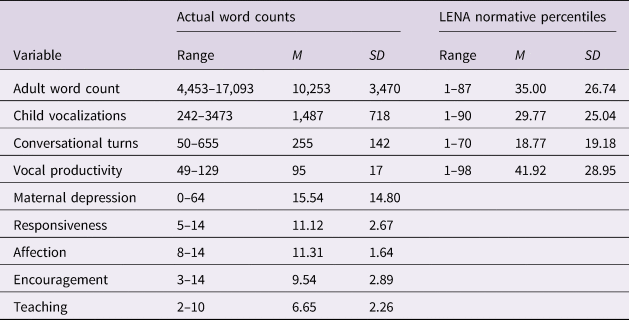
Range of scores, means, standard deviations of language and parenting variables, and LENA normative percentiles (N = 26)

A second wave of recruitment and informed consent took place in order to collect home language environment data. This took place when children were approximately 18 months of age and was the only additional inclusion requirement. After receiving IRB approval for the LENA portion of the study, research assistants began recruiting for the home language environment study. Research assistants explained the study to mothers during a regularly scheduled assessment and informed consent was obtained for interested participants during this time. At the completion of the survey, mothers were given the recording device and instructions and recording days were chosen. Participants who would not be returning for a regularly scheduled assessment for several months and had a child 18 months of age or older were contacted by a research assistant to inform them of the study. This was done only for participants who indicated that they would like to be contacted for future studies on their original consent form. Participants were compensated $40.00 for the home language environment portion of the study.
Instruments and measures
Parenting behaviors
Parenting Interactions with Children: Checklist of Observations Linked to Outcomes (PICCOLO)
Parenting behaviors were assessed using the PICCOLO parenting interactions checklist to analyze video-recorded play interactions between mothers and their infants. This assessment tool was developed to measure developmentally supportive parenting behaviors during parent–child interactions. It is a strength-based coding system designed to look specifically for parent behaviors known to positively impact the social and emotional, cognitive, and language development of young children (Roggman et al., Reference Roggman, Cook, Innocenti, Jump Norman and Christiansen2013). To create the PICCOLO coding system, researchers used video-recordings from the Early Headstart Research and Evaluation Project, which analyzed over 4,500 observations between parents and children 10 to 47 months old and included European, African, and Latino Americans. The reliability and validity of 89 parenting behaviors was assessed and the 29 most valid and reliable items were included in the checklist. The PICCOLO measures four domains of parenting behavior; affection, responsiveness, encouragement, and teaching. Affection includes behaviors that are warm, positive, affectionate, or physically close. The PICCOLO measure has been shown to be reliable and valid across diverse ethnic groups (similar to families in the current study) and with children from 10 to 47 months of age (Roggman et al., Reference Roggman, Cook, Innocenti, Jump Norman and Christiansen2013). Psychometric properties for the reliability and validity of this measure are well established. (Roggman et al., Reference Roggman, Cook, Innocenti, Jump Norman and Christiansen2013). Cronbach's α value of .78 for affection, .75 for responsiveness, .77 for encouragement, and .80 for teaching, and a value of .91 for the total PICCOLO score indicating strong internal consistency and scale reliability (Roggman et al., Reference Roggman, Cook, Innocenti, Jump Norman and Christiansen2013). Confirmatory factor analysis showed moderate to high construct validity for each of the four domains (Matsunaga, Reference Matsunaga2010; Roggman et al., Reference Roggman, Cook, Innocenti, Jump Norman and Christiansen2013). Additional evidence of construct validity associated with child development outcomes was established by examining correlations between PICCOLO scores and scores from other well-established observational techniques. Observational techniques measuring the same constructs as the PICCOLO and coded using the same videotaped interactions found statistically significant correlations across ethnic groups and child age (Roggman et al., Reference Roggman, Cook, Innocenti, Jump Norman and Christiansen2013). Research also indicates good predictive validity for this measure, with PICCOLO scores being found to be significantly correlated with child social and emotional, cognitive, and language outcomes at ages two, three, and five years (Roggman et al., Reference Roggman, Cook, Innocenti, Jump Norman and Christiansen2013).
Sample items include “speaks in a warm tone of voice”, “is physically close to the child”, and “shows emotional warmth”. Responsive behaviors include items that reflect responding to the child's cues, needs, emotions, words, or interests, and positively responding to the child's behaviors. Sample items include “pays attention to what the child is doing”, “follows what child is trying to do”, and “looks at child when child talks or makes sounds”. Encouragement includes items that look for actively supporting the child's exploration, effort, skills, initiative, curiosity, creativity, and play, and teaching includes behaviors that elicit shared conversation and play, cognitive stimulation, explanations, and questions. Sample items include “supports child in making choices”, “supports child in doing things on his or her own”, and “verbally encourages child's efforts”. There are a total of 29 items and each item has a range of 0 to 2. A score of 0 indicates that the behavior is ‘absent’, a score of 1 indicates that the behavior is ‘barely’ present, and a score of 2 indicates that a behavior is ‘clearly’ present (Roggman et al., Reference Roggman, Cook, Innocenti, Jump Norman and Christiansen2013) Total possible scores range from 0 to 58.
In the current study, mothers were given a box of toys that included a cloth book, play keys, shaker, sensory ball, squeaky toy, and soft blocks. The same toys were used with each mother and infant dyad. Mothers and their babies were in a private room with recording equipment unobtrusively embedded in the wall. Before leaving the room, research assistants asked the mothers to play with their baby as they normally would at home. These play interactions were ten minutes in length and all ten minutes were coded. The videos were coded by trained research assistants and a reliability coder scored every other video. Research assistants met bi-weekly to assess reliability during the coding process. Inter-rater reliability in the current study was high between the primary coder and the reliability coder with correlations of r = .84 for affection, r = .87 for responsiveness, r = .96 for encouragement, and r = .94 for teaching.
Maternal depression
Center for Epidemiological Studies Depression Scale – Revised (CESD-R)
The CESD-R is a revised scale of the CESD and is a widely used assessment tool to measure depression in the general population (Van Dam & Earleywine, Reference Van Dam and Earleywine2011). The CESD-R consists of 20 items that ask how often an individual felt a certain way in the last week. Items include, “My appetite was poor”, “I could not shake off the blues”, “I lost interest in my usual activities”, and “I could not focus on the important things”. Responses range from “not at all” to “nearly every day for 2 weeks”. Each item has a range of scores from 0 to 5, with a total possible range of 0 to 100. Research has shown the CESD-R to be a reliable and valid measurement of depression, demonstrating high internal consistency and validity (Eaton, Smith, Ybarra, Muntaner, & Tien, Reference Eaton, Smith, Ybarra, Muntaner, Tien and Maruish2004; Van Dam & Earleywine, Reference Van Dam and Earleywine2011). Internal consistency for the current study was high, with a Cronbach's alpha of .92.
Home language environment
Language Environment Analysis System (LENA)
The LENA devices are designed to measure the natural language environment from the perspective of the child. The recording devices are small and lightweight and fit into the front pocket of a vest that was specially designed to maximize recording quality (Xu, Yapanel, & Gray, Reference Xu, Yapanel and Gray2009). The device records every utterance between the parent or adult (within 6 feet of the device) and child, including babbles and coos, as well as background noise, overlapping speech, television, and electronics (Gilkerson & Richards, Reference Gilkerson and Richards2008). Data from the recordings are then uploaded and analyzed by software specifically designed to process live recordings of the language environment. Once the data are analyzed, the software generates measures of the home language environment that include adult word counts, conversational turns, child vocalizations, a vocal productivity score (defined below), and a measure of the audio environment. LENA normative data were developed using data collected as part of an ongoing longitudinal study of the language environments of children from 2 months to 48 months of age. Norms were established using data from over 32,000 hours of speech recordings collected from 2,000 families (Gilkerson & Richards, Reference Gilkerson and Richards2008). The sample was selected to be representative of the United States population with respect to mother's level of education. Over 300 participants provided monthly full-day recordings. Children's language was also assessed by speech-language pathologists using standardized speech and language assessments. The normative database contains over 32,000 hours of speech collected in a natural language setting (Gilkerson & Richards, Reference Gilkerson and Richards2008). The automated LENA recording system cuts out the need for time-consuming transcription and utilizes speech samples from full-day recordings, and has been shown to be a reliable and valid tool to measure the child's language environment (Xu et al., Reference Xu, Yapanel and Gray2009).
The adult word count is defined as the number of adult words the child hears during the recording time. Conversational turns are the number of back and forth exchanges between the child and adult. A turn is defined as any time an adult speaks and the child responds, or the child speaks, and the adult responds. Child vocalizations are defined as the number of vocalizations made by the child during the recording time. Vocalizations are distinguished from non-speech sounds such as crying or laughter (Xu et al., Reference Xu, Yapanel and Gray2009). The vocal productivity measure assesses children's vocal output. This measure is created by analyzing the length of child vocalizations in canonical syllables or consonant/vowel pairs (Oller et al., Reference Oller, Buder, Ramsdell, Warlaumont, Chorna and Bakeman2013). This is different from previous work measuring early language development as it utilizes canonical syllables that are turn contingent, meaning only canonical syllables during conversational turns are analyzed. This allows for a distinction to be made between interactive talk and self-talk (Du, Xu, Richards, Hannon, & Gilkerson Reference Du, Xu, Richards, Hannon and Gilkerson2017). The audio environment measured the amount of time the child spent using television or electronics.
Mothers were asked to record for one full day beginning when their child first woke up in the morning. During nap time, bath time, and bedtime, mothers were asked to leave the recorder on but to remove the vest holding the recorder so that conversation and vocalizations could still be recorded. Participants were asked to not turn off or pause the device to minimize any potential recording errors such as pausing the recording and forgetting to turn it back on. At bedtime the device was left on and allowed to turn itself off automatically after 16 hours. This ensured that all participants met the minimum ten-hour continuous recording time required for the LENA software to analyze the data.
Statistical analysis
Descriptive statistics were calculated for study variables. Pearson correlation analysis was conducted to look for relationships between participant demographics, language variables, parenting behaviors, and maternal depression. One-tailed Pearson correlations were used due to the small sample size and because of the directional nature of study hypotheses. Data were assessed for normality by a Shapiro–Wilk's test and examined for outliers by visual inspection of box-plots.
Results
Preliminary analyses
When data was assessed for normality by a Shapiro–Wilk's test, significance (p < .05) was found only for maternal depression, which was positively skewed. A square root transformation was performed for maternal depression and the new variable was included in the analysis. The overall pattern of significance held. Therefore, the decision was made to proceed with the untransformed maternal depression variable. After visual examination of the box-plots, one significant outlier was found for maternal depression. One participant was found to be a significant outlier for both child vocalizations and conversational turns. Correlation analyses were conducted with and without the identified outliers and the overall pattern of significance held. Therefore, the decision was made to include the outliers in the analysis. In the LENA Natural Language Study adult word count did not significantly vary by age, while conversational turns and child vocalizations did (Gilkerson & Richards, Reference Gilkerson and Richards2008). Due to this difference, researchers computed LENA norms for conversational turns and child vocalizations based on the age of the child in months. Therefore, while descriptive statistics for actual word counts are reported below, percentiles, means, and standard deviations are reported for conversational turns and child vocalizations. The normative data for the full range of ages of the children in this study (18 to 28 months) is available in the ‘Appendix’.
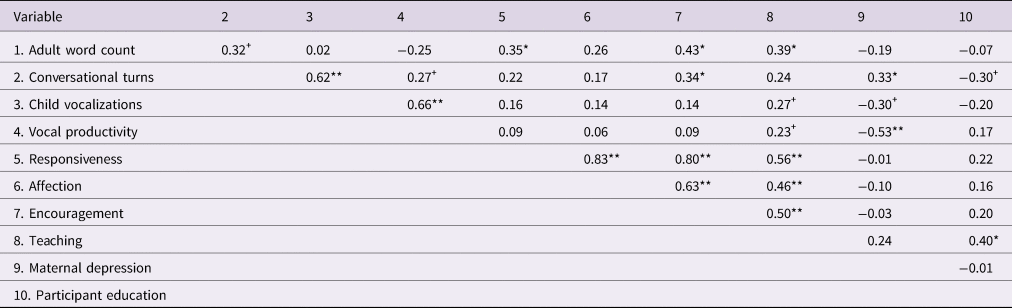
Correlations between study variables are presented in Table 2. No significant correlations were found between marital status, race, child gender, mother's age, child age, Legacy participation, and study variables. Mother's level of education was positively associated with observed teaching behaviors. Significant associations were found between adult word count and child vocalizations, conversational turns, and vocal productivity scores. Adult word counts were found to be significantly associated with observed responsiveness, encouragement, and teaching, while conversational turns were only found to be significantly associated with encouragement. Child vocalizations were marginally correlated with observed teaching behaviors and child vocal productivity scores.
Bivariate correlations between language variables, parenting behaviors, and maternal depression (N = 26)

Note. + p < .10, * p < .05, p < .01.
Descriptive statistics
The range of scores, means, and standard deviations, are presented in Table 1. LENA normative percentiles are also included in this table. The average adult word count for this sample fell in the 35th percentile with the average number of adult words spoken being 10,253 (SD = 3,471), and was lower than the average of 12,297 (SD = 6,642) words in the LENA normative database. Conversational turns for this sample were low, with the average in the 18th percentile (M = 18.77, SD = 19.18). Child vocalizations were in the 29th percentile (M = 29.77, SD = 25.04). Normative data for vocal productivity has not yet been published; however, the software does calculate percentiles. Vocal productivity scores were in the 41st percentile (M = 41.92, SD = 28.95). Maternal depression scores ranged from 0 to 64 with an average of 16 (M = 15.54, SD = 14.80).
Parenting behaviors and language outcomes
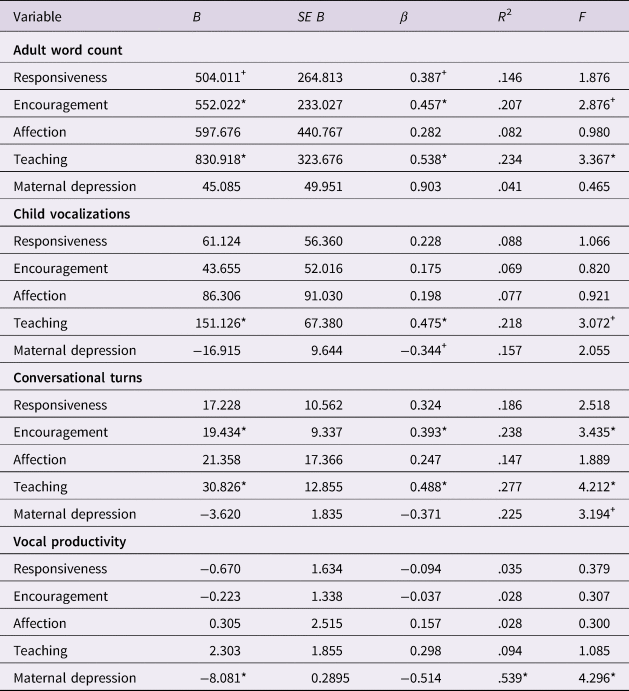
A regression analysis was conducted for each parenting variable (responsiveness, encouragement, affection, teaching, and maternal depression) predicting language variables, while controlling for mother's education level. Separate models were run for each parenting variable due to the small sample size (see Table 3). After controlling for maternal education, only teaching behaviors remained a significant predictor of adult word counts; the effect size was moderate. Observed teaching behaviors significantly predicted conversational turns and marginally predicted child vocalizations; the effects sizes were small. Encouraging behaviors were a small and significant predictor of conversational turns and were a marginally significant predictor of adult word counts. Maternal depression was a moderate and significant predictor of children's vocal productivity scores and a small, marginal predictor of conversational turns.
Summary of multiple regression analyses for parenting behaviors controlling for maternal education (N = 26)

Note. + p < .10, * p < .05.
Discussion
The aim of the current study was to examine and delineate differences in the home language environments of young children living in poverty and to examine the relationship between positive parenting behaviors, maternal depression, and young children's language environments, using full-day recordings collected in the child's natural environment. Overall, scores on home language environment variables were low, in comparison to LENA normative data. Results from regression analyses indicated that, of the four parenting behaviors observed (responsiveness, encouragement, affection, and teaching), teaching behaviors (e.g., giving explanations, labeling objects, repeating sounds or words) were the most consistent predictor of language outcomes. Mothers with lower levels of education also reported experiencing more depressive symptoms. Further vocal productivity scores, child vocalizations, and back and forth interactions were all lower among children whose mothers reported depressive symptoms approximately one year earlier; however, contrary to expectations, maternal depressive symptoms did not predict less adult talk.
Home language environment and maternal depression
The scores on home language environment variables were consistent with our hypothesis. Within an all low-income sample, these scores were low when compared to LENA normative data. These findings are consistent with those of other studies examining the associations between socioeconomic status and language outcomes (Gilkerson & Richards, Reference Gilkerson and Richards2008; Hart & Risley, Reference Hart and Risley1995; Leffel & Suskind, Reference Leffel and Suskind2013). Mothers with lower levels of education also reported experiencing more depressive symptoms. Moreover, vocal productivity scores, child vocalizations, and back and forth interactions were all lower among children whose mothers reported depressive symptoms approximately one year earlier. However, depressive symptoms did not predict less adult talk. One explanation for this finding is that maternal depression was assessed when children were between 3 and 11 months of age, and adult word counts were measured when children were approximately two years of age. Therefore, adult word counts would likely not be affected, if mothers were not currently experiencing depressive symptoms. These findings are in line with results from Stein and colleagues (Reference Stein, Malmberg, Sylva, Barnes and Leach2008), who found maternal depression in the first year of year of life predicted poorer child language outcomes at ten months, but not 36 months of age. If the effects of maternal depression on the amount of adult talk cannot later be identified, routine screening and treatment for mothers experiencing depression is of crucial importance for young children's language outcomes.
In addition to adult talk, studies have shown that child directed speech, social interactions, shared attention, and maintained engagement, impact young children's language development (Hollich, Hirsh-Pasek, & Golinkoff, Reference Hollich, Hirsh-Pasek and Golinkoff2000; Kuhl, Tsao, & Liu, Reference Kuhl, Tsao and Liu2003; Roseberry, Hirsh-Pasek, & Golinkoff, Reference Roseberry, Hirsh-Pasek and Golinkoff2014). Infants whose mothers are experiencing depression may have fewer opportunities to engage and interact with their mothers. Further, these interactions are also more likely to be characterized as negative in affect, less responsive, synchronous, and contingent, all of which have the potential to limit the child's access to adult words and interactions (Beebe et al., Reference Beebe, Jaffe, Buck, Chen, Cohen, Feldstein and Andrews2008; Cohn & Tronick, Reference Cohn and Tronick1983). Infants who experience these types of interaction may begin to limit their own efforts to engage in interactions or respond negatively to them (Cohn & Tronick, Reference Cohn and Tronick1983). In the current study, mother's depressive symptoms predicted children's vocal productivity scores one year later, suggesting that maternal depression negatively impacts child language outcomes.
Positive parenting behaviors and home language environment
After controlling for mother's education level, only teaching behaviors remained a significant predictor of adult word count, child vocalizations, and conversational turns, suggesting that teaching behaviors play a unique role in the quality of the early home language environment. Observed teaching behaviors included providing explanations, labeling objects or actions, talking about characteristics of objects, making suggestions to extend an activity the child is engaged in, asking questions, repeating or expanding words or sounds, asking for information and doing activities in a sequence, and engaging in pretend play. These finding are in line with those of other studies where teaching behaviors have been found to be associated with joint attention, shared play, and increased explanations and conversations (Fuligni & Brooks-Gunn, Reference Fuligni and Brooks-Gunn2013; Hollich et al., Reference Hollich, Hirsh-Pasek and Golinkoff2000; Roggman et al., Reference Roggman, Cook, Innocenti, Jump Norman and Christiansen2013; Roggman, Langlois, & Hubbs-Tait, Reference Roggman, Langlois and Hubbs-Tait1987). In addition, these findings support previous research suggesting that the qualitative features of the home language environment may be more significant than quantitative features (Gilkerson, Reference Gilkerson2017; Hirsh-Pasek et al., Reference Hirsh-Pasek, Adamson, Bakeman, Owen, Golinkoff, Pace and Suma2015; Romeo et al., Reference Romeo, Leonard, Robinson, West, Mackey, Rowe and Gabrieli2018). Numerous empirical studies suggest that the amount of talk matters, and that the quantity of verbal input has been associated with children's language growth, language speed, and processing abilities (Huttenlocher, Haight, Bryk, Seltzer, & Lyons;Reference Huttenlocher, Haight, Bryk, Seltzer and Lyons1991; Rowe, Reference Rowe2018; Weisleder & Fernald, Reference Weisleder and Fernald2013). However, when young children interact with their parents or caregivers through back and forth interactions, the linguistic and interactional components of the language environment are likely to be more complex when compared to the amount of overheard speech (Huttenlocher, Waterfall, Vasilyeva, Vevea, & Hedges, Reference Huttenlocher, Waterfall, Vasilyeva, Vevea and Hedges2010; Rowe, Reference Rowe2018; Weizman & Snow, Reference Weizman and Snow2001), which in turn positively impact child outcomes. In a recent study, a significant relationship was found between children's brain development and conversational turns (qualitative), but this relationship was not found for adult word count or child vocalizations (quantitative), suggesting that these back and forth interactions provide a unique contribution to language processing that is not present for the amount of adult or child speech (Romeo et al., Reference Romeo, Leonard, Robinson, West, Mackey, Rowe and Gabrieli2018). Further support for the importance of the qualitative features of the home language environment come from longitudinal research spanning a decade (Gilkerson, Reference Gilkerson2017). In this study, the strongest association between home language environment variables and child language outcomes 10 years later was the number of conversational turns. Further, significant positive associations were found between conversational turns, working memory, and cognitive development that were not found for adult word count or child vocalizations (Gilkerson, Reference Gilkerson2017).
In the current study, mothers’ encouraging behaviors (e.g., enthusiasm, verbal encouragement, support for child efforts) predicted conversational turns and marginally predicted adult word count, suggesting that encouraging interaction between young children and their mothers leads to more adult talk and conversational turns. This is in line with previous research, suggesting a positive relationship between positive parenting behavior and increased adult–child conversation (Tamis-Lemonda & Bornstein, Reference Tamis-LeMonda and Bornstein2002; Roggman et al., Reference Roggman, Cook, Innocenti, Jump Norman and Christiansen2013). While no relationship was found between affection and home language variables, this may be due to the items that make up the affection scale. Four of the seven items in that scale – physical proximity, smiling, engagement, and emotional warmth – are behaviors that cannot be captured by the LENA software. In addition, the first item, “speaks in a warm tone of voice”, can be coded highly for a parent who speaks little but very warmly. No significant findings for depression and parenting variables were found; this may be due to the timing of data collection. Maternal depression was assessed when infants were on average six months of age, while parenting behaviors were assessed approximately nine months later. We also did not find significant associations between participation in Legacy and study variables. This is likely due to the small sample size and the small number of Legacy participants in the analyses; only four.
Strengths and limitations
It is important to note that the sample size in the current study is small, therefore there is less power to detect associations that may reach significance in a larger sample. The demographics and small sample size limit the generalizability of the study findings. Replicating this study on a larger scale with a similar low-income population is an important next step. In addition, a larger sample size would allow for the delineation of demographic differences in the home language environments of low-income families, which we were unable to assess in the current study. Further, replicating these findings with respect to the negative association found between maternal depression and the quality of the home language environment would add to the internal validity of study findings. Legacy has been shown to positively impact children's developmental trajectories (Kaminski et al., Reference Kaminski, Perou, Visser, Scott, Beckwith, Howard and Danielson2013). While we did not find significant differences in the current study, there were not enough Legacy participants to detect group differences. Despite these limitations, the longitudinal design of the study is a strength and adds to the literature on the qualitative features of the home language environment. Further, the home language quality was measured using full-day recordings collected in the child's natural environment, rather than a structured lab setting, adding to the validity of the current study. To our knowledge, no studies to date have used LENA recording devices to assess home language environments in conjunction with observations of parent–child interactions and maternal depression. The focus on differences within a low-income sample and the observational measures of parent and child interactions are additional strengths of the current study and add to the current literature.
Study implications and future directions
Despite these limitations, this study has implications for interventions focused on early interventions targeting language quality. Identifying and treating depression prenatally and postnatally is critical if we are to reduce the language gap and improve language outcomes for low-income children. Interventions embedded within a medical home, such as Healthy Steps (Minkovitz et al., Reference Minkovitz, Hughart, Strobino, Scharfstein, Grason, Hou and Guyer2003) and Centering Pregnancy and Centering Parenting (Mittal, Reference Mittal2011), are in a unique position to screen for and treat depression. In addition, the group model of the Centering programs adds a social support component to the intervention similar to the Legacy intervention (Kaminski et al., Reference Kaminski, Perou, Visser, Scott, Beckwith, Howard and Danielson2013; Minkovitz et al., Reference Minkovitz, Hughart, Strobino, Scharfstein, Grason, Hou and Guyer2003; Mittal, Reference Mittal2011), which we also think may be helpful in minimizing depressive symptoms. Legacy focuses on increasing social support and parents’ confidence in their parenting abilities, and this may work to reduce maternal depression and improve interactions between mothers and their young children, thereby improving young children's language outcomes. Study findings indicate that teaching behaviors uniquely predict more adult talk and child vocalizations. Educating parents about the important role they play as their child's first teacher is an important next step. Many parents do not feel that their role is to teach their child; this is especially true with bilingual families (Talking is Teaching, 2017, p. 4). It is important to recognize this cultural difference when designing or implementing interventions. In addition, identifying and supporting the strengths of families from various cultural backgrounds is an important consideration that should not be overlooked. Providing parents with knowledge about the important role they play, in addition to arming them with easily implementable strategies, can empower them to engage in more meaningful dialogue with their children.
Acknowledgment
This project was supported by the Cooperative Agreement Number 5 U38 OT 000140-03 funded by the Centers for Disease Control and Prevention as a subaward from the Association of University Centers on Disabilities. The findings and conclusions in this report are those of the authors and do not necessarily represent the official position of the Centers for Disease Control and Prevention, the Department of Health and Human Services, or the Association of University Centers on Disabilities. The authors would like to thank the George Kaiser Family Foundation for their support of the Legacy for Children parenting program.
Appendix
LENA normative data