Introduction
Although many major causes of death including heart disease and stroke have recently been on the decline, deaths associated with impaired cognitive function (dementia) have been rising dramatically.1 Many studies have identified common vascular risk factors as markers for the pathogenesis of both Alzheimer's disease (AD) and vascular dementia (VaD), while longitudinal studies have suggested that hypertension is associated with a higher incidence of dementia in old age. It has been observed that long-standing hypertension may lead to severe atherosclerosis and impaired cerebrovascular autoregulation, which in turn is thought to correlate with dementia.Reference Kennelly, Lawlor and Kenny2 For these reasons, several studies have investigated whether antihypertensive treatment may retard cognitive decline or dementia.Reference Forette, Seux, Staessen, Thijs, Babarskiene, Babeanu, Bossini, Fagard, Gil-Extremera, Laks, Kobalava, Sarti, Tuomilehto, Vanhanen, Webster, Yodfat and Birkenhäger3–Reference Peters, Beckett, Forette, Tuomilehto, Clarke, Ritchie, Waldman, Walton, Poulter, Ma, Comsa, Burch, Fletcher and Bulpitt7 These five randomized controlled trials are reviewed.
At the same time, hypotension in later life may contribute to diminished cerebral perfusion, which can potentially lead to dementia. Consistent with this, some reports have suggested that hypotension, especially low diastolic blood pressure in late life, increases risk.Reference Kennelly, Lawlor and Kenny2 This literature is also reviewed.
Hypertension and the risk of dementia
In general, the risk of hypertension, which is defined as a systolic blood pressure ≥ 140 mmHg and/or a diastolic blood pressure ≥ 90 mmHg,Reference Lenfant, Chobanian, Jones and Roccella8 increases with advancing age. In fact, the prevalence of hypertension in individuals 60 years and older is double that of those aged 49–59 years. Considering that the incidence of dementia among the elderly population is rising rapidly worldwideReference Chen, Lin and Chen9 and evidence is accumulating that hypertension may contribute to the development of both AD and VaD,Reference Gorelick10 there is reason to believe effective management of hypertension may translate into major health benefits through protection against dementia.
Can control of hypertension protect against dementia?
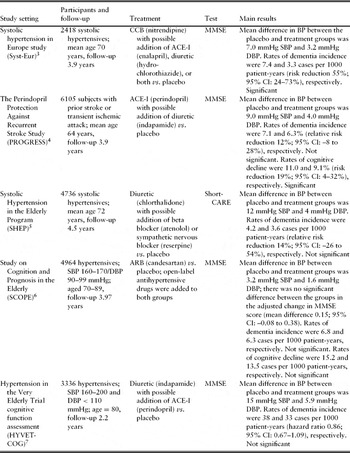
Despite the speculated relationship between hypertension and dementia, clinical trials examining the preventive effects of antihypertensive therapy on dementia have been inconclusive (Table 1). Among five randomized double blind placebo-controlled trials surveying antihypertensive treatments and dementia, four (Syst-Eur, PROGRESS, SCOPE and HYVET-COG) used the Mini-Mental State Examination (MMSE), a widely used screening instrument, to assess cognitive function. In the fifth study (SHEP), cognitive screening was performed by a short-comprehensive assessment and referral evaluation (short-CARE) questionnaire. These five studies are described below.
Randomized controlled trials about antihypertensive treatments and dementia/cognitive decline

BP, blood pressure; SBP, systolic blood pressure; DBP, diastolic blood pressure.
Syst-Eur
The Systolic Hypertension in Europe study (Syst-Eur) investigated whether antihypertensive treatment in elderly patients with isolated systolic hypertension led to a significant change in stroke morbidity and mortality. Syst-Eur investigated the effects of a calcium channel blocker (CCB; 10–40 mg/day nitrendipine). If necessary, nitrendipine was combined with an angiotensin converting enzyme (ACE)-inhibitor (5–20 mg/day enalapril maleate) and/or a diuretic (12.5–25 mg/day hydrochlorothiazide). Participants had no dementia and were at least 60 years old. Their systolic blood pressure at the beginning of the trial was between 160 and 219 mmHg and their diastolic blood pressure was below 95 mmHg. Antihypertensive therapy began immediately after randomization in the active treatment group, but only after termination of the double-blind trial in the control patients. The mean difference in blood pressure between the control and treatment groups at the end of the trial was 7.0 mmHg systolic and 3.2 mmHg diastolic; the rates of dementia for patients in the control and active treatment groups were 7.4 and 3.3 cases per 1000 patient-years (relative risk reduction 55%; 95% CI: 24–73%), respectively.
In Syst-Eur, because active treatment using a CCB resulted in a 42% decrease in the primary end-point of fatal and non-fatal stroke, only 2418 of the 4695 randomly assigned patients participated in a sub-study on dementia. Compared with the control group, the portion of the treatment group that received only CCB (60%) had a significantly reduced risk of dementia (55%). Interestingly, while the total incidence of dementia was 64 cases, 41 of these were AD. Therefore, Syst-Eur suggests that using a CCB to lower blood pressure may protect against dementia, particularly AD, in elderly individuals with systolic hypertension.
PROGRESS
The Perindopril Protection Against Recurrent Stroke Study (PROGRESS) was a trial involving 6105 patients, all with prior stroke or transient ischaemic attack. Participants were assigned to either active treatment (perindopril for all participants plus indapamide for those with neither an indication nor a contraindication to a diuretic) or a matching placebo(s). The mean difference in blood pressure between the two groups was 9.0 mmHg systolic and 4.0 mmHg diastolic; the rates of dementia in patients in the control and active treatment groups at trial end were 7.1% and 6.3% (relative risk reduction 12%; 95% CI: −8 to 28%). This difference is not statistically significant. However, the rates of cognitive decline were 11.0% and 9.1% (risk reduction 19%; 95% CI: 4–32%), difference, which is significant.
SHEP
The Systolic Hypertension in the Elderly Program (SHEP) study was a trial conducted over an average 5-year follow-up period and involved 16 academic clinics. Among the 447,921 candidates aged 60 years and older screened, 4736 (1.06%) were chosen for the study. Systolic blood pressure at baseline ranged from 160 to 219 mmHg, while diastolic blood pressure was less than 90 mmHg. Participants were randomized into either an active antihypertensive drug therapy or a matching placebo group. Active treatment consisted of 12.5 to 25 mg chlorthalidone for step 1, and 25 to 50 mg atenolol for step 2. If atenolol was contraindicated, 0.05 to 0.10 mg reserpine was used instead. The cohort mean difference in blood pressure between the placebo and treatment groups at study end-point was 12.0 mmHg systolic and 4.0 mmHg diastolic; the rates of dementia for the control and active treatment groups were 4.2 and 3.6 cases per 1000 patient-years (relative risk reduction 14%; 95% CI: ˗26 to 54%), respectively, a difference that is not statistically significant.
SCOPE
The Study on Cognition and Prognosis in the Elderly (SCOPE) was a prospective study conducted from 1997 to 2002. The study involved 4964 patients aged 70–89 years with systolic blood pressures ranging from 160 to 179 mmHg and/or diastolic blood pressures ranging from 90 to 99 mmHg. Patients were assigned randomly to receive the angiotensin II receptor blocker (ARB) candesartan or a placebo, with open-label active antihypertensive therapy added as required (84% of patients in the control group). The mean difference in blood pressure between the placebo and treatment groups was 3.2 mmHg systolic and 1.6 mmHg diastolic at the end of the trial; the rates of dementia for the control and active treatment groups were 6.8 and 6.3 cases per 1000 patient-years, respectively, a difference that is not statistically significant.
In a subgroup analysis of SCOPE performed later, a significant positive effect on some cognitive domains (attention and episodic memory) was reported when using testing methods more sensitive than the MMSE.
HYVET-COG
The Hypertension in the Very Elderly Trial-cognitive function assessment (HYVET-COG) examined antihypertensive medication for patients >80 years of age. Eligible patients had no dementia, their systolic blood pressure at entry was 160–200 mmHg, and their diastolic blood pressure was below 110 mmHg. Participants were randomly assigned to receive 1.5 mg slow release indapamide with the option of 2–4 mg perindopril, or a placebo. The target systolic blood pressure was 150/80 mmHg. Possible new cases of dementia (a fall in the MMSE score to <24 or a drop of three points in 1 year) were assessed by standard diagnostic criteria and expert review. HYVET-COG was the first randomized control study to report the effects of antihypertensive treatment in participants aged 80 years and older, finding a significant decrease in stroke after an average follow-up of 2.2 years, which led to its early termination. This follow-up period may be too short to detect any benefit in preventing dementia.
The mean difference in blood pressure between the treatment and control groups at study end was 15 mmHg systolic and 5.9 mmHg diastolic; the rates of dementia for the control and active treatment groups were 38 and 33 cases per 1000 patient-years (hazard ratio 0.86; 95% CI: 0.67–1.09), respectively, a difference that is not statistically significant.
Of these five studies, only Syst-Eur and PROGRESS showed significant differences in the rate of dementia between the treatment and control groups.
However, when data were combined in a meta-analysis with three other placebo-controlled trials (Syst-Eur, SHEP and PROGRESS),Reference Peters, Beckett, Forette, Tuomilehto, Clarke, Ritchie, Waldman, Walton, Poulter, Ma, Comsa, Burch, Fletcher and Bulpitt7 antihypertensive therapy was found to significantly reduce the risk of dementia (HR 0.87; 95%CI: 0.76–1.00, P = 0.045). Another study, however, found that combining the antihypertensive therapy results from Syst-Eur, SHEP and SCOPE reduced the risk of dementia by 11% (odds ratio 0.89; 95% CI: 0.69–1.16), an insignificant effect.Reference Morris, Scherr, Hebert, Bennett, Wilson, Glynn and Evans13 Therefore, further long-term randomized trials designed especially to assess a link between antihypertensive therapy and cognition as the primary outcome are needed.
Hypotension and the risk of dementia
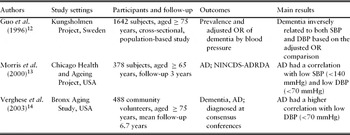
Some reports have suggested the hypotension may also correlate with dementia (Table 2). The Kungsholmen ProjectReference Guo, Viitanen, Fratiglioni and Winblad12 studied a cohort of 1642 subjects aged 75–101 years, among whom 202 were diagnosed with dementia, including 112 with AD. The study found that the incidence of dementia was inversely related to both systolic and diastolic blood pressure and that low blood pressure (≤140/75 mmHg) was related to a higher prevalence of both dementia and AD. The Chicago Health and Ageing Project (CHAP)Reference Morris, Scherr, Hebert, Bennett, Wilson, Glynn and Evans13 also showed AD to be significantly more common among subjects with low systolic pressure (<130 mmHg) when compared with a control group with a systolic blood pressure of 130–139 mmHg (odds ratio (OR) = 2.2; 95% CI: 1.2–4.1) and that AD is more common among subjects with low diastolic pressure (<70 mmHg) when compared with a control group with a diastolic pressure of 70–79 mmHg (OR = 1.8; 95% CI: 1.1–3.1).
Studies describing an association between hypotension and dementia
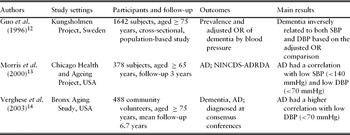
NINCDS-ADRDA, National Institute of Neurological and communicative Disordered and Stroke-Alzheimer's Disease and related Disorders Association; OR, odds ratio.
The Bronx Aging Study,Reference Verghese, Lipton, Hall, Kuslansky and Katz14 a prospective study, examined 406 community-dwelling elderly individuals over the age of 75 and dementia-free at baseline (1980 to 1983). They were followed at 12- to 18-month intervals for up to 21 years. Over a median follow-up of 6.7 years, 122 subjects developed dementia, and of these 65 were diagnosed with AD. Individuals with a diastolic blood pressure <70 mmHg were twice as likely to develop AD than those whose blood pressure was >90 mmHg. Subjects with persistently low blood pressure for over 2 years also had a higher risk of developing dementia. No association with systolic blood pressure was described, nor was there any relationship between low diastolic blood pressure and VaD.
Recently, Molander et al.Reference Molander, Gustafson and Lövheim15 studied the association between low blood pressure and cognition in the very old (over 85 years). This cross-sectional study included 575 individuals with measured systolic and diastolic blood pressures, from which pulse pressure (PP) was calculated. Cognitive function was evaluated using the MMSE. After adjustment for several demographic variables and diagnoses, systolic blood pressure was found to be significantly and non-linearly associated with the MMSE, with both high and low blood pressures associated with lower scores. There was also a positive linear association between PP and MMSE scores, but no association between MMSE and diastolic blood pressure. Overall, participants with dementia were found in general to have lower blood pressure.
Although several reports show a relationship between hypotension and dementia, they do not establish whether this relationship is causal. Consequently, further studies are required.
Orthostatic hypotension and dementia
Orthostatic hypotension (OH), arbitrarily defined as a decrease in SBP ≥ 20 mmHg and/or DBP ≥ 10 mmHg upon standing, is more common in patients suffering from dementia.Reference Sonnesyn, Nilsen, Rongve, Nore, Ballard, Tysnes and Aarsland16 Recently, Mehrabian et al.Reference Mehrabian, Duron, Labouree, Rollot, Bune, Traykov and Hanon17 studied the association between cognitive function and OH in 495 consecutive elderly out-patients, finding an association between the two. The study therefore concluded there is a need for longitudinal studies that are designed to evaluate the nature of this relationship.
The renin–angiotensin–aldosterone system and cognitive function
Blocking the renin–angiotensin–aldosterone system (RAS) is another means that could have benefits in the prevention of dementia,Reference Tzourio, Anderson, Chapman, Woodward, Neal, MacMahon and Chalmers18 but in a manner independent of blood pressure lowering.Reference Turnbull, Neal, Pfeffer, Kostis, Algert, Woodward, Chalmers, Zanchetti and MacMahon19 A potential neuroprotective effect on focal cerebral ischaemia has been reported by blocking the RAS with an ARB that specifically targets the angiotensin II receptor.Reference Krikov, Thoene-Reineke, Müller, Villringer and Unger20 Moreover, the Fournier hypothesis proposes that ARB treatment has potential advantages over ACE inhibitor treatment in the prevention of stroke and cognitive impairment because of the lower likelihood of harmful effects like vasoconstriction and proatherothrombogenesis, while at the same time promoting neutral or even potentially beneficial effects like vasodilatation and endothelial modulation.Reference Fournier, Messerli, Achard and Fernandez21, Reference Boutitie, Oprisiu, Achard, Mazouz, Wang, Messerli, Gueyffier and Fournier22
Consistent with this theory, the Ongoing Telmisartan Alone and in Combination with Ramipril Global Endpoint Trial (ONTARGET)23 and the parallel Telmisartan Randomized Assessment Study in ACE Intolerant Subjects with Cardiovascular Disease (TRANSCEND) Trial24 have reported the effects of the ARB telmisartan, a unique angiotensin II receptor blocker with peroxisome proliferator-activated receptor-gamma (PPAR-gamma)-stimulating activity, and the ACE inhibitor ramipril on cognitive function in patients aged 55 years and older with established atherosclerotic cardiovascular disease or diabetes with end-organ damage. In ONTARGET, a 56-month median duration follow-up found cognitive impairment occurred in 652 (8%) of the 7865 patients allocated ramipril, 584 (7%) of the 7797 allocated telmisartan, and 618 (8%) of the 7807 allocated a combination of the two (combination vs. ramipril, OR 0.95, 95% CI 0.85–1.07, P = 0.39; telmisartan vs. ramipril, OR 0.90, CI 0.80–1.01, P = 0.06). Corresponding figures for cognitive decline were 1314 (17%), 1279 (17%) and 1240 (17%), respectively (telmisartan vs. ramipril, OR 0.97, CI 0.89–1.06, P = 0.53; combination vs. ramipril, OR 0.95, CI 0.88–1.04, P = 0.28). In TRANSCEND, cognitive impairment occurred in 239 (9%) of the 2694 participants allocated telmisartan compared with 245 (9%) of the 2689 allocated a placebo (OR 0.97, CI 0.81–1.17, P = 0.76). The corresponding figures for cognitive decline were 454 (17%) and 412 (16%; OR 1.10, CI 0.95–1.27, P = 0.22), respectively.
Recently, the Prevention Regimen for Effectively Avoiding Second Strokes (PRoFESS) trialReference Diener, Sacco, Yusuf, Cotton, Ounpuu, Lawton, Palesch, Martin, Albers, Bath, Bornstein, Chan, Chen, Cunha, Dahlöf, De Keyser, Donnan, Estol, Gorelick, Gu, Hermansson, Hilbrich, Kaste, Lu, Machnig, Pais, Roberts, Skvortsova, Teal, Toni, VanderMaelen, Voigt, Weber and Yoon25 investigated the impact of ARBs on cognitive function in a randomized controlled design. There were no significant differences in the rate of cognitive decline or dementia between the treatment and control groups. These results were very similar to those found in SCOPE. However, PRoFESS had several limitations that obfuscate its conclusions. For example, the duration of the follow-up period was short, there was a frequent discontinuation of the study drug among subjects, and many patients experienced recurrent stoke requiring termination of the antihypertensive treatments.
Figaro et al.Reference Fogari, Mugellini, Zoppi, Lazzari, Destro, Rinaldi and Preti26 reported that antihypertensive therapy with an ARB and diuretic (telmisartan and hydrochlorothiazide) caused significant improvement in cognitive function compared with therapy using an ACE-I and diuretic (lisinopril and hydrochlorothiazide). In addition, the Observational Study on Cognitive function And Systolic Blood Pressure Reduction (OSCAR), an open label trial in 28 countries designed to evaluate the impact of the ARB eprosartan on cognitive function, found that reduction in systolic blood pressure had an independent negative association with cognitive decline (OR 0.77; 95% CI: 0.73–0.82). Recently, Tsukuda et al.Reference Tsukuda, Mogi, Iwanami, Min, Sakata, Jing, Iwai and Horiuchi27 demonstrated that a low dose of telmisartan had a preventive effect on cognitive decline in an AD mouse model (Aβ-injection mouse model). This was in part due to the clearance of Aβ in response to an inhibition of inflammation because of PPAR-gamma activation. Thus ARBs that can act as a partial agonist for PPAR-gamma may provide a benefit for the treatment of dementia, along with their already well-described blood pressure lowering effects.
Conclusion
It is thought that a dependent relationship exists between the occurrence of hypertension and the risk of developing dementia in old age.Reference Kennelly, Lawlor and Kenny2 This offers promise in the prevention of dementia because hypertension is a potentially reversible risk factor. In particular, given that Syst-Eur found treating hypertension with the dihydropyridine CCB nitrendipine reduced the incidence of AD by 55%, nitrendipine could prove to be a potentially reliable option for protection against dementia.
Hypotension also showed a correlation with dementia in elderly subjects, especially those with diastolic blood pressures ≤ 70 mmHg. However, further studies are required to determine whether this relationship is causal or a secondary response to neurodegeneration that affects blood pressure centres within the brain.
As for AD, because current theories assume AD is triggered by the accumulation of soluble and insoluble forms of β-amyloid, if high or low blood pressure can increase the risk of AD, they should then also lead to an accumulation of β-amyloid.
Therefore, future trials primarily designed to investigate the effects of antihypertensive and antihypotensive agents on impaired cognition are needed. In particular, whether these agents possess specific neuroprotective properties or exert their effects by an increase in cerebral perfusion remains to be clarified.
Conflicts of interest
The authors declared no conflicts of interest.