


Introduction
In 2016, Tunisia’s largest queer rights organization was suspended pending an investigation into the legality of its activities (Ferchichi Reference Ferchichi2019). In 2017, a concert by Lebanese band Mashrou’ Laila in Cairo resulted in the arrest of 75 queer rights advocates, and a broader crackdown on sexual freedoms and gender expression (Ameling Reference Ameling2022). In 2018, attacks were mounted in and outside of court against the recent removal of a ban on interfaith marriage in Tunisia (Bajec Reference Bajec2018). In 2020, 11 TikTok content creators in Egypt were prosecuted under charges of prostitution and human trafficking. In the so-called TikTok Ladies cases, the young defendants were jailed because of their artistic content on the social media platform (Osman Reference Osman2021). In 2022, the Arabic film Perfect Strangers, a Netflix production by and for the Middle East and North Africa, provoked legal battles in the region due to its sexual content (Saraya 2022). The film, featuring a main character who comes out as gay to his friends, prompted litigation against Netflix, the film producers, and governments in the region (El-Naggar Reference El-Naggar2022).
In all these cases, conservative legal actors marshalled the law to fight against gender equality and sexual rights and to punish sexual minorities and rights advocates. Legal mobilization, commonly viewed as a weapon in the fight for human rights and minority protections (Chua Reference Chua2019; McCann Reference McCann1994; Sikkink Reference Sikkink2011), is now increasingly weaponized against rights and equality (Escoffier et al. Reference Escoffier, Payne, Zulver, Payne, Zulver and Escoffier2023; Southworth Reference Southworth2008). Conservative actors around the world are adopting rights discourses, using litigation, drawing on social movement repertoires, and building transnational coalitions to challenge a selection of rights in the name of the supposed defense of others (Southworth Reference Southworth2008, Reference Southworth2024, 310). Rather than rejecting rights discourses, these actors strategically engage with rights frameworks to undermine minority rights, often in the name of defending and restoring other traditional rights such as family rights and religious freedoms (Escoffier et al. Reference Escoffier, Payne, Zulver, Payne, Zulver and Escoffier2023, 3). Scholarship on the right against rights has grown in a context of mounting assaults on rights by conservatives around the world. The assault on human rights is not new or surprising, but what stands out is its context, tactics, and impact (De Búrca and Young Reference De Búrca and Young2023, 207; Payne Reference Payne, Payne, Zulver and Escoffier2023). When and how do conservative legal actors mobilize the law to suppress rights and fight forms of equality?
This question has been the subject of growing scholarship investigating the legal mobilization of the right against rights. Scholars have situated this clampdown on rights within the contexts of a backlash to the rights revolution (Payne Reference Payne, Payne, Zulver and Escoffier2023), the precariousness produced by neoliberal governmentality (Regilme Reference Regilme2019), and the rise of illiberal legality (Scheppele Reference Scheppele2018). Concerns about the rising illiberal legality mirror those of the mounting attacks by the right against rights. While autocracy and assaults on democratic norms are not new either, the legalistic tactics and logics of these assaults are remarkable. In her comparative research into the rise of autocratic legalism, Scheppele (Reference Scheppele2018) observes that the language, institutions, and procedures of law are increasingly weaponized in the service of antidemocratic and antirights agendas. Constitutional retrogression and democratic backsliding are not just fascinating because of their global spread, but their legalistic modus operandi has contributed to our understanding of the complex nexus between law, liberalism, and rights (Ginsburg and Huq Reference Ginsburg and Huq2018). Once again, rather than rejecting the law or its institutions, conservative actors use the law to undermine democracy, silence dissent, and centralize power (Scheppele Reference Scheppele2018, 572).
In addition to examining the causes behind the rise of conservative legal mobilizations against rights, scholars investigate the tactics and strategies of these assaults. Scholarship from the United States and from around the world highlights important strategies adopted by the right in their onslaught on rights and freedoms. The list of strategies includes the repurposing of rights, including the right to privacy, to protect some rights – such as parental rights – while oppressing other rights, especially queer rights (Wuest Reference Wuest2021). Weaponizing rights discourses is often combined with an appeal to traditions and values that enable the oppression of minorities (Cummings Reference Cummings2018). Other research exposed the reliance on (mis)appropriations of rights to justify and enable the repression of rights (De Búrca and Young Reference De Búrca and Young2023), including through the mobilization of religion to support conservative legal reform in the areas of gender, sexuality and reproductive rights (Palazzo Reference Palazzo2024). In some contexts, conservative legal actors weaponize anticolonial sentiments to justify antiequality and antisexuality agendas (Currier Reference Currier2011). In other cases, legal doctrines, such as hisba (Moustafa Reference Moustafa2010) and antiprostitution laws are selectively applied to punish sexual minorities and gender expression (Ameling Reference Ameling2022; Magued Reference Magued2023). While sociolegal scholarship has long examined the tactics of social movements and the rights revolution, it has become mandatory to turn our attention to antirights mobilizations and examine their context, tools and strategies, especially when these mobilizations are not institutionalized or backed by a conservative legal movement.
This article builds on the emergent literature on the rise of conservative legal mobilization against rights by examining the tactics and strategies that conservative legal actors deploy in challenging sexual rights and gender equality. Drawing on legal case studies, interviews, and court observations in Egypt and Tunisia, this paper contributes to understanding the context and tactics of legal mobilizations by the right against rights in North Africa. I argue that within the context of illiberal legality, the law and rights discourses have become the legitimizing discourses and tactics of conservative mobilizations. Specifically, based on the case studies, I identify three main tactics: rights selectivism, repressive legalism, and majoritarianism. The first, rights selectivism, is a tactic of mobilizing rights frameworks and a set of rights to legitimize the oppression of other rights. Rights frameworks including antitrafficking laws are employed to criminalize and punish sex workers and, in Egypt’s case, content creators on TikTok (Magued Reference Magued2023). Second, repressive legalism emerges as an important legal tactic, where conservative actors find any tangential legal code to use for the purpose of punishing minorities and those advocating for minorities’ rights and gender equality. Third, appeals to majoritarianism, democracy, and anticolonial work are tactics that were used in all legal cases. By majoritarianism, I mean an appeal to majority views or anxieties on a subject as an excuse for the suppression of minority rights. In their appeal to majorities, conservative legal actors adopt a simplistic view of democracy as the rule of the majority, thus couching their activism in a seemingly democratic principle that majorities trump minorities. In the case studies presented in this paper, conservative Egyptian and Tunisian lawyers have gone as far as accusing LGBTQ activists of being antidemocratic, because they do not respect that the majority of the population might not support queer rights. The case studies analyzed in this paper showcase the strategies and tactics deployed by conservative legal actors in North Africa, and the selective, repressive, and majoritarian logics that they follow. At the same time, the case studies highlight the degree to which legalism and rights discourses are embraced in the right’s assault on rights. While these conservative actors are not necessarily institutionalized or backed by a conservative legal movement, their legal mobilizations at times unleashed episodes of state repression of minority rights.
In the following sections, I position this study within the scholarship on the right against rights and literature on illiberal legalism. I then outline the methodology and case study selection and detail the findings of four legal case studies. Finally, I discuss the theoretical and empirical lessons and what they tell us about when and how conservative legal actors mobilize the law against rights.
The right against rights amidst illiberal legality
As illiberal and antirights legal regimes spread, scholars have examined the ways in which conservative actors mobilize the law and its symbolic legitimacy to restrict, rather than expand, rights and freedoms (Sanders Reference Sanders2018; Scheppele Reference Scheppele2018). In their edited volume The Right Against Rights in Latin America, Payne et al. (Reference Payne, Zulver and Escoffier2023) define right-against-rights actions as:
collective extra-institutional and institutional mobilization(s) to check, roll back, or reverse specific rights promoted by previously marginalized groups and communities (i.e. gender and sexuality, ethnic, race, environment, accountability for crimes against humanity) and to restore, promote or advance a status quo ante of traditional political, social, economic and cultural rights. (3)
With the notable rise of conservative mobilizations against rights, researchers have delved into the make-up, motivations, and tactics of right-against-rights groups (Payne et al. Reference Payne, Zulver and Escoffier2023), or what scholars called a rights’ countermobilization (Rosenberg Reference Rosenberg2008), a conservative legal movement (Southworth Reference Southworth2018), a countermovement (Cummings Reference Cummings2018), or the moral conservatives (Lehoucq Reference Lehoucq2021). Specifically, sociolegal scholars examined why and how conservative legal actors advance antirights, antigender, and antisexuality agendas (Sanders Reference Sanders2018; Southworth Reference Southworth2024; Wuest Reference Wuest2021).
While early sociolegal scholarship focused on legal mobilization as a vehicle for progressive change (McCann Reference McCann1994), contemporary research recognizes law as a site of contestation, where both progressive and conservative actors deploy rights claims to shape social and political orders (Cummings Reference Cummings2018; Rosenberg Reference Rosenberg2008). Legal mobilization has various definitions, but in this paper, I adopt Lehoucq and Taylor’s understanding of legal mobilization as “the use of law in an explicit, self-conscious way through the invocation of a formal institutional mechanism” (2019, 183). While legal mobilization refers to the practice of using the law in the service of social agendas, the actors behind such mobilization vary depending on the context. Southworth (Reference Southworth2018) describes a conservative legal movement in the United States as an institutionally coordinated effort, composed of lawyers, judges, advocacy groups, think tanks, funders, and media outlets working together “generating, legitimating, and diffusing ideas to support legal change” (1708). Echoing a noninstitutional form of legal mobilization, Lehoucq (Reference Lehoucq2021) sheds light on the moral conservatives of Colombia, the legal actors that mobilize the law in defense of traditional marriage and family rights (300). Similarly, noninstitutionalized hisba lawyers in Egypt and across the Middle East have used the law to protect religious morality (Moustafa Reference Moustafa2010). And despite the widespread impact of some of these litigations, hisba lawyers never formed an organized or institutionalized movement (Lambert Reference Lambert2015).
Context and drivers of conservative legal action
What drives conservative legal mobilization? Legal mobilization is driven by both the presence of grievances and the opportunity structures to fight for change. Scholars have identified multiple reasons and contexts for the rise of conservative legal action against rights. Rosenberg (Reference Rosenberg2008) observed in his foundational work The Hollow Hope that legal victories for civil rights generated legal and political countermobilizations, as seen in the aftermath of the Supreme Court decision in Brown v. Board of Education (72). Other scholars made similar arguments about abortion and the rights discourse that framed the movement around “choice” leading up to the 1973 Roe v. Wade decision (Cummings Reference Cummings2018). In backlash, a countermovement framed around the “right to life” built momentum for decades, paving the way for the 2022 Supreme Court decision Dobbs v Jackson (Cummings Reference Cummings2018: 397). In their comparative study of the right against rights in Latin America, Escoffier et al. (Reference Escoffier, Payne, Zulver, Payne, Zulver and Escoffier2023) argue that the backlash is not merely triggered by legal changes (14). Rather, the perception that minority groups are advancing in their rights was enough to elicit a reaction from the right (ibid.,). Similarly, the case studies presented in this paper illustrate that the perceived threat of minority rights advances, whether by unfurling rainbow flags in a concert or seeing an LGBTQ group expand its operations outside the capital, is enough to unleash an aggressive reaction. In addition to forming as a backlash against the expansion of rights, legal mobilization – whether on the right or left – is specifically useful when freedom of speech and association are under attack, especially in undemocratic contexts (Cummings and NeJaime Reference Cummings and NeJaime2010; Anabtawi Reference Anabtawi2022; Khalil Reference Khalil2023a, Levitsky Reference Levitsky2015). The law can be a critical avenue for fighting for and against change in repressive contexts that restrict the “rights to association, to protest, to organize, and even to the mere presence in public spaces” (Khalil Reference Khalil, Boutcher, Shdaimah and Yarbrough2023b, 302).
But, even in more liberal contexts, where protest and freedom of expression are protected, scholars have mapped the rise of autocratic legalism, the phenomenon when “constitutional and legal changes are used in the service of illiberal agendas” (Scheppele Reference Scheppele2018: 548). In parallel to the right against rights framework, sociolegal scholars explored the rise of autocratic legalism, the prevalence of legalistic democratic backsliding, the phenomenon of legal dualism, and the pervasiveness of illiberal legality (Ginsburg and Huq Reference Ginsburg and Huq2018; Hendley Reference Hendley2022; Scheppele Reference Scheppele2018). As the law is increasingly being used for the service of undemocratic outcomes, it is also serving to advance antirights agendas. In this legal mobilization, legal professionals, including lawyers, judges, and prosecutors, are playing a central role in entrenching autocratic rule through policy work, legal interpretation, and litigation (de Sa e Silva Reference Silva2022). In Egypt, legal professionals have marshalled the law to assist autocracy; they did so by rewriting the constitution, capturing the judicial institutions, and enacting legislative changes through the parliament (Khalil Reference Khalil2024: 1599). Simultaneously, conservative legal actors engaged the law to punish sexual minorities, deny due process to victims of sexual violence, and resist gender equality (Amar Reference Amar2013, 51).
In addition to the pervasiveness of legalism, scholars have argued that controlling sexuality and upholding patriarchy are important tool kits in enacting state power and producing state effects (Amar Reference Amar2013; Pratt Reference Pratt2007; Puri Reference Puri2016). This is particularly pertinent at times when the relevance of states seems to diminish “as a result of neoliberal policies or transnational forms of governmentality” (Puri Reference Puri2016: 150). In her analysis of the applications of the antisodomy laws in India, Puri (Reference Puri2016) argues that “sexual states” use the governance and control of sexuality to underscore their “inevitability,” especially when they are “in flux” (6). Similarly, in her analysis of the first court trials of gay men in Egypt in 2001, in what became known as the Queen Boat Case, Pratt (Reference Pratt2007) argues that punishing gay men, much like controlling women, has to be “understood as a government response not only to its own vulnerability but also to the economic and geopolitical insecurity of the state” (134–135). The vulnerability of the state finds its roots in the dismantling of the welfare state in Egypt with its adoption of neoliberal policies in the last few decades (Khalil and Dill Reference Khalil and Dill2018: 577). Amar (Reference Amar2013) shows how the neoliberal state in Egypt invoked the “right to security” to roll back gender and sexual rights in the country. The insecurity at the level of the state can be analyzed as a contributing factor to state-sponsored, antirights legal reforms, as well as individual-based conservative legal work (Ameling Reference Ameling2022: 28). Payne and de Souza Santos (Reference Payne and de Souza Santos2020) similarly point to the role of neoliberalism, and economic vulnerabilities in the creation and weaponization of moral panics in Brazil’s antirights mobilizations (7). North Africa’s conservative legal mobilization against rights is thus located within the context of rising illiberal legality, where the discourse and framework of law are used and abused (Corrales Reference Corrales2015, 38) by actors to elicit legitimizing effects. At the same time, it is enabled by fragile, neoliberal states, which enact their power and relevance through sounding moral panics about sexuality, gender, and external danger. In the case studies presented in this paper from Tunisia and Egypt, it is noninstitutional actors who instigate the panics, use and abuse the law to police and punish sexual and gender minorities and advocates. In response, institutional actors get involved, especially prosecutors, and take over the tasks of disciplining and punishing sexual minorities and gender advocates. Even when conservative legal actors are not always successful in securing courtroom victories, they succeed in mobilizing public opinion, sounding the cultural alarm on certain issues, and further stigmatizing minorities and their rights, as the cases of the women TikTokers and the rainbow flag queer activists will show in this text.
Tactics and strategies of conservative legal actors
The tool kit of conservative legal mobilization is varied and sophisticated. In this paper, I draw on sociolegal scholarship on conservative legal mobilization against rights and legal case studies from North Africa to introduce three tactics: rights selectivism, repressive legalism, and majoritarianism. While elements of these strategies have been discussed individually in prior work (e.g., Decker Reference Decker2016; Garces et al. Reference Garces, Johnson, Ambriz and Bradley2022; Wuest Reference Wuest2021), this framework contributes to the literature by organizing and naming these tactics in ways that synthesize and extend their current theorization while drawing attention to their patterned use in conservative legal mobilization against rights.
Far from rejecting rights discourses, conservative actors weaponize the language of rights to selectively uphold some rights, while restraining others (Ayoub and Stoeckl Reference Ayoub and Stoeckl2024; Decker Reference Decker2016; Magee Reference Magee2018). I refer to this as rights selectivism, the weaponization of a set of rights against other groups of rights. In the United States, Magee (Reference Magee2018) illustrates that conservative think tanks have done the “intellectual labor” of building antirights discourses, sometimes by couching them in selective rights-talk, such as arguing that environmental regulations infringe on “the rights of individuals and businesses” (297). Or as Decker (Reference Decker2016) puts it: “Conservatives could not turn back the clock on the rights revolution. But they could make a rights revolution of their own” (227). De Búrca and Young (Reference De Búrca and Young2023) highlight the phenomenon of (mis)appropriations, in which conservatives “use human rights language in the service of ends which are exclusionary, repressive, or anti-pluralist in character, highly retrogressive or reversing of previous commitments, and evasive of external monitoring or accountability” (205). Wuest (Reference Wuest2021) explores how the right to privacy, once a pillar of reproductive and queer rights, has been appropriated by conservatives to oppose transgender healthcare and inclusive curricula. On a transnational level, Southworth (Reference Southworth2024) and Ayoub and Stoeckl (Reference Ayoub and Stoeckl2024) document how conservative legal actors coordinate across borders, forming transnational alliances to share legal arguments and strategies in their assault on rights, often by drawing on “rival rights” (Bob 2009, cited in Southworth Reference Southworth2024). Drawing on these studies, I highlight rights selectivism as a tactic not of “misappropriations” (De Búrca and Young Reference De Búrca and Young2023), but rather as a strategic appropriation of some rights in the service of undermining others. In other words, the appropriation of rights is neither accidental nor mistaken; it is purposeful and strategic.
In addition, instead of attacking the law and legal institutions, conservative legal actors engage the law and legal institutions to fight against rights and freedoms (Wuest Reference Wuest2021). It is precisely because of the dawn of rule-by-law (Ginsburg and Moustafa Reference Ginsburg and Moustafa2008), where legal form matters above content, that law’s legitimacy is called upon for repressing others. This repressive legalism emerges from the legal case studies discussed in the following pages, and I define it as the tactical use of the law to dominate and punish. Conservatives mobilizing the law is a wide umbrella that refers to the strategic use of law and legal institutions by actors servicing traditionalist, moralistic, religious or antirights agendas (Southworth Reference Southworth2018). Specifically, conservative legal mobilization draws on a tool kit of activities that includes litigation, but can also include boycotts, lobbying, writing letters, and other forms of contentious action (Lehoucq and Taylor Reference Lehoucq and Taylor2019, 173). Even when conservatives mobilize the law through litigation, they can do so by engaging in strategic litigation, or by filing amicus briefs to the court (ibid.,). Moreover, conservative actors can lobby for new laws that infringe on rights and freedoms in the name of protecting tradition, families, and nationhood. In Egypt in the 1970s, conservative religious groups successfully lobbied for Law 95/1980 that penalized vice and unreligious acts, including speech construed as going against religion (‘abd Al-mun‘im Reference ‘Abd Al-mun‘im1984, 234). The vice law became a tool for conservative litigations by Islamist lawyers in the 1990s, who sought to challenge religious freedoms, artistic expressions, gender equality, and sexual freedoms on the grounds of hisba, an Islamic concept that means “accountability” in Arabic (Ezzat Reference Ezzat2020). The success of the lawsuit against prominent writer Nasr Hamid Abu Zeid triggered a series of litigations against artists, scholars, novelists, and other public figures until 1998, when the Egyptian government intervened to end hisba initiation in court (Moustafa Reference Moustafa2010, 624). Today, instead of hisba, conservative legal actors in North Africa increasingly exploit antiprostitution laws to police gender and sexuality. For example, Magued (Reference Magued2023) documents how Egyptian women have been prosecuted for violating “family values” under vague statutes, a new iteration of hisba-style policing. While repression and legalism have always intersected, the purposeful weaponization of laws and formal legal procedure to punish minorities, often under the guise of criminal offenses different than the reason for seeking to punish them in the first place, is what I refer to as repressive legalism. The concept of repressive legalism was first advanced by Garces et al. (Reference Garces, Johnson, Ambriz and Bradley2022) in the context of university administrators responding to hate speech on campuses, to refer to “the interpretation and application of legal norms and other facets of the legal environment in a manner that suppresses, or holds back, other possible actions – in this case, policies and practices that promote inclusion for students of color.” In this paper, I take the concept further to include mobilizing the law and legal institutions to prosecute and punish minorities.
And finally, in their fight against change, conservative actors around the world appeal to nationhood, tradition, and universal morality (Moghadam, Reference Moghadam2024; Southworth Reference Southworth2024, 310; Wuest Reference Wuest2021, 978). These various logics have in common an appeal to the people, the masses, or the silent majorities, what some scholars have recently referred to as majoritarianism (Barkey and Naresh Reference Barkey, Naresh, Barkey, Naresh and Kaviraj2021; Bhat Reference Bhat, Khosla, Liebman and Tushnet2025). Scholars have highlighted that conservative legal actors often make claims about moral and religious orders, nationhood, sovereignty, and protecting future generations. In the United States, Cummings (Reference Cummings2018) notes the strategic appeal to the non-elites, where conservative actors claim to represent the will of the people against elite-imposed liberal values. In this context, the appeal to silent majorities is often used to advocate for judicial restraint and for letting parliaments (or individual state legislatures) decide on rights based on democratic processes (394). But these appeals do not exist in a vacuum. Like Ferree (Reference Ferree2003) highlights in her comparative research on abortion debates in Germany and the United States, successful movements and actors craft their claims to “resonate” with “discursive opportunity structures” in their contexts (306), which she defines as the “institutionally anchored ways of thinking that provide a gradient of relative political acceptability to specific packages of ideas” (309). In other words, hegemonic ideas that resonate with the public are different from one context to another; what matters is that actors, conservatives or not, mobilize these hegemonic discourses for their purposes. For example, in postcolonial contexts, anticolonial and democratic claims are used to attack queer and sexual rights as Western or colonial impositions. For example, Currier (Reference Currier2011) illustrates how conservatives in Namibia and South Africa attack LGBTQ rights in the name of fighting Western colonial impositions and protecting the independent nation and its sovereignty (18). Similarly, Magued (Reference Magued2023) illustrates that queer rights are often represented as Western impositions on traditional family norms in the Middle East (10). Drawing on India and other contexts, Bhat (Reference Bhat, Khosla, Liebman and Tushnet2025) argues that majoritarianism is a political project engaged in the social and discursive construction of majorities along racial, ethnic, and religious lines, with the goal of privileging dominant groups at the expense of minorities. In other words, majoritarianism is not a demographic fact; rather, it is a strategy employed to legitimize antidemocratic and antirights practices (2). An ironic component that emerges from this majoritarian logic in Egypt and Tunisia is its appeal to democracy, anticolonial sentiment, and sovereignty. Not only do conservative legal actors claim the rights framework but they also appropriate progressive discourses on democracy, antielitism and anticolonialism to serve their agendas.
Research methods: learning from legal case studies
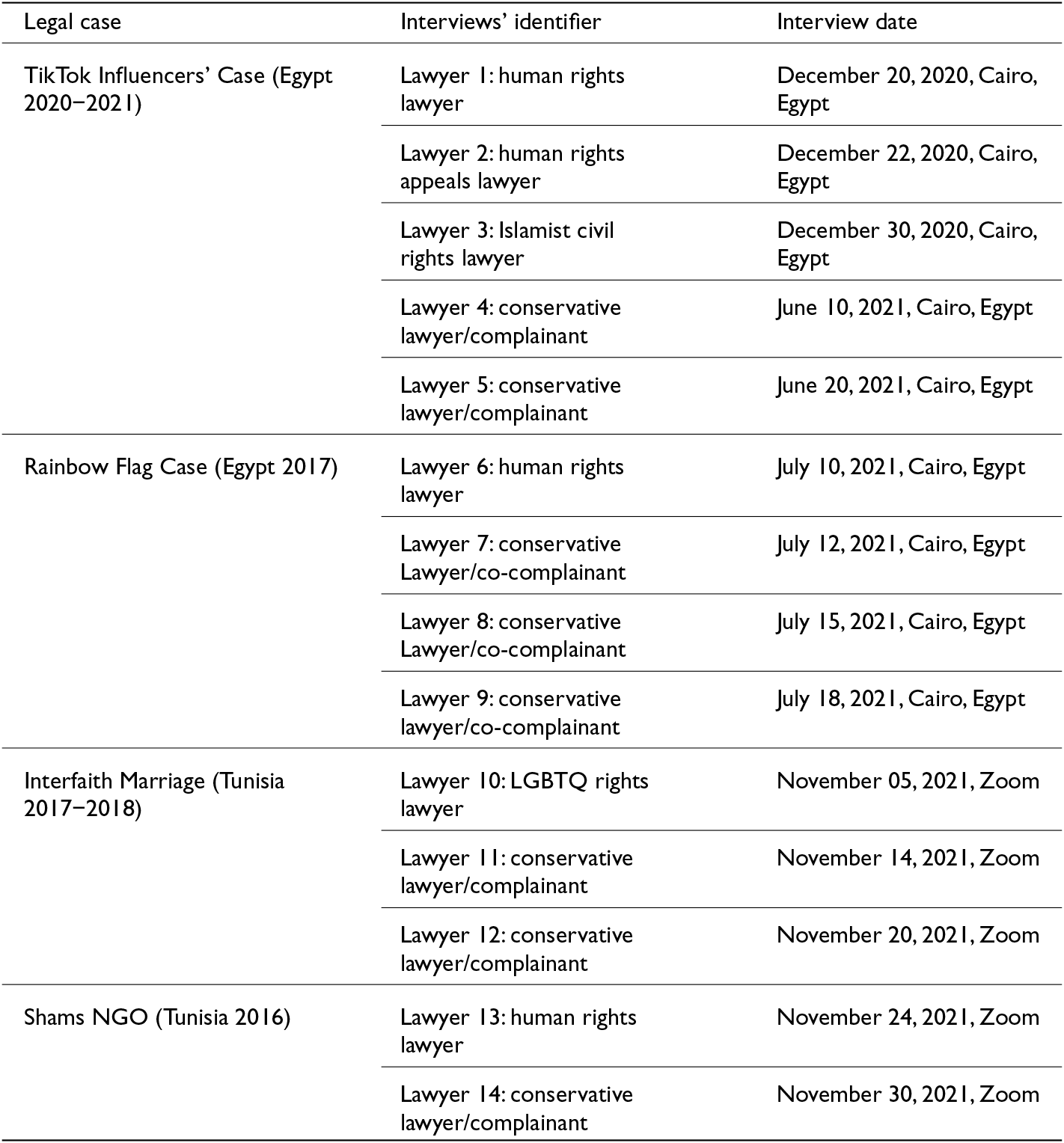
This article draws on research conducted during an 18-month-long court ethnography in Egypt (2019–2021),Footnote 1 in addition to interviews and legal case analyses in both Egypt and Tunisia. While undertaking fieldwork for my doctoral research, I stumbled upon what some Egyptian lawyers called the morality police (Arabic: shurtet il-akhlaq). The morality police are conservative lawyers who mobilize the law to repress minority rights and discipline rights advocates while making claims to the nation’s morals and values. In this paper, I draw on four legal case studies, semi-structured interviews, and court observations to explore how conservative lawyers mobilize the law to challenge gender equality and queer rights in postrevolutionary North Africa. For the legal case studies, I have analyzed legal documents (including legal complaints and court decisions), interviewed lawyers involved in the cases, and observed court proceedings when possible. I obtained the legal documents either directly from the lawyers or online through other sources (Global Freedom of Expression 2021). In total, I analyzed 4 key legal cases, conducted 14 semi-structured interviews, and observed 5 court sessions (see Table 1).
Legal case studies and interview schedule

Table 1 Long description
The table lists interview schedules for four legal case studies, pairing each case with a lawyer interview identifier and the interview date and location or platform. The TikTok Influencers’ Case in Egypt includes five interviews, all in Cairo, from December 20 and 22 and 30 in 2020 through June 10 and 20 in 2021, involving three human rights or civil rights lawyers and two conservative complainants. The Rainbow Flag Case in Egypt includes four interviews, all in Cairo, dated July 10, 12, 15, and 18 in 2021, with one human rights lawyer and three conservative co-complainants. Tunisia cases are conducted remotely: Interfaith Marriage includes three Zoom interviews on November 5, 14, and 20 in 2021, and Shams NGO includes two Zoom interviews on November 24 and 30 in 2021. Overall, Egypt interviews are in person in Cairo across late 2020 to mid 2021, while Tunisia interviews occur later and exclusively via Zoom in late November 2021. Identifiers describe lawyer roles such as human rights, LGBTQ rights, Islamist civil rights, and conservative complainant, but the table does not provide outcomes or the number of participants beyond the listed interviews.
The legal case studies
This paper draws on four legal cases from Egypt and Tunisia. While there are various legal mobilizations by the right against rights to draw on, two central criteria guided my case selection. First, I chose cases based on their importance and impact. Importance and impact include the extent to which these cases guided and formed public debates, as well as the extent to which these cases produced precedents for other conservative legal action. In making this judgement, I relied on interviews, scholarship on antirights mobilization in North Africa, and on reports by leading human rights organizations. Second, I picked cases based on how accurately they represented legal mobilization by the conservative right against gender and sexual rights specifically.
In Egypt, I selected the following cases:
(1) The TikTok Influencers Case (2020–2021), which saw young content creators reported by conservative lawyers (Osman Reference Osman2021).
(2) The Rainbow Flag Case (2017), which started as a complaint against LGBTQ activists waving the rainbow flag at a concert and resulted in the arrest of 75 queer activists (Ameling Reference Ameling2022).
The selected court cases were cited by Egyptian and international human rights advocates as important examples of the regression on rights in the region (Ameling Reference Ameling2022; EIPR 2021). In addition, both cases sparked public debates and resulted in legal precedents that restricted gender expression, free speech, and sexual rights (EIPR 2021). I excluded other important cases, including the Fairmont Rape Case (Younes Reference Younes2021), because they did not fit the profile of case studies I was looking for: noninstitutional conservative legal mobilizations against rights. To deepen the analysis, I also conducted 10 in-depth interviews with Egyptian lawyers, including those directly involved in the selected cases. I also observed five court sessions related to the TikTok cases in 2021.
In Tunisia, I selected the following legal case studies:
(1) The legal challenge to interfaith marriage equality (Bajec Reference Bajec2018).
(2) The lawsuit against Shams (2016), which was an attempt to shut down the region’s leading LGBTQ + rights organization.
Following the same selection criteria outlined above, I selected these Tunisian cases through consultations with local human rights lawyers and advocates, who identified them as key legal battlegrounds where conservative lawyers attempted to fight against feminist and queer rights advances (HRW 2019). In both cases, Tunisian human rights advocates observed that the small North African country was ahead of its Arab neighbors (Interview with Lawyer 10, 11/05/21). Therefore, both legal cases were prominent not just in Tunisia, but across the Arab world. For example, in a regional precedent, Egyptian conservative lawyers filed a lawsuit in an Egyptian court challenging the Tunisian President’s decree on gender equality in inheritance in 2017 (Al-‘Ayyadi 2017). While the court rejected the lawsuit on jurisdictional grounds, the symbolic move by the conservative lawyers signaled that such gender equality reforms would not be welcome in Egypt (Interview with Lawyer 6, 07/10/21).
Semi-structured interviews
I conducted a total of 14 interviews with lawyers in Egypt and Tunisia in 2020 and 2021. All interviews were held in Arabic, transcribed, coded, and analyzed for themes related to legal mobilization, tactics, rights, morality, religion, democracy, and nationalism. In translating my interlocutors’ words, I have strived to preserve the linguistic and cultural nuances of the Egyptian and Tunisian dialects. Where possible, I conducted word-for-word translations to retain my interviewees’ tone and style. While the total number of interviewees does not capture the full scale of conservative lawyers in either country, it includes a significant proportion of those directly responsible for the major legal mobilizations targeting gender and sexuality rights between 2016 and 2020. Because of the risks and dangers associated with conducting scholarly research in North Africa (Middle East Studies Association 2019), I have carefully avoided some of the most notorious conservative lawyers, including one of Egypt’s top conservative legal actors with a reputation for litigating against anyone he crosses paths with. I chose my interviewees primarily based on the cases they litigated, and in this way, I was able to analyze the legal tactics, goals, and practices of these conservative legal actors. In many cases, I have interviewed human rights lawyers involved in the defense as well to get a better picture of how the right fights against rights from both perspectives. In total, I have interviewed eight conservative and six human rights lawyers for this research.
During interviews, I maintained a neutral and nonconfrontational stance, refraining from challenging conservative narratives to minimize personal risk. I often nodded along as my interlocutors took pride in putting young women in jail to protect Egypt’s youths, and I did not comment when they accused queer groups of being foreign-funded agents sent to corrupt the Tunisian nation. While conducting Zoom interviews with Tunisian lawyers offered greater physical safety, I maintained the same listening-oriented approach across both contexts to ensure comparability. Overall, I have relied on court observations and legal documents to draw a more comprehensive understanding of the goals and tactics of conservative legal actors despite the limited number of interviews.
The legal mobilization by the right against rights in North Africa: the case studies
Background: a rights revolution in North Africa
The Arab region witnessed major uprisings against authoritarian rule in 2011, which came to be known as the Arab Spring (Bayat Reference Bayat2017, 11). Despite the initial success of these mass movements in toppling dictatorships in the region, the path to freedom remained unclear. With Syria and Libya descending into Civil War, ISIL rising in Iraq and the Levant (Bayat 2020: 86), and Egypt falling into autocratic rule (Khalil Reference Khalil2024), the region is far from reaching freedom or stability. Despite this, a rights revolution in the region has continued with growing demands for sexual rights, gender equality, and social justice (Maravankin Reference Maravankin2017). This article presents case studies from Egypt and Tunisia, two North African countries with several similarities and differences. Besides being both postcolonial societies with Arab and Muslim majorities, both countries’ social and historical trajectories overlapped in the initial success of their revolutions, which toppled long-term dictators Ben Ali and Mubarak consecutively in 2011. While the outcomes of the political transitions differed in both countries (Josua and Edel Reference Josua and Edel2021: 587), the aftermath of the revolutionary fervor continued to influence the politics, movements, and aspirations for change.
In Tunisia, sexual rights movements and LGBTQ rights organizations proliferated since 2011 (Anabtawi Reference Anabtawi2022: 389). Eastward along the Mediterranean, Egyptian activists organized for sexual rights and gender equality, oftentimes through legal mobilization (Al-Ali Reference Al-Ali2014). But demands for gender equality and queer rights have been met with growing policing and enforcement of antiqueer laws (Anabtawi Reference Anabtawi2022: 385). In what seems like a backlash to increasing sexual freedoms and demands for gender equality, conservative legal actors intensified their attacks on sexual minorities, equality advocates, and the enjoyment of rights in both countries (ibid.,). The conservative backlash included various actors, including state institutions and non-state actors, such as media corporations and conservative political parties (Ameling Reference Ameling2022; Anabtawi Reference Anabtawi2022). For example, Ameling (Reference Ameling2022) argues that Egypt intensified its prosecution of LGBTQ rights in response to anxieties about the postrevolutionary movement for gender equality and sexual rights in the country (25). In this backlash, both institutional and noninstitutional actors played a role in policing sexual minorities, and misrepresenting their rights claims (ibid.,). In the following case studies, I zoom in on conservative legal mobilizations that are initiated by noninstitutional actors, exploring their contexts, tactics, and outcomes. While I focus narrowly on noninstitutional actors, I also explore the impact of their legal mobilization on institutional actors, including judges and the public prosecutor’s office. Despite differences in context, the case studies reveal strikingly similar patterns: conservative lawyers strategically invoke rights frameworks, legalism, and the rule of law, and majoritarian sentiments to contest progressive reforms. In both settings, conservative actors adapt tangential legal tools, including antiprostitution codes, cybercrime laws, or democratic and constitutional arguments to advance their antirights and antiequality agendas.
The legal mobilization against Tiktok influencers in Egypt
In April 2020, conservative lawyers in Egypt began filing complaints with the public prosecutor’s office against young women active on TikTok and other social media platforms. The resulting legal wave that came to be known as the “TikTok Ladies” cases (Arabic: fatayat al-TikTok), centered on accusations of incitement to prostitution, debauchery, offending public modesty, and child abuse (AFTE 2021a). These cases emerged at the intersection of new digital visibility and traditional moral anxieties (Interview with Lawyer 1, 12/20/20), with the charges often rooted in Egypt’s Anti-Prostitution Code (Law 10/1961) and the Law on Combating Trafficking in Persons (Law 64/2010) (AFTE 2021a). However, due to difficulties in producing direct evidence of prostitution or trafficking, prosecutors increasingly relied on a new Cybercrime Law (Law 175/2018), especially its provisions criminalizing online content deemed “contrary to public morals” (AFTE 2021a).
A conservative lawyer filed the initial complaint at the public prosecutor’s office in 2020. In his complaint, he accused a university student and TikTok influencer of inciting debauchery, trafficking in minors, and undermining family values (Al-Arabiya 2020). The lawyer’s complaint, widely circulated in national media, quickly transformed him into a public figure (Interview with Lawyer 3, 12/30/20). Following his intervention, a coalition of conservative lawyers launched the campaign “The Purification of Egypt,” encouraging tens of complaints by other conservative lawyers against individual influencers, and resulting in 11 women being referred to trial for social media content during 2020 alone (AFTE 2021a, 2021b). Drawing on interviews, court observations, and court decisions, I traced the legal tactics used by conservative lawyers involved in the TikTok cases. Lawyer 4, a solo practitioner based in Cairo, offered insight into the legal framing underlying these lawsuits. Lawyer 4 framed his legal mobilization as a national duty, defending Egypt’s youth against what he perceived as moral decay imported through globalized digital culture:
“We are not going to stand by and watch Egypt’s youths be poisoned with these Chinese applications. If the government cannot control them, I and others will, for this country and its future.” (Interview with Lawyer 4, 06/10/21)
Initially, Lawyer 4 filed his complaint to the public prosecutor, citing accusations of prostitution and debauchery under the Criminal Code and Penal Code (Complaint to the Public Prosecutor’s Office, 26812/2020). However, due to insufficient evidence, the public prosecutor reclassified the charges under Articles 25–27 of the Cybercrime Law, focusing on offenses against public morals and family values (Masaar 2020). Lawyer 4 was frustrated at the shift away from prostitution charges, viewing the new framing of the charges as a dilution of the severity of the crimes. He explained that his concern centered on the crimes of trafficking and prostitution:
“When a university student encourages other girls to just dance and perform on social media to make money, we are creating a society of prostitutes. Money does not fall from the sky, does it?” (Interview with Lawyer 4, 06/10/21)
The lawyer’s arguments were couched in protecting children’s rights and family values by punishing what he viewed as incitement to prostitution and attempts at sex trafficking (Complaint to the Public Prosecutor’s Office, 26812/2020). Despite not explicitly citing religion in his complaint, a co-complainant lawyer emphasized that it was the values of “the majority of the population” that were under threat, Muslim and Christian alike (Interview with Lawyer 5, 06/20/21). Notably, while Lawyer 4 initiated the complaint, he did not consistently attend court proceedings (Cairo Economic Court Observation, May 2021). Instead, he relied on the prosecutor to advance the cases once he filed his complaint, demonstrating how legal mobilization at the complaint stage by noninstitutional actors can shift litigation into the hands of state authorities. In this case, the public prosecutor took on the lawyers’ conservative case, altered its strategies, while continuing to pursue its targets. Instead of dismissing the charges for lack of evidence, the prosecutor brought new charges under the cybercrimes law, thus enabling the influencer’s conviction (Cairo Economic Court Decision 479/2020 2020).
The TikTok case had immediate legal consequences that went beyond the conviction of the defendant, an undergraduate student at Cairo University. The legal mobilization opened the floodgates for similar complaints by other conservative actors against other social media influencers (AFTE 2021a). Several women received prison sentences and fines, although some convictions were later overturned on appeal (Cairo Economic Court Appeals Decision 2021). More broadly, these cases set a new precedent for using cybercrime laws to police gendered behavior online, allowing the Egyptian state to selectively enforce morality under the guise of internet regulation (Interview with Lawyer 2, 12/22/20). For conservative lawyers, these cases were seen as only the beginning of a mission to protect “society’s rights” in a digitized society against ideas that they perceived as dangerous, such as sexual liberation and gender expression (Lawyers 4 and 5). As lawyer 4 asserted,
“She was not my first, and she will not be my last complaint.” (Interview with Lawyer 4, 06/10/21)
The right against marriage rights in Tunisia
Following the fall of Tunisia’s long-standing dictator Ben Ali in 2011, Tunisia pursued ambitious reforms to advance gender equality, including the lifting of the 1973 ban on Muslim women marrying non-Muslim men. In 2017, during a Women’s Day speech, late President Beji Caid Essebsi announced the repeal of the ban, framing it as part of Tunisia’s modern civil identity (AlJazeera 2017). While the secular-leaning Tunisian legal framework had long prohibited polygyny (since 1965) and debated inheritance equality reforms (Zaki Reference Zaki2019), these newer reforms regarding interfaith marriage crossed a perceived cultural red line (Interview with Lawyer 10, 11/05/21). Muslim clerics, civil servants, and notaries resisted implementing the new regulations, invoking the 1956 Personal Status Code to justify their stance (Bajec Reference Bajec2018). At the same time, conservative lawyers initiated direct legal challenges against the reforms, in what they perceived as a moral duty to defend society and its traditions against foreign and colonial impositions (Lawyers 11 and 12). One of these lawyers filed a complaint with a court of first instance in the capital city, Tunis, arguing that the legalization of Muslim women marrying non-Muslim men was unconstitutional and violated Tunisia’s Islamic heritage (Interview with Lawyer 11, 11/14/21; Complaint to the Attorney General, Tunis, 2020). Although the court ultimately dismissed his claim, citing Tunisia’s constitutional secularism and the plurality of Islamic interpretations, the case reflected a conservative effort to resist the postrevolutionary gender rights agenda.
The lawyer explained his legal challenge not primarily in religious terms but through a narrative of national sovereignty against foreign impositions (Interview with Lawyer 11, 11/14/21). In his view, the legalization of interfaith marriage and similar reforms were colonial impositions designed to erode Tunisia’s unique identity:
“They ban the hijab in France, this is their problem. But why do we follow their lead on marriage? We are a modern and civil nation, but we are our own nation.” (Interview with Lawyer 11, 11/14/21)
The lawyer’s arguments echoed anticolonial tactics identified by Currier (Reference Currier2011) in Namibia and South Africa, whereby conservative actors frame gender and sexuality rights as illegitimate, colonial interventions. Moreover, he combined his anticolonial rhetoric with a claim that majority views on any issue should prevail, citing democracy as the rule of the majority:
We have a secular constitution, but we are a predominantly Muslim nation. We are more a Muslim nation than Egypt, you have other major religions, but we do not. Ask the population, are they happy with these changes? I tell you: only some feminists educated in France are happy. But the majority… go to other cities, walk outside of the capital, the majority of Tunisians do not like this. Where is democracy then? (Interview with Lawyer 11, 11/14/21)
By invoking the alleged views of the majority, the conservative lawyer sought to delegitimize the reforms as foreign and elite-driven and unrepresentative of Tunisia’s “real” society. This strategy mirrored regional and international patterns where conservative lawyers challenge rights expansions by appealing to both cultural authenticity and the will of the silent, non-elite majority (Cummings Reference Cummings2018; Lehoucq Reference Lehoucq2021).
In our conversation, the Tunisian conservative lawyer also mentioned his involvement in filing complaints against social media influencers whom he accused of “trafficking young women,” in what sounded very similar to Egypt’s TikTok litigations (Interview with Lawyer 11, 11/14/21). Although the lawyer distinguished his own activism from what he described as the theatrical litigation culture of Egyptian conservative lawyers, the underlying tactic of using legal formality for repression – or repressive legalism – remained strikingly similar. The global parallels between legal mobilizations in antifeminist litigation and public morality prosecutions also expose the transnational logic of the conservative legal backlash that has been observed by other scholars (Southworth Reference Southworth2024; Moghadam, Reference Moghadam2024).
Although joined by other co-complainants, the legal challenge was unsuccessful. The Tunis Court upheld the secularist interpretation of the Tunisian Constitution and rejected the argument that interfaith marriages violated constitutional norms (Boukhayatia 2023). This conservative legal activism, although failing to obtain a courtroom victory, has played a crucial role in reshaping public discourse and normalizing the contestation around marriage equality in the legal field (Interview with Lawyer 12, 11/20/21). As Youssef (Reference Youssef2023) notes, these efforts have become part of Tunisia’s “backsliding on women’s rights,” despite the country’s reputation as a regional leader in gender equality reforms.
The right’s legal fight against pride
In September 2017, the Lebanese band Mashrou ‘Laila performed in Cairo in a packed venue with widespread fan celebration on social media (Ameling Reference Ameling2022, 24). During the concert, some attendees waved rainbow flags in support of the band’s openly gay lead singer (Soliman Reference Soliman2019). Videos of the event circulated widely, sparking public outrage among conservative commentators (Ameling Reference Ameling2022).
Within a week, more than 70 concertgoers were arrested and charged with debauchery and promoting indecency, triggering the largest crackdown on queer individuals in Egypt since the Queen Boat incident of 2001 (Ameling Reference Ameling2022; Pratt Reference Pratt2007). Egypt’s legal code does not explicitly criminalize same-sex relations (Legal Agenda 2018). However, authorities have increasingly used the Anti-Prostitution Code (Law 10/1961) to prosecute queer individuals under charges of “habitual debauchery” (Legal Agenda 2018). Despite the lack of evidence of paid sexual exchange or commercial sex work, weaponizing the antiprostitution code has become a trend in reporting, charging, arresting, and detaining same sex advocates pretrial (Interview with Lawyer 6, 07/10/21). The resort to tangential laws to punish and repress sexual rights does not always secure convictions, but it succeeds in harassing activists and sexual minorities through the mobilization of the law for prolonged periods awaiting trial (Interview with Lawyer 2, 12/22/20). During the pretrial detention periods, same sex individuals have been subjected to anal examinations, which are considered methods of torture by the United Nations Committee on Torture (EIPR 2017, 32; Interview with Lawyer 6, 07/10/21).
Scholars and human rights defenders view the crackdown on the Mashrou’ Laila concertgoers as a pivotal moment in the conservative crackdown on the sexual revolution in the country (Ameling Reference Ameling2022; Soliman Reference Soliman2019; Lawyers 1, 2, 3, and 6). The case was both the largest, in terms of the defendants named in it, and the most influential in the crystallization of a public moral panic against queer activism (Ameling Reference Ameling2022, 24). One Cairo-based conservative lawyer was amongst the first to marshal the law against the concertgoers (Interview with Lawyer 2, 12/22/20). Following debates on Facebook about the rainbow flag display, he filed a complaint with the public prosecutor, asserting in his complaint that he had a “professional and moral duty” to protect Egyptian society from “perversion” and “foreign” influence (Complaint to the Public Prosecutor No. 10949/2017 ). The complaint triggered massive media coverage, with both state-owned and private outlets amplifying the narrative of national violation (Ameling Reference Ameling2022). As Ameling’s (Reference Ameling2022) media discourse analysis shows, Egyptian media portrayed the concertgoers in pejorative terms, emphasizing their “deviance,” “abnormality,” and “betrayal” of national values (29). The lawyer was soon joined by other conservative lawyers, who expanded the legal offensive by filing complaints against the Musicians’ Syndicate and other concert organizers (Othman Reference Othman2017). The legal arguments rested on debauchery charges, the need to protect family values and children’s rights, and allegations that the concert symbolized a Western infiltration of Egyptian society (Complaint to the Public Prosecutor No. 10949/2017 ).
In my conversation with Lawyer 8, the conservative lawyer involved in the lawsuits framed his actions as defending national unity and cultural authenticity against foreign impositions:
“It is not about religion. It is about protecting our society from division. They [the concertgoers] follow western flags and western ideas in the name of freedom, but real freedom respects society and tradition.” (Interview with Lawyer 8, 07/15/21)
His framing closely mirrors patterns observed in the American conservative legal movement, where social issues like racial justice and LGBTQ + rights are portrayed as threats to national cohesion because of their alleged divisiveness (Decker Reference Decker2016). Moreover, in our conversation, Lawyer 8 weaponized democracy and majority rule to argue against same-sex relationships. Not only viewing them as divisive but also describing their “imposition” as antidemocratic, because it goes against the values of the majority of the population, as he alleged (Interview with Lawyer 8, 07/15/21). As he talked about same-sex relationships, he described them with the derogatory term shaath that can translate into “queer.”
“Freedom must have its limits. Our society – Muslim and Christian – agrees that queer relationships are western ideas. The revolution opened the door to new thinking, but we must now set limits if we want to preserve the nation.” (Interview with Lawyer 8, 07/15/21)
The legal and political consequences of the Rainbow Flag Case were profound. While most court convictions based on the Anti-Prostitution Code were later successfully dismissed, the crackdown extended well beyond the legal punishment, detention, and torture of the 75 defendants (EIPR 2017). The moral panic that followed the public debates on social and national media deepened social stigma and reinforced state surveillance of queer activism (Ameling Reference Ameling2022; EIPR 2017). Egyptian parliamentarians proposed legislation to criminalize homosexuality and the display of symbols like the pride flag, but it did not receive enough votes to move forward (Interview with Lawyer 9, 07/18/21; Human Dignity Trust 2024). The Egyptian government banned Mashrou’ Laila from performing in Egypt again (New Arab 2017). The case also exposed profound divisions within the Egyptian human rights community, pointing to the fact that selectivism in rights is even present amongst human rights defenders. In one of my interviews, an interlocutor shared his encounter with a human rights lawyer defending the concertgoers on behalf of his NGO (Interview with Lawyer 6, 07/10/21). The human rights lawyer expressed prejudice against and discomfort with LGBTQ + individuals and reluctantly participated in the legal defense efforts while complaining to his cocounsel:
“The day has come when we will defend faggots and gays” (Interview with Lawyer 6, 07/10/21)
The legal mobilization against Shams
In the years following the Arab Spring, LGBTQ activists in Tunisia successfully established advocacy organizations, built alliances with international human rights networks, and publicly advocated for sexual rights (Anabtawi Reference Anabtawi2022, 399; 418). Newly registered groups like Shams, founded in 2015, advocated for the decriminalization of same-sex relations and the protection of sexual minorities (Interview with Lawyer 13, 11/24/21). However, the growing visibility and activism of the LGBTQ movement provoked a conservative backlash in the country (Ayoub and Stoeckl Reference Ayoub and Stoeckl2024; Interview with Lawyer 13, 11/24/21). Conservative lawyers in Tunisia started a legal battle in court against queer activists and organizations. In their conservative legal action, they informally aligned with conservative clerics, politicians, and media actors in the country (Sabaghi Reference Sabaghi2022; Interview with Lawyer 13, 11/24/21).
In January 2016, a first-instance court in Tunis ordered Shams to suspend its activities pending an investigation into alleged violations of NGO laws (HRW 2019). The Attorney General, supported by a conservative lawyer’s complaint, argued that Shams’s advocacy violated the Tunisian Penal Code’s Article 230, a colonial-era provision criminalizing same-sex acts with up to 3 years of imprisonment (HRW 2019). Although the lower court ultimately dismissed the case against Shams, government authorities appealed, this time framing the organization’s mission as contradictory to Tunisia’s Islamic values (MontCarlo News 2019). Once again, the court ruled in favor of Shams (Human Dignity Trust 2025).
In an interview with Lawyer 14, the conservative lawyer mobilizing the law against Shams, he emphasized that while he supported democracy, LGBTQ organizations like Shams represented a foreign imposition on Tunisian society:
“Diversity is good, but there are limits. If you survey our population, you will see that the majority disagrees with these gay groups. So maybe they are being undemocratic, not me.” (Interview with Lawyer 14, 11/30/21)
Like strategies observed in Egypt and other global contexts, the lawyer combined anticolonial rhetoric with democracy and pluralism claims, asserting that LGBTQ rights advances reflected foreign-influenced agendas, not the true will of the majority of the Tunisian people (Interview with Lawyer 14, 11/30/21). I pointed to the irony that he was weaponizing a colonial-era law to fight against what he viewed as a colonial imposition. In response, the lawyer explained that he was provoked by Shams’s Facebook post announcing the opening of a new regional branch outside Tunis:
“Organizing in the capital is one thing. But diving deeper into Tunisian society is another. Neither we nor our culture support this. Someone needed to step up and protect our values and traditions.” (Interview with Lawyer 14, 11/30/21)
While the conservative lawyer’s legal action initially succeeded in forcing a temporary suspension of Shams’s activities, the courts ultimately sided with the organization, affirming that its advocacy efforts were protected under Tunisia’s postrevolutionary legal framework (Human Dignity Trust 2025). Nonetheless, the appeal filed by the government and the aggressive media and political mobilization around the case (Interview with Lawyer 13, 11/24/21), exposed the fragile status of LGBTQ rights in Tunisia (Human Dignity Trust 2025). It also pointed to the porous nature of the conservative legal mobilization, and how they can start as noninstitutional challenges and then be adopted and driven forward by the justice institutions of the state.
Discussion and conclusion: the legalistic tactics of the right against rights
The legal case studies in this article reveal a common set of tactics utilized by conservative legal actors in Egypt and Tunisia to fight against rights: rights selectivism, repressive legalism, and majoritarian arguments. Despite significant differences between the two countries’ legal systems, civil societies, and political transitions, conservative legal actors in both contexts have strategically mobilized the law to defend traditional norms and rights against gender equality and sexual rights. Their legal tactics reflected not only resistance to specific rights but also strategic efforts to redefine the relationship between rights, democracy, and the law.
The first tactic that emerged from the legal case studies is rights selectivism. Similar to the so-called (mis)appropriation of rights by De Búrca and Young (Reference De Búrca and Young2023), the case studies analyzed in this paper reveal how conservative actors weaponize some rights against others. Lawyers do not merely uphold select rights against others, but they also invoke legal human rights frameworks in their litigation. For example, in the TikTok influencers case, lawyers framed their legal actions as a defense of children’s rights, invoking the antitrafficking frameworks. When the prosecutor changed the charges due to a lack of evidence, the complainant’s lawyer was dissatisfied and was no longer interested in attending the court sessions. Similarly, in the Rainbow Flag case, conservative lawyers defended their legal complaints as protection of the youths and children against Western “perversions” and divisive tactics. In doing so, the lawyers strategically reframed LGBTQ visibility as a violation of the public’s rights to moral stability and national cohesion. Similarly, in Tunisia, the legal challenge to interfaith marriage rights weaponized the notion of democratic rights against gender equality, portraying legal reforms as elite impositions. Like conservatives in the US Supreme Court, conservative lawyers sometimes argue that enforcing minority rights from above is antidemocratic (Cummings Reference Cummings2018). In all instances, rights discourse, long associated with progressive causes, was repurposed by conservative lawyers to justify restrictions on specific rights (De Búrca and Young Reference De Búrca and Young2023; Escoffier et al. Reference Escoffier, Payne, Zulver, Payne, Zulver and Escoffier2023; Payne Reference Payne, Payne, Zulver and Escoffier2023). These lawyers engage in human rights reversals through misappropriation of human rights discourses, “when they use human rights language in the service of ends which are exclusionary, repressive, or anti-pluralist in character” (De Búrca and Young Reference De Búrca and Young2023: 210).
A second key tactic emerging from the case studies is repressive legalism, which I define as the strategic use of any available legal provision, even if tangential, to repress sexual and gender rights. In Egypt’s TikTok influencers cases, conservative complaints initially cited antiprostitution laws and criminal codes. However, due to a lack of evidence, prosecutors shifted to applying the Cybercrime Law 175/2018. Using legislation primarily intended for cybersecurity to charge influencers with assaults on “family values” and “public morals” and ensure a conviction is one such example of repressive legalism. In Tunisia’s Shams case, the conservative lawyer used the colonial-era Penal Code Article 230, criminalizing same-sex conduct, to argue for the suspension of the NGO, even though the organization was legally registered and operated under a constitutional framework that protected the right to association. Similarly, in the Rainbow Flag case, conservative lawyers weaponized Egypt’s Anti-Prostitution Code (Law 10/1961), originally intended to regulate commercial sex work, to criminalize queer concertgoers for acts of symbolic expression and free speech. Despite the law’s irrelevance to advocacy and free speech behavior, it served as a flexible instrument for repressing queer visibility.
Repressive legalism proved central to conservative legal mobilization, allowing lawyers to pursue their goals regardless of the available legal texts. It is critical to note that these conservative legal actors are attaching their attacks to the law because of the context of illiberal legality in Egypt and Tunisia, in the region, and around the world (Khalil Reference Khalil2024). In fact, scholars of autocratic legalism highlight the use, abuse, and nonuse of the law as integral to illiberal legality (Corrales Reference Corrales2015). It is a system in which the form, procedures, and institutions of the law are upheld in exchange for the content, constitutionality, and coherence of the laws (Scheppele Reference Scheppele2018, 562).
A third tactic is the appeal to majoritarianism. Based on these case studies, I understand majoritarianism as an appeal to socially constructed majorities, and their will, in defense of abolishing minority rights. In the appeal to majoritarianism, demographic majorities are not necessary because majorities are constructed through hegemonic ideas and values in society. More importantly, the appeal to majoritarianism legitimizes the repression of minorities in the name of democracy. It is an assertion that majority views should trump minority protections, and it is often framed as a defense of democracy itself. Both in Egypt and Tunisia, conservative lawyers emphasized that the majority of the population opposed LGBTQ rights, interfaith marriage, and “immoral” online behaviors. In the interfaith marriage case, the conservative lawyer argued that secular reforms ignored Tunisia’s predominantly Muslim and Arab values. The conservative lawyer went as far as claiming that the will of the Tunisian people should come ahead of the country’s secular constitution. Likewise, in the Shams case, the lawyer framed LGBTQ organizations as incompatible with the preferences of the majority of Tunisian people. In so doing, the conservative lawyer suggested that operating LGBTQ organizations in Tunisia against popular will would be antidemocratic. In Egypt, lawyers in the Rainbow Flag case posited that same-sex visibility was a dangerous foreign imposition, insisting that rights must conform to collective cultural values shared by the majority of the population, Muslim and Christian alike. In all these narratives, minority rights and protections are never mentioned. Instead, minority protection is represented as a fringe view that should not find realization in society.
These majoritarian framings adopt a simplistic understanding of democracy as the rule of the majority (Scheppele Reference Scheppele2018, 557). In doing so, they represent the will of the majority as the only democratic legitimacy. While conservative legal mobilization around the world can go against the will of the majority (Southworth Reference Southworth2024), one significant finding of these case studies is that the conservative right weaponized hegemonic values in society to undermine minority rights in the name of democracy. These discursive opportunity structures (Ferree Reference Ferree2003: 306) included appeals to family and children’s rights, traditional values, national unity, and anticolonial sovereignty. As Cummings (Reference Cummings2018) and De Búrca and Young (Reference De Búrca and Young2023) observe, the invocation of national sovereignty and majority rule can easily serve illiberal ends when it is used to suppress rights and reinforce traditional norms and the status quo. Explaining similar dynamics in the American conservative right, Magee (Reference Magee2018) highlights “an almost dizzying number of conservative counter-rights that would defend the interests of majorities, aggrieved by imposition of minority rights, from the ‘original’ rights revolution of the 1960s” (298). The majoritarian appeal has a dual purpose: it articulates a democratic-sounding, representative argument about the will of the people, and at the same time, it justifies the oppression of minorities by claiming the consent of the majority. This is like Southworth’s analysis of the doctrine of originalism that seeks to undermine the advancement of rights in the name of respecting the nation (Reference Southworth2024, 309). This argument takes shape differently, particularly in postcolonial societies, where the will of the people is represented as superior to both minority rights and international human rights orders. In fact, like Currier showed in South Africa and Namibia, while human rights frameworks are symbolically embraced by conservatives in their attack on rights, some rights continue to be attacked as colonial and foreign impositions, especially gender and sexual rights (2011). Interestingly, Southworth’s interviews with conservative lawyers in the United States reveal similar dynamics, where American conservatives expressed their objections to foreign-imposed international law, and called for the defense of US sovereignty against such foreign intrusions (Reference Southworth2024: 312)
Far from rejecting the law or rights discourses, conservative lawyers in Egypt and Tunisia appropriated and reframed these tools, using them to mount effective challenges to gender and sexual rights. Whether these lawyers won their legal battles, such as in the rainbow flag case, or failed, such as in the cases of Shams and Marriage Equality, the conservative legal mobilization against rights in North Africa continues to be significant in shaping public debate, encouraging additional repressive legal mobilization from other actors, and at times, unleashing repressive practices by judicial and executive institutions. These findings contribute to emerging sociolegal scholarship on illiberal legality and the right against rights, illustrating how law and rights frameworks are increasingly deployed not only to expand freedoms but also to restrict, redefine, and establish a hierarchy of rights. As seen in these cases, the battleground over law and rights is not only one of courts and legislatures but also one of cultural contestation, national identity formation, and claims to democratic legitimacy. This paper has demonstrated how conservative legal actors in Egypt and Tunisia tactically deploy rights discourses, selectively engage legal frameworks, and strategically invoke majoritarian claims to fight against gender and sexual rights. These findings contribute to sociolegal understandings of illiberal legality, showing that law is not inherently emancipatory but is a critical tool for antirights projects. They also contribute to scholarship on the right against rights in exposing the tactics of noninstitutional conservative legal mobilizations. This paper demonstrates how conservative legal actors employ rights discourses, adopt repressive legalism in their campaign to repress minority rights, and appeal to majorities to crush minorities. In an era of rising illiberalism, conservative legal mobilization in North Africa reminds us that legality and rights remain powerful weapons in lending legitimacy to conservative projects and mobilizations.
Acknowledgements
I am grateful to the editors of Law & Society Review for their generous feedback, time, and thoughtful engagement throughout the review process. I would also like to extend my sincere thanks to the guest editors, Simón Escoffier, Leigh A. Payne, and Gabriel Pereira, for their profound editorial guidance and for developing the right against rights framework, which provided an invaluable conceptual lens for this article.
Funding statement
This research was supported by a 2019 Civil Society Scholar Award from the Open Society Foundations.
Conflict of interest statement
The author declares no conflicts of interest.