

INTRODUCTION
Cryospheric processes in karst systems are heavily under-researched, despite evidence of a rather dramatic ice loss documented in glaciated caves worldwide (Kern and Perşoiu Reference Kern and Perşoiu2013). A prominent karst region is southeastern Europe where numerous cavities host perennial ice and snow accumulations (Barović et al. Reference Barović, Kicińska, Mandić and Mulaomerović2018; Buzjak et al. Reference Buzjak, Bočić, Paar, Bakšić and Dubovečak2018; Nešić and Ćalić Reference Nešić and Ćalić2018; Pennos et al. Reference Pennos, Styllas, Sotiriadis and Vaxevanopoulos2018; Temovski Reference Temovski2018). However, only very few data are available on the age of the cave ice deposits of this region (Horvatinčić Reference Horvatinčić1996; Paar et al. Reference Paar, Buzjak, Sironić and Horvatinčić2013; Staut et al. Reference Staut, Vreča, Merela, Brenčič, Mihevc, Hajna Zupan and Gostincar2016).
Radiocarbon (14C, t1/2=5730 yr) is the primary dating tool for organic macroremains from cave ice sequences deposited before the 20th century (Kern Reference Kern2018). Vegetal macroremains have been analyzed frequently (e.g. Fórizs et al. Reference Fórizs, Kern, Nagy, Szántó, Palcsu and Molnár2004; Sancho et al. Reference Sancho, Belmonte, López-Martínez, Moreno, Bartolomé, Calle and Santolaria2012; Spötl et al. Reference Spötl, Reimer and Luetscher2014; Perşoiu et al. Reference Perșoiu, Onac, Wynn, Blaauw, Ionita and Hansson2017; Munroe et al. Reference Munroe, O’Keefe and Gorin2018), and occasionally animal remains (Yonge and MacDonald Reference Yonge and MacDonald1999; Citterio et al. Reference Citterio, Turri, Perşoiu, Bini and Maggi2005; Hercman et al. Reference Hercman, Gąsiorowski, Gradziński and Kicińska2010; Gradziński et al. Reference Gradziński, Hercman, Peresviet-Soltan, Zelinka and Jelonek2016) have also been dated with the aim of placing constraints on the age of cave ice deposits.
Macroscopic organic remains could be situated in distinct stratigraphical positions within a cave ice sequence complicating the interpretation of a radiocarbon age depending on the stratigraphical context of the sample. Isolated individual objects found in otherwise organic-free ice layers might indicate rapid embedding in firn and ice representing positive cave ice balance (e.g. Hercman et al. Reference Hercman, Gąsiorowski, Gradziński and Kicińska2010; Spötl et al. Reference Spötl, Reimer and Luetscher2014; Gradziński et al. Reference Gradziński, Hercman, Peresviet-Soltan, Zelinka and Jelonek2016). Organic inclusions concentrated along discrete layers are frequently observed in cave ice deposits. If these organic horizons occur parallel or sub-parallel in more-or-less regular spacing throughout the section they likely mark seasonal ablation periods, hence annual layering (see e.g. Munroe et al. Reference Munroe, O’Keefe and Gorin2018). However, if these intercalated layers of organic detritus form unconformities or unusually thick layers within the given cave ice sequence then they can be interpreted as stratigraphic markers of elongated (multiannual) negative mass balance periods (e.g. Stoffel et al. Reference Stoffel, Luetscher, Bollschweiler and Schlatter2009; Spötl et al. Reference Spötl, Reimer and Luetscher2014; Sancho et al. Reference Sancho, Belmonte, Bartolomé, Moreno, Leunda and López-Martínez2018) while ice layers represent positive mass balance periods in the accumulation history of cave ice.
Only limited research has been carried out on Croatian cave ice deposits so far (Buzjak et al. Reference Buzjak, Bočić, Paar, Bakšić and Dubovečak2018), although mass ice loss (Kern et al. Reference Kern, Bočić, Horvatinčić, Fórizs, Nagy and László2008; Bočić et al. Reference Bočić, Buzjak and Kern2014) or complete deglaciation (Bočić et al. Reference Bočić, Faivre, Kovačić and Horvatinčić2012) have also been reported from these ice caves. Velebit Mountain represents a prominent range of the Dinaric Karst with the abundant occurrence of cave ice (Bočić et al. Reference Bočić, Buzjak and Kern2014; Buzjak et al. Reference Buzjak, Bočić, Paar, Bakšić and Dubovečak2018).
Many horizons rich in organic material and a few individual trunks have been recovered from the shrinking ice deposits in the Velebit Mountain. Here we report seven new measurements and three earlier (recalibrated) data from Velebit Mountain. One main purpose of the study is the comparison of the inferred geochronological data with those from cave ice deposits in other parts of Europe.
SAMPLES AND METHODS
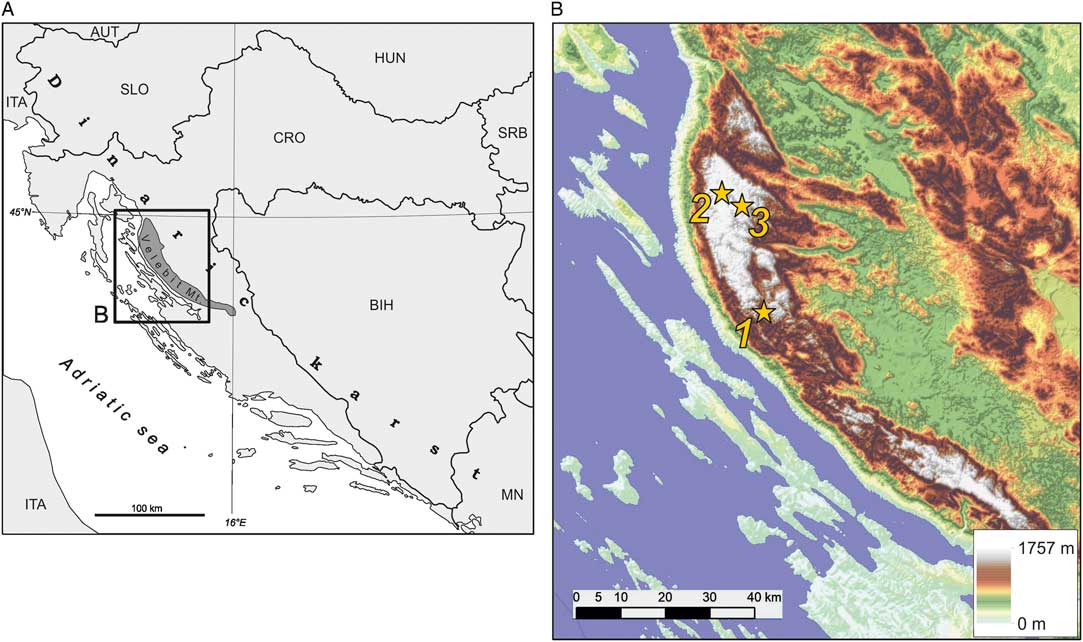
The study area includes the northern and central parts of the Velebit mountain range (Figure 1) with a maximum altitude of 1699 m asl (the peak of Mali Rajinac). Mean annual air temperature in the area up to 1000 m asl is ~5.5°C, while in the highest region it drops to 3.5°C. The coldest months are January and February (between –2 and –5°C) and the warmest one is July (12–16°C). Annual precipitation in the northern and central part of the Velebit Mountain is up to 3000 mm/yr. Snow can be present from the middle of November until the middle of May. Snow cover ≥30 cm can be expected in 36% of the year, and in 31% of days the snowpack is thicker than 50 cm. Above 1500 m asl a humid boreal climate (Köppen’s type Df) dominates and the lower parts have a temperate humid climate (Cfb) mainly determined by the relief (Zaninović, Reference Zaninović2008). Cooler conditions at higher elevations and strong temperature inversions in large depressions favor the accumulation of ice and snow in karst depressions such as deep mountain dolines, caves and pits (Buzjak et al. Reference Buzjak, Paar, Dubovečak and Bočić2014, Reference Buzjak, Bočić, Paar, Bakšić and Dubovečak2018).
Location of the studied ice caves. A: Location of the Velebit Mountain in the Dinaric karst. The area enlarged in panel B is indicated (rectangle), B: Location of Kugina Ice Cave (1), Vukušić Ice Cave (2), and Ledena Pit (3)
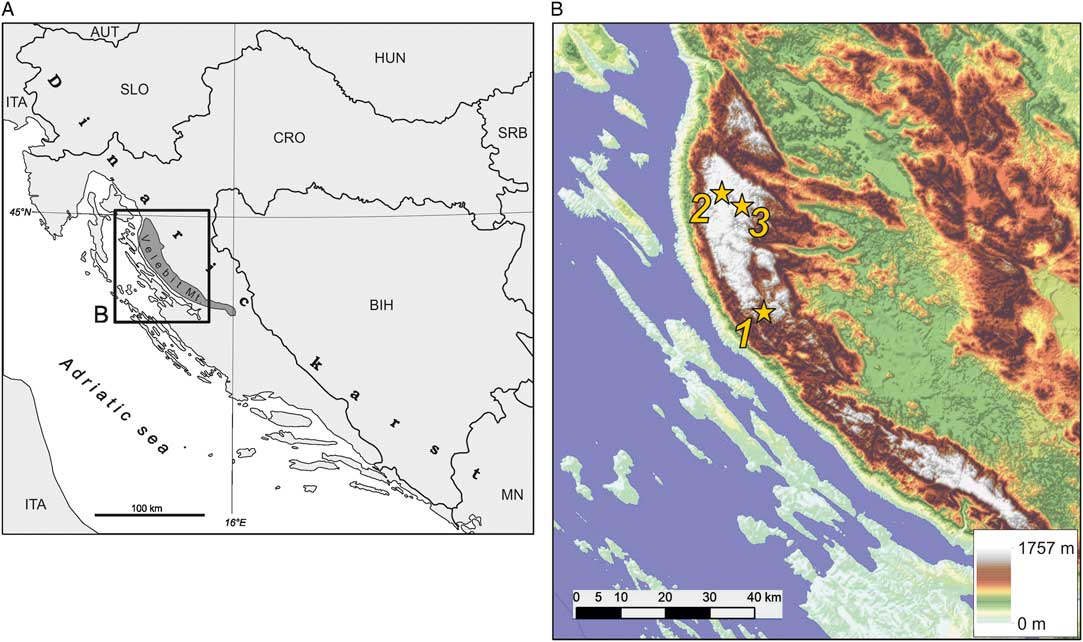
Currently 230 ice and snow caves (predominantly shafts) are known in the Velebit Mountain (Buzjak et al. Reference Buzjak, Bočić, Paar, Bakšić and Dubovečak2018). The spatial density of ice caves is highest in the area of northern Velebit Mountain (up to 25 ice caves/km2).
Caves and Samples
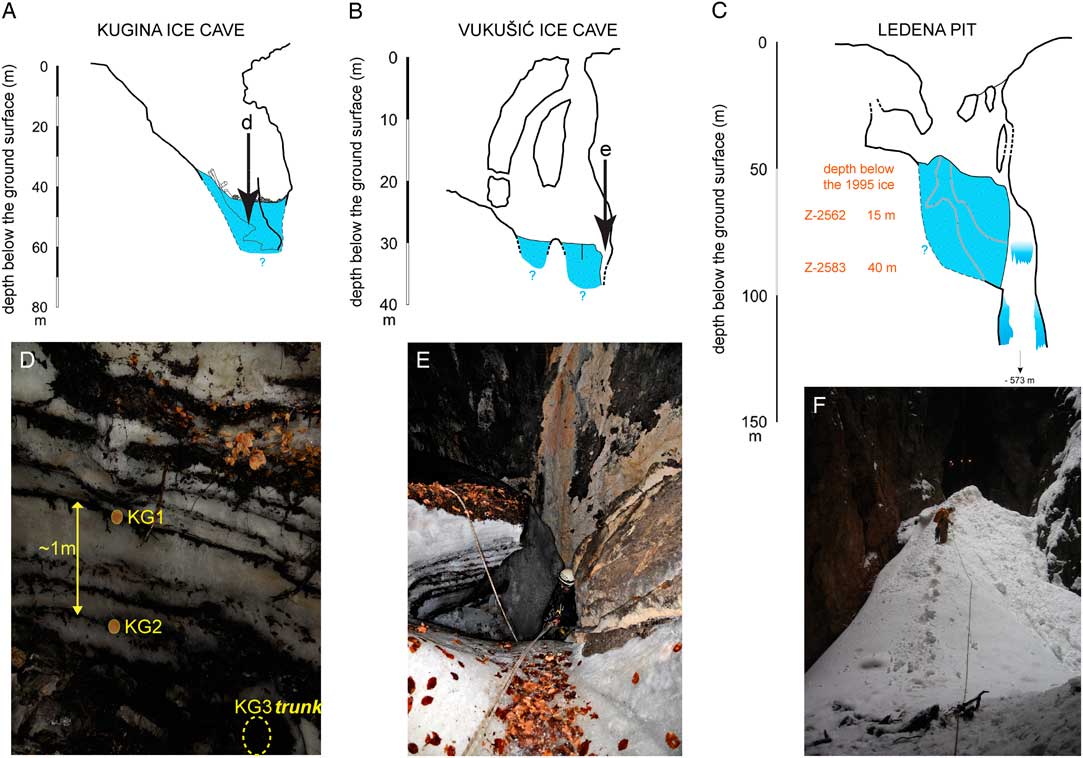
Kugina Ice Cave (Kugina ledenica, 44.61°N, 15.08°E, 1140 m asl) was explored in late July 2004 (Bočić Reference Bočić2005). The entrance opens in a forested area dominated by European beech (Fagus sylvatica L.). It is a simple cave with a single large entrance (43×27 m) and a large chamber hosting a 15-m-wide ice plug at the bottom (Figure 2a). With regard to its morphological characteristics, it is a typical static cave with firn. The known depth of the ice profile is about 20 m. In 2004 the ice plug extended from a depth of ~40 m to 61 m, and the estimated ice volume was approximately 1500 m3. A peculiar feature of this deposit is the high number of wood trunks embedded in the ice (Bočić et al. Reference Bočić, Buzjak and Kern2014).
Cross sections and site photos of the studied ice caves. A: Kugina Ice Cave (after Bočić Reference Bočić2005). The location of the profile shown in panel d is marked. B: Vukušić Ice Cave (redrawn after Kuhta Reference Kuhta2002). Position of the image shown in panel e is marked. C: Ledena Pit (after Jelinić et al. Reference Jelinić, Horvatinčić and Božić2001). D: Stratigraphy and location of the radiocarbon dated vegetal samples in Kugina Ice Cave. E: Accessible part of the ice cliff in Vukušić Ice Cave. F: Firn cone of the Ledena Pit.
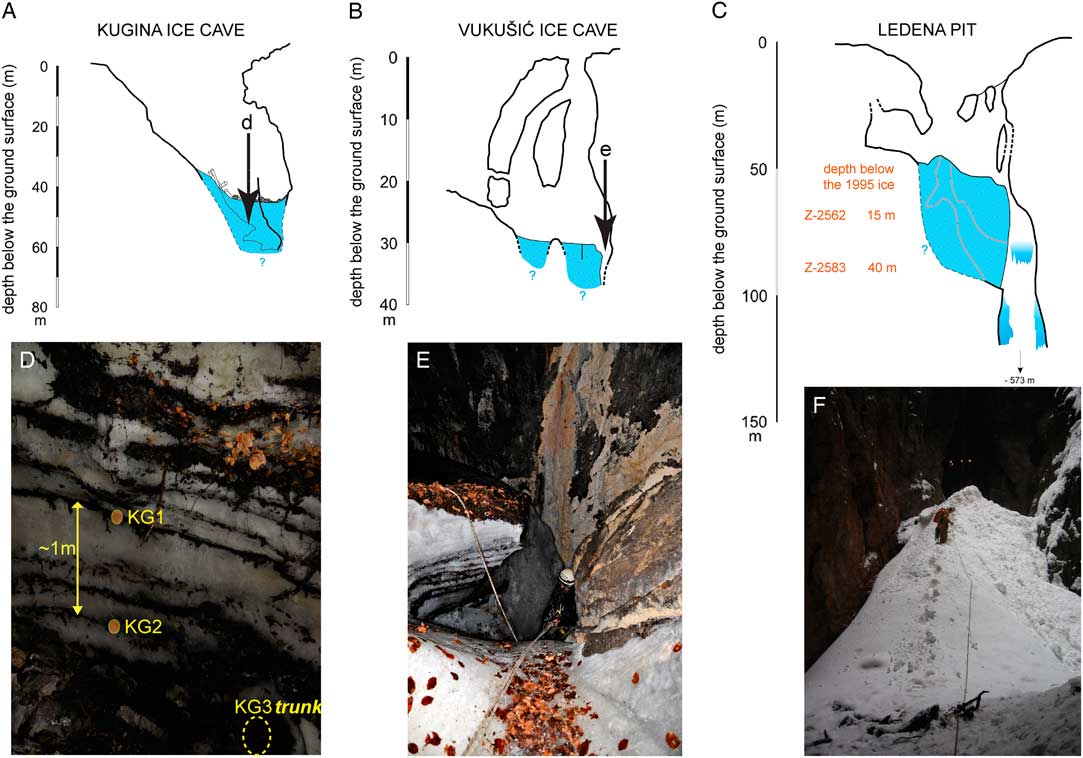
Leaf remains (including 10–20 leaves of European beech) were collected from two major organic-rich horizons in the accessible lower section of the ice cliff during a survey in 2014. Sample KG2 was collected close to the base of the ice cliff and KG1 ~1 m above KG2 (Figure 2d). However, the exact depth below the ice surface could not be measured because the sloping upper edge of the ice profile lacked a sharp delineation and the refreezing of surface ice layers over the edge. Another major and one minor organic horizon were also observed between these sampled layers, KG1 and KG2, and additional horizons rich in organic material were observed in higher sections of the ice cliff (Figure 2d). These horizons represent hiatuses in cave ice accumulation.
In addition, two pieces of relict tree trunks (KG3, KG4) found at the base of the ice deposit were also collected. Their outermost part was sampled and subjected to radiocarbon analysis in order to minimize the contribution of old wood and to constrain the date of their death and of subsequent burial to the cave ice.
Vukušić Ice Cave (Vukušić snježnica, 44.80°N, 14.98°E, 1470 m asl) is located near to the Zavižan peak in the northern part of the Velebit Mountain, ~8 km from the Adriatic coast. The forest surrounding the cave entrance is dominated by European beech and silver fir (Abies alba Mill). Vukušić Ice Cave formed in Middle Jurassic limestone. This shallow (rock overburden <10 m) cave consists of an entrance and two chambers filled with permanent ice (Figure 2b). These chambers are connected to the upper entrance via a shaft. The length of the cave is 20 m, and the depth, from the upper entrance to the ice level, is 30 m. The ice-covered area was only ~50 m2 in October 2007. The thickness of the ice body, however, exceeded 10 m.
Ten layers rich in organic material were identified in the accessible lateral upper part of the ice deposit of the Vukušić Ice Cave in 2014. A disk sample was sawn from a medium-sized trunk (VUK10) accessed from the side wall of the ice block. Two smaller branches (VUK11, VUK12) were collected from the best developed 9th horizon situated ~1.3 m below the ice surface in August 2014 (Figure 2e). All wood samples were identified as European beech. The samples were subsampled for 14C dating. A conventional radiocarbon date had already been reported for this ice deposit (Z-4329; Kern et al. Reference Kern, Fórizs, Horvatinčić, Széles, Bočić and Nagy2010; Table 1). However the stratigraphic relation of Z-4329 sample to the new set of samples could not be reconstructed due to the changes in the morphology of the ice body.
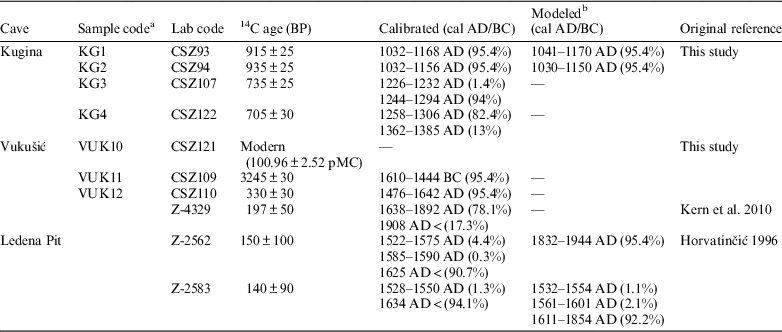
Radiocarbon activity and calibration results of vegetal remains from three cave ice deposits in the Velebit Mountain (Croatia).

a : Only for the new samples.
b : Only where a depositional model could be established using a priori knowledge of the stratigraphical relationship between the samples.
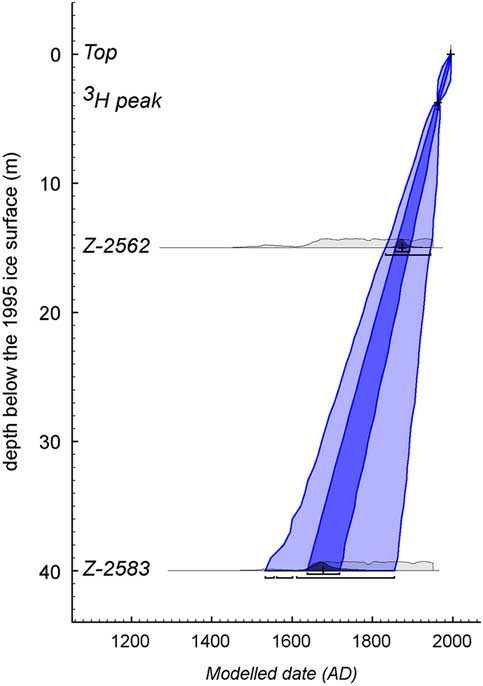
The Ledena Pit (Ledena jama u Lomskoj dulibi, 44.74°N, 15.03°E, 1235 m asl) is a knee-shaped, 536-m-deep pit (Jelinić et al. Reference Jelinić, Horvatinčić and Božić2001). Its entrance opens in the Lomska duliba glacial valley. Part of the entrance pit preserves a large ice body extending from a depth of 50 m down to 90 m, and ~20–30 m in diameter (Figure 2c, f). The firn and ice formed from snow and by freezing of percolating water (Buzjak et al. Reference Buzjak, Paar, Dubovečak and Bočić2014). The deposit is layered and contains soil and rock particles, leaves, branches, and bones (Buzjak et al. Reference Buzjak, Paar, Dubovečak and Bočić2014). During speleological explorations ice samples were collected for tritium analysis at nine levels and two wood branches were obtained from the side wall of the ice deposit at depths of 15 and 40 m below the ice surface and sampled for radiocarbon analysis in 1995 (Horvatinčić Reference Horvatinčić1996). The maximum tritium activity (2.8 Bq L–1) was found in the sample collected 3 m below the surface. This peak was assigned to the mid-1960s maximum in atmospheric activity related to thermonuclear weapon tests. The estimated period of cave ice deposition, assuming a constant rate of ice accumulation was considered to be in agreement with 14C ages of 450±100 yr (Horvatinčić Reference Horvatinčić1996; Horvatinčić and Krajcar-Bronić Reference Horvatinčić and Krajcar-Bronić1998). Later, the tritium activity of the local precipitation was modeled and the 3H activity of the 1995 ice samples was adjusted to the model results (Kern et al. Reference Kern, Bočić, Horvatinčić, Fórizs, Nagy and László2008). This re-assessment placed the likely position of the 1963 reference horizon to 3.75 m below the 1995 surface.
Radiocarbon Analysis, Calibration, and Age-Depth Modeling
Wood branches weighed 20–30 g, while the batch of leaf remains hardly weighed 2–3 g. Each sample was subjected to the standard AAA chemical treatment (Tans and Mook Reference Tans and Mook1980). Samples were converted to benzene using an Atomkomplex Prylad-type benzene synthesis line (Skripkin and Kovaliukh Reference Skripkin and Kovaliukh1998). Li2C2 was produced by vacuum pyrolysis in the presence of 5–10 g of Li and approximately 1 g of MnO2. In case of small samples pyrolysis was repeated two more times to maximize the output. Li2C2 was hydrolyzed then to acetylene and finally converted to benzene using a vanadium catalyst. Any remaining H2O and Rn were removed by freezing and selective sublimation of components. All procedures were performed under vacuum. Benzene output ranged from 0.3 g (leaves) to 1.5 g (branches).
LSC measurements were performed using a Quantulus 1220™ ultra low level beta spectrometer. Benzene samples were transferred into 1.5 mL teflon vials (Skripkin and Buzinnyi Reference Skripkin and Buzynnyi2017) and a scintillation cocktail (mixture of toluene, PPO and POPOP) was added. The net time of measurement per sample was at least 48 hr to ensure good counting statistics. Spectra were processed using the Easy View software.
The published radiocarbon age (Z-4329) from Vukušić Ice Cave was measured using an LSC Quantulus 1220 employing the benzene synthesis method for sample preparation at the Laboratory for Low-level Radioactivities, Ruđer Bošković Institute (Horvatinčić et al. Reference Horvatinčić, Barešic, Krajcar Bronić and Obelić2004), while data for two older samples (Z-2562 and Z-2583) from Ledena Pit were obtained by gas proportional counting (Horvatinčić and Krajcar-Bronić Reference Horvatinčić and Krajcar-Bronić1998).
Calibration of 14C dates was performed using OxCal v.4.3.2 (Bronk Ramsey Reference Bronk Ramsey2009) in conjunction with the IntCal13 (Reimer et al. Reference Reimer, Bard, Bayliss, Beck, Blackwell, Bronk Ramsey, Grootes, Guilderson, Haflidason, Hajdas, Hatte, Heaton, Hoffmann, Hogg, Hughen, Kaiser, Kromer, Manning, Niu, Reimer, Richards, Scott, Southon, Staff, Turney and van der Plicht2013) dataset. Calibrated ages are reported with two standard deviations (2σ).
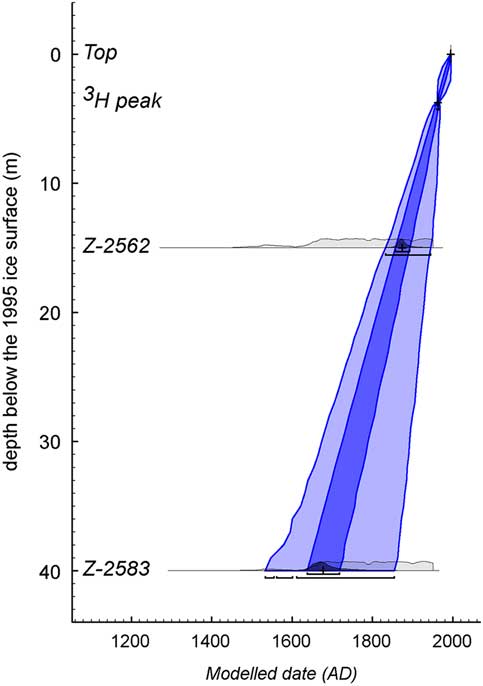
The previously published conventional dates from Ledena Pit were recalibrated. Age-depth modeling was performed using the P_Sequence function (Bronk Ramsey Reference Bronk Ramsey2008), taking into consideration the stratigraphical position of the samples (i.e., 15 and 40 m depth) and constraining the model with the 1963 reference horizon at 3.75 m below the 1995 surface. In the case of samples KG1 and KG2, only the relative stratigraphical position could be used in Bayesian modeling; therefore the Sequence function (Bronk Ramsey Reference Bronk Ramsey2008) was applied. The model was further constrained by assigning 1995 and 2004 to to the top of the section for the Ledena Pit and Kugina Ice Cave, respectively. The reason for this is that archive samples were collected in 1995 in the Ledena Pit (Horvatinčić Reference Horvatinčić1996), while the ice surface in Kugina Ice Cave cannot be younger than this date since the deposit has shrunk drastically since 2004 (Bočić et al. Reference Bočić, Buzjak and Kern2014).
RESULTS
All but one of the samples provided historical ages (Table 1). The 14C data indicate that the organic layers KG1 and KG2, observed in the lower section of the ice cliff in the Kugina Ice Cave, were deposited between AD 1041 and AD 1170 and between AD 1030 and AD 1150, respectively (Table 1). The trunk samples (KG3, KG4) yielded younger dates, indicating that the samples were very likely redeposited; they probably slided down during thawing and retreating of the ice wall (Bočić et al. Reference Bočić, Buzjak and Kern2014), and their collection spot at the foot of the ice cliff was not their original stratigraphical position. Since some additional ice layers were observed below the KG2 sample (~1 m, Figure 2b), the age of the basal ice deposit probably dates back to the turn of the 1st to 2nd millennium AD.
Radiocarbon ages obtained for VUK11 and VUK12, which were collected from the best developed horizon with organic detritus in the accessible upper part of the Vukušić Ice Cave, showed a remarkable difference in age (Table 1) and probably bracket a major hiatus in the accumulation history of the cave ice between the ~17th century BC and the ~16th century AD.
Bayesian age-depth modeling of the Ledena Pit using the recalibrated 14C ages and taking into account the stratigraphical relation of the samples (Figure 3) suggests a younger age for the basal layer of the ice deposit (median date: 1680 AD; 95% range: 1530–1860 AD) compared to the previous estimates (Horvatinčić Reference Horvatinčić1996; Horvatinčić and Krajcar-Bronić Reference Horvatinčić and Krajcar-Bronić1998), although the error margins overlap.
Depth-age model of the Ledena Pit. Light (dark) blue shading shows the 95% (68%) confidence range of the Bayesian model. Original and modeled probability density distributions are plotted in light and dark grey, respectively.
DISCUSSION
Age of the Cave Ice Deposits of the Velebit Mountain in a Southern European Context
The new data reveal the preservation of ice as old as the mid-Holocene in the lower section of Vukušić cave ice deposit, and from Medieval times in Kugina Ice Cave. Geochronological information is scarce for other cave ice deposits in the Dinarides. 14C dating of wood samples collected in 2011 in a vertical passage at depths of 120 m and 160 m in another shaft system from the Velebit (Lukina jama-Trojama) showed an upper age of 410±75 yr (Paar et al. Reference Paar, Buzjak, Sironić and Horvatinčić2013). The same study assigned an age of 525±40 yr to another part of the Ledena Pit cave ice deposit based on the 14C result of an individual piece of wood collected at a depth of 50 m in 2012 (Paar et al. Reference Paar, Buzjak, Sironić and Horvatinčić2013).
Comparing the 14C data from the Velebit Mountain presented here with data from cave ice in Southern Europe also yields interesting results. Date of the basal layer of the Grotta de Castellato di Mezzo ice deposit (Dolomites, N Italy) was estimated to 1532±60 AD according to counting of deposition bands whose annual nature was validated by tritium measurements in the upper 2.45 m of the ice block (Borsato et al. Reference Borsato, Miorandi and Flora2006). Dendrochronologically dated larch trunks collected from a thawing ice block at the entrance chamber of Ledena Jama pri Planini Viševnik (Slovenia) constrained the onset of cave ice deposition to 1703 AD (Staut et al. Reference Staut, Vreča, Merela, Brenčič, Mihevc, Hajna Zupan and Gostincar2016). Age constraints on cave ice deposits derived from 14C-dated vegetal remains are available for two major karstic regions of the Iberian Peninsula. Leafs and a branch collected from the ice deposits of the Altáiz and Verónica Ice Caves (Cantabrian Mountains, Spain) were dated to the 17th and 14th century AD (Gómez-Lende Reference Gómez-Lende2015). Hitherto, the oldest cave ice layers in Southern Europe were identified in the A492 cave (Pyrenees, Spain), where calibrated ages ranged from 4256–4043 to 3637–3496 BC (Sancho et al. Reference Sancho, Belmonte, Bartolomé, Moreno, Leunda and López-Martínez2018) in the lower section of a ~10-m-thick firn/ice deposit (Belmonte-Ribas et al. Reference Belmonte-Ribas, Sancho, Moreno, Lopez-Martinez and Bartolome2014).
In the light of these data, the oldest layers of the ice block of the Kugina Ice Cave predate most of the previously studied cave ice occurrences in the Dinarides. Vukušić Ice Cave, however, hosts the oldest known cave ice deposit in the Central Mediterranean realm and the second oldest known cave ice deposit of the entire Mediterranean region.
Comparison of Mass Balance Periods in Ice Caves of the Velebit Mountain and Other European Ice Caves
The dated vegetal remains were collected from organic inclusions concentrated along discrete layers (Figure 2) or assumed to be released from similar stratigraphic position during the current thawing process of these deposits (such as KG3, KG4, VUK10). Therefore their age is preferred to be interpreted as indicative of times unfavorable of firn accumulation. The remarkable age difference of VUK11 and VUK12 clearly supports the interpretation of the layers of concentrated organic inclusions as hiatus in the ice accumulation history of the Velebit cave ice deposits. Although, the age difference of VUK11 and VUK12, collected from the same erosion horizon, does not necessarily indicate a continuous negative mass balance over these ca. 3000 years in the Vukušić Ice Cave. Organic horizons usually originate from a longer ablation period and are mixtures of both organics accumulated during the negative mass balance period and older material released by melting of older ice strata.
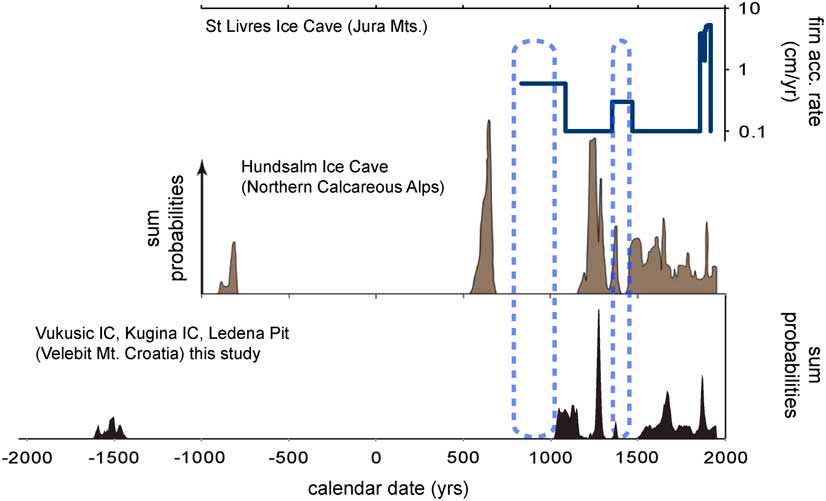
The probability densities of the calibrated and model-derived ages of the cave ice deposits of the Velebit Mountain appear to cluster into three periods spreading over the past 4000 yr (Figure 4). The presence of concentrated organic material might indicate the timing of periods of negative mass balances, while periods of reduced or even lacking organic remains might indicate increased snow accumulation and positive mass balances.
Sum probabilities of the calibrated and model-derived ages from cave ice deposits in the Velebit Mountain compared to a record from Hundsalm Ice Cave (Spötl et al. Reference Spötl, Reimer and Luetscher2014) and the reconstructed firn accumulation rate of St. Livres Ice Cave (Stoffel et al. Reference Stoffel, Luetscher, Bollschweiler and Schlatter2009). The dashed frames mark intervals with scarce organic deposition in the ice caves of Velebit and Northern Calcareous Alps and enhanced firn accumulation in the Jura.
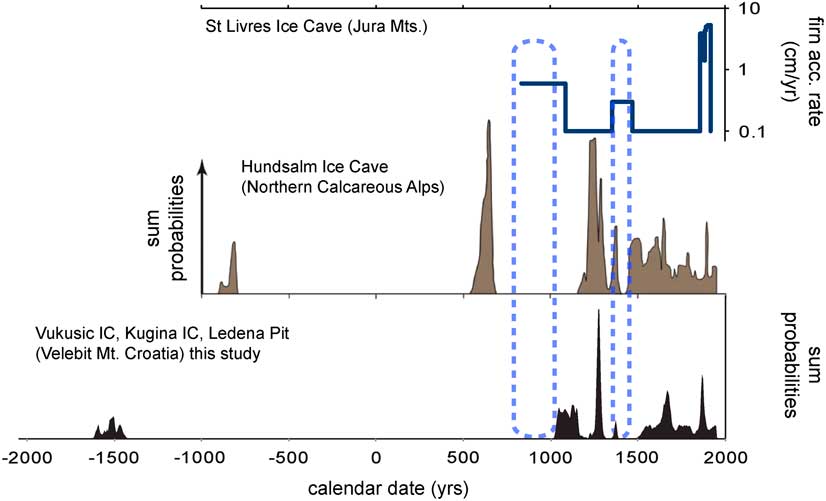
Very few datasets are available from other cave ice deposits for comparison. The nearest available record is from a 7-m-thick deposit of snow, firn and congelation ice of the Hundsalm Ice Cave (Eastern Alps), where 19 14C data allowed to place constraints on the accumulation and ablation history of the cave ice (Spötl et al. Reference Spötl, Reimer and Luetscher2014). For the 6-m-thick succession of the St. Livres Ice Cave (Swiss Jura Mountains) the firn accumulation rate has been reconstructed based on 45 dendrochronologically and partly 14C-dated wood macrofossils for the past ~1200 yr (Stoffel et al. Reference Stoffel, Luetscher, Bollschweiler and Schlatter2009).
The periods lacking vegetal remains in the cave ice sequences of the Velebit match well with similar patterns from Hundsalm Ice Cave (Spötl et al. Reference Spötl, Reimer and Luetscher2014) before the 11th century and for the 15th century AD, and correspond to periods of higher cave firn accumulation rates reconstructed for St. Livres Ice Cave (Swiss Jura Mts) (Stoffel et al. Reference Stoffel, Luetscher, Bollschweiler and Schlatter2009) (Figure 4). In addition, accumulation peaks of organic material also tend to correspond to periods of reduced cave firn accumulation rates in St. Livres Ice Cave and enhanced organic deposition in Hundsalm Ice Cave. Times of high abundances of 14C-dated vegetal remains of the Velebit ice deposits are preferably interpreted as indicative of times unfavorable of firn accumulation agrees well with the reduced firn accumulation rate in St. Livres Ice Cave. However, the interpretation of the observed corresponding pattern regarding the Hundsalm record is not straightforward because times of abundance peaks of 14C-dated wood remains have been interpreted as indicative of times favorable for increased accumulation in the Hundsalm Ice Cave (Spötl et al. Reference Spötl, Reimer and Luetscher2014).
Despite the contrast in the current interpretation of the of high abundances of 14C-dated vegetal remains the broad agreement suggests, at least, coherent changes in the mass balance of the cave ice deposits in the Dinaric and Alpine domains over the past ~1200 yr. Since static ice caves, such like St. Livres, Vukušić or Hundsalm Ice Cave, are sensitive recorders of winter precipitation and are relatively unaffected by summer conditions (Luetscher et al. Reference Luetscher, Jeannin and Haeberli2005) presumably large-scale changes of winter precipitation patterns might be reflected in the spatiotemporal accordance/discordance of their mass balance fluctuations.
Firn accumulation rates calculated from a set of radiocarbon dates of organic layers of the Pyrenean A492 cave ice deposit (Sancho et al. Reference Sancho, Belmonte, Bartolomé, Moreno, Leunda and López-Martínez2018) overlap with the Velebit record only for the 1st and 2nd millennia BC. There is some agreement between the higher Pyrenean firn accumulation rates reconstructed for the 12th century BC and between ~300 BC and 60 AD and periods lacking vegetal remains in the cave ice sequences of the Velebit. Vegetal remains are lacking for the latter period also in the Hundsalm Ice Cave (Figure 4). However, this comparison is cannot be conclusive since the date of the current surface of the ice body in the A294 cave was estimated to ca. 170 cal AD (Sancho et al. Reference Sancho, Belmonte, Bartolomé, Moreno, Leunda and López-Martínez2018) so there is practically no overlap with the better replicated last millennial period of the Velebit dataset.
CONCLUSIONS
A set of 10 radiocarbon data, including seven new measurements, are reported from three cave ice deposits of the Velebit Mountain. The results show that two of the studied cave ice deposits preserve organic material older than previously documented in the Dinaric Karst. 14C age of a sample suggests that the ice in the lower section of Vukušić cave ice deposit is very likely older than 3500 yr. The work is in progress to verify this suggestion. Maxima in the abundance of organic material (late-13th and late-17th century AD) and periods lacking vegetal remains (8th and 15th century AD) in cave ice sequences of the Velebit broadly match similar patterns reported from Hundsalm Ice Cave (Eastern Alps; Spötl et al. Reference Spötl, Reimer and Luetscher2014) and St. Livres Ice Cave (Swiss Jura Mountains; Stoffel et al. Reference Stoffel, Luetscher, Bollschweiler and Schlatter2009) suggesting large-scale coherence in conditions regulating European cave ice mass balance changes over the past ~1200 yr.
ACKNOWLEDGMENTS
The research was supported by the European Union and the State of Hungary, co-financed by the European Regional Development Fund in the project of GINOP-2.3.2.-15-2016-00009 “ICER” and by the Hungarian Human Resource Development Operational Program (EFOP-3.6.2-16-2017-00010). LP2012-27/2012, UniZG 202799/2015, and HURO/1101/126/2.2.1. are also acknowledged for financial support. Thanks to Tomislav Rukavina and Josip Tomaić (Nature Park Velebit), Mátyás Árvai, and the Speleological Society Karlovac for their great help during field work. Enikő Lázár, Dávid Filyó and Tamás Bartyik (University of Szeged) are thanked for preparing and measuring the seven new radiocarbon samples. Constructive comments from Christoph Spötl and an anonymous reviewer have greatly improved the manuscript. This is contribution No. 62 of the 2ka Palæoclimatology Research Group.