Several studies have shown that many chronic diseases adversely affect the health-related quality of life (HRQoL) (Reference Brown, Melville and Gray5;Reference Duncan, Samsa and Weinberger7;Reference Gulliford and Mahabir9;Reference Lyons, Lo and Littlepage12). It has also been shown that hypertension in the general population is related to lower HRQoL in most of the scales even after adjustment for concomitant diseases (Reference Bardage and Isacson3). Low socioeconomic status has also been associated with poor health functioning (Reference Hemingway, Nicholson, Stafford, Roberts and Marmot10).
Familial hypercholesterolemia (FH) is an autosomal dominant disorder attributable to mutations in the low density lipoprotein (LDL) receptor gene affecting 1 of every 500 individuals in its heterozygous form in Europe. It is characterized by hypercholesterolemia beginning already at birth, the presence of xanthomas, and premature coronary heart disease (CHD). In heterozygotic FH individuals, serum cholesterol levels are two- to threefold higher compared with the general population (Reference Goldstein, Hobbs, Brown, Scriver, Beaudet and Sly8). In patients with untreated FH, the age- and sex-standardized CHD mortality ratios are four to five times higher than those found in the general population (15). Specific cholesterol lowering drug treatment has been shown to reduce the risk of both CHD and death (15).
In addition to the sequelae of vascular disease, the simple awareness that one is carrying a trait that predisposes to future disease could well influence the quality of life. A few studies have investigated the quality of life in young and middle-aged FH patients. In Sweden, the quality of life was assessed in 185 adult FH patients, those individuals already suffering from CHD were excluded. The conclusion was that their quality of life was at least as good as controls, but they were worried about suffering CHD in the future (Reference Hollman, Gullberg, Ek, Eriksson and Olsson11). Fifty-seven patients with FH (mean age, 48 years; range, 30–69 years), in a long-term treatment study, reported having a similar quality of life to that of a reference population (Reference Retterstol, Stugaard, Gorbitz and Ose14). A Dutch study of sixty-nine statin-treated FH children and their parents showed that psychosocial functioning was not affected, but some specific FH-related concerns were expressed (Reference De Jongh, Kerckhoffs and Grootenhuis6).
With the introduction of effective cholesterol-lowering HMG-CoA reductase inhibitors (statins) in 1987, it became possible for FH patients to live longer because the macrovascular complications could be avoided or at least postponed. There is evidence that FH patients treated with statins are not at any increased risk for stroke or other brain lesions of vascular origin, at least before the age of 50 years (Reference Soljanlahti, Autti and Lauerma17). Thus far, there are very few studies that have examined elderly people with FH. However, this patient group—which did not have the possibility to receive statin therapy until midlife—make it possible to determine how lifelong hypercholesterolemia can affect mental functions in the elderly. In this study, we assessed HRQoL in FH patients aged 65 years or older and compared the data with the age-standardized general population.
PATIENTS AND METHODS
Study Design
The analyses included all elderly survivors of FH with the same North Karelia-mutation living in the North Karelia province situated in the eastern part of Finland with approximately 180,000 inhabitants. During our original survey, we identified 340 of the 407 FH North Karelian individuals who were heterozygous for the FH North Karelia-mutation (Reference Vuorio, Turtola and Piilahti23). A total of sixty-two were born in the year 1939 or earlier. During the ten subsequent years, nineteen of them had died, leaving forty-three survivors in November 2003. Two of them could not be contacted; two were in long-term care and two persons refused to provide consent. Consequently, thirty-seven individuals (86 percent of total, age range 65 to 84 years, 27 of them women) agreed to participate in this study. The study protocol was approved by the ethics committee of the North Karelia Central Hospital and written informed consent was obtained from all participants.
Methods
The present report focuses on HRQoL in our study population. The participants underwent an extensive workup, including questionnaires (with RAND-36 and 15D instruments embedded), interview, clinical examination, laboratory tests, imaging studies, and cognitive tests with CERAD testing (Consortium to Establish a Registry for Alzheimer's disease). RAND-36 and 15D instruments were primarily selected, because population data were available for comparison. These studies were conducted between April and August 2004.
The interview included questions about histories of diabetes mellitus, hypertension, and cardiovascular diseases; medication; and items on lifestyle (smoking, physical activity, alcohol consumption). The diagnosis of hypertension was made when a subject was receiving medication for elevated blood pressure. The diagnosis of diabetes was based on the use of insulin or oral hypoglycemic therapy. CHD was considered to be present if the patient had a documented history of acute myocardial infarction (AMI); if a previous coronary angioplasty or coronary bypass surgery had been carried out; if there was a previous diagnostic finding on a bicycle ergometer test, thallium scanning, or coronary angiogram; or if the patient had a typical history of effort-induced angina pectoris.
HRQoL was assessed with two internationally and nationally validated instruments: RAND-36 and 15D. The Finnish version of the RAND36-Item Health Survey 1.0 (virtually identical to the SF-36 health survey) has been validated in the Finnish population (Reference Aalto, Aro and Teperi1). This questionnaire consists of thirty-six items that assess the following eight dimensions: physical functioning, role-physical, bodily pain, general health, vitality, social functioning, role-emotional, and mental health. The subject's answers receive a numerical value, which, after being coded, is ranked on a scale of 0 (worst) to 100 (best). The population reference values had been earlier collected as a postal survey among 3,000 randomly selected Finns (aged 18 to 79 years) and from an additional sample (n = 400) from the age group 65 to 79 years. The response rate was 68 percent in the age group over 65 years (Reference Aalto, Aro and Teperi1). Our patients were compared with age-matched controls, for example, those aged 65 and older (n = 531).
The 15D is a generic, comprehensive, 15-dimensional, standardized, self-administered measure of HRQoL (Reference Sintonen16). It can be used both as a profile (each 0–1) and single index score measure (0–1, a difference of 0.02–0.03 points has been shown to be clinically important) (Reference Sintonen16). The 15D profile includes the following 15 dimensions: breathing, mental function, speech (communication), vision, mobility, usual activities, vitality, hearing, eating, elimination, sleeping, distress, discomfort and symptoms, sexual activity, and depression. The 15D data for the general population came from the National Health 2000 Health Examination Survey representing the Finnish population aged 30 and over. The original sample was 8,028 individuals (Reference Aromaa and Koskinen2). The 15D data were obtained from 6,166 individuals (response rate 77 percent). For this analysis, those individuals were selected who were in the same age range of the patients (n = 1287). This sample of the general population was weighted to correspond to the age structure of the patients.
Statistical Methods
To compare the groups, independent t-test and Mann-Whitney test were used when appropriate for continuous variables; χ2 test was used for proportions. To check whether adjustment for multiple testing was needed with the 15D dimensions, a stepwise binary logistic regression was run with the group dummy as the dependant variable and the level values of the dimensions as independent variables. In statistical analyses, two-tailed tests were used and p values <.05 were taken as statistically significant. SPSS 13.0 for Windows was used for statistical analyses.
RESULTS
Clinical Characteristics
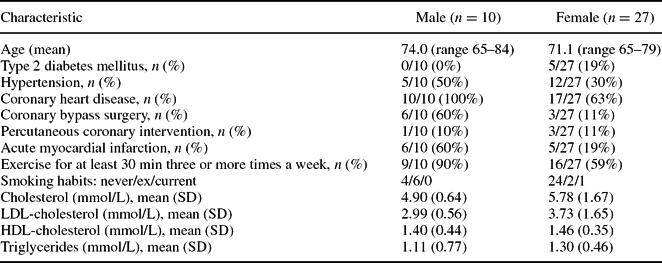
The characteristics of these FH patients are shown in Table 1. The study patients were 65 to 84 years old, and their mean age was 71.9 years (median, 70.6 years). Most of them had a low level of education, and they had been blue-collar workers. All of the men and more than half of the women had CHD, thus three of four were CHD patients, but other vascular disorders were less common. The subjects without CHD were also free of any other cardiovascular disease.
Characteristics of FH Patients

FH, Familial hypercholesterolemia; LDL, low density lipoprotein; HDL, high density lipoprotein.
All but one of these FH patients had been using statins, the average duration of use was 15 years (range, 11–18 years). The only statin non-user had discontinued her statin treatment because of side effects. The total cholesterol mean value at the time of diagnosis of FH, that is, before the initiation of statin therapy, had been 11.31 mmol/L (SD 2.14). Total and LDL-cholesterol mean values after long-term statin medication were 5.35 mmol/L (SD 0.84) and 3.34 mmol/L (SD 0.81), respectively. Most of our patients had been physically active for their whole life. Two of three reported exercising at least three times a week. There was only one current smoker, but there were eight former smokers.
HRQoL Measured with RAND-36
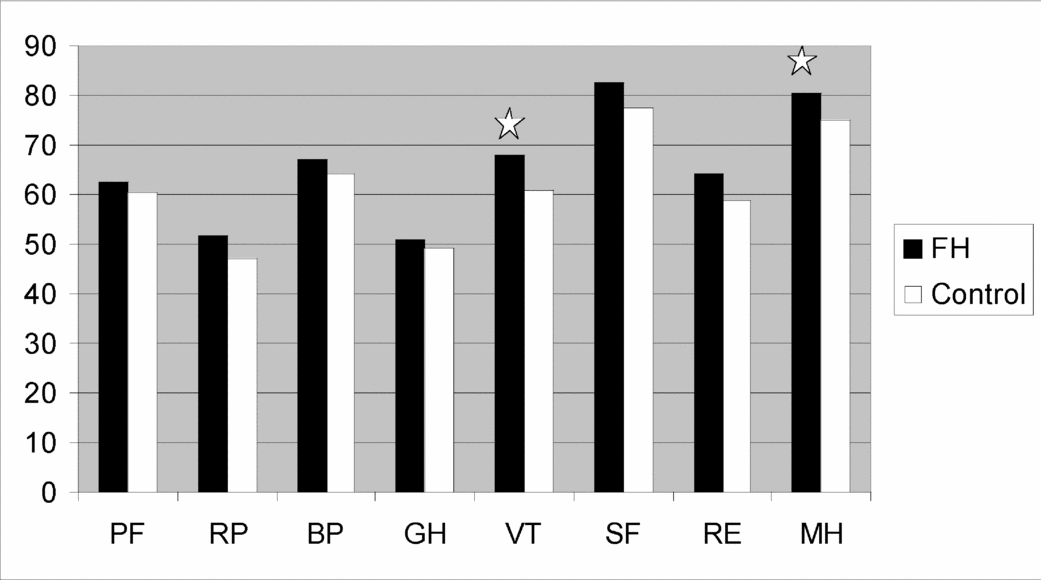
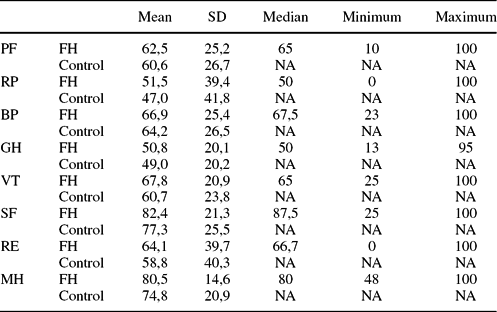
Figure 1 shows means in the eight RAND-36 dimensions for FH patients compared with the age-standardized population controls (aged 65 and older, n = 531). FH patients had a significantly higher score in mental health (p = .031), and their score in vitality was also higher, but did not quite achieve statistical significance (p = .051) compared with the general elderly population, otherwise there were no significant differences. Table 2 shows means, standard deviations, medians, minimum, and maximum for FH patients and means and standard deviations for the population controls.
RAND-36 Questionnaire: means in eight domains for familial hypercholesterolemia (FH; n = 35) and age-matched Finnish controls (n = 531). PF, physical functioning; RP, role-physical; BP, bodily pain; GH, general health; VT, vitality; SF, social functioning; RE, role-emotional; MH, mental health. ☆p = .031 (MH), p = .051 (VT).

RAND-36 Results Containing Mean, Standard Deviation, Median, Minimum, and Maximum for FH (n = 32–35) and Mean and Standard Deviation for Controls (n = 531)

FH, Familial hypercholesterolemia; PF, physical functioning; RP, role-physical; BP, bodily pain; GH, general health; VT, vitality; SF, social functioning; RE, role-emotional; MH, mental health; NA, not applicable.
HRQoL Measured with 15D
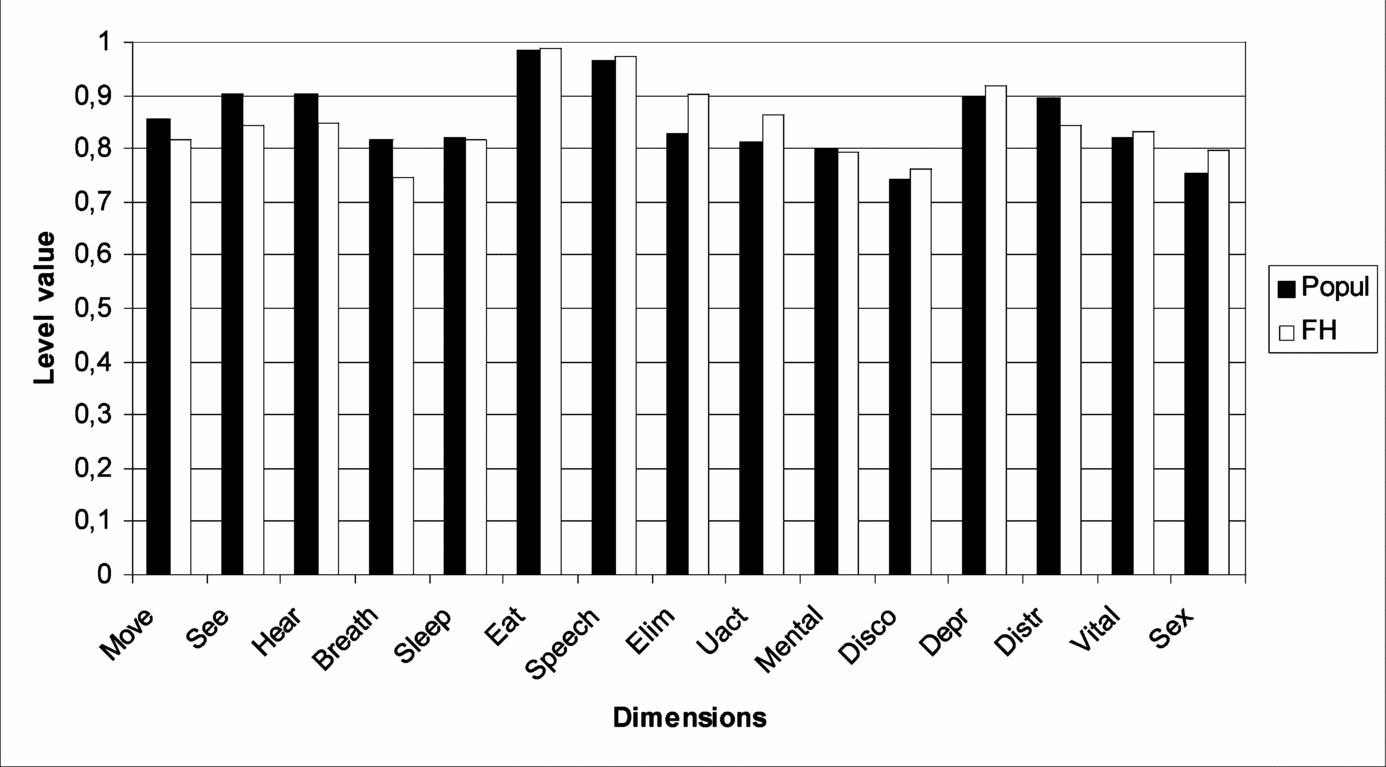
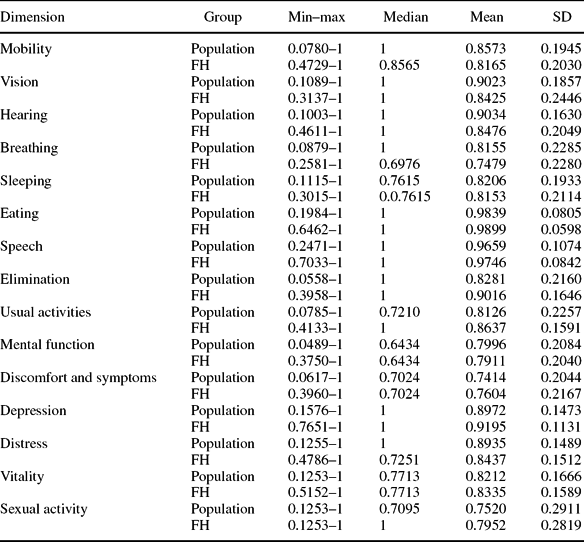
Figure 2 shows the 15D profile in FH patients compared with age-standardized population controls. There were statistically significant differences between the groups on the dimensions of elimination (FH better, p = .014) and distress (controls better, p = .051). In addition, in the logistic regression, depression was found to be a significant explanatory variable discriminating the groups; controls were worse off (p = .010). The mean 15D scores were almost identical: 0.850 for the FH patients and 0.851 for the population controls. Table 3 shows means, standard deviations, medians, minimum, and maximum for FH and the control population.
15D Profile for familial hypercholesterolemia (FH) group (n = 36) and age-standardized control population (Popul; n = 1,287) in Finland.

15D Results Containing Minimum, Maximum, Median, Mean, and Standard Deviation for FH Group (n = 36) and Age-Standardized Control population (n = 1287) in Finland

FH, Familial hypercholesterolemia.
DISCUSSION
We observed that elderly FH patients had very similar HRQoL to age-standardized controls in the general population. This finding was somewhat surprising, because FH patients suffered from cardiovascular morbidity and had low socioeconomic status. The strengths of our study were that it included almost all genetically verified elderly FH patients having the same North Karelia-mutation in North Karelia, and we compared the HRQoL using two validated instruments (RAND-36 and 15D). Both instruments revealed the same results. Adjustments for multiple testing in RAND-36 were not performed and, therefore, the differences where p values were close to .05 should be interpreted cautiously.
Our working hypothesis was that the HRQoL in our elderly FH patients would be lower than HRQoL among the general population, because of the deleterious effects of long-term hypercholesterolemia. Our patients were mostly women, with little schooling and most of them had been diagnosed with CHD. Nonetheless, it seems that the impact of CHD on perceived health may not be so pronounced in elderly people as it is in younger individuals (Reference Brown, Melville and Gray5;Reference Torres, Calderon and Diaz21). This finding may be due to several reasons, for example, comorbidity is more common with advancing age and these individuals may have adapted to their condition. Furthermore, older patients have fewer expectations than younger individuals.
Several studies among CHD patients have shown that female patients experience poorer HRQoL than men, possibly because women do not cope as well physically and psychosocially as men (Reference Brezinka and Kittel4;Reference Soto, Failde and Marquez18;Reference Van Jaarsveld, Sanderman and Ranchor22;Reference Westin, Carlsson, Erhardt, Cantor-Graae and McNeil24). Patients who were older, female, had a low level of education, were not living with a partner, and had at least one comorbid condition, in general reported the poorest level of quality of life (Reference Sprangers, de Regt and Andries19). Additionally, those with higher education tend to have higher scores on the dimensions evaluated by SF-36 (Reference Aalto, Aro and Teperi1;Reference Regidor, Barrio and de la Fuente13).
We speculate that there may be two possible explanations for our results. First, long-standing hypercholesterolemia may not have a “true” effect on HRQoL. At first sight, this would not seem likely, because hypercholesterolemia is an established cause of vascular disease and a higher cholesterol level in midlife has been shown to be associated with poorer HRQoL in old age (Reference Strandberg, Strandberg and Rantanen20). However, our patients (with one exception) had been using statins for 15 years (range, 11–18 years) and in this way had counteracted the adverse effects of hypercholesterolemia. Consequently, “asymptomatic” hypercholesterolemia would not affect HRQoL. Second, the result may be due to the “healthy survivor effect,” that is, those individuals who survive into old age even though they carry a heavy genetic burden, such as FH, possibly have some other positive genetic and environmental protecting factors. Our patients enjoyed a healthy lifestyle: there was only one current smoker, and eight former smokers. They were physically active: two of three reported exercising at least three times a week for 30 minutes or more.
One inevitable limitation of our study is that the number of patients was small. However, our study was comprehensive, that is, it included almost all of the elderly patients with FH in our district and they all carried the same mutation.
CONCLUSIONS
In conclusion, our study shows that the HRQoL of elderly persons with genetic hypercholesterolemia (FH) and high cardiovascular morbidity appears to be similar to the HRQoL of age-standardized controls in the general population. These elderly FH individuals are characterized by their healthy lifestyle and long-term statin treatment.
CONTACT INFORMATION
Laura Hyttinen, MD (laura.hyttinen@pkssk.fi), Consultant Physician, Päivi Kekäläinen, MD, PhD (paivi.kekalainen@pkssk.fi), Chief Physician of Outdoor Clinic of Internal Medicine, Department of Internal Medicine, North Karelia Central Hospital, Tikkamäentie 16, 80210 Joensuu, Finland
Alpo F. Vuorio, MD, PhD (alpo.vuorio@welho.com), Senior Researcher, Department of Medicine, University of Helsinki (University Hospital of Helsinki), P.O. Box 340, FIN-00029 HYKS, Finland
Harri Sintonen, PhD (harri.sintonen@helsinki.fi), Professor, Department of Public Health, University of Helsinki, Mannerheimintie 172, 00300 Helsinki, Finland; Research Professor, Finnish Office for Health Technology Assessment, STAKES, Lintulahdenkuja 4, 00530 Helsinki, Finland
Timo E. Strandberg, MD, PhD (timo.strandberg@oulu.fi), Professor, Deptartment of Public Health Science and General Practice, University of Oulu, Aapistie 1, Oulu, FIN-90014, Finland; Chief Physician, Unit of General Practice, Oulu University Hospital, P.O. Box 22, FIN-90221 Oulu, Finland.