Linked fate has become a ubiquitous variable of interest in scholarship on racial minority politics. Ever since Michael Dawson elaborated the concept and documented its far-reaching effects among Blacks in Behind the Mule (1994b), it has risen to canonical status. This shorthand measure of racial solidarity is now the leading workhorse for studying political groupness in nonwhite minority populations. This reflects a decades-long transformation in the research on racism and mass political behavior in the United States. Previous scholarship had focused on the racial psychology of whites and diagnosed racism as a “virus in the American bloodstream” (Moynihan Reference Moynihan1967, quoted in Bobo and Charles Reference Bobo and Charles2009, 243; see Kinder and Sanders Reference Kinder and Sanders1996; Schuman et al. Reference Schuman, Steeh and Bobo1985; Sidanius, Pratto, and Bobo Reference Sidanius, Pratto and Bobo1996; and Sniderman and Piazza Reference Sniderman and Piazza1993; for an overview of the literature see Bobo and Charles Reference Bobo and Charles2009). Dawson’s linked fate proceeded instead from the premise that racism is not all psychology but is also a congenital deformity deep in the bones of American politics. It turned the empirical focus to those most harmed by systemic racial inequality, foregrounding how Blacks act in concert to resist racism and pursue their interests. The concept centered nonwhites, their collective agency, and the racialized power dynamics of American politics. This was nothing less than the start of an epistemological revolution in the study of race, ethnicity, and political behavior.
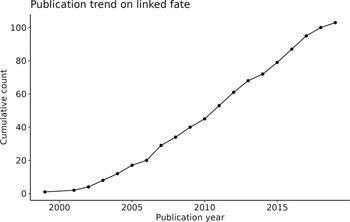
Yet as linked fate has gained broad currency, the research program around it has not quite matched the original scope of the concept. To survey how the linked fate literature has evolved, we turned to Google Scholar to inventory publications on the concept.Footnote 1 We used two search queries: (1) “linked fate” + “dawson” and (2) “linked fate” + “group consciousness” + “solidarity.” We culled the initial 103 results for each query, sorted them by relevance, removed duplicates, and excluded nonempirical research. The resulting sample (N = 89) is not exhaustive but provides a rough sketch of the trajectory of the research (figure 1).
Publication Trend on Linked Fate

The most notable pattern in the data is the increasing diversity in research subjects. Not surprisingly, articles on African American linked fate comprise half (50%) of the publications captured by our search. But research on other target groups—Asian Americans, Latinos, Black immigrants, whites, American Indians, women, transgender groups, Muslims, and even ethnic groups in Eastern Europe—has accelerated in recent years. This diversifying trend in the research tracks with changing racial demographics in the United States. As the country’s racial demography has diversified, so too has the range of groups analyzed in the scholarship (see figure A.1 in the online supplemental appendix A).
Theoretical and methodological approaches to studying linked fate, however, have been less diverse. Behavioral studies are overwhelmingly predominant and tend to prioritize survey methods that pinpoint patterns in public opinion (see figure A.2. in the online supplemental appendix). The empirical contributions from survey-based studies have been substantial, elucidating the distribution of linked fate across racial and ethnic groups and how it correlates with other political and socioeconomic variables. Methodological and theoretical controversies have been relatively muted, confined mostly to measurement inconsistencies or occasional debates about whether linked fate is an appropriate surrogate for more complex forms of group solidarity (e.g., Chong and Kim Reference Chong and Kim2006; Chong and Rogers Reference Chong and Rogers2005; Gay, Hochschild, and White Reference Gay, Hochschild and White2016; Junn and Masuoka Reference Junn and Masuoka2008; Masuoka Reference Masuoka2006; McConnaughy et al. Reference McConnaughy, White, Leal and Casellas2010; Philpot and Walton Reference Philpot and Walton2007; Sanchez and Masuoka Reference Sanchez and Masuoka2010; Watts Smith Reference Watts Smith2013; White Reference White2007).
But the heavy reliance on survey-based behavioral approaches can obscure key elements of the original theory underlying linked fate, Dawson’s Black utility heuristic. Linked fate perceptions are only a part of the theoretical framework—the most micro-level, individualistic dimension of it. The theory specifies dynamics operating at the macro, meso, and micro levels that together have activated this form of racial solidarity in the Black mass public. It begins at the macro level with the brutal material conditions and historical legacies that have cemented Blacks’ subordinate position in the country’s racial hierarchy. It then turns crucially to meso-level dynamics involving elites, the strategic choices they make, the messages they convey about the value of racial solidarity, and the social structure of the groups they lead. Finally, the theory arrives at the micro level when racial group identification in the form of linked fate takes root and acquires cognitive utility among individual Blacks. This is the last element in a “slow-moving process” (Pierson Reference Pierson, Mahoney and Rueschemeyer2003) and the final step in “the identity-to-politics link” (Lee Reference Lee2008).
Many behavioral studies of linked fate focus only on this last step, bypassing or giving cursory attention to the macro- and especially the meso-level components of Dawson’s original theory. Nor does the empirical analysis in Behind the Mule attend to all three levels in equal measure. Reflecting the predominant methodology of the time, the study primarily consists of correlation estimates of cross-sectional national survey data on individual-level variables, supplemented by secondary source analysis of the historical roots of Black political behavior. Although Dawson (Reference Dawson2001) would extend his historical analysis of Black politics in later studies, the macro- and especially the meso-level components of the theory are not as rigorously specified and validated as the micro-level elements are in the 1994 book. Subsequent studies on linked fate likewise have focused largely on individual-level variables and micro-level processes, with few systematic efforts to investigate and develop the other parts of the original theoretical blueprint. The behavioral research as a whole still has ample room to generate comprehensive and conceptually valid explanations of linked fate in minority populations (Gay, Hochschild, and White Reference Gay, Hochschild and White2016; McClain et al. Reference McClain, Carew, Walton and Watts2009).
In what follows, we propose a way forward for advancing the research program around linked fate and completing Dawson’s unfinished revolution. First, we recover the theoretical foundation underlying the concept. We then call for bringing elite-level agency and group-level social practices back into the research to clarify the macro- and meso-level conditions under which marginalized racial status translates into individual-level racial group consciousness. We theorize that elite actions are especially critical for understanding linked fate as a contingent outcome shaped by group historical processes and social dynamics. Finally, we recommend augmenting the empirical strategies researchers deploy to study linked fate and other forms of group solidarity. We argue for multiple streams of evidence and methods that not only center marginalized populations but also fully capture their experiences. This diverse, integrative approach widens the scope of the theorizing and expands the methodological toolbox for studying the politics of race and ethnicity.
Bringing History and Agency back in Linked Fate Research
We begin with a brief primer on linked fate and the underlying Black utility heuristic theory. Despite the ubiquity of linked fate in the research on racial and ethnic politics, Dawson originally developed it to understand patterns in Black politics—particularly the well-documented high levels of political uniformity across the group. Studies dating back decades have attributed distinctive tendencies in Black politics, including this robust political unanimity, to the salience of racial identification in the group (e.g., Pinderhughes Reference Pinderhughes1987; Shingles Reference Shingles1981; Verba and Nie Reference Verba and Nie1972). Solidarity is a vital source of leverage when a minority group is as hobbled as African Americans are by economic and political disadvantages. Mustering unified political action from the ballot box to the streets has been integral to their long quest to challenge white supremacy and demand government responsiveness. Linked fate is the linchpin to their solidarity in politics.
Dawson (Reference Dawson1994b, 77) defines linked fate as an identity construct that reflects “the degree to which African Americans believe their own self-interests are linked to the interests of the race.” Blacks who evince linked fate are convinced that their individual life chances are tethered to the collective fortunes of their racial group. Before Dawson, other researchers had developed similar ideas, such as interdependence and common fate, to explain politicized group consciousness in Blacks and other social groups (e.g., Conover Reference Conover1984; Reference Conover1988; Gurin, Hatchett, and Jackson Reference Gurin, Hatchett and Jackson1989). But he was the first to hypothesize a direct link between individual self-interest and racial group interests in Blacks’ political decision making.
This perceived connection between individual and group outcomes is what prompts African Americans to substitute the collective racial good for their personal interests. Dawson (Reference Dawson1994b, 10–11) argues that Blacks use the group’s absolute and relative status, usually vis-a-vis whites, as a proxy for their individual utility calculations. Linked fate operates as a heuristic or informational shortcut for simplifying political decision making in these instances (e.g., Lupia Reference Lupia1994; Popkin Reference Popkin1991). By focusing on interests and information, Dawson’s conceptualization of linked fate emphasizes the rational, rather than the affective, dimensions of group solidarity. This linked fate is not just a feeling; it is also a way of knowing.
The Black utility heuristic theory is the skeleton key for studying linked fate: it specifies the conditions under which linked fate should wax and wane in the Black population. This is how Dawson (Reference Dawson1994b, 61) stipulates the basic logic of the theory: “As long as African-Americans’ life chances are powerfully shaped by race, it is efficient for individual African Americans to use their perceptions of the interests of African Americans as a group as a proxy for their own interests.” The theory thus draws a causal chain linking the overarching conditions faced by the racial group to individual-level perceptions of linked fate in Black politics.
Dawson’s emphasis on how much race pervades the lives of ordinary Black people, however, might provoke conceptual confusion. Linked fate could be mistaken for a simple psychological indicator of racial salience rather than a measure of racial group interest per se. In Behind the Mule, Dawson occasionally leaves room for such ambiguity.Footnote 2 Black lives, he notes, were so overdetermined by racism, at least until the late twentieth century, that race was sure to be cognitively salient among Blacks (Reference Dawson1994b, 57). This brute fact, which arguably still applies to most Blacks today, could mean that race is a chronically accessible feature of Black political thinking. It also could mean that Blacks are predisposed to elevating racial considerations in their political decision making. In our conceptual lens, racial salience is the cognitive precondition for linked fate. But salience does not ensure either mutual recognition of shared racial interests or the group solidarity registered by linked fate. Dawson’s Black utility heuristic is a framework for predicting how individual Blacks go from this acute awareness that race matters to perceiving distinct racial group interests and then prioritizing them over other interests in politics.
Metaphorically, linked fate is akin to the climactic resolution of a two-hour movie on the politics of racial group solidarity. Paying attention to the preceding developments is crucial for understanding how characters developed and the plot unspooled. Yet behavioral studies that operationalize linked fate simply as an individual-level dispositional variable often skip over the early parts of the plot. This is especially evident in analyses extending linked fate by analogy to minority groups other than African Americans. Many of them investigate the causal impact of discrimination, because experiences or perceptions of discrimination are hypothesized to foster linked fate. Researchers have tested this hypothesis with a range of groups, including Latinos, Asian Americans, Muslims, and women, as well as African Americans (e.g., Gay, Hochschild, and White Reference Gay, Hochschild and White2016; Junn and Masuoka Reference Junn and Masuoka2008; Lien, Conway, and Wong Reference Lien, Conway and Wong2003; Masuoka Reference Masuoka2006; McClain et al. Reference McClain, Carew, Walton and Watts2009; Sanchez and Masuoka Reference Sanchez and Masuoka2010; Stout, Kretschmer, and Ruppanner Reference Stout, Kretschmer and Ruppanner2017; Verkuyten Reference Verkuyten2017). Most survey-based studies rely on statistical models to test the argument and operationalize the linked fate dependent variable with a pair of survey items that replicate the wording of the measures in Dawson's original work: [what happens to [your group] in this country will have something to do with what happens in your life]. They also sometimes supplement these measures with items tapping more complex forms of racial solidarity like group consciousness (e.g., Masuoka Reference Masuoka2006; Sanchez and Vargas Reference Sanchez and Vargas2016).
The findings have been decidedly mixed.Footnote 3 For example, Masuoka (Reference Masuoka2006) concludes that racial discrimination predicts group consciousness among both Asian Americans and Latinos. Sanchez and Masuoka (Reference Sanchez and Masuoka2010, 525–26), however, find that, among a range of potential explanatory variables, it is “Latinos getting ahead,” not “discrimination experience,” that yields a statistically detectable relationship with linked fate in a sample of Latino respondents. The effect size of “Latinos getting ahead” is much larger than that of “discrimination experience.” Still, a more recent analysis based on 2016 data uncovers a statistically positive association between Latino linked fate and discrimination (Sanchez, Masuoka, and Abrams, Reference Sanchez, Masuoka and Abrams2019). The evidential inconsistency is also not limited to the research on non-Black racial minorities. Gay, Hochschild, and White (Reference Gay, Hochschild and White2016, 135), for instance, show that “perceptions of discrimination” are weakly related to linked fate among the major racial groups (see also Gay Reference Gay2004; Chong and Kim Reference Chong and Kim2006).
There are two possible explanations for these mixed findings. First, the issue could be purely methodological. Perhaps the sampling in many of the extant studies is biased and the models are misspecified. If this is the case, researchers can course correct by collecting higher-quality data and applying more rigorous methods. The other possibility is theoretical. Problems stemming from theory pose a more fundamental challenge: they cannot be rectified simply by leveraging better data or analytic techniques. Rather, they call for clarifying the scope and dimensions of the theory underlying linked fate. We believe that careful attention to the components of the theory can help identify which approaches and kinds of evidence could generate reliable insights on how the construct develops and operates among racial minorities.
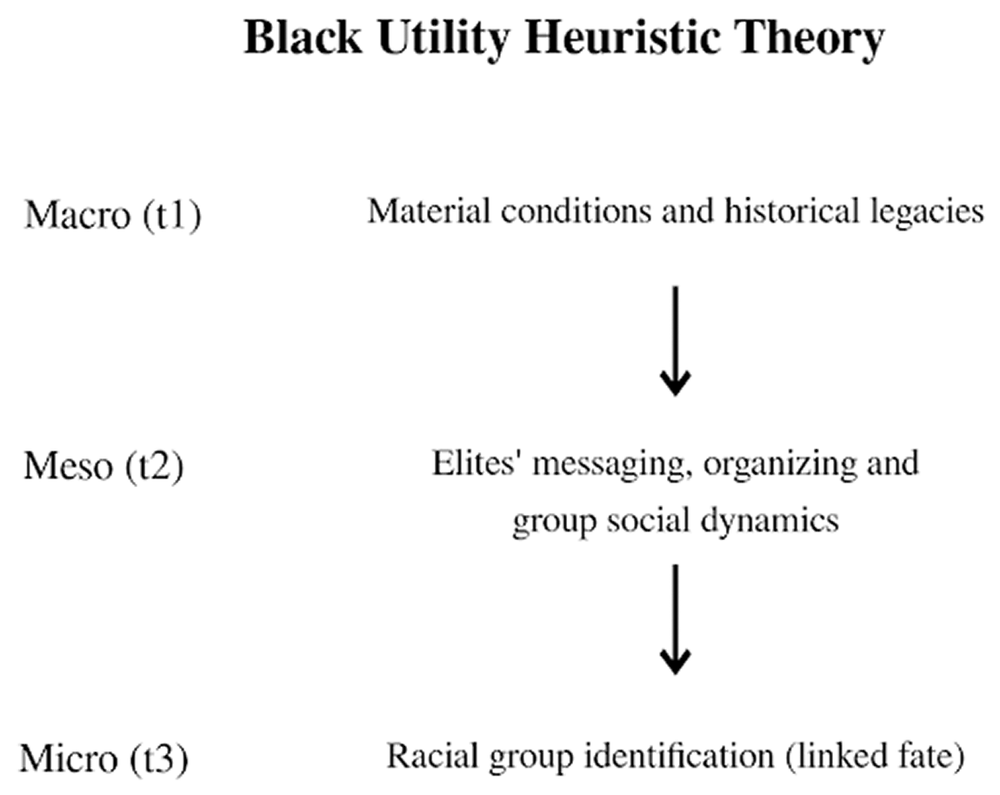
Black utility heuristic theory stipulates both the historical and social origins of racial group solidarity (Dawson Reference Dawson1994b, 48–60). These macro- and meso-level components are not mere background information; they are predicates for the basic political logic of Dawson’s linked fate concept. “Politics” he explains, “is much more than simply the behavior of individuals or the sum of these individual actions … one clearly needs to pay more attention to the boundaries between society and the individual, with the group as the intermediary phenomenon” (13). In addition to using statistical models to understand the relationship between linked fate and other individual-level variables then, Dawson traces the antecedents of linked fate to a set of macro- and meso-level conditions in Blacks’ historical and social experiences (figure 2). He does not attempt, however, to estimate the effects of discrete causal variables, such as exposure to discrimination. The fully elaborated theory lays out a constellation of upstream factors that structure how Blacks—and presumably other racial minorities—harness group solidarity (i.e., linked fate) to assert their political agency. If these conditions were not specified, the Black utility heuristic would be a narrow theory about the micro-level processing of racial cues like perceptions of discrimination and feelings of in-group closeness. Dawson certainly suggests that “individual experiences with discrimination” can motivate linked fate (63). But the psychological pivot from perceptions of discrimination to linked fate is neither reflexive nor ineluctable.
Schematic Causal Diagram of the Black Utility Heuristic Theory

As figure 2 illustrates, Dawson’s theory treats the formation of linked fate as conditional, context dependent, and elite driven. The theory is configurational. Linked fate is the result of a combination of “racializing” and “consciousness-raising” phenomena, including but not limited to discrimination. Exposure to discrimination alone does not necessarily generate group solidarity. Such hardship could lead to a rejection of racial group ties and a reliance solely on individual effort to pursue social mobility (Chong Reference Chong2000). Blacks historically have debated these alternatives when considering the advisability of collectivist versus individualist strategies for overcoming racism (Jagmohan Reference Jagmohan2015; Shelby Reference Shelby2005). The common experience of discrimination does not lead inevitably to shared racial group interests or mutual agreement on political strategy. Discrimination is a key variable, but it is simply one stick in the bundle of conditions necessary for the emergence of a collectivist mindset like linked fate. Yet the commonly tested hypothesis drawing a direct causal arrow from discrimination to linked fate ignores these other factors, often relegating them to a black box of unspecified assumptions.
The macro- and meso-level factors that often get empirical short shrift are the historical processes, elite dynamics, and social practices posited in the theory. The inequalities that marginalize racial minority groups do not emerge ex nihilo. They are, at least in part, the historical legacies of racial injustices (
 $ {t}^1 $
in figure 2). These conditions—slavery, segregation, economic precarity—make marginalization a communal predicament (Dawson Reference Dawson1994b, 48–57). They batter minorities into a subordinate structural position and, along with ongoing discrimination, heighten the salience of race among group members. They then prompt in-group elites to mobilize nonelites around their shared racial identity and (mis)fortunes (
 $ {t}^2 $
in figure 2). Social practices, in turn, may amplify and sustain this racial solidarity (i.e., linked fate) at the individual level (
 $ {t}^2 $
in figure 2).
Elite Dynamics
Elites play a pivotal role in political learning and collective action processes within groups (Iyengar and Kinder Reference Iyengar and Kinder1987; Wasow Reference Wasow2020; Zaller Reference Zaller1992). They drive two of the necessary vehicles for group mobilization: messaging and organizing. Minority group leaders help individuals make sense of the macro-level conditions they face in common with their racial peers. They share information about their racial group’s status by identifying the immediate and downdraft consequences of these conditions for group members (Blumer Reference Blumer1958). They interpret what these shared racial experiences mean; advocate collective action strategies and policies for addressing them; and convey these messages to the rest of the group. In addition, leaders organize individuals to prepare them to act in unison. Communication directed to in-group constituents cannot increase a group’s political power if there is no means to mobilize them to take action when needed (Han Reference Han2014).
Recognizing this dual challenge, many prominent Black leaders have pursued both messaging and organizing. Marcus Garvey established the Universal Negro Improvement Association and the Negro World, its associated newspaper, to advance Black nationalism. W. E. B. Du Bois cofounded the National Association for the Advancement of Colored People and the Crisis, its in-house magazine, to combat racism. More recently, the Black women who launched the Movement for Black Lives on social media also started a virtual alphabet soup of grassroots organizations, such as #BlackLivesMatter, Assata’s Daughters, the Dream Defenders, and Black Youth Project 100. In short, elites not only heighten the salience of linked fate as a description of their group’s disadvantaged status but they also promote linked action among the rank and file as a prescription for remedying it.
Dawson (Reference Dawson1994b) cites a series of historical examples to illustrate the sway Black leaders have over how linked fate is formed and activated among ordinary Black people. But his study does not specify the mechanisms that enable elite actors to be prime movers at the meso level of his Black utility heuristic theory.Footnote 4 Elites are uniquely positioned to play this role because of their elevated standing within groups. They can use their proverbial megaphones to amplify the racial messaging that shapes mass opinion and galvanizes collective action. This gives them the power to set the agenda by prioritizing specific issues and framing them as racial group interests warranting group unity and mobilization (Dawson Reference Dawson2001; Lee Reference Lee2002; Tate Reference Tate2010). With such leverage, elites get to define which issues are matters of racial common cause and which ones are not. They also get to signal whom they consider core versus peripheral members of their group. This elite-driven agenda-setting process delineates the boundaries of groupness—or as Cohen (Reference Cohen1999) put it in the African American case, the “boundaries of Blackness” (also see Reed Reference Reed1999).
African American leaders, for example, are key influencers of partisan preferences in the Black population. When figures like Barack Obama or Stacey Abrams tout support for the Democratic Party as good for the racial group, they translate this partisan choice into a normative one for African Americans. Their exhortation transforms identifying with Democrats into an act of racial solidarity. It is something that individual African American voters ought to do in the interest of Blacks as a whole; making another choice, like supporting a Republican candidate at the polls, is out of racial bounds. This is how elites take the lead in crystallizing racial solidarity as a political norm (Cohen Reference Cohen1999; White and Laird Reference White and Laird2020; White, Laird, and Allen Reference White, Laird and Allen2014).
Ethnic group elites have compelling strategic incentives to appeal to group solidarity and frame issues in collective terms. The extent to which a group is perceived as unified around specific interests is what gives leaders their capacity to speak and act on behalf of their in-group (Carmichael and Hamilton Reference Carmichael and Hamilton1967; Dawson Reference Dawson1994b; Hardin Reference Hardin1995). But elites are not caesarist actors who can summon linked fate perceptions at will: they are bound by constraints at the macro level. Whether and when they cue racial group interests to override individual self-interest is largely influenced by the macro-level racial environment. For starters, the severity and sweep of racial inequality and conflict (i.e., the level of segregation, economic distress, violence, etc.) at any given time or place determine elites’ messaging options. Messages that are sharply at odds with the state of the racial environment or its rigors as experienced by minority group members are likely to fall flat.
Leaders’ messaging options are further circumscribed by the fact that the individual-level effects of racial adversity are heterogeneous and intersectional. Racial hardships fall unevenly across the members of a minority group, depending on socioeconomic status, geographic location, and so on (e.g., Gay Reference Gay2004; Reed Reference Reed1999; Taylor Reference Taylor2016). Elites must tailor their messaging to issues that can be framed credibly as affecting either the broadest swath of group members or a core subset of the group—the latter are usually the most privileged members who have political and economic capital to wield. Issues portrayed by elites as widely shared racial concerns actually may favor the interests of these high-status individuals (Forman Reference Forman2017; Reed Reference Reed1999). The possibility of such class or other biases lurking behind the framing of racial group interests is why empirical investigation into elite agenda-setting dynamics is theoretically warranted. In addition to fashioning the right rhetoric to mobilize in-group members, elites also might craft their messaging and organizational tactics to minimize backlash from whites (e.g., McCormick and Jones Reference McCormick, Jones and Persons1993; Stephens-Dougan Reference Stephens-Dougan2020; Wasow Reference Wasow2020). They even might devise messages to accommodate dominant white interests while also appealing to their minority in-group (Johnson Reference Johnson2016).
Finally, the macro-level racial environment—how open or cramped it is for a minority group—is broadly the result of policies in different domains like housing, policing, election administration, and education. Thus, the universe of prevailing policies and viable alternatives—the Overton window built by a governing regime—informs the content and the limits of elites’ racial messaging. For example, Johnson-era social policies buoyed the rise of a cadre of Black political leaders in cities in the years following the civil rights movement (Reed Reference Reed1999). The imprimatur of Johnson’s War on Poverty policies (i.e., the 1964 Economic Opportunity Act, the 1968 Kerner Commission) and the resources they generated showed plainly in the messaging, community-building strategies, and agenda-setting choices of this generation of Black officialdom.
Social Dynamics
Elites’ decisions about racial messaging and organizing are also subject to meso-level social dynamics, which determine how much traction linked fate or other forms of racial solidarity attain at the individual level. In-group elites typically convey agenda-setting racial messages through a network of indigenous institutions. In his theorization of Black racial solidarity and the utility heuristic, Dawson (Reference Dawson1994a; Reference Dawson2001) assigned crucial significance to just such a network in the African American population. The Black counterpublic, as he dubbed it, emerged just after the Civil War and expanded during the Jim Crow era when extreme segregation barred Blacks from participating in white civil society (Du Bois Reference Du Bois1899). This all-Black network historically has included civil rights organizations, trade unions, social clubs, colleges, and principally churches and other places of worship. It also encompasses indigenous media outlets and informal public spaces, such as barbershops and beauty salons (Harris-Perry Reference Harris-Perry2004; Kelley Reference Kelley1993).
Elite messages are not only disseminated but also vetted, debated, and synthesized via this network. Yet, it is not just the messages that are subject to inspection; the role that leaders play also draws scrutiny (e.g., Carmichael and Hamilton Reference Carmichael and Hamilton1967; Cruse Reference Cruse1967; Ransby Reference Ransby2003). Black elites affiliated with Black membership organizations are better positioned to make credible, verifiable claims to leadership of their racial group than those who are not. They are also accountable to these organizations, navigating disagreements within them to build consensus around specific interests and agendas. Black politics always has been riven by competing interests and visions of how to improve Black life and achieve a more just society. Debates within the group extend beyond the merits of individualist versus collectivist messaging and tactics for advancing Blacks’ interests. Even advocates of solidarity politics (i.e., linked fate), for instance, sometimes disagree over which ideological vision is ideal for improving Blacks’ status. Blacks have pursued various mobilization strategies and ideological pathways, including liberal integrationism, Black conservatism, feminism, Black nationalism, Black Marxism, and more (Dawson Reference Dawson2001; Gooding-Williams Reference Gooding-Williams2011; Harris-Perry Reference Harris-Perry2004)—all in response to the vagaries of white supremacy, changes in their access to state resources, and shifts in the presumed risks and rewards of collective action. Elites advance these ideological outlooks and their prescriptive implications, such as partisan choice or policy preferences, distilling them into coherent messages for circulation in the counterpublic.
These messages are then amplified and reinforced via social connections among ordinary black people. The social ties that bind Blacks are especially robust because of their high levels of residential segregation (Rogers Reference Rogers, Smith and Greer2018; White and Laird Reference White and Laird2020). The bonds function as social pressure and can induce broad in-group compliance with these messages (White and Laird Reference White and Laird2020). Social pressure also can constrain what elites say and do. Elites whose messaging contravenes established racial group norms risk losing their standing in the group (Kennedy Reference Kennedy2008). Through these social processes, particular messages gain currency and emerge as a collective vision of Black politics or a unifying political agenda (Dawson Reference Dawson2001).
“Black institutions and social networks … limit the reduction of black political homogeneity” (Dawson Reference Dawson1994b, 59). This counterpublic is the key crucible, then, for mobilizing and sustaining solidarity, including perceptions of linked fate, in Black politics. Presumably, indigenous networks might operate to similar political effect among other racial minorities, depending on the strength of their institutional and social connections. Not all minority populations boast the extensive institutional infrastructure and thick social bonds that prevail among Blacks.
Analogizing from Blacks to Other Groups
Much of the research extending linked fate from African Americans to other racial minorities, however, is based on analogical reasoning that elides distinctions in these consequential social practices, elite dynamics, and historical processes. The reasoning assumes that (1) one set of features (i.e., discrimination) is more significant than others and that (2) cases of interest are highly comparable per those features. When researchers focus exclusively on discrimination as the key causal mechanism for linked fate, racial minority groups might seem like commensurate cases, because most inevitably encounter discrimination in the United States.
Yet this version of the Black utility heuristic theory is too deterministic. It does not necessarily square with the experiences of non-Black minority groups, whose marginalized racial status has not always led to collective mobilization or coalition building with racial peers. Asian Americans, for instance, remained divided by nationality until a new generation of activists mobilized these groups in the 1960s and 1970s (Espiritu Reference Espiritu1993; Okamoto Reference Okamoto2014). Likewise race-based solidarity among Latinos has emerged only in the past half-century (e.g., J. Y. Kim Reference Kim2020a Mora Reference Mora2014; Padilla Reference Padilla1985). If oversimplification leads to myopic determinism, paying close attention to distinct historical processes, social dynamics, and elite strategic behavior across these groups may be the solution. For example, J. Y. Kim (Reference Kim2020b) shows that, despite their shared “Oriental” racial status, Chinese ethnics across the United States and Canada in the 1960s and 1970s did not all pursue a race-based coalition strategy to fight gentrification and demand affordable housing in their neighborhoods. Race-based coalitions appeared in San Francisco and Seattle, but not in Vancouver, where a cross-racial coalition between the Chinese and southern and eastern Europeans materialized. The differences across these cases emerged because ethnic community organizers in each city were strategic: they chose their allies based on the size and strength of their social relations with each prospective partner group. Weighing these factors often entails a trade-off: large partner groups are useful for asserting political power, but they may inflate coordination costs depending on their familiarity to the group making the assessment.
By the 1960s and 1970s when the Chinese needed coalition partners, the candidate pool had been fated by history. Past immigration and segregation policies set the course for the demographic and residential patterns that influenced community organizers’ strategic calculations. The Chinese in San Francisco and Seattle allied with other Asian ethnic populations because these groups were large and familiar to them as friends and neighbors. Their counterparts in Vancouver, using the same strategic calculus, surmised that southern and eastern Europeans would be their ideal coalition partners.
This brief historical comparison shows that distinct racial predicaments and policy environments have shaped solidarity politics in these populations. Researchers rightly have called for more specificity in empirical accounts of the racial hardships that saddle different minority groups (C. J. Kim Reference Kim1999; Masuoka and Junn Reference Masuoka and Junn2013; Rosenbloom and Way Reference Rosenbloom and Way2004). Racial marginalization is not monolithic. Nor is linked fate or any form of racial solidarity a one-size-fits-all phenomenon. As Dawson (Reference Dawson1994b, 62) notes, “One should not expect group consciousness to have the same content, the same strength, or even the same structure across groups.” Meso-level investigations into group historical processes, social practices, and elite behavior can illuminate variations in racial marginalization and solidarity building across minority populations. Attention to these details can help clarify when and where discrimination might activate linked fate. The practice of analogizing across groups of color solely based on their vulnerability to discrimination misses these critical distinctions and contingencies.
Analogical reasoning has limits even for understanding how racial solidarity has evolved in Black politics in the face of internal differences in the population. Although Blacks are wholly vulnerable to racial discrimination, the interests of all Blacks are not necessarily treated equally in the elite-driven process that builds solidarity in politics. In her study of African Americans’ initially halting response to the AIDS epidemic, for example, Cohen (Reference Cohen1999) concludes that Black elites center specific issues as integral to the group’s collective interests while marginalizing others as incompatible or anathema. Black leaders likewise may try to mobilize racial solidarity for some in-group interests and inhibit it for others.
Pointing to a similar process, Rogers (Reference Rogers2006) observes that coalition building between African Americans and Afro-Caribbean people has been fitful, even contentious, despite their shared skin color. Elites in both groups sometimes have instrumental motivations that lead them to elevate their competing ethnic interests over the prospect of racial solidarity, particularly in battles for electoral office. During these conflicts, African American elites sometimes assert greater authority to define the agenda for Black solidarity politics than their Afro-Caribbean counterparts.
These examples from Black and Asian American politics illustrate a key point: racial solidarity may be unifying, yet not necessarily equalizing; encompassing, but not fully inclusionary. The analogical reasoning underlying some behavioral studies of linked fate misses these caveats. But they are crucial to understanding how racial solidarity evolves and then develops at the individual level. The shared racial group interests that motivate solidarity politics should not be taken for granted or treated a priori as essential properties of racialized minority populations. Group interests are constructed through agenda-setting and mobilization networks. Racial solidarity in minority group politics is not simply a mutual feeling or a shared psychological reaction to discrimination. It is a process shaped by history, indigenous social practices, and the agency of ingroup elites.
Evidence, Methods, and Racial and Ethnic Politics
The linked fate formation process looks like a kind of two-step communication flow involving elites and masses moving in sequences (Lazarsfeld, Berelson, and Gaudet Reference Lazarsfeld, Berelson and Gaudet1944; Zaller Reference Zaller1992). Leveraging their command of information, resources, and networks to mobilize group members, elites dominate the upstream stage. The masses drive the downstream stage as individual circumstances predispose them to accept or reject elite messages. This delineation of roles is empirically observable, although it can be unclear during social movements (Lee Reference Lee2002). Because the Black utility heuristic theory encompasses processes unfolding at both levels, testing linked fate requires an integrative research program targeting both elites and the masses. Without knowledge about elite behavior, it is hard to create valid survey instruments and experimental manipulations to study the concept at the mass level. Bringing elites’ agency into the purview of linked fate research would help improve behavioral scholarship, sharpening not only observable implications but also elements of research design like measurement.
Incorporating elite-level dynamics requires rethinking what data researchers collect and analyze. Data on ethnic elite discourse exist in the form of archival documents, literary texts, and oral history. Sociologists, historians, and ethnic studies scholars have used these data sources to understand the racialized experiences of ethnic minorities, including their influence on group mobilization and coalition building. Admittedly, using these resources could be challenging for quantitatively oriented political scientists, most of whom have been trained to work with tabular data such as Excel spreadsheets. Even simple quantification, like counting words from these unstructured or semi-structured data sources, could be complicated.
But recent technical and infrastructural advances bode well for addressing these challenges. Computational tools and techniques have lowered the cost of analyzing these texts at scale. Data vendors, such as ProQuest, have digitized millions of ethnic newspapers and magazines published in the United States and made them accessible to researchers. A recent study (J. Y. Kim Reference Kim2021) demonstrates that applying computational methods to the large volume of African American and Asian American ethnic newspapers can provide insights into the commonalities and similarities in the political issues these groups have confronted.
Research on linked fate and other racial and ethnic political phenomena also could make greater use of field-focused methods like interviews and participant observation. In comparative politics research, fieldwork is foundational and frequently integrated with other methods. In contrast, behaviorists studying American politics largely neglect fieldwork, seemingly undervaluing the knowledge to be gained from such methods. Americanists typically emphasize proficiency in a specific theoretical and methodological approach suitable for analyzing a particular aspect of American politics. For instance, public opinion researchers rely heavily on survey techniques and large representative samples to measure concepts. This method limits them to close-ended questions designed to tap into ideas deduced from established theories. The formulation of these questions and the corresponding ideas, however, may be quite removed from the everyday political experiences of some Americans.
One epistemological virtue of in-depth field interviews is that they engage respondents in the context of their everyday lives. Field research can be used to interpret and evaluate frameworks, often with interview questions based on the same literature that informs survey instrumentation. But in-depth interviews are more instructive than surveys when interviewee accounts defy expectations stemming from the extant scholarship (Rosenthal Reference Rosenthal2020). In these instances, researchers can observe patterns in what interviewees say and use them to critique the literature and innovate or deepen theory and conceptualization.
Field research has other benefits for studying concepts like linked fate. Focus groups and participant observation, for example, enable researchers to scrutinize social practices (i.e., racial peer pressure) that bolster group solidarity. These methods also offer a glimpse of how elite messages about group interests register in the everyday talk of ordinary people (i.e., Harris-Perry Reference Harris-Perry2004). This evidence can serve as a transcript of ideas and idioms that could be incorporated into survey instrumentation. Some of these social dynamics can be approximated with experimental treatments or uncovered with open-ended survey questions. Yet these techniques are hardly perfect substitutes for people’s usual experiences.
The more common specialized approaches for studying American politics are sometimes so removed from people’s direct experiences that they are especially hard to justify when researching marginalized groups. Many questions in standard public opinion datasets, for instance, implicitly assume white voters as their main targets. These questions are often designed based on how whites would be expected to construe them. Take political knowledge, for example. Questions about the workings of US mainstream institutions could be useful for gauging the depth of white American’ political knowledge. But for groups that historically have experienced little democratic responsiveness or been oppressed by these institutions, such questions may be less valid.
Marginalized minorities often have deeper knowledge of how the government has worked against them rather than for them (Cohen and Luttig Reference Cohen and Luttig2020; Weaver, Prowse, and Piston Reference Weaver, Prowse and Piston2019). Government institutions with the power to control and regulate people are also often more visible to these groups than they are to whites (Michener, SoRelle, and Thurston Reference Michener, SoRelle and Thurston2020; Rosenthal Reference Rosenthal2020). In racial minority populations, these coercive institutions pose the most palpable challenge to those at the bottom of the class structure—the poor people in inner-city and inner-ring suburban neighborhoods who are overpoliced and hyperincarcerated (Clegg and Usmani Reference Clegg and Usmani2019; Forman Reference Forman2017). They often see the most menacing aspect of the second-face institutions that mete out social control and state violence (Gottschalk Reference Gottschalk2008; Murakawa Reference Murakawa2014). They also experience the most broken parts of American democracy, like long voting lines and underfunded public services.
Yet the racial and ethnic politics subfield traditionally has paid little attention to the second face of the American state, focusing instead on first-face issues such as representation, electoral behavior, and public opinion (Soss and Weaver Reference Soss and Weaver2017, 576). Knowledge about minorities’ experiences with second-face government institutions is often missing from survey-based studies. Geared toward the familiar first-face topics, surveys routinely replicate questions originally tailored to whites. Their respondent samples also typically underrepresent the most economically marginalized members of racial minority populations. Insights about the second face of the American state thus often come instead from in-depth conversations and field interviews with these minority group members (e.g., Harris-Perry Reference Harris-Perry2004; Kelley Reference Kelley1993; Michener Reference Michener2020; Weaver, Prowse, and Piston Reference Weaver, Prowse and Piston2019). This knowledge is essential for understanding the incongruities in how discrimination is experienced within racial minority groups, and for specifying exactly which group members’ everyday racial realities are included and excluded in the agenda-setting process that designates the group interests associated with linked fate.
Blacks or other minority groups facing substantial discrimination do not have a singular set of transhistorical racial group interests that reflexively generate individual-level linked fate perceptions. The in-group social structure and elite-level dynamics that shape group interests vary both over time and across places. To extend and deepen linked fate scholarship then, we also propose that researchers track temporal and spatial variations in these meso-level factors. This may require moving beyond national-level analyses of cross-sectional public opinion data. National survey data that capture a snapshot of group attitudes are not necessarily suited for studying the agenda-setting and opinion-leading dynamics that vary with historical and geographic context. Longitudinal survey data might enable researchers to track fluctuations in aggregate levels of linked fate over time and across generations. One recent study using this approach and documenting such trends speculates that they might be due to shifts in the macro-level racial environment (e.g., Watts Smith, Bunyasi, and Smith Reference Smith, Candis and Smith2019). This is a promising direction for the research program, but it should be supplemented by studies on the meso-level dynamics underlying estimated aggregate trends in linked fate.
Attention to geographic context may be especially illuminating. Minority group politics is local politics to a great extent. In recent decades, local politics has diminished in salience relative to national politics (Hopkins Reference Hopkins2018). Yet in the decentralized US federal system, local politics remains consequential, especially for marginalized minority groups. State and local governments have considerable authority over the key democratic institutions (e.g., election administration, redistricting) and public resource allocations (e.g., housing, policing, health, and education) that determine minorities’ prospects for attaining substantive equality in their everyday lives (Michener Reference Michener2018; Miller Reference Miller2008; Trounstine Reference Trounstine2018).
State and local policy areas are perennial sites of contention between marginalized minorities looking to improve their material status and privileged groups (i.e., affluent whites) determined to hoard resources and power (Grumbach Reference Grumbach2020; Hertel-Fernandez Reference Hertel-Fernandez2019; Michener Reference Michener2020). Specific racial group interests often materialize via elite-driven processes in the heat of these local conflicts. Localities are also where patterns in the social structure of minority groups, such as growing class segregation or atrophying institutional networks, are most evident. Several studies have demonstrated that careful examination of group politics in local geographic contexts can clarify how, when, and why linked fate rises or fades (e.g., Cohen and Dawson Reference Cohen and Dawson1993; Gay Reference Gay2004; Nuamah and Ogorzalek Reference Nuamah and Ogorzalek2021). Scaling down the level of analysis also can help broaden the scope of evidence and the choice of methods.
In general, racial and ethnic politics scholarship probably should avoid the “add-minority group-and-stir” approach. This means not automatically or always adopting theories and measures that are designed to study whites in American politics. Instead, the research should foreground ideas that capture the experiences of subjugated, marginalized minorities. In addition to understanding how mainstream theories of American politics or various quantitative and qualitative methods apply to these groups, racial and ethnic politics scholars should learn and emphasize the history, discourse, and cultures of the communities they study. One key objective of racial and ethnic politics research is to formalize and validate the political knowledge generated in marginalized populations. Dawson’s original conceptualization of linked fate and the black utility heuristic exemplified this approach. The revolution he started remains unfinished.
Conclusion
We have proposed more expansive theoretical and methodological approaches for studying linked fate by returning to the foundations of the concept. First, pitfalls arise when researchers examine linked fate in individuals without investigating how this form of racial solidarity was set in motion at other levels. The Black utility heuristic, Dawson’s original theory underlying linked fate, tackles this problem by emphasizing both historical processes and social practices. Though these theoretical elements largely have been ignored in subsequent analyses of linked fate, they are crucial for explaining why and how politicized racial solidarity emerged among African Africans. Second, the common practice of studying linked fate mostly as an outcome of racial discrimination may limit understanding of ethnic elites’ role in constructing this politically potent perception of groupness. Rather than simply assuming the connection between racial marginalization and race consciousness, scholars should investigate how ethnic elites exercise their agency to shape the contours of racial group solidarity.
For the study of racial and ethnic politics to realize its full revolutionary potential, scholars need to incorporate fully into their research the untapped knowledge of ethnic elites and the experiences of the groups they represent. Researchers studying the racial underpinnings of the American carceral and welfare state already have called for this kind of bottom-up approach (Cohen and Luttig 2019; Michener, SoRelle, and Thurston Reference Michener, SoRelle and Thurston2020; Weaver, Prowse, and Piston Reference Weaver, Prowse and Piston2019). A bottom-up view deepens our understanding not only of the political development of racial minority communities but also of how American democracy has functioned and faltered for those on its periphery. Researchers who study American political behavior should follow suit. The scholarship already has made a welcome turn to investigating the attitudes and behavior of racial and ethnic minorities. Yet behavioral research too often abstracts individuals from their history and everyday experiences. This contextual knowledge is crucial for understanding the roots of racial minorities’ political behavior and will to overcome inequalities in power.
Finally, we recommend a mixed-methods approach that integrates research on elites and masses. Historical and ethnographic methods trace how ethnic elites and social practices build group solidarity. Surveys and experiments investigate the extent to which these elite-level decisions and social dynamics affect mass behavior. An integrative approach that combines these methods is essential for probing how group-centered attitudes like linked fate form. But this must be a deliberate choice. Power determines not only which subjects are worthy of study but also which methods are apt for social inquiry (Emirbayer and Desmond Reference Emirbayer and Desmond2015; Zuberi and Bonilla-Silva Reference Zuberi and Bonilla-Silva2008). Scholars have no control over how oral histories, meeting minutes, organizational newsletters, or ethnic newspaper articles are generated. Nor are we able to conduct in-depth interviews at numbers that would justify broad generalization. Most of these data sources might fall short of conventional scientific standards (e.g., internal and external validity). Yet these unconventional data, at least in quantitatively oriented American politics scholarship, could be the most theoretically and conceptually valid evidence for creating and expanding research programs focused on minority populations. The insights gained from these methods can advance behavioral research with new ideas for survey and experimental design. Combining different methods and evidence is common in the comparative politics subfield, but less so in American politics. Researchers studying racial and ethnic politics in the United States can take the lead in reversing this trend if they further commit to grounding this field in the concrete realities of racially marginalized populations. The revolutionary potential of the decision to center these groups in research demands no less.
Supplementary Materials
To view supplementary material for this article, please visit http://doi.org/10.1017/S1537592721003261.
Acknowledgements
We thank Sally Nuamah, Gwen Prose, Matthew Nelsen, and Kumar Ramanathan for sharing their ideas and encouragement. We are also grateful to Michael Bernhard for his wise editorial guidance and to the anonymous reviewers for their valuable feedback on an early draft. Both authors contributed equally to this article.