


Introduction
Benefits of formulation for clinicians and clients
Over the past two decades, formulation has become an integral component of a number of psychological approaches to the treatment of mental health difficulties. Formulation is considered to be the basis for achieving an understanding of the client's difficulties in cognitive behaviour therapy (CBT) (Beck, Reference Beck1995; Eells, Reference Eells1997; Aston, Reference Aston2009). The importance of collaborative development of formulation has been emphasized in the extant CBT literature (see Kinderman & Lobban, Reference Kinderman and Lobban2000; Dudley & Kuyken, Reference Dudley, Kuyken, Johnstone and Dallos2006). The current evidence base appears to focus on the benefits of CBT formulation from clinicians’ perspectives, for example, Pain et al. (Reference Pain, Chadwick and Abba2008) state that formulation can aid clinicians’ understanding of the client and help clients to comprehend and adapt to the cognitive model. Furthermore, CBT formulation allows for a focus on the ‘here and now’ which is considered to be particularly helpful to clinicians (Flitcroft et al. Reference Flitcroft, James and Freeston2007), as well as informing appropriate interventions (Kuyken, Reference Kuyken and Tarrier2006).
In contrast, less is understood regarding the benefits of formulation for clients (Aston, Reference Aston2009). In the UK, NHS clinicians have a commitment to involving service users throughout the research process (DoH, 2004) as well as a need to utilize evidence-based interventions in the treatment of mental health difficulties. Some interventions, such as manualized CBT do not use formulation, therefore clinicians need to be able to justify the use of formulation.
Research on the client's experience of formulation
There appears to be an absence of the client's voice in the extant empirical literature (Gray & Grant, Reference Gray and Grant2005), as well as a dearth of research conducted into clients’ experiences of CBT formulation (Aston, Reference Aston2009). Interestingly, a search of the literature identified only three empirical papers which investigated clients’ experiences of CBT formulation. First, Chadwick et al. (Reference Chadwick, Williams and Mackenzie2003) examined the impact of case formulation in CBT for psychosis using structured questionnaires. Thirteen participants took part within this quantitative study where no significant findings emerged. Although, participants reported some benefits of formulation, these were not described in any detail and the authors of the study suggest that the benefits of formulation might not have been captured due to limitations within the quantitative methodology employed. Second, Pain et al. (Reference Pain, Chadwick and Abba2008) investigated experiences of CBT formulation in individuals with psychosis, using qualitative methodology. They used a sample of 15 participants, investigating clients’ experience using semi-structured interviews. The data was analysed using content analysis through which a number of themes were identified, the most important being clients experiencing an emotional reaction to receiving the formulation (within this category, 40% had a negative reaction and 22% a positive reaction). Third, Brown (Reference Brown2008) explored clients’ experiences of formulation in a sample of six participants with differing mental health presentations who had received formulations from a variety of psychological orientations (including dynamic/systemic, integrative, CBT/systemic and cognitive analytic therapy/integrative). A linear model of clients’ experiences was developed consisting of three stages: initial doubt, assimilation and empowerment. Brown (Reference Brown2008) highlighted an under-representation of negative reactions to formulation which raises the question of whether all aspects of clients’ reactions were adequately captured in the study.
Building upon the relatively small body of published research in this area, the present study explores clients’ experiences of formulation within a single therapeutic model, CBT, and focusing on a specific clinical population, clients referred for the treatment of depression. Through recruiting a sample of clients with similar psychological difficulties, who have all received formulations using the same therapeutic modality, the present study also attempts to address some of the limitations of sample heterogeneity present in previous research.
Methodology
Design
Thematic Analysis (Boyatzis, Reference Boyatzis1998; Braun & Clarke, Reference Braun and Clarke2006) was used to inform the data collection and analysis of the present study, which elicits and analyses first-person accounts from clients with depression who offer a unique perspective on CBT formulation. The use of semi-structured interviews allowed participants to provide a rich, and open, description of their experiences, a widely adopted approach in qualitative research (Smith & Eatough, Reference Smith, Eatough, Lyons and Coyle2007).
Participants
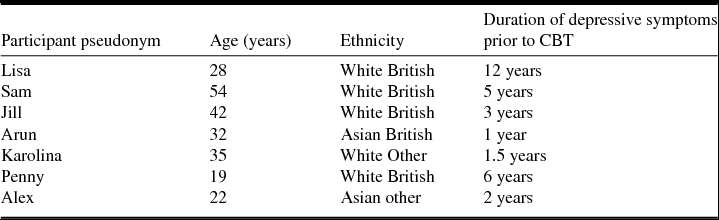
The sample consisted of seven adults aged between 19 and 54 years, referred to psychological services for treatment of depression and recruited using purposive sampling methods. Table 1 summarizes participant demographic information while presenting the pseudonyms used in the analysis to anonymize participants.
Participant summary of pseudonyms, age, ethnicity, number of CBT sessions and duration of depressive symptoms prior to CBT

The inclusion criteria required that participants in the present study should be adults of working age (18–65 years), who had been referred to psychological services for treatment of depression, and who had not previously received a formulation. Potential participants were excluded if they had comorbid severe and enduring psychological difficulties or if they did not have the capacity to consent to the study. To control for participants not having received a formulation before, all participants who had received psychological therapy prior to CBT were excluded from the study.
Materials
A semi-structured interview schedule was developed based on discussion with and feedback from clinical psychologists, the first author's own clinical experience of developing formulations collaboratively with service users, and a review of relevant literature. Key themes that the interview covered were:
(1) Formulation development.
(2) Emotional reactions of the client to receiving the formulation.
(3) How the formulation informed the therapeutic process.
(4) The impact that the formulation had on the client's difficulties and their day-to-day life.
(5) What the client learnt from the formulation.
Additional questions were asked dependent on participants’ responses during the interview.
Procedure
Clinical psychologists and psychological therapists working in primary- and secondary-care psychological services for adults and using a CBT approach were asked to review their caseloads for clients who met the study criteria. Suitable potential participants who completed and returned the opt-in form were contacted by the first author. Seven clients expressed an interest in the study and subsequently consented to participate in the study. Participants were interviewed by the first author and all interviews were audio-recorded.
Data analysis
The interviews were transcribed verbatim and analysed using Thematic Analysis (Boyatzis, Reference Boyatzis1998; Braun & Clarke, Reference Braun and Clarke2006). This entailed reading and re-reading the first transcript and developing line-by-line comments and descriptions on participants’ thoughts and experiences, from which points of convergence and similarity were identified. A list of emergent themes was developed from this initial commentary. This process was subsequently repeated for each transcript following which, patterns of themes and frequency of theme occurrence across all the dataset were considered in order to develop subordinate themes. Superordinate themes were developed by considering difference and commonality between subordinate themes.
An independent audit was conducted whereby an independent researcher was provided with excerpts of transcripts to develop their own line-by-line coding and themes. These were then compared to the themes identified by the first author. Discussions with the independent researcher were used to highlight both the similarities and some subtle differences in coding and themes, and this, in addition to research supervision discussions, served as a quality control procedure within the data analysis.
Researcher's position
The data analysis was conducted by the first author who at the point of conducting the research was a trainee clinical psychologist with an interest in CBT, having used this model with adults on placement where she had developed CBT formulations with clients. Her own experience of CBT formulation combined with her experience of other theoretical and therapeutic perspectives had resulted in a particular interest in thinking about the formulation process from an eclectic perspective.
The second author is a clinical psychologist who has interests in integrative and CBT formulation, therapy process, and the therapeutic relationship.
The third author is a clinical psychologist and university lecturer, with research interests in older adult clinical psychology, person-centred psychology, third-wave cognitive-behavioural therapies and process variables in psychological therapy.
Writing up the data
In writing up the findings of the present study, it was decided to separate the results from the analysis to enable the reader to differentiate between the participants’ and the researcher's voice. Thus, the Results section provides a descriptive summary of the data found while the discussion incorporates the authors’ interpretations of this. By separating the analysis in this way readers are invited to consider their own interpretations of the findings.
Results
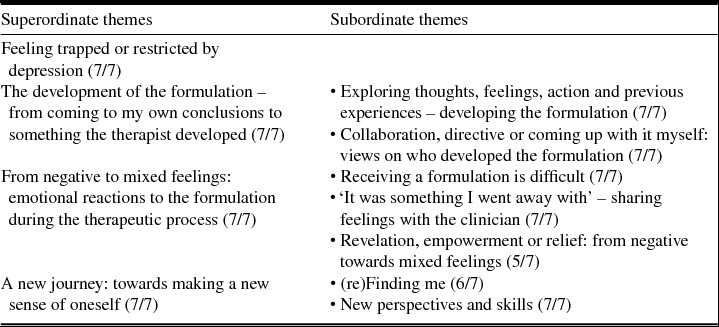
Four superordinate themes were drawn from the participants’ data, these were: ‘Feeling trapped or restricted by depression’, ‘The development of the formulation – from coming to my own conclusions to something the therapist developed’, ‘From negative to mixed feelings: emotional reactions to the formulation during the therapeutic process’ and ‘A new journey: towards making a new sense of oneself’. The themes along with their subordinate themes are illustrated in Table 2. The extent to which themes and subthemes represent the dataset is noted in parentheses. Superordinate themes, along with their subordinate themes will be described and illustrated with quotations from participant interviews.
Superordinate and subordinate themes with participant representation in parentheses

Feeling trapped or restricted by depression
Although the first superordinate theme does not directly relate to participants’ experience of CBT formulation, it will be briefly explored in order to provide a context to the process participants have gone through. Even though this was not an area explored by the interviewer, all participants discussed their experience of depression prior to therapy.
The data showed that prior to therapy, participants experienced a lack of control over their emotions and thought processes and felt caught up in these. All participants reflected on this time in their life as having been more challenging or negative than their present situation. In particular, participants described a sense of feeling stuck within or constricted by depression. One participant made a link between the potential hazards within their external world and feeling trapped but was unable to describe what they were trapped by illustrating the difficulty in describing this complex experience:
Every situation is a hazard, reflected, negative, of being trapped in something, with difficulties or something. (Arun)
Another participant described this experience as one of feeling trapped within one's mind and having an inability to take in his entire external world:
As I say, going along blinkered, mired in your own mind. I think you do feel trapped in your own mind. (Sam)
In the extract below, the experience of being depressed is described as the client feeling tortured as a result of her expectations upon herself and social interactions:
I think because the main problem I had was that I just used to be tortured by my thoughts, from any little innocent little interaction with anybody, and now it is just, I used to have little noisy voices saying, it sounds schizophrenic but oh for god's sake, kind of why just giving myself a hard time and having such high expectations of myself. (Jill)
Understandably, individuals feeling this way had been socially isolating themselves and, prior to therapy, had been struggling to find a way to change their current emotional world alone.
The development of the formulation – from coming to my own conclusions to something the therapist developed
Exploring thoughts, feelings, actions and previous experiences – developing the formulation
The formulation was developed between the clinician and participant by exploring the individuals’ experience through questions and answers for all seven participants. All participants described a process of exploring thought, feelings and personal experiences with their clinician. One participant shared her experience of the development of the formulation through initially discussing her past which was still hard to talk about:
It was basically developed from where I had to think about when I was younger and what kind of life I’d wanted. Different feelings and thoughts that I’d have, bad feelings in my life, well, to relate back to bad things that have happened in the past – who it was and when it was, and what it was, and started from that and then basically carried on. (Lisa)
Another participant described a further element of the development of a formulation where they and their clinician explored not only feelings, but also the client's actions, suggesting that behaviours as well as thoughts and feelings were a focus during the process of developing the formulation:
It was developed I think, through questions being asked slowly. First of all I think it was quite distant unrelated questions, and then it started to be a bit more focused, and questioning why I would do something. I think originally it was on why I would feel bad about something. (Arun)
Another participant described the formulation process as involving the development of an account of why she had become depressed. Furthermore, the process of developing a formulation is described by this participant as something which was occurring or evolving throughout the course of the therapy:
The formulation was developed really over the course of the entire 16 weeks. Erm, I think the first couple of times that [the therapist] and I met they just explored how I was feeling, and what had been happening with me, and then just slowly it evolved into a bit of an explanation of why I had reached that point. (Jill)
Collaboration, directive, or coming up with it myself: views on who developed the formulation
Even though all participants appeared to agree that the formulation had emerged as a result of the discourse between client and clinician, their comments varied regarding their views of who had been responsible for developing the formulation. Five participants viewed the process as a collaborative process, one of whom considered the formulation as being something initially developed together with her therapist within the session but then further elaborated out of sessions by herself alone:
Well it was probably, I probably best say developed together at first but then I, obviously because we met once a week I developed it on my own on the rest of the days. (Penny)
In contrast, another participant considered it to be more a process of coming up with her own formulation which seemed to have a greater impact than a clinician-developed explanation:
I think, retrospectively, I realized it was more of a validation for me because it was coming from me and I was talking through everything myself and coming to my own conclusions. And I think it had more of an impact, and my clinician would affirm what I was saying or nod and I think, because she obviously thought the same things. (Jill)
The remaining two participants viewed the formulation as having been developed predominantly by the clinician. While one of these participants felt this was due to them needing more prompting during their early therapy sessions as a result of not being ready to commence therapy, another expressed the view that the formulation was not an interactive process but more something that the clinician brought along, which could not be changed, having developed it without him:
I would think that it was something, when I looked at it, it was something that he developed. It wasn't something so much, it wasn't an interactive thing where we said ‘oh okay what about this, what about that?’, it almost felt like one day he came up with this thing and I was like looking at it going ‘oh okay’ rather than ‘oh shall we change this?’ and ‘do you feel like this and like this? (Arun)
From negative to mixed feelings: emotional reactions to the formulation during the therapeutic process
All of the participants experienced a broad range of feelings towards the formulation which appeared to differ during the therapeutic process. With the exception of one individual, feelings towards the formulation appeared more negative earlier on. However, these individuals also expressed more positive feelings later on in the therapeutic process.
Receiving a formulation is difficult
All the participants had more negative feelings towards their formulation to begin with. For one participant these feelings were combined with that person's reservations regarding whether therapy would help them, apparently linked to the experience of medication not helping:
Not sure really, you know just confusion, thinking I hope it's going to work and thinking things like that, and ‘I hope I’m going to get better from all of this’ at the time because tablets haven't been working or anything. (Lisa)
In line with Lisa's experience, other participants also found the formulation to be difficult to comprehend with one participant stating that it was ‘very technical’ and another finding the initial formulation emotionally very difficult. While this participant found it very difficult to be open or receptive to the content of the formulation, he also recognized that although parts of the formulation were unexpected, other aspects were already familiar to him:
Oh it was very hard to look at it at the beginning and to think that I had been thinking this way for so long. I wanted to just close my eyes and ignore what was in front of me. Some aspects were completely new to me. But once I started to revisit the formulation I started to realize that not all of the information was new, in fact I already knew some of it. But along the way I had stopped seeing the whole view – like selective vision. (Alex)
Another participant described the formulation as serving the role of reminding him of a part of himself which he had forgotten or perhaps lost. While another participant found it more difficult to connect to his formulation, in part, due to him feeling that some aspects of the explanation were not accurate. Finally, Karolina felt that the written formulation, although helpful, seemed easier to talk about and develop, then to put into practice:
How easy it is actually on the paper [laughter] . . . I think it does because you know I am a person who can talk and you can say whatever you want, but feeling it and practising it, going into practice I think it would be much more harder than actually writing on paper. Erm, but I did find it quite okay with it and useful for me to be honest. (Karolina)
‘It was something I went away with’ – sharing feelings with the clinician
Six participants felt unable to share their feelings about the formulation with their clinician. One of these was a participant who had only received their formulation that week and therefore whether or not they would share their feelings with their clinician remains unknown. Five participants chose to keep their feelings to themselves. In response to being asked about whether the participant was able to share her feelings with her clinician, here one participant talks about leaving a session without discussing their feelings with their clinician:
It was something I went away with really and thought about again. (Lisa)
In contrast to this experience, Jill was able to create a more open dialogue about her explanation of her difficulties with her clinician. She felt that she was able to share her views with her clinician openly:
Yes there was a lot of debate really actually, there was a lot of discussion and I felt like I could disagree or you know, I would try and take her points on board, erm, I felt like I was able to be very open, you know whether it was something I would consider or just give it a moment or say ‘It is not for me’, or ‘I don't really agree that that is the case’. (Jill)
In part, it seems that Jill's experience was different to the other participants as she developed a reason for her behaviour and why she felt the way she had over the entire course of therapy.
Revelation, empowerment or relief: from negative towards mixed feelings
Participants’ reactions to the formulation appeared to reflect a sense that for some individuals the past was still difficult to talk about, even though a more positive focus for the future had been established. One participant described the process of incorporating the new information received from the formulation as a process which, though revelatory, would take time to integrate having realized they had been missing out on aspects of their life in the past:
It's a bit of a revelation, once you start to realize that you really have been missing out, and that takes, that does take a long time, it's not a quick process at all I don't think. (Sam)
One participant described a sense of newly developed awareness of things he had been ignoring. However, it seems that although the formulation helped him to see things he had previously been putting out his mind, though he recognized the process of being able to be fully present and active in his life would take time. Another participant described feeling hesitant initially due to feelings of fear and doing things wrong while later feeling relief:
Yes, I was a bit wary at first in case it wasn't for me or, in case, or I would do something wrong because that is what I have always been afraid of, but you don't really have anything to be afraid of because it does work and it is more of a relief when you realize that. (Penny)
For Arun, a sense of relief was expressed when thinking about his formulation, linked to an understanding of why he had been feeling the way he had and being able to challenge his previously held perspective on situations:
So I think it more relief it was an understanding that, you know, that everything isn't so bad in the world but sometimes this thing can, you yourself through how you act and how you are going to act can create, how can I put it? A relief of understanding why you feel that way. (Arun)
A new journey: towards making sense of oneself
It would appear that once clients had received their formulation or had discussed it with their clinician and begun to process associated feelings, they also began a journey of making a new sense of themselves. This may possibly be due to the emergence of a new or different self or a different way of responding to making sense of oneself, resulting from changes made during the intervention. With the exception of one participant, this process was apparent for all the participants even though the process of making sense of themselves may have differed. This observation appears to be less relevant for the one participant who had received a formulation very recently and thus her voice is less represented in this section. Through the process of making sense of themselves it seems that participants were also developing a changed perspective on their difficulties.
re(Finding) me
It seems that the formulation gave participants an insight into themselves which appeared to be positive for the majority of the participants in the study. In the following extract, one participant shares his experience where, although he at times still felt the same way as he did in the past, he now understands his feelings better. Additionally, recognizing his feelings to be normal, which makes him feel more confident and equipped to deal with everyday situations in his life:
I just seem to know myself much better now – I know, erm, why I feel the way I do and this has kind of made me more self-confident. I still feel the same feelings as before, but now I know that the way I feel is no different to other people. And I know the dark feelings will pass and when I feel that way it's like I now know I’ll be able to deal with it no matter what life throws my way. (Alex)
A second participant described rediscovering his identity, while also being able to think for himself again:
Erm, day-to-day. I can think clearer. I was always saying ‘I’m confused, I can't think straight, I can't work things out, I can't make decisions’ and I couldn’t. I genuinely thought I couldn’t. But I think I’m now starting, you know, at the end of the tunnel sort of thing. I think I’m now starting to be able to think for myself again, which is nice. It's horrible to be, I suppose the best way to describe it is walking around in a fog, and you’re lost. You are lost. You don't know which way to go, you don’t, you lose your identity even. And to get that back is, it's lovely. To be able to think for yourself again, yeah, that's important. (Sam)
Interestingly, another participant realized that although the formulation had not given him the answers to making his life easier, it had helped him realize how he could be contributing to his own mood states. This newly developed understanding had also helped him to begin to look at things more positively which he continues to do in the present:
I think it certainly helped me, erm, in that it made me realize that in a way I was creating my own moods, through how I perceived everything in life and how I react. It didn't give me, erm, it wasn't a route map to make things easier, because I, but after the realization that how I could have got into this position, then it certainly helped me to start thinking about things a little bit more positively. I still do it now. (Arun)
New perspectives and skills
All the participants described a changed perception of their difficulties. For some participants this came with new skills in managing emotions and thoughts. For example, Penny shared how her difficulties reduced due to her knowing how to manage and prevent low mood:
My problems kind of shrunk for me, after grasping what to do, everything kind of seemed much better for me in myself and people around me. I started to get less anxious and more, I don't know, kind of bouncy instead because you feel low and you feel high, but I suppose you don't shut the lows out – you kind of prevent them instead. (Penny)
In a similar vein, Lisa described how the formulation helped her to not only make sense of her feelings but how she could make changes to her thinking in order to be less negative:
Yeah, it made a bit more sense actually, it seemed to make sense of why I’d been feeling the way I’d been feeling, and how I could change things and change the way I think about things to make a difference basically, instead of thinking negative all the time. (Lisa)
One participant expressed having a greater feeling of control over their feelings and thoughts; describing being able to recognize that it was in fact he who makes the decisions within his life. Another participant realized that he does in fact have a choice by being aware of when he may be getting stuck and how he might respond differently at those times:
It's made me realize that you don't have to be trapped, there are choices, you’ve just got to be aware of when you’re trapping yourself and what opportunities, what sort of techniques, to try and get out of it. (Sam)
Finally another, participant spoke about how their perspective may have been inaccurate and that through the therapeutic process they were able to be more open to consider all the facts around them and influence their perspective:
[The therapist] helped show me the whole picture and then I realized I had it all wrong. I was missing important information out and blaming myself for things that were not my fault. I guess, I’d say therapy really helped me to have a more balanced view of things (Alex)
Discussion
Feeling trapped or restricted by depression
All the participants described their thoughts and feelings prior to coming to therapy. This was unexpected by the interviewer, who had not directly asked questions about this aspect of the participants’ experience. The pervasive nature of symptoms described by participants appears consistent with descriptions in the current NICE guidelines for depression (NICE, 2010) as well as a qualitative research paper on experience of depression conducted by Smith & Rhodes (Reference Smith and Rhodes2010).
The development of the formulation – from coming to my own conclusions to something the therapist developed
For most participants, the formulation was developed through the client exploring their thoughts, feelings and life experiences with the clinician. Significant variability was observed, ranging from formulations being client-developed with clinicians only providing validation, through to clinicians developing formulations more autonomously and sharing that with the client (participant). Participants appeared to feel understood and also more able to contribute when formulations were developed collaboratively over time. In contrast, the therapist-led formulation appeared to leave participants unable to share their feelings and uncertain of the accuracy of the formulation, suggesting that formulation development requires collaboration and time in order for clients to feel sufficiently comfortable to address perceived inaccuracies within the formulation.
Where the clinician was perceived as working at the client's pace, the participant reported mainly positive feelings towards the formulation process, such as being able to openly share feelings and to question aspects of the formulation which they did not agree with. This experience is consistent with research which suggests that clients seem to have a more positive experience of formulation when the formulation is developed collaboratively (McManus et al. Reference McManus, Peerbhoy, Larkin and Clark2010). Furthermore, it highlights the importance of collaborative formulation development in clinical practice.
For one participant, it seemed that the process of receiving their formulation was particularly difficult. This may have been because the participant felt less connected to the formulation as they disagreed with some aspects of it. This may also be related to the fact that the participant had received a relatively brief intervention lasting only five sessions. Therefore, perhaps the participant felt less able to share their feelings with their clinician as they had not developed a ‘good enough’ therapeutic relationship within this time. Having received the formulation in the penultimate session, the participant felt that the clinician did not allow adequate time to review the original formulation before ending the therapeutic relationship. This experience may have specific significance for short-term CBT interventions, and is a reminder for clinicians of the importance of allowing sufficient time both for the development of the therapeutic relationship and for a truly collaborative process of formulation development to occur.
From negative to mixed feelings: emotional reactions to the formulation during the therapeutic process
It seems that participants initially struggled to connect with their formulation for many reasons. For some, it seemed that the formulation itself may have been technically difficult to comprehend due to unfamiliarity to CBT terminology. However, other participants were also debating whether the intervention would actually work for them. One aspect of this may have been the pervasive nature of negative automatic thoughts in depression making it difficult to initially consider change in thinking, feelings, behaviour and physiology. These feelings of initial doubt and questioning whether the intervention will work appear to be in line with Brown's (Reference Brown2008) model of ‘client's view of client's experience of formulation’. However, an additional dimension to this experience was identified in the present study, with some participants struggling to relate to memories and feelings linked to difficult past experiences.
It is also clear that clinicians face a challenge at the beginning of therapy in terms of balancing empathy for the client's mixed feelings along with challenging the client within therapy so that they can begin to consider the potential benefits of trying something different. This finding, of initially experiencing negative feelings towards the formulation, is consistent with research by Pain et al.'s (Reference Pain, Chadwick and Abba2008), who found that 40% of participants reported negative feelings after receiving their formulation. It is noteworthy that they interviewed their participants relatively soon (2–3 weeks) after receiving a formulation and the responses appear to be in line with the ‘initial doubt’ period highlighted in Brown's (Reference Brown2008) formulation model. Perhaps a richer picture of clients’ experiences would have been gained if the researchers had interviewed their participants again at the end of their intervention. Such research may have captured a broader range of clients’ views towards their formulation at different points of optimism or hopelessness.
Participants may have struggled to share their feelings with their clinician because they themselves were still processing how they felt, or perhaps because they did not feel able to do this due to the power differential or lack of trust between client and clinician at the beginning of therapy. This poses a difficulty for clinicians as they may be unsure of which aspects of the formulation their clients disagree with initially. Some participants in the present study expressed that they would not have continued with therapy if they could not agree with their formulation, indicating the need for clinicians to formulate in a sensitive way inviting clients to share their opinions. Clients being unable to connect to their formulation may suggest one possible explanation for early drop-out of CBT interventions.
While initial responses to the formulations seemed to be predominantly negative, it seems that after some time processing their formulation and perhaps through having time to make changes in their life through their therapeutic intervention, participants felt more positive, even though the journey towards making changes felt challenging. Participants reported feeling liberated and enlightened which, compared to the entrapment they felt prior to therapy, appeared to be a significant positive change. These subsequent feelings seem consistent with Townend & Grant's (Reference Townend, Grant, Grant, Townend, Mills and Cockx2008) view that CBT formulation instils hope and optimism in clients.
A new journey towards understanding oneself
It was anticipated that as a result of the formulation and intervention, participants would report an improvement in mood. However, what actually seemed to change was the way participants perceived themselves, their thoughts and feelings. Participants reported rediscovering lost identities and realized that difficult feelings pass. Additionally, participants were able to think more clearly and become more confident and self-accepting. It may be that these positive changes stemmed from having better strategies to manage negative thoughts and feelings, as well as a normalized perspective about their problems. It appears that this new perspective may have been just as important as the reduction of their depressive symptoms, pointing to a need for therapists to use a broader range of outcome measures to capture the effects of psychological interventions.
Along with a changed perspective and tools to manage negative thoughts and feelings, participants appeared to have regained control in their lives which perhaps empowered individuals who had previously felt stuck within depression.
The subordinate themes within this superordinate theme appeared to be closely linked, perhaps because new skills in managing depression are necessary to the development of a positive perspective of oneself and the external world. Future research could perhaps focus on furthering our understanding the relationship between these factors as they may be key to successful outcomes in therapy.
Limitations
The clinicians of all of the participants’ were experienced clinical psychologists who primarily, although not necessarily exclusively, used the CBT approach in their therapeutic work. As a result it is unclear whether the findings of this study would have been the same if the clinicians had practised purely from a CBT perspective. Furthermore, the nature and power of the therapeutic relationship was not considered within this study, for example the interpersonal style of the participants was not established which may have had a significant impact on the therapeutic process.
The length of depressive episode varied for each participant and the research was unable to establish whether duration or chronicity of the depressive episode impacts upon the experience formulation. In light of this limitation to the present study, future quantitative research where such variables can be controlled for is indicated. Additionally, clients may have experienced different levels of formulation and future studies could investigate this more closely by collecting data at multiple time points during therapy.
Finally, another limitation to the study may have been the use of a purposive sampling style. It remains possible that participants who were recruited were either clients who had responded well to a CBT approach or those who were perceived as having formed a good relationship with their clinician. Although some negative experiences were identified in the present study, it may also be that a sampling bias resulted in an over reporting of positive reactions of formulations.
Future research
As a relatively new area for research there are several further aspects of formulation which could usefully be explored in future studies. First, research exploring clients’ experiences of formulation with other mental health difficulties other than depression would allow for comparison of findings with those of the present study. Second, clients’ accounts could be explored at different time points after receiving their formulation, in order to explore similarities and difference across time. Third, it may be helpful for a future study to specifically focus on individuals who have had negative experiences of formulation, in order to help guide clinical practice in this area. Finally, as an evidence base is gradually developed in the area of clients’ experiences of formulation, further quantitative research with larger samples and using longitudinal designs is also indicated.
Ethical statement
The authors assert that all procedures contributing to this work comply with the ethical standards of the relevant national and institutional committees on human experimentation and with the Helsinki Declaration of 1975, as revised in 2008. Ethical approval for the study was granted by the National Research Ethics Service.
Acknowledgements
The authors thank the participants for sharing their personal experiences as well as reading early proofs of the study to ensure their voice was accurately captured. The authors also thank the clinical psychologists who supported the recruitment process.
Although a formal grant was not required to support the study, the authors thank Coventry University for providing support for all administrative aspects of the study.
Declaration of Interest
None.



Comments
No Comments have been published for this article.