Introduction
Stroke is a major public health concern in China and worldwide due to its significant mortality and long-term morbidity (Kahraman and Jones Reference Kahraman and Jones2009). In China, according to the official statistical data from the Ministry of Health (2013), stroke was the third and the second most common cause of death among urban and rural residents, respectively, in 2012. It is estimated that about 2·5 million people have a stroke each year, and 1·6 million Chinese residents die from stroke (Liu et al. Reference Liu, Wang, Wong and Wang2011).
Stroke is mainly a disease of older people, and the rapidly ageing population in China will lead to a further increase in the number of strokes in the future. Stroke has multiple impacts on a person's health, and can result in physical, psychological and social problems, and functional deficits, exerting a negative influence on overall quality of life, especially for older patients with complex health conditions, and co-morbidities (Sneeuw et al. Reference Sneeuw, Aaronson, de Hann and Limburg2007). Moreover, the impact of stroke is not confined to the patient but also has major repercussions for the wider family (Brereton and Nolan Reference Brereton and Nolan2002).
Following an acute stroke, both older people and their family carers have to make major life decisions in a relatively short period of time, often without an adequate understanding about stroke and its consequences (Brereton and Nolan Reference Brereton and Nolan2002; Eames et al. Reference Eames, Hoffmann, Worrall and Read2010; Hafsteinsdóttir et al. Reference Hafsteinsdóttir, Vergunst, Lindeman and Schuurmans2011; Mackenzie et al. Reference Mackenzie, Perry, Lockhart, Cottee, Cloud and Mann2007; Wiles et al. Reference Wiles, Pain, Buckland and McLellan1998). To improve the situation, it is suggested that professionals need to work actively with patients and carers, provide timely support and empower them to make informed decisions in order to manage the stroke better, feel more in control, create positive attitudes towards their disease, receive the best possible care and make a good recovery (Martins Reference Martins2009).
There have been several studies on this topic in a Western context which promote the concept of partnership working, with the stroke survivor being seen to play a major role in decision-making by having a full understanding of the nature of their condition (Hoffmann and Cochrane Reference Hoffmann and Cochrane2009; Stacey et al. Reference Stacey, Menard, Gaboury, Jacobsen, Sharif, Ritchie and Bunn2008). This is one manifestation of the now widely accepted principle in the Western literature that patients should be actively involved in decision-making about their care (Da Silva Reference Da Silva2012). The challenges of achieving this with very frail older people are acknowledged, with there being calls for a ‘revolution’ in care practices (Cornwell Reference Cornwell2012). However, despite difficulties in realising full participation (see Da Silva Reference Da Silva2012), the principle is well established, with participation increasingly being seen as a basic ethical right (Irish Hospice Foundation 2011). Despite such debates, until recently, most of the empirical work has been around ‘breaking bad news' regarding a terminal diagnosis (Ben Natan, Shaher and Garfinkel Reference Ben Natan, Shaher and Garfinkel2009; Locatelli et al. Reference Locatelli, Piselli, Cicercha, Raffaele, Abbatecola and Repitto2010). Whilst this is very important, our primary concern here is wider involvement of older people in making care decisions which were perceived as ‘difficult’ but where a terminal diagnosis was not the main issue, using stroke as an exemplar.
Despite the attention given to patient participation in health-care decision-making in the West, there has been very little ethical debate or empirical work in China, where both cultural factors and the nature of the Chinese system of health and social care are likely to exert significant influences. Concepts developed in the West may therefore be of limited value in understanding how decisions are made in China.
This paper reports on a constructivist grounded theory study that explored how decisions are made in an acute care context in mainland China by older people, family carers and professionals following a stroke. The current findings are considered in relation to Glaser and Strauss' (1965) theory of ‘awareness contexts' and discussion focuses on how older people in China may be encouraged to play a more active role in decision-making following a major health event. In order to set the study in context, attention is first turned to the relevant literature.
Literature review
The literature presented here focuses primarily on older patients', family carers' and health professionals' experiences of making decisions in the context of stroke but also provides a broad overview of the influence of Eastern culture on health-care decisions. Consistent with a constructivist approach to grounded theory, the main purpose of the review was to identify sensitising concepts and foreshadowed questions to guide the initial stages of the study (Rodwell Reference Rodwell1998).
The review involved a comprehensive search of relevant literature using online databases for English- and Chinese-language articles, Web-based online sources (ASSIA via CSA, British Nursing Index, CINAHL, EBM Reviews, EMBASE, MEDLINE, PsycINFO, Social Sciences Abstracts, Social Sciences Citation Index, and CNKI), reference lists of published articles and hand searching of journals. Multiple key words were used. A constant comparison approach advocated by Nolan, Grant and Keady (Reference Nolan, Grant and Keady1996) and further developed by Repper et al. (Reference Repper, Nolan, Grant and Curran2008) was used to analyse the relevant references, which involved a three-stage process of review, analysis and synthesis of research findings. As a result of this process, the following sensitising concepts emerged.
The processes of making decisions
The literature suggests that stroke patients and their families make several different types of decisions relating both to their immediate and longer-term care including those that impact on their daily lives post-stroke. Many studies have adopted a temporal approach to such decisions that illuminates how events unfold over time, beginning with the onset of stroke.
For example, Moloczij et al. (Reference Moloczij, McPherson, Smith and Kayes2008) reported that stroke survivors sequentially go through the processes of recognition, interpretation and negotiation in order to decide whether and when to seek medical help at the onset of stroke. Olofsson, Andersson and Carlberg (Reference Olofsson, Andersson and Carlberg2005) suggested that stroke survivors experience varying levels of participation in decision-making at different stages of their journey such as actively making decisions to seek care at the onset of stroke, leaving decisions largely up to professionals during hospitalisation and actively making decisions with family carers upon returning home. Hedberg, Johanson and Cederborg (Reference Hedberg, Johanson and Cederborg2008) identified three processes, which they named advising, summarising and intervening, that stroke survivors, their relatives, and health and social care professionals use to communicate with each other when making decisions during post-discharge care planning meetings. All of the above studies suggest a relatively active role for the stroke survivor, which assumes that they have access to the required information.
Other studies have concentrated on the participation of family carers. For instance, Brereton and Nolan (Reference Brereton and Nolan2002, Reference Brereton, Nolan, Nolan, Lundh, Grant and Keady2003) found that carers engaged in a series of ‘seeking’ activities, such as seeking information or knowledge from a variety of sources, and seeking partnership, help and support from both other family members and professionals in order to provide the best possible care for their relative. Similar ‘seeking’ behaviours were also identified by other researchers, although they were not named as such (Rogers and Addington-Hall Reference Rogers and Addington-Hall2005). Once again emphasis is given to active engagement.
However, such engagement is not always sought and the literature suggests a variety of viewpoints, ranging from those studies which argue that most stroke survivors wish to play an active role in decision-making (Health Care Commission 2005, 2006; Hjelmblink Reference Hjelmblink2008; Mangset et al. Reference Mangset, Dahl, Forde and Wyller2008; Payne et al. Reference Payne, Burton, Addington-Hall and Jones2009; Slot and Berge Reference Slot and Berge2009), as do family carers (Christensen and Anderson Reference Christensen and Anderson1989; Marques, Rodrigues and Kusumota Reference Marques, Rodrigues and Kusumota2006), to others which suggest that older stroke survivors would prefer to leave decisions primarily to their family (Huby et al. Reference Huby, Brook, Thompson and Tierney2007) or professionals (Mangset et al. Reference Mangset, Dahl, Forde and Wyller2008; Olofsson, Andersson and Carlberg Reference Olofsson, Andersson and Carlberg2005; Wellwood, Dennis and Warlow Reference Wellwood, Dennis and Warlow1994).
The literature indicates that a number of factors influence peoples' desire for active involvement or not. These include the stroke survivor's age, gender, educational level, condition/severity of illness, the extent to which they are well informed about their condition and supported to make decisions, and the degree of trust that they have in health and social care professionals.
Age seems to play a role in both the degree of desired participation, and the extent to which people seek timely medical help. According to Almborg et al. (Reference Almborg, Ulander, Thulin and Berg2008), younger stroke patients want far more participation in decision-making about care, rehabilitation and discharge planning. Chang, Tseng and Tan (Reference Chang, Tseng and Tan2004) reported that older people significantly delay their help-seeking decisions, arguing that this is due to either earlier negative experiences of hospital treatment or their inability to identify stroke symptoms.
With regard to gender, Andersson and Hansebo (Reference Andersson and Hansebo2009) reported that female stroke survivors are more willing to have health professionals make care decisions for them, whereas men are more likely to question health professionals' decisions, to make suggestions themselves or to negotiate with professionals. However, in the study by Kapral et al. (Reference Kapral, Devon, Winter, Wang, Peters and Bondy2006), although female patients were found to be less confident than men in their ability to make decisions, they still preferred shared or independent decision-making rather than having decisions made by professionals, mainly doctors.
Education also appears to exert an influence. According to Almborg et al. (Reference Almborg, Ulander, Thulin and Berg2008), stroke survivors with higher than elementary school education are significantly more likely to want to be involved in decision-making about their care, rehabilitation and discharge planning, as are those with a less severe stroke.
Whilst demographic factors are clearly important, active involvement is greatly facilitated if professionals provide timely and accurate information and create an encouraging atmosphere (Alaszewski et al. Reference Alaszewski, King, Alaszewski and Potter2008; Health Care Commission 2006; Olofsson, Andersson and Carlberg Reference Olofsson, Andersson and Carlberg2005; |Proot et al. Reference Proot, Crebolder, Huijer Abu-Saad, Macor and Ter Meulen2000a , Reference Proot, Huijer Abu-Saad, de Esch-Janssen, Crebolder and Ter Meulen2000b ). Conversely a lack of information from professionals inhibits participation and constrains autonomy (Health Care Commission 2006; |Proot et al. Reference Proot, Huijer Abu-Saad, de Esch-Janssen, Crebolder and Ter Meulen2000b , Reference Proot, Ter Meulen, Huijer Abu-Saad and Crebolder2007). Much also hinges on the degree of trust that stroke survivors have in the professionals they encounter. Where good trust exists then active participation is much more likely, whereas in its absence participation is inhibited (Alaszewski et al. Reference Alaszewski, King, Alaszewski and Potter2008; Slingsby Reference Slingsby2006).
Clearly decision-making following a major health crisis such as stroke is complex and many factors impinge on the likelihood of older stroke survivors playing an active role. Irrespective of this, the rhetoric within the largely Western health-care literature and policy views participation as inherently desirable, with the stroke survivor themselves being seen as the key player. This is quite evident in the stroke guidelines developed in Western countries, such as the United Kingdom, which place considerable emphasis on the active involvement of stroke survivors in decision-making, their participation in health management, and partnership working between them and health professionals. These guidelines strongly advocate the patient's right to be the primary decision-maker (Royal College of Physicians Intercollegiate Stroke Working Party 2012a , 2012b ). However, the more limited literature available from Eastern cultures suggests that the same principle may not apply and therefore the role of culture needs to be considered more critically.
The role of Eastern culture in health-care decision-making
The review revealed little specific work in relation to stroke and its boundaries were therefore extended to cover involvement in health care more generally, including ‘breaking bad news'.
Whilst as noted above the emphasis in the West is on the ever-greater involvement of older people in decisions about their health care, the family is accorded a far greater significance in Eastern cultures. For example, Huang et al. (Reference Huang, Neufeld, Likourezos, Breuer, Khaski, Milano and Libow2003) in the United States of America (USA) found that compared with white counterparts, Chinese older people were less likely to make medical decisions by themselves and depended largely on family members. It has been suggested that such ethnic differences might be due to the family-centred decision-making style held by Chinese people, which is different from the Western model that promotes patient autonomy (Blackhall et al. Reference Blackhall, Murphy, Frank, Michel and Azen1995; Hornung et al. Reference Hornung, Eleazer, Strothers, Wieland, Eng, McCann and Sapir1998). Such considerations also seem to apply to professionals, with Yap, Joynt and Gomersall (Reference Yap, Joynt and Gomersall2004) in Hong Kong finding that the majority of doctors working in intensive care units preferred to involve families when making decisions concerning therapy. In contrast, less than half of the doctors in a European study involved families in the decision-making process (Vincent Reference Vincent1999). This strong preference for family participation in decision-making probably reflects Hong Kong doctors' respect for the Chinese cultural tradition which emphasises family values and accords families a leading role in health-care decision-making for patients (Ip et al. Reference Ip, Gilligan, Koenig and Raffin1998).
Reflecting similar beliefs, Elwyn et al. (Reference Elwyn, Fettersb, Sasakic and Tsudad2002) reported that in a Japanese cultural context, doctors do not disclose a diagnosis of cancer to patients, believing that it would depress them. They therefore inform the family first and leave the decision as to whether to tell the patient or not to the family. Similar findings have been found in Taiwan (Tang et al. Reference Tang, Liu, Lai, Liu, Chen and Koong2006) and Korea (Yun et al. Reference Yun, Lee, Kim, Lee, Heo, Kim, Lee, Hong, Lee and You2004), suggesting that in an Asian cultural context family members expect to be informed about a cancer diagnosis and prognosis before the patient, with the subsequent decisions about whether to inform the patient being at the families' discretion.
In a study carried out in mainland China, Cong (Reference Cong2004) found that the majority of doctors preferred to inform family members about potentially ‘bad news' first, and believed that the family should decide whether, what and how much the patient should be told. Consequently, family members made treatment decisions and signed the informed consent form for their relatives. Based on the findings from the above studies, it is clear that families play a major, or the only, role as decision-makers, even if this might run contrary to the patient's wishes.
This need not necessarily be a negative thing as Bowman and Singer (Reference Bowman and Singer2001) found that Chinese older people trusted their children's decision-making abilities and were happy to leave their end-of-life decisions up to their children, especially when they were no longer able to make these decisions themselves. It has been suggested that this is because Chinese culture promotes interdependence (Lee Reference Lee, Walsh and McGoldrick1991) and intergenerational responsibility (Berger Reference Berger1998; Tsai Reference Tsai1999), with children being expected to support their older parents in this way.
Several studies have found that in an Eastern culture patients, as well as doctors, adopt a relationship-centred decision-making style in order to create and maintain harmonious relationships with their family members (Bowman and Singer Reference Bowman and Singer2001; Takahashi et al. Reference Takahashi, Noguchi, Rahman, Shimbo, Goto, Matsui, Asaia, Onishi, Koyama, Sawadab, Yoshinakab and Fukui2003), friends (Takahashi et al. Reference Takahashi, Noguchi, Rahman, Shimbo, Goto, Matsui, Asaia, Onishi, Koyama, Sawadab, Yoshinakab and Fukui2003) as well as professionals (Ngo-Metzger, Legedza and Phillips Reference Ngo-Metzger, Legedza and Phillips2004; Ruhnke et al. Reference Ruhnke, Wilson, Akamatsu, Kinoue, Takashima, Goldstein, Koenig, Hornberger and Raffin2000) when making various health-related decisions.
In summary, whilst the Western literature highlights the prominence given to active engagement of older people in health-care decision-making studies, exploring Eastern cultures raises questions about the appropriateness of applying such principles in differing contexts. However, there have been very few studies that have explored decision-making following stroke in a Chinese acute care setting. Based on the above, our study sought to explore the following questions:
-
• How can we best understand participants' perceptions and experiences of making decisions following acute stroke in China?
-
• What types of decisions are made by whom?
-
• What factors most influence the way that decisions are made and how do these affect patient involvement?
-
• What types of knowledge are used to inform decision-making?
The primary focus of this paper is on the factors influencing the way that decisions are made.
Methodology
Design
Given that there had been very little prior work in the area and that one of the primary goals of the study was not only to improve theoretical understanding but also to generate insights that had the potential to inform practice, the decision was made to adopt a grounded theory approach. The primary aim of grounded theory is to identify the ‘social processes' that guide action in the context of specific (substantive) areas (Glaser and Strauss Reference Glaser and Strauss1965), in this case decision-making in acute care following stroke in mainland China. Since its ‘discovery’ (Glaser and Strauss Reference Glaser and Strauss1965), debates about the nature of grounded theory have tended to polarise between what have been called ‘objectivist’ and ‘constructivist’ approaches (see Charmaz Reference Charmaz2006). Objectivist approaches see the researcher playing the major role in data analysis and determining the final ‘theory’, whereas constructivist models give a far greater role to participants in helping to shape the emerging results. As the study was, by definition, about involvement and participation, a constructivist model as proposed by Charmaz (Reference Charmaz2006) provided the philosophical basis, with the intention being to involve participants as fully as their condition, wishes and resources permitted. Consistent with the inclusive approach of constructivism, all the major ‘stakeholders', that is older people, family carers and professionals, were invited to take part. All the participants were ethnic Chinese, living in mainland China, although some came from differing parts of the country.
The project was formally approved by the University of Sheffield's Research Ethics Committee and endorsed by the Director of the Hospital in which data were collected. All participants received written information about the purpose and methods used in the study and the voluntary nature of their participation. Assurance regarding anonymity and the confidentiality of the data was also given. Signed written consent was provided by all participants.
The participants were recruited from the wards at the neurological department of a large acute hospital in Tianjin, China. In selecting participants, convenience sampling was not used as concepts such as ‘selection bias' play no part in grounded theory. Rather, purposive sampling was used to identify participants who met the inclusion criteria (see below) in the initial stages of the study, after which ongoing theoretical sampling was employed and sampling decisions were informed throughout by concurrent data collection and constant comparative analysis (Berg Reference Berg2007).
Older patients with stroke were selected based on the following main criteria: medical diagnosis of stroke; aged 60 years of age and over; a two- to three-week stay in hospital; being able to give informed consent and participate verbally in the interview; and being considered medically stable by physicians. Exclusion criteria included: having severe multiple-morbidity; having severe speech and/or hearing problems; and having cognitive impairment. The main family carer, as identified by the older patient, together with those professionals involved in their care, comprised the other participants.
Interviews involving 19 older patients with stroke, 28 family members and 25 professionals were undertaken. There were 14 male and five female patients. Their ages ranged from 60 to 80 years. The relationships of the 28 main family carers to older people with stroke ranged from sons (seven), daughters (12), husbands (three), wives (five), to son-in-law (one), with the majority (17) being female. The ages of family carers ranged from 33 to 77 years. Among the 25 health-care professionals, there were 15 doctors, seven nurses, two physiotherapists and one acupuncturist. Nineteen participants were female and six were male. Their ages ranged from 24 to 46 years and their years of clinical experience from one to 20 years.
Data collection for the study was conducted in two phases over an eight-month period. During phase one, interviews were conducted with 20 health professionals (11 doctors, seven nurses, one acupuncturist and one physiotherapist), 15 patients (13 men and two women) and 18 carers (six sons, seven daughters, two husbands, two wives and one son-in-law).
An open-ended interview schedule was developed and translated into Chinese, and included questions on the socio-demographic characteristics of the participants and a list of open-ended broad topic areas such as: ‘In your opinion, what is (patient or carer participation in) decision-making?’, ‘Who is usually involved in decision-making?’ and ‘How do you make decisions? The interviews lasted between 30 and 150 minutes, and were recorded with the participants' permission.
In order to follow the principle of constructivist research, participants were encouraged to discuss freely topics which they considered to be most relevant and important from their own perspective. As a part of the hermeneutic process, issues or themes that emerged during the early interviews were introduced into subsequent interviews (Rodwell Reference Rodwell1998).
Interview data were complemented by periods of non-participant observation from 8:30 am to 5 pm for 55 days in total. This involved the researcher attending ward rounds, patient education sessions, discharge discussions or team meetings; following participants around; hanging around on the ward, and sitting in the ward or staff's office. Field-notes were made in order to keep a detailed account of the observations.
Documents were used in the construction to provide background information and context, these included a wide range of materials, such as patient treatment and care plans, patient progress records, flow charts on procedures of admission and discharge, health education information or posters on the wall or the notice board, written regulations on health insurance policy and different types of forms, e.g. consent form for receiving treatment involving risks. These documents were read, brief notes made and a more detailed interpretation was undertaken later (Patton Reference Patton2002).
Overall, phase one data collection lasted approximately five months and was carried out from July to November 2010.
After preliminary data analysis, a second phase of data collection using the same methods was undertaken according to the principles of theoretical sampling to elaborate upon key themes and to undertake member checking with previous and new participants. This involved four patients (three women and one man), ten carers and five staff (three female doctors, one male doctor and one physiotherapist) also participated in the interviews. Seven periods of observation were also undertaken between 5 pm and 8:30 am.
Analysis of the data
The interview data were transcribed verbatim in Chinese. Several were also translated into English so that both authors could contribute to the analysis process. Initial and focused coding were performed with memos being used to capture emerging themes. These were developed using constant comparative analysis to identify patterns, connections and relationships within and between categories. Successive rounds of increasingly theoretical coding were undertaken to identify the core categories and social processes that best explained the relationships within the data. Consistent with the principles of constructivist grounded theory (Charmaz Reference Charmaz2006), the findings were shared with participants in a variety of ways in order to provide them with the opportunity to make additions or suggestions for change (see Wang Reference Wang2013).
The observational data were analysed in a similar way and integrated with the interview data and documentary analysis to provide a comprehensive picture of the key concepts relating to older stroke patients', family carers' and staffs' decision-making processes. These were integrated into a theoretical framework which formed the basis of the resultant grounded theory.
Findings
The theory that emerged indicated that decision-making could best be understood by the interaction between two core categories and their associated social processes. The core categories were termed ‘Keeping the peace’ and ‘Making decisions' and these interacted in subtle and complex ways to shape the overall experience of decision-making and the role that all parties played. Our focus here is on the core category ‘Keeping the peace’ and the influence of the key social process of ‘hiding’, which we argue inhibited older people from playing an active role in decision-making.
Keeping the peace
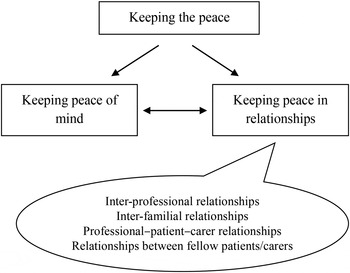
The core category of ‘Keeping the peace’ was primarily influenced by the deep-rooted Chinese cultural ideal which dictates that people should maintain harmony in their daily life and in society. In this study ‘Keeping the peace’ was seen to comprise two major dimensions: ‘keeping peace of mind’ and ‘keeping peace in relationships' (see Figure 1).
The core category of keeping the peace.

At a personal level, especially in respect of others' interactions with the patient, ‘Keeping the peace’ was a process intended to maintain the patient's peace of mind and happy mood. The belief that there is a close link between a person's mood and a good recovery was widely held by patients, family carers and health professionals, and was the fundamental rationale for ensuring that a patient's positive mood was maintained at all costs. As will be seen, this resulted in any potentially negative news being ‘hidden’ from them.
At the interpersonal level, ‘Keeping the peace’ involved numerous efforts to ensure that harmonious relationships were maintained at all levels, such as inter-professional relationships, inter-familial relationships, relationships between professionals, patients and carers, and relationships between patients and carers sharing the same room or the same ward. ‘Keeping the peace’ within these relationships often involved complex and diverse compromises that also exerted a considerable impact on the way in which decisions were made.
Making decisions
The second core category was termed ‘Making decisions' and comprised several basic social processes. A major social process that related both to ‘Keeping the peace’ and to the way that decisions were made was ‘hiding’, and this is considered in detail below.
Hiding
Hiding behaviours were practised by all three groups of participants and their goal was to ‘Keep the peace’ in both of the senses described above by either failing to disclose potentially negative information or ‘tailoring’ the truth in some way. Whilst all three groups of participants used ‘hiding’ behaviours, they were more common amongst professionals and carers and their impact, although largely unintentional, was effectively to preclude patients from involvement in some of the most important and contentious decisions. Under the category of ‘hiding’, three sub-categories were identified, these were named: (a) temporary hiding, (b) permanent hiding and (c) tailoring to hide.
Temporary hiding
Temporary hiding describes behaviours that were used by patients and carers for a relatively short period of time rather than during the whole stroke journey. For example, in some instances patients temporarily hid the truth about their disease and/or hospital treatment from certain family carers. For instance, to prevent their older spouse from suffering fears or anxiety patients might not inform them about their initial symptoms until they became too severe to ignore. Whilst this was intended to ‘keep peace of mind’, it could also delay help-seeking decisions.
In other cases family carers might choose to ‘hide’ information about hospitalisation from other family members, as below when a patient's husband did not inform his daughter of her mother's admission in order to save her from worry:
The reason why my father didn't immediately and timely tell me that my mother was sick was that he didn't think that my mother had a very serious disease, but he thought that my mother would spend at most several days staying in the hospital for treatment and then make a full recovery. So he didn't want to worry me. (Carer (21)4)
Here it is unclear whether the intent to save the daughter from worry, although motivated by what were believed to be good reasons, was entirely consistent with the daughter's wishes.
Temporary hiding, as the name suggests, was a brief expedient and did not last for a long period. Its impact was therefore often limited, in contrast to the potentially far greater impact of permanent hiding.
Permanent hiding
Permanent hiding processes were used widely by patients, carers and professionals, and involved keeping certain information from others deliberately and permanently. Permanent hiding was used far less often by patients and usually involved them in being less than frank with doctors about their prior medical history, especially if this suggested that they had been engaging in socially undesirable behaviours. For example, a male patient hid his history of having pancreatitis from his current doctor as this was associated with his prolonged and heavy drinking habit.
The motivation here seems to have been to ‘maintain face’ with the doctor, another important Chinese cultural value important to ‘maintaining peace in relationships'. However, in this instance it backfired as the doctor discovered the pancreatitis from the scan and therefore the patient ‘lost face’ twice: firstly, by having initially ‘hidden’ the information and, secondly, by subsequently being found out.
Other examples suggested that patients sometimes failed to listen to the doctor and preferred to take lay advice instead. This could lead them to stopping their medication, something that they understandably then wanted to ‘hide’. Unfortunately, the consequences could be serious and a patient's health condition could be severely jeopardised.
As can be seen, although less commonly adopted by patients the consequences of permanent ‘hiding’ were nevertheless often negative, either in terms of eroding the doctor's trust if the patient's ‘hiding’ subsequently came to light or in terms of the patient's health. Permanent hiding was practised more commonly by carers and doctors, either separately or in collusion. For example, family members sometimes permanently hid certain types of information from patients' spouses, other relatives, health professionals and, most importantly, from older patients themselves. This operated in several ways.
Hiding bad news from their older relative was the most significant and most prevalent form of permanent hiding demonstrated by family carers, often in collusion with medical personnel. Carers often went to considerable efforts not to let their relative know of a poor prognosis or of the full extent of the risks or costs involved in certain treatment options. This denied the patient any role in what were often very important decisions. Conversely, decisions that involved little or no risk, such as those concerning diet or physical exercise, were far more likely to include the older person.
It was clear that carers would selectively involve the older patient in decision-making based on the nature of the decision to be made and the extent to which it might compromise their ‘peace of mind’. Whilst ultimately well meaning, such behaviour could also be viewed as being paternalistic.
Carers adopted different strategies to achieve their aim of hiding negative information. Some, in order to keep information private, would talk outside the patient's room rather than in front of them; or they might try to downplay (or sometimes even deny) the seriousness of a patient's condition by telling a ‘white lie’. A daughter described her experience of hiding bad news from her father:
I will tell my father some information about his condition … I said ‘daddy, you still have a little inflammation in your lung, and we will go back home as soon as you get recovered’ … I have a principle which is that I only tell him the good news, but don't tell him the bad news. That is to say, I don't tell him all sorts of information, but only tell him positive information, but keep negative information secret. (Carer (5)13)
In addition to hiding potentially bad news about prognoses, carers would usually hide the full economic costs of treatment, especially if this went beyond their insurance cover and the family had to pay themselves or decline the treatment if they could not afford the cost.
Where bad news or issues of cost emerged, patients were rarely, if ever, informed and in most cases it was the adult child, or in their absence a spouse, that the doctor initially approached. In some instances the child hid bad news from both parents and only selectively involved them in the decisions to be made. Typically such information related to a patient's poor prognosis or to treatments/examinations which involved considerable risk. This reflected the adult child's unwillingness to increase their older parents' anxieties, fears or concerns, and thereby compromise their ‘peace of mind’.
However, hiding behaviours by carers were not confined to the patient or the wider family but also, on occasion, related to their interactions with professionals. Typically, family members hid the truth about any financial difficulties from health professionals such as their doctors, as they did not wish to ‘lose face’ by revealing their inability to pay for potentially expensive investigations or procedures. They might ‘hide’ this by providing another ‘reason’ for not wanting a certain procedure undertaken. Once again this could backfire as doctors were often aware of such hiding and this served to erode trust and compromise relationships between carers and professionals:
Sometimes the carer or patient does have financial problems, but they don't directly refuse the treatment by saying that they can't afford the cost, and they may find other excuses or give other rationales for refusing the doctor's advice … So in this case, the real reason [for refusing admission to an intensive care unit] behind perhaps was due to the financial difficulties wrapped up as the family's desire to stay with the patient during the final stage of her life. (Doctor (15)5)
Permanent hiding was also commonly used by health professionals. As noted above, this was often undertaken in collusion with carers and typically involved either downplaying or keeping bad news about the patient's poor prognosis from them. The rationale was usually to maintain a patient's ‘peace of mind’ in the belief that a happy mood leads to a better recovery. Consequently, considerable information was kept from patients.
For example, if the patient had a major stroke, the doctor would decide to hide the seriousness of their condition, usually by telling the patient that they only had a minor problem. As a result, the patient was not in control of the information they received and could not make informed decisions. Indeed, they were often not involved in making major decisions at all. However, doctors were more open with patients when the decision was about a minor problem, and in such cases usually allowed patients to make decisions on their own.
Below, a doctor describes very clearly his reluctance to tell patients bad news in order to maintain harmony. His deliberate ‘hiding’ strategy and the conditions under which ‘hiding’ was practised were reinforced:
If the patient is in a serious or critical situation or has a very poor prognosis, I will tell the carer about his or her situation in order not to increase the patient's concern or psychological pressure, which may further influence his or her recovery. Of course when the patient doesn't have a normal consciousness level, I will also tell the carer about the patient's condition. Generally speaking, when the patient has a minor problem, is in a stable condition or has a positive prognosis, we may talk to the patient and/or carer about treatment either at the patient's bedside or doctor's office. But if the patient is in a serious or life-threatening condition, or has a poor prognosis, we will only talk to carers about the patient's treatment, possible outcomes and prognosis. But we will not have this discussion in front of the patient, but in the doctor's office or outside the patient's room, in order to avoid the patient from knowing the bad news or negative information. (Doctor (15)2)
The other main reason doctors used hiding was to ensure a harmonious relationship with family carers and avoid possible conflict with them. Patients' negative emotional reactions and other potentially negative consequences following the disclosure of the truth could make families very unhappy with a doctor's performance and might trigger serious conflicts between families and doctors. This was illustrated by the following transcript from an interview with a female doctor:
In China, in this country, I think we should provide negative information such as poor condition, diagnosis and prognosis to carers. For example, in the current hospital, generally we will provide all this information to family carers. I know that there were situations in which the doctor told the patient such information and made the patient very anxious, then the carers went to criticise the doctor: ‘How come you tell the bad news to our relative? How come you tell him the truth!’ So in China, the negative information should be provided to carers and allow them to have a full understanding about the patient's poor condition or situation, and make decisions for patients. In China basically we don't let patients know the bad news. (Doctor (11)10)
The last main form of hiding behaviour was termed ‘tailoring to hide’.
Tailoring to hide
This tactic was generally used by professionals who would selectively ‘tailor’ information in order to hide certain aspects or facts about a particular choice from patients and carers. Their willingness to provide detailed and clear information to patients and carers could be influenced by a number of factors such as the perceived trustworthiness of carers or patients, their own preference or desire for decisions, or the expected outcome or consequence of different choices. As a result of ‘tailoring to hide’, patients and/or carers could not always make a fully informed choice, but were more likely to select a doctor's preferred choice. Examples are given below.
Doctors might selectively tailor information based on the perceived trustworthiness of carers or patients and in these circumstances would either exaggerate or downplay the risks associated with a particular decision.
For example, if doctors did not think that carers were trustworthy, in other words, if they didn't trust carers to understand their treatment plan, follow doctors' advice, be willing to give informed consent and be responsible for their decisions and outcomes, but rather they believed that carers were likely to blame professionals if things went wrong, they would talk in great detail about the risks associated with a radical or invasive treatment whilst downplaying its effectiveness. At the same time, they would give more information about a conservative treatment which was usually safe but perhaps less effective in resolving the patient's health problem. As a result, carers were more likely to choose the conservative or safer treatment. On the contrary, if doctors felt that carers were trustworthy, they would give more information about the effectiveness of radical or invasive treatment and downplay its potential risks. At the same time they gave less information about the conservative treatment.
Through this ‘tailoring’ process, doctors aimed to maintain harmony between themselves and carers as well as patients, and prevent possible negative consequences such as a poor outcome for the patient, family complaints, or conflicts or tensions between themselves and patients or carers:
If I don't trust patients and carers, if I think that they are not trustworthy … when I communicate with carers, I may be more careful to give more detailed information about risk … because I feel that they don't trust me and so I also don't trust them. (Doctor (10)11)
Another situation in which doctors selectively tailored information was when they had a preference for a particular decision. Here doctors might provide information that promoted their preferred treatment, whilst downplaying possible alternatives.
As can be seen, professionals might selectively tailor information based on the anticipated outcome or consequence of different choices. This was quite common, especially when decisions regarding thrombolytic treatment needed to be made. Here there was evidence that practitioners, both doctors and nurses, tailored the information given to carers and sometimes patients, depending on what they thought the clinical outcome was likely to be:
If I intend to use conservative treatment, I will put more emphasis on the risks associated with the radical or invasive treatment, because based on my experiences, or the current treatment protocol … although the patient is able to receive the radical or invasive treatment, the risks will far outweigh the benefits. Or sometimes for some patients the benefits may outweigh the risks. Based on my experiences … I will be able to know what kind of patients can get good treatment effect and what kind of patients can have poor treatment effect. (Doctor(1)13)
In the above example, the doctor gave more information about a choice which was more likely to result in a positive outcome or prognosis, and downplayed or hid information about a less-effective choice. Their underlying motivation was to avoid potential problems, poor treatment effects and conflict, and to maintain harmony in professional–patient–carer relationships.
The dynamics between the core categories
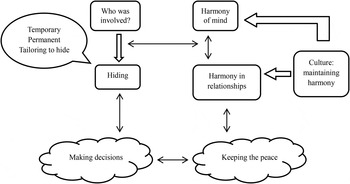
The dynamic and reciprocal relationship between hiding, the core category of ‘Keeping the peace’ and the part played by the Chinese cultural ideal of maintaining harmony on the decision-making process are illustrated in Figure 2.
Dynamics between the two core categories and other factors.

Decision-making was a major factor shaping the nature of the patient/carer journey following stroke. Making decisions by patients, carers and professionals was significantly influenced by the key social process of hiding and its three sub-categories of temporary hiding, permanent hiding and tailoring to hide. The main motivation for hiding was the desire to ‘keep the peace’, which was underpinned by the traditional Chinese cultural value of ‘maintaining harmony’.
‘Keeping the peace’ comprised maintaining ‘peace of mind’ for the patient and also maintaining harmony in interpersonal relationships. This desire to keep the peace influenced the processes involved in making decisions at all stages of the stroke journey.
Whilst hiding was central to the goal of keeping the peace, it had the largely unintended consequence of determining who played a key role in making ‘difficult’ decisions, with the patient being effectively precluded in most instances. Consequently, the findings suggested the central theme of Chinese traditional culture, the idea of ‘maintaining harmony’, was the most important overall background factor influencing the way in which decisions were made.
Discussion
This study is the first to explore the factors influencing decision-making in China post-stroke from the perspectives of older stroke survivors, family carers and professionals. The focus here has been on the impact of the desire of all parties, but especially family carers and professionals, to adhere to the traditional Chinese cultural value of maintaining harmony. To do so they used ‘hiding’ behaviours in order to ‘keep the peace’. The unintended consequence of this was effectively to preclude older patients from full and active involvement in what were perceived to be ‘difficult’ decisions. Whilst this issue has not been explored previously in the context of stroke in China, there are some parallels in the literature.
For example, Bowman and Singer (Reference Bowman and Singer2001) found that in order to maintain harmonious inter-familial relationships, when making end-of-life decisions if they themselves were incapable, older Chinese patients were unwilling to designate a surrogate decision-maker due to concerns that conflicts within the family might develop if there was disagreement between the surrogate decision-maker and other family members. A harmonious relationship between the patient and family is also highly valued in Japan (Takahashi et al. Reference Takahashi, Noguchi, Rahman, Shimbo, Goto, Matsui, Asaia, Onishi, Koyama, Sawadab, Yoshinakab and Fukui2003). Ngo-Metzger, Legedza and Phillips (Reference Ngo-Metzger, Legedza and Phillips2004) reported that lower levels of participation in health-care decision-making amongst Americans of Chinese and other Asian descent compared to their white counterparts was primarily due to their desire to maintain harmonious relationships and avoid potential conflict with doctors.
From a professional perspective, Ruhnke et al. (Reference Ruhnke, Wilson, Akamatsu, Kinoue, Takashima, Goldstein, Koenig, Hornberger and Raffin2000) and Weng et al. (Reference Weng, Joynt, Lee, Du, Leung, Peng, Gomersall, Hu and Yap2011) emphasised the need for Japanese and Chinese doctors to avoid open discussion about bad news with patients in order to both maintain a harmonious patient mood, and harmonious relationships between doctors and family members.
It is clear that the cultural goal of maintaining both harmonious interpersonal relationships and inner harmony within the patient significantly influences health-care decision-making behaviours among patients, family carers and professionals of Asian background. However, no similar evidence on the influence of the idea of maintaining harmony in health-care decision-making was found in studies on participants from Western backgrounds, further highlighting the strong influence of harmony as a core value of Chinese traditional culture (Chen and Starosta Reference Chen and Starosta1997). Rather, in the West, any failure to involve older people fully is attributed mainly to the team and organisational climate of care operating within specific contexts (Cornwell Reference Cornwell2012), although a tendency to defer to family carers when revealing bad news to older people is still apparent (Locatelli et al. Reference Locatelli, Piselli, Cicercha, Raffaele, Abbatecola and Repitto2010). This is seen to be a consequence of professional reluctance rather than deeper cultural mores.
No literature that explicitly adopted the concept of hiding as it related to patient/carers behaviour was found. However, Japanese studies have reported a similar process, in which doctors do not tell cancer patients their true diagnosis but rather inform families first and let them decide whether to tell patients the truth (Elwyn et al. Reference Elwyn, Fettersb, Sasakic and Tsudad2002; Ruhnke et al. Reference Ruhnke, Wilson, Akamatsu, Kinoue, Takashima, Goldstein, Koenig, Hornberger and Raffin2000). The main purpose of this, as in the present study, was to maintain patients' happy mood or harmonious inner state which was closely linked to a good recovery. As in the present study, maintaining a harmonious relationship with families was also a consideration. However, the result in both instances is that patients are precluded from playing a fully informed part in the decision-making process.
Other studies suggest practices similar to those described here as ‘tailoring to hide’. For example, Weng et al. (Reference Weng, Joynt, Lee, Du, Leung, Peng, Gomersall, Hu and Yap2011) suggested that only 19 per cent of Chinese doctors in ICU give complete medical information to patients, with most providing individually adjusted or specifically tailored information, based on the patient's disease, clinical condition and prognosis, in order to hide negative information from patients.
Whilst the motivation behind the ‘hiding’ behaviours described above can be related to the Chinese cultural context, they can also be understood using Glaser and Strauss’ (Reference Glaser and Strauss1965) seminal work ‘awareness context theory’. This was a product of the first application of their new methodological approach of ‘grounded theory’ in which they explored the nature of death and dying in acute hospitals in the USA. Based on their data, Glaser and Strauss (Reference Glaser and Strauss1965) proposed four main types of what they termed ‘Awareness Contexts', which related to the degree to which patients, families and professionals were aware of, and discussed, the impending death. The four types of context they described were closed awareness, suspected awareness, mutual pretence awareness and open awareness, each of which remains potentially relevant today, albeit with differing applications.
The authors argued that such awareness contexts were a product of their time, as during the 1960s death was a ‘taboo’ subject, knowledge of which both professionals and families worked hard to keep secret from the patient, thus creating a ‘closed’ awareness context. This often involved considerable effort on the part of professionals and families who frequently had to collude and resort to ‘little white lies' to keep the true seriousness of their condition from the patient. However, the patient often became ‘suspicious' and sought ways of confirming their fears which could result in strained relationships. Moreover, as in the present study, a closed awareness context precluded the dying patient from playing a full role in decision-making. Since the 1960s there has emerged, at least in the West, a more open attitude to death, although others have argued that closed awareness contexts are still apparent in certain conditions which remain stigmatised, e.g. dementia (Hellström, Nolan and Lundh Reference Hellström, Nolan and Lundh2005).
In the context of the current study, the notion of awareness contexts helps to explain ‘hiding’ as a key social process used by professionals and family carers when making decisions about, rather than with, hospitalised stroke patients when decisions were perceived as difficult. This effectively created a ‘closed’ awareness context, the main goal of which was to maintain the older person's peace of mind, but also to maintain harmonious relationships between professionals and families, and thereby avoid potential conflict. As a result, patients were excluded from the most serious and far-reaching decisions.
Unlike the earlier American study of Glaser and Strauss, there was little evidence in the current study of suspicion awareness (as described above) or of mutual pretence (where all parties knew of the impending death but pretended not to), with open awareness being confined largely to either younger and more highly educated stroke survivors, or when decisions related to minor health problems, diet, physical activity or similar issues. Although the reasons for the lack of suspicion awareness was not explored in the current study, it seems likely that so deeply ingrained is the need to maintain inner harmony that older people themselves do not wish to hear bad news and therefore made no real effort to find out.
If an open awareness context emerged unexpectedly, for example, when during her ward round, a female doctor directly talked to a female older patient about the possibility of her having a percutaneous transluminal stent, the consequences were largely negative and included poor mood, less perceived potential for a good recovery, disrupted relationships between the carer and doctors, and the carer being unhappy with, and distrustful of, doctors.
The above scenarios relate to ‘permanent closed awareness contexts' but there were also instances in the present study when what might be termed ‘temporary closed awareness contexts' were created, again with the primary intention of ‘keeping the peace’. For example, patients often temporarily hid information about their condition and hospital treatment from their older spouse or children to prevent them from suffering fears or anxiety. Such temporary closed awareness contexts were often not sustained and became more open over time.
Applying the concept of awareness contexts provides an important theoretical link between caring for people dying in the hospital and decision-making in stroke care in the current study, but several decades later and in a very different cultural context. In their original work, Glaser and Strauss (Reference Glaser and Strauss1965) noted that one of the main factors contributing to the creation and maintenance of a closed awareness context was doctors' ‘ordinary practice’ of not telling patients they were dying. In the current study, although carers and professionals also aimed to keep negative information secret, their motivation seemed to be more complex, as their hiding behaviours were significantly influenced by the Chinese cultural tradition of maintaining harmony in both people's minds and interpersonal relationships. This reflects the key difference between the findings in the current study and those in the original work. Therefore, the current study extends the reach and dimensions of the original awareness context work by adding the idea of permanent and temporary closed awareness contexts which have differing temporal dimensions and consequences.
Clearly, at the moment, Chinese culture continues to exert a significant influence on decision-making in acute care contexts, but whether the ideal of ‘maintaining harmony’ remains as pervasive and influential in the future remains to be seen. China is rapidly becoming more Westernised and traditional cultural values are being eroded (Knight Reference Knight2006). However, for the time being at least, Chinese health-care professionals would benefit from a clear understanding of awareness context theory, and the need to carry out a comprehensive assessment of patients' preferences for being involved in order to help them make better decisions. Thus, almost 50 years after it was first developed, the idea of awareness contexts continues to offer practical suggestions for improving the quality of patient care (Andrews and Nathaniel Reference Andrews and Nathaniel2009).
In addition to highlighting the continued relevance of awareness context theory, the findings of this study have implications for practice, educational and policy initiatives to enhance decision-making practices and thereby potentially improve the quality of stroke care and the quality of life of stroke patients and their carers in China.
What appears to be evident from the findings is the implicit or tacit understanding regarding truth-telling or disclosing unfavourable information held or shared by patients, families and health professionals within a Chinese cultural context. This was therefore largely ‘taken for granted’, with there being no examples of either professionals or carers ‘checking out’ these assumptions either with themselves or the older person. This could clearly lead to misunderstandings or to situations where professionals not familiar with these ingrained values (e.g. Western practitioners) could fail to adhere to them, potentially causing distress.
Given the importance attached to maintaining harmony, especially for the current cohort of older people, it may be neither possible nor desirable to involve older people fully in all decisions, but greater awareness of the true extent of their current exclusion may help to alert professionals of the need for a more complete exploration of older patients' wishes in this regard. The findings may also help to alert older patients about the need to express their wishes for more involvement, or not, more explicitly.
The same argument can also be applied to the interaction between families and professionals, and those between families and patients during decision-making processes. Fuller discussion would help to avoid the risk of misunderstandings about peoples' wishes and ensure that non-disclosure is what families and patients really want. The findings serve to remind health professionals, both Chinese and those from different cultural backgrounds, to evaluate families' and patients' desires and expectations, to gain a better understanding of how to relate to patients and families in a culturally acceptable way (Oliffe et al. Reference Oliffe, Thorne, Hislop and Armstrong2007), in order to individualise the form and content of information provision.
Whatever cultural changes occur over time, for the immediate future family carers will remain significant players. The more explicit fostering of close interactions between professionals and carers from the outset can clarify mutual expectations and establish harmonious relationships between the two parties, which are likely to improve the quality of decisions that are made and lessen the potential for conflict.
As China becomes more exposed to Western culture, concepts such as participation and involvement are likely to be more readily adopted. Indeed, it seems unlikely that future generations of Chinese Elders, brought up with ready access to outside influences via social media and other sources, will be happy to accept the largely passive role adopted by the participants in this study. Such developments are likely to occur naturally over time.
For the present, the findings can be used to alert current and future health-care professionals to the insidious impact of ‘hiding’ on elders' involvement in decision-making and both prepare them for future changes and assist them in producing better information, advice and guidance for patients and carers that enable them to work more effectively with professionals. The study can also help to inform the development of policy by the Ministry of Health and other government organisations or regulatory bodies in China in order to improve health-care decision-making practice. For example, the findings can help encourage the government to develop new policy and to modify current guidelines regarding stroke care that stress professionals' duty in relation to quality health information provision to patients and carers, thereby enabling them to make better health-care decisions. There is also a need for greater clarity about patients' and carers' legal rights in relation to informed consent and participation in health-care decision-making and services.
The findings of this study have also suggested some important areas for further investigation, such as exploring health-care decision-making in the context of stroke with other complications; exploring health-care decision-making in the context of other conditions within China; and extending the study to other Asian populations living in differing countries.
Limitations of the study
The relatively small-scale nature of the study must be acknowledged and care taken not to extend the findings of the work too far beyond their context. Whilst generalisation is not the aim of grounded theory, findings should be transferable to like settings and contexts (Rodwell Reference Rodwell1998). It is to be hoped that other researchers in the field will find the results of the present study useful in this regard. Moreover, whilst the study adopted a constructivist approach, the extent to which participants were fully engaged was, paradoxically, influenced by the very hiding processes that emerged. Because patients had not been involved in decisions regarding difficult issues, it was neither possible nor ethical to explore the full results with them. However, much fuller involvement of professionals, and to a lesser extent family carers, suggest considerable support for the findings (Wang Reference Wang2013). This gives further confidence in the potential utility of the findings, which would appear to merit further exploration in larger studies.
Conclusions
The findings of this study provide evidence of the impact of a specific social process, i.e. hiding, which patients, carers and professionals employ when making decisions around stroke and offer new insights, particularly into the role of the traditional Chinese cultural value of maintaining harmony, in health-care decision-making. These results can contribute to the development of practical, educational, policy and research initiatives to enhance decision-making practices, help professionals to provide the best possible support and care whilst promoting informed decision-making amongst all concerned, to improve the quality of life of stroke patients and their carers. The present study is also likely to have wider relevance and currency in differing settings and in relation to differing conditions.
Acknowledgement
The authors would like to thank all the participants for their time, co-operation and involvement in this study. There was no specific funding associated with this study. There are no conflicts of interests. Both authors played a significant role in the (a) conception, design, analysis and interpretation of the data; (b) the drafting and revising of the article for important intellectual content; and (c) approval of the final version of the article.