Introduction
Schizophrenia is characterized by widespread neuropsychological impairment (Heinrichs & Zakzanis, Reference Heinrichs and Zakzanis1998; Dickinson et al. Reference Dickinson, Ragland, Gold and Gur2008). Among the specific domains affected, processing speed is the most impaired, with patients performing approximately 1.5 standard deviations below healthy comparison subjects on average (Dickinson et al. Reference Dickinson, Ramsey and Gold2007). Processing speed impairment is an important predictor of functional outcome in patients, may predict conversion to a full-blown psychotic disorder in at-risk subjects, and is also present in unaffected relatives of probands (Dickinson et al. Reference Dickinson, Ramsey and Gold2007; Sanchez et al. Reference Sanchez, Ojeda, Pena, Elizagarate, Yoller, Gutierrez and Ezcurra2009; Nuechterlein et al. Reference Nuechterlein, Subotnik, Green, Ventura, Asarnow, Gitlin, Yee, Gretchen-Doorly and Mintz2011; Fusar-Poli et al. Reference Fusar-Poli, Deste, Smieskova, Barlati, Yung, Howes, Stieglitz, Vita, McGuire and Borgwardt2012). Consequently, elucidating the neural basis of processing speed impairment has the potential to improve our understanding of the etiology and treatment of schizophrenia.
Given the nature of neuropsychological tests of processing speed, which require subjects to rapidly perform relatively simple tasks that integrate several basic cognitive operations, it is not surprising that neuroimaging investigations of the neural basis of processing speed have focused on anatomical brain connectivity. In healthy subjects, processing speed is associated with white matter (WM) integrity, inferred from fractional anisotropy (FA) quantified with diffusion tensor imaging (DTI), in several brain areas, including prefrontal WM, longitudinal fasciculus, external capsule, optic radiation, cingulum and corpus callosum (Tuch et al. Reference Tuch, Salat, Wisco, Zaleta, Hevelone and Rosas2005; Turken et al. Reference Turken, Whitfield-Gabrieli, Bammer, Baldo, Dronkers and Gabrieli2008; Kerchner et al. Reference Kerchner, Racine, Hale, Wilheim, Laluz, Miller and Kramer2012; Salami et al. Reference Salami, Eriksson, Nilsson and Nyberg2012; Koch et al. Reference Koch, Wagner, Schachtzabel, Schultz, Gullmar, Reichenbach, Sauer and Schlosser2013; Sasson et al. Reference Sasson, Doniger, Pasternak, Tarrasch and Assaf2013). Some of these associations seem to be specific to processing speed. For instance, WM integrity in the cingulum, corpus callosum and corona radiata has been reliably linked to processing speed whereas correlations between WM integrity and executive functions and memory are often limited to frontal and temporal lobe regions respectively (Bendlin et al. Reference Bendlin, Fitzgerald, Ries, Xu, Kastman, Thiel, Rowley, Lazar, Alexander and Johnson2010; Sasson et al. Reference Sasson, Doniger, Pasternak, Tarrasch and Assaf2013). However, there is also evidence that WM integrity throughout the brain is related to processing speed and, more broadly, intellectual functioning (Penke et al. Reference Penke, Munoz, Murray, Gow, Hernandez, Clayden, Starr, Wardlaw, Bastin and Deary2010, Reference Penke, Maniega, Bastin, Valdes Hernandez, Murray, Royle, Starr, Wardlaw and Deary2012).
Evidence of widespread reductions in WM integrity in schizophrenia provides a possible neural basis for processing speed impairment (Melonakos et al. Reference Melonakos, Shenton, Rathi, Terry, Bouix and Kubicki2011; Fitzsimmons et al. Reference Fitzsimmons, Kubicki and Shenton2013; Yao et al. Reference Yao, Lui, Liao, Du, Hu, Thomas and Gong2013). Numerous WM regions/tracts have been implicated in schizophrenia, including the corpus callosum, cingulum and longitudinal fasciculus. However, the findings are remarkably heterogeneous, raising the possibility that WM disruption in schizophrenia may vary as a function of individual differences in cognitive impairment. Emerging evidence suggests that this is indeed the case as the integrity of several WM tracts, including the cingulum, uncinate fasciculus, longitudinal fasciculi, internal capsule and thalamocortical connections, has been linked to several cognitive abilities, including processing speed, working memory, executive functioning and verbal memory (Nestor et al. Reference Nestor, Kubicki, Gurrera, Niznikiewicz, Frumin, McCarley and Shenton2004, Reference Nestor, Kubicki, Nakamura, Niznikiewicz, McCarley and Shenton2010; Szeszko et al. Reference Szeszko, Robinson, Ashtari, Vogel, Betensky, Sevy, Ardekani, Lencz, Malhotra, McCormack, Miller, Lim, Gunduz-Bruce, Kane and Bilder2007; Karlsgodt et al. Reference Karlsgodt, van Erp, Poldrack, Bearden, Nuechterlein and Cannon2008; Qiu et al. Reference Qiu, Zhong, Graham, Chia and Sim2009; Takei et al. Reference Takei, Yamasue, Abe, Yamada, Inoue, Suga, Muroi, Sasaki, Aoki and Kasai2009; Perez-Iglesias et al. Reference Perez-Iglesias, Tordesillas-Gutierrez, McGuire, Barker, Roiz-Santianez, Mata, de Lucas, Rodriguez-Sanchez, Ayesa-Arriola, Vazquez-Barquero and Crespo-Facorro2010; Levitt et al. Reference Levitt, Alvarado, Nestor, Rosow, Pelavin, McCarley, Kubicki and Shenton2012; Marenco et al. Reference Marenco, Stein, Savostyanova, Sambataro, Tan, Goldman, Verchinski, Barnett, Dickinson, Apud, Callicott, Meyer-Lindenberg and Weinberger2012; Voineskos et al. Reference Voineskos, Felsky, Kovacevic, Tiwari, Zai, Chakravarty, Lobaugh, Shenton, Rajji, Miranda, Pollock, Mulsant, McIntosh and Kennedy2013). Nevertheless, several questions remain unaddressed. First, the extent to which cognitive impairment, especially slowed processing speed, is mediated by WM integrity remains unclear. Second, the specificity of cognition–WM associations has not been established. Third, it is not known if disrupted WM integrity in schizophrenia is entirely attributable to cognitive impairment. That is, is there a categorical ‘disease’ effect on WM integrity, or does variation along the dimension of cognition account for altered WM integrity in schizophrenia? We explored these questions using tract-based spatial statistics (TBSS; Smith et al. Reference Smith, Jenkinson, Johansen-Berg, Rueckert, Nichols, Mackay, Watkins, Ciccarelli, Cader, Matthews and Behrens2006) analysis of DTI data and neuropsychological testing. In light of strong evidence that processing speed in particular is related to WM integrity in healthy subjects, we tested the hypothesis that processing speed impairment in schizophrenia is mediated by diminished WM integrity and that this relationship is would be strongest for processing speed compared to other cognitive domains. We further explored the extent to which cognitive impairment accounts for reduced WM integrity in schizophrenia.
Method
Participants and study procedures
Twenty-six schizophrenia/schizo-affective patients and 20 healthy subjects were recruited to participate in this study, which was approved by the Vanderbilt University Institutional Review Board. All subjects provided written informed consent prior to participation. Individuals with schizophrenia were recruited from the Psychotic Disorders Program at the Vanderbilt Psychiatric Hospital in Nashville, TN. Healthy subjects were recruited from Nashville and surrounding area by print/internet advertisement and by word of mouth. All study participants were administered the SCID (First et al. Reference First, Spitzer, Gibbon and Williams1996) to confirm diagnoses in patients and rule out current or past psychiatric illness in healthy subjects. Exclusion criteria included: age <18 years or >60 years; estimated pre-morbid IQ<70; presence of a systemic medical illness or neurological disorder that would affect study results; reported pregnancy or lactation; history of significant head trauma; psychotropic drug use (healthy controls only); substance abuse within the past 3 months (patients); lifetime history of substance abuse/dependence (healthy controls); and magnetic resonance imaging (MRI) contraindicators (e.g. metal implants, claustrophobia).
Neuropsychological testing
Subjects completed the Wechsler Test of Adult Reading (WTAR; Wechsler, Reference Wechsler2001), a single-word reading test of estimated pre-morbid intellectual functioning, and the Screen for Cognitive Impairment in Psychiatry (SCIP; Purdon, Reference Purdon2005). The SCIP is a brief cognitive battery that includes five subtests: (1) a word-list learning test of verbal memory comprising three learning trials of a 10-word list; (2) a working memory test modeled after the Auditory Consonant Trigram Test; (3) a phonemic verbal fluency test of executive functioning; (4) a visuomotor coding test of processing speed modeled after the Coding subtest from the Wechsler Adult Intelligence Scales (WAIS; Wechsler, Reference Wechsler1997); and (5) a delayed recall trial of the word list. Each subtest was administered the tests and scored according to published guidelines.
Neuroimaging data acquisition and preprocessing
Diffusion weighted images (DWIs) and T1-weighted anatomical MR images were collected from each subject on a research-dedicated 3-T Philips Intera Achieva scanner (Philips Healthcare, The Netherlands). DWIs were acquired using an eight-channel sensitivity encoding (SENSE) head coil with the following parameters: repetition time (TR) = 10000 ms, echo time (TE) = 48 ms, field of view (FOV) = 240 × 240 mm2, B0 image and 92 diffusion directions at B = 1000 s/mm2, flip angle = 90°, matrix size = 96 × 96, voxel size = 2.5 mm isotropic, and number of slices = 52. The high-resolution T1-weighted anatomical image included 170 sagital slices with 1.0-mm isotropic resolution. The DWIs were pre-processed using the Analysis Group at the Oxford Centre for Functional MRI of the Brain (FMRIB) Software Library (FSL) version 4.1.4 (www.fmrib.ox.ac.uk/fsl/; Behrens et al. Reference Behrens, Woolrich, Jenkinson, Johansen-Berg, Nunes, Clare, Matthews, Brady and Smith2003; Smith et al. Reference Smith, Jenkinson, Woolrich, Beckmann, Behrens, Johansen-Berg, Bannister, De Luca, Drobnjak, Flitney, Niazy, Saunders, Vickers, Zhang, De Stefano, Brady and Matthews2004). Raw DTI data were corrected for eddy current distortions using the Eddy Current Correction (ECC) tool and for motion using the McFlirt Motion Correction tool. The FMRIB Brain Extraction Tool (BET; Smith, Reference Smith2002) was then used for skull stripping. Diffusion tensors were fitted at each voxel and FA images were created using the DTIFIT tool of FMRIB FDT toolbox, version 2.0 (Behrens et al. Reference Behrens, Woolrich, Jenkinson, Johansen-Berg, Nunes, Clare, Matthews, Brady and Smith2003).
TBSS analysis
Voxel-wise statistical analysis of the DTI FA images was carried out using TBSS (Smith et al. Reference Smith, Jenkinson, Johansen-Berg, Rueckert, Nichols, Mackay, Watkins, Ciccarelli, Cader, Matthews and Behrens2006) in FSL. First, each subject's FA image was aligned to the standard 1 × 1 × 1 mm MNI152 template in FSL using the non-linear registration tool (FNIRT). Next, the mean FA image was created and thinned to create a mean FA skeleton representing the centers of all tracts using a threshold of 0.25. Each subject's aligned FA map was then projected onto this skeleton resulting in each subject's skeletonized FA image.
Statistical analyses
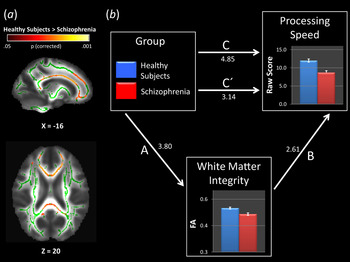
Given our a priori interest in understanding the neural correlates of processing speed impairment, a mediation analysis was performed to estimate the direct and indirect relationships between group, WM integrity and processing speed. Parameter estimates were computed for each path in the mediation analysis: A, B, C, C′ (see Fig. 1 b). First, the association between neuropsychological functioning and diagnostic group (i.e. path C) was established by carrying out an independent groups t test. Once this was confirmed, we tested to see whether there was a relationship between group and the mediator variable, WM integrity (i.e. path A). Group differences in voxel-wise FA were examined by entering each subject's skeletonized FA into a general linear model (two-sample t test) design matrix with non-parametric permutation testing using the randomize tool in FSL (10 000 permutations). The results were thresholded at p = 0.05 (corrected) using the threshold-free cluster enhancement (TFCE) option to find clusters without setting an initial cluster level (Smith & Nichols, Reference Smith and Nichols2009). From this, we extracted the mean FA from all voxels demonstrating a group difference from each subject's skeletonized FA image. Thus, each subject contributed a single value to the mediation analysis that reflected mean FA within the regions identified in the between-groups analysis. Mean FA was then regressed onto processing speed (i.e. path B). Finally, a regression analysis with group and the mediator variable (i.e. mean FA from regions showing between-groups differences) entered as predictors was performed (i.e. path C′). We used the Sobel test to determine the significance of the mediation effect. We also used a bootstrap method (Preacher & Hayes, Reference Preacher and Hayes2004) to confirm the results of the Sobel test based on evidence that traditional methods have normality assumptions that are rarely met (Hayes, Reference Hayes2009) or suffer from low statistical power (MacKinnon et al. Reference MacKinnon, Lockwood, Hoffman, West and Sheets2002). Bootstrap methods are distribution free and provide greater statistical power. We estimated the 95% confidence interval (CI) of the coefficient from the Sobel test; intervals that did not include zero were considered statistically significant. To determine whether the relationship was most robust for processing speed, we repeated the mediation analysis with the verbal learning, delayed recall, working memory and verbal fluency subtest scores entered as dependent variables.
Reduced white matter (WM) integrity and processing speed impairment in schizophrenia. (a) WM integrity, inferred from fractional anisotropy (FA), was reduced in several brain areas in schizophrenia including the corpus callosum, superior frontal gyrus WM and precuneus WM. Areas demonstrating reduced FA in schizophrenia (i.e. warm colors) are overlaid on the skeletonized FA map (i.e. green). (b) Processing speed impairment in schizophrenia was partially mediated by mean FA from the regions that demonstrated lower FA in patients compared to healthy subjects. Standardized coefficients, all of which were significant (p < 0.05), are shown for each pathway. The Sobel test confirmed that the strength of the association between the independent variable (group) and dependent variable (processing speed) was reduced after accounting for WM integrity (path C v. C′: β = 0.48, bootstrap confidence interval 0.18–0.92, p < 0.05).

In addition to determining whether processing speed impairment in schizophrenia was mediated by WM integrity, we also investigated the extent to which abnormal WM integrity in schizophrenia was accounted for by cognitive impairment. That is, we were interested in determining whether WM differences associated with the categorical disease dimension were accounted for by individual differences in the dimension of cognitive impairment. To address this question, we repeated the voxel-wise between-groups analysis of FA entering each of the SCIP domains, processing speed, verbal learning, verbal fluency, working memory and delayed recall, separately as covariates in ANCOVAs. The results from these analyses show group differences on a voxel-wise basis after covarying for impairment in each neuropsychological domain.
Results
Demographics and neuropsychological test scores
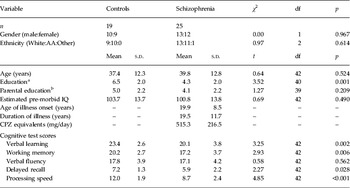
Two subjects (one with schizophrenia and one healthy subject) were excluded from the study because of suspected artifacts in the imaging data. Therefore, the final sample consisted of 25 schizophrenia patients and 19 healthy controls. Demographic data for the two groups are presented in Table 1. Level of education was lower in schizophrenia compared to healthy subjects (t = 3.52, p = 0.001). The two groups were otherwise well-matched on age, parental education, sex, race and estimated pre-morbid intellectual functioning. With respect to clinical variables, the average age of onset and duration of illness were approximately 20 and 19 years respectively. Most patients were taking one atypical antipsychotic (n = 15), with the remaining patients taking two atypical antipsychotics (n = 2) and one typical antipsychotic (n = 2). Three patients were unmedicated and medication status could not be determined for three patients. The average antipsychotic dosage among the medicated patients, calculated in chlorpromazine equivalents using the guidelines established by Gardner et al. (Reference Gardner, Murphy, O'Donnell, Centorrino and Baldessarini2010), was 515.3 ± 216.5 mg/day. Consistent with expectations, schizophrenia patients performed worse on all subtests of the SCIP, except the verbal fluency subtest (see Table 1).
Demographic characteristics and cognitive tests scores

AA, African American; CPZ, chlorpromazine; df, degrees of freedom; s.d., standard deviation.
a Data on education were unavailable for two schizophrenia patients.
b Data on parental education were unavailable for three schizophrenia patients.
Group differences in WM integrity
Whole-brain voxel-wise analysis revealed decreased FA in several brain regions in schizophrenia, including the genu, body and splenium of the corpus callosum, cingulum, bilateral superior and inferior frontal subgyral WM, bilateral anterior corona radiata and right precuneus WM (see Fig. 1 a). There were no significant increases in FA in schizophrenia patients compared to healthy controls.
Relationship between cognitive impairment in schizophrenia and WM integrity
Consistent with our hypothesis, processing speed impairment in schizophrenia was partially mediated by WM integrity (Fig. 1 b). Specifically, patients performed worse than healthy subjects on the SCIP processing speed subtest (i.e. path C: t 42 = 4.85, p < 0.0001) and this effect was substantially attenuated when WM integrity was added as an additional predictor (i.e. path C′: t 42 = 3.15, p = 0.003). The Sobel test confirmed that the relationship between schizophrenia and processing speed was partially mediated by WM integrity (β = 0.48, bootstrap CI 0.18–0.92, p < 0.05). Repetition of the mediation analysis with verbal learning, working memory, verbal fluency and delayed recall entered as the dependent variable confirmed that the relationship was strongest for processing speed (see online Supplemental Table 1). Specifically, even though verbal learning, working memory and delayed recall were robustly impaired in schizophrenia, FA did not mediate these relationships (β values ranged from 0.11 to 0.31 and all CIs for the mediation test included zero). To further investigate the selectivity of the relationship between WM and processing speed, we calculated a SCIP composite score by converting raw subtest scores to Z scores using published normative data and averaging them together, excluding the processing speed measure, and performed a mediation analysis with the SCIP composite score as the dependent variable. As expected, the SCIP composite score was lower in schizophrenia compared to healthy subjects (path C: t 42 = 3.91, p < 0.001, effect size = –1.20). However, the effect was not substantially attenuated when WM integrity was added as a predictor (i.e. path C′: t 42 = 2.98, p = 0.005; Sobel test β = 0.04, bootstrap CI −0.13 to −0.19), indicating that impaired overall cognitive ability in schizophrenia was not mediated by WM integrity.
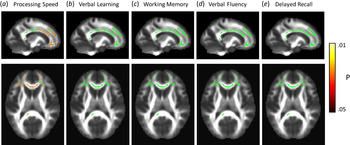
A voxel-wise correlation analysis was performed to further investigate the relationship between processing speed impairment and WM integrity. Specifically, each schizophrenia patient's skeletonized FA map was entered into a general linear model with processing speed test scores entered as a predictor. As with the between-groups analysis, 10 000 iterations of a random permutation method (randomize tool, FSL) and the TFCE option were used to find clusters without setting an initial cluster level. The resultant statistical maps were masked by the between-group differences image, and thresholded at p < 0.05. This analysis was repeated entering the remaining SCIP subtest scores as a predictor to determine whether other cognitive functions also correlated with FA. As shown in Fig. 2 a, several of the regions that demonstrated reduced FA in schizophrenia also correlated positively with processing speed in the patient group, including the genu and body of corpus callosum, bilateral superior and inferior frontal subgyral WM, and left anterior corona radiata. By contrast, FA did not correlate with verbal learning, working memory, verbal fluency and delayed recall (see Fig. 2 b–e).
Correlations between white matter (WM) integrity, inferred from fractional anisotropy (FA), and cognition in schizophrenia. (a) Processing speed correlated with FA in the corpus callosum and superior frontal gyrus. (b–e) WM integrity was not correlated with other cognitive domains.

Group differences in WM integrity after controlling for cognitive impairment
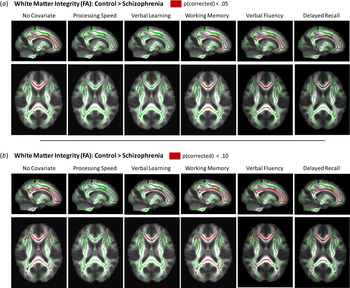
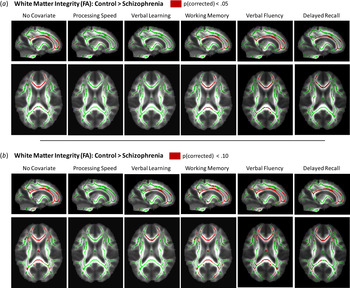
To further examine the impact of cognitive functioning on WM integrity in schizophrenia, the whole-brain analysis of group differences in WM integrity was repeated including each of the SCIP subtests as a covariate in separate ANCOVAs. As shown in Fig. 3, after accounting for processing speed, there were no significant group differences in FA anywhere in the brain, even when a more liberal threshold of p = 0.10 (corrected) was used. By contrast, significant differences persisted after correcting for working memory and verbal fluency. The group differences were also mitigated to some extent when verbal learning was included as a covariate; however, the same general pattern of reduced WM integrity observed in the no-covariate analysis was apparent at the more liberal threshold of p = 0.10 (corrected).
White matter (WM) integrity reductions in schizophrenia with and without covarying for cognition. Without covarying for cognitive impairment, WM integrity, inferred from fractional anisotropy (FA), was reduced in multiple brain areas in schizophrenia at both (a) conservative (p < 0.05) and (b) liberal statistical thresholds (p < 0.10). Similar results were observed after covarying for working memory, verbal fluency, delayed recall and, to a lesser extent, verbal learning. By contrast, no group differences were observed after covarying for processing speed at either the conservative or liberal statistical thresholds. Statistical parametric maps (i.e. warm colors) are overlaid on the skeletonized FA map (i.e. green).
Discussion
Cognitive impairment, and slowed processing speed in particular, is an important predictor of functional outcome in schizophrenia and a potential endophenotype of the disorder (Dickinson et al. Reference Dickinson, Ramsey and Gold2007; Sanchez et al. Reference Sanchez, Ojeda, Pena, Elizagarate, Yoller, Gutierrez and Ezcurra2009; Nuechterlein et al. Reference Nuechterlein, Subotnik, Green, Ventura, Asarnow, Gitlin, Yee, Gretchen-Doorly and Mintz2011). Prompted by compelling evidence that brain anatomical connectivity is related to processing speed in healthy subjects, we investigated the relationship between WM integrity and processing speed, and cognitive functioning more broadly, in schizophrenia. We hypothesized that: (1) consistent with prior studies, the integrity of key WM tracts would be reduced in schizophrenia; and (2) cognitive impairment, especially processing speed impairment, would be mediated by WM integrity. Our results support these hypotheses. Specifically, WM integrity in the corpus callosum, frontal lobe, cingulum, anterior corona radiata and precuneus was reduced in schizophrenia. Importantly, processing speed impairment in schizophrenia was partially mediated by WM integrity in these regions. The relationship between cognitive functioning and WM integrity was strongest for processing speed as impairments in other cognitive domains, including working memory, verbal learning and executive functioning, were not mediated by WM integrity. Finally, in an effort to further understand the relationship between cognition and WM integrity in schizophrenia, we examined the extent to which WM reductions associated with the categorical diagnosis of schizophrenia were accounted for by variation in the dimension of cognitive impairment. The results of this analysis revealed that disrupted WM integrity in schizophrenia is largely accounted for by individual differences in processing speed impairment. By contrast, group differences in WM integrity persisted after impairment in other cognitive domains were accounted for, including working memory and executive functioning. Combined, our findings implicate reduced WM integrity in the expression of cognitive impairment in schizophrenia, especially slowed processing speed, and indicate that WM integrity in schizophrenia covaries with individual differences in the severity of processing speed impairment.
Several limitations of our investigation merit discussion before considering the potential implications of our findings. First, the sample sizes, although comparable to most psychiatric neuroimaging investigations, are modest for mediation analysis. For instance, power analysis based on Fritz & MacKinnon (Reference Fritz and MacKinnon2007) indicates that we were well-powered (i.e. > 80%) to detect large effect sizes for the ‘a’ and ‘b’ paths of the mediation model for processing speed. However, for the other cognitive variables, which had smaller effects for the ‘b’ paths (all Cohen's d < 0.30), we would have needed considerably larger sample sizes to reach 80% power to detect an effect. Thus, although our findings speak to the strength of the relationship between WM integrity and processing speed impairment in schizophrenia, we cannot rule out the possibility that deficits in other cognitive domains are also partially mediated by WM integrity. Indeed, our ANCOVAs revealed that, similar to processing speed, no group differences in WM were detected after covarying for verbal learning at the standard p = 0.05 (corrected) threshold. However, in contrast to the ANCOVA covarying for processing speed, significant group differences remained at the more liberal threshold of p = 0.10 (corrected) after covarying for verbal learning. This suggests that verbal learning also accounts for some of the variability in reduced WM integrity in schizophrenia, but less than processing speed. Larger sample sizes will probably be needed to more accurately determine the extent to which specific cognitive domains are related to WM pathology in schizophrenia. A second limitation is that the SCIP, although a very good approximate of overall cognitive functioning, is not a replacement for a comprehensive neuropsychological assessment (Cuesta et al. Reference Cuesta, Pino, Guilera, Rojo, Gomez-Benito, Purdon, Franco, Martinez-Aran, Segarra, Tabares-Seisdedos, Vieta, Bernardo, Crespo-Facorro, Mesa and Rejas2011). It is possible that other cognitive domains, in addition to processing speed, might have been linked to WM integrity had we used a more extensive battery. However, the fact that a specific relationship between processing speed and WM was detected with a relatively brief battery is all the more striking as more extensive neuropsychological batteries generally result in greater independence between cognitive domains, not less, and greater power for detecting specific brain–behavior relationships. Additionally, processing speed, as measured with commonly used neuropsychological tests, taps a wide range of cognitive abilities, raising questions about which specific cognitive operations contributing to neuropsychological tests of processing speed are related to WM integrity. Finer-grained measures capable of parsing the specific cognitive operations involved in processing speed will be required to address this limitation. Finally, our decision to focus on overall WM integrity derived from voxels identified in the between-groups analysis might have limited our ability to detect more spatially circumscribed associations between cognition and WM. A voxel-wise approach is more sensitive in this case; however, there is considerably debate in the neuroimaging field about the validity of voxel-wise brain–behavior correlation analyses, with some investigators arguing that exploratory, whole-brain voxel-wise correlation analyses yield inflated estimates of effect size when not tested in an independent data set (e.g. Vul & Pashler, Reference Vul and Pashler2012). Thus, although our mediation analysis is methodological sound as it focused on mean FA extracted from regions identified a priori in the between-groups analysis, it might be insensitive to detecting WM–cognition associations that are spatially circumscribed, and the voxel-wise correlation analysis examining the relationship between WM integrity and cognition in schizophrenia should be interpreted cautiously until replicated.
Consistent with many prior studies, we found reductions in WM integrity in schizophrenia that included many tracts often implicated in the disorder, including the corpus callosum, cingulum and anterior corona radiata (Melonakos et al. Reference Melonakos, Shenton, Rathi, Terry, Bouix and Kubicki2011; Fitzsimmons et al. Reference Fitzsimmons, Kubicki and Shenton2013). However, the findings across studies are remarkably heterogeneous, with some investigations reporting widespread decreases in WM integrity and others reporting circumscribed reductions or, in the case of a small minority of studies, no changes at all (e.g. Nenadic et al. Reference Nenadic, Wagner, Gullmar, Schachtzabel, von Consbruch, Kohler, Koch, Roebel, Schultz, Reichenbach, Sauer and Schlosser2011). By linking the severity of WM pathology to individual differences in processing speed impairment, our results provide a potential explanation for the variable findings. The current results also have implications for dimensional approaches to parsing the heterogeneity of schizophrenia (Cuthbert & Insel, Reference Cuthbert and Insel2013). Specifically, the fact that we did not find any effect of schizophrenia diagnosis on WM integrity after covarying for processing speed indicates that the changes in WM associated with the categorical illness variable were accounted for by variability in a specific dimension of the illness. This was not the case for several other cognitive domains prominently affected in schizophrenia, indicating that the association between processing speed and WM integrity was unlikely to be a statistical artifact related to co-linearity (i.e. strong association between processing speed impairment and schizophrenia). In particular, widespread reductions in the integrity of the corpus callosum and prefrontal cortex WM remained after covarying for working memory, executive functions and verbal memory, all of which were impaired in schizophrenia. Our results make a compelling case that WM pathology in schizophrenia is related to cognitive impairment and provide further support for dimensional approaches to dissecting the heterogeneity of schizophrenia.
The association between processing speed impairment and reduced WM integrity in schizophrenia, while correlational in nature, raises the possibility that the two features result from a common etiological mechanism. The high heritability of schizophrenia, along with strong evidence that WM integrity, inferred from FA, and processing speed are also heritable, implicates a genetic basis (Toulopoulou et al. Reference Toulopoulou, Picchioni, Rijsdijk, Hua-Hall, Ettinger, Sham and Murray2007; Doherty et al. Reference Doherty, O'Donovan and Owen2012; Jahanshad et al. Reference Jahanshad, Kochunov, Sprooten, Mandl, Nichols, Almasy, Blangero, Brouwer, Curran, de Zubicaray, Duggirala, Fox, Hong, Landman, Martin, McMahon, Medland, Mitchell, Olvera, Peterson, Starr, Sussmann, Toga, Wardlaw, Wright, Hulshoff Pol, Bastin, McIntosh, Deary, Thompson and Glahn2013). This is supported by evidence that the integrity of WM tracts prominently affected in probands, such as the corpus callosum, is reduced in unaffected relatives of patients (Knochel et al. Reference Knochel, Oertel-Knochel, Schonmeyer, Rotarska-Jagiela, van de Ven, Prvulovic, Haenschel, Uhlhaas, Pantel, Hampel and Linden2012). Imaging genetic studies have linked allelic variation in several putative schizophrenia risk genes, including CNTNAP2, NTRK1, NTRK3 and MIR137, to WM integrity (Braskie et al. Reference Braskie, Jahanshad, Stein, Barysheva, Johnson, McMahon, de Zubicaray, Martin, Wright, Ringman, Toga and Thompson2012, Reference Braskie, Kohannim, Jahanshad, Chiang, Barysheva, Toga, Ringman, Montgomery, McMahon, de Zubicaray, Martin, Wright and Thompson2013; Clemm von Hohenberg et al. Reference Clemm von Hohenberg, Wigand, Kubicki, Leicht, Giegling, Karch, Hartmann, Konte, Friedl, Ballinger, Eckbo, Bouix, Jager, Shenton, Rujescu and Mulert2013; Lett et al. Reference Lett, Chakavarty, Felsky, Brandl, Tiwari, Goncalves, Rajji, Daskalakis, Meltzer, Lieberman, Lerch, Mulsant, Kennedy and Voineskos2013). However, there are also negative findings. For instance, the genome-wide risk gene ZNF804A seems to be unrelated to WM integrity (Sprooten et al. Reference Sprooten, McIntosh, Lawrie, Hall, Sussmann, Dahmen, Konrad, Bastin and Winterer2012; Wei et al. Reference Wei, Kang, Diao, Guidon, Wu, Zheng, Li, Guo, Hu, Zhang, Liu and Zhao2013). Recently, Voineskos et al. (Reference Voineskos, Felsky, Kovacevic, Tiwari, Zai, Chakravarty, Lobaugh, Shenton, Rajji, Miranda, Pollock, Mulsant, McIntosh and Kennedy2013) found that the effect of several risk alleles in oligodendrocyte genes on cognition, including MAG, CNP and OLIG2, was mediated by WM integrity, thus establishing a putative pathway linking genetic variation within WM genes to WM integrity and, ultimately, cognition.
The current results may also have implications for the prevention and treatment of cognitive impairment in schizophrenia. Both deficient processing speed and reductions in WM integrity are observed in individuals at high risk for psychosis, with those who go on to develop a full-blown psychotic disorder demonstrating worse cognition and more WM pathology than non-converters (Karlsgodt et al. Reference Karlsgodt, Niendam, Bearden and Cannon2009; Carletti et al. Reference Carletti, Woolley, Bhattacharyya, Perez-Iglesias, Fusar, Valmaggia, Broome, Bramon, Johns, Giampietro, Williams, Barker and McGuire2012). In patients with schizophrenia, chronic patients demonstrate greater WM changes than first-episode patients (Friedman et al. Reference Friedman, Tang, Carpenter, Buchsbaum, Schmeidler, Flanagan, Golembo, Kanellopoulou, Ng, Hof, Harvey, Tsopelas, Stewart and Davis2008). It is not known whether cognitive decline and changes in anatomical brain connectivity move in parallel during the transition to psychosis, or over the course of the illness. However, interventions designed to preserve the integrity of WM in high-risk populations, or ameliorate WM deterioration in patients, may ward off cognitive impairment and/or reduce deterioration over the course of the illness. Moreover, evidence that processing speed impairment mediates deficits in other cognitive domains suggests that the benefits of improving processing speed could be widespread (Rodriguez-Sanchez et al. Reference Rodriguez-Sanchez, Crespo-Facorro, Gonzalez-Blanch, Perez-Iglesias and Vazquez-Barquero2007; Andersen et al. Reference Andersen, Fagerlund, Rasmussen, Ebdrup, Aggernaes, Gade, Oranje and Glenthoj2013). For instance, Anderson et al. (Reference Andersen, Fagerlund, Rasmussen, Ebdrup, Aggernaes, Gade, Oranje and Glenthoj2013) found that deficits in other cognitive domains, including working memory, verbal memory and executive function, were mediated by processing speed. Mounting pre-clinical and clinical evidence supporting myelin dysfunction in schizophrenia implies that drugs that improve or preserve myelin might prove effective in the disorder, as some have suggested (Walterfang et al. Reference Walterfang, Velakoulis, Whitford and Pantelis2011). There is also accumulating evidence that cognitive remediation improves WM integrity. Recently, Penades et al. (Reference Penades, Pujol, Catalan, Massana, Rametti, Garcia-Rizo, Bargallo, Gasto, Bernardo and Junque2013) found that WM integrity of the genu of the corpus callosum, a region that mediated processing speed impairment in the current investigation, increased to a greater extent in patients receiving cognitive remediation compared to a treatment control group. Although Penades et al. (Reference Penades, Pujol, Catalan, Massana, Rametti, Garcia-Rizo, Bargallo, Gasto, Bernardo and Junque2013) found no effect of cognitive remediation on processing speed, a meta-analysis by Wykes et al. (Reference Wykes, Huddy, Cellard, McGurk and Czobor2011) concluded that cognitive remediation does have a modest effect on processing speed. However, it is important to note that processing speed impairment was only partially mediated by WM integrity. Clearly, other factors, including possible gray matter changes and functional abnormalities, also contribute to processing speed dysfunction.
In conclusion, we found that cognitive functioning, particularly processing speed impairment in schizophrenia, is mediated by decreased WM integrity. Moreover, we did not detect any differences in WM integrity between healthy subjects and individuals with schizophrenia after accounting for individual differences in processing speed. Importantly, the relationship between WM and cognitive impairment was most robust for processing speed; deficits in other cognitive domains affected in schizophrenia, including working memory, verbal memory and overall cognitive impairment, were not mediated by WM integrity. However, larger sample sizes will be required to determine the extent to which deficits in other cognitive domains are mediated by WM integrity. The results suggest that a common etiological mechanism, possibly genetic, might underlie processing speed impairment and WM pathology, and further imply that interventions that preserve and/or improve WM integrity may enhance cognition.
Supplementary material
For supplementary material accompanying this paper, please visit http://dx.doi.org/10.1017/S0033291714001111.
Acknowledgments
This research was supported by funding from the Brain and Behavior Research Fund [National Alliance for Research on Schizophrenia and Depression (NARSAD) Young Investigator Award awarded to N.D.W.], the Jack Martin, M.D., Research Professorship in Psychopharmacology (held by N.D.W.), the National Institute of Mental Health (K01-MH083052 awarded to J.U.B.) and the Vanderbilt University Psychiatric Genotype/Phenotype Project.
Declaration of Interest
None.