I. INTRODUCTION
The effects of alloying and interstitial elements on the mechanical properties of dense titanium and titanium alloys have been extensively studied and reported in the literature.Reference Conrad1 Most common alloying elements, such as aluminum and vanadium, increase the material yield and ultimate strength. Elements such as oxygen, nitrogen, and carbon are generally seen as impurities, fill interstitial sites in the titanium crystal, modify the lattice parameter and consequently impact the yield and ultimate strength, the hardness and the ductility of the materials. These elements may react easily with titanium during material processing (i.e., casting, sintering, 3D printing, and heat treating) and have relatively high solubility in α titanium (maximum solubility in α-Ti being 30, 19, and 2 at.% for oxygen, nitrogen and carbon respectively).
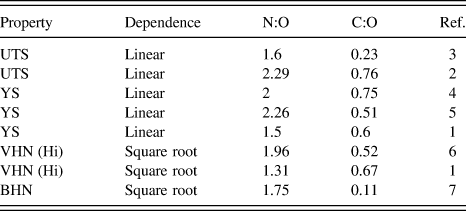
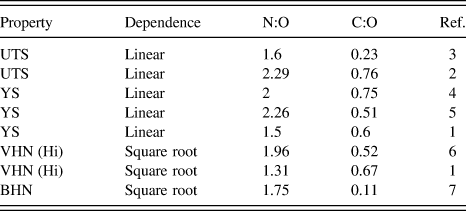
The effect of interstitials on the properties of dense titanium has been previously investigated and the trends are well understood within certain concentration limits. For example, Wood reported that the effect of 2 at.% of oxygen on the Vickers hardness of pure titanium was equivalent to that of 1 at.% of nitrogen and 4 at.% of carbon.Reference Wood2 Other investigators reported such trends for other properties [yield strength (YS), ultimate tensile strength (UTS) and ductility] and the effect of nitrogen was generally reported as the most significant, followed by oxygen and carbon. Finlay and SnyderReference Finlay and Snyder3 proposed to investigate the combined effect of different interstitials (oxygen, nitrogen, and carbon) on the UTS and determined ratios that describe the impact of each element relative to the others. The authors establish, with such correlations, the concept of equivalent contents of oxygen, which is a weighted sum of the contents in oxygen, nitrogen, and carbon. Other researchers followed the same approach for different properties and used equivalent amount of oxygen to describe the global effect of interstitials on the properties of titanium.Reference Conrad4–Reference Brown, Folkman and Schussler7Table I presents interstitial weight coefficients reported in the literature for different properties. Correlations between the interstitial content and the UTS and YS in tension are reported as linear while hardness follows a square root relationship with interstitial content. In all cases, the effect of nitrogen is significantly more important than that of oxygen (average interstitial weight coefficient of 1.8 for UTS, YS and hardness and 1.9 for YS alone) and carbon (average weight coefficient of 0.5 for UTS, YS and hardness and 0.6 for YS alone).
Reported dependence and relative effects of nitrogen and carbon when compared to oxygen.
Many processes for the production of porous titanium or titanium foams involve the use of titanium particles. These particles have large surface area and are naturally covered with a thin oxide film. This oxide contributes to increase the oxygen content of the powder and affects the composition of the materials produced with these powders. The large surface area of the powder and foam also provides large surfaces to react with additives (i.e., binder, foaming agent, spacers, etc.) that are used to produce the foam or with the atmosphere or environment during processing (furnaces atmosphere, molds, sintering support, etc.). In addition, the high temperature processing of the powder (i.e., sintering, melting, etc.) leads to the dissolution of the oxide and/or nitride layer on the surface of the powder in the bulk titanium and, therefore, creates a fresh titanium surface to react with the atmospheric constituents. Thus, a natural oxide layer reforms on the surface of the foam after exposure to air at low temperature.
While the effect of interstitials on the properties of dense titanium has been widely studied and reported in the literature, their impact on the properties of titanium foams has been significantly less documented. References to the impact of the oxygen content on the properties of titanium foams are sometimes made in the literature but the systematic evaluation of the effect of these elements on the properties of foams having different compositions and structures has not been extensively reported. One studyReference Lefebvre and Baril8 presented the effect of oxygen and oxygen distribution on the properties of pure titanium foams. The method used to modify the oxygen concentration and distribution was a low temperature (350–450 °C in Ar-20% O) oxidation and solution treatment (1000 °C in vacuum). The results obtained showed that the surface oxide can be an important contributor to the oxygen content measured in the foam but its effect on the monotonic compression properties of the foam was minimal, at least for the oxide thicknesses investigated (up to 75-nm thick). The impact of the oxygen content in solution on the properties of the foams was found to be significant and the YS and ductility of the foams were affected by the oxygen content in solution. The oxygen content has also an impact on the material deformation during cyclic loading. Rupture of the specimens is more brittle and cracks are more apparent after cyclic deformation when the amount of oxygen increases. However, cyclic compression tests done on specimens having similar structure and porosity showed that S-N curves of materials with oxygen contents varying from 0.24–0.51 wt% were not significantly different and the observed fatigue limits does not seem to be affected by the oxygen content within this range.Reference Lefebvre, Baril and Bureau9 This observation was associated with the effect of the increasing YS with oxygen that counterbalances the negative impact of oxygen on ductility. This finding is significantly different from observations reported in the literature for dense titanium in tension, where fatigue limits are usually proportional to the YS of the materials (65–70%).Reference Conrad1
While some papers reported the effect of oxygen on the properties of titanium foam, the impact of other interstitials such as nitrogen and carbon on the microstructure and properties of titanium foams has not been well documented in the literature. The objective of this paper is to provide some data on the effect of these elements on the properties of titanium foams. The effect of oxygen, nitrogen, and carbon on the compression properties of titanium foams were evaluated and compared. A powder metallurgy process (described in the following section) was used to produce the foams. The process allowed controlling the interstitial content using titanium oxide, titanium nitride and graphite additives (in a powder form) as sources of oxygen, nitrogen and carbon. Verifications were made to confirm that the additives had little impact on the structure and porosity of the resulting materials, the additives were dissolved during sintering and the oxygen, nitrogen and carbon went into solution during sintering. The following sections present the experimental procedures used and the results obtained in this study.
II. EXPERIMENTAL PROCEDURE
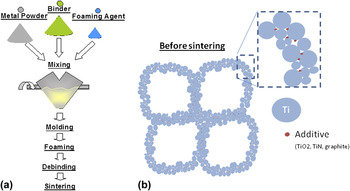
Small cylinders (11 mm diameter and 11 mm long cylinders) of titanium (CpTi) were produced using the process described in Fig. 1. Plasma atomized CpTi spherical powder (Grade 1; −45 µm, AP&C) was admixed with a polyethylene wax powder (i.e., binder) and a chemical foaming agent (p,p′-oxybis[benzenesulfonyl hydrazide]). The concentration of oxygen, nitrogen and carbon in the foams were modified by admixing different amounts of titanium oxide (between 0 and 0.625 wt%, HC Starck, 10–45 µm), titanium nitride (between 0 and 1.14 wt%; Cerac, 10–45 µm) and graphite (between 0 and 0.5 wt%; Timcal, Switzerland, KS10, 2.5–12.5 µm) particles with the titanium powder. The resulting powder mixture (titanium, additives, binder and foaming agent) was transferred into a mold and foamed at 210 °C in air. During foaming, the binder melts and forms a suspension with the titanium particles and additive (if present). The foaming agent then decomposes, expands the material and creates the porosity in the material. The resulting material was then debinded at 450 °C in Ar to remove the binder and residues of the foaming agent. After foaming and debinding, the additives were distributed in the microstructure as shown schematically in Fig. 1(b). The specimens were then machined in the form of small cylinders and sintered (1 h at 1300 °C under vacuum) to create metallurgical bonds between the titanium particles and provide the mechanical strength to the resulting materials. The specimens were produced in different batches and not all processes in the same thermal cycles.
(a) Schematic representation of the process used to produce the foam and (b) structure of the foam with admixed additives after debinding/before sintering.

The porosity (i.e., 56%) was evaluated using the weight (Ohaus, Parsippany, NJ, Explorer, 210 g ± 0.1 mg) and physical dimensions of the cylinders after sintering using 4.5 g/cm3 as the theoretical density of CpTi. Polished cross-sections of the specimens were observed using optical microscopy. Nanoindentation measurements were used to monitor the impact of oxygen, nitrogen and carbon on the properties (hardness and modulus) of the α-titanium phase and use as a way to monitor modification of the properties and composition of the titanium matrix. Instrumented indentation tests were done using a Nano Indenter G200 (Agilent, Santa Clara, CA) with a diamond Berkovich indenter on polished cross-sections of specimens without additive as well as with different additives (TiO2, TiN, and graphite). Continuous stiffness measurement (CSM) was used to provide hardness and modulus as a continuous function of penetration depth. Ten indents were performed on each sample to penetration depth limits of 2000/1200/650 nm. Compression tests were done on the cylinders using an MTS 100 kN testing machine using a crosshead speed of 1.25 mm/min. Compression curves were obtained by plotting the stress as a function of deformation. The YS was determined as the intersection of the lines parallel to the elasto-plastic loading (i.e., first stage) and the plastic deformation plateau (i.e., second stage) as described in ref. Reference Lefebvre, Gauthier and Patry10 and in the Results section. The oxygen and nitrogen concentrations were evaluated by the inert gas fusion method (IGF) using a LECO TCH-600 analyzer (St. Joseph, MI) while the carbon was analyzed using a LECO CS600 combustion analyzer (St. Joseph, MI). The chemical analyses were done on one sample per group on crunched specimens after the compression tests. Three measurements were done on each specimen for oxygen and nitrogen while two measurements were done for carbon.
III. RESULTS
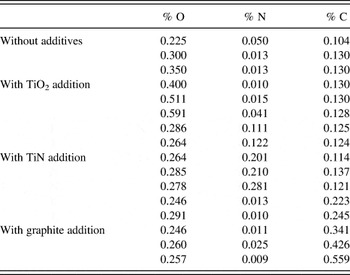
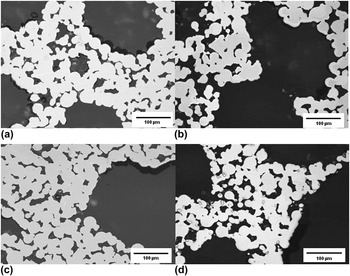
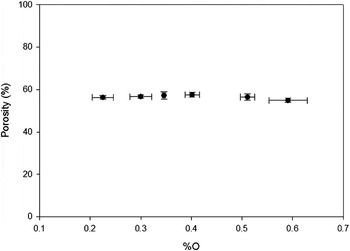
The composition of the foams produced with and without additive is presented in Table II. It is worth noting that the oxygen content in the foam without additive is significantly larger than the nitrogen and carbon content. The microstructures of the CpTi foams produced with and without interstitial additive are presented in Fig. 2. The pores are significantly larger than the size of the titanium particles used and are created by the decomposition of the foaming agent particles during foaming. The contours of the particles used to produce the foams are still visible on the polished cross-sections. Good sintering necks are formed between the particles but small pores are still present between the particles. The structure, the porosity (56%), as well as the quality of the sintering necks between the particles are similar for all specimens produced with or without additives. Indeed, Fig. 3 shows the porosity of CpTi foams produced with different loadings of TiO2 particles (0 and 0.625 wt% TiO2), providing foams with different oxygen contents. The results indicate that the porosities of all specimens were similar and the addition of TiO2 particles did not affect the porosity of the specimens. The amount of titanium oxide particles used in the formulation was small (i.e., below 0.625 wt%) and did not impact the rheology of the suspensions during foaming nor the densification during sintering. Similar observations were made with the TiN and carbon additions.
Oxygen, carbon and nitrogen concentrations in the CpTi foams with and without additive.

Polished cross-sections observed using optical microscopy of CpTi foams (a) without additives (b) with 0.625 wt% TiO2 additive (0.59 wt% O measured), (c) with 1.141 wt% TiN additive (0.28 wt% N measured), and (d) with 0.5 wt% graphite additive (0.51% C measured).

Porosity of the specimens produced for the evaluation of the effect of the oxygen content (between 0 and 0.59 wt% TiO2 addition).

Figures 2(a) and 2(b) presenting polished cross-sections of the foams with and without TiO2 additives show that the titanium oxide particles admixed with the titanium powder are not visible in the foam after sintering and the microstructures of the materials produced with and without TiO2 are similar. This suggests that the titanium oxide particles were dissolved during sintering and the oxygen went into solution in the titanium matrix. This dissolution of TiO2 by titanium at high temperature was previously observed with titanium oxide coating on CpTi foams heated at 1000 °C.Reference Lefebvre and Baril8 The quality of the metallurgical bonds created between the titanium particles is similar for foams with and without titanium oxide additions, and suggests that the titanium oxide particles added to the formulation did not affect sintering and consolidation.
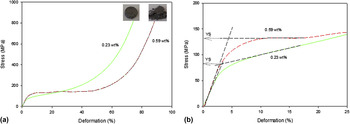
The effect of the oxygen content on the monotonic compression of small titanium foam cylinders can be seen in Fig. 4(a). The compression curves of the specimens are smooth (i.e., without sharp stress oscillation during deformation) and composed of three deformation stages representative of ductile metallic foams. The initial stage (i.e., elasto-plastic loading) is characterized by a steep increase of the stress with deformation at the beginning of the test. As opposed to the elastic stage observed during loading of dense titanium in tension, deformation during this stage is composed of both elastic and plastic deformation, due to the nonuniform stress distribution during loading, as generally observed with ductile metallic foams.Reference Ashby, Evans, Fleck, Gibson, Hutchinson and Wadley11 The second stage (i.e., plastic deformation plateau) is characterized by a long and smooth plastic deformation plateau while the third stage (i.e., densification) shows a dramatic increase of the stress with deformation at the end of the compression tests.
Compression curves for foams having two different oxygen contents (0.26 and 0.59 wt%) (a) complete curve and (b) zoom on the initial portion of the curves. Pictures of the specimens after compression are provided in (a) to indicate the level of ductility of the specimens.

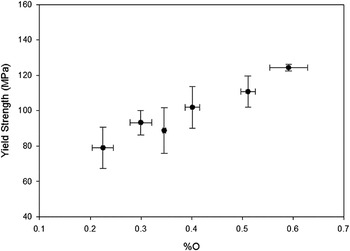
Effect of oxygen content on the compression YS.

While the structure and porosity of the materials are similar [Figs. 2(a) and 2(b), Fig. 3], the compression properties of the materials are affected by the addition of TiO2 particles (Fig. 4). Pictures of the compacted specimens [Fig. 4(a)] show that the materials with larger oxygen content are more brittle. The materials with lower oxygen content deform into flat specimens while the cylinders with larger oxygen contents were highly damaged during compression. The slope of the plastic deformation plateau is affected by the oxygen concentration and is an indicator of the ductility of the materials. For the foam with lower oxygen content, the stress increases steadily during the plastic deformation stage, indicating that the material consolidates during compression. Indeed, the material deforms plastically and the stress increases due to the densification during compression. The specimens with larger oxygen contents show little consolidation during deformation as a result of the damages created during compression. The cracks and material losses observed in the specimens with larger oxygen content increase local stresses and counterbalance the effect of the densification during compression. The ductility of the titanium matrix with lower oxygen content enables a better load distribution during deformation leading to a more uniform densification and strengthening of the foam under constant deformation. The oxygen concentration has also an impact on the YS of the material (Fig. 5), evaluated as the intersection of lines parallel to the elasto-plastic loading and plastic deformation plateau stages, as presented in Fig. 4(b).
The modification of the compression behavior (YS, slope of the plastic deformation plateau and shape of the specimens after compression) suggests that the titanium oxide particles added to the titanium powder were dissolved during sintering, the oxygen went into solution and modified the properties of the titanium matrix and consequently, the properties of the foams. These results are consistent with observations previously reported in the literature on similar materials but produced with a different powder and procedure (i.e., oxidation and solution treatments)Reference Lefebvre and Baril8 and as well as with observations on the modification of the microhardness of the titanium matrix measured using nanoindentation (to be presented later in this paper).
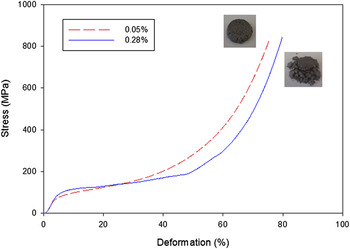
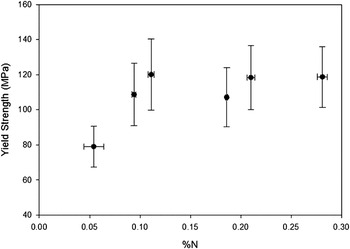
Fig. 6 presents the effect of nitrogen concentration on the monotonic compression of titanium foams. While the curves of the foams containing 0.05 wt% and 0.28 wt% N are smooth and representative of ductile foams, the two materials behave differently. Nitrogen concentration has an impact on the ductility of the specimens, as demonstrated by the visual aspect of the specimens at the end of the compression tests. When the nitrogen content is small, the foams are ductile and deform plastically into the form of a pancake. The foams with larger nitrogen content are more brittle and disintegrate during the compression tests. The effect of nitrogen on the ductility can be observed on the slope of the plastic deformation plateau of the curves. Indeed, the slopes are lower for the foams with higher nitrogen content due to the embrittlement coming from the nitrogen into solution. Nitrogen has also an impact on the YS of the specimens as shown in Fig. 7 showing the YS as a function of nitrogen concentration. The effect of nitrogen concentration on the YS seems to be similar to the effect observed with oxygen. Due to the non-negligible concentration of oxygen in the specimens produced to investigate the effect of nitrogen and the combined effect of these 2 interstitials on the properties of the foams (to be presented later in the paper), the analysis of the effect of nitrogen was limited to concentrations below 0.28 wt%. Above that concentration, the specimens were very brittle and the method used to measure the YS (intersection of lines parallel to the elasto-plastic loading and the plastic deformation plateau) was no longer valid.
Compression curves of foams having two different nitrogen contents (0.05 and 0.28 wt%). Pictures of the specimens after compression are provided to indicate the level of ductility of the specimens.

Effect of nitrogen content on the compression YS.

As mentioned earlier, the specimens produced with and without TiN additive have similar porosity and the effect of the addition of TiN on the properties observed essentially comes from differences of nitrogen concentration in solution in the titanium matrix. In fact, the titanium nitride particles added to the powder formulation were no longer visible after sintering [Figs. 2(a) and 2(c)] and the microstructures of the foams with and without TiN additives were similar. During sintering, the titanium nitride particles were dissolved and the nitrogen went into solution, the same way the titanium oxide particles were dissolved during sintering.
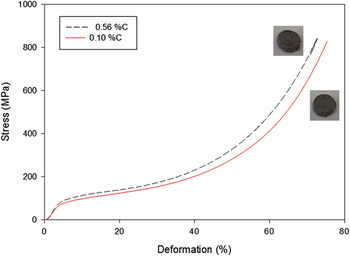
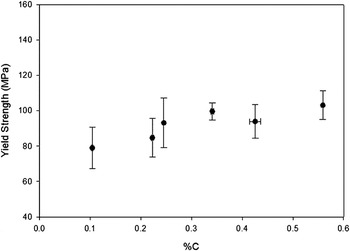
Fig. 8 presents the effect of carbon concentration on the compression behavior of the foams. The effect of carbon concentration on the shape of the curve is not as important as observed with oxygen and nitrogen (Figs. 4 and 6). Indeed, a fivefold increase of the carbon content (0.1–0.5 wt%) has a limited impact on the slope of the plastic deformation plateau, indicating that the carbon concentration has little effect on the ductility of the foams. This is confirmed by the shape of the specimens at the end of the compression tests, which are similar, for all specimens. The carbon concentration seems, however, to have a small effect on the YS of the foam, as indicated in Figs. 8 and 9. The effect of carbon concentration on the YS is, on the other hand, significantly less important than the effect of oxygen and nitrogen. The smaller effect should come from the mechanisms responsible for the strengthening of the materials. Indeed, the carbon concentrations investigated (0.1–0.5 wt%) were above room temperature carbon solubility limit while the concentration of oxygen and nitrogen was well below their solubility limit in α-titanium. Therefore, the effect of the variation of carbon concentration was essentially a modification of the carbide concentration [see Fig. 2(a) and 2(d)] and had no impact on the properties of the titanium matrix (as demonstrated later using nanoindentation).
Compression curves for foams having two different carbon concentrations (0.10 and 0.51 wt%). Pictures of the specimens after compression are provided to indicate the level of ductility.

Effect of carbon content on the compression YS.

As the addition of small quantities of graphite did not impact foaming and the structure of the sintered specimens and the carbon concentration was in all cases above the carbon solubility limit in titanium, the impact of carbon content essentially came from precipitation hardening. During sintering, graphite particles were dissolved and the carbon went into solution. As the solubility limit is reduced when temperature goes down, carbides precipitated during cooling after sintering. At 0.1 wt% C, the carbon content is close to the solubility limit and the carbide concentration is very small. However, as the concentration of carbon increases, the concentration of these carbides increases significantly [Fig. 2(d)].
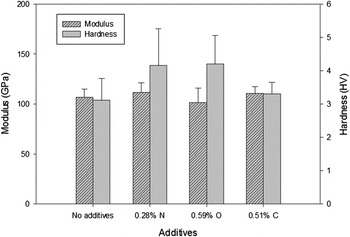
Fig. 10 presents the effect of the different elements on the hardness and elastic modulus of the α-titanium phase measured using nanoindentation. The results show that oxygen and nitrogen concentrations have an impact on the α-titanium hardness while carbon concentration does not. The impact of oxygen and nitrogen comes from differences in their concentration in solution in the α-titanium matrix. As carbon concentration was above the solubility limit, the carbon concentration variations did not affect the amount of carbon in solution and the hardness of the α-titanium phase. The impact of oxygen, nitrogen and carbon concentration on the elastic modulus is, on the other hand, limited as the interstitial concentration has only a small effect on the elastic modulus of titanium.Reference Conrad1
Effect of nitrogen, oxygen and carbon addition on the elastic modulus and hardness measured with nanoindentation on polished cross-sections. Measurements were done on CpTi foams with and without additives. The composition of the specimen with no additive is 0.26% O, 0.05% N, and 0.12% C. The composition provided in the x-axis corresponds to the element concentration modified.

As the concentration of all elements was not exactly identical for all series of specimens (i.e., nitrogen concentration was below 0.05 wt% for all specimens in the series of specimens used to investigate the effect of oxygen or carbon concentration) while the oxygen concentration was significant (above 0.23 wt%) in the specimens used to investigate the impact of nitrogen and carbon and these effects are additive, an analysis of the variation of the combined effect of all interstitials on the YS was conducted using multivariable data analysis. The following relationship has been calculated from the analysis of all the experiments:
 $$\eqalignb{{\rm{YS}}\left( {{\rm{MPa}}} \right) = \,\,49.22 + 111.55{^*}\,[{\rm{O}}\left( {{\rm{wt}}{\rm{.\% }}} \right) \cr+ 1.17{^*}\,{\rm{N}}\left( {{\rm{wt}}{\rm{.\% }}} \right) + 0.38{^*}\,{\rm{C}}\left( {{\rm{wt}}{\rm{.\% }}} \right){\rm{]}}\quad{\rm{.}}$$
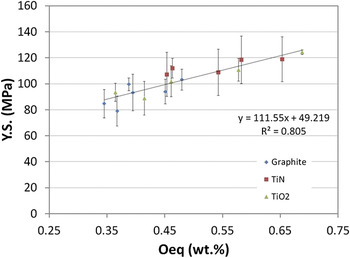
The resulting coefficient of determination, R2, was 0.81 for all data points. The terms in brackets in Eq. 1 is the expression of the equivalent concentration of oxygen similar to the one introduced by FinleyReference Finlay and Snyder3 (see Sec. I). The coefficients of the weighted sum are 1.17 and 0.38 for nitrogen and carbon, respectively. When converted in atomic fraction (%), the weight coefficients become 1.03 for N:O and 0.29 for C:O. The weight coefficient for nitrogen is lower than those reported in the literature (Table I) for dense titanium in tension. A value close to 1 indicates that the effect of nitrogen on the YS is similar to the effect of oxygen, which is the different from the results reported with dense titanium in tension. The weight coefficient for carbon is much lower than 1, indicating that its impact is significantly smaller than the effect of oxygen and nitrogen. This value is significantly smaller than those reported in the literature (Table I). This difference may come from the fact that the concentration of carbon was above its solubility limit in titanium and precipitation hardening has less impact on the YS and ductility than solution hardening, at least for the conditions investigated in this study. The differences between the results obtained and those reported for dense titanium in tension (Table I) may also be associated with differences of morphology of the material (foam versus dense) and loading conditions that create complex loading patterns (compression, bending and shearing) rather than pure tension.
Fig. 11 presents the YS as a function of the equivalent concentration of oxygen using the weight coefficients presented in Eq. 1. Despite the fact that strengthening mechanisms involved for oxygen and nitrogen are different from the one observed with carbon (i.e., precipitation hardening), the values obtained with the addition of titanium oxide, titanium nitride and graphite particles fit relatively well and all data points are overlapping, indicating that the equivalent oxygen equation can be applied with these materials over the range of compositions studied in this work.
Correspondence between the compression YS and the equivalent oxygen concentration calculated using Eq. 1 with weight coefficients N:O = 1.17 and C:O = 0.38.

IV. CONCLUSION
The effects of oxygen, nitrogen and carbon on the properties of titanium foams produced with a powder metallurgy process were investigated. Oxygen, nitrogen and carbon concentrations were modified by adding titanium oxide (TiO2), titanium nitride (TiN), and graphite particles in the powder formulation. Oxygen, nitrogen, and carbon concentrations were adjusted by varying the amount of additives admixed with the powder. Titanium oxide, titanium nitride, and graphite particles were dissolved during sintering and are not observed in the microstructure after sintering. Oxygen, nitrogen, and carbon went into solution in the α-titanium matrix during sintering. On the one hand, oxygen and nitrogen remained in solution after cooling due to their high solubility (>5 wt%) in α-Ti at room temperature. On the other hand, as the carbon contents investigated were above room temperature carbon solubility in titanium, titanium carbides precipitated in the α-titanium matrix during cooling after sintering. The results indicate that oxygen and nitrogen concentration has an important impact on the ductility, the YS and consolidation during compression. For the conditions investigated in this study, carbon concentration had little impact on the ductility and a small effect on the compression YS, due to precipitation hardening. Within the interval of concentration investigated in this study, the effect of oxygen and nitrogen was similar while carbon had a minor effect (weight coefficient C:O of 0.38) compared to oxygen and nitrogen.
ACKNOWLEDGMENTS
The authors would like to acknowledge J.P. Nadeau, S. Mercier, D. Simard and F. Perrin for their contributions in the experimental work presented in this article.