Introduction
Costa Rica, together with El Salvador (Bennett and Smith, Reference Bennett and Smith2018; Burton et al., Reference Burton, Chévez, Sauerbrey, Guinovart, Hartley, Kirkwood, Boslego, Gavidia, Alemán Escobar, Turkel, Steketee, Slutsker, Schneider and Campbell2018) and Belize (WHO, 2018), are very likely to soon achieve malaria elimination in Mesoamerica, a highly vulnerable region to vector-borne tropical diseases, including malaria (Hotez et al., Reference Hotez, Woc-Colburn and Bottazzi2014). Plasmodium vivax (Grassi & Feletti) is the most prevalent species in Costa Rica, accounting for more than 95% of the cases since reliable records exist (Vargas, Reference Vargas2001; Marín Rodríguez and Chaves, Reference Marín Rodríguez and Chaves2019). Malaria elimination in Costa Rica follows a national (Grupo Técnico Nacional de Enfermedades Vectoriales, 2015), and regional (Herrera et al., Reference Herrera, Ochoa-Orozco, González, Peinado, Quiñones and Arévalo-Herrera2015), commitment to reduce malaria transmission. Malaria elimination also occurs against a background where only half of Costa Rica area is assumed to have optimal conditions for malaria transmission, but where around 70% of the population lives in areas that are assumed to be protected from malaria by environmental conditions that limit malaria transmission, mainly elevation associated low temperatures (Grupo Técnico Nacional de Enfermedades Vectoriales, 2015; Grupo Técnico Nacional de Enfermedades Vectoriales, 2016). Low temperatures mainly limit malaria parasite development in vectors (Patz and Olson, Reference Patz and Olson2006; Chaves, Reference Chaves, Johnson and Jones2017). Low temperatures might also limit the distribution and abundance of Anopheles albimanus Wiedemann, the main malaria vector in Costa Rica (Vargas, Reference Vargas2001) and Mesoamerica (Rigg et al., Reference Rigg, Hurtado, Calzada and Chaves2019).
Costa Rica is a middle-income country (The Economist Intelligence Unit, 2018), where malaria elimination is happening under the context universal health coverage administered through decades-old, and robust, social security trust (Caja Costarricense de Seguro Social, CCSS). This universal coverage health system has achieved exceptional successes in health indicators, for example, life expectancy at birth (Rosero-Bixby and Dow, Reference Rosero-Bixby and Dow2016) and mortality at birth (Kruk et al., Reference Kruk, Gage, Joseph, Danaei, García-Saisó and Salomon2018), and has health indicators at the level of wealthier nations in Europe and East Asia (Knaul et al., Reference Knaul, Bhadelia, Ornelas, de Lima and del Rocio Sáenz Madrigal2015). Along these lines understanding the conditions that have led Costa Rica to the current malaria pre-elimination stage are of great importance, as malaria health policies implemented in Costa Rica could serve to improve regional malaria elimination plans in Mesoamerica. Moreover, the analysis of malaria health policies in Costa Rica could also provide insights for malaria elimination at a global scale, by highlighting health policy shifts associated with malaria transmission reduction and elimination (Greenwood, Reference Greenwood2009).
Here, we analyze three historical annual malaria time series that cover most of the historical period from 1913 to 2018. For the analysis, we compiled a list of malaria health policy shifts and natural events that are assumed to have affected malaria transmission during the study period. With these data we test the hypothesis that malaria health policy shifts, and large scale natural events, have impacted malaria transmission in Costa Rica, eventually leading to its near elimination stage in Costa Rica. We then use time series tools to identify breakpoints, i.e. the time when temporal dynamics of a natural system undergo structural and functional changes (Scheffer, Reference Scheffer2009). The regime shift analysis allows the identification of different malaria transmission regimes, i.e. time periods when malaria transmission had persistent dynamical behaviour through time (Chaves et al., Reference Chaves, Hashizume, Satake and Minakawa2012). Then, we employ regression methods to quantitatively assess the impacts of different health policies on reducing malaria transmission. In other words, an impactful malaria health policy is expected to temporally coincide with, or to be followed by, a regime shift. In contrast, an ineffective malaria health policy is not expected to lead to a regime shift. A successful malaria health policy is expected to be followed by a regime with a reduced number of malaria cases when compared with the regime prior to the policy shift. By contrast, a detrimental health policy shift, or a natural environmental catastrophe, is expected to be followed by a regime with an increased number of malaria cases when compared with the regime prior to the policy shift.
Materials and methods
Large-scale natural events and malaria health policy shifts in Costa Rica
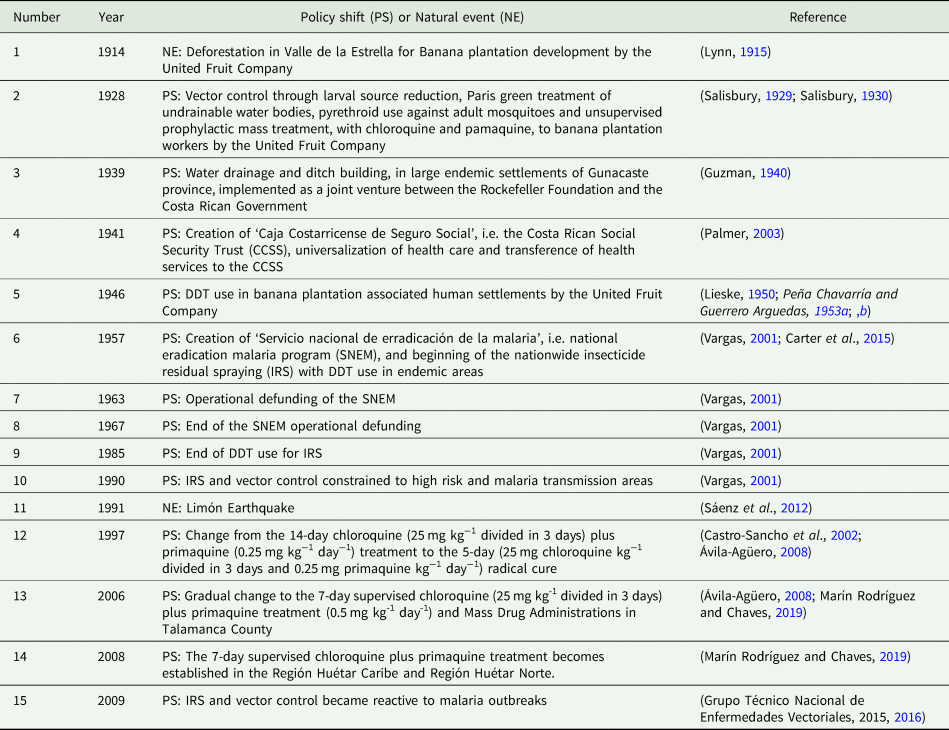
Malaria likely arrived in Costa Rica when its territory was part of the Spanish Empire (Frantzius, Reference Frantzius1868; Adams, Reference Adams1996). However, interest on malaria transmission reduction only started in the 1910s when malaria was a major barrier for the successful commodification of bananas by the United Fruit Company (UFCo) (Lynn, 1913, 1914, Reference Lynn1915; Aliano, Reference Aliano2006). The first malaria survey, which estimated malaria prevalence at 19.0% among UFCo banana plantation workers, was done in 1927 (Clarck, Reference Clarck1928). In the 1930s the Rockefeller Foundation funded preliminary research, evaluating the feasibility of malaria eradication, that allowed the mapping of malaria endemicity (Kumm and Ruiz, Reference Kumm and Ruiz1939) in Costa Rica. The Rockefeller Foundation also promoted joint ventures that led to water drainage and ditching in settlements of Guanacaste province in Northwest Costa Rica (Guzman, Reference Guzman1940), the area with the largest malaria burden in the 1930s (Kumm and Ruiz, Reference Kumm and Ruiz1939). In 1941, the CCSS was created by the government led by Dr Rafael Angel Calderón Guardia (Palmer, Reference Palmer2003), positively impacting health policies in Costa Rica, mainly through the creation of a universal coverage health system (Knaul et al., Reference Knaul, Bhadelia, Ornelas, de Lima and del Rocio Sáenz Madrigal2015), but also including the development of a rudimentary epidemiologic surveillance system which recorded malaria cases at the time (Peña Chavarría and Guerrero Arguedas, Reference Peña Chavarría and Guerrero Arguedas1953a,Reference Peña Chavarría and Guerrero Arguedasb). In 1954 Costa Rica joined the Pan-American Health Organization (PAHO) Continental Malaria Eradication Program and in 1955 the World Health Organization (WHO) sponsored Global Malaria Eradication Campaign (GMEC) (International Cooperation Administration Expert Panel on Malaria, 1961; Carter et al., Reference Carter, Singh, Mujica, Escalada, Ade, Castellanos and Espinal2015), creating in 1957 the ‘Servicio Nacional de Erradicación de la Malaria’ (SNEM), i.e. the national malaria eradication program. Since 1957 all malaria cases have been recorded by ‘Vigilancia de la Salud’ at ‘Ministerio de Salud’, i.e. the health surveillance division at Costa Rica´s Ministry of Health (Vargas, Reference Vargas2001). Table 1 shows a detailed list of the major malaria health policy shifts and large scale natural phenomena associated with malaria changes in Costa Rica between 1913 and 2018. Briefly, we compiled information from the published literature where we employed the terms ‘malaria’ and ‘Costa Rica’ in PubMed, Science Citation Index, Scientific Electronic Library Online and Google Scholar. We also reviewed policy documents available at Costa Rica`s Ministry of Health. In addition to events listed in Table 1, we also considered the impacts of different El Niño Southern Oscillation (ENSO) phases on malaria transmission, provided this large scale climatic phenomenon has been identified as a major driver of malaria epidemics in the region (Bouma et al., Reference Bouma, Poveda, Rojas, Chavasse, Quiñones, Cox and Patz1997; Bouma and Dye, Reference Bouma and Dye1997; Hurtado et al., 2014, Reference Hurtado, Cáceres, Chaves and Calzada2018). We classified every year as belonging to a given ENSO phase (hot, cold, normal) if such phase was present in two or more quarters of the year according to the classification by Wolter and Timlin (Reference Wolter and Timlin2011) for the period between 1913 and 1952. From 1957 to 2018 we classified years by ENSO phase based on more than 4 continuous months of reported cold or hot or normal ENSO activity according to the US National Oceanic and Atmospheric Administration classification (NOAA, 2019)
Policy shifts and natural events affecting malaria transmission in Costa Rica (1913–2018)

All health policy shifts were implemented by the Costa Rican Government unless otherwise noted. In the table, number indicates the event order, year the time when the event occurred and reference the source describing the event.
Malaria, funding and vector control data
The first dataset spans 1913–1931 (Fig. 1A) and it is based on data published in the Annual Reports of the United Fruit Company Medical Department, which recorded the total number of malaria cases diagnosed at hospitals and dispensaries run by UFCo in areas where the company had banana plantations, which were mainly located on the Caribbean coast of Costa Rica (Aliano, Reference Aliano2006). These data had separated records for ambulatory patients (mild malaria cases) and inpatients (severe malaria cases needing attention in hospitals). The second dataset spans 1942–1952 and is the annual time series of malaria inpatients attended at Hospital San Juan de Dios (HSJD), the main CCSS hospital in Costa Rica (Fig. 1B). Raw data for this period were published in the scientific literature (Peña Chavarría and Guerrero Arguedas, Reference Peña Chavarría and Guerrero Arguedas1953a,Reference Peña Chavarría and Guerrero Arguedasb). The third dataset spans 1957–2018 (Fig. 1C) and records are kept by the health surveillance division at Costa Rica`s Ministry of Health. All three datasets are based on malaria cases confirmed by blood slide examination (Salisbury, Reference Salisbury1930; Peña Chavarría and Guerrero Arguedas, Reference Peña Chavarría and Guerrero Arguedas1953a,Reference Peña Chavarría and Guerrero Arguedasb; Vargas, Reference Vargas2001).
Annual malaria cases, funding and people protected against vectors (A) Total (1913–1932) and inpatient (1912–1932) malaria cases reported by the Costa Rica Division in the Annual Reports of the United Fruit Company Medical Department. (B) Inpatient malaria cases (1942–1952) at the Hospital San Juan de Dios, San José, Costa Rica. (C) Total malaria cases in Costa Rica (1957–2019) recorded by the Ministerio de Salud. (D) Budget for malaria-related activities (1959–2017) in Costa Rica. (E) Estimated number of people protected by insecticide residual spraying between 1959 and 2000. (F) Estimated number of people protected by insecticide residual spraying between 2001 and 2018. In panels A, B and C line type indicates the type of malaria cases, for details, see the inset legend of panel A, while dot colour indicates the El Niño Southern Oscillation phase, for details, see the inset legend of panel B. Numbers in some dots refer to the policy shifts and natural events presented in Table 1. In panels D and F, the inset legends indicate, respectively, the funding source and the source of anti-malaria protection.

We were also able to collect more detailed data about the UFCo malaria control program that started in 1928 (Salisbury, 1929, Reference Salisbury1930), event No. 2 in Table 1, the Guanacaste water drainage and ditching of 1939 (Guzman, Reference Guzman1940), event No. 3 in Table 1, where the number of cases (or a malaria parasite exposure measurement) prior and after the interventions was published, and the start of DDT fogging in 1946 (event No. 5 in Table 1) in the city of Limón by the UFCo (Lieske, Reference Lieske1950).
We obtained data about funding used for malaria-related activities, and its sources (Fig. 1D), through the PAHO malaria online database for the Americas (PAHO, 2019), a database where we also collected data on the number of people protected by Insecticide Residual Spraying (IRS) and insecticide-treated bednets (Fig. 1E and F).
To assess the importance of imported malaria cases on the total number of local malaria cases (Ruktanonchai et al., Reference Ruktanonchai, Bhavnani, Sorichetta, Bengtsson, Carter, Córdoba, Le Menach, Lu, Wetter, zu Erbach-Schoenberg and Tatem2016a,b) we estimated their percentage from 1975, when imported malaria cases started to be recorded by Costa Rica´s Ministry of Health, until 2018.
Statistical analysis
To ensure that inpatient malaria cases were a good proxy measurement of all malaria cases we started by estimating the Pearson`s correlation coefficient (Sokal and Rohlf, Reference Sokal and Rohlf1994) between the number of inpatients and total cases in the UFCo time series (Fig. 1A). Since that correlation was high (r̂= 0.50), we will assume parameter estimates for the HSJD time series (Fig. 1B) can be extrapolated to the total number of cases between 1942 and 1952, and we will simply refer to malaria cases through the rest of the manuscript, irrespectively of whether data were from inpatients, like in the HSJD dataset, or the total number of cases, like in the UFCo and Ministerio de Salud datasets.
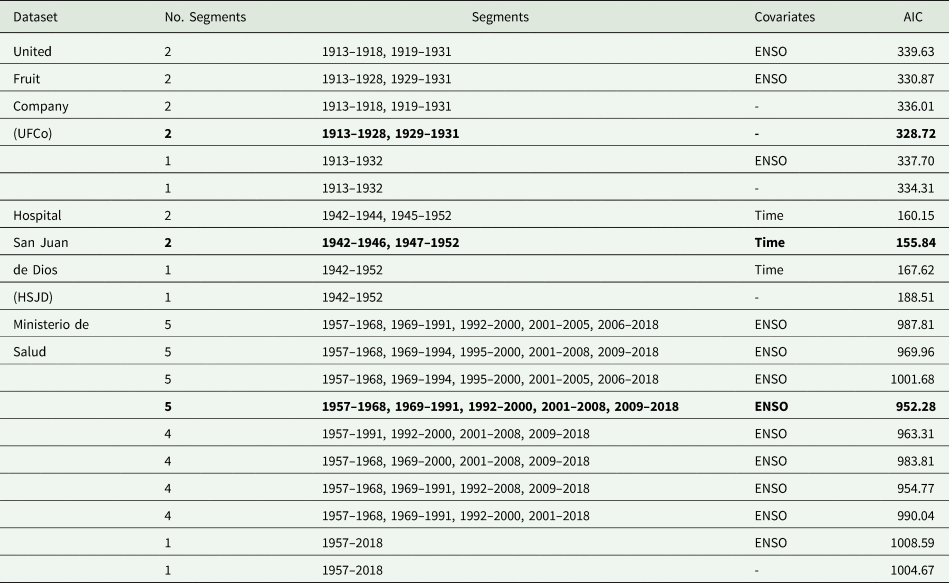
To identify potential breakpoints for the regime shifts in annual malaria cases, i.e. time points when the average number of malaria cases changed (Chaves et al., 2012, Reference Chaves, Hashizume, Satake and Minakawa2008; Hurtado et al., Reference Hurtado, Cáceres, Chaves and Calzada2014), we plotted the annual difference in the number of cases and estimated the 2.5 and 97.5 percentiles of these annual malaria case change distribution (Sokal and Rohlf, Reference Sokal and Rohlf1994). Values outside these extreme percentiles were identified as potential regime shifts and assumed to be the start and the end of the breakpoints unless the difference time series took longer to reach values near 0, a time-point which was then assumed to be the breakpoint end, the time between start and end of a breakpoint representing transient dynamics between two continuous regimes (Scheffer, Reference Scheffer2009; Hastings et al., Reference Hastings, Abbott, Cuddington, Francis, Gellner, Lai, Morozov, Petrovskii, Scranton and Zeeman2018). We then split the time series into regimes that ended in the identified breakpoints, and for the breakpoints that did not end in the same year, we tested regimes ending at the start and the end of the breakpoints. The significance of the identified regime shifts was then tested by fitting negative binomial models, provided malaria case counts were over-dispersed (Faraway, Reference Faraway2006), with different means for the segments defined by the breakpoints and a covariate for the ENSO phase (Bouma and Van Der Kaay, Reference Bouma and Van Der Kaay1996; Bouma et al., Reference Bouma, Poveda, Rojas, Chavasse, Quiñones, Cox and Patz1997; Bouma and Dye, Reference Bouma and Dye1997). Models were then selected by computing the Akaike information criterion (AIC), a metric that trades-off model fit and parameter number and selects the best models based on its minimization(Faraway, Reference Faraway2004). For comparison, we also estimated the AIC of models without regime shifts, with and without considering ENSO phases. For the UFCo and HSJD, we also tested models that considered changes in transmission followed policy changes in those time series. More specifically, we assumed there was a change in transmission in 1928 (event no. 2 in Table 1) in the UFCo time series and in 1946 (event no. 5 in Table 1) in HSJD time series. For the best models for each dataset, parameter estimates different from intercepts were exponentiated in order to be interpreted as proportional changes (Faraway, Reference Faraway2006) in the number of malaria cases.
For the Vigilancia de la Salud dataset we assessed the correlation, using the Spearman coefficient (Sokal and Rohlf, Reference Sokal and Rohlf1994; Venables and Ripley, Reference Venables and Ripley2002), between the whole time series and the different significant regimes in malaria cases with funding, and also with the number of people protected by IRS and bednets.
Results
Figure 2 shows the regime shift identification results. For the UFCo dataset (Fig. 2A) 1915 and 1919 were identified as potential regime shift breakpoints, but testing showed them as not significant when compared with models without regime shifts (Table 2). Similarly, ENSO phases did not significantly change the risk of infection in the UFCo dataset period. In contrast, the observed change of 1929, following the 1928 control campaign (event no. 2 in Table 1), had a significant impact on malaria transmission. For the HSJD dataset (Fig. 2B) 1944 was suggested as a breakpoint, which was significant (Table 2), but a model considering a change in 1946, when DDT fogging started to be implemented in settlements associated with UFCo banana plantations (event no. 3 in Table 1), was selected as a better fit (Table 2). For the HSJD dataset, the impacts of ENSO were not tested provided the period was dominated by normal years (Fig. 1B). For the Ministerio de Salud dataset we found 4 potential breakpoints: 1968, 1991–1993, 2000, 2005–2008 (Fig. 2C), where model selection showed the best breakpoints for regime shifts, with transients that lasted more than a year, were 1991 and 2008 (Table 2).
Malaria regime shift analysis (A) Annual difference in total cases (1913–1932) from the Costa Rica division of the United Fruit Company. (B) Annual difference in inpatient malaria cases (1942–1952) at the Hospital San Juan de Dios, San José, Costa Rica. (C) Annual difference in total malaria cases in Costa Rica (1957–2018) recorded by the Ministerio de Salud. In the panels dotted vertical lines indicate significant breakpoints potentially associated with regime shifts, indicating the start (S-breakpoints) and end of the breakpoints (E-breakpoints), while horizontal solid lines indicate the 95% percentiles of the data.

Akaike information criterion (AIC)-based model selection for negative binomial models explaining the number of malaria cases in datasets from Costa Rica as function of different regime segments, El Niño Southern Oscillation (ENSO)

The best model for each dataset is shown in bold. In the table, dataset indicates the specific dataset studied, no. of segments the number of segments considered in the regression, segments the years spanning each segment, while covariates indicate whether models considered ENSO as covariate or a temporal (Time) trend.
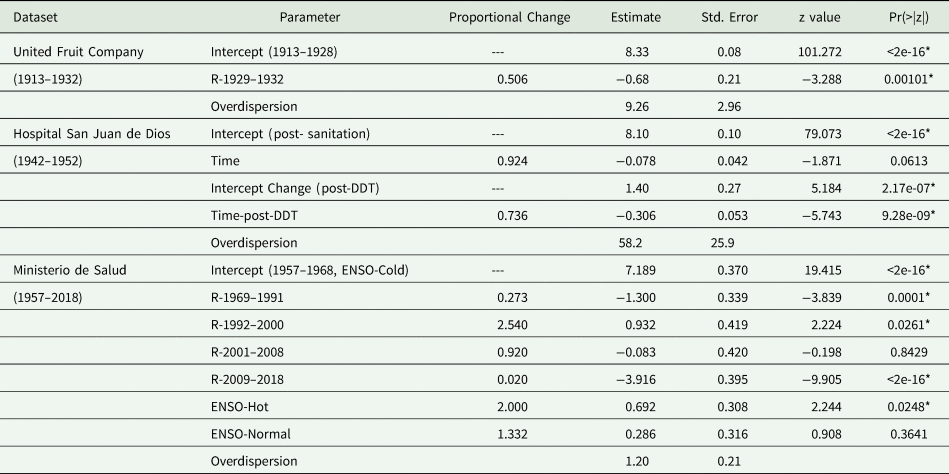
Table 3 shows parameter estimates for each dataset best model. The control campaigns started by UFCo (event 2 in Table 1), decreased by at least 50% malaria transmission during 1929–1931. This figure is in accordance with prevalence changes reported for adults working for UFCo, where malaria prevalence decreased from 25% to 12% (Salisbury, Reference Salisbury1929). In the original analysis, however, Salisbury (Reference Salisbury1929), reported that malaria prevalence in the whole population was reduced from 35% of the population to 14%, and also reported statistics for children where malaria was reduced from 47% to 18%. DDT introduction in 1946 (event 5 in Table 1) was associated with an increase in annual malaria case reduction from 7.6% (1942–1946) to 26.4% (1947–1952). Here, it is worth highlighting that malaria transmission was declining at the national level likely as a product of water drainage and ditching in Guanacaste province (event 3 in Table 1), which according to Guzman (Reference Guzman1940) was associated with a 75% decline in the splenic index of children in Liberia and Cañas, the two main human settlements in Guanacaste province. A similar case reduction was observed in the Limón hospital, where raw data reported by Lieske (Reference Lieske1950) showed that average number (±s.d.) of malaria cases decreased from 177 ± 20, in 1941–1945, to 58 ± 29, in 1950–1952, a statistically significant difference (Welch`s t = 6.13, df = 3.36, P value <0.006). The end of the operational SNEM defunding, a period when the SNEM was not allocated enough operative funds, in 1967 (event 8 in Table 1), was followed by a 72% decrease in malaria cases that lasted until 1991 when the Limón Earthquake hit the Caribbean coast of Costa Rica (event 11 in Table 1) with malaria cases increasing by 254% between 1992 and 2000 when compared with the baseline period of 1957–1968. Malaria cases decreased again between 2001 and 2008, a time when treatments changed from the 5-day radical cure to the 7-day supervised treatment (events 12 and 13 in Table 1) reducing malaria cases by 8% when compared with the baseline period of 1957–1968. Malaria cases decreased by 98% during the 2009–2018 period when compared with the 1957–1968 baseline period. In the 2009–2018 period Costa Rica reached the pre-elimination period, following the implementation of the 7-day supervised treatment in all areas with the transmission in 2008 (event 14 in Table 1) and was unaffected by a change in policy to a reactive use of IRS and vector control in 2009 (event 15 in Table 1). For the Ministerio de Salud dataset, an interesting phenomenon was that malaria cases doubled during years belonging to the hot ENSO phase (Table 3) when compared with cold ENSO phase years.
Parameter estimates for the best negative binomial models explaining the number of malaria cases in Costa Rica (1913–2018)

Parameters starting with “R-” indicate the estimate for a given regime and parameters starting with “ENSO-” indicate the estimate for a given the El Niño Southern Oscillation phase.
*Statistically significant (P<0.05)
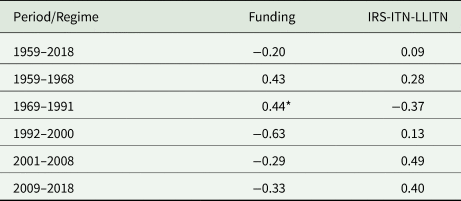
For the Ministerio de Salud dataset we found that overall, during the 1959–2018 period (Table 4), funding was negatively associated with malaria cases. In other words, increasing investments in malaria transmission reduction led to a decrease in malaria cases. By contrast, during 1959–2018, the deployment of malaria protection tools had a very low association with the case number. When the associations were analyzed through the different regimes of the 1958–2018 period (Table 4), investment was positively associated with malaria cases until 1991, suggesting that investment increased in response to malaria cases, the relationship became negative in 1992–2018, suggesting an increased investment was associated with a reduction in malaria cases. Regarding the impact of protective anti-malaria measurements (nets and IRS), these were negatively associated with malaria cases only between 1969 and 1991, suggesting that only during that period IRS effectively reduced malaria cases (Table 4).
Spearman correlation between malaria case number and funding for malaria and the number of people protected by insecticide residual spraying (IRS) and bednets (insecticide-treated nets, ITN, and long-lasting insecticide-treated nets, LLITN) between 1959 and 2018

Results are shown for the full period and significant regimes.
*Statistically significant (P < 0.05)
Figure 3 shows the percentage of imported malaria cases between 1975 and 2018. The figure shows that historically these numbers were below 20% of the total cases recorded in the country. There was a peak in the early 1980s when Costa Rica received an important group of refugees from the armed conflict in El Salvador (Rivera Funes, Reference Rivera Funes2005). After that time the per cent of imported cases was very small, until 2012 when the percentage of imported malaria cases started to proportionally rise as Costa Rica reached the pre-elimination stage. Currently, imported cases are being increasingly associated with malaria outbreaks occurring in the country since 2017 (Vigilancia de la Salud, 2019).
Percentage of imported malaria cases in Costa Rica (1975–2019) based on data recorded by the Ministerio de Salud.

Discussion
Malaria case data from 1913–2018 in Costa Rica show that most of the studied events presented in Table 1 had an impact on malaria transmission. Our methods were only unable to show a lasting impact for (i) the Valle de la Estrella deforestation where data suggest deforestation impacts on big malaria epidemics were transient (Lynn, Reference Lynn1915). Nevertheless, deforestation had the long-term cost of creating malaria-endemic areas (Kumm and Ruiz, Reference Kumm and Ruiz1939; Vargas, Reference Vargas2001) as observed elsewhere where deforestation has driven malaria transmission emergence (Wallace et al., Reference Wallace, Chaves, Bergmann, Ayres Lopes, Hogerwerf, Kock and Wallace2018; Castro et al., Reference Castro, Baeza, Codeço, Cucunubá, Dal'Asta, De Leo, Dobson, Carrasco-Escobar, Lana, Lowe, Monteiro, Pascual and Santos-Vega2019). (ii) The creation and operational defunding of the SNEM, which basically reflects the problems faced by the SNEM to become fully operational after its creation (Warren et al., Reference Warren, Collins, Jeffery and Skinner1975; Weinstock et al., Reference Weinstock, Garcés, S and Rodríguez1979; Vargas, Reference Vargas2001). (iii) The end of DDT use, which was successfully replaced by pyrethroids that more quickly degrade in the natural environment not having the side effects of DDT (Vargas, Reference Vargas2001). (iv) The change from 14-day chloroquine plus primaquine treatment to a 5-day radical cure that delivered a pharmacokinetically insufficient primaquine dose (Marín Rodríguez and Chaves, Reference Marín Rodríguez and Chaves2019). This treatment change likely led to an improvement in terms of increasing treatment coverage in remote areas (Bergonzoli and Rivers Cuadra, Reference Bergonzoli and Rivers Cuadra2000), but was unable to prevent malaria relapses in endemic villages (Marín Rodríguez and Chaves, Reference Marín Rodríguez and Chaves2019). These detrimental effects became evident when other issues exacerbating malaria transmission were controlled since malaria reached zero transmission only once a pharmacokinetically sufficient treatment was used to treat all malaria cases across Costa Rica (Marín Rodríguez and Chaves, Reference Marín Rodríguez and Chaves2019).
About the specific impacts of different malaria transmission reduction strategies, it is worth highlighting that (i) a limited scope on target populations curtail potential impacts even on the target populations. For example, UFCo control campaigns, although able to reduce malaria transmission by up to 50%, were focused on keeping a healthy labour workforce, ignoring other populations living around the banana plantations (Salisbury, 1929, Reference Salisbury1930; Aliano, Reference Aliano2006). This might explain the limited success of UFCo control campaigns at reducing malaria in children when compared with working adults, who received free treatments. This is very important given that access to treatment was limited by income during the 1920s and quinine shortages were suggested as a cause for the exacerbation of malaria epidemics in Costa Rica (Núñez, Reference Núñez1926). Similarly, (ii) the emphasis on unique tools proves insufficient to reduce malaria transmission. Even though the SNEM focus on IRS had a major impact on reducing malaria from 1969 to 1991, by the mid-1970s it was clear there were issues of parasite persistence in some villages that were unrelated to the impact of vector control and little to no attention was given to improving treatment in those areas (Warren et al., Reference Warren, Collins, Jeffery and Skinner1975; Weinstock et al., Reference Weinstock, Garcés, S and Rodríguez1979). Equally, (iii) some policy shifts might synergistically act with ongoing policies accelerating malaria transmission reduction. In Costa Rica, although DDT introduction unequivocally helped to reduce malaria transmission (Lieske, Reference Lieske1950; Peña Chavarría and Guerrero Arguedas, Reference Peña Chavarría and Guerrero Arguedas1953a,Reference Peña Chavarría and Guerrero Arguedasb; Vargas, Reference Vargas2001), it did so against a background where malaria was already going down as part of the health system strengthening via the CCSS creation (Palmer, Reference Palmer2003) and major infrastructure transformations, some related to water management (Guzman, Reference Guzman1940), that were also reducing malaria transmission. (iv) Some policy shifts also produce impacts over longer time periods than others. While shifts in vector control policy produced quick changes in malaria transmission, as illustrated in this study, policy shifts on drug use take longer to produce an impact. For example, only once the 7-day full dose primaquine and chloroquine treatment was established in areas with transmission in Costa Rica (Ávila-Agüero, Reference Ávila-Agüero2008; Marín Rodríguez and Chaves, Reference Marín Rodríguez and Chaves2019) its impact in reducing malaria transmission became evident. In that sense, it is very important that (v) policy shifts should be grounded on robust scientific evidence. The 5-day radical cure was implemented based on a very limited study (Bergonzoli and Rivers Cuadra, Reference Bergonzoli and Rivers Cuadra2000) criticized at the time of its publication (Kroeger, Reference Kroeger2001; Ruebush et al., Reference Ruebush, Trenton, Marquiño, Cabezas and Neyra2001) in light of the scientific evidence available at the time about the problems of pharmacokinetically insufficient primaquine doses to cure P. vivax infections (John et al., Reference John, Douglas, von Seidlein, Nosten, Baird, White and Price2012). However, it took several years to change that policy despite evidence from the Costa Rican surveillance system about common relapses and repeated transmission in the same households (Ávila-Agüero, Reference Ávila-Agüero2008; Marín Rodríguez and Chaves, Reference Marín Rodríguez and Chaves2019). As shown by our analysis, the change to treatment with a pharmacokinetically sufficient primaquine dose was the most impactful malaria health policy change in Costa Rica, reducing cases by 98% when compared with the baseline.
In that sense, as a country close to elimination, and based on previous successes (Marín Rodríguez and Chaves, Reference Marín Rodríguez and Chaves2019), Costa Rica is aiming to systematically use mass drug administration (MDA) to eliminate the last remaining malaria foci in the country. This is done considering encouraging results about MDA community wise protection from South East Asia (Parker et al., Reference Parker, Tun, White, Kajeechiwa, Thwin, Landier, Chaumeau, Corbel, Dondorp, von Seidlein, White, Maude and Nosten2019), mathematical modelling (Brady et al., Reference Brady, Slater, Pemberton-Ross, Wenger, Maude, Ghani, Penny, Gerardin, White, Chitnis, Aguas, Hay, Smith, Stuckey, Okiro, Smith and Okell2017) and long-term elimination results from proof of concept trials in islands of Oceania (Kaneko et al., Reference Kaneko, Taleo, Kalkoa, Yamar, Kobayakawa and Björkman2000; Kaneko, Reference Kaneko2010). This choice also relies on the functional universal health care system administered by the CCSS and the strong epidemic surveillance system of Costa Rica. The biggest challenge for malaria elimination in Costa Rica is the prediction, and eventual prevention, of new outbreaks driven by human movement (Ruktanonchai et al., Reference Ruktanonchai, Bhavnani, Sorichetta, Bengtsson, Carter, Córdoba, Le Menach, Lu, Wetter, zu Erbach-Schoenberg and Tatem2016a). To confront that challenge, mathematical modelling and statistical and computational tools (Ruktanonchai et al., Reference Ruktanonchai, DeLeenheer, Tatem, Alegana, Caughlin, zu Erbach-Schoenberg, Lourenço, Ruktanonchai and Smith2016b) could help to establish guidelines for MDA implementation, optimizing MDA deployment (Smith et al., Reference Smith, Perkins, Reiner, Barker, Niu, Chaves, Ellis, George, Le Menach, Pulliam, Bisanzio, Buckee, Chiyaka, Cummings, Garcia, Gatton, Gething, Hartley, Johnston, Klein, Michael, Lloyd, Pigott, Reisen, Ruktanonchai, Singh, Stoller, Tatem, Kitron, Godfray, Cohen, Hay and Scott2014). Modelling could also help to further assess the implications of the vulnerability to extreme climatic events associated with ENSO, which was associated with malaria transmission increases in Costa Rica during the ENSO hot phase. This same phenomenon has been observed in neighbouring nations (Bouma et al., Reference Bouma, Poveda, Rojas, Chavasse, Quiñones, Cox and Patz1997; Bouma and Dye, Reference Bouma and Dye1997; Hurtado et al., 2014, Reference Hurtado, Cáceres, Chaves and Calzada2018). These results highlight the importance of studying the impacts of ENSO, and more generally natural catastrophes (Wallace et al., Reference Wallace, Chaves, Bergmann, Ayres Lopes, Hogerwerf, Kock and Wallace2018), especially in the Costa Rica-Nicaragua border, where the largest malaria outbreaks have been concentrated over recent times (Vigilancia de la Salud, 2019). This border concentrates the most socio-economically disadvantaged counties in Costa Rica (Ministerio de Planificación Nacional y Política Económica., 2018).
Conclusion
Despite the implementation of successful policies, that reduced malaria transmission, in Costa Rica outbreaks currently follow malaria importation into vulnerable areas. This epidemiological pattern highlights the need to timely diagnose and treat malaria in both local and migrant populations, aiming to also improve their overall living conditions.
Acknowledgements
The authors thank Ms. Urania Obando whose personal initiative to carefully keep copies of all reports and statistics related to malaria through her career at Vigilancia de la Salud made possible this study. The authors also thank Mr. Scott Martin, Librarian at the University of Michigan, for his help accessing the United Fruit Company Annual Medical Reports kept at the University of Michigan Library.
Financial support
This study was funded by Proyecto B6 601 Vicerrectoría de Investigación, Universidad de Costa Rica, with additional support from Dirección de Vigilancia de la Salud, Ministerio de Salud de Costa Rica.
Conflict of interest
All authors declare that no conflicts of interest exist.
Ethical standards
This research is based on publicly available non-identifiable data.