The rapid ageing of the global population has shifted significant public health focus towards promoting health and preventing disease among older adults, with cognitive impairment emerging as a major and increasing concern. A meta-analysis of sixty-six studies with 242 804 participants found that the global prevalence of mild cognitive impairment in community-dwelling adults aged 50 and above is approximately 15 %, with higher rates in older age groups(Reference Bai, Chen and Cai1). China bears a substantial proportion of this burden. In 2019, an estimated 15 million older individuals in China lived with cognitive impairment, representing a prevalence rate of 6·0 % and accounting for 25·0 % of the global total(Reference Li, Feng and Sun2). The number of Chinese adults aged ≥65 years with cognitive impairment is projected to increase substantially, from 11·4 million in 2015 to nearly 47·8 million by 2060(Reference Ansah, Chiu and Wei-Yan3).
Studies have demonstrated that oxidative stress is negatively associated with cognitive function and is recognised as a key risk factor for cognitive impairment(Reference Papathanasiou, Fradelos and Malli4,Reference Kandlur, Satyamoorthy and Gangadharan5) . Oxidative stress is defined as an imbalance between pro-oxidant and antioxidant systems, in which pro-oxidative factors predominate, resulting in oxidative damage to cells and tissues(Reference Jones6). A broad range of nutritional and lifestyle factors may contribute to oxidative balance. In healthy adults, demographic, nutritional and lifestyle factors have been associated with biomarkers of lipid peroxidation, including malondialdehyde and F₂-isoprostanes(Reference Block, Dietrich and Norkus7). In a large population-based cohort of older adults, higher physical activity was associated with lower levels of oxidative stress(Reference Schöttker, Salem and Schwenk8). Furthermore, a nationwide population study integrating multiple dietary and lifestyle pro- and antioxidant exposures into an oxidative balance score (OBS) found that a more favourable oxidative balance was associated with lower levels of inflammatory biomarkers(Reference Lakkur, Judd and Bostick9). These findings suggest that multiple dietary and lifestyle exposures may collectively contribute to overall oxidative status and may be more appropriately considered in combination rather than in isolation.
Given this complex landscape, the OBS was developed as an integrated measure of oxidative-related exposures(Reference Hernández-Ruiz, García-Villanova and Guerra-Hernández10). The OBS integrates antioxidant components (e.g., Se, vitamin B12, vitamin C, vitamin E, β-carotene, Ca, physical exercise and aspirin use) and pro-oxidant components (e.g., Fe, smoking, alcohol consumption and elevated BMI), providing a more comprehensive evaluation of the balance within an individual’s oxidative–antioxidative network(Reference Hernández-Ruiz, García-Villanova and Guerra-Hernández11–Reference Ilori, Sun Ro and Kong13). Despite its comprehensive advantages in assessing oxidative balance, research on the association between OBS and cognitive function remains limited. One cross-sectional analysis of the NHANES found a significant positive association between OBS and cognitive function in older adults, with circulating albumin, uric acid and vitamin D levels identified as potential key mediators. However, the cross-sectional design of this study precludes causal inference(Reference Song, Li and Fu14). Furthermore, given the significant differences in lifestyle and dietary patterns, findings from Western populations may not generalise to Chinese older adults.
Therefore, using longitudinal data from a nationally representative cohort of Chinese older adults, this study aims to systematically investigate the association between OBS and cognitive function and to explore the potential mediating role of key circulating oxidative stress biomarkers. The findings are expected to contribute to the development of evidence-based dietary and lifestyle strategies for promoting cognitive health in the ageing Chinese population.
Materials and methods
Study population
This study used data from the Chinese Longitudinal Healthy Longevity Survey (CLHLS), a nationally representative longitudinal study of older adults in China, initiated in 1998. The CLHLS employed a multi-stage, stratified random sampling method with unequal probabilities(Reference Zheng15), covering twenty-three provinces, municipalities and autonomous regions, which represents over 85 % of China’s population. Follow-up surveys were conducted in 2000, 2002, 2005, 2008–2009, 2011–2012, 2014 and 2017–2018. The CLHLS was approved by the Ethics Committee of Peking University (IRB00001052–13074), and written informed consent was obtained from all participants.
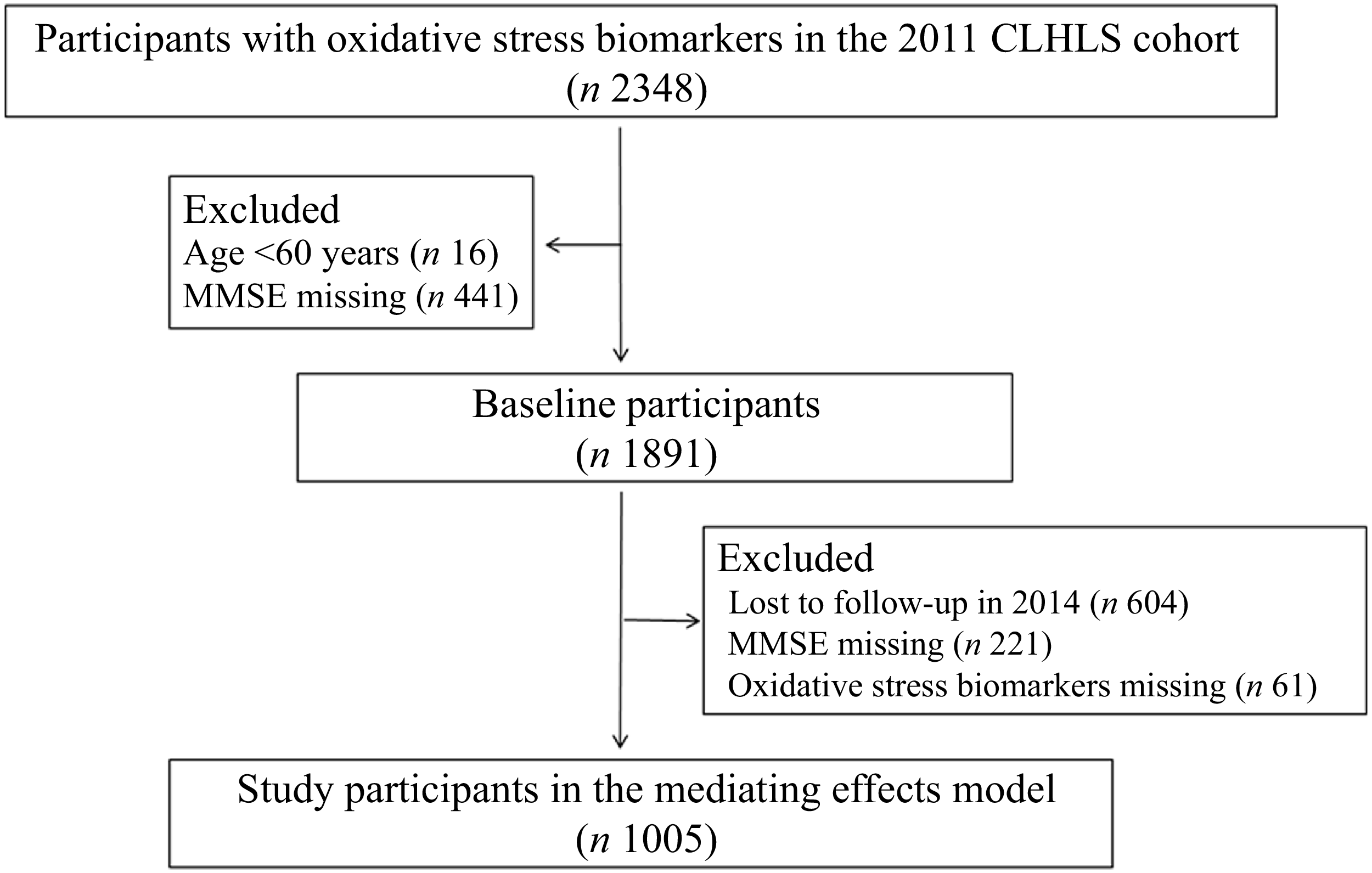
Participants aged ≥60 years with complete data on oxidative stress biomarkers, Mini-Mental State Examination (MMSE) scores, and baseline characteristics in 2011–2012 were enrolled as the baseline (n 1891). Mediation analysis was conducted using data from 2011–2012 and 2014, as blood samples were available for both. We excluded participants who were (1) lost to follow-up in 2014 (n 604); (2) had missing MMSE data in 2014 (n 221) or (3) had missing data on oxidative stress biomarkers in 2014 (n 61). The final sample for the mediation analysis comprised 1005 participants with complete data for both waves (Figure 1).
Study participants flow chart.

Study outcomes
Oxidative Balance Score
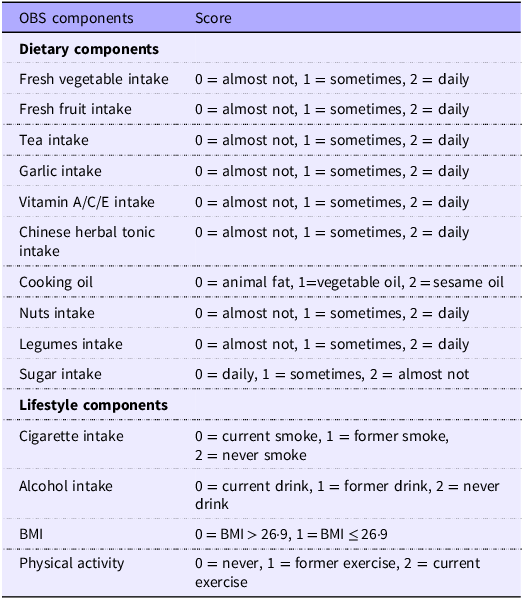
The OBS was constructed from fourteen components: ten dietary and four lifestyle factors (Table 1). These were categorised as antioxidants (e.g. fresh vegetables, fresh fruits, tea, garlic, vitamin A/C/E, traditional Chinese medicine, sesame oil, nuts, legumes and higher physical activity) or pro-oxidants (e.g. sugar, cigarettes, alcohol and BMI). As the CLHLS dataset lacks quantitative food consumption data, dietary components were assessed based on consumption frequency, with higher frequency receiving higher scores for antioxidants and lower scores for pro-oxidants(Reference Hou, Wu and Lv16). The primary OBS used a BMI cut-off of 26·9 kg/m2 based on recommendations for the Chinese oldest-old population(17,18) . In sensitivity analyses, we reconstructed the OBS using the conventional Chinese adult overweight cut-off of 24 kg/m² and repeated the analyses to examine the robustness of the findings. Cigarette smoking, alcohol consumption and physical activity were categorised as former, current or never. ‘Former’ indicated past practice discontinued by the time of the study; ‘current’ indicated practiced at the time of data collection, regardless of prior history; and ‘never’ indicated no history of the practice. A higher total OBS indicated a more favourable oxidative balance, reflecting greater overall antioxidant exposure.
Oxidative balance score (OBS) assignment scheme

Table 1. Long description
A table titled OBS components with two main categories: Dietary components and Lifestyle components. The table has two columns: OBS components and Score. Dietary components include Fresh vegetable intake, Fresh fruit intake, Tea intake, Garlic intake, Vitamin A/C/E intake, Chinese herbal tonic intake, Cooking oil, Nuts intake, Legumes intake, and Sugar intake. Lifestyle components include Cigarette intake, Alcohol intake, BMI, and Physical activity. Each component has a scoring criteria ranging from 0 to 2, with specific descriptions for each score. For example, Fresh vegetable intake scores are 0 for almost not, 1 for sometimes, and 2 for daily. The table provides a structured way to assess oxidative balance based on dietary and lifestyle factors.
Current = behaviour ongoing presently; former = past behaviour, now ceased; never = behaviour never performed.
Cognitive scores
Cognitive status was assessed using the Chinese version of the MMSE scale. This scale comprises twenty-four items across seven domains, including orientation (orientation to time, four points, place orientation, one point); verbal fluency (naming as many types of food as possible within 1 min, seven points); immediate recall of three words (three points); attention and calculation (serial subtraction of sevens, five points); visuospatial construction (copying a figure, one point); delayed recall of the three words (three points) and language abilities (object naming, two points; sentence repetition, one point; following commands, three points). The total MMSE score ranges from 0 to 30, with higher scores indicating better cognitive performance. The validity and reliability of the Chinese MMSE have been confirmed in several previous studies(Reference Zhang19).
Oxidative stress biomarkers
A panel of blood-based biomarkers, established in the literature to be associated with oxidative stress, was selected to represent the body’s redox status. These included albumin (g/L), serum uric acid (μmol/L), superoxide dismutase (IU/mL), blood urea nitrogen (mmol/L), malondialdehyde (μmol/L), vitamin B12 (pg/mL) and plasma 25-hydroxyvitamin D [25(OH)D] (ng/mL)(Reference Valko, Leibfritz and Moncol20,Reference Cordiano, Di Gioacchino and Mangifesta21) . Detailed assay methods were as follows: serum uric acid was measured using the uricase colorimetric method(Reference Chen, Dong and Yang22); plasma albumin concentrations were determined by the bromocresol green method on a continuous autoanalyser (Hitachi 7108)(Reference Chen, Liu and Cao23); plasma superoxide dismutase activity was evaluated by the hydroxylamine method with a T-superoxide dismutase detection kit(Reference Mao, Yuan and Lv24); malondialdehyde levels were detected using the thiobarbituric acid method with an malondialdehyde assay kit(Reference Sun, Sun and Xu25) and plasma 25(OH)D was measured using an enzyme-linked immunoassay supplied by Immunodiagnostic Systems Limited (IDS Ltd.) at the National Center for Biological Sample Testing. The inter-assay and intra-assay coefficients of variation were <10 % and <8 %, respectively(Reference Liu, Cao and Lu26); serum vitamin B12 levels were detected through chemiluminescent immunoassay(Reference Zhu, Qiao and Yang27) and blood urea nitrogen concentrations were determined using the urease UV kinetic method(Reference Miao, Liu and Wang28).
Covariates
Covariates included age (continuous), sex, annual household income (categorised into high, middle and low tertiles), educational level (no formal education, primary school, junior high school or higher), marital status (partnered [married/cohabiting] v. single [widowed/divorced/separated/never married]), residential area (urban v. rural) and the number of comorbidities (0, 1, ≥2). Comorbidities were identified from self-reported or physician diagnoses in the physical health section of the questionnaire, covering twenty-seven diseases including diabetes, hypertension, heart disease, stroke and other CVD.
Statistical analysis
Baseline characteristics were summarised using descriptive statistics. The distributions of continuous variables were assessed using the Shapiro–Wilk test, visual inspection of histograms and Q–Q plots and sample skewness coefficients. Because several continuous variables showed non-normal or skewed distributions, continuous variables were reported as medians with interquartile ranges (IQR), and categorical variables were presented as frequencies and percentages. Differences in characteristics across OBS tertiles were assessed using the Kruskal–Wallis test, whereas categorical variables were compared using the χ 2 test. Effect sizes were reported as Kruskal–Wallis ϵ² for continuous variables and Cramér’s V for categorical variables. Mixed-effects linear regression models were used to analyse the association between OBS and cognitive scores. Three models were constructed: model 1, unadjusted; model 2, adjusted for demographic variables, including age, sex, residence, marital status, educational level and household annual income and model 3, further adjusted for the number of comorbidities. To explore the potential mediating role of oxidative stress in the association between OBS and cognitive function, we employed semi-longitudinal cross-lagged models. Separate mediation analyses were conducted for each of the seven oxidative stress biomarkers, including albumin, uric acid, superoxide dismutase, blood urea nitrogen, malondialdehyde, vitamin B12 and plasma 25(OH)D. Using the two-wave longitudinal design, we examined two key pathways: (1) The effect of OBS in 2011 on the oxidative stress indicator in 2014 (Path X1→M2) and (2) the effect of the oxidative stress indicator in 2011 on cognitive function in 2014 (Path M1→Y2). Autoregressive paths for all variables were included to control for temporal stability. Model fit was evaluated using the comparative fit index, Tucker–Lewis index, root mean square error of approximation and standardised root mean square residual. Direct, indirect, and total effects were estimated. The significance of the indirect effects was tested using bootstrapping with bias-corrected 95 % CI, considering an effect significant if the 95 % CI did not include zero(Reference Hayes and Preacher29). All mediation models were adjusted for the full set of covariates. As a sensitivity analysis, we repeated the mixed-effects linear regression and the 25(OH)D mediation analysis after excluding participants with self-reported or hospital-diagnosed dementia at baseline.
Statistical analyses were conducted using STATA 17.0 and Mplus 8.10. Statistical significance was defined as a 2-tailed P < 0·05.
Results
Baseline characteristics of participants in 2011
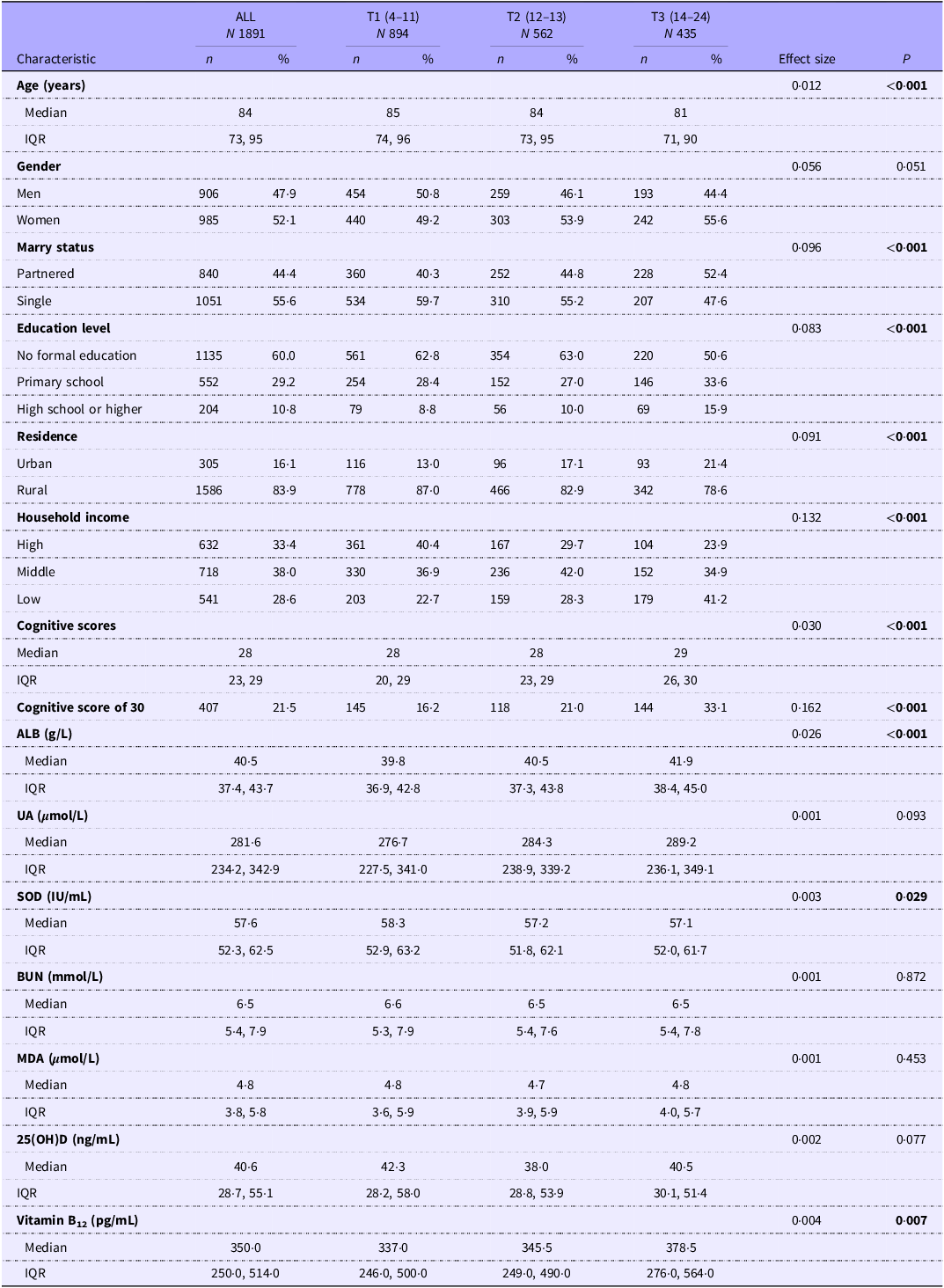
Table 2 summarises the baseline characteristics of the 1891 participants (aged ≥60 years) stratified by OBS tertiles. The overall median age was 84 years (IQR: 73–95), and 52·1 % of them were female. The median baseline cognitive score was 28 (IQR: 23–29). Participants in the highest OBS tertile were younger, had higher education levels and higher cognitive scores compared with those in lower tertiles.
Baseline characteristics of participants in 2011 according to the oxidative balance score’s tertile

Table 2. Long description
A table comparing baseline characteristics of participants in 2011 according to the oxidative balance score’s tertile. The table has 14 rows and 6 columns. Column headers are Characteristic, ALL, T1 (4-11), T2 (12-13), T3 (14-24), Effect size, and P. Row labels include Age (years), Gender, Marry status, Education level, Residence, Household income, Cognitive scores, Cognitive score of 30, ALB (g/L), UA (μmol/L), SOD (IU/mL), BUN (mmol/L), MDA (μmol/L), 25(OH)D (ng/mL), and Vitamin B12 (pg/mL). Each row provides data for each tertile and overall statistics. Notable trends include variations in age, gender distribution, education level, and cognitive scores across different tertiles.
ALB, albumin; UA, uric acid; BUN, blood urea nitrogen; SOD, superoxide dismutase; MDA, malondialdehyde; T, tertile.
Association between oxidative balance score and cognitive function
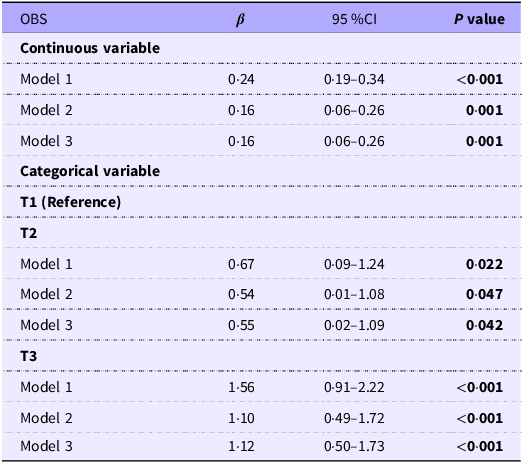
Table 3 presents the association between OBS and cognitive function using mixed-effects linear regression models. When modelled as a continuous variable, a significant and positive association was observed between OBS and cognitive function (model 1: β: 0·24, 95 % CI: 0·19, 0·34). This association remained statistically significant after full adjustment for confounding factors (model 3: β: 0·16, 95 % CI: 0·06, 0·26). When OBS was analysed as a categorical variable, participants in the highest OBS tertile demonstrated significantly better cognitive function compared to those in the lowest tertile in the unadjusted model (model 1: β: 1·56, 95 % CI: 0·91, 2·22). This positive association persisted in the fully adjusted model (model 3: β: 1·12, 95 % CI: 0·50, 1·73). Although statistically significant, the magnitude of the fully adjusted association was modest. After excluding fifty-four participants with baseline dementia (n 951), the positive association between OBS and cognitive function remained significant, with consistent findings for both continuous OBS and the highest OBS tertile (Table S1).
Mixed linear regression analysis between OBS and cognitive function (n 1005)

Table 3. Long description
A table with the structure of 8 rows and 4 columns. The columns are labeled OBS, β, 95 %CI, and P value. The table is divided into two main sections: Continuous variable and Categorical variable. Under Continuous variable, there are three models: Model 1, Model 2, and Model 3, with corresponding β values of 0.24, 0.16, and 0.16, 95 %CI values of 0.19-0.34, 0.06-0.26, and 0.06-0.26, and P values of <0.001, 0.001, and 0.001 respectively. Under Categorical variable, there are two tertiles: T2 and T3, with T1 as the reference. For T2, there are three models: Model 1, Model 2, and Model 3, with corresponding β values of 0.67, 0.54, and 0.55, 95 %CI values of 0.09-1.24, 0.01-1.08, and 0.02-1.09, and P values of 0.022, 0.047, and 0.042 respectively. For T3, there are three models: Model 1, Model 2, and Model 3, with corresponding β values of 1.56, 1.10, and 1.12, 95 %CI values of 0.91-2.22, 0.49-1.72, and 0.50-1.73, and P values of <0.001, <0.001, and <0.001 respectively.
Model 1: Unadjusted variables.
Model 2: adjusted for age, sex, residence, marital status, educational level and annual household income.
Model 3: adjusted for age, sex, residence, marital status, educational level, annual household income and the number of combined diseases.
T1, T2 and T3 represent the low, middle and high tertile groups of OBS, respectively (cut-offs: 33.3rd and 66.7th percentiles). For the categorical analysis, T1 was the reference group for estimating the effects of T2 and T3 in the same regression model.
Mediating role of oxidative stress
A significant mediating effect was observed for plasma 25(OH)D (Figure 2). Specifically, a higher OBS at Time 1 was associated with lower 25(OH)D at Time 2 (a = –1·015). In turn, a higher 25(OH)D level at Time 1 was associated with better cognitive score at Time 2 (b = 0·025). The indirect effect of OBS on cognitive score through 25(OH)D was statistically significant (a × b = −0·025). In contrast, no significant indirect effects were found for the other oxidative stress biomarkers, including albumin, uric acid, superoxide dismutase, blood urea nitrogen, malondialdehyde or vitamin B12. A sensitivity analysis using standard adult BMI cut-off values yielded results consistent with those of the main analysis (Figure S1). The association between OBS and cognitive scores was reversed by plasma 25(OH)D levels. The cross-lagged mediation model demonstrated a good fit to the data (comparative fit index = 0·93, Tucker–Lewis index = 0·70, root mean square error of approximation < 0·001 and standardised root mean square residual = 0·03). After excluding participants with baseline dementia, the indirect effect through plasma 25(OH)D remained statistically significant (Table S2).
The two-wave cross-lagged model for the mediating effects of oxidative balance score on cognitive score through 25(OH)D. *, P < 0.05. Model adjusted for age, gender, residence, marital status, education and household income.

Discussion
This longitudinal analysis, based on a nationally representative cohort of older adults in China (CLHLS), provides evidence that a higher OBS was independently associated with better cognitive performance in older adults. A key finding was that plasma 25(OH)D appears to mediate this association, suggesting a possible biological pathway linking oxidative balance with cognitive aging. The two-wave design allowed us to examine temporally ordered associations among OBS, plasma 25(OH)D and cognitive function. However, given the observational nature of the study, causal inference remains limited because residual confounding and reverse causation cannot be excluded. In addition, the magnitude of the observed association was modest, and its clinical relevance remains uncertain.
Consistent with previous research, participants with a higher OBS had better cognitive performance and tended to have a more favourable socio-economic profile, including younger age and higher educational attainment. These factors were associated with healthier lifestyle patterns – balanced diet, regular physical activity and smoking cessation – which collectively contribute to a superior oxidative balance. Furthermore, younger age is associated with more robust endogenous antioxidant defenses and a greater propensity for health-promoting behaviours(Reference Liu, Han and Gao30). This constellation of socio-demographic and biological factors likely underpins the observed positive association between OBS and cognitive function.
Although the literature linking OBS to cognitive function in older adults remains limited, a recent cross-sectional analysis of NHANES data reported that higher OBS levels were associated with better cognitive performance. Given that higher OBS generally reflected lower oxidative stress, prior investigations on oxidative stress and cognitive outcomes provided supportive context for our results(Reference Garcia, Desio and de Souza31,Reference Li, Bai and Liu32) . This association is biologically plausible, as oxidative stress accelerates key neurodegenerative processes, such as mitochondrial dysfunction, inflammation and synaptic damage(Reference Terracina, Petrella and Francati33,Reference Ioannidou, Tsolaki and Ginoudis34) . Furthermore, neuropathological changes including β-amyloid and tau further amplify oxidative injury through excessive reactive oxygen species production, reinforcing neurotoxicity(Reference Giraldo, Lloret and Fuchsberger35). These mechanisms provided a possible biological context for the observed association between OBS and cognitive function.
An important finding of this study was that plasma 25(OH)D might inversely alter the association between OBS and cognitive function. Vitamin D exerts well-documented neuroprotective effects by promoting neurotransmitter synthesis, regulating neurotrophic factors and upregulating antioxidant enzymes(Reference Berridge36,Reference Pietruszkiewicz, Mrozek and Zwierz37) . Consequently, vitamin D deficiency has been associated with increased neuronal vulnerability, impaired synaptic plasticity and accelerated cognitive decline(Reference Wang, Gan and Wu38,Reference Ye, Zhou and Ren39) .
One possible explanation for the inverse association is the composition of the OBS used in the CLHLS. The score included several plant-based dietary indicators, such as vegetables, fruits, legumes, garlic and tea, which are rich in antioxidants but are not major dietary sources of vitamin D(Reference Neufingerl and Eilander40). In contrast, vitamin D is mainly obtained from other dietary sources and endogenous synthesis, both of which may be limited in older adults(Reference Liu, Hu and Fang41–Reference Pennisi, Malaguarnera and Di Bartolo43). Thus, a higher OBS does not necessarily indicate adequate vitamin D status. Nevertheless, the explanation for the observed inverse association remains uncertain.
A key strength of this study is its two-wave longitudinal design, which provides a stronger basis for examining temporal associations among OBS, 25(OH)D and cognitive function than cross-sectional studies. As an observational study, our findings provide epidemiological evidence supporting a potential association between antioxidant-related dietary and lifestyle profiles and cognitive function, but do not establish a clinically relevant effect size or causal benefit. Nevertheless, several limitations should be noted. First, the use of a non-standardised dietary questionnaire may have introduced measurement error. Self-reported dietary and lifestyle information may also have been susceptible to recall error, particularly among participants with undiagnosed dementia or milder cognitive impairment. Second, the follow-up period was relatively short, with biomarkers measured at only two waves, leaving the long-term dynamics unclear. In addition, the specific fourteen-component OBS used in this study has not been formally validated against external biomarkers or clinical outcomes. Third, unmeasured confounders such as sunlight exposure, which significantly influences vitamin D status, could not be adjusted for. Detailed information on dietary vitamin D intake, supplementation and season of blood collection was also unavailable, and the observed inverse association between OBS and plasma 25(OH)D should therefore be interpreted with caution. Additionally, available documentation was insufficient to confirm whether the laboratory participated in the Vitamin D External Quality Assessment Scheme (DEQAS) during the relevant measurement period. Fourth, the MMSE may have been subject to a ceiling effect, particularly among participants with higher cognitive performance. Future longitudinal and intervention studies using more sensitive cognitive assessments are needed to determine whether these differences translate into meaningful changes in cognitive health.
Conclusion
In conclusion, a higher OBS was associated with better cognitive function in Chinese older adults. This relationship was partially mediated by plasma 25(OH)D, suggesting a biologically relevant pathway may link oxidative balance to cognitive ageing. These findings strengthen the evidence from prior cross-sectional studies and suggest that combined interventions targeting both oxidative balance and 25(OH)D status may be a promising strategy for preserving cognitive function in older adults.
Supplementary material
For supplementary material/s referred to in this article, please visit https://doi.org/10.1017/S0007114526109350
Data availability statement
Some or all datasets generated during and/or analysed during the current study are not publicly available but are available from the corresponding author on reasonable request.
Acknowledgements
We are grateful to the older adults who volunteered to take part in the study.
Author contributions
K.L.: Investigation; writing – original draft; data curation. R.L.: Formal analysis; statistical analysis; writing – original draft. Q.G.: Investigation; data curation. W.Z.: Investigation; data curation. X.M.: Investigation; data curation. P.N.: Administrative support; writing – review & editing. W.C.: Administrative support; writing – review & editing. Y.W.: Conceptualisation; methodology; supervision; writing – review & editing. X.S.: Conceptualisation; methodology; supervision; writing – review & editing. All authors read and approved the final manuscript.
Financial support
This study was supported by grants from the Natural Science Basic Research Plan in Shaanxi Province [grant number: 2025JC-YBQN-1056].
Competing interests
All authors declare no conflict of interest.