Introduction
Pediatric bipolar disorder (BD) is a significant global health concern, with clinical studies suggesting an increased rate of children diagnosed with the mood disorder during the past few decades. For example, the percentage of minors with a BD diagnosis admitted to German psychiatric hospitals increased 68.5% between 2000 and 2007, whereas those discharged from U.S. psychiatric hospitals surged from less than 10% in the mid-1990s to more than 20% in the mid-2000s.Reference Blader and Carlson 1 Another study showed this increase was not confined to psychiatric hospitals, with a 40-fold rise in the incidence of U.S. outpatient visits for youth diagnosed with BD to providers of all mental health specialties, from 25/100,000 in 1993–1994 to 1003/100,000 in 2002–2003.Reference Moreno, Laje, Blanco, Jiang, Schmidt and Olfson 2 Moreover, with an estimated overall prevalence of 1.8%Reference Van Meter, Moreira and Youngstrom 3 and more than 80 million children in the U.S. per the 2000 Census, there are millions of children and adolescents being brought for evaluation/treatment of BD annually.Reference Grant, Stinson and Hasin 4 Beyond the obvious concern for the sheer number of youth affected by the disorder, pediatric BD results in substantial morbidity and functional impairment for the affected children and their familiesReference Dickstein, Rich and Binstock 5 , Reference Birmaher, Axelson and Goldstein 6 including high rates of suicidal ideation and suicide attempts.Reference Goldstein, Ha and Axelson 7
With respect to treatments for children and adolescents with BD, studies support a role for both medication (eg, lithium, atypical neuroleptics, and anti-epileptic drugs)Reference Haas, DelBello and Pandina 8 – Reference Geller, Luby and Joshi 10 and psychotherapy (eg, family-focused therapy [FFT], and cognitive behavioral therapy [CBT]).Reference Miklowitz, George and Axelson 11 – Reference Fristad, Verducci, Walters and Young 14 However, we need better treatments for pediatric BD because, despite our best currently available treatments, pediatric BD results in considerable morbidity and mortality, including high rates of suicidality and psychiatric hospitalization.Reference Goldstein, Ha and Axelson 7 , Reference Axelson, Birmaher and Strober 15 , Reference Berry, Heaton and Kelton 16 Moreover, these agents may result in serious physical side effects—eg, extreme weight gain and metabolic syndrome from atypical neuroleptics.Reference Correll, Manu, Olshanskiy, Napolitano, Kane and Malhotra 17 Finally, there is a need for interventions that can overcome traditional barriers to access, including dearth of specialists, including child psychiatrists, psychologists, and pediatricians who are trained and feel comfortable in evaluating and treating children with serious psychopathology, such as BD.
Cognitive remediation—broadly defined as training impaired cognitive or emotional skills in order to reduce the impairment from a psychiatric illness—is a novel, brain-based treatment approach that may address these needs as part of a comprehensive treatment plan for youth with BD. In the present manuscript, we review cognitive remediation as a possible adjunctive treatment approach for psychiatric conditions, including BD. In particular, after explaining what cognitive remediation is, we discuss recent research on cognitive remediation for psychiatric disorders as well as potential brain-based targets for cognitive remediation in youth with BD.
What Is Cognitive Remediation?
Cognitive remediation is a behavioral approach to treatment with basic tenets that involve the following 3 components. First, cognitive functions representing separable domains (eg, attention, memory, etc) can be assessed and treated independently. Second, rehabilitation of impaired cognitive functions is possible given the brain’s capacity for neural plasticity and change in response to drill-and-practice learning. Third, improving those skills may result in reduced illness symptom burden or functional impairment (for an excellent review, see Vinogradov et al Reference Vinogradov, Fisher and Villers-Sidani 18 ).
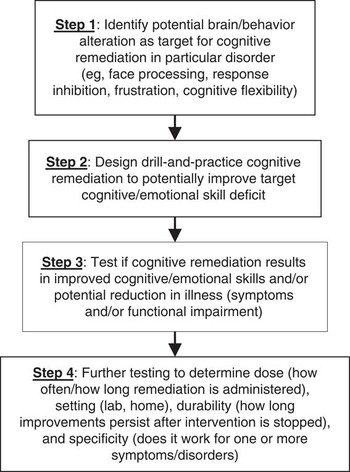
Figure 1 outlines the basic steps required to assess the potential for cognitive remediation for a specific disorder or symptom profile. In brief, first studies must determine if there are specific cognitive or emotional processes altered in a particular disorder or associated with a particular symptom profile. Such assessment may include the use of standard pen-and-paper neuropsychological assessments, computerized behavioral tasks, or approaches that directly tap neural function in people, such as functional magnetic resonance imaging (fMRI) or electroencephalography paired with neuroimaging (ie, magnetoencephalography [MEG]) or with behavioral tasks (ie, psychophysiology). Then, a drill-and-practice cognitive remediation can be designed to try to ameliorate those deficits. Finally, cognitive remediation must be tested to determine if it can successfully build those skills previously shown to be deficient, and if patients with those disorders/symptoms can improve, meaning that patients experience reduced symptoms or impairment from them. For example, studies have demonstrated that adults with schizophrenia have impaired working memory. Therefore, cognitive remediation for schizophrenia might examine if adults with schizophrenia could improve their working memory with repeated drill-and-practice learning, and if such training improved the symptoms of schizophrenia. As would be true of any treatment, key refinements include determining the optimal dose and setting (ie, at home or in the lab/office) for the cognitive remediation to be delivered as well as the treatment’s durability (ie, how long the improvements will last) (Figure 1).
Basic steps in assessing cognitive remediation as potential treatment.

Cognitive remediation is neither new nor confined to neuropsychiatric illnesses. Rather, it has been used since the mid-twentieth century in a variety of disorders, including rehabilitation from stroke or traumatic brain injury. Examples of this work include Wagner’s finding that adults with schizophrenia had reduced cognitive function, including attention and abstraction, which could improve with positive reinforcement.Reference Vinogradov, Fisher and Villers-Sidani 18
Cognitive remediation offers several potential advantages over traditional forms of treatment for psychiatric illness. First and foremost, cognitive remediation may improve patients’ access to care because, unlike other medication and therapy approaches delivered by 1 practitioner to 1 patient at a time (or at best to 10 group therapy members at a time), cognitive remediation programs are “scalable”—meaning treatment may be delivered to far more patients simultaneously. For example, many patients can simultaneously receive the remediation in a testing center while being monitored by a technician in collaboration with a physician or psychologist as is currently done by neurofeedback centers. At its extreme, potentially unlimited numbers of individuals may receive the remediation simultaneously via Internet-based, computer-assisted cognitive remediation.
Additionally, cognitive remediation may be personalized in that interventions can be precision-tailored to meet an individual’s needs. For example, based on their individual and illness-based deficits, one patient with schizophrenia may need remediation for both attention and memory, while another may just need memory.
Finally, cognitive remediation may have fewer side effects than medications used to treat psychiatric illness, such as metabolic syndrome with atypical neuroleptics or sexual dysfunction with selective serotonin reuptake inhibitors. This is not to say that cognitive remediation may be a substitute for psychiatric medications, as most studies to date have examined cognitive remediation’s role as augmenting psychotropic medications and/or psychotherapy, rather than as monotherapy for psychiatric illness. It is possible that cognitive remediation may have no side effects, akin to other forms of learning or educational games. However, we are at the early stages of understanding what, if any, side effects cognitive remediation programs may have.
Similarly, there are several important unknowns about cognitive remediation for psychiatric disorders, especially in children, where such work is just beginning. First, are there critical windows of neurodevelopment when cognitive remediation is possible or works best? Second, what is the role of cognitive reserve (ie, the brain’s resilience and ability to cope with stress, illness, and other insults) in determining how children may respond to cognitive remediation, and how can such cognitive reserve be assessed in children?Reference Stern, Zarahn, Hilton, Flynn, DeLaPaz and Rakitin 19 , Reference Kontis, Huddy, Reeder, Landau and Wykes 20
What Is Known About Cognitive Remediation in Child and Adult Psychiatric Disorders?
Cognitive remediation is an important and emerging form of treatment for psychiatric disorders. However, as this manuscript is being written, there are no currently published studies that have tested the role of cognitive remediation for BD in children, and, in fact, cognitive remediation research in patients with mood disorders (either BD or unipolar major depressive disorder) has lagged behind that in other disorders. In adults, the vast majority of research so far centers on the role of cognitive remediation for schizophrenia, although it has also been studied in a host of other disorders, including attention deficit hyperactivity disorder (ADHD), eating disorders,Reference White and Shah 21 – Reference Tchanturia, Davies and Campbell 25 and, as previously mentioned, to a lesser extent BD.Reference Deckersbach, Nierenberg and Kessler 26 – Reference Correa, da Silveira and de Lima 30 Moreover, we unfortunately note that far less is known about cognitive remediation for children with psychiatric disorders than in adults, despite the fact that cognitive remediation centers on restoring function at school, work, home, and in social relationships.Reference Martínez-Arán, Vieta and Colom 31 , Reference Cavedini, Zorzi and Bassi 32
With respect to adults with schizophrenia, cognitive remediation studies have targeted several cognitive processes, especially working memory, but also verbal memory, processing speed, and reasoning.Reference Garrido, Barrios and Penadés 33 For example, schizophrenic adults whose standard vocational rehabilitation was augmented with cognitive remediation had improved cognitive performance at 3 months and greater work outcomes at 2 years vs. those who received only vocational rehabilitation and no cognitive remediation.Reference McGurk, Mueser, DeRosa and Wolfe 34 Studies suggest that cognitive remediation can be cost-effective for adults with schizophrenia,Reference Patel, Knapp and Romeo 35 with notable effects on cognitive functioning, as well as quality of life and self-esteem.Reference Garrido, Barrios and Penadés 33 A meta-analysis of 2104 patients found that cognitive remediation may result in enduring improvements in functioning.Reference Wykes, Huddy, Cellard, McGurk and Czobor 23 Another meta-analysis of 1151 patients showed that cognitive remediation for adults with schizophrenia was associated with a medium effect size for cognitive performance (0.41), a smaller effect size for psychosocial functioning (0.36), and a small effect size for symptoms (0.28).Reference McGurk, Twamley, Sitzer, McHugo and Mueser 22 Guided by this work in adults, a recent study evaluated cognitive remediation for executive function and working memory in adolescents presenting with early onset schizophrenia. They showed not only improved working memory and executive function, but improved daily living skills and global functioning vs. those randomized to receive treatment as usual.Reference Puig, Penades and Baeza 36 Thus, the trickle-down effect from studies of cognitive remediation in adults with schizophrenia to pediatric-aged samples with schizophrenia and psychosis has begun.
In children, studies have thus far begun to examine cognitive remediation for ADHD and anxiety disorders. With respect to studies of children with ADHD, findings generally support improved functioning (ie, in the targeted cognitive skill(s) and/or ADHD symptoms) among those youths receiving a cognitive remediation-based intervention.Reference van der Oord, Ponsioen, Geurts, Brink and Prins 37 – Reference Chacko, Bedard and Marks 40 For example, Van der Oord et al Reference van der Oord, Ponsioen, Geurts, Brink and Prins 37 showed that latency-aged children randomized to a computerized executive functioning training (ie, targeting inhibition, cognitive flexibility, and working memory) had improvement in the executive skills targeted, as well as decreased ADHD symptoms of inattention and hyperactivity/impulsivity as rated by parents on the Disruptive Behavior Disorder Rating Scale, compared to youths placed in the waitlist condition.Reference Pelham, Gnagy, Greenslade and Milich 41 Interestingly, this study showed these improvements not only at the end of their 25 training sessions, but also at a 9-week post-treatment follow up. Similarly, Gray et al found that adolescents with comorbid ADHD and learning disorders randomized to a working memory vs. math training program showed significantly improved WM and were rated as less inattentive/hyperactive at home by their parents.Reference Gray, Chaban and Martinussen 39 Children with ADHD who received drill-and-practice cognitive remediation have shown moderate to large effects on academic tasks and parental ratings of ADHD.Reference Klingberg, Fernell and Olesen 42 , Reference Shalev, Tsal and Mevorach 43 Specifically, Klingberg et al Reference Klingberg, Fernell and Olesen 42 found decreased inattention and hyperactivity/impulsivity on the Conners Parent ADHD rating scale among children randomized to a working memory training vs control condition, whereas Shalev et al Reference Shalev, Tsal and Mevorach 43 only found decreased parental ratings of inattention after treatment with an attention training program vs. control condition.
A recent meta-analytic review of 25 cognitive remediation studies in children with ADHD concluded that while training short-term memory resulted in moderate improvements, similar training programs in attention or mixed executive functions did not result in those domains improving, reduced ADHD symptoms, or improved functioning.Reference Rapport, Orban, Kofler and Friedman 44 Working memory training with COGMED (a commercially available software product produced by the Pearson Corporation) has yielded mixed results, with some studies showing neither improved working memory nor ADHD symptoms,Reference Dongen-Boomsma, Vollebregt, Buitelaar and Slaats-Willemse 45 while others show improved verbal and nonverbal working memory storage, but no improvements either in working memory processing/manipulation or in ADHD symptoms.Reference Chacko, Bedard and Marks 40 Thus, there is a need for ongoing research to examine key aspects of cognitive remediation for ADHD, including whether it is better to have a laser-like focus on training one cognitive skill or to have a shotgun-like, broad approach to training multiple domains simultaneously, as well as identifying which domains result in the greatest symptom reduction and functional improvement.
Beyond ADHD, an emerging literature has examined attention bias modification treatment (ABMT) for children and adults with anxiety disorders. ABMT is based on considerable literature demonstrating that children with anxiety disorders as well as related conditions, such as behavioral inhibition, have brain/behavior alterations in how they respond to threat and fearful stimuli.Reference Davidson 46 – Reference Lindstrom, Guyer and Mogg 50 For example, young adults who were found to have high levels of behavioral inhibition when they were children have greater neural connectivity between the amygdala and dorsal-lateral prefrontal cortex (DLPFC) when watching threat-related stimuli.Reference Hardee, Benson and Bar-Haim 51
In this vein, ABMT seeks to reverse this attention bias—meaning the tendency of cues in a person’s environment to preferentially engage and hold a person’s attention. Specifically, ABMT for anxiety might involve having a child complete a computerized task whereby pairs of face stimuli—one happy and one threatening—are simultaneously displayed followed by a star on only one side, and the child would have to indicate by key press which side the star was on. To train away from threat, the game would be configured to have more trials where the star was on the side of the happy face rather than the threatening face. Thus, by drill-and-practice, the anxious child would have reduced attention bias for threat and better ability to attend to the star regardless of whether the preceding same-sided image was threatening or not.
Thus far, studies of ABMT in anxious youths have demonstrated that the largest reduction in the number and severity of anxiety symptoms came from active ABMT compared to either a placebo ABMT that did not train away from threat or an ABMT that used neutral, rather than threatening, stimuli.Reference Eldar, Apter and Lotan 52 A recent study showed that ABMT when combined with cognitive behavioral therapy (CBT) may result in reduced anxiety symptoms by self-report and interview compared to a placebo ABMT plus CBT.Reference Shechner, Rimon-Chakir and Britton 53 These early studies show that ABMT has promise as part of the treatment of anxiety disorders in children, with emerging work examining the role of dose (ie, how often ABMT must be administered), durability (ie, how long after ABMT anxiety symptoms will remain diminished), and interaction with other treatments, such as psychotropic medication and psychotherapy.
Similarly, and certainly relevant to considering the role of cognitive remediation for youth with BD, ABMT has been used with individuals diagnosed with depression. For example, Yang et al showed decreased depressive symptoms among college students randomized to the ABMT condition vs. placebo or control conditions at post-treatment and 3-month follow-up.Reference Yang, Ding, Dai, Peng and Zhang 54 However, Baert et al suggested the effect of cognitive remediation on depressive symptoms might depend on the initial symptom severity.Reference Baert, De Raedt, Schacht and Koster 55 That is, they found that symptoms decreased post-ABMT for young adults initially presenting with mild to moderate depression, whereas symptoms actually increased for adults presenting with more severe depression and while receiving inpatient psychiatric care compared to those receiving outpatient psychiatric treatment.Reference Baert, De Raedt, Schacht and Koster 55
In adults with BD, primary targets for cognitive remediation have also included attention, memory, and executive functions. For example, Deckersbach et al showed fewer residual depressive symptoms and improved occupational functioning at post-treatment and 3-month follow-up for adults diagnosed with either BD I or II who were provided 14 individual sessions of cognitive remediation.Reference Deckersbach, Nierenberg and Kessler 26 Sole et al found significant improvement in overall psychosocial functioning at post-treatment for euthymic BD II adults who were provided 21 weeks of group-formatted cognitive remediation.Reference Solé, Bonnin and Mayoral 29 The first randomized, controlled trial that has assessed the effect of cognitive remediation for adults with continued cognitive difficulties, despite remission from BD, is currently underway and will likely prove valuable in leading child-focused efforts in the future.Reference Demant, Almer, Vinberg, Kessing and Miskowiak 28
What Are Potential Targets for Cognitive Remediation Among Children/Adolescents with Bipolar Disorder?
In contrast to the above-mentioned disorders, research on the potential of cognitive remediation for BD among children and adolescents is in its infancy. However, such work will build on a robust and growing literature about the pathophysiology of pediatric BD. In particular, studies grounded in affective neuroscience—the study of brain/behavior interactions underlying emotion and neuropsychiatric disorders—has shown that children and adolescents with BD have aberrant functioning in at least 4 cognitive/emotional processes: emotional face processing, response inhibition, frustration, and cognitive flexibility. As outlined below, each cognitive process and its underlying circuitry is a potential target for cognitive remediation. However, without further research, the following unknowns remain important: (1) Are any of these processes amenable to change/remediation? (2) Will remediation result in symptom improvement? (3) Is a laser-like remediation, focusing on only one process, more or less likely to result in both remediation and functional improvement compared to a shotgun-like remediation, which trains aspects of all of these (and potentially other) processes?
Face processing provides a window into basic aspects of emotional function because humans are hard-wired from birth to attend to faces and to identify familiar (eg, one’s own mother) vs. novel (eg, a stranger’s) faces.Reference Johnson, Dziurawiec, Ellis and Morton 56 , Reference Farroni, Csibra, Simion and Johnson 57 Face processing is often evaluated using emotional face identification tasks, whereby participants must identify which emotion a picture of a person is showing (ie, happy, angry, sad, neutral, etc). Variants of this type of task include facial morphing, whereby face stimuli represent gradations in intensity of emotion by blending them with neutral or other faces (ie, combining a happy and neutral face so that you get 10% happy, 20% happy, or 30% happy, etc). Another variant often used with fMRI is to compare neural activity when a participant is attending to an emotional (ie, “how angry?”) vs. non-emotional (ie, “how wide is the nose?) of facial stimuli.
Out-of-scanner behavioral studies using Diagnostic Assessment of Non-Verbal Accuracy (DANVA) have demonstrated that youth with BD make significantly more errors categorizing emotional faces than both typically developing children (TDC) without psychopathology and also vs. those with anxiety disordersReference Guyer, McClure and Adler 58 and vs. youth with primary ADHD, especially on low-intensity happy faces.Reference Seymour, Pescosolido and Reidy 59 Similar deficits have been identified in youth at familial risk for BD.Reference Brotman, Guyer and Lawson 60 With respect to neuroimaging, fMRI studies from several research groups across the United States indicate that youth with BD have abnormal prefrontal cortex (PFC)–amygdala–striatal neural activation compared with TDC children when viewing faces with happy, angry, or neutral emotions.Reference Rich, Vinton and Roberson-Nay 61 – Reference Kalmar, Wang and Chepenik 63 Other fMRI studies suggest that the neural circuitry that mediates face processing in youth with BD with episodes of mania may be different than the underlying circuitry in youths with chronic, non-episodic, functionally disabling irritability meeting Leibenluft et al’sReference Leibenluft, Charney, Towbin, Bhangoo and Pine 64 research criteria for severe mood dysregulation (SMD), which served as the basis for the new Diagnostic and Statistical Manual of Mental Disorders, 5th Edition’s diagnosis known as disruptive mood dysregulation disorder (DMDD).Reference Leibenluft, Charney, Towbin, Bhangoo and Pine 64 – 68
Response inhibition refers to the ability to stop actions that interfere with goal-directed behavior because they are incorrect or inappropriate.Reference Mostofsky and Simmonds 69 Response inhibition is linked to the symptoms of distractibility and impulsivity that are most linked to ADHD, which is commonly comorbid to BD. Furthermore, distractibility is an explicit diagnostic criteria for a manic episode. Response inhibition can be tested in several ways, including stop signal and go/no-go tasks. These tasks have some differences, but their core feature is to prime a participant to execute a motor response to one stimulus that is more frequent (ie, press the “1” when you see an “X,” which happens on 70% of trials), but then to sometimes require them to inhibit that response (ie, if you see an “O” do not press anything, which happens on 30% of trials).Reference Verbruggen and Logan 70
With respect to response inhibition, one study found that youth with BD had a reduced striatal “error signal” during failed motor inhibition compared to controls,Reference Leibenluft, Rich and Vinton 71 a deficit which might contribute to the patients’ inability to effectively inhibit. Another study by Singh et al found that youth with BD had greater neural activation than TDCs in the right DLPFC during no-go vs. go trials, suggesting greater reliance on cognitive control areas to maintain adequate behavioral performance.Reference Singh, Chang and Mazaika 72 Given its links to core features of BD and comorbid ADHD, response inhibition may be an important target for cognitive remediation in youth with BD.
Frustration may be defined from an affective neuroscience perspective as “reactions elicited in response to withdrawal or prevention of reward.” Frustration is relevant to BD via Blair’s somatic marker hypothesis, which posits that children who are less able to adapt to social rewards (eg, praise or reprimand from parents/peers) may feel frustrated (defined as “affective response to blocked goal attainment”) and show symptoms of irritability and aggression, which are found in both manic episodes and depressive episodes.Reference Blair and Cipolotti 73 – Reference Blair 75 Frustration can be studied in the laboratory or with neuroimaging using tasks involving rigged feedback, meaning that feedback that is not connected with an individual’s actual responses, for example, telling participants that they were incorrect when they correctly responded that 8 minus 5 is 3.
Among youth with BD, the Leibenluft group has conducted a series of studies on frustration using the affective Posner task. At its core, this is an attention task, requiring participants to indicate if a target shape was on the left or right side of the screen. However, the task involves 3 stages that manipulate feedback. An initial stage provides accurate feedback based on performance (“you are correct” or “you are incorrect” for correctly/incorrectly indicating which side the target was on). A second stage adds accurate monetary reward (ie, win/lose money based on correct/incorrect responses). A third stage uses rigged feedback (ie, “Too slow! Lose 25 cents!” for providing the correct response).
In this series of studies, which paired the affective Posner task with EEG psychophysiology monitoring, Rich et al Reference Rich, Schmajuk, Perez-Edgar, Fox, Pine and Leibenluft 76 showed that youth with BD had altered P3 EEG amplitude vs. both TDC and SMD participants with chronic, non-episodic irritability, potentially indicating that youth with BD had impaired executive attention. In contrast, regardless of condition, SMD youths had lower N1 amplitude than either BD or TDC participants, indicating impairments in the initial stage of attention.Reference Rich, Schmajuk, Perez-Edgar, Fox, Pine and Leibenluft 76 Another study that paired the affective Posner task with MEG showed that youth with BD had greater superior frontal gyrus activation and decreased insula activation after negative feedback than TDC or SMD youths, while SMD participants had greater anterior cingulate cortex and medial frontal gyrus activation than TDCs.Reference Rich, Carver and Holroyd 77 Taken together, these studies suggest that specific alterations in the brain/behavior processes underlying frustration may offer useful targets for cognitive remediation in children and adolescents with BD.
Cognitive flexibility is defined as the ability to adapt one’s thinking and behavior in response to changing rewards and punishments.Reference Cools, Clark, Owen and Robbins 78 Cognitive flexibility is relevant to BD because clinical features of BD may reflect specific alterations in how reward inaccurately shapes behavior—ie, hyper-hedonia in mania (eg, excessive involvement in pleasurable activities with high potential for painful consequences) and hypo-hedonia in depression (eg, anhedonia).Reference Cools, Clark, Owen and Robbins 78 Cognitive flexibility can be studied using reversal learning tasks. In these, subjects use trial-and-error learning to determine first, that an object is initially rewarded, and then, that this stimulus/reward relationship has switched, so that the previously rewarded object is now punished and vice versa.
Thus far, studies suggest that youth with BD may have specific alterations in the brain/behavior interactions that mediate cognitive flexibility and reversal learning. For example, youth with BD have impaired cognitive flexibility and reversal learning vs. both TDC participants and also SMD youths.Reference Dickstein, Treland and Snow 79 – Reference Dickstein, Finger and Brotman 82 This remains true when using a second behavioral task that increases task difficulty by adding probabilistic feedback—ie, blocks of trials when a participant receives accurate feedback 80% of the time but inaccurate feedback 20% of the time.Reference Dickstein, Treland and Snow 79 – Reference Dickstein, Finger and Brotman 82 fMRI studies have shown that youth with BD had the opposite neural response as TDC participants during reversal learning.Reference Dickstein, Finger, Skup, Pine, Blair and Leibenluft 83 While controls show the expected pattern (greater activation when acquiring the initial stimulus/response relationship vs. the reversal), pediatric BD participants had the exact opposite neural pattern (greater activation in reversal than acquisition). Another study showed that this pattern in youth with BD differed from that among SMD youths.Reference Adleman, Kayser, Dickstein, Blair, Pine and Leibenluft 84
In sum, each of these 4 cognitive processes—emotional face processing, response inhibition, frustration, and cognitive flexibility—holds promise as a potential target for cognitive remediation in youth with BD. Future work is required to design cognitive remediation strategies for each of these processes, and to test if such programs engage the underlying circuitry proximal to these processes and result in distal improvements in symptoms or functioning.
Conclusion
In conclusion, cognitive remediation for psychiatric disorders is a burgeoning area of research. Leveraging what is known about the brain/behavior interactions underlying BD in children and adolescents, there are many potential cognitive processes that might be amenable to retraining. Guided by cognitive remediation studies in other psychiatric disorders and also in adults, cognitive remediation is likely to play an important role in the treatment of pediatric BD in the future. Such work represents a synergistic union of affective neuroscience techniques and treatment studies, as well as between academic and industry research, which can be united toward improving the lives of children and families who are struggling with BD.
Disclosures
Dan Dickstein has the following disclosures: NIMH, researcher, grants (5R21MH096850, 5R01MH087513). Grace Cushman, Kerri Kim, Alexandra Weissman, and Ezra Wegbreit have nothing to disclose.