Introduction
The prevalence of major depressive disorder (MDD) is approximately 2–3% in adults of all ages and the depression symptom profile remains broadly similar, although older severely ill subjects may have a higher frequency of psychomotor changes and psychotic symptoms (Brodaty et al. Reference Brodaty, Peters, Boyce, Hickie, Parker, Mitchell and Wilhelm1991, Reference Brodaty, Luscombe, Parker, Wilhelm, Hickie, Austin and Mitchell1997). However, one domain of depressive symptomatology that is usually understood to be more severely impaired in late-life depression is cognition. Studies have consistently shown that both younger (e.g. Elliott et al. Reference Elliott, Baker, Rogers, O'Leary, Paykel, Frith, Dolan and Sahakian1997; Austin et al. Reference Austin, Mitchell, Wilhelm, Parker, Hickie, Brodaty, Chan, Eyers, Milic and Hadzi-Pavlovic1999; Porter et al. Reference Porter, Gallagher, Thompson and Young2003) and older (e.g. Kramer-Ginsberg et al. Reference Kramer-Ginsberg, Greenwald, Krishnan, Christiansen, Hu, Ashtari, Patel and Pollack1999; Butters et al. Reference Butters, Whyte, Nebes, Begley, Dew, Mulsant, Zmuda, Bhalla, Meltzer, Pollock, Reynolds and Becker2004b; O'Brien et al. Reference O'Brien, Lloyd, McKeith, Gholkar and Ferrier2004; Sheline et al. Reference Sheline, Barch, Garcia, Gersing, Pieper, Welsh-Bohmer, Steffens and Doraiswamy2006) depressed adults have neuropsychological deficits in information processing, memory and executive function (Elliott et al. Reference Elliott, Baker, Rogers, O'Leary, Paykel, Frith, Dolan and Sahakian1997; Austin et al. Reference Austin, Mitchell, Wilhelm, Parker, Hickie, Brodaty, Chan, Eyers, Milic and Hadzi-Pavlovic1999; Butters et al. Reference Butters, Becker, Nebes, Zmuda, Mulsant, Pollock and Reynolds2000; Porter et al. Reference Porter, Gallagher, Thompson and Young2003; O'Brien et al. Reference O'Brien, Lloyd, McKeith, Gholkar and Ferrier2004; Sheline et al. Reference Sheline, Barch, Garcia, Gersing, Pieper, Welsh-Bohmer, Steffens and Doraiswamy2006). These deficits persist after clinical recovery (Paradiso et al. Reference Paradiso, Lamberty, Garvey and Robinson1997; Butters et al. Reference Butters, Becker, Nebes, Zmuda, Mulsant, Pollock and Reynolds2000; O'Brien et al. Reference O'Brien, Lloyd, McKeith, Gholkar and Ferrier2004; Bhalla et al. Reference Bhalla, Butters, Mulsant, Begley, Zmuda, Schoderbek, Pollock, Reynolds and Becker2006) and seem to be a core part of depressive illness itself (Austin et al. Reference Austin, Mitchell and Goodwin2001). These neurocognitive impairments have also been associated with hyperintense lesions in the deep white matter (Lesser et al. Reference Lesser, Boone, Mehringer, Wohl, Miller and Berman1996; Kramer-Ginsberg et al. Reference Kramer-Ginsberg, Greenwald, Krishnan, Christiansen, Hu, Ashtari, Patel and Pollack1999), indicating that they may be due to disruption of frontal–subcortical circuitry. Some reports have suggested that neuropsychological deficits are associated with a poor response to treatment (Simpson et al. Reference Simpson, Baldwin, Jackson and Burns1998; Kalayam & Alexopoulos, Reference Kalayam and Alexopoulos1999) but others disagree (Butters et al. Reference Butters, Bhalla, Mulsant, Mazumdar, Houck, Begley, Dew, Pollock, Nebes, Becker and Reynolds2004a).
A recent systematic review of the literature on late-life depression reported executive dysfunction to be characteristic of depression beginning in later life (late-onset depression, LOD) whereas episodic memory dysfunction is a feature of both LOD and early onset depression (EOD) (Herrmann et al. Reference Herrmann, Goodwin and Ebmeier2007). However, the studies reviewed compared only these subgroups (EOD and LOD) with each other and with elderly controls and did not examine directly whether the cognitive profile is different in younger and older depressed subjects or whether more severe impairment in late-life depression is due to differences in the nature of depression in older people or can be explained by the additive effects of ageing. Despite general suggestions of such differences in neurocognitive impairments in older and younger adults with depression, surprisingly few studies have investigated this issue directly (Porter et al. Reference Porter, Bourke and Gallagher2007). Lockwood et al. (Reference Lockwood, Alexopoulos and van Gorp2002) compared 20 younger depressed adults (⩽60 years) with 20 older depressed adults and with 20 younger and 20 older controls on measures of attention and executive function. Executive function was impaired in the late-life depression group compared to both the younger depressed subjects and the older controls, and there was a significant depression–age interaction, but this study did not assess memory. Tarbuck & Paykel (Reference Tarbuck and Paykel1995) reported a similar study examining the neuropsychological profile in subject groups below and above the age of 60 years and, in addition to age-associated effects in most tests, found tasks with greater complexity were disproportionately impaired in the older depressed group.
In view of the limited information from direct comparisons using the same instruments in younger and older depressed subjects, we investigated whether attention, memory and executive function are differentially impaired in older adults with depression compared with younger depressed subjects. We hypothesized that, following standardization of scores to their respective, similar-aged control groups, older depressed adults would have more severe deficits in both memory and executive function.
Method
Younger (<60 years) and older (⩾60 years) adults who fulfilled diagnostic criteria for DSM-IV major depression were recruited from primary and secondary care facilities in the Tyne and Wear region in the North of England. These subjects have been reported previously in separate studies and were drawn from community- and hospital-based clinics (Porter et al. Reference Porter, Gallagher, Thompson and Young2003; O'Brien et al. Reference O'Brien, Lloyd, McKeith, Gholkar and Ferrier2004). They all received a full neuropsychiatric assessment including physical examination, blood screen and cognitive assessment (including the mini-mental state examination, MMSE; Folstein et al. Reference Folstein, Folstein and McHugh1975). Comprehensive demographic and clinical information was collected, including education, social class, family history, psychiatric and medical history, and medication history. Subjects were excluded if they had ever met criteria for other mental illnesses, including manic episodes and dementia, if their MMSE score was <24, if they had received electroconvulsive therapy in the past 3 months or if they had a history of alcohol or substance abuse. Psychiatrically healthy comparison subjects were recruited from spouses and friends of depressed subjects and of other patients attending the same units and by local advertising. They were thus drawn from the same socio-economic background as the depressed subjects. Comparison subjects received the same neuropsychiatric assessment and were subject to the same exclusion criteria as the depressed subjects but additionally had no history of psychiatric illness. The severity of depression in study subjects was assessed using the Montgomery–Åsberg Depression Rating Scale (MADRS; Montgomery & Åsberg, Reference Montgomery and Åsberg1979). The study was approved by the relevant local research ethics committees and, after full explanation of the study, all subjects gave written informed consent to participate.
Neuropsychological assessment
A combination of pen-and-paper and computerized tasks from the Cambridge Automated Neuropsychological Test Battery (CANTAB) was administered to all study subjects. In addition, the pre-morbid IQ of all subjects was estimated using the National Adult Reading Test (NART; Nelson, Reference Nelson1982). CANTAB tests were administered according to the manual protocols using a PC with a colour touch-sensitive screen. These tests have been used previously in both older (Abas et al. Reference Abas, Sahakian and Levy1990; Beats et al. Reference Beats, Sahakian and Levy1996; O'Brien et al. Reference O'Brien, Lloyd, McKeith, Gholkar and Ferrier2004) and younger (O'Brien et al. Reference O'Brien, Sahakian and Checkley1993; Porter et al. Reference Porter, Gallagher, Thompson and Young2003) subjects and have been described in detail elsewhere. The test battery was designed to assess attention, memory and executive function and the individual tests administered are described briefly below.
Controlled Oral Word Association Test (Benton's FAS; Benton & Hampsher, Reference Benton and Hampsher1976)
This is a standard test of verbal fluency in which subjects generate words beginning with ‘F’, ‘A’ and ‘S’, following a prescribed set of rules. Subjects are given 60 s with each letter and the total number correct and errors (perseverative and rule breaks) are recorded.
Spatial Working Memory (CANTAB)
This is a self-ordered search task that requires subjects to locate counters hidden in boxes and avoid repetitious searching of locations. Thus, subjects need to develop a search strategy and this forms a test of executive ability. Between- and within-search errors are recorded along with a strategy score, based on the use of a systematic searching strategy.
Vigil Continuous Performance Test (Vigil CPT; Cegalis & Bowen, Reference Cegalis and Bowen1991)
In this continuous performance test, subjects view serially presented random letters over 8 min and must respond only to the sequence of an ‘A’ followed by a ‘K’. Response latency and errors of omission and commission are recorded.
Rey Auditory Verbal Learning Test (RAVLT; Rey, Reference Rey1964)
This is a test of immediate and delayed verbal learning. Subjects are presented with a list of 15 words a total of five times, with immediate recall tested after each occasion (list A1–A5). A distracter list (list B) is then presented, again with an immediate recall test. Without further presentation, recall of list A is then tested immediately and again after a filled delay of 30 min (list A7). Finally, recognition of both lists is tested from among a series of distracters. For each measure, the number of words correct is recorded.
Pattern recognition (CANTAB)
Subjects learn a series of 12 complex patterns before being presented with pairs of patterns and are required to identify the familiar one. Two sets are presented and total percentage correct and response latency are recorded.
Spatial recognition (CANTAB)
Subjects are required to learn the on-screen spatial position of five serially presented squares, with a subsequent forced-choice recognition between two locations. Four trials are completed and total percentage correct and response latency are recorded.
Statistical analysis
Prior to analysis, neurocognitive data for the subject groups were converted to standardized z scores based on the mean and standard deviation of their respective control groups. Composite scores were then calculated by summing the z scores for the primary outcome measures from each of four neurocognitive domains (see Appendix for details): (i) attention and executive function; (ii) verbal learning and memory; (iii) visuospatial learning and memory; (iv) motor speed (see Appendix for outcome measures contributing to each domain). Missing data, due to subject fatigue during testing, resulted in incomplete composite scores in one or more domains for seven subjects (three younger, four older). These data points were replaced with the mean of each group to enable analysis of the full dataset. To satisfy the assumptions permitting parametric analysis, the data were first square root transformed (to make all data points positive values, this was done following the addition of a constant). Data from the four neurocognitive domains were then analysed using a general linear model (GLM) multivariate analysis of variance (MANOVA) with group (older depressed or younger depressed) and sex as fixed factors. To control the type 1 error rate, only those domains that were found to be significant in the multivariate analysis were examined in more detail, on an individual test basis.
Results
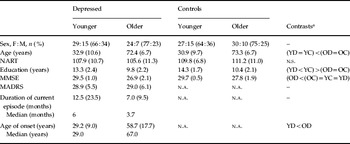
We recruited 75 depressed subjects (<60 years (n=44), ⩾60 years (n=31)] and 82 psychiatrically healthy comparison subjects (<60 years (n=42), ⩾60 years (n=40)]. Their demographic and clinical characteristics are summarized in Table 1. At assessment, of the 31 older subjects with depression, 25 were on antidepressant monotherapy [16 selective serotonin reuptake inhibitors (SSRIs), four venlafaxine, three monoamine oxidase inhibitors (MAOIs), one tricyclic antidepressant (TCA) and one mianserin], two were on combination therapy (fluoxetine and mirtazapine; dothiepin and mirtazpine) and four were not on antidepressant treatment. Of the younger depressed subjects, none were on antidepressant treatment at the time of testing, and this median time to referral and commencement of antidepressant treatment is in keeping with other studies (e.g. Hornblow et al. Reference Hornblow, Bushnell, Wells, Joyce and Oakley-Browne1990).
Demographics and illness characteristics

F, female; M, male; NART, National Adult Reading Test; MADRS, Montgomery–Åsberg Depression Rating Scale; YD, younger depressed; OD, older depressed; YC, younger controls; OC, older controls; n.s., not significant; n.a., not available.
Data are mean (standard deviation) unless specified otherwise.
a Contrasts performed only if overall ANOVA was significant.
Analysis of the composite z scores indicated that there was no (relative) difference in MMSE scores (t=0.384, df=72, p=0.702), NART scores (t=0.923, df=72, p=0.359) or years of education (t=0.849, df=73, p=0.399) between younger and older depressed patients, normalized against their respective control groups. There was also no difference in depression severity (as assessed by the MADRS) between the older and younger depressed groups (t=0.81, df=71, p=0.935).
Primary neurocognitive analysis
A single MANOVA was performed on the four neurocognitive domains. Significant main effects of group (MANOVA main effect: F=2.501, df=4, 68, p=0.05) and sex (MANOVA main effect: F=4.891, df=4, 68, p=0.002) were observed, with older patients performing worse than younger patients and male subjects performing worse than female subjects. There was no significant sex by group interaction (F=0.504, df=4, 68, p=0.733). Examination of the four neurocognitive domains after excluding patients on anticholinergic medications indicated that the significant between-group differences in the verbal memory and motor domains remained significant. All other domains remained non-significant (data not shown).
Examination of the between-subject effects for each of the four individual neurocognitive domains revealed that the main effect of group resulted from significant differences in the verbal learning and memory [composite score (higher scores represent worse performance): younger mean=2.51, s.d.=0.65; older mean=2.80, s.d.=0.58; F=5.922, df=1, 71, p=0.017] and motor speed (composite score: younger mean=2.53, s.d.=0.74; older mean=2.95, s.d.=0.76; F=5.927, df=1, 71, p=0.017) domains, with no difference in attention and executive function (composite score: younger mean=3.08, s.d.=1.11; older mean=3.08, s.d.=1.12; F=0.001, df=1, 71, p=0.980) or visuospatial learning and memory (composite score: younger mean=2.49, s.d.=0.36; older mean=2.48, s.d.=0.35; F=0.139, df=1, 71, p=0.711). The main effect of sex resulted from females outperforming males within the verbal learning domain only (F=15.874, df=1, 71, p<0.001).
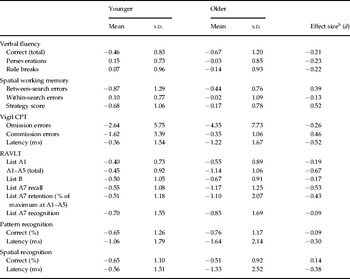
Analyses of individual tests from within these significant domains are presented below (see also Table 2).
Verbal learning and memory
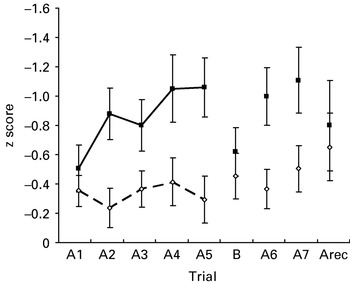
Older depressed patients were impaired to a greater extent on several indices of the RAVLT, including total trials A1–A5 (t=2.968, df=71, p=0*"/>
Rey Auditory Verbal Learning Test (RAVLT) z scores for younger (- -•- -) and older (–■–) patients.

Neurocognitive test results for the younger and older patient groups (all data are mean z scoresFootnote a and s.d. unless specified otherwise)

CPT, Continuous Performance Test; RAVLT, Rey Auditory Verbal Learning Test; s.d., standard deviation.
a Signs have been modified so that negative scores always represent worse performance with respect to the control group.
b Cohen's d: negative scores indicate worse performance in the older patient group compared to the younger patient group.
Motor speed
Older patients exhibited slowed reaction times on the Vigil test (t=2.235, df=69, p=0.029) whereas the differences in latencies on the pattern (t=1.257, df=72, p=0.213) and spatial (t=1.633, df=71, p=0.107) recognition tests failed to reach significance.
Exploratory analyses
To examine the effect of age of onset of depression (AOD) on neurocognitive domains, the older patient group was divided into subjects with AOD ⩾60 years (n=19) and AOD <60 years (n=12). The primary MANOVA was then repeated with the group recoded as younger patients versus AOD ⩾60 years versus AOD <60 years (sex was removed as a factor because of the small sample sizes). The MANOVA main effect of group differed at a trend level (F=2.457, df=8, 70, p=0.053). This was the result of trends in the verbal domain (F=2.637, df=2, 72, p=0.078) and motor speed domain (F=2.815, df=2, 72, p=0.067), with the later age of onset group performing worse than the younger group. At the time of testing the AOD ⩾60 years group was slightly older than the AOD <60 years group, although this difference in age did not reach statistical significance (AOD ⩾60 years: age=74.1 years; AOD <60 years: age=69.6 years; t=1.904, df=29, p=0.067).
Discussion
In this comparison of the neurocognitive performance of older and younger adults with major depression we found a robust difference in verbal learning and memory and a subtle effect in motor speed, with older depressed subjects being significantly more impaired than younger depressed subjects. Those with a late onset of depression were similarly more impaired than depressed subjects with an early age of onset, although this was only at a trend level of significance and may reflect a type 2 error. We did not identify any differences in visuospatial learning or attention and executive function between the groups. Our main hypotheses were therefore only partly supported, as we had hypothesized differences in executive function as well as in verbal learning and memory.
To our knowledge this study is the largest comparison of neuropsychological performance between older and younger adults with depression and the first to specifically examine verbal and visuospatial learning and memory. Although the study may have been more robust with larger numbers of subjects, especially in our exploratory analyses, the main findings are highly significant (or non-significant) and not therefore likely to have been altered with larger groups. The groups were well matched on potentially important confounding variables: global cognitive function (measured using the MMSE), severity of depression (as assessed by the MADRS) and in pre-morbid intelligence (tested using the NART). Study subjects were drawn from community and hospital clinics and there may have been differences in the recruitment pattern of patients, reflecting the underlying differences in the nature of the service provision for the different age groups. However, the two patient groups were very similar in MADRS and NART scores, suggesting that if any differences were present they were subtle and unlikely to have affected our findings.
The younger depressed subjects spent a little less time in education than their controls but as their NART scores were well matched this is not likely to be a clinically important difference. The main difference, apart from age, was in antidepressant treatment. We do not think this is likely to have affected our findings because most of the antidepressants used were SSRIs. Studies in healthy volunteers on the cognitive effects of SSRIs (e.g. Hasbroucq et al. Reference Hasbroucq, Rihet, Blin and Possamai1997; Furlan et al. Reference Furlan, Kallan, Ten Have, Pollock, Katz and Lucki2001; Siepmann et al. Reference Siepmann, Grossmann, Muck-Weymann and Kirch2003) involving both younger (Siepmann et al. Reference Siepmann, Grossmann, Muck-Weymann and Kirch2003) and older subjects (Furlan et al. Reference Furlan, Kallan, Ten Have, Pollock, Katz and Lucki2001) have reported either no change or an improvement in measures of memory and attention. Similarly, a study of older people with mild cognitive impairment, but no depression, reported improvement in global cognition and memory on fluoxetine (Mowla et al. Reference Mowla, Mosavinasab and Pani2007).
In an investigation by Lockwood et al. (Reference Lockwood, Alexopoulos and van Gorp2002), executive impairment was reported in late-life depression; specifically, they identified differences in response initiation and inhibition and in set shifting but, as in our study, they did not find differences in attention compared with younger depressed subjects. They also took age 60 as the cut-off for younger versus older groups, had similar aged groups, a similar age difference (of about 40 years) between groups, and their subjects, like ours, had severe depression. In another similar previous investigation, Tarbuck & Paykel (Reference Tarbuck and Paykel1995) examined two groups of depressed in-patients, again using a cut-off of 60 years of age. The groups were well matched for gender, number of previous episodes, NART-estimated IQ and severity of depressive symptoms, and were assessed on a comprehensive battery of tests during the depressive episode and upon recovery. Overall, significant effects of age were observed on the majority of tests administered, both when depressed and after recovery, with tasks assessing complexity being disproportionately impaired in the older depressed group. This absence of a difference in executive function is especially surprising because not only was it identified in these studies but also, compared with EOD, LOD has usually been associated with such a pattern of impairment (Herrmann et al. Reference Herrmann, Goodwin and Ebmeier2007). We used a conservative approach to analysis and because our MANOVA on the executive composite domain did not identify any differences we did not conduct further analyses. Our surprising finding here suggests that there may be important heterogeneity among even those with more severe late-life depression or it may simply reflect the heterogeneity of measures used to assess executive function, which is a broad construct, encompassing several related domains.
We had hypothesized that we would find more widespread differences between the older and younger depressed groups. Our findings support the view that, with the exception of verbal learning and motor speed (although the latter was only for the Vigil test of reaction time), the more severe impairments in older people with depression are primarily due to ageing rather than to differences in the nature of depressive illness in later life because ageing itself produces a similar pattern of neurocognitive impairment to depression (Austin et al. Reference Austin, Mitchell and Goodwin2001). That the most robust difference was in verbal learning and memory raises the question of whether this is due to a subgroup of the older depressed subjects having early Alzheimer's disease. None of our older subjects met standard criteria for dementia because any such potential subjects were excluded from the study. We have been able to follow-up many of the study subjects for up to 4 years and none have developed dementia, suggesting that incipient Alzheimer's disease in some of our subjects is not the explanation of the larger verbal memory impairment we identified in the older depressed group. Our findings of greater verbal declarative memory impairment in older depressed subjects may reflect a greater hippocampal volume reduction in this group (Steffens et al. Reference Steffens, Byrum, McQuoid, Greenberg, Payne, Blitchington, MacFall and Krishnan2000). Although it should be noted that, as can be seen in Fig. 1, the z score difference remains level across successive presentations in the younger depressed group while increasing over successive presentations in the older group. This suggests that the rate of learning in the younger group is constant relative to their controls, but is reduced in the older group. In addition, despite reduced delayed recall in older relative to younger depressed subjects, the percentage retention index did not differ significantly, suggesting that impaired delayed recall in the older group was the result of poorer initial learning or encoding. The pathophysiology of this remains to be determined, although both cortisol toxicity and damage due to vascular disease have been proposed, as discussed below.
An important difference, likely to be relevant, between the younger and older depressed groups is that the former were physically healthy whereas the latter had co-morbidity typical of older people with depression, especially vascular disease. Although the cognitive impairment profile typical of cerebrovascular disease is of executive dysfunction and impaired attention (O'Brien, Reference O'Brien2006), prominent impairments in memory are recognized and reported (Jokinen et al. Reference Jokinen, Kalska, Mantyla, Pohjasvaara, Ylikoski, Hietanen, Salonen, Kaste and Erkinjuntti2006) and in some studies impairments in verbal memory and psychomotor speed have been most prominent (Nyenhuis et al. Reference Nyenhuis, Gorelick, Geenen, Smith, Gencheva, Freels and deToledo-Morrell2004). Thus, cerebrovascular disease may explain part of this increased impairment in late-life depression. An alternative explanation for the difference in late-life depression is the greater dysfunction in the hypothalamic–pituitary–adrenal (HPA) axis, associated with memory impairment, compared with depression in earlier life (Rubin et al. Reference Rubin, Poland, Lesser, Martin, Blodgett and Winston1987; O'Brien et al. Reference O'Brien, Ames, Schweitzer, Colman, Desmond and Tress1996). Given the robust evidence for age-related HPA axis dysfunction and memory impairments in age-related cerebrovascular disease, then both are likely to be contributors to our findings.
The difference we identified between older and younger depressed subjects on motor speed resulted from the older subjects having slower reaction times on the Vigil CPT. We do not think this is due to age-related physical impairment because each group was compared to its age-matched control group, or to depression severity and more severe psychomotor retardation in the older group because the younger and older depressed subjects showed similar levels of depression severity on the MADRS (see Table 1). However, it is possible that a similar burden of depression may have a greater impact on cognition in the older depressed group because of a loss of cognitive reserve in this group due to the combined effect of other factors, such as a higher burden of cerebrovascular disease and a longer exposure to HPA axis-related hypercortisolaemia. Furthermore, recent reports (Butters et al. Reference Butters, Whyte, Nebes, Begley, Dew, Mulsant, Zmuda, Bhalla, Meltzer, Pollock, Reynolds and Becker2004b; Sheline et al. Reference Sheline, Barch, Garcia, Gersing, Pieper, Welsh-Bohmer, Steffens and Doraiswamy2006) on the neurocognition of late-life depression have indicated that information processing speed may be the core deficit in late-life depression, underpinning the range of other deficits. Impaired reaction time appears to be tapping into this same domain (information processing speed) and this may therefore not only be key to cognitive impairment in late-life depression but also a deficit that is different (more severe) in late-life compared with early life depression. However, as our study was designed before these findings were reported, we are not able to examine this important issue more closely. Furthermore, in a recent follow-up study of the younger patients and controls we found evidence that baseline psychomotor impairment was the only domain that differed between patients who remitted and those who did not at <6 months (Gallagher et al. Reference Gallagher, Robinson, Gray, Porter and Young2007). Although this is only a preliminary finding, it may suggest that psychomotor impairment in younger depressed patients may be predictive of individuals who may develop a more chronic or recurrent illness. In the context of the present findings, it was also of interest that there was evidence of a significantly greater improvement in verbal declarative memory in patients who remitted compared to those who did not (Gallagher et al. Reference Gallagher, Robinson, Gray, Porter and Young2007).
The sex difference we identified, due to women performing better than men on verbal learning, has been reported previously (Herlitz et al. Reference Herlitz, Nilsson and Backman1997, Reference Herlitz, Airaksinen and Nordstrom1999; Lewin et al. Reference Lewin, Wolgers and Herlitz2001) and, as in our study, appears to be a feature common to mid-life and late-life depression (Herlitz et al. Reference Herlitz, Nilsson and Backman1997) that persists up to 90 years of age (de Frias et al. Reference de Frias, Nilsson and Herlitz2006).
Although age of depression onset is an important issue, we did not design our study to investigate this and the interpretation of our exploratory analyses needs to take this into account. The issue has been investigated previously by other groups and a recent review of the literature on late-life depression identified executive dysfunction to be typical of LOD compared with EOD (Herrmann et al. Reference Herrmann, Goodwin and Ebmeier2007). However, our finding that LOD subjects may have greater impairments in learning and memory is consistent with some previous reports (e.g. Salloway et al. Reference Salloway, Malloy, Kohn, Gillard, Duffy, Rogg, Richardson, Thomas and Westlake1996) and with our main findings supporting the view that late-life depression may be different cognitively from depression in younger adults.
In conclusion, we have addressed the specific question of whether depression in older people, compared with depression in younger adults, is associated with more severe cognitive impairments after correcting for age-related changes. We have reported evidence here suggesting that the illness itself accounts for some of the difference in the poorer cognitive performance in late-life depression. We believe that our approach, normalizing depression groups against age-matched comparison groups, combined with the relatively large numbers for such a study and the detailed neuropsychological assessment used, makes our findings robust and relevant.
Appendix: Neurocognitive tests included in each domain

FAS, Benton's FAS; SWM, Spatial Working Memory; RAVLT, Rey Auditory Verbal Learning Test; PRM, Pattern Recognition Memory; SRM, Spatial Recognition Memory.
Declaration of Interest
None.