Introduction
Alcohol dependence (AD) among older adults is an increasing public health concern which leads to rising healthcare costs; especially given the fact that the proportion of elderly people is increasing, as well as life expectancy (Wetterling et al., Reference Wetterling, Veltrup, John and Driessen2003; Immonen et al., Reference Immonen, Valvanne and Pitkälä2011). These findings suggest that increasing numbers of older people will exhibit alcohol-related problems in the near future. However, relatively little attention has been directed towards research on AD in the elderly. This is nevertheless important, since older people are more sensitive to the adverse effects of excessive alcohol use than younger people (Oslin, Reference Oslin2004). Excessive alcohol intake cannot only lead to severe physical problems but has also been associated with psychiatric disorders and cognitive decline (Yonker et al., Reference Yonker, Nilsson, Herlitz and Anthenelli2005; Green et al., Reference Green, Garrick, Sheedy, Blake, Shores and Harper2010).
Neuropsychological and neuroimaging studies on AD provide evidence of structural frontal brain abnormalities, damage of the fronto-cerebellar circuitry and disturbed associated functions, namely executive and visuospatial functions and memory (Green et al., Reference Green, Garrick, Sheedy, Blake, Shores and Harper2010; Zahr et al., Reference Zahr, Pitel, Chanraud and Sullivan2010). Structural abnormalities in the frontal lobes appear to be more severe in older alcohol-dependent (AD) patients compared to younger AD patients, even after adjustment for the effect of normal aging and independently of actual lifetime alcohol consumption (Pfefferbaum et al., Reference Pfefferbaum, Sullivan, Mathalon and Lim1997).
As AD is regarded as a heterogeneous cluster of symptoms, several authors have attempted to classify AD into various typologies. The age of onset is often considered to be an essential distinguishing characteristic for subgrouping AD patients (see review by Leggio et al., Reference Leggio, Kenna, Fenton, Bonenfant and Swift2009). Early onset AD is more strongly genetically determined than late onset AD and is associated with more medical and psychiatric comorbidity, such as antisocial traits. Furthermore, early onset AD is also related to less treatment compliance compared to late onset AD (Liu et al., Reference Liu, Serdula, Byers, Williamson, Mokdad and Dana Flanders1996). Late onset AD, sometimes referred to as situational alcoholism, often seems to be induced by age-related stress, e.g. the loss of a spouse, retirement, or loss of daily structure (Moos et al., Reference Moos, Schutte, Brennan and Moos2010).
The cut-off age discriminating early and late onset AD is usually placed at 25 years of age (Demir et al., Reference Demir, Ulug, Lay Ergun and Erbas2002b; Dom et al., Reference Dom, Hulstijn and Sabbe2006; Le Strat et al., Reference Le Strat, Grant, Ramoz and Gorwood2010; Joos et al., Reference Joos2013). However, literature on elderly AD patients who seek treatment shows that a substantial proportion of these elderly patients started to develop alcohol problems after 45 years of age (Wetterling et al., Reference Wetterling, Veltrup, John and Driessen2003; Sorocco and Ferrell, Reference Sorocco and Ferrell2006), or even after 60 years (Atkinson, Reference Atkinson1990; Barrick and Connors, Reference Barrick and Connors2002). Therefore, older people, who drink only moderately until the age of 45 and who become problem drinkers at a later age, could constitute a third subtype of elderly AD patients, the “very late onset” group. Overall, these AD patients with a late(r) onset have a healthier outcome and a better prognosis (higher rate of abstinence after 12 months) compared to those with an early onset of AD (Wetterling et al., Reference Wetterling, Veltrup, John and Driessen2003; Sorocco and Ferrell, Reference Sorocco and Ferrell2006). Whether this more favourable outcome for late(r) onset AD patients also applies to cognitive functioning, is still unknown. This is however important to investigate, as the level of cognitive impairment in subgroups with different ages of onset of AD may have implications for treatment as well as for prognosis (Bates et al., Reference Bates, Pawlak, Tonigan and Buckman2006; Berre et al., Reference Berre2012).
To our knowledge, only four studies compared early and late onset AD patients with regard to neuropsychological functions. Pishkin et al. (Reference Pishkin, Lovallo and Bourne1985) reported that 12 early onset AD patients were more impaired on a cognitive rule-learning task than 12 late onset AD patients. Demir and colleagues (Reference Demir, Ucac, Ulug, Ulusoy, Sevinc and Batur2002a) found no differences in memory, planning, problem solving and cognitive flexibility between 13 early onset AD patients and 10 late onset AD patients. In another study with a different sample, Demir and colleagues (Reference Demir, Ulug, Lay Ergun and Erbas2002b) reported that 16 early onset AD patients showed diminished cognitive flexibility compared to 17 late onset AD patients. In a more recent study by Joos et al. (Reference Joos2013), 36 early onset AD patients showed less cognitive interference and better visual memory compared to 57 late onset AD patients. No differences were observed with regard to other cognitive domains, such as attention, impulsivity and memory. Evidently, findings across these studies are inconsistent and require further elucidation. Furthermore, the aforementioned studies did not include older AD patients, and only focused on two age of onset groups, thereby disregarding the very late onset group (≥45 years).
Our study is the first to investigate whether older - recently abstinent – AD patients with early, late, or very late onset differ in their cognitive abilities. We assumed that older patients with an early onset AD have been drinking alcohol excessively for much longer compared to those with (very) late onset AD. Therefore, more brain damage and associated impairment in cognition is to be expected. Furthermore, as the frontal brain regions are not fully developed until the mid-twenties, early onset AD may result in disruption of the later stages of frontal lobe maturation, which could have adverse effects on (later) cognitive functioning.
We hypothesized that cognitive functioning will be poorest in the early onset group, intermediate in the late onset group, and best in the very late onset group.
Methods
Sample
Participants were recruited from an inpatient detoxification unit for older people with substance dependence in The Hague, the Netherlands. Patients were included if they were diagnosed with AD according to the criteria of the Diagnostic Statistical Manual of Mental Disorders IV-TR (American Psychiatric Association, 2000) and if they had (at least) completed primary school in the Netherlands to ensure sufficient command of the Dutch language. Patients were included if they were abstinent from alcohol for at least three days, to preclude the effect of alcohol intoxication. If participants showed clinical signs of withdrawal (irritability, tremors, agitation, (facial) sweating), the assessment was postponed.
Procedure
Prior to the participants’ consent to participate in the study, they were informed about the purpose of the current study and the duration of the tests. A neuropsychological test battery was administered, which comprised three tests which will be discussed below. Data concerning age of onset was collected from the European version of the Addiction Severity Index (Europ-ASI) (Kokkevi and Hartgers, Reference Kokkevi and Hartgers1995), which had been administered at the detoxification unit by an ASI-certified nurse. All participants were tested within three weeks after detoxification, as this was for most patients the maximum stay at the detoxification unit.
Measures
The independent variable was age of onset of AD. To assign the participants to the groups, we used the Europ-ASI question “at what age did you first start regularly drinking 5 or more alcoholic beverages a day?” If the answer to this question was missing, we used data from earlier interviews, in order to assign the patient to an age of onset category. Level of education was classified according to the coding system for educational level by Verhage (Reference Verhage1964). Premorbid verbal intellectual functioning was estimated with the Dutch Adult Reading Test (DART) (Schmand et al., Reference Schmand, Lindeboom and Harskamp1992). The variable “years of excessive drinking” was obtained with the Europ-ASI question: “how many years (in total in your life) have you regularly consumed 5 or more alcoholic drinks per day?”. The dependent variables were the results of the neuropsychological assessment. We used data from neuropsychological instruments that were part of the routine assessment of patients at the alcohol ward. These instruments provided a global assessment of cognitive functioning and could be administered within 45 minutes.
Neuropsychological assessment
The Kaufman-Short Neuropsychological Assessment Procedure (K-SNAP) (Kaufman and Kaufman, Reference Kaufman and Kaufman1994) assesses aspects of cognitive functioning in adolescents and adults. The Dutch translation of the K-SNAP was found to be a reliable and valid measure (Mulder et al., Reference Mulder, Dekker and Dekker2005). It consists of four subtests, organized into three levels of cognitive complexity and takes approximately 30 minutes to administer.
-
• Attention-orientation, general knowledge (Mental Status)
-
• Immediate short-term memory and perceptual skills (Number Recall and Figure Recognizing)
-
• Complex intellectual functioning and planning ability (Code Words)
Performance can be interpreted using Dutch norms controlled for age and gender.
The Stroop Color Word Test is considered a general measure of cognitive control, interference and response inhibition (Stroop, Reference Stroop1935). The Trail Making Test (TMT) assesses visual search, speed of processing and cognitive flexibility (Tombaugh, Reference Tombaugh2004).
Data analysis
The participants were categorized into three groups according to their age of onset of AD: “early onset” (< 25 years), “late onset” (25–44 years), and “very late onset” (≥ 45 years). Group means and standard deviations were calculated for all test scores, demographic variables (age, gender, education) and premorbid intellectual functioning. Using a Dutch norm population (Schmand et al., Reference Schmand, Houx and De Koning2003), the scores of the Stroop test were adjusted for age, gender and education and the scores of the TMT were only adjusted for age and education. Scores on both tests were then converted into T-scores. We conducted Analyses of Variance (ANOVAs) and χ2 tests to examine group differences. For the K-SNAP, we conducted an analysis of covariance (ANCOVA) with educational level as a covariate, as the norm scores of the K-SNAP subtests were not adjusted for educational level. In addition, we conducted ANCOVAs to examine group differences on the raw data. These analyses were adjusted for age, gender and education. A p-value ≤ 0.05 was considered significant. All statistical analyses were performed using the Predictive Analytics Software Statistics (PASW) version 20 for Windows, Statistical Package for the Social Sciences (IBM SPSS).
Results
In the data collection period from 1 April 2011 until 1 June 2012, 188 unique AD patients were admitted to the inpatient detoxification unit. Of these, 13 patients were not sufficiently proficient in the Dutch language, 69 did not meet the criteria of abstinence or were already discharged at the time the assessment was planned. The remaining 106 patients were invited to participate in the study, and 93 agreed. Of these, eight patients were excluded because we were not able to retrieve the age at which they started regularly drinking 5 or more alcoholic beverages a day. The total study population consisted of 85 persons (32 women and 53 men), with a mean age of 62.4 (SD = 7.3) years, ranging from 48 to 82 years. All participants were tested in the aforementioned period. Table 1 shows demographic variables of the study population. Mean age of the early and late onset AD group differed significantly from the mean age of the very late onset AD group (F (2,82) = 5.62, p < 0.01). Post hoc analyses revealed that, compared to the early onset AD group, both the late onset AD and very late onset AD group reported fewer years of heavy drinking (F (2,68) = 21.10, p < 0.001). Compared to a Dutch norm group, all age of onset groups had an average estimated premorbid verbal IQ, as estimated with the DART (Schmand et al., Reference Schmand, Lindeboom and Harskamp1992).
Characteristics of the study population (N = 85)

Notes: EO = Early onset, LO = Late onset, VLO = Very late onset, DART = Dutch Adult Reading Test, M = male, F = female.
*ANOVAs for continuous variables, χ2 test for categorical variable (gender).
1Reported number of years drinking 5 or more alcoholic drinks per day.
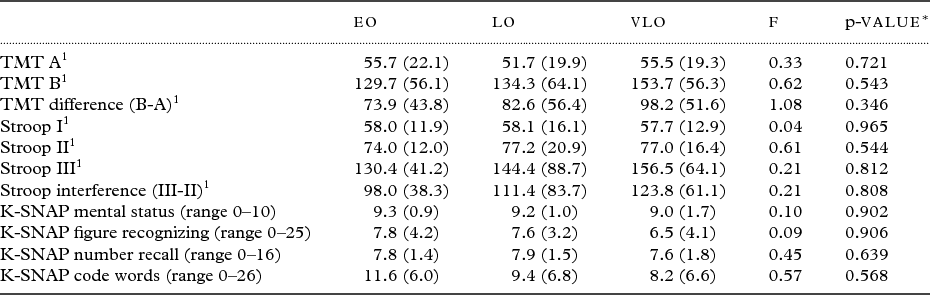
Table 2 lists mean raw test scores. ANOVAs revealed no statistical differences between the age of onset groups on any of the raw test scores. ANCOVAs, adjusted for age, gender and educational level, did not reveal any significant differences between the groups either.
Mean raw test scores and standard deviations per onset group

Notes: EO = Early onset, LO = Late onset, VLO = Very late onset, TMT = Trail Making Test, K-SNAP = Kaufman-Short Neuropsychological Assessment Procedure.
All raw test scores were adjusted for age, gender and educational level.
1test scores in seconds.
*ANCOVAs for all scores.
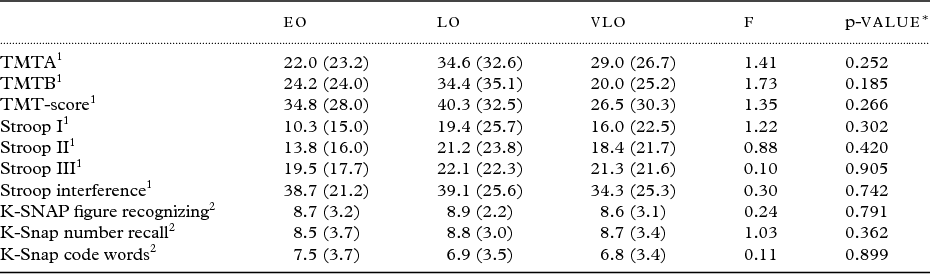
Table 3 lists mean standardized test scores. Again, no group differences were found between the early, late and very late onset groups. Adding gender as a covariate to the ANCOVA on the TMT scores did not influence the results. Compared with a healthy non-alcoholic norm group (Schmand et al., Reference Schmand, Houx and De Koning2003), all groups scored below average on the majority of the tests with percentiles ranging from the 10th through the 40th percentile for the TMT and Stroop tests. Performance on three K-SNAP subtests was low average as well for all groups, compared to a healthy non-alcoholic norm group (Mulder et al., Reference Mulder, Dekker and Dekker2005).
Mean standardized test scores and standard deviations per onset group

Notes: EO = Early onset, LO = Late onset, VLO = Very late onset, TMT = Trail Making Test, K-SNAP = Kaufman-Short Neuropsychological Assessment Procedure.
K-SNAP subtest Mental Status was not included in this analysis, as norm data is not available.
1Percentiles, compared with a healthy population.
2Standardized norm scores (M = 10, SD = 3), compared with a healthy population.
* ANOVAs for TMT and Stroop scores, ANCOVAs for K-SNAP scores.
Discussion
The primary aim of this study was to examine if older alcohol dependent people with a different age of onset of AD differ in terms of cognitive (dys)function. We expected, based on previous research within this field, that the early onset (< 25 years) group would perform the poorest on measures of cognitive functioning, and the very late onset group the best. Surprisingly, no differences in cognitive performance between the three age of onset groups were found on any of the neuropsychological measures. This is the first study to suggest that older people who have been drinking heavily since their twenties have similar cognitive abilities compared to their peer group who started to drink heavily after the age of 44, or even much later. Our results are, to some extent, in line with those reported by Demir and colleagues (Reference Demir, Ucac, Ulug, Ulusoy, Sevinc and Batur2002a) and Joos and colleagues (Reference Joos2013), who found no difference with respect to cognitive flexibility, working memory and attention between patients with early and late onset AD either. In terms of cognitive control, our findings are in contrast with those of Joos and colleagues (Reference Joos2013), who found that early onset AD patients performed better on the Stroop task than late onset AD patients. However, our sample consisted of older people, equally distributed over three age of onset groups, whereas Joos et al. (Reference Joos2013) and Demir et al. (Reference Demir, Ucac, Ulug, Ulusoy, Sevinc and Batur2002a) focused only on two groups of AD patients, with a younger age (mean age (SD) of early onset respectively 36.2 (8.5) and 41.1 (9.9)). In this respect, comparison with aforementioned studies is difficult.
Definitions of late onset AD vary among studies, with cut-offs discriminating early and late onset ranging from 22 to 60 years (Demir et al., Reference Demir, Ulug, Lay Ergun and Erbas2002b; Le Strat et al., Reference Le Strat, Grant, Ramoz and Gorwood2010). In agreement with Joos et al. (Reference Joos2013) and Dom et al. (Reference Dom, Hulstijn and Sabbe2006) we chose a cut-off age of 25 years to discriminate early and late onset. As we were particularly interested in the subgroup of patients who develop AD (much) later in life, we followed Wetterling et al. (Reference Wetterling, Veltrup, John and Driessen2003) in creating a subgroup of patients with an age of onset of 45 and older, which we named the “very late onset” group. This term is, however, not commonly used in other alcohol studies, as most studies do not subdivide the late onset group.
Although no cognitive differences were found between the age of onset groups, when corrected for age, gender and education, all three onset groups performed below average compared to a healthy norm group, despite the fact that their estimated premorbid verbal IQ was average. This corresponds with previous reports stating that drinking alcohol heavily for long periods of time is associated with impairment of cognitive functioning (Yonker et al., Reference Yonker, Nilsson, Herlitz and Anthenelli2005; Green et al., Reference Green, Garrick, Sheedy, Blake, Shores and Harper2010). Our results suggest that the detrimental consequences of excessive alcohol consumption for cognition are apparent in older AD patients, irrespective of their age of onset. Although previous literature indicated that late(r) onset AD is associated with better social functioning and professional careers, normal family lives, and fewer medical and psychiatric co-morbidities than early onset AD (Liberto and Oslin, Reference Liberto and Oslin1995; Wetterling et al., Reference Wetterling, Veltrup, John and Driessen2003), this does not seem to apply to cognitive functioning. The fact that our early onset group reported on average 26.0 (SD = 13.7) years of heavy drinking compared to 6.7 (SD = 6.2) years for the very late onset group, makes it even more surprising that their cognitive performance was similar. These findings do not converge with previous research, that indicated that cognitive performance deteriorated in direct proportion to duration of AD (Parsons, Reference Parsons1998), and that cognitive deficits may be detectable only in those AD patients who have been drinking for 10 years of more (Eckardt et al., Reference Eckardt1998).
Our counter-intuitive results may be explained by the increasing vulnerability of the aging brain. On the one hand, it is possible that brain damage due to alcohol misuse in early years has a ceiling effect, stabilizing rather than deteriorating any further. On the other hand, (very) late onset of AD could accelerate the cognitive deterioration inherent to the normal aging process, hence resulting in similar cognitive impairments. This latter “increasing vulnerability hypothesis” is in line with the results of Pfefferbaum and colleagues (Reference Pfefferbaum, Sullivan, Mathalon and Lim1997), who found that older patients with AD exhibited more frontal lobe atrophy than younger patients with AD, often despite similar total lifetime alcohol consumption. However, it is also possible that (part of) the early onset AD patients are “healthy survivors” and that their peers who were more vulnerable to the deleterious effects of excessive alcohol consumption, may have died or may have been admitted to nursing homes, and therefore no longer eligible for our study. This could have biased the results of the early onset group.
Some limitations of this study need to be discussed. First, the age at which patients first started regularly drinking 5 or more alcoholic beverages per day was gathered through self report, which makes our data vulnerable to recall bias. However, because of the use of broad age categories, we do not expect this to have misclassified the age of onset. Second, as our patients were assessed between 3 days and 3 weeks after admission to the detoxification program, it is possible that some participants were more recovered from the detoxification than others at the time of assessment, which may have influenced their performance on the tests. However, the time of assessment was unrelated to the age of onset of AD. Third, benzodiazepines were prescribed to all of our patients to counteract withdrawal effects. This could have influenced our results. However, we did neither expect significant differences in the use of benzodiazepines, nor in the effect of benzodiazepines on cognition, between the three age of onset groups. Fourth, as our sample consisted of older AD people seeking treatment in a clinical center, our conclusions can therefore neither be generalized to outpatients, nor to community dwelling older AD persons. Finally, the interactions between alcohol, aging and the brain are complex. The effects of alcohol on the brain are diverse and may be influenced by a wide range of other variables, which we could not include in this study, such as the (cumulative) quantity and frequency of consumed alcohol, smoking, vascular risk factors, medical status and genetic background. Thus we could not rule out the possibility of residual confounding, which may have obscured the associations of our study.
To our knowledge, this study is the first to investigate the cognitive performance of three groups of older AD patients with a different age of onset of AD. Our data suggest that the majority of the AD patients included in this study are cognitively impaired, irrespective of their age of onset. Evidently, this has clinical implications for the treatment of AD, as the standard treatment for AD, generally based on cognitive behavioral therapy (CBT), relies on the acquisition of novel information or cognitive procedures (Pitel et al., Reference Pitel2007). Thus, when choosing the most appropriate treatment for older AD people, clinicians should take potential cognitive dysfunction into account. Finally, we emphasize the importance of longitudinal studies to examine the association between age of onset and the course of cognitive functioning, and between cognitive functioning and the course of AD and its treatment. Routine assessment of cognitive abilities should become standard practice in every detoxification facility. As the prevalence of AD in the elderly is increasing, more research on the cognitive consequences of alcohol on the aging brain is needed.
Conflict of interest
None.
Description of authors’ roles
N. Kist and Dr. J.F. van den Berg designed the study and formulated the research question. N. Kist collected and analyzed the data, and drafted the paper. Dr. J.F. van den Berg supervised the data collection and edited the paper. J. Sandjojo participated in concept and design, and in paper revisions. Dr. R.M. Kok participated in paper revisions. All authors contributed and have approved the final paper.
Acknowledgments
The author would like to thank Jolanda Hermes for coordination of data collection and data management, and the patients and carers who participated in this research.