Canada has a rapidly aging population. The senior population (65+) has already doubled in the past 35 years, and the 80-and-over age category is expected to increase by another 110 per cent by 2031 (Statistics Canada, 2009). Notably, 81 per cent of seniors living at home have been diagnosed with at least one chronic illness and the number of chronic illnesses has been cited as the most important variable in predicting health care use. The demands that will be placed on Canada’s health care services, therefore, are significant (Gilmour & Park, Reference Gilmour and Park2003; Rotermann, Reference Rotermann2003).
Canada must prepare for the aging of its population by training an adequate number of health care personnel, particularly nurses, to meet their needs. Despite this need, the nursing profession is not graduating a sufficient number of students to meet the needs of the Canadian health care system (Maddalena & Crupi, Reference Maddalena and Crupi2008). Moreover, a 19.9% turnover rate has been reported for nurses in Canadian hospitals (O’Brien-Pallas, Tomblin-Murphy, Shanian, Li & Hayes, 2010). Given the expected demographic changes, there is a need not only for more nurses in general, but also for more nurses trained and willing to work with older patients (Canadian Nurses Association, 2011). In fact, only 9.7 per cent of nurses in Canada work in geriatrics, and the average age of nurses is 45.4 (Canadian Institute for Health Information, 2011). Even when nurses do not plan on working in geriatric units, the prevalence of older adults in all parts of the health care system suggests that developing the knowledge and skills to care for elderly patients is crucial. Given these needs, a better understanding of student nurses’ attitudes and beliefs about aging, and about caring for older patients, is of great importance.
It is well established that ageist attitudes are prevalent in the general population (Kite, Stockdale, Whitley, & Johnson, Reference Kite, Stockdale, Whitley and Johnson2005; Ragan & Bowen, Reference Ragan and Bowen2001). Ageism incorporates negative attitudes, stereotypes, discrimination, and generalizations concerning old age, and can be implicit or explicit (Iversen, Larsen, & Solem, Reference Iversen, Larsen and Solem2009). Some recent work (e.g., Moyle, Reference Moyle2003; Zambrini, Moraru, Hanna, & Kalache, Reference Zambrini, Moraru, Hanna and Kalache2008) suggests that ageist attitudes are also exhibited by health care providers and by students of health care programs.
Studies of attitudes about aging, among nursing students compared to students in other helping profession programs, have yielded contradictory findings. Zambrini et al. (Reference Zambrini, Moraru, Hanna and Kalache2008) measured ageism in students from several health care disciplines (medicine, occupational therapy, physiotherapy, nursing, psychology, social work, and dentistry) in Spain. Their results indicated that nurses had the least positive attitudes towards older adults, whereas psychology students had the most positive attitudes. In contrast, Karlin, Emick, Mehls, and Murry (Reference Karlin, Emick, Mehls and Murry2005) compared nursing and psychology students in a US sample, and found that nursing students had more-positive attitudes about their ability to work effectively with older adults than did psychology students. Finally, Gonçalves et al. (Reference Gonçalves, Guedes, Fonseca, Pinto, Martín and Byrnel2011) looked at undergraduates in nursing, social work, and psychology in Portugal and found that nursing and social work students were more willing to work with older adults than were psychology students.
Although it is very difficult to compare these three studies directly given that different measures and cultural contexts were used and that the students in the programs differed substantially in age, one possible interpretation for the different findings is that they reflect differences in the amount of knowledge that students had about the aging process. Specifically, Zambrini et al. (Reference Zambrini, Moraru, Hanna and Kalache2008) suggested that the psychology students at that university received a gerontology focus in their courses because the program was housed in a faculty with an international reputation for its gerontology program. Similarly, Karlin et al. (Reference Karlin, Emick, Mehls and Murry2005) found that the nursing students in their study reported having taken more courses with gerontological content (as defined by the students) but that they also had more clinical experience with older adults than did the psychology students. However, Gonçalves et al. (Reference Gonçalves, Guedes, Fonseca, Pinto, Martín and Byrnel2011) found a negative correlation between knowledge on aging (as measured by Palmore’s Facts on Aging quiz, Reference Palmore1988) and interest in working with older populations. These results may reflect findings in the general (i.e., non-health provider) population that interventions in which aging-related knowledge is simply transmitted are much less effective in reducing ageism than are interventions in which attitude change is reinforced (Cottle & Glover, Reference Cottle and Glover2007; Ragan & Bowen, Reference Ragan and Bowen2001). Indeed, it has been suggested that the modeling of positive attitudes about aging by instructors may be as or even more important than aging-related knowledge in fostering positive attitudes in student nurses (Cozort, Reference Cozort2008; Ferrario, Freeman, Nellett, & Scheel, Reference Ferrario, Freeman, Nellett and Scheel2008; Latimer & Thornlow, Reference Latimer and Thornlow2006).
The role of aging-related knowledge has also been addressed specifically by researchers looking at the impact of curricula and clinical experiences in nurses’ training. Söderhamn, Lindencrona, and Gustavsson (Reference Söderhamn, Lindencrona and Gustavsson2001) examined the attitudes towards older adults of nursing students in a Swedish sample and concluded that experience, age, and gender were important factors in determining scores on a scale measuring feelings towards older people. Specifically, it was found that first-year students were more negative than were third-year students, students under age 25 were more negative than students over 25, and male students were more negative than female students. Söderhamn et al. recommended that young students and male students be exposed early in their training to positive role models of geriatric care. Similarly, Välimäki, Haapsaari, Katajisto, and Suhonen (Reference Välimäki, Haapsaari, Katajisto and Suhonen2008) found that clinical experience had a positive effect on perceptions of older persons’ involvement in their own treatment and the extent to which nurses support this involvement. Thus, these studies suggest that as nursing students progress through the nursing program and gain clinical experience, their views about working with older patients may become more positive.
In contrast, Abbey et al. (Reference Abbey, Abbey, Bridges, Elder, Lemke and Liddle2006) found that student nurses had quite negative views of geriatric nursing after working in a nursing home setting. Using a qualitative approach with a small number of students, these authors found that students were concerned about the career opportunities in this field, and that a placement in a nursing home setting exposed them primarily to basic rather than technical nursing skills, which they perceived did little to equip them for career advancement.
The timing of the clinical experiences during a nursing student’s training has also been studied. Jansen and Morse (Reference Jansen and Morse2004) found that a curriculum that presented aging content in an integrated format early in the program was more successful in fostering positive attitudes in nursing students than a program in which aging was taught in a senior seminar. Similarly, Ferrario et al. (Reference Ferrario, Freeman, Nellett and Scheel2008) found that an overarching emphasis across the curriculum on the normal and positive aspects of aging successfully improved attitudes in nursing students.
Haight, Christ, and Dias (Reference Haight, Christ and Dias1994) tested nursing students every year for the last three years of a four year nursing program using the Kogan’s Attitude Toward Old People scale (Kogan, Reference Kogan1961) as well as a semantic differential scale and found that students’ contact with grandparents was important in fostering positive attitudes, and that positive attitude gains were larger in the first year when students worked with healthy older adults, and somewhat smaller in the program’s second and third year when they cared for ill elderly and did classwork on aging diseases. Nursing students’ past experiences in long-term care did not have a significant effect on the outcome variables.
These results are consistent with the suggestion by Ferrario et al. (Reference Ferrario, Freeman, Nellett and Scheel2008) that for clinical placements to be effective in influencing attitudes about aging, there should be a gradual progression in the type of placement nursing to which students are exposed. They proposed that it is important for nursing students to first learn to communicate with older adults before being introduced to a patient who is perhaps both mentally and physically dependent. Patients with cognitive and physical deficiencies would be more suitable in a senior placement program where students have had enough exposure to be better equipped to manage these more challenging patients.
In some studies, negative attitudes about older adults are exhibited through an unwillingness to work with this age group. For example, in a study carried out in Australia, Le Couteur, Bansal, and Price (Reference Le Couteur, Bansal and Price1997) found negative attitudes towards elderly patients in fifth-year medical students. In a survey assessing students’ interest in working in geriatrics, the researchers found that the only medical students who indicated interest in working with the 80-and-older category were those who chose all age groups. Indeed, more than 75 per cent of students wanted to work with patients under the age of 60, while at the same time they estimated that 85 per cent of their patients would be between 61 and 90 years of age. In other words, three-quarters of the sample felt that they would spend the vast majority of their time working with an age group with which they did not desire to work.
Similar findings have been obtained with nursing students. Happell (Reference Happell2002) found that nursing students indicated that nursing specialization in the care of older people was their least preferred among nine categories, both at the beginning and end of their undergraduate studies. Similarly, Moyle (Reference Moyle2003) found that 97 per cent of the student nurses interviewed had no interest in working in geriatrics. The most common reason given by the nursing students was that it was a depressing area to work in. However, the students indicated that they would be more inclined to consider geriatrics as a specialization if (a) there was a more favourable view of aged care within the nursing profession, (b) they had a better understanding of geriatric nursing, and (c) better working conditions were present (e.g., less heavy lifting). Moyle interpreted these results as an indication that these student nurses had integrated society’s perceptions of older adults as being sickly and frail into their personal beliefs.
In a similar study, de la Rue (Reference de la Rue2003) carried out extensive interviews and focus groups with a small number of nursing students. She found that nursing students were aware of ageism, yet maintained ageist beliefs due to their own personal fears of the aging process. The participants explored effective strategies for preventing ageist beliefs (which they acknowledged as existing in themselves) and identified the importance of having experienced nurses in charge to exemplify non-ageist attitudes and respect towards their older patients. Moreover, in a later study involving a large number of nursing undergraduates, Eshbaugh, Gross, & Satrom (Reference Eshbaugh, Gross and Satrom2010) found that aging anxiety and death anxiety were negatively related to a willingness to work with older adults. Interestingly, positive relationships with non-family-related older adults were also predictive of a student’s interest in geriatric nursing.
Herdman (Reference Herdman2002) drew an interesting and potentially important distinction between ageism and willingness of nursing students to work with older adults. The researcher used a mixture of quantitative and qualitative approaches to study 96 student nurses and nine qualified nurses in Hong Kong and concluded that attitudes about aging and career preferences were not related. Specifically, student nurses did not necessarily hold negative attitudes towards the elderly, but at the same time, they did not select geriatric nursing as their career preference. Herdman proposed that occupational choices are the result of complex interrelationships between perceived technical and interpersonal abilities, professional prestige, and career prospects. Of course, it is entirely possible that a relationship could exist between the perceived prestige of geriatric nursing and ageist attitudes. Nonetheless, one implication of Herdman’s findings is that asking students about their career interests is not the same thing as measuring their attitudes towards elderly persons.
In summary, much of the research investigating nursing students and their attitudes concerning aging suggests that student nurses have inculcated the ageism present in the general population, and that these attitudes may make them less willing to care for older adults. However, further research is clearly warranted to clarify a number of issues. Thus, the first goal of our study was to describe the willingness of Canadian nursing students to care for older patients. We addressed four questions: (a) Are novice students willing to care for older adults when they first enter a nursing program? (b) Do advanced students differ from novice students on their willingness-to-care ratings? (c) Do willingness-to-care ratings change after novice students experience their first clinical placements? (d) Do advanced students also show changes in willingness-to-care ratings across the academic year?
A second major goal of this study was, through use of an open-ended question format, to explore students’ perceptions of the positive and negative aspects of caring for two particular groups of vulnerable patients, namely young children and older adults. Finally, we investigated how health care providers’ responses to a questionnaire on ageism correlated with willingness-to-care ratings. Specifically, we sought to answer: Are negative stereotypes about older adults important predictors of a willingness to care for older adults? In addition, does the importance of these predictors differ in novice and advanced students?
Methods
Participants
In this study, students were enrolled in a four-year Bachelor of Science in Nursing program in Eastern Canada for which a new curriculum was being gradually implemented. We grouped first-year students from the new curriculum and second-year students from the old curriculum as the novice group since these students had similar clinical placement experience and a group of fourth-year students was labeled as advanced. Both groups were tested at the beginning of the academic year, and a follow-up survey was carried out again at the end of the academic year. Novice students experienced a clinical placement lasting 16 to 18 days, with some students working exclusively in a hospital setting and others working in hospital, community, and nursing home settings. Advanced students experienced 42 days of clinical placement within a hospital setting.
During testing at the end of the academic year, students within each year were discovered to have class conflicts with the time that researchers were present for the data collection. Consequently, it was difficult to achieve similar response rates to the rates we obtained at baseline. The follow-up sample was smaller and made up predominantly (but not exclusively) of participants who were tested at Time 1. To take advantage of all the data collected, we carried out analyses of the entire sample collected at Time 2, but we also looked at longitudinal effects within the subsample that was tested twice.
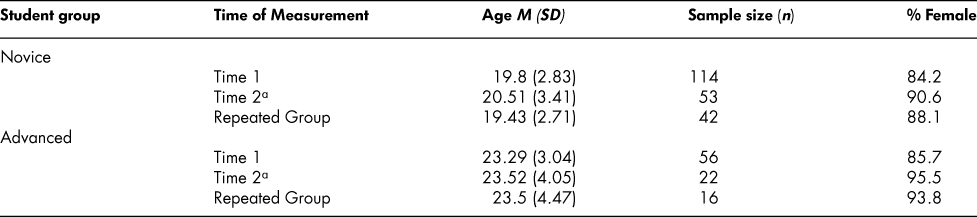
Table 1 presents the mean age and gender distribution of students in the novice and advanced groups. The novice and advanced student groups did not differ from each other in terms of gender at either Time 1 [χ2 (1, n = 170) = .07, p = .798, Cramér’s V = .02] or Time 2 [χ2 (1, n = 75) = .51, p = .477, Cramér’s V = .08]. The characteristics of the subsample of individuals who answered the survey at both testing times (repeated group) are also provided. A t-test was run on age at Time 1 to compare the students who returned for testing to the students who did not return. The mean age for returning novices (M = 19.46, SD = 2.73, n = 41) did not differ from the mean age for the novices who did not return [M = 19.99, SD = 2.88, n = 73, t(112) = –.95, p = .34]. Similarly, a t-test showed that the age of the advanced students who returned (M = 23.53, SD = 4.63, n = 15) and the advanced students who did not return (M = 23.2, SD = 2.28, n = 41) did not differ: t(54) = .37, p = .72.
Demographic characteristics of study sample at Time 1, Time 2, and the repeated group

a Larger sample size at Time 2 compared to the repeated group was because some students who filled out questionnaires at Time 2 were not present at Time 1.
M = arithmetic mean
SD = standard deviation
Procedure
This study used a mixed longitudinal and cross-sectional design. Measurements were taken at two times: at the beginning of the fall semester, first- and second-year students (the novice group) and fourth-year students (the advanced group) completed the survey; at the end of the winter semester, both groups were approached for retesting with the original questionnaire, along with the addition of some new questions. The students were tested at either the beginning or end of class time. The questionnaire was given in English, while instructions were verbally delivered in French and English, and students were given the option of responding to the questions in French or English. Although the mother tongue of most of these students was French, this approach was deemed acceptable as instructors noted that (a) English textbooks were regularly used in the program, (b) an English course was a requirement of the program, (c) students were living in a predominantly English city, and (d) many students did their clinical placements in an English-speaking environment.
Materials
The questionnaire used a mix of qualitative open-ended questions and quantitative Likert scales. It addressed which age group nursing students wanted to work with and why, past relationships and experiences potentially moderating this decision, and attitudes towards older adults. The first question looked at the student’s willingness to work with six different age groups (i.e., ages 0–10, 11–20, 21–40, 41–60, 61–80, and 81 and over). For each age group, respondents were asked to rate their willingness to work with them on a 7-point scale ranging from “not at all willing” to “very willing”. The question was adapted from Zambrini et al. (Reference Zambrini, Moraru, Hanna and Kalache2008). Students were then presented with a series of open-ended questions in which they were asked to give three reasons why, and then why not, they would wish to work with children and with older adults (i.e., List three reasons why in your own nursing career you would enjoy providing care for older adults/young children; List three reasons why in your own nursing career you would not enjoy providing care for older adults/young children). The next question, taken from Moyle (Reference Moyle2003), asked at what age the participants conceptualized adults as “older”. The questionnaire then included a series of 16 questions adapted from the medical student survey by Le Couteur et al. (Reference Le Couteur, Bansal and Price1997) relating to attitudes about the care of older people. Changes we made to the original survey included the following: (a) questions were adapted to be used for a nursing rather than a medical sample, (b) two questions were added relating to communication issues, (c) two questions were added relating to the psychological/emotional needs of elderly patients, and (d) one question was added presenting the complexity of elderly adults’ medical conditions as a rewarding challenge. Possible responses to each question ranged from 1 (strongly agree) to 5 (strongly disagree). The survey concluded with a series of demographic questions.
Scoring
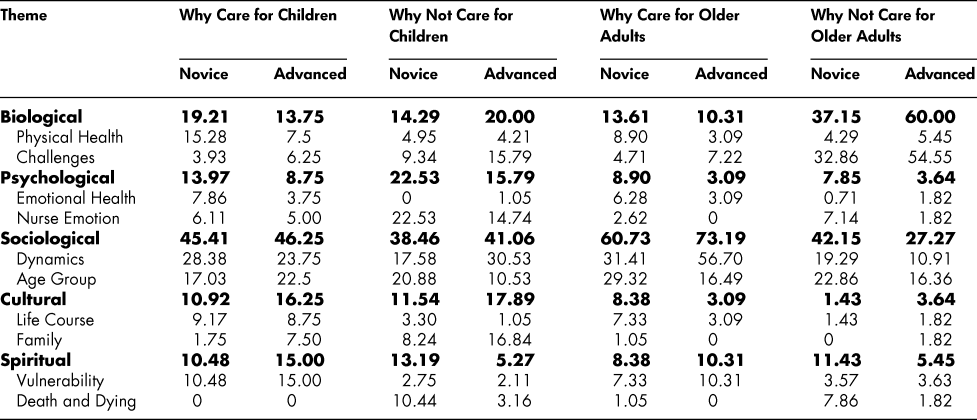
A scoring system was established for the open-ended questions that asked why or why not the participant would be willing to work with a particular cohort. This was done by establishing themes from the answers of a sample of 20 surveys. Subsequently, the coders (this article’s first and second authors) separately used the themes to code 10 new surveys, and we assessed inter-rater reliability. The themes we identified, along with examples, are provided in Table 2 and Table 3. Throughout the process, 20 surveys were coded at a time and any disagreements were discussed and resolved.
Distribution of reasons to care/not care responses in each category for novice and advanced students

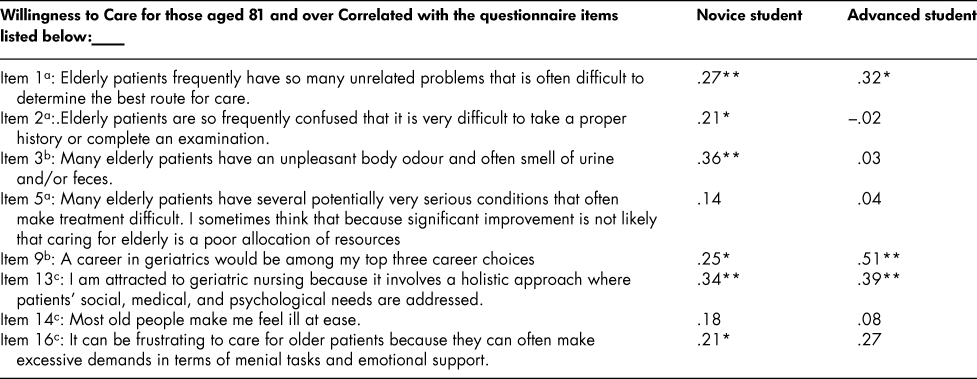
Correlations between willingness to care for patients aged 81 and over and attitudes questionnaire for novice and advanced students

* p < .05, ** p < .01
a Item is adapted from Le Couteur et al., (Reference Le Couteur, Bansal and Price1997); b Item is reproduced from Le Couteur et al, (Reference Le Couteur, Bansal and Price1997); c Item developed for this study.
A low score indicates agreement with the statement. Scores on the questionnaire could vary between 1 (strongly agree) to 5 (strongly disagree).
As a first step, the two coders assigned all responses to 11 preliminary categories. There were 1,158 decisions made, with an agreement rate of 89 per cent (Cohen’s kappa = 0.810). In a second step, it was decided that three categories occurred relatively infrequently, and were conceptually similar to other categories. Items originally coded in these categories were at this point reassigned independently by the two coders. Agreement for these reassignments was 83 per cent. Finally, in a third step, it was determined that a category labeled “patient relations” was not only very large but that it also contained two distinct themes, namely “dynamics of nurse-patient interactions” and “characteristics of the age group”. Thus, the coders independently reassigned all items from the patient relations category into these two new categories, and agreement was 91.52 per cent. The final 10 themes we developed, described in the following paragraphs, fall within the typical bio-psycho-social-cultural-spiritual framework used within nursing education (Roy & Andrews, Reference Roy and Andrews1999). Examples of responses to the question of why or why not the respondent would be willing to work with a particular age cohort are provided in italics.
Biological Themes
Nursing Care: Physical Health referred to the potential or lack of potential for positive health outcomes and improvement in the patient from the help of the nurse (e.g., “I think I can care for them in a way that best helps them” and “You often see them deteriorate instead of getting better”).
Challenges referred to how easy, interesting, or intellectually challenging the work was for the students or the skill advancement made possible by the work, or in contrast, how difficult, boring, and low-tech the work was or lack of skill advancement that was made possible by the work (e.g., “A challenge because they [patients] often have more than one condition/illness” and “They [patients] can get aggressive if they have dementia”).
Psychological Themes
Nursing Care: Emotional Health referred to the nurse’s being able, or unable, to improve the patient’s emotional well-being (e.g., “Help them with their loss of independence and have a better quality of life” and “Afraid to traumatize them”).
Emotional Experience of the Nurse referred to when the nurses discussed their own personal emotions experienced during care (e.g., “Helping a sick child is heart-warming” and “It would be difficult to see them in pain”).
Sociological Themes
Nurse-Patient Dynamics referred to interactions between the nurse and patient and how these interactions positively or negatively affected nursing care (e.g., “They can participate in the nursing care” and “They don’t always cooperate well”).
Characteristics of the Age Group referred to the generalizations about and attitudes towards the general age group of the patient (e.g., “[I would want to work with children] Because they’re adorable and full of fun” and “They are very demanding”).
Cultural Themes
Family referred to dealing with the patient’s family members, whether this made providing care easier or more difficult (e.g., “You work with the parents, so they can get better care” and “Parents are sometimes too demanding and don’t know when the care is going too far and where to stop”).
Life Course referred to when the person’s place in the lifespan was emphasized (e.g., “I want them to live a long and productive life. They are our future” and “Knowing they are sick and have not lived their life yet”).
Spiritual Themes
Vulnerability referred to the patient’s being a type of person who particularly needs help, who can’t care for themselves as well as the basic/fundamental right for care and respect (e.g., “They need someone to protect/defend them” and “They are very needy”).
Death and Dying referred to any mention of death (e.g., “So they die well (with dignity, happy, in peace) a nurse can make a difference” and “Seeing a kid pass away”).
Results
Willingness to Care
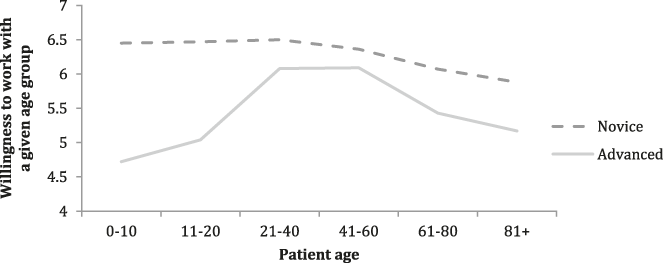
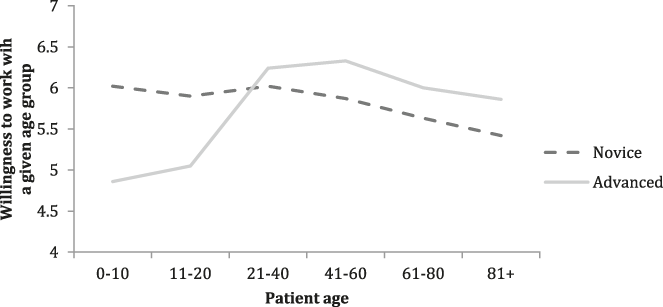
The first set of analyses addressed the issue of the nursing students’ willingness to care for individuals of different age groups at the beginning of the academic year. A 2 (student level) × 6 (patient age) mixed ANOVA was carried out with patient age treated as a repeated-measure factor. As Figure 1 shows, it was found that novice students had higher scores overall than advanced students [F(1, 164) = 36.36, p < .001, partial η2 = .181], that patient age had a significant effect [F(2.58, 422.77) = 13.53, p < .001, partial η2 = .076], and that the interaction was significant [F(2.58, 422.77) = 10.79, p < .001, partial η2 = .062]. Simple main effects showed that the student levels differed on all patient ages except 41–60, with significant Fs ranging from 7.10–49.61. In all cases, the novice students’ attitudes were more positive than those of the advanced students.
Willingness to care across age categories at Time 1

Using a different approach, we also looked at the two student groups separately, and tested polynomial trends across the patient age groups. For novice students, the strongest effect was for a linear trend [F(1,112) = 15.56, p < .001, partial η2 = .12], showing that they were less willing to care for elderly patients than other age groups. In contrast, for the advanced students, the strongest trend was a quadratic one [F(1,52) = 24.26, p < .001, η2= .320], showing that advanced students were less keen on working with both children and older adults.
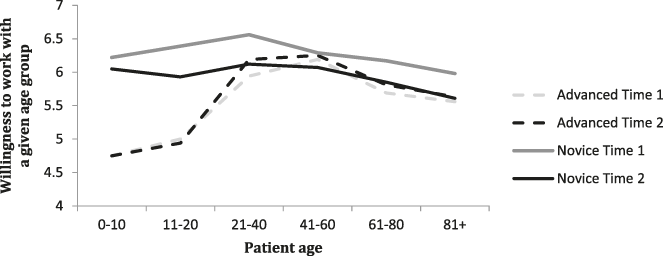
In a second analysis, responses at the end of the academic year were analyzed. A 2 (student level) × 6 (patient age) mixed ANOVA was run on responses at Time 2, and it was found that student level was not significant [F(1, 71) = .12 , p = .725, partial η2 = .002], but that patient age [F(2.36, 167.43) = 3.73, p = .02, partial η2 = .05] and the interaction were both significant [F(2.36, 167.43) = 5.41, p = .003, partial η2 = .071]. Simple main effects showed that the student levels differed only on ages 0–10 [F(1, 71) = 7.49, p = .008, partial η2 = .095] and 11–20 [F(1, 71) = 4.24, p = .043, partial η2 = .056]. At both these ages, the novice students were more positive than were the advanced students. Again, follow-up analyses were done using polynomial contrasts. For the novice students, no contrasts were statistically significant (p > .05), indicating that their willingness to care did not differ across age groups. For the advanced students, the quadratic effect was very strong [F(1,20) = 19.68, p < .001, η2 = .35], showing that their preferences for caring for younger adults had not changed. These results can be seen in Figure 2.
Willingness to care across age categories at Time 2

In a third analysis, the change in responses from the beginning to the end of the academic year was observed in the subsample that was tested at both times. Because some students were present only for testing at Time 2, this analysis included only those students who returned for the second testing period. A 2 (student level) × 2 (time of measurement) × 6 (patient age) doubly repeated mixed ANOVA was run on willingness-to-care responses, with each participant tested at Time 1 and Time 2, and at both times providing a rating for all six patient age categories. As Figure 3 shows, it was found that novice students were generally more willing to care than advanced students [F(2.24, 122.98) = 3.64, p = .025, partial η2 = .062]. Also, the interaction of time of measurement and student level was significant [F(1, 1.34) = 4.18, p = .046, partial η2= .071], indicating that novice students had a larger decrease in their willingness to care than did advanced students.
Willingness to care at Time 1 and Time 2 for students tested at both times of measurement.

Patients’ age also had a significant effect [F(2.24, 122.98) = 4.37, p = .012, partial η2 =.074], such that students did not regard all ages similarly. The results were not significant for the time of measurement [F(1, 55) = 1.70, p = .198, partial η2 =.03], for the patients’ age by time of measurement interaction [F(4.04, 222.46) = .285, p = .889, partial η2 = .005], nor for the interaction between the three variables [F(4.04, 222.46) = .431, p = .788, partial η2= .008]. In summary, novice students were more willing to work with older adults than were advanced students at Time 1, but this difference disappeared at Time 2. This seems to be due to novices becoming more negative in their ratings in general, with advanced students remaining consistent in their ratings.
One possible explanation for different ratings by the two student groups was that they perceived the age categories differently. However, novice and advanced students did not have significantly different responses for what age they consider a person to be an older adult: F(1, 163) = 3.48, p = .064, partial η2 = .021. Score on this variable ranged from 55 to 100, (M = 69.99, SD = 7.6).
Reasons to Care/Not Care
To obtain a deeper understanding of the ratings obtained in the willingness-to-care responses, participants were asked to provide three reasons why they would enjoy or not enjoy providing care for young children and older adults. Each response was grouped into one of 10 categories corresponding to the bio-psycho-social-cultural-spiritual framework used within nursing (Roy & Andrews, Reference Roy and Andrews1999) (see Table 2).
A chi-square test of independence was carried out to compare how novice and advanced students’ responses were distributed across the 10 categories. There was no significant difference between novice and advanced students as to why they would enjoy working with young children [χ2 (8, n = 309) = 13.56, p = .09, Cramér’s V = .21] and not enjoy working with older adults [χ2 (9, n = 195) = 14.69, p = .10, Cramér’s V = .27]. However, there was a significant difference between novice and advanced students as to why they would enjoy working with older adults: χ2 (9, n = 288) = 26.85, p = .001, Cramér’s V = .31. Advanced students were much more likely to refer to issues surrounding the Nurse-Patient Dynamics theme than were novice students, while the latter were much more likely to discuss the characteristics of the age group as a whole. The two groups of students also differed in the reasons offered for why a student would not enjoy working with children: χ2 (9, n = 277) = 24.39, p = .004, Cramér’s V = .30. The advanced students more frequently reported responses related to Family, Challenges, and Nurse-Patient Dynamics themes, while novice students responses related more to the Emotional Experience of the Nurse and the Characteristics of the Age Group themes.
Predicting Willingness to Care
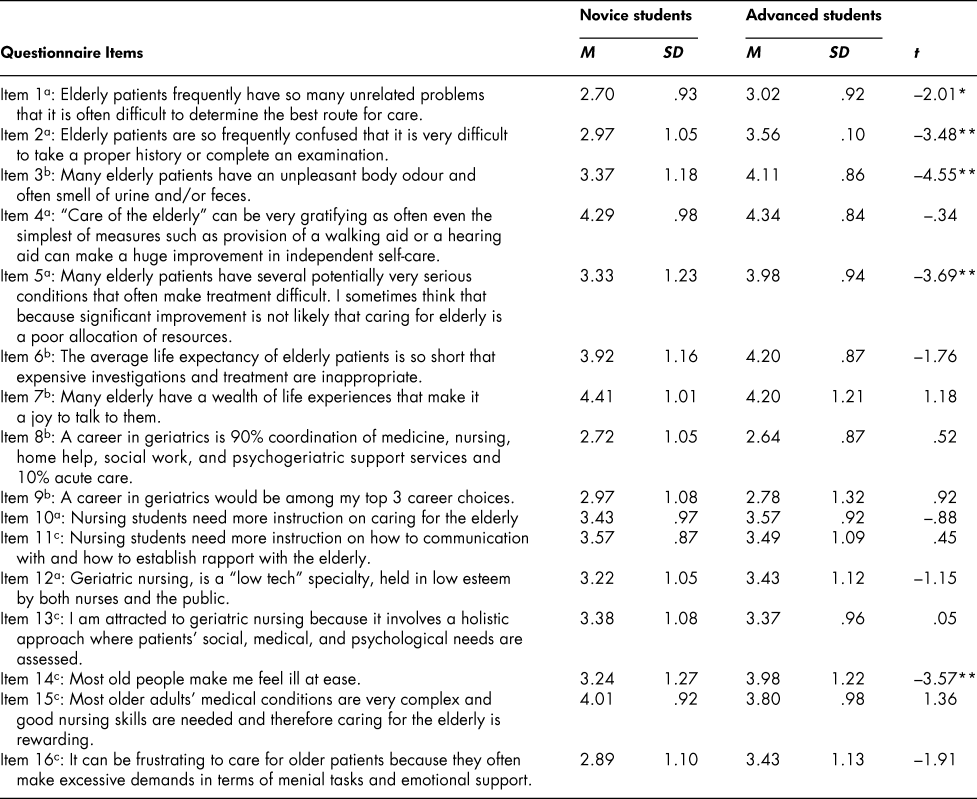
To explore variables related to willingness to care, the 16 questions we adapted from the Le Couteur et al. (Reference Le Couteur, Bansal and Price1997) questionnaire were correlated with a willingness to care for patients age 81 and over, and the means of the two student groups were compared on each questionnaire item. Because the reliability of the scale was low (Cronbach α = .62), analyses were carried out with individual items. Only responses at Time 1 were included in these analyses. This was then done with the novices and the advanced students separately. Statistically significant results are presented in Tables 3 and 4. The results show that novice students were more likely to focus on stereotypes of older adults that make the students less willing to work with them (such as older adults having a bad odour and being demanding). There were significant differences between novice and advanced students on issues such as feeling ill at ease around older adults and the view that treating older adults was a poor allocation of nursing resources. In general, advanced students demonstrated more-positive attitudes. For the question about body odour, the Fisher r-to-z transformation showed that correlations with willingness to care differed significantly among the novices and the advanced students: z = 1.98, p = .048, two tailed.
Means, standard deviations, and t-tests for attitude questionnaire items among novice and advanced students

* p < .05, ** p < .01
M = arithmetic mean
SD = standard deviation
t =t-test
A low score indicates agreement with the statement. Scores on the questionnaire ranged from 1 (strongly agree) to 5 (strongly disagree).
a Item is adapted from Le Couteur et al., (Reference Le Couteur, Bansal and Price1997); b Item is reproduced from Le Couteur et al, (Reference Le Couteur, Bansal and Price1997); c Item developed for this study.
Discussion
For purposes of this study, we posited that a better understanding of nursing students’ attitudes towards caring for older patients is an important aspect of preparing for the aging of the Canadian population. Our key variable of interest was students’ willingness to care for patients across the lifespan. As others have found in past research, the nursing students tested here were not equally willing to work with all age groups. The differences we observed indicated that novice students were generally more positive than advanced students, thus replicating findings previously reported by Haight et al. (Reference Haight, Christ and Dias1994).
The attitudinal changes that occurred from the beginning to the end of the academic year for novice students are of particular interest: they represent students’ reactions to their first clinical placements – and all of these students cared for older patients, either in acute or long-term care settings. Generally, students became less positive about nursing for all age groups, not only about caring for older patients. Although the negative linear trend across age groups was still present at Time 2, it was no longer significant, possibly because of the loss of power linked to the smaller sample size present at Time 2. Thus, while the experience of caring for older adults did not significantly decrease willingness to care for older adults at the end of the year, it certainly did not improve it, either. The overall decrease in ratings may simply reflect the more realistic perspective students held at the end of the academic year than before any hands-on care had been carried out.
It is interesting to contrast this result with that obtained for advanced students. Specifically, having cared for children during their nursing training, the advanced students reported negative attitudes towards the care of both children and older adults. Thus, contact with children but not with older adults seemed to lead to negative attitudes towards caring for both age groups. One possible interpretation of this pattern is that nursing students entered the program with negative attitudes about the elderly – and that this negativity is reinforced – or at the very least not eradicated – during their clinical placements.
Despite the finding that nursing students in general were more positive about care for young and middle-aged adults, the nursing students tested here notably were relatively positive about caring for older adults, particularly when compared to past studies (e.g., Le Couteur et al, Reference Le Couteur, Bansal and Price1997; Moyle, Reference Moyle2003). Indeed, average ratings were above a 5 on the 7-point Likert scale (with 44% of the sample rating themselves as “very willing” (a 7) on the scale at Time 1, and 35% selecting “very willing” at Time 2). These results can be contrasted with those of Moyle (Reference Moyle2003) who found that only 3 per cent of those studied had an interest in working in geriatrics. On the one hand, the different results obtained in the two studies may be linked to sociocultural differences between Moyle’s Australian sample and our Canadian one. On the other hand, the phrasing of the questions used in the two studies may be key to explaining the different results. In the Moyle study, nursing students were asked “do you want to work in aged care” (Moyle, Reference Moyle2003, p. 19), whereas in this study we asked students, “Once you are a nurse, how willing would you be to care for the following types of patients?” Moyle’s respondents may have interpreted the question to mean choosing to care exclusively for this age group – possibly in a long-term care setting, while our phrasing may have allowed students to see older patients as only part of their patient load in an acute care setting. Clearly, further exploration of student nurses’ perceptions of what geriatric nursing means would be not only fascinating but also important.
One strength of our study was that the use of open-ended questions allowed us to more deeply explore attitudes about work with different age cohorts. Indeed, the pattern of responses obtained to the open-ended questions suggests that nursing students, even in their first year, possess a multidimensional view of nursing care, which includes psychological, cultural, and spiritual aspects. If we focus on the reasons provided for why it would be enjoyable to work with older adults, the most commonly used categories by both student groups fell within the sociological-issues domain. Interestingly, note that whereas novice students were equally likely to produce reasons relating to Characteristics of the Age Groups and Nurse-Patient Dynamics themes, advanced students were more likely to emphasize Nurse-Patient Dynamics. Basically, advanced students focused less on the stereotypical beliefs about the age group as a whole and more on the positive aspects of interpersonal interactions within a nursing care context. Although not statistically significant, the pattern of responses obtained for reasons why it would not be enjoyable to care for older patients remains interesting. Advanced students were less likely to mention difficulties with Nurse-Patient Dynamics, and much more likely to mention the Challenges-related theme of caring for older patients, namely the fact that the work is difficult and low-tech, particularly when dementia is present in patients.
The use of open-ended questions also allowed us to further compare our findings to Moyle’s (Reference Moyle2003) findings. In that study, students responded in open-ended format to questions about why they would not wish to work in “aged care”. The students stated that they saw this work as “a depressing area where everyone was dying” (Moyle, Reference Moyle2003, p. 19). In this study, two categories correspond to the notion of depressing work: the negative Nurse Emotion theme, and Death and Dying theme. Surprisingly, not only were novice students (who were less likely to have experienced the death of a patient) more likely to produce these responses, but they were more likely to produce them as reasons why they would not enjoy working with children rather than with older adults. These results may also indicate that novices hadn’t yet learned to distance themselves from their work, as can be implied from their increased focus on their own emotions. For both novices and advanced students in this study, it may have been easier to distance themselves from their own emotions with older adults than with children.
The final set of measures in our study was the use of a questionnaire adapted from that used by Le Couteur et al. (Reference Le Couteur, Bansal and Price1997). The students were asked to rate their agreement with a series of questions addressing attitudes about caring for older patients. Generally, the advanced students were found to have more positive attitudes than did the novice students. Moreover, when we looked at which of these responses were predictive of the willingness-to-care variable, we found that three questions in particular were dramatically different for the two student groups. Specifically, for novice students, (a) the more they felt that older patients are frequently confused and difficult to work with (Item 2), (b) the more they felt that older people have an unpleasant body odour related to urine and feces (Item 3); and, the more they felt that older adults are frustrating and demanding (Item 16), the less likely they were to be willing to care for older adults.
Although it is not surprising that such negative views of older adults would reduce one’s willingness to care for them, what is surprising is that this relationship was present for novices but not for advanced students. Thus, these results, like those for the open-ended questions, suggest that novice nursing students’ career choices seem to be greatly influenced by general or stereotypical views of old age. More advanced students, in contrast, seem to base their career preferences on practical issues, such as the difficulty of the work (Item 1), and their personal interest in the holistic care needed in geriatric care (Item 13).
In conclusion, this pattern of findings, if replicated, suggests that targeted interventions may be helpful to increase interest in geriatric nursing among nursing students. If novice students base their willingness to care for older adults on general stereotypes about aging, it is possible that interventions addressing these negative views may be particularly effective. Specifically, nursing programs could focus on providing novice nursing students with opportunities to modify their negative stereotypes of older adults through work with healthy community-dwelling seniors. Indeed, authors such as Ferrario et al. (Reference Ferrario, Freeman, Nellett and Scheel2008) have made similar proposals. One possible downside of this type of intervention, however, is that it may reinforce negative attitudes about older frail adults if the differences between ill and healthy older adults are emphasized. An alternative approach would be to give these novice students opportunities to work with experienced nurses who value and enjoy their work with vulnerable older populations. Clearly, the effectiveness of these contrasting interventions is an empirical question worthy of further study.
A further implication of the results we obtained is that different interventions may be needed for advanced students. With these students, it may be necessary to show that acute care of older patients can be intellectually challenging and require complex skills, while at the same time providing these students with the skills required to work safely and comfortably with difficult patients (e.g., aggressive dementia patients; obese immobile patients). Clearly, exposure to role models who enjoy their work and can share their passion and enthusiasm as well as their skills is vital at all stages of geriatric nursing training.
Finally, this study has a number of limitations, not least among them a small sample limited to a single nursing program, a diverse novice sample made up of both first- and second-year students, and a high attrition rate. Moreover, although the students were bilingual, the survey was presented in English, and comprehension problems may have hampered responses to some items. Despite these important limitations, the methodology used here and the results obtained suggest an interesting and possibly fertile approach to understanding attitudes about caring for aging patients – and preparing the health care field for a rapidly aging population.