INTRODUCTION
The philophthalmid trematode Parorchis acanthus (Nicoll, 1906), parasitizing in a variety of marine gastropods and seabirds, is distributed in coastal waters worldwide (Yamaguti, Reference Yamaguti1971; Lauckner, Reference Lauckner and Kinne1980). In rocky shore habitats of the eastern North Atlantic, intramolluscan stages of this trematode are commonly observed in the dogwhelk Nucella lapillus (Linnaeus, 1758), causing castration and shell deformation in affected individuals (Feare, Reference Feare1970). Unlike the majority of digeneans which typically exploit three hosts (Poulin & Cribb, Reference Poulin and Cribb2002), P. acanthus exhibits a two-host life cycle, comprising a gastropod intermediate and a bird final host. The comparatively large cercariae (see Rees, Reference Rees1937), developing in colourless rediae in the gastropod's digestive gland, do not seek and penetrate a second intermediate host following liberation from the gastropod, but form a protective cyst on a substrate in the open. The encysted metacercariae have to be ingested by the avian final host, to allow completion of the life cycle.
Whilst recent studies on factors influencing the transmission of marine cercariae focused on digeneans exhibiting a three-host life cycle (e.g. de Montaudouin et al., Reference de Montaudouin, Wegeberg, Jensen and Sauriau1998; Jensen et al., Reference Jensen, Castro and Bachelet1999; Wegeberg et al., Reference Wegeberg, de Montaudouin and Jensen1999; Cross et al., Reference Cross, Irwin and Fitzpatrick2001; Mouritsen, Reference Mouritsen2002a, Reference Mouritsenb; Thieltges & Rick, Reference Thieltges and Rick2006; Thieltges, Reference Thieltges2007; Thieltges et al., Reference Thieltges, Bordalo, Caballero Hernández, Prinz and Jensen2008), transmission processes in trematode species whose cercariae encyst in the open received less attention (Evans et al., Reference Evans, Irwin and Fitzpatrick1997; Morley et al., Reference Morley, Crane and Lewis2001, Reference Morley, Leung, Morritt and Crane2003; Bennett et al., Reference Bennett, Irwin and Fitzpatrick2003; Prinz et al., Reference Prinz, Kelly, O'Riordan and Culloty2009). Although P. acanthus represents a ubiquitous parasitological component of marine coastal ecosystems and affects a variety of different organisms by exhibiting a wide host spectrum, information on the transmission of this parasite is still scarce. However, knowledge of factors regulating transmission is crucial for the understanding of the ecology of this cosmopolitan species. Considering the fact that P. acanthus cercariae encyst in contact with various solid surfaces, mechanisms increasing the probability of successful transmission (i.e. by encystment on a substrate forming the diet of the target host) are of particular interest.
Here, we present data on the transmission ecology of cercariae of P. acanthus with regard to the importance of various abiotic and biotic factors. Since temperature (Pietrock & Marcogliese, Reference Pietrock and Marcogliese2003; Thieltges & Rick, Reference Thieltges and Rick2006), light (Bell et al., Reference Bell, Sommerville and Gibson1999; Mouritsen Reference Mouritsen2002a) and water level (Koprivnikar & Poulin, Reference Koprivnikar and Poulin2009) are known to be important environmental parameters affecting trematode transmission, we investigated the influence of these factors on the emergence of cercariae from the intermediate host N. lapillus and on cercarial encystment, respectively, in two laboratory experiments. Moreover, biotic factors like host density (Mouritsen et al., Reference Mouritsen, McKechnie, Meenken, Toynbee and Poulin2003), size (Jensen et al., Reference Jensen, Castro and Bachelet1999), condition (Mouritsen et al., Reference Mouritsen, McKechnie, Meenken, Toynbee and Poulin2003) and the presence of ambient organisms within the host space (Thieltges et al., Reference Thieltges, Bordalo, Caballero Hernández, Prinz and Jensen2008; Prinz et al., Reference Prinz, Kelly, O'Riordan and Culloty2009) may determine transmission success. Therefore, we studied cercarial settlement on blue mussels Mytilus edulis Linnaeus, 1758, in relation to quality and quantity of the mussel substrate provided in another three experiments.
MATERIALS AND METHODS
Organisms
Dogwhelks Nucella lapillus (25–29 mm shell height) as a source for Parorchis acanthus cercariae were collected from Grab-all Bay, Crosshaven, Ireland (51°48′N 8°16′W). Individuals infected with the parasite were isolated in the laboratory by observing release of cercariae when exposing snails to light in seawater at room temperature. Blue mussels Mytilus edulis were obtained from Blackrock, Ireland (53°17′N 6°09′W). Mussels and dogwhelks, the latter being fed with small M. edulis, were maintained in the laboratory in separate tanks filled with constantly aerated seawater at 15°C and light applied from above before the start of the experiments. All organisms were collected just prior to conducting the respective experiments. Mussel shells were cleaned and inspected for the presence of P. acanthus cysts under a stereomicroscope before being used in the laboratory trials.
Laboratory experiments
CERCARIAL EMERGENCE FROM NUCELLA LAPILLUS
To test whether temperature influences cercarial release from N. lapillus as well as subsequent encystment (experiment 1), dogwhelks infected with P. acanthus were individually placed in clear plastic dishes filled with 300 ml of seawater and covered with a clear plastic lid, to keep gastropods from crawling out. Dishes were maintained in a water bath at 10, 15, 20 and 25°C, respectively. Each treatment was replicated ten times. Constant aeration and artificial daylight were applied throughout the experiment. After 8 hours, gastropods were removed and the dishes were left in the experimental set ups for another 24 hours to allow formation of metacercarial cysts. Metacercariae as well as unencysted cercariae in the dishes were subsequently counted under a stereomicroscope.
To investigate the influence of light and water on cercarial emergence (experiment 2), 40 infected dogwhelks were individually placed in clear plastic dishes. Half of the dishes were subsequently filled with 300 ml of seawater, the other half were moistened with seawater prior to the start of the experiment using an aerosol can. All treatments were covered with a clear plastic lid, placed in a constant temperature room at 15°C with artificial light applied from above and constantly aerated (where appropriate). Ten dishes filled with seawater and ten dishes without water were covered with a box to keep them in darkness. After 8 hours, gastropods were removed from the dishes and numbers of cercariae (whether encysted or unencysted) were determined per dish under a stereomicroscope.
CERCARIAL SETTLEMENT ON MYTILUS EDULIS
To study the settlement of P. acanthus cercariae on M. edulis in relation to quality and quantity of the mussel substrate provided (experiment 3), five different treatments were set up: (1) one M. edulis; (2) one M. edulis with valves held shut by means of a cable tie; (3) one empty M. edulis shell with valves held shut; (4) one M. edulis densely covered (>90% of the shell) with barnacles Semibalanus balanoides; and (5) six small M. edulis. Shell length of mussels in the treatments 1–4 ranged between 32 and 35 mm. Mussels in treatment 5 measured 17–20 mm. Their combined fresh weight (approximately 6 g) matched the fresh weight of one mussel individual used in treatment 1. Mussels were placed in clear plastic dishes filled with 300 ml of seawater. Since cercarial stages of P. acanthus rapidly encyst when in contact with any solid surface (e.g. the tip of a pipette), adding a defined number of cercariae was not feasible. Therefore, one N. lapillus infected with P. acanthus was added to each dish. The dishes were covered, placed in a constant temperature room at 15°C under artificial daylight and constantly aerated for the duration of the experiment. Each treatment was replicated ten times. After 24 hours, dogwhelks were removed from the dishes. After another 24 hours, numbers of encysted metacercariae on the mussels and in the dishes were counted and position of metacercariae on the mussel valves recorded using a stereomicroscope. In addition to the experiment, separate dishes containing mussels of each experimental treatment were observed under a stereomicroscope to document the process of cercarial settlement on the mussel valves.
In a further experiment, we tested the influence of mussel density on the settlement success and intensity of P. acanthus larvae on M. edulis (experiment 4). Plastic dishes, filled with 300 ml of seawater, were placed in a constant temperature room at 15°C and constantly aerated for the duration of the experiment. Three different densities of M. edulis (18–22 mm shell length) were used: 5, 10 and 20 mussels respectively per dish. One infected dogwhelk was added per dish, which were subsequently covered with a lid. Each treatment was replicated ten times. After 24 hours, gastropods were removed from the dishes. After another 24 hours, numbers of encysted metacercariae on the mussels and in the dishes were determined under a stereomicroscope.
As observations of cercarial settlement have revealed (experiment 3; see Results), cercariae enter the mussel via the inhalation current before actively emerging using their suckers and encysting on the shell. To evaluate the importance of mussel size on cercarial settlement efficiency (experiment 5), small (16–18 mm shell length) and large (48–51 mm) M. edulis were individually placed in dishes containing P. acanthus cercariae (maximum age of two hours) and allowed to inhale 50 cercariae each, which was observed under a stereomicroscope. Mussels were subsequently removed from the dishes and individually transferred into fresh, aerated seawater for another 24 hours, to allow cyst formation. Mussel shells were screened for cysts and numbers of metacercariae were noted.
Statistical analysis
Cercarial encystment success (experiment 1) was calculated by dividing the number of metacercarial cysts by the total number of emerged cercariae. Cercarial settlement success (experiments 3 and 4) was determined by dividing the number of cysts counted on the mussel valves by the total number of metacercariae in the dish. Recovery rates of cercariae (experiment 5) were calculated by dividing the number of cysts recovered on the mussel shells by the number of cercariae inhaled.
All statistical analyses were performed using the statistical package SPSS for Windows. Results were considered as significant at P < 0.05. Prior to the parametric tests, data were examined for violation of assumptions and transformed if required. A two-way analysis of variance (ANOVA) was used to evaluate differences in numbers of emerged cercariae per treatment in experiment 2, with light and water as fixed factors after log(y + 1)-transformation of data. Differences in numbers of emerged cercariae and cercarial encystment rates in experiment 1 as well as intensity (number of cysts per mussel) and settlement success in experiment 4 were tested using one-way ANOVAs with temperature and mussel density, respectively, as fixed factor. Cercarial numbers were square root-transformed; data on intensity were log-transformed. Data on cercarial encystment as well as settlement success were arcsine-transformed. Post-hoc calculations were done with Tukey's HSD-test. Data on settlement success in experiment 3 (influence of mussel substrate) were analysed with t-tests, after being arcsine-transformed. To test for differences in the recovery rate in experiment 5 (influence of mussel size) a t-test was performed. Potential differences in mussel shell length (mussel fresh weight, respectively, in case of the treatment with six small mussels) between the treatment containing one mussel and the other treatments in experiment 3, were analysed with t-tests. Possible differences in mussel shell length between treatments in experiment 4 were checked using a one-way ANOVA.
RESULTS
Cercarial emergence from Nucella lapillus
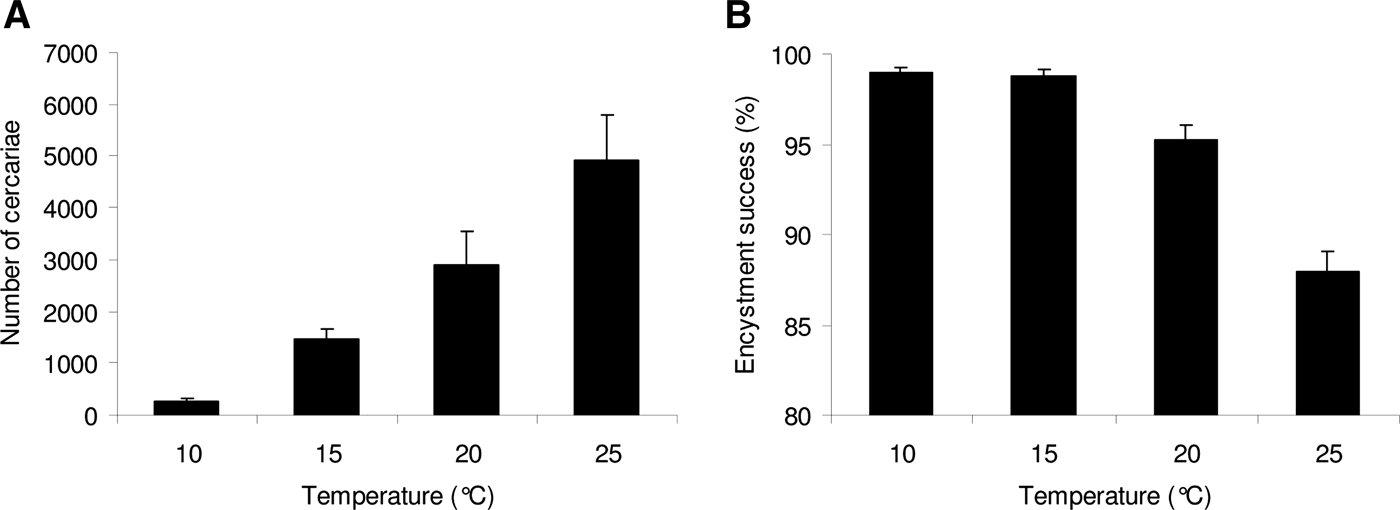
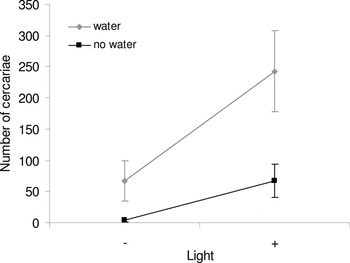
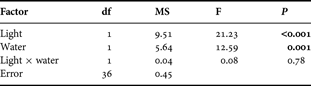
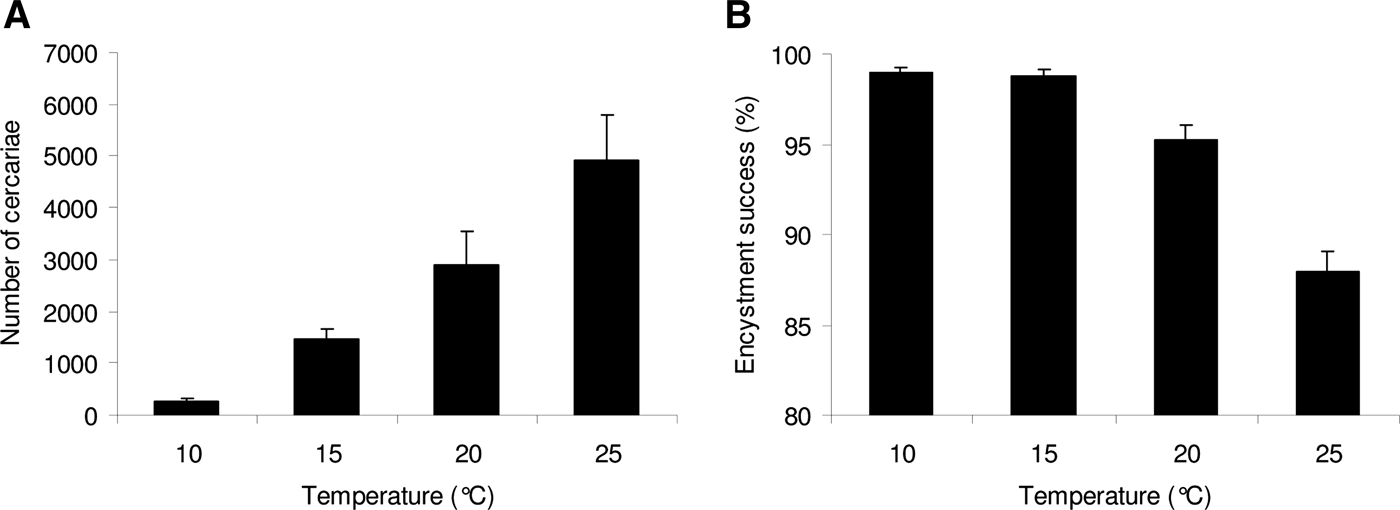
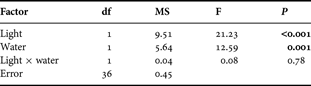
Numbers of cercariae released from Nucella lapillus increased with increasing temperature (one-way ANOVA; F3,36 = 25.98, P < 0.001; Figure 1A). A significant difference in numbers of emerged cercariae was observed between 10 and 15°C (Tukey's HSD-test; P = 0.004), 10 and 20°C (P < 0.001), 10 and 25°C (P < 0.001), as well as between 15 and 25°C (P < 0.001). Cercarial encystment success decreased with increasing temperature (one-way ANOVA; F3,36 = 43.69, P < 0.001; Figure 1B) due to significant differences in encystment rates between all treatments (Tukey's HSD-test; P < 0.001 each, and P = 0.001 for the difference between 15 and 20°C, respectively), with the exception of the difference in encystment rates between 10 and 15°C, which was not significant. Both light and water significantly affected numbers of released cercariae (Figure 2; Table 1). Numbers of emerged cercariae were highest in the presence of light and water. Statistical analysis showed no interaction between the two factors.
Emergence of Parorchis acanthus cercariae from the intermediate host Nucella lapillus and cercarial encystment at four different temperature regimes. (A) Mean number + SE of cercariae released per dogwhelk within 8 hours; (B) mean encystment success (%) + SE. N = 10 replicates per treatment.
Mean number ± SE of Parorchis acanthus cercariae released per gastropod intermediate host Nucella lapillus within 8 hours at four different combinations of the factors light and water. N = 10 replicates per treatment.

Results of a two-way analysis of variance, evaluating the number of Parorchis acanthus cercariae emerged from Nucella lapillus in relation to the factors light and water. Data were arcsine-transformed prior to analysis. N = 10 replicates per treatment. Significant results are in bold.
Cercarial settlement on Mytilus edulis
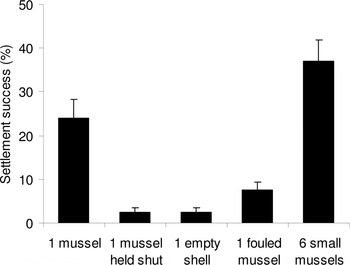
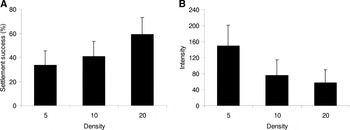
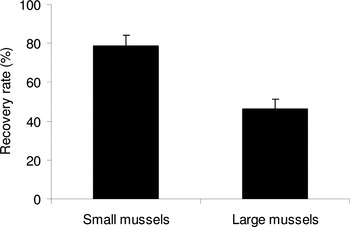
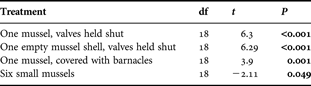
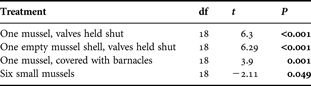
Cercarial settlement success on Mytilus edulis in experiment 3 was significantly lower in the treatments with empty and fouled shells as well as in mussels with valves held shut, when compared to the treatment containing one mussel (Figure 3; Table 2). Except in mussels with valves held shut and empty shells, M. edulis was observed to inhale cercariae. After being inhaled, cercariae actively emerged from the mussels using their suckers and subsequently encysted on the shells, preferably along the rim of the valves. In the treatment with barnacles, Semibalanus balanoides was found to actively filter and ingest as well as to disturb cercariae by causing small scale water turbulences. Six small mussels attracted more cercariae than one large M. edulis of the same fresh weight (Figure 3; Table 2). Mussel density positively influenced cercarial settlement success (one-way ANOVA; F2,27 = 9.84, P = 0.001; Figure 4A), which was due to a significant difference between the densities 5 and 20 mussels (Tukey's HSD-test; P < 0.001). In contrast, intensity of Parorchis acanthus cysts on M. edulis was higher at low densities (one-way ANOVA; F2,27 = 12.39, P < 0.001; Figure 4B). A post-hoc test revealed significant differences between the densities 5 and 10 mussels (Tukey's HSD-test; P = 0.014) and between 5 and 20 mussels (P < 0.001). The recovery rate of cercariae on small mussels in experiment 5 was almost twice that on large mussels (t-test; t = 4.32, P < 0.001; Figure 5). No differences in mussel length and fresh weight, respectively, between the respective treatments in experiment 3 and 4 were detected (P > 0.05).
Mean settlement success (%) + SE of Parorchis acanthus cercariae on Mytilus edulis in five different treatments (1 mussel, 1 mussel with valves held shut, 1 empty mussel shell with valves held shut, 1 mussel covered with barnacles Semibalanus balanoides and 6 small mussels matching the fresh weight of 1 large mussel). N = 10 replicates per treatment.

Settlement of Parorchis acanthus cercariae emerged from the gastropod intermediate host Nucella lapillus on Mytilus edulis at three different mussel densities (5, 10 and 20 individuals). (A) Mean settlement success (%) + SE; (B) mean intensity + SE. N = 10 replicates per treatment.

Mean recovery rate (%) + SE of Parorchis acanthus cercariae as metacercariae on small and large Mytilus edulis, respectively, after inhalation of 50 cercariae. N = 10 replicates per treatment.

Results of t-tests (one mussel versus treatment) for the experimental trials evaluating the settlement success of Parorchis acanthus cercariae on Mytilus edulis in relation to quality and quantity of the mussel substrate provided. Data were arcsine-transformed prior to analysis. N = 10 replicates per treatment. All results are significant.
DISCUSSION
The release of Parorchis acanthus cercariae from Nucella lapillus was strongly temperature-dependent, with a Q10 value (factor by which the rate of a reaction changes for every 10°C rise in temperature) of 11.5 at 20°C. The phenomenon that cercarial emergence increases with rising temperatures stronger than expected from physiological processes (Q10 ≈ 2) is commonly observed in marine and freshwater host–parasite systems (see Poulin, Reference Poulin2006; Thieltges & Rick, Reference Thieltges and Rick2006), suggesting that cercarial release is not only mediated by host metabolism, but also by other factors acting in synergy (Poulin, Reference Poulin2006). The unusual results (see Poulin, Reference Poulin2006) obtained by Rees (Reference Rees1937), who observed a slight decrease in cercarial output with increasing temperature in the same host–parasite system, are presumably due to experimental design. Although in the present study cercarial emission was highest at high temperatures, which may be occasionally reached in rock pools at low tide during sunny days in the summer, lower temperatures are presumably advantageous to P. acanthus with regard to cercarial encystment success. At high temperatures, cercariae use up their limited energy reserves quickly due to increased cercarial activity (Pechenik & Fried, Reference Pechenik and Fried1995), resulting in less energy available for the process of cyst formation, which may explain reduced encystment rates of P. acanthus cercariae at 20 and 25°C in our experiment. Since filtering activity of mussels, which increases with rising temperature (Newell, Reference Newell1979), is of importance for the accumulation of P. acanthus cysts on the valves of M. edulis (this study), it would be interesting to investigate temperature-dependent settlement success of cercariae using mussels as a substrate for encystment in future experiments.
Both the presence of light and water positively affected emergence of cercariae, with light being particularly influential. The factor light is known to strongly affect release of cercariae from the intermediate host; whilst in some marine as well as freshwater trematode species emergence of cercariae is enhanced by the presence of light (Kuntz, Reference Kuntz1947; Rees, Reference Rees1948; Craig, Reference Craig1975; Bell et al., Reference Bell, Sommerville and Gibson1999; Mouritsen, Reference Mouritsen2002a; this study), cercarial emission is stimulated by darkness in others (Olivier, Reference Olivier1951; Wagenbach & Alldredge, Reference Wagenbach and Alldredge1974; Craig, Reference Craig1975; Bell et al., Reference Bell, Sommerville and Gibson1999) or light- and dark-independent (Lo & Lee, Reference Lo and Lee1996; Lyholt & Buchmann, Reference Lyholt and Buchmann1996). It remains to be elucidated, whether light directly triggers the emergence of P. acanthus cercariae or acts indirectly by regulating host activity as the ultimate factor for release (Mouritsen, Reference Mouritsen2002b). The presence of water was found to enhance emission of cercariae from N. lapillus, which does not seem surprising in a marine gastropod host. However, cercariae were also released under damp conditions as they arise at low tide in the lower eulittoral, where dogwhelks commonly occur. In the dishes without seawater, we observed parasites moving inside the cyst wall, suggesting encystment of metacercariae being successful. The ability to emerge and successfully encyst when the gastropod host is not submerged allows continuous release of cercariae and largely extends the parasite's transmission window. Being somewhat independent of the tidal cycle could constitute an adaptive advantage in comparison to trematode species which are dependent on the presence of water as a medium for transmission to the second intermediate host. Moreover, cercariae which are liberated in the presence of water risk getting dislodged by tidal currents, resulting in loss of infective stages. Instead, P. acanthus cercariae released at low tide may encyst immediately after liberation, either directly on N. lapillus (Rees, Reference Rees1948; personal observation) or on M. edulis shells, which seems likely since these species are closely associated, both forming a suitable substrate for transmission to the bird target host. Hence, although less cercariae are released under dry conditions, the overall transmission success might be comparable to the one achieved in the presence of water.
Cercariae of P. acanthus were found to settle predominantly on live, actively filtering, unfouled M. edulis. The observation that settlement success on live mussels with valves held shut was only marginal, suggests that the filtering activity of M. edulis is of major importance for the process of cercarial settlement on the mussel shell. Trematodes, which penetrate a bivalve second intermediate host, usually enter the mollusc via the inhalant current (de Montaudouin et al., Reference de Montaudouin, Wegeberg, Jensen and Sauriau1998; Wegeberg et al., Reference Wegeberg, de Montaudouin and Jensen1999). In P. acanthus, cercariae are also inhaled but emerge again and subsequently encyst on the mussel valves (this study). Finding a substrate is thus presumably a passive process from the parasite's point of view and a function of the filtration activity of the mussel, rather than being mediated by chemical host cues as known for a variety of freshwater trematode species (Haas et al., Reference Haas, Körner, Hutterer, Wegner and Haberl1995; Haas, Reference Haas2003). Whether additional substrate-finding mechanisms such as geo-orientation (see Haas, Reference Haas1994) play a role in facilitating transmission of this species has still to be clarified. Whilst encystment in the open is probably advantageous in terms of bypassing the host's defensive system, it also implies an increased vulnerability to adverse abiotic as well as biotic environmental factors, e.g. high temperatures (Asanji & Williams, Reference Asanji and Williams1985) or grazing by littoral gastropods (Prinz et al., Reference Prinz, Kelly, O'Riordan and Culloty2009). On mussels covered by barnacle epibionts Semibalanus balanoides encystment success was significantly lower than on unfouled individuals. As previously noticed, barnacles prey on cercarial stages of P. acanthus (Prinz et al., Reference Prinz, Kelly, O'Riordan and Culloty2009), which explains the low encystment success in the treatment containing S. balanoides. The barnacles' filtering activity may have additionally impaired the inhalation of cercariae by the mussels. Furthermore, the comparatively rough surface structure of mussel valves overgrown with barnacles is probably less suited for cercarial settlement than the smooth surface of unfouled shells. The fact that some of the shed cercariae might have been ingested by M. edulis in the dishes with actively filtering mussels, could have led to a slight overestimation of settlement success in the respective treatments. However, given the large differences in settlement success between one mussel and the treatments containing a non-filtering mussel or shell, we suppose that this does not affect the main findings of the experiment, namely that the filtration current of M. edulis plays a major role in the concentration of P. acanthus metacercariae on mussels and that barnacle epibionts may hinder successful settlement.
Cercariae were found to encyst more efficiently on small mussel individuals than on large ones. In neither of the two tested size-classes did the cercarial recovery rate reach 100%, suggesting that some of the inhaled cercariae were possibly ingested and digested by the mussels. In fact, M. edulis is known to consume zooplankton including mussel larvae (Davenport et al., Reference Davenport, Smith and Packer2000; Lehane & Davenport, Reference Lehane and Davenport2004) and is capable of ingesting particles of considerable size (Lehane & Davenport, Reference Lehane and Davenport2002). Since larger bivalves exhibit higher filtration rates (Riisgård, Reference Riisgård2001) their inhalant current can be expected to be stronger. Hence, cercariae are probably subject to a higher risk of being ingested in large M. edulis than in small individuals, from which the larvae may emerge again more easily. Settlement on comparatively large mussels might also be disadvantageous in terms of transmission to the avian final hosts. Unlike small mussels, large individuals cannot be swallowed whole by birds but are opened and only the soft tissue is being ingested. Encystment on mussels exceeding a certain size might therefore pose a dead end in the parasite's life cycle.
Besides mussel size, density of the mussel substrate was found to affect cercarial settlement success. A greater settlement success at higher mussel densities is presumably attributable to a higher overall filtration capacity, attracting a greater number of cercariae. In contrast to cercarial settlement success, intensity decreased with increasing mussel density which has also been observed in other host–parasite associations (Mouritsen et al., Reference Mouritsen, McKechnie, Meenken, Toynbee and Poulin2003; Thieltges & Reise, Reference Thieltges and Reise2007). The filtering activity of the mussels probably facilitates distribution of cercariae across several mussel individuals as the bivalves virtually ‘compete’ for parasite larvae (Mouritsen et al., Reference Mouritsen, McKechnie, Meenken, Toynbee and Poulin2003). This presumably not only increases the probability of transmission to a bird final host, but also minimizes the risk of inbreeding among adult stages of the parasite (see Combes et al., Reference Combes, Fournier, Moné and Théron1994; Mouritsen, Reference Mouritsen2002b; Rauch et al., Reference Rauch, Kalbe and Reusch2005).
The findings of the present study suggest that the transmission of P. acanthus cercariae is regulated by a range of abiotic and biotic factors, with similarities to cercarial transmission processes in trematode species exploiting a second intermediate host. A variety of additional factors that have not been considered in this study, are likely to influence the transmission of P. acanthus cercariae, some of which have already been described, e.g. salinity (Stunkard & Shaw, Reference Stunkard and Shaw1932; Rees, Reference Rees1948) and pollutants of anthropogenic origin (Morley et al., Reference Morley, Crane and Lewis2001, Reference Morley, Leung, Morritt and Crane2003; Bennett et al., Reference Bennett, Irwin and Fitzpatrick2003). The study of possible interactions between these factors would allow a more general understanding of the transmission ecology of this species.
ACKNOWLEDGEMENT
K. Prinz received funding from the Irish Research Council for Science, Engineering and Technology (IRCSET) under the National Development Plan.