Introduction
Television viewing is a common pastime in very young children (Cespedes et al. Reference Cespedes, Gillman, Kleinman, Rifas-Shiman, Redline and Taveras2014). In toddlerhood, its role is more than entertainment as some parents depend on children's screen time to keep them safe and busy while they engage in adult activities (Funk et al. Reference Funk, Brouwer, Curtiss and McBroom2009). Current guidelines recommend that, beyond age 2 years, children should minimize their televiewing time to no more than 2 h per day (American Academy of Pediatrics, 2013). This is assuming that the content is of quality and developmentally appropriate. Almost half of children exceed those limits, especially if they attend child care facilities (Tandon et al. Reference Tandon, Zhou and Christakis2012). Many parents seem unaware or unconcerned about these guidelines (Funk et al. Reference Funk, Brouwer, Curtiss and McBroom2009; Cespedes et al. Reference Cespedes, Gillman, Kleinman, Rifas-Shiman, Redline and Taveras2014). What is more, adults do not always actively supervise the television remote, thus not being able to ensure optimal home viewing content (Funk et al. Reference Funk, Brouwer, Curtiss and McBroom2009; Fitzpatrick et al. Reference Fitzpatrick, Barnett and Pagani2012). As many as a third of children eat breakfast or supper in front of the television and many children have a screen device in their bedroom (Sisson et al. Reference Sisson, Sheffield-Morris, Spicer, Lora and Latorre2014). Both characteristics diminish social exchanges and child monitoring in the home environment, which is daunting given that family interaction remains the primary vehicle of socialization in childhood (Richert et al. Reference Richert, Robb and Smith2011; Gingold et al. Reference Gingold, Simon and Schoendorf2014).
From birth through the preschool years, exponential brain maturation is characterized by increasingly effective cognitive problem-solving, communication and interpersonal skills (Kuhl, Reference Kuhl2007; Meltzoff et al. Reference Meltzoff, Kuhl, Movellan and Sejnowski2009). During this developmental period, children are particularly sensitive to environmental input through live social interaction and active play with persons and objects across different social contexts (Christakis, Reference Christakis2009; Richert et al. Reference Richert, Robb and Smith2011). Rapid and extensive brain growth in the first several years of life also implies considerable vulnerability in less stimulating or neurotoxic home environments (Cillero & Jago, Reference Cillero and Jago2010; Shonkoff, Reference Shonkoff2011).
Social skills, such as sharing, valuing and being respected by others, are rooted in early development and eventually play a key role in personal and economic success (Heckman, Reference Heckman2006). Because there are only so many waking hours in a day, more time spent televiewing typical content might leave less time for creative play, interactive endeavors and foundational experiences that hone basic socio-cognitive skills (Pagani et al. Reference Pagani, Fitzpatrick, Barnett and Dubow2010). Televiewing does not require much cognitive effort, making it a more passive rather than active cognitive activity in daily preschool life (Christakis, Reference Christakis2009). Consequently, it might serve as a means of distraction from endeavors that require more effortful attention (Barkley, Reference Barkley2012), thus interfering with the development of the brain's executive system, which is important for emotional regulation and, ultimately, social interaction (Nathanson et al. Reference Nathanson, Aladé, Sharp, Rasmussen and Christy2014).
Although it does sometimes help receptive vocabulary in toddlers (Richert et al. Reference Richert, Robb and Smith2011), excessive televiewing could be detrimental to learning skills associated with social competence and management of interpersonal conflict (Mistry et al. Reference Mistry, Minkovitz, Strobino and Borzekowski2007; Fitzpatrick et al. Reference Fitzpatrick, Barnett and Pagani2012). This could place children at later risk of experiencing relational difficulties and, ultimately, poor mental health (Arseneault et al. Reference Arseneault, Bowes and Shakoor2010). In one observational birth cohort study, Canadian toddlers who watched more television were later rated by kindergarten teachers as more likely to be victimized than their counterparts who watched less (Pagani et al. Reference Pagani, Fitzpatrick and Barnett2013). Furthermore, higher amounts of televiewing at age 2 years by the same children predicted an increased risk of being victimized by classmates at age 10 years, as reported by fourth-grade teachers (Pagani et al. Reference Pagani, Fitzpatrick, Barnett and Dubow2010). In both studies, victimization at school was defined as experiencing repeated negative interactions with one (or more) classmate(s) who intentionally aimed to inflict harm, alienate or cause discomfort to a fellow classmate. Whether direct or indirect, such proactive relational aggression is associated with a number of short- and long-term mental health and academic consequences for their targets as they grow into adolescence and adulthood, including an increased risk of social withdrawal and even depression (Arseneault et al. Reference Arseneault, Bowes and Shakoor2010; Rudolph et al. Reference Rudolph, Lansford, Agoston, Sugimura, Schwartz, Dodge, Pettit and Bates2014). Solitude, preferred or not, is generally associated with peer rejection and victimization (Rubin & Barstead, Reference Rubin and Barstead2014). It also predicts deviant peer affiliation in adolescence (Rudolph et al. Reference Rudolph, Lansford, Agoston, Sugimura, Schwartz, Dodge, Pettit and Bates2014). Through social learning processes, victims also risk becoming reactively antisocial themselves (Arseneault et al. Reference Arseneault, Bowes and Shakoor2010). Although not based on a birth cohort data, one previous study on American children from the National Longitudinal Survey of Youth suggests that televiewing at age 4 years predicted parent-reported bullying between the ages of 6 and 11 years (Zimmerman et al. Reference Zimmerman, Glew, Christakis and Katon2005).
To greater extremes, antisocial behavior violates major age-appropriate societal norms and the basic rights of others and is linked with social disruption in the school, neighborhood and home (Byrd et al. Reference Byrd, Loeber and Pardini2014). It includes behaviors such as vandalism, risk-taking, stealing, lying and passive aggression. Although any such behaviors can occur from time to time in typical elementary school-aged children, their persistence across development forecasts unhealthy lifestyle, mental health, judiciary and socio-economic risks (Moffitt, Reference Moffitt1993). Antisocial behavior is often accompanied by proactive aggression, which refers to unprovoked, premeditated and apathetic harmful behavior in order to obtain or coerce a desired object from or outcome on others (Hubbard et al. Reference Hubbard, McAuliffe, Morrow and Romano2010). Longitudinally observing a Canadian birth cohort, Fitzpatrick et al. (Reference Fitzpatrick, Barnett and Pagani2012) found that preschool televiewing habits are also associated with antisocial behavior in later childhood. In children from the 1972–1973 Dunedin birth cohort (New Zealand), excessive televiewing from the ages of 5 to 15 years is associated with increased chances of a criminal conviction, a diagnosis of antisocial personality disorder, and more aggressive personality traits in emerging adulthood compared with those who viewed less television in that age range (Robertson et al. Reference Robertson, McAnally and Hancox2013). How youth relate to each other is of major clinical concern in adolescence, as it is more resistant to treatment and also charts a psychopathological developmental course in adulthood (Moffitt, Reference Moffitt1993; Arseneault et al. Reference Arseneault, Bowes and Shakoor2010; Byrd et al. Reference Byrd, Loeber and Pardini2014).
Very little is known about whether childhood televiewing habits during early exuberant brain development in areas that regulate emotional regulation and intelligence pose any long-term risks for relational impairment. Moreover, the prospective–longitudinal studies available have been either on externalizing or internalizing behavioral pathologies, but not both. An inclusive design with consistent control over potential confounders would be clearly advantageous for establishing associations, if any, with subsequent relational impairment. Thus, in the present study, we use a population-based birth cohort to verify whether televiewing at age 2 years is prospectively associated with self-reported difficulties in social relations at age 13 years, which corresponds to the end of the first year of middle school. Internalizing and externalizing behavioral outcomes include victimization and social isolation, and proactive aggression and antisocial behavior, respectively. It is expected that children with higher levels of televiewing during toddlerhood will be at greater risk of social impairment in adolescence.
Method
Participants
The participants in this institutional review board (IRB)-approved study were from the Quebec Longitudinal Study of Child Development (www.jesuisjeserai.stat.gouv.qc.ca/etude_an.htm) which originates from a randomly selected stratified sample of 2837 newborns born in 1997 and 1998 in Quebec, Canada. From this birth registry selection: 93 were deemed ineligible; 172 were untraceable due to incorrect coordinates; 14 were untraceable; and 438 refused participation. The baseline sample, representing 82% of the eligible target population, comprises 2120 infants followed up annually from 5 months throughout childhood. Of these, 39% were firstborn. For each follow-up, informed consent was obtained from parents, teachers and children when applicable. Predictor variable data were collected for 991 girls and 1006 boys at age 2 years (specifically, 29 months), thus creating our subsample for analyses. Outcome variable data were collected at age 13 years (158 months).
Predictor variable: daily televiewing (age 2 years)
During the early childhood follow-up, parents answered the following questions: ‘How much time per day does your child spend watching TV on a typical weekday?’ and ‘How much time per day does your child spend watching TV on a typical weekend?’ Scores reflect the total hours of weekly television exposure (weekday viewing multiplied by 5 plus weekend viewing multiplied by 2), which were then divided by 7 to give an estimate of typical daily viewing. This measure is comparable or similar to previous population-based assessments of children's screen viewing in the home (Christakis et al. Reference Christakis, Zimmerman, DiGiuseppe and McCarty2004; Mistry et al. Reference Mistry, Minkovitz, Strobino and Borzekowski2007), including our own (Pagani et al. Reference Pagani, Fitzpatrick, Barnett and Dubow2010, Reference Pagani, Fitzpatrick and Barnett2013; Fitzpatrick et al. Reference Fitzpatrick, Barnett and Pagani2012; Watt et al. Reference Watt, Fitzpatrick, Derevensky and Pagani2015).
Outcome variables: indicators of social impairment (age 13 years)
Participants self-reported on social impairment over the previous 6 months using four factors from the Social Behavior Questionnaire (Tremblay et al. Reference Tremblay, Pihl, Vitaro and Dobkin1994; Dobkin et al. Reference Dobkin, Tremblay, Mâsse and Vitaro1995; Pagani et al. Reference Pagani, Fitzpatrick, Barnett and Dubow2010, Reference Pagani, Fitzpatrick and Barnett2013; Fitzpatrick et al. Reference Fitzpatrick, Barnett and Pagani2012): (1) victimization (α = 0.81): insulted by peers; actively excluded from being a part of a group; told mean words; laughed at; robbed; and pushed, shoved, or hassled; (2) social isolation (α = 0.72): tends to work on his own; low interest in activities with others; and prefers playing alone; (3) proactive aggression (α = 0.74): threatened to hit others; encouraged others to pick on someone; sought to dominate others; and used fear to obtain something; and (4) antisocial behavior (α = 0.75): broken his own belongings; broken belongings of others; stolen from home; stolen outside of home; lied or cheated; committed vandalism; and tried to exclude members of a group when angry at them. Item responses ranged on a Likert scale ranging from 1 (never) to 3 (often). Factor scores were then rescaled from 0 to 10, with higher scores corresponding to a higher level the factor of interest.
Pre-existing and concurrent control variables
These include child and family factors which could confound the relationship between early televiewing and later social impairment (Pagani et al. Reference Pagani, Fitzpatrick, Barnett and Dubow2010, Reference Pagani, Fitzpatrick and Barnett2013; Fitzpatrick et al. Reference Fitzpatrick, Barnett and Pagani2012; Watt et al. Reference Watt, Fitzpatrick, Derevensky and Pagani2015). Individual characteristics include temperament (using the sum of both parent-reports of difficult and unpredictable temperament at 17 months), early cognitive skills (measured using the Imitation Sorting Task which assesses attention and working memory at 29 months), concurrent screen time at age 13 years (television, DVD, and videogame exposure during both week and weekend) and child gender (boys = 1 and girls = 0). Family characteristics at the 17-month assessment include family configuration (two-parent = 1 and single-parent = 0), parental education (mother and father graduated high school = 2, mother or father graduated = 1, and neither parent graduated = 0) and parental antisocial behavior during adolescence and adulthood. This last measure was assessed using a composite score from mother and father responses to the National Institute of Mental Health-Diagnostic Interview Schedule (Robins et al. Reference Robins, Helzer, Croughan and Ratcliff1981). Higher scores correspond to more parental antisocial behavior.
Data analytic strategy
In this study, we aimed to examine long-term prospective linear associations using multiple regression, in which indicators of social impairment (SI i@age13, represented by victimization, social isolation, proactive aggression and antisocial behavior) at age 13 years are regressed on televiewing at age 2 years (TV i@age 2) for each individual i child. To reduce the possibility of omitted variable bias, we estimate this linear relationship while simultaneously controlling for pre-existing and concurrent child (CHILD i ) and family (FAMILY i ) characteristics that statistically or theoretically correlate with our predictor and/or outcome variables (Christakis, Reference Christakis2009; Arseneault et al. Reference Arseneault, Bowes and Shakoor2010; Byrd et al. Reference Byrd, Loeber and Pardini2014). Our results refer to the adjusted model, where ‘a’ and ‘e’ correspondingly represent the intercept and stochastic error:
 $${\rm SI}_{i{\rm @age1}3} = a_1 + \beta _1 {\rm TV}_{i{\rm @age 2}} + \gamma _1 {\rm CHILD}_i + \gamma _2 {\rm FAMILY}_i + e_{it} $$
Statistical analysis
This population-based longitudinal study required data from several collection waves and sources. Over a third of the data were incomplete either for control or outcome variables (37.4%). Consequently, we conducted an attrition analysis to compare the 1314 cases with complete televiewing data at age 2 years with the 823 cases from the original sample (n = 2120) with incomplete control variable data, using independent-sample t tests. Some differences were found. Children with complete televiewing data were less likely to be raised by single parents (mean = 0.80 v. 0.81, t 2039 = 2.42, p = 0.04). An attrition analysis also compared the children with complete v. incomplete outcome data at age 13 years and control variable data. More girls had complete outcome data than boys (mean = 0.45 v. 0.59, t 1312 = −4.912, p < 0.001). Between-group differences for temperament problems at 17 months were marginally significant (mean = 0.493 v. 0.427, t 1312 = 1.883, p = 0.060). The NORM multiple imputation program was used to impute missing control and outcome data (Schafer, Reference Schafer1999). By drawing values from the conditional variable distributions, NORM uses an iterative method based on the EM algorithm to impute missing data, depending on the available and valid observations from the original dataset (http://www.stat.psu.edu/~jls/misoftwa.html).
Results
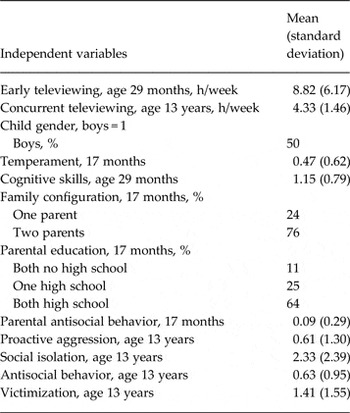
Table 1 provides descriptive statistics of predictor, outcome and control variables. Boys comprised 50% of the sample and 24% lived in single-parent homes when the child was 17 months. In toddlerhood, participants watched on average 1.26 h/day (s.d. = 0.88 h/day), based on 8.82 h for the entire week (s.d. = 6.17 h). These quantities are similar to averages found with American children at this age (Christakis et al. Reference Christakis, Zimmerman, DiGiuseppe and McCarty2004; Mistry et al. Reference Mistry, Minkovitz, Strobino and Borzekowski2007). At age 13 years, participants watched on average 4.33 h for the entire week (s.d. = 1.46 h). Televiewing mostly occurred on the weekend, rather than daily, and this is probably due to homework and extracurricular activities. These quantities are within current American Academy of Pediatrics (AAP) (2013) limitations of not more than 2 h/day beyond 2 years of age, assuming that the content is developmentally appropriate. Nevertheless, 11% of children in our subsample surpassed the AAP televiewing recommendations at age 2 years.
Descriptive statistics of predictor, outcome and control variables

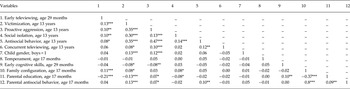
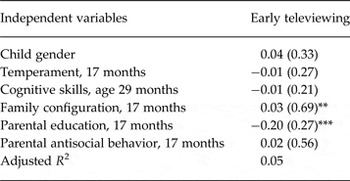
Bivariate associations between the predictor, outcomes and confounding variables are detailed in Table 2. Televiewing at age 2 years is associated with all four outcome variables at age 13 years. Table 3 reports standardized regression coefficients reflecting the relationship between televiewing at age 2 years and pre-existing individual and family factors, which were implemented as control variables. As expected from the bivariate relationships in Table 2, children with less educated parents watched more television (11.62 v. 8.65 h/week, t 157.136 = 4.196, p < 0.001) and children from single-parent families watched more television (9.93 v. 8.65 h/week, t 444.71 = −2.83, p < 0.01) at age 2 years, compared with children from more educated and two-parent families, respectively.
Bivariate associations between the predictor, outcomes and confounding variables

* p ⩽ 0.05, ** p < 0.01, *** p < 0.001.
Standardized regression coefficients which reflect the relationship between child televiewing at toddlerhood and pre-existing individual and family characteristics

Data are given as standardized regression coefficient (standard error).
* p ⩽ 0.05, ** p < 0.01, *** p < 0.001.
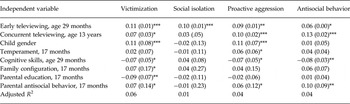
Table 4 reports regression coefficients which reflect the relationship between early televiewing and social impairment in early adolescence. At age 2 years, television habits predicted increases in self-reported victimization, social isolation, proactive aggression and antisocial behavior at age 13 years. More specifically, every 1 h increase in daily televiewing was prospectively associated with an 11% s.d. unit increase in victimization [unstandardized β = 0.03, 95% confidence interval (CI) 0.02–0.04], a 10% s.d. unit increase in social isolation (unstandardized β = 0.04, 95% CI 0.03–0.05), a 9% s.d. unit increase in proactive aggression (unstandardized β = 0.02, 95% CI 0.01–0.03) and a 6% s.d. unit increase in antisocial behavior (unstandardized β = 0.01, 95% CI 0.01–0.01). Increases in concurrent televiewing were associated with additional independent risks of victimization (unstandardized β = 0.07, 95% CI0.04–0.10), proactive aggression (unstandardized β = 0.09, 95% CI 0.07–0.11) and antisocial behavior (unstandardized β = 0.08, 95% CI 0.06–0.10). Coefficients in Tables S1 and S2 are not corrected for attrition bias.
Standardized regression coefficients which reflect the relationship between televiewing at toddlerhood and self-reported victimization, social withdrawal, proactive aggression and antisocial behavior at age 13 years

Data are given as standardized regression coefficient, corrected for attrition bias (standard error).
* p ⩽ 0.05, ** p < 0.01, *** p < 0.001.
Discussion
Identifying early modifiable factors that foretell later risks for child well-being represents an important goal for public health and social pediatrics (American Academy of Pediatrics, 2013). Developing solid peer relationships, getting along with others and establishing a positive social identity within a group represent essential elements of a successful transition from childhood to adolescence. We sought to examine the prospective influence of early childhood televiewing on four key indicators of social impairment in typically developing youth at age 13 years. Remarkably, our self-reported findings revealed long-term risks for developmental psychopathology. Moreover, save for social isolation, televiewing at age 13 years also showed additional concurrent risks for social impairment. This suggests independent dose–response associations operating over the lifetime of the participants.
Approximately every additional daily hour of televiewing at age 2 years predicted an increased risk of later victimization and socially isolative behavior. Victimization represents a traumatic social learning experience and its relationship with early televiewing is detectable around school entry (Pagani et al. Reference Pagani, Fitzpatrick and Barnett2013). Adolescent experiences such as being teased, assaulted or insulted by other classmates and personal preferences toward solitude for typical leisure activities were associated with higher levels of watching television in toddlerhood. These social characteristics place adolescents at risk for long-term negative psychological and interpersonal sequelae such as underachievement, loneliness, lower self-esteem and depression (Gini & Pozzoli, Reference Gini and Pozzoli2009; Schreier et al. Reference Schreier, Wolke, Thomas, Horwood, Hollis, Gunnell and Harrison2009; Reijntjes et al. Reference Reijntjes, Kamphuis, Prinzie and Telch2010; Rudolph et al. Reference Rudolph, Lansford, Agoston, Sugimura, Schwartz, Dodge, Pettit and Bates2014; Van Geel et al. Reference Van Geel, Vedder and Tanilon2014). The consequences of childhood victimization show developmental stability into adulthood (Arseneault et al. Reference Arseneault, Bowes and Shakoor2010; Brunstein et al. Reference Brunstein, Sourander and Gould2010). Victimization experiences often developmentally precede predispositions toward antisocial behavior, which includes bullying (Arseneault et al. Reference Arseneault, Bowes and Shakoor2010).
Approximately every additional 1 h of early childhood television exposure at age 2 years also forecasted an increased risk of engaging in deception, theft, vandalism, and threatening and instilling fear on others, and encouraging social exclusion of others as an aggressive means of social domination. Such proactive antisocial behaviors were self-reported at age 13 years, which is disconcerting from a clinical perspective because externalizing childhood psychopathology predicts Axis I and II mental health disorders, unhealthy lifestyle habits, criminality and physical disease in adulthood (Morcillo et al. Reference Morcillo, Duarte, Sala, Wang, Lejuez, Kerridge and Blanco2012; Loth et al. Reference Loth, Drabick, Leibenluft and Hulvershorn2014).
There are macroscopic mechanisms that can elucidate the link between early childhood televiewing and subsequent victimization and such extreme disregard for the well-being of others. Excessive televiewing habits create a time debt for effortful interpersonal interactions that sharpen the critical foundations of self-regulation and emotional intelligence. That is, higher amounts of televiewing indicate a higher proportion of passive rather than active daily cognitive activity in toddlerhood, ultimately affecting social interaction frequency which practises socio-emotional skills (Pagani et al. Reference Pagani, Fitzpatrick and Barnett2013). Related to all of this is that more early televiewing is linked to developmental deficits in executive functions, which drive interpersonal problem solving, emotional regulation, socially competent peer play and positive social contact (Nathanson et al. Reference Nathanson, Aladé, Sharp, Rasmussen and Christy2014). Like a coordinated orchestra, the executive functions play a key role in developing one's cognitive and emotional processing (Barkley, Reference Barkley2012). Time spent televiewing represents choosing less effortful endeavors in lieu of partaking in activities and playing games that require more sustained attention and working memory (Nathanson et al. Reference Nathanson, Aladé, Sharp, Rasmussen and Christy2014). Habitually elevated televiewing predicts increased exposure to fast-paced cartoon content, which is common in preschool programming and undermines executive functioning (Lillard & Peterson, Reference Lillard and Peterson2011).
As for microscopic mechanisms, eye contact is at the heart of positive social development (Zeidner et al. Reference Zeidner, Matthews and Robert2009). In the first years of life, attention and self-assertion skills recruit common sensory systems and cortical structures (Marsh et al. Reference Marsh, Gerber and Peterson2008). Throughout development, a shared gaze between people functions beyond mere visual detection, as it remains a vital cue system for mutual understandings between people (Beier & Spelke, Reference Beier and Spelke2012). Eye contact is a necessary condition for human empathy and appropriate social exchanges, as it modulates the activation of the social brain as it processes socially relevant sensory information and internal states of partners in social interaction (Farroni et al. Reference Farroni, Csibra, Simion and Johnson2002; Senju & Johnson, Reference Senju and Johnson2009). Although wired prenatally, this inherent skill is honed by opportunities for increasingly complex social interactions during early childhood (Beier & Spelke, Reference Beier and Spelke2012). Children who develop asynchronous gaze behavioral patterns, such as looking down or away from others, tend to evoke more negative social responses from others throughout development (Zeidner et al. Reference Zeidner, Matthews and Robert2009; Beier & Spelke, Reference Beier and Spelke2012) and risk having callous–unemotional traits (Dadds et al. Reference Dadds, Allen, Oliver, Faulkner, Legge, Moul and Scott2012). Very few televised programs have scenes where the central character speaks directly to the viewer, which both parallels a real-life social interaction and fosters a virtual social relationship with the character (Cummins & Cui, Reference Cummins and Cui2014). More time televiewing means less time being spoken to directly, either in person or from the screen. This adds support to our speculative hypothesis regarding disrupted gaze development. It is plausible that a time debt for complex social interaction created by excessive televiewing at age 2 years could interfere with progressive interdependence in overlapping cortical structures which eventually support higher-order cognitive functions and cortico-thalamic sensory relay processes involved in social interaction and emotional intelligence (Zeidner et al. Reference Zeidner, Matthews and Robert2009). Using functional imaging with 116 Japanese children aged 5–18 years, Takeuchi et al. (Reference Takeuchi, Taki, Hashizume, Asano, Asano, Sassa and Kawashima2015) remains the only study to our knowledge that has documented cross-sectional and longitudinal correlations between televiewing time and compromised regional gray/white matter volume. Taken together, these neuroscientific explanations could translate into plausible risks for impaired social and emotional development and warrant further direct investigation in relation to excessive early televiewing.
This study is not without limitations. Foremost is that epigenetic influences cannot be denied their direct and even more plausible indirect explanatory role in how environmental quality either activates or suppresses phenotypic expression. Second, our measure of television exposure did not comprise a finely tuned, objective scale of quantity and content of television exposure. Moreover, parents using child care may have underestimated the true amount of total screen-time. Despite such a limited television measure, we still found robust net effects. This is statistically remarkable and points to a stronger associations than suggested by the coefficients. The question remains: influence of what? We have argued that too much televiewing means less time left for other developmental enriching activities during waking hours. Framing it this way suggests that, beyond genetic influence, excessive early childhood screen time represents a marker for deficient socialization experiences. From this perspective, campaigns and guidelines that aim to discourage screen time could instead be reconceptualized to encourage the value-added of socialization as an enriching alternative.
The use of a prospective longitudinal design from birth onward represents a major strength, as it does not depend on retrospective recall and monitors growth and development without researcher bias or interference. The findings, which capitalize on child self-reports of specific social outcomes within an inclusive study, not only replicate previous singular findings based on adult observations but also to examine whether habitual cognitive and physical sedentariness in toddlerhood influences social relationship patterns in adolescence. This represents an improvement on prior research since adults may not always be fully aware of the extent to which a child is experiencing or causing psychosocial distress. By statistical standards, the results only show modest associations, yet small adjusted effect sizes can conservatively translate into important social costs when projected over a lifespan and across an entire population. Because social impairment risks can translate into a general propensity for morbidity and mortality in adulthood (Teo et al. Reference Teo, Choi and Valenstein2013; Non et al. Reference Non, Rewak, Kawachi, Gilman, Loucks, Appleton, Román, Buka and Kubzansky2014), excessive early childhood television exposure could pose epigenetic risks to population health. Our findings thus suggest a need for better parental awareness of how young children invest their time in what remains of their 24-h day.
Supplementary material
The supplementary material for this article can be found at http://dx.doi.org/10.1017/S0033291716001689
Acknowledgements
All authors have had full access to all data in the study and take responsibility for its integrity and the accuracy of its analysis. This IRB-approved study was conducted without specific funding to any of the authors.
Declaration of Interest
None.