Introduction
Late in 2017, Lynette Nampijinpa Granites called Georgia Curran asking for copies of a recording made over ten years earlier. The recording was of a public genre of Warlpiri women’s song associated with the country around an area known as Wapurtarli (Mt. Singleton), in the Central Australian Tanami desert. As part of annual initiatory ceremonies held over the summer months in this region, senior women sit in groups in the late afternoon singing the songs which relate to each boys’ patrilineally inherited Dreamings whilst painting up their chests with associated ochre designs (Curran Reference Curran2020a:87–90).Footnote 2 For Granites, getting hold of this recording was pressing as her grandson was going to be “caught” for the ceremonies that year and she wanted to be able to sing for him in the proper way, that is, in accordance with the ways she had watched her older family members sing at these events during her lifetime. As it was her husband and her son who passed on patrilineal ownership rights for Wapurtarli country to her grandson, and as one of only a small number of senior female singers, Granites had an obligation to make sure that this was done properly. Amongst the current group of senior Warlpiri singers, no one could remember these songs and they were keen to listen to recordings so that they could remind themselves of the verses to fulfill their ritual duties and family commitments at that year’s ceremonies.
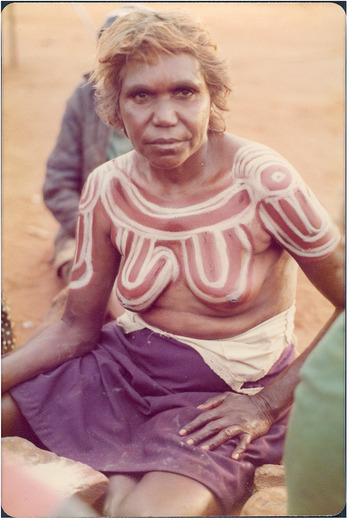
Between 2005 and 2008, Curran was working in Yuendumu on a broader recording project with a then much larger group of senior women, who passionately dedicated themselves to making audio recordings of the many thousands of songs that Warlpiri women collectively sung. One hot December day in 2006, the group of women had managed to find a rare air-conditioned room at one of Yuendumu’s community organisations to check through the recordings that had already been made over the last year. It was not long until the Wapurtarli song set was identified as missing from this collection. Granites’s sister-in-law, Bessie Nakamarra Sims (her husband’s sister) (Figure 1), was required to sing this set of songs as she was, at this time, the most senior female owner for the sites, Dreamings, and songs associated with Wapurtarli. The group tracked her down at the Art Centre where she was easily convinced to break from her busy painting schedule for this important task. Sims was escorted back to the cooled space where the rest of the women gathered in a group on the floor. Sims was guided to sit most directly behind a single mic supported by a tripod. In this position, she adopted her role as the song leader, asserting her ownership immediately in leading the first verse. She sang in her distinctive high pitch, while the rest of the woman joined her by singing an octave lower. Between songs, they collectively discussed the country around Wapurtarli and the actions of the ancestral beings at this place, occasionally humming or quietly singing to prompt memories of further verses.
Bessie Nakamarra Sims painted up with a Wapurtarli design, 1983. Photo: Mary Laughren.Footnote 1

In this article, we examine how musical analysis of this performance recording can contribute to what is known about Aboriginal music, and how it can assist with community-led song revitalisation efforts. We consider the issues faced by the custodians of these songs when senior singers, like Sims, pass away. This article begins by examining the context of endangerment in which the Wapurtarli songs were recorded. We open a dialogue on the importance of each performance instance and how its practices reflect and also challenge the social context that songs derive from, especially when there are considerable threats to future transmission of these deeply valued components of cultural heritage. Musical features including the verse structures, rhythms, the tonal centres, and melodic descents are analysed in order to assess the significance of these elements in the song repertory and social context.
This analysis has allowed us to become more sensitive to a number of aspects of a performance, especially the relationship between sung music and social context. This gives hints towards the complex ways in which song repositories are passed on in contexts with few proficient singers, in particular, the ways in which the song items are presented in a “skeleton” form (a term borrowed from Lau Reference Lau2005 and Reference Lau2007). We have used this term to refer to elements such as the tonal centre and limited intervallic range that function as the underlying support system for songs. To conclude, we draw together perspectives from Warlpiri women about their contemporary engagement with the recording in a world where there are no longer a substantial group of female singers, and where these traditional songs are becoming increasingly at-risk.
Historical Background and Current Musical Vitality
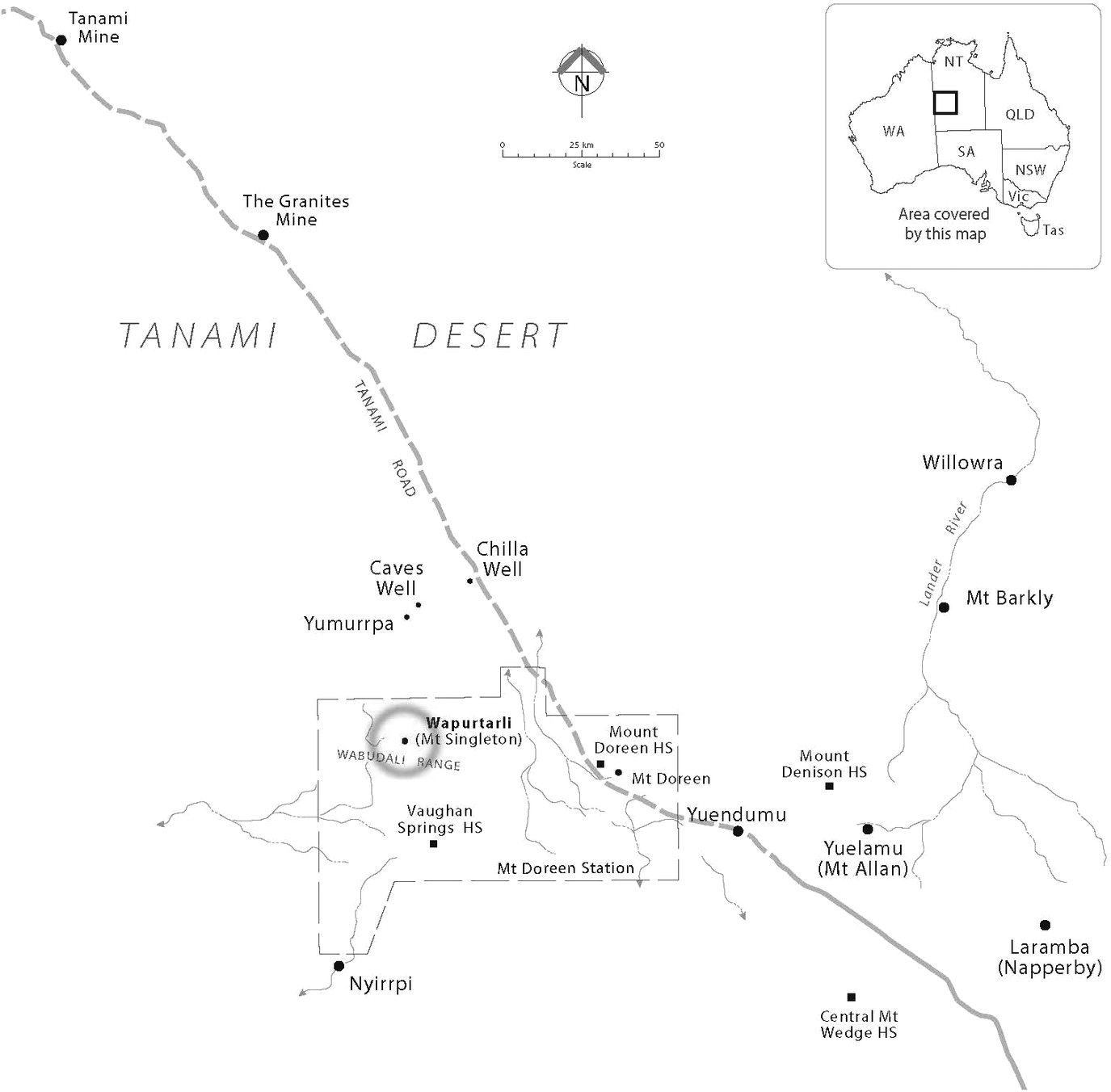
European colonisation of Australia, beginning in 1788, led to abrupt and dramatic changes to many Aboriginal cultural practices. The languages and musical genres that previously flourished across Australia in many regions rapidly declined as Aboriginal societies were faced with frontier violence and the spread of diseases which decimated populations (see Perkins and Langton Reference Perkins and Langton2010). Warlpiri people live in the Central Australian Tanami desert, an area which was not settled until well into the 1900s due to its remoteness and harsh landscape, though a small number of explorers did travel through this area in the late 1890s. Many Central Australian communities, including Yuendumu where the focal singers of this article reside, were established as government reserves in the post-WW2 era. A number of cattle stations were set up in the decades prior to this, notably the Mt. Doreen station, which encompassed WapurtarliFootnote 3 (Mt. Singleton) and surrounding country covering a small area located around 100 km to the west of the settlement of Yuendumu (see Figure 2).
The region around Wapurtarli (Mt. Singleton) in Central Australia. Map by Brenda Thornley (used with permission).

In this early settlement era, there were dramatic shifts to the structures of Warlpiri lives. Previously living in smaller family groups across the Tanami desert, Warlpiri people shifted into centralised settlements and became largely welfare dependent. Dussart (Reference Dussart2000:33–35) has observed shifts to ceremonial practices across the early settlement era, including an increase in ceremonial activity with the enhanced residential associations brought about by settlement. Despite a rise in the scale and numbers of people attending these ceremonies, many of the smaller-scale rituals which traditionally involved nurturing of land, Dreamings and kin groups declined. In recent decades, presentational modes have again begun to dominate with Warlpiri women now focusing on opportunities to perform as part of openings, book launches, community arts events, and other contexts involving intercultural audiences (Turino Reference Turino2008). Throughout these shifts, Warlpiri song traditions continue to maintain the links that people have to land and kin, and are still the main way in which detailed religious knowledge is transmitted to younger generations.Footnote 4 With this decline in ceremonial contexts, senior Warlpiri women are actively pursuing opportunities to ensure that they can continue to teach younger women these deeply valued songs encoding details of Warlpiri cultural heritage (see Curran Reference Curran, Barwick, Green and Vaarzon-Morel2020b; Curran and Sims Reference Curran and Sims2021).
Warlpiri Women’s Yawulyu
Yawulyu is the main genre of place-based songs sung by Warlpiri women, and other Aboriginal women across the Central Australian region (known as awely in Arandic language groups). A core group of senior women collectively sing and hold in their minds hundreds of hours of songs which relate to the country around a broad area of the Tanami desert. Warlpiri women understand these songs to be originally composed by ancestral beings in a timeless creational moment known in Warlpiri as jukurrpa, and often glossed into English as the Dreaming (see Stanner Reference Stanner1966). Yawulyu is intimately related to individual Warlpiri women’s identity, their patrilineal inherited country, and associated ancestral stories. Women share ownership (kirda) together with their aunts (father’s sisters) who are responsible for educating their nieces (brother’s daughters) in specific gendered knowledge and practices, including singing, dancing, painting, and storytelling. Warlpiri women also have managerial responsibilities (kurdungurlu) for the Dreamings and songs for which their mother has ownership rights. Yawulyu must be performed with women who hold both these important roles and nurtured by a group of singers. Particular women can become leaders for yawulyu ceremonies, often due to their vast knowledge of many repertories and leadership skills in ceremonial contexts (see Dussart Reference Dussart2000:85–138).
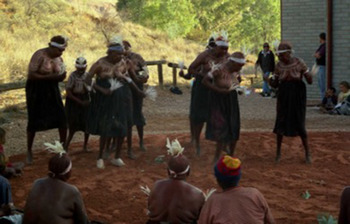
Yawulyu comprise the majority of traditional Warlpiri women’s public songs and are sung as part of larger ceremonies, as well as in some more private contexts relating to deaths, healing (nyurnukurlangu), and love magic (yilpinji). Nowadays, yawulyu is also sung in a number of organised events including biannual dance camps, school country visits, and as part of larger community events (examples include openings, community arts performances, and visual art displays). Yawulyu is multimodal with complex interlocking components such as dancing, painting body designs, and other ritualised acts that accompany singing and are essential for proper performance (Barwick, Laughren, and Turpin Reference Barwick, Laughren and Turpin2013:191; Turpin Reference Turpin2005) (Figure 3). Women play clapsticks and other percussive devices, including the thud of dancers’ feet, but there are no accompanying tonal instruments, with the pitch determined by a lead singer who is, in most cases, the most senior owner of the particular Dreaming or the most proficient singer of a particular repertoire.
Warlpiri women dance yawulyu for the opening of the CLC building in Alice Springs. Photo: Yasmine Musharbash (used with permission).

Musical Vitality and Challenges of Revitalisation
In Catherine Grant’s (Reference Grant2014) “Music Vitality Endangerment Framework” (MVEF), she identifies twelve factors which can be used to assess the health of a musical tradition. The identification of the factors that cause endangerment is, amongst other reasons, important in helping to “establish focus and priorities for action” (Grant Reference Grant2014:106). For the first factor, Intergenerational Transmission, we assess yawulyu to be severely endangered as it is “performed mostly by the older generations” (ibid.:112). However, it must also be noted that traditionally, this genre is learned over a lifetime with women typically being middle-aged by the time they have the authority and confidence to sing, particularly in a lead role. However, younger women do participate in dancing and painting up aspects of yawulyu performances, meaning they have many years of listening attentively to these songs before they are expected to sing and carry them forward to future generations. Other factors relevant to yawulyu from Grant’s framework which are of concern for yawulyu are a “change in number of proficient musicians” (factor 2) and “accessibility of knowledge and skills for music practices” (factor 8). For Aboriginal musical traditions like yawulyu, the lack of an “audience-performer division” results in the general expectation for everyone to participate in music (Yeoh and Turpin Reference Yeoh and Turpin2018:99). Yet, the occurrences of ceremonies where songs, knowledge, and certain cosmological paradigms are shared have decreased significantly today, leading to the current context of endangerment (Barwick et al. Reference Barwick, Laughren and Turpin2013; Curran Reference Curran2020a; Schippers Reference Schippers2009).
Revitalisation is hard and complex due to the systems of authority that determine the custodians of a song as well as the current small number of knowledgeable singers who are able to lead and share songs. As has been observed in other areas of Australia, the complex interplay of authority, ownership rights, and performance competence all come together to give some the status necessary to lead and pass on singing practices (Bracknell Reference Bracknell2017:100; Stubington Reference Stubington2007). Conservative adherence to tradition is particularly pronounced in Central Australia, and whilst new songs can be dreamed and enter performance repertories, this does not occur very often nowadays (Curran Reference Curran2020a). Learning the complex interplay of musical, linguistic, social, and performance qualities are essential and this is often acquired by participating in performances over a lifetime. It is rare, in traditional song learning contexts, for Warlpiri women to engage in the kind of analytic separation of the different components of a song. Yet with fewer performance opportunities in the modern world, and vastly different performance contexts on top of fewer links to country or opportunities to learn in this traditional manner, Warlpiri people have begun to establish new ways of learning songs through collaborations, and documentation in books and recordings (Gallagher et al. Reference Gallagher, Brown, Curran and Martin2014; Warlpiri Women from Yuendumu 2017).Footnote 5 Warlpiri people have also set up educational opportunities through school and youth programmes, which involve learning of particular aspects of song such as designs, dances, and stories. Musical analysis can be of significant assistance to these efforts as it helps to separate the complex parts of song, develop methods for learning, and then bring the parts back together again in performance. In this way, music analysis can aid in understanding the processes necessary for revitalisation (see also Turpin Reference Turpin2007a, Reference Turpin2007b, Reference Turpin, Burenhult, Holmer, Karlsson, Lundström and Svantesson2012, Reference Turpin2015; Treloyn Reference Treloyn2003, Reference Treloyn2006, Reference Treloyn2007).
Recordings of songs and analysis of them can be integral in “rescuing” a song set as it increases the accessibility of traditional genres of music as well as our understanding of them. These recordings, however, must be considered as a representation of the song, with each performance instances being unique according to the musical styles of the singers and the contexts in which they are being performed. Despite the difficulties of capturing the modes of oral transmission, the analysis of song recordings “can assist in learning, particularly when a tradition can no longer be learnt through immersion due to a decline in its performance” (Yeoh and Turpin Reference Yeoh and Turpin2018:99). Music analysis can aid in understanding the intricacies of various musical features and how they interlock together.Footnote 6 Understanding these musical features play an integral part in how songs are learnt, especially when platforms for songs to be learnt, such as in ceremonial contexts, occur intermittently (ibid.). As Steven Knopoff has pointed out, our musical training and environment can cause our ears to be biased, meaning that analysis (mixed with an extent of performance participation) allows us to “actually hear the music in question” (Reference Knopoff2003:46). Following Knopoff and others, including Allan Marett (Reference Marett2005), the analysis of songs and performance in this article are guided by the priorities of the Indigenous custodians and singers. Perspectives from Warlpiri women have been incorporated throughout the musical analysis, but it is important to note that this method of analysis is very new for them, and not traditionally held in their learning systems. We recognise that methodology taken in research must strive to reflect the practices of how knowledge is organised and translated in Warlpiri culture. The challenge that lies here is to reflect upon creative research methods that may not be common in the Western academy and to develop more organic modes of research which can assist in revitalisation efforts in Aboriginal communities.
Wapurtarli Yawulyu Led by Bessie Nakamarra Sims, 2006: Recording Context and Research Methodology
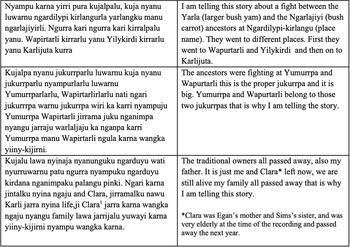
The songs reference the events of the Wapurtarli Dreaming story as well as providing details of the ecological and social environment (Figure 4). The texts of the songs illustrate many features of the landscape and have rich imagery encoding knowledge of plants, the ways in which they seasonally grow, methods for harvesting, and details of the Dreaming stories which have kept this knowledge prevalent over generations. In the past, these songs may have been important mnemonic aids for people to maintain the knowledge necessary to survive in the harsh desert environments (see Curran et al. Reference Curran, Barwick, Turpin, Walsh and Laughren2019). With songs becoming increasingly at-risk, the modes of transmitting this detailed cultural and ecological knowledge to future generations are also threatened. There is no question that the Wapurtarli yawulyu songs are highly endangered musical art forms as is evident in the story told by Sims to accompany the song recordings.
Wapurtarli story told by Bessie Nakamarra Sims in December 2006. Recorded by Georgia Curran and Jeannie Nungarrayi Egan, transcribed and translated by Theresa Napurrurla Ross.Footnote 7

The recordings of the Wapurtarli song set were made by Curran, alongside Jeannie Nungarrayi Egan in December 2006.Footnote 8 Further information on this song set including the recording dates and location of archival deposits are given at the end of this article. The transcriptions presented in this article have been developed in close collaboration with senior Warlpiri women whom Curran has worked with for the last fifteen years. Skilled Warlpiri linguists, including Egan, and senior singers worked together to identify words, meanings, and associated stories. The process of working on songs in this analytic way has proven to be a new mode for engagement with song traditions, one vital to the current context of endangerment (Curran, Carew, and Martin Reference Curran, Carew and Martin2019). The recording and some documentary aspects of this research were conducted as part of a formal project through Australian National University (2005–2008). Further documentation and musical analyses were produced more recently through a project at the University of Sydney (2016–2020). As part of this, Calista Yeoh has produced musical transcriptions of all song items from this recording based on the lead singer’s voice. These projects required ethical clearances, permits from Aboriginal organisations and informed consent from individuals. Our research is informed by the Guidelines for Ethical Research in Aboriginal and Indigenous Studies (GERAIS) produced by the Australian Institute for Aboriginal and Torres Strait Islander Studies (AIATSIS) which emphasises that Indigenous peoples have control over how their knowledge is researched, participate in the research, and that the research must have a positive impact on the community. The current senior women in Yuendumu have given permission to publish the verses and associated cultural knowledge in this article.
The elicited recording described above, made fourteen years ago, is to our knowledge one of the most recently made recordings of the Wapurtarli song set, as Sims, the lead singer and owner, sadly passed away only a few years after it was made. Sims was the only woman present with the authority to lead the singing. Whilst several of the song verses were well known, many were remembered after time spent collectively discussing features of the country and Dreaming stories to trigger memories of further verses.
During this recording instance, only eight verses and a total of thirty-five individual song items were sung. The performance instance and recording had a total duration of twenty-three minutes. Today none of these singers are still alive, although a number of other women who participated in this recording session less actively still live in Yuendumu and lead ceremonial singing today. Granites, who sought out these recordings for the 2017 ceremonial season, is one of these women.
Musical Analysis
We now turn to a musical analysis of the Wapurtarli song set. Terminology used here conform to previous writing and analysis on Central Australian music, and have been defined as follows:

Verse Structure
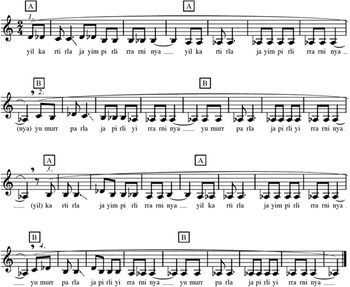
Within the songs analysed in the Wapurtarli corpus,Footnote 10 it was found that each verse is made up of two lines, termed here as Line A and Line B. Line A repeats twice followed by two iterations of Line B, producing an AABB structure (Figure 5). This is a common verse structure for songs found throughout Central Australia (Barwick Reference Barwick1989:18; Turpin Reference Turpin2005:99). Capital letters (“A” and “B”) are used to show that the complete line has been sung at the beginning and/or end of a song item.
Song item 13 with AABB verse structure outlined.

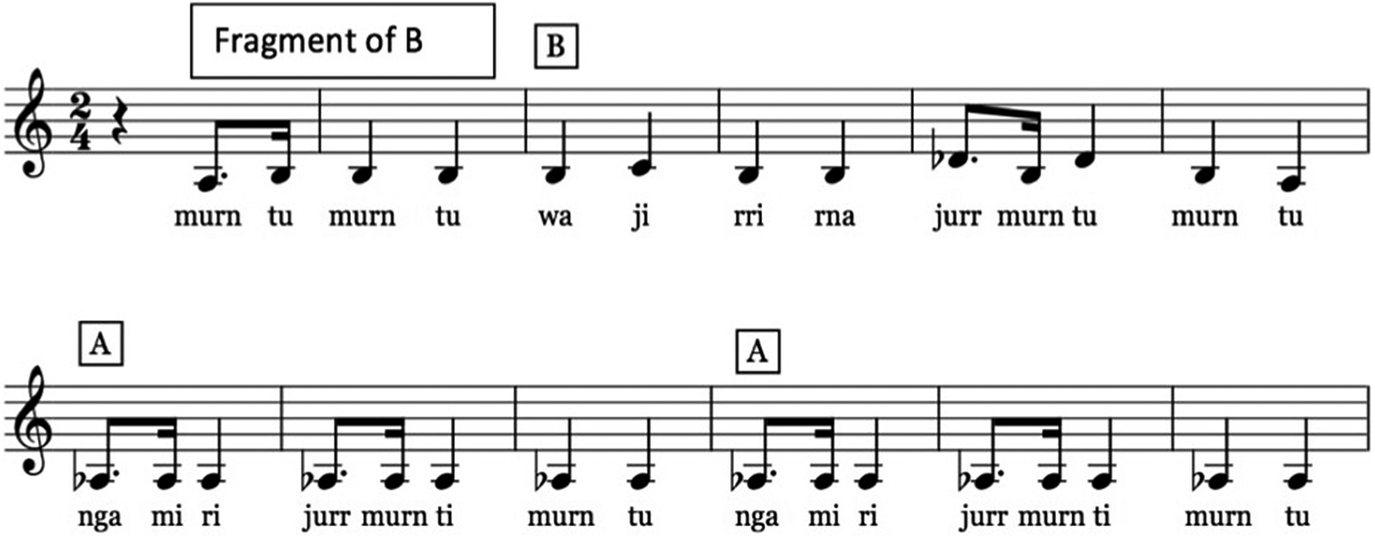
Most song items start at the beginning of a line. However four song items (4, 19, 23, 26) begin midway (Figure 6). For example, Song item 19 commences midway of line (wajirrirna jurrmurntamurnta), skipping the first five syllables (wajirrirna jurr).
Song item 19 beginning midway of a line.

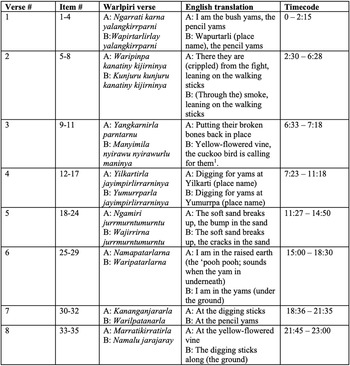
Some song items also end midway of a line or before a whole line is realised, but these are assumed in the singers’ minds (Figure 7). The flexibility in how a song starts and ends is due to the cyclical nature of songs, allowing it to begin or finish on any syllable (Barwick Reference Barwick1989, Reference Barwick1990; Ellis and Barwick Reference Ellis and Barwick1987; Yeoh and Turpin Reference Yeoh and Turpin2018:102). There are eight distinct verses sung during the recording session, as outlined in Figure 8.
Last three bars of Song item 1, showing the incomplete Line B in the last bar.

Verses of Wapurtarli song set, led by Bessie Nakamarra Sims on 19 December 2006, Yuendumu.

Rhythm
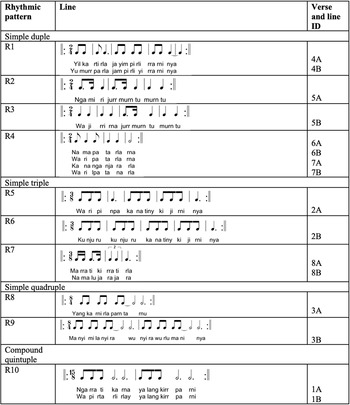
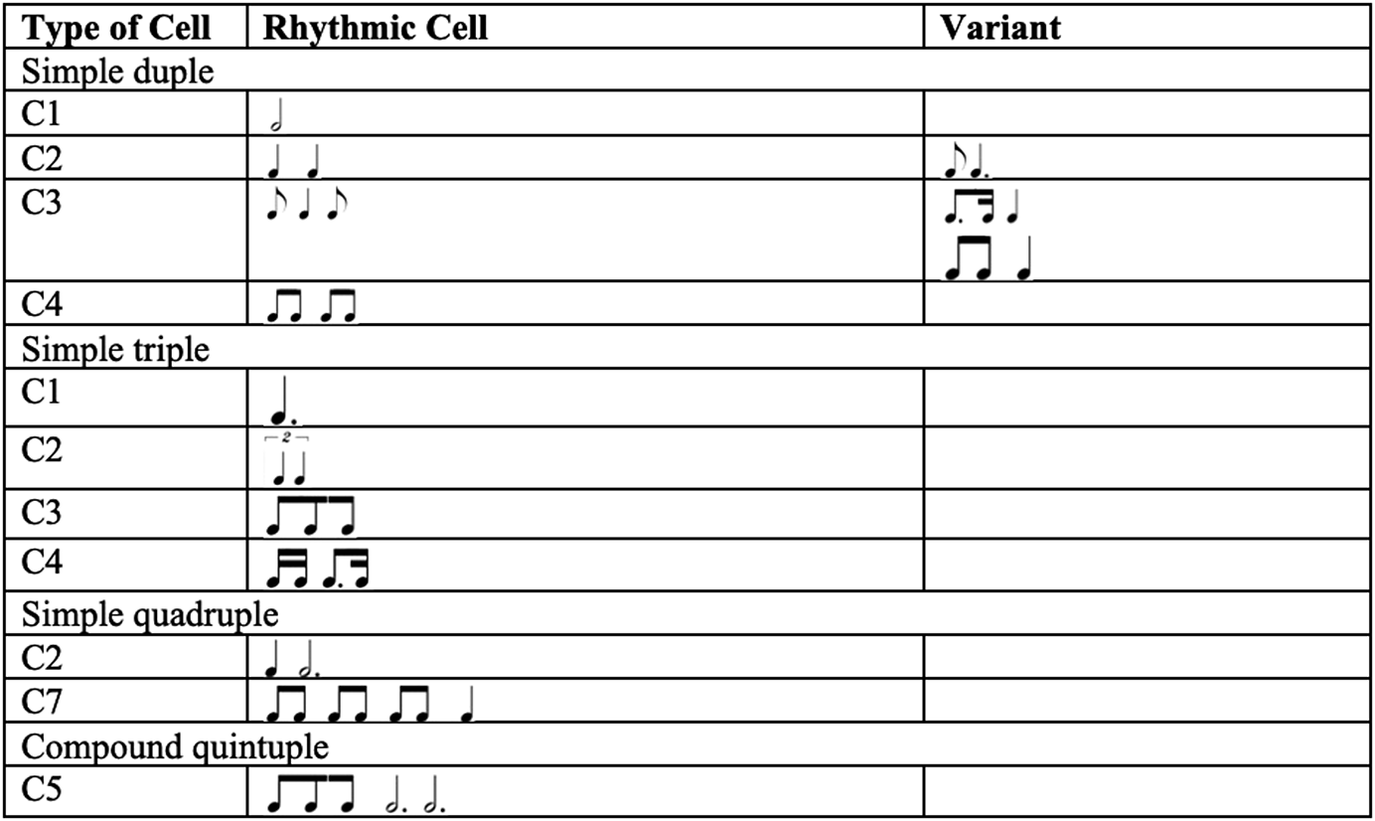
There are ten unique rhythmic patterns in the sixteen text lines of the Wapurtarli song set. Four rhythmic patterns of the text lines are in duple metre, three are in simple triple metre, two are in simple quadruple metre and one is in compound quintuple. These unique rhythmic patterns are grouped in Figure 9.
Ten rhythmic lines of the sixteen text lines in the Wapurtarli song set. Note that there is a slight swing on 3A and 3B where  .

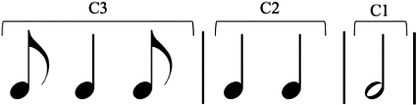
The configuration of these rhythmic cells is not based on metre, but rather, it is based on the number of notes (Figure 9, 10, and 11). A one-note cell is termed as C1, a two-note cell as C2, a three-note cell as C3, and so on. Figure 10 illustrates an example of how rhythmic cells combine to make a rhythmic pattern where Verses 6 and 7 (in both Lines A and B) begin with a three-note cell (C3), followed by a two-note cell (C2) and concludes with a one-note cell (C1). There are four rhythmic cells in simple duple, four rhythmic cells in simple triple, two rhythmic cells in simple quadruple and one rhythmic cell in compound quintuple (Figure 11).
The three rhythmic cells in Verses 6 and 7 (Lines A and B).

Rhythmic cells in duple, triple, quadruple, and quintuple metre.

An example of how variant rhythmic cells combine to make a rhythmic pattern, such as verse 4, is shown in Figure 12. Verse 4 begins on an anacrusis, where the first and last bar of this verse is made up of a three-note call variant (C3 variant). The second bar features a two-note cell variant (C2 variant), followed by a four-note cell (C4) and then a three-note cell variant (C3 variant).
The four rhythmic cells (including its variant) in Verse 4 (Lines A and B). Note the anacrusis at the beginning of this verse which forms part of a rhythmic cell variant (C3 variant).

We suggest that the numerous configurations of rhythmic cells to produce a verse may contribute to the difficulties of learning the Wapurtarli song set. In particular, rhythmic complexity is evident in syncopated rhythmic patterns, such as the three-note cell in simple duple metre and the two-note cell of crotchet (quarter note) duplets in simple triple metre (Figure 11). Warlpiri singers often describe verses with these kinds of complex rhythms as “tricky songs” to learn, noting comparatively how easy it is to pick up verses from particular repertories that favour simpler rhythms (see for example Ngapa yawulyu in Warlpiri Women from Yuendumu 2017). Marett observes how the northern Australia community of Wadeye often simplify rhythms in the Walakandha wangga to encourage greater participation and “thereby to project a stronger identity in local ceremonial contexts” (Reference Marett2005:132; Reference Marett2007:63). Ethnomusicologists and traditional singers across Central Australia have also observed that songs with more complex rhythms are the first to get “lost” and are often those missing from performances of songs which are not frequently held.
Tonal Centre and Intervallic Range
All songs in this corpus feature A-flat as the tonal centre. This is a distinct feature of the Wapurtarli song set as other yawulyu song sets have two or more tonal centres, such as Yumurrpa yawulyu songs (which are closely related and owned by the same group) or Arrwek awely songs (belonging to the same genre, but from country further to the east). We argue that the presence of this tonal centre gives all song items a strong sense of tonality and may assist in teaching the melodic possibilities for particular verses. Catherine Ellis (Reference Ellis1967) found that the tonal centre greatly determines the pitch range of a melody. This is certainly true in this corpus and will be explored further in the next section. This tonal centre may also be a feature of this corpus that holds great authority when songs are transmitted orally to appropriate custodians and performers. Perhaps the distinct tonal centre of Wapurtarli songs may also be due to the context of endangerment in which this recording was made, where there was only one person who had the ability to lead the songs and only two to three other proficient singers.
Most songs are sung in a perfect fourth range, from note A-flat to D-flat (Figure 13). In song items with an augmented fourth, the note D (that makes it an augmented fourth) may be due to a sharpened perfect fourth range, with a slightly higher note of a semitone (or half-step) (note D instead of D-flat) used as either embellishment or as a reflection of personal style. Song items 3 and 34 feature a perfect fifth interval. The frequency of this interval occurs once, as the starting note in a melodic descent. This is the same for song item 4 which features an augmented fifth interval, suggesting that there is flexibility in the note beginning the melodic descent.
Intervallic range of song items.

The strong presence of a perfect fourth is also commonly found in other Central Australian songs (see Yeoh and Turpin Reference Yeoh and Turpin2018 as an example). Yet, no explanations for why this interval occurs more predominantly than others have been provided. It may be that this is a cognitive or neurological element to this aiding in the memory. Intervals are thought of as two distinct pitches with different vibrating frequencies in Western music. Pythagoras’ tuning system breaks down each pitch in terms of ratios where intervals considered to be “perfect” (intervals of unison, octave, fourth and fifth) have exact ratios while other non-perfect intervals (intervals of a second, third, sixth and seventh) have more complex mathematical ratios (Rogers Reference Rogers2016:42). Perfect fourth intervals have a 4:3 ratio, thus producing a high degree of consonance which may aid in memory when these songs are verbally transmitted to others. We suggest the prevalent use of a perfect fourth may have close relation to a particular Dreaming and associated land which is vital information to pass on to future generations. This may be a characteristic component, and part of the “skeleton” form or most crucial melodic aspects of the song, which may more normally be embellished upon when there are greater numbers of proficient singers.
Lorraine Nungarrayi Granites, a senior yawulyu song leader, describes how when she learned to sing as a younger woman: she would first pick up the tune and hum along before gaining competence in singing along with lyrics as well. For her, she learned in a context where there was a large group of other women singing as well. Nowadays this is not the case, making this learning process more challenging.
Melodic Descents
Pitch analysed here follows Sims’s voice due to her vast knowledge, authority, and role as a custodian and leader of these songs. There are four types of melodic descents in this song corpus. The tonal centre (note A-flat) is the last note repeated several times, marking the end of a melodic descent. A new melodic descent is marked by a leap, usually to the perfect fourth interval, thus marking the intervallic range of a song.
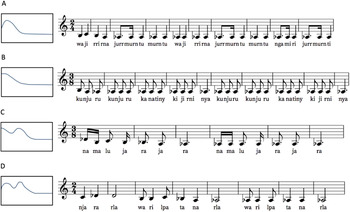
The types of melodic descents have been labelled A, B, C, and D. The descent of each melodic descent is shown below in Figure 14. Melodic descent A features a stepwise movement at the beginning of the contour before it descends in steps to the tonic. Melodic descent B features a descent to the tonic, often in stepwise or chromatic movement. Melodic descent C features a leap down, followed by a stepwise ascent before the melodic contour descends down. Melodic descent D features an ascent up, followed by a jump down which repeats again before a further descent to the tonic.
Four types of melodic descents from various song items in the song corpus.

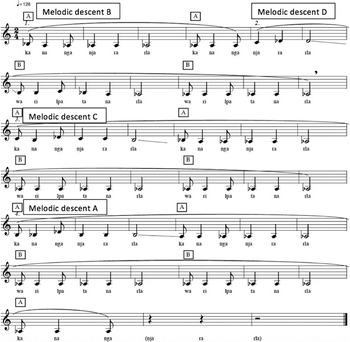
Song 31 is used as an example of these melodic descents (Figure 15). All descents (A, B, C, and D) feature in the melodic descents present in this song item. However, most songs do not feature all four types of melodic descents.
Song item 31 featuring all types of melodic descents.

The descending melodic descent found in this corpus is a common feature of Aboriginal songs from Central Australia. There are 109 melodic descents in this corpus. Melodic descent C is most commonly sung in this corpus (see Figure 16).
Number of times a melodic descent type features in corpus.

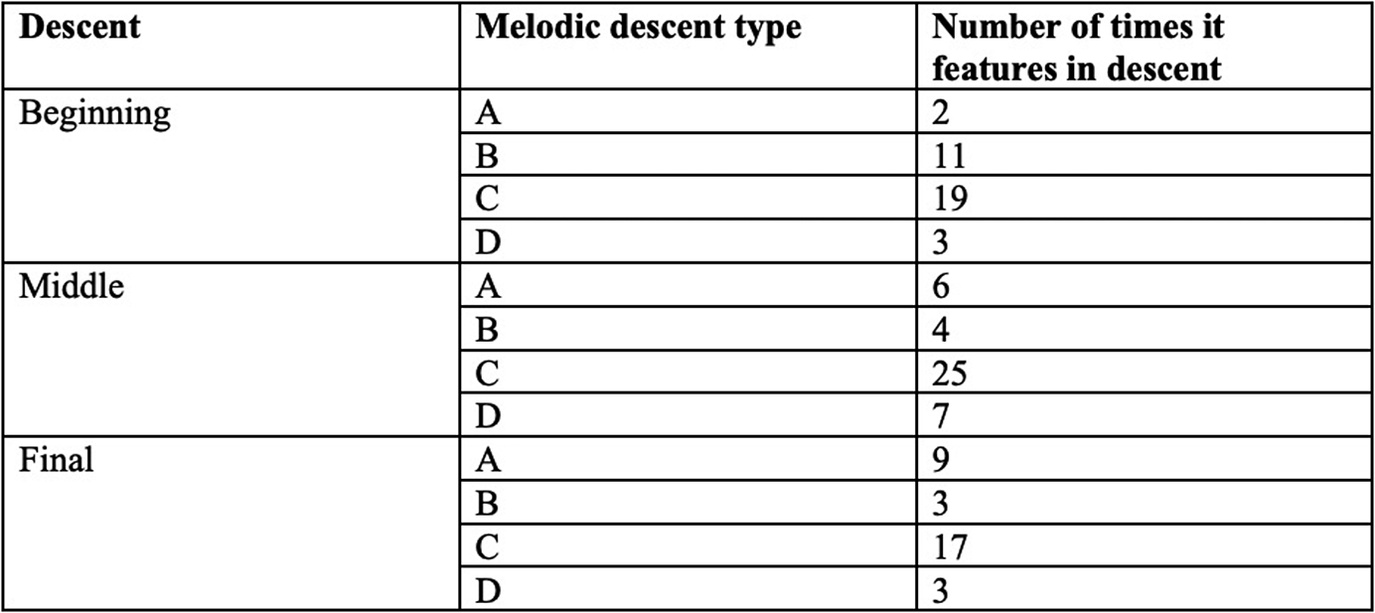
Melodic descents B and C are most common at the beginning of a song. Melodic C is most common in the middle of a song. Melodic descents A and C are most common at the end of a song. This suggests that there is a relationship between the type of descent and its placement in a song item, where different descents act as cues to performance points (Figure 17).
Placement of melodic descent types in a song and the number of times it features.

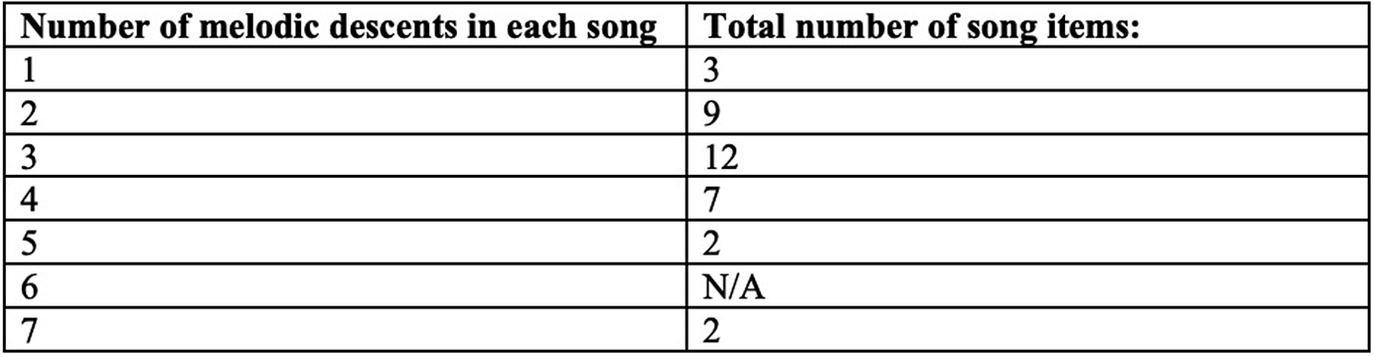
Song items with three melodic descents are most common (see Figure 18). There are no song items that have six melodic descents. As song items 9, 10 and 11 only have one melodic descent, this has been considered as the first descent. We suggest that there is also a relationship between verse and the number of melodic descents sung. For example, all songs sung in Verse 3 (song items 9, 10, and 11) have only one melodic descent. Verse 6 features three melodic descents in each song item (song items 26, 27, 28, and 29).
Intervallic range of song items.

Ellis (Reference Ellis1997) observed that melodic descents identify particular family or land-owning groups with unique connections to Dreamings (also observed in Curran Reference Curran2020a; Turpin and Stebbins Reference Turpin and Stebbins2010). The interlocking of these melodic patterns with the rhythmic texts and other knowledge about how to perform a song are vital components that identify a particular yawulyu as being connected to specific people, related country, and Dreamings. Rhythmic texts are aligned and repeated (Turpin and Laughren Reference Turpin and Laughren2013) but melodic forms change with the cyclical repetition within each song item. These observations of the melodic descents and intervallic ranges within the song items recorded in this performance instance of the Wapurtarli song set indicate that in this context of musical endangerment, these are crucial melodic features vital to the song. Stylistic embellishments and ornamentation are incorporated in contexts where there are more proficient singers who have more familiarity and confidence with these “skeleton” melodic requirements, and the knowledge and authority to be able to incorporate them to shape performance in specific ways.
Importantly, this analysis illustrates how documenting these “skeleton” melodic forms can assist in teaching some of the core components of particular songs and facilitate their teaching outside of, and in, performance so that they can be passed on to future generations. Warlpiri school teacher, Barbara Napanangka Martin has commented that musical analysis can assist with the creation of materials for formalised teaching of songs, similar to the ways in which other aspects of song, such as the associated body designs, are nowadays being taught to school children who use templates of bodies on paper to copy and learn their Dreaming designs.
Conclusions: Challenges for Intergenerational Transmission
In this article, we have provided a musical analysis of the Wapurtarli song set to contribute to what is known about Aboriginal songs, and in particular, songs that belong to the yawulyu genre. Greater knowledge and understanding of songs can assist with song revitalisation efforts, and help in the process of teaching and sharing songs, particularly to younger generations.
The analysis of the Wapurtarli song set uncovers certain musical features that affect the process of its teaching and learning. In particular, the cyclical nature of a song where flexibility is present in how one begins or ends a song reveal the possible challenges for remembering and passing on songs to future generations. Syllables within a verse, melody, and rhythm all interlock together within this cyclical structure to produce a song, and must be correctly connected in order for it to be sung in the proper way. The ten unique rhythmic patterns and eleven rhythmic cells (with three variants) in this song set also draw from diverse metres (duple, triple, quadruple, and quintuple), adding to the complexity of learning songs and singing it correctly. As all songs have the same tonal centre, we argue that this is an integral and important feature that give it a strong sense of tonality and may be a result of the context in which these songs were recorded, in which there was only one person who was able to lead the singing and performance.
These musical features, uncovered through analysis, deepen our knowledge of the Central Australia Aboriginal musical structures and open possibilities for new modes for intergeneration transmission.
Granites recounted several months later how it had been hard to remember the Wapurtarli yawulyu earlier in 2018 during the annual ceremonies. Although a group of women had supported her, they had struggled to sing only two verses. Only two proficient singers had attended the painting up session in the early part of the ceremonies in which her grandson would go through his initiatory rites, and the aid of the recording did not allow for the flexibility needed for the group to be able to pick up the verses. Granites was determined to get all the senior women together to hold a workshop in which we would document these songs, listening carefully again to the 2006 recording led by Sims. In April 2018, she gathered all the senior female singers together and with Curran, they sat in the yard of the Yuendumu Old People’s programme area, surrounded by a number of other elderly Warlpiri women who, despite being quite senile at the time, had known the songs well in their younger years and participated by singing along to the recording.
Granites demanded that Curran drive her vehicle over to pick up Wendy Nungarrayi Sims, B. Sims’s daughter, who was said to be the current most senior female custodian for Wapurtarli, despite her being a manager (kurdungurlu), rather than owner (kirda), due to her inherited connections from her mother’s side. W. Sims had sadly never learned these songs from her mother, this being the case for many women of her generation, who had the pressures of school and domestic work in their early lives, and for whom the current ceremonial contexts for singing were significantly fewer than in the early periods. As W. Sims leaned in close to the speaker, the pressure placed on her to learn these songs seemed deeply unfair. Lorraine Granites who sat with the group, reflected that when she was a young girl she had learned yawulyu slowly, throughout her life, beginning by dancing, then humming, and gradually becoming confident enough to sing the words aloud, and eventually being a leader of the songs.Footnote 11 W. Sims, as it was deeply apparent to all involved, did not have these kind of learning opportunities in her lifetime. Her involvement in the documentation efforts of the Wapurtarli song set has allowed her to participate in many contexts where she has gained knowledge of her country and Dreamings, and the ways in which this knowledge has been passed on through song.
In these contexts, pulling apart the components of song (such as words, rhythms, and melodies), which in performance must be presented as interlocking parts, has assisted with learning in a modern world. Despite the deep differences that this approach has to traditional learning contexts, it appears as though it may be one way to better transmit songs which are highly endangered and not being learned through traditional modes. In many ways this is also similar to L. Granites’s description of learning yawulyu over her lifetime, in which she gradually became competent in various components of the song performance as she gained knowledge, confidence, and authority.
To be a proficient singer of yawulyu (i.e., a competent musician, factor 2 in Grant’s MVEF), all of the interlocking parts of a song must eventually come together. When Curran recorded Sims in 2006, she not only had the authority as the most senior female owner for Wapurtarli Dreamings and country, but she had the learned musical skills to draw together these interlocking parts of a song. Whilst a number of other singers were able to accompany Sims in this recording, the systems of authority to lead this singing have meant that they have not been able to pass it on to younger women following her death.
The context of musical endangerment set up in this article, and the musical analyses presented show that contemporary spaces for learning yawulyu must consider the complex components that come together for a song set to be properly performed. On top of the inherited forms of authority, singers must be given a chance to learn the musical modes for singing. The flexibility of the verse structure and permutations of the melodic contour will never be exactly the same in two performances of the same song set. Proper revitalisation efforts need to recognise the complex mechanisms present here and musical analysis can assist to develop ways in which to learn the various interlocking parts of a song. The expectation of learning from recordings (a very different technique to traditional forms of learning through personal participation) is a harsh but realistic situation that is faced by contemporary Warlpiri women. Efforts to revitalise songs like the Wapurtarli yawulyu need to consider that new modes of learning and teaching must be developed, and musical analysis can have an important role in teaching some of the complexities.
Acknowledgements
For the late Bessie Nakamarra Sims, an owner of Wapurtarli yawulyu songs and leader for the songs which were recorded and are analysed in this article. The songs, stories, and other cultural knowledge in this article have been published with the permission of Sims’s late brother, Harry Jakamarra Nelson, also owner for these Dreamings, and her children, Wendy Nungarrayi Sims and Otto Jungarrayi Sims. Dealing with any part of the knowledge for any purpose that has not been authorised may breach the customary laws of the Warlpiri people and may also breach copyright and moral rights under the Copy Right Act 1968 (Australian Commonwealth). We would also like to acknowledge that this article has benefitted from discussions with and comments from Lynette Nampijinpa Granites, Lorraine Nungarrayi Granites, Linda Barwick, and Myfany Turpin. We also thank Myfany Turpin for her assistance with rhythmic transcriptions. In addition, this article has benefitted from comments from Amanda Harris, Christopher Coady, James Humberstone, and Catherine Ingram. The research has been supported by the Australian Research Council grants, LP0560567 through which the original recordings and documentation were made, and DE200100120 which supported further research.
Glossary

Information on Sound Recording
Title of Recording: Wapurtarli Yawulyu
Date recorded: 19 December 2006
Place of recording: Yuendumu community
Singers: Bessie Nakamarra Sims, Long Maggie Nakamarra White, Judy Nampijinpa Granites, Lena Nungarrayi, Coral Napangardi Gallagher, Maggie Napaljarri Ross, Ruby Napurrurla Williams, Nelly Nangala Wayne, Pamela Nangala, Dora Napaljarri Kitson, Liddy Napanangka Wallker, Ena Napaljarri Spencer, Ruth Napaljarri Oldfield, Ada Nangala, Lynette Nampijinpa Granites, Lorraine Nungarrayi Granites, and Gracie Napangardi Johnson
Recorded by Georgia Nungarrayi Curran and Jeannie Nungarrayi Egan
Publisher: Australian Institute for Aboriginal and Torres Strait Islander Studies (AIATSIS)
Deposit: PETERSON-CURRAN_01 (Sound collection), GC2006_12_19_06