Introduction
This article explores the negotiation of social relationships and the creation of community during funerary rituals of a group frequently overlooked: children. Focusing primarily on emotions (Tarlow Reference Tarlow2000; Reference Tarlow2012) and personhood (Fowler Reference Fowler2004; Reference Fowler2016), I open alternative directions for studying the development of social complexity with specific reference to Predynastic (fourth-millennium bc) Egypt. State formation in Predynastic Egypt has been of sustained interest over the last four decades (Bard Reference Bard1994; Hassan Reference Hassan1988; Savage Reference Savage2001; Stevenson Reference Stevenson2016). These studies have paid considerable attention to political histories (Bard Reference Bard2017), the origins of kingship (Williams Reference Williams, Adams, Midant-Reynes and Ryan2016), interregional trade and craft specialization (Köhler Reference Köhler and Wendrich2010). Nevertheless, neo-evolutionary models have dominated, despite African ethnographies demonstrating their problematic assumptions (McIntosh Reference McIntosh1999; Stevenson Reference Stevenson2016, 426–8). Particularly lamentable is the lack of attention given to social relationships (Stevenson Reference Stevenson2009b), with only exceptional examples considering gender constructions (Hassan & Smith Reference Hassan, Smith, Nelson and Rose-Ayalon2002), identities (Stevenson Reference Stevenson2009a) or social memories and corporality (Wengrow & Baines Reference Wengrow, Baines, Hendrickx, Friedman, Ciałowicz and Chłodnicki2004).
Burgeoning interest in the archaeology of childhood emerged hand-in-hand with gender archaeology in the late 1980s and has continued ever since (Baxter Reference Baxter2005; Kamp Reference Kamp and Coşkunsu2015; Lillehammer Reference Lillehammer2010; Reference Lillehammer2015). Recognizing that children have been overlooked in archaeological and historical narratives, this work focuses on the emotional engagement with the death of a child through funerary practices in order to understand the development of social complexity. Children have featured prominently in funerary studies since the 1970s, acquiring a paramount role in models of inherited status. According to positivistic models, rich children's burials can be taken as proxies for ascribed rank and social inequality: the variety of objects present in the tomb and their quantity should be a reflection of inheritance from the family, evidencing the lineage status and the presence of ascribed rank in a complex society. Such a perspective has been readily adopted in Predynastic Egypt (Adams Reference Adams1987; Bard Reference Bard1988; Castillos Reference Castillos1982; Reference Castillos2015; Kroeper Reference Kroeper and Van der Brink1992).
Despite their popularity, these approaches face three main criticisms. First, the relationships between inheritance and graves may be more complicated than previously acknowledged (Stevenson Reference Stevenson2009a, 160–70). Secondly, these theories side-line other dimensions of funerary rites such as social identities and personhood (Díaz-Andreu Reference Díaz-Andreu2005; Fowler Reference Fowler2004), or emotional, sensuous and mnemonic experiences (Joyce Reference Joyce2001; Tarlow Reference Tarlow2000). Finally, it is a misconception to consider material culture as a simple reflection of past societies that can be directly read by the archaeologist: in our case, that rich child burials mean ascribed status and social inequality. There is a long-standing critique of these assumptions and recent theoretical developments have reaffirmed the importance of things in relation to agency and practice (Harris & Cipolla Reference Harris and Cipolla2017). The funerary record is particularly fruitful in this sense, as funerals are commemorative events through which society is (re-)negotiated, active media for social discussion that should not be considered as simple pictures of past social structures. Such critique also applies to demographic approaches to the mortuary remains of children (i.e. Bocquet-Appel & Dubouloz Reference Bocquet-Appel and Dubouloz2004).
Predynastic burial grounds were fundamental for anchoring communities in space and for the negotiation of social relations. This phenomenon has been termed the urbanization of the dead (Wengrow Reference Wengrow2006, 72–98), where tombs and cemeteries were arenas for display in which, through the creation of final memory pictures of the deceased, social relationships could be altered (Stevenson Reference Stevenson2009b, 177). Working with children's graves, I will study the negotiation of personhood, age identities and the changing emotional reactions towards children's death through the fourth millennium bc.
After introducing some methodological issues, the first section demonstrates the clear underrepresentation of children in communal cemeteries due to their cross-cultural consideration as non-persons. I posit alternative funerary practices and spaces for sub-adults in Egypt, linking the exclusivity of some child burials in adults’ cemeteries with a privileged negotiation of personhood and social relationships. Analysing the varying percentages of children throughout the Predynastic period, this analysis links the radical reduction in children during the late Predynastic (Naqada IIIA–B) to the development of social stratification. The second section examines the spatial-temporal distribution of child graves within cemeteries, evincing their common concentration during the earliest phases of Naqada I–IIB, a phenomenon referred to as ‘community clusters’. This phenomenon is understood through the ritual relevance of children's tombs, working as intense emotional and mnemonic foci to create collective identities. Finally, I will show the development of a drastic reorganization of children's funerary customs during the Naqada III period, interpreted as a change in the emotional engagement towards the loss of children.
Methodology
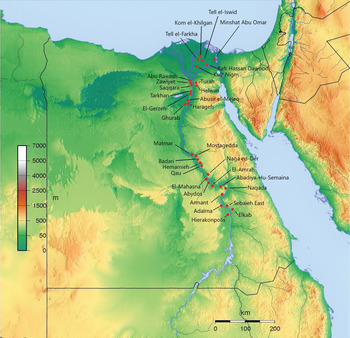
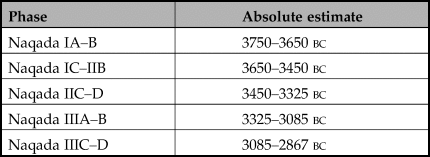
The funerary record is the best means archaeologists have to study childhood, as in no other context is the presence of children so self-evident (Baxter Reference Baxter2005, 93). A total of 31 sites, spanning the whole Naqada period (3750–2867 bc), were analysed (Fig. 1), some of them consisting of different cemeteries or internal ‘localities’ and dated following phases based on absolute chronology (Dee et al. Reference Dee, Wengrow, Shortland, Stevenson, Brock, Flink and Ramsey2013) (Table 1).
Predynastic cemeteries used for the database of this analysis.

Chronological phases cited in this article.

Predynastic material has been recognized for more than a century with the dataset today benefitting from a large number of both early reports and up-to-date excavations. Some anthropologists have questioned the validity of sex/gender data in early twentieth-century reports (see, however, Beuthe Reference Beuthe2013). While gender studies may be hindered by a lack of reliable data, age can still be confidently utilized based on the easily identifiable differences in the size of sub-adults. As the last considerable growth spurt occurs at the age of 14 in girls and 16 in boys (Lancy & Grove Reference Lancy and Grove2011, 293), I have considered ‘children’ as individuals between 0 and 14 years old.
However, by no means do I imply that archaeologists should define childhood on strictly biological terms, or that 15 years constitutes a universal cut-off between childhood and adulthood. In the last three decades, archaeologists have emphasized the cultural specificity of childhood (Baxter Reference Baxter2005; Kamp Reference Kamp and Coşkunsu2015; Lillehammer Reference Lillehammer2010; Sánchez Romero Reference Sánchez Romero2017). In addition, there is also a growing awareness of naively applying Western bio-chronological categorizations of children, despite their usefulness to the organization of raw data (Lewis Reference Lewis, Lally and Moore2011). Consequently, the definition of children used here responds exclusively to a convenient heuristic device to gain information from early excavations. Archaeological studies should explore emic definitions of childhood in Predynastic times through the study of initiation rituals, iconographic representations or mortuary representations, among other means (Baxter Reference Baxter2005, 15–23). I will briefly explore these inner cultural limits of childhood, opening ways to research exploring emic fluctuations of personhood and childhood in Predynastic Egypt.
Apart from the doubtful quality of anthropological studies, old reports can be problematic in other senses, such as inconsistent terminology and fieldwork methodology, or partial publication. This stands in stark contrast with recent archaeological projects, more methodical in excavation and publication. To combine reports of such different natures in this analysis, various levels of confidence were assigned to each site/locality according to a three-tiered scheme. Two factors were applied to distinguish between levels: the accuracy in recording/publishing the results obtained during the excavations, and the credibility of the bioarchaeological studies, which would only reach modern standards around 1975 (Tristant Reference Tristant and Nenna2012, 16–22). The higher-tier sites (Confidence Level 1, recent high-quality excavations) will guide our discussions and nuance the outcomes from low-confidence cemeteries. The latter (Confidence Level 2 and 3, mid and early twentieth-century excavations, respectively), however, constitute the essence of the database and will be paramount in the development and testing of my hypothesis, as they remain a vital source of information for scholars of the Predynastic period.
Personhood, childhood and funerary spaces
Locating Predynastic burial practices of children
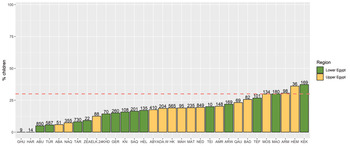
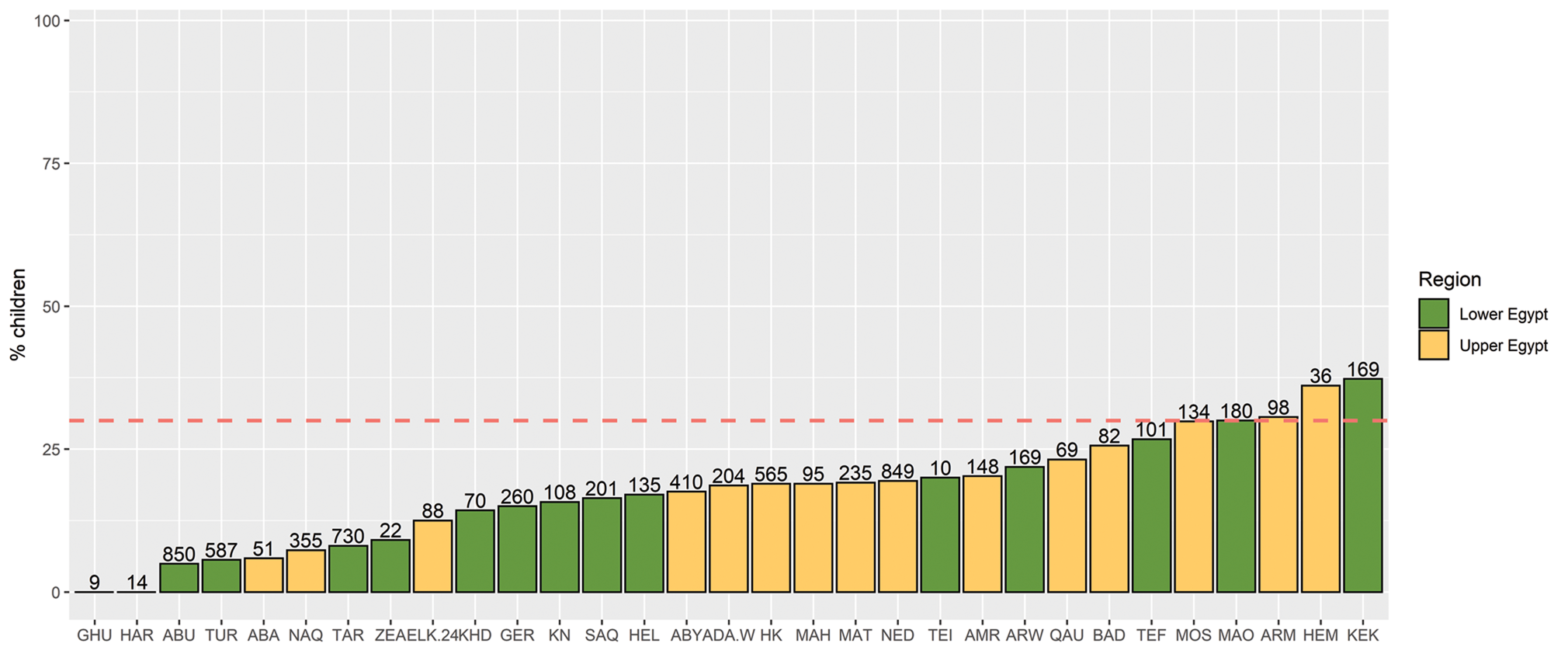
It has been observed that children are underrepresented in various cemeteries from the Nile Valley (Crubézy et al. Reference Crubézy, Bocquet-Appel and Braga2017, 31–47; Friedman et al. Reference Friedman, Van Neer, De Cupere, Droux, Pieri, Dougherty, Antoine, Midant-Reynes and Tristant2017, 279–80; Stevenson Reference Stevenson2009a, 172; Tristant Reference Tristant and Nenna2012). The analysis here undertaken confirmed this (Fig. 2). Considering the prevalence of children in prehistoric populations and the high levels of mortality in pre-Jennerian groups (Chamberlain Reference Chamberlain and Sofaer-Derevenski2000), if cemeteries provided a natural picture of the demography of the community, the presence of sub-adults in those spaces should reach higher rates. Although it is increasingly debated whether population dynamics from ethnographic societies should fit prehistoric ones, it has been established that any cemetery with less than 30 per cent sub-adults is likely to show a negative bias in the funerary recruitment of children (Lewis Reference Lewis, Lally and Moore2011, 5).Footnote 1 While the poor preservation of sub-adult bones is usually cited, recent studies point out that, when taphonomic conditions are acceptable, no such bias should be expected (Lewis Reference Lewis, Lally and Moore2011, 4). Therefore, we should consider alternative funerary practices and spaces.
Rates of children in Predynastic funerary sites. The red dashed line marks the underrepresentation of sub-adults in cemeteries (below 30%) and the number determines the total of individuals available for each site. We observe a clear underrepresentation of children in most communal cemeteries.
The first alternative would be settlement areas. The burial of children in domestic spaces is commonly attested (i.e. Moore Reference Moore2009; Tibbetts Reference Tibbetts, Murphy and Le Roy2017). The creation of foundation deposits, incomplete inclusion of children in society, magic providing fertility and protection to the household or that children were linked with domestic spaces are common explanations for this phenomenon (Murphy & Le Roy Reference Murphy, Le Roy, Murphy and Le Roy2017, 6). There are a handful of examples available in Egypt, like Adaïma (Midant-Reynes & Buchez Reference Midant-Reynes and Buchez2002, 71–6), Naqada (Petrie & Quibell Reference Petrie and Quibell1895, 2) or Badari (Brunton & Caton-Thompson Reference Brunton and Caton-Thompson1928, 89). This practice continued during the pharaonic period (Tristant Reference Tristant and Nenna2012, 44–9).
It is also a widespread practice to define segregated spaces only for children (i.e. Clement et al. Reference Clement, Hillson and Michalaki-Kollia2008; Murphy & Donnelly Reference Murphy and Donnelly2010). We have four cemeteries demarcated exclusively to immature individuals in Predynastic and Early Dynastic Egypt. The most striking, due to its uniqueness and magnitude, is the cemetery of Adaïma East (Naqada IID–IIID) (Crubézy et al. Reference Crubézy, Bocquet-Appel and Braga2017). Divided in two sections—South and North—a total of 282 and 199 tombs were unearthed, of which 99 per cent and 77 per cent belonged to individuals under 15 years old, respectively. Similarly, the locality of Elkab 53J houses mainly sub-adult remains dating to Naqada IIID (Hendrickx et al. Reference Hendrickx, Huyge and Warmenbol2002). Three circular clusters marked by rock blocks contained 41 tombs, with clear preponderance of children (only five graves contained adults). In the site of Tell el-Farkha another child-only necropolis was found, dating to the Early Old Kingdom (3rd–4th Dynasties) (Dębowska-Ludwin Reference Dębowska-Ludwin, Chłodnicki, Ciałowicz and Mączyńska2012, 72–4; Kaczmarek Reference Kaczmarek, Chłodnicki, Ciałowicz and Mączyńska2012, 395): 63 per cent of the individuals from the 19 tombs located were children. Sebaieh East, the last of the Predynastic child cemeteries, was dug by J. de Morgan between 1908 and 1909 (de Morgan Reference de Morgan1912, 28–9; Lortet & Gaillard Reference Lortet and Gaillard1909, 214–18). It probably dates to the Naqada IIIC–D (Hendrickx & van den Brink Reference Hendrickx, van den Brink, van den Brink and Levy2002, 362). The number of tombs unearthed, always children in pottery urns, is unknown, although at least 21 immature individuals were shipped back to France.
All these cemeteries display an evident surplus of sub-adults, surpassing by far the 30 per cent figure for children's misrepresentation. Furthermore, they all date to the Naqada III and Early Old Kingdom Periods (3300–2500 bc). Similarly, another child-only funerary space in prehistoric Egypt is the newborn cemetery of Gebel Ramlah (Czekaj-Zastawny et al. Reference Czekaj-Zastawny, Goslar, Irish and Kabaciński2018). Dating to 4500–4300 bc, Gebel Ramlah housed 39 individuals, among which 32 were infants who died at/shortly after birth (82 per cent) and four were between 1.5 and 36 months. Were child cemeteries a frequent practice throughout the prehistory of Egypt? It is difficult to assess whether there was a continuity in cultural praxis between Gebel Ramlah and Adaïma East, separated by a thousand years. Nevertheless, the temporal accumulation of these exceptional child cemeteries in the beginnings of the state suggests perhaps a drastic historical shift in burial practices for children.
There is a third explanation for the shortage of child burials in community cemeteries. As multiple ethnographic examples show, children are usually endowed with funerary treatments that leave no archaeological trace whatsoever (Lancy & Grove Reference Lancy and Grove2011, 289; Ucko Reference Ucko1969, 269–71). The Dayak and Papuans’ funerary rites are a typically referenced example (Hertz Reference Hertz1970). These groups deposit the corpses of children in tree trunks or suspended from branches, practices that would be impossible to determine archaeologically. According to Insoll (Reference Insoll, Renfrew, Boyd and Morley2015, 155–6), some sub-Saharan societies will not try to curate the material remains of a ‘bad death’, including childbirth death. Thus, it is possible that Predynastic societies also deposited dead children in liminal spaces, as children are usually considered non-persons yet to be fully socialized (Lancy Reference Lancy, Keller and Otto2014): funerary rites taking place in the open desert, in the Nile or in marshes would leave perfunctory remains for future archaeologists. It is intriguing to think that probably most children were given these unrecoverable treatments (Scott Reference Scott1999, 107).
Consequently, the former evidence shows that the burial of a child within a communal funerary space was a privilege only given to a few, and we should discuss both why this misrepresentation occurred and why some received such special treatment. I argue that the incomplete inclusion of children in community cemeteries relies on their nature as not fully socialized beings, putting a major emphasis on personhood (Fowler Reference Fowler2004). Cross-cultural ethnographies show that the full acquisition of personhood is a long project in most non-Western societies, usually finishing when entering adulthood, becoming a parent or even grandparent (Degnen Reference Degnen2018, 57–90). This latter model fits what Conklin and Morgan (Reference Conklin and Morgan1996, 660) have termed ‘processual personhood’, as they explore with the Amazonian Wari’. In this group, social birth—the acquisition of personhood—is a long process beginning after biological birth and consisting of the incorporation of substances by the baby/child through various ongoing social relationships, including bathing, body painting and breastfeeding. Mortuary practices can inform us of the presence of forms of ‘delayed personhood’, especially through their exclusion from communal necropoleis (Lancy Reference Lancy, Keller and Otto2014, 87–8). Among the Wari’ (Conklin & Morgan Reference Conklin and Morgan1996, 679), when a perinate died, no ceremony, wailing or public mourning was allowed, the remains being buried under the house. However, if such a child had already been nurtured, and consequently introduced into society and personified, then they could receive public mourning and be buried in the cemetery of the community. Thus, it is highly probable that children in Predynastic Egypt, due to their misrepresentation in adults’ cemeteries, were not considered as full persons, and were given other funerary practices away from the main burial areas.
However, personhood is far from a static category: it is multiply contested and negotiated, even within communities (Fowler Reference Fowler2016). Material culture, space and bodies play a fundamental role in such discussion (Brück Reference Brück2001; Fowler Reference Fowler2004; Harris Reference Harris2014; Harris & Sørensen Reference Harris and Sørensen2010), which occurs both through life and death, as society produces and re-evaluates bodies (Fowler Reference Fowler2004, 38–42). Funerary practices provide the opportunity to renegotiate social categories and landscapes during the emotional crisis of the loss of a beloved one. This negotiation of personhood is arguably more important with regard to children, as they are new bodies, ‘new flesh’ to be socialized (Conklin & Morgan Reference Conklin and Morgan1996, 662–3). Consequently, the introduction of children in community cemeteries constitutes a unique moment to renegotiate bodies, personhood, power and social formations through the creation of positive images and memories of the deceased. Through their study of Wari’ infanticide, Conklin and Morgan (Reference Conklin and Morgan1996, 679–81, 683) provide us with a precise example of how children's personhood can be paramount in this renegotiation. Children can be ‘formed’ as non-persons (or persons) through a wide variety of symbols and actions, from sharing substances to gifting ornaments (Santos-Granero Reference Santos-Granero2012), making infanticide acceptable (or not) in front of other members of community. The case of Wem Tao's child, born out of an unacceptable incestuous relationship, is an appropriate case: despite the community dissent, the mother decided to nurture the baby, thus invoking an incipient personhood that made the new-born a legitimate member of the community. Consequently, when the ‘personal’ baby was later killed by the mother's elder brother, who did not approve the incestuous creature, the family and community were enraged: ‘This was not socially acceptable infanticide; this was murder’ (Conklin & Morgan Reference Conklin and Morgan1996, 681). Ethnography thus shows how children's personhood can be actively (de)constructed to negotiate social bonds and empower certain individuals/groups within the community through material actions, including their funerary ritual and burial space.
We must acknowledge that the differential treatment of the dead—as that of the living—relates to continuous changing strategies and social interests in order to modify present social relationships (Fowler Reference Fowler2004, 36). I argue that the inclusion of some immature individuals in community cemeteries in Predynastic Egypt responds to an interest in renegotiating the personal category of the deceased and, in this way, reassemble the identity and social position of the family or lineage within the social meshwork. As death is a new stage in personhood, being interred within the community burial ground reshaped the social consideration of the child as a person—albeit not necessarily a complete one (Fowler Reference Fowler2004, 97–100)—thus providing an opportunity for the living to renegotiate social relationships both with the dead and between themselves. In fact, what is striking about most infant burials in Predynastic cemeteries is that they are usually provisioned as adults in matters of wealth, diversity of objects and size (Janulíková Reference Janulíková2017, 178; Stevenson Reference Stevenson2009a, 176; Tristant Reference Tristant and Nenna2012, 49). At Minshat Abu Omar, tomb 2275, belonging to a 9-year-old child, was the richest and most complex grave in the cemetery (Kroeper Reference Kroeper and Van der Brink1992, 134–6); the same is evident in Armant tomb 1461 (Bard Reference Bard1988, 52) or HK27 tomb 66 (Adams Reference Adams1987, 180).
Other factors might be at play, such as economic agencies and wealth transmission. Rowland (Reference Rowland2003, 79) mentions conspicuous display and adornment as a means to attract potential allies, or retiring economic resources if the deceased had no offspring, as possible factors behind rich child tombs in the Egyptian Delta. Similar processes have been suggested for infant burials in Mesopotamia, probably functioning as means for capital accumulation within the household or lineage (Brereton Reference Brereton2013). In addition, the investment in child graves could also relate to risk management, with the death of a child prompting a need to recover the lost ‘education’ or ‘socialisation’ by according a higher funerary investment. On the other hand, the burial in a cemetery also permitted a unique memorialization, a continuation of the emotional bonds with the dead child (Croucher Reference Croucher2018) that other funerary practices, especially the materially perfunctory ones, did not allow. The material memories of these personal children would remain through their graves in cemeteries, thus being awarded a religious and social immortality (Stevenson Reference Stevenson, Renfrew, Morley and Boyd2015b) that most children could not achieve. Such privilege would have benefitted certain families in the renegotiation of social relationships, probably those with power aggrandizing ambitions.
Fixed identities, changing personhoods
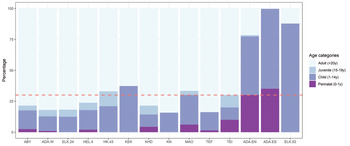
While juveniles (15–19 years old) are conspicuously represented in community (adult) cemeteries, they are practically absent in those for children (Fig. 3). Research at Adaïma shows that, in cemetery West (communal area), children under 10 years old were clearly underrepresented, while individuals older than 10 were overrepresented (Crubézy et al. Reference Crubézy, Bocquet-Appel and Braga2017, 33–4). Conversely, the East cemetery houses exclusively children between the emergence of their first tooth (6 months) until the start of puberty (12 years old) (Crubézy et al. Reference Crubézy, Bocquet-Appel and Braga2017, 38, 43). We could extrapolate from this that juveniles were already considered adults in Predynastic societies.
Relative distributions of different age categories in localities of the first level of confidence, evidencing clear contrasting profiles between adult and child cemeteries. The cemeteries on the left are communal adults’ cemeteries (Abydos; Adaïma West; Elkab; Helwan; HK43; Kom el-Khilgan; Kafr Hassan; Minshat Abu Omar; Tell el-Farkha; Tell el-Iswid). The three necropoleis on the right (Adaïma East North, South and Elkab 53J) represent the profiles of child cemeteries.

We may perhaps be observing the emic upper limits of childhood, around 12–15 years old, although intracultural variation is to be expected. Grave goods analyses in Early Dynastic cemeteries of the Memphite region point to a similar age for the end of childhood (Janulíková Reference Janulíková2017, 286–7). Nevertheless, it is not clear if individuals became adults after puberty or went through another phase towards complete socialization: adolescence. The existence of such an intermediate phase varies cross-culturally, although it is considerably common (Lancy & Grove Reference Lancy and Grove2011, 292–3). Sometimes body modifications and other rituals mark this social transformation. The practice of circumcision is attested in reliefs from the Old and Middle Kingdom and seems to be related to the onset of puberty, although it is hazy whether it was part of a larger rite of passage (Janssen Reference Janssen1990, 90–98). Indeed, some well-preserved bodies in Naga-ed-Dêr could potentially present signs of circumcision, as a few anthropomorphic figurines might as well suggest (Ucko Reference Ucko1967, 350). A similar social transition could have happened with women during the menarche, although it is even more difficult to determine archaeologically.
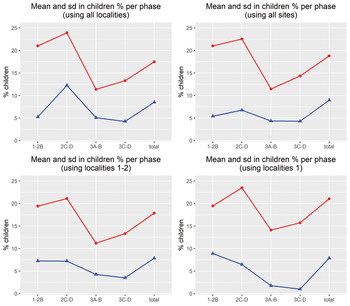
Sánchez Romero (Reference Sánchez Romero2017, 27–8) has recently highlighted the importance of paying attention to temporal dynamics when analysing the incidence of children within cemeteries. Working with the sample of 31 funerary sites, I analysed the trends in mean and standard deviation (SD) of child rates in community cemeteries. To be certain that the samples I was working with were statistically significant, a minimum number of aged individuals per cemetery was established. Bocquet-Appel and Dubouloz (Reference Bocquet-Appel and Dubouloz2004, 28–9) suggest a minimum of 50 skeletons available to avoid sample bias. Such a figure is too strict for the available data because of the quality of old reports. Consequently, I cautiously fixed the minimum size at 15, and decided to repeat the analysis using different categories of cemeteries: first working only with sites, then only with localities, thirdly only with localities of the first and second level of confidence (CL1–2) and lastly using only the best quality reports (CL1). The data from CL1 and CL2 reports, originating from modern meticulous excavations, provide reliability to the analysis of data from early twentieth-century excavations (see above methodology). No matter what analysis we undertake, we obtain a similar profile (Fig. 4).
Trends in child recruitment in Predynastic communal cemeteries considering sites, localities, CL1–2 localities and CL1 localities (mean = red circles; sd = blue triangles). The trends of the mean show a clear reduction in the Naqada IIIA–B period (3325–3085 bc) regardless of the quality of the datasets analysed. (CL2 cemeteries: Naga ed-Dêr; HK27; el-Gerzeh; Abu Rawash. CL1 cemeteries: Adaïma; Abydos; Elkab; Helwan; HK43; Minshat Abu Omar; Tell el-Farkha; Kafr Hassan; Kom el-Khilgan; Kufur Nigm).

The results obtained from the mean of child percentages in community cemeteries show a clear drop during the Naqada IIIA–B (3325–3085 bc). A one-way ANOVA analysis showed that, when considering only sites or only localities, the null hypothesis could be significantly rejected (p = 0.000479 and p = 0.00242). A Tukey HSD test showed that the statistical significance of the differences between periods is concentrated mainly between the Naqada IIC–D and IIIA–B. That is, while we cannot statistically distinguish between the means of Naqada I–IIB and IIC–D or Naqada IIIA–C and IIIC–D, the difference between the values in Naqada IIC–D and IIIA–B is highly significant in both sites and localities (p = 0.0008 and p = 0.004). We can conclusively defend a dramatic reduction in child rates in community cemeteries at the beginning of the Naqada III period. However, the analysis undertaken for localities belonging to the first tier or first and second tier of confidence could not reject the null hypothesis (p = 0.2 and p = 0.33). This is likely related to the limited number of sites available per phase fulfilling all the restricting conditions, a factor that complicates the rejection of null hypothesis in ANOVA tests. The results of the SD are more complicated, as there is tentative agreement between the different graphs. However, the higher SD value in the Naqada IIC–D period is probably related to a moment of social experimentation and changing social dynamics at the threshold of state formation (Stevenson Reference Stevenson2016, 438–43), with different regions and groups reacting differently to major cultural developments.
The decreasing incidence of children in community cemeteries during the Predynastic had already been noted by Castillos (Reference Castillos1982, 174–5, table 5). Although my results support his conclusions of a general decrease in rates of children, they do not support the regular change he proposes, suggesting a more sudden modification. With the onset of the unified state (Naqada IIIA–B), a drastic decrease of sub-adults included in communal necropoleis demarcated a radical change in children's personhood and in the emotional engagement with their death. This reduction in child burials is seen throughout all Egypt and in cemeteries connected to communities of different kinds. The analysed database includes cemeteries ascribed to diverse socioeconomic groups: Abydos U, elite cemetery (Hartung Reference Hartung, Kabaciński, Chłodnicki, Kobusiewicz and Winiarska-Kabacińska2018); el-Gerzeh, rural community (Stevenson Reference Stevenson2009a); Tell el-Farkha, commercial and administrative enclave (Dębowska-Ludwin Reference Dębowska-Ludwin, Chłodnicki, Ciałowicz and Mączyńska2012); the urban non-elite necropolis HK27 (Adams Reference Adams1987); the ‘Workers’ cemetery’ HK43 (Friedman Reference Friedman2004)—thus emphasizing the relevance of these radical funerary modifications. This widespread contraction coincides with the development of cemeteries exclusive for children, perhaps pointing towards a link between both cultural reorganizations. These shifts were also accompanied by wider changes in conceptions of personhood and bodies (Wengrow Reference Wengrow2006, 142–75; Wengrow & Baines Reference Wengrow, Baines, Hendrickx, Friedman, Ciałowicz and Chłodnicki2004, 1103–4), as well as ritual, time and space (Stevenson Reference Stevenson2015a,Reference Stevenson, Renfrew, Morley and Boydb). If the emergence of the state implied for most of the population an ‘evolution of simplicity’ (Wengrow Reference Wengrow2006, 151–75), an aesthetic emptying of daily life experience, the current drop-off could be perhaps interpreted in this light.
Thus, during Naqada I–II, bodies and images constructed in children's funerary rituals had a fundamental role in the creation of positive memories of the deceased to reconstitute social relationships (Wengrow & Baines Reference Wengrow, Baines, Hendrickx, Friedman, Ciałowicz and Chłodnicki2004). Nevertheless, with the emergence of the state and the monopolization of aesthetic display, cemeteries became devoid of child burials. The emotional practices towards children's death shifted away from community burial grounds. This shows an increasing concentration of social power by certain factions, marking a transition from open competitive societies to a closed stratified one (Wengrow Reference Wengrow2006, 165–75). With the development of a starker stratification, the number of social actors able to renegotiate the personhood status of children—thus empowering themselves for actively modifying the social network—is reduced. This limitation in the negotiation of power and society is marked by the parallel contraction in children being buried in communal funerary spaces. The spaces of social negotiation moved from child graves in communal cemeteries towards new, more socially restricted arenas.
Spatial patterns in Predynastic cemeteries
Until now, we have analysed cemeteries as ‘single and unique events’, paying attention only to the overall percentage of children in burial grounds. However, Predynastic cemeteries, like any other archaeological site, are the result of multiple depositions taking place across generations. They emerge as the intersection of multiple social histories converging in a same space. As many Predynastic cemeteries have a long-life usage, sometimes spanning almost a whole millennium, we must understand the social construction of these spaces and see them as palimpsests of varied agencies through time. It is thus important to acknowledge the necessity of studying cemeteries through a biographical perspective, recognizing that they cannot be considered as static pictures of fixed cultures but as an active scene for shifting social debates.
‘Child community clusters’ during Naqada I–II
The presence of child spatial clusters and other patterns of segregation within funerary spaces is a common phenomenon across cultures (Lewis Reference Lewis, Lally and Moore2011, 4), and it has been observed before in Egyptian localities such as Deir el-Medina (c.1500–1300 bc). Its Eastern Necropolis showed zoning according to age, with very young children being buried in the lower slope of the hill, adolescents in the middle levels and adults at the top (Meskell Reference Meskell1999, 163). As I will show, spatial arrangements were also common in Predynastic times.
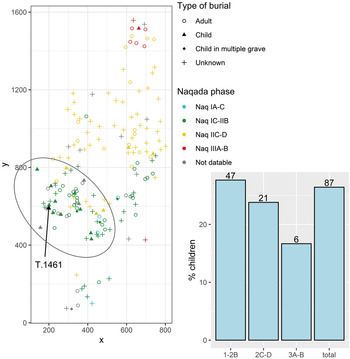
Armant's cemetery 1400–1500 (Fig. 5) presents a clear chronological development, with the earliest graves of the Naqada I–IIB grouped in the centre and south of the necropolis and later Naqada IIC–D and IIIA–B burials emerging northwards. It is notable how most of the child tombs concentrate in the central and western sectors of the cemetery, the first stages of the life of the cemetery. In addition, many of them appear to form in a well-defined circular structure with other adult and unknown tombs. The rates of children buried in Armant peaked in its first phases, then declined as the generations passed.
Spatial distribution of children in Armant 1400–1500 and their relative frequency through the Naqada Period. The grey circle signals the ‘community cluster’, a concentration of children in the earliest phase of the cemetery. Also note the position of the rich child tomb 1461.

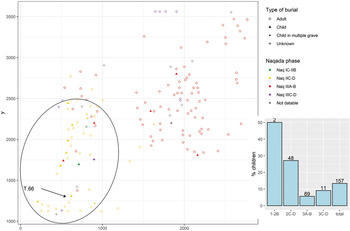
The Fort Cemetery in Hierakonpolis (HK27) has a similar pattern in both spatial distribution and frequencies of child graves (Fig. 6). The western sector (Naqada IIC–D period) constitutes the earliest phase of the cemetery, and it is there that most child burials are concentrated. During the later eastward expansion of the cemetery, some children continued to be buried in this original space, although four other burials rejected such treatment. Again, we see a gradual diminishment of the percentage of children as the cemetery develops.
Spatial distribution of children in HK27 and their relative frequency through the Naqada period. The grey circle marks the ‘community cluster’. Note as well the position of the wealthy child grave 66.

The Naqada IIC–D cemetery of el-Gerzeh presents similar characteristics. Stevenson's reanalysis (Reference Stevenson2009a, 172–3) showed a concentration of infants in the western part of the locality, which according to the typological studies should be the earliest sector. Other cemeteries could perhaps display the same pattern (see below: Adaïma and Naga-ed-dêr). In Kafr Hassan Dawood, multiple burials including children only occur in the northern part of the cemetery, again the initial phase, probably belonging to the Naqada IIC–D or earlier (Hassan et al. Reference Hassan, Tassie, Rowland and van Wetering2003); in Kom el-Khilgan (Naqada II–III) there may be some geographic distribution according to age (Midant-Reynes et al. Reference Midant-Reynes, Briois, Buchez, Hendrickx, Friedman, Ciałowicz and Chłodnicki2004, 475–8); in the South Complex of HK6 (Naqada IB-IIB), 54 per cent of the individuals recovered were sub-adults (Friedman et al. Reference Friedman, Van Neer, De Cupere, Droux, Pieri, Dougherty, Antoine, Midant-Reynes and Tristant2017, 279). Partial excavation and publication hamper further interpretations.
The data therefore demonstrate a recurrent pattern in some Naqada I–II cemeteries: the earliest stage of the cemetery is characterized by higher numbers of children's graves spatially concentrated, a phenomenon I relate to the creation of a sense of community. There is an increasing awareness towards the collective, relational and embodied process through which place attachment is defined (Degnen Reference Degnen2005; Reference Degnen2016). Children, and their mortuary rituals, probably played a paramount role in the formation of this connection in these communities. Childhood is said inherently to foster memories about our own past, continuously creating social relationships. Psychologists have analysed how children trigger remembrance of our own childhood events and experiences, forcing us to establish social relationships (Scott Reference Scott1999, 107–8). Furthermore, children are key in the development of social conviviality through the shaping of their bodies and their education in the right morale (Harris Reference Harris, Lally and Moore2011). These ideas of childhood as a common experience linking generations and people through memory and shaping adults’ lives are gaining attention in archaeology (Lillehammer Reference Lillehammer2015, 79).
Child burials could be very powerful events, emotionally and mnemonically: they could be intense ‘acts of remembering’ (Scott Reference Scott1999, 108) in which various sectors of a new community joined together through shared emotions and experiences. Through the funerary rituals involved in sub-adult burials, which triggered personal and collective remembrance, experiences and memories could be attached to place. Perhaps the intention behind the clusters of children is the urbanization of these dwelled experiences and emotions into a new land- and deadscape. As children have this quality of stimulating emotional and memory reactions, their burial associated to the foundations of the cemetery would make this place one ‘sticky with emotions’ (Harris & Sørensen Reference Harris and Sørensen2010), giving a profounder ritual meaning to later burials to occur in these spaces.
In addition, memories and emotions in shared events have a fundamental role in the creation of communities (Harris Reference Harris2009). The clustering of children joined the community members in a same space, creating bonds between people and place through deadscape rituals. This new perspective allows alternative interpretations of lavish child burials in communal spaces. We have already mentioned how tomb 1461 at Armant was the richest in the whole cemetery (Bard Reference Bard1988, 52), or how grave 66 in HK27 was not only the wealthiest but also contained the most exotic goods (Adams Reference Adams1987, 180–82). Both tombs form part of the earliest phase of the cemetery, belonging to these ‘community clusters of children’. Thus, instead of understanding them as tombs of wealthy elite families in complex societies of inherited status, we could interpret these lavish burials as cumulative emotional efforts undertaken by different community members towards a sorrowful death in an unstable moment: the beginning of the necropolis and of the community. These combined efforts favoured the development of emotional bonds required to create a sense of conviviality and sustain the new community. Consequently, it is likely that the funerals of children and the emotional reactions towards them in early Predynastic deadscapes account for ‘the powerful ways in which place works not just to tie people as individuals to places, but that it also works to tie individuals to each other’ (Degnen Reference Degnen2016, 1649, emphasis added).
Predynastic graves were marked by superstructures that created tangible and visible landscapes of past lives and senses of continuity with those past subjects materially remembered (Stevenson Reference Stevenson, Renfrew, Morley and Boyd2015b, 375). These superstructures enhanced the material memorialization of immature individuals incorporated in communal burial areas. Not only religious rituals, but also daily experiences, remembrances and conversations form fundamental parts in the creation of attachment to place (Degnen Reference Degnen2005). As people processed through the cemetery, genealogies or lineages of people buried there could have been recounted (Fowler Reference Fowler, David and Thomas2008, 295–6), probably paying especial attention to the clusters of children interred together during the foundation of the cemetery. In fact, in cemeteries like HK27 we see a temporal continuity in the use of these specific spaces for children, with various child burials from later phases (Naqada III) being incorporated next to the earliest graves. The persistence in this use of space might relate to the preservation of memory through oral narratives, helping the creation of social bonds with past and present members of the community. Various personal artefacts deposited in the tomb could have prompted emotional reminiscences. The multiple burial of tomb 213–219 in HK43 (Hendrickx Reference Hendrickx2002) contained two bodies—an adult and a child—accompanied by a rough-ware jar with the depiction of two ostriches drawn in very different styles and skills, perhaps each representing one of the deceased. The tomb was probably reopened to bury the child and the pot within the previous adult's grave. The deposition of similar personal objects triggered the remembrance of stories by the relatives and other members of community and fomented the construction of a collective memorial picture of the deceased.
On the other hand, it is a cross-cultural belief that children are intimately connected with the world of spirits and that their liminality makes them a valuable means for rituals (Lancy Reference Lancy, Keller and Otto2014, 84–5). In this sense, children are usually considered as non-humans, divine creatures coming from the land of ancestral spirits (Gottlieb Reference Gottlieb2004). As exceptional spiritual beings, their remains deserve particular funerary rites that can provide specific ritual means for heightened emotional and mnemonic states. Thus, this enhanced emotionality behind ‘divine’ child tombs reemphasizes their preponderant role in the negotiation of society. There might, then, be a foundational ritual intention behind the accumulation of child burials in Naqada cemeteries. In Adaïma, tomb S55, which led to the creation of the cemetery and probably the settlement, contained an adult and five children. Various objects and remains of a hearth accompanied the bodies, suggestive of a complex funerary ritual related to a foundational event (Crubézy et al. Reference Crubézy, Bocquet-Appel and Braga2017, 295–6). It is a common practice to treat landscape features (like houses, shrines or tombs) as human bodies with life-cycles, a pattern of personhood usually cited as ‘fractal’ (Fowler Reference Fowler, David and Thomas2008, 292–3). The wider inclusion of children in early stages of the cemetery could be a material metaphor for the infancy of a cemetery. If in Predynastic societies bodies were the centre of social relationships and cemeteries were paramount for anchoring social memories through the final containment of human bodies (Wengrow Reference Wengrow2006, 69–71), it is not far-fetched to propose the existence of a fractality of personhood according to which some communal necropoleis were embodied.
These discussions about the creation of the community should not detract from our former investigations on personhood and power negotiation. Spatial meanings are continuously re-elaborated through the social interaction of bodies and places (Brück Reference Brück2001; Fowler Reference Fowler, David and Thomas2008). Despite the interment of children to create an emotional bond of conviviality and community, still only a few were awarded this privileged reformulation of personhood and material memorialization. Through these funerary spaces both a sense of community and authority emerged, two parallel discourses of conflict and conviviality dialectically reshaping each other. Social memories and collective experiences were fundamental to the creation of place attachment, but social memories are always discussed in a personal and collective endeavour (Degnen Reference Degnen2016). This might help to understand power debates in prehistory from a more fluid perspective, as should happen in societies where relational aspects of personhood preponderate (Brück Reference Brück2001).
Multiple burials as relational assemblages
The cemetery of Adaïma West presents a cluster of children from its earliest phase. What is more intriguing here is that 45 per cent of the children appear in multiple burials (n = 18/40), mostly accompanied by adults. Multiple burials were the dominant burial during the beginnings of this necropolis (at least 50, Naqada IC–IIB), and although the causes of death are not always clear, in five cases we see marks of capital executions (Crubézy et al. Reference Crubézy, Bocquet-Appel and Braga2017, 23–4). Similarly, in Naga-ed-Dêr we see a higher number of children in the earliest area of the cemetery (west section). Furthermore, 59 per cent (n = 104/175) of children interred in the communal necropolis were included in multiple graves, mainly with adults. The percentage of both individual children and children in multiple graves diminishes, however, through the development of the cemetery. Finally, Abydos Cemetery U again shows a preponderance of children being buried in multiple graves with adults (50 per cent, n = 36/72). The abundance of multiple burials during Naqada I–II lies in stark contrast with the great elite individual tombs of the later Naqada III constructed at the south of the funerary space. Burials containing children appear distributed through several tomb clusters pertaining to different competing lineages (Hartung Reference Hartung, Kabaciński, Chłodnicki, Kobusiewicz and Winiarska-Kabacińska2018). The northern clusters contain the greatest number of child burials: around these areas will appear the greater elite tombs of the Naqada IIC–D period. Perhaps the inversion in child burials as a technology of self conferred an advantageous position to these lineages during the Naqada I–IIB in order to renegotiate social and power relations.
Be that as it may, despite the recurrent appearance of children in multiple graves in these three cemeteries, only 2.6 per cent of multiple graves with sub-adults contained children exclusively (n = 6/226): the remaining 97.4 per cent are children buried with adults. There are many factors behind multiple graves of children and adults. One cause might be dystocia, or death of the baby and mother during birth due to labour complications. Such cases are known in Predynastic Egypt, although they do not abound (Crubézy et al. Reference Crubézy, Bocquet-Appel and Braga2017, 60–61). Kinship relationships are a commonly cited factor in multiple burials: in HK43, tomb B383 belonging to a 12-year-old child was reopened to introduce the remains of an infant, maybe a sibling (Friedman Reference Friedman2004, 4); in Adaïma, tomb S11 contained a female and a child, probably related, in an intimate position (Crubézy et al. Reference Crubézy, Duchesne, Mindant-Reynes, Midant-Reynes and Tristant2008, 297–8).
However, other aspects of multiple burials have been left unattended to. Ethnographic examples show that ancestry and kinship relationships are not strictly biologically related but are created through performative rituals (Thomas Reference Thomas, Loizos and Heady1999), and that lineages can be increased through specific funerary rituals (Insoll Reference Insoll, Renfrew, Boyd and Morley2015, 155–7). Children could be prominent in the creation of networks of practical kinship, as has been suggested for Çatalhöyük (Tibbetts Reference Tibbetts, Murphy and Le Roy2017). Perhaps multiple burials including children served to form fictional kinship affiliations in order to establish communal identities through certain paramount individuals. Most multiple burials with children belong to the earliest phases of the cemeteries, declining through time: during the establishment of a new community, the creation of practical kinship bonds could have been fundamental for the conviviality of the group. Sharing emotions and experiences in multiple burials helped the development of a relational sense of place attachment in new deadscapes (Degnen Reference Degnen2016). Multiple graves—especially those containing children—brought people together, emotionally linking individuals in moments of grief, although at the same time providing an arena for power competition through the manipulation of personhood and social memories.
It is possible that multiple burials, if the result of a unique funerary event and not of later interments in already occupied tombs, attracted more bereaved people. This implies bigger audiences both for the creation of emotional ties within the community and for the display and construction of social statuses. The foundation of cemeteries and communities required a high emotional investment in social links that was acquired through the burial of children, whether alone or in multiple graves with adults. As the community settled and the cemetery expanded, these social technologies for the creation of social bonds, conviviality and place attachment were not required any longer to such an extent as during the foundational phase.
Naqada III mortuary reorganization
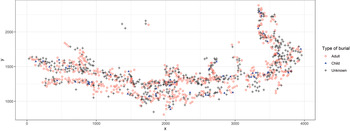
The clustering patterns and prominence of multiple burials disappeared at the very beginning of Naqada III, relating to a general modification in conceptions of memory and emotions towards the death of children. Instead of the ‘child community clusters’ that existed during the Naqada I–II periods, we see tombs of children randomly spaced within cemeteries, at times creating small clusters of two to five sub-adult graves. Early Dynastic cemeteries including Turah, Helwan, Tarkhan or Abu Rawash 400 and 800 (Fig. 7) present these multiple children groupings. The presence of child graves in these cemeteries is uncommon and multiple burials containing children are rare. In Helwan, child tombs consisted of shallow ovoid/rectangular pits with no or few grave goods, certainly contrasting with the mudbrick architecture of nearby tombs (Köhler Reference Köhler2014). However, the impoverishment of child tombs in the Naqada III is not necessarily a total phenomenon (i.e. Kroeper Reference Kroeper and Van der Brink1992, 134–6) and deserves further analysis.
Spatial distribution of children in Tarkhan (after Petrie's excavations). Note the random distribution of child tombs, occasionally forming small groupings.

On the other hand, in other necropoleis from the Protodynastic period no clear pattern emerges regarding child graves. For instance, this has been observed by Rowland (Reference Rowland2003) in the Lower Egyptian sites of Kufur Nigm, Kafr Hassan-Dawood and Minshat Abu Omar. My analysis showed a similar absence of pattern in the Naqada III cemeteries of Elkab and Abu Rawash 300. It is thus clear that the evident temporal and spatial conglomeration of child tombs that occurred during the Early Predynastic, associated with dialectic discourses of creation of community and negotiation of power, disappeared at the beginning of Naqada III.
Perhaps these modifications of funerary practices overlap with a change from communal experiences of the death of children—when the departure of (some) children was a locus for the creation of social bonding—towards more domestic, private or familial ones—when child burials lost this prominence in the negotiation of social relationships. I tentatively propose that the spatial distribution of graves either randomly scattered through the cemetery or arranged in various small groups could signal a new more private engagement with the death of immature individuals, now excluded from social communitarian matters. It is possible that this shift in practices towards the death of children parallels the practical absence of deceased children in formal art representations during Dynastic periods (Tristant Reference Tristant and Nenna2012, 18–20), strengthening the hypothesis of the lack of social relevance of sub-adults deaths in pharaonic Egypt (cf. Meskell Reference Meskell1999, 135). However, this Early Dynastic relationship with childhood and its possible ‘private’ nature deserves more attention and cautious study to be correctly defined, although space does not allow for further enquiries here.
Conclusions
Children have a rare presence in Predynastic cemeteries, but where their presence is recorded the pattern is striking. The privileged burial of some children allowed the material negotiation of their personhood, thus providing the mourners with the opportunity to rework social formations. Furthermore, the drastic reduction of child burials in the Naqada IIIA–B has been linked with an increasing social stratification, limiting the capacity to renegotiate personhood and social relations through child funerary rituals. Finally, the role of children's burials in the creation of a sense of community through emotional bonds and place attachment was explored through the analysis of ‘community clusters’.
What unites my different results is that all of them show a radical change in mortuary practices towards children at the Naqada IIIA–B period, coinciding with the onset of the state. These drastic modifications in spatial patterns of child graves, in the appearance of alternative burial grounds and in the reduction of child tombs admitted in communal cemeteries and of multiple burials signal a wide transformation in the emotional engagement with the death of children. These changes probably implied a minor capacity of families to display and renegotiate social relationships, at least through childhood and funerary spaces, and they might relate to a concealment of children from social negotiations in the mortuary realm (Tristant Reference Tristant and Nenna2012). With the emergence of the state as a new, highly stratified society, the capacity that child tombs had to create communal identities and to empower certain people to create social relationships was radically diminished. To what extent this exclusion of sub-adults from social issues was also present in the daily life of the (Early) Dynastic period is, however, debatable (Harrington Reference Harrington, Crawford, Hadley, Shepherd and Harrington2018).
It has been acknowledged that the foundation of the state implied a huge modification in aesthetic display, ideology and conceptions of time and space (Stevenson Reference Stevenson2015a,Reference Stevenson, Renfrew, Morley and Boydb; Wengrow Reference Wengrow2006, 151–75). This research adds to previous investigations defining the development of the state as a new set of pervasive social and power practices (Routledge Reference Routledge2014). Nevertheless, against previous conceptions of the state as a monolithic stage determined by static evolutionistic characteristics to be ticked off, the contestation of local communities and the long-lasting political dynamics of its development during the early Dynastic and Old Kingdom should also be explored (Stevenson Reference Stevenson2016, 452). In fact, the boundaries between pre-state and state societies should not be fossilized. Regarding my use of the term ‘community’, Harris (Reference Harris2014, 77) warns us between the unsolicited political connotations of the strict distinction between Gesellschaft—the modern individualistic and impersonal society—and Gemeinschaft—an idealized community emotionally united. Predynastic societies, despite the emphasis shown here towards conviviality, were also affected by social competition and even physical violence (Crubézy et al. Reference Crubézy, Bocquet-Appel and Braga2017, 17–22; Dougherty & Friedman Reference Dougherty, Friedman, Midant-Reynes and Tristant2008).
Here I defended the importance of practice and qualitative dimensions such as personhood and emotions, usually overlooked in traditional explorations of social complexity despite their centrality in the negotiation of social relationships. These unconventional qualities do not render the study of state formation a worthless enterprise. Rather they provide new perspectives to an old matter: they are fruitful threads for the exploration of the development of social complexity in prehistoric societies. The changing emotional engagements with the death of children, contemporaneous with the syncopated rhythms of the development of social complexity in Egypt, foretell profitable results for this line of archaeological enquiry.
Acknowledgements
I would like to thank my MA thesis supervisor Prof. David Wengrow for his support and guidance through this project and my PhD co-coordinator Dr Alice Stevenson for her valuable remarks on a previous version of this article. I must also thank Prof. Stephen Quirke and the two anonymous reviewers for their constructive comments on the ideas here exposed.