1. Introduction
The Neoproterozoic era was a tumultuous period in the history of the Earth, marked by the formation and break-up of the supercontinent Rodinia and the subsequent amalgamation of Gondwana (Merdith et al. Reference Merdith, Collins, Williams, Pisarevsky, Foden, Archibald, Blades, Alessio, Armistead, Plavsa, Clark and Müller2017). Accompanied by the amalgamation and dispersal of the supercontinent, many aspects of the Earth system changed, such as the climate, rapid increase in oxygen, and emergence of complex life (e.g. Lyons et al. Reference Lyons, Reinhard and Planavsky2014; Cawood et al. Reference Cawood, Strachan, Pisarevsky, Gladkochub and Murphy2016; Merdith et al. Reference Merdith, Collins, Williams, Pisarevsky, Foden, Archibald, Blades, Alessio, Armistead, Plavsa, Clark and Müller2017). Neoproterozoic magmatic rocks, preserved in different continents, are thought to be tectonic markers of continental evolution (Halls et al. Reference Halls, Campal, Davis and Bossi2001; Hanski et al. Reference Hanski, Mertanen, Rämö and Vuollo2006; Srivastava, Reference Srivastava2010; Peng, Reference Peng2015) and constraints on tectonic environments (Ernst et al. Reference Ernst, Grosfils and Mège2001). Matching the synchronous short-lived magmatic events from different continents and reconstructing their geometries could facilitate the completion of the Neoproterozoic configuration of the supercontinent (Peng, Reference Peng2015). Those magmatic events associated with the assembly and break-up of Rodinia have been widely used to reconstruct the supercontinent (e.g. Yale & Carpenter, Reference Yale and Carpenter1998; Greentree et al. Reference Greentree, Li, Li and Wu2006; Ernst et al. Reference Ernst, Bleeker, Söderlund and Kerr2013; VH Isakson, unpub. data, Reference Isakson2017: http//:www).
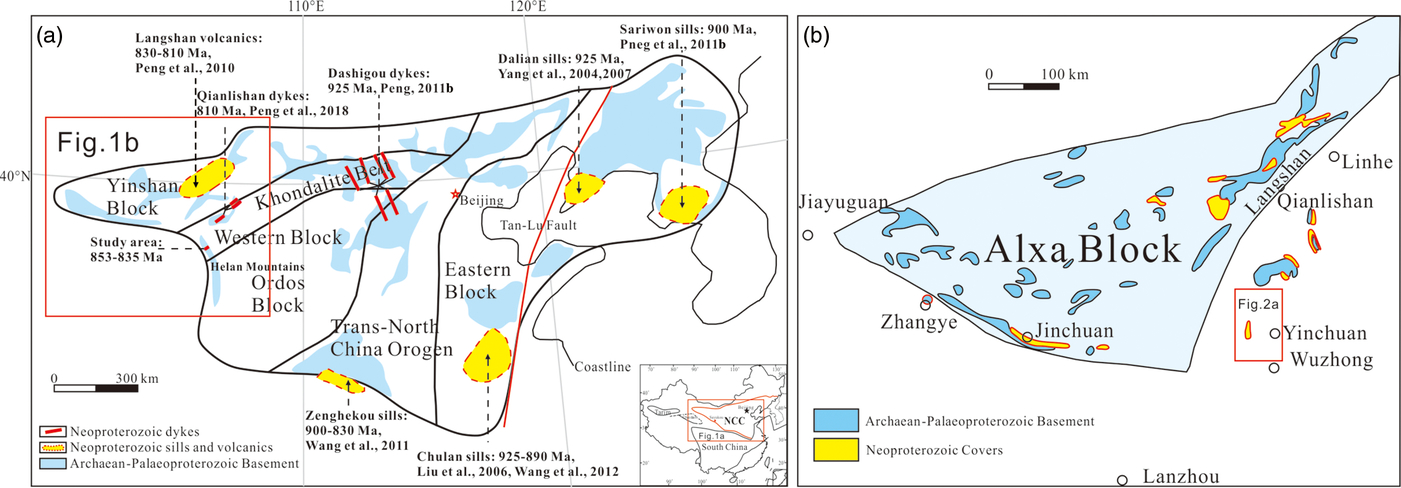
The North China Craton (NCC), South China Craton (SCC) and Tarim Craton (TC) are three of the major Precambrian cratonic blocks in China (e.g. Zhao & Cawood, Reference Zhao and Cawood2012; Zhao & Zhai, Reference Zhao and Zhai2013; Wu et al. Reference Wu, Xiao, Bonin, Ma, Li and Zhu2018) (Fig. 1a). Neoproterozoic magmatic events in TC (e.g. Shu et al. Reference Shu, Deng, Zhu, Ma and Xiao2011; Xu et al. Reference Xu, He, Zhang, Zhang, Wang and Cai2013; Zhang et al. Reference Zhang, Zou, Li and Wang2013) and South China (e.g. Zhou et al. Reference Zhou, Yan, Kennedy, Li and Ding2002; ZX Li et al. Reference Li, Li, Kinny, Wang, Zhang and Zhou2003; WX Li et al. Reference Li, Li and Li2005; Dong et al. Reference Dong, Liu, Santosh, Zhang, Chen, Yang and Yang2011; Cui et al. Reference Cui, Jiang, Wang, Wang, Zhuo, Deng, Liao, Wu, Jiang and Wei2015) indicate a relationship between the assembly and break-up of supercontinent Rodinia. However, owing to strong and multistage deformations and magmatism, as well as the extensive Mesozoic–Cenozoic sedimentation, geochronological records of Neoproterozoic magmatic activity in the NCC are very scarce. Therefore, the NCC has rarely been considered in the reconstruction of Rodinia (Liu et al. Reference Liu, Gao, Liu, Song and Wang2006).
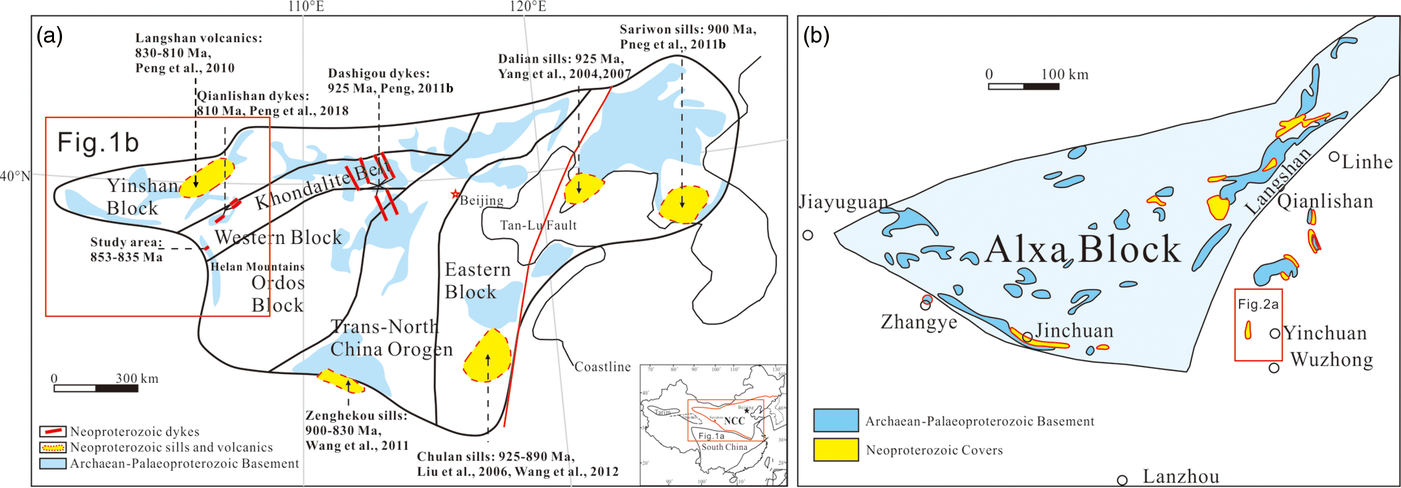
Sketch map showing the distribution of Neoproterozoic mafic dyke swarms and tectonic subdivision of the NCC (a) and the Alxa Block (b) (modified from Zhao & Zhai, Reference Zhao and Zhai2013; Peng, Reference Peng2015; Peng et al. Reference Peng, Wang, Zhou, Wang, Sun, Su, Chen, Guo and Zhai2018).
In this study, c. 853–835 Ma magmatic rocks, named the Xiaosongshan complex, are identified in the western margin of the NCC. We analysed the zircon U–Pb dating results and the isotope compositions of Hf in the same zircon grains, using in situ analysis with a laser-ablation microprobe coupled to a multi-collector inductively coupled plasma mass spectrometer (MC-ICP-MS). These results in combination can reveal the relationship between the NCC and Rodinia. This discovery, along with the recently reported Neoproterozoic magmatic activity in the NCC and adjacent areas (e.g. R Peng et al. Reference Peng, Zhai, Wang, Chen, Liu, Lv, Shi, Wang, Li, Wang, Ma and Zhang2010; P Peng et al. Reference Peng, Zhai, Li, Wu, Hou, Li, Li and Zhang2011 b; Wang et al. Reference Wang, Jiang, Dai, Griffin, Dai and Yang2011; Peng, Reference Peng2015; Zhang et al. Reference Zhang, Zhao, Ye and Hu2016), contributes significantly to the understanding of the early Neoproterozoic history of the NCC and the evolution of Rodinia.
2. Geological background
2.a. Regional geology
The NCC is one of the oldest cratonic blocks in the world, covering over 300000 km2 and containing rocks as old as c. 3.85 Ga (Liu et al. Reference Liu, Nutman, Compston, Wu and Shen1992; Song et al. Reference Song, Nutman, Liu and Wu1996; Zhao & Zhai, Reference Zhao and Zhai2013; Zhai, Reference Zhai and Zhou2015). Traditionally, the NCC consists of the Precambrian basement and late Palaeoproterozoic–Palaeozoic sedimentary cover (Zhai, Reference Zhai and Zhou2015). The Precambrian NCC can be further separated into the Archaean–Palaeoproterozoic metamorphic basement and the Palaeo-Mesoproterozoic unmetamorphosed cover, referred to as the Changcheng (1.8–1.6 Ga), Jixian (1.6–1.0 Ga) and Qingbaikou (1.0–0.8 Ga) groups (Lu et al. Reference Lu, Li, Zhang and Niu2008; Zhao & Zhai, Reference Zhao and Zhai2013). Because many basement rocks underwent intense deformation and widespread metamorphism during the Archaean to Palaeoproterozoic eons and were reworked during the Mesozoic to Cenozoic eras (e.g. Zhao & Cawood, Reference Zhao and Cawood2012; Zhao & Zhai, Reference Zhao and Zhai2013; Li et al. Reference Li, Dong and Liu2018; Wang et al. Reference Wang, Li and Han2018), the Precambrian history of the NCC is complex and has remained poorly understood. Although the formation and tectonic evolution of the NCC are still not well understood, its origin and geological evolution can provide important insights into the amalgamation of the Earth and early Precambrian crustal accretion (Yin et al. Reference Yin, Zhao, Guo, Sun, Xia, Zhou and Liu2011).
A number of collision models have been proposed regarding the tectonic subdivision of the NCC (e.g. Zhao et al. 2001; Kusky, Reference Kusky2011; Trap et al. Reference Trap, Faure, Lin, Augier and Fouassier2011). Zhao et al. (Reference Zhao, Wilde, Guo, Cawood, Sun and Li2010) proposed that two terranes, separated by a continent–continent collisional belt, should be assigned to different continental blocks. Recognition of three Palaeoproterozoic orogenic belts (Zhao et al. Reference Zhao, Wilde, Cawood and Lu1998, Reference Zhao, Wilde, Cawood and Sun2001, Reference Zhao, Sun, Wilde and Li2005; Zhao & Zhai, Reference Zhao and Zhai2013) – the Jiao–Liao–Ji Belt, Trans-North China Orogen and Khondalite Belt – revealed that the N–S-trending Trans-North China Orogen can divide the Precambrian basement of the NCC into eastern and western blocks (Fig. 1a), and the E–W-trending Khondalite Belt can further subdivide the Western Block into the Yinshan Block in the north and Ordos Block in the south. Ultimately, the amalgamation of the eastern and western blocks at ∼1.85 Ga formed the NCC (Zhao et al. Reference Zhao, Wilde, Cawood and Sun2001, Reference Zhao, Sun, Wilde and Li2005; Zhang et al. Reference Zhang, Zhao, Sun, Wilde, Li and Liu2006).
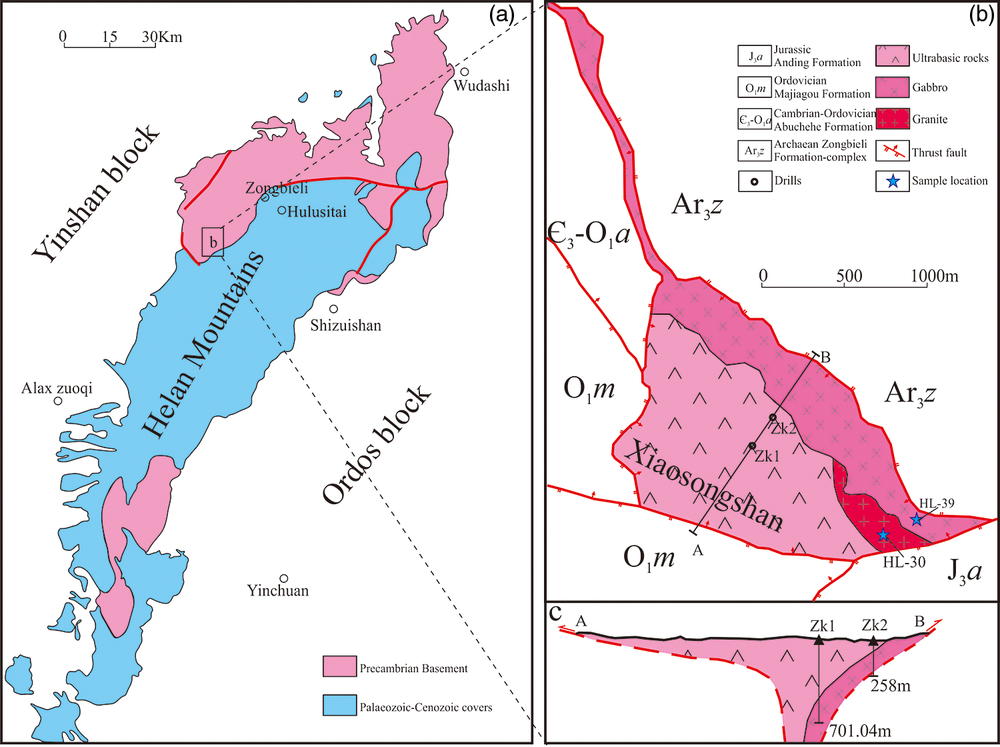
The N–S-trending Helan Mountains, whose range stretches 150 km long and 20–60 km wide, are located along the western margin of the NCC (Fig. 2a). The Archaean–Palaeoproterozoic metamorphic basement in this area consists mainly of the Helanshan (Archaean) and Zhaochigou complexes (Palaeoproterozoic), and the Palaeo-Mesoproterozoic cover is composed primarily of the Huangqikou Formation (Changcheng), Wangquankou Formation (Jixian) and Xihuashan complex (Qingbaikou). According to differences in geomorphological features, the Helan Mountains are usually divided into three portions from south to north. The study area lies within the northern portion of the Helan Mountains near the boundary between the Ordos Block and Khondalite Belt (Fig. 1a).
Geological sketch map of the Helan Mountains (a) and the Xiaosongshan complex (b) (modified from Wang et al. Reference Wang, Bai, Yang, Lu, Jin and Ma2008; D. Li et al. Reference Li, Dong and Liu2018). (c) A cross-section from SW to NE of the magmatic rocks in the study area. Section and drill numbers match those in (b). (Drilling data are from Zhao, Reference Zhao2003.)
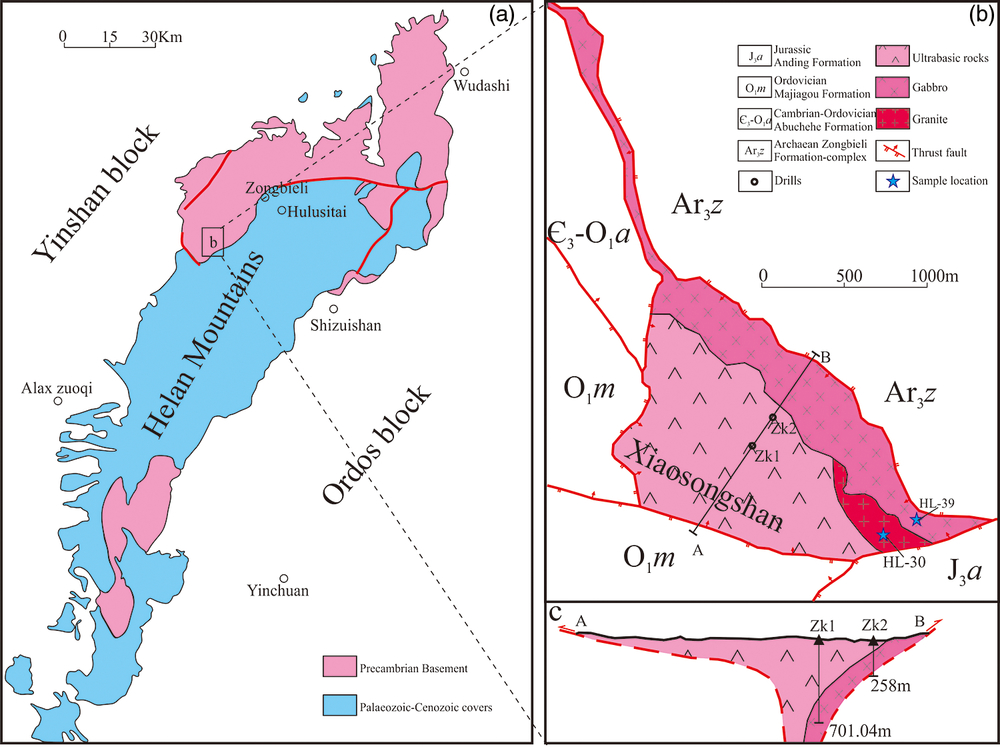
The studied magmatic rock, named the Xiaosongshan complex, is mostly distributed in the Xiaosongshan areas in the northern Helan Mountains near the boundary between Inner Mongolia and the Ningxia Hui Autonomous Region. The intrusions of magmatic rocks are spread out in the NW–SE direction, and their overall plane shapes cover ∼2.37 km2, which can be presented as an isosceles triangle c. 4 km long (Fig. 2b, c). According to the 1:200000 Jilantai regional geological survey performed by the Ningxia Hui Autonomous Region Monitoring Institute of Land and Resources Survey (NXMILRS), the Xiaosongshan complex was assumed to be formed in the middle–late Devonian (K/Ar ages of ∼384.4 Ma) (Wang et al. Reference Wang, Bai, Yang, Lu, Jin and Ma2008). However, the age data from Wang et al. (Reference Wang, Bai, Yang, Lu, Jin and Ma2008) are sparse and have low precision, and higher-precision data have not been reported. Thus, the age of the Xiaosongshan complex is still a matter of controversy. In this study, we carried out a detailed petrological, geochronological and geochemical analysis of the Xiaosongshan complex with the goal of elucidating its precise age and origin.
2.b. Sample descriptions
The Xiaosongshan complex is surrounded by sedimentary and metamorphic rocks, including carbonatites from the Cambrian–Ordovician Abuchehe and Majiagou formations in the west and southwest, clastic rocks from the Jurassic Anding formation in the southeast, and gneisses from the Archaean Zongbieli complex in the northeast (Fig. 2b). There is significant thrust fault contact between the magma intrusions and the surrounding rocks, as well as some thermal contact metamorphic features (Wang et al. Reference Wang, Bai, Yang, Lu, Jin and Ma2008). In the studied area, the Xiaosongshan complex is composed of ultrabasic rocks, gabbros and granites.
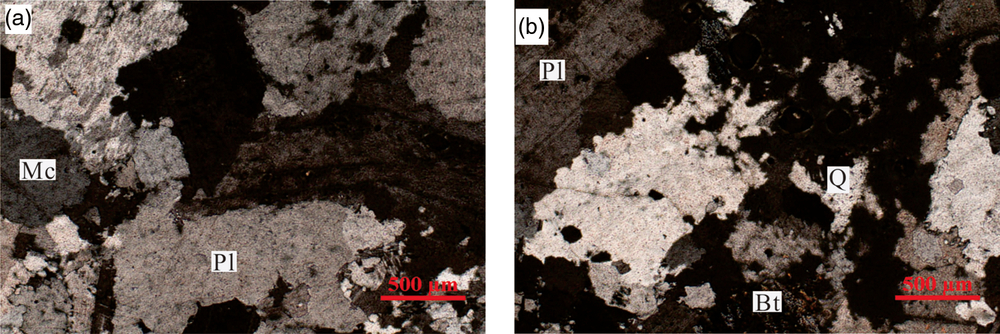
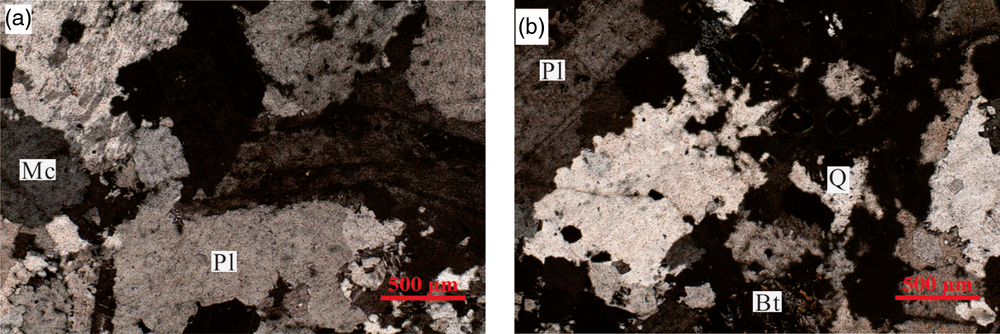
The ultrabasic rocks are composed primarily of olivine, diopside and plagioclase, with accessory minerals of spinel, apatite and ilmenite. Under the microscope, the granite sample consists of plagioclase (50–55 vol. %), microcline (10–15 vol. %), quartz (∼20 vol. %), biotite (∼8 vol. %) and minor accessory minerals (∼2 vol. %) such as magnetite, apatite and sphene (Fig. 3). The gabbro sample contains plagioclase (45–55 vol. %) and pyroxene (40–50 vol. %), with small amounts of biotite, hornblende and magnetite.
Microphotographs for the biotite monzogranite samples (a, b) Pl. plagioclase; Mc. microcline; Bt. Biotite; Q. quartz.
3. Materials and methods
Two representative samples (HL-39 and HL-30) were collected from the Xiaosongshan complex in the northern Helan Mountains for the zircon U–Pb and Hf isotope analysis (Fig. 2b). Gabbro sample HL-39 (location: 39° 06′ 17″ N, 106° 02′ 06″ E) was obtained from the eastern part of the Xiaosongshan complex. Granite sample HL-30 (location: 39° 06′ 31″ N, 106° 02′ 16″ E) was collected from the southeastern part of the Xiaosongshan complex. Thin-sections of the samples were prepared for microscopic observation.
The samples were cleaned using nanopore deionized water, and the weathered surface was removed. The fresh and unaltered samples were then processed for heavy-mineral, liquid and magnetic separation. Zircon particles from non-magnetic fractions were selected under the binocular microscope at the Langfang Integrity Geological Services Incorporation (LFIGSI). The zircons were polished and photographed in reflected light and transmitted light, and through backscattered scanning electron (BSE) microscopy and cathodoluminescence (CL) using the JXA-8100 electron probe. Zircon system analysis, microscopic imaging and zircon U–Pb dating were carried out in the State Key Laboratory of Geological Processes and Mineral Resources, China University of Geosciences. Zircon U–Pb dating was performed using the Agilent 7700a ICP-MS instrument, equipped with the 193-nm GeoLas 2005. The adopted laser diameter was 32 μm. Helium and argon were applied as the carrier gas and compensation gas. Detailed analytical methods were described by Li et al. (Reference Li, Zeng, Lu, Wei, Xiang and Pan2014). Errors of a single data point were quoted at the 1σ level, and the errors of the weighted average age were quoted at the 2σ (95%) confidence level. Zircon U–Pb dating data are presented in Supplementary Tables 1 and 2.
In situ zircon Hf isotope analysis was conducted at the State Key Laboratory of Geological Processes and Mineral Resources, China University of Geosciences, using a Neptune Plus MC-ICP-MS (Thermo Fisher Scientific, Germany) in conjunction with a GeoLas 2005 excimer ArF laser ablation system (Lambda Physik, Göttingen, Germany). Detailed analytical methods were the same as outlined by Hu et al. (Reference Hu, Gao, Liu, Hu, Chen and Yuan2008 a, b). The results of the zircon Hf isotope compositions for the samples are listed in Supplementary Tables 3 and 4.
4. Results
4.a. Zircon U–Pb geochronology
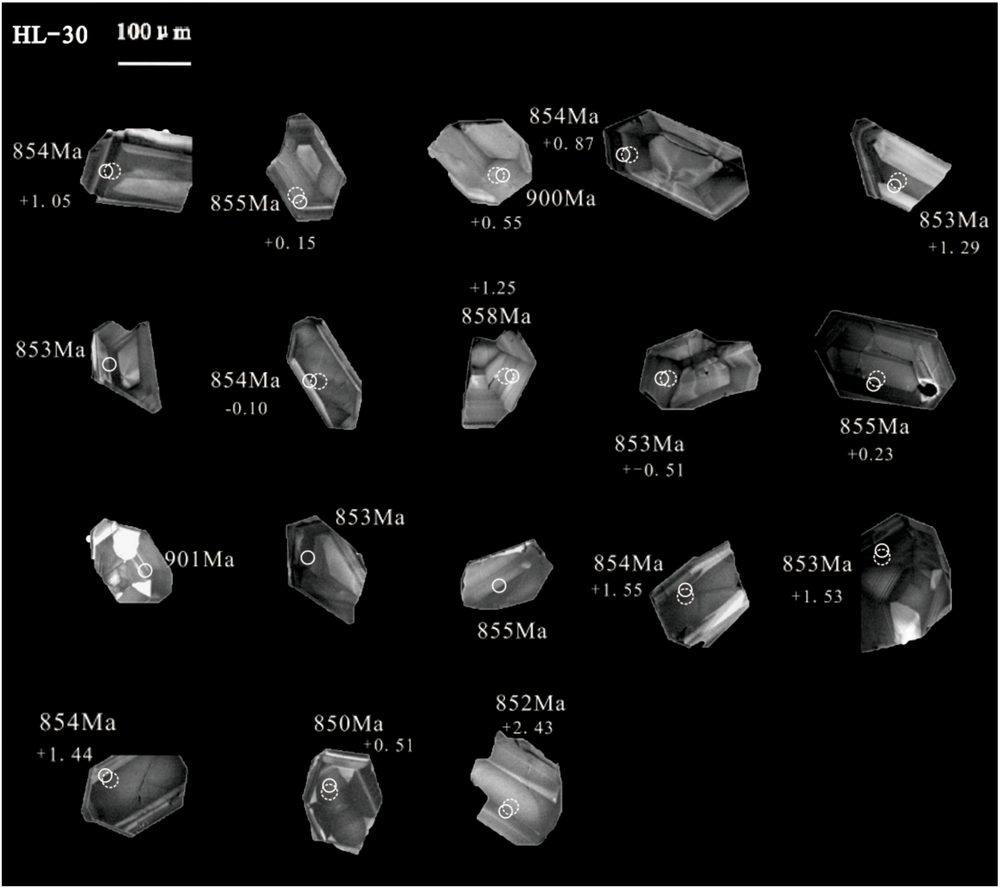
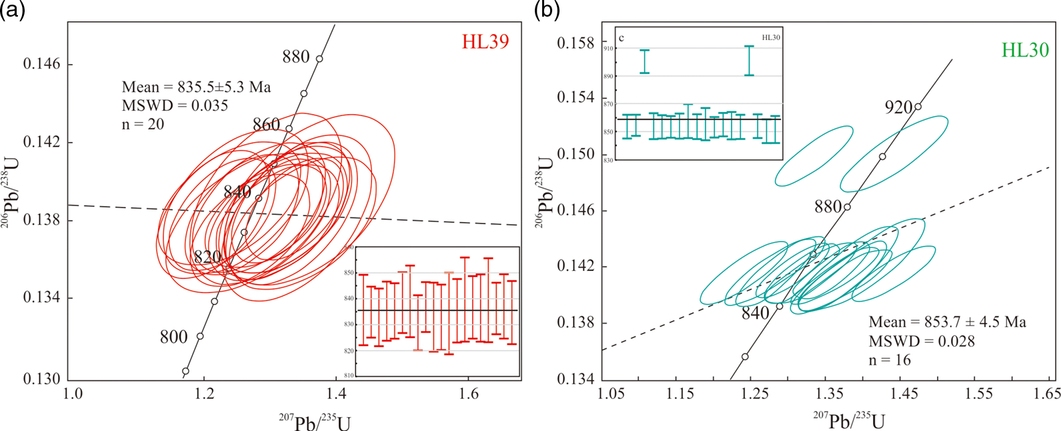
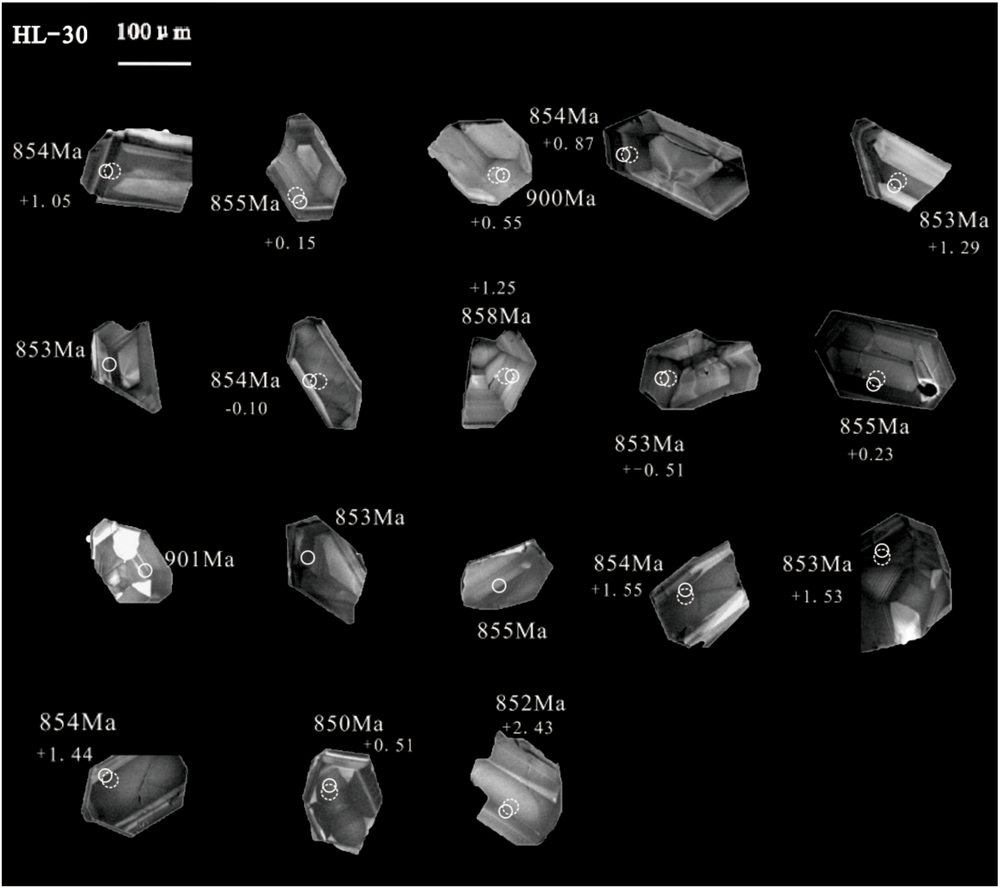
A total of 18 zircon grains were selected from the gabbro sample (HL-39), and 20 analysis points distributed among them were selected for zircon U–Pb dating. Based on the photomicrographs and CL images obtained (Fig. 4), the zircon crystals display oscillatory zoning without any inheritable cores or metamorphic rims. The CL images, as well as the relatively high concentrations of Th and U (ranging from 20 × 10−6 to 113 × 10−6 and from 44 × 10−6 to 182 × 10−6, respectively) and Th/U ratios (ranging from 0.38 to 0.67) (Supplementary Table 1), indicate a magmatic origin (Wu & Zheng, Reference Wu and Zheng2004). Zircon U–Pb dating results for the gabbro (HL-39) are listed in Supplementary Table 1 and on the concordia U–Pb age diagrams (Fig. 5). The 206Pb/238U ages for the gabbro vary from 833 ± 11 Ma to 840 ± 16 Ma, with an average age of 835.5 ± 5.3 Ma (n = 20, mean square weighted deviation (MSWD) = 0.035).
CL images of representative magmatic zircon crystals from the granite (HL-30). Morphology of zircon grains, εHf(t) values (large broken white line circles) and 206Pb/238U ages (small white circles) are presented.
Concordia U–Pb age diagrams and average U-Pb age plots for the gabbro sample HL-39 (a) and granite sample HL-30 (b).
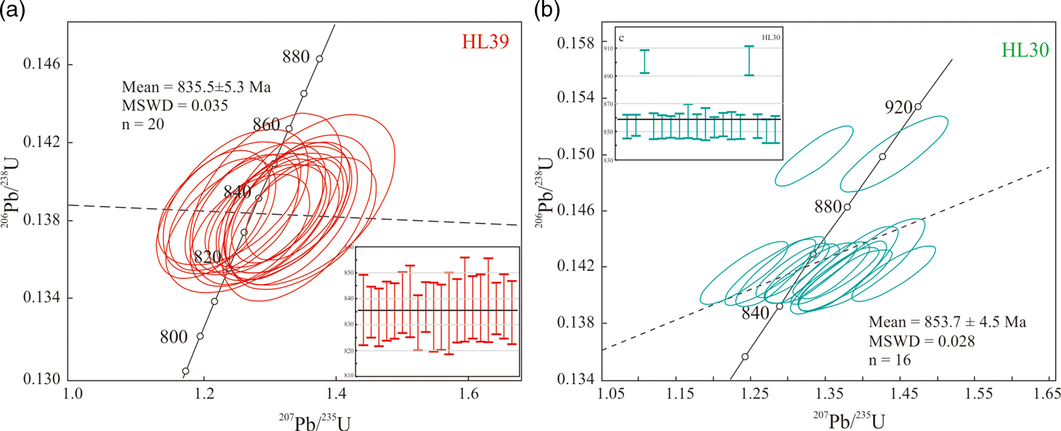
Likewise, 18 zircon grains were selected from the granite sample and 18 analysis points distributed among them were selected for zircon U–Pb dating. It can be seen from the CL images that these grains mostly show good crystal, euhedral–subhedral, short column–rhombohedron morphology and wide oscillatory zones, indicating a magmatic origin. The concentrations of Th and U in samples are from 64 × 10−6 to 488 × 10−6 and from 180 × 10−6 to 674 × 10−6, respectively, with Th/U ratios ranging from 0.35 to 0.75 (Supplementary Table 2). These relatively high concentrations of Th and U and Th/U ratios reveal a magmatic origin (Wu & Zheng, Reference Wu and Zheng2004). Zircon U–Pb dating results for the granite sample (HL-30) are listed in Supplementary Table 2 and on the concordia U–Pb age diagrams (Fig. 5). The granite 206Pb/238U ages vary from 850 Ma to 860 Ma (except two inheritable magmatic zircons with ages of 900 Ma and 901 Ma), with an average age of 853.7 ± 4.5 Ma (n = 16, MSWD = 0.028).
4.b. Zircon Hf isotope compositions
In situ zircon Hf isotope compositions for the samples are presented in Supplementary Tables 3 and 4. The εHf(t) values and Hf model ages (T DM) were calculated using
 \[\begin{array}{*{20}{c}}{\varepsilon {\rm{Hf}}\left( t \right)} \hfill & = \hfill & {\{ {{{[^{176}}{\rm{Hf}}{/^{177}}{\rm{Hf)}}}_{\mathop{\rm s}\nolimits} }{ - ^{176}}{\rm{Lu}}{/^{177}}{\rm{H}}{{\rm{f}}_{\rm{S}}}} \hfill \\
{} \hfill & {} \hfill & { \times ({{\rm{e}}^{\lambda t}} - 1)]/{{{[^{176}}{\rm{Hf}}{/^{177}}{\rm{Hf)}}}_{{\rm{CHUR}},0}} - {{(176{\rm{Lu}}{/^{177}}{\rm{Hf)}}}_{{\rm{CHUR}}}}} \hfill \\{} \hfill & {} \hfill & { \times ({{\rm{e}}^{\lambda {\rm{t}}}} - 1)] - 1\} \times 10000,} \hfill \\
\end{array}\]
 $$\eqalign{ {{\it{T}}_{{\rm{DM}}}}{\rm{ = 1/lln\{ 1 + [}}{\left( {^{{\rm{176}}}{\rm{Hf}}{{\rm{/}}^{{\rm{177}}}}{\rm{Hf}}} \right)_{\rm{S}}} - {\left( {^{{\rm{176}}}{\rm{Hf}}{{\rm{/}}^{{\rm{177}}}}{\rm{Hf}}} \right)_{{\rm{DM}}}}{\rm{]}} \cr {\rm{/[}}{\left( {^{{\rm{176}}}{\rm{Lu}}{{\rm{/}}^{{\rm{177}}}}{\rm{Hf}}} \right)_{\rm{S}}} - {\left( {^{{\rm{176}}}{\rm{Lu}}{{\rm{/}}^{{\rm{177}}}}{\rm{Hf}}} \right)_{{\rm{DM}}}}{\rm{]\} }}{\rm{.}} \cr} $$
To calculate the εHf(t) values, we use the 176Lu decay constant of λ = 1.865 × 10⁻¹¹ a−1 (Scherer et al. Reference Scherer, Münker and Mezger2001) and the chondritic values of 176Lu/177Hf = 0.0336 and 176Hf/177Hf = 0.28275 (Bouvier et al. Reference Bouvier, Vervoort and Patchett2008). The depleted mantle values of 176Lu/177Hf = 0.0384 (Griffin et al. Reference Griffin, Pearson, Belousova, Jackson, Achterbergh, O’Reilly and Shee2000) and 176Hf/177Hf = 0.28325 (Nowell et al. Reference Nowell, Kempton, Noble, Fitton, Saunders, Mahoney and Taylor1998), and the average mafic lower continental crust values of 176Lu/177Hf = 0.34 were used to calculate the two-stage model ages (T DM2).
A total of 15 analysis points distributed among 13 zircon grains in sample HL-39 were selected for the zircon Hf isotope composition analysis using laser ablation (LA-)MC-ICP-MS. The 176Yb/177Hf ratios and the 176Hf/177Hf ratios of sample HL-39 vary from 0.012570 to 0.034272 and from 0.282421 to 0.282478, respectively (Supplementary Table 3). The initial εHf(t) values of the zircons with an age of ∼835 Ma range from 5.83 to 7.87. The Hf single-stage model ages (T DM1) and Hf two-stage model ages (T DM2) range from 1075 Ma to 1155 Ma and from 1176 Ma to 1289 Ma, respectively (Supplementary Table 3).
In addition, 14 analysis points distributed among 14 zircon grains in the granite sample HL-30 were selected for the zircon Hf isotope composition analysis using the same method. The 176Yb/177Hf ratios and 176Hf/177Hf ratios vary from 0.034849 to 0.187297 and from 0.000806 to 0.003991, respectively (Supplementary Table 4). The εHf(t) values are between −0.51 and 2.43, and the corresponding T DM1 and T DM2 ages vary from 1348 Ma to 1461 Ma and from 1493 Ma to 1655 Ma, respectively (Supplementary Table 4).
5. Discussion
5.a. Formation ages of the Xiaosongshan complex
The formation age of the Xiaosongshan complex has long remained uncertain owing to the lack of isotopic age data. As discussed above, based on the K–Ar isotopic age of olivine from the basic–ultrabasic complex rocks, the Xiaosongshan complex has been interpreted to be formed during the middle–late Devonian (Wang et al. Reference Wang, Bai, Yang, Lu, Jin and Ma2008). However, because of low precision and sparse data points, these ages are disputable. Higher-precision data are needed to constrain the formation age of these magmatic rocks. In this study, the zircon U–Pb ages of the gabbro and granite samples provide new geochronological constraints on the Xiaosongshan complex.
The majority of zircons in the gabbro sample (HL-39) are euhedral–subhedral with fine-scale oscillatory zoning and relatively high Th/U ratios (0.38–0.67), indicating a magmatic origin. Furthermore, no inheritable or captured zircons were observed for the zircon CL images. Thus, the average 206Pb/238U age of 835.5 ± 5.3 Ma for zircon in the gabbro sample (HL-39) should represent the crystalline age of the gabbro intrusion.
Likewise, the characteristics of the zircon in the granite sample (HL-30) and the relatively high Th/U ratios (0.35–0.75) indicate a magmatic origin. Two analysis points (HL-30-3 and HL-30-15) yield relatively older ages (206Pb/238U ages of 900 Ma and 901 Ma, respectively) than the other 16 analysis points (average 206Pb/238U age of 853.7 ± 4.5 Ma). Based on similar observations regarding magmatic rocks and basement of the Alxa Block and the western NCC, Peng et al. (Reference Peng, Wang, Zhou, Wang, Sun, Su, Chen, Guo and Zhai2018) suggested that the Alxa Block was a part of the NCC during the Neoproterozoic. Furthermore, the U–Pb age and Hf isotope features of detrital zircons indicate that the Helan Mountains had received clastics from the Alxa Block in the Neoproterozoic (Dong et al. Reference Dong, Hu, Li, Zhao, Gong and Yang2017). Therefore, based on the early Neoproterozoic (∼900 Ma) magmatic event in the Alxa area of Inner Mongolia on the western margin of the NCC (Geng & Zhou, Reference Geng and Zhou2010, Reference Geng and Zhou2011), we interpret the two ∼900 Ma zircons to be inheritable magmatic zircons. The average 206Pb/238U age of 853.7 ± 4.5 Ma from the other 16 analysis points, therefore, represents the crystalline age of the granite intrusion, indicating the granites (c. 853 Ma) and the gabbros (c. 835 Ma) are contemporaneous.
5.b. Implication of the zircon Hf isotope results
As a common accessory mineral in most rocks, zircon typically contains 0.5–2 wt % Hf in its crystal structure and its 176Lu/177Hf ratio is extremely low (usually less than 0.002). The 176Hf that comes from the beta decay of 176Lu is negligible. The 176Lu/177Hf ratios in zircon are regarded as the initial values at the time of its formation (Hu et al. Reference Hu, Liu, Gao, Liu, Zhang, Tong, Lin, Zong, Li and Chen2012). Therefore, the isotope compositions of Hf in zircon can provide relevant information for deciphering the origin of zircon grains (Patchett et al. Reference Patchett, Kouvo, Hedge and Tatsumoto1982; Knudsen et al. Reference Knudsen, Griffin, Hartz, Andresen and Jackson2001; Wu et al. Reference Wu, Li, Zheng and Gao2007) and the evolution of the crust (Cherniak et al. Reference Cherniak, Hanchar and Watson1997; Hawkesworth & Kemp, Reference Hawkesworth and Kemp2006).
We analysed the zircon Hf isotope composition with the LA-MC-ICP-MS method, together with the U–Pb age dating for the same zircon grain. The 176Lu/177Hf ratios of the gabbro (HL-39) and the granite (HL-30) vary from 0.0002 to 0.0007 and from 0.0008 to 0.003, respectively (Supplementary Table 3). Moreover, the concentration of Lu is extremely low, indicating that the 176Hf, which came from the decay of 176Lu, is negligible. This corroborates that the 176Lu/177Hf ratios in zircon can represent the initial values of the zircon (Hu et al. Reference Hu, Liu, Gao, Liu, Zhang, Tong, Lin, Zong, Li and Chen2012).
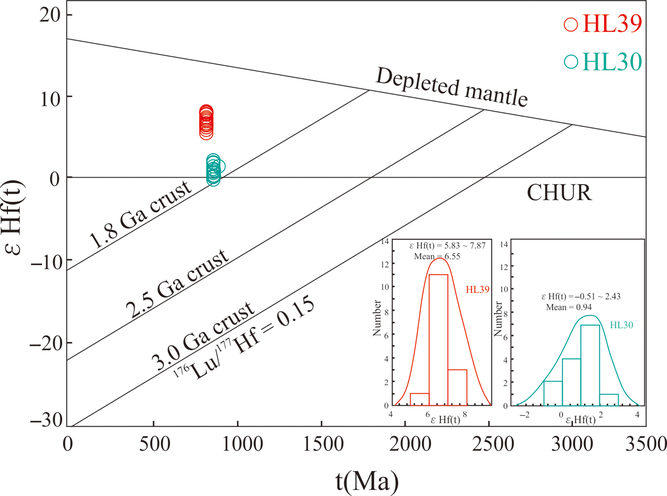
The zircon Hf isotope compositions of the gabbro (HL-39) are relatively high (with εHf(t) of 5.83–7.87). The plotted points in the zircon formation age vs zircon εHf(t) diagrams are primarily located between the trends representing the chondrite and the evolutionary trends of the depleted mantle, near the evolutionary trends of the c. 1.8 Ga crustal rocks (Fig. 6). This suggests a similar genesis for these zircons and an older mantle origin for the protoliths. If the Hf model ages exceed the formation ages of zircons, the parent rocks should remain in the crust for a period of time, and the two-stage Hf model age may reflect the extraction time of the protoliths from the mantle (Wu et al. 2007; Geng et al. Reference Geng, Du and Ren2012). These zircons are younger, with their mean U–Pb ages being 835.5 ± 5.3 Ma, as compared to those determined by the Hf single-stage model (T DM1) and Hf two-stage model (T DM2); the models determined their ranges to be 1075–1155 Ma and 1176–1289 Ma, respectively. These observations suggest that the parent rocks, which are derived from the Mesoproterozoic mantle, must have remained settled in the crust for a period of time to be modified along with the ancient crustal rocks.
Zircon formation age vs. zircon εHf(t) diagrams and Histograms of the zircon εHf(t) for the gabbro sample HL-39 and granite sample HL-30.
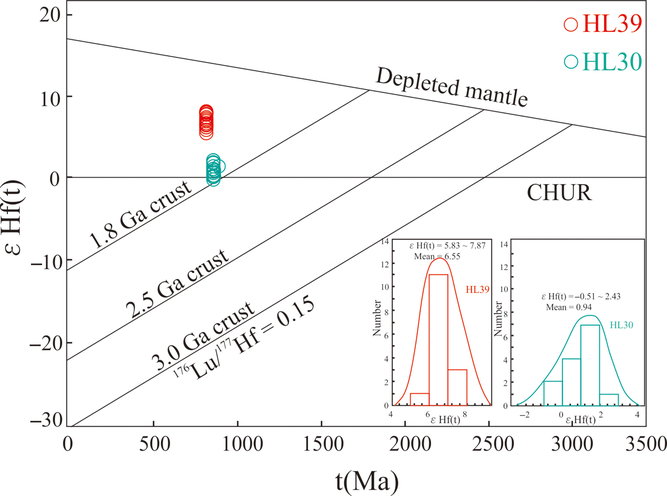
The εHf(t) values of the granite (HL-30) range between −0.51 and 2.43 (mean = 0.94), and remain close to 0. In the zircon formation age vs zircon εHf(t) diagrams, the plotted points are mainly located near the chondrite (Fig. 6), implying that the source materials of the granite were produced by the partial melting of the crustal rocks. Because the corresponding Hf single-stage model ages (T DM1) and Hf two-stage model ages (T DM2) (varying from 1348 Ma to 1461 Ma and from 1493 Ma to 1655 Ma, respectively) of these zircons greatly exceed the formation ages (mean of 853.7 ± 4.5 Ma), it can be suggested that parental magma of the granites may have remained settled in the crust for a long time after being generated from the partial melting of ancient materials.
5.c. Neoproterozoic magmatic events in North China Craton
Zircon U–Pb dating suggests that the gabbros (c. 835 Ma) and granites (c. 853 Ma) are contemporaneous. This provides evidence for the development of an early Neoproterozoic magmatic episode along the western margin of the NCC. In this region, there are several Neoproterozoic magmatic events whose ages are close to those of the Xiaosongshan complex. In the Qianlishan Mountains, there are many mafic dykes that are several metres wide and several kilometres long (Fig. 1b), consisting of diabase rocks. They are unconformably overlain by Carboniferous rocks and penetrate the Mesoproterozoic sediments. For one of the mafic dykes, a baddeleyite 207Pb/206Pb age of 813 Ma was determined (Peng, Reference Peng2015; Peng et al. Reference Peng, Wang, Zhou, Wang, Sun, Su, Chen, Guo and Zhai2018). Li et al. (Reference Li, Su, Song and Liu2004) reported the Jinchuan ultramafic intrusion with an age of ∼827 Ma in the adjacent Longshou Mountains, southwest of the Alxa Block. Peng et al. (Reference Peng, Zhai, Wang, Chen, Liu, Lv, Shi, Wang, Li, Wang, Ma and Zhang2010) discovered Neoproterozoic Langshan acid volcanic rocks from the Mesoproterozoic Zha’ertaishan Group in the western margin of the NCC, which have an age of ∼810 Ma (Fig. 1a). Together with these ∼810 Ma and ∼827 Ma magmatic events, a few ∼837 Ma mafic dyke swarms in the Lanzhou–Qin’an area are also present (Liu et al. Reference Liu, Hu, Gao, Feng, Coulson, Feng, Qi, Yang, Yang and Tang2012). Nevertheless, additional work is necessary to further confirm the precise location of these dykes. Moreover, the Neoproterozoic (837–810 Ma) magmatic rocks not only exist in the western margin of the NCC, but also in the southern margin. Wang et al. (Reference Wang, Jiang, Dai, Griffin, Dai and Yang2011) examined the geochronology of gabbros, which were dated at c. 830 Ma by sensitive high-resolution ion microprobe (SHRIMP) and LA-ICP-MS methods, from the Luanchuan Group at the southern margin of the NCC. In conclusion, the coeval and chemically similar magmatic associations in the NCC and adjacent areas, such as the Alxa Block and Lanzhou–Qin’an area (Fig. 1b), suggest that these areas experienced c. 850–810 Ma magmatic activity during the Neoproterozoic.
Along with these 850–810 Ma magmatic events in the NCC, there are also several early Neoproterozoic dykes and/or sill swarms distributed in other parts of the NCC (Fig. 1a), such as the ∼925 Ma Dashigou dyke swarm, which comprises gabbro and diabase in the central NCC (Peng, Reference Peng, Kusky, Zhai and Xiao2011); the ∼900 Ma Sariwan sills, which are composed of dolerite, in the southeastern margin of the NCC (Peng et al. Reference Peng, Zhai, Li, Wu, Hou, Li, Li and Zhang2011 b); the ∼925 Ma Dalian sills and dykes, which are composed of tholeiites and dolerites in the eastern NCC (Yang et al. Reference Yang, Wu, Zhang, Zhang and Wilde2004, Reference Yang, Sun, Chen, Wilde and Wu2007; Zhang et al. Reference Zhang, Zhao, Ye and Hu2016); the 925–890 Ma Chulan sills and dykes, which also comprise mostly tholeiites and dolerites in the southeastern NCC (Liu et al. Reference Liu, Gao, Liu, Song and Wang2006; Wang et al. Reference Wang, Yang and Xu2012); and the 900–830 Ma Zenghekou sills, which are composed of dolerites in the southern NCC (Wang et al. Reference Wang, Jiang, Dai, Griffin, Dai and Yang2011). Moreover, similar c. 920 Ma magmatism also occurred in the Congo (Franssen & André, Reference Franssen and André1988; Tack et al. Reference Tack, Wingate, Liégeois, Fernandez-Alonso and Deblond2001) and São Francisco cratons (e.g. Correa-Gomes & Oliveira, Reference Correa-Gomes and Oliveira2000). On the basis of the precisely matched ages and similar chemical compositions, Peng et al. (Reference Peng, Bleeker, Ernst, Söderlund and McNicoll2011a) proposed that the Bahia dykes in the São Francisco craton and the Gangila–Mayumbian volcanics in the Congo craton could be the same large igneous provinces as the magmatic dykes/sills of the NCC. In summary, although the Neoproterozoic magmatic rocks were very weak in the NCC, the newly discovered Xiaosongshan complex, as well as these reported synchronous magmatic rocks in the NCC, indicate that the Neoproterozoic magmatic activity in the NCC could possibly have been stronger than what we identified before.
5.d. Implication for the relationship between the NCC and the Neoproterozoic supercontinent Rodinia
As discussed above, the Xiaosongshan magmatic rocks formed in the Neoproterozoic era, which was a critical period in the history of the Earth, were a witness to the waning stages of the break-up of the Rodinia supercontinent and the substantial migration of isolated cratons across a wide variety of latitudinal ranges during the assembly of Gondwana (Bowyer et al. Reference Bowyer, Wood and Poulton2017). Along with the drastic changes in Earth’s crust, atmosphere and hydrosphere from Rodinia to Gondwana, the global tectonic framework was reorganized (Cawood et al. Reference Cawood, Strachan, Pisarevsky, Gladkochub and Murphy2016; D. Li et al. Reference Li, Chen, Kang, Xu and Zhang2018), resulting in a series of orogenies (Merdith et al. Reference Merdith, Collins, Williams, Pisarevsky, Foden, Archibald, Blades, Alessio, Armistead, Plavsa, Clark and Müller2017). Magmatic events linked to the break-up of Rodinia are preserved in many continental fragments such as in Western Australia (e.g. Wingate & Giddings, Reference Wingate and Giddings2000), the East European Craton (e.g. Nosova et al. Reference Nosova, Kuz’menkova, Veretennikov, Petrova and Levsky2008), India (e.g. Torsvik et al. Reference Torsvik, Carter, Ashwal, Bhushan, Pandit and Jamtveit2001), Laurentia (e.g. Wingate, Reference Wingate2001), the northern Canadian Shield (e.g. Harlan et al. Reference Harlan, Heaman, LeCheminant and Premo2003), the Tarim Craton (e.g. Shu et al. Reference Shu, Deng, Zhu, Ma and Xiao2011; Xu et al. Reference Xu, He, Zhang, Zhang, Wang and Cai2013; Zhang et al. Reference Zhang, Zou, Li and Wang2013; Wu et al. Reference Wu, Xiao, Bonin, Ma, Li and Zhu2018) and South China (e.g. Zhou et al. Reference Zhou, Yan, Kennedy, Li and Ding2002; ZX Li et al. Reference Li, Li, Kinny, Wang, Zhang and Zhou2003; WX Li et al. Reference Li, Li and Li2005; Dong et al. Reference Dong, Liu, Santosh, Zhang, Chen, Yang and Yang2011; Cui et al. Reference Cui, Jiang, Wang, Wang, Zhuo, Deng, Liao, Wu, Jiang and Wei2015). According to the Rodinia configuration (Hoffman, Reference Hoffman1991), East Gondwanaland and Laurentia were located at a central position in the Rodinia supercontinent. Nevertheless, the precise locations of the South China Block and NCC during the Neoproterozoic era are controversial. Based on the study of tectonostratigraphy and palaeogeography, Li et al. (Reference Li, Zhang and Powell1996) suggested that the South China Block lay at the centre of the Rodinia supercontinent during the early Neoproterozoic.
In China, Neoproterozoic magmatic rocks, which might be related to the Rodinia supercontinent, are widespread in the South China Block and Tarim Craton, and some are distributed in the NCC. Therefore, fewer studies have dealt with the role of the NCC in the Rodinian reconstruction, and the question of whether the NCC was involved in the global Neoproterozoic magmatic events is still a mystery. Zhai et al. (Reference Zhai, Shao, Hao and Peng2003) suggested that the NCC may have been located at a marginal position in Rodinia, and two metamorphic–magmatic events during ∼1300–1000 Ma and ∼850–650 Ma may exist in the NCC. Although these events were very weak, especially the latter, they are considered as indicators for the assembly and break-up of Rodinia. Hence, identifying the Neoproterozoic magmatic rocks in the NCC is critical to unravelling the Neoproterozoic history of the NCC and the relationship with other blocks and continents. The newly found Neoproterozoic magmatic rocks (Xiaosongshan complex) in the Helan Mountains, as well as the reported synchronous rocks in the southern margin (Wang et al. Reference Wang, Jiang, Dai, Griffin, Dai and Yang2011), western margin (Li et al. Reference Li, Su, Song and Liu2004; Peng et al. Reference Peng, Zhai, Wang, Chen, Liu, Lv, Shi, Wang, Li, Wang, Ma and Zhang2010; Peng, Reference Peng2015), eastern margin (Yang et al. Reference Yang, Wu, Zhang, Zhang and Wilde2004, Reference Yang, Sun, Chen, Wilde and Wu2007; Peng et al. Reference Peng, Zhai, Li, Wu, Hou, Li, Li and Zhang2011 b; Zhang et al. Reference Zhang, Zhao, Ye and Hu2016), southeastern margin (Liu et al. Reference Liu, Gao, Liu, Song and Wang2006; Peng et al. Reference Peng, Zhai, Li, Wu, Hou, Li, Li and Zhang2011 b; Wang et al. Reference Wang, Yang and Xu2012) and centre of the NCC (Peng, Reference Peng, Kusky, Zhai and Xiao2011), indicate that the NCC might have been connected with the Rodinia supercontinent during the Neoproterozoic. The newly discovered Neoproterozoic (c. 850 Ma) magmatic rocks along the western margin of the NCC could be important for the Rodinian palaeogeographic reconstruction.
6. Conclusions
Based on the zircon U–Pb and Hf isotope compositions of the Xiaosongshan complex in the western margin of the NCC, we draw the following conclusions:
(1) LA-ICP-MC zircon U–Pb age dating of two representative samples (HL-39 and HL-30) yielded 206Pb/238U average ages of 835.5 ± 5.3 Ma and 853.7 ± 4.5 Ma, respectively, providing evidence for the development of early Neoproterozoic magmatic activity along the western margin of the NCC.
(2) In situ zircon Hf isotope compositions for the samples (HL-39 and HL-30) show that the εHf(t) values are 5.83–7.87 and −0.51 to 2.43, the corresponding Hf single-stage model ages (T DM1) range from 1075 Ma to 1155 Ma and from 1348 Ma to 1461 Ma, respectively, and the Hf two-stage model ages (T DM2) vary from 1176 Ma to 1289 Ma and from 1493 Ma to 1655 Ma, respectively. Viewed together, these data suggest that their parental magma formed by the reworking of the ancient crust evolved from Mesoproterozoic mantle.
(3) The newly found Neoproterozoic Xiaosongshan complex on the western margin of the NCC, as well as the reported Neoproterozoic magmatic rocks in other parts of the NCC, indicate that the NCC may have been connected with the supercontinent Rodinia during the Neoproterozoic.
Author ORCIDs
jie Yang 0000-0002-9092-6346
Acknowledgements
This research was supported by China Geological Survey (1212011120552) and China Scholarship Council (201606410022). We thank Yunxu Wei and Shiming Xiang for field assistance. We express our sincere appreciation to Timothy W. Lyons and Kingsley O. Odigie for their beneficial suggestions. We thank editor Chad Deering for his thoughtful editorial comments. Two anonymous reviewers provided helpful reviews.
Supplementary material
To view supplementary material for this article, please visit https://doi.org/10.1017/S0016756819000347.