Introduction
A scholarly debate has emerged over whether Asian democracies – against the general global trend in institutional design – are moving towards Lijphart's (Reference Lijphart1999) model of ‘majoritarian democracy’. While Reilly is the most vocal advocate of this thesis, arguing that ‘there has been a convergence in recent years on an identifiable “Asian model” of democracy characterized by aggregative electoral politics, centrist political competition, and, in some cases, nascent two-party systems’ (Reference Reilly2007a: 1351), Croissant and Schächter (Reference Croissant and Schächter2010) find no supporting empirical evidence.
The literature also provides contradicting evidence when we disaggregate Lijphart's models of democracy and focus on what is commonly considered the key institutional component – namely, the electoral system. Whereas the ‘Asian model’ hypothesis argues that democracies across the region have in recent years adopted majoritarian electoral systems in an attempt to engineer stable governments and facilitate more efficient – that is, less consensual – policy making (Reilly, Reference Reilly2007a, Reference Reilly2007b; Rock, Reference Rock2013), a comparative review of single-country studies of electoral reform suggests a different picture: electoral reform was not driven by a deliberate effort to manufacture two-party systems; instead, all major electoral reforms had the objective of tackling problems of ‘money politics’ and corruption. Put in more abstract terms, single-country studies seem to agree that, to strengthen the accountability of politicians, electoral reform was aimed at re-shaping competitive patterns within parties, rather than between parties.
Existing explanations of electoral reform in Asia thus focus on very different aspects of electoral systems. While the ‘Asian model’ hypothesis emphasizes the interparty dimension, single-country studies imply that institutional reform intended to reposition electoral systems on the intraparty dimension. To adjudicate between these two opposing views, this paper will provide a quantitative ‘mapping’ of electoral reform in Asia through a two-dimensional framework, which allows to directly compare shifts on both the interparty and intraparty dimension. This exercise will show that the most significant transformation of electoral systems in Asia over the last two decades has happened on the intraparty rather than the interparty dimension. More generally, the evidence suggests that Asian democracies have been ‘normalizing’ their electoral systems rather than working towards an ‘Asian model’ of governance based on the ‘winner takes all principle’.
Electoral systems: interparty and intraparty effects
In a review of the academic literature on electoral systems, Shugart (Reference Shugart, Gallagher and Mitchell2005: 29–30) summarizes that ‘[m]ost research over several decades of the development of the field has been concerned with how electoral systems affect the translation of votes into seats for competing political parties, and how electoral systems affect the overall nature of the party system – basically, the number of parties and how proportional the allocation is among them’. The general consensus that has emerged from this research is that the district magnitude of an electoral system – that is, the number of parliamentary seats per constituency – has the greatest effect on proportionality: the larger the district magnitude, the more proportional the translation of votes to seats (see, for example, Lijphart, Reference Lijphart1994).
Proportionality, in turn, influences the number of parties in a party system: as proportionality increases, so does party system fragmentation (Taagepera and Shugart, Reference Taagapera and Shugart1989: 142–55). There is therefore a link between district magnitude and the number of parties in party system: electoral systems with a smaller district magnitude will facilitate the emergence of a two-party system, while electoral systems with a larger district magnitude will promote a multi-party system. However, it is widely acknowledged that the relationship between district magnitude and party system fragmentation also depends on other factors. For example, Amorim Neto and Cox (Reference Amorim Neto and Cox1997) show that the number of parties is the product of both the ‘permissiveness’ of the electoral system and the degree of social heterogeneity. Similarly, Moser and Scheiner (Reference Moser and Scheiner2012) argue that whether electoral systems have a reductive effect on party system fragmentation is determined by the level of party institutionalization and voters’ ability to gauge the competitiveness of the different parties.
Nevertheless, despite the fact that district magnitude has been found to have the largest influence on the proportionality of election results, most existing categorizations of electoral systems are actually based on the electoral formula – that is, the method by which votes are translated into seats (Farrell, Reference Farrell2011: 6). The three main families of electoral systems distinguished are thus majoritarian/pluralitarian, proportional representation (PR), and mix-member systems. Lijphart's models of democracy, too, make reference to the dichotomy between majoritarian/pluralitarian and proportional electoral systems. However, this is a mere heuristic device; ultimately, Lijphart is interested in the output of electoral systems, rather than their mechanical components. Whereas the ‘majoritarian’ model of democracy is characterized by high levels of disproportionality and a two-party system, the ‘consensus’ model of democracy features highly proportional election results and a multi-party system (Lijphart, Reference Lijphart1999).
A growing number of scholars are starting to realize, however, that, by focusing ‘on the distinction between majority and proportional rules’, many classifications and analyses of electoral systems ‘address only party representation, but neglect the second essential element of any electoral system: personal representation’ (Colomer, Reference Colomer and Colomer2011: 2, emphasis added by the author). In other words, existing research places heavy emphasis on the interparty dimension – that is, the question of how voting rules affect the allocation of seats to parties – but has largely ignored the intraparty dimension – that is, the question of how electoral institutions affect the allocation of seats to candidates.
Aiming to deal with this shortcoming, a number of authors have developed alternative classifications of electoral systems based on the ballot structure – that is, the degree of voter choice offered by the electoral system. For example, Shugart (Reference Shugart, Gallagher and Mitchell2005: 37–8; also see Colomer, Reference Colomer and Colomer2011: 8–11) organizes his classification around two questions: does the electoral system specify an allocation process for converting votes into seats (1) among parties and/or (2) among candidates? Based on the resulting two-dimensional matrix, three broad families of electoral systems can be distinguished: under closed-list systems, parties present ranked ballots and voters simply select one party list over another; the electoral rules do thus not specify the allocation of seats to candidates. Under nominal systems (or non-list systems), voters vote for candidates by name; the electoral rules, in other words, specify which individual candidates obtain seats.Footnote 1 Finally, preferential list systems specify allocation criteria on both the interparty and intraparty dimension: ‘Individual candidates compete for votes, as in nominal systems, but these votes are aggregated at the level of a party list, as in closed-list systems’ (ibid: 39). The main subtypes of preferential list systems are open-list systems and flexible-list systems.Footnote 2
These different electoral system types place a significant constraint on politicians’ electoral strategies. Broadly speaking, a politician needs to decide whether he or she wants to campaign on a personal vote – that is, on ‘his or her personal qualities, qualifications, activities, and record’ (Cain et al., Reference Cain, Ferejohn and Fiorina1984: 9) – or a party vote – that is, by investing in a collective party reputation. While under closed-list systems the incentives for cultivating a personal vote are almost zero, other electoral system types – because they allow voters to vote for candidates by name – give politicians stronger incentives for personal vote-seeking. This is especially true for those systems that pit candidates of the same party against each other in the same district: preferential list systems and non-list systems with multi-member districts. Under such electoral rules, the challenge for candidates is to find a way to set themselves apart from their co-partisan contenders. The most effective way for candidates to do so is to ‘differentiate themselves on the basis of their ability to provide particularistic goods’ (Cox and Thies, Reference Cox and Thies1998: 269).
There are, in general, three different strategies through which individual candidates can deliver particularistic goods to voters: (1) governmental ‘pork’, (2) clientelism, and (3) vote buying. Usually, pork is aimed at larger groups of voters (for example, neighborhoods or other communities), while clientelism and vote buying are targeted at individual voters. The latter two strategies differ in that clientelism comes with ‘electoral strings’ attached: material benefits are only distributed to voters who have already delivered or who promise to deliver their votes (Hicken, Reference Hicken2011).
However, as with the interparty dimension, it is important to take into consideration other factors when explaining the constraining effects of electoral systems on politicians’ vote-seeking strategies. As a number of authors point out, the electoral system alone is never a sufficient condition for the emergence of particularistic electoral strategies (see, for example, Hicken, Reference Hicken and Schaffer2006a; Samuels, Reference Samuels1999). On the ‘demand side’, the efficiency of strategies such as clientelism and vote buying is driven by the degree to which voters depend on particularistic benefits to maintain their standard of living. More specifically, a voter's ‘reservation price’ – that is, the price at which voters will trade their vote for a particularistic benefit – ‘will be set at a level that is at or above what he can easily procure through his own efforts in the private market’ (Lyne, Reference Lyne, Kitschelt and Wilkinson2007: 164). This means that clientelism and vote buying tend to thrive when poverty is widespread. On the other hand, under conditions of economic development and rising living standards, ‘supply-side’ factors gain in importance. In particular, clientelism will be difficult to maintain without ‘large-scale public enterprise and “planned” political economies’ as such regulatory policies provide politicians with a large supply of public resources to keep up with voters’ growing reservation price (Kitschelt et al., Reference Kitschelt, Hawkins, Luna, Rosas and Zechmeister2010: 41). Even more critically, political parties need to have access to these public resources; parties that are excluded from access will have to develop policy-based appeals (Shefter, Reference Shefter1977).
Finally, as for the interparty dimension, there are wider socio-political implications to consider. Most significantly, a growing body of literature explores the negative effects of pervasive personal vote-seeking on democracy and general social welfare. For example, Chang makes a strong connection between the personal vote and corruption: ‘When dependence on the personal vote rises in elections, candidates need more campaign resources to advertise their individual candidacies. However, these personal vote-seeking activities are very costly and the party is unlikely to help. The high cost of elections, therefore, tempts candidates into seeking illegal campaign contributions’ (2005: 719). Other authors (Golden, Reference Golden2003; Hicken and Simmons, Reference Hicken and Simmons2008), pointing in a similar direction, argue that the widespread cultivation of a personal vote breeds bureaucratic inefficiencies and an oversupply of particularistic legislation.
At the same time, closed-list electoral systems that create incentives for politicians to invest in a collective party reputation have also been criticized. Here, the bulk of criticism revolves around the fact that lawmakers have no direct ties with voters, which means that holding individual politicians accountable is very difficult. Some scholars have argued that, similar to preferential list systems and non-list systems with multi-member districts, these institutional properties facilitate corruption and hinder good governance (for example, Kunicová and Rose-Ackerman, Reference Kunicová and Rose-Ackerman2005).
Reviewing single-country studies: there is no ‘Asian model’
To sum up the preceding section, academic work on the effects of electoral systems has mainly focused on the interparty dimension – that is, the question of how electoral systems affect the distribution of parliamentary seats between parties. On the other hand, the question of how electoral rules shape the allocation of seats within parties – in other words, the intraparty dimension of electoral competition – has been largely ignored.
Proponents of the ‘Asian model’ hypothesis, too, follow the dominant conceptual framework and analyze electoral reform primarily along the interparty dimension. The argument goes that established parties – contrary to the global trend towards the consensus model of democratic politics – have deliberately engineered lower levels of electoral proportionality as part of a larger move to strengthen the majoritarian features of their respective political systems.
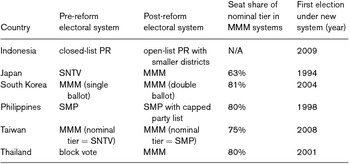
More specifically, the ‘Asian model’ hypothesis is based on the observation that democracies in the region have either (a) reduced the size of their electoral constituencies or (b) adopted a particular subtype of mixed-member electoral systems: mixed-member majoritarian (MMM) systems with a high share of seats set aside for single-member districts (SMD) (see Table 1). MMM systems, in general, have been found to produce less proportional results than the second subtype of mixed-member systems – mixed-member proportional (MMP) systems – because the nominal tier and the party list tier are not linked in the allocation of seats to parties, meaning that ‘the typical majoritarian boost received by a large party in the nominal tier is not likely to be wiped away by proportional allocation from the list tier’ (Shugart and Wattenberg, Reference Shugart, Wattenberg, Shugart and Wattenberg2001: 13).
Major cases of electoral reform in Asia

Overall, these electoral system choices are interpreted ‘as an attempt by Asia-Pacific governments to minimize the threat of political fragmentation by restricting the electoral prospects of minor parties and (not incidentally) promoting the interests of incumbents’ (Reilly, Reference Reilly2007a: 1359–60). However, as this section will show, single-country analyses of recent electoral reform in East Asia do not agree with this assessment.
Rethinking the case selection
Before reviewing the body of single-country studies, however, it seems necessary to first discuss which cases to include in this review. In particular, it is questionable whether – for conceptual and empirical reasons – the Philippines and South Korea do indeed constitute cases of electoral reform towards MMM, as advocates of the ‘Asian model’ hypothesis claim.
In the Philippines, the provision for the implementation of a mixed-member electoral system had originally been written into the 1987 constitution after the downfall of the Marcos regime. However, subsequently, established political parties – dominated by politicians from the traditional oligarchic elite (trapos) – gutted the reform provision by formulating the electoral law in such a way that it would ‘divide mass-based organizations and progressive groups’ (Wurfel, Reference Wurfel1997: 27). Therefore, although the Filipino electoral system could technically be classified as MMM, it contains a number of technical features that make it distinctively unique. Most remarkably, the top five parties in the previous House of Representatives election may not compete in the party list tier and there is a ‘cap’ of three seats per party in the list system.Footnote 3 As a result, ‘overall the party-list system in its current form has not made much of an impact on the trapo system. Traditional politicians representing different factions of the elite still constitute the overwhelming majority in both houses of Congress and they continue to operate as before’ (Quimpo, Reference Quimpo2005: 18). As even the chair of the Commission on Elections (Comelec), Sixto Brillantes, has called the party-list tier a ‘joke’ (Philippine Daily Inquirer, 2012), it thus seems more appropriate to classify the Filipino electoral system as single-member plurality (SMP).
South Korea, too, should be excluded from the sample of cases. This is because Korea had already implemented a MMM electoral system for the first free elections in 1988, while subsequent reform was aimed at achieving a higher level of proportionality rather than a lower level. Most significantly, electoral reform in 2004 introduced a second vote, allowing voters to cast separate votes for an individual candidate in the SMD tier and for a closed party list in the PR tier. Supporters of electoral reform hoped that this two-ballot system ‘would reduce the effects of regionalism in the distribution of [SMD] seats and strengthen proportionality and minority representation’ (Cho, Reference Cho2005: 526).
Having excluded the Philippines and South Korea from the sample of relevant cases, this leaves us with four democracies worth closer investigation: Japan, Taiwan, Thailand, and Indonesia.Footnote 4 A large body of single-country studies has emerged in recent years, analyzing electoral reform in each of the four democracies. Taken together, these studies tell a very different story to the ‘Asian model’ account. First of all, there appears to be general agreement that pressure for electoral reform had built up because the old electoral systems were perceived to facilitate pervasive ‘money politics’ and corruption. Concerns over government stability and blackmailing by smaller parties, on the other hand, had not been important drivers for reform. Second, single-country studies suggest that, despite this pressure, electoral reform was difficult to achieve because – in line with the dominant rational-choice approach to electoral system design (see Colomer, Reference Colomer2005; Shugart, Reference Shugart1998) – political parties’ electoral system preferences clashed. In Japan, Taiwan, and Indonesia, contention largely revolved around the question of proportionality: small parties wanted a proportional electoral system, while larger parties advocated a more disproportional system. In Thailand, rural-based political parties blocked electoral reform because they benefited from the candidate-centered electoral system more than Bangkok-based parties. In other words, single-country studies suggest that, in all four democracies, the final outcome of electoral reform was a compromise between self-interested political parties. In no case do these studies imply that there was a concerted effort across parties to implement more majoritarian electoral institutions.
Explaining the implementation of MMM: Japan, Taiwan, and Thailand
Starting with the question of how electoral reform made it onto the political agenda, qualitative analyses seem to agree that – in Japan, Taiwan, and Thailand – the mechanical incentives for cultivating a personal vote were the most important factor. Both Japan and Taiwan employed single non-transferable vote (SNTV) – a nominal electoral system with multi-member districts. Crucially, SNTV provides voters with only one vote, which – as the name suggests – is non-transferable, meaning that voters are not given the opportunity to rank order candidates.Footnote 5 Candidates of the same party therefore compete for the same votes. Thailand, on the other hand, used a block vote system to elect the lower chamber of parliament. Block vote resembles SNTV in all aspects, except that voters are given as many votes as there are seats to be filled in a constituency. Although this feature allows parties aiming to win a parliamentary majority to nominate a full slate of candidates and instruct their voters to give all their votes to the party's slate, block vote still provokes intense intraparty competition (Hicken, Reference Hicken and Schaffer2006a: 49–50). Accordingly, in all three countries, politicians made use of the full arsenal of particularistic strategies outlined earlier to differentiate themselves from their co-partisan contenders.
In Japan, politicians of the dominant Liberal Democratic Party (LDP) relied on a mix of three primary strategies to cultivate a personal vote. First, candidates established clientelistic machines – the famous koenkai – at the local level: by means of the koenkai, ‘the politician sponsors various activities which serve to give him publicity and contact with large number of the electorate. Through such activities . . . participants are gradually made to feel a sense of identification with the politician’ (Curtis, Reference Curtis1971: 132). In addition to developing emotional bonds, politicians also designed the koenkai to provide members with material benefits, ‘ranging from providing tax advice to fixing traffic tickets and job hunting on behalf of constituents, their relatives and friends’ (Fukui and Fukai, Reference Fukui, Fukai, Grofman, Lee, Winckler and Woodall1999: 127). Second, politicians laid virtual ‘pipelines of pork’ that delivered public funds to local politicians, who, in return, mobilized voters to support the respective politician in national elections (Fukui and Fukai, Reference Fukui and Fukai1996). Third, through participation in the LDP's Policy Affairs and Research Council (PARC) – which had the power to veto all emerging policy proposals before these were introduced to the Diet – politicians had the opportunity to ‘press for policies and budget allocations that benefit[ed] their constituents’ (Ramseyer and Rosenbluth, Reference Ramseyer and Rosenbluth1997: 32). Politicians used the complex divisional structure of the PARC to carve out a certain policy niche, which, in turn, allowed them to claim credit for corresponding interest groups in their constituency, such as agricultural cooperatives or doctors’ associations.
In Taiwan, the former regime party, the Kuomintang (KMT), opted for a centralized distribution of particularistic goods: in the SNTV system's multi-member constituencies, candidates were allocated so-called ‘responsibility zones’ and subjected to penalties if they campaigned outside their own zone (Liu, Reference Liu, Grofman, Lee, Winckler and Woodall1999). To assist candidates in their campaigns, the KMT maintained a party-controlled vote-buying system that connected the party headquarters to local vote brokers (called tiau-a-ka in Taiwanese), most of whom were recruited among local politicians, criminal gang leaders, heads of voluntary organizations, or business owners (Chin, Reference Chin2003: 136). Where possible, the KMT relied on local factions (difang paixi) – large interpersonal networks held together by informal social ties (such as kin, friendship, neighborhood, school) – which provided ‘ready-made’ networks of vote brokers. In return for their electoral support, local factions were supplied with a variety of resources, ranging from economic privileges (such as special loans by provincial banks or contracts for public construction projects) to protection for illegal businesses (for example, brothels and gambling dens) and employment in party-owned enterprises (Fields, Reference Fields and Gomez2002). Moreover, local faction members were often themselves nominated as candidates for public elections.
Finally, in Thailand, to differentiate themselves from co-partisan contenders, candidates mainly relied on vote buying, based on dense networks of hua khanaen (a term best translated as ‘canvassers’) who would serve as the link between the politician and the voter at the local level (Surin and McCargo, Reference Surin, McCargo and Hewison1997). Similar to Taiwan, these vote brokers were usually recruited among individuals with significant influence within their community (such as village heads, businessmen, or teachers) – that is, among any social group able to deliver a block of votes. The most sought-after hua khanaen were criminal ‘godfathers’ (chao pho), who not only provided an efficient network to organize vote buying but whose corrupt ties to government officials often made them exempt from law (Ockey, Reference Ockey and McVey2000).
Although electoral systems certainly played an important role in shaping politicians’ approach to voter mobilization, it needs to be pointed out that these particularistic strategies were also facilitated by contextual factors. For example, on the ‘demand side’, it can be observed that clientelism and vote buying were more efficient when targeting certain voter groups. For example, in Japan, two parallel party systems emerged: one rural, LDP dominated, clientelistic system and one programmatic urban system (Scheiner, Reference Scheiner2006: 156–83). Similarly, in Thailand, the density of vote broker networks became a deciding factor for electoral success in the rural impoverished parts of the country, not so much in urban areas (Surin and McCargo, Reference Surin, McCargo and Hewison1997: 139). In Japan and Taiwan – which had witnessed decades of impressive economic growth – ‘supply-side’ factors also mattered to a large extent. More specifically, access to the resources of the ‘developmental state’ proved key for maintaining clientelistic linkages with an ever-more affluent electorate (Hellmann, Reference Hellmann2013). Parties that were permanently excluded from the distribution of public resources under the one-party dominant systems – such as the Japan Socialist Party (JSP) or the Taiwanese Democratic Progressive Party (DPP) – were unable to engage in clientelism but had to appeal to voters through programmatic policy packages instead.
Nevertheless, although the picture was much more complex than a mono-causal institutional explanation, electoral systems were increasingly blamed for a number of political and economic problems.
In Japan, the issue of electoral reform was catapulted onto the political agenda as early as 1954, when the so-called Shipbuilding Scandal publicly highlighted the negative drawbacks of SNTV.Footnote 6 As a response, the Hatoyama government put forward a proposal to introduce an SMP system, but this particular proposal was objected to by smaller opposition parties for its potentially disproportional effects. Still, over the next decades – driven by skyrocketing campaigning costs and chronic, large-scale corruption scandals – electoral reform continued to feature high on the agenda. However, although the need to abolish SNTV was widely acknowledged, parties remained unable to agree on an alternative electoral system: the dominant LDP persisted on a system based primarily on SMDs, while smaller parties pushed for PR.
It was only in the early 1990s after the Japanese financial bubble had burst – the symptom of a deeper economic crisis for which SNTV was indirectly blamedFootnote 7 – that political parties ‘softened’ their positions on electoral reform: while the LDP came to advocate MMM, smaller parties now promoted MMP. Critically, the deadlock was broken when two smaller parties switched over to the MMM camp – for purely rational calculations: the Komeito had plans to merge with a large LDP splinter party; the JSP did not want to end up as ‘the party that killed reform’ (Reed and Thies, Reference Reed, Thies, Shugart and Wattenberg2003: 171).
In Taiwan, too, electoral reform was hindered as parties clashed on the question of how proportional the new system should be. When, in 1994, the KMT proposed to replace SNTV with a Japanese-style MMM system, other parties – although generally recognizing the need for electoral reform – rejected this proposal.Footnote 8 Instead, the main opposition party, the DPP, pushed for MMP, arguing that, because MMM does not use the party-list tier to compensate for the disproportionality in the SMP tier, smaller parties would suffer a serious disadvantage under the KMT's proposal. However, similar to Japan – driven by growing public concern over ‘money politics’, inefficient policymaking, and the ever-closer links between organized crime and politics – electoral reform remained high on the political agenda. In fact, the DPP turned the ‘black gold’ issue into a very effective campaign topic (Fell, Reference Fell2005). Hence, after unexpectedly losing the 2000 presidential elections, the KMT submitted a new proposal for an MMM system. And this time the DPP accepted the proposal – for a simple, rational reason: before the 2000 elections, the voter base of the KMT had been split in two, as the charismatic James Soong had left the party to establish the People First Party (PFP). With the conservative camp divided, the DPP now calculated that it would gain a significant advantage in the SMP tier (Chang and Chang, Reference Chang and Chang2009).
While, in Japan and Taiwan, the initiative for electoral reform thus came from within the party system – albeit, admittedly, fueled by deep public dissatisfaction – in Thailand the main drive for reform had to come from outside the political establishment. Critically, parliament was dominated by politicians who owed their electoral success to vote-broker networks in rural areas and thus directly benefited from the block vote system; only Bangkok-based politicians demonstrated enthusiasm for electoral reform (McCargo, Reference McCargo1998: 18). However, with ‘money politics’ reaching epidemic proportions in the 1980s, external pressure on parliament increased. In 1991, the military even launched a coup, with the proclaimed objective being ‘to clean up the political system, remove the corrupt politicians, and then return to a purified democracy’ (Ockey, Reference Ockey and Alagappa2001: 206). When – after the re-establishment of democracy – the same politicians came to dominate government, it was an incoherent coalition of business groups, NGOs, and the media that kept electoral reform on the political agenda (Connors, Reference Connors and McCargo2002: 42). At this point, contention shifted to the question of how to proceed with reform: while established parties insisted on parliamentary involvement, the reform movement aimed at bypassing parliament. In the end a settlement was reached that locked MPs out of the Constitution Drafting Assembly (CDA) but allowed parliament to nominate 76 members from a group of 760 provincial representatives and 23 experts from a list compiled by universities.
The 1997 constitution that came out of the CDA ‘reflected a variety of compromises between competing interest groups’ (McCargo, Reference McCargo1998: 26). In terms of electoral reform, the new constitution replaced the block vote system with an MMM system. A strong SMD tier was chosen to produce legislators that ‘were directly answerable to their constituents’ (Murray, Reference Murray1998: 533). Moreover, it was calculated that reducing the size of electoral districts would lower the costs for campaigning, thus allowing less well-off candidates to contest seats. The objective of the party list, on the other hand, was to allow the electorate to express their preferences along party lines and force parties to nominate higher-quality candidates (Surin, Reference Surin, Hsieh and Newman2002: 195–7). The nominal tier and the party-list tier were kept separate for the allocation of seats to undermine the proliferation of small parties and thus reduce government instability. Crucially, the instability of multi-party governments was seen as ‘[o]ne of the main culprits militating against establishing effective measures to deal with corruption’ (Borwornsak and Burns, Reference Borwornsak and Burns1998: 237).
The government at the time initially rejected the CDA's draft of a new constitution. However, when the Thai economy took a nosedive 1997, public pressure for reform became too strong to withstand. Of most relevance here, the electoral system's mechanical incentives for cultivating a personal vote were, similar to Japan, indirectly blamed for economic crisis. In particular, it was understood that the highly personalistic style of elections had undermined parties’ ability to formulate coherent, sustainable policies, contributed to the politicization of the bureaucracy, and discouraged industrial upgrading (Doner and Ramsay, Reference Doner, Ramsay, Khan and Jomo2000: 173–4).
Explaining the reduction of district magnitude: Indonesia
Indonesia had traditionally used closed-list PR system with constituencies identical to the country's provinces – a system borrowed from the Dutch colonialists and originally implemented in 1953. However, as explained earlier, closed-list systems have generally been criticised for making it very difficult for voters to hold individual politicians accountable. And it was precisely such concerns over accountability that put electoral reform on the political agenda in Indonesia. Soon after the transition to democracy had set in, strong anti-party attitudes developed among voters. With the euphoria of the first free elections in 1999 fading, many voters began to believe that parties behaved like those under the autocratic regime – that is, they placed the personal interests of the political elite ahead of those of ‘the people’ (Johnson Tan, Reference Johnson Tan2002). And political parties’ own actions significantly contributed to these negative attitudes: before the election, party leaders had literally ‘sold’ places on the party list to the highest bidders; after the election, lawmakers were put under tremendous ‘pressure to divert state funds into party coffers, mostly by offering projects to businesses or individuals closely associated with the party’ (Mietzner, Reference Mietzner2007: 247). The publicly visible results of these hidden mechanisms were a political system plagued by corruption scandals, and the capturing of political parties by elements of the ancien régime and established oligarchs (Hadiz, Reference Hadiz2003).
The need to address the problematic aspects of closed-list PR had already been recognized during the negotiations over the new constitution. Driven by the objective ‘to make legislators more responsive to their constituents’ (Crouch, Reference Crouch2010: 63) the electoral reform team appointed after the downfall of Suharto recommended replacing closed-list PR – which had been in use since 1953 – with open-list PR. The former regime party, Golkar, supported this proposal, adding the condition that the electoral districts be drawn along second-level (regency and municipality) – rather than first-level (province) – administrative boundaries. However, the regime's two satellite parties calculated that out of the 310 districts proposed by Golkar, 260 (84 per cent) were too small in population to qualify for more than one seat. In other words, the outcome would have been a system allocating most seats through SMP. The smaller parties thus rejected the proposal, based on the concern that, Golkar – due to the fact that local bureaucratic structures had been strongly integrated into the party – would have enjoyed a significant competitive advantage in SMDs (King, Reference King2003: 61–2).
Because parties were unable to agree on an alternative, the closed-list electoral system remained in place for the 1999 elections. After the elections, parties returned to the question of electoral reform. However, as Golkar refused to drop its demands that electoral districts be based on second-level administrative units, interparty negotiations soon reached a deadlock again. In the end, a rather weak consensus was reached: the size of electoral districts was moderately decreased – provinces remained the basic unit, but larger provinces were split into smaller multi-member districts – and a mere flexible list system was introduced. Under this flexible list system, voters were given the opportunity to choose individual candidates but candidates had to reach a certain quota of votes (30 per cent of all votes in a given constituency) to be elected directly. If candidates failed to reach the quota, the rank orderings provided by the parties determined the winning candidates.Footnote 9
It was only when, before the 2009 elections, the Constitutional Court ruled that the flexible list system violated democratic principles that a fully fledged open-list system was introduced.
A quantitative visualization of reform: ‘normalizing’ electoral systems
The discussion so far has revealed that there are two competing interpretations of electoral reform in Asia. While the ‘Asian model’ hypothesis argues that electoral reform has to be understood as part of a larger project to engineer majoritarian democracy, single-country studies suggest that the main driver for reform was the perceived need to fight ‘money politics’ and corruption. The two interpretations thus focus on very different aspects of electoral systems. Whereas the ‘Asian model’ hypothesis emphasizes the interparty dimension, arguing that electoral reform was aimed at decreasing the proportionality in the allocation of seats between parties, single-country studies stress the importance of the intraparty dimension, highlighting how electoral reformers intended to re-design the allocation of seats between candidates, thereby reducing institutional incentives for politicians to engage in corrupt activities.
To adjudicate between these two contrasting hypothesis, the following section will ‘map’ electoral reform in a two-dimensional space – constituted by the interparty and intraparty dimensions – using a quantitative framework developed by Shugart (Reference Shugart2001, Reference Shugart, Shugart and Wattenberg2003). This exercise will demonstrate that the most significant transformation of electoral systems in Asia over the last two decades has happened on the intraparty rather than the interparty dimension, thus adding further evidence to existing work that denies the ‘Asian model’ hypothesis. In fact, the mapping exercise will show that institutional reform has meant that electoral systems in Asia – rather than bucking global trends – have converged towards the ‘efficient’ ideal on both the interparty and intraparty dimension.
According to Shugart, the interparty dimension ‘concerns the tradeoff between polities that provide choices of government before elections and those that offer choices of parties that form governments after elections’ (Reference Shugart, Shugart and Wattenberg2003: 30; emphasis added by the author); the intraparty dimension, on the other hand, ‘concerns the extent to which legislative candidates depend on their own personal reputations, as opposed to the reputation of their parties, to gain election’ (ibid: 36; emphasis added by the author). On each dimension, Shugart identifies two extremes: pluralitarian and hyper-representative systems on the interparty dimension, and hyper-centralized and hyper-personalistic systems on the intraparty dimension. On the interparty dimension, the ‘efficient’ ideal between the two extremes is a situation where voters can identify clear government alternatives in the election campaign and the government that subsequently forms represents a majority of the electorate. On the other hand, on the intraparty dimension, ‘electoral efficiency refers to the simultaneous accountability of legislators to constituents and to their party’ (Shugart, Reference Shugart2001: 175).
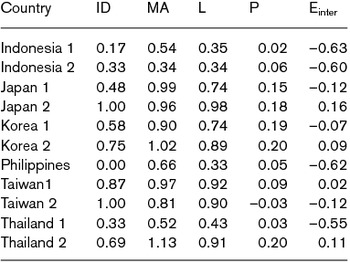
To measure electoral systems’ position on the interparty dimension Shugart suggests three empirical indicators: pre-election identifiability (did an election provide voters with clear choices of competing governments prior to elections?),Footnote 10 majority approximation (how closely did an election outcome approximate a majority of seats for a single party or a pre-election coalition?),Footnote 11 and plurality enhancement (to what extent, in a given election, did the largest party or pre-election coalition found its plurality of votes enhanced through the votes-to-seats conversion process?).Footnote 12 Shugart then uses these three variables to calculate the index of interparty efficiency.Footnote 13 Very negative values of interparty efficiency indicate hyper-representative systems, while highly positive values denote a pluralitarian system.
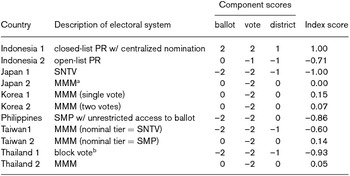
Shugart's index of intraparty efficiency, on the other hand, is based on three components – ballot, vote, and district – with negative scores on any component pushing the electoral system in a candidate-centered direction and positive scores pushing the system in a party-centered direction. While the ballot component ‘captures how candidates gain access to the ballot and what the structure of that ballot is’ (ibid: 37),Footnote 14 the vote component ‘captures the degree to which voters are casting list vs. nominal votes’ (ibid: 38).Footnote 15 The decision to also include a district component in the calculation of the intraparty index is based on Carey and Shugart's (Reference Carey and Shugart1995: 430) argument that ‘the importance of personal reputation . . . increases with magnitude in those systems in which co-partisans compete with each other for votes and seats’.Footnote 16 To calculate the index of intraparty efficiency the component scores are not added up but Shugart offers a more qualitatively derived ranking, taking into consideration the different party and personal reputation incentives provided by ‘real world’ examples of electoral systems (Shugart, Reference Shugart, Shugart and Wattenberg2003: 39).
Having outlined the methodological details, it becomes evident that Shugart's two-dimensional model of electoral systems can be criticized on two points. First, the underlying measurements of each dimension do not correspond to each other: to construct the index of interparty efficiency, Shugart draws on the outcomes that electoral systems produce; to build the index of intraparty efficiency, Shugart uses the institutional properties of electoral systems. Second, the ballot component of the index of intraparty efficiency takes into consideration procedures of candidate selection. This, however, is – in the rigorous technical sense – an institutional property of party organization, not of electoral systems. In particular, within the same party system, parties may adopt different methods to select candidates for public election – some may grant participatory rights to members and ordinary voters, some may monopolize decision making in the party leadership.
Nevertheless, Shugart's index of intraparty efficiency is still the best measure available to assess how electoral systems shape the personal representation of voters. Crucially, we still lack a direct and straightforward indicator of the personal vote, which means that, inevitably, we have to rely on the second-best solution: the question of whether electoral systems provide incentives for either cultivating a personal vote or collectively investing in the reputation of the party.
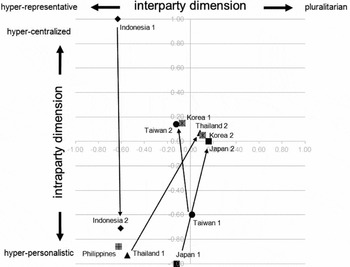
If we apply Shugart's two-dimensional framework to the democracies of Asia, it becomes clear that electoral systems have mainly been stretched out towards the extreme ends on the intraparty dimension (see Figure 1). The general deviation from the midpoint on the interparty dimension, on the other hand, has been much smaller – in particular, there has never been a strong pull towards the pluralitarian end.

Strikingly, all democracies – with the exception of South Korea – have, at some point, employed electoral systems close to the extreme ends on the intraparty dimension. Japan and Taiwan even used the most candidate-centered electoral system in the world: SNTV.Footnote 17 SNTV, according to Shugart (Reference Shugart, Shugart and Wattenberg2003: 38), ‘puts a greater premium than any other [system] on a candidate's ability to garner a personal vote because votes cannot be pooled with co-partisans or transferred to other candidates’. Thailand's block vote system, as explained earlier, also created strong incentives for cultivating a personal vote – albeit, because giving voters as many votes as there are seats to be filled in a constituency, to a lesser extent than SNTV (Carey and Shugart, Reference Carey and Shugart1995: 427).
The Indonesian closed-list PR system, in contrast, was located at the hyper-centralized extreme of the intraparty dimension, as it only offered voters a choice between closed lists in large multi-member districts. At the same time, political parties were characterized by a lack of party internal democracy, placing control over the compilation of candidate lists tightly within the party leadership – a pattern of party internal power distribution that had its origin in Suharto's autocratic regime but continued after the transition to democracy (Hellmann, Reference Hellmann2011: 134–7). Unlike the hyper-personalistic systems discussed so far, Indonesia's hyper-centralized system thus, effectively, provided no incentive for candidates to attend to personal reputations.
Certainly, electoral systems in Southeast Asia (Indonesia, Thailand, Philippines) have to some extent also been pulled towards the hyper-representative extreme on the interparty dimension. However, here we need to take into consideration the different measurement rules underpinning each of the dimensions: because the index of interparty efficiency is based on outcomes – rather than institutional properties – it is important to acknowledge other factors to explain why these electoral systems have failed to produce clear choices of government. For example, as outlined earlier, whether pluralitarian/majoritarian systems reduce the number of parties depends to a large extent on the level of party system institutionalization, while, under permissive electoral rules, it is ultimately the degree of social diversity that shapes the number of parties. The case of the Philippines perfectly illustrates the first point. Although SMP is used to elect the House of Representatives, the party system remains highly fragmented, mainly because ‘politics is determined by fights among clans and is, thus, extremely unpredictable’ (Ufen, Reference Ufen2008a: 345). For the case of Indonesia, on the other hand, it could be argued that the PR system only produces a multi-party system because of the large number of social cleavages.Footnote 18
So far, the mapping exercise supports the interpretation of electoral reform offered by single-country studies: pressure for reform had built up because electoral systems either sat at the hyper-personalistic (Japan, Taiwan, Thailand) or hyper-centralized (Indonesia) ends of the intraparty dimension. While the hyper-personalistic systems encouraged particularistic policy-making – which, in the cases of Japan and Thailand, arguably contributed to major economic crises – under Indonesia's hyper-centralized system voters were effectively denied the ability to monitor and punish individual legislators. In all four countries, these ‘extreme’ mechanical features were perceived to facilitate widespread corruption and ‘money politics’.
Moreover, as can be seen from Figure 1, reform mainly pushed electoral systems along the vertical intraparty axis; reform-induced movement on the horizontal interparty axis, in contrast, has been rather limited. In Indonesia, the reduction of district magnitude has not encouraged the emergence of clearer government alternatives, as the party system remains highly fragmented. In Japan and Taiwan, the large share of SMDs under the new MMM systems did nothing to push interparty competition towards a more pluralitarian logic. Crucially, even before reform, SNTV – although producing highly proportional resultsFootnote 19 – had facilitated the emergence of two opposing party blocs. This feature can be explained by referring back to the earlier discussion of how the LDP and the KMT monopolized access to public resources for the maintenance of patron–client networks, which allowed for the consolidation of one-party dominant systems.
The only country that made a significant jump towards more pluralitarian election outcomes is Thailand. However, it needs to be stressed that this was not only due to electoral reform. For example, the 1997 constitution contained a number of other provisions that helped to drive down the number of political parties – most importantly, stricter restrictions on party switching and the stipulation that cabinet members would have to resign from parliament (Hicken, Reference Hicken2006b: 392; Kuhonta, Reference Kuhonta2008).
The implementation of MMM systems means that Japan, Taiwan and Thailand are now placed close to the intersection of the interparty and intraparty axes – that is, close to the electoral ‘efficiency’ ideal on both the interparty and intraparty dimension. On the interparty dimension, the MMM systems encourage clearly identifiable government alternatives (through the SMD tier), while, at the same time, guaranteeing the representation of smaller parties (through the PR tier). On the intraparty dimension, the MMM systems provide incentives for some candidates to specialize in representing local constituencies (through the SMD tier) and some to specialize in providing collective goods associated with a party label (through the PR tier).
Indonesia also moved considerably closer to the ‘efficiency’ mid-point on the intraparty axis, as the open-list system now gives voters the opportunity to voice their preferences for individual candidates and influence the order of the list. However, the final product of the reform process overshot the ‘target’ and displays a strong tendency towards the hyper-personalistic end.
To sum up, after mapping electoral systems in a two-dimensional space we need to conclude that single-country studies offer a more plausible interpretation of electoral reform than the ‘Asian model’ hypothesis. Impetus for reform came from the fact that electoral systems displayed highly problematic features on the intraparty dimension. Moreover, reform mainly shifted electoral systems towards the mid-point between the hyper-centralized and hyper-personalistic extremes; movement along the interparty dimension, on the other hand, has been rather limited. As such, electoral systems in Asia – together with other electoral systems around the world (see Shugart, Reference Shugart2001, Reference Shugart, Shugart and Wattenberg2003) – seem to be converging on the ideal of electoral ‘efficiency’ rather than running ‘directly counter to the experience of other democratizing world regions’, as Reilly (Reference Reilly2007a: 1351) claims.
Conclusion
This article has argued that the institutional element of personal representation – as opposed to party representation – provides the most useful lens through which to understand recent cases of electoral reform in East Asia. Several democracies in the region have over the past two decades replaced their extreme systems on the intraparty dimension with more moderate types: Japan, Taiwan, and Thailand made the shift from hyper-personalistic systems to MMM; Indonesia moved away from the hyper-centralized end of the spectrum by implementing an open-list electoral system.
In all four countries, growing public discontent with these ‘extreme’ systems set the context for electoral reform: hyper-personalistic systems – because they provoked competition between candidates of the same party – were increasingly blamed for particularistic policy making; Indonesia's hyper-centralized system, on the other hand, came under fire because it denied voters the ability to hold individual politicians accountable. In short, the public began pointing at these ‘extreme’ mechanical features as the main cause for widespread ‘money politics’ and corruption.
The new electoral systems that were subsequently implemented to address these problems – in particular, the MMM systems in Japan, Taiwan, and Thailand – sit very close to the ‘efficiency’ midpoints on both the intraparty and interparty dimensions. This suggests that electoral reform should not be seen as part of a wider project to engineer a majoritarian ‘Asian model’ of democracy. Instead, electoral systems in Asia seem to be following the global trend in electoral system design away from ‘extreme’ types. However, the argument put forward here is not that politicians in Asian democracies deliberately designed electoral ‘efficiency’. Rather, as the review of single-country studies has shown, the more ‘efficient’ electoral systems were largely the product of negotiations between self-interested, rationally driven political parties.
The question that this article has not answered is how much of an impact electoral reform has had on ‘money politics’ and corruption. If we follow the general findings of neo-institutional approaches to corruption, the prospects are bleak: once politicians have invested in corrupt networks and a positive feedback loop reinforces individual incentives for corruption, changing the formal rules of the political game (such as electoral systems) is unlikely to persuade politicians to pull out of the corruption market (della Porta and Vannucci, Reference della Porta and Vannucci2012). However, only future research will show whether these general expectations also hold in Asia.Footnote 20
About the author
Olli Hellmann is Lecturer in Politics at the University of Sussex. His main research interests include political corruption and electoral politics. He is the author of Political Parties and Electoral Strategy: The Development of Party Organization in East Asia (Palgrave Macmillan, 2011) and has published in a number of peer-reviewed journals, including Party Politics, Government and Opposition, and the Journal of East Asian Studies.
Appendix
Scores on the intraparty dimension

Scores on the interparty dimension