Introduction
Anti-N-methyl-d-aspartate receptor (NMDAR) encephalitis is an increasingly recognised cause of psychiatric symptoms with over 70% of cases presenting to psychiatric services (Dalmau, Lancaster, Martinez-Hernandez, Rosenfeld, & Balice-Gordon, Reference Dalmau, Lancaster, Martinez-Hernandez, Rosenfeld and Balice-Gordon2011). The most common psychiatric symptoms in the acute phase of illness include psychosis, agitation, affective lability and catatonia (Kayser & Dalmau, Reference Kayser and Dalmau2011; Warren, Siskind, & O'Gorman, Reference Warren, Siskind and O'Gorman2018). The psychiatric symptoms are often severe, distressing and associated with increased risk of aggression and self-harm (Florance et al., Reference Florance, Davis, Lam, Szperka, Zhou, Ahmad and Dalmau2009). However, when anti-NMDAR encephalitis is suspected, high potency antipsychotic agents are often withheld due to reports of increased sensitivity, greater likelihood of extra-pyramidal side effects (EPSE) and increased risk of neuroleptic malignant syndrome (NMS) (Kuppuswamy, Takala, & Sola, Reference Kuppuswamy, Takala and Sola2014; Lejuste et al., Reference Lejuste, Thomas, Picard, Desestret, Ducray, Rogemond and Honnorat2016; Warren et al., Reference Warren, Siskind and O'Gorman2018). In addition, the majority of cases will develop seizures, movement disorders, autonomic dysfunction and deteriorate sufficiently to require high dependency or intensive care support, thus there is also concern in further impacting seizure threshold, autonomic symptoms and level of sedation (Dalmau et al., Reference Dalmau, Lancaster, Martinez-Hernandez, Rosenfeld and Balice-Gordon2011).
Primary treatment of anti-NMDAR encephalitis is with immunotherapy, including glucocorticoids, immunoglobulin or plasmapheresis, and surgery when associated with a tumour such as an ovarian teratoma (Titulaer et al., Reference Titulaer, Mccracken, Gabilondo, Armangué, Glaser, Iizuka and Dalmau2013). Although, the majority improve within 4 weeks, the psychiatric symptoms may be slower to improve than the neurologic deficits, and recovery often involves a ‘stepwise reversal’ of disease course, with relapse of early psychiatric features during this period (Dalmau et al., Reference Dalmau, Lancaster, Martinez-Hernandez, Rosenfeld and Balice-Gordon2011, Reference Dalmau, Armangué, Planagumà, Radosevic, Mannara, Leypoldt and Graus2019). Furthermore, despite lengthy treatment, some ongoing cognitive or behavioural sequelae occurs in up to a quarter of cases, including deficits in memory, attentional function, processing speed, impulsivity and other executive skills, generalised fatigue and mood disturbance (De Bruijn et al., Reference De Bruijn, Aarsen, Van Oosterhout, Van Der Knoop, Catsman-Berrevoets, Schreurs and Titulaer2018; Finke et al., Reference Finke, Kopp, Pruss, Dalmau, Wandinger and Ploner2012; Mckeon et al., Reference Mckeon, Robinson, Ryan, Blum, Gillis, Finke and Scott2018; Titulaer et al., Reference Titulaer, Mccracken, Gabilondo, Armangué, Glaser, Iizuka and Dalmau2013; Warren et al., Reference Warren, Siskind and O'Gorman2018).
The clinical features and immunotherapy of anti-NMDAR encephalitis have been defined in large cohorts but there is limited evidence to guide the management of psychiatric symptoms (Dalmau et al., Reference Dalmau, Gleichman, Hughes, Rossi, Peng, Lai and Lynch2008; Dalmau et al., Reference Dalmau, Lancaster, Martinez-Hernandez, Rosenfeld and Balice-Gordon2011; Kuppuswamy et al., Reference Kuppuswamy, Takala and Sola2014; Warren, Grote, O'Gorman, & Siskind, Reference Warren, Grote, O'Gorman and Siskind2019). Low dopaminergic blocking and highly sedating antipsychotics, as well as benzodiazepines and/or electroconvulsive therapy (ECT) for management of catatonia, have been suggested (Espinola-Nadurille et al., Reference Espinola-Nadurille, Flores-Rivera, Rivas-Alonso, Vargas-Cañas, Fricchione, Bayliss and Ramirez-Bermudez2019; Kayser, Titulaer, Gresa-Arribas, & Dalmau, Reference Kayser, Titulaer, Gresa-Arribas and Dalmau2013; Warren et al., Reference Warren, Grote, O'Gorman and Siskind2019). What is currently unclear, is how to weigh the risks and benefits of using antipsychotics in this disorder, which psychotropic to preference and how long to continue treatment. We aim to explore psychiatric care given to a cohort of cases with anti-NMDAR encephalitis and review the effectiveness and side effects of the treatment options.
Methods
We performed a retrospective chart review of all adult cases of cerebrospinal fluid (CSF) positive anti-NMDAR encephalitis cases occurring in Queensland, Australia between January 2010 and December 2018. Cases were identified from the Pathology Queensland database, the diagnostic referral laboratory offering specialised neuroimmunology testing, including anti-NMDAR antibody testing. Anti-NMDAR antibodies are detected through a two-person blinded reading of a commercial fixed cell assay containing four biochips of primate hippocampus, primate cerebellum, NR1 transfected human embryonic kidney cells 293 (HEK293) and non-transfected control HEK293 cells (Euroimmun, Germany). Cases were all followed through the two neuroimmunology clinics in the public health care system responsible for the population studied. Cases were included if they had a clinical presentation that met the diagnostic criteria for anti-NMDAR encephalitis and had positive CSF immunoglobulin G (IgG) anti-NMDAR antibody result (Graus et al., Reference Graus, Titulaer, Balu, Benseler, Bien, Cellucci and Dalmau2016). Cases were excluded if age <18 years, they resided outside Queensland, or there was positive serum NMDAR antibody testing without CSF confirmation, or CSF testing yielded equivocal or indeterminate results.
Case identification and data collection was performed separately by two authors (NW and AS) with discrepancies discussed. Pre-specified variables included location of care, psychiatric symptoms, pharmacological and non-pharmacological treatments, side effects and outcome. Data were collected from initial admission to hospital, throughout the acute course of illness or recurrences and through clinic letters to the study endpoint (December 2018). Where a clinical feature was not documented it was assumed to be absent. For clinical improvement or deterioration to be associated with psychotropic treatment, clear documentation was required including new or progressed symptoms and time course. Antipsychotic daily dose equivalence to 1 mg olanzapine was calculated using recognised formula (Leucht et al., Reference Leucht, Samara, Heres, Patel, Furukawa, Cipriani and Davis2015). The cases with psychiatric features were grouped into those prescribed and not prescribed antipsychotics and a comparison using Fisher's exact test, significance threshold set at p < 0.05, was employed looking at the following variables: seizures, movement disorders, arrhythmias, blood pressure alteration and reduced consciousness. Fisher's exact test was also used to compare cases on antipsychotics which developed movement disorders or seizures with those who didn't. Student's t test was used to compare the mean average olanzapine equivalence daily dosages for those who developed movement disorders or seizures with the cases which did not.
Ethical approval for this study was granted from Metro South Human Research and Ethics Committee (HREC/17/QPAH/423A).
Results
There were 30 adult cases of anti-NMDAR encephalitis between 2011 and 2018 in Queensland, Australia, presenting to nine different hospitals, with care followed for a mean average of 419 days (s.d. 304). The female to male ratio was 3:2 and the mean age was 37.5 years (s.d. 16.7). The initial symptoms in the majority of cases were psychiatric (25/30, 83%) and accordingly most were first admitted to psychiatric services (18/30, 60%). Half of these cases required involuntary admission under the mental health act. With disease progression, transfer to general medical or neurology care occurred in all cases (average 13.6 days, s.d. 14.5). Reasons given for transfer included development of neurological/autonomic features (9), requiring further investigations (5) or commencement of immunotherapy (4). Constant 1:1 psychiatric nursing was required for 11 cases, and a further 15 cases were nursed in a high dependency area, when on the medical ward.
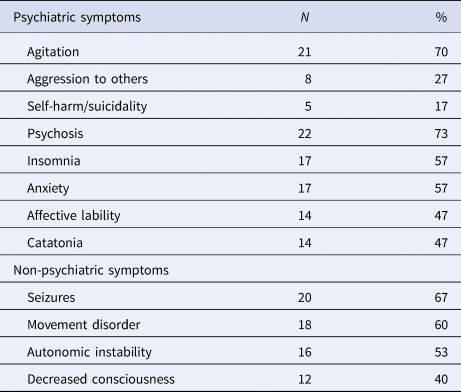
The psychiatric symptoms recorded in each case tended to all be present within the first week of admission, with only three cases developing a catatonia in the second week of admission (Table 1). Non-psychiatric manifestations were seen in almost all cases (93%) but there was an isolated psychiatric presentation in two cases. Intensive care was required in nine cases (30%) with a mean average ICU admission of 52 days (s.d. 68.9).
Clinical symptoms of anti-NMDAR encephalitis cases

Of the 25 cases with psychiatric symptoms, 20 cases received antipsychotics during the acute course of the illness, all commenced prior to immunomodulation therapy, and multiple antipsychotics were required to control symptoms in the majority of cases (14/20, 70%). The cumulative mean average daily dose was 11.5 mg olanzapine equivalence (s.d. 5.7). Olanzapine was most commonly used (12/20), with other antipsychotics used including risperidone (8/20), quetiapine (5/20), aripiprazole (4/20), haloperidol (2/20) and zuclopenthixol acetate (1/20). Prior to immunomodulation therapy, a reduction/cessation of aggression towards others occurred with antipsychotic treatment (seven out of eight cases with aggression) with 6/8 cases using multiple antipsychotics but with a daily olanzapine equivalence dose of 8.3 mg (s.d. 3.3). There was no recorded improvement in psychosis, catatonia, anxiety or affective lability with antipsychotics, with the exception of a single case which had resolution of psychiatric symptoms with a combination of olanzapine and aripiprazole and never commenced immunomodulation therapy. Following immunomodulation therapy, 12 cases required continued antipsychotic treatment and of these, eight remain on long-term treatment to the end point of this study.
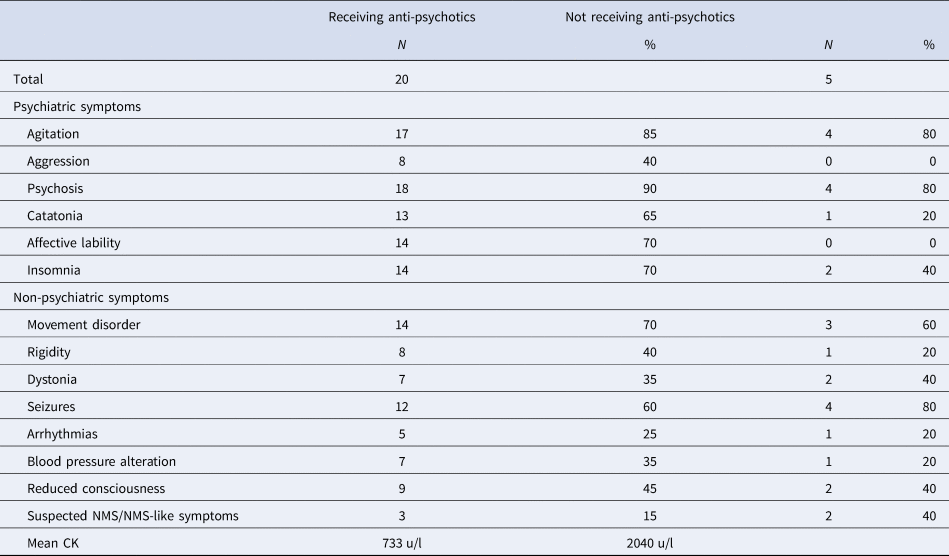
In the cases with psychiatric symptoms, there was no significant difference in the rate of occurrence of neurological and autonomic symptoms between cases prescribed (20 cases) and not prescribed antipsychotics (five cases) (Table 2). Although rigidity, dystonia and movement disorders were common, these symptoms were documented as EPSE in six cases. There was no significant difference in the cases which went on to develop movement disorders in the mean olanzapine equivalence dose or multiple antipsychotic use, compared to those on antipsychotics who did not develop movement disorders. This was also true for those who developed seizures compared to those who didn't. Suspected NMS was seen in 3/18 cases (17%); two with olanzapine/risperidone/quetiapine, and one case who received olanzapine/zuclopenthixol acetate. When NMS was suspected, antipsychotics were ceased, supportive care was provided and benzodiazepines were employed for management of symptoms, with two of the cases going on to receive ECT. In all three suspected NMS cases, events prompted testing for NMDAR antibodies and subsequent neurological and autonomic symptoms resolved with immunotherapy. Two of the five cases who presented with psychiatric symptoms who did not receive antipsychotics or other psychotropics developed a similar cluster of symptoms including rigidity, dystonia, autonomic instability, fever and periods of decreased consciousness.
Cases with psychiatric symptoms who were and were not treated with antipsychotics

Other psychotropics used in combination with antipsychotics, in the acute phase of illness, included benzodiazepines, melatonin and mood stabilisers. There was minimal improvement documented in the eight cases (26.7%) using ‘as required’ benzodiazepines for acute behavioural disturbance with two cases reporting an associated deterioration with confusion and over-sedation. Lorazepam challenge for catatonia (total dose ranged from 1 to 4 mg; mean dose: 3.14 mg) was attempted in 7/14 catatonic cases with partial improvement in two cases; five cases did not improve. Melatonin was prescribed in two cases with insomnia when stabilised on a medical ward and was effective. There was no documented improvement following the use of lithium in two cases, or in the two cases where sodium valproate was reported to be commenced for acute mood stabilisation.
ECT was used in two cases where catatonia had failed to respond to lorazepam and there was suspected NMS. In both cases this was prior to the diagnosis of anti-NMDAR encephalitis. The number of sessions, ECT electrode placement and dosage was not available. There were no noted side effects to ECT, although both cases reported minimal improvement in symptoms.
Immunomodulation therapy was given in 29/30 cases; one case improved with antipsychotic medication alone. Time to immunomodulation therapy ranged from 4 to 120 days, mean time 26.05 days, s.d. 29.6. The most common treatment was intravenous immunoglobulin (26/29), steroids (14/29), plasmapheresis (6/29), rituximab (14/29), cyclophosphamide (5/29) and mycophenolate (3/29). Anti-epileptic medications were often used in combination and included levetiracetam (10), sodium valproate (7), lacosamide (5), lamotrigine (2), clobazam (2), zonisamide (1) and phenytoin (1). Surgical removal of ovarian teratomas was performed in five cases. Behavioural side effects from immunomodulation therapy and anti-epileptic medication could not be differentiated clearly from the course of illness.
Following immunomodulation therapy (and resection of teratoma where applicable) there was complete resolution of symptoms in eight cases (27%), partial improvement in 18 cases (60%) and no or minimal improvement in four cases (13%). Most cases (14/18) with partial improvement continued to have subjective cognitive deficits including poor memory, attention and executive dysfunction despite all but one of these cases receiving in-patient cognitive rehabilitation. Continued agitation or impulsivity was reported in eight cases (26.7%), one case had remaining hallucinations, and a new onset depression or depressive adjustment disorder was documented in four cases (13.3%), although six cases were commenced on anti-depressants. Sodium valproate was continued in seven cases and lamotrigine in two, although it was not clear if the indication was for seizures or psychiatric control. In two cases there was a psychotic deterioration within days following the cessation of antipsychotics at 43 days and 180 days post presentation. Both cases improved following antipsychotic recommencement and immunomodulation therapy was not re-trialled. A further four cases (13.3%) were felt to have a recurrence of encephalitis, one with seizures and three cases with cognitive deterioration, mild movement disturbance and recurrence of psychosis despite being continued on antipsychotic medication. These four cases resolved with immunomodulation therapy.
Discussion
This is the first detailed evaluation of psychiatric management in an anti-NMDAR encephalitis cohort. The demographic and clinical characteristics of the cohort is similar to other published cohorts and case series presenting to psychiatric services (Dalmau et al., Reference Dalmau, Lancaster, Martinez-Hernandez, Rosenfeld and Balice-Gordon2011; Kayser & Dalmau, Reference Kayser and Dalmau2011; Warren et al., Reference Warren, Siskind and O'Gorman2018). Almost all cases developed psychiatric symptoms during the course of the illness, including severe agitation, psychosis and catatonia, with associated distress and risk to self and others. Psychotropic choice was particularly complex and variable in the acute phase of anti-NMDAR encephalitis, where the focus of treatment was upon management of severe behavioural disturbance and psychosis whilst balancing the risk of worsening delirium due to the presence of organic brain disorder and multiple medication use (Clegg & Young, Reference Clegg and Young2010).
In this cohort, antipsychotics (most commonly olanzapine, reflecting local guidelines) were beneficial in reducing aggression and agitation but there was minimal effect on psychosis or affective symptoms until immunotherapy was used (Boettger, Jenewein, & Breitbart, Reference Boettger, Jenewein and Breitbart2015; Ozbolt, Paniagua, & Kaiser, Reference Ozbolt, Paniagua and Kaiser2008). This is despite dosages higher than would typically be employed in a delirium-like picture (Lonergan, Britton, & Luxenberg, Reference Lonergan, Britton and Luxenberg2007). This may reflect the limitations of using retrospective documentation but may also relate to the underlying pathology of the disorder. When the anti-NMDAR antibody causes receptor internalisation and glutamatergic synapse dysfunction, it is purported there is subsequent disruption to mesolimbic dopaminergic pathways (Dalmau, Reference Dalmau2016; Dalmau et al., Reference Dalmau, Armangué, Planagumà, Radosevic, Mannara, Leypoldt and Graus2019). Although the hypothesis is that these are the same neurotransmitters and pathways implicated in schizophrenia, the rapid network dysfunction that occurs in anti-NMDAR encephalitis may not be as amenable to the dopamine antagonism of antipsychotics (Howes & Kapur, Reference Howes and Kapur2009). There is preliminary evidence from animal models of psychosis that olanzapine may be more effective than other antipsychotics in targeting NMDAR-mediated effects but, in this cohort, no antipsychotic appeared superior (Liu et al., Reference Liu, Li, Guo, Wang, Sun, Wang and Si2018).
There was no difference in this cohort in the rate at which neurological and autonomic symptoms occurred in those prescribed antipsychotics and those who were not. The two cases which had an isolated psychiatric presentation did not report any antipsychotic side effects. Additionally, in the cases which did later develop movement disorders or seizures, compared to those who did not, there was no difference in antipsychotic dosage or concomitant antipsychotic use. It may be that in anti-NMDAR encephalitis, where almost every case develops movement disorders, seizures, autonomic disturbance and decreased consciousness, it is difficult to differentiate side effects such as EPSE and monotherapy with lower dopaminergic atypical anti-psychotics is a reasonable strategy (Dalmau et al., Reference Dalmau, Armangué, Planagumà, Radosevic, Mannara, Leypoldt and Graus2019).
In a similar respect, discrimination between suspected NMS and anti-NMDAR encephalitis was difficult in this cohort. Withdrawal of antipsychotic medication, substitution for benzodiazepines, supportive care and ECT did not result in clinical improvement of the suspected NMS cases, whom only improved following commencement of immunomodulation therapy. Elevated creatinine kinase was seen more commonly in those not prescribed antipsychotics. There were also cases, not exposed to antipsychotics, which demonstrated NMS-like symptoms (rigidity, fever, altered consciousness). Yet, NMS risk factors are prominent in those with anti-NMDAR encephalitis, who are typically young and female, with an underlying brain disorder, a need for high antipsychotic dosages with rapid titration, presence of polypharmacy and neuroleptic naivety (Berman, Reference Berman2011; Dayalu & Chou, Reference Dayalu and Chou2008; Lejuste et al., Reference Lejuste, Thomas, Picard, Desestret, Ducray, Rogemond and Honnorat2016; Marsden, Mindham, & Mackay, Reference Marsden, Mindham, Mackay, Bradley and Hirsch1982). Therefore, withdrawal of antipsychotic medication in this disorder should be considered on a case by case basis, but the presence of NMS-like symptoms in a psychiatric presentation should prompt early consideration of anti-NMDAR encephalitis.
Psychiatric symptomology may also be influenced by the effects of non-neuroleptic pharmacotherapy. For example, sedation with benzodiazepines was generally ineffective and worsened confusion in 2/8 cases, as has been noted in delirium and other organic brain disorders (Lonergan, Luxenberg, & Sastre, Reference Lonergan, Luxenberg and Sastre2009). Around half of the cases used high dose steroids which can cause mood lability, irritability, anxiety, insomnia and psychosis in up to 40–80% within the first week of commencement (Dubovsky, Arvikar, Stern, & Axelrod, Reference Dubovsky, Arvikar, Stern and Axelrod2012). The movement disorder may be treated with clonidine, benztropine, benzhexol or levodopa, which may worsen delirium and psychosis (Ananth & Jain, Reference Ananth and Jain1973; Goodwin, Reference Goodwin1971; Huffman & Stern, Reference Huffman and Stern2007; Mohammad et al., Reference Mohammad, Jones, Hong, Nosadini, Sharpe, Pillai and Dale2016). Irritability, agitation and aggression can also be caused by anti-epileptic medications, especially with levetiracetam (Brodie et al., Reference Brodie, Besag, Ettinger, Mula, Gobbi, Comai and Steinhoff2016). Levetiracetam was the most commonly used anti-epileptic in this cohort, however, data for behavioural side effects were not available. Comparatively, sodium valproate may be effective at treating a range of psychiatric symptoms as well as seizures. Valproate induces the release and increases the presynaptic levels of gamma-Aminobutyric acid (GABA), the major inhibitory neurotransmitter postulated to be impaired by the NMDAR dysfunction (Dalmau et al., Reference Dalmau, Armangué, Planagumà, Radosevic, Mannara, Leypoldt and Graus2019; Scharko, Panzer, & Mcintyre, Reference Scharko, Panzer and Mcintyre2015). There is good evidence for efficacy of valproate in mood stabilisation as well as treatment of aggression, agitation and impulsivity in traumatic brain injury and there is emerging evidence for the benefit in delirium (Lindenmayer & Kotsaftis, Reference Lindenmayer and Kotsaftis2000; Scharko et al., Reference Scharko, Panzer and Mcintyre2015).
Following transition into recovery, there were ongoing cognitive or behavioural symptoms that were treated in 12 cases with continued antipsychotic medication and several received anti-depressants. In acquired brain injury, selective serotonin re-uptake inhibitors (SSRIs), such as sertraline and paroxetine, have been shown to be effective for managing aggressive and explosive behaviour (Warden et al., Reference Warden, Gordon, Mcallister, Silver, Barth, Bruns and Katz2006). SSRIs may also be useful for depression, dysthymia and anxiety which are commonly reported during the recovery phase of this illness. Psychotherapeutic approaches may also be beneficial, with good evidence for behavioural approaches such as problem solving and activity scheduling for treating depression post brain injury and attention and metacognitive strategy training to target impairments of self-regulation (Cicerone et al., Reference Cicerone, Langenbahn, Braden, Malec, Kalmar, Fraas and Ashman2011; Juengst, Kumar, & Wagner, Reference Juengst, Kumar and Wagner2017). However, in this cohort, 13/14 with cognitive impairment underwent a cognitive rehabilitation programme with minimal improvement, possibly because rehabilitation programmes designed for people with traumatic brain injury may not be as suitable for those with anti-NMDAR encephalitis. The cognitive profile in recovery for this disorder is very variable, and potentially there is ongoing dysfunction in the cellular mechanisms associated with learning (Mckeon et al., Reference Mckeon, Robinson, Ryan, Blum, Gillis, Finke and Scott2018). Fatigue, poor attention and slow processing speeds may also reduce participation and engagement in activities (De Bruijn et al., Reference De Bruijn, Aarsen, Van Oosterhout, Van Der Knoop, Catsman-Berrevoets, Schreurs and Titulaer2018). Individualised cognitive rehabilitation programmes, based on strengths and weakness characterised in formal neuropsychological testing, and using errorless learning approaches may provide better outcomes (Baddeley & Wilson, Reference Baddeley and Wilson1994; Kessels & Haan, Reference Kessels and Haan2003).
There is no evidence to guide long-term psychiatric management in anti-NMDAR encephalitis and in eight cases, of this cohort, it was necessary to continue antipsychotic medication long-term (>1 year). There needs to be consideration of the metabolic and tardive side effects of long-term antipsychotics (Correll, Rubio, & Kane, Reference Correll, Rubio and Kane2018). Guidance may be taken from the management of first episode psychosis, where continued treatment for 1 year after resolution of the episode is recommended; however, there is also recognition of increased relapse risk following discontinuation (Hasan et al., Reference Hasan, Falkai, Wobrock, Lieberman, Glenthoj, Gattaz and Moller2017). In this cohort, the two cases who relapsed quickly improved following recommencement of antipsychotic therapy. Relapses in anti-NMDAR encephalitis are relatively common, and have an increased rate of psychiatric symptoms and isolated psychiatric presentations, in this cohort occurring despite continued antipsychotic medication (Gabilondo et al., Reference Gabilondo, Saiz, Galan, Gonzalez, Jadraque, Sabater and Graus2011; Kayser et al., Reference Kayser, Titulaer, Gresa-Arribas and Dalmau2013). A recurrence of psychiatric symptoms should prompt careful consideration of immunomodulation therapy, re-screening for associated tumours and a risks and benefits analysis of psychotropic dose-adjustment or initiation.
There are limitations inherent to the nature of a small retrospective descriptive cohort study. Data collected could only reflect the quality and content of the medical record. There is considerable variability in the clinical course of anti-NMDAR encephalitis which complicates assessment of treatment effect for symptoms such as aggression or agitation. Total case numbers remain small, which limit comparison and generalisability. This may have impacted on the role of psychotropics highlighted as potentially beneficial in the literature used infrequently, such as melatonin, or not used in this cohort, such as clonidine and trazadone (Chapman & Vause, Reference Chapman and Vause2011). Both lorazepam challenge and ECT was minimally effective for catatonia in these cases, although both have been reported to be safe and effective in the literature (Barry, Byrne, Barrett, Murphy, & Cotter, Reference Barry, Byrne, Barrett, Murphy and Cotter2015; Espinola-Nadurille et al., Reference Espinola-Nadurille, Flores-Rivera, Rivas-Alonso, Vargas-Cañas, Fricchione, Bayliss and Ramirez-Bermudez2019; Warren et al., Reference Warren, Grote, O'Gorman and Siskind2019). Additionally, it is difficult to differentiate benefit for medications with multiple indications, such as valproate, with further prospective studies required.
There is a clear need for continuing psychiatric input into the care of those with anti-NMDAR encephalitis, in both acute and rehabilitation phases. Antipsychotic medications are an adjunct to immunomodulation therapy, and may be particularly important for aggression, distress, and risk to self and others. Suspected NMS and EPSE cannot be differentiated easily from clinical progression of anti-NMDAR encephalitis and clinical re-evaluation, careful withdrawal of potential causative agent, and immunomodulation therapy should be considered. Further work is needed to establish which medication(s) are most appropriate and safest and which cognitive and psychological management options best address the neurocognitive, adjustment and affective issues for the patient long term. It is likely that flexibility in psychiatric management and psychotropic choice is most appropriate in anti-NMDAR encephalitis, with modification depending on the most pressing psychiatric symptom, stage of illness, neurological symptoms and risks of side effects.
Financial support
D. Siskind is partially supported by NHMRC ECF APP1111136.
Conflict of interest
None.