Introduction
The poultry industry is one of the largest and rapidly growing industries worldwide and the prevalence of pathogenic microbes challenges practical management and causes significant economic losses. Additionally, the downstream industry, including slaughter, shipping and retail marketing tends to suffer from carcasses contamination by pathogens (Mainali et al., Reference MAINALI, MCFALL, KING and IRWIN2014). Vaccination can prevent diseases of a single aetiology. Antibiotics have some benefits over vaccination when multiple infections and environmental stresses produce diseases. Since most antibiotics produced are used in diets of livestock animals, the increased occurrence of antibiotic resistance in microbes further limits the use of antibiotics in poultry.
Contemporary international legislation has withdrawn antibiotics in poultry production as a growth promoter. Consequently, it is necessary to find alternates for microbial challenges in domestic fowl. Certain research attention has concentrated on the possible use of YCW β-glucans in chickens to combat the limitations mentioned above. Subsequent studies have demonstrated that dietary supplementation of β-glucans can reduce the severity of enteric pathogen infection (Huff et al., Reference HUFF, HUFF, RATH and TELLEZ2006; Shao et al., Reference SHAO, GUO and WANG2013), increase phagocytosis by macrophages after bacterial infection (Chen et al., Reference CHEN, WENG, CHANG, LIAO, CHEN and CHU2008) and improve growth performance (Cho et al., Reference CHO, ZHANG and KIM2013). Based on the characteristics of β-glucans, this review will focus on their effects as growth promoters and antibiotic alternatives against enteric pathogens in poultry.
Yeast cell wall β-glucans
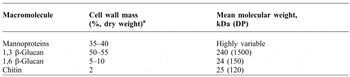
Saccharomyces cerevisiae, is a unicellular yeast that has been developed to be used in animal feeds (Hooge, Reference HOOGE2004; Rosen, Reference ROSEN2007). Broiler production can be improved by maintaining the intestinal integrity with the inclusion of yeast in their diets (Santin et al., Reference SANTIN, MAIORKA, MACARI, GRECCO, SANCHEZ, OKADA and MYASAKA2001; Zhang et al., Reference ZHANG, LEE, LEE, LEE, AN, SONG and LEE2005; Baurhoo et al., Reference BAURHOO, PHILLIP and RUIZ-FERIA2007). Typically, the yeast cell wall (YCW) is composed of β-glucans, mannoproteins, and chitin with varying degrees of polymerisation, as presented in Table 1 .
YCW components with their molecular weight and degree of polymerisation (DP).

a =Klis et al., Reference KLIS, MOL, HELLINGWERF and BRUL2002; Freimund et al., Reference FREIMUND, SAUTER, KÄPPELI and DUTLER2003; Lessage and Bussey, Reference LESSAGE and BUSSEY2006; Kwiatkowski et al., Reference KWIATKOWSKI, THIELEN, GLENNY and MORAN2009.
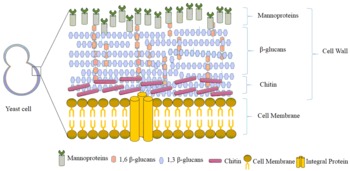
YCW components, presented in Figure 1 , can vary depending upon growth conditions, time of harvesting (Klis et al., Reference KLIS, MOL, HELLINGWERF and BRUL2002; Aguilar-Uscanga and Francois Reference AGUILAR-USCANGA and FRANCOIS2003; Klis et al., Reference KLIS, BOORSMA and DE GROOT2006) and most importantly, strains of yeast (Hahn-Hägerdal et al., Reference HAHN-HÄGERDAL, KARHUMAA, LARSSON, GORWA-GRAUSLUND, GÖRGENS and VAN ZYL2005). In general, baker's yeast is used for producing high quality β-glucans with good therapeutic applications (Kim et al., Reference KIM, KANG, LEE, CHANG, YUN, PAIK, KANG and KIM2007). The processes involved in the separation of β-glucans have been heavily patented., and there are various methods for separation of β-glucans from yeasts (Borchani et al., Reference BORCHANI, FONTEYN, JAMIN, PAQUOT, THONART and BLECKER2016).
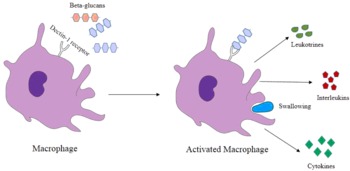
β-glucans as a YCW component, are composed with polymerisation of glucose through β-1,3/1,6 glycosidic linkages. It has the ability to bind with numerous types of cell surface receptors on macrophages and polymorphonuclear cells (PMNCs) by binding to Dectin-1 or CR3 receptors (Palić et al., Reference PALIĆ, ANDREASEN, HEROLT, MENZEL and ROTH2006) with subsequent activation of macrophages/lymphocyte, production of inflammatory cytokines, leukotriene, interleukins and stimulation of phagocytosis for microbial killing (Brown and Gordon, Reference BROWN and GORDON2003; Brown et al., Reference BROWN, HERRE, WILLIAMS, WILLMENT, MARSHALL and GORDON2003). Figure 2 demonstrates activation of macrophages by β-glucans binding to Dectin-1 receptor.
Structure of yeast cell wall.

Activation of macrophages by YCW β-glucan binding to Dectin-1 receptor.

Furthermore, YCW β-glucans can modulate the function of neutrophils that assists in disease resistance. Benefits of YCW β-glucans in poultry production can be partially attributed to enhanced proliferation and phagocytosis by avian macrophages and heterophils (Guo et al., Reference GUO, ALI and QURESHI2003; Lowry et al., Reference LOWRY, FARNELL, FERRO, SWAGGERTY, BAHL and KOGUT2005). Broilers fed diets with YCW β-glucans supplementation showed amplified cell mediated (Chen et al., Reference CHEN, LI, CHANG, GONG, PIAO, YI and ZHANG2003; Chae et al., Reference CHAE, LOHAKARE, MOON, LEE, PARK and HAHN2006) and humoral immune responses (Guo et al., Reference GUO, ALI and QURESHI2003; Zhang et al., Reference ZHANG, GUO and WANG2008). This immune enhancing ability can remove Salmonella enterica and Escherichia coli, economically important pathogens, from the digestive tract (Lowry et al., Reference LOWRY, FARNELL, FERRO, SWAGGERTY, BAHL and KOGUT2005; Huff et al., Reference HUFF, HUFF, FARNELL, RATH, SOLIS DE LOS SANTOS and DONOGHUE2010). Furthermore, YCW β-glucans can enhance broiler performance under unhygienic conditions through increases in villi height, uniformity and integrity, leading to improved intestinal function and gut health (Huff et al., Reference HUFF, HUFF, RATH and TELLEZ2006; Yang et al., Reference YANG, IJI, KOCHER, MIKKELSEN and CHOCT2007). The YCW β-glucans from different sources have large variations in their structure that ultimately affect their physiological functions (Volman et al., Reference VOLMAN, RAMAKERS and PLAT2008).
Alternative to antibiotic growth promoters
Feeds containing no chemical additives are increasingly used in poultry nutrition. Since antibiotic growth promoters have been discredited by consumer associations, there has been an increasing trend in formulating diets without supplementation of synthetic drugs and chemical additives and many scientists are dedicated in finding natural alternatives to replace antibiotics as growth promoters (Langhout, Reference LANGHOUT2000; Mellor, Reference MELLOR2000).
There are numerous studies on the role of YCW β-glucans as growth promoters in poultry birds. A growth improving effect of YCW β-glucans at 0.1% dietary supplementation in an unchallenged setting was observed (Cho et al., Reference CHO, ZHANG and KIM2013), which showed improved body weight gain in broilers compared to control groups. In another study, Cox et al. (Reference COX, SUMNERS, KIM, MCELROY, BEDFORD and DALLOUL2010b) noted that dietary supplementation with 0.02 or 0.1% β-glucans had no significant differences on growth performance of broilers with or without an Eimeria challenge. However, Zhang et al. (Reference ZHANG, GUO and WANG2008) reported a growth improving effect of β-glucan supplemented at 50 and 75 mg/kg in broilers. Rathgeber et al. (Reference RATHGEBER, BUDGELL, MACISAAC, MIRZA and DONCASTER2008) found that 40 ppm yeast β-glucans could increase body weight in broilers during the grower phase, and an increase in relative weight of the gizzard was observed, enhancing the digestive capacity of broilers which may account for the growth effect. Broiler chickens supplemented with 22 ppm β-glucans in feed showed some improvement when infected by E. coli (Huff et al., Reference HUFF, HUFF, RATH and TELLEZ2006). In another study, the progressive effects of β-glucans were noted in birds reared on litter pen than those in the cages (Chae et al., Reference CHAE, LOHAKARE, MOON, LEE, PARK and HAHN2006). The variations in the results reported could be due to reasons including differences in the sources of β-glucans (species and strains), purity, composition, dosage or presence/absence and type of pathogen challenge (Zhang et al., Reference ZHANG, GUO and WANG2008; Cox et al., Reference COX, SUMNERS, KIM, MCELROY, BEDFORD and DALLOUL2010b). More studies to optimise the dosage and source of β-glucans for consistent results in broiler production are required.
β-glucans originating from YCW have different effects on the visceral organs. A study by Cho et al. (Reference CHO, ZHANG and KIM2013) showed that 0.1% dietary supplementation of YCW β-glucans in an unchallenged trial resulted in an improvement in the relative weight of the spleen and the bursa of Fabricius. The effects of β-glucans on the relative weight of the spleen and the bursa of Fabricius varied with studies, depending on the dose and the presence of pathogen challenges (Rathgeber et al., Reference RATHGEBER, BUDGELL, MACISAAC, MIRZA and DONCASTER2008; Cox et al., Reference COX, STUARD, KIM, MCELROY, BEDFORD and DALLOUL2010a; Salarmoini and Fooladi, Reference SALARMOINI and FOOLADI2011). In another study broilers supplemented with 40-50 mg/kg of β-glucans in feed showed an increase in the relative weight of the thymus, bursa of Fabricius and spleen (Guo et al., Reference GUO, ALI and QURESHI2003; Zhang et al., Reference ZHANG, GUO and WANG2008). Chickens supplemented with mannoprotein and β-glucans showed improved thymus weight (Morales-Lopez et al., Reference MORALES-LOPEZ, AUCLAIR, GARCIA, ESTEVE-GARCIA and BRUFAU2009), and β-glucan supplementation improved red blood cells count (Guo et al., Reference GUO, ALI and QURESHI2003) and increased the villus height of the jejunum mucosa of chickens (Morales-Lopez et al., Reference MORALES-LOPEZ, AUCLAIR, GARCIA, ESTEVE-GARCIA and BRUFAU2009), and subsequently may increase the surface area for nutrient absorption. Further studies are required to delineate the mechanisms of the effect of β-glucans on primary immune organs and other visceral organs weight in relation to growth performance.
Activity against enteric pathogens
In humans, food-borne gastroenteritis is mainly caused by Salmonella enterica serovar typhimurium from contaminated poultry products (Zhang et al., Reference ZHANG, KINGSLEY, SANTOS, ANDREWS-POLYMENIS, RAFFATELLU, FIGUEIREDO, NUNES, TSOLIS, ADAMS and BAUMLER2003; Liljebjelke et al., Reference LILJEBJELKE, HOFACRE, LIU, WHITE, AYERS, YOUNG and MAURER2005). Severe colonisation by Salmonella typhimurium in the gastrointestinal tract can damage intestinal barriers and may cause bacteremia in both domestic fowls and humans (Jepson et al., Reference JEPSON, SCHLECHT and COLLARES-BUZATO2000; Zhang et al., Reference ZHANG, KINGSLEY, SANTOS, ANDREWS-POLYMENIS, RAFFATELLU, FIGUEIREDO, NUNES, TSOLIS, ADAMS and BAUMLER2003; Griffin and McSorley, Reference GRIFFIN and MCSORLEY2011). Moreover, Salmonella infection causes high mortality and decreases the production of poultry birds (Fasina et al., Reference FASINA, HOLT, MORAN, MOORE, CONNER and MCKEE2008). Colibacillosis, caused by E. coli, is another important enteric disease in domestic fowl and causes air sacculitis, decreased BW gain, and increased faecal and carcass contamination (Barnes et al., Reference BARNES, VAILLANCOURT and GROSS2003; Russell, Reference RUSSELL2003). Gastrointestinal parasites constitute major stress factors which reduce growth performance and nutrient utilisation in broilers. Coccidiosis by an intracellular protozoan belonging to the genus Eimeria (Dalloul and Lillehoj, Reference DALLOUL and LILLEHOJ2005) can disrupt the intestinal lining resulting in gross lesions and decreased growth performance by malabsorption of nutrients (Brake et al., Reference BRAKE, STRANG, LINEBERGER, FEDOR, CLARE, BANAS and MILLER1997). Controlling these infections is needed for food safety, as well as for both animal and human health.
Various prophylactic approaches including antibiotics, vaccines, genetic selection for improved immunity and standard hygienic conditions, are being used to eradicate these infections from poultry birds (Vandeplas et al., Reference VANDEPLAS, DUBOIS DAUPHIN, THIRY, BECKERS, WELLING, THONART and THEWIS2010). Dietary supplementation with yeast β-glucans may be beneficial in controlling these challenges.
Defence mechanisms in the gastrointestinal tract (GIT)
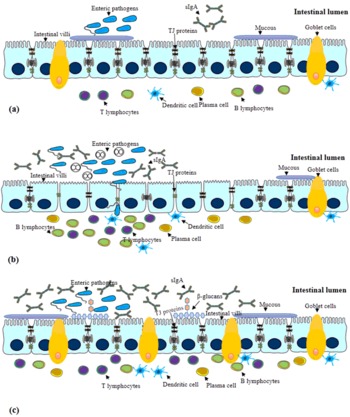
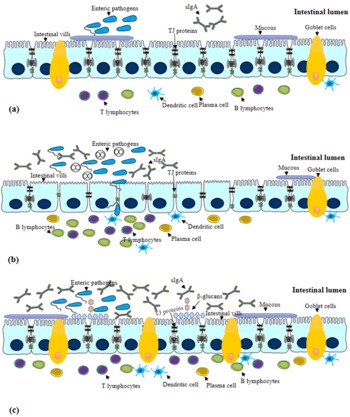
In addition to nutrient absorption, the lining of the digestive tract acts as a barrier against pathogen invasion. Goblet cells secret mucins to attract microbe adhesion to increase elimination of microbes, and thus prevent physical and chemical injury by pathogens (Deplancke and Gaskins, Reference DEPLANCKE and GASKINS2001; Iijima et al., Reference IIJIMA, TAKAHASHI and KIYONO2001). When the mucus layer is disturbed, adhesion of microbes to the intestinal epithelial surface may increase epithelial permeability and reduce the absorption of nutrients. Intestinal secretory immunoglobulin A (sIgA) is a line of defence in protecting the intestinal epithelium from pathogenic microorganisms and maintaining the mucosal layer (Mantis et al., Reference MANTIS, ROL and CORTHÉSY2011). Intestinal integrity is maintained by tight junctions (TJ) proteins including claudins, junctional adhesion molecules and occludin (Tsukita et al., Reference TSUKITA, FURUSE and ITOH2001; Schneeberger, Reference SCHNEEBERGER2004). Claudin and occludin families thus maintain intestinal integrity to form a solid barrier from pathogen invasion (Fanning et al., Reference FANNING, JAMESON, JESAITIS and ANDERSON1998) as presented in Figure 3 (a) .
Damage in GIT due to enteric pathogens
Invasion of enteric pathogens such as Salmonella typhimurium causes loss of integrity and dysfunction of the intestinal epithelium (Clark et al., Reference CLARK, HIRST and JEPSON1998; Sears, Reference SEARS2000). Salmonella typhimurium infection can down regulate TJ protein expression in the intestinal epithelial cells, damage intestinal barrier function, and thus facilitate bacterial invasion into the blood stream (Jepson et al., Reference JEPSON, SCHLECHT and COLLARES-BUZATO2000; Kohler et al., Reference KOHLER, SAKAGUCHI, HURLEY, KASE, REINECKER and MCCORMICK2007). Broilers infected by Salmonella spp. have been reported to have decreased villi height in the jejunum and altered ratio to crypt depth, a reduced number of goblet cells with increased sIgA production and its expressing cells (Beal et al., Reference BEAL, POWERS, WIGLEY, BARROW and SMITH2004; Withanage et al., Reference WITHANAGE, WIGLEY, KAISER, MASTROENI, BROOKS, POWERS, BEAL, BARROW, MASKELL and MCCONNELL2005; Rahimi et al., Reference RAHIMI, GRIMES, FLETCHER, OVIEDO and SHELDON2009; Revolledo et al., Reference REVOLLEDO, FERREIRA and FERREIRA2009; Fasina et al., Reference FASINA, HOERR, MCKEE and CONNER2010; Marcq et al., Reference MARCQ, COX, SZALO, THEWIS and BECKERS2010; Shao et al., Reference SHAO, GUO and WANG2013) as presented in Figure 3(b) . Cytokines, including interleukin-6 (IL-6), IL-1β, IL-8 and interferon-γ, play a pivotal role in the regulation of intestinal TJ barrier with Salmonella spp. infection (Withanage et al., Reference WITHANAGE, KAISER, WIGLEY, POWERS, MASTROENI, BROOKS, BARROW, SMITH, MASKELL and MCCONNELL2004; Withanage et al., Reference WITHANAGE, WIGLEY, KAISER, MASTROENI, BROOKS, POWERS, BEAL, BARROW, MASKELL and MCCONNELL2005; Fasina et al., Reference FASINA, HOLT, MORAN, MOORE, CONNER and MCKEE2008; Al-Sadi, Reference AL-SADI2009; Groschwitz and Hogan, Reference GROSCHWITZ and HOGAN2009; Turner, Reference TURNER2009). TJ proteins including occluding, claudin-1 and claudin-4 expression declined in the jejunum during Salmonella spp. infection in broilers (Zhang et al., Reference ZHANG, SHAO, LIU, YIN, GUO and YUAN2012). Decrease of TJ protein expressions increases epithelial permeability, interrupts intestinal barriers and allows leakage and invasion of antigens, pathogens and bacterial toxins into the circulation (Kucharzik et al., Reference KUCHARZIK, WALSH, CHEN, PARKOS and NUSRAT2001; Tsukita et al., Reference TSUKITA, FURUSE and ITOH2001; Schneeberger, Reference SCHNEEBERGER2004). Increased intestinal permeability has been shown to increase the infiltration of pathogenic bacteria into distinct organs including the liver and spleen (Kops et al., Reference KOPS, LOWE, BEMENT and WEST1996; Jepson et al., Reference JEPSON, SCHLECHT and COLLARES-BUZATO2000; Kohler et al., Reference KOHLER, SAKAGUCHI, HURLEY, KASE, REINECKER and MCCORMICK2007; Revolledo et al., Reference REVOLLEDO, FERREIRA and FERREIRA2009).
Mechanisms by which β-glucans act as an antibiotic alternative
Yeast β-glucans have been shown to have positive effects against various infectious diseases by improving immunity, while its role as an antibiotic alternative in domestic fowl against enteric pathogens is not yet completely explored. β-glucans have various mechanisms to improve the growth performance of domestic fowls, in which dietary supplementation has been shown to increase the intestinal clearance of numerous imperative pathogens such as E. coli and Salmonella spp. (Lowry et al., Reference LOWRY, FARNELL, FERRO, SWAGGERTY, BAHL and KOGUT2005; Huff et al., Reference HUFF, HUFF, FARNELL, RATH, SOLIS DE LOS SANTOS and DONOGHUE2010) by protecting intestinal barriers, stimulating phagocytosis and suppressing pathogen invasion into organs (Lowry et al., Reference LOWRY, FARNELL, FERRO, SWAGGERTY, BAHL and KOGUT2005). Previous studies have suggested that β-glucan supplementation can enhance goblet cell number and villus height in the ileum (de Los Santos et al., Reference DE LOS SANTOS, DONOGHUE, FARNELL, HUFF, HUFF and DONOGHUE2007; Morales-Lopez et al., Reference MORALES-LOPEZ, AUCLAIR, GARCIA, ESTEVE-GARCIA and BRUFAU2009), as well as restore villus damage/loss by Salmonella spp. challenge (Shao et al., Reference SHAO, GUO and WANG2013). In addition, β-glucans supplemented at 0.1% level of the diet improved villus height and crypt depth and their ratio in the duodenum and ileum, upregulated mucin-2 production from goblet cells, modulated intestinal profile of cytokines, and reduced lesion severity and inflammation in the intestine of broilers during Eimeria/coccidia infection (Cox et al., Reference COX, STUARD, KIM, MCELROY, BEDFORD and DALLOUL2010a; Reference COX, SUMNERS, KIM, MCELROY, BEDFORD and DALLOUL2010b). Another mechanism by which YCW β-glucans can act as an antibiotic alternative is attributed to increased sIgA secretion and numbers of goblet cells that maintain the integrity of the mucous protective layers for expulsion of enteric pathogen invasion (Brandtzaeg, Reference BRANDTZAEG2010). β-glucan supplementation has been shown to increase jejunal TJ protein expressions such as occluding and claudin-1, leading to the increased removal of Salmonella Typhimurium (Shao et al., Reference SHAO, GUO and WANG2013) as illustrated in Figure 3 (c) , while it also inhibits the colonisation and invasion of Salmonella in the caeca and liver, respectively (Lowry et al., Reference LOWRY, FARNELL, FERRO, SWAGGERTY, BAHL and KOGUT2005; Chen et al., Reference CHEN, WENG, CHANG, LIAO, CHEN and CHU2008; Revolledo et al., Reference REVOLLEDO, FERREIRA and FERREIRA2009).
These mechanisms of yeast β-glucans relate to the improvement of the intestinal epithelial cell functions but no mechanism regarding direct killing or binding of β-glucans with enteric pathogens is available to date. However, various studies relating to microbial killing by activation of macrophages/lymphocytes are available.
Conclusions
YCW β-glucans can act as a safeguard in domestic fowl against enteric pathogens by increasing sIgA secretion, goblet cell numbers, upregulating expression of intestinal TJ proteins and cytokines. Moreover YCW β-glucans merits being considered as a growth promoter in broilers. As a growth promoter and antibiotic alternative, further studies are required to optimise the dosage and source of β-glucans to determine its effects on growth performance and mechanisms against enteric pathogens. In conclusion, β-glucans may be used as a growth promoter and antibiotic alternative.
Intestinal morphology. (a) normal goblet cells, TJ proteins, sIgA, mucous, intestinal villi, B and T lymphocytes, plasma and dendritic cells, (b) disruption of TJ proteins, reduced villus height, decreased goblet cells, mucous, increased sIgA, dendritic cells, plasma cells, T and B lymphocytes by enteric pathogens, (c) increased goblet cells, mucous, sIgA, T and B lymphocytes, plasma cells, and dendritic cells with β-glucans and reduced enteric pathogens.
Conflict of interest statement
None of the authors of this paper has a financial or personal relationship with other people or organisations that could inappropriately influence or bias the content of the paper.