INTRODUCTION
Sustaining a traumatic brain injury (TBI) in childhood can lead to impairments across many domains, including motor skills, physical functioning, attention, executive and intellectual functioning, social competence, global functioning, and quality of life (Catroppa et al., Reference Catroppa, Hearps, Crossley, Yeates, Beauchamp, Fusella and Anderson2017; Finnanger et al., Reference Finnanger, Olsen, Skandsen, Lydersen, Vik, Evensen and Indredavik2015). Deficits in executive functioning are one of the most common and persistent impairments following TBI (Aaro Jonsson, Smedler, Leis Ljungmark, & Emanuelson, Reference Aaro Jonsson, Smedler, Leis Ljungmark and Emanuelson2009; Beauchamp & Anderson, Reference Beauchamp and Anderson2013; Sesma, Slomine, Ding, & McCarthy, Reference Sesma, Slomine, Ding and McCarthy2008). In one study, 26% of children who sustained a moderate TBI and 42% of those who sustained a severe TBI demonstrated significant impairments in executive functioning 10 years post injury (Muscara, Catroppa, & Anderson, Reference Muscara, Catroppa and Anderson2008). In addition, rates of new psychiatric diagnoses in children with TBI are higher than in healthy controls, and most pre-injury mental health disorders continue or worsen following TBI (Catroppa et al., Reference Catroppa, Crossley, Hearps, Yeates, Beauchamp, Rogers and Anderson2015; Max et al., Reference Max, Wilde, Bigler, MacLeod, Vasquez, Schmidt and Levin2012; Schachar, Park, & Dennis, Reference Schachar, Park and Dennis2015). For example, the rate of secondary ADHD in children after TBI is greater than in children with orthopedic injuries and healthy controls (Narad et al., Reference Narad, Kennelly, Zhang, Wade, Yeates, Taylor and Kurowski2018; Yeates et al., Reference Yeates, Armstrong, Janusz, Taylor, Wade, Stancin and Drotar2005). Similarly, internalizing disorders and post-traumatic stress disorders are overrepresented among children with TBI (Max et al., Reference Max, Koele, Smith, Sato, Lindgren, Robin and Arndt1998; Schachar et al., Reference Schachar, Park and Dennis2015). Children with TBI also show short-term and long-term impairments in social cognition and participation, which can negatively affect friendships and other social relationships (Anaby, Law, Hanna, & Dematteo, Reference Anaby, Law, Hanna and Dematteo2012; Catroppa et al., Reference Catroppa, Crossley, Hearps, Yeates, Beauchamp, Rogers and Anderson2015; Dennis et al., Reference Dennis, Agostino, Taylor, Bigler, Rubin, Vannatta and Yeates2013; Prigatano & Gupta, Reference Prigatano and Gupta2006; Renstrom, Soderman, Domellof, & Emanuelson, Reference Renstrom, Soderman, Domellof and Emanuelson2012; Yeates et al., Reference Yeates, Gerhardt, Bigler, Abildskov, Dennis, Rubin and Vannatta2013).
TBI is also associated with caregiver burden and distress (Aitken et al., Reference Aitken, McCarthy, Slomine, Ding, Durbin, Jaffe and Mackenzie2009; Stancin, Wade, Walz, Yeates, & Taylor, Reference Stancin, Wade, Walz, Yeates and Taylor2008). Caregivers of children with TBI face significant stressors during their child’s recovery, including financial strain and coping with changes in their child’s behavior and cognition, which can lead to clinically elevated levels of distress (Ganesalingam et al., Reference Ganesalingam, Yeates, Ginn, Taylor, Dietrich, Nuss and Wright2008; Hawley, Ward, Magnay, & Long, Reference Hawley, Ward, Magnay and Long2003; Rivara et al., Reference Rivara, Fay, Jaffe, Polissar, Shurtleff and Martin1992; Rivara et al., Reference Rivara, Jaffe, Polissar, Fay, Liao and Martin1996; Wade et al., Reference Wade, Taylor, Drotar, Stancin, Yeates and Minich2002). An increase in caregiver distress is particularly concerning given the well-documented association between parent and family functioning and child outcomes after TBI (Catroppa et al., Reference Catroppa, Hearps, Crossley, Yeates, Beauchamp, Fusella and Anderson2017; Chapman et al., Reference Chapman, Wade, Walz, Taylor, Stancin and Yeates2010; Durber et al., Reference Durber, Yeates, Taylor, Walz, Stancin and Wade2017; Yeates, Taylor, Walz, Stancin, & Wade, Reference Yeates, Taylor, Walz, Stancin and Wade2010). Parental mental health is predictive of academic, behavioral, and social outcomes for children with TBI (Catroppa et al., Reference Catroppa, Hearps, Crossley, Yeates, Beauchamp, Fusella and Anderson2017). Furthermore, higher quality family and home environments are associated with better academic achievement and classroom functioning in children with TBI, whereas poorer home environments and parental mental health predict poorer quality of life (Durber et al., Reference Durber, Yeates, Taylor, Walz, Stancin and Wade2017; Sluys, Lannge, Iselius, & Eriksson, Reference Sluys, Lannge, Iselius and Eriksson2015; Stancin et al., Reference Stancin, Drotar, Taylor, Yeates, Wade and Minich2002).
Given the importance of parental mental health and family functioning for children’s recovery after TBI, parenting or family-centered interventions may be an effective strategy to improve family functioning, parental mental health, and child outcomes. All online family problem-solving therapies (OFPST) reported here teach children and their caregivers cognitive reframing, problem-solving strategies, communication skills, and behavior management. The therapy helps families define goals and involves real-life exercises and continual practice of learned skills.
Although problem-solving therapy was originally developed as a cognitive-behavioral treatment to promote more effective coping with life stresses (Nezu & D’Zurilla, Reference Nezu and D’Zurilla2006), OFPST may be particularly beneficial for children with TBI because it also provides injured youth with problem-solving strategies for addressing post-injury challenges. Similarly, OFPST may help children and adolescents cope with stressors and symptoms of anxiety and depression following TBI. In fact, OFPST has shown promise in decreasing externalizing and internalizing behavior problems in children and adolescents after TBI (Wade et al., Reference Wade, Walz, Carey, McMullen, Cass, Mark and Yeates2011; Wade et al., Reference Wade, Stancin, Kirkwood, Brown, McMullen and Taylor2013; Wade et al., Reference Wade, Kurowski, Kirkwood, Zhang, Cassedy, Brown and Taylor2015; Wade, Taylor, et al., Reference Wade, Taylor, Yeates, Kirkwood, Zang, McNally and Zhang2018b). OFPST may also improve executive functioning, but outcomes in this domain have been less consistent across age groups and family income levels (Kurowski et al., Reference Kurowski, Wade, Kirkwood, Brown, Stancin and Taylor2013; Wade, Carey, & Wolfe, Reference Wade, Carey and Wolfe2006a; Wade et al., Reference Wade, Walz, Carey, Williams, Cass, Herren and Yeates2010, Wade, Taylor, et al., Reference Wade, Taylor, Yeates, Kirkwood, Zang, McNally and Zhang2018b). However, only one study found improvements in social competence, and improvements were only seen for younger teens with moderate injuries and older teens with severe injuries (Tlustos et al., Reference Tlustos, Kirkwood, Taylor, Stancin, Brown and Wade2016). Additionally, because OFPST involves both caregivers and children, it has demonstrated utility in improving family functioning and alleviating caregiver distress (Narad et al., Reference Narad, Minich, Taylor, Kirkwood, Brown, Stancin and Wade2015; Petranovich et al., Reference Petranovich, Wade, Taylor, Cassedy, Stancin, Kirkwood and Brown2015; Wade, Carey, & Wolfe, Reference Wade, Carey and Wolfe2006b; Wade, Walz, Carey, & McMullen, Reference Wade, Walz, Carey and McMullen2012).
Although some benefits of OFPST may be immediate, other benefits may not appear until adolescence or later during recovery. For example, one study found that following OFPST with children aged 12–17, improvements in family functioning were not seen until 18 months after baseline (Narad et al., Reference Narad, Minich, Taylor, Kirkwood, Brown, Stancin and Wade2015). Subtle or delayed treatment effects such as these may be more readily detected by aggregating results across multiple randomized trials. More specifically, joint analysis of results from separate OFPST randomized clinical trials (RCTs) can help us better understand the timing of treatment effects and which child and family outcomes are most sensitive to treatment.
We therefore conducted an individual-level profile meta-analysis of five RCTs of OFPST to better understand behavioral, family, and social outcomes of this intervention and the timing of improvements across domains. Researchers have used profile analysis of single studies to improve our understanding of neurological profiles and adaptive functioning in children who sustained a TBI (Shultz et al., Reference Shultz, Hoskinson, Keim, Dennis, Taylor, Bigler and Yeates2016; Treble-Barna et al., Reference Treble-Barna, Zang, Zhang, Taylor, Yeates and Wade2017). However, prior research has not used profile analysis to understand intervention effects for children with TBI, nor are we aware of similar analyses based on multiple studies in the TBI literature. We aim to further our understanding of OFPST and facilitate translation of these interventions into clinical practice by identifying those aspects of behavioral and family profiles that are most sensitive to treatment. We hypothesized that improvements following OFPST would be more pronounced for externalizing problems, executive function behaviors, and parental depression in comparison to improvements in social competence, with greater improvements immediately post treatment and with longer time post treatment.
METHOD
We report on the joint analysis of five randomized trials of OFPST for pediatric TBI, conducted between 2000 and 2015. In total, the trials included 359 children between the ages of 5 and 18, randomized to treatment or control up to 24 months post injury. A research librarian’s search identified only these five trials of a telehealth problem-solving intervention for pediatric TBI. The trials were conducted by largely the same set of Principal Investigators (PIs), reducing study-to-study heterogeneity that could reduce power but also the potential generalizability of the study results. In all studies, parents and children with TBI provided informed consent/assent, completed pretreatment questionnaires, and, upon completion of the pretreatment assessment, were randomly assigned to either OFPST or a control condition. Follow-up assessments were completed 6 months later in all studies. Maintenance of treatment effects was examined at 12 months (3 studies) or 18 months (1 study) after baseline.
The project used fully de-identified data and was approved by the Institutional Review Board at the primary site. Each study used the Trauma Registries of participating hospitals to identify potentially eligible participants. Some studies used additional means of identification (see Wade, Kaizar, et al., Reference Wade, Kaizar, Narad, Zang, Kurowski, Yeates and Zhang2018a) All participants were hospitalized overnight following TBI and met criteria for a complicated mild (Glasgow Coma Scale score of 13–15 with positive findings on neuroimaging) to severe TBI (lowest Glasgow Coma Scale score of 3–8). Studies did not select for children already experiencing problems.
Treatment and Control Groups
Online family problem-solving therapy (OFPST)
The original eight-session OFPST program, tested in the initial two trials (Online and CDC), provided training in cognitive reframing, problem solving, behavior management, and family communication targeted to families of children aged 5–18. The content was subsequently adapted to target adolescents (TOPS, TOPS-RRTC and CAPS) with the modified modules and treatment goals placing greater emphasis on the adolescent’s self-regulation, problem solving, and anger management, with the overarching goal of promoting more independent functioning. The 10-session Teen Online Problem-Solving program, tested in two trials (TOPS, TOPS-RRTC), included two additional modules on nonverbal communication and social problem solving. Across all five studies, OFPST combined either 8 or 10 core self-guided online modules and live videoconference sessions with a therapist to teach families (i.e., the child with TBI, parents/caregivers, and siblings when available) targeted skills. Families had the option of completing up to four additional supplemental sessions to address specific issues (i.e., marital stress, sibling behavior, pain, or sleep difficulties). Videoconference sessions, during which a trained therapist reviewed online content and problem solved around a family-identified goal, were 45–60 minutes in length.
Control groups
In four studies, the control group was given access to internet resources for pediatric TBI; in one study, the control group involved usual psychosocial care. We treated these two types of groups as a single composite control group based on their similar performance across studies. Participants randomized to conditions other than OFPST or the control group in two of the trials (n = 85) were excluded from the analysis.
Measures
The analyses relied on measures collected via interview and questionnaire completion before treatment initiation which reflected current functioning 0–24 months post injury, at treatment completion 6 months later, and, depending on the study, at follow-up assessments 12 or 18 months post baseline.
Background interview
In each study, the parent/primary caregiver completed an interview regarding the child’s medical and educational history. We used parents’ highest level of education as a proxy for socioeconomic status.
Parental Depression and Distress
The Center for Epidemiological Studies Depression Scale (CES-D)
The CES-D (Radloff, Reference Radloff1977) is a 20-item scale that assesses symptoms of depression. Parents rated the frequency of their specific depression symptoms over the past week, including depressed mood, restlessness, poor appetite, and social withdrawal. Higher scores (range 0–60) indicate more severe depressive symptoms. Raw scores of 16 and higher were used as a cut-off score to identify clinically significant depressive symptomatology (Radloff, Reference Radloff1977).
The Symptom Checklist 90-Revised (SCL-90-R)
Parents also completed the SCL-90-R, a 90-item self-report inventory on which they rated the extent to which they have been bothered in the past week by a range of psychiatric symptoms (Derogatis & Savitz, Reference Derogatis and Savitz1999). The scores are reported as a T score with a mean of 50 and standard deviation of 10. The Global Severity Index (GSI), a global scale of current level of symptomology, was examined as an overall measure of psychiatric distress. Scores of 63 were used as a cut-off to identify clinically significant levels of distress.
Injury information
A research coordinator reviewed the child’s medical chart and abstracted information regarding injury mechanism, severity, and length of stay in the hospital.
Child Behavior
Child Behavior Checklist (CBCL)
Parents completed the CBCL, a 112-item rating scale that asks questions about children’s problem behaviors in everyday settings. The CBCL yields Internalizing, Externalizing, and Total Behavior Problem composites. The scale is a widely used indicator of child adjustment, with high validity and reliability (Achenbach & Rescorla, Reference Achenbach and Rescorla2001). Our analysis focused on the Internalizing and Externalizing Problem composite scales.
Behavioral Rating Inventory of Executive Function (BRIEF)
Parents completed the BRIEF, an 86-item rating scale of executive function that has been validated in both normative and TBI samples (Gioia, Isquith, Guy, & Kenworthy, Reference Gioia, Isquith, Guy and Kenworthy2000; Gioia & Isquith, Reference Gioia and Isquith2004). The Global Executive Composite (GEC) incorporates all BRIEF subscales to provide an overall index of executive function behaviors, with elevated scores suggesting greater executive functioning deficits.
Home and Community Social Behavior Scale (HCSBS)
Parents completed the Social Competence scale of the HCSBS to assess their child’s peer relations and self-management/compliance. The HCSBS has good reliability and is well validated in relation to other social behavior measures; it yields a total score, with higher scores reflecting greater social competence (Merrell, Streeter, Boelter, Caldarella, & Gentry, Reference Merrell, Streeter, Boelter, Caldarella and Gentry2001).
Family Functioning and Parent–Child Conflict
Family Assessment Device (FAD)
The FAD is a 60-item self-report questionnaire measuring structural, organizational, and transactional characteristics of families, with established reliability and validity (Miller, Bishop, Epstein, & Keitner, Reference Miller, Bishop, Epstein and Keitner1985). Parents rated how well each statement described their own family. Examples of statements include “we don’t get along well together”and“ we confide in each other”. Scores range from 1 to 4, and higher scores indicate worse functioning (Epstein, Baldwin, & Bishop, Reference Epstein, Baldwin and Bishop1983). The 12-item General Function scale was used to reflect global family dysfunction (Miller et al., Reference Miller, Bishop, Epstein and Keitner1985).
Interaction Behavior Questionnaire (IBQ)
The 20-item short form of the IBQ assesses parent–child communication and conflict behavior. Parents are asked to rate each statement (e.g., “we almost never seem to agree” or “at least 3 times a week, we get angry at each other”) as true or false. Total scores can range from 0 to 20 with higher scores reflecting greater conflict. The IBQ has high internal consistency (α > .90) and has test–retest correlations ranging from .61 to .85 (Robin & Foster, Reference Robin and Foster1989).
Statistical Analysis
Descriptive statistics were used to summarize demographic, premorbid, and injury characteristics within each study, and simple summary statistic meta-analyses were used to characterize the combined studies. Child behavioral outcomes and parent/family outcomes in the OFPST and control groups were analyzed using a profile analysis. Profile analysis is a statistical technique for simultaneously examining differences among groups on a set of outcome variables (Harris, Reference Harris2001). Three primary questions are addressed:
1. Level—Does the OPFST group have improved scores across the measures compared to the control group (main effect of group)?
2. Flatness—Are some measures more improved than other measures in both groups (main effect of measure)?
3. Shape—Do improvements in scores show a distinct pattern between groups over time (interaction of group by measure by visit)?
To facilitate comparison across scores, scores on each measure were converted to Z scores based on the means and standard deviations of the corresponding measure at baseline across studies so that all scores reflected the same metric. Social competence was reverse coded so that higher values correspond to worse outcomes, to parallel the other child behavioral outcomes. The profile analysis was conducted as an initial mixed-effect model of the standardized scores on treatment group by measure by visit and the associated lower-order interactions (group by measure, group by visit, measure by visit) and main effects, with adjustment for baseline score, time since injury at baseline, child sex, age at baseline, parental education, and study site. Repeated measures on the same participant and possible dependence of participants in the same study were accounted for through random intercepts. Iterative backward elimination was used to remove non-significant higher- and then lower-order terms. Separate analyses were conducted for child behavioral outcomes (CBCL internalizing problems, CBCL externalizing problems, BRIEF and HCSBS), and parent/family outcomes (CES-D, SCL-90, IBQ, FAD). Follow-up post hoc ‘least squares means’ tests compared treatment groups on each measure to determine which measures were responsive to the OPFST at each follow-up visit. All analyses were conducted using SAS version 9.4 (SAS Institute, Cary, NC); R version 3.4.3 was used to generate plots (R Core Team, 2017).
RESULTS
Profile Analysis of Parent-Reported Child Behavior
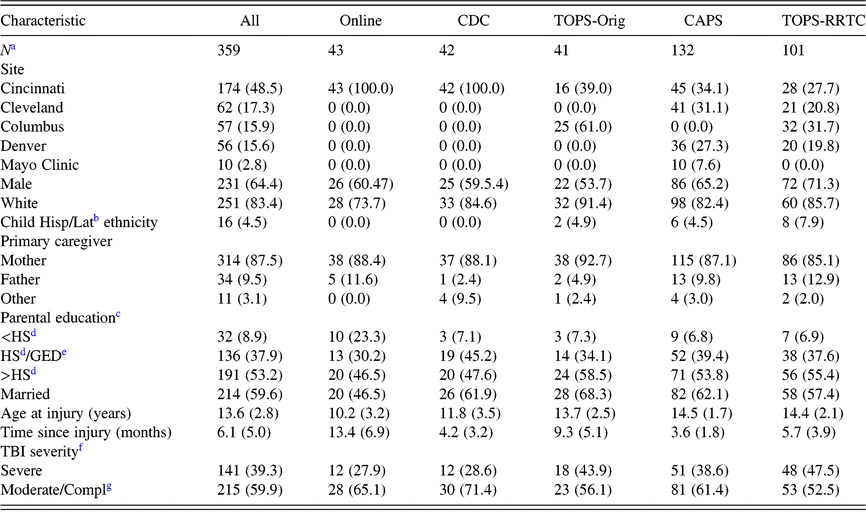
Baseline characteristics by study can be found in Table 1. The profile analysis for child behavior revealed a main effect for measure [F(3, 731) = 7.35, p < .001], indicating that the degree of improvement varied across the measures for both groups. Post hoc comparisons of the least square means revealed significantly lower average internalizing problem, externalizing problem, and executive function scores, indicating significantly greater reductions from baseline in comparison to social competence scores [t(731) = −2.68, p = .038; t(731) = −4.65, p < .001; t(731) = −2.85, p = .023, respectively]. The internalizing problems score showed a lower average score than the externalizing problem or executive function scores, but the magnitude of the difference was less pronounced [t(731) = −1.99, p = .047; t(731) = −1.81, p = .07, respectively].
Baseline characteristics by study; Count (%) or Mean (SD)

a N = number of participants assessed at baseline,
b Hisp/Lat = Hispanic/Latino,
c Parental Education = reported education of the primary caregiver,
d HS=High School,
e GED = General Education Diploma,
f Unknown values omitted from display but included in percentage calculation,
g Moderate/Compl = Moderate or Complicated Mild TBI.
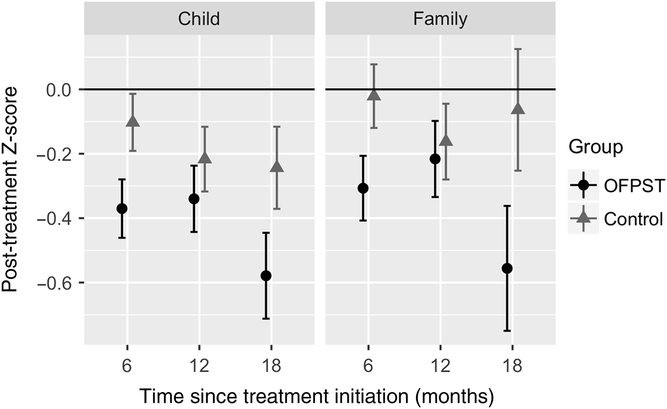
Although we did not find a group by measure or measure by visit interaction for child outcomes, we found a significant treatment group by visit interaction, F(3, 731) = 3.48, p = .031, indicating distinct shapes of improvement over time between the two groups. Post hoc comparisons of the least square means indicated that the OFPST group showed a significantly greater reduction in behavior problems than the control group at both 6 and 18 months [t(731) = −5.15, p < .001, and t(731) = −3.90, p = .002, respectively], but not at 12 months post baseline. Examination of the post hoc average score estimates in Figure 1 suggests that these differences were predominantly due to trends in the OFPST group, while the control group showed a relatively consistent and modest improvement over baseline.
Model-based post hoc post-treatment Z score separately averaged across child behavior and family function measures within groups defined by time since treatment initiation (horizontal axis) and treatment group (shape; circle = online family problem-solving therapy [OFPST], triangle = control group). Vertical lines span 95% confidence intervals for the mean Z score in each group.

Profile Analysis of Parent and Family Outcomes
Examination of parent and family outcomes revealed a statistically significant main effect for measure [F(3, 532) = 4.79, p = .003], indicating that improvement varied across the four measures in both groups. Specifically, post hoc least squares comparisons suggested that there was a significantly greater reduction in impairment on the IBQ than the other three parent/family measures [t(532) = 1.89, p = .059 for CES-D; t(532) = 2.54, p = .012 for FAD; and t(532) = 3.65, p < .001 for GSI]. The standardized CES-D scores were also on average lower than the GSI [t(532) = 2.24, p = .026], but we found no strong evidence that the FAD had a greater reduction on average than the GSI or CES-D.
Although we did not find a group by measure or measure by visit interaction for family outcomes, we found a statistically significant treatment group by time interaction [F(2, 532) = 6.47, p = .002], indicating distinct trajectories of improvement over time between the two groups. Post hoc least squares differences displayed in Figure 1 suggest trends that are remarkably similar to the child behavior profile analysis. Again, parent/family measure outcomes significantly differed between the control group and treatment group at both 6 and 18 months post baseline [t(532) = −4.81, p < .001, and t(532) = −3.80, p < .001, respectively], but not at 12 months post baseline.
DISCUSSION
We used an individual-level meta-analytic approach to profile analyses to better understand the nature and timing of treatment effects following OFPST in children with moderate to severe TBI. By incorporating data from five RCTs involving 359 children and families, we found evidence of both main effects of measure and differential trajectories of improvement between the treatment and control group over time. Specifically, across groups, we found greater recovery in internalizing and externalizing behavior problems and executive function behaviors than in social competence. In testing group by measure and measure by visit interactions, we did not find that certain measures were more sensitive to treatment than others or distinct shapes of improvement over time across the measures. However, group differences in both child and parent/family outcomes were significant across outcomes, occurring both immediately post treatment and 18 months post baseline. Taken together, these findings provide further support for the efficacy of OFPST in improving child behavior, parent distress, and family functioning. Moreover, the results inform outpatient rehabilitation by highlighting variable recovery over time and the child and family outcomes that show greater improvement, regardless of treatment.
Main effects for child outcome measures suggest that behavioral symptoms such as internalizing and externalizing behavior problems and executive function behaviors may recover over time, without intervention; in contrast, social competence may show less natural improvement. Indications that internalizing behaviors may improve more than externalizing behaviors are counter to previously reported effects of behavioral interventions, which highlight improvements in externalizing problems and executive function behaviors rather than internalizing problems (Kurowski et al., Reference Kurowski, Wade, Kirkwood, Brown, Stancin and Taylor2013; Wade et al., Reference Wade, Carey and Wolfe2006a, Reference Wade, Carey and Wolfe2006b, Reference Wade, Walz, Carey, Williams, Cass, Herren and Yeates2010, Reference Wade, Walz, Carey, McMullen, Cass, Mark and Yeates2011, Reference Wade, Stancin, Kirkwood, Brown, McMullen and Taylor2013, Reference Wade, Karver, Taylor, Cassedy, Stancin, Kirkwood and Brown2014, Reference Wade, Kurowski, Kirkwood, Zhang, Cassedy, Brown and Taylor2015; Wade, Taylor, et al., Reference Wade, Taylor, Yeates, Kirkwood, Zang, McNally and Zhang2018b). Although the treatment and control groups did not differ on time since injury, and time since injury was included as a covariate in the models, some measures may improve more due to natural recovery in the initial months post injury. For example, internalizing symptoms, such as fatigue and irritability, often improve acutely without intervention, perhaps accounting for some of the differential improvement among measures. This different pattern of results may also be attributable to the inclusion of moderators such as the child’s age/grade at baseline and injury severity in prior analyses demonstrating improvements in executive dysfunction following OFPST. Specifically, the effects on self-regulation and executive dysfunction may be more pronounced among older adolescents who can directly apply the executive heuristics of inhibition (stop and think) and problem solving to their daily lives (Wade et al., Reference Wade, Stancin, Kirkwood, Brown, McMullen and Taylor2013).
Main effects for measure on the parent/family profile analysis indicated that parent-reported parent–teen conflict was more improved than other outcomes, with parental depression showing more improvement relative to global parental distress. Parent–teen conflict may have prompted families to enroll in the trials and may show regression to the mean at follow-up; in contrast, parental distress and family dysfunction may be more entrenched and require active intervention.
For both child and parent/family outcomes, OFPST resulted in improvements immediately post treatment. Because of improvements in the control group between treatment completion and follow-up 6 months later (i.e., at the 12-month time point), treatment differences at the 6-month post-treatment follow-up were no longer significant, indicating some natural recovery in the control group. However, subsequent improvements in the OFPST group between the 12- and 18-month post-baseline follow-ups resulted in large group differences a full year following treatment. These findings suggest that treatment effects may consolidate over time. Given the focus of OFPST on problem-solving and self-regulation skills, further improvements with increasing time may correspond to more consistent and successful implementation of skills in their daily lives. Although promising, this pattern of findings merits further investigation given that only one of the five studies, involving 132 participants, followed participants beyond 12 months post baseline. Nonetheless, the results do suggest that children and families may reap intervention benefits over a longer period of time, leading to later improvements.
Consistent with research indicating reciprocal relationships between parent/family functioning and child recovery over time, child and parent outcomes demonstrated a similar pattern of improvement (Taylor et al., Reference Taylor, Yeates, Wade, Drotar, Stancin and Burant2001). The present data do not shed light on whether improvements in one drove improvements in the other, but do suggest that family-centered treatments such as OFPST may be valuable given their ability to improve outcomes at both levels. As noted previously, the focus on improving problem solving, self-regulation, and communication skills in both parents and adolescents with TBI may promote improved functioning in both parents and teens and facilitate the parent’s ability to scaffold behavior change in their child.
The results must be considered in the context of study limitations, including the exclusive reliance on parent-report measures, particularly given that parents completing OFPST may experience social desirability biases that increase their likelihood of reporting improved functioning. Independent ratings or diagnostic interviews with the child would strengthen the findings. Time since injury ranged from 1 to 24 months, with many children enrolled during the initial year post injury. Emerging evidence (Wade, Kaizar, et al., Reference Wade, Kaizar, Narad, Zang, Kurowski, Yeates and Zhang2018a) suggests that children and adolescents benefit less from OFPST during the initial months post injury, likely due to acute neurocognitive challenges (e.g., slow processing speed, fatigue, headaches) that affect their ability to actively engage in the problem-solving training. Thus, the pattern of findings may differ if all participants were in the post-acute phase of recovery. Similar patterns of improvements in child behavior and parent and family functioning may be driven, in part, by shared rater variance. While the profile analysis benefits from the assessment of outcomes over time, only one study involving 132 participants included assessments at all four time points; as a consequence, this study had a disproportionate influence on the long-term profiles.
In summary, the results provide important new evidence regarding the child and parent/family outcomes that are most responsive to OFPST and the pattern of maintenance of improvements over time. The results highlight OFPST’s utility in improving both child behavior problems and parent/family functioning, with greater improvements immediately post treatment and with extended time post treatment. Further research is needed to elucidate the potential reciprocal relationships between improvements in parent and child functioning over time following OFPST.
ACKNOWLEDGEMENTS
We acknowledge the contributions of Amy Cassedy, Ph.D. and Nori Minich, B.S. to data cleaning and synthesis, and Jennifer Taylor, B.A. to regulatory oversight.
FUNDING
This work was funded by the NIH grant 1R21HD089076-01 from the National Institutes of Health.
Data from the following clinical trials were used in this study: An On-Line Intervention for Families Following Pediatric TBI, conducted prior to trial registration; A Trial of Two On-Line Interventions for Child Brain Injury, NCT00178022, https://clinicaltrials.gov/ct2/show/NCT00178022?term%3DNCT00178022&rank%3D1; Teen Online Problem Solving (TOPS)- An Online Intervention Following TBI (TOPS), NCT00409058, https://clinicaltrials.gov/ct2/show/NCT00409058?term%3DNCT00409058&rank%3D1; Improving Mental Health Outcomes of Childhood Brain Injury (CAPS), NCT00409448, https://clinicaltrials.gov/ct2/show/NCT00409448?termNCT00409448&rank1; and Rehabilitation Research and Training Center for Traumatic Brain Injury Interventions—Teen Online Problem Solving Study (RRTC—TOPS), NCT01042899, https://clinicaltrials.gov/ct2/show/NCT01042899?term%3DNCT01042899&rank%3D1.
CONFLICTS OF INTEREST
The authors have nothing to disclose.