1 Introduction
Many notions of topology and combinatorics of the reals have been reformulated and investigated in terms of ideals on the natural numbers (always assuming that an ideal contains all the finite sets of natural numbers). For instance, the usual notion of convergence on a topological space, which states that a sequence
 $\langle x_n:\, n<\omega \rangle $
in a topological space converges to a point
 $x\in X$
when the set
 ${\left \{ {n<\omega } :\, {x_n\notin U} \right \}}$
is finite for any open neighborhood U of x, is generalized in terms of ideals J on the natural numbers by changing the latter requirement by
 ${\left \{ {n<\omega } :\, { x_n\notin U} \right \}}\in J$
(see, e.g., [Reference Kostyrko, Šalát and Wilczyński28]). More recent and remarkable examples are the so-called selection principles, which are reformulated in terms of ideals, and show deep connections with cardinal characteristics of the real line [Reference Bukovský, Das and Šupina17, Reference Repický37, Reference Repický38, Reference Šottová and Šupina41, Reference Šupina42].
In combinatorics of the real line, some classical cardinal characteristics have been reformulated in terms of ideals (and in many cases they are connected to selection principles in topology). The most natural examples are the reformulations of the bounding number
 ${\mathfrak {b}}_J$
and the dominating number
 ${\mathfrak {d}}_J$
in terms of an ideal J on
 $\omega $
, more concretely, with respect to the relation
 $\leq ^J$
on
 ${{}^\omega \omega }$
, which states that
 $x \leq ^J y$
iff
 ${\left \{ {n<\omega } :\, {x(n)\nleq y(n)} \right \}}\in J$
. These have been investigated by, e.g., Canjar [Reference Canjar18], Blass and Mildenberger [Reference Blass and Mildenberger10], also in connection with arithmetic in the sense that, for any maximal ideal J,
 ${\mathfrak {b}}_J={\mathfrak {d}}_J$
is the cofinality of the ultrapower (on the dual filter of J) of
 $\omega $
. Other classical cardinal characteristics have been reformulated in terms of ideals on
 $\omega $
, like the almost disjointness number [Reference Farkas and Soukup21, Reference Haga, Schrittesser and Törnquist23, Reference Raghavan and Steprāns36] and the pseudo-intersection number [Reference Borodulin-Nadzieja and Farkas13, Reference Šupina43], among others (see [Reference Hrušák25, Section 8.4]).
In the present paper we offer a reformulation, in terms of ideals on
 $\omega $
, of the ideal of Lebesgue measure zero subsets of the reals. Our reformulation does not come from a definition of the Lebesgue measure in terms of an ideal J on
 $\omega $
, but it is inspired from one combinatorial characterization of measure zero. Details of this new definition are provided in Section 2. We work in the Cantor space
 ${{}^\omega 2}$
for simplicity, but the same reformulations and results can be obtained in other standard Polish spaces with a measure (see Section 7). We denote by
 ${\mathcal {N}}_J$
the collection of null subsets modulo J of
 ${{}^\omega 2}$
. It will be clear that
 ${\mathcal {N}}_{\mathrm {Fin}}={\mathcal {N}}$
, the ideal of Lebesgue measure subsets of
 ${{}^\omega 2}$
, where
 ${\mathrm {Fin}}$
denotes the ideal of finite subsets of
 $\omega $
.
We also provide a reformulation of
 ${\mathcal {E}}$
, the ideal generated by the
 $F_\sigma $
measure zero subsets of
 ${{}^\omega 2}$
, in terms of an ideal J on
 $\omega $
, which we denote by
 ${\mathcal {N}}^*_J$
. As expected, we have
 ${\mathcal {N}}^*_{\mathrm {Fin}} = {\mathcal {E}}$
.
We obtain that, for any ideal J on the natural numbers,
 ${\mathcal {N}}_J$
and
 ${\mathcal {N}}^*_J$
are actually
 $\sigma $
-ideals on
 ${{}^\omega 2}$
and that, whenever K is another ideal on
 $\omega $
and
 $J\subseteq K$
,
 $$ \begin{align*}{\mathcal{E}}\subseteq {\mathcal{N}}^*_J\subseteq {\mathcal{N}}^*_K\subseteq {\mathcal{N}}_K\subseteq {\mathcal{N}}_J\subseteq {\mathcal{N}}.\end{align*} $$
In fact, it will be clear from the definitions that, whenever K is a maximal ideal on
 $\omega $
,
 ${\mathcal {N}}^*_K={\mathcal {N}}_K$
.
Our first set of main results work as interesting characterizations of ideals on
 $\omega $
with the Baire property:
Theorem A. Let J be an ideal on
 $\omega $
. Then, the following statements are equivalent:
-
(i) J has the Baire property.
-
(ii)
 ${\mathcal {N}}_J={\mathcal {N}}$
.
-
(iii)
${\mathcal {N}}^*_J={\mathcal {E}}$
.


Although no new ideals on the reals are obtained from ideals with the Baire property, we obtain new characterizations of the ideals
 ${\mathcal {N}}$
and
 ${\mathcal {E}}$
. Moreover, ideals without the Baire property offer new ideals on the reals that are worth of research: the previous result can be expanded in connection with
 ${\mathcal {M}}$
, the ideal of meager subsets of
 ${{}^\omega 2}$
.
Theorem B. Let J be an ideal on
 $\omega $
. Then, the following statements are equivalent:
 $$ \begin{align*} \begin{array}{ll} \mathrm{(i)}\ \ J\ \mbox{does not have the Baire property.}\qquad \qquad & \mathrm{(iv)}\ \ \mbox{No member of}\ {\mathcal{N}}_J\ \mbox{is co-meager}\mbox{.}\\ \mathrm{(ii)}\ \ {\mathcal{N}}_J\subsetneq{\mathcal{N}}\mbox{.} & \mathrm{(v)}\ \ {\mathcal{M}}\cap{\mathcal{N}}\nsubseteq{\mathcal{N}}_J\mbox{.}\\ \mathrm{(iii)}\ \ {\mathcal{E}} \subsetneq {\mathcal{N}}^*_J\mbox{.} & \mathrm{(vi)}\ \ {\mathcal{N}}^*_J\nsubseteq{\mathcal{M}}\mbox{.}\\ \end{array} \end{align*} $$
Theorems A and B summarize Theorems 2.18, 3.7, and 3.11 and Corollary 3.5. There are two elements providing the proof of these results. The first corresponds to monotonicity results with respect to the well-known Katětov–Blass order
 ${\mathrel {\leq _{\mathrm {KB}}}}$
and Rudin–Blass order
 ${\mathrel {\leq _{\mathrm {RB}}}}$
between ideals (Theorem 2.15), and the second is Bartoszyński’s and Scheepers’ game [Reference Bartoszyński and Scheepers5] that characterizes filters (and hence ideals) with the Baire property, which we use to prove many properties of
 ${\mathcal {N}}_J$
and
 ${\mathcal {N}}^*_J$
for any ideal J on
 $\omega $
without the Baire property, specifically that
 ${\mathcal {N}}_J$
cannot contain co-meager subsets of
 ${{}^\omega 2}$
, and that
 ${\mathcal {N}}^*_J$
contains non-meager sets.
About the connection between
 ${\mathcal {N}}_J$
and
 ${\mathcal {N}}_K$
for different ideals J and K on
 $\omega $
, (and likewise for
 ${\mathcal {N}}^*_J$
and
 ${\mathcal {N}}^*_K$
), we discovered a deep connection between these ideals and the notion of nearly coherence of ideals (or filters) on
 $\omega $
, original from Blass [Reference Blass7]. The ideals J and K are nearly coherent if there is some finite-to-one function
 $f\colon \omega \to \omega $
such that
 ${\left \{ {y\subseteq \omega } :\, {f^{-1}[y]\in J\cup K} \right \}}$
generates an ideal. We prove that nearly coherence of ideals is characterized as follows:
Theorem C (Theorem 4.10).
Let J and K be ideals on
 $\omega $
. Then the following statements are equivalent:
-
(i) J and K are nearly coherent.
-
(ii) There is some ideal
$K'$
such that
${\mathcal {N}}^*_J\cup {\mathcal {N}}^*_K\subseteq {\mathcal {N}}^*_{K'}\subseteq {\mathcal {N}}_{K'}\subseteq {\mathcal {N}}_J\cap {\mathcal {N}}_K$
. -
(iii)
${\mathcal {N}}^*_J\subseteq {\mathcal {N}}_K$
.


This means that, whenever J and K are not nearly coherent, the ideals
 ${\mathcal {N}}_J$
and
 ${\mathcal {N}}_K$
are quite different, likewise for
 ${\mathcal {N}}^*_J$
and
 ${\mathcal {N}}^*_K$
.
Blass and Shelah [Reference Blass and Shelah11] proved that it is consistent with ZFC that any pair of ideals are nearly coherent, which is known as NCF, the principle of nearly coherence of filters. Theorem C implies that, under NCF, there is only one
 ${\mathcal {N}}_J$
for maximal ideals J on
 $\omega $
. We still do not know whether NCF implies that there is just one
 ${\mathcal {N}}_J$
(or
 ${\mathcal {N}}^*_J$
) for J without the Baire property. On the other hand, when we assume that there are not nearly coherent ideals (which is consistent with ZFC, e.g., it is valid under CH and in random model, see [Reference Blass7, Section 4]), we can construct a non-meager ideal K on
 $\omega $
such that
 ${\mathcal {N}}^*_K\neq {\mathcal {N}}_K$
(Lemma 4.11). In contrast with the previous question, we do not know whether ZFC proves the existence of an ideal K without the Baire property such that
 ${\mathcal {N}}^*_K\neq {\mathcal {N}}_K$
.
The proof of Theorem C uses Eisworth’s game that characterizes nearly coherence [Reference Eisworth20]. Another element relevant to this proof is the order
 ${\mathrel {\leq _{\overline {\mathrm {KB}}}}}$
, which is the dual of the Katětov–Blass order (see Definition 2.14). If J and K are nearly coherent then it is clear that there is some ideal
 $K'$
such that
 $J,K{\mathrel {\leq _{\overline {\mathrm {KB}}}}} K'$
, but the converse is also true thanks to Theorem C. This equivalence is claimed in [Reference Blass7], but here we present an alternative proof using our new ideals.
We also study the cardinal characteristics associated with the ideals
 ${\mathcal {N}}_J$
and
 ${\mathcal {N}}^*_J$
, i.e., additivity, covering, uniformity, and cofinality. Recall that
 ${\mathfrak {s}}$
denotes the splitting number and
 ${\mathfrak {r}}$
the reaping number.Footnote
1
In ZFC, we can prove the following result.
Theorem D. Let J be an ideal on
 $\omega $
. With respect to Cichoń’s diagram (see Figure 1):
-
(a)
${\mathrm {cov}}({\mathcal {N}})\leq {\mathrm {cov}}({\mathcal {N}}_J) \leq {\mathrm {cov}}({\mathcal {N}}^*_J)\leq {\mathrm {cov}}({\mathcal {E}}) \leq \min \{{\mathrm {cof}}({\mathcal {M}}),{\mathfrak {r}}\}$
and i.e., the coverings of
$$ \begin{align*}\max\{{\mathrm{add}}({\mathcal{M}}),{\mathfrak{s}}\}\leq {\mathrm{non}}({\mathcal{E}})\leq {\mathrm{non}}({\mathcal{N}}^*_J)\leq {\mathrm{non}}({\mathcal{N}}_J) \leq {\mathrm{non}}({\mathcal{N}}),\end{align*} $$
${\mathcal {N}}_J$
and
${\mathcal {N}}^*_J$
are between
${\mathrm {cov}}({\mathcal {N}})$
and
$\min \{{\mathrm {cof}}({\mathcal {M}}),{\mathfrak {r}}\}$
, and their uniformities are between
$\min \{{\mathrm {add}}({\mathcal {M}}),{\mathfrak {s}}\}$
and
${\mathrm {non}}({\mathcal {N}})$
.
-
(b) The additivities of
${\mathcal {N}}_J$
and
${\mathcal {N}}^*_J$
are between
${\mathrm {add}}({\mathcal {N}})$
and
${\mathrm {cov}}({\mathcal {M}})$
, and their cofinalities are between
${\mathrm {non}}({\mathcal {M}})$
and
${\mathrm {cof}}({\mathcal {N}})$
.


Cichoń’s diagram including the cardinal characteristics associated with our ideals,
 ${\mathfrak {s}}$
and
 ${\mathfrak {r}}$
, as stated in Theorem D.

The previous theorem summarizes Theorem 5.6 and Corollary 5.13. Item (a) follows directly by the subset relation between the ideals, and also because
 ${\mathrm {add}}({\mathcal {E}})={\mathrm {add}}({\mathcal {M}})$
and
 ${\mathrm {cof}}({\mathcal {E}})={\mathrm {cof}}({\mathcal {M}})$
due to Bartoszyński and Shelah [Reference Bartoszyński and Shelah6]. Results from the latter reference guarantee easily the connections with
 ${\mathrm {cov}}({\mathcal {M}})$
and
 ${\mathrm {non}}({\mathcal {M}})$
in (b), but the connections with
 ${\mathrm {add}}({\mathcal {N}})$
and
 ${\mathrm {cof}}({\mathcal {N}})$
require quite some work. To prove this, we define two cardinal characteristics
 ${\mathfrak {b}}_J({{\overline {\Omega }}})$
and
 ${\mathfrak {d}}_J({{\overline {\Omega }}})$
. It will not be hard to show that the additivities and cofinalities of
 ${\mathcal {N}}_J$
and
 ${\mathcal {N}}^*_J$
are between
 ${\mathfrak {b}}_J({{\overline {\Omega }}})$
and
 ${\mathfrak {d}}_J({{\overline {\Omega }}})$
(Definition 5.9), and that
 ${\mathfrak {b}}_{\mathrm {Fin}}({{\overline {\Omega }}})\leq {\mathfrak {b}}_J({{\overline {\Omega }}})$
and
 ${\mathfrak {d}}_J({{\overline {\Omega }}})\leq {\mathfrak {d}}_{\mathrm {Fin}}({{\overline {\Omega }}})$
. The real effort is to prove the following new characterization of
 ${\mathrm {add}}({\mathcal {N}})$
and
 ${\mathrm {cof}}({\mathcal {N}})$
.
Theorem E (Theorem 5.12).
 ${\mathfrak {b}}_{\mathrm {Fin}}({{\overline {\Omega }}})={\mathrm {add}}({\mathcal {N}})$
and
 ${\mathfrak {d}}_{\mathrm {Fin}}({{\overline {\Omega }}})={\mathrm {cof}}({\mathcal {N}})$
.
In terms of inequalities with classical characteristics of the continuum, Theorem D seems to be the most optimal: we also manage to prove that, in most cases, no further inequalities can be proved, not just with the cardinals in Cichoń’s diagram, but with many classical cardinal characteristics of the continuum. We just leave few open questions, for example, whether it is consistent that
 ${\mathrm {cov}}({\mathcal {N}}_J)<{\mathrm {add}}({\mathcal {M}})$
(and even smaller than the pseudo-intersection number
 ${\mathfrak {p}}$
) for some maximal ideal J (likewise for
 ${\mathrm {cof}}({\mathcal {M}})<{\mathrm {non}}({\mathcal {N}}_J)$
). This is all dealt with in Section 6.
Many consistency results supporting the above comes from the forcing model after adding uncountably many Cohen reals.
Theorem F (Theorem 6.4).
Let
 $\lambda $
be an uncountable cardinal. After adding
 $\lambda $
-many Cohen reals: for any regular uncountable
 $\kappa \leq \lambda $
there is some (maximal) ideal
 $J^\kappa $
on
 $\omega $
such that
 ${\mathrm {add}}({\mathcal {N}}_{J^\kappa })={\mathrm {cof}}({\mathcal {N}}_{J^\kappa })=\kappa $
.
This shows that there are many different values for the cardinal characteristics associated with different
 ${\mathcal {N}}_J$
after adding many Cohen reals. This potentially shows that many of these values can be strictly between
 ${\mathrm {non}}({\mathcal {M}})$
and
 ${\mathrm {cov}}({\mathcal {M}})$
because, after adding
 $\lambda $
-many Cohen reals,
 ${\mathrm {non}}({\mathcal {M}})=\aleph _1$
and
 $\lambda \leq {\mathrm {cov}}({\mathcal {M}})$
(and
 ${\mathfrak {c}}=\lambda $
when
 $\lambda ^{\aleph _0}=\lambda $
). See more in Section 6, specifically item (M1). This is inspired in Canjar’s result [Reference Canjar18] stating that, after adding
 $\lambda $
many Cohen reals, for any uncountable regular
 $\kappa \leq \lambda $
there is some (maximal) ideal
 $J^\kappa $
such that
 ${\mathfrak {b}}_{J^\kappa }={\mathfrak {d}}_{J^\kappa }=\kappa $
.
1.1 Structure of the paper
In Section 2 we define
 ${\mathcal {N}}_J$
and
 ${\mathcal {N}}^*_J$
, prove their basic properties, the monotonicity with respect to the orders
 ${\mathrel {\leq _{\mathrm {KB}}}}$
,
 ${\mathrel {\leq _{\overline {\mathrm {KB}}}}}$
, and
 ${\mathrel {\leq _{\mathrm {RB}}}}$
, and that
 ${\mathcal {N}}_J={\mathcal {N}}$
and
 ${\mathcal {N}}^*_J={\mathcal {E}}$
when J has the Baire property. In Section 3 we deal with ideals without the Baire property and finish to prove Theorems A and B. Section 4 is devoted to our results related to nearly coherence of ideals, specifically with the proof of Theorem C. Section 5 presents ZFC results about the cardinal characteristics associated with our new ideals, mainly the proof of Theorems D and E, and Section 6 deals with the consistency results and Theorem F. Finally, in Section 7, we present discussions and summarize some open questions related to this work.
2 Measure zero modulo ideals
We first present some basic notation. In general, by an ideal on M we understand a family
 ${J}\subseteq {\mathcal {P}}(M)$
that is hereditary (i.e.,
 $a\in {J}$
for any
 $a \subseteq b\in {J}$
), closed under finite unions, containing all finite subsets of M and such that
 $M\notin J$
. Let us emphasize that ideals on
 $\omega $
or on any countable set can not be
 $\sigma $
-ideals. We focus on ideals on
 $\omega $
and we use the letters
 ${J}$
and
 ${K}$
exclusively to denote such ideals. For
 $P\subseteq {\mathcal {P}}(M)$
we denote
 $$ \begin{align*} P^{d}={\left\{ {a\subseteq M} :\, {M\smallsetminus a\in A} \right\}}. \end{align*} $$
Recall that
 ${F}\subseteq {\mathcal {P}}(M)$
is a filter when
 ${F}^d$
is an ideal. A maximal filter
 ${U}\subseteq {\mathcal {P}}(M)$
with respect to inclusion is called an ultrafilter. For an ideal
 ${K}\subseteq {\mathcal {P}}(M)$
we denote
 ${K}^{+}={\mathcal {P}}(M)\smallsetminus {K}$
. One can see that
 $a\in {K}^+$
if and only if
 $M\smallsetminus a\notin {K}^d$
.
A set
 $A\subseteq {\mathcal {P}}(M)$
generates an ideal on M iff it has the so called finite union property, i.e.,
 $M\smallsetminus \bigcup C$
is infinite for any finite
 $C\subseteq A$
. In this case, the ideal generated by A isFootnote
2
 $$ \begin{align*} {\left\{ {a\subseteq M} :\, {a\smallsetminus \bigcup C \mbox{ is finite for some finite }C\subseteq A} \right\}}.\end{align*} $$
When s and t are functions (or sequences
 $s=\langle s_i:\, i\in a\rangle $
and
 $t:=\langle t_i:\, i\in b\rangle $
),
 $s\subseteq t$
means that s extends t, i.e.,
 ${\mathrm {dom}} s\subseteq {\mathrm {dom}} t$
and
 $t\upharpoonright {\mathrm {dom}} s=s$
(or,
 $a\subseteq b$
and
 $s_i=t_i$
for all
 $i\in a$
). We denote by
 $\mu $
the Lebesgue measure defined on the Cantor space
 ${}^\omega 2$
, that is, the (completion of the) product measure on
 ${}^\omega 2=\prod _{n<\omega }2$
where
 $2=\{0,1\}$
is endowed with the probability measure that sets
 $\{0\}$
of measure
 $\frac {1}{2}$
. In fact, for any
 $s\in 2^{<\omega }$
,
 $\mu ([s])=2^{-|s|}$
where
 $|s|$
denotes the length of s and
 $[s]:={\left \{ {x\in {{}^\omega 2}} :\, {s\subseteq x} \right \}}$
. Recall that
 ${\left \{ {[s]} :\, {s\in 2^{<\omega }} \right \}}$
is a base of clopen sets of the topology of
 ${{}^\omega 2}$
. Then
 $$ \begin{align*} \mathcal{N}:={\left\{ {A\subseteq {}^\omega2} :\, {{\mu\left({A}\right)}=0} \right\}} \quad \mbox{and} \quad \mathcal{M}:={\left\{ {A\subseteq {}^\omega2} :\, {A \mbox{ is meager}} \right\}} \end{align*} $$
are
 $\sigma $
-ideals, i.e., the union of any countable subset of the ideal belongs to the ideal.
The ideal
 ${\mathcal {N}}$
has a combinatorial characterization in terms of clopen sets. To present this, we fix the following terminology. We usually write
 $\bar {c} :={\left \langle {c_n} :\, {n\in \omega }\right \rangle }$
for sequences of sets.
Definition 2.1. Denote
 $\Omega :={\left \{ {c\subseteq {}^\omega 2} :\, {c \mbox { is a~clopen set}} \right \}}$
. For
 $\varepsilon \colon \omega \to (0,\infty )$
, consider the set
 $$ \begin{align*} \Omega^*_\varepsilon := {\left\{ {\bar{c}\in{}^\omega\Omega} :\, {(\forall\, n\in\omega)\ {\mu\left({c_n}\right)}\leq \varepsilon_n} \right\}}. \end{align*} $$
For each
 $\bar {c}\in {}^\omega \Omega $
(or in
 ${}^\omega {\mathcal {P}}(\omega )$
in general) denote
 $$ \begin{align*} N(\bar{c}) & :=\bigcap_{m<\omega}\bigcup_{n\geq m}c_n ={\left\{ {x\in {}^\omega2} :\, {|{\left\{ {n\in\omega} :\, {x\in c_n} \right\}}|=\aleph_0} \right\}},\\ N^*(\bar c) & :=\bigcup_{m<\omega}\bigcap_{n\geq m}c_n ={\left\{ {x\in{{}^\omega 2}} :\, {|{\left\{ {n\in\omega} :\, {x\notin c_n} \right\}}|<\aleph_0} \right\}}. \end{align*} $$
Fact 2.2 [Reference Bartoszyński and Judah4, Lemma 2.3.10].
Let
 $\varepsilon :\omega \to (0,\infty )$
, and assume that
 $\sum _{i\in \omega }\varepsilon _i<\infty $
. Then:
-
(a) For any
$\bar {c}\in \Omega ^*_\varepsilon $
,
$N(\bar {c})\in \mathcal {N}$
. -
(b) For any
$X\subseteq {}^\omega 2$
,
$X\in \mathcal {N}$
iff
$(\exists \, \bar {c}\in \Omega ^*_\varepsilon )\ X\subseteq N(\bar {c})$
.


The analog of Fact 2.2 using
 $N^*(\bar c)$
becomes the characterization of
 ${\mathcal {E}}$
, the
 $\sigma $
-ideal generated by the closed measure zero subsets of
 ${{}^\omega 2}$
.
Fact 2.3. Let
 $\varepsilon :\omega \to (0,\infty )$
and assume that
 $\liminf _{i\to \infty }\varepsilon _i=0$
. Then:
-
(a) For any
$\bar {c}\in \Omega ^*_\varepsilon $
,
$N^*(\bar {c})\in \mathcal {E}$
. -
(b) For any
$X\subseteq {}^\omega 2$
,
$X\in \mathcal {E}$
iff
$(\exists \, \bar {c}\in \Omega ^*_\varepsilon )\ X\subseteq N^*(\bar {c})$
.


Proof Item (a) is clear because, for any
 $n\in \omega $
,
 $\bigcap _{m\geq n}c_m$
is closed and, since
 $\liminf \limits _{i\to \infty }\varepsilon _i=0$
and
 $\bar c\in \Omega ^*_\varepsilon $
, it has measure zero.
For (b), the implication
 $\Leftarrow $
is clear by (a). To see
 $\Rightarrow $
, let
 $X\in {\mathcal {E}}$
, i.e.,
 $X\subseteq \bigcup _{n<\omega }F_n$
for some increasing sequence
 $\langle F_n:\, n<\omega \rangle $
of closed measure zero sets. For each
 $n<\omega $
, we can cover
 $F_n$
with countably many basic clopen sets
 $[s_{n,k}]$
(
 $k<\omega $
) such that
 $\sum \limits _{k<\omega }\mu ([s_{n,k}])<\varepsilon _n$
, but by compactness only finitely many of them cover
 $F_n$
, so
 $F_n\subseteq c_n:=\bigcup _{k<m_n}[s_{n,k}]$
for some
 $m_n<\omega $
, and
 $\mu (c_n)<\varepsilon _n$
. Then
 $\bar c:=\langle c_n:\, n<\omega \rangle $
is as required.
Motivated by the combinatorial characterization of
 ${\mathcal {N}}$
and
 ${\mathcal {E}}$
presented in Facts 2.2 and 2.3, we introduce a smooth modification of these via ideals on
 $\omega $
. To start, we fix more terminology and strengthen the previous characterizations.
Definition 2.4. Denote
 ${{\overline {\Omega }}} :={\left \{ {\bar {c}\in {}^\omega \Omega } :\, { N(\bar {c})\in {\mathcal {N}}} \right \}}$
.
By Fact 2.2(a) we have that
 $\Omega ^*_\varepsilon \subseteq {{\overline {\Omega }}}$
whenever
 $\varepsilon \colon \omega \to (0,\infty )$
and
 $\sum _{i<\omega }\varepsilon _i<\infty $
. Hence, as a direct consequence of Fact 2.2, we obtain the following equivalence.
Fact 2.5. For any
 $X\subseteq {{}^\omega 2}$
,
 $X\in {\mathcal {N}}$
iff
 $X\subseteq N(\bar c)$
for some
 $\bar c\in {{\overline {\Omega }}}$
.
We also have the analogous version of
 ${\mathcal {E}}$
. Before stating it, we characterize
 ${{\overline {\Omega }}}$
as follows.
Lemma 2.6. For any sequence
 $\bar c=\langle c_i:\, i<\omega \rangle $
, the following statements are equivalent.
-
(i)
$\bar c\in {{\overline {\Omega }}}$
. -
(ii)
$(\forall \, \varepsilon \in {\mathbb {Q}}^+)\ (\exists \, N<\omega )\ (\forall \, n\geq N)\ \mu \left (\bigcup _{N\leq i<n}c_i\right )<\varepsilon .$
-
(iii) For any
$\varepsilon \colon \omega \to (0,\infty )$
there is some interval partition
$\bar I=\langle I_n:\, n<\omega \rangle $
of
$\omega $
such that
$\mu \left (\bigcup _{i\in I_n}c_i\right )<\varepsilon _n$
for all
$n>0$
. -
(iv) There is an interval partition
$\bar I=\langle I_n:\, n<\omega \rangle $
of
$\omega $
such that
$$ \begin{align*}\sum_{n<\omega}\mu\left(\bigcup_{i\in I_n}c_i\right)<\infty.\end{align*} $$


Proof
 $\mathrm{(i)} \mathrel \Rightarrow \mathrm{(ii)}$
: Let
 $\varepsilon $
be a positive rational number. Since
 $\bar c\in {{\overline {\Omega }}}$
,
 $\mu (N(\bar c))=0$
, so
 $\lim \limits _{n\to \infty }\mu \left (\bigcup _{i\geq n}c_i\right )=0$
. Then
 $\mu \left (\bigcup _{i\geq N}c_i\right )<\varepsilon $
for some
 $N<\omega $
, which clearly implies that
 $\mu \left (\bigcup _{N\leq i<n}c_i\right )<\varepsilon $
for all
 $n\geq N$
.
 $\mathrm{(ii)}\mathrel {\Rightarrow }\mathrm{(iii)}$
: Let
 $\varepsilon \colon \omega \to (0,\infty )$
. Using (ii), by recursion on
 $n<\omega $
we define an increasing sequence
 $\langle m_n:\, n<\omega \rangle $
with
 $m_0=0$
such that
 $\mu \left (\bigcup _{m_{n+1}\leq i<k}c_i\right )<\varepsilon _{n+1}$
for all
 $k\geq m_{n+1}$
. Then
 $I_n:=[m_n,m_{n+1})$
is as required.
 $\mathrm{(iii)}\mathrel {\Rightarrow }\mathrm{(iv)}$
: Apply (iii) to
 $\varepsilon _n:=2^{-n}$
.
 $\mathrm{(iv)}\mathrel {\Rightarrow }\mathrm{(i)}$
: Choose
 $\bar I$
as in (iv), and let
 $c^{\prime }_n:=\bigcup _{i\in I_n}c_i$
. It is clear that
 $N(\bar c)=N(\bar c')$
and
 $\bar c'\in \Omega ^*_\varepsilon $
where
 $\varepsilon \colon \omega \to (0,\infty )$
,
 $\varepsilon _n:=\mu (c^{\prime }_n)+2^{-n}$
. Since
 $\sum _{n<\omega }\mu (c^{\prime }_n)<\infty $
, by Fact 2.2 we obtain that
 $N(\bar c)=N(\bar c')\in {\mathcal {N}}$
. Thus
 $\bar c\in {{\overline {\Omega }}}$
.
As a consequence of Lemma 2.6(ii), considering
 $\Omega $
as a countable discrete space, the fact below immediately follows.
Corollary 2.7. The set
 ${{\overline {\Omega }}}$
is Borel in
 ${}^\omega \Omega $
.
Lemma 2.8. The ideal
 ${\mathcal {E}}$
is characterized as follows:
-
(a)
$N^*(\bar c)\in {\mathcal {E}}$
for any
$\bar c\in {{\overline {\Omega }}}$
. -
(b) For
$X\subseteq {{}^\omega 2}$
,
$X\in {\mathcal {E}}$
iff
$(\exists \, \bar c\in {{\overline {\Omega }}})\ X\subseteq N^*(\bar c)$
.


Proof (a) is proved similarly as Fact 2.3(a), noting that
 $\bar c\in {{\overline {\Omega }}}$
implies that
 $\lim _{i\to \infty }\mu (c_i)=0$
(by Lemma 2.6(ii)). (b) follows by (a) and Fact 2.3.
We use this characterization to introduce the promised generalized versions of
 ${\mathcal {N}}$
and
 ${\mathcal {E}}$
. Consider the ideal
 ${\mathrm {Fin}}$
of finite subsets of
 $\omega $
. For
 $\bar c\in {}^\omega \Omega $
and
 $x\in {{}^\omega 2}$
, note that,
 $$ \begin{align*} x\in N(\bar c) & {\mathrel{\Leftrightarrow}} {\left\{ {n\in\omega} :\, {x\in c_n} \right\}}\in{\mathrm{Fin}}^+,\\ x\in N^*(\bar c) & {\mathrel{\Leftrightarrow}} {\left\{ {n\in\omega} :\, {x\in c_n} \right\}}\in{\mathrm{Fin}}^d. \end{align*} $$
Replacing
 ${\mathrm {Fin}}$
by an arbitrary ideal on
 $\omega $
, we obtain the following notion.
Definition 2.9. Fix an ideal
 ${J}$
on
 $\omega $
. For
 $\bar c\in {}^\omega \Omega $
, define
 $$ \begin{align*} N_{{J}}(\bar{c})&:={\left\{ {x\in {}^\omega2} :\, {{\left\{ n\in\omega :\, x\in c_n \right\}}\in{J}^+} \right\}},\\ N^*_{{J}}(\bar{c})&:={\left\{ {x\in {}^\omega2} :\, {{\left\{ n\in\omega :\, x\in c_n \right\}}\in {J}^d} \right\}}. \end{align*} $$
These sets are used to define the families:
 $$ \begin{align} {\mathcal{N}_{{J}}}& := {\left\{ {X\subseteq {}^\omega2} :\, {(\exists\, \bar{c}\in {{\overline{\Omega}}})\ X\subseteq N_{J}(\bar{c})} \right\}}, \end{align} $$
 $$ \begin{align} {\mathcal{N}}^*_{{J}}&:={\left\{ {X\subseteq {}^\omega2} :\, {(\exists\, \bar{c}\in{{\overline{\Omega}}})\ X\subseteq N^*_{{J}}(\bar{c})} \right\}}. \end{align} $$
We say that the members of
 ${\mathcal {N}}_{J}$
have measure zero (or are null) modulo
 ${J}$
.
Due to Fact 2.5 and Lemma 2.8, we obtain
 ${\mathcal {N}_{{\mathrm {Fin}}}}={\mathcal {N}}$
and
 ${\mathcal {E}}={\mathcal {N}}^*_{{\mathrm {Fin}}}$
. Moreover, one can easily see that, if
 ${J}\subseteq {K}$
are ideals on
 $\omega $
, then
 $$ \begin{align} {\mathcal{N}}^*_{{J}}\ \subseteq\ {\mathcal{N}}^*_{{K}}\ \subseteq\ {\mathcal{N}}_{K}\ \subseteq\ {\mathcal{N}}_{J}. \end{align} $$
In particular, we obtain
 $$ \begin{align} {\mathcal{E}}={\mathcal{N}}^*_{\mathrm{Fin}}\subseteq{\mathcal{N}}^*_{{J}}\subseteq{\mathcal{N}}_{J}\subseteq{\mathcal{N}}_{\mathrm{Fin}}={\mathcal{N}}. \end{align} $$
Furthermore, if
 ${J}$
is a maximal ideal (i.e., its dual
 ${J}^d$
is an ultrafilter), then
 ${\mathcal {N}_{{J}}}={\mathcal {N}^*_{J}}$
.
We can prove that, indeed, both
 ${\mathcal {N}}_{J}$
and
 ${\mathcal {N}}^*_{J}$
are
 $\sigma $
-ideals on the reals, exactly as the original notions.
Lemma 2.10. Let
 ${J}$
be an ideal on
 $\omega $
. Then both
 ${\mathcal {N}_{{J}}}$
and
 ${\mathcal {N}^*_{J}}$
are
 $\sigma $
-ideals on
 ${{}^\omega 2}$
.
Proof Thanks to (2.4), both
 ${\mathcal {N}_{{J}}}$
and
 ${\mathcal {N}^*_{J}}$
contain all finite subsets of
 ${{}^\omega 2}$
and the whole space
 ${{}^\omega 2}$
does not belong to them. It is also clear that both families are downwards closed under
 $\subseteq $
, so it is enough to verify that both
 ${\mathcal {N}_{{J}}}$
and
 ${\mathcal {N}^*_{J}}$
are closed under countable unions.
Consider
 $\bar {c}^k \in {{\overline {\Omega }}}$
for each
 $k\in \omega $
. By recursion, using Lemma 2.6(ii), we define an increasing sequence
 ${\left \langle {n_l} :\, {l<\omega }\right \rangle }$
of natural numbers such that
 $\mu \left (\bigcup _{n\geq n_l}c^k_n\right )<\frac {1}{(l+1)2^l}$
for all
 $k\leq l$
. Let
 $I_0:=[0,n_1)$
and
 $I_l:=[n_l,n_{l+1})$
for
 $l>0$
. Then, we define the sequence
 $\bar {c}$
by
 $$ \begin{align*} c_n = \begin{cases} \bigcup\limits_{k\leq l}c^k_n, & \mbox{if } n\in[n_l,n_{l+1}),\\ \emptyset, & \mbox{if }n<n_0. \end{cases} \end{align*} $$
Finally,
 $$ \begin{align*}\sum_{l<\omega}\mu\left(\bigcup_{n\in I_l}c_n\right)\leq \sum_{l<\omega}\sum_{k\leq l}\mu\left(\bigcup_{n\geq n_l}c^k_n\right)\leq \sum_{l<\omega}\sum_{k\leq l}\frac{1}{(l+1)2^l}=\sum_{l<\omega}\frac{1}{2^l}<\infty,\end{align*} $$
so
 $\bar c\in {{\overline {\Omega }}}$
by Lemma 2.6(iv). It is clear that
 $\bigcup _{k\in \omega }N_{J}(\bar {c}^k)\subseteq N_{J}(\bar {c})$
and
 $\bigcup _{k\in \omega }N^*_{J}(\bar {c}^k)\subseteq N^*_{J}(\bar {c})$
.
Remark 2.11. The following alternative definition does not bring anything new: Let
 ${{\overline {\Omega }}}_0$
be the set of countable sequences
 $\bar a=\langle a_n:n<\omega \rangle $
of open subsets of
 ${}^\omega 2$
such that
 $N(\bar a)\in {\mathcal {N}}$
. Define
 $N_{J}(\bar {a})$
similarly, and
 ${\mathcal {N}}^0_{J}$
as the family of subsets of
 ${}^\omega 2$
that are contained in some set of the form
 $N_{J}(\bar a)$
for some
 $\bar a\in {{\overline {\Omega }}}_0$
. Define
 ${\mathcal {N}}^{*0}_{J}$
analogously. It is not hard to show that
 ${\mathcal {N}}^{*0}_{J}={\mathcal {N}}^0_{J}={\mathcal {N}}$
. The inclusions
 ${\mathcal {N}}^{*0}_{J}\subseteq {\mathcal {N}}^0_{J}\subseteq {\mathcal {N}}$
are clear; to see
 ${\mathcal {N}}\subseteq {\mathcal {N}}^{*0}_{J}$
, if
 $B\in {\mathcal {N}}$
, then we can find some
 $\bar a\in {{\overline {\Omega }}}_0$
such that
 $B\subseteq \bigcap _{n\in \omega }a_n$
and
 $\mu (a_n)<2^{-n}$
, so it is clear that
 $B\subseteq N^*_{J}(\bar a)$
. For this reason, it is uninteresting to consider sequences of open sets instead of clopen sets.
Remark 2.12. We expand our discussion by allowing ideals on an arbitrary infinite countable set W instead of
 $\omega $
. Namely, for
 $\bar c \in {}^W \Omega $
(or in
 ${}^W {\mathcal {P}}({{}^\omega 2})$
), we define
 $N_J(\bar c)$
and
 $N^*_J(\bar c)$
similar to Definition 2.9,
 ${\mathrm {Fin}}(W)$
as the ideal of finite subsets of W,
 $$ \begin{align*}{{\overline{\Omega}}}(W):={\left\{ {\bar c \in {}^W \Omega} :\, {N_{{\mathrm{Fin}}(W)}(\bar c)\in{\mathcal{N}}} \right\}} \mbox{(so}\ {{\overline{\Omega}}}(\omega)= {{\overline{\Omega}}})\end{align*} $$
and
 ${\mathcal {N}}_J$
and
 ${\mathcal {N}}^*_J$
as in (2.1) and (2.2), respectively. We need this expansion to allow ideals obtained by operations as in Example 2.13.
Using a one-to-one enumeration
 $W={\left \{ {w_n} :\, {n<\omega } \right \}}$
by Lemma 2.6 we get that, for
 $\bar c\in {}^W \Omega $
,
 $$ \begin{align} &\bar c\in {{\overline{\Omega}}}(W) \mbox{ iff, } \\ &\mbox{for any }\varepsilon>0 \mbox{, there is some finite set }a\subseteq W\mbox{ such that }\mu\left(\bigcup_{n\in W\smallsetminus a} c_n\right)<\varepsilon.\nonumber \end{align} $$
In fact, considering the bijection
 $f\colon \omega \to W$
defined by
 $f(n):=w_n$
for
 $n<\omega $
, and the ideal
 $J':={\left \{ {f^{-1}[a]} :\, {a\in J} \right \}}$
(which is isomorphic to J), we obtain
 ${\mathcal {N}}_J = {\mathcal {N}}_{J'}$
and
 ${\mathcal {N}}^*_J ={\mathcal {N}}^*_{J'}$
. As a consequence,
 ${\mathcal {N}}_{{\mathrm {Fin}}(W)}={\mathcal {N}}_{\mathrm {Fin}}={\mathcal {N}}$
and
 ${\mathcal {N}}^*_{{\mathrm {Fin}}(W)}={\mathcal {N}}^*_{{\mathrm {Fin}}}={\mathcal {E}}$
.
Example 2.13. Consider
 $\omega ={\mathbb {N}}_1\cup {\mathbb {N}}_2$
as a disjoint union of infinite sets, let
 $J_1$
be an ideal on
 ${\mathbb {N}}_1$
and
 $J_2$
an ideal on
 ${\mathbb {N}}_2$
. Recall the ideal
 $$ \begin{align*}J_1\oplus J_2={\left\{ {x\subseteq\omega} :\, {x\cap{\mathbb{N}}_1\in J_1 \mbox{ and } x\cap{\mathbb{N}}_2 \in J_2} \right\}}.\end{align*} $$
Note that:
-
(1)
$\bar c\in {{\overline {\Omega }}}$
iff
$\bar c\upharpoonright {\mathbb {N}}_1\in {{\overline {\Omega }}}({\mathbb {N}}_1)$
and
$\bar c\upharpoonright {\mathbb {N}}_2\in {{\overline {\Omega }}}({\mathbb {N}}_2)$
. -
(2) For
$\bar c\in {{\overline {\Omega }}}$
,
$$ \begin{align*} N_{J_1\oplus J_2}(\bar c) & =N_{J_1}(\bar c\upharpoonright{\mathbb{N}}_1)\cup N_{J_2}(\bar c\upharpoonright{\mathbb{N}}_2)) \mbox{ and }\\ N^*_{J_1\oplus J_2}(\bar c) & =N^*_{J_1}(\bar c\upharpoonright{\mathbb{N}}_1)\cap N^*_{J_2}(\bar c\upharpoonright{\mathbb{N}}_2). \end{align*} $$


As a consequence:
-
(3)
${\mathcal {N}}_{J_1\oplus J_2}$
is the ideal generated by
${\mathcal {N}}_{J_1}\cup {\mathcal {N}}_{J_2}$
, in fact
$$ \begin{align*}{\mathcal{N}}_{J_1\oplus J_2}={\left\{ {X\cup Y} :\, {X\in {\mathcal{N}}_{J_1} \mbox{ and } Y\in {\mathcal{N}}_{J_2} } \right\}}.\end{align*} $$
-
(4)
${\mathcal {N}}^*_{J_1\oplus J_2}={\mathcal {N}}^*_{J_1}\cap {\mathcal {N}}^*_{J_2}$
.


The inclusion
 $\subseteq $
in both (3) and (4) follows from (2); the converse follows by the fact that, whenever
 $\bar c^1\in {{\overline {\Omega }}}({\mathbb {N}}_1)$
and
 $\bar c^2\in {{\overline {\Omega }}}({\mathbb {N}}_2)$
,
 $\bar c\in {{\overline {\Omega }}}$
where
 $\bar c = \bar c^1\cup \bar c^2$
, i.e.,
 $\bar c=\langle c_n:\, n<\omega \rangle $
such that
 $c_n:=c^i_n$
when
 $n\in {\mathbb {N}}_i$
(
 $i\in \{1,2\}$
), and
 $$ \begin{align*} N_{J_1\oplus J_2}(\bar c) & =N_{J_1}(\bar c^1)\cup N_{J_2}(\bar c^2)) \mbox{ and }\\ N^*_{J_1\oplus J_2}(\bar c) & =N^*_{J_1}(\bar c^1)\cap N^*_{J_2}(\bar c^2), \end{align*} $$
which follow by (1) and (2) because
 $\bar c^i=\bar c\upharpoonright {\mathbb {N}}_i$
for
 $i\in \{1,2\}$
.
By allowing
 ${\mathcal {P}}(\omega )$
instead of an ideal,
 $N_{{\mathcal {P}}(\omega )}(\bar c)=\emptyset $
and
 $N^*_{{\mathcal {P}}(\omega )}(\bar c)={{}^\omega 2}$
. Since
 $$ \begin{align*}J_1\oplus{\mathcal{P}}({\mathbb{N}}_2)={\left\{ {a\subseteq\omega} :\, {a\cap{\mathbb{N}}_1\in J_1} \right\}}\end{align*} $$
is an ideal, for any
 $\bar c\in {{\overline {\Omega }}}$
, we obtain
 $N_{J_1\oplus {\mathcal {P}}({\mathbb {N}}_2)}(\bar c) =N_{J_1}(\bar c\upharpoonright {\mathbb {N}}_1)$
and
 $N_{J_1\oplus {\mathcal {P}}({\mathbb {N}}_2)}^*(\bar c) =N_{J_1}^*(\bar c\upharpoonright {\mathbb {N}}_1)$
by (2). Therefore,
 ${\mathcal {N}}_{J_1\oplus {\mathcal {P}}({\mathbb {N}}_2)}={\mathcal {N}}_{J_1}$
and
 ${\mathcal {N}}^*_{J_1\oplus {\mathcal {P}}({\mathbb {N}}_2)}={\mathcal {N}}^*_{J_1}$
. Similar conclusions are valid for
 ${\mathcal {P}}({\mathbb {N}}_1)\oplus J_2$
.
We now review the following classical orders on ideals.
Definition 2.14. Let
 $M_1$
and
 $M_2$
be infinite sets,
 ${K}_1\subseteq {\mathcal {P}}(M_1)$
and
 ${K}_2\subseteq {\mathcal {P}}(M_2)$
. If
 $\varphi \colon M_2\to M_1$
, the projection of
 ${K}_2$
under
 $\varphi $
is the family
 $$ \begin{align*} \varphi^{\to}({K}_2)={\left\{ {A\subseteq M_1} :\, {\varphi^{-1}(A)\in{K}_2} \right\}}. \end{align*} $$
We write
 ${K}_1\leq _{\varphi }{K}_2$
when
 ${K}_1\subseteq \varphi ^{\to }({K}_2)$
, i.e.,
 $\varphi ^{-1}(I)\in {K}_2$
for any
 $I\in {K}_1$
.
-
(1) [Reference Blass7, Reference Katětov26] The Katětov–Blass order is defined by
${K}_1\leq _{\mathrm{KB}}{K}_2$
iff there is a finite-to-one function
$\varphi \colon M_2\to M_1$
such that
$I\in {K}_1$
implies
$\varphi ^{-1}(I)\in {K}_2$
, i.e.,
${K}_1\subseteq \varphi ^{\to }({K}_2)$
. -
(2) [Reference Blass7, Reference Laflamme and Zhu31] The Rudin–Blass order is defined by
${K}_1\leq _{\mathrm{RB}}{K}_2$
iff there is a finite-to-one function
$\varphi \colon M_2\to M_1$
such that
$I\in {K}_1$
if and only if
$\varphi ^{-1}(I)\in {K}_2$
, i.e.,
$\varphi ^{\to }({K}_2)={K}_1$
. -
(3) We also consider the “dual” of the Katětov–Blass order:
$K_1{\mathrel {\leq _{\overline {\mathrm {KB}}}}} K_2$
iff there is some finite-to-one function
$\varphi \colon M_1\to M_2$
such that
$\varphi ^\to (K_1)\subseteq K_2$
.


Recall that the relations
 ${\mathrel {\leq _{\mathrm {KB}}}}$
and
 ${\mathrel {\leq _{\mathrm {RB}}}}$
are reflexive and transitive, and it can be proved easily that
 ${\mathrel {\leq _{\overline {\mathrm {KB}}}}}$
also has these properties.
Note that
 $K_1{\mathrel {\leq _{\mathrm {RB}}}} K_2$
implies
 $K_1{\mathrel {\leq _{\mathrm {KB}}}} K_2$
and
 $K_2{\mathrel {\leq _{\overline {\mathrm {KB}}}}} K_1$
. Also recall that
 $K_1\subseteq K_2$
implies
 $K_1{\mathrel {\leq _{\mathrm {KB}}}} K_2$
and
 $K_1{\mathrel {\leq _{\overline {\mathrm {KB}}}}} K_2$
(using the identity function).
Recall that, if
 ${K}_2$
is an ideal on
 $M_2$
, then
 $\varphi ^{\to }({K}_2)$
is downwards closed under
 $\subseteq $
and closed under finite unions, and
 $M_1\not \in \varphi ^{\to }({K}_2)$
. If
 $\varphi $
is in addition finite-to-one then
 $\varphi ^{\to }({K}_2)$
is an ideal.
We show that our defined
 $\sigma $
-ideals behave well under the previous orders. In fact, this is a somewhat expected result that can usually be obtained for many well-known objects in topology. For example, given an ideal J on
 $\omega $
, consider the relation
 $\leq ^J$
on
 ${{}^\omega \omega }$
defined by
 $x\leq ^J y$
iff
 ${\left \{ {n<\omega } :\, {x(n) \nleq y(n)} \right \}}\in J$
, and define the cardinal characteristics
 $$ \begin{align*} {\mathfrak{b}}_J & := \min{\left\{ {|F|} :\, {F\subseteq{{}^\omega \omega},\ \neg(\exists\, y\in{{}^\omega \omega})\ (\forall\, x\in F)\ x\leq^J y} \right\}},\\ {\mathfrak{d}}_J & := \min{\left\{ {|D|} :\, {D\subseteq{{}^\omega \omega},\ (\forall\, x\in{{}^\omega \omega})\ (\exists\, y\in D)\ x\leq^J y} \right\}}. \end{align*} $$
It is known from [Reference Farkas and Soukup21] that:
-
(1) If
$K{\mathrel {\leq _{\mathrm {KB}}}} J$
, then
${\mathfrak {b}}_K\leq {\mathfrak {b}}_J$
and
${\mathfrak {d}}_J\leq {\mathfrak {d}}_K$
. -
(2) If
$K {\mathrel {\leq _{\overline {\mathrm {KB}}}}} J$
, then
${\mathfrak {b}}_K\leq {\mathfrak {b}}_J$
and
${\mathfrak {d}}_J\leq {\mathfrak {d}}_K$
. -
(3) If
$K{\mathrel {\leq _{\mathrm {RB}}}} J$
, then
${\mathfrak {b}}_I={\mathfrak {b}}_J$
and
${\mathfrak {d}}_I={\mathfrak {d}}_J$
.


We present another similar example in Theorem 5.11.Footnote 3
Theorem 2.15. Let
 ${\mathbb {N}}_1$
and
 ${\mathbb {N}}_2$
be countable infinite sets,
 ${J}$
an ideal on
 ${\mathbb {N}}_1$
and let
 ${K}$
be an ideal on
 ${\mathbb {N}}_2$
. Then:
-
(a) If
${K}{\mathrel {\leq _{\mathrm {KB}}}} {J}$
, then
${\mathcal {N}}^*_{K}\subseteq {\mathcal {N}}^*_{J}$
and
${\mathcal {N}}_{J}\subseteq {\mathcal {N}}_{K}$
. -
(b) If
$K{\mathrel {\leq _{\overline {\mathrm {KB}}}}} J$
, then
${\mathcal {N}}^*_K\subseteq {\mathcal {N}}^*_J$
and
${\mathcal {N}}_J\subseteq {\mathcal {N}}_K$
. -
(c) If
${K}{\mathrel {\leq _{\mathrm {RB}}}} {J}$
, then
${\mathcal {N}}^*_{J}={\mathcal {N}}^*_{K}$
and
${\mathcal {N}}_{J}={\mathcal {N}}_{K}$
.


Proof Without loss of generality, we may assume
 ${\mathbb {N}}_1={\mathbb {N}}_2=\omega $
in this proof. Fix a finite-to-one function
 $f\colon \omega \to \omega $
and let
 $I_n:=f^{-1}[\{n\}]$
for any
 $n\in \omega $
. Given
 $\bar c\in {{\overline {\Omega }}}$
we define sequences
 $\bar c'$
and
 $\bar c^-$
by
 $c^{\prime }_n:=\bigcup _{k\in I_n}c_k$
and
 $c^-_k:= c_{f(k)}$
. Since
 $N(\bar c')= N(\bar c)$
and
 $N(\bar c^-)\subseteq N(\bar c)$
, we have that
 $\bar c',\bar c^- \in {{\overline {\Omega }}}$
.
It is enough to show:
-
(i)
$K\subseteq f^\to (J)$
implies
$N^*_K(\bar c) \subseteq N^*_J(\bar c^-)$
and
$N_J(\bar c) \subseteq N_K(\bar c')$
, and -
(ii)
$f^\to (K)\subseteq J$
implies
$N^*_K(\bar c)\subseteq N^*_J(\bar c')$
and
$N_J(\bar c)\subseteq N_K(\bar c^-)$
.


(i): Assume
 $K\subseteq f^\to (J)$
. If
 $x\in N^*_{K}(\bar c)$
then
 $\{n<\omega :\, x\notin c_n\}\in {K}$
, so
 $$ \begin{align*}\{k<\omega:\, x\notin c^-_k\}=f^{-1}[{\left\{ {n<\omega} :\, {x\notin c_n} \right\}}]\in{J},\end{align*} $$
i.e.,
 $x\in N^*_{J}(\bar c^-)$
; and if
 $x\in N_{J}(\bar c)$
, i.e.,
 $\{k<\omega :\, x\in c_k\}\notin {J}$
, then
 $$ \begin{align*} f^{-1}[\{n<\omega:\, x\in c^{\prime}_n\}] = \{k<\omega:\, x\in c^{\prime}_{f(k)}\}\supseteq\{k<\omega:\, x\in c_k\}, \end{align*} $$
so
 $f^{-1}[\{n<\omega :\, x\in c^{\prime }_n\}]\notin {J}$
, i.e.,
 $\{n<\omega :\, x\in c^{\prime }_n\}\notin {K}$
, which means that
 $x\in N_{K}(\bar c')$
.
(ii) Assume
 $f^\to (K)\subseteq J$
. If
 $x\in N^*_K(\bar c)$
, i.e.,
 $\{k<\omega :\, x\notin c_k\}\in K$
, then
 $$ \begin{align*} f^{-1}[\{n<\omega:\, x\notin c^{\prime}_n\}] = \{k<\omega:\, x\notin c^{\prime}_{f(k)}\}\subseteq\{k<\omega:\, x\notin c_k\}, \end{align*} $$
so
 $f^{-1}[\{n<\omega :\, x\notin c^{\prime }_n\}]\in K$
, which implies that
 $\{n<\omega :\, x\notin c^{\prime }_n\}\in J$
, i.e.,
 $x\in N^*_J(\bar c')$
; and if
 $x\in N_J(\bar c)$
then
 $\{n<\omega :\, x\in c_n\}\notin J$
, so
 $$ \begin{align*}\{k<\omega:\, x\in c^-_k\}=f^{-1}[{\left\{ {n<\omega} :\, {x\in c_n} \right\}}]\notin K,\end{align*} $$
i.e.,
 $x\in N_K(\bar c^-)$
.
Example 2.16. Notice that
 $J{\mathrel {\leq _{\mathrm {RB}}}} J\oplus {\mathcal {P}}(\omega )$
, however, J and
 ${\mathcal {P}}(\omega )$
should come from different sets. Concretely, if J is an ideal on
 $\omega $
then
 $J\oplus {\mathcal {P}}(\omega )$
should be formally taken as
 $J\oplus {\mathcal {P}}({\mathbb {N}}')$
where
 ${\mathbb {N}}'$
is an infinite countable set and
 $\omega \cap {\mathbb {N}}'=\emptyset $
. Therefore, by Theorem 2.15,
 ${\mathcal {N}}_{J\oplus {\mathcal {P}}(\omega )}={\mathcal {N}}_J$
and
 ${\mathcal {N}}^*_{J\oplus {\mathcal {P}}(\omega )}={\mathcal {N}}^*_J$
(already known at the end of Example 2.13).
Recall the following well-known result that characterizes ideals on
 $\omega $
with the Baire property.
Theorem 2.17 (Jalani-Naini and Talagrand [Reference Talagrand44]).
Let
 ${J}$
be an ideal on
 $\omega $
. Then the following statements are equivalent.
 $$ \begin{align*} \begin{array}{ll} \mathrm{(i)}\ \ {J}\ \mbox{has the Baire property in}\ {\mathcal{P}}(\omega). & \mathrm{(iii)}\ \ {\mathrm{Fin}}{\mathrel{\leq_{\mathrm{RB}}}} {J}.\\ \mathrm{(ii)}\ \ {J}\ \mbox{is meager in}\ {\mathcal{P}}(\omega). \end{array} \end{align*} $$
Therefore, as a consequence of Theorem 2.15, the result below follows.
Theorem 2.18. If
 ${J}$
is an ideal on
 $\omega $
with the Baire property, then
 ${\mathcal {N}}_{J}={\mathcal {N}}$
and
 ${\mathcal {N}}^*_{J}={\mathcal {E}}$
.
So the
 $\sigma $
-ideals associated with definable (analytic) ideals do not give new
 $\sigma $
-ideals on
 ${{}^\omega 2}$
, but they give new characterizations of
 ${\mathcal {N}}$
and
 ${\mathcal {E}}$
. The converse of the previous result is also true, which we fully discuss in the next section.
3 Ideals without the Baire property
In this section, we study the ideals
 ${\mathcal {N}}_J$
and
 ${\mathcal {N}}^*_J$
when J does not have the Baire property. With respect to our main results, we finish to prove Theorem A: an ideal
 ${J}$
on
 $\omega $
without the Baire property gives us new
 $\sigma $
-ideals
 ${\mathcal {N}}_{J}$
and
 ${\mathcal {N}}^*_{J}$
. We prove Theorem B as well (see Theorem 3.11).
One of the main tools in our study of
 ${\mathcal {N}_{J}}$
and
 ${\mathcal {N}^*_{J}}$
is the technique of filter games.Footnote
4
For the main results mentioned in the previous paragraph, we will use the meager game.
Definition 3.1. Let
 ${F}$
be a filter on
 $\omega $
. The following game of length
 $\omega $
between two players is called the meager game
 $M_{F}$
:
-
• In the nth move, Player I plays a finite set
$A_n\in [\omega ]^{<\omega }$
and Player II responds with a finite set
$B_n\in [\omega ]^{<\omega }$
disjoint from
$A_n$
. -
• After
$\omega $
many moves, Player II wins if
$\bigcup {\left \{ {B_n} :\, {n\in \omega } \right \}}\in {F}$
, and Player I wins otherwise.


Let us recall an important result from Bartoszyński and Scheepers about the aforementioned game.Footnote 5
Theorem 3.2 [Reference Bartoszyński and Scheepers5].
Let
 ${F}$
be a filter on
 $\omega $
. Then Player I does not have a winning strategy in the meager game for the filter
 ${F}$
if and only if
 ${F}$
is not meager in
 ${\mathcal {P}}(\omega )$
.
We use the meager game to show that, whenever J does not have the Baire property, no member of
 ${\mathcal {N}}_J$
can be co-meager with respect to any self-supported closed subset of
 ${{}^\omega 2}$
, i.e., a closed subset of positive measure such that each of its non-empty (relative) open subsets have positive measure.
Main Lemma 3.3. Let
 $C\subseteq {}^\omega 2$
be a self-supported closed set. If
 ${J}$
is not meager then
 $\displaystyle N_{J}(\bar {c})\cap C$
is not co-meager in C for each
 $\bar {c}\in {{\overline {\Omega }}}$
. As a consequence,
 $Z\cap C$
is not co-meager in C for any
 $Z\in {\mathcal {N}}_{J}$
.
Proof Let
 $C\subseteq {}^\omega 2$
be a self-supported closed set, and let
 $G\subseteq C$
be a co-meager subset in C. Then there is a sequence
 ${\left \langle {D_n} :\, {n\in \omega }\right \rangle }$
of open dense sets in C such that
 $\bigcap _{n\in \omega }D_n\subseteq G$
. Moreover, since C is closed, there is a tree T such that
 $C=[T]$
.
Consider
 $\bar {c}\in {{\overline {\Omega }}}$
and construct the following strategy of Player I for the meager game for
 ${J}^d$
.
The first move:
Player I picks an
 $s_0\in T$
such that
 $[s_0]\cap C\subseteq D_0$
and chooses
 $n_0<\omega $
such that
 ${\mu \left ({\bigcup _{n\geq n_0}c_n}\right )}<{\mu \left ({C\cap [s_0]}\right )}$
(which exists because
 $\bar c\in {{\overline {\Omega }}}$
). Player I’s move is
 $n_0$
.
Second move and further:
Player II replies with
 $B_0\in [\omega ]^{<\omega }$
such that
 $n_0\cap B_0=\emptyset $
. Since
 ${\mu \left ({\bigcup _{n\in B_0} c_n}\right )}<{\mu \left ({C\cap [s_0]}\right )}$
,
 $C\cap [s_0]\nsubseteq \bigcup _{n\in B_0}c_n$
, so there exists an
 $x_0\in C\cap [s_0]\smallsetminus \bigcup _{n\in B_0} c_n$
. Then Player I finds an
 $m_0>|s_0|$
such that
 $[x_0{\upharpoonright }m_0]\cap \bigcup _{n\in B_0} c_n=\emptyset $
. Since
 $D_1$
is dense in C, Player I can pick an
 $s_1\in T$
such that
 $s_0\subseteq x_0{\upharpoonright } m_0\subseteq s_1$
and
 $[s_1]\cap C\subseteq D_1$
. Then Player I moves with an
 $n_1\in \omega $
such that
 ${\mu \left ({\bigcup _{n\geq n_1} c_n}\right )}<{\mu \left ({C\cap [s_1]}\right )}$
. Player II responds with
 $B_1\in [\omega ]^{<\omega }$
such that
 $n_1\cap B_1=\emptyset $
, and the game continues in the same way we just described.
Finally, since
 ${J}$
is not meager, Player I does not have a winning strategy in the meager game for
 ${J}^d$
. Hence, there is some match
 ${\left \langle {(n_k, B_k)} :\, {k\in \omega }\right \rangle }$
where Player I uses the aforementioned strategy and Player II wins. Thus, we have
 $F:=\bigcup _{k\in \omega } B_k\in {J}^d$
. Define
 $x:=\bigcup _{k\in \omega }s_k$
. Then,
 $x\in \bigcap _{k\in \omega }D_k$
. On the other hand,
 $x\notin \bigcup _{n\in F}c_n$
(because
 $[s_{k+1}]\cap \bigcup _{n\in B_k}c_k=\emptyset $
) and hence
 $x\notin N_{{J}}(\bar {c})$
.
Main Lemma 3.3 shows a connection between
 ${\mathcal {N}}_{J}$
and meager sets. First recall the following well-known fact.
Lemma 3.4 (See, e.g., [Reference Kechris27]).
Let
 $A\subseteq {}^\omega 2$
. If A is meager in
 ${{}^\omega 2}$
then, for any
 $s\in 2^{<\omega }$
,
 $[s]\cap A$
is not co-meager in
 $[s]$
. The converse is true when A has the Baire property.
Consequences of Main Lemma 3.3 are stated as follows.
Corollary 3.5. If
 ${J}$
is an ideal on
 $\omega $
, then
 ${J}$
does not have the Baire property iff Z is not co-meager in
 ${{}^\omega 2}$
for any
 $Z\in {\mathcal {N}}_{J}$
.
Proof For the implication from left to right, apply Main Lemma 3.3 to
 $C={{}^\omega 2}$
. For the converse, if
 ${J}$
has the Baire property then
 ${\mathcal {N}}_{J}={\mathcal {N}}$
by Theorem 2.18, and it is well-known that
 ${\mathcal {N}}$
contains a co-meager set in
 ${{}^\omega 2}$
(Rothberger’s Theorem [Reference Rothberger39]).
Corollary 3.6. Assume that
 ${J}$
is an ideal on
 $\omega $
without the Baire property. Then, for any
 $Z\in {\mathcal {N}}_{J}$
, Z is meager in
 ${{}^\omega 2}$
iff it has the Baire property.
Proof Assume that
 $Z\in {\mathcal {N}}_{J}$
has the Baire property. By Main Lemma 3.3,
 $Z\cap [s]$
is not co-meager in
 $[s]$
for all
 $s\in 2^{<\omega }$
. Therefore, by Lemma 3.4, Z is meager in
 ${{}^\omega 2}$
.
Main Lemma 3.3 gives us the converse of Theorem 2.18 for
 ${\mathcal {N}}_{J}$
. Furthermore, we can prove that there is a meager set of Lebesgue measure zero which is not contained in
 ${\mathcal {N}_{J}}$
for non-meager
 ${J}$
.
Theorem 3.7. Let
 ${J}$
be an ideal on
 $\omega $
. Then, the following statements are equivalent.
 $$ \begin{align*} \mathrm{(i)}\ \ {\mathcal{N}}_{J}\subsetneq{\mathcal{N}}. \qquad\qquad\mathrm{(ii)}\ \ {\mathcal{M}}\cap{{\mathcal{N}}} \nsubseteq {\mathcal{N}_{J}}. \qquad\qquad \mathrm{(iii)}\ \ {J} \mbox{is not meager.} \end{align*} $$
Proof The implication
 $\mathrm{(i)}\rightarrow \mathrm{(iii)}$
follows directly from Theorem 2.18. On the other hand, since
 ${\mathcal {M}}\cap {{\mathcal {N}}} \subseteq \mathcal {N}$
the implication
 $\mathrm{(ii)}\to \mathrm{(i)}$
is obvious.
It remains to show
 $\mathrm{(iii)}\to \mathrm{(ii)}$
. First, we choose a closed nowhere dense
 $C\subseteq ^\omega 2$
of positive measure, which can be found self-supported (as in the hypothesis of Main Lemma 3.3). Then, we find
 $G\subseteq C$
which is co-meager in C and has Lebesgue measure zero. Hence
 $G\in {\mathcal {M}}\cap {\mathcal {N}}$
, but
 $G\notin {\mathcal {N}}_{J}$
by Main Lemma 3.3.
The proof of
 $\mathrm{(iii)}\to \mathrm{(ii)}$
is similar to the proof of
 ${\mathcal {E}}\subsetneq {\mathcal {M}}\cap {\mathcal {N}}$
from [Reference Bartoszyński and Judah4, Lemma 2.6.1]. Actually, the latter is already implied by
 $\mathrm{(ii)}$
(see (2.4)).
However,
 ${\mathcal {N}}_{J}$
, and even
 ${\mathcal {N}}^*_{J}$
, contain many non-meager sets when
 ${J}$
is not meager. Examples can be obtained from the following construction.
Definition 3.8. For any non-empty tree
 $T\subseteq 2^{<\omega }$
without maximal nodes we define
 $\bar {c}^T$
as follows. Enumerate
 $T=\{t_n:n\in \omega \}$
in such a way that
 $t_m\subseteq t_n$
implies
 $m\leq n$
. By recursion on n, construct
 $\{t^n_k:k\leq n\}\subseteq T$
such that:
-
(i)
$t^0_0\in T$
extends
$t_0$
and
$|t^0_0|\geq 1,$
-
(ii)
$t^{n+1}_{n+1}\supseteq t_{n+1}$
, -
(iii) for each
$k\leq n$
,
$t^{n+1}_k\supseteq t^n_k$
, and -
(iv) for each
$k\leq n+1$
,
$|t^{n+1}_k|\geq 2n+2$
.


Define
 $c^T_n:=\bigcup _{k\leq n}[t^n_k]$
and
 $\bar {c}^T:={\left \langle {c^T_n} :\, {n\in \omega }\right \rangle }$
. In addition, the inequality
 ${\mu \left ({c^T_n}\right )}\leq 2^{-n}$
holds, so
 $\bar c^T\in {{\overline {\Omega }}}$
.
In general, for any sequence
 $\bar \varepsilon ={\left \langle {\varepsilon _n} :\, {n<\omega }\right \rangle }$
of positive reals, it is possible to construct a similar
 $\bar {c}^{T,\bar \varepsilon }$
such that
 ${\mu \left ({c^{T,\bar \varepsilon }_n}\right )}<\varepsilon _n$
for all
 $n<\omega $
, that is,
 $\bar {c}^{T,\bar \varepsilon }\in \Omega ^*_{\bar \varepsilon }$
. For this, we just need to modify the length of each
 $t^n_k$
accordingly.
Main Lemma 3.9. Let
 $T\subseteq 2^{<\omega }$
be a non-empty tree without maximal nodes and let
 ${J}$
be a non-meager ideal on
 $\omega $
. Then
 $N^*_{J}(\bar {c}^T)\cap G\neq \emptyset $
for every co-meager set
 $G\subseteq [T]$
in
 $[T]$
, i.e.,
 $N^*_{J}(\bar {c}^T)$
is not meager in
 $[T]$
.
In other words, for any non-empty closed
 $H\subseteq {{}^\omega 2}$
there is some
 $\bar {c}^H\in {{\overline {\Omega }}}$
such that, for any non-meager ideal
 ${J}$
on
 $\omega $
,
 $N^*_{J}(\bar c^H)\cap H$
is non-meager in H.
Proof Let
 $G\subseteq [T]$
be co-meager in
 $[T]$
. Then, there is a sequence
 ${\left \langle {D_n} :\, {n\in \omega }\right \rangle }$
of open dense sets in
 $[T]$
such that
 $\bigcap _{n\in \omega }D_n\subseteq G$
. We look for an
 $x\in N^*_{J}(\bar {c}^T)\cap \bigcap _{n\in \omega }D_n$
by using the non-meager game.
Construct the following strategy of Player I for the non-meager game for
 ${J}^d$
along with fragments of the desired x.
The first move:
Player I chooses some
 $s_0\in T$
extending
 $t^0_0$
such that
 $[s_0]\cap [T]\subseteq D_0$
. Since
 $s_0\in T$
,
 $s_0=t_{n_0}$
for some
 $n_0\in \omega $
. Player I moves with
 $A_0:=n_0+1$
.
Second move and further:
Player II replies with
 $B_0$
. Since
 $B_0\cap A_0=\emptyset $
, by (ii)–(iii) of Definition 3.8, Player I can extend
 $s_0$
to some
 $s^{\prime }_0\in T$
such that, for any
 $\ell \in B_0$
,
 $s^{\prime }_0$
extends
 $t^\ell _{n_0}$
, and further finds
 $s_1\in T$
extending
 $s^{\prime }_0$
such that
 $[s_1]\cap [T]\subseteq D_1$
. Here,
 $s_1=t_{n_1}$
for some
 $n_1\in \omega $
, and Player I moves with
 $A_1:=n_1+1$
. Player II would reply with some
 $B_1$
not intersecting
 $A_1$
, and Player I continues playing in the same way.
Now, since
 ${J}$
is not meager, Player I does not have a winning strategy. In particular, there is some match
 ${\left \langle {(A_n,B_n)} :\, {n\in \omega }\right \rangle }$
of the game where Player I uses the strategy defined above and Player II wins, i.e.,
 $F:=\bigcup _{n\in \omega }B_n$
is in
 ${J}^d$
. On the other hand, Player I constructed the increasing sequence
 ${\left \langle {s_n} :\, {n\in \omega }\right \rangle }$
of members of T, so
 $x:=\bigcup _{n\in \omega }s_n$
is a branch of the tree. By the definition of the strategy, we have that
 $x\in c^T_m$
for any
 $m\in F$
, so
 $x\in N^*_{J}(\bar {c}^T)$
. Also
 $x\in D_n$
for every
 $n\in \omega $
.
As a consequence for
 $T=2^{<\omega }$
, we conclude that
 ${\mathcal {N}^*_{J}}$
contains non-meager subsets of
 ${{}^\omega 2}$
when
 ${J}$
is an ideal on
 $\omega $
without the Baire property. Moreover, let us emphasize that the same is true for
 ${\mathcal {N}_{J}}$
as well (because
 $N^*_{J}(\bar c)\subseteq N_{J}(\bar c)$
).
Corollary 3.10. If
 ${J}$
is not meager then
 $N^*_{J}(\bar {c}^T)$
and
 $N_{J}(\bar {c}^T)$
are not meager in
 $^\omega 2$
.
In contrast with Main Lemma 3.9, if
 ${J}$
has the Baire property then
 $N^*_{J}(\bar c^T)$
is meager in
 ${{}^\omega 2}$
(and even
 $N^*_{J}(\bar c^T)\cap [T]$
is meager in
 $[T]$
when
 ${\mu \left ({[T]}\right )}>0$
) because
 $N_{J}^*(\bar c^T)\in {\mathcal {E}}$
by Theorem 2.18.
As a consequence of Main Lemma 3.9, we can finally conclude that
 ${\mathcal {N}}^*_{J}={\mathcal {E}}$
iff
 ${J}$
has the Baire property.
Theorem 3.11. Let
 ${J}$
be an ideal on
 $\omega $
. Then the following statements are equivalent:
 $$ \begin{align*} \begin{array}{l@{\qquad}l} \mathrm{(i)}\ \ {\mathcal{N}}^*_{J}\nsubseteq{\mathcal{M}}. & \mathrm{(iii)}\ \ \mathcal{E}\subsetneq{\mathcal{N}}^*_{J}.\\ \mathrm{(ii)}\ \ {\mathcal{N}}_{J}^*\nsubseteq{\mathcal{M}}\cap{{\mathcal{N}}}. & \mathrm{(iv)}\ \ {J}\ \mbox{is not meager.} \end{array} \end{align*} $$
Proof
 $\mathrm{(iv)}\rightarrow \mathrm{(i)}$
follows by Corollary 3.10;
 $\mathrm{(i)}\rightarrow \mathrm{(ii)}$
is obvious;
 $\mathrm{(ii)}\rightarrow \mathrm{(iii)}$
is a consequence of
 ${\mathcal {E}}\subseteq {\mathcal {M}}\cap {\mathcal {N}}$
;
 $\mathrm{(iii)}\rightarrow \mathrm{(iv)}$
is a consequence of Theorem 2.18.
In the case of
 ${\mathcal {N}}_{J}$
, whether
 ${J}$
is meager or not,
 ${\mathcal {N}}_{J}$
contains non-meager sets.
Corollary 3.12. For every ideal
 ${J}$
on
 $\omega $
,
 ${\mathcal {N}}_{J}\nsubseteq {\mathcal {M}}$
and
 ${\mathcal {N}_{J}}\nsubseteq {\mathcal {M}}\cap {{\mathcal {N}}}$
.
Proof Since
 ${\mathcal {N}}_{J}^*\subseteq {\mathcal {N}}_{J}$
, the conclusion is clear by Theorem 3.11 when
 ${J}$
is not meager. Otherwise
 ${\mathcal {N}}_{J}={\mathcal {N}}$
, and
 ${\mathcal {N}}$
contains a co-meager set.
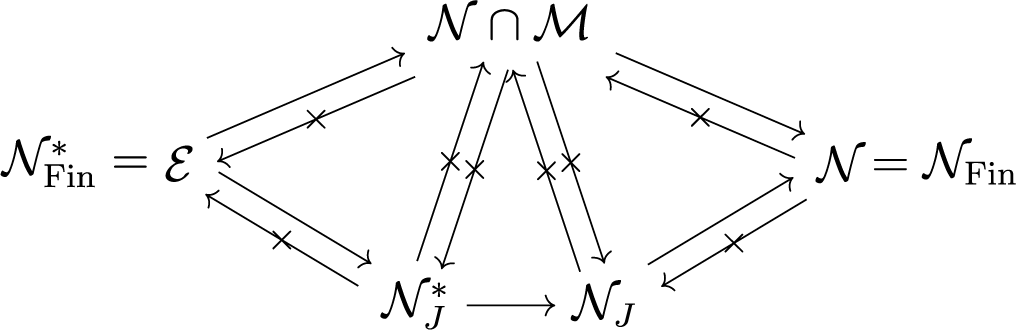
Figure 2 summarizes the situation in Theorems 3.7 and 3.11 when
 ${J}$
is a non-meager ideal on
 $\omega $
.
The situation when
 ${J}$
is an ideal on
 $\omega $
without the Baire property. An arrow denotes
 $\subseteq $
, while a crossed arrow denotes
 $\nsubseteq $
. The arrow on the bottom could be reversed, e.g., when
 ${J}$
is a maximal ideal.

4 The effect of nearly coherence of filters
In this section, we prove a characterization of nearly coherence of filters (or ideals) in terms of the ideals
 ${\mathcal {N}}_{J}$
and
 ${\mathcal {N}}^*_{J}$
. We first recall the notion of nearly coherence.
Definition 4.1 (A. Blass [Reference Blass7]).
Two filters
 ${F}_0$
and
 ${F}_1$
on
 $\omega $
are nearly coherent if there is a finite-to-one function
 $\varphi \in {}^\omega \omega $
such that
 $\varphi ^\to ({F}_0)\cup \varphi ^\to ({F}_1)$
has the finite intersection property. Dually, we say that two ideals
 ${J}_0$
and
 ${J}_1$
are nearly coherent if there is a finite-to-one function
 $\varphi \in {}^\omega \omega $
such that
 $\varphi ^\to ({J}_0)\cup \varphi ^\to ({J}_1)$
is contained in some ideal.
If
 $J_0$
and
 $J_1$
are nearly coherent ideals on
 $\omega $
, then there is some ideal K in
 $\omega $
which is
 ${\mathrel {\leq _{\overline {\mathrm {KB}}}}}$
-above both
 $J_0$
and
 $J_1$
. As a consequence of Theorem 2.15(b), the following result follows.
Lemma 4.2. If
 ${J}_0$
and
 ${J}_1$
are nearly coherent ideals on
 $\omega $
, then there is some ideal
 ${K}$
on
 $\omega $
such that
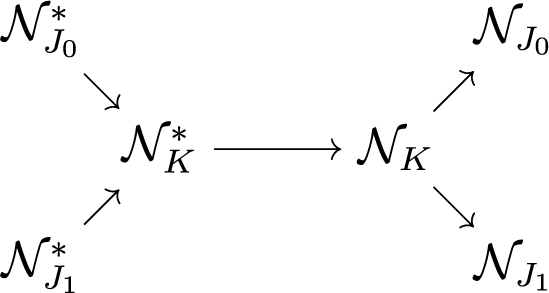
 ${\mathcal {N}}^*_{{J}_0}\cup {\mathcal {N}}^*_{{J}_1} \subseteq {\mathcal {N}}^*_{K}\subseteq {\mathcal {N}}_{K} \subseteq {\mathcal {N}}_{{J}_0}\cap {\mathcal {N}}_{{J}_1}$
(see Figure 3).
Situation describing Lemma 4.2 (an arrow denotes
 $\subseteq $
).

Since
 ${\mathcal {N}}^*_{J}={\mathcal {N}}_{J}$
for any maximal ideal
 ${J}$
on
 $\omega $
, we immediately obtain the following consequence.
Corollary 4.3. If
 ${J}$
and
 ${K}$
are nearly coherent ideals and
 ${K}$
is maximal, then
 ${\mathcal {N}}^*_{J}\subseteq {\mathcal {N}}_{K}\subseteq {\mathcal {N}}_{J}$
. In particular, if
 ${J}$
is also a maximal ideal, then
 ${\mathcal {N}}_{J}={\mathcal {N}}_{K}$
.
A. Blass [Reference Blass7] has introduced the following principle, which was proved consistent with ZFC by Blass and Shelah [Reference Blass and Shelah11].
-
(NCF) Near coherence of filters: Any pair of filters on
$\omega $
are nearly coherent.

In fact,
 $\mathfrak {u}<\mathfrak {g}$
(which holds in Miller model [Reference Blass8, Reference Blass and Shelah12]) implies NCF [Reference Blass9, Corollary 9.18]. On the other hand, it is possible to obtain not nearly coherence pairs of filters under CH and in random model [Reference Blass7, Section 4], as well as in Cohen model (e.g., Theorem 6.3).
The following is a consequence of Corollary 4.3.
Corollary 4.4.
NCF implies that all
 ${\mathcal {N}}_{J}$
with
 ${J}$
maximal ideal on
 $\omega $
are the same.
We prove the converse of Lemma 4.2 and of Corollaries 4.3 and 4.4, which gives us a characterization of nearly coherence and NCF. For this purpose, we use the following game, formulated by T. Eisworth, that characterizes nearly coherence.
Definition 4.5 (Eisworth [Reference Eisworth20]).
Let
 ${F}_0$
,
 ${F}_1$
be two filters on
 $\omega $
. The following game of length
 $\omega $
between two players is called the nearly coherence game
 $C_{{F}_0,{F}_1}$
:
-
• In the nth move, Player I plays a finite set
$A_n\in [\omega ]^{<\omega }$
and Player II responds with a finite set
$B_n\in [\omega ]^{<\omega }$
disjoint from
$A_n$
. -
• After
$\omega $
many moves, Player II wins if
$\bigcup {\left \{ {B_{2n+i}} :\, {n\in \omega } \right \}}\in {F}_i$
for
$i\in \{0,1\}$
. Otherwise, Player I wins.


Theorem 4.6 (Eisworth [Reference Eisworth20]).
Let
 ${F}_0$
,
 ${F}_1$
be two filters on
 $\omega $
. Then
 ${F}_0$
and
 ${F}_1$
are nearly coherent iff Player I has a winning strategy of the game
 $C_{{F}_0,{F}_1}$
.
We use the nearly coherence game
 $C_{{F}_0,{F}_1}$
to prove the following technical lemma.
Main Lemma 4.7. Let
 $C\subseteq {}^\omega 2$
be a closed self-supported set. If
 ${J}$
and
 ${K}$
are not nearly coherent ideals on
 $\omega $
then
 $N^*_{J}(\bar {c}^T)\notin {\mathcal {N}}_{K}$
where T is the tree without maximal nodes such that
 $C=[T]$
, and
 $\bar c^T$
is as in Definition 3.8.
Proof We use the nearly coherence game
 $C_{{J}^d,{K}^d}$
and build a strategy for Player I, in order to get an
 $x\in N^*_{J}(\bar {c}^T)\smallsetminus N_{K}(\bar {c}')$
for any
 $\bar {c}'\in {{\overline {\Omega }}}$
.
The first move: Player I first moves with
 $A_0=\{0\}$
, and put
 $s_0:= t_0$
(which is the empty sequence).
The second and third moves, and further:
After Player II replies with
 $B_0\subseteq \omega \smallsetminus A_0$
, Player I finds
 $s_1\supseteq s_0$
in T such that
 $s_1\supseteq t^n_0$
for every
 $n\in B_0$
, and further finds
 $n_1\geq |s_1|$
such that
 $\mu \left (\bigcup _{\ell \geq n_1}c^{\prime }_\ell \right )<\mu (C\cap [s_1])$
, which implies that there is some
 $x_1\in C\cap [s_1]\smallsetminus \bigcup _{\ell \geq n_1}c^{\prime }_\ell $
. Player I moves with
 $A_1=n_1+1$
.
After Player II replies with
 $B_1\subseteq \omega \smallsetminus A_1$
, Player I finds some
 $m_2\geq n_1$
such that
 $[s_2]\cap \bigcup _{n\in B_1}c^{\prime }_n=\emptyset $
where
 $s_2:=x_1{\upharpoonright }m_2$
. Player I moves
 $A_2=n_2+1$
where
 $n_2<\omega $
is such that
 $s_2=t_{n_2}$
.
Afterwards, Player II moves with
 $B_2\subseteq \omega \smallsetminus A_2$
, and the same dynamic is repeated: Player I finds an
 $s_3\supseteq s_2$
in T such that
 $s_3\supseteq t^n_{n_2}$
for every
 $n\in B_2$
, and some
 $n_3\geq |s_3|$
such that
 $\mu \left ( \bigcup _{\ell \geq n_3} c^{\prime }_\ell \right )<\mu (C\cap [s_3])$
, which implies that there is an
 $x_3\in C\cap [s_3]\smallsetminus \bigcup _{\ell \geq n_3}c^{\prime }_\ell $
. Player I moves with
 $A_3=n_3+1$
, and the game continues as described so far.
Since Player I does not have a winning strategy, there is some run as described above where Player II wins. Thus,
 $F_0:=\bigcup _{n\in \omega }B_{2n}\in {J}^d$
and
 $F_1:=\bigcup _{n\in \omega }B_{2n+1}\in {K}^d$
. Set
 $x:=\bigcup _{n\in \omega }s_n$
. Note that
 $x\in c^T_\ell $
for any
 $\ell \in F_0$
, and
 $x\notin c^{\prime }_\ell $
for any
 $\ell \in F_1$
, which means that
 $x\in N^*_{J}(\bar {c}^T)$
and
 $x\notin N_{K}(\bar {c}')$
.
An application of the previous result to
 $C={{}^\omega 2}$
yields the following distinction.
Theorem 4.8. If
 ${J}$
and
 ${K}$
are not near-coherent ideals on
 $\omega $
then
 ${\mathcal {N}}^*_{J}\nsubseteq {\mathcal {N}}_{K}$
and
 ${\mathcal {N}}^*_{K}\nsubseteq {\mathcal {N}}_{J}$
. In particular,
 ${\mathcal {N}_{{K}}}\neq {\mathcal {N}_{J}}$
and
 ${\mathcal {N}}^*_{J}\neq {\mathcal {N}}^*_{K}$
.
It is clear that
 ${\mathrm {Fin}}$
is nearly coherent with any filter on
 $\omega $
. Therefore, any pair of not nearly coherent filters must be non-meager. The following is a consequence of Theorems 3.7 and 3.11.
Corollary 4.9. Let
 ${J}$
and
 ${K}$
be not nearly coherent ideals on
 $\omega $
. Then the ideals
 $\mathcal {E}$
,
 ${\mathcal {N}^*_{J}}$
,
 ${\mathcal {N}_{{K}}}$
and
 $\mathcal {N}$
are pairwise different.
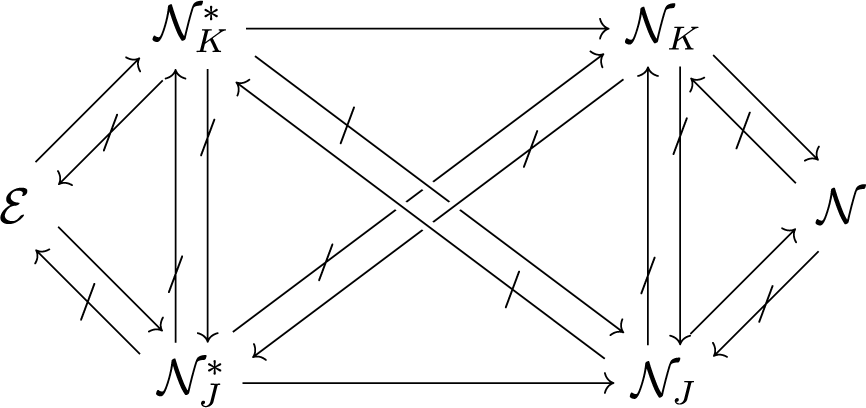
The situation in Theorem 4.8 and Corollary 4.9 is illustrated in Figure 4.
Diagram corresponding to the situation in Theorem 4.8 where
 ${J}$
and
 ${K}$
are not nearly coherent ideals on
 $\omega $
. An arrow denotes
 $\subseteq $
, and a crossed arrow denotes
 $\nsubseteq $
. The arrow on the top could be reversed, e.g., when
 ${K}$
is a maximal ideal (likewise for the arrow on the bottom).

We summarize our results as a characterization of nearly coherence.
Theorem 4.10. Let J and K be ideals on
 $\omega $
. The following statements are equivalent.
-
(i) J and K are nearly coherent.
-
(ii) There is some ideal
$K'$
on
$\omega $
such that
$J {\mathrel {\leq _{\overline {\mathrm {KB}}}}} K'$
and
$K{\mathrel {\leq _{\overline {\mathrm {KB}}}}} K'$
. -
(iii) There is some ideal
$K'$
on
$\omega $
such that
${\mathcal {N}}^*_J\cup {\mathcal {N}}^*_{K}\subseteq {\mathcal {N}}^*_{K'}\subseteq {\mathcal {N}}_{K'}\subseteq {\mathcal {N}}_J \cap {\mathcal {N}}_K$
. -
(iv)
${\mathcal {N}}^*_J\subseteq {\mathcal {N}}_K$
.


Proof
 $\mathrm{(i)}\mathrel {\Rightarrow } \mathrm{(ii)}$
is obvious;
 $\mathrm{(ii)}\mathrel {\Rightarrow } \mathrm{(iii)}$
is immediate from Theorem 2.15;
 $\mathrm{(iii)}\mathrel {\Rightarrow }\mathrm{(iv)}$
is obvious; and
 $\mathrm{(iv)}\mathrel {\Rightarrow } \mathrm{(i)}$
follows by (the contrapositive of) Theorem 4.8.
The non-nearly coherence of filters also gives us examples of non-meager ideals J such that
 ${\mathcal {N}}^*_J\neq {\mathcal {N}}_J$
. We do not know how to construct such an example in ZFC.
Lemma 4.11. Assume that
 $J_1$
and
 $J_2$
are non-nearly coherent ideals on
 $\omega $
. Then
 $J_1\oplus J_2$
is non-meager and
 ${\mathcal {N}}^*_{J_1\oplus J_2}\neq {\mathcal {N}}_{J_1\oplus J_2}$
.
Proof Partition
 $\omega ={\mathbb {N}}_1\cup {\mathbb {N}}_2$
into two infinite sets, let
 $g_e\colon \omega \to {\mathbb {N}}_e$
be a bijection for each
 $e\in \{1,2\}$
, and let
 $J^{\prime }_e= g_e^\to (J_e)$
, which is an ideal on
 ${\mathbb {N}}_e$
isomorphic with
 $J_e$
. Here, our interpretation of
 $J_1\oplus J_2$
is
 $J^{\prime }_1\oplus J^{\prime }_2$
. It is clear that
 ${\mathcal {N}}_{J^{\prime }_1}={\mathcal {N}}_{J_1}$
and
 ${\mathcal {N}}^*_{J^{\prime }_1}={\mathcal {N}}^*_{J_1}$
(by Theorem 2.15(c)).
Recall that non-nearly coherent ideals must be non-meager (this also follows by Theorem 4.8), so
 $J^{\prime }_1\times J^{\prime }_2$
is a non-meager subset of
 ${{}^\omega 2}= {}^{{\mathbb {N}}_1}2 \times {}^{{\mathbb {N}}_2}2$
by Kuratowski–Ulam Theorem, which implies that
 $J^{\prime }_1\oplus J^{\prime }_2$
is non-meager.
By Example 2.13,
 ${\mathcal {N}}^*_{J^{\prime }_1\oplus J^{\prime }_2}={\mathcal {N}}^*_{J^{\prime }_1}\cap {\mathcal {N}}^*_{J^{\prime }_2} = {\mathcal {N}}^*_{J_1}\cap {\mathcal {N}}^*_{J_2}$
and
 ${\mathcal {N}}_{J^{\prime }_1 \oplus J^{\prime }_2}$
contains both
 ${\mathcal {N}}_{J_1}$
and
 ${\mathcal {N}}_{J_2}$
, so
 ${\mathcal {N}}^*_{J^{\prime }_1\oplus J^{\prime }_2}= {\mathcal {N}}_{J^{\prime }_1\oplus J^{\prime }_2}$
would imply that
 ${\mathcal {N}}_{J_1}\cup {\mathcal {N}}_{J_2}\subseteq {\mathcal {N}}^*_{J_1}\cap {\mathcal {N}}^*_{J_2}$
, and in turn
 ${\mathcal {N}}_{J_2}\subseteq {\mathcal {N}}^*_{J_1}$
, which implies
 ${\mathcal {N}}^*_{J_2}\subseteq {\mathcal {N}}_{J_1}$
(because
 ${\mathcal {N}}^*_{J_e}\subseteq {\mathcal {N}}_{J_e}$
), contradicting Theorem 4.10 and the fact that
 $J_1$
and
 $J_2$
are not nearly-coherent. Therefore,
 ${\mathcal {N}}^*_{J^{\prime }_1\oplus J^{\prime }_2}\neq {\mathcal {N}}_{J^{\prime }_1\oplus J^{\prime }_2}$
In contrast with the previous result, we do not know whether NCF implies that all
 ${\mathcal {N}}_J$
are the same for non-meager J.
5 Cardinal characteristics
In this section, we focus on investigating the cardinal characteristics associated with
 ${\mathcal {N}}_J$
and
 ${\mathcal {N}}^*_J$
.
We review some basic notation about cardinal characteristics. Many cardinal characteristics are defined using relational systems in the following way [Reference Vojtáš45]. A relational system is a triplet
 ${\mathbf {R}}=\langle X,Y,R\rangle $
where R is a relation and X and Y are non-empty sets.Footnote
6
Define
 $$ \begin{align*} {\mathfrak{b}}({\mathbf{R}}) & :=\min{\left\{ |F| :\, F\subseteq X,\ \neg\,(\exists\, y\in Y)\ (\forall\, x\in F)\ x\, R\, y \right\}},\\ {\mathfrak{d}}({\mathbf{R}}) & :=\min{\left\{ |D| :\, D\subseteq Y,\ (\forall\, x\in X)\ (\exists\, y\in D)\ x\, R\, y \right\}}. \end{align*} $$
The dual of
 ${\mathbf {R}}$
is defined by
 ${\mathbf {R}}^\perp :=\langle Y,X,R^\perp \rangle $
where
 $y\, R^\perp \, x$
iff
 $\neg \, x\, R\, y$
. Hence
 ${\mathfrak {b}}({\mathbf {R}}^\perp )={\mathfrak {d}}({\mathbf {R}})$
and
 ${\mathfrak {d}}({\mathbf {R}}^\perp )={\mathfrak {b}}({\mathbf {R}})$
.
Given another relational system
 ${\mathbf {R}}'=\langle X', Y', R'\rangle $
, say that a pair
 $(\varphi _-,\varphi _+)$
is a Tukey connection from
 ${\mathbf {R}}$
to
 ${\mathbf {R}}'$
if
 $\varphi _-:X\to X'$
,
 $\varphi _+:Y'\to Y$
and, for any
 $x\in X$
and
 $y'\in Y'$
, if
 $\varphi _-(x)\, R'\, y'$
then
 $x\, R\, \varphi _+(y')$
.
We say that
 ${\mathbf {R}}$
is Tukey below
 ${\mathbf {R}}'$
, denoted by
 ${\mathbf {R}}{\mathrel {\preceq _{\mathrm {T}}}}{\mathbf {R}}'$
, if there is a Tukey connection from
 ${\mathbf {R}}$
to
 ${\mathbf {R}}'$
. Say that
 ${\mathbf {R}}$
is Tukey equivalent to
 ${\mathbf {R}}'$
, denoted by
 ${\mathbf {R}}{\mathrel {\cong _{\mathrm {T}}}}{\mathbf {R}}'$
, if
 ${\mathbf {R}}{\mathrel {\preceq _{\mathrm {T}}}}{\mathbf {R}}'$
and
 ${\mathbf {R}}'{\mathrel {\preceq _{\mathrm {T}}}}{\mathbf {R}}$
. It is known that
 ${\mathbf {R}}{\mathrel {\preceq _{\mathrm {T}}}}{\mathbf {R}}'$
implies
 ${\mathfrak {d}}({\mathbf {R}})\leq {\mathfrak {d}}({\mathbf {R}}')$
and
 ${\mathfrak {b}}({\mathbf {R}}')\leq {\mathfrak {b}}({\mathbf {R}})$
. Hence
 ${\mathbf {R}}{\mathrel {\cong _{\mathrm {T}}}}{\mathbf {R}}'$
implies
 ${\mathfrak {d}}({\mathbf {R}})={\mathfrak {d}}({\mathbf {R}}')$
and
 ${\mathfrak {b}}({\mathbf {R}}')={\mathfrak {b}}({\mathbf {R}})$
.
We constantly use the relational system
 ${\mathbf {c}}^{\mathcal {J}}_{\mathcal {I}}:=\langle {\mathcal {I}},{\mathcal {J}},\subseteq \rangle $
discussed in [Reference Bartoszyński and Judah4, Chapter 2], and we identify
 ${\mathcal {I}}$
with the relational system
 ${\mathbf {c}}^{\mathcal {I}}_{\mathcal {I}}$
. Denote
 ${\mathrm {add}}({\mathcal {I}},{\mathcal {J}}):={\mathfrak {b}}({\mathbf {c}}^{\mathcal {J}}_{\mathcal {I}})$
and
 ${\mathrm {cof}}({\mathcal {I}},{\mathcal {J}}):={\mathfrak {d}}({\mathbf {c}}^{\mathcal {J}}_{\mathcal {I}})$
. These cardinal characteristics are interesting when
 ${\mathcal {I}}\subseteq {\mathcal {J}}$
are ideals on some set X. It is well-known that, for any ideal
 ${\mathcal {I}}$
on X, we can express the cardinal characteristics associated with
 ${\mathcal {I}}$
as follows:
 $$ \begin{align*} {\mathrm{add}}({\mathcal{I}})& ={\mathrm{add}}({\mathcal{I}},{\mathcal{I}}), & {\mathrm{cof}}({\mathcal{I}}) &={\mathrm{cof}}({\mathcal{I}},{\mathcal{I}}),\\ {\mathrm{non}}({\mathcal{I}})& ={\mathrm{add}}([X]^{<\aleph_0},{\mathcal{I}}), & {\mathrm{cov}}({\mathcal{I}})& ={\mathrm{cof}}([X]^{<\aleph_0},{\mathcal{I}}). \end{align*} $$
In fact, via the relational system
 ${\mathbf {C}}_{\mathcal {I}}:=\langle X,{\mathcal {I}},\in \rangle $
, we obtain
 ${\mathrm {non}}({\mathcal {I}})={\mathfrak {b}}({\mathbf {C}}_{\mathcal {I}})$
and
 ${\mathrm {cov}}({\mathcal {I}})={\mathfrak {d}}({\mathbf {C}}_{\mathcal {I}})$
. The following easy claims illustrate basic relations between these cardinal characteristics.
Fact 5.1. If
 ${\mathcal {I}}$
is an ideal on X,
 ${\mathcal {I}}\subseteq {\mathcal {I}}'$
and
 ${\mathcal {J}}\subseteq {\mathcal {P}}(X)\smallsetminus \{X\}$
, then
 $({\mathbf {c}}_{{\mathcal {I}}'}^{\mathcal {J}})^\perp\ {\mathrel {\preceq _{\mathrm {T}}}} {\mathbf {C}}_{\mathcal {I}}{\mathrel {\preceq _{\mathrm {T}}}}{\mathbf {c}}_{[X]^{<\aleph _0}}^{\mathcal {I}}$
. In particular,
 ${\mathrm {add}}({\mathcal {I}}',{\mathcal {J}})\leq {\mathrm {cov}}({\mathcal {I}})$
and
 ${\mathrm {non}}({\mathcal {I}})\leq {\mathrm {cof}}({\mathcal {I}}',{\mathcal {J}})$
.
Proof We only show the first Tukey connection. Define
 $F\colon {\mathcal {J}}\to X$
such that
 $F(B)\in X\smallsetminus B$
(which exists because
 $X\notin {\mathcal {J}}$
), and define
 $G\colon {\mathcal {I}}\to {\mathcal {I}}'$
by
 $G(A):=A$
. Then, for
 $A\in {\mathcal {I}}$
and
 $B\in {\mathcal {J}}$
,
 $F(B)\in A$
implies
 $B\nsupseteq A$
. Hence,
 $(F,G)$
witnesses
 $({\mathbf {c}}_{{\mathcal {I}}'}^{\mathcal {J}})^\perp\ {\mathrel {\preceq _{\mathrm {T}}}}\ {\mathbf {C}}_{\mathcal {I}}$
.
Fact 5.2. If
 ${\mathcal {I}}\subseteq {\mathcal {I}}'$
and
 ${\mathcal {J}}'\subseteq {\mathcal {J}}$
then
 ${\mathbf {c}}^{\mathcal {J}}_{\mathcal {I}}{\mathrel {\preceq _{\mathrm {T}}}} {\mathbf {c}}^{{\mathcal {J}}'}_{{\mathcal {I}}'}$
. In particular,
 ${\mathrm {add}}({\mathcal {I}}',{\mathcal {J}}')\leq {\mathrm {add}}({\mathcal {I}},{\mathcal {J}})$
and
 ${\mathrm {cof}}({\mathcal {I}},{\mathcal {J}})\leq {\mathrm {cof}}({\mathcal {I}}',{\mathcal {J}}')$
.
Corollary 5.3. If
 ${\mathcal {J}}'\subseteq {\mathcal {J}}$
are ideals on X, then
 ${\mathbf {c}}^{{\mathcal {J}}}_{[X]^{<\aleph _0}} {\mathrel {\preceq _{\mathrm {T}}}} {\mathbf {c}}^{{\mathcal {J}}'}_{[X]^{<\aleph _0}}$
and
 ${\mathbf {C}}_{{\mathcal {J}}}\ {\mathrel {\preceq _{\mathrm {T}}}}\ {\mathbf {C}}_{{\mathcal {J}}'}$
. In particular,
 ${\mathrm {cov}}({\mathcal {J}})\leq {\mathrm {cov}}({\mathcal {J}}')$
and
 ${\mathrm {non}}({\mathcal {J}}')\leq {\mathrm {non}}({\mathcal {J}})$
.
We look at the cardinal characteristics associated with
 ${\mathcal {N}}_J$
and
 ${\mathcal {N}}^*_J$
when J is an ideal on
 $\omega $
. If
 ${J}$
has the Baire property then the cardinal characteristics associated with
 $\mathcal {N}_{J}$
equal to those associated with
 $\mathcal {N}$
because
 ${\mathcal {N}}_J={\mathcal {N}}$
(Theorem 2.18). Moreover, since
 ${\mathcal {N}}^*_J={\mathcal {E}}$
, the cardinal characteristics associated with
 ${\mathcal {N}^*_{J}}$
equal to those associated with
 $\mathcal {E}$
. We recall below some results about the cardinal characteristics associated with
 ${\mathcal {E}}$
.
Theorem 5.4 ([Reference Bartoszyński and Shelah6], see also [Reference Bartoszyński and Judah4, Section 2.6]).
-
(a)
$\min \{{\mathfrak {b}},{\mathrm {non}}({\mathcal {N}})\} \leq {\mathrm {non}}({\mathcal {E}})\leq \min \{{\mathrm {non}}({\mathcal {M}}),{\mathrm {non}}({\mathcal {N}})\}$
. -
(b)
$\max \{{\mathrm {cov}}({\mathcal {M}}),{\mathrm {cov}}({\mathcal {N}})\}\leq {\mathrm {cov}}({\mathcal {E}}) \leq \max \{{\mathfrak {d}},{\mathrm {cov}}({\mathcal {N}})\}$
. -
(c)
${\mathrm {add}}({\mathcal {E}},{\mathcal {N}})={\mathrm {cov}}({\mathcal {M}})$
and
${\mathrm {cof}}({\mathcal {E}},{\mathcal {N}})={\mathrm {non}}({\mathcal {M}})$
. -
(d)
${\mathrm {add}}({\mathcal {E}})={\mathrm {add}}({\mathcal {M}})$
and
${\mathrm {cof}}({\mathcal {E}})={\mathrm {cof}}({\mathcal {M}})$
.


Theorem 5.5 [Reference Bartoszyński and Judah4, Lemma 7.4.3].
 ${\mathfrak {s}}\leq {\mathrm {non}}({\mathcal {E}})$
and
 ${\mathrm {cov}}({\mathcal {E}})\leq {\mathfrak {r}}$
.
Thanks to the previous results, and the fact that
 ${\mathcal {E}}\subseteq {\mathcal {N}^*_{J}}\subseteq {\mathcal {N}_{J}}\subseteq \mathcal {N}$
, the inequalities below immediately follow.
Theorem 5.6.
 $\mathrm {ZFC}$
proves
 $$ \begin{align*}\begin{array}{c@{\ \ \,}c@{\ \ \,}c@{\ \ \,}c@{\ \ \,}c@{\ \ \,}c@{\ \ \ }c@{\ \ \ }c@{\ \ \ }c} {\mathrm{cov}}({\mathcal{N}}) &\leq & {\mathrm{cov}}({\mathcal{N}}_J) & \leq & {\mathrm{cov}}({\mathcal{N}}^*_J) &\leq & {\mathrm{cov}}({\mathcal{E}}) &\leq & \min\{{\mathrm{cof}}({\mathcal{M}}),{\mathfrak{r}}\},\\ \max\{{\mathrm{add}}({\mathcal{M}}), {\mathfrak{s}}\} &\leq & {\mathrm{non}}({\mathcal{E}}) &\leq & {\mathrm{non}}({\mathcal{N}}^*_J) &\leq & {\mathrm{non}}({\mathcal{N}_{J}}) &\leq & {\mathrm{non}}(\mathcal{N}). \end{array}\end{align*} $$
We now turn to the additivity and cofinality numbers. In the case of
 $J={\mathrm {Fin}}$
, we can characterize
 ${\mathrm {add}}({\mathcal {N}})$
and
 ${\mathrm {cof}}({\mathcal {N}})$
using slaloms.
Definition 5.7. Let
 $b=\langle b(n):\, n<\omega \rangle $
be a sequence of non-empty sets, and let
 $h\in {{}^\omega \omega }$
. Denote
 $$ \begin{align*} \prod b & := \prod_{n<\omega}b(n),\\ {S}(b,h) & := \prod_{n<\omega}[b(n)]^{\leq h(n)}. \end{align*} $$
Define the relational system
 ${\mathbf {Lc}}(b,h):=\langle \prod b, {S}(b,h), \in ^*\rangle $
where
 $$ \begin{align*}x\in ^* y \mbox{ iff }{\left\{ n<\omega :\, x(n)\notin y(n) \right\}} \mbox{ is finite}.\end{align*} $$
Denote
 $\mathfrak {b}^{\mathrm {Lc}}_{b,h}:={\mathfrak {b}}({\mathbf {Lc}}(b,h))$
and
 $\mathfrak {d}^{\mathrm {Lc}}_{b,h}:={\mathfrak {d}}({\mathbf {Lc}}(b,h))$
.
When b is the constant sequence
 $\omega $
, we use the notation
 ${\mathbf {Lc}}(\omega ,h)$
and denote its associated cardinal characteristics by
 $\mathfrak {b}^{\mathrm {Lc}}_{\omega ,h}$
and
 $\mathfrak {d}^{\mathrm {Lc}}_{\omega ,h}$
.
Theorem 5.8 (Bartoszyński [Reference Bartoszyński2, Reference Bartoszynski3]).
Assume that
 $h\in {{}^\omega \omega }$
diverges to infinity. Then,
 ${\mathbf {Lc}}(b,h){\mathrel {\cong _{\mathrm {T}}}} {\mathcal {N}}$
. In particular,
 $\mathfrak {b}^{\mathrm {Lc}}_{\omega ,h}={\mathrm {add}}({\mathcal {N}})$
and
 $\mathfrak {d}^{\mathrm {Lc}}_{\omega ,h}={\mathrm {cof}}({\mathcal {N}})$
.
We propose the following relational system, which is practical to find bounds for the additivity and cofinality of
 ${\mathcal {N}}_J$
and
 ${\mathcal {N}}^*_J$
.
Definition 5.9. Let J be an ideal on
 $\omega $
. For
 $c,d\in {{\overline {\Omega }}}$
, define the relation
 $$ \begin{align*}c\subseteq^J d \mbox{ iff }{\left\{ n<\omega :\, c_n\nsubseteq d_n \right\}}\in J.\end{align*} $$
Define the relational system
 ${\mathbf {S}}_J:=\langle {{\overline {\Omega }}}, {{\overline {\Omega }}}, \subseteq ^J\rangle $
, and denote
 ${\mathfrak {b}}_J({{\overline {\Omega }}}):={\mathfrak {b}}({\mathbf {S}}_J)$
and
 ${\mathfrak {d}}_J({{\overline {\Omega }}}):={\mathfrak {d}}({\mathbf {S}}_J)$
.
It is clear that
 ${\mathfrak {b}}_J({{\overline {\Omega }}})$
is regular and
 ${\mathfrak {b}}_J({{\overline {\Omega }}})\leq {\mathrm {cf}}({\mathfrak {d}}_J({{\overline {\Omega }}}))\leq {\mathfrak {d}}_J({{\overline {\Omega }}})$
.
Theorem 5.10. Let J be an ideal on
 $\omega $
. Then
 ${\mathcal {N}}_J{\mathrel {\preceq _{\mathrm {T}}}} {\mathbf {S}}_J$
and
 ${\mathcal {N}}^*_J{\mathrel {\preceq _{\mathrm {T}}}} {\mathbf {S}}_J$
. In particular, the additivities and cofinalities of
 ${\mathcal {N}}_J$
and
 ${\mathcal {N}}^*_J$
are between
 ${\mathfrak {b}}_J({{\overline {\Omega }}})$
and
 ${\mathfrak {d}}_J({{\overline {\Omega }}})$
(see Figure 5).
Diagram of inequalities between the cardinal characteristics associated with
 ${\mathbf {S}}_J$
, and the additivities and cofinalities of
 ${\mathcal {N}}_J$
and
 ${\mathcal {N}}^*_J$
.

Proof Define
 $F\colon {\mathcal {N}}_J\to {{\overline {\Omega }}}$
such that
 $X\subseteq N_J(F(X))$
for any
 $X\in {\mathcal {N}}_J$
, and define
 $G\colon {{\overline {\Omega }}} \to {\mathcal {N}}_J$
by
 $G(\bar d):=N_J(\bar d)$
for any
 $\bar d\in {{\overline {\Omega }}}$
. It is clear that
 $(F,G)$
is a Tukey connection from
 ${\mathcal {N}}_J$
into
 ${\mathbf {S}}_J$
, because
 $\bar c\subseteq ^J \bar d$
implies
 $N_J(\bar c)\subseteq N_J(\bar d)$
.
Similarly, we obtain a Tukey connection from
 ${\mathcal {N}}^*_J$
into
 ${\mathbf {S}}_J$
via functions
 $F^*\colon {\mathcal {N}}^*_J\to {{\overline {\Omega }}}$
and
 $G^*\colon {{\overline {\Omega }}} \to {\mathcal {N}}_J$
such that
 $X\subseteq N^*_J(F^*(X))$
for
 $X\in {\mathcal {N}}^*_J$
and
 $G^*(\bar d):= N^*_J(\bar d)$
.
Analogous to Theorem 2.15, we have the following result about
 ${\mathbf {S}}_J$
.
Theorem 5.11. Let J and K be ideals on
 $\omega $
.
-
(a) If
$K{\mathrel {\leq _{\mathrm {KB}}}} J$
, then
${\mathbf {S}}_J{\mathrel {\preceq _{\mathrm {T}}}} {\mathbf {S}}_K$
, in particular
${\mathfrak {b}}_K({{\overline {\Omega }}})\leq {\mathfrak {b}}_J({{\overline {\Omega }}})$
and
${\mathfrak {d}}_J({{\overline {\Omega }}})\leq {\mathfrak {d}}_K({{\overline {\Omega }}})$
. -
(b) If
$K {\mathrel {\leq _{\overline {\mathrm {KB}}}}} J$
, then
${\mathbf {S}}_J{\mathrel {\preceq _{\mathrm {T}}}} {\mathbf {S}}_K$
, in particular
${\mathfrak {b}}_K({{\overline {\Omega }}})\leq {\mathfrak {b}}_J({{\overline {\Omega }}})$
and
${\mathfrak {d}}_J({{\overline {\Omega }}})\leq {\mathfrak {d}}_K({{\overline {\Omega }}})$
. -
(c) If
$K {\mathrel {\leq _{\mathrm {RB}}}} J$
, then
${\mathbf {S}}_K{\mathrel {\cong _{\mathrm {T}}}} {\mathbf {S}}_J$
, in particular
${\mathfrak {b}}_K({{\overline {\Omega }}}) ={\mathfrak {b}}_J({{\overline {\Omega }}})$
and
${\mathfrak {d}}_K({{\overline {\Omega }}}) = {\mathfrak {d}}_J({{\overline {\Omega }}})$
.


Proof It is clear that (c) follows from (a) and (b).
Let
 $f\colon \omega \to \omega $
be a finite-to-one function and denote
 $I_n:=f^{-1}[\{n\}]$
. Like in the proof of Theorem 2.15, define
 $F'\colon {{\overline {\Omega }}}\to {{\overline {\Omega }}}$
by
 $F'(\bar c):=\bar c'$
where
 $c^{\prime }_n:=\bigcup _{k\in I_n}c_k$
, and define
 $F^-\colon {{\overline {\Omega }}}\to {{\overline {\Omega }}}$
by
 $F^-(\bar c):=\bar c^-$
where
 $c^-_k:=c_{f(k)}$
.
If
 $K\subseteq f^{\to }(J)$
then
 $(F',F^-)$
is a Tukey connection from
 ${\mathbf {S}}_J$
into
 ${\mathbf {S}}_K$
, which shows (a). To prove this, assume
 $\bar c,\bar d\in {{\overline {\Omega }}}$
and
 $\bar c'\subseteq ^K \bar d$
, and we show
 $\bar c \subseteq ^J \bar d^-$
. The hypothesis indicates that
 ${\left \{ n<\omega :\, c^{\prime }_n\subseteq d_n \right \}}\in K^d$
, which implies that
 ${\left \{ {k<\omega } :\, {c^{\prime }_{f(k)}\subseteq d_{f(k)}} \right \}}\in J^d$
. Since
 $c_k\subseteq c^{\prime }_{f(k)}$
, the previous set is contained in
 ${\left \{ k<\omega :\, c_k\subseteq d^-_k \right \}}$
, so
 $\bar c \subseteq ^J \bar d^-$
.
To show (b), we verify that, whenever
 $f^\to (K)\subseteq J$
,
 $(F^-,F')$
is a Tukey connection from
 ${\mathbf {S}}_J$
into
 ${\mathbf {S}}_K$
. Let
 $\bar c,\bar d\in {{\overline {\Omega }}}$
and assume that
 $\bar c^-\subseteq ^K \bar d$
, i.e.,
 ${\left \{ {k<\omega } :\, {c_{f(k)}\subseteq d_k} \right \}}\in K^d$
. Since
 $d_k\subseteq d^{\prime }_{f(k)}$
, this set is contained in
 ${\left \{ {k<\omega } :\, {c_{f(k)}\subseteq d^{\prime }_{f(k)}} \right \}}$
, so
 ${\left \{ n<\omega :\, c_n\subseteq d^{\prime }_n \right \}}\in J^d$
, i.e.,
 $\bar c\subseteq ^J \bar d'$
.
In the case
 $J={\mathrm {Fin}}$
, we obtain the following characterization of the additivity and cofinality of
 ${\mathcal {N}}$
.
Theorem 5.12.
 ${\mathfrak {b}}_{\mathrm {Fin}}({{\overline {\Omega }}})={\mathrm {add}}({\mathcal {N}})$
and
 ${\mathfrak {d}}_{\mathrm {Fin}}({{\overline {\Omega }}})={\mathrm {cof}}({\mathcal {N}})$
.
Proof Note that
 ${\mathcal {N}}={\mathcal {N}}_{\mathrm {Fin}}{\mathrel {\preceq _{\mathrm {T}}}} {\mathbf {S}}_{\mathrm {Fin}}$
by Theorem 5.10, so
 ${\mathfrak {b}}_{\mathrm {Fin}}({{\overline {\Omega }}})\leq {\mathrm {add}}({\mathcal {N}})$
and
 ${\mathrm {cof}}({\mathcal {N}})\leq {\mathfrak {d}}_{\mathrm {Fin}}({{\overline {\Omega }}})$
.
We show the converse inequality for
 ${\mathrm {add}}({\mathcal {N}})$
. It is enough to prove that, whenever
 $F\subseteq {{\overline {\Omega }}}$
has size
 ${<}{\mathrm {add}}({\mathcal {N}})$
, it has some upper
 $\subseteq ^{\mathrm {Fin}}$
-bound. For each
 $\bar c\in F$
, find a function
 $f^{\bar c}\in {{}^\omega \omega }$
such that
 $\mu \big (\bigcup _{k\geq f^{\bar c}(n)}c_k\big )<\frac {1}{(n+1)2^n}$
for all
 $n<\omega $
. Now
 $|F|<{\mathrm {add}}({\mathcal {N}})\leq {\mathfrak {b}}$
, so there is some increasing
 $f\in {{}^\omega \omega }$
with
 $f(0)=0$
dominating
 ${\left \{ f^{\bar c} :\, \bar c\in F \right \}}$
, which means that, for any
 $\bar c\in F$
,
 $\mu \big (\bigcup _{k\geq f(n)}c_k\big )<\frac {1}{(n+1)2^n}$
for all but finitely many
 $n<\omega $
. By making finitely many modifications to each
 $\bar c\in F$
, we can assume that the previous inequality is valid for all
 $n<\omega $
.
For each
 $n<\omega $
, let
 $I_n:=[f(n),f(n+1))$
. Consider the functions
 $b^f$
and h with domain
 $\omega $
such that
 $b^f(n){\kern-1pt}:={\kern-1pt}{\left \{ {s\in {}^{I_n}\Omega } :\, {\mu \left ( \bigcup _{k\in I_n}s_k\right ){\kern-1pt}<{\kern-1pt}\frac {1}{(n+1)2^n}} \right \}}$
and
 $h(n){\kern-1pt}:={\kern-1pt}n+1$
. Since
 ${\mathbf {Lc}}(b^f,h){\mathrel {\cong _{\mathrm {T}}}} {\mathbf {Lc}}(\omega ,h){\mathrel {\cong _{\mathrm {T}}}} {\mathcal {N}}$
, we obtain that
 $\mathfrak {b}^{\mathrm {Lc}}_{b^f,h}={\mathrm {add}}({\mathcal {N}})$
by Theorem 5.8. Since F can be seen as a subset of
 $\prod b^f$
, there is some
 $\varphi \in {S}(b^f,h)$
such that, for any
 $\bar c\in F$
,
 $\bar c\upharpoonright I_n\in \varphi (n)$
for all but finitely many
 $n<\omega $
. Define
 $\bar d\in {}^\omega \Omega $
by
 $d_k:=\bigcup _{s\in \varphi (n)}s_k$
for
 $k\in I_n$
. Note that
 $$ \begin{align*}\mu\left(\bigcup_{k\in I_n}d_k\right) = \mu\left( \bigcup_{s\in\varphi(n)} \bigcup_{k\in I_n}s_k\right)<\frac{1}{(n+1)2^n}(n+1)=\frac{1}{2^n},\end{align*} $$
thus
 $\bar d\in {{\overline {\Omega }}}$
. On the other hand, for any
 $\bar c\in F$
,
 $c_k\subseteq d_k$
for all but finitely many
 $k<\omega $
, i.e.,
 $\bar c\subseteq ^{\mathrm {Fin}} \bar d$
.
The proof of
 ${\mathfrak {d}}_{\mathrm {Fin}}({{\overline {\Omega }}})\leq {\mathrm {cof}}({\mathcal {N}})$
is similar. Fix a dominating family D of size
 ${\mathfrak {d}}$
formed by increasing functions f such that
 $f(0)=0$
. For each
 $f\in D$
, note that
 $\mathfrak {d}^{\mathrm {Lc}}_{b^f,h}={\mathrm {cof}}({\mathcal {N}})$
by Theorem 5.8, so we can choose some witness
 $S^f\subseteq {S}(b^f,h)$
and, for each
 $\varphi \in S^f$
, define
 $d^{f,\varphi }_k:=\bigcup _{s\in \varphi (n)}s_k$
for
 $k\in [f(n),f(n+1))$
. Then,
 $E:={\left \{ \bar d^{f,\varphi } :\, \varphi ^f\in S^f,\ f\in D \right \}}$
has size
 ${\leq }{\mathrm {cof}}({\mathcal {N}})$
and it is
 ${\mathbf {S}}_{\mathrm {Fin}}$
-dominating, i.e., any
 $\bar c\in {{\overline {\Omega }}}$
is
 $\subseteq ^{\mathrm {Fin}}$
-bounded by some
 $\bar d\in E$
.
Corollary 5.13. The additivities of
 ${\mathcal {N}}_J$
and
 ${\mathcal {N}}^*_J$
are between
 ${\mathrm {add}}({\mathcal {N}})$
and
 ${\mathrm {cov}}({\mathcal {M}})$
(at the bottom of Cichoń’s diagram)
 $;$
the cofinalities of
 ${\mathcal {N}}_J$
and
 ${\mathcal {N}}^*_J$
are between
 ${\mathrm {non}}({\mathcal {M}})$
and
 ${\mathrm {cof}}({\mathcal {N}})$
(at the top of Cichoń’s diagram).
Proof Since
 ${\mathrm {Fin}}\ {\mathrel {\leq _{\mathrm {KB}}}}\ J$
, by Theorem 5.11 we obtain that
 ${\mathfrak {b}}_{\mathrm {Fin}}({{\overline {\Omega }}})\leq {\mathfrak {b}}_J({{\overline {\Omega }}})$
and
 ${\mathfrak {d}}_J({{\overline {\Omega }}})\leq {\mathfrak {d}}_J({{\overline {\Omega }}})$
. Hence, by Theorems 5.10 and 5.12, we obtain
 $$ \begin{align*} {\mathrm{add}}({\mathcal{N}})\leq &\ {\mathfrak{b}}_J({{\overline{\Omega}}})\leq \min\{{\mathrm{add}}({\mathcal{N}}_J),{\mathrm{add}}({\mathcal{N}}^*_J)\} \mbox{ and }\\ \max\{{\mathrm{cof}}({\mathcal{N}}_J),{\mathrm{cof}}({\mathcal{N}}^*_J)\}\leq &\ {\mathfrak{d}}_J({{\overline{\Omega}}})\leq {\mathrm{cof}}({\mathcal{N}}). \end{align*} $$
On the other hand, by Fact 5.2 and Theorem 5.4,
 ${\mathrm {add}}({\mathcal {N}}_J)={\mathrm {add}}({\mathcal {N}}_J,{\mathcal {N}}_J)\leq {\mathrm {add}}({\mathcal {E}},{\mathcal {N}})={\mathrm {cov}}({\mathcal {M}})$
and
 ${\mathrm {non}}({\mathcal {M}})= {\mathrm {cof}}({\mathcal {E}},{\mathcal {N}}) \leq {\mathrm {cof}}({\mathcal {N}}_J,{\mathcal {N}}_J)={\mathrm {cof}}({\mathcal {N}}_J)$
, likewise for
 ${\mathcal {N}}^*_J$
.
6 Consistency results
We show the behaviour of the cardinal characteristics associated with
 ${\mathcal {N}}_J$
and
 ${\mathcal {N}}^*_J$
in different forcing models. As usual, we start with the Cohen model, where the behaviour of these cardinal characteristics are similar to
 ${\mathfrak {b}}_J$
and
 ${\mathfrak {d}}_J$
, in the sense of [Reference Canjar18]. Inspired by this reference, we present the following effect of adding a single Cohen real.
Lemma 6.1. Cohen forcing
 ${\mathbb {C}}$
adds a real
 $\bar e\in {{\overline {\Omega }}}$
such that, for any ideal J on
 $\omega $
in the ground model, there is some ideal
 $J'\supseteq J$
on
 $\omega $
in the generic extension, such that
 $\bar c\subseteq ^{J'} \bar e$
for any
 $\bar c\in {{\overline {\Omega }}}$
in the ground model.
Proof Consider Cohen forcing
 ${\mathbb {C}}$
as the poset formed by pairs of finite sequences
 $p=(n^p,c^p)$
such that
 $n^p=\langle n^p_k:\, k<m \rangle $
is an increasing sequence of natural numbers,
 $c^p= \langle c^p_i :\, i<n^p_{m-1}\rangle $
is a sequence of clopen subsets of
 ${{}^\omega 2}$
and
 $$ \begin{align} \mu\left(\bigcup_{i=n^p_k}^{n^p_{k+1}-1} c^p_i\right)<2^{-(k+1)} \end{align} $$
for any
 $k<m-1$
. The order is
 $q\leq p$
iff
 $n^q$
end-extends
 $n^p$
and
 $c^q$
end-extends
 $c^p$
. If G is
 ${\mathbb {C}}$
-generic over the ground model V, we define
 $\bar e$
by
 $e_k:=c^p_k$
for some
 $p\in G$
(this value does not depend on such a p). It is easy to show that
 $\bar e \in {{\overline {\Omega }}}$
.
It is enough to show that, in the Cohen extension,
 $$ \begin{align*}J\cup{\left\{ {{\left\{ {k<\omega} :\, {c_k\nsubseteq e_k} \right\}}} :\, {\bar c\in {{\overline{\Omega}}}\cap V} \right\}} \mbox{ has the finite union property,}\end{align*} $$
i.e.,
 $\omega $
cannot be covered by finitely many members of that collection. Then, the promised
 $J'$
will be the ideal generated by this collection.
So, in the ground model, fix
 $a\in J$
,
 $F\subseteq {{\overline {\Omega }}}$
finite and
 $p\in {\mathbb {C}}$
with
 $n^p=\langle n^p_k:\, k<m \rangle $
and
 $c^p= \langle c^p_i :\, i<n^p_{m-1}\rangle $
. We have to show that there is some
 $q\leq p$
and some
 $k<\omega $
such that q forces
 $$ \begin{align*}k\notin a\cup\bigcup_{\bar c\in F}{\left\{ k<\omega :\, c_k\nsubseteq e_k \right\}},\end{align*} $$
that is,
 $k\notin a$
and
 $c_k\subseteq c^q_k$
for any
 $\bar c\in F$
. To see this, find some
 $n'\in \omega \smallsetminus a$
larger than
 $n^p_{m-1}$
such that, for any
 $\bar c\in F$
,
 $$ \begin{align*}\mu\left(\bigcup_{k\geq n'}c_k\right)<\frac{1}{(|F|+1)2^{m+1}}.\end{align*} $$
Define
 $q\in {\mathbb {C}}$
such that
 $n^q$
has length
 $m+2$
, it extends
 $n^p$
,
 $n^q_m:=n'$
and
 $n^q_{m+1}:=n'+1$
, and such that
 $c^q$
extends
 $c^p$
,
 $c^q_i=\emptyset $
for all
 $n^p_{m-1}\leq i< n'$
, and
 $c^q_{n'}:= \bigcup _{\bar c\in F}c_{n'}$
. It is clear that
 $q\in {\mathbb {C}}$
is stronger than p, and that
 $c^q_{n'}$
contains
 $c_{n'}$
for all
 $\bar c\in F$
. So
 $k:=n'$
works.
Since FS (finite support) iterations of (non-trivial) posets adds Cohen reals at limit steps, we have the following general consequence of the previous lemma.
Theorem 6.2. Let
 $\pi $
be a limit ordinal with uncountable cofinality and let
 ${\mathbb {P}}=\langle {\mathbb {P}}_\alpha ,{\dot {\mathbb {Q}}}_\alpha :\, \alpha <\pi \rangle $
be a FS iteration of non-trivial
 ${\mathrm {cf}}(\pi )$
-cc posets. Then,
 ${\mathbb {P}}$
forces that there is some (maximal) ideal J such that
 ${\mathfrak {b}}_{J}({{\overline {\Omega }}})={\mathrm {add}}({\mathcal {N}}_{J})={\mathrm {add}}({\mathcal {N}}^*_{J})={\mathrm {cof}}({\mathcal {N}}^*_{J})= {\mathrm {cof}}({\mathcal {N}}_{J}) ={\mathfrak {d}}_{J}({{\overline {\Omega }}})={\mathrm {cf}}(\pi )$
.
Proof Let
 $L:=\{0\}\cup {\left \{ {\alpha <\pi } :\, {\alpha \mbox { limit}} \right \}}$
. For each
 $\alpha \in L$
let
 $\bar e_\alpha $
be a
 ${\mathbb {P}}_{\alpha +\omega }$
-name of a Cohen real in
 ${{\overline {\Omega }}}$
(in the sense of the proof of Lemma 6.1) over the
 ${\mathbb {P}}_\alpha $
-extension. We construct, by recursion, a sequence
 $\langle \dot J_\alpha :\, \alpha \in L\cup \{\pi \}\rangle $
such that
 $\dot J_\alpha $
is a
 ${\mathbb {P}}_\alpha $
-name of an ideal on
 $\omega $
and
 ${\mathbb {P}}$
forces that
 $\dot J_\alpha \subseteq \dot J_\beta $
when
 $\alpha <\beta $
. We let
 $\dot J_0$
be (the
 ${\mathbb {P}}_0$
-name of) any ideal
 $J_0$
in the ground model.Footnote
7
For the successor step, assume we have constructed
 $\dot J_\alpha $
at a stage
 $\alpha \in L$
. By Lemma 6.1, we obtain a
 ${\mathbb {P}}_{\alpha +\omega }$
-name
 $\dot J_{\alpha +\omega }$
of an ideal extending
 $\dot J_{\alpha }$
, such that
 $\bar e_\alpha \ \subseteq ^{\dot J_{\alpha +\omega }}$
-dominates all the
 $\bar c\in {{\overline {\Omega }}}$
from the
 ${\mathbb {P}}_{\alpha }$
-extension. For the limit step, when
 $\gamma $
is a limit point of L (which includes the case
 $\gamma =\pi $
), just let
 $\dot J_\gamma $
be the
 ${\mathbb {P}}_\gamma $
-name of
 $\bigcup _{\alpha <\gamma }\dot J_\alpha $
. This finishes the construction.
We show that
 $\dot J_\pi $
is as required. In the final generic extension, since
 $\bar e_\alpha \subseteq ^{J_{\beta +\omega }} \bar e_\beta $
for all
 $\alpha <\beta $
in L and
 $J_{\beta +\omega }\subseteq J_\pi $
, we obtain
 $\bar e_\alpha \subseteq ^{J_\pi } \bar e_\beta $
. To conclude
 ${\mathfrak {b}}_{J_\pi }({{\overline {\Omega }}})={\mathfrak {d}}_{J_\pi }({{\overline {\Omega }}})={\mathrm {cf}}(\pi )$
, it remains to show that
 ${\left \{ {\bar e_\alpha } :\, {\alpha \in L} \right \}}$
is
 $\subseteq ^{J_\pi }$
-dominating (because L is cofinal in
 $\pi $
, and the rest follows by Theorem 5.10). Indeed, if
 $\bar c\in {{\overline {\Omega }}}$
in the final extension, then
 $\bar c$
is in some intermediate extension at
 $\alpha \in L$
, so
 $\bar c \subseteq ^{J_{\alpha +\omega }} \bar e_\alpha $
and hence
 $\bar c \subseteq ^{J_\pi } \bar e_\alpha $
.
It is then clear that
 ${\mathfrak {b}}_{J_\pi }({{\overline {\Omega }}})\leq {\mathfrak {d}}_{J_\pi }({{\overline {\Omega }}})\leq {\mathrm {cf}}(\pi )$
. For
 ${\mathrm {cf}}(\pi )\leq {\mathfrak {b}}_{J_\pi }({{\overline {\Omega }}})$
, if
 $F\subseteq {{\overline {\Omega }}}$
has size
 ${<}{\mathrm {cf}}(\pi )$
, then we can find, for each
 $\bar c\in F$
, some
 $\alpha _{\bar c}\in L$
such that
 $\bar c\subseteq ^{J_\pi } \bar e_{\alpha _{\bar c}}$
. Since
 $|F|<{\mathrm {cf}}(\pi )$
, there is some
 $\beta \in L$
larger than
 $\alpha _{\bar c}$
for all
 $\bar c\in F$
, so
 $\bar e_{\alpha _{\bar c}}\subseteq ^{J_\pi } \bar e_\beta $
. Then
 $\bar e_\beta $
is a
 $\subseteq ^{J_\pi }$
-upper bound of F (because
 $\subseteq ^{J_\pi }$
is a transitive relation).
Note that any (maximal) ideal extending
 $J_\pi $
also satisfies the conclusion (by Theorem 5.11).
The previous results gives a lot of information about the effect of adding many Cohen reals.
Theorem 6.3. Let
 $\lambda $
be an uncountable cardinal. Then
 ${\mathbb {C}}_\lambda $
forces that, for any regular
 $\aleph _1\leq \kappa \leq \lambda $
, there is some (maximal) ideal
 $J^\kappa $
on
 $\omega $
such that
 ${\mathfrak {b}}_{J^\kappa }({{\overline {\Omega }}})={\mathrm {add}}({\mathcal {N}}_{J^\kappa })={\mathrm {add}}({\mathcal {N}}^*_{J^\kappa })={\mathrm {cof}}({\mathcal {N}}^*_{J^\kappa })= {\mathrm {cof}}({\mathcal {N}}_{J^\kappa }) ={\mathfrak {d}}_{J^\kappa }({{\overline {\Omega }}})=\kappa $
.
Proof Let
 $\kappa $
be a regular cardinal between
 $\aleph _1$
and
 $\lambda $
. Recall that
 ${\mathbb {C}}_\lambda $
is forcing equivalent with
 ${\mathbb {C}}_{\lambda +\kappa }$
, so we show that the latter adds the required
 $J^\kappa $
. In fact,
 ${\mathbb {C}}_{\lambda +\kappa }$
can be seen as the FS iteration of
 ${\mathbb {C}}$
of length
 $\lambda +\kappa $
. Since
 ${\mathrm {cf}}(\lambda +\kappa )=\kappa $
, by Theorem 6.2 we get that
 ${\mathbb {C}}_{\lambda +\kappa }$
adds the required
 $J^\kappa $
. Note that any (maximal) ideal extending
 $J^\kappa $
also satisfies the conclusion (by Theorem 5.11).
Using sums of ideals, we can obtain from the previous theorem that, after adding many Cohen reals, there are non-meager ideals K satisfying
 ${\mathrm {non}}({\mathcal {N}}^*_K)<{\mathrm {non}}({\mathcal {N}}_K)$
and
 ${\mathrm {cov}}({\mathcal {N}}_K)<{\mathrm {cov}}({\mathcal {N}}^*_K)$
(Corollary 6.5). Before proving this, we calculate the cardinal characteristics associated with some operations of ideals.
Lemma 6.4. Let
 ${\mathcal {I}}$
and
 ${\mathcal {J}}$
be ideals on an infinite set X. Then:
-
(a)
$\min \{{\mathrm {add}}({\mathcal {I}}),{\mathrm {add}}({\mathcal {J}})\} \leq {\mathrm {add}}({\mathcal {I}}\cap {\mathcal {J}})$
and
${\mathrm {cof}}({\mathcal {I}}\cap {\mathcal {J}}) \leq \max \{{\mathrm {cof}}({\mathcal {I}}), {\mathrm {cof}}({\mathcal {J}})\}$
. -
(b)
${\mathrm {non}}({\mathcal {I}}\cap {\mathcal {J}})=\min \{{\mathrm {non}}({\mathcal {I}}), {\mathrm {non}}({\mathcal {J}})\}$
and
${\mathrm {cov}}({\mathcal {I}}\cap {\mathcal {J}}) = \max \{{\mathrm {cov}}({\mathcal {I}}), {\mathrm {cov}}({\mathcal {J}})\}$
.


For the following items, assume that
 ${\mathcal {I}}\cup {\mathcal {J}}$
generates an ideal
 ${\mathcal {K}}$
.
-
(c)
$\min \{{\mathrm {add}}({\mathcal {I}}),{\mathrm {add}}({\mathcal {J}})\} \leq {\mathrm {add}}({\mathcal {K}})$
and
${\mathrm {cof}}({\mathcal {K}}) \leq \max \{{\mathrm {cof}}({\mathcal {I}}),{\mathrm {cof}}({\mathcal {J}})\}$
. -
(d)
$\max \{{\mathrm {non}}({\mathcal {I}}),{\mathrm {non}}({\mathcal {J}})\} \leq {\mathrm {non}}({\mathcal {K}})$
and
${\mathrm {cov}}({\mathcal {K}}) \leq \min \{{\mathrm {cov}}({\mathcal {I}}),{\mathrm {cov}}({\mathcal {J}})\}$
.


Proof We use the product of relational systems to shorten this proof. If
 ${\mathbf {R}}=\langle X,Y,R\rangle $
and
 ${\mathbf {R}}'=\langle X',Y',R'\rangle $
are relational systems, we define
 ${\mathbf {R}}\times {\mathbf {R}}':=\langle X\times X', Y\times Y', R^\times \rangle $
with the relation
 $(x,x')\, R^\times \, (y,y')$
iff
 $x\, R\, y$
and
 $x'\, R'\, y'$
. Recall that
 ${\mathfrak {b}}({\mathbf {R}}\times {\mathbf {R}}')=\min \{{\mathfrak {b}}({\mathbf {R}}),{\mathfrak {b}}({\mathbf {R}}')\}$
and
 $\max \{{\mathfrak {d}}({\mathbf {R}}),{\mathfrak {d}}({\mathbf {R}}')\}\leq {\mathfrak {d}}({\mathbf {R}}\times {\mathbf {R}}')\leq {\mathfrak {d}}({\mathbf {R}})\cdot {\mathfrak {d}}({\mathbf {R}}')$
(so equality holds when some
 ${\mathfrak {d}}$
-number is infinite), see, e.g., [Reference Blass9, Section 4].
As relational systems, it is easy to show that
 ${\mathcal {I}}\cap {\mathcal {J}} {\mathrel {\preceq _{\mathrm {T}}}} {\mathcal {I}}\times {\mathcal {J}}$
and
 ${\mathbf {C}}_{{\mathcal {I}}\cap {\mathcal {J}}}{\mathrel {\preceq _{\mathrm {T}}}} {\mathbf {C}}_{\mathcal {I}}\times {\mathbf {C}}_{\mathcal {J}}$
, which implies (a),
 $\min \{{\mathrm {non}}({\mathcal {I}}), {\mathrm {non}}({\mathcal {J}})\}\leq {\mathrm {non}}({\mathcal {I}}\cap {\mathcal {J}})$
and
 ${\mathrm {cov}}({\mathcal {I}}\cap {\mathcal {J}}) \leq \max \{{\mathrm {cov}}({\mathcal {I}}),{\mathrm {cov}}({\mathcal {J}})\}$
. The converse inequality for the uniformity and the covering follows by Corollary 5.3, as well as (d).
We can also show that
 ${\mathcal {K}}{\mathrel {\preceq _{\mathrm {T}}}} {\mathcal {I}}\times {\mathcal {J}}$
, which implies (c).
Corollary 6.5 (of Theorem 6.3).
The poset
 ${\mathbb {C}}_\lambda $
forces that, for any regular
 ${{\aleph _1\leq \kappa _1\leq \kappa _2\leq \lambda }}$
, there is some non-meager ideal K such that
 $$ \begin{align*} {\mathrm{add}}({\mathcal{N}}^*_K)= {\mathrm{add}}({\mathcal{N}}_K) = {\mathrm{non}}({\mathcal{N}}^*_K) = {\mathrm{cov}}({\mathcal{N}}_K) & = \kappa_1,\\ {\mathrm{cof}}({\mathcal{N}}^*_K)= {\mathrm{cof}}({\mathcal{N}}_K) = {\mathrm{cov}}({\mathcal{N}}^*_K) = {\mathrm{non}}({\mathcal{N}}_K) & = \kappa_2. \end{align*} $$
Proof In the
 ${\mathbb {C}}_\lambda $
-generic extension, let
 $J^\kappa $
be a maximal ideal as in Theorem 6.3. We show that
 $K:= J^{\kappa _1}\oplus J^{\kappa _2}$
is the required ideal. By Example 2.13,
 ${{\mathcal {N}}^*_K={\mathcal {N}}^*_{J^{\kappa _1}}\cap {\mathcal {N}}^*_{J^{\kappa _2}}}$
and
 ${\mathcal {N}}_K$
is the ideal generated by
 ${\mathcal {N}}^*_{J^{\kappa _1}}\cup {\mathcal {N}}^*_{J^{\kappa _2}}$
, so by Lemma 6.4 we can perform the following calculations:
 $$ \begin{align*} \kappa_1 & =\min\{{\mathrm{add}}({\mathcal{N}}^*_{J^{\kappa_1}}),{\mathrm{add}}({\mathcal{N}}^*_{J^{\kappa_2}})\} \leq {\mathrm{add}}({\mathcal{N}}^*_K)\\ & \leq {\mathrm{non}}({\mathcal{N}}^*_K)=\min\{{\mathrm{non}}({\mathcal{N}}^*_{J^{\kappa_1}}),{\mathrm{non}}({\mathcal{N}}^*_{J^{\kappa_2}})\}=\kappa_1;\\ \kappa_1 & =\min\{{\mathrm{add}}({\mathcal{N}}_{J^{\kappa_1}}),{\mathrm{add}}({\mathcal{N}}_{J^{\kappa_2}})\} \leq {\mathrm{add}}({\mathcal{N}}_K)\\ &\leq {\mathrm{cov}}({\mathcal{N}}_K) \leq \min\{{\mathrm{cov}}({\mathcal{N}}_{J^{\kappa_1}}),{\mathrm{cov}}({\mathcal{N}}_{J^{\kappa_2}})\}=\kappa_1;\\ \kappa_2 & =\max\{{\mathrm{cov}}({\mathcal{N}}^*_{J^{\kappa_1}}),{\mathrm{cov}}({\mathcal{N}}^*_{J^{\kappa_2}})\} = {\mathrm{cov}}({\mathcal{N}}^*_K)\\ & \leq {\mathrm{cof}}({\mathcal{N}}^*_K) \leq \max\{{\mathrm{cof}}({\mathcal{N}}^*_{J^{\kappa_1}}),{\mathrm{cof}}({\mathcal{N}}^*_{J^{\kappa_2}})\}=\kappa_2;\\ \kappa_2 & =\max\{{\mathrm{non}}({\mathcal{N}}_{J^{\kappa_1}}),{\mathrm{non}}({\mathcal{N}}_{J^{\kappa_2}})\} \leq {\mathrm{non}}({\mathcal{N}}_K)\\ & \leq {\mathrm{cof}}({\mathcal{N}}_K) \leq \max\{{\mathrm{cof}}({\mathcal{N}}_{J^{\kappa_1}}),{\mathrm{cof}}({\mathcal{N}}_{J^{\kappa_2}})\}=\kappa_2.\\[-35pt]\end{align*} $$
We do not know how to force that there is some non-meager ideal K such that
 ${\mathrm {add}}({\mathcal {N}}^*_K)\neq {\mathrm {add}}({\mathcal {N}}_K)$
, likewise for the cofinality.
Using Theorem 6.3 and well-known forcing models, we can show that ZFC cannot prove more inequalities of the cardinal characteristics associated with our new ideals with the classical cardinal characteristics of the continuum of Figure 6, but leaving some few open questions. We skip most of the details in the following items, but the reader can refer to the definition of the cardinal characteristics and their inequalities in [Reference Balcar, Hernández-Hernández and Hrušák1, Reference Bartoszyński and Judah4, Reference Blass9], and learn the forcing techniques from, e.g., [Reference Bartoszyński and Judah4, Reference Blass9, Reference Brendle14, Reference Mejía32, Reference Mejía33].
Cichoń’s diagram and the Blass diagram combined, also including the coverings and uniformities of our new ideals. An arrow
 $\mathfrak x\rightarrow \mathfrak y$
means that ZFC proves
 $\mathfrak x\le \mathfrak y$
.

-
(M1) Using
$\lambda>\aleph _2$
,
${\mathbb {C}}_\lambda $
forces that there is some (maximal) ideal J on
$\omega $
such that
${\mathrm {non}}({\mathcal {M}})={\mathfrak {g}} ={\mathfrak {a}}=\aleph _1< {\mathrm {add}}({\mathcal {N}}_J)={\mathrm {cof}}({\mathcal {N}}_J) ={\mathrm {add}}({\mathcal {N}}^*_J) ={\mathrm {cof}}({\mathcal {N}}^*_J)<{\mathrm {cov}}({\mathcal {M}})$
(see Theorem 6.3). -
(M2) We can iterate the Hechler poset, followed by a large random algebra, to force
${\mathrm {non}}({\mathcal {N}})=\aleph _1<{\mathfrak {b}}={\mathfrak {d}}={\mathfrak {a}}<{\mathrm {cov}}({\mathcal {N}})={\mathfrak {c}}$
. In this generic extension, we obtain
${\mathrm {add}}({\mathcal {N}}_J)= {\mathrm {add}}({\mathcal {N}}^*_J) = {\mathrm {non}}({\mathcal {N}}_J)= {\mathrm {non}}({\mathcal {N}}^*_J)={\mathfrak {g}} =\aleph _1<{\mathfrak {b}}={\mathfrak {d}}={\mathfrak {a}}<{\mathrm {cov}}({\mathcal {N}}_J)= {\mathrm {cov}}({\mathcal {N}}^*_J) = {\mathrm {cof}}({\mathcal {N}}_J)= {\mathrm {cof}}({\mathcal {N}}^*_J)={\mathfrak {c}}$
for any ideal J on
$\omega $
. This idea to force with a random algebra after some other FS iteration of ccc posets is original from Brendle, but some details can be found in [Reference Goldstern, Kellner, Mejía and Shelah22, Section 5]. -
(M3) In the Miller model,
${\mathrm {non}}({\mathcal {M}})={\mathrm {non}}({\mathcal {N}})={\mathfrak {u}}={\mathfrak {a}}=\aleph _1<{\mathfrak {g}}={\mathfrak {c}}=\aleph _2$
, so NCF follows. Hence
${\mathrm {add}}({\mathcal {N}}_J)= {\mathrm {add}}({\mathcal {N}}^*_J) = {\mathrm {non}}({\mathcal {N}}_J)= {\mathrm {non}}({\mathcal {N}}^*_J)= {\mathrm {cov}}({\mathcal {N}}_J) = {\mathrm {cov}}({\mathcal {N}}^*_J)=\aleph _1 < {\mathfrak {g}}={\mathfrak {c}}=\aleph _2$
for any ideal J on
$\omega $
, e.g., since ZFC proves
${\mathrm {cov}}({\mathcal {E}})\leq {\mathfrak {r}}\leq {\mathfrak {u}}$
,
${\mathrm {cov}}({\mathcal {E}})=\aleph _1$
in the Miller model. Although
${\mathrm {cof}}({\mathcal {N}}_J)$
and
${\mathrm {cof}}({\mathcal {N}}^*_J)$
are
$\aleph _2$
when J has the Baire property, we do not know what happens when J does not have the Baire property (or just in the case of maximal ideals). -
(M4) In the Mathias model,
${\mathrm {cov}}({\mathcal {E}})=\aleph _1<{\mathfrak {h}}={\mathfrak {c}}=\aleph _2$
(the first equality due to the Laver property). Hence
${\mathrm {add}}({\mathcal {N}}_J)= {\mathrm {add}}({\mathcal {N}}^*_J)= {\mathrm {cov}}({\mathcal {N}}_J) = {\mathrm {cov}}({\mathcal {N}}^*_J)=\aleph _1 < {\mathrm {non}}({\mathcal {N}}_J)= {\mathrm {non}}({\mathcal {N}}^*_J)= {\mathrm {cof}}({\mathcal {N}}_J) = {\mathrm {cof}}({\mathcal {N}}^*_J)= \aleph _2$
(notice that
${\mathfrak {h}}\leq {\mathfrak {s}}\leq {\mathrm {non}}({\mathcal {E}})$
). -
(M5) Assume
$\kappa $
and
$\lambda $
cardinals such that
$\aleph _1\leq \kappa \leq \lambda =\lambda ^{\aleph _0}$
. The FS iteration of Hechler forcing of length
$\lambda \kappa $
(ordinal product) forces
${\mathfrak {e}}= {\mathfrak {g}}={\mathfrak {s}} =\aleph _1$
,
${\mathrm {add}}({\mathcal {M}})={\mathrm {cof}}({\mathcal {M}})=\kappa $
and
${\mathrm {non}}({\mathcal {N}})={\mathfrak {r}}={\mathfrak {c}}=\lambda $
. Thanks to Theorem 6.2, there is a (maximal) ideal
$J^\kappa $
on
$\omega $
such that
${\mathrm {add}}({\mathcal {N}}_{J^\kappa })={\mathrm {add}}({\mathcal {N}}^*_{J^\kappa })={\mathrm {cof}}({\mathcal {N}}^*_{J^\kappa })= {\mathrm {cof}}({\mathcal {N}}_{J^\kappa })=\kappa $
. In general, we can just say that the additivities and coverings of
${\mathcal {N}}_J$
and
${\mathcal {N}}^*_J$
are below
$\kappa $
, and that their uniformities and cofinalities are above
$\kappa $
for any ideal J on
$\omega $
.Since the Hechler poset makes the set of reals from the ground model meager, we have that any ideal
$J_0$
on
$\omega $
with a set of generators in the ground model (or in any intermediate extension) is meager in the final extension, so
${\mathrm {cov}}({\mathcal {N}}_{J_0})=\aleph _1$
and
${\mathrm {non}}({\mathcal {N}}_{J_0})={\mathfrak {c}}=\lambda $
. We still do not know how to obtain a maximal (or just non-meager) ideal
$J'$
in the final extension such that
${\mathrm {cov}}({\mathcal {N}}_{J'})=\aleph _1$
and
${\mathrm {non}}({\mathcal {N}}_{J'})=\lambda $
. -
(M6) With
$\kappa $
and
$\lambda $
as in (M5), there is a FS iteration of length
$\lambda \kappa $
of
$\sigma $
-centered posets forcing
${\mathrm {cov}}({\mathcal {N}})=\aleph _1$
,
${\mathfrak {p}}={\mathfrak {u}}={\mathfrak {a}}={\mathfrak {i}}=\kappa $
and
${\mathrm {non}}({\mathcal {N}})={\mathfrak {c}}=\lambda $
. For example, by counting arguments, we make sure to force with all
$\sigma $
-centered posets of size
${<}\kappa $
, while adding witnesses of
${\mathfrak {u}}$
,
${\mathfrak {a}}$
and
${\mathfrak {i}}$
of size
$\kappa $
using a cofinal subset of
$\lambda \kappa $
of size
$\kappa $
(for
${\mathfrak {u}}$
, use Mathias–Prikry forcing with ultrafilters, and for
${\mathfrak {a}}$
and
${\mathfrak {i}}$
use Hechler-type posets as in [Reference Hechler24], all of which are
$\sigma $
-centered). We have exactly the same situation of the previous model for the cardinal characteristics associated with
${\mathcal {N}}_J$
and
${\mathcal {N}}^*_J$
. -
(M7) Over a model of CH, the countable support iteration of length
$\omega _2$
of the tree forcing from [Reference Brendle15, Lemma 2] forces
${\mathfrak {d}}= {\mathrm {cov}}({\mathcal {E}})=\aleph _1<{\mathrm {non}}({\mathcal {E}})=\aleph _2$
. Concretely, this forcing is proper,
${{}^\omega \omega }$
-bounding, and does not add random reals (see also [Reference Bartoszyński and Judah4, Section 7.3B]), hence
${\mathrm {cov}}({\mathcal {E}})\leq \max \{{\mathfrak {d}},{\mathrm {cov}}({\mathcal {N}})\}=\aleph _1$
(see Theorem 5.4). In this generic extension, all additivities and coverings of
${\mathcal {N}}_J$
and
${\mathcal {N}}^*_J$
are
$\aleph _1$
, while the uniformities and cofinalities are
$\aleph _2$
. -
(M8) Brendle’s model [Reference Brendle16] of
${\mathrm {cof}}({\mathcal {N}})<{\mathfrak {a}}$
clearly satisfies that the cardinal characteristics associated with
${\mathcal {N}}_J$
and
${\mathcal {N}}^*_J$
are strictly smaller than
${\mathfrak {a}}$
for every ideal J on
$\omega $
.


It is not clear from the above whether
 ${\mathfrak {g}} \leq {\mathrm {cof}}({\mathcal {N}}_J)$
in ZFC for all J, and whether we can force
 ${\mathrm {cov}}({\mathcal {N}}_J)<{\mathfrak {p}}$
and
 ${\mathrm {non}}({\mathcal {N}}_J)>\max \{{\mathfrak {u}},{\mathfrak {i}}\}$
for some non-meager J.
7 Discussions and open questions
We developed our work in the Cantor space, but we could as well work in other Polish spaces with a measure (on the Borel
 $\sigma $
-algebra), like
 ${\mathbb {R}}$
, the unit interval, and any product
 $\prod _{n<\omega } b(n)$
of discrete finite spaces such that
 $|b(n)|\geq 2$
for infinitely many n (note that the Cantor space is a particular case). In the case of
 ${\mathbb {R}}$
, for a fixed countable base B, we can replace
 $\Omega $
by the collection of open sets that can be written as a finite union of sets from B. For
 $\prod _{n<\omega } b(n)$
, we can look at clopen subsets and the product measure of the uniform measures. We can define
 ${\mathcal {N}}_J$
and
 ${\mathcal {N}}^*_J$
for these spaces, and prove the same results similarly. Alternatively, we can use the natural “almost homeomorphisms” between
 $\prod _{n<\omega } b(n)$
and the unit interval to transfer results from one space to the other. For example, the cardinal characteristics associated with
 ${\mathcal {N}}_J$
and
 ${\mathcal {N}}^*_J$
are the same because the relational systems for
 ${\mathcal {N}}_J$
are Tukey equivalent for two different spaces, and the same applies to
 ${\mathbf {C}}_{{\mathcal {N}}_J}$
,
 ${\mathcal {N}}^*_J$
and
 ${\mathbf {C}}_{{\mathcal {N}}^*_J}$
.
In a preliminary version of this work [Reference Šottová40], we considered a weaker notion of
 ${\mathcal {N}}_J$
and
 ${\mathcal {N}}^*_J$
by using, instead of
 ${{\overline {\Omega }}}$
,
 $$ \begin{align*}{{\ell^1({\Omega})}}:={\left\{ {\bar c\in {}^\omega \Omega} :\, {\sum_{n<\omega}\mu(c_n) < \infty} \right\}}.\end{align*} $$
Although we do not know whether we have the same ideals in this way, many results of this paper can be repeated for this weaker notion.
More details about the discussion in the previous paragraphs can be found in the arXiv version of this paper.Footnote 8
We now address several open questions of this work.
Question 7.1. Does some converse of the statements in Theorem 2.15 hold in ZFC?
Concerning nearly coherence, we ask the following.
Question 7.2. Does NCF imply that there is only one
 ${\mathcal {N}}_J$
for non-meager J?
We may also ask whether (under NCF)
 ${\mathcal {N}}^*_J={\mathcal {N}}_J$
for any non-meager J. In contrast, we ask the following.
Question 7.3. Can we prove in
 $\mathrm {ZFC}$
that there is a non-meager ideal J on
 $\omega $
such that
 ${\mathcal {N}}^*_J\neq {\mathcal {N}}_J$
?
Recall that we produced such an example in Lemma 4.11 under the assumption that there is a pair of non-nearly coherent ideals on
 $\omega $
. The answer to the previous questions would expand our knowledge about the difference between
 ${\mathcal {N}}_J$
and
 ${\mathcal {N}}_K$
for different J and K.
Concerning the cardinal characteristics, we showed that it is possible to have
 ${\mathrm {non}}({\mathcal {N}}^*_K)<{\mathrm {non}}({\mathcal {N}}_K)$
and
 ${\mathrm {cov}}({\mathcal {N}}_K)<{\mathrm {cov}}({\mathcal {N}}^*_K)$
for some non-meager ideal K (in Cohen model, see Corollary 6.5). However, we do not know what happens to the additivities and the cofinalities.
Question 7.4. Is it consistent that
 ${\mathrm {add}}({\mathcal {N}}_J)$
and
 ${\mathrm {add}}({\mathcal {N}}^*_J)$
are different for some non-meager ideal J on
 $\omega $
? The same is asked for the cofinalities.
Question 7.5. Does
 $\mathrm {ZFC}$
prove some inequality between
 ${\mathrm {add}}({\mathcal {N}}_J)$
and
 ${\mathrm {add}}({\mathcal {N}}^*_J)$
? The same is asked for the cofinalities.
The second author [Reference Mejía32] has constructed a forcing model where the four cardinal characteristics associated with
 ${\mathcal {N}}$
are pairwise different. Cardona [Reference Cardona19] has produced a similar model for
 ${\mathcal {E}}$
. In this context, we ask the following.
Question 7.6. Is it consistent with
 $\mathrm {ZFC}$
that, for some non-meager (or maximal) ideal J on
 $\omega $
, the four cardinal characteristics associated with
 ${\mathcal {N}}_J$
are pairwise different?
In relation with the cardinal characteristics in Figure 6, to have a complete answer that no other inequality can be proved for the cardinal characteristics associated with our ideals, it remains to solve the following problems.
Question 7.7. Does
 $\mathrm {ZFC}$
prove
 ${\mathfrak {g}}\leq {\mathrm {cof}}({\mathcal {N}}_J)$
for any ideal J on
 $\omega $
?
Question 7.8. Is it consistent that
 ${\mathrm {cov}}({\mathcal {N}}_J)<{\mathfrak {p}}$
for some maximal ideal J?
Question 7.9. Is it consistent that
 $\max \{{\mathfrak {u}},{\mathfrak {i}}\}<{\mathrm {non}}({\mathcal {N}}_J)$
for some maximal ideal J?
Concerning the structure of our ideals, we ask the following.
Question 7.10. What is the intersection of all
 ${\mathcal {N}}_J$
? What is the union of all
 ${\mathcal {N}}^*_J$
?
Note that such intersection is
 ${\mathcal {N}}_{\min }$
and the union is
 ${\mathcal {N}}^*_{\max }$
, where
 $$ \begin{align*} {\mathcal{N}}_{\min} & :=\bigcap{\left\{ {{\mathcal{N}}_J} :\, {J \mbox{ maximal ideal}} \right\}},\\ {\mathcal{N}}^*_{\max} & :=\bigcup{\left\{ {{\mathcal{N}}_J} :\, {J \mbox{ maximal ideal}} \right\}}. \end{align*} $$
According to Corollary 4.4, under NCF,
 ${\mathcal {N}}_{\min }={\mathcal {N}}^*_{\max }$
. It is curious what would these families be when allowing non-nearly coherent ideals.
We finish this paper with a brief discussion about strong measure zero sets. Denote by
 ${\mathcal {SN}}$
the ideal of strong measure zero subsets of
 ${{}^\omega 2}$
. We know that
 ${\mathcal {SN}}\subseteq {\mathcal {N}}$
and
 ${\mathcal {E}}\nsubseteq {\mathcal {SN}}$
(because perfect subsets of
 ${{}^\omega 2}$
cannot be in
 ${\mathcal {SN}}$
). Under Borel’s conjecture, we have
 ${\mathcal {SN}}\subseteq {\mathcal {E}}$
, however,
 ${\mathrm {cov}}({\mathcal {SN}})<{\mathrm {cov}}({\mathcal {E}})$
holds in Cohen’s model [Reference Pawlikowski35] (see also [Reference Bartoszyński and Judah4, Section 8.4A]), which implies
 ${\mathcal {SN}}\nsubseteq {\mathcal {E}}$
. This motivates to ask the following.
Question 7.11. Does ZFC prove that there is some non-meager ideal J such that
 ${\mathcal {SN}}\subseteq {\mathcal {N}}_J$
, or even
 ${\mathcal {SN}}\subseteq {\mathcal {N}}^*_J$
?
In the model from Theorem 6.3 this can not happen for some maximal ideals because ZFC proves
 ${\mathrm {cov}}({\mathcal {M}}) \leq {\mathrm {non}}({\mathcal {SN}})$
(Miller [Reference Miller34]).
Acknowledgments
The authors thank the participants of Košice set-theoretical seminar, especially Jaroslav Šupina and Miguel Cardona, for very fruitful discussions about this work, and the anonymous referee for the constructive comments.
Funding
The first author was supported by APVV-20-0045 of the Slovak Research and Development Agency, and the second author was supported by the Grant-in-Aid for Early Career Scientists 18K13448 and the Grant-in-Aid for Scientific Research (C) 23K03198, Japan Society for the Promotion of Science.