Romantic relationships engender positive and negative emotions, which can be powerful drivers of both adaptive and maladaptive behavior. Negative interactions and emotions afford prime contexts where intimate partner violence (IPV) may occur (McNulty & Helmuth, Reference McNulty and Hellmuth2008). Thus, the ability of both partners to regulate their emotions—involving not overreacting to their partner's negative affect yet supportively reacting to their positive affect, especially during times of disagreement—could protect individuals from engaging in physical IPV. Both psychological aggression and physical IPV have been directly linked to poorer emotion regulation abilities and higher levels of trait anger and hostility among couples (Norlander & Eckhardt, Reference Norlander and Eckhardt2005; Shorey, Brasfield, Febres, & Stuart, Reference Shorey, Brasfield, Febres and Stuart2011; Stith, Smith, Penn, Ward, & Tritt, Reference Stith, Smith, Penn, Ward and Tritt2004). Likewise, couples’ physical aggression has been shown to be positively associated with and predicted by couples’ self-reports of negative communication behaviors and feeling emotionally and physiologically overwhelmed or flooded, buttressing the association between violence and an inability to regulate emotions (Cornelius, Shorey, & Beebe, Reference Cornelius, Shorey and Beebe2010).
Couples’ communication patterns and observed affect, and their associations to the overall quality and stability of couples’ relationships, have long been a focus of research, given their importance for couples’ well-being and family stability. Measures of affect include both global or static measures (i.e., the overall level or amount of positive and negative affect expressed during conversation; Ackerman et al., Reference Ackerman, Kashy, Donnellan, Neppl, Lorenz and Conger2013; Gordis, Margolin, & Vickerman, Reference Gordis, Margolin and Vickerman2005; Johnson et al., Reference Johnson, Cohan, Davila, Lawrence, Rogge, Karney and Bradbury2005; Shortt, Capaldi, Kim, & Laurent, Reference Shortt, Capaldi, Kim and Laurent2010) and time-dynamic measures (i.e., the second-to-second unfolding of or dynamic changes in positive and negative affect states across time; Burman, Margolin, & John, Reference Burman, Margolin and John1993; Gottman, Swanson, & Murray, Reference Gottman, Swanson and Murray1999). Each of these measurement approaches has been used primarily to understand how interactions between partners impact, or are impacted by, macro-level relationship factors (e,g,, relationship satisfaction, psychological aggression, physical IPV, and relationship cessation; Johnson et al., Reference Johnson, Cohan, Davila, Lawrence, Rogge, Karney and Bradbury2005; Shortt et al., Reference Shortt, Capaldi, Kim and Laurent2010). Studies of observed affective interactions during couples’ conflict have usually involved samples of convenience (e.g., college student, flyer recruited, and distressed couples) and have often been limited to married couples (vs. including cohabiting and dating couples) or to samples selected by some other characteristic (e.g., samples with a violent husband). It is not clear how characteristics of dynamic affect reactivity during couples problem-solving discussions found in such studies would generalize to community samples, or be related to trait hostility and IPV perpetration in community samples. The purpose of the current study was to examine these questions for an at-risk (due to higher levels of delinquency in neighborhoods where they resided in childhood) community sample of young men and their women partners.
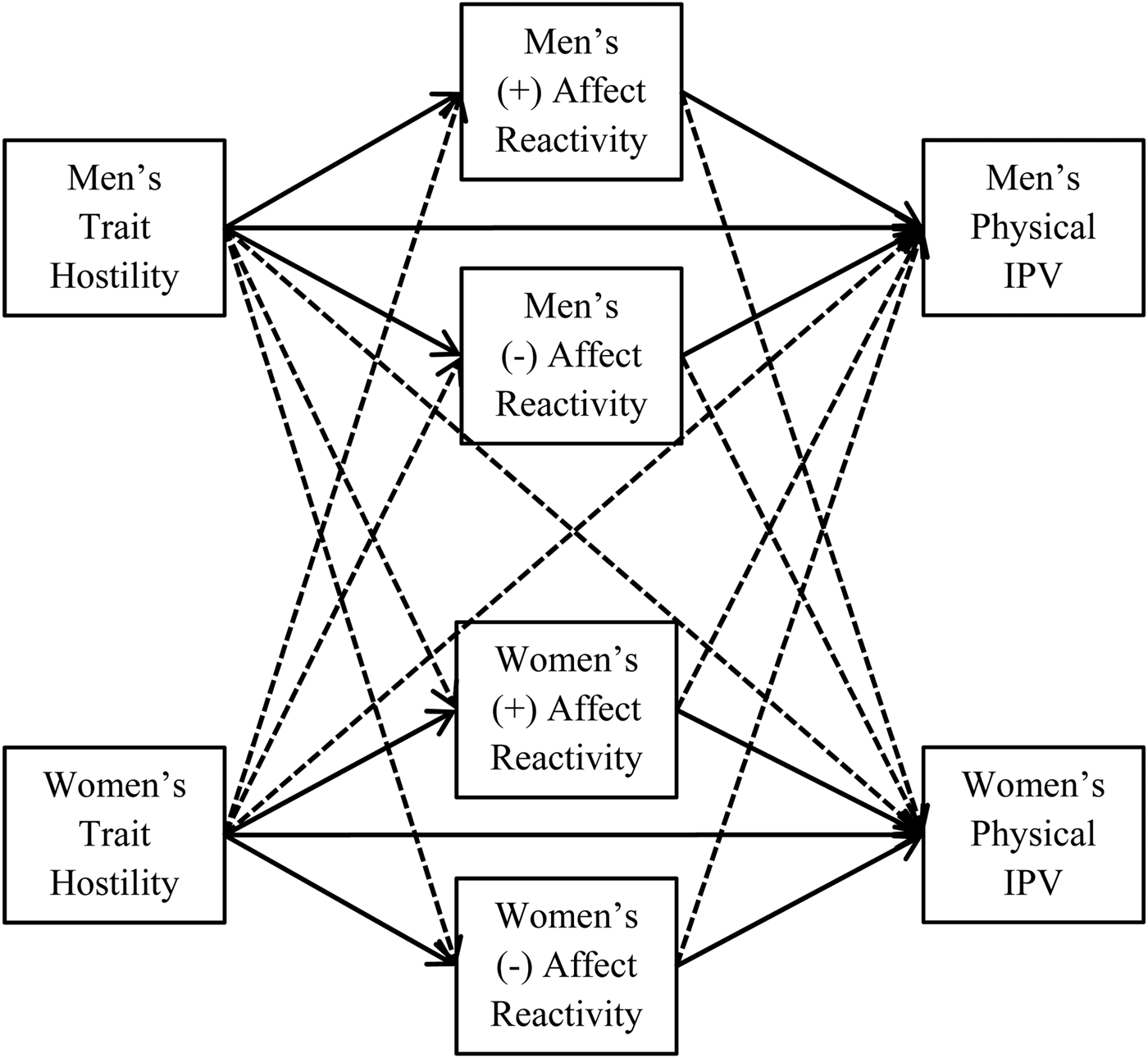
The conceptual model regarding the posited direct associations of each partner's trait hostility with each partner's IPV perpetration and indirect associations via affect reactivity is shown in Figure 1. The hypothesized associations are predicated on stress and emotion regulation theory in couples (Laurent & Powers, Reference Laurent and Powers2007), prior evidence of the negative effects of dysregulation or poor emotional control for relationships (Gottman & Levenson, Reference Gottman and Levenson1992), and in dynamic developmental systems (DDS) theory (Capaldi, Kim, & Shortt, Reference Capaldi, Kim, Shortt, Putallaz and Bierman2004; Capaldi, Shortt, & Kim, Reference Capaldi, Shortt, Kim, Pinsof and Lebow2005). The DDS framework emphasizes the simultaneous examination of individual characteristics (e.g., psychological traits) of both partners, and relationship-specific factors (e.g., relationship processes) to furthering our understanding of the development and occurrence of IPV in couples. Specific to the current study, the DDS theory is utilized within an actor–partner interdependence model (APIM; Kenny, Kashy, & Cook, Reference Kenny, Kashy and Cook2006) framework to examine whether the associations between each partner's trait hostility (individual characteristics) and physical IPV perpetration may operate through couples’ negative and positive affect dynamics (relationship processes). A dyadic approach is utilized allowing for both actor effects, examining the extent to which one's own hostility and affect reactivity predict one's own IPV perpetration, and partner effects, examining the extent to which IPV perpetration by a man or woman can be predicted by his or her partner's hostility and affect reactivity. This thus allows each partner to be simultaneously both a perpetrator and victim of IPV.
Conceptual model: Men's and women's positive and negative affect reactivity, trait hostility, and physical intimate partner violence (IPV) perpetration. (+) denotes positive and (–) denotes externalizing negative affect reactivity. Solid and dashed lines denote actor and partner effects, respectively. Correlations between men's and women's hostility and all affect reactivity variables are not shown for parsimony.

IPV and negative emotionality (e.g., anxiety, anger, and hostility) are strongly associated for both men and women (Moffitt, Krueger, Caspi, & Fagan, Reference Moffitt, Krueger, Caspi and Fagan2000; White & Widom, Reference White and Widom2003). In a meta-analytic review of male perpetrators of physical IPV, perpetrators versus nonperpetrators and moderate-to-high perpetrators versus low-to-moderate perpetrators of physical IPV were found to have elevated levels of anger and hostility (Norlander & Eckhardt, Reference Norlander and Eckhardt2005). A review by Corvo and Johnson (Reference Corvo and Johnson2013) found that psychological risk factors, including anger and hostility, tend to be the strongest predictors of IPV. They are relatively proximal predictors, compared for example to family-of-origin risk factors or adolescent behaviors (Capaldi, Knoble, Shortt, & Kim, Reference Capaldi, Knoble, Shortt and Kim2012). In the current study, men's and women's trait hostility were included in the prediction models for two reasons. First, to examine whether negative and positive affect reactivity would add to prediction of IPV over and above this proximal trait, as poor emotional control and hostility are associated (Fosco, Caruthers, & Dishion, Reference Fosco, Caruthers and Dishion2012); and second, to test whether negative and positive affect reactivity mediate the association of trait hostility and IPV perpetration. Thus, it was hypothesized that negative affective reactivity would be positively associated with trait hostility and physical IPV and positive affective reactivity would be negatively associated with trait hostility.
Regarding effects of trait hostility versus affect reactivity, Madhyastha, Hamaker, and Gottman (Reference Madhyastha, Hamaker and Gottman2011) examined moment-to-moment spousal influence on affect during problem solving for two samples each recruited via news advertising. The first sample (N = 124) was selected to provide a uniform distribution of marital satisfaction and participants were on average aged in their 40s; the second was of newlyweds (N = 130) married in the last 6 months, both in first marriage and childless. Although they found some evidence of influence, they also found evidence that for many people their own initial state and emotional inertia dictated the outcome of the conflict discussion more than the moment-to-moment affect of the spouse. Thus, the current study represents an important further test of the hypothesis that, within couples, individuals show emotional reactivity related to their partner's affective expression and that such reactivity is related to both their overall level of hostility and their perpetration of physical IPV.
The propensity of one partner to reciprocate the other's negative affect quickly and consistently during conflict discussions may be a key aspect of emotional reactivity and risk for IPV. Burman et al. (Reference Burman, Margolin and John1993) studied a sample of convenience recruited via advertising of 65 married couples (in their middle to late 30s on average), with a child aged 3–18 years, who were recruited for a study of marital conflict and selected to fit particular conflict types (physically aggressive, verbally aggressive, withdrawing, and nondistressed/low conflict). They found that although most of the couples entered into angry affective states to some degree during conflictual interactions, for couples who reported physical IPV (vs. couples characterized as verbally aggressive, withdrawn, or low conflict), men and women (but particularly women) were more likely to reciprocate their partner's angry affect.
In addition to the study by Burman et al. (Reference Burman, Margolin and John1993), there is further evidence that there may be some gender differences in negative affect reactivity during discussions of conflicts, from work regarding demand and withdrawal behavior during marital interactions. Christensen and Heavey (Reference Christensen and Heavey1990) found for a sample of convenience (recruited through clinics and advertising) of 31 married couples (with a child aged 7–12 years, 18 of whom had a diagnosis of attention-deficit/hyperactivity disorder) that the wife–demand/husband–withdraw pattern was more likely than the husband–demand/wife–withdraw pattern. Patterns varied somewhat according to whether the issue under discussion involved the wife demanding a change of the husband's behavior or vice versa. However, the men were overall more withdrawn than were the women, suggesting that men may be more conflict avoidant than women, and thus possibly less likely to show negative affect reactivity to their partner's negative affect. Christensen, Eldridge, Catta-Preta, Lim, and Santagata (Reference Christensen, Eldridge, Catta-Preta, Lim and Santagata2006) examined demand–withdraw patterns for a cross-cultural sample of young university student couples in four countries recruited via class announcements and social contacts. Self-reports of communication patterns indicated that woman–demand/man–withdraw was significantly more likely than man–demand/woman–withdraw.
Eldridge, Sevier, Jones, Atkins, and Christensen (Reference Eldridge, Sevier, Jones, Atkins and Christensen2007) examined demand–withdraw communication among 182 married couples recruited via news advertising and seeking marital therapy (N = 68 severely distressed, N = 66 moderately distressed) or nondistressed couples (N = 48). The men and women were, on average, aged in their 40s and had been married for an average of 10 years. Using self-reports and rating scales, rather than moment-by-moment coding, Eldridge et al. found that greater demand–withdraw during relationship problem-solving discussions was associated with greater distress and that overall, wife–demand/husband–withdraw was greater than husband–demand/wife–withdraw. They found that behaviors varied by which partner was seeking change and which carried the burden of change; wife–demand/husband–withdraw was greater than husband–demand/wife–withdraw for wife-chosen topics, but not for husband-chosen topics, where there was no significant difference between the two interaction patterns.
This current study was also influenced by and builds on the work of Dr. Tom Dishion in a number of ways. Much of his work tested aspects of the coercion model (Dishion, Patterson, & Kavanagh, Reference Dishion, Patterson, Kavanagh, McCord and Tremblay1992), including work with his mentor Dr. Gerald Patterson. The coercion model involves interactions, initially within the family of origin, which reinforce problem or antisocial behaviors. These mechanisms were posited to involve negative reinforcement, whereby a young child would use aversive responses (termed coercive behaviors) to terminate aversive behaviors of parents or siblings (Patterson, Reid, & Dishion, Reference Patterson, Reid and Dishion1992). For example, a parent or sibling makes a request, the child ignores it, which on further repeated or escalated requests may result in yelled refusals to cooperate. If the parent or sibling then backs off from the demand, this reinforces the child's strategy. Positive reinforcement involves gaining someone's cooperation through aversive behavior (e.g., nagging and shouting at the mother until she lets the child have candy). Coercion theory posits that these practiced behaviors are a basis of antisocial and aggressive behaviors, as well as of related problem behaviors (e.g., substance use). Much of Dr. Dishion's work involved observation of influences in dyadic interactions and development of real-time codes to capture such moment-by-moment exchanges and social influences, including the Peer Process Code (Dishion et al., Reference Dishion, Crosby, Rusby, Shane, Patterson and Baker1989). A particularly innovative aspect of his work was to observe how exchanges based around positive reinforcement resulted in increases in problem behaviors for male deviant peer dyads (Dishion, Spracklen, Andrews, & Patterson, Reference Dishion, Spracklen, Andrews and Patterson1996).
More recently, Dr. Dishion extended his work in examining coercive processes within key relationships across the earlier life span to examination of processes in couples’ relationships, via observations of interactions. This work involved, first, a study of influences of observed positive and negative emotions on depressive symptoms using the Specific Affect Coding System (Ha, Dishion, Overbeek, Burk, & Engels, Reference Ha, Dishion, Overbeek, Burk and Engels2014), and second, a study examining prediction from disrupted parenting in early adolescence to use of coercive strategies—assessed as negative-hostile interactions, coercion (i.e., the way partners dismiss, invalidate, criticize, put down, or show contempt for each other), and commitment—at age 28–30 years (Ha, Otten, McGill, & Dishion, Reference Ha, Otten, McGill and Dishion2019). Ha et al. (Reference Ha, Otten, McGill and Dishion2019) found that disruptive parenting in early adolescence predicted romantic partner coercive strategies 15 years later, and that deviancy training with peers also predicted such coercive strategies. Thus, the study identified processes at key developmental stages related to risk for aggressive and destructive interactions in romantic relationships.
Current Study
The first aim of the current study was to examine affect dynamics between partners, involving the reactivity of men and women to the changes in their partners’ affect during their problem-solving discussions. Real-time estimates were derived of the rate with which men and women transitioned into positive affect states (e.g., humor, affection, and interest) or externalizing negative affect states (e.g., anger, domineering, and belligerence) as a function of the time-varying changes in their partners’ affect using a time-dynamic modeling approach (Stoolmiller & Snyder, Reference Stoolmiller and Snyder2006). The two constructs of positive and externalizing negative affect reactivity (where higher values denote greater reactivity) were defined as the ability (or poorer ability in the case of negative affect) of one partner to modulate his or her affect. Such modulation involved not overreacting to his or her partner's negative affect, yet supportively reacting to his or her positive affect, when discussing points of contention in their relationship. The second aim of the current study was to examine the association of trait hostility to physical IPV for both the men and the women and to examine whether (a) affect reactivity is predictive of physical IPV over and above effects of trait hostility and (b) whether the direct effect of hostility on physical IPV is explained (i.e., mediated) by quicker negative and slower positive affect reactivity of each partner. The third aim was to examine the aforementioned direct and mediated effects within a dyadic actor partner framework.
There is compelling evidence that factors related to IPV perpetration of both women and men should be examined regarding the etiology of IPV. First, much IPV in couples is bidirectional, involving perpetration by women and by men. Langhinrichsen-Rohling, Misra, Selwyn, and Rohling (Reference Langhinrichsen-Rohling, Misra, Selwyn and Rohling2012) reviewed rates of bidirectional versus unidirectional IPV across samples, sexual orientations, and race/ethnicities. Bidirectional violence was common across all types of samples (population based to criminal justice), at an average of 58% of IPV-involved couples. Second, reviews indicate that externalizing behaviors including hostility are risk factors for IPV perpetration for women and for men (Capaldi et al., Reference Capaldi, Knoble, Shortt and Kim2012). Third, there is evidence of assortative partnering by antisocial behavior for young couples (similar to differential peer association), which relates to higher risk for IPV and related injuries for the couple (Capaldi, Low, Tiberio, & Reference Capaldi, Low, Tiberio, Shortt, Geffner, Vrith, Vaughan-Eden, Rosenbaum, Hamberger and WhiteShortt, in press). Higher levels of negative emotional reactivity and lower levels of positive reactivity during couples’ conflicts may be one of the mechanisms related to elevated risk for perpetrating IPV for couples where each partner has higher levels of trait hostility. Emotional coregulation processes are a mechanism whereby more skilled couples may limit conflict and help manage stress in the relationship (Laurent & Powers, Reference Laurent and Powers2007).
Hypotheses were tested for a community sample of young men at risk for delinquency and their women partners (men's and women's average ages of 26 and 25 years, respectively). Physical IPV is relatively prevalent at these younger ages (e.g., Shortt et al., Reference Shortt, Capaldi, Kim, Kerr, Owen and Feingold2012); yet, at the same time, the couples were in relatively committed relationships in that most were married or cohabiting, making this developmental period relevant for examining relationship processes associated with IPV. For Aim 1, men and women were expected to show an overall likelihood to react to their partner's affect with similar affect. Thus, they were posited to transition more quickly into congruent affect states (e.g., into positive if their partner was positive) and less quickly into incongruent affect states of their partners. Regarding gender differences, it was hypothesized that women would be likely to transition into negative affect in response to negative affect from their partner more rapidly than would men. No predictions were made regarding expected gender differences in transitions to positive affect. For the second and third aims, both men's and women's trait hostility were expected to be predictive of rates of their own and their partners’ transitions into either positive or externalizing negative affect states (i.e., affect reactivity), which in turn were hypothesized to be associated with both partners perpetration of physical IPV. Models were tested using cross-sectional data, which made this a preliminary test of the mediational hypotheses.
The study addresses a number of gaps in prior research in this area, in addition to the issue of possible limitations to generalizability due to the sampling approaches used in previous studies. First, studies have rarely examined the association of affective reactivity with IPV perpetration for both men and women (combining both self-reports of perpetration and reports of victimization by the partners, thus correcting for single-reporter bias in prior studies), while accounting for effects of hostility. If affect reactivity is significantly associated with IPV, while controlling for trait hostility, this suggests that the interactional patterns between partners (i.e., relationship process), beyond overall hostility and negativity (i.e., traits), partially explain violence in couples. Second, it is important to examine a dyadic model, including actor and partner effects, rather than just focusing on men's violent behavior and depicting women as solely victims. Third, studies have rarely had a community sample where hypotheses regarding gender differences could be tested that were not biased by sample design (e.g., sample chosen with violent husbands, wife volunteering for study due to relationship distress). Fourth, design of the problem-solving discussion task affects study findings, including regarding gender differences. Kim, Capaldi, and Crosby (Reference Kim, Capaldi and Crosby2007) found that the affective behavior of men and women during problem-solving discussions differed by whether the woman or man chose the issue, because the chosen issue often involves criticism of some aspect of the partner's behavior (e.g., not doing enough housework). Kim et al. (Reference Kim, Capaldi and Crosby2007) found, for example, that women showed a higher frequency of low-intensity negative affect and higher negative affect when discussing the issue that they had selected themselves. With notable exceptions (e.g., Christensen & Heavey, Reference Christensen and Heavey1990), prior studies have often not involved a balanced selection of topics by each partner (e.g., Gottman, Coan, Carrère, & Swanson, Reference Gottman, Coan, Carrère and Swanson1998). Due to this issue, in the current study women's affective reactivity was examined during the relationship topic she had selected to discuss, and men's affective reactivity was examined during the relationship topic he had selected to discuss. Fifth, to our knowledge, this study is one of the first to examine time-dynamic dependence in couples’ positive affect and whether it may be a protective factor of IPV, as both positive and negative affect were examined in the study. Sixth, the current study takes advantage of methodological developments since a number of the prior studies of observed affective interaction were published. These include (a) using a continuous-time event history approach for multiple or repeated events, where the event is transitioning into an affective state (i.e., from neutral to positive or negative in affect) and (b) a conceptual design using an APIM framework (Kenny et al., Reference Kenny, Kashy and Cook2006), which allows for testing pathways both within and across the men's and women's behaviors within couples (e.g., allowing for each partner to be both a perpetrator and a victim of IPV).
Method
Participants and procedures
Men were originally recruited at ages 9 to 10 years for the longitudinal Oregon Youth Study (OYS; 74% recruitment, N = 206). The boys were at increased risk for problem behaviors because of elevated neighborhood risk of delinquent behavior associated with the location of their public school. The men were assessed nearly annually to age 37 years with a participation rate of at least 88%. At age 18 years and approximately biannually thereafter, eligible men were invited to participate in the OYS–Couples Study of couples’ adjustment with their romantic partners. Data for the current study is from OYS–Couples Study assessment Wave 4 (91% participation rate) and includes N = 156 heterosexual couples (one same-sex couple was excluded to clarify the focus on men's and women's behaviors within male–female couples) when the men were ages 25 to 27 years, and Specific Affect Coding (SPAFF; Coan & Gottman, Reference Coan and Gottman2007; Gottman, McCoy, Coan, & Collier, Reference Gottman, McCoy, Coan and Collier1995) was conducted. Average ages were 26.14 (SD = 0.62) and 24.94 (SD = 4.07) for the men and women, respectively. Regarding ethnic origin, 90.4% of the men and 82.7% of the women were European American, with the next most common group being Hispanic. The average relationship length was 3.49 (SD = 2.85) years. Regarding relationship status, 42.3% (N = 66) of the couples were married, 37.2% (N = 58) were cohabiting, and 20.5% (N = 32) were dating. Average annual income for the couples was $38,160 (SD = 2,280).
Following internal review board approval and written informed consent, men and women completed interviews and questionnaires separately and videotaped discussions together (total duration of 34 min). Discussion topics included a warm-up (5 min), party planning (5 min), interpersonal problem solving (14 min total, 7 min for each partner's topic), and personal goals (10 min total, 5 min for each partner's topic). Each partner selected his or her relationship problem issue by rating a list of issues that tend to cause disagreements for couples (e.g., partner not doing share of chores) using the Partner Interaction Checklist (Capaldi, Reference Capaldi1991). Problem-solving discussions of the men's topics preceded the women's topics.
Measures
Observed affect
Men's and women's affect during the problem-solving discussions was coded using the SPAFF (Coan & Gottman, Reference Coan, Gottman, Coan and Allen2009; Gottman et al., Reference Gottman, McCoy, Coan and Collier1995). Affect codes were assigned on the basis of a gestalt of verbal content, verbal tone, context, facial expressions, and body movements. Each partner's affect was coded separately during multiple passes through the video for each discussion topic, as each individual was assigned a code during both speaking and listening turns. In each pass, coders focused on a single person of the dyad assigning SPAFF codes with the associated session time stamps to indicate changes in affect. An individual remained in a particular affective state until a change in affect was observed and coded (e.g., from neutral to positive affect), thus yielding continuous-time measures of each person's affect (i.e., time series) during the discussions. Partner's files were merged using session time.
Regarding the coding of different affect states, SPAFF has three overarching mutually exclusive categories of positive, neutral, and negative affect composed of 18 individual affect codes. To ensure adequate interrater reliability of the assignment of affect codes, 15% of couples’ topic discussions were independently coded by two different coders (κ = .83). Positive affect encompassed joy, humor, affection, validation, and interest. Internalizing negative affect serves a different function from externalizing negative affect (Shortt et al., Reference Shortt, Capaldi, Kim and Laurent2010). Thus, men's and women's negative affect was subdivided into externalizing negative affect (which included anger, domineering, belligerence, defense, disgust, contempt, criticism, and threats) and internalizing negative affect (which included fear or tension, sadness, whining, and stonewalling). However, transitions into and out of internalizing negative affect accounted for less than 2% of the total transitions and were therefore too sparse to be modeled accurately. Hence, men's and women's affect was collapsed into one of three categories: positive, neutral, and externalizing negative affect (the latter is hereafter referred to as negative affect). The time-varying transitions among these affective states were analyzed. Only affect during the two interpersonal problem-solving discussions was included, and men's and women's affective reactivity was analyzed within their own chosen topic discussion only. Thus, the men's affective reactivity, given their partners’ affect, was assessed from coding during the man's chosen relationship problem; the women's affective reactivity, given their partners’ affect, was assessed from coding during the woman's chosen relationship problem.
Trait hostility
Men's and women's trait hostility was measured by self-reports using the five-item hostility subscale (e.g., easily irritated) of the Brief Symptoms Inventory (Derogatis & Spencer, Reference Derogatis and Spencer1982). Likert response scales included five categories that ranged from 1 = not at all to 5 = very much. Men's and women's reliability equaled α = .75 and α = .55, respectively.
Physical IPV
Men's and women's physical IPV was measured using the perpetration and victimization physical assault subscales of the Conflict Tactics Scale (Straus, Reference Straus1979). Six items were answered twice by both partners, first in relation to their own perpetration (e.g., I pushed my partner) and second in relation to their victimization (e.g., My partner pushed me). Response scales included eight categories and were scored to reflect the approximate number of times in the last year physical IPV occurred (i.e., the annual frequency scores as described by Straus, Hamby, Boney-McCoy, & Sugarman, Reference Straus, Hamby, Boney-McCoy and Sugarman1996), where the midpoints of the response categories were used as follows: 0 = never or less than once a year and not in past year but before that; 1.5 = once or twice a month; 9 = several times a year but less than monthly; 18 = once or twice a month; 25 = several times a month, one or more times a week but less than daily, and daily). Reliability of men's and women's self-reported perpetration equaled α = .80 and α = .78, respectively, and self-reported victimization equaled α = .82 and α = .84, respectively. Composite IPV scores were created by summing over the six items.
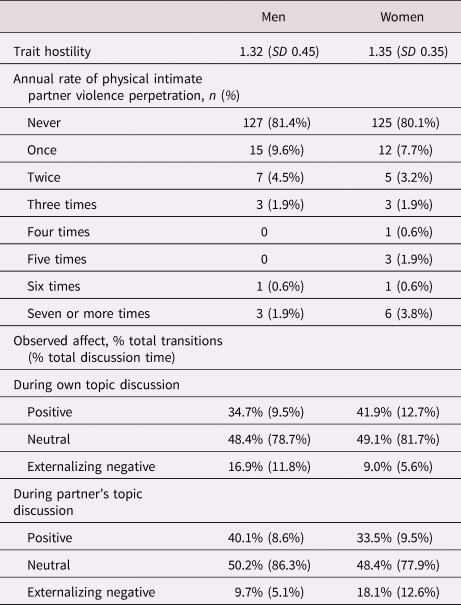
Self-reported perpetration and partner-reported victimization composite scores were significantly associated (r = .95, p < .001 for men's perpetration and r = .75, p < .001 for women's perpetration), indicating congruence between self-reports and partner reports of each partner's behaviors. The men's perpetration report and the women's victimization report scores were averaged to denote the men's perpetration with a corresponding calculation to denote the women's perpetration. Scores were then rounded to the highest integer value to denote the number of times in the last year that the men and women, respectively, had perpetrated physical IPV. Finally, given that only three women and two men reported perpetration of physical IPV at a rate of greater than seven times in the last year, physical IPV scores were capped at seven. These scores were then used in the subsequent analyses. Frequencies of men's and women's rates of physical IPV perpetration in the past year are in Table 1.
Descriptive statistics of study variables

Data analytic plan
Model 1: Couples’ time-varying affect dynamics
The second-to-second changes in affect for men and women during their respective problem-solving discussions were modeled using advanced survival analysis techniques (Gardner & Griffin, Reference Gardner and Griffin1989). Specifically, time-varying influence models were used to predict the rate with which men and women transitioned from neutral into either positive or negative affect states during their own topic discussions as a function of their partners’ time-varying affect (Stoolmiller & Snyder, Reference Stoolmiller and Snyder2006). Note that these are only two of the six possible transitions among affect states. Transitions from positive to either neutral or negative and from negative to either neutral or positive were not examined. Neutral affect was chosen as the reference category for both statistical and substantive reasons. Statistically, the low base rates of positive-to-negative transitions (1.6% of men's and 1.0% of women's transitions) and negative-to-positive transitions (1.2% of men's and 0.8% of women's transitions) were too sparse to model accurately. Substantively and more important, choosing neutral affect as the reference category allowed for the examination of how the time-varying changes in partners’ supportive, positive affect and unsupportive, negative affect (vs. neutral affect) may provoke the other partner to transition out of neutral affect into either positive or negative affect.
Survival analyses are time-to-event models, where an estimate of the likelihood of an event occurring over a particular time interval is obtained, provided that the event has not yet occurred during that interval. Formally, this quantity is known as the hazard rate and is denoted as h(t), which is a function of time, t. The higher the estimated value of the hazard rate, the sooner the event occurs. Events in the current analyses were men's and women's transitions from neutral into either positive or negative affect during the problem-solving discussions of their own respective topics. The survival analysis models used have three advanced components, namely, multiple events, competing risks, and multilevel analyses. First, multiple events indicate that multiple transitions from neutral into either positive or negative affect occurred across the course of the 7-min discussions. This differs from traditional survival analyses where events, such as death, can only occur once (cf. Allison, Reference Allison1984). Second, the models also allow for competing risks. Specifically, from neutral affect, it is possible to transition into positive affect or negative affect, but not both; thus, the positive and negative affect states have competing risks of occurring. Third, the models are multilevel; intraindividual variability in the second-to-second changes in observed affect states (Level 1) were nested within persons (Level 2).
Estimates of men's and women's positive and negative affect reactivity during their respective topic discussions were allowed to correlate and were simultaneously estimated in one model using Mplus version 7 (Muthén & Muthén, Reference Muthén and Muthén1998–2012). The baseline hazard rates represent the average rates with which men and women transitioned from neutral into positive or negative affect states, respectively (i.e., grand means). Tests of congruent affect dynamics captured the rate with which men and women transitioned into negative (or positive) affect states, given their partners were also negative (or positive), whereas tests of incongruent affect dynamics captured the rate with which men and women transitioned into negative and positive affect states, given that their partners were in opposing affect states (e.g., transition into positive, given that their partner was negative). Finally, two random intercept effects (more formally referred to as strata effects, see Appendix A) were included for both men and women, indicating the deviation above or below the overall baseline hazard rates (i.e., the grand means) of positive and negative affect transitions, respectively. These random effects were correlated within person for both men and women and were expected to be negatively related; that is, the person who transitions the fastest into positive affect is expected to be the slowest to transition into negative affect. Correlations across partners and across positive and negative affect reactivity estimates were also allowed in the model. It was expected that those men and women who transition into positive affect states the fastest would have partners who also were quick to transition into positive affect states but slow to transition into negative affect states (and similarly for negative transitions). See Appendix A for further details regarding the event history model.
The person-specific estimates (i.e., random effects) of the rates with which men and women transitioned from neutral into positive and negative affect states (conditioned on the average partners’ affect) then served as mediating variables in the subsequent APIM (Figure 1) analysis examined in Model 2. This approach has the limitation of less consistent estimates due to unaccounted-for measurement error in the estimates (Buonaccorsi, Reference Buonaccorsi2010). However, attempting the simultaneous estimation of both the survival analysis (which modeled men's and women's affect reactivity) and the associations among men's and women's affect reactivity and their trait hostility and perpetration of physical IPV resulted in an unwieldy model (i.e., convergence issues due to the number of estimated parameters).
Model 2: Couples’ affect dynamics, trait hostility, and physical IPV
In the model relating men's and women's trait hostility, affect dynamics, and physical IPV perpetration (Figure 1), actor effects are depicted as solid lines—denoting associations between one's own traits (e.g., hostility) and behaviors (e.g., IPV), whereas partner effects are depicted as dashed lines—denoting associations between partners traits and one's behaviors (e.g., IPV). The model was estimated as a path analysis in Mplus version 7 (Muthén & Muthén, Reference Muthén and Muthén1998–2012). The anteceding variables (men's and women's trait hostility) were correlated, as were the mediating variables (estimates of men's and women's positive and negative affect reactivity previously derived in Model 1). The outcome variables (men's and women's rates of physical IPV perpetration in the last year) were modeled using negative binomial distributions to account for the low prevalence of men's and women's physical IPV perpetration (19% and 20%, respectively) and the overdispersion in the data involving instances where the variability in the rate of physical IPV perpetration exceeds the average level of perpetration (Agresti, Reference Agresti2013). Overdispersion indicates that physical IPV perpetration was rare, but when it did occur, there was substantial variability in the rate with which it happened. Note that, given the use of count variables, there were no residual variances for men's and women's rates of physical IPV perpetration (Agresti, Reference Agresti2013); as such, the outcome variables could not be correlated.
Results
Sample descriptives
Sample descriptives for trait hostility, rate of IPV perpetration, and observed affect are presented in Table 1. Men's and women's average trait hostility and prevalence of physical IPV perpetration (19% and 20%, respectively) were similar. Of those men and women who perpetrated physical IPV, approximately one half of them committed one such act in the last year. Regarding observed affect, couples spent most of their discussion time in neutral affect and were most likely to transition into neutral affect (which accounted for approximately 80% of their total time and nearly 50% of their total transitions), followed by positive affect (which accounted for approximately 10% of their time and 38% of their total transitions) and negative affect (which accounted for approximately 9% of their time and 13% of their total transitions).
Model 1: Couples’ time-varying affect dynamics (Aim 1)
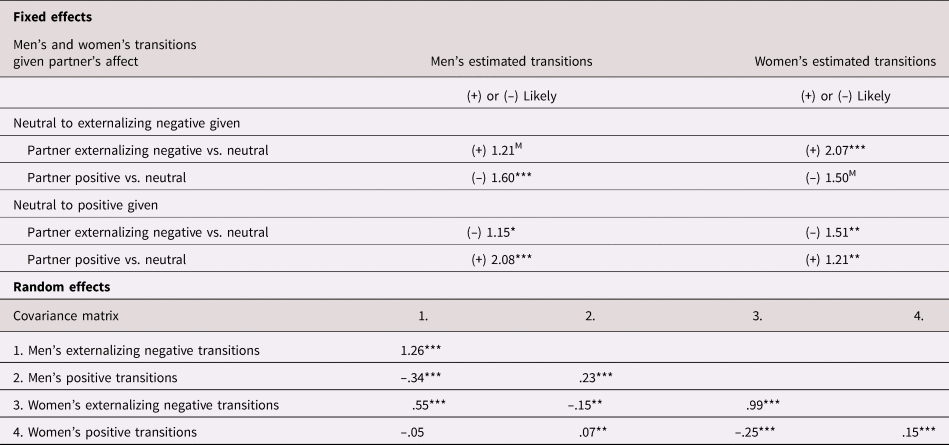
Model results for the survival analysis are presented in Table 2. During couples’ problem-solving discussions, men's and women's transitions into positive affect (from neutral affect) occurred at a faster rate if the partner was positive in affect and at a slower rate if the partner was negative in affect, thus exhibiting support for positive affect dynamics between partners. Alternatively, women (but not men) were significantly more likely to transition into negative affect if their partners were negative in affect, whereas men (but not women) were significantly less likely to transition into negative affect if their partners were positive. Thus, partial support was found for negative affect dynamics between partners, and support was found for the hypothesis that negative affect reactivity was more likely for women than for men.
Couples’ affect dynamics results (Model 1): Fixed effects and random effects

Note: (+) and (–), respectively, denote that men and women were more and less likely to transition.
Mp < .10. *p < .05. **p < .01. ***p < .001.
Regarding the estimates of the random effects, both men and women exhibited significant variation in the rates with which they transitioned into negative and positive affect during their problem-solving discussions. Findings for covariances among transition rates (Table 2) indicated that those men and women who were the fastest to transition into negative affect were the slowest to transition into positive affect. In addition, rates of negative and positive transitions were positively associated for men and women within couples. Thus, those men and women who were quicker to transition negatively (or positively) during their own topic discussions had partners who were also quicker to transition negatively (or positively) during the partner's chosen topic discussion. The one exception was that men who transitioned into negative affect more slowly did not have partners who were faster to transition into positive affect during the women's topic discussions. Thus, support was found for the expected correspondence in affective reactivity across partners.
Model 2: Couples’ affect dynamics, trait hostility, and physical IPV (Aims 2 and 3)
Bivariate associations
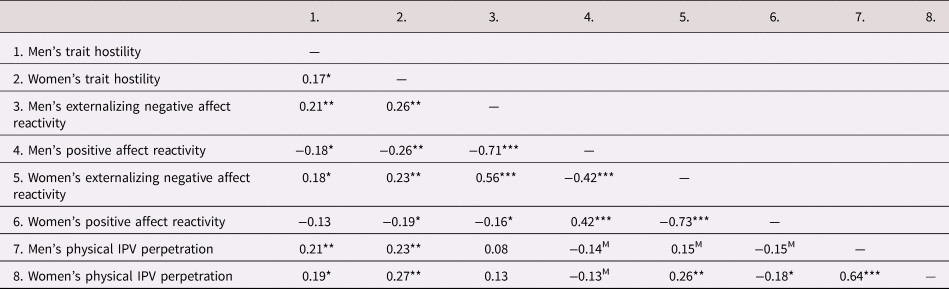
Shown in Table 3 are the bivariate correlations among all of the study variables, including men's and women's affect reactivity scores (with higher values denoting faster affect transitions), which were estimated as random effects in the survival analysis (Model 1). Correlations indicated that more hostile men and women were quicker to react with negative affect and slower to react with positive affect, both within and across partners; the only exception was that women's positive affect reactivity was not related to men's trait hostility. Furthermore, men's and women's perpetration of physical IPV was positively related to both partners’ trait hostility levels, whereas only women's (but not men's) physical IPV perpetration was associated with women's quicker transitions into negative and slower transitions into positive affect.
Bivariate correlation matrix of the study variables

Note: Men's and women's externalizing negative and positive affect reactivity denote estimates of the random effects from the survival analysis (Model 1). Higher values denote quicker transitions into externalizing negative or positive affect states from neutral states. Physical intimate partner violence (IPV) denotes the number of times in the last year physical violence was perpetrated by men or women.
Mp < .10. *p < .05. **p < .01. ***p < .001.
Path analysis results
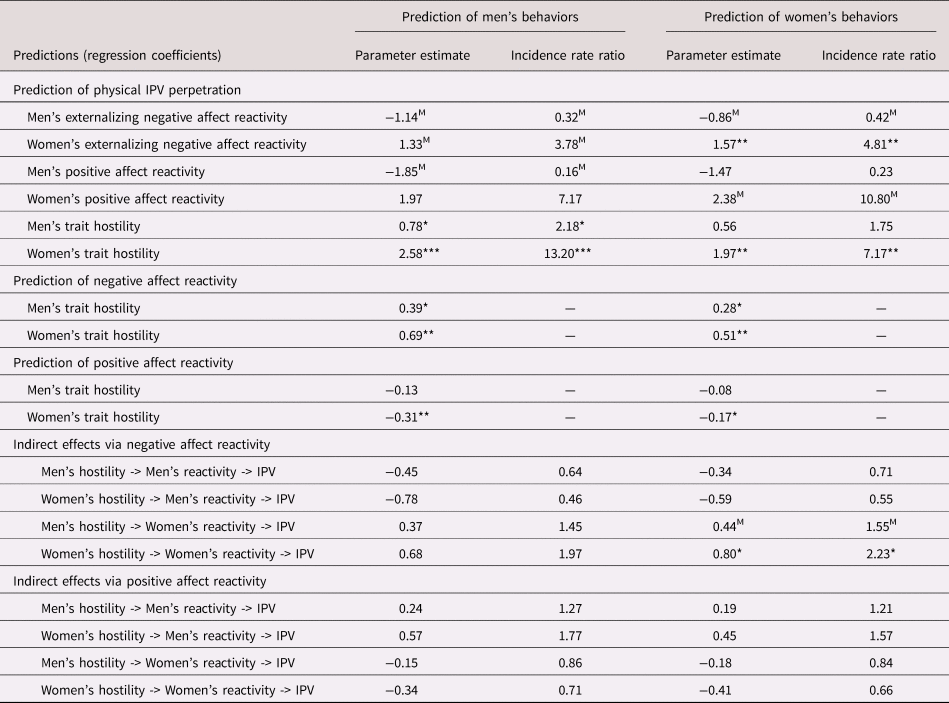
Model results for the path analysis are presented in Table 4, including path coefficients and incidence rate ratios, which denote the change in the rate of IPV perpetration for a one-unit increase in the predictor variable. Note that effects are for the full path model and thus account for other associations in the model. Regarding prediction of rate of affect transitions from trait hostility, as hypothesized, more hostile men and women were quicker to transition into negative affect compared to less hostile men and women. In comparison, only women's (but not men's) higher trait hostility predicted slower positive affect transitions for both men and women, suggesting that only women's levels of trait hostility impaired the positive affect dynamics for couples during their problem-solving discussions.
Path analysis results (Model 2): Couples’ affect reactivity, trait hostility, and physical intimate partner violence (IPV) perpetration

Note: Incident rate ratios denote the change in the rate of IPV perpetration for a 1-unit increase in the corresponding predictor variable. Incident rate ratios above, equal to, and below 1, respectively, denote an increase, no change, and decrease in the rate of physical IPV perpetration.
Mp < .10. *p < .05. **p < .01. ***p < .001.
Regarding prediction of physical IPV perpetration from trait hostility, both more hostile men and more hostile women perpetrated physical IPV at higher rates than those men and women who were less hostile. However, regarding partner effects, only women's hostility significantly predicted men's physical IPV perpetration. Men's trait hostility was not significantly predictive of women's IPV perpetration.
Regarding prediction of physical IPV perpetration from affect reactivity, women's externalizing negative affect reactivity predicted the women's IPV perpetration, whereas the corresponding association for men was not significant, as were effects of either men's or women's negative affect reactivity on their partners’ physical IPV perpetration. Associations of men's and women's positive affect reactivity with their IPV perpetration were not significant.
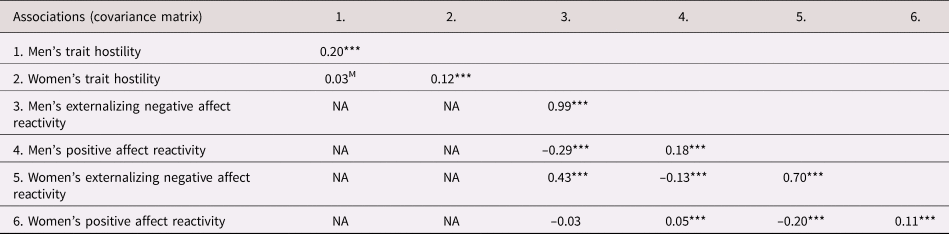
Findings regarding indirect effects of hostility on IPV mediated by affect reactivity (lower part of Table 4) were consistent with the findings for direct effects. The only significant indirect effect indicated that more hostile women were quicker to transitions into negative affect states and to perpetrate physical IPV at over twice the rate of women who were less hostile and showed lower levels of negative affect reactivity. The estimated covariance matrix for Model 2 denoting associations between each partner's hostility and negative and positive affect reactivity is shown in Appendix A.
In sum, more hostile men and women committed more acts of physical aggression toward their partners, but only women's hostility increased their risk for greater victimization. In general, there was support for the expectation that both women's hostility and their negative affect reactivity play a role in explaining IPV involvement, whereas positive affect reactivity was not predictive of IPV for either partner; thus, evidence did not support it as a protective factor. Furthermore, the rate with which women reacted to their partners’ negative affect by also becoming negative was found to partially explain the association between women's trait hostility and their IPV perpetration, thus identifying women's negative affect reactivity as a mediating, relationship process variable.
Discussion
The current study examined the positive and negative affect dynamics observed during discussions of contentious issues for an at-risk community sample of early adult couples, where each partner picked an issue in their relationship for two separate discussions, frequently related to a behavior of their partner's that was problematic for them. A time-dynamic modeling approach was utilized to test for transactional, reciprocating processes between partners’ negative and positive affect responses. In addition, the DDS framework was employed to elucidate how these relationship processes of negative and positive affect reactivity may explain associations between each partner's trait hostility and physical IPV perpetration by each partner. Overall, findings indicated support for considerable but not total correspondence in negative and positive affect transitions across men and women. Findings for the path model of associations in trait hostility, affective reactivity, and IPV perpetration indicated support for both the DDS model whereby IPV is posited to be influenced by prior characteristics of each partner and by relationship processes, with some mediational effects of prior characteristics on IPV perpetration via relationship processes (women's negative affect reactivity). They also are consistent with the findings of Madhyastha et al. (Reference Madhyastha, Hamaker and Gottman2011) that, although there is evidence of partner influence on moment-to-moment affect during problem solving, there was also evidence of the influence of conceptually prior more enduring factors (in the current study assessed by each partner's trait hostility) on affect and relationship outcomes.
Couples’ time-varying affect dynamics
Consistent with hypotheses, differential effects by gender suggested that only women reacted more quickly to their partner's negative affect by also displaying negative affect. In comparison, men were less likely to engage in such negative reciprocity, which is consistent with prior findings that men show greater withdrawal or avoidance during conflict than do women (Christensen & Heavey, Reference Christensen and Heavey1990). Men were, however, slower to transition into negative affect states if their partners were positive (vs. neutral) in affect. This indicates that even though men were discussing conflictual topics with their partners, they still responded positively to their partners’ positive affect. Women, however, did not exhibit this behavior during the discussions.
Full support was found for the expected couples’ positive affect dynamics. Both men and women were quicker to react with positive affect if their partners were positive (vs. neutral) in affect and slower to react with positive affect if their partners were negative (vs. neutral) in affect. The latter result coincides with prior findings where men and women were less likely to react with positive affect if their partners had exhibited anger or contempt (Burman et al., Reference Burman, Margolin and John1993). Although partner's levels of self-reported positive affect have been associated in a previous study (Johnson et al., Reference Johnson, Cohan, Davila, Lawrence, Rogge, Karney and Bradbury2005), to our knowledge, this study is one of the first to demonstrate that time-dynamic dependence exists in couples’ positive affect interactions.
The rates with which men and women transitioned into negative and positive affect were associated in expected directions. During the discussions of their own topics, men and women who were faster to react positively were also slower to react negatively. In addition, those men who were quicker to transition negatively (or positively) during their own topic discussions had partners who were also quicker to transition negatively (or positively) during the women's topic discussions. In couples where the women were slower to transition into negative affect, the men were quicker to react positively in affect. However, the opposite was not true; the rate with which men transitioned into negative affect was not associated with the rate with which women were positive in affect. Thus, within couples, women's greater negative affect reactivity was associated with impaired positive affect processes in men, indicating that if women were quicker to react negatively, men were slower to react positively in affect.
Couples’ affect dynamics, trait hostility, and physical IPV
Regarding the associations among men's and women's trait hostility, affect dynamics, and physical IPV perpetration, greater trait hostility of both partners was associated with an increased rate with which men and women transitioned into negative affect. Hence, the associations found in prior research between elevated hostility (and anger) and poorer emotion regulation abilities, which have typically been measured via self-reported scales (Shorey, Cornelius, & Idema, Reference Shorey, Cornelius and Idema2011; Tharp, Schumacher, Samper, McLeish, & Coffey, Reference Tharp, Schumacher, Samper, McLeish and Coffey2013), were corroborated using self-reported hostility and real-time estimates of men's and women's observed affect reactivity.
The magnitude of the risk from trait hostility is emphasized by the fact that women's and men's elevated trait hostility was associated with men's perpetration of approximately 13 and 2 more physically aggressive acts per year, respectively; similarly, women's perpetration of physical IPV increased by approximately 7 acts per year when comparing more versus less hostile women. Thus, it is important to consider how each partner's individual traits or characteristics and, in particular, women's hostility, may relate to the severity of physical IPV.
The association found between couples’ negative (but not positive) affect dynamics and women's perpetration of physical IPV suggests that it may not be the absence of positive interactions between partners that is associated with increases in women physical IPV perpetration, but rather the presence of negative affect dynamics. Men's positive and negative affect reactivity were not associated with their rate of physical IPV perpetration. Instead, the hostility of the men and their partners increased the likelihood of higher rates of men's physical IPV perpetration, suggesting that both partners’ trait characteristics of hostility are more salient in understanding men's physical IPV perpetration than the dynamic affect processes that occurred during their second-to-second interactions. Such findings for men coincide with past research that has linked great hostility (and anger) to greater physical IPV perpetration (Margolin, Burman, & John, Reference Margolin, Burman and John1989; Moffitt et al., Reference Moffitt, Krueger, Caspi and Fagan2000; Norlander & Eckhardt, Reference Norlander and Eckhardt2005; White & Widom, Reference White and Widom2003). The association between men's hostility and physical IPV was found to persist beyond what could be explained by their poorer emotion regulation abilities (Tharp et al., Reference Tharp, Schumacher, Samper, McLeish and Coffey2013).
The associations of hostility, affect, and perpetration of physical IPV differed for the women compared with the men. IPV perpetration occurred at higher rates if women were more hostile and were faster to transition into negative affect. In comparison, only men's trait hostility predicted their perpetration of physical IPV. The only significant indirect effect operated solely through women's characteristics and behaviors; more hostile women transitioned more quickly into negative affect and perpetrated physical IPV at an annual rate over two times greater than women who were less hostile and were better able to regulate their negative affect reactivity. Such findings for women are in line with past research that has inferred a negative interaction dynamic between partners that is associated with increased risk for physical violence (Berns, Jacobson, & Gottman, Reference Berns, Jacobson and Gottman1999; Burman et al., Reference Burman, Margolin and John1993; Margolin et al., Reference Margolin, Burman and John1989).
These findings emphasize the importance of a dynamic dyadic model for understanding couples’ risk behaviors and IPV. Significant associations between men's and women's trait hostility, the associations of the hostility of each with IPV, and of women's negative affective processes with IPV emphasize that couples who show assortative partnering by significant risk factors for IPV, in this case trait hostility, are at particularly elevated risk for IPV in their relationship. The IPV is likely mutual, given that the risk operates for both men and women, and the expectation of mutuality is supported by the high association that was found between men's and women's IPV perpetration. The importance of risk operating for both partners is emphasized by the fact that women and men in relationships with mutual IPV are at higher risk of injuries (Capaldi, Kim, & Shortt, Reference Capaldi, Kim and Shortt2007).
This study has important prevention and intervention implications. Findings of direct effects on IPV from men's and women's trait hostility, and indirect risk via women's negative affect reactivity, indicate that such high-risk couples are in need of preventive interventions and treatment interventions that address the risk coming from each partner's behavior, not just that of the men. Overall, findings indicate that clinicians and interventionists should address how couples’ communication patterns may be improved not only by teaching effective problem-solving strategies, for example, but also by addressing each partner's own affect and their affective reactions to one other, particularly women's negative affect reactivity. Furthermore, the findings of Ha et al. (Reference Ha, Otten, McGill and Dishion2019)—that disruptive parenting in early adolescence predicted romantic partner coercive strategies 15 years later—indicates that preventive and intervention work to improve problem solving and reduce hostility and negative or coercive interactions in family-of-origin relationships may have long-term benefits, including reducing coercive and violent behaviors with intimate partners in early adulthood. Finally, the magnitude of the risks for IPV from the men's and women's hostility emphasizes the importance of including emotion or anger regulation techniques in IPV prevention and treatment programs.
Other possible behavioral and neurological mechanisms may explain the association between poorer affect reactivity and a greater propensity to commit physical violence. Previous studies have demonstrated that physically aggressive couples lack sufficient problem-solving skills (Burman, John, & Margolin, Reference Burman, John and Margolin1992; Margolin et al., Reference Margolin, Burman and John1989). Thus, men and women may be more prone to act violently toward a partner, not only because of their great trait hostility (and anger) and greater difficulties regulating their affect, but also because they lack the necessary repertoire of problem-solving skills vital for resolving conflict. In addition, impulsive violence is associated with diminished or enhanced activity in the regions of the brain and interconnecting neural circuitry immediately responsible for the regulation of emotions (Davidson, Putnam, & Larson, Reference Davidson, Putnam and Larson2000). Thus, neurological factors are important to consider. Similarly, Krakowski (Reference Krakowski2003) examined the role of serotonin in violence perpetration (which encompassed both physical assaults and hostile or aggressive responses) and concluded that whether serotonergic dysfunction will lead to violent acts or aggressive responses will vary depending on the individual's social competence, impulsivity, and emotion regulation. Thus, no simple one-to-one association exists. Krakowski (Reference Krakowski2003) acknowledges that “aggressive acts occur in a broader social context. As such, serotonergic function has an effect not only on the individual but also on the group dynamics, and it is in turn influenced by these dynamics” (p. 294). Thus, the likelihood of perpetrating violence interacts, potentially dynamically, with a number of factors within differing dynamic systems germane to the individual and environment. In the current study, such dynamic interactions were demonstrated in partners’ positive affective and their negative interactions. Future research should explore whether these affectively negative and positive interactions relate to other macrolevel relationship factors, such as greater relationship satisfaction and less relationship cessation.
The current study had a number of advantages, including the at-risk community sample of young couples and the moment-by-moment examination of transactions in their affective interactions. There were also some limitations. First, assessment was concurrent; therefore, temporal associations among hostility, affect dynamics, and IPV could not be determined, nor does the study design allow for casual inference. IPV was assessed over the past year, thus prior to the affective interaction. Testing for mediational and indirect effects using such a design is not optimal and findings should not be interpreted as longitudinal but instead as cross-sectional, such that women's quicker negative affect reactivity partially explained between-couple associations in trait hostility and IPV. An important next step would be to examine prediction to future IPV. Second, the reliability of the trait hostility scale was relatively low for the women (α = .55). Third, the sample, although not exclusively European American, was not racially diverse; thus, the results may not generalize to non–European American men and women. Third, the men's topic discussions always preceded the women's topic discussion and hence carryover effects cannot be ruled out for the women's results.
Overall, the findings of this study highlight key risks for couples’ affective processes during problem-solving interactions and for IPV involvement from trait hostility of both partners. Hypotheses that women may show more negative affect reactivity during conflict discussions than do men were supported, and it was found that such negative affect reactivity in women is an important risk factor for their IPV perpetration. Furthermore, the study emphasizes the importance of addressing such empirically based risk factors in prevention and treatment interventions using a dyadic framework.
Financial Support
This work was supported by the National Institutes of Health (NIH), US PHS to Dr. Capaldi: Award Number R01 DA 015485 (Intergenerational Studies Consortium: Understanding Mechanisms of Family Substance Use Transmission and Effects of Marijuana Legalization) from the National Institute on Drug Abuse (NIDA), and HD 46364 (Risk for Dysfunctional Relationships in Young Adults) from the National Institute of Child Health and Development (NICHD). The content is solely the responsibility of the authors and does not necessarily represent the official views of the NIH, NIDA, or NICHD. The NIH, NIDA, or NICHD had no further role in study design; in the collection, analysis, and interpretation of data; in the writing of the report; or in the decision to submit the paper for publication.
Appendix A
Statistical detail regarding event history analysis
Model 1
Algebraically, the time-varying influence model (Model 1) can be expressed as follows for the men's and women's topic discussions, respectively:


where the first subscripts denote men (M) or women (W) and
S_i(t) = stratum indicator (equaling 1 for positive and 0 for negative affect transitions)
h_N(t) = baseline hazard rate from neutral to negative affect
h_P(t) = baseline hazard rate from neutral to positive affect
〖PN〗_i(t) = partner negative affect (vs. neutral)
〖PP〗_i(t) = partner positive affect (vs. neutral)
β^'s = fixed effects
γ_(i)^'s = random strata effects for positive or negative affect transitions
The first and second lines of Equations (1) and (2), respectively, model negative and positive affect transitions from neutral. The baseline hazard rates, h_P(t) and h_N(t), denote the average rates with which men and women transitioned from neutral into positive or negative affect states, respectively (i.e., grand means). β_(N,N) and β_(P,P) denote the tests of congruent affect dynamics between couples, capturing the rate with which men and women transitioned into negative (or positive) affect states given their partners were also negative (or positive). In contrast, β_(N,P) and β_(P,N) denote the tests of incongruent affect dynamics between couples, capturing the rate with which men and women transitioned into negative and positive affect states, given that their partners were in opposing affect states (e.g., transition into positive, given that their partner was negative). Finally, we allowed for two random strata effects for both men and women (the γ_(i)^' s), which indicated the individual's deviation above or below the overall baseline hazard rates (i.e., the grand means) of positive and negative affect transitions. These random effects were correlated across strata for both men and women and were expected to be negatively related; that is, the person who transitions the fastest into positive affect is expected to be the slowest to transition into negative affect. Correlations across partners and across positive and negative affect reactivity estimates were also allowed in the model: It was expected that those men and women who transition into positive affect states the fastest would have partners who also were quick to transition into positive affect states but slow to transition into negative affect states (and similarly for negative transitions).
Path analysis results (Model 2): Couples’ affect reactivity, trait hostility and physical intimate partner violence perpetration