1. Introduction
In the last years, properties of the asymptotic models for water waves have been extensively studied to understand the full water wave systemFootnote 1. As well know, we can formulate the waves as a free boundary problem of the incompressible, irrotational Euler equation in an appropriate non-dimensional form. Some physical conditions give us the so-called long waves or shallow water waves. For example, in one spatial dimensional case, the so-called Kawahara equation which is an equation derived by Hasimoto and Kawahara in [Reference Hasimoto14, Reference Kawahara17] that takes the form

If we look at two spatial dimensions, wave phenomena that exhibit weak transversality and weak nonlinearity are modelled by the Kadomtsev–Petviashvili (KP) equation

where $u=u(x,\,y,\,t)$ and $\alpha,\, \gamma$
 are constants. Equation (1.2) was introduced by Kadomtsev and Petviashvili [Reference Kadomtsev and Petviashvili15] in 1970. In 1993, Karpman included the higher-order dispersion in (1.2) which led to a fifth-order generalization of the KP equation [Reference Karpman16]

which will be called the Kawahara–Kadomtsev–Petviashvili equation (K-KP). Note that, by scaling transformations on the variables $x,\, t$ , and $u$
 , the coefficients in equation (1.3) can be set to $\alpha >0,\, \beta <0,\, \gamma ^2=1$
 . For the sequel, we consider this scaled form of the equation:

When $\gamma =-1$ we will refer to the case as K-KP-I and for $\gamma =1$
 as K-KP II, respectively. This is motivated in analogy with the usual terminology for the KP equation, which distinguishes the two cases for the sign of the ratio of the highest derivative terms in $x$
 and $y$
 , that is, focussing and defocusing cases, respectively.
It is important to point out that there are several physical applications in modelling long water waves in a shallow water regime with a strong dispersion represented by systems (1.1)–(1.4). We can cite at least two of them, the first one is to describe both the wave speed and the wave amplitude [Reference Haragus13], and the second one is modelling plasma waves with strong dispersion [Reference Kawahara17].
1.1 Problem setting
There is an important advance in control theory to understand how the damping mechanism acts in the energy of systems governed by a partial differential equation. In particular, exponential stability for dispersive equations related to water waves posed on bounded domains has been intensively studied. For example, it is well known that the KdV equation [Reference Menzala, Vasconcellos and Zuazua23], Boussinesq system of KdV-KdV type [Reference Pazoto and Rosier24], Kawahara equation [Reference Araruna, Capistrano–Filho and Doronin1], and others are exponentially stable using the Compactness-Uniqueness developed by J.L. Lions [Reference Lions22]. Other results, such as those presented in [Reference Capistrano–Filho, Cerpa and Gallego5] and [Reference Capistrano–Filho and Gallego7] are obtained by using Urquiza's and Backstepping approach. All these results use damping mechanisms in the equation or the boundary as a control.
Recently, in [Reference Capistrano–Filho and Gonzalez Martinez8, Reference Chentouf9], the authors obtained exponential decay for a fifth-order KdV type equation via the Compactness-Uniqueness argument and Lyapunov approach. Additionally to that, in [Reference Gomes and Panthee11] and [Reference de Moura, Nascimento and Santos10], exponential decay for the KP-II and K-KP-II was shownFootnote 2. In both works, the authors can prove regularity and well-posedness for these equations and show that the energy associated with these equations decays exponentially in the presence of a damping term acting on the equation.
As we can see in these articles, in the mathematical context, there is interest in studying the asymptotic behavior of solutions of equation (1.4). Additionally, as pointed out, the model under consideration in this article has importance in the context of the dispersive equations as well as, physical motivation. So, motivated by [Reference Capistrano–Filho and Gonzalez Martinez8–Reference Gomes and Panthee11] we will analyse the qualitative properties of the initial-boundary value problem for the K-KP-II equation posed on a bounded domain $\Omega =(0,\,L)\times (0,\,L)\subset \mathbb {R}^2$ with localized damping and delay terms

Here $h>0$ is the time delay, $\alpha >0$
 , $\gamma >0$
 and $\beta <0$
 are real constants. Additionally, define the operator $\partial _x^{-1}:=\partial _x^{-1} \varphi (x,\,y,\,t)= \psi (x,\,y,\,t)$
 such that $\psi (L,\,y,\,t)=0$
 and $\partial _x\psi (x,\,y,\,t)=\varphi (x,\,y,\,t)$
 Footnote 3 and, for our purpose, let us consider the following assumption.
Assumption 1.1 The real functions $a(x,\,y)$ and $b(x,\,y)$
 are non-negative belonging to $L^\infty (\Omega )$
 . Moreover, $a(x,\,y) \geq a_0>0$
 is almost everywhere in a nonempty open subset $\omega \subset \Omega$
 .
Our propose here is to present, for the first time, the K-KP-II system not only with a damping mechanism $a(x,\,y)u$ , which plays the role of a feedback-damping mechanism (see e.g. [Reference de Moura, Nascimento and Santos10]) but also with an anti-damping, that is, some feedback such that our system does not have decreasing energy. In this context, we would like to prove that the energy associated with the solutions of system (1.5)

decays exponentially. Precisely, we want to answer the following question:
Does $E_u(t) \rightarrow 0$ as $t \rightarrow \infty$
 ? If it is the case, can we give the decay rate?
1.2 Notation and main results
Before presenting answers to this question, let us introduce the functional space that will be necessary for our analysis. Given $\Omega \subset \mathbb {R}^2$ let us define $X^k(\Omega )$
 to be the Sobolev space

endowed with the norm $\left \lVert \varphi \right \rVert _{X^k(\Omega )}^2 = \left \lVert \varphi \right \rVert _{H^k(\Omega )}^2 + \left \lVert {\partial _x^{-1}} \varphi \right \rVert _{H^k(\Omega )}^2.$ We also define the normed space $H_x^k(\Omega )$
 ,

with the norm $\left \lVert \varphi \right \rVert _{H_x^k(\Omega )}^2 =\sum _{j=0}^k \left \lVert \partial _x^j \varphi \right \rVert _{L^2(\Omega )}^2$ and the space

with $\left \lVert \varphi \right \rVert _{X_x^k(\Omega )}^2 = \left \lVert \varphi \right \rVert _{H_x^k(\Omega )}^2 + \left \lVert {\partial _x^{-1}} \varphi \right \rVert _{H_x^k(\Omega )}^2.$ Finally, $H_{x0}^k(\Omega )$
 will denote the closure of $C_0^\infty (\Omega )$
 in $H_x^k(\Omega )$
 .
The next result will be used repeatedly throughout the article:
Theorem 1.2 [Reference Besov, Il'in and Nikol'skii2, Theorem 15.7]
Let $\beta$ and $\alpha ^{(j)},$
 for $j = 1,\,\ldots,\, N,$
 denote $n$
 - dimensional multi-indices with non-negative-integer-valued components. Suppose that $1 < p^{(j)} < \infty,$
 $1 < q < \infty,$
 $0 < \mu _j < 1$
 with

Then, for $f(x)\in C_0^\infty (\mathbb {R}^n)$ ,

Where, for non-negative multi-index $\beta = (\beta _1,\,\dots,\, \beta _N)$ we denote $D^\beta$
 by $D^\beta = D_{x_1}^{\beta _1}\dots D_{x_n}^{\beta _n}$
 and $D_{x_i}^{\beta _i} = \frac {\partial ^{\beta _i}}{\partial x_i^{k_i}}$

From now on, the constants of system (1.5) satisfy $\alpha >0,\, \beta <0$ , and $\gamma ^2=1$
 . With this, the first result of this work ensures that without a restrictive assumption on the length $L$
 of the domain and with the weight of the delayed feedback small enough energy (1.6) associated with the solution of system (1.5) is locally stable.
Theorem 1.3 Optimal local stabilization
Assume that the functions $a(x,\,y), b(x,\,y)$ satisfy the conditions given in assumption 1.1. Let $L>0,$
 $\xi >1,$
 $0<\mu <1$
 and $T_0$
 given by

with $\theta = \frac {3\alpha \eta }{(1+2\eta L)L^2},\, \kappa = 1+\max \left \lbrace {2\eta L,\, \frac {\sigma }{\xi }}\right \rbrace$ and $\eta \in (0,\, \frac {\xi -1}{2L(1+2\xi )})$
 satisfying

where $\sigma =\xi -1 -2L\eta (1+2\xi )$ . Let $T_{\min }>0$
 given by

Then, there exists $\delta >0$ , $r>0$
 , $C>0$
 and $\gamma$
 , depending on $T_{\min },\, \xi,\, L,\, h$
 , such that if $\lVert b \rVert _\infty \leq \delta$
 , then for every $(u_0,\,z_0) \in \mathcal {H} = L^2(\Omega )\times L^2(\Omega \times (0,\,1))$
 satisfying $\lVert (u_0,\, z_0) \rVert _{\mathcal {H}}\leq r$
 , the energy of system (1.5) satisfies

Next, following the ideas presented in [Reference Capistrano–Filho and Gonzalez Martinez8], we obtain some stability properties about the next system, called $\mu _i$ –system. Note that if we choose $a(x,\,y)= \mu _1 a(x,\,y)$
 and $b(x,\,y)=\mu _2 a(x,\,y)$
 in (1.5), where $\mu _1$
 and $\mu _2$
 are real constants we obtain the system

Here, $\mu _1>\mu _2$ are positive real number and $a(x,\,y)$
 satisfies assumption 1.1. We define the total energy associated to (1.8)

where $\xi >0$ satisfies

Note that the derivative of energy (1.9) satisfies

for $C:= C(\mu _1,\,\mu _2,\,\xi,\,h)\geq 0$ . This indicates that the function $a(x,\,y)$
 plays the role of a feedback-damping mechanism, at least for the linearized system. Therefore, for system (1.8) we split the behavior of the solutions into two parts. Employing Lyapunov's method, it can be deduced that the energy $E_u(t)$
 goes exponentially to zero as $t \rightarrow \infty$
 , however, the initial data needs to be sufficiently small in this case. Precisely, the second local result can be read as follows:
Theorem 1.4 Local stabilization
Let $L>0$ . Assume that $a(x,\,y)\in L^\infty (\Omega )$
 is a non-negative function, that relation (1.10) holds and $\beta < -\frac {1}{30}$
 . Then, there exists

such that for every $(u_0,\,z_0(\cdot,\,\cdot,\,-h(\cdot )))\in \mathcal {H}$ satisfying $\left \lVert {(u_0,\,z_0(\cdot,\,\cdot,\,-h(\cdot )))}\right \rVert _{\mathcal {H}} \leq r$
 , the energy defined in (1.9) decays exponentially. More precisely, there exists two positives constants $\theta$
 and $\kappa$
 such that $E_u(t) \leq \kappa E_u(0)e^{-2\theta t}$
 for all $t>0.$
 Here,

and $\eta$ and $\sigma$
 are positive constants such that

The last result of the manuscript, still related to the system (1.8), removes the hypothesis of the initial data being small. To do that, we use, as mentioned before, the compactness-uniqueness argument due to J.-L. Lions [Reference Lions21], which reduces our problem to prove an observability inequality for the nonlinear system (1.8) and removes the hypotheses that the initial data are small enough.
Theorem 1.5 Global stabilization
Let $a\in L^\infty (\Omega )$ satisfies assumption 1.1. Suppose that $\mu _1>\mu _2$
 satisfies (1.10). Let $R>0$
 , then there exists $C=C(R)>0$
 and $\nu =\nu (R)>0$
 such that $E_u$
 , defined in (1.9) decays exponentially as $t$
 tends to infinity, when $\left \lVert (u_0,\,z_0)\right \rVert _{\mathcal {H}}\leq R$
 .
1.3 Novelty and outline of the article
We finish the introduction by highlighting some facts about our problem in comparison with the works previously mentioned, as well as the organization of the paper.
a. Observe that the absence of drift term $u_x$
 , in comparison with Kawahara equation in [Reference Capistrano–Filho and Gonzalez Martinez8, Reference Chentouf9], leads to get stabilization results without restriction in the length of the spatial domain. This term is not important in our analysis, the term only plays an important role in the problems where the control (damping or delay) is acting in the boundary conditionFootnote 4.
b. As stated earlier, we introduce an anti-damping together with the damping mechanism to show that the energy of system (1.5) decays exponentially. Compared with the known result [Reference de Moura, Nascimento and Santos10], the novelty of this paper is twofold:
(i) Our work gives the precise decay rate, see theorems 1.3 and 1.4.
(ii) Lyapunov's method shows an optimal decay rate in terms of $\theta$
in theorem 1.3. Observe that the value of $\theta$ can be optimized as a function of $\eta$, that is, we can choose
(1.11)$$\begin{align} \eta \in \left(0,\frac{\xi-1}{2L(1+2\xi)}\right) \end{align}$$such that the value of $\theta$
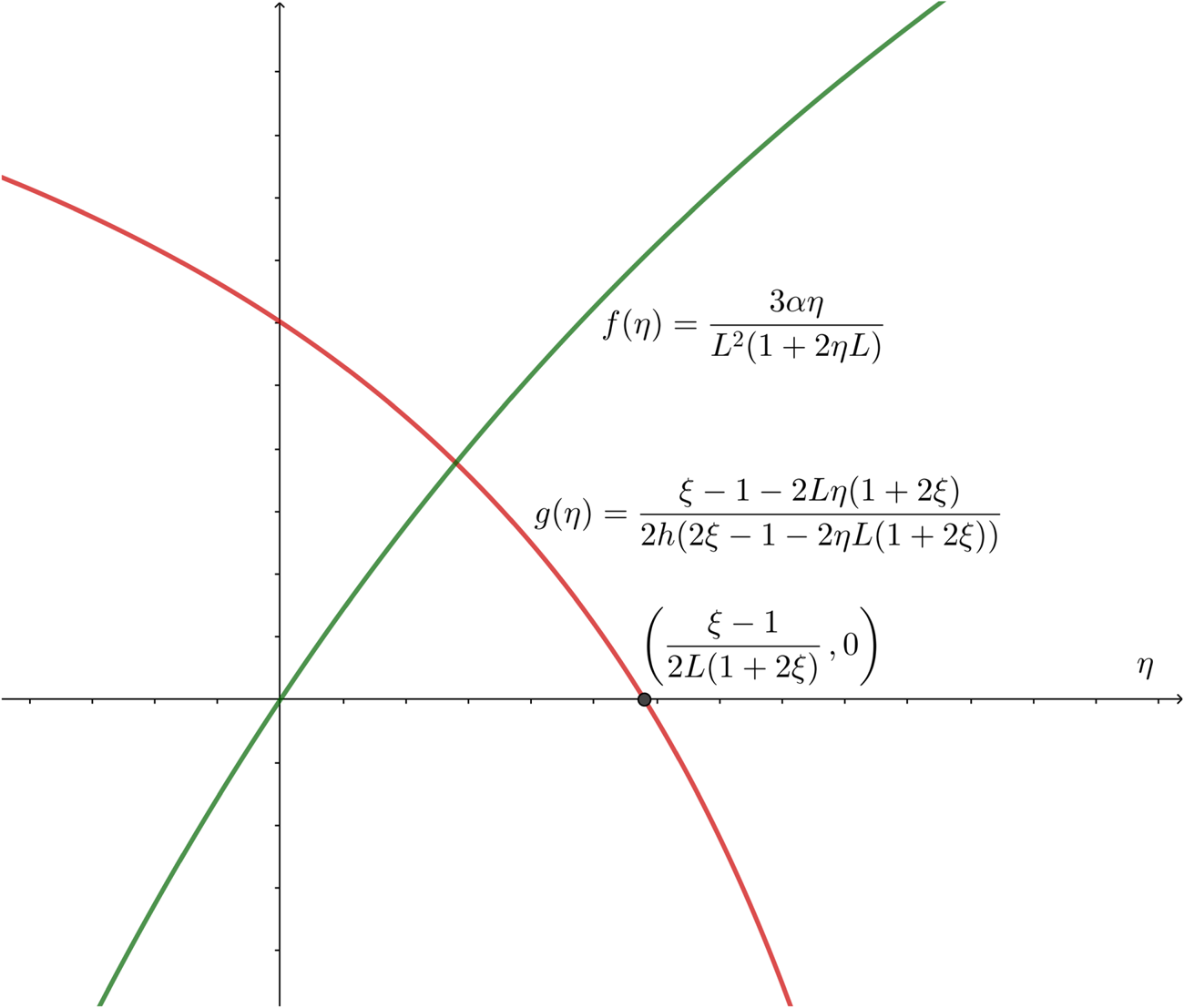
is the largest possible, which implies that the decay rate $\theta$ obtained in this way, is the best one. It can be shown defining functions $f,\, g : [0,\,\frac {\xi -1}{2L(1+2\xi )}] \longrightarrow \mathbb {R}$ by
\[ f(\eta)= \frac{3\alpha\eta }{L^2(1+2\eta L)}, \quad g(\eta)= \frac{\xi-1-2L\eta(1+2\xi)}{2h(2\xi-1-2\eta L(1+2\xi))}, \]and considering $\gamma (\eta )=\min \{f(\eta ),\,g(\eta )\}$
. So, the function $f$ is increasing in the interval $[0,\,\frac {\xi -1}{2L(1+2\xi )})$ while the function $g$ is decreasing in this same interval. In fact, note that
\[ f(\eta)= \frac{3\alpha}{2L^3}\left(1-\frac{1}{1+2\eta L}\right) \]and
\[ g(\eta)= \frac{1}{2h}-\left(\frac{\xi}{4hL(1+2\xi)}\right)\left(\frac{1}{\frac{\xi}{2L(1+2\xi)}+\frac{\xi-1}{2L(1+2\xi)}-\eta}\right). \]If $-\frac {1}{2L}<\eta$
, then
\[[ f'(\eta)= \frac{3\alpha}{2L^3}\frac{2L}{(1+2L\eta)^2}>0. \]In particular, $f'(\eta )>0$
when
\[ \eta \in \left[0,\frac{\xi-1}{2L(1+2\xi)}\right). \]Analogously,
\[ g'(\eta)={-}\left(\frac{\xi}{4hL(1+2\xi)}\right)\frac{1}{\left(\frac{\xi}{2L(1+2\xi)}+\frac{\xi-1}{2L(1+2\xi)}-\eta\right)^2}<0, \]since $\xi >1$
and $\eta <\frac {\xi -1}{2L(1+2\xi )},$ showing our claim. Now, we claim that there exists only one point satisfying (1.11) such that $f(\eta )=g(\eta )$. To show the existence of this point, it is sufficient to note that $f(0)=0$, $g(\frac {\xi -1}{2L(1+2\xi )})=0$ and
\[ f\left(\frac{\xi-1}{2L(1+2\xi)}\right)=\frac{3\alpha}{2L^3} \left(\frac{3\xi-1}{3\xi}\right)>0, \quad g(0)=\frac{1}{2h}\left(1-\frac{\xi}{2\xi-1}\right)>0. \]The uniqueness follows from the fact that $f$
is increasing while $g$ is decreasing in this interval.
c. Taking into account the above information about $f$
and $g$, the maximum value of the function must be reached at the point $\eta$ satisfying (1.11), where $f(\eta )=g(\eta )$. The figure 1 below shows, in a simple case, what was said earlier to the functions $f$ and $g$ when we consider some values, for example, $L=1$, $\xi =2.3$, $\alpha =0.5$ and $h=1.5$:d. Still concerning the theorem 1.3, observe that we do not need to localize the solution of the transport equation in a small subset of $(0,\,L)$
as in [Reference Valein29, Section 4]. Moreover, we emphasize that we can take $a=0$ in theorem 1.3. Finally, it is important to mention that we do not know if the time $T_{\min }$ is optimal.e. Aiming to present optimal decay results, note that for the nonlinear system, we obtain one stabilization result with no restriction in the length of the spatial domain but carries a restriction in one parameter of the system, see theorem 1.4. Once again, it is possible to waive one of the conditions (either the restriction on $L$
or a restriction in one system parameter). Observe that, using theorem 1.2 like as (2.7) below, we have
(1.12)$$\begin{align} \begin{aligned} \int_0^L\int_0^L u^3(x,y,t)\,{\rm d}x\,{\rm d}y & \leq cL \left\lVert{u_{xx}}\right\rVert_{L^2(\Omega)}^{\frac{1}{2}} \left\lVert{u}\right\rVert_{L^2(\Omega)}^{\frac{5}{2}} \\ & \leq { \frac{1}{4}(CL)^{4} \left\lVert u_{xx} \right\rVert_{L^2(\Omega)}^2 +\frac{3}{4} r^{\frac{4}{3}} \left\lVert u \right\rVert_{L^2(\Omega)}^2.} \end{aligned} \end{align}$$This estimate allows obtaining, with an analogous argument another result for exponential stability without restriction in the parameter $\beta$
but with restriction in the length $L$ of the domain. Thus, in theorem 1.4, we can remove the hypothesis over $\beta$, however, a hypothesis over $L$ is necessary. The result is the following:Theorem 1.6 Local stabilization-bis
Let $0< L< \sqrt [4]{\frac {-30\beta }{C}}.$
Assume that $a(x,\,y)\in L^\infty (\Omega )$ is a non-negative function and that the relation (1.10) holds. Then, there exists $0< r< \frac {\sqrt [4]{216\alpha ^3}}{CL^{\frac {5}{2}}}$ such that for every $(u_0,\,z_0(\cdot,\,\cdot,\,-h(\cdot )))\in \mathcal {H}$ satisfying $\left \lVert {(u_0,\,z_0(\cdot,\,\cdot,\,-h(\cdot )))}\right \rVert _{\mathcal {H}} \leq r$, the energy defined in (1.9) decays exponentially. More precisely, there exists two positives constants $\theta$ and $\kappa$ such that $E_u(t) \leq \kappa E_u(0)e^{-2\theta t}$ for all $t>0,$ where $\theta$, $\kappa$, $\eta$ and $\sigma$ are positive constants defined as in theorem 1.4.
Figure 1.Maximum of $\gamma (\eta )=\min \{f(\eta ),\,g(\eta )\}$
.f. The results obtained here can be easily adapted for the KP-II system (1.2) with or without the drift term $u_x$
, extending the results of [Reference de Moura, Nascimento and Santos10] and [Reference Gomes and Panthee11].


The work is organized as follows:
– § 2 is devoted to proving the first, and optimal, local stability result, that is, theorem 1.3.
– In § 3 we are able to prove the exponential stability, theorem 1.4, for the energy associated with the $\mu _i$ –system (1.8).
– Additionally, to extend the local property to the global one, in § 3 we give the proof of theorem 1.5.
– For the sake of completeness, we present in Appendix A, at the end of the work, the well-posedness of the time-delayed K-KP-II system.
2. The damping-delayed system: optimal local result
This section deals with the behavior of the solutions associated with (1.5). The first result ensures local stability considering the perturbed system. After that, we are in a position to prove the first main result of the article, theorem 1.3.
2.1 Preliminaries
We are interested in analysing the well-posedness of (1.5) with total energy associated defined by (1.6) that satisfies

This implies that the energy is not decreasing, in general, since the term $b(x,\,y)\geq 0$ . So, we consider the following perturbation system

with $f=-\frac {1}{2}\partial _x(u^2(x,\,y,\,t)$ , which is ‘close’ to (1.5), where $\xi$
 a positive constant, and now the following energy associated with the perturbed system

is decreasing. In fact, note that

for $\xi >1$ . Note that system (2.1) can be written as a first-order system

Here $A = A_0+B$ with domain $D(A)=D(A_0)$
 , $A_0$
 is defined by

and the bounded operator $B$ is defined by $B(u,\,z) = (\xi b(x,\,y)u,\, 0),$
 for all $(u,\,z)\in \mathcal {H}$
 . Observe that system (2.3) has a classical solution (see proposition A.2).
Consider $(e^{A_0t})_{t\geq 0}$ the $C_0$
 –semigroup associated with $A_0$
 . First, let us prove the exponential stability of system (2.1), with $f=0$
 , by using Lyapunov's approach. To do that, let us consider the following Lyapunov's functional

where $\eta$ and $\sigma$
 are suitable constants to be fixed later, $E_u(t)$
 is the energy defined by (2.2), $V_1(t)$
 is giving by

and $V_2(t)$ is defined by

Note that $E_u(t)$ and $V(t)$
 are equivalent in the following sense

Then, we have the next results for exponential stability to the system (2.1) with $f=0$ .
Proposition 2.1 Let $L>0$ . Assume that $a(x,\,y)$
 and $b(x,\,y)$
 belonging to $L^\infty (\Omega )$
 are non-negative functions, $b(x,\,y) \geq b_0 >0$
 in $\omega$
 and $\xi >1$
 . Then for every $(u_0,\,z_0(\cdot,\,\cdot,\,-h(\cdot )))\in \mathcal {H}$
 the energy defined in (2.2) decays exponentially. More precisely, there exists two positives constants $\theta$
 and $\kappa$
 such that $E_u(t) \leq \kappa E_u(0)e^{-2\theta t}$
 for all $t>0.$
 Here,

and $\eta$ and $\sigma$
 are positive constants such that $\sigma = \xi -1 -2L\eta (1+2\xi )$
 and $\eta < \frac {\xi -1}{2L(1+2\xi )}.$

Proof. Consider $(u_0,\,z_0(\cdot,\,\cdot,\, - h(\cdot ))) \in D(A_0)$ . Let $u$
 be the solution of the linear system associated with (2.1). Differentiating (2.4) and using (2.1)$_1$
 , we obtain

Therefore, for $\theta >0$ , $\eta$
 and $\sigma$
 chosen as in the statement of proposition we have $\frac {{\rm d}}{{\rm d}t} V(t) + 2 \theta V(t) \leq 0,$
 which is equivalent to

thanks to (2.5).
The next result shows that the energy (1.6) associated with the system (2.1) with appropriate source term $f$ decays exponentially.
Proposition 2.2 Consider $a(x,\,y)$ and $b(x,\,y) \in L^\infty (\Omega )$
 non-negative functions, $b(x,\,y) \geq b_0 >0$
 in $\omega$
 and $\xi >1$
 . So, there exists $\delta > 0$
 such that if $\lVert \beta \rVert \leq \delta$
 then, for every initial data $(u_0,\, z_0(\cdot,\,\cdot,\,-h(\cdot )) \in \mathcal {H}$
 the energy of the system $E_u(t)$
 , defined in (1.5) is exponentially stable.
Proof. Consider a function $v$ satisfying system (2.1) with $f=0$
 , initial condition $v(x,\,y,\,0)=u_0(x,\,y)$
 , and $z^1(1)=u(x,\,y,\,t-h)$
 where $z^1$
 satisfies

and $w$ satisfying the source system associated with (2.1) with $f=\xi b(x,\,y)v(x,\,y,\,t)$
 , initial condition $w(x,\,y,\,0)=0$
 and $z^2(1)=u(x,\,y,\,t-h)$
 where $z^2$
 satisfies

Define $u = v + w$ and $z = z^1 + z^2$
 , then $u$
 satisfies the linear system associated with (1.5) where $z(1)=u(x,\,y,\,t-h)$
 with $z$
 satisfying equation (A.1).
Now, fix $0<\mu <1$ and choose

where $\eta,\, \sigma,\, \theta$ and $\kappa$
 are given in the proposition 2.1. As $E_v(0) \leq \xi E_u(0)$
 , it follows that

Observe that

Since $A$ generates a $C_0$
 semi-group we have that

thanks to the fact that

For $\varepsilon >0$ such that $0 < \mu +\varepsilon < 1$
 and

we obtain that,

Finally, considering a boot-strap and induction arguments, for $T_0$ defined by (1.7), we can construct another solution that satisfies the linear system associated with (2.1) such that the following inequality holds $E_u(mT_0) \leq (\mu + \varepsilon )^m E_u(0),\,$
 for all $m\in \mathbb {N}$
 . Picking $t>T_0$
 , we note that there exists $m\in \mathbb {N}$
 such that $t=mT_0+s$
 with $0\leq s < T_0$
 , then

where

showing the result.
2.2 Proof of theorem 1.3
With the previous result in hand, in this section, we are going to prove a local stabilization result with an optimal decay rate. Using the same arguments in § A.3 we have that (1.5) is well-posed. Besides that, we have by using Gronwall's inequality

This implies directly that

and

Now, multiplying system (1.5) by $xu(x,\,y,\,t)$ and integrating by parts in $\Omega \times (0,\,T)$
 we get

From

and taking $E_u(0)\leq 1$ , we infer

where

Observe that, by definition, ${\partial _x^{-1}} u(\cdot,\,\cdot,\, t) = \varphi (\cdot,\,\cdot,\,t) \in H_{x0}^2$ such that $\partial _x\varphi (\cdot,\,\cdot,\,t) = u(\cdot,\,\cdot,\,t)$
 . Since $u\in H_{x0}^2$
 , using Poincaré's inequality, we have that

Therefore,

Let $(u_0,\,z_0(\cdot,\,\cdot,\,-h(\cdot )))$ be a initial data satisfying $\lVert (u_0,\,z_0(\cdot,\,\cdot,\,-h(\cdot )))\rVert _{\mathcal {H}}\leq r,$
 where $r$
 will be chosen later. The solution $u$
 of (1.5) can be written as $u=u^1+u^2$
 where $u^1$
 is the solution of the linear system associated with (1.5) considering the initial data $u^1(x,\,y,\,0)=u_0(x,\,y)$
 and $u^1(x,\,y,\,t) = z_0(x,\,y,\,t)$
 and $u^2$
 fulfills the nonlinear system (1.5) with initial data $u^2(x,\,y,\,0)=0$
 and $u^2(x,\,y,\,t) = 0$
 .
Fix $\mu \in (0,\,1)$ , follows the same ideas introduced by [Reference Capistrano–Filho and Gonzalez Martinez8, Appendix A], there exists, $T_1>0$
 such that

with $\nu$ defined by (2.6), satisfying $E_{u^1}(T_1) \leq \frac {\mu }{2} E_{u^1}(0).$
 This implies together with (2.7) that

where

Therefore, given $\varepsilon >0$ such that $\mu +\varepsilon < 1$
 , we take $r>0$
 such that

to obtain $E_u(T_1) \leq (\mu +\varepsilon ) E_u(0),$ with $\mu +\varepsilon < 1$
 . Using a prolongation argument, first for the time $2T_1$
 and after for $mT_1$
 , the result is obtained. This completes the proof of theorem 1.3.
3. $\mu _i$-system: stability results

The main objective of this section is to prove the local and global exponential stability for the solutions of (1.8) using two different approaches.
3.1 Local stabilization: proof of theorem 1.4
Consider the Lyapunov's functional $V(t) = E_u(t) + \eta V_1(t) + \sigma V_2(t),\,$ where $E_u(t)$
 is defined by (1.9), $V_1(t)$
 defined by (2.4) and

Using the same argument as in the proof of proposition 2.1 we see that

for all $\theta >0$ . Note that, thanks to theorem 1.2 we have

Putting this previous inequality in (3.1), and using Poincaré's inequality and (1.12), we get

Consequently, taking the previous constant as in the statement of the theorem we have that

Finally, from the following relation $E(t) \leq V(t) \leq (1+\max \left \lbrace {2\eta L,\,\sigma }\right \rbrace ) E(t)$ and (3.2), we obtain

and theorem 1.4 is proved.
3.2 Global stabilization: proof of theorem 1.5
As is classical in control theory, theorem 1.5 is a consequence of the existence of a constant $C:=C(T,\,\left \lVert {u_0}\right \rVert _{L^2(\Omega )}^2 )>0$ such that following observability inequality holds

Observe that using the same ideas of (A.7), we get

Moreover, multiplying (A.2)$_5$ by $a(x,\,y)\xi z(x,\,y,\,\rho,\,s)$
 , integrating in $\Omega \times (0,\,1)\times (0,\,T)$
 and taking into account that $z(x,\,y,\,\rho,\,t)=u(x,\,y,\,t-\rho h)$
 we obtain

Gathering (3.4) and (3.5), we see that to show (3.3) is sufficient to prove that for any $T$ and $R>0$
 , there exists $C:=C(R,\,T)>0$
 such that

holds for all solutions of (1.8) with initial data $\left \lVert (u_0,\,z_0(\cdot,\,\cdot,\,-h(\cdot )))\right \rVert _{\mathcal {H}}\leq R$ .
To prove it, let us argue by contradiction. Suppose that (3.6) does not holds, then there exists a sequence $(u^n)_{n}\subset \mathcal {B}_X$ of solutions of (1.8) with initial data $\left \lVert (u_0^n,\,z_0^n(\cdot,\,\cdot,\,-h(\cdot )))\right \rVert _{\mathcal {H}}\leq R$
 such that

where

Let $\lambda _n = \left \lVert u^n \right \rVert _{L^2(0,T,L^2(\Omega ))}$ and $v^n(x,\,y,\,t) = 1/\lambda _n u^n(x,\,y,\,t)$
 , then $v^n$
 satisfies $\eqref {eqn8}_1$
 with the following boundary conditions

and $B(v^n)\to 0$ as $n\to \infty$
 . Therefore, we have from (3.4) that

which together with (3.7)5 and $B(v^n)\to 0$ gives that $(v^n(\cdot,\,\cdot,\,0))_n$
 is bounded in $L^2(\Omega )$
 . Additionally to that, the following inequality (see (3.5))

ensures that $(\sqrt {a(x,\,y)}v^n(\cdot,\,\cdot,\,-h(\cdot )))_n$ is bounded in $L^2(\Omega \times (0,\,1))$
 and from (A.5), $(\lambda _n)_n\subset \mathbb {R}$
 is bounded. On the other hand, as a consequence of proposition A.5, we have that $(v^n)_n$
 is bounded in $L^2(0,\,T,\, H_{x}^2(\Omega ))$
 . Now, using theorem 1.2, we get

and $(v^n v_x^n)_n$ is bounded in $L^2(0,\,T,\,L^1(\Omega ))$
 . Defining $\partial _yv^n =\partial _x \varphi ^n$
 , and using once again theorem 1.2 we have $\left \lVert {\partial _x^{-1}} v_{yy}^n \right \rVert _{L^2(\Omega )} \leq C^2 \lVert v_x^n\rVert _{L^2(\Omega )} < \infty.$
 Consequently, using the Cauchy–Schwarz inequality

Observe that $(v^n)_n$ bounded in $L^2(0,\,T; H_x^2(\Omega ))$
 implies, in particular, that $(v_x^n)_n$
 is bounded in $L^2(0,\,T,\, L^2(\Omega ))$
 , so

where we have used that $H_x^2(\Omega )\subset L^2(\Omega )$ .
Thus, the previous analysis ensures that

is bounded in $L^2(0,\,T,\, H^{-3}(\Omega ))$ , which together with classical compactness results (see, for example, [Reference Simon27]), give us the existence of a sequence $(v^n)_n$
 relatively compact in $L^2(0,\,T,\, L^2(\Omega ))$
 , that is, there exists a subsequence, still denoted $(v^n)_n$
 ,

with $\left \lVert v \right \rVert _{L^2(0,T, L^2(\Omega ))}=1.$
From weak lower semicontinuity of convex functional, we obtain

Since $(\lambda _n)_n$ is bounded, we can extract a subsequence denoted $(\lambda _n)_n$
 which converges to $\lambda \geq 0$
 .
We claim that ${\partial _x^{-1}} \partial ^2_yv^n \rightarrow {\partial _x^{-1}} \partial ^2_yv$ in $L^2(0,\,T,\,H^{-2}(\Omega ))$
 . In fact, from definition of $\mathcal {B}_X$
 we have ${\partial _x^{-1}} v^n = \varphi ^n$
 where $\partial _x\varphi ^n = v^n$
 , $v^n(\cdot,\,\cdot,\,t)\in H_{x0}^1(\Omega )$
 and $\varphi ^n(\cdot,\,\cdot,\,t)\in H_{x0}^1(\Omega )$
 . Since $\partial _x^{-1}\partial ^2_yv^n =\partial ^2_y \varphi ^n$
 we obtain

Therefore, the desired convergence follows from the previous inequality and convergence (3.8).
Finally, from the above convergences $v(x,\,y,\,t)$ satisfies (3.9) and (1.8) with the following conditions

Thus, for $\lambda =0$ we obtain $v=0$
 , thanks to Holmgren's uniqueness theorem, which is a contradiction with the fact that $\left \lVert v \right \rVert _{L^2(0,T, L^2(\Omega ))} = 1$
 . Otherwise, if $\lambda >0$
 , we can show that $v\in L^2(0,\,T,\, H_x^5(\Omega )\cap X^2(\Omega ))$
 and applying [Reference de Moura, Nascimento and Santos10, Theorem 1.2], follows that $u\equiv 0$
 in $\Omega \times (0,\,T)$
 , achieving theorem 1.5.
Acknowledgements
The authors are grateful to the anonymous reviewer for their constructive comments and valuable remarks that improved the work.
Capistrano–Filho was supported by CAPES grant numbers 88881.311964/2018-01 and 88881.520205/2020-01, CNPq grant numbers 307808/2021-1 and 401003/2022-1, MATHAMSUD grant 21-MATH-03 and Propesqi (UFPE). Muñoz acknowledges support from FACEPE grant IBPG-0909-1.01/20. This work is part of the Ph.D. thesis of Muñoz at the Department of Mathematics of the Universidade Federal de Pernambuco and the author would like to thank the Department of Mathematics at Universidade Federal da Pernambuco for the pleasant and productive period during his Ph.D. at that institution.
Appendix A.
In this appendix, we deal with the well-posedness of the $\mu _i$ –system (1.8) which provides essential tools to obtain the stabilization results for system (1.5). Since the results are classical, we just give the main results and the idea of the proofs.
A.1 Well-posedness of the linear system associated with the $\mu _i$–system (1.8)

Here, we use the semigroup theory [Reference Pazy25] to obtain well-posedness results for the linear system associated with (1.8). To do that, consider $z(x,\,y,\,\rho,\,t)=u(x,\,y,\,t-\rho h)$ , for $(x,\,y)\in \Omega$
 , $\rho \in (0,\,1)$
 and $t>0$
 . Then $z(x,\,y,\,\rho,\,t)$
 satisfies the transport equation

Let $\mathcal {H}=L^2(\Omega )\times L^2(\Omega \times (0,\,1))$ , which is a Hilbert space endowed with the inner product

where $\xi$ satisfies (1.10). To study the well-posedness in the Hadamard sense (see, e.g. [Reference Tikhonov and Arsenin28]), we need to rewrite the linear system associated with (1.8) as an abstract problem. Let $U(t)=(u(\cdot,\,\cdot,\,t),\, z(\cdot,\,\cdot,\,\cdot,\,t))$
 and denote $z(1):=z(x,\,y,\,1,\,t)$
 . From the linear system associated with (1.8) and (A.1) we get the next system

which is equivalent to

where $A\colon D(A)\subset \mathcal {H}\to \mathcal {H}$ is defined by

and the dense domain $D(A)$ given by

The next result is classical and its proof will be omitted.
Lemma A.1 The operator $A$ is closed and its adjoint $A^\ast \colon D(A^\ast )\subset \mathcal {H}\to \mathcal {H}$
 is given by

with dense domain

Proposition A.2 Assume that $a\in L^\infty (\Omega )$ is a non-negative function and (1.10) is satisfied. Then $A$
 is the infinitesimal generator of a $C_0$
 -semigroup in $\mathcal {H}$
 .
Proof. Let $U=(u,\,z)\in D(A)$ . Thus

Hence, for $\lambda =\frac {\xi \left \lVert {a}\right \rVert _\infty }{2h}$ we have $\left \langle (A-\lambda I)U,\,U\right \rangle _\mathcal {H}\leq 0$
 (resp. $\left \langle (A^\ast -\lambda I)U,\,U\right \rangle _\mathcal {H} \leq 0,$
 for $U=(u,\,z)\in D(A^\ast )$
 ). Since $A-\lambda I$
 is a densely defined closed linear operator, and both $A-\lambda I$
 and $(A-\lambda I)^\ast$
 are dissipative, $A$
 generate an infinitesimal $C_0$
 -semigroup on $\mathcal {H}$
 .
The next theorem establishes the existence of solutions for the abstract Cauchy problem (A.3). This result is a consequence of the previous proposition.
Theorem A.3 Assume that $a\in L^\infty (\Omega )$ and (1.10) is satisfied. Then, for each initial data $U_0\in \mathcal {H}$
 there exists a unique mild solution $U\in C([0,\,\infty ),\, \mathcal {H})$
 for the system (A.3). Moreover, if the initial data $U_0\in D(A)$
 then the solutions are classical, i.e., $U\in C([0,\,\infty ),\, D(A))\cap C^1([0,\,\infty ),\, \mathcal {H}).$

Next results are devoted to showing a priori and regularity estimates for the solutions of (A.3).
Proposition A.4 Let $a\in L^\infty (\Omega )$ be a non-negative function and suppose that (1.10) holds. Then, for any mild solution of (A.3) the energy $E_u$
 , defined by (1.9), is non-increasing and there exists a constant $C>0$
 such that

where $C=C(\beta,\,\gamma,\,\xi,\,h,\,\mu _1,\,\mu _2)$ is given by

Proof. First, multiply (A.2)$_1$ by $u(x,\,y,\,t)$
 and integrate by parts in $L^2(\Omega )$
 . Next, multiply (A.2)$_5$
 by $z(x,\,y,\,\rho,\,t)$
 and integrate by parts in $L^2(\Omega \times (0,\,1))$
 . Finally, adding the results we obtain the proposition statement.
To use the contraction principle and to obtain the Kato smoothing effect (see, for example, [Reference Linares and Ponce20]), for $T>0$ , we introduce the following sets:

endowed with its natural norms

Here, $X_{x0}^2(\Omega )$ denotes the space

Proposition A.5 Let $a\in L^\infty (\Omega )$ be a non-negative function. Then, the map

is continuous and for $(u_0,\, z_0(\cdot,\,\cdot,\,-h(\cdot )))\in \mathcal {H}$ , the following estimates are satisfied


and

Proof. The proof is classical and uses the Morawetz multipliers (see, for instance, [Reference Komornik18]). In fact, (A.5) follows from (A.4). To get the other two inequalities for $(u_0 ,\, z_0(\cdot,\,\cdot,\, -h(\cdot )))\in \mathcal {H}$ , we multiply (A.2)$_{5}$
 by $z(x,\,\rho,\,t)$
 and (A.2)$_{1}$
 by $xu(x,\,y,\,t)$
 and integrating by parts in $\Omega \times (0,\,T)$
 , (A.6) holds. Finally, multiplying (A.2)$_{1}$
 by $(T-t)u(x,\,y,\,t)$
 and integrating by parts in $\Omega \times (0,\,T)$
 we obtain (A.7).
A.2 Well-posedness of linear $\mu _i$–system with a source term

We will study system (A.2), with a source term $f(x,\,y,\,t)$ on the right-hand side. The next result ensures the well-posedness of this system.
Proposition A.6 Assume that $a(x,\,y)\in L^\infty (\Omega )$ is a non-negative function and that (1.10) is satisfied. For any $(u_0,\,z_0(\cdot,\,\cdot,\, -h(\cdot )))\in \mathcal {H}$
 and $f\in L^1(0,\,T,\,L^2(\Omega ))$
 , there exists a unique mild solution for (A.2) with the source term $f(x,\,y,\,t)$
 on the right-hand side in the class $(u,\,u(\cdot,\,\cdot,\, t-h(\cdot )))\in \mathcal {B}_X\times C([0,\,T],\, L^2(\Omega \times (0,\,1))).$
 Moreover, we have

and

where

and $\delta =\min \left \lbrace {1,\,3\alpha /2,\, -5\beta /{2}}\right \rbrace$ .
Proof. Note that $A$ is an infinitesimal generator of a $C_0$
 -semigroup $(e^{tA})_{t\geq 0}$
 satisfying $\left \lVert {e^{tA}}\right \rVert _{\mathcal {L}(\mathcal {H})}\leq e^{\frac {\xi \left \lVert {a}\right \rVert _\infty }{2h}t}$
 and the system can be rewritten as a first order system with source term $(f(\cdot,\,\cdot,\,t),\,0)$
 , showing the well-posed in $C([0,\,T],\,\mathcal {H})$
 . Finally, observe that the right-hand side is not homogeneous, since

This proves the result.
A.3 Nonlinear system: global results
In this last subsection of the Appendix, we consider the nonlinear term $uu_x$ as a source term.
Proposition A.7 If $u\in \mathcal {B}_X$ then $uu_x\in L^1(0,\,T; L^2(\Omega ))$
 and the map $u\in \mathcal {B}_X \mapsto u\partial _xu\in L^1(0,\,T; L^2(\Omega ))$
 is continuous. In particular, there exists a constant $K>0$
 , such that, for all $u,\,v\in \mathcal {B}_X$
 we have

Proof. The Hölder inequality and the Sobolev embedding $H_{x0}^2(\Omega )\hookrightarrow L^\infty (\Omega )$ (for details, see [Reference Brezis4]) gives us

for $u,\,v\in \mathcal {B}_X$ . Note that, $u\in \mathcal {B}_X$
 implies that $u(\cdot,\,\cdot,\, t)\in H_{x0}^2(\Omega )$
 and consequently $u(\cdot,\,\cdot,\,t)\in H_{x0}^1(\Omega )$
 and $u_x(\cdot,\,\cdot,\,t)\in H_{x0}^1(\Omega )$
 . Here, using the definition of the operator ${\partial _x^{-1}}$
 and the Poincaré's inequality (see e.g. [Reference Brezis4]) we obtain,

So, from (A.10), with $v=0$ , and (A.11) we get $u\partial _xu \in L^1(0,\,T,\, L^2(\Omega ))$
 and the proof is complete.
We prove the global well-posedness of the K-KP-II with delay term.
Proposition A.8 Let $L>0$ , $a(x,\,y)\in L^\infty (\Omega )$
 be a non-negative function and assume that (1.10) holds. Then, for all initial data $(u_0,\,z_0(\cdot,\,\cdot,\, -h(\cdot ))\in \mathcal {H}$
 , there exists a unique $u\in \mathcal {B}_X$
 solution of (1.8). Moreover, there exist constants $\mathcal {C}>0$
 and $\delta \in (0,\,1]$
 such that

Proof. To obtain the global existence of solutions we show the local existence and use the following a priori estimate, which is proved using the multipliers method and Gronwall's inequalityFootnote 5:

From (A.12) we infer the local existence and uniqueness of solutions of (1.8). In fact, pick $(u_0,\,z_0(\cdot,\,\cdot,\,-h(\cdot )))\in \mathcal {H}$ and $u\in \mathcal {B}_X$
 , consider the map $\Phi \colon \mathcal {B}_X\to \mathcal {B}_X$
 defined by $\Phi (u)=\tilde {u}$
 , where $\tilde {u}$
 is solution of (1.8) with the source term $f=-u\partial _xu$
 . Then, $u\in \mathcal {B}_X$
 is the solution for (1.8) if and only if $u$
 is a fixed point of $\Phi$
 . To show this, we need to prove that $\Phi$
 is a contraction.
If $T<1$ then from (A.8), (A.9) and proposition A.7 we get

and

where $S=\sqrt {\delta ^{-1}\mathcal {C}}\cdot C_1\cdot C$ . Now, consider the application $\Phi$
 restricted to the closed ball $\left \lbrace { u\in \mathcal {B} \colon \left \lVert {u}\right \rVert _{\mathcal {B}_X}\leq R }\right \rbrace,\,$
 with $R>0$
 such that $R=4\sqrt {\delta ^{-1} \mathcal {C}} \lVert (u_0,\, z_0(\cdot,\,\cdot, - h(\cdot )) \rVert _{\mathcal {H}}$
 and $T>0$
 satisfying

Therefore, it is easy to show that $\Phi$ is a contraction. From Banach's fixed point theorem, application $\Phi$
 has a unique fixed point.