INTRODUCTION
Review of control structures
Within the framework of Generative Grammar, control theory addresses how a referent is assigned to the unspoken subject of non-finite clauses. This unspoken subject is indicated in notation by the empty category PRO, and the assigned referent is indicated through the use of corresponding subscripts. When two spoken or unspoken elements refer to the same thing, they are said to be co-referential. PRO can occur in non-finite subject, adjunct and complement clauses, shown in (1a, b, c) respectively.
(1a) PROi To eat fruit is a pleasure.
(1b) The dogi whined (in order) PROi to go outside.
(1c) Erniei decided to PROi buy some flowers.
Notice that in (1c) Ernie is both the one doing the deciding and the one understood to be doing the buying. In (1a), the referent is not provided within the sentence and as a result there is no corresponding subscript indicated. The data presented in the present study are primarily concerned with non-finite sentential complements (as in 1c), so other clause types (as in 1b) will not be explored further here.
Non-finite sentential complements (e.g. 1c), vary along two dimensions which affect the interpretation of PRO, illustrated in (2).
(2a) Erniei tried PROi to play the flute.
(2b) The mother said PROi to play outside.
(2c) The waiteri promised the patron PROi to bring the food.
(2d) The teacher told the classi PROi to start the test.
(2e) The girli wanted PROi to wear a hat.
(2f) *Ernie tried Elmoi PROi to play.
One distinction is whether the matrix verb takes an argument in addition to the complement clause. Examples (2a, b, e) illustrate cases where the only verb arguments are the subject and the complement clause; examples (2c, d) involve the addition of a third argument. A second distinction has to do with the referent of PRO. When PRO refers to the subject of the matrix clause, as in (2a, c, e), this is termed subject control. PRO can also refer to the object of the matrix clause, as in (2d), called object control. Sometimes the referent for PRO is only recoverable from the discourse, as in (2b). Matrix verbs that can take non-finite complements are termed control verbs. The control properties of PRO and the presence or absence of a direct object are often considered to be lexical properties of control verbs, which must be learned along with the verb itself (Bock & Levelt, Reference Bock, Levelt and Gernsbacher1994).Footnote 1
Theories related to the acquisition of control
Although adults readily recover the meaning of PRO, children have more difficulty with this task. Children's production and comprehension of control structures have been well examined in an attempt to explain why children systematically misinterpret PRO in certain structures and when and how children begin to accurately assign a referent to PRO. A seminal study by Carol Chomsky (Reference Chomsky1969) explored the ability of children aged 5 ; 0–10 ; 0 to assign referents to PRO through a series of interviews about the words promise, ask and tell (among other things). She found that children gradually develop accurate assignment of reference during this time and that use of promise may develop as late as age 9 ; 0 and the use of ask in certain complex contexts may continue to develop beyond the age of the oldest children in the study.
The gradual acquisition of ask and promise was attributed to the fact that they violated the Minimal Distance Principle, which states that the unspoken referent will refer to the nearest preceding referent in the surface structure (Chomsky, Reference Chomsky1969). This account focused on the fact that promise and ask do not assign reference in the same way that more frequent verbs such as tell do. Specifically children had to overcome their understanding of how tell worked in order to use the less common verbs promise and ask appropriately. Since that time, these findings have been replicated and extended to other cases. A variety of theories have been put forth to explain children's difficulty with assigning reference which encompass the findings reported above. The theories can be broadly cast into two types: a lexical approach and a syntactic approach.
Lexical accounts
McDaniel, Hsu, Cairns & colleagues (Cairns, McDaniel, Hsu & Rapp, Reference Cairns, McDaniel, Hsu and Rapp1994; Hsu, Cairns, Eisenberg & Schlisselberg, Reference Hsu, Cairns, Eisenberg and Schlisselberg1989; Hsu, Cairns & Fiengo, Reference Hsu, Cairns and Fiengo1985; McDaniel, Cairns & Hsu, Reference McDaniel, Cairns and Hsu1991) have proposed an account that focuses on growth in the lexical–syntactic interface. Following Tavakolian (Reference Tavakolian1977), this account suggests that children initially treat all pairs of clauses as coordinate clauses. As they learn about individual verb properties and identify verbs that subcategorize for sentence complements, children begin to subordinate those complements and interpret PRO (and pronouns) in complement clauses correctly. Such an account allows for the piecemeal development of the proper reference for PRO across different clause types because it depends on lexical development, which is expected to be gradual and individualized.
The primary area of growth and change, then, is hypothesized to be within the lexicon. The change that is occurring based on lexical knowledge has a direct bearing on syntax because it dictates whether the complement clause is attached as a coordinate or subordinate (or adjunct) clause. The location and structure of the attachment site affects the structural relationship between PRO and its potential referents, which partially determines the referent of PRO. Critically, children are hypothesized to properly attach complement clauses very early, with mastery of other clause types occurring later. Of the five stages of development of PRO hypothesized by McDaniel, Hsu & Cairns (Cairns et al., Reference Cairns, McDaniel, Hsu and Rapp1994; McDaniel et al., Reference McDaniel, Cairns and Hsu1991), only the first stage, which is limited to children aged 5 ; 1 and younger, involves difficulty with the interpretation of PRO in sentential complements due to misattachment.
When this account attempts to explain the acquisition of control in adjunct clauses (as in 1b), it seems to suggest that children rely on a default strategy (coordination) until they acquire the lexical item (an adverbial conjunct) at which point they are able to function in a more adult-like matter (Cairns et al., Reference Cairns, McDaniel, Hsu and Rapp1994; McDaniel et al., Reference McDaniel, Cairns and Hsu1991). The data reported above suggest that it is difficult to attribute problems with subject and object control in non-finite complement clauses to misattachment. Rather, the difficulties tend to be attributed to piecemeal acquisition of verbs and their control properties. The theory is relatively silent on the strategies children employ in non-finite complements when they do not know the properties of a verb. However, it should be possible to extend the general principle of a default strategy from the attachment of clauses to the choice of subject/object control for verbs. Presumably children will rely on a default strategy and attempt to assign reference in a consistent way when they lack evidence to the contrary.
Syntactic accounts
An alternative account, proposed by Carlson (Reference Carlson, Frazier and de Villiers1990) and extended by Wexler (Reference Wexler, Larson, Iatridou, Lahiri and Higginbotham1992), posits that the central area of development related to the interpretation of PRO is the maturation of PRO itself, or more specifically to the maturation of empty categories as a class. They argue that PRO is temporarily unavailable, so children interpret the clause as a nominal clause instead of interpreting it appropriately. Thus, PRO has a free or arbitrary interpretation. Once the children's use of PRO matures, children begin to appropriately interpret control structures. The use of nominals is, in essence, a coping strategy available from within Universal Grammar for use when the child is unfamiliar with the structure presented. In this case, what matures is the empty category PRO. This account would predict that children either consistently have free interpretation of PRO (as with a nominal interpretation) or consistently interpret PRO correctly.
Lexical development does play some role in this account. Wexler states that nominal interpretations may remain in the grammar in some cases because both nominal and non-finite interpretations of the same morpheme are permissible (as with -ing, e.g. The children ienjoyed PRO isinging the songs, The children enjoyed the singing of the songs, Cookie Monster itouches Grover after PRO ijumping over the fence; examples from Wexler, Reference Wexler, Larson, Iatridou, Lahiri and Higginbotham1992: 257, 265), but he also acknowledges that the non-finite morpheme to is not a nominalizing morpheme and that alternate interpretations should be eliminated once PRO becomes available (p. 271). Children should readily learn the status of non-alternating morphemes and avoid most misinterpretations once PRO has matured. Thus Wexler holds that children demonstrate two stages of development of PRO in non-finite complement clauses – one involving free interpretation of PRO and one involving adult-like interpretation of PRO.
Summary and purpose
The above two theories of linguistic development compete to explain the difficulties that children have with the acquisition of control in non-finite complement clauses. Although both accounts acknowledge that there is a protracted period of development associated with control structures, they posit two different means of accounting for this delay. Broadly speaking, one hypothesis posits the gradual acquisition of lexical items as a means of accounting for the developmental path. Such an account would predict that children have a default strategy which they rely on until they acquire lexically specific information which forces them to apply a different strategy.
The other hypothesis suggests that maturation of syntactic classes accounts for the available information about children's development of PRO. This syntactic account would predict that children either misinterpret PRO with a nominal interpretation or have an adult-like interpretation of PRO. Although the theory states that these two interpretations can co-exist for a period of time, at some point the child comes to rely primarily on the adult-like interpretation of PRO in complement clauses and only applies nominal interpretations to appropriately nominal contexts. In what follows, we present elicited and spontaneous data that shed light on each of these accounts.
METHOD
Participants
Twenty typically-developing children between the ages of 4 ; 0 and 7 ; 11 participated in this study (9 four-year-olds, 4 five-year-olds, 4 six-year-olds and 3 seven-year-olds). These children were members of the typically-developing control groups in a larger study examining the ability of children with specific language impairment to produce finite and non-finite complement clauses. All children performed within normal limits on tests related to syntax and vocabulary. Additional subject characteristics are reported in Owen & Leonard (Reference Owen and Leonard2006). An additional 6 typically-developing children (4 four-year-olds and 2 five-year-olds) were examined as part of the larger study and are not reported here because they did not pass the verb screening described below.
Procedures
Each child participated in a speech and language assessment battery, two formal language samples (expository and narrative), a verb comprehension screener and two lists of 32 puppet shows each designed to elicit simple finite and non-finite complement clauses (termed monotransitive complement clauses by Eisenberg & Cairns, Reference Eisenberg and Cairns1994, such as Ernie remembered to wear a hat, Ernie remembered that Elmo wore a hat). Each of these elements will be described in more detail below. The children also participated in two lists of 24 puppet shows, each of which was designed to elicit finite and non-finite complement clauses plus an object complement (termed ditransitive complement clauses by Eisenberg & Cairns, Reference Eisenberg and Cairns1994, such as Ernie reminded Elmo to wear a hat, Ernie reminded Elmo that Big Bird wore a hat), which are not reported here.
Experimental sessions were conducted at Purdue University in the M.D. Steer Speech, Language and Hearing clinic and were usually spaced approximately one week apart. Most children participated in five to six experimental sessions, each lasting approximately an hour. The number of sessions was variable to accommodate fatigue and individual children's rate of progress through the experimental tasks and assessment protocol. During their first visit to the lab, children's speech and language abilities were assessed using standardized and non-standardized measures. Children also participated in the expository language sample and received the verb comprehension screener prior to completion of any experimental items. In each of the remaining four sessions, children received one of the four lists of experimental items (counterbalancing across the two experiments and the two lists of items within each experiment). Additional speech and language testing was administered to complete the hour-long session. If any assessments remained at the end of the last experimental session, children were asked to return for a sixth visit to complete the testing. During the children's final visit to the lab, the narrative language sample was elicited.
Language sample elicitation
Language samples were formally elicited from all children in two different contexts: an expository context and a narrative context. The expository context was modeled after Nippold & colleagues' elicitation methods (Nippold, Hesketh, Duthie, Moran, Gillon & Anderson, Reference Nippold, Hesketh, Duthie, Moran, Gillon and Anderson2003) and required the child to teach the experimenter a familiar game. The narrative samples were spontaneous and cued stories, based on the wordless book and video Picnic (Bresnahan, Reference Bresnahan and Gagne1991; McCully, Reference McCully1984). In addition, all conversation during the experimental sessions was transcribed, constituting a third, conversational, context. The language samples served two purposes: (1) in conjunction with a comprehension measure, the language samples provided evidence of the children's ability to use and understand the verbs elicited during the experimental tasks; and (2) the language samples ensured that the ability to produce utterances as long or longer than the elicited responses was within the capabilities of all children in the study.
Verb comprehension screener
In order to establish whether the children had at least minimal knowledge of the lexical properties of verbs they were to use in the elicitation task, a screening task was developed to demonstrate the children's understanding of the meanings of the verbs to be employed in the probes described here (know, forget, remember and decide), plus three more verbs used in the larger study (advise, tell, remind). The videos were meant to convey the basic semantic components of the verb, but children did not have to understand the syntactic frame in order to answer correctly. For instance, to demonstrate decide, two children in the video studied a table with several toys on it and then pointed to the one they wanted, which was then handed to them. This video was contrasted with one depicting learning, in which an adult helped a child to tie her shoe and then the child attempted to do it on her own.
The children participated in the verb comprehension screener prior to participating in the experimental tasks. Each child viewed 7 pairs of videos, which consisted of 1 scene that illustrated a verb included in the experimental item and 1 scene illustrating a contrasting verb. Three additional action-verb pairs were used as teaching trials/foils. Children were asked to watch both of the videos in the pair and then point to a still clip from the video that went with the word that the experimenter said.
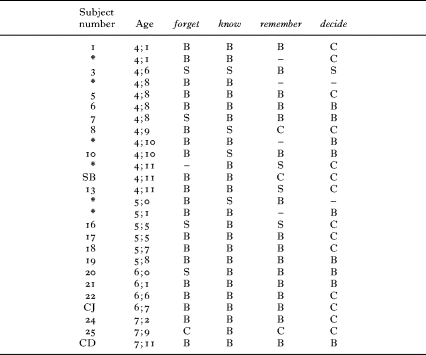
Only children who could be considered to have some understanding of the verbs' lexical meanings are included in the results reported here. Children were considered to have minimal knowledge of a given verb if they either were able to choose the correct item in the comprehension screening or if they used the verb spontaneously during one of the language sample contexts (see Table 1 for a list of children who passed, based on each criterion for each verb).
Method of children's demonstration of verb comprehension

This table shows how children demonstrated that they had basic understanding of the verbs tested in the elicited production task. Children who were used in the case studies have had their subject number replaced with initials. Children who were excluded have their subject number replaced by an asterisk.
B=demonstrated knowledge through the comprehension screener and spontaneous use.
C=passed the comprehension screener.
S=used the verb spontaneously in a language sample.
– indicates that the child failed to indicate knowledge of the verb and was excluded from further analyses.
Sentence elicitation task
Two different types of sentence complements were elicited, using four different verbs as matrix verbs (know, remember, forget and decide). Each of these verbs served as a matrix verb for 16 items, 8 of each complement type, resulting in 64 items in total. The elicitation of the complement clauses was blocked by complement clause type. Thus one block of 32 items consisted of simple finite sentence complements, and another block of 32 items were non-finite complement clauses. All of the non-finite complement clauses required subject control. Each list was presented on a different day, usually a week apart. Order of presentation was counterbalanced across children.
The four matrix verbs were chosen because they all take both finite and non-finite complements and do not allow an additional noun phrase (*Ernie decided Elmo to wear a hat, *Ernie decided Elmo that Bigbird should wear a hat). Brief puppet show enactments were used to elicit the children's responses. Children watched the show and then were prompted by the experimenter to complete the sentence. The items and characters used in acting out the scenario were left in sight of the child to serve as memory aids while the child formulated a response. All of the matrix verbs occurred in the past tense with third person singular subjects to ensure that the matrix clause was treated as a proposition and not a discourse marker (Diessel & Tomasello, Reference Diessel and Tomasello2001).
The puppet shows were designed to be biasing situations to encourage children to use the target complement clause type. For instance, situations used to elicit finite complements deliberately used two different characters for the actions in the matrix and subordinate clauses. This meant that the subject of each clause could not be co-referential, making a finite complement clause obligatory. For example, to elicit the sentence The Count decided that Cat should eat the cookies, the following scenario was enacted.
(3) Cat: I want to eat something. I can't decide. What should I eat? Count, help me decide. (Cat is looking at a cupcake and some cookies)
The Count: I'll decide. You should eat the cookies. (Count points to cookies and Cat eats the cookies)
Exp1: What did The Count decide?
Exp2: The Count decided …
Child: … (that) Cat should eat the cookies
Only a finite complement is grammatical in this case. A non-finite complement does not adequately describe the situation (*The Count decided to eat the cookies).
Similarly, situations used to elicit the non-finite complements incorporated only one character to complete both actions, making the subject of the matrix clause and the subject of the complement clause co-referential. For instance, to elicit a sentence like The Count decided to eat a cookie, the following puppet show would be used.
(4) (The Count is looking at a cookie and a cupcake)
The Count: Should I eat a cookie or a cupcake? I can't decide. (pauses, looking back and forth) I know. I'll eat the cookie.
Exp2: What did The Count decide?
Exp1: The Count decided …
Child: … to eat the cookie
This scenario makes a non-finite complement more likely, but not obligatory. That is, both The Count decided to eat a cookie and The Count decided that he should eat a cookie could be felicitous responses.
To be clear, compare the interpretations of the possible statements in (5) against the scenarios shown in (3 & 4).
(5a) The Counti decided PROi/*j to eat a cookie.
(5b) The Counti decided that hei/j should eat a cookie.
(5c) The Counti decided that Catj should eat a cookie.
It is important to note that a simple non-finite complement (5a) can be converted to a simple finite complement (5b) without significant change in meaning. This is possible provided that the pronoun used for the subject of the subordinate clause (he) can be construed as referring to the subject of the main clause (The Count). However, the reverse is not true if two different characters are used, as in (3). That is, if there are two distinct actors in the complex sentence, then a finite complement clause (5c) can not be converted to a non-finite complement clause (5a) without substantially altering the meaning of the sentence. Similar issues arise with verbs that take complement clauses plus an object noun phrase, however the critical number of distinct characters required to produce biasing and obligatory situations is increased by 1 in each case (compare Ernie ireminded Elmo jPRO jto wear a hat, Ernie ireminded Elmo jthat he i/j/kshould wear a hat and Ernie ireminded Elmo jthat Big Bird kshould wear a hat).
Transcription and scoring
All responses were audio-recorded and transcribed for later analysis. Inter-transcriber reliability was quite high (approximately 96% for the non-finite condition and 94% for the finite condition) and is reported in detail in Owen & Leonard (Reference Owen and Leonard2006). Children's responses were initially classified as attempting one of the two target complement clauses or as an alternative response. Classification of items was completed from typed transcripts by two experimenters. A third experimenter resolved any disagreements between the first two experimenters. For each item, experimenters were asked to judge whether children were attempting to produce the target utterance. A hierarchy of cues was developed to resolve differences with regard to whether or not the target complement clause was being attempted. These cues are listed in Appendix A and were applied in the order listed. Irrelevant and unclear items were classified as unscorable and excluded from all analyses. Results were recorded as the percentage of scorable items that constituted an attempt at the target structure. Percentages were employed to accommodate the differences among the children in the number of attempts due to unscorable items or items that children did not respond to. Items classified as an alternative subcategorization frame (e.g. a wh-complement clause as in Ernie knew how to build a bookshelf, or a for-to construction, as in Ernie decided for Elmo to wear a hat) were included in this analysis as a part of the denominator of the percentage of target structures attempted by the children. The numerator consisted only of those structures that were finite attempts in the finite condition and non-finite attempts in the non-finite condition.
RESULTS
Group data
Group results will be reported first, followed by three case studies used to illustrate in more detail the types of responses that constituted the group results. Although means and standard deviations reported here will be in percentages, all percentages were arcsine transformed prior to being entered into the ANOVA. Post-hoc testing was completed using Fishers LSD test.
A 2 (target complement clause type)×4 (verb) repeated measures ANOVA was used to examine children's likelihood of attempting each subcategorization frame for each verb. Age in months and MLU in words were each considered separately as covariates but neither were found to be significant, and thus were excluded from the analyses reported below (Age: F(1, 18)=0·16, p=0·698; MLU: F(1, 18)=2·46, p=0·134). There was no main effect for complement clause type, however there was a main effect for verb (F(3, 57)=7·91, p=0·0002), with children producing fewer target complement clauses for the verb decide than for any other verb (all p values <0·006). There were no other differences between the verbs. This main effect is best interpreted in the context of a verb by complement clause type interaction (F(3, 57)=8·55, p<0·0001).
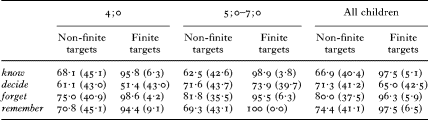
Upon examination of the types of responses (see Table 2), one can see that for all of the verbs except decide the number of attempts at the target complement clause was greater in the finite condition than in the non-finite condition (p<0·05). That is, when they were supposed to produce finite complement clauses, children did so on average more than 90% of the time for the verbs know, forget and remember. However, when they were supposed to produce non-finite complement clauses, they were much less likely to do so for these same verbs. For the verb decide, children produced the target complement clause type much less frequently in the finite condition than for the other verbs (p<0·001). Furthermore, the number of responses that were attempts at the target structure did not differ between the finite and non-finite conditions for decide (p=0·213), unlike the other verbs.
Means (and standard deviations) of the percentage of responses for each verb that were classified as being the targeted complement clause

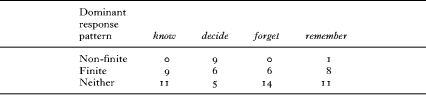
Although the older children were more accurate and less variable overall, the same pattern of results held for both the younger children and the older children included in the study (younger N=9 with ages 4 ; 0–4 ; 11; older N=11, ages 5 ; 1–7 ; 11 – see Table 2). As children got older, they were more likely to use all of the verbs in appropriate ways, including decide, but the difficulty of using a finite complement with decide did not entirely disappear. These results are further supported if we consider the pattern of responses of individual children. As can be seen in Table 3, the non-finite response pattern was dominant for almost half of the participants for the verb decide. This pattern was not a primary response for any of the other verbs (except for 1 child with remember). In fact, for the other verbs, most children tended to use them appropriately (no response bias) or tended to be biased towards a finite response pattern. This information suggests these results do not stem from a few individual children driving the results or from the preponderance of four-year-olds in the sample.
The number of children producing each pattern of responses for each verb

To be classified as using a dominant pattern, that response type had to occur at least 60% of the time with that verb (10 or more responses of a given type, if the child produced a response for every item). Children who used each pattern between 41–59% of the time were not classified as using either pattern dominantly. The expected pattern of responses would be 50% use of each pattern, given the nature of the elicitation scenarios.
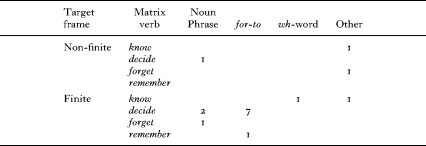
Overwhelmingly, the errors children made were errors of the opposing type of complement clause rather than alternate responses (see Table 4 for the number of different children who produced each type of alternate response). Thus, children were substituting finite complements for non-finite complements for all verbs, and they are accurate responses for the depicted situations (e.g. Ernie remembered that he should wear a hat in place of Ernie remembered to wear a hat). However, for the verb decide, children were also substituting non-finite complements for finite complements, which was not an appropriate response to the situation enacted by the experimenter.
The number of children producing alternate responses for each target complement clause and verb combination

Case studies
These results are perhaps best illustrated through the presentation of 3 case studies. All of the children described here were typically developing, as can be seen by their performance on standardized tests and language samples. The number of complete and intelligible spontaneous utterances in the language sample, MLU in words, and standardized language test results are presented in Table 5 for all three children. Verb screener results can be found in Table 1, where these children's subject numbers have been replaced with their initials.
Standardized test results for children who were used in the case studies

The spontaneous utterances are the number of complete and intelligible utterances obtained from the language samples and used in the case studies. MLU is reported in words. Structured Photographic Expressive Language Test 2nd ed. (SPELT-II, Werner & Kresheck, Reference Werner and Kresheck1974) scores are reported in percentiles, with the typical range being 16th–84th percentile. The Expressive Vocabulary Test (EVT, Williams, Reference Williams1997), Peabody Picture Vocabulary Test 3rd ed., (PPVT-III, Dunn & Dunn, Reference Dunn and Dunn1997) and Columbia Mental Maturity Scales (CMMS, Burgemeister, Blum & Lorge, Reference Burgemeister, Blum and Lorge1972) are reported as standard scores with a mean of 100 and a standard deviation of 15, making the typical range 85–115.
In the first two cases, the children appear to know how to use both finite and non-finite complements on the basis of spontaneous speech samples. However, the children do not always use these complements appropriately in the elicitation tasks and their difficulties seem to be specific to the verb decide. In the third case, the child is highly accurate in her use of finite and non-finite complements both spontaneously and in the experimental task. However, she does make one error with the use of the verb decide, followed by a self-correction, that highlights a weakness in the use of complement clauses.
Case study 1 – CJ 6 ; 7 M
The first child, CJ, was a typically developing boy aged 6 ; 7. In spontaneous speech CJ demonstrated the ability to produce non-finite complement clauses with several verbs, including try, know, forget, want and like.
(6a) He was trying to go to asleep in the grass.
(6b) He tried to sneak out, but he didn't.
(6c) I do not know where to put this one.
(6d) I forgot to do the other ones.
(6e) I like to do different ones of these.
(6f) Blue wants to jump everywhere.
(6g) I just want to flip them up.
The examples in (6a–g) above illustrate CJ's ability to use complement clauses with subject control verbs. In addition to these sentences, which are unambiguously non-finite sentence complements, CJ produced non-finite clauses that could be interpreted as meaning ‘in order to’ rather than being complement clauses (7a) and instances where the main verb may have been functioning as a semi-modal (7b–d) rather than a matrix verb.
(7a) and then drived to find … what's his name I said? … Tim.
(7b) then you have to draw until you get a blue one.
(7c) if you have a circle thing with a line through it, that means the person who layed it down gets to go again.
(7d) I thought you said there were going to be two shows.
Furthermore, CJ demonstrates a clear ability to use finite complement clauses in spontaneous speech, including producing the optional complementizer that (8b, c).
(8a) I thought you said there were going to be two shows.
(8b) I think he knew that the little mouse flew up in the air and then fell onto the ground.
(8c]; I can see that my mom is holding Carlie.
(8d) I thought it was Curious George, but it's a monkey.
Example (8d) further illustrates that CJ understands that the relationship between an embedded clause and a matrix clause depends on the meaning of the matrix clause. That is, he understands that what he thinks may be different from reality and he is able to use language to express that false belief. The examples in (8a, b) also demonstrate more complex utterances which may involve recursion. Whether CJ is actually double embedding in (8a, b) is questionable, and the analysis is dependent upon the way that the first main clause I thought (8a) and I think (8b) are interpreted (see Diessel & Tomasello, Reference Diessel and Tomasello2001 for an in-depth discussion of this issue). Setting the issue of double embedding aside, the examples in (8) suggest that CJ is sophisticated enough to use finite complements appropriately and with a full understanding of their meaning. His speech should not be limited by cognitive or linguistic limitations related to the use of mental verbs.
Despite this high level of competence with complement clauses and mental verbs in spontaneous language, CJ's responses to the experimental items suggest some weaknesses in his ability to use these structures appropriately. Sample responses for finite and non-finite complement clause targets for the verb decide are listed in (9). His responses for the verb remember are listed in (10) and are typical of his responses for know and forget as well. In each case the target is listed in plain text and the child's response is in italics. The experimenter's prompt is underlined. The number of responses similar to the example is given in parentheses following the example.
(9) decide
(9a) Tigger decided that Joe should eat the cookies.
Tigger decided the cookies.(2 examples)
(9b) Thing One decided that Bird should wear the blue hat.
Thing One decided to wear the blue hat.(6 examples)
(9c) Magenta decided to bark at a yellow cat.
Magenta decided to bark at the yellow cat.(8 examples)
(10) remember
(10a) Joe remembered that Tigger washed his face.
Joe remembered that uh Tigger washed his face.(8 examples)
(10b) The Cat remembered to draw a picture.
The Cat remembered that he drawed a picture of a cat. (3 examples)
(10c) Fish remembered to cook dinner.
Fish remembered uh to make the dinner.(5 examples)
As can be seen in the examples above, CJ either gave reduced responses to the finite targets that included decide (9a) or altered the target to a non-finite complement (9b). He never produced an appropriate finite response for the verb decide. All of the non-finite targets were responded to appropriately (9c), suggesting that CJ does understand how decide functions in some cases. In addition, it is clear that CJ understands the task and is able to produce finite responses, because he produced appropriate finite responses for some verbs. For remember (and know and forget) he responded to all of the finite targets with finite complement clauses. However, he did change a few non-finite complements to finite complements. Although there is a subtle difference in meaning between the target and the response in (10b), the response does accurately describe the scenario presented to the child to elicit these responses.Footnote 2
Important for our discussion of the interpretation of PRO is how to analyze CJ's productions of sentences like Thing One decided to wear the blue hat in cases where Thing One is clearly not the character wearing the hat. In fact, the character who completed the action (the Bird) was always left in view of the child, posed to indicate that he was the one who had done the action. Although adults typically interpret decide as a subject control verb and assume that PRO is co-referenced with the subject of the matrix clause, the only way to preserve the original meaning of the target items based on CJ's responses would be for PRO to refer to something within the discourse context. At the same time, CJ is clearly capable of using PROsubj with decide, based on (9c). Thus, there are two possible ways that CJ may be interpreting PRO when he uses decide, neither of which match the adult grammar. Either decide has two potential interpretations of PRO, which would be unusual, or decide always permits free interpretation of PRO, a phenomenon that has been documented in much younger children with control verbs (Eisenberg & Cairns, Reference Eisenberg and Cairns1994).
Case study 2 – SB 4 ; 11 F
Although SB is slightly younger than CJ, she presents with a similar profile. SB is a girl aged 4 ; 11, who was typically developing. She only produced 221 spontaneous utterances across the three contexts used to elicit language samples, during which she produced the verbs forget and know spontaneously. There were fewer instances of non-finite clauses that were unambiguously complement clauses (11a, d) in her spontaneous speech than in CJ's. She also produced some examples that may be interpreted as complement clauses or semi-modals (11b, c).
(11a) Next time I want to pick that.
(11b) I need to find another one of these.
(11c) We have to match them.
(11d) They're getting ready to go to a picnic.
There are no instances of SB producing a finite complement that includes the complementizer that, but there are instances of finite complements without the overt use of that, as seen in (12).
(12d) I think I know where this one is.
(12b) I already know who he is.
(12c) Then they were so happy they weren't even noticing it.
Although SB's spontaneous speech sample was somewhat more limited than CJ's, her responses to the experimental items may demonstrate that she has more competence with the target structures.
(13) decide
(13a) Tigger decided that Joe should eat the cookies.
Tigger decided for Joe to eat the cookies.(4 examples)
(13b) Cookie Monster decided that Duck should push the tractor.
Cookie Monster decided to push the tractor.(4 examples)
(13c) Magenta decided to bark at the yellow cat.
Magenta decided to bark at the yellow cat.(8 examples)
(14) remember
(14a) Joe remembered that Tigger washed his face.
Joe remembered to wash his face.(1 example)
(14b) Joe remembered that Tigger brushed his hair.
Joe remembered Tigger combing his hair.(1 example)
(14c) Thing One remembered that Bob cooked dinner.
Thing One remembered that Bob made dinner.(6 examples)
(14d) The Cat remembered to draw a picture.
The Cat remembered to draw a cat.(8 examples)
SB appears to be slightly more sophisticated than CJ in her use of decide, inasmuch as she uses the complementizer for to preserve the separate subject of the target structure while still using a non-finite complement (13a). However, she was equally likely to drop the subject, using a non-finite complement clause (13b). Like CJ, SB uses the non-finite complement appropriately in situations where subject control would be expected (13c), demonstrating a certain degree of competence with the structure.
Although SB's responses for remember show some variation (14a, b), her responses tended to be correct and tended to rely on finite complement clauses when such a response was expected (14c). She overwhelmingly preserved the separate subject dictated by each elicitation scenario in the finite complement clause targets (7/8 responses, 14b, c). She also appropriately treated remember as a subject control verb in the non-finite target items. SB had one unscorable item each for the finite targets for know and forget, but all of her scorable responses conformed to the expected pattern shown in (14c, d).
Like CJ, SB illustrates a limitation in the possible complement clauses available for use with the verb decide. This limitation clearly cannot be attributed to difficulty with finite complement clauses in general or to misunderstanding of the scenarios presented (recall that half the time she preserves the separate subject). Rather, it appears to be some sort of restriction that limits the use of decide to non-finite complement clauses, even though adult speakers of English do not have such a restriction. In order to preserve the restriction that decide only occurs with non-finite complement clauses, the use of PRO must be extended beyond what would be allowed in the adult grammar. In SB's speech, we can see three different referents allowed for PRO with the same verb: PROsubj, which is the expected referent in cases like (13c), PROobj in cases like (13a) and free interpretation of PRO as in (13b). Thus, the conclusion we can come to about SB's grammar is similar to the conclusion that comes from CJ's responses – either SB has multiple representations for PRO depending upon the actual structure being produced or SB allows PRO to be interpreted freely in all cases where she uses decide.
Case study 3 – CD 7 ; 11 F
CD was the oldest child who participated in the study and her case will be presented in somewhat less detail. CD was 7 ; 11 at the time of the study and was shown to be typically developing. Like the other two children described above, she was able to produce finite and non-finite complement clauses in spontaneous speech. She was also highly accurate in the experimental task. All of her responses in the non-finite complement clause task were adult-like, as were most of her responses in the finite complement clause task. However, she produced an atypical response in the finite complement clause task.
(15) Dragon decided that Dog should bark at the girl.
Dragon decided to bark at the girl … to have the dog bark at the girl. Dragons can't bark, can they?
As can be seen in example (15), CD self-corrected to a non-finite complement that preserved the original meaning of the scenario. Furthermore, she appeared to self-correct primarily on the basis of semantic information (dragons do not bark). Although CD is definitely aware of and accurately produces the various structures that are available for the verb decide, she still seems to be struggling somewhat with actually producing a finite complement clause. In this case, it may be convenient to attribute the slip to a performance error. But such a vulnerability in a child who is almost eight years old highlights how late these subcategorization frames for certain complement taking verbs are acquired.
DISCUSSION
To summarize then, we have seen through both group data and illustrations from individual children that typically developing children have particular difficulty with the use of finite complement clauses with the verb decide. They substitute non-finite complements for finite complements in ways that indicate a non-standard interpretation of those sentences. This pattern does not appear to be driven by a few individual children or to be entirely restricted to the younger children included in the study. At the same time, these children are able to use finite and non-finite complement clauses appropriately with other verbs, both in the experimental task and in spontaneous language data.
Limitations
Before addressing the potential implications of these results, certain limitations of the data set should be discussed. The original study was not designed to examine the acquisition of these structures by typically developing children (Owen & Leonard, Reference Owen and Leonard2006). Thus, the distribution of the children's ages and language abilities is such that only limited conclusions can be drawn about the age of acquisition of the structures discussed above. A cross-sectional study with sufficient children in each age group to make group comparisons would provide a more complete picture of children's abilities. Additional children who are older than those included in this study would also augment our understanding of the development of control.
The production results would be stronger if there were more instances where the verb decide was produced spontaneously by the children, so that the syntax of the spontaneous productions could be compared to that of the elicited productions. This would serve to clarify the range of interpretations that the children had for the verb decide and provide additional evidence about the types of structures that they believe decide can be used in. Unfortunately, decide is a low frequency verb, even in adult language (Francis & Kucera, Reference Francis and Kucera1982), and obtaining spontaneous productions in an uncontrived setting would be very difficult.
In addition, we lack comprehension data or information from grammaticality judgment tasks to corroborate the production results. Although the possible interpretations of the children's responses are constrained by the elicitation scenarios, misunderstanding of the scenarios cannot be entirely ruled out. Each main verb (know, decide, forget and remember) required a slightly different set-up in order to elicit an appropriate response due to the semantic content of the verb. Thus it is possible that there was something unique about the decide scenarios that biased children to produce non-finite responses. At the same time, pragmatic factors have been shown to change the results of children's interpretations in only a minimal way (Cohen Sherman & Lust, Reference Cohen, Lust and Lust1986), making this concern less credible.
Given our lack of comprehension data, it is also possible that children assigned PRO in the standard fashion, even though their verbal responses did not match the presented scenario. This seems unlikely, because children did produce some appropriate finite responses to those scenarios involving decide, albeit at a much lower rate than they did for the other three verbs. They also relied on the for-to construction, which allowed them to preserve the referent while using a non-finite complement clause, suggesting that they understood the lead-in in the finite scenarios. The children also appeared to understand the proper referents required for decide and the other verbs as measured by appropriate responses in the non-finite scenarios. A corresponding act-out comprehension task or grammaticality judgment task like that used by Eisenberg & Cairns (Reference Eisenberg and Cairns1994) would strengthen these results, lending credence to the idea that children have multiple interpretations of PRO in sentences using decide.
Implications
With these limitations in mind, these data make a case that syntactic maturation alone may not be a parsimonious account of the data. Recall that in the syntactic maturation accounts, what is hypothesized to develop is PRO (Wexler, Reference Wexler, Larson, Iatridou, Lahiri and Higginbotham1992). A strong interpretation of these accounts would suggest that children should either always interpret PRO correctly or always rely on a coping strategy, such as nominalization of the complement clause. This account specifically would not predict the data observed here, which include correct use of non-finite complements in spontaneous speech and an over-reliance on non-finite complement clauses in the elicitation scenarios related to decide. Further, children seemed to be assigning variable referents to PRO when they used the verb decide, but not when they used the other verbs. In the non-finite elicitation scenarios with decide, PRO could be assumed to refer to the subject, but in the finite elicitation scenarios it referred either to the object, as in the for-to examples or to something outside the sentence when they chose to use a non-finite complement clause. In fact, a nominal analysis of the non-finite complement could be argued to lend itself to such variable interpretation of PRO.
This account would not predict that a nominal interpretation would be used for one verb (decide) and not for other similar verbs (remember, know and forget) at the same time. One assumption that is made by syntactic maturation accounts is that the lexicon and the syntax develop independently of one another. Often these accounts appeal to lexical acquisition to explain the gradual development of certain structures. In our case, it would appear that the child has acquired an accurate interpretation of the morpheme to (thus precluding a nominal interpretation of the complement clause) based on their use of that morpheme with the verbs remember, forget and know. It seems less than parsimonious to assume that to is analyzed correctly as introducing a non-finite complement clause with some verbs and interpreted as introducing a nominal with others.
Rejection of the syntactic maturation hypothesis is further supported by cross-linguistic work by Goodluck, Terzi & Chocano Díaz (Reference Goodluck, Terzi and Chocano2001) on English, Greek and Spanish. This work has shown that assigning a referent to PRO varies for the verbs want and try across these three languages. Thus the determination of the meaning of the unspoken subject of the complement clause is a lexical distinction that must be learned. However, in Spanish, assignment of reference also covaries with structural properties related to the use of the indicative and subjunctive moods. The Spanish- and Greek-speaking children included in this study mirrored the adults with regard to interpretation of sentences that involved internal reference, but had particular difficulty with those that involved external reference. The difficulties with external reference were attributed to performance factors while the mastery of internal reference was taken as evidence that children had established the empty category PRO.
A more nuanced interpretation of the syntactic maturation account would be that syntactic and lexical knowledge interact. Once PRO has matured, the lexicon still plays a major role in the accurate use of complement clauses and some property of the individual verb (such as frequency) determines when a complement clause will be misinterpreted as a nominal clause. Accurate interpretation thus proceeds verb-by-verb. At some undetermined point the vast majority of the lexical items have been acquired after which the adult-like interpretation is consistently shown. Although such an account may be a more accurate reflection of the position taken by the proponents of the syntactic maturation approach, it seems as if it would be difficult to separate this position in a meaningful (testable) way from the position put forth by those who favor a lexical acquisition account.
Indeed, the lexical development account seems very attractive because children in this study appeared competent with know, remember and forget, but not with decide. Studies that consider complement clauses seem to rely primarily on the verbs tell, remind and promise to illustrate difficulties with subject and object control because these verbs have the surface form [N-V-N-to-V], providing ambiguous sentence internal referents (studies focusing on tell and promise include Cohen Sherman & Lust, Reference Cohen, Lust and Lust1986, Reference Cohen and Lust1993; Wexler, Reference Wexler, Larson, Iatridou, Lahiri and Higginbotham1992; use of this form of describing surface structure follows Eisenberg & Cairns, Reference Eisenberg and Cairns1994). These studies tend to look to the low frequency of the verb promise and the fact that it functions somewhat differently than other higher frequency verbs, like tell, with regard to assigning reference. A common part of the explanation about protracted development is that children must learn that verbs like promise function differently than the default interpretation and thus additional time is required for children to extract the differences from the input.
Our results suggest that it is not simply the case that children must learn to reject the ‘default’ analysis. Decide functions much like other verbs in its class, such as know, remember and forget. All four verbs are subject control verbs that do not allow external reference for PRO. Previous work has shown that children are able to rely on tell as a prototype for low-frequency verbs such as remind, enabling them to use remind correctly (Cohen Sherman & Lust, Reference Cohen and Lust1993), and one would expect to be able to extend that to these matrix verbs. One might suggest that decide is distinct because it allows its sentential complement clause to alternate between finite and non-finite constructions. Alternations cannot be the entire explanation – all four of these verbs allow alternations, but only decide seems to pose a problem for the children in terms of acquisition of control. Like promise, decide is of much lower frequency than the other verbs and thus one would expect children to have less experience with it. Perhaps reduced experience with a verb is the source of the problem. This leads to questions about why children do not rely on the established pattern for the class of verbs, which would lead to appropriate responses as they appear capable of doing with tell and remind.
Another explanation that has been put forth within the lexicalist accounts is that children have stylistic preferences associated with certain verbs. For example, Eisenberg & Cairns (Reference Eisenberg and Cairns1994) suggest that some children prefer a finite form with specific verbs, like promise. Such an account does describe individual differences well; however, it fails to provide an explanation for why and how children might develop such stylistic preferences and does not allow us to predict for which children and/or for which verbs these preferences might be found. Furthermore, our data suggest that this is not simply a case of individual differences, but rather a more systematic problem experienced by several children across a wide age range. Translating stylistic differences into a metric related to input frequency could provide a means of testing such an approach.
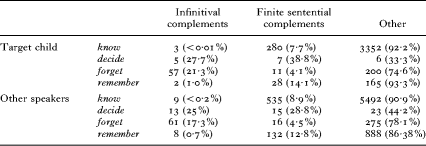
Working within the framework of a usage-based approach (Tomasello, Reference Tomasello2003), Kidd and colleagues (Kidd, Lieven & Tomasello, Reference Kidd, Lieven, Tomasello and Clark2005) suggest that children's grammatical proficiency with complement taking verbs is primarily related to the relative frequency of that verb within each syntactic frame, or construction. In particular, they predict that children will be less accurate with a construction in which a verb rarely occurs in comparison to use with a construction in which the verb occurs more frequently. Table 6 presents the relative frequency of occurrence of each verb studied here in the relevant constructions for adult and child usage within the American English data available in CHILDES (MacWhinney, Reference MacWhinney2000). These data would initially suggest that children would be more likely to make mistakes of the nature observed here with a verb like forget, which favors the infinitival complement type heavily, rather than with decide, which shows approximately equal use of finite and infinitival complement clauses. This is clearly not the case. However, decide is of much lower absolute frequency overall than the other verbs. Absolute frequency may interact with relative frequency, making decide more vulnerable than other more established verbs. Connecting the verb-by-verb development proposed by lexicalist accounts to the more concrete frequency based methods proposed by the usage-based approach may move our discussion of these topics forward in a substantial way.
Relative frequency with which each verb occurred in each type of construction

All utterances that included any form of the words know, decide, forget and remember were extracted from all transcripts included in the CHILDES database of American English (MacWhinney, Reference MacWhinney2000). These utterances were hand coded for complement clause type (finite sentential complement, infinitival complement and other). This process was completed for the target child in the transcript and for all other speakers. Other speakers were usually caregivers or experimenters, although occasionally a sibling was also involved. The other speakers are taken to be representative of the input a child might receive.
Although our results extend the age upwards, they are not alone in indicating difficulty with PRO with verbs beyond the common example of promise. One production and act-out comprehension experiment that examined a broader range of verbs (want, like, tell, force, try, pretend, ask, beg, promise, threaten and say) demonstrated that three- to five-year-olds allow arbitrary reference in sentences where adults would not (Eisenberg & Cairns, Reference Eisenberg and Cairns1994). All of the children in this study were able to produce some infinitives in the elicitation task, but this did not mean that these children had mastered the task of assigning a referent to PRO and only allowed PRO to refer to the subject of the sentence. In fact, of the 25 children studied, only 2 children approximated adult-like control in the comprehension task for sentences of the [N-V-to-V] surface structure. Taken with our results, this suggests that spontaneous data may overestimate children's ability to assign reference and that free interpretation of PRO persists well beyond the preschool years, even in typical children.
The task of assigning a referent to PRO is anything but straightforward. Although it is mastered by adulthood, children experience a protracted period of development of this syntactic class. Because children appear to be able to use PRO effectively in some situations, with regard to both comprehension and production, it is difficult to say that PRO does not exist within their grammars and that they are entirely relying on coping strategies. Accounts of lexical development are limited because children do not seem to fall back on a default strategy for unfamiliar verbs, but rather seem to create their own strategy for each new verb they encounter in ways that are not consistent with the input that they receive. However, the verb-by-verb acquisition of reference is reminiscent of other accounts that describe a verb-by-verb acquisition of argument structure (Tomasello, Reference Tomasello2003). Perhaps a better understanding of the role that input structure plays in acquisition and generalization of a syntactic frame would clarify the current inconsistencies.
Appendix A
Ranking of cues used to determine response type
Cues on a higher level were always considered prior to cues on lower levels. Cues on the lower levels were only considered if higher cues had been ambiguous. Cues on the same level were considered mutually exclusive – use of multiple cues on the same level resulted in an item being labeled as unscorable or as an alternative response.