Introduction
According to the recently published United Nations report, entitled ‘World Population Prospects 2019’, for the first time ever, the older population has outnumbered children under the age of five years, and older persons (aged 65 years or more) comprise the fastest-growing age group worldwide.1 Age is the strongest risk factor for cancer development, but, despite this, the older patient population remains the most under-represented group in randomised trials.Reference Abbasi2
Head and neck cancer is the sixth most common malignancy worldwide. Approximately 25 per cent of head and neck cancer patients are older than 70 years at the time of presentation, and this trend will continue to rise in the Western world with the increase in life expectancy.Reference Grenman, Chevalier, Gregoire, Myers and Rogers3
A recent meta-analysis in head and neck cancer involving 107 randomised trials, with more than 19 000 patients, showed that only 9.1 per cent of patients were aged 70 years or more.Reference Lacas, Carmel, Landais, Wong, Licitra and Tobias4 This leaves a knowledge gap in the optimal management of older head and neck cancer patients, particularly the very old group. There is evidence indicating that up to 40 per cent of head and neck cancer patients aged over 70 years receive non-standard treatments.Reference Derks, de Leeuw, Hordijk and Winnubst5
The primary objective of this observational study was to examine the patterns of care for octogenarian patients with head and neck cancer.
Materials and methods
The institutional database was searched, and all head and neck cancer patients aged 80 years and above, newly diagnosed between June 2018 and October 2020, were identified. Patients’ demographic, clinical and treatment characteristics were collected retrospectively.
For the comparison of patient cohorts treated with radical and palliative treatments, continuous variables were compared using the student's t-test or the Mann–Whitney U test where appropriate. Categorical variables were compared using the chi-square and Fisher's exact tests. A p-value of less than 0.05 was considered significant.
As per local institutional policy, this project was registered with the clinical effectiveness register. The project identification number was 10934.
Results
The total number of patients was 42. The mean age of the patient cohort was 83.8 years (standard error = 0.53). There were 27 males (64.3 per cent) and 15 females (35.7 per cent). Fifteen patients (35.7 per cent) had never smoked, 22 (52.4 per cent) were ex-smokers (who had stopped smoking 12 months or more before the diagnosis) and 5 (11.9 per cent) were current smokers at the time of diagnosis. The median Charlson Comorbidity Index was 5 (range, 4–9).
The larynx was the most common head and neck cancer subsite (n = 12, 29 per cent), followed by the oral cavity (n = 7, 17 per cent), hypopharynx (n = 6, 14 per cent), oropharynx (n = 5, 12 per cent), salivary gland (n = 4, 10 per cent) and nasopharynx (n = 3, 7 per cent), and the remaining five patients (12 per cent) had other primary head and neck cancer sites.
Regarding tumour (T) staging, 15 patients (36 per cent) had T1 disease, 5 (12 per cent) had T2 disease, 8 (19 per cent) had T3 disease and 14 (33 per cent) had T4 disease. With regard to nodal (N) staging, 16 patients (38 per cent) were classified as N0, 1 (2 per cent) was N1, 23 (55 per cent) were N2 and the remaining 2 patients (5 per cent) were N3. None of these patients presented with distant metastases. With regard to overall staging (American Joint Committee on Cancer staging manual, 7th edition), eight patients (19 per cent) were diagnosed at disease stage I, four (10 per cent) at stage II, one (2 per cent) at stage III, 20 (48 per cent) at stage IVa and eight (19 per cent) at stage IVb.
Squamous cell carcinoma was the most common histological finding (n = 36, 86 per cent). Other histological findings included mucoepidermoid carcinoma, adenocarcinoma, high grade neuroendocrine carcinoma and mucosal melanoma.
World Health Organization performance status was recorded in all cases; the median performance status score was 1 (range, 0–4).
Twenty-six patients (62 per cent) had radical treatment: 13 patients (50 per cent of patients who had radical treatment) had surgery and adjuvant radiotherapy, 10 patients (39 per cent) had radical radiotherapy and 3 patients (11 per cent) had surgery only. Sixteen patients (38 per cent) had palliative treatment: 12 had palliative radiotherapy, 1 patient declined palliative radiotherapy and the remaining 3 patients had best supportive care.
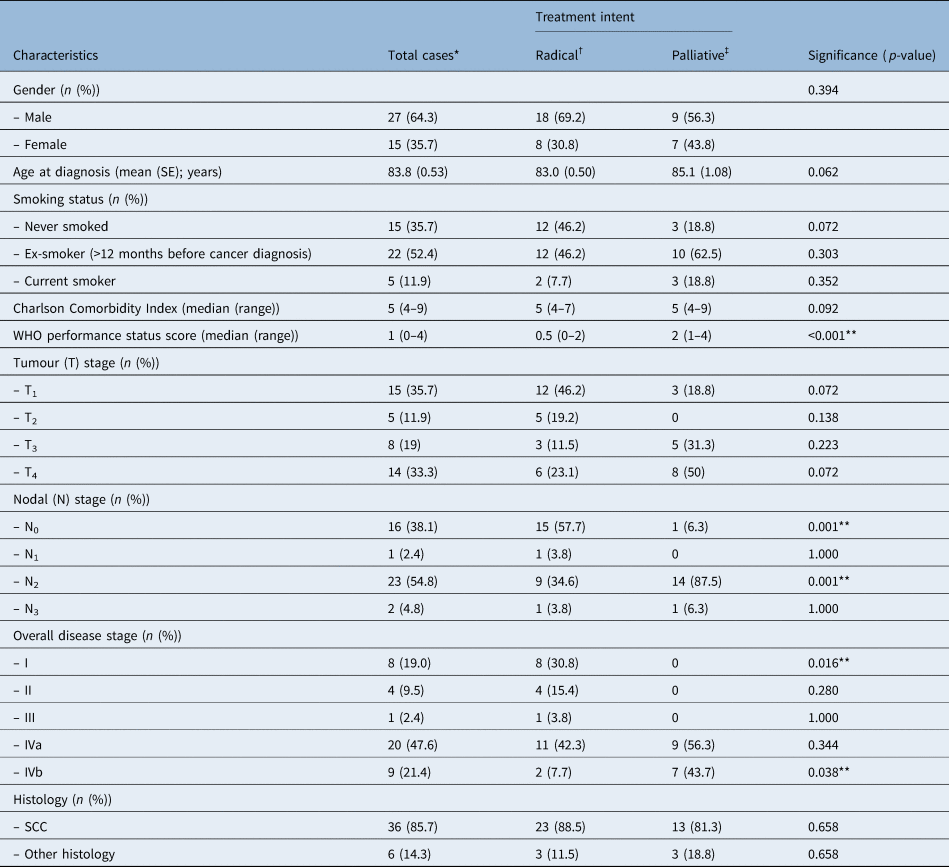
Performance status (p = 0.001), N-stage (p = 0.001) and overall staging (p = 0.016) were significant factors influencing the treatment intention (radical vs palliative) (Table 1).
Comparison of characteristics in patients treated with radical or palliative intent

*n = 42; †n = 26; ‡n = 16. **Indicates statistical difference (p < 0.05). SE = standard error; WHO = World Health Organization; SCC = squamous cell carcinoma
At a median follow up of nine months (range, 1–32 months), 18 patients (43 per cent) had died. Of these 18 deceased patients, 12 had undergone palliative treatment. The estimated six-month and one-year overall survival rates for radical and palliative treatment cohorts were 92.3 per cent and 42.9 per cent (p = 0.001) and 65.4 per cent and 15.4 per cent (p = 0.003), respectively. At the end of the follow-up period, 18 patients (69 per cent) treated with radical intent were alive and disease free. There were eight disease recurrences (31 per cent) in patients who were treated with radical intent; five of these eight patients had distant metastases.
The median overall survival time for those patients who underwent radical treatment was 16 months, versus 4 months for patients treated with palliative intent (p = 0.021). For those patients treated with radical intent (n = 26), there was no difference in recurrence rates (5 out of a total of 13 (38.5 per cent) treated with combined modality of surgery and adjuvant radiotherapy, versus 3 out of a total of 13 (23.1 per cent) treated with a single modality of surgery or radiotherapy: p = 0.673). Similarly, there were no differences in overall survival between these two subgroups at six months (92.3 per cent with combined modality vs 92.3 per cent with single modality, p = 1.000), one year (69.2 per cent vs 61.5 per cent, p = 1.000) or two years (37.5 per cent vs 44.4 per cent, p = 1.000).
Discussion
Presented in an abstract form, Desai et al.Reference Desai, Saksena, Miller, Karnad and Cervantez6 described the University of Texas experience of treating head and neck cancer in 34 octogenarian patients. The oral cavity was the most common primary site, and 48 per cent of the total patients had disease stage IVa at presentation. Fifty-three per cent underwent surgery alone, 27 per cent had surgery and radiotherapy, and 20 per cent received chemotherapy and radiotherapy. Mean overall survival was significantly better for patients with locally advanced disease treated with multimodality therapy than for those treated with single-modality therapy (23 months vs 8.5 months, p < 0.02). In our study, there was no difference in overall survival rates between patients treated with a combined or single modality approach. This difference between the findings of these two studies could be because the most common primary site in the Desai et al.Reference Desai, Saksena, Miller, Karnad and Cervantez6 study was the oral cavity, which often requires a combined modality treatment approach, whilst larynx was the most common primary site in our study, and early stage laryngeal tumours often require single-modality treatment.
Our study showed that patients receiving proposed radical treatment had better survival than those to whom palliative treatment was offered. This may reflect appropriate stratification of patients before treatment. The choice of treatment may be further improved with more detailed evaluation using geriatric assessment tools, for example the ‘G8’ (Geriatric 8) health status screening tool, and comprehensive geriatric assessment, is incorporated into investigations of patients.Reference Iqbal, Dua, Kelly and Bossi7
• The older population is increasing globally
• Older patients are frequently under-represented in clinical trials
• This study examined disease characteristics and treatment outcomes in octogenarian patients with head and neck cancer who presented at our centre
• This information may aid prospective studies focusing on older patients with head and neck cancer
There are certain limitations to our study. The follow-up period is short, but the study's primary objective was to evaluate the patterns of care rather than survival. In addition, there was no comparison with a younger cohort; this will be a focus of future prospective research incorporating formal frailty evaluation with geriatric assessment tools. Furthermore, treatment-related toxicity and patient-reported outcome data were not available for this study.
Conclusion
Our study provides useful information on real-world practice management of octogenarian patients with head and neck cancer. The addition of this information to the literature may help in conducting prospective studies, especially those focusing on older patients with head and neck cancer in order, to define the optimal care of this patient population.
Competing interests
None declared